




Abstract
In the present work, the rod response due to the impact of a ball is studied in order to analyze the longitudinal wave propagation during the impact and evaluate the velocity of points over the rod length at the end of impact. An analytical solution is given for the governing equation of rod vibration by assuming the impact force as an equivalent sinusoidal function of time. The impact force is defined by a Fourier series to be zero at the rod length except at the impacted end. An analysis of wave propagation will give information about the rod–ball interaction. The evaluated velocity profile at the end of impact can be used as the initial condition for after-impact solution of the rod vibration. It will modify the common simple assumption of constant initial velocity for impacted end.
Introduction
The impact forces have high values and the suggestions which result to decreasing these forces are appreciated by industries. There are situations in which the impact force results in the abnormal wear and breakdown. Such problems occur at the vibrating screens, mill liners, Joe crushers, feeders, etc. They experience a large number of impacts during the working life. The influencing parameters include the material and geometrical properties of the projectile and impacted target. 1 Viscoelastic properties of the mated materials have the major influence on the impact behavior. 2 Because of the complicated behavior of materials and dependency on the impact parameters, the experimental studies are more relied. Since the materials show the different behavior in low- and high-impact velocities, 3 the experimental apparatus are designed for the low 4 or high velocity impacts. 2 Several impact studies aimed to evaluate the wear due to the impact. Lewis 5 presented a new procedure to model the impact wear validated by experimental data. Di Maio and Di Renzo6,7 presented the valuable developments in evaluation of the impact force and impact duration by linear and nonlinear relations.
One of the interesting problems of this field is the response of a rod to an impact which is a common occurrence in industries. Ugrimov et al. 8 studied theoretically and experimentally the wave propagation in a sapphire rod. They considered the different orientation of crystallographic axes. Shabana and Gau 9 studied the wave propagated longitudinally in rotating rod where the impact was replaced by a nonzero initial velocity at the impacted end as the initial condition. The longitudinal wave propagation in a stepped rod was solved by Bityurin and Manzhosov 10 to evaluate the cross-section velocity. They also assumed that the impact actuated the rod end in the form of an initial velocity. Younesian and Sadri 11 modeled the under railway ground to study the effects of vibration-induced parameters on propagated wave in ground. Arabadzhi 12 investigated the coating for absorbing the propagated mechanical and acoustic waves. As industrial applications, Wang and Varadan 13 studied the longitudinal wave propagation in piezoelectric structures, Serajian and Salimi 14 investigated the contact stresses between the rail and wheel by finite element method (FEM), and Mohammadi and Serajain 15 studied the effects of influencing parameters of train on longitudinal wave produced through the brake.
In the present work, the impact is not treated as an immediate shock which actuates the rod end by an initial velocity, as assumed by some researchers.9,16 Instead, the rod response is evaluated through the impact duration, and the velocity profile of the rod at the end of impact is determined which is the initial condition for the after-impact rod response. There are industrial situations in which the study of the behavior of propagated wave is important. One of such situations is what occurs in the impact between mineral ore and chute body which results in the failure of the chute in the form of the body bearing, breakage, and wear. One possible way to decrease such devastating effects is to design the appropriate elastic bed from materials such as rubber plates. To have the optimum design for the best results, study of the wave propagation will be helpful.
Longitudinal wave
A longitudinal wave is produced and propagates over the rod length due to the impact of a projectile to the rod end. The wave moves through the rod length as illustrated schematically in Figure 1. The deformation occurred due to the ball impact has initially the complicated form near the contact area. At a distance, the wave propagates in a regular manner trough the rod toward the rod support. 17
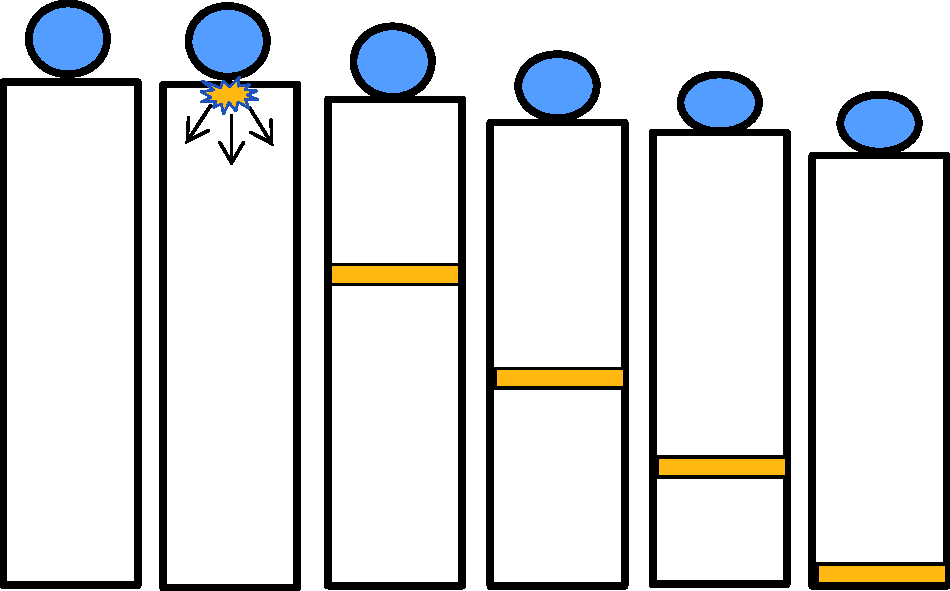
Schematic of the longitudinal wave propagation.
Depending on the mechanical and geometrical properties of the rod, the reflected wave may return to the impacted end before the separation of the projectile and affect the force transmitted between the rod and projectile. It means that if the reflected wave returns and receives the impacted end after the separation the projectile, it does not influence the contact force. Moreover, the inertial resistance of rod is another factor which affects the transmitted force between the projectile and rod. The combination of these effects determines the contact force between the projectile and rod which is an important parameter in failure studies.
Mathematical model
The governing equation of the longitudinal rod vibration is
18


And the initial conditions are

The wave propagation velocity is

Contact duration
There are relations for evaluation of the impact duration. One relation is given by Goldsmith
21



Another relation given by Boettcher et al.
22
is as follows


Solution of the rod response
The rod response is obtained by solving the governing equation (1) with the boundary and initial conditions (2 and 3). The decomposition of the displacement function is considered as follows


Derivation by x gives


By such suggestion, we have the new boundary conditions

By separation of variables for g(x, t), we have

And inserting the boundary conditions of g(x, t) gives


Substituting equations (12) and (16) into the governing equation (1) and rearranging the relation gives
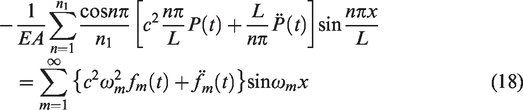
The right of (18) is a Fourier series and the coefficient can be evaluated as follows
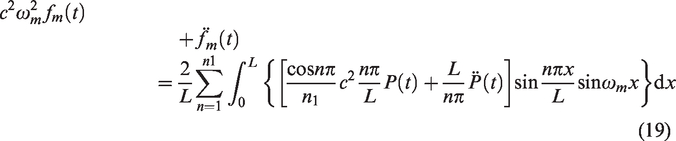
Impact force starts from zero value when contact starts, increases up to a maximum value, and then decreases to zero. It behaves as a sinusoidal function through the contact duration, and assuming the sinusoidal function of impact force with respect of impact time, as that given in equation (4), will be acceptable. An appropriate relation for P0 in equation (4) was given by Boettcher et al.
22
as follows

Assuming the sinusoidal impact force and substituting it in the governing equation gives

By inserting the boundary conditions

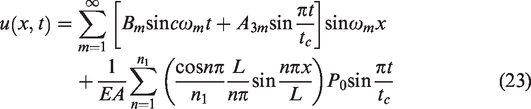
Coefficients A and B are




Results and discussion
Rod displacement
The steel rod displacement under the impact of a 10 mm ball with the impact velocity of 5 m/s to the rod end at the different times during the impact is illustrated in Figure 2. The corresponding peak force is P0 = 2300 N.
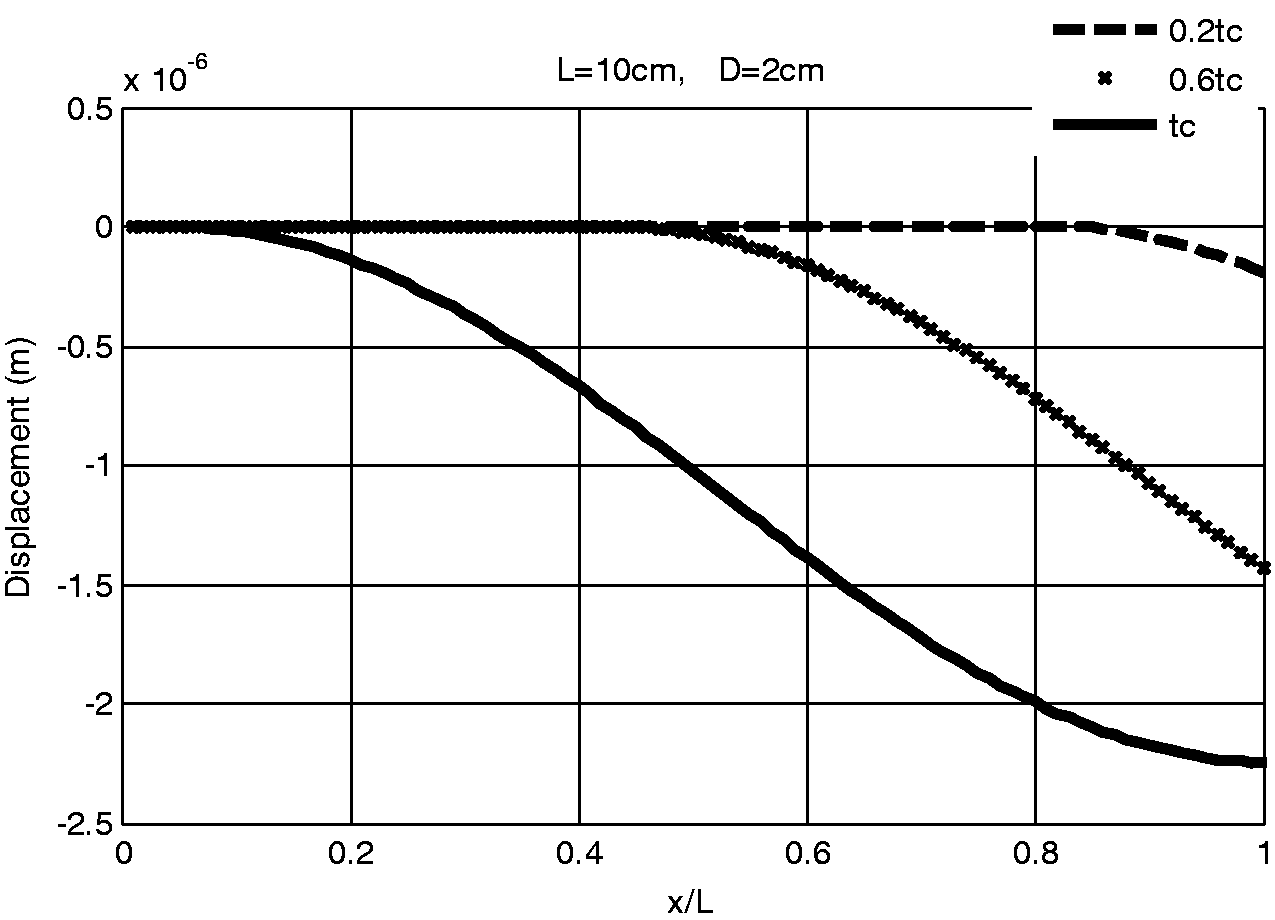
Rod displacement at the different times over the impact duration, L = 10 cm.
It can be seen that the rod displacement starts from the impacted end and propagated over the length. At the end of the impact (t=tc), all of the rod has been influenced and experiences deformation. But it may not occur for any rod and depends on the impact conditions and rod properties. This can be described by choosing different conditions. For example, the displacement of a rod with the length of 2 cm is illustrated in Figure 3. However, the transverse effects may influence the longitudinal wave motion results when the length/diameter rod ratio is decreased, but the aim of the present work is to determine when the produced wave reaches the other end, regardless of the transverse motion of the wave. The ball radius has been selected large relative to the rod diameter (d/D = 0.5) to decrease the transverse effects of wave longitudinal motion.
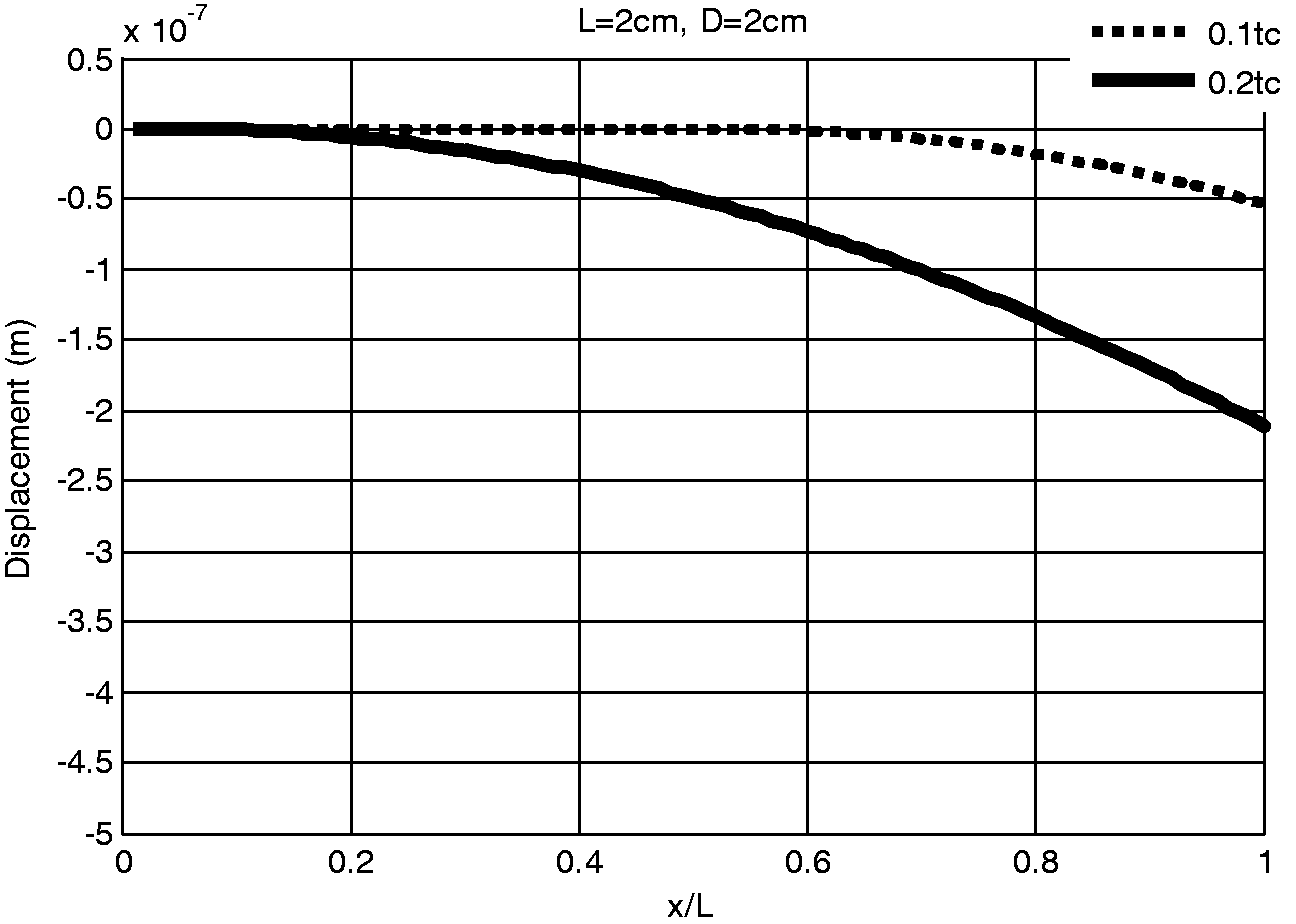
Rod displacement at the different times over the impact duration, L = 2 cm, (.) t = 0.1tc, (−) t = 0.2tc.
As illustrated in Figure 3, the wave reaches the other end at t = 0.2tc. For this case the impact duration is evaluated by equation (8) which is about 19 μs and the period of wave reciprocation is
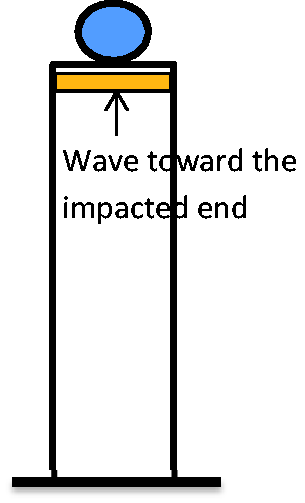
Schematic of the returned wave.
The returned wave influences the impact force and affects the restitution ball velocity. The displacement of points of rod with the length of 20 cm is illustrated in Figure 5. The wave does not reach the middle of the rod at the end of the impact duration. It can be inferred that the end condition does not influence the impact behavior because that the propagated wave does not experience the end condition during the impact. In the other words, the end condition does not influence the impact force because that the wave reaches the other end (x = 0) after the separation of projectile from the impacted end of rod.
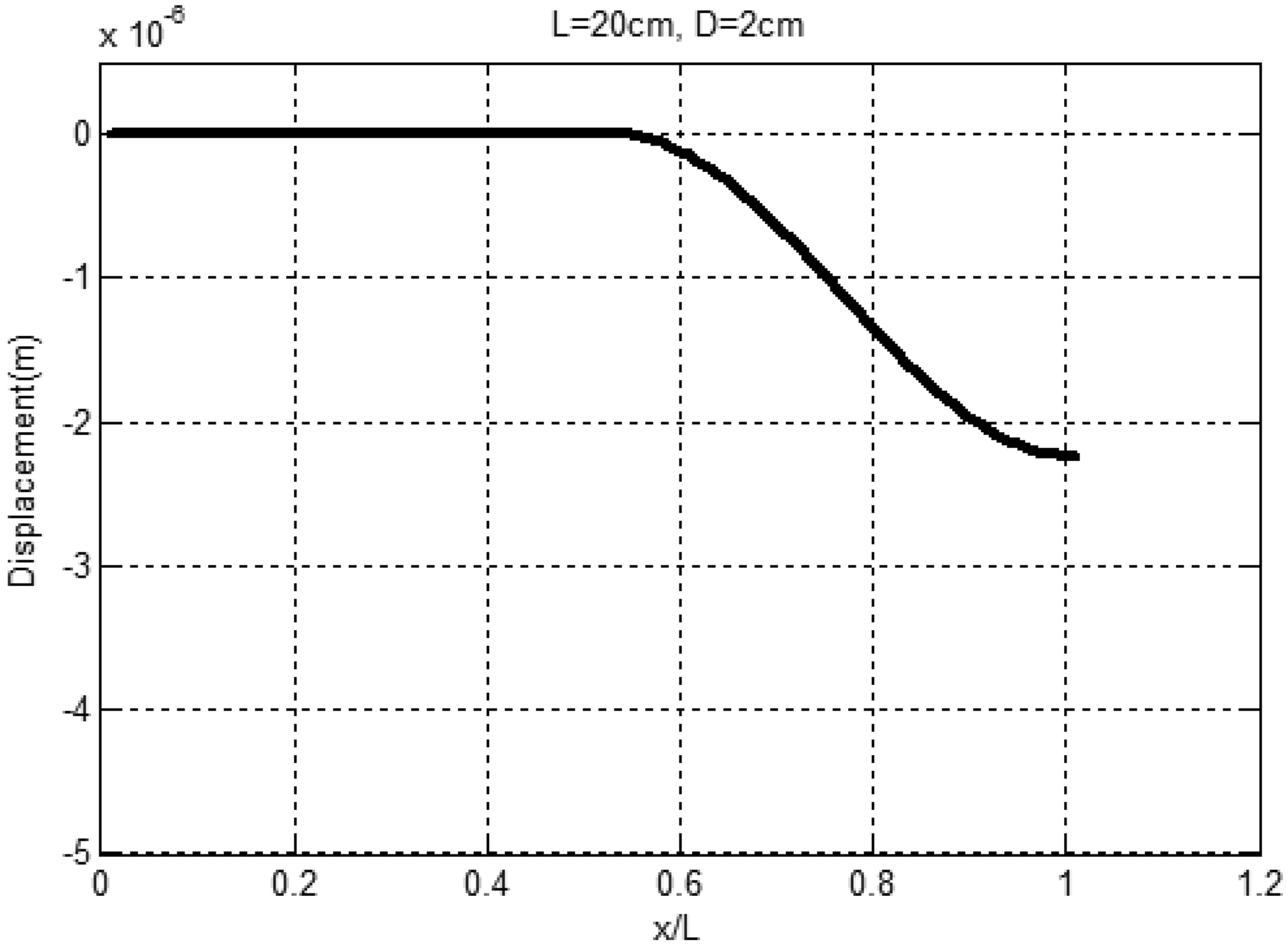
Rod displacement for L = 20 cm.
Velocity profile at the end of the impact
Researchers consider the initial conditions of the impact as v(L, 0)=v0. 9 It means when a projectile impacts the rod end, the impacted end obtains an initial velocity and other points of the rod have no velocity. In reality, it is not a real assumption. The present study shows that there is a velocity profile over the rod length at the end of impact. The velocity profile for 2 cm and 10 cm rods are given in Figure 6. The fitted functions are v = 0.16(x/L)+0.015 for L = 2 cm and v=−0.18sinπ(x/L) for L = 10 cm. This velocity functions can be used as the initial conditions for the study of the after-impact rod vibration, i.e., v(x, 0)=H(x) where H(x) is the velocity function.
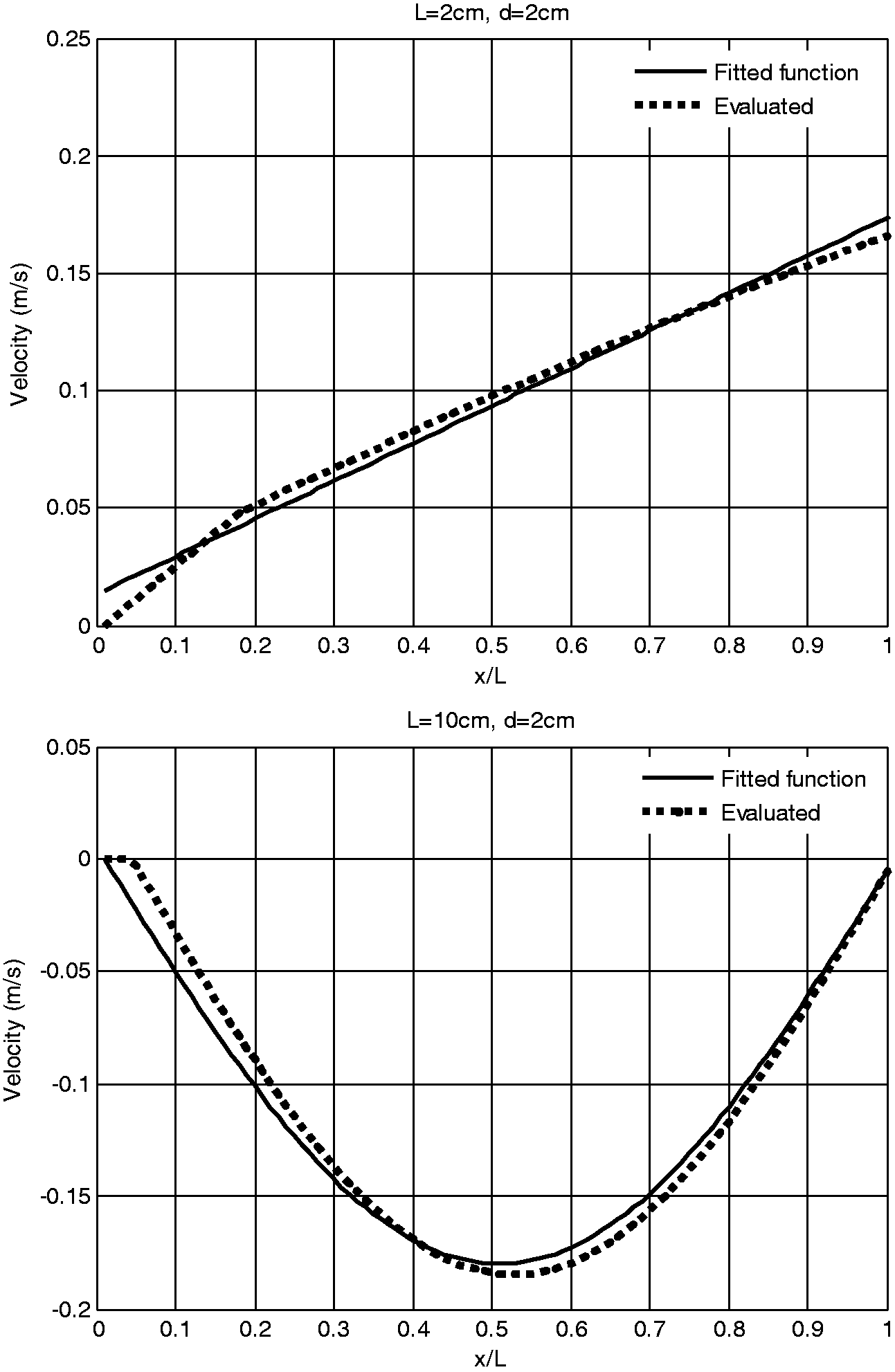
Velocity profile at the end of impact.
Conclusions
Since the large contact forces transmit during the impact of mechanical elements and unpredictable failures may occur, determining the material response to the impact load is important. The rod response is analyzed to evaluate the duration of wave propagation and the rod velocity profile at the end of the impact. The boundary condition at the impacted end was considered in the form of a Fourier series. It was shown that for long rod, the wave does not reach the other end and does not experience the other end boundary condition. In fact, it means that, for long rods, the wave does not reach the other end through the contact duration. Before the wave reaches the other end, the contact between the ball and the rod ends. According to the present theory, since the propagated wave does not experience the boundary condition at the other end, this boundary condition does not influence the force transmitted between the ball and rod and the ball return conditions. Actually, the boundary condition influences the rod vibration after impact. The rod velocity profile at the end of the impact was derived to be the initial condition for evaluating the vibration response of the rod after the impact.
Footnotes
Declaration of conflicting interests
The author(s) declared no potential conflicts of interest with respect to the research, authorship, and/or publication of this article.
Funding
The author(s) received no financial support for the research, authorship, and/or publication of this article.