




Abstract
The traditional deterministic damage detection method is based on the assumption that the measured data and the finite element model are accurate. However, in real situation, there are many uncertainties in the damage identification procedure such as the errors of the finite element model and the measurement noise. Since the uncertainties inevitably exist in the finite element models and measured data, the statistic method which considers the uncertainty has wide practical application. This paper proposes a statistical damage identification method based on dynamic response sensitivity in state-space domain. Considering the noise of the finite element model and measured acceleration response, the statistical variations of the damaged finite element model are derived with perturbation method which is based on a Taylor series expansion of the response vector and verified by Monte Carlo technique. Afterward, the probability of damage existence for each structural element is estimated using the statistical characteristic of the identified structural parameters. A numerical simply supported beam under the moving load is applied to demonstrate the accuracy and efficiency of the proposed statistical method.
Keywords
Introduction
The vibration-based damage identification has been widely used in structural health monitoring and damage assessment of the structure nowadays. The vibration-based damage detection method is to establish the mapping relation between the variation of the vibration characteristics and the local damage. Yan et al. 1 presented a general summary and review of state of art and development of vibration-based structural damage detection. Frequency response function 2 and modal parameters3–8 such as natural frequency, mode shapes, and modal strain energy have been frequently used as the variation of the vibration characteristics to detect the structural damage.
But in the field of damage identification of the bridge structures under the moving vehicle loads, the time domain methods9–14 have the potential to handle linear time-varying systems. The time-domain dynamic responses such as acceleration responses are desirable to detect the local damages from the view of structural online health monitoring. Zhan et al. 9 proposed a damage identification approach using train-induced responses and sensitivity analysis. The dynamic response sensitivity-based FE model updating damage identification method is utilized to identify the damages of the bridge after the sensitivity matrices of the train-induced bridge responses are formed. Li et al.12,13 presented a dynamic response sensitivity-based identification procedure with the unknown moving loads based on the dynamic response reconstruction technique in wavelet domain. Furthermore, optimal sensor placement is investigated to identify the best locations for response reconstruction and sensitivity-based damage identification in wavelet domain. 13 An et al. 14 proposed a damage localization method based on the curvature directly from acceleration signals, without identifying modal shapes of the structure. Furthermore, this method does not require any calibration of numerical models.
The above vibration-based damage detection methods are based on the assumption that the parameters of the finite element model and the measured data are deterministic. However, in real situation, there are many uncertainties in the damage identification procedure such as the errors of the finite element model and the measurement noise. Since the uncertainties inevitably exist in the FE models and measured data, the statistical method which considers the uncertainty has wide practical application. Stefanou 15 provided a state-of-the-art review of past and recent developments in the area of stochastic finite element method. Considering the errors of the measurement data and finite element model, many researchers used statisticals analysis into the model updating and damage identification. The three representative stochastic damage identification methods are Monte Carlo technique, perturbation method, and Bayesian method.
Xia et al. 16 proposed a statistical method with combined uncertain frequency and mode shape data for structural damage identification. The statistical variations of the updated finite element model are derived with perturbation method and verified by Monte Carlo technique. Hua et al. 17 developed an improved perturbation method for the statistical identification of structural parameters by using the measured modal parameters with randomness. In this method, two recursive systems of equations are derived for estimating the first two moments of random structural parameters from the statistics of the measured modal parameters. The above statistical damage identification methods are based on the damage index in the frequency domain. Zhang et al. 18 and Xu et al. 19 extended the statistical moment-based damage detection method in the frequency domain to the time domain for the shear building structure considering non-Gaussian and nonstationary excitation. Li and Law 20 utilized statistical analysis into the acceleration sensitivity-based damage identification procedure from the unit impulse response functions. The statistical characteristics of the damage parameters are derived by the perturbation method based on the sensitivity matrix of the UIRs in time domain. Then Law and Li 21 studied quantitative reliability analysis for a three-span continuous prestressed concrete bridge with a passing vehicle including system uncertainties and measurement noise. Zhang et al. 22 proposed a probabilistic method based on Monte Carlo technique to identify the damages of the structures with uncertainties under unknown input. In this method, the statistic characteristics of the identified parameters are obtained from repetitious calculation for many sets of identified parameters of the damaged structure based on the deterministic identification procedure.
Considering the bridge structure under moving vehicle load, the direct use of dynamic acceleration for damage identification avoids the error which is introduced by the data transformation and reduction process for structural modal parameters. Furthermore, the dynamic response-based damage identification in the time domain obtains abundant structural information with the increase of the measured response length. Therefore, this paper proposed a statistic damage identification method based on dynamic acceleration response sensitivity in the state-space domain. Considering the noise of the FE model and measured acceleration response, the statistic variations of the damaged finite element model are derived with perturbation method which is based on a Taylor series expansion of the response vector and verified by Monte Carlo technique. Afterward, the probability of damage existence (PDE) in the structural elements are estimated using the statistic characteristic of the identified structural parameters. The numerical results by a simply supported beam under the moving load using proposed method show the statistical characteristics of the identified structural damage are consistent with the results by Monte Carlo method, and the proposed statistical method is more efficient than the Monte Carlo method, which needs repeated calculation for a large number of samples to obtain a reliable result.
Formulation
Deterministic damage identification method
The motion equation of the linear structure under the moving load is written as

The state-space method is especially powerful for multi-input, multioutput linear systems and time-varying linear systems. Therefore, equation (1) is shown as the following first-order differential equation by using the state-space formulation

Combining with the exponential matrix algorithm, equation (2) can be represented as the following discrete equation


The local damage in the structure is assumed as a change in the elemental stiffness factors


In equation (6),

Based on the dynamic acceleration sensitivity, the identification equation in time domain
23
is expressed as a first-order Taylor series

Statistical damage identification with uncertainty
The deterministic damage identification mentioned above is based on the assumption that the finite element model and measured acceleration response are both accurate. However, in reality, the errors of the FE model and the measurement inevitably exist in the damage identification procedure. Considering the uncertainties of the FE model and the measurement noise are normally distributed random variables with zero means and given covariance, the measured dynamic response and elemental stiffness parameter (ESP) are expressed as


With the perturbation technique, equation (8) is expanded as a second-order Taylor series in terms of



Substituting equations (11) to (13) into equation (8) and comparing the terms 1,







From equation (9), the first and second derivative of measured acceleration with respect to the noise vector are expressed as

Afterward,



The mean values and covariance matrix of


Substituting



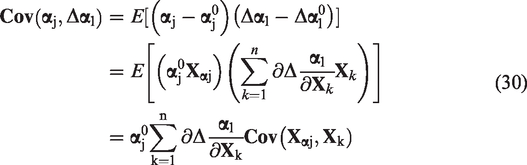
Similarly

The statistics of ESPs in the damaged structure
Numerical example
Description of the numerical example
In order to validate the accuracy and efficiency of the proposed statistical damage identification method, a simply supported beam under the moving load is adopted in this paper. The beam is numerically modeled by 20 elements with each 1 m long. The beam has 21 nodes and 60 DOFs in total. The material constants of the beam elements are chosen as bending rigidity (EI)=270 × 105 N m2, axial rigidity (EA) = 525 × 108 N, mass per unit length (ρA) = 196 kg/m, and Poisson’s ratio =0.3. The Rayleigh damping coefficients a and b are 0.1476 and 4.345 × 10⁻⁴ with about 1% damping ratio for the first two modes. The external moving force F(t)=
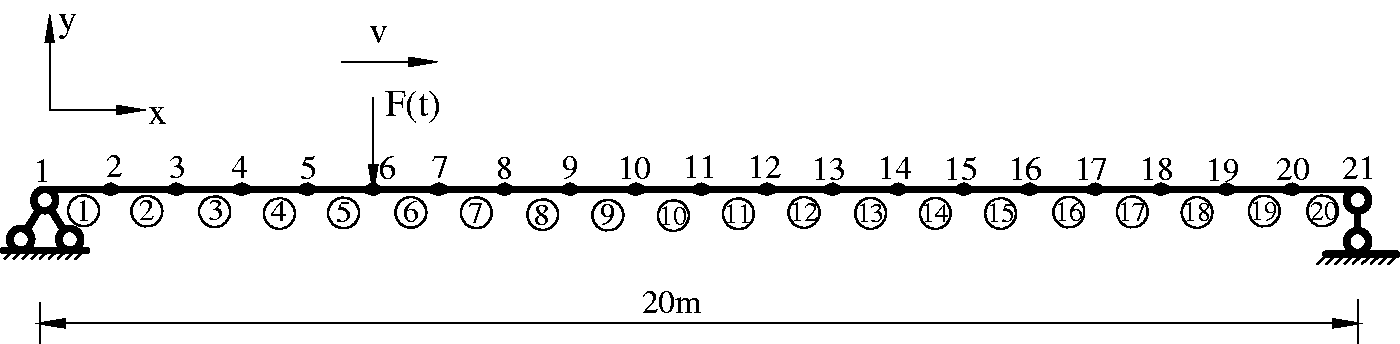
The finite element model of the simply supported beam.
It is assumed that the elemental stiffness of Element 6 and Element 7 is, respectively, reduced by 20 and 15%, and the vertical accelerations on Nodes 6, 8, 10 (AY(6), AY(8), AY(10)) are selected as measured dynamic responses. The measured acceleration responses are plotted in Figure 2.
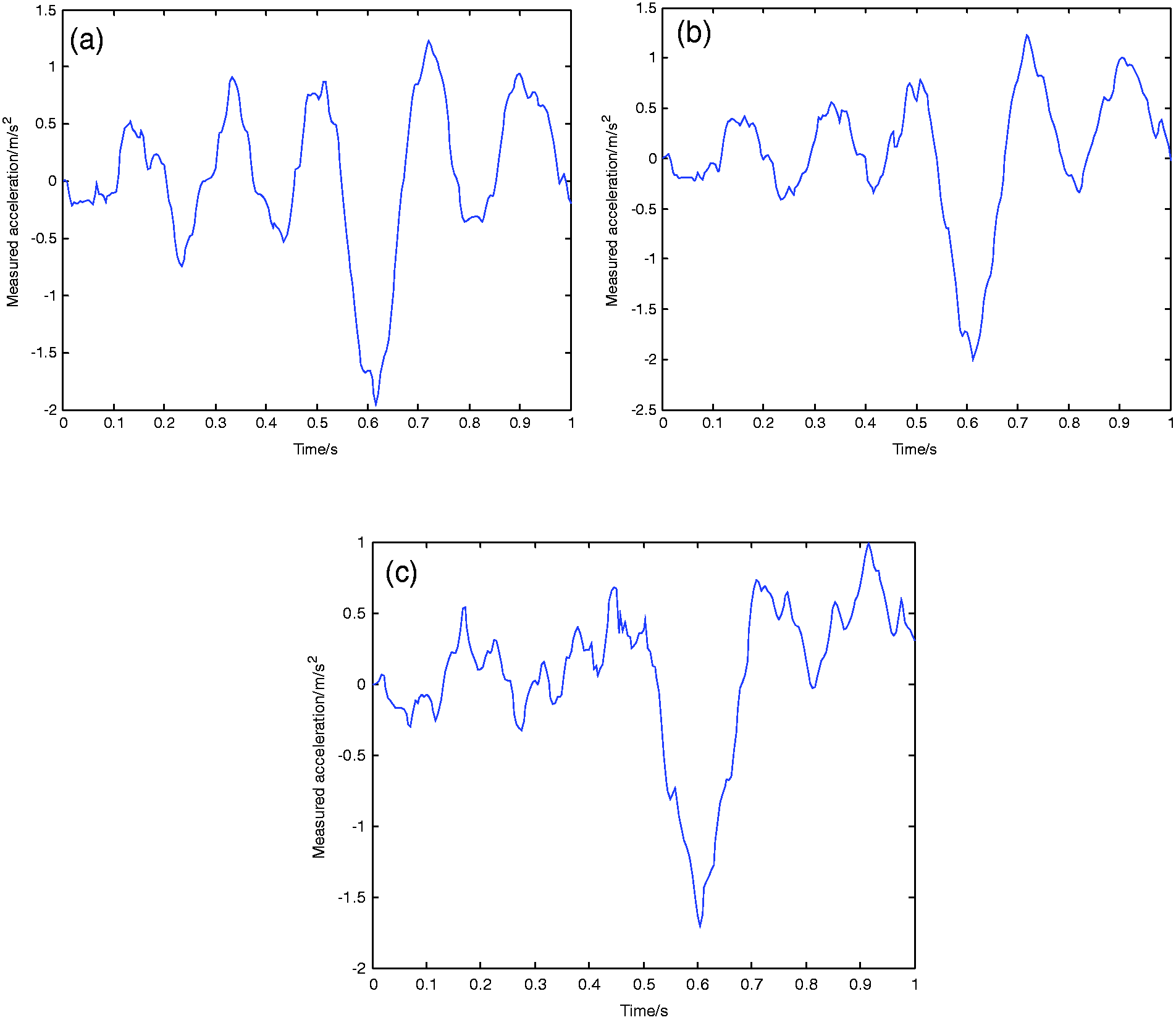
The measured acceleration responses: (a) node 6, (b) node 8, and (c) node 10 (AY(6), AY(8), and AY(10)).
Assuming the random noises are independent of each other, the covariance matrix of noises is a 743 × 743 diagonal matrix (3 × 241 for measured acceleration responses, 20 for ESPs). In this study, only the noise effect in the measurement is considered. The uncertainties in the finite element modeling can also be analyzed by the same derivation of formulas in the proposed method. Thus, the level of the measurement noise is set to be 1%, which means the standard deviation of the random noise is equal to 1% of the corresponding true quantity (mean value) as shown in equation (32), and the noise level of ESPs is set to be zero. Therefore

Distribution test
The Monte Carlo technique is employed for the reference to validate the accuracy of the proposed perturbation method. One thousand times simulation is repeatedly calculated in the Monte Carlo method. The Monte Carlo simulation results indicate that the probabilistic distribution of the ESPs has normal type characteristics. This observation needs to be verified by goodness-of-fit test technique. And the sample of every element is tested at a confidence level of 95%.
Figure 3 shows probability density function (PDF) of elemental stiffness reduction factor for Element 6, 7, and 10 for 1% measurement noise. The elemental stiffness reduction factor
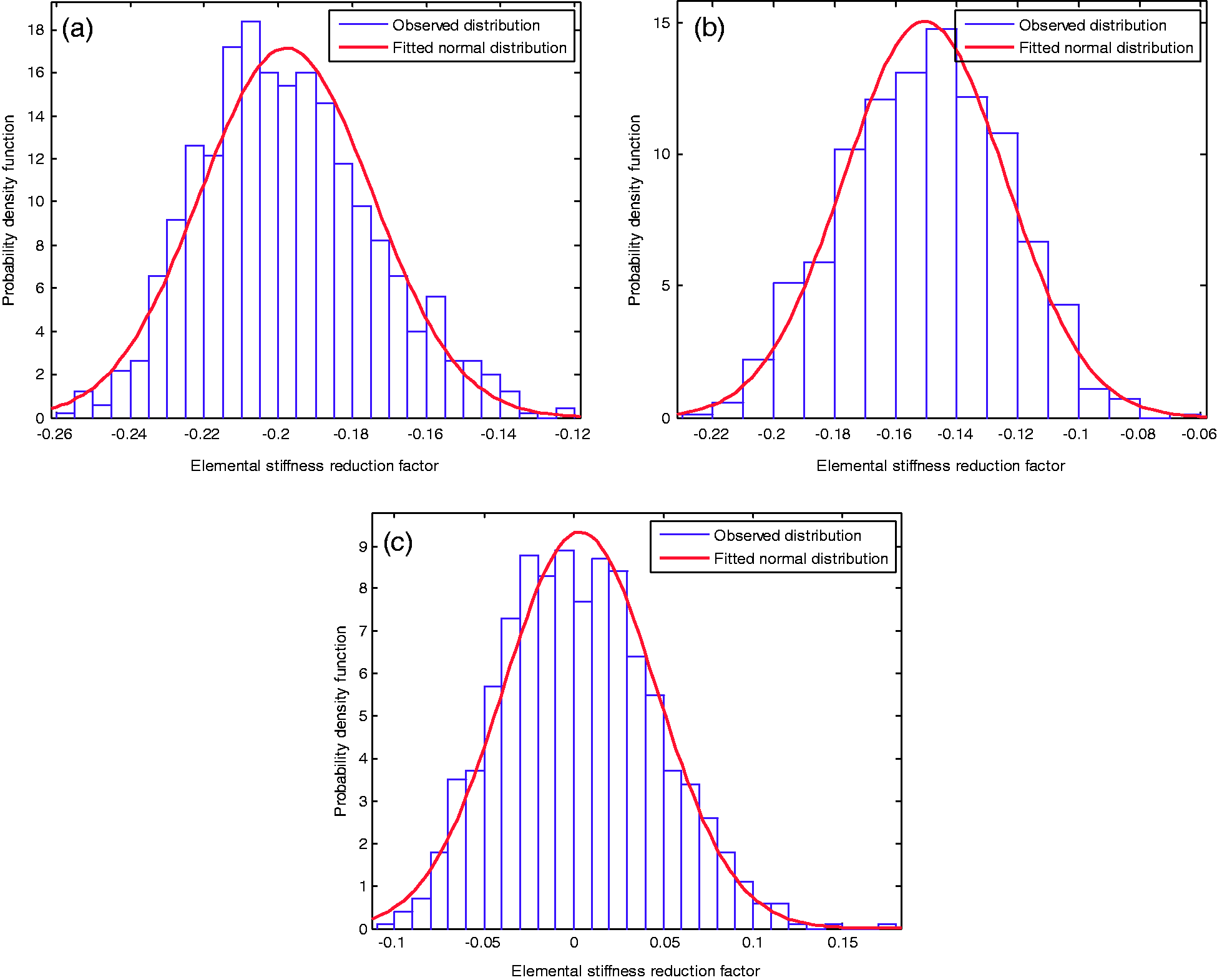
PDF of (a) Element 6, (b) Element 7, and (c) Element 10 for 1% measurement noise.
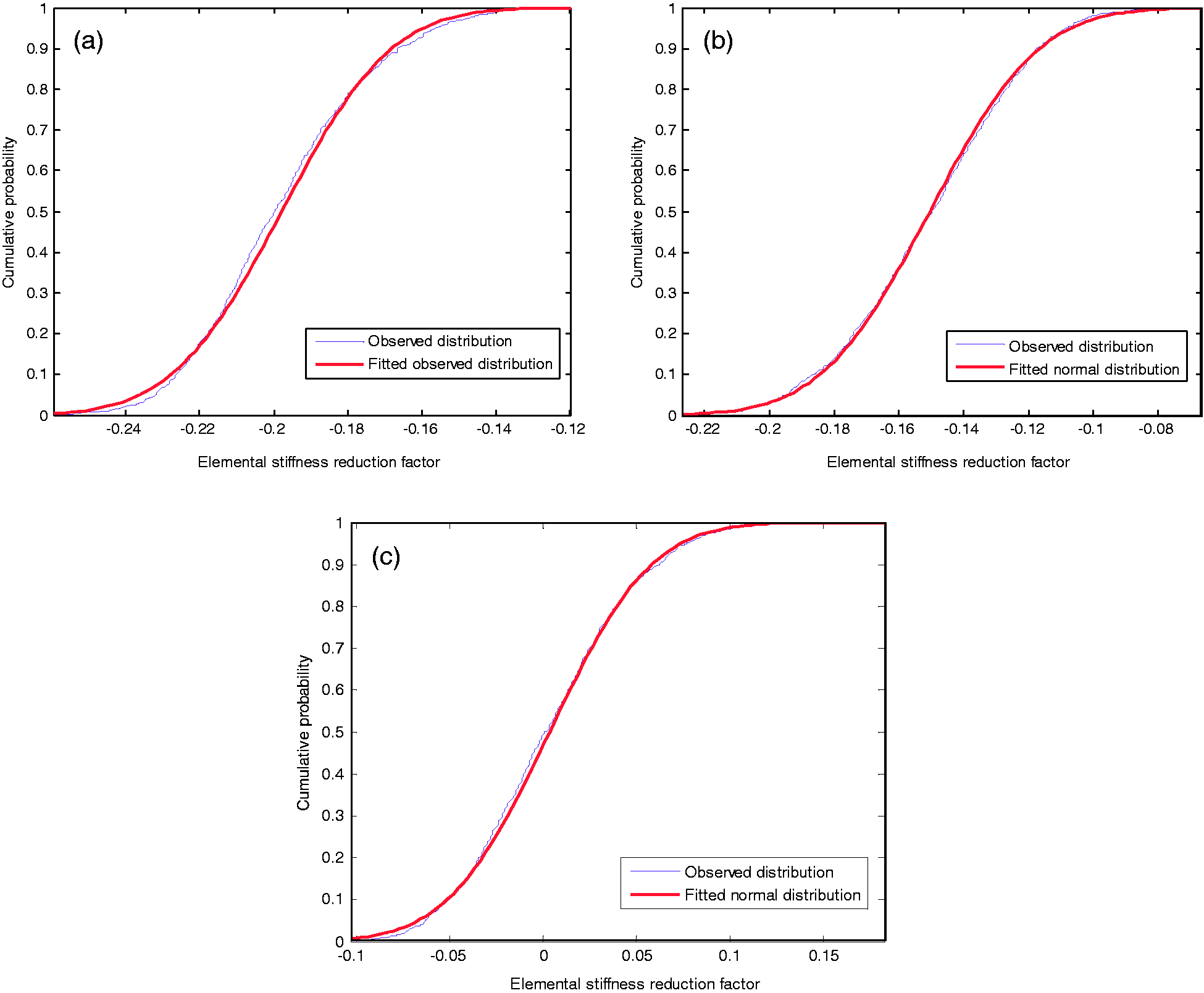
CDF of (a) Element 6, (b) Element 7, and (c) Element 10 for 1% measurement noise.
Statistical damage identification
By the statistical perturbation damage identification method, the mean value and coefficients of variation of ESPs can be estimated. Figures 5 and 6, respectively, show the calculated mean and coefficients of variation of elemental stiffness reduction for 1% measurement noise by perturbation method and Monte Carlo method. The mean values of the elemental stiffness reduction factor obtained by the perturbation method and Monte Carlo method are both consistent with the real damage shown in Figure 5 indicating that the proposed perturbation method based on a Taylor series expansion is reliable. From Figure 6, the coefficients of variation for each element calculated by the two methods are generally close to each other, which indicate the accuracy of the proposed perturbation method. The coefficients of variation of elemental stiffness reduction factor are about from 3 to 10% when the measurement noise level is 1%, that is to say, the uncertainties are enlarged after the identification process. A small coefficient of variation indicates that the identified elemental stiffness reduction factor has a good accuracy when considering the measurement noise.
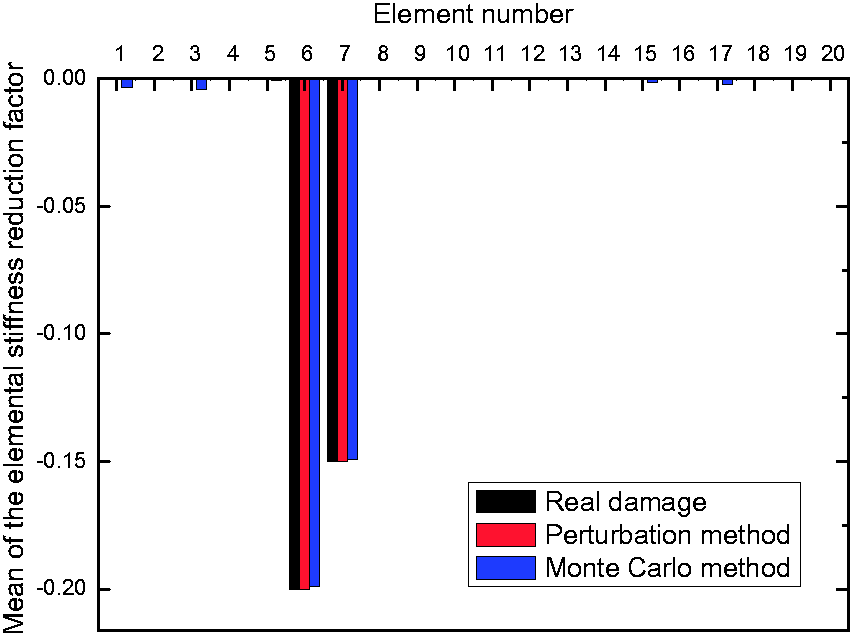
Mean of elemental stiffness reduction factor for 1% measurement noise.
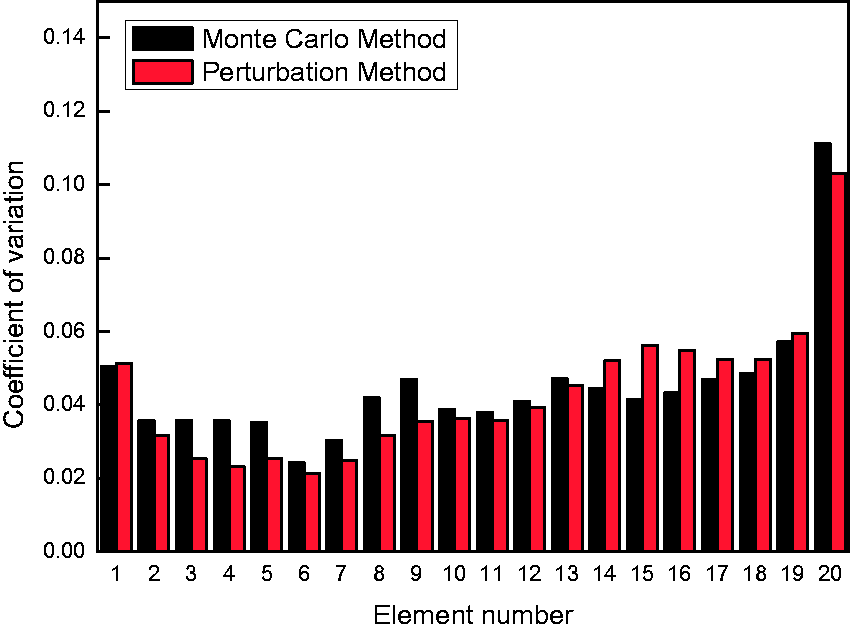
Coefficients of variation of elemental stiffness reduction factor for 1% measurement noise.
PDE
Based on the statistical characteristics of structural elemental parameters in the intact state and damaged state, the PDE can be estimated.
16
In this paper, the PDE of each element is computed at a confidence level of 95%. That is to say, the PDE of the ith element is calculated as

Table 1 shows the elemental PDE value of the structure from perturbation method and Monte Carlo method. From Table 1, it can be seen that Element 6 and Element 7 are most likely damaged with very high probability. The PDE values of other elements are less than 6%, and thus these elements can be considered as undamaged. Meanwhile, the PDEs estimated by perturbation method and Monte Carlo method approximate to each other, thus the proposed statistical damage identification algorithm based on perturbation method can be considered dependable.
PDE of all the elements for different methods.
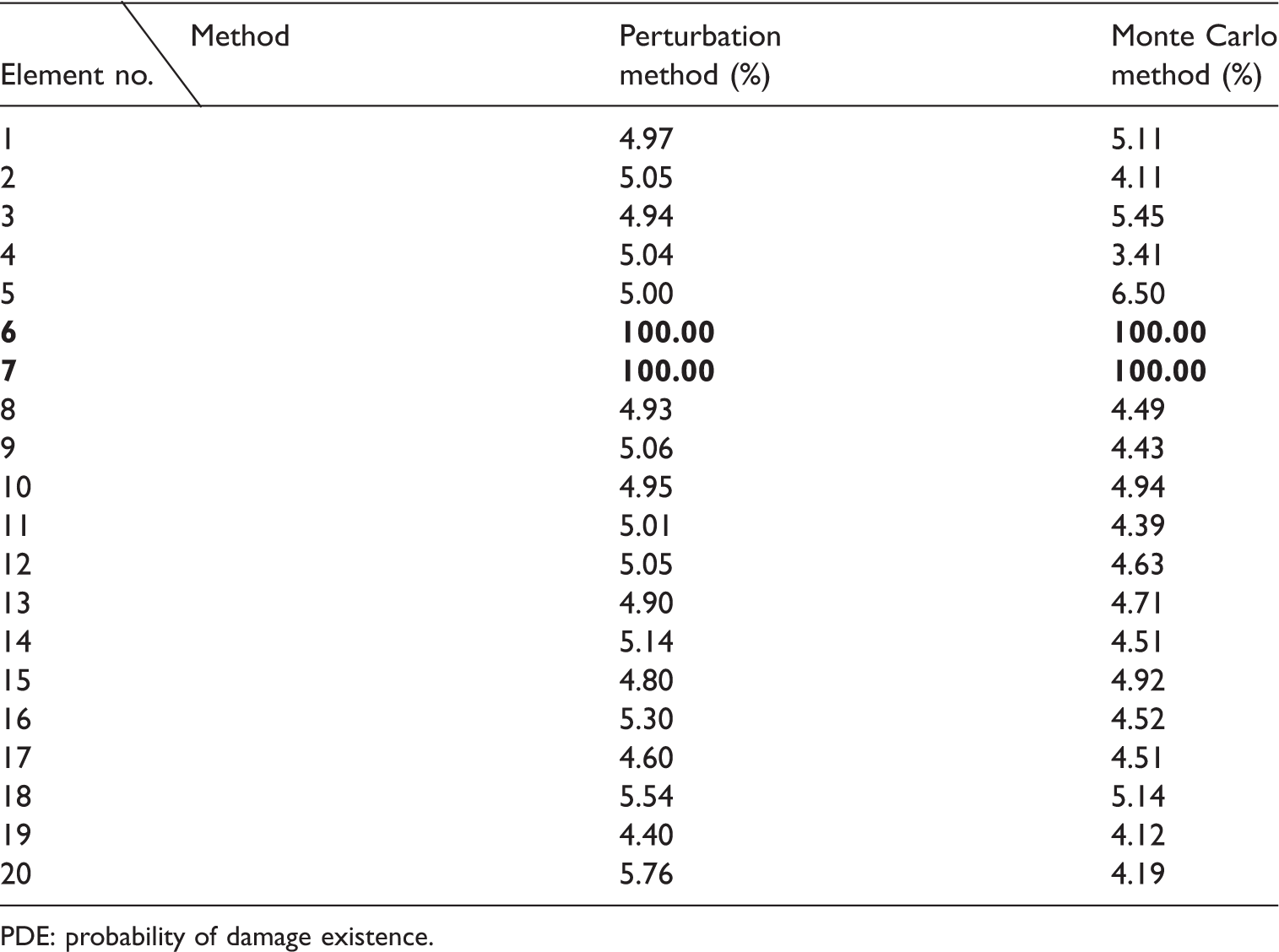
PDE: probability of damage existence.
In order to investigate the influence of the damage level to the damage identification result, it is assumed that Element 6 and Element 7 are damaged with different stiffness reduction values (2%, 5%, 10%, and 20%). Table 2 lists the PDE of all the elements for different damage levels (2%, 5%, 10%, and 20%) with 1% measurement noise. For all cases of different damage levels, the PDE values of Element 6 and Element 7 are much larger than other elements, which indicate that Element 6 and Element 7 are most likely damaged with high probability. From Table 2, when the damage level is 2%, the damage probabilities of Element 6 and Element 7 are 13.84% and 13.19%, respectively, which are not very high. It means that when the damage level is inconspicuous, the damaged elements may not be detected very well. This is because the dynamic response changes are not apparent in this case and the noises of measurement and modeling errors may make the small changes intangible. With the increase of the damage level from 2% to 20%, the calculated PDE values of Element 6 and Element 7 increase from about 13% to 100% sharply and monotonously, which means that the damage identifiability is improved with the damage level of the structural elements increases.
PDE of all the elements for different damage levels.
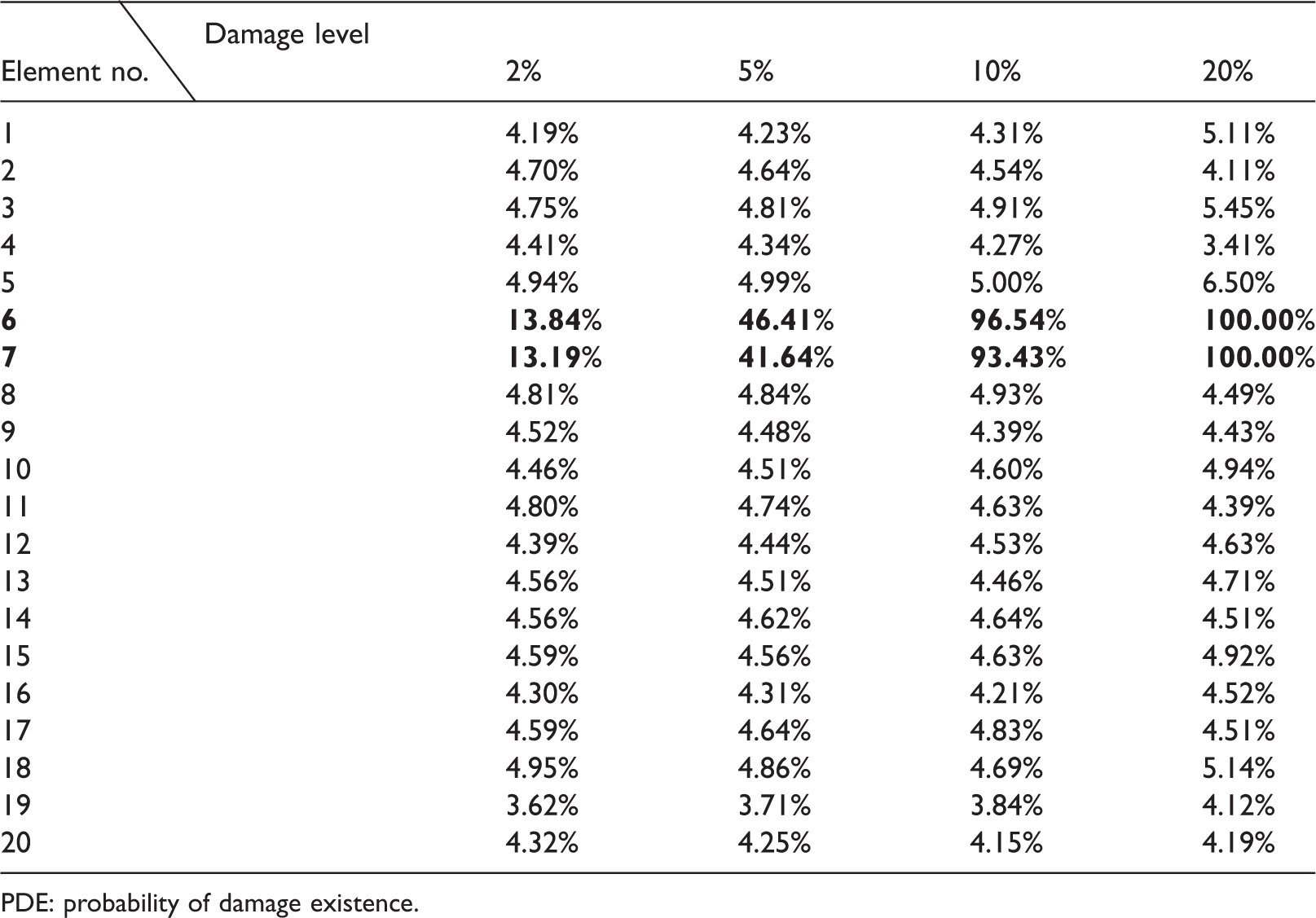
PDE: probability of damage existence.
Conclusions
This paper proposes a statistical damage identification method based on dynamic response sensitivity considering the uncertainties of the finite element model and the measured acceleration. The statistical variations of the damaged finite element model are derived with perturbation method which is based on a Taylor series expansion of the response vector and verified by Monte Carlo technique. Afterward, the PDE in the structural elements are estimated.
The numerical results by a simply supported beam under the moving load using proposed method show the statistical characteristics of the identified structural damage are consistent with the results by Monte Carlo method, and the proposed statistical method is more efficient than the Monte Carlo method, which needs repeated calculation for a large number of samples to obtain a reliable result.
Footnotes
Declaration of conflicting interests
The author(s) declared no potential conflicts of interest with respect to the research, authorship, and/or publication of this article.
Funding
The author(s) disclosed receipt of the following financial support for the research, authorship, and/or publication of this article: This work is supported by the grants from National Natural Science Foundation of China (NSFC, contract number: 51778258, 51678464, and 51629801), Natural Science Foundation of Hubei (contract number: 2018CFA088), the Research Funds from Wuhan Urban and Rural Construction Commission (contract number: 201742, 201511, and 201621), and the Fundamental Research Funds for the Central Universities (HUST: 2016JCTD113, 2014TS130, and 2015MS064).