




Abstract
An analytical modeling method of hard-coating laminated plate under base excitation was studied considering strain-dependent characteristic of coating material (i.e. a kind of material nonlinear behavior). For convenience, the strain-dependent characteristic of hard-coating material was characterized by polynomial, and the material parameters were divided into two parts: linearity and nonlinearity. Hard coating was regarded as a special layer in the analysis and Lagrange’s equation was used to acquire nonlinear equation of motion of the hard-coating laminated plate. Based on Newton–Raphson method, the procedure of solving resonant response and resonant frequency of composite plate was presented. Finally, a T300/QY89l1 laminated plate with NiCoCrAlY + YSZ hard coating was chosen to demonstrate the proposed method, the linear and nonlinear vibrations of the composite plate were solved, and only the linear results were validated by ANSYS software. The results reveal that there is a big difference between the calculation results considering the nonlinearity of coating material and the linear results, which means the laminated plate displays soft nonlinear phenomenon because of depositing coating.
Keywords
Introduction
Composite laminated plates have been widely used in aeronautic, astronautic, and other fields because of their superior mechanical properties such as high stiffness-to-weight and strength-to-weight ratios. 1 The vibration control of laminated structure has been increasingly concerned to ensure that the components made of laminated plates can work stably and reliably under multifield coupling loads. The main method of vibration control of laminated plates is adding several layers of damping materials to the external surfaces or interior of the plates. These can be damping materials which implement passive vibration control with their inner damping. 2 They can also be smart materials3,4 which realize vibration control with active methods.
Some composite laminates need to work in extreme environments such as high stress, high temperature, or high corrosion, for example, titanium matrix composites and fiber reinforced plastic composite components in aircraft engines. 5 Vibration control of such laminates becomes a more challenging task since the viscoelastic damping and active control techniques6,7 which need additional energies are difficult to work in such extreme conditions. The hard coating is a kind of coating material which is made of metals, ceramics, or their mixtures and can be used as the thermal coating, antifriction and antierosion coating. In recent years, it has also been found to be used as damping coating8,9 and the relative vibration reduction techniques have been applied to aero-engine compressor blades 10 and blisks. 11 The biggest technical advantage is that the hard coating can maintain its damping capacity in high temperature or high corrosion environment. Thus, the vibration reduction problems can be solved by depositing hard coatings on the outer surface of laminated plates.
To implement damping treatments efficiently, dynamic analysis model of hard-coating laminated composite structures is needed. There have been many researches on the dynamic modeling and analysis of laminated composite structures presently. For example, Kabir 12 analyzed the deformation and free vibration of rectangular laminated plates with classical lamination theory. Phan-Dao et al. 13 analyzed the free vibration and buckling behaviors of symmetric laminated plate. Mao et al. 14 approximated the displacement function of constrained damping of laminated cantilever plates with beam function; they established the dynamic model of plates and obtained the transient response. Zhang et al. 15 analyzed nonlinear dynamic responses of cantilever rectangular laminates with external excitation. Hasheminejad and Keshavarzpour 16 created an exact 3D elasticity model of piezo-laminated composite circular plate based on the spatial state-space method and the Rayleigh integral formula. These aforementioned methods of dynamic modeling and analyzing can be used as references while studying the vibration characteristics of hard-coating laminates.
Hard-coating materials have strain-dependent characteristics,17,18 which means their storage modulus and dissipation modulus (or loss factors) change with the strain response amplitude of composite structure and this is a unique material nonlinear behavior. Therefore, it becomes a challenging task to study the dynamic modeling method of hard-coating laminates under the consideration of strain-dependent characteristic.
In this paper, an analytical modeling method of hard-coating laminated plate under base excitation was studied considering strain-dependent characteristic of coating material. In the next section, the hard coating was regarded as a special layer of plate in analysis and the equations of motion of hard-coating laminates were derived based on classical lamination theory. In “Solution of vibration response considering the strain-dependent characteristic of hard-coating laminates” section, the procedure of solving resonant response and resonant frequency of composite plate was presented based on Newton–Raphson method. In “Study case” section, a T300/QY89l1 laminated plate with NiCoCrAlY + YSZ hard coating was chosen to demonstrate the proposed method, the linear and nonlinear vibrations of the composite plate were solved, and the linear results were validated by ANSYS software. Some relevant conclusions were listed in the final section.
Equations of motion of hard-coating laminates under base excitation
The hard-coating cantilever laminated plate structure is shown in Figure 1(a). The length and width of the plate are a and b, respectively, and the thickness of hard coatings which are deposited on the upper and lower surfaces of the laminates is
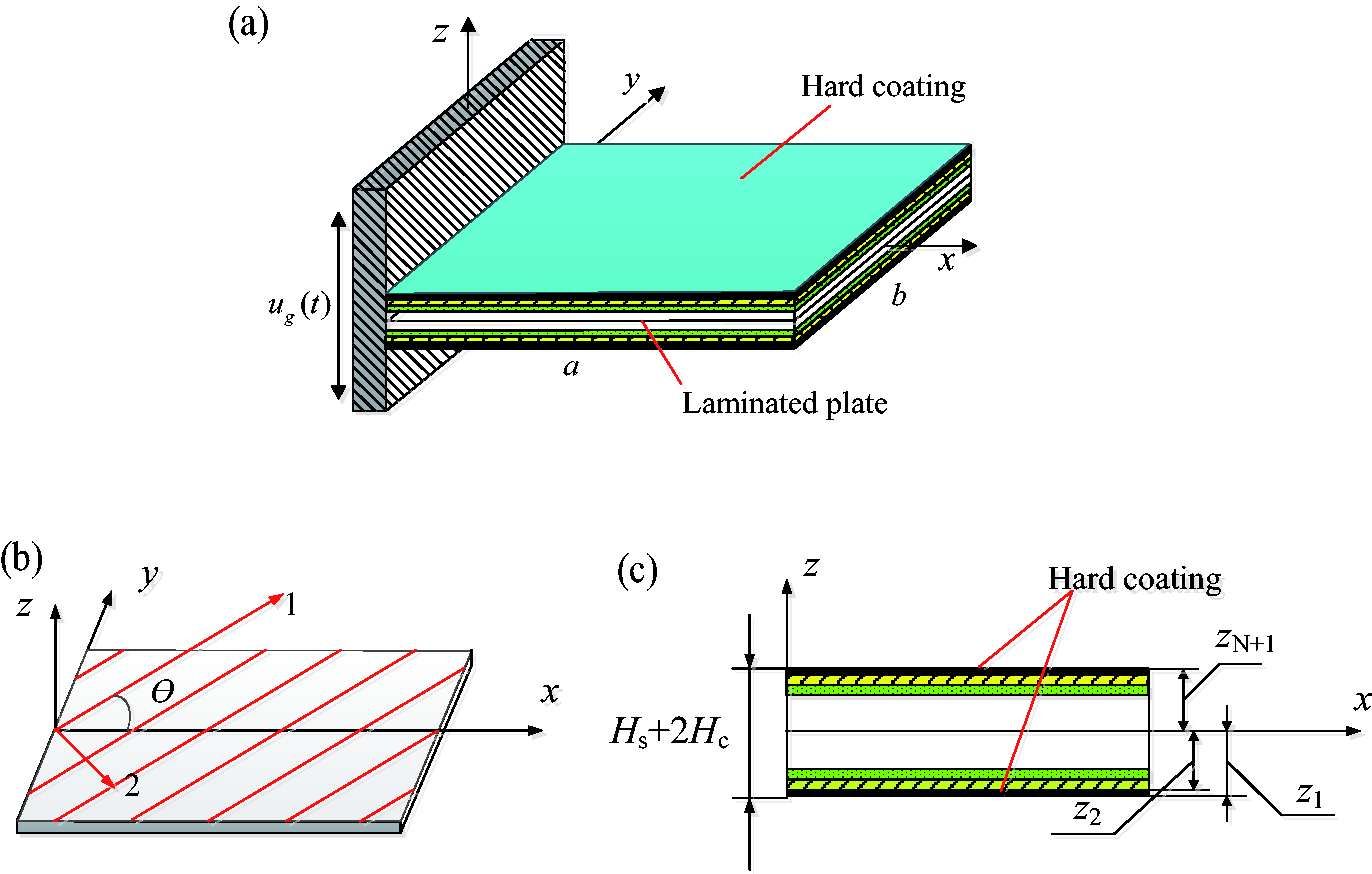
(a) Hard-coating cantilever laminated plate under base excitation, (b) representation of fiber orientation, and (c) cross-section of laminated plate.
The elastic modulus


Here,

Choose one layer arbitrarily in laminates matrix and the sequence number is
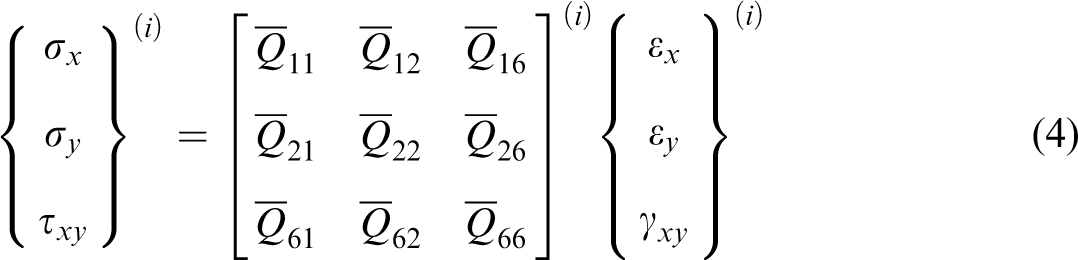
Since the hard coatings deposited on the surface of the laminate (
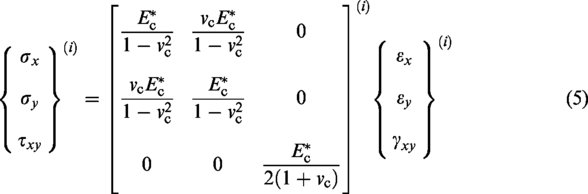
According to the mechanics of elasticity, the strain energy

Substituting equations (4) and (5) into equation (6) can yield the expression of linear and nonlinear strain energy, of which the linear one is
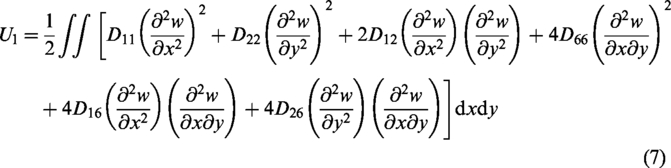
Here, the transverse motions of the hard-coating laminates are considered only,
If the polynomial in equation (1) adopts to its third only, then the expression of nonlinear strain energy can be shown as




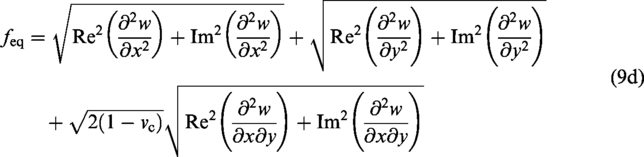

Here, Re () and Im () refer to the real part and imaginary part of the value of quantities, respectively.
The kinetic energy of hard-coating laminates can be expressed as

Here, the steady-state response of hard-coating laminated plates is considered only and the Galerkin discrete method is used to reduce the order of this nonlinear problem. Assuming that the transverse displacement in natural surface is

Substituting equation (11) into equations (7), (8), and (10) can yield the expressions of linear strain energy, nonlinear strain energy, and kinetic energy.
To obtain the equations of motion of the laminated plates, the derived kinetic energy expression and strain energy expression are substituted into the following Lagrange’s equation

Here, the base excitation is considered only, it can be assumed that



The element of the kth row and pth column of complex stiffness matrix
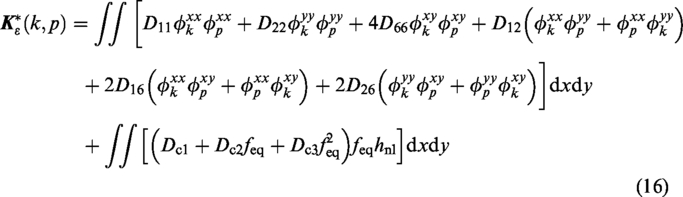

Here,
The element of the kth row and pth column in mass matrix can be expressed as

The specific expression of the kth element of the excitation vector

Solution of vibration response considering the strain-dependent characteristic of hard-coating laminates
The nonlinear algebraic equation shown in equation (14) can be solved with the nonlinear iterative algorithm. In the solving process, it is necessary to modify the material parameters of hard coatings with the equivalent strain


Practice shows that this simplification does not introduce large errors but has significantly improved the computational efficiency.
Solution of vibration response
The Newton–Raphson method is adopted to solve the vibration response of hard-coating laminates, and equation (14) can be transformed as

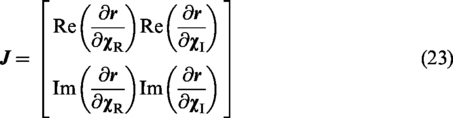
Here,
Extract the real and imaginary part of vector


Then the iterative formulas of the Newton–Raphson method can be derived as


The specific procedure of solving the vibration response of hard-coating laminated plate is shown in Figure 2 and some key steps are explained as follows.
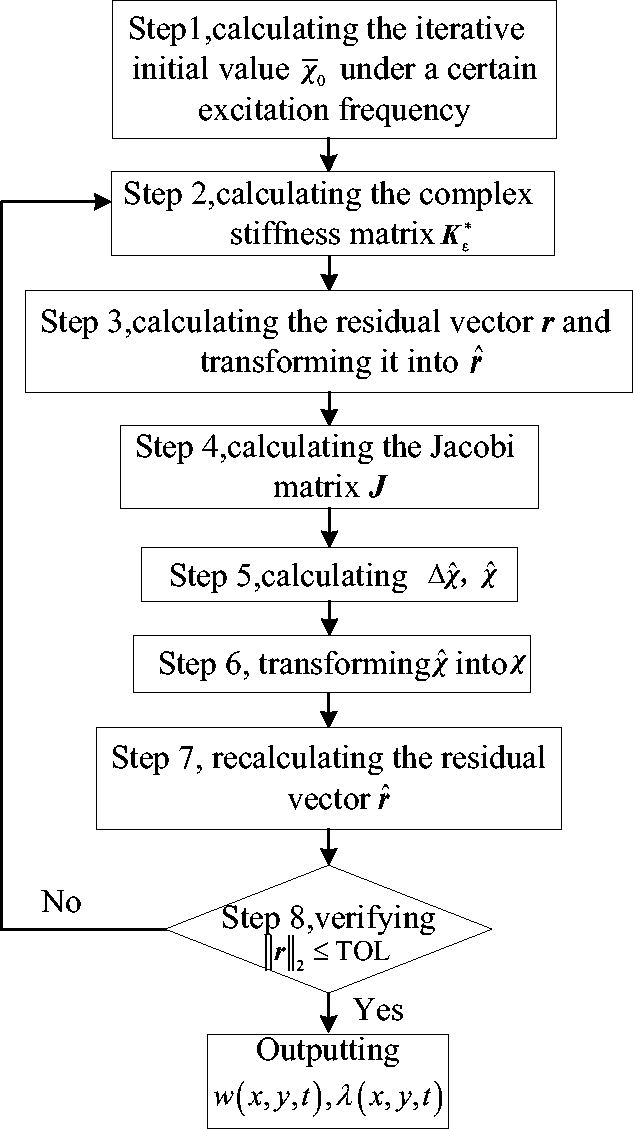
The procedure of solving vibration response of hard-coating laminated plate. TOL: is a setting value used to control calculation accuracy.
While calculating the iterative initial value

The convergence condition is defined as the norm 2 of vector

Solution of resonant frequency
Obtaining the resonant response of hard-coating laminated plates is the first step of calculating resonant frequency, so in this section, the calculation method of vibration response is described first. Neglecting the excitation force items in equation (14), the characteristic equation of hard-coating laminated plates considering strain-dependent characteristic can be expressed as

By calculating the complex stiffness matrix
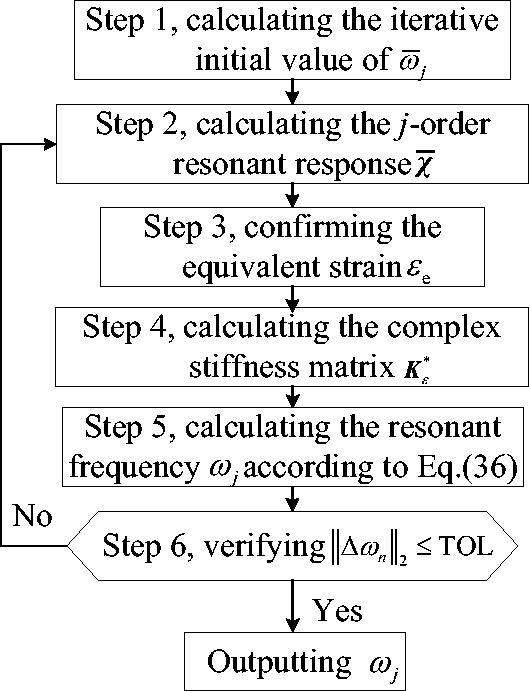
The procedure of solving resonant frequency of hard-coating laminated plate. TOL: ▪.
To obtain the initial value

Substituting the initial value of natural frequency into equation (26) can derive the resonant response vector
Similar to the response calculation, the convergence condition is defined as the norm 2 of the difference between two adjacent natural frequencies and the expression is
Study case
Problem description
In this section, a T300/QY8911 laminated plate with NiCoCrAlY + YSZ hard coating was chosen to demonstrate the proposed method assuming that the total number of layers after coating is 6. The upper and lower surface are hard coating, so the number of layers of substrate is 4 and the fiber orientation angles from upper surface to lower surface are 0°, 30°, −30°, −30°, 30°, 0°, respectively. The relative dimension of the laminated plate is shown in Table 1 and the material parameters of substrate and hard coatings are shown in Table 2.
Geometry parameters of composite plate (mm).

Material parameters of composite plate.

It should be noticed that the material parameters given in Table 2 are the values corresponding to the linear part of NiCoCrAlY + YSZ hard-coating materials (which means the strain value is 0) and the complete expressions of cubic polynomial are


Then the following parameters can be calculated with the proposed procedure: (1) the linear resonant frequency and frequency response of this laminated plate in the 250 Hz frequency range under 1 g excitation level; (2) the fifth-order nonlinear resonant frequency and resonant region response under different excitation levels (1, 3, 5, 7, 9 g).
Analysis of linear vibration characteristic
The linear vibration analysis mentioned here has neglected the strain-dependent characteristic (which means the nonlinear part
In order to demonstrate the rationality of the proposed method, the finite element software ANSYS is used to do the same calculations. SHELL281 element is adopted to simulate the hard-coating laminated plates and the finite element model is shown in Figure 4. This model contains 1200 elements and 1281 nodes in total. The section/shell command is used to set the parameters of laminated plates, such as the values of fiber angle and thickness. The DMPRAT command is used to input the values of material damping into the analytical model. The ACEL command is used to exert 1 g acceleration excitation to the finite element modal. For the model created above, the Block Lanczos method is adopted to calculate the natural frequency and the mode superposition method is adopted to calculate the harmonic response of laminated plates, the resonant frequency and frequency response can be obtained at the same time.
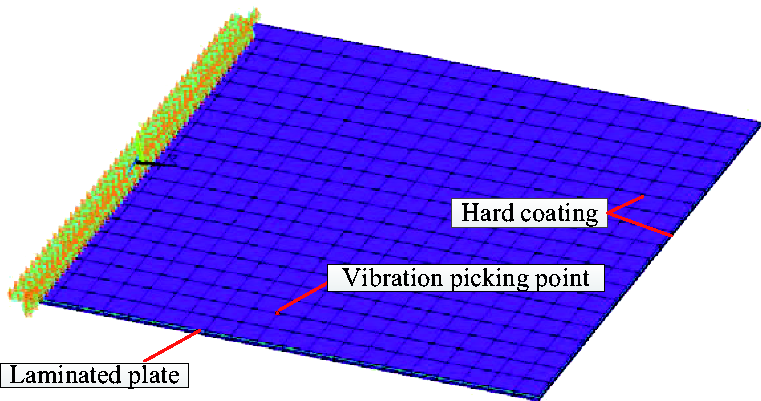
Finite element model of hard-coating cantilevered laminate plate.
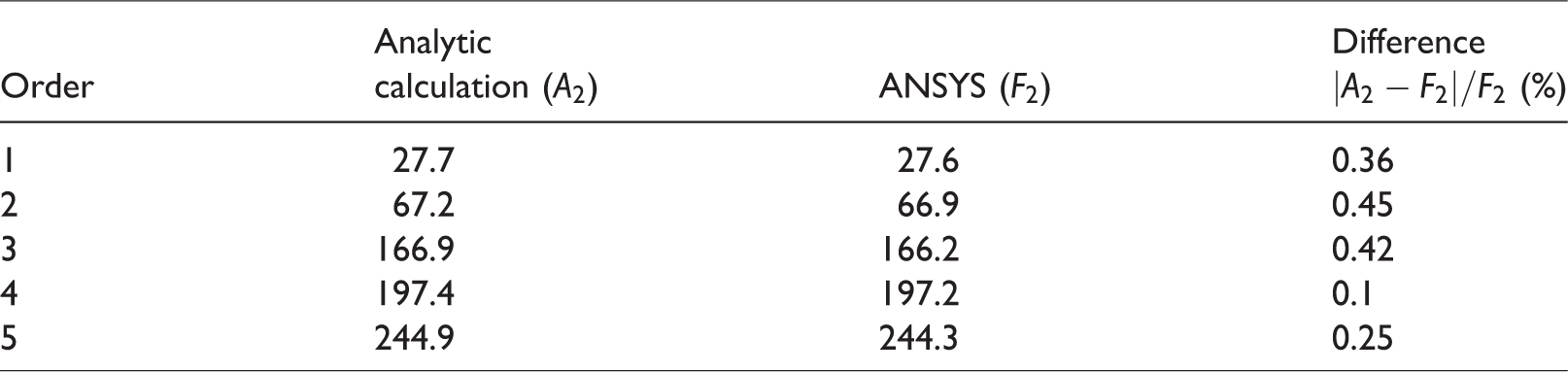
All the results of linear calculation are listed in Figure 5 and Table 3. It can be seen from Figure 5 that the linear frequency responses obtained by the analytic algorithm proposed in this study are basically the same as the results calculated by ANSYS software. Meanwhile, it can be seen in Table 3 that the maximum difference between analytic calculation and ANSYS method is 0.45%.Then, the rationality of analytic algorithm proposed in this study can be demonstrated.
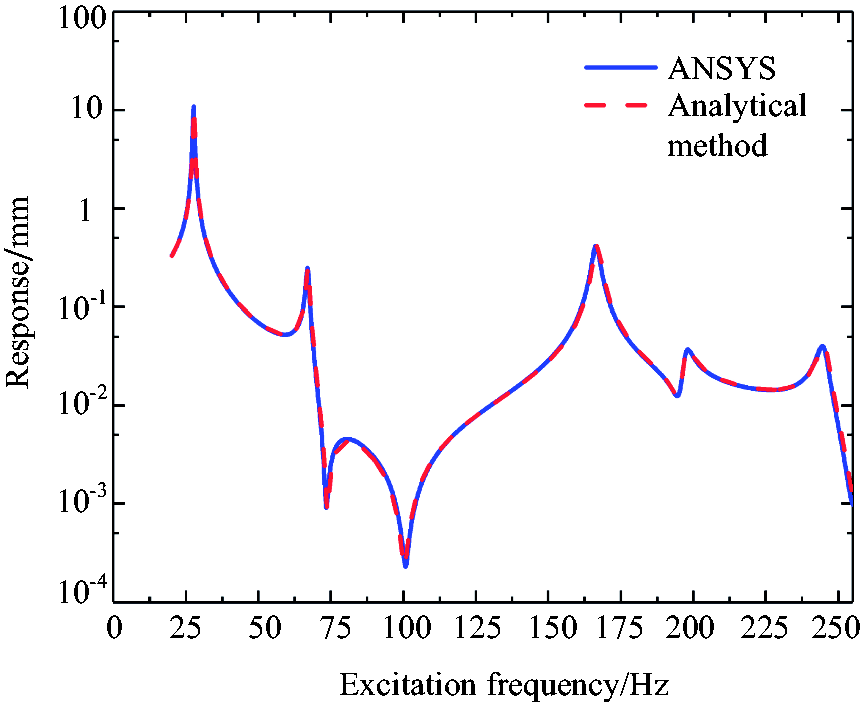
Frequency-domain responses of the hard-coating cantilever laminated plate obtained by analytical method and ANSYS software.
Resonant frequencies of the hard-coating cantilever laminated plate obtained by analytical method and ANSYS software (Hz).
Analysis of nonlinear vibration characteristic
If the linear and nonlinear part of hard-coating materials are considered simultaneously, then equation (14) becomes a nonlinear equation and all these analyses are nonlinear vibration analysis. ANSYS software cannot consider the strain-dependent characteristic of hard-coating materials, so the proposed method is adopted to calculate the nonlinear resonant frequency and resonant region response under different excitation levels, and the fifth-order frequency and response are chosen as examples. The nonlinear iterative computations are performed according to Figures 2 and 3, the vibration picking point is the same as that in linear calculation and the convergence condition is defined as
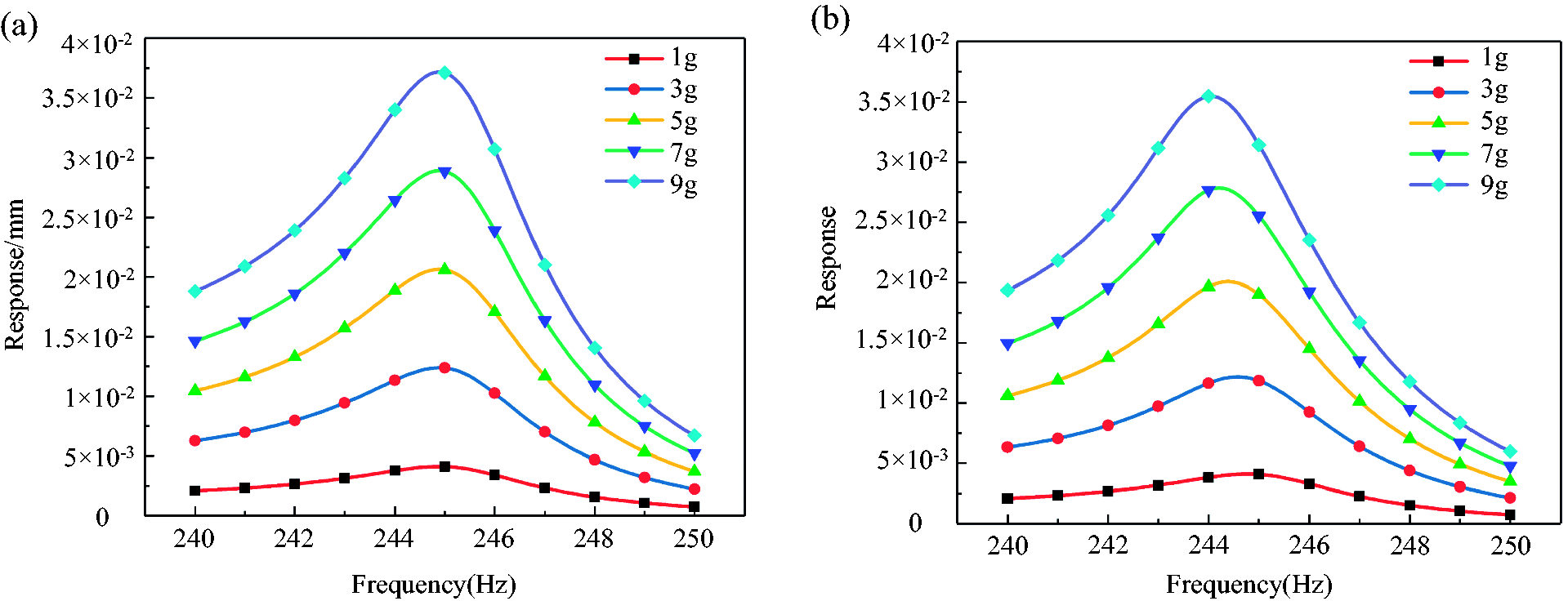
Frequency-domain responses of the hard-coating cantilever laminated plate near the fifth resonant region. (a) Linear calculation and (b) nonlinear calculation.
The fifth-order resonant frequency and resonant response under different excitation levels obtained by linear and nonlinear calculation.
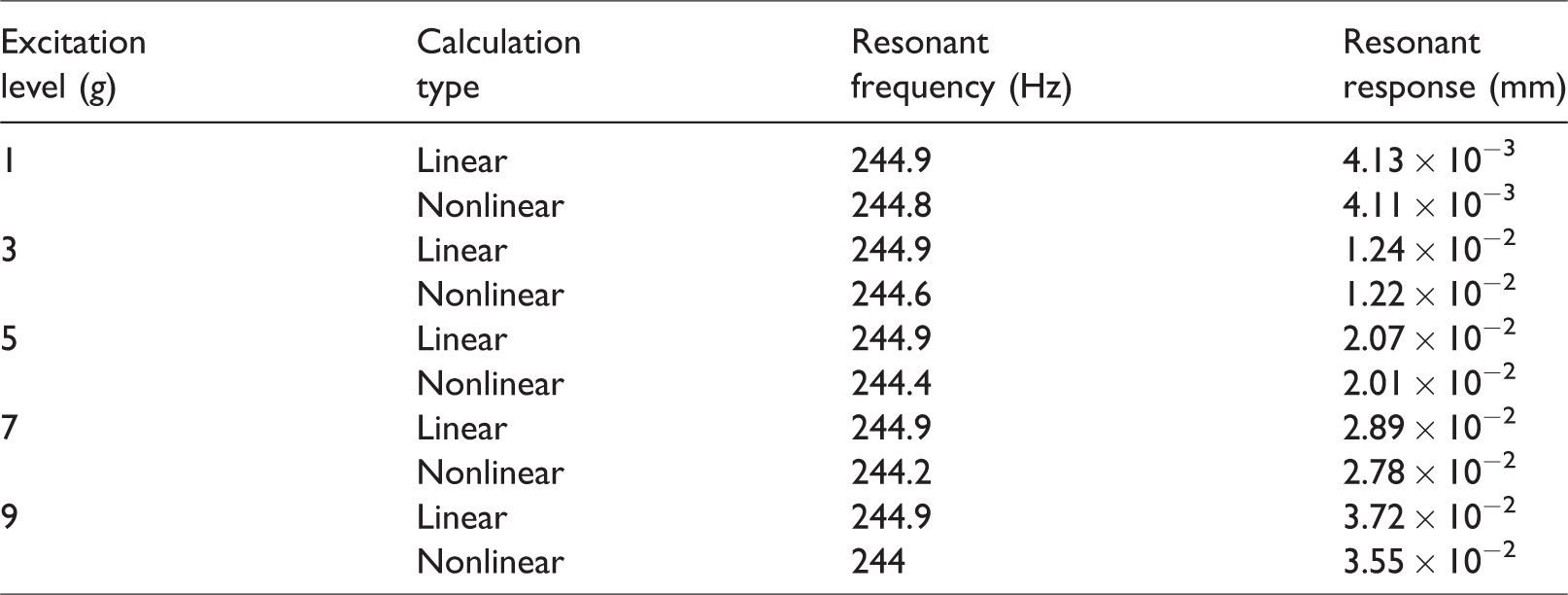
It can be seen in Figure 6 that the peak value of frequency response obtained by nonlinear calculation is less than that of the linear one under the same excitation level. And with the increase of excitation amplitude, the magnitude of attenuation increases. It can be seen in Table 4 that for the same order, the resonant frequency obtained by nonlinear calculation is less than that of the linear one under the same excitation level and with the increase of excitation amplitude, the magnitude of attenuation increases. Figure 6 shows that the resonant peak shifts to the left of horizontal axis, and the offset distance increases with excitation amplitude, this phenomenon also indicates the decrement of nonlinear resonant frequency. In conclusion, the laminated plate displays a soft nonlinear phenomenon because of depositing hard coating.
Conclusions
In this paper, the dynamic model of hard-coating laminated plates is proposed and the vibration characteristic is analyzed considering the strain-dependent characteristic of hard-coating materials. The conclusions are listed as follows.
The hard coating is regarded as a special layer in the laminated plate, using polynomials to express the material parameters of hard coatings with strain-dependent characteristics, then the modeling of plates can be accomplished. In practical computations, the parameters of strain-dependent hard-coating materials can be divided into linear part and nonlinear part to conduct linear and nonlinear calculations, respectively. After confirming the proper equivalent strain, the vibration responses and resonant frequencies of laminated plates can be calculated with Newton–Raphson method, and the detailed procedure is given in this study. The vibration characteristic of a T300/QY89l1 laminated plate with NiCoCrAlY+YSZ hard coating was calculated with the proposed method and the linear results were validated by ANSYS software. The results also reveal that the resonant frequency of the laminated plate shifts to the left with the increase of excitation amplitude, which means the laminated plate displays soft nonlinear phenomenon because of depositing coating.
Footnotes
Declaration of conflicting interests
The author(s) declared no potential conflicts of interest with respect to the research, authorship, and/or publication of this article.
Funding
The author(s) disclosed receipt of the following financial support for the research, authorship, and/or publication of this article: This work was supported by the National Natural Science Foundation of China (Grant No. 51375079) and the Fundamental Research Funds for the Central Universities of China (Grant No. N170308028).