




Abstract
Paper board with bending stiffness is usually used as the substrates on cigarette package printing industry. The vibration of these paper boards in high speed affects the printing precision. The dynamic characteristics and stability of moving paper board with finite interior elastic point supports and elastic edges restrained are investigated. First, the energy function of the system is established by using the extended Hamilton’s principle; second, the dimensionless equations of motion for the moving paper board are obtained using the element-free Galerkin method. The equations of motion and the eigenvalue equations of the system are established. The relationship between the first three complex frequencies of the system and the moving speed is then obtained by the numerical calculation. The effects of the elastic point supports, the elastically restrained edges, and the dimensionless speed of the motion on the dynamic stability of the paper board are analyzed. The critical speed when the paper board is in a stable state under different conditions is obtained. The results improve the dynamic stability of the paper board in printing process and provide the theoretical basis for the optimization of printing equipment.
Introduction
Moving paper board with certain thickness and bending stiffness is widely used in printing and packaging industry. The vibration characteristics of paper board have a great impact on printing quality. At present, the research of cigarette package with printing background is less. In this paper, based on industry background, the printing materials of Shaanxi Bei Ren PRC 250 cigarette package gravure press (see Figure 1) was used as the sample. When take it as the thin plate, the adjacent two rollers can be regarded as the boundary supports or intermediate supports. The transverse vibration characteristics and stability of moving paper board with added subsystems are investigated. In this paper added subsystems are the systems under elastic point supports and elastic edges restrained. The critical transferring speed of the paper board under different conditions is obtained.
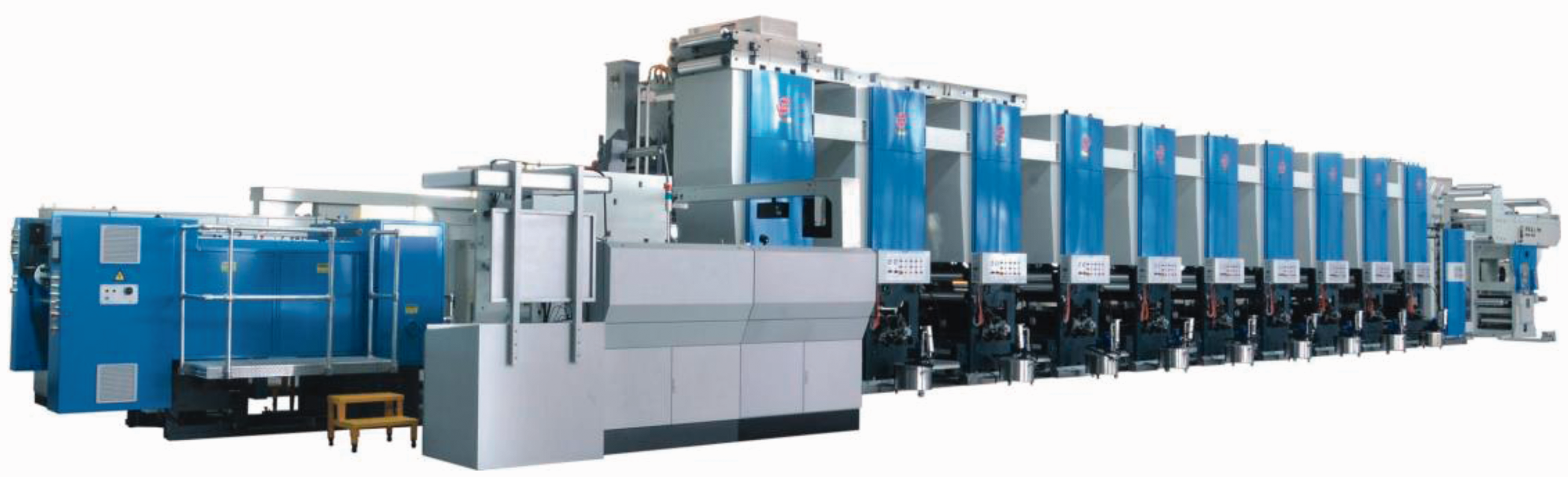
Shaanxi Bei Ren PRC 250 cigarette package gravure press.
Dynamics and mechanical stability of axially moving systems have been widely studied for a long time. The most common models for these systems include moving strings, beams, membranes, and plates. Ulsoy and Mote 1 early researched the large band saw blade by two-dimensional plate model and investigated the coupled and torsional vibration of the plate. Lin 2 investigated the stability and vibration characteristics of axially moving plates with two simply supported and two free edges. Marynowski 3 used a two-dimensional rheological element to model the moving viscoelastic web. Saksa et al. 4 studied the stability and dynamic behavior of axially moving viscoelastic panels with the help of a classical modal analysis. The nonlinear vibration in parametric and internal resonances of accelerating viscoelastic plates was studied by Tang and Chen. 5 The nonlinear dynamics for forced motions of an axially moving plate was investigated using Von Karman plate theory by Ghayesh et al. 6 Wang et al. 7 studied the dynamic stability of the moving viscoelastic plate with the piezoelectric.
Boundary control of axially moving system was investigated by Hong et al.8–10 They proposed a set of effective boundary control laws for axially moving systems. An optimal delayed feedback control methodology was developed to mitigate the primary and super harmonic resonances of a flexible beam with piezoelectric sensor and actuator by Liu et al. 11 They obtained the stable vibratory regions of the feedback gains by using the stability conditions of eigenvalue equation. Khanna and Singhal 12 analyzed the vibration of a tapered isotropic rectangular plate under thermal condition, and they calculated the first two modes of frequency of rectangular plate for five boundary conditions. Nguyen and Hong13,14 proposed a novel control algorithm for controlling the transverse vibration of an axially moving web system.
Ashour 15 presented an excellent review on the topic of plates with elastic edges restrained. The effects of elastic edge support on the natural frequencies of thin symmetric cross-ply laminates were studied by Hung et al. 16 Chung et al. 17 investigated the free vibration of orthotropic Mindlin plates with elastic edges restrained against rotation using the Rayleigh–Ritz method. Bert and Malik 18 applied a semianalytical differential quadrature method (DQM) to investigate the effects of rotationally restrained boundaries on the natural frequencies of laminated plates with two simply supported opposite edges. Liew et al. 19 studied the free vibration of symmetric cross-ply laminated plates that were elastically restrained against rotation and translation. Karamia et al. 20 proposed a free vibration analysis of moderately thick symmetric laminated plates with elastic edges restrained using a DQM. The free and forced vibration of variable stiffness composite annular thin plates with elastically restrained edges was investigated by Tan and Nie. 21
In addition, the paper board that can be supported at interior points is designed. Point-supported paper boards are plates that have prescribed displacements at a number of discrete locations within their domains. Rigid point supports have a prescribed displacement of zero while elastic point supports have displacements that are dependent on the stiffness at the support. Lee and Lee 22 studied a one-dimensional deformation function of a beam with point load, the admissible shape function of the plate was formed, and the free and flexural vibration for rectangular plates with arbitrary interior elastic point supports has been undertaken. Zhou et al. 23 analyzed the free vibrations of thick, isotropic, and laminated composite rectangular plates with point supports by using the finite layer method. Gorman 24 provided analytical solutions for the free vibration frequencies and shapes of thin corner-supported rectangular plates with symmetrically distributed reinforcing beams running along the plate edges. Taking into account the compatibility of displacements and the rotations between the plate and the columns, Zhou and Ji 25 derived the coupled vibration of a thin rectangular plate with two opposite edges simply supported and additional column-supported interior points. Huang et al. 26 developed a discrete method to analyze the free vibration problem of rectangular plates with point supports. In this method, the point supports were simulated using Dirac delta functions and the differential equations were transformed into integral equations; a Green’s function approach was used to obtain the characteristic equations. Bahmyari and Khedmati 27 analyzed the free vibration of nonhomogeneous moderately thick plates with point supports resting on Pasternak elastic foundation by using element-free Galerkin method. Lopatina and Morozovb 28 obtained the fundamental frequency of an orthotropic rectangular plate with a centrally located point support and free edges.
Therefore, we pay more attention to research the analytical problem of the transverse vibration stability of an axially moving rectangular paper board with added subsystems. In the present study, the variational equation for the transverse vibration of a moving paper board with finite elastic point supports and elastic restraints is formulated. This paper aims to study the transverse vibration stability of the paper board with added subsystems in axially moving condition. The research provides the theoretical basis for the optimization of printing equipment and improves the dynamic stability of the paper board in printing process.
Vibration model and solution of characteristic equation by element free Galerkin (EFG) method
The basic parameters of the Shaanxi Bei Ren PRC 250 cigarette package gravure press are shown in Table 1. The cigarette packaging paper board is fed through a pair of guide roller and transferred to printing color unit. The paper board between two adjacent rollers is studied. The two adjacent rollers can be regarded as boundary condition. This can be viewed as the axial system and its transverse vibration can be studied. A moving paper board with an internal elastic point support at
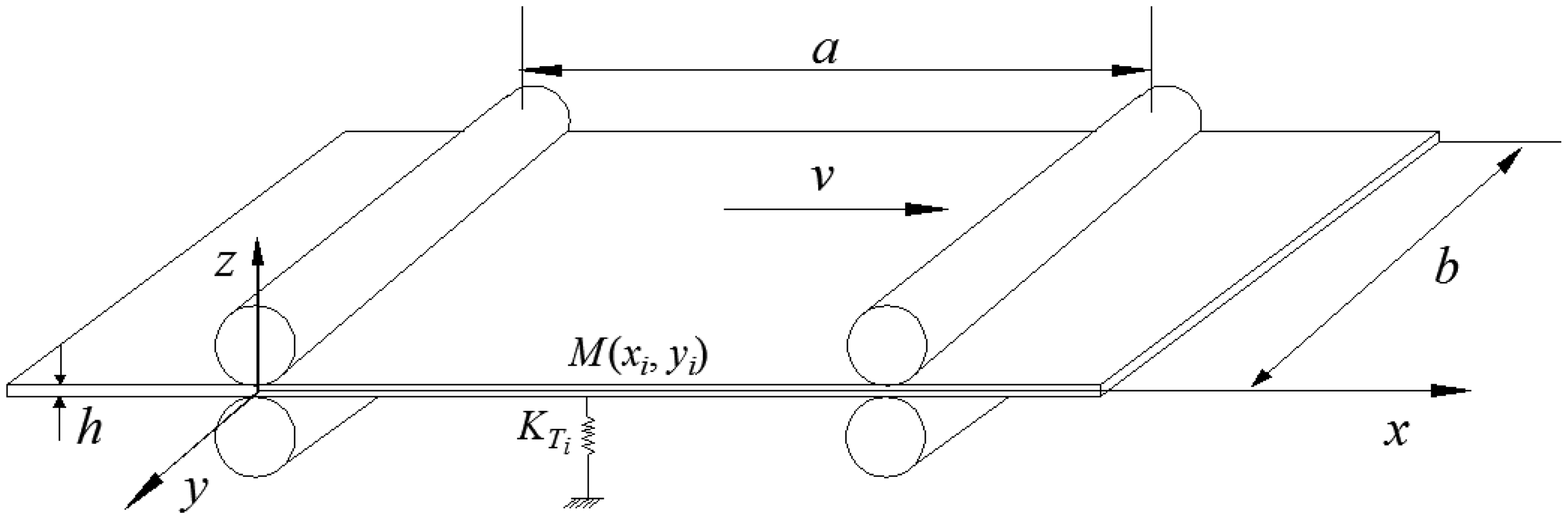
Moving rectangular paper board with elastic point supports and elastic edges restrained.
The basic parameters of the Shaanxi Bei Ren PRC 250 gravure press.

The transverse speed of the moving paper board can be expressed as

The bending strain energy of paper board is


The relations between stresses (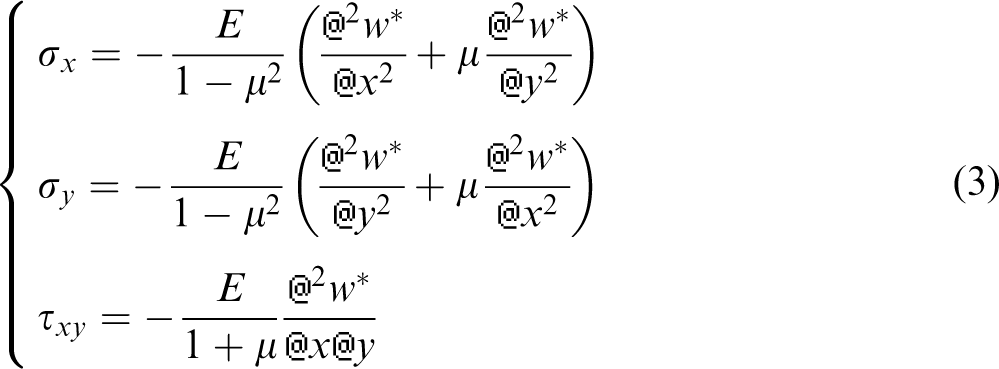
Substituting strains and stresses into equation (2) yields the following equation

The strain energy induced by the internal elastic point support and the strain energy induced by the elastic restrain can be, respectively, expressed as


The kinetic energy of the system can be expressed as

The energy function can be expressed as
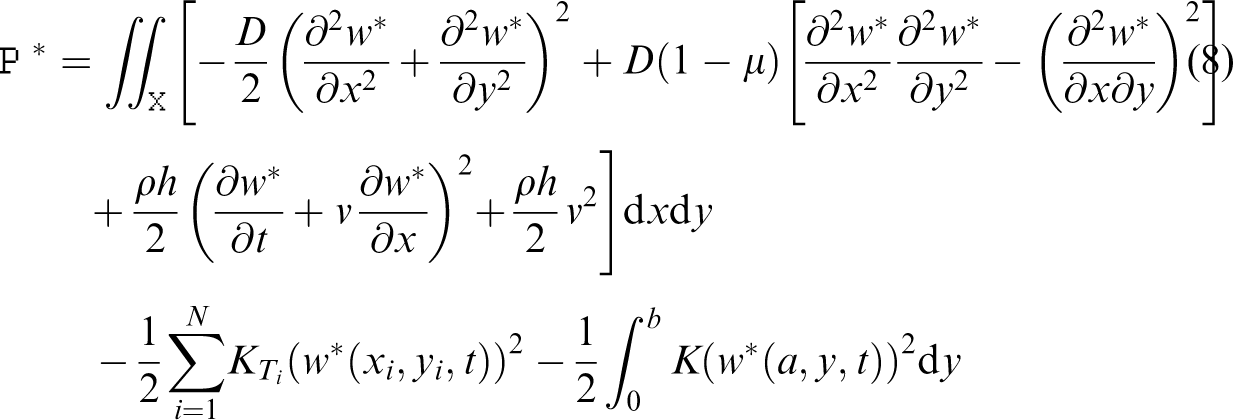
Based on Hamilton’s principle, the penalty function method is employed to impose the essential boundary conditions, where 

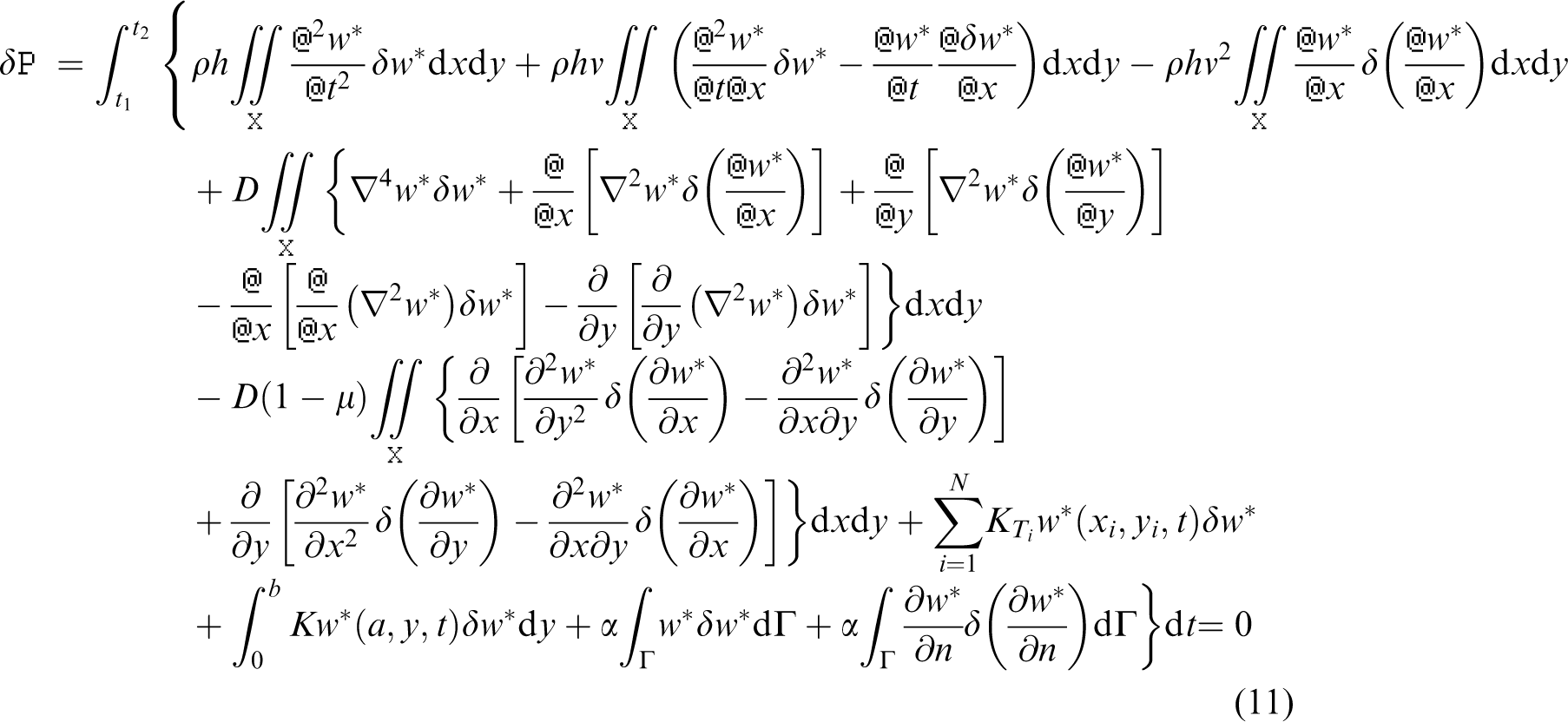
Substituting equations (8) and (10) into equation (9), according to the variational principle, the variational forms of the dynamic equations are obtained as follows
Introduce the dimensionless quantities


Equation (11) takes the form
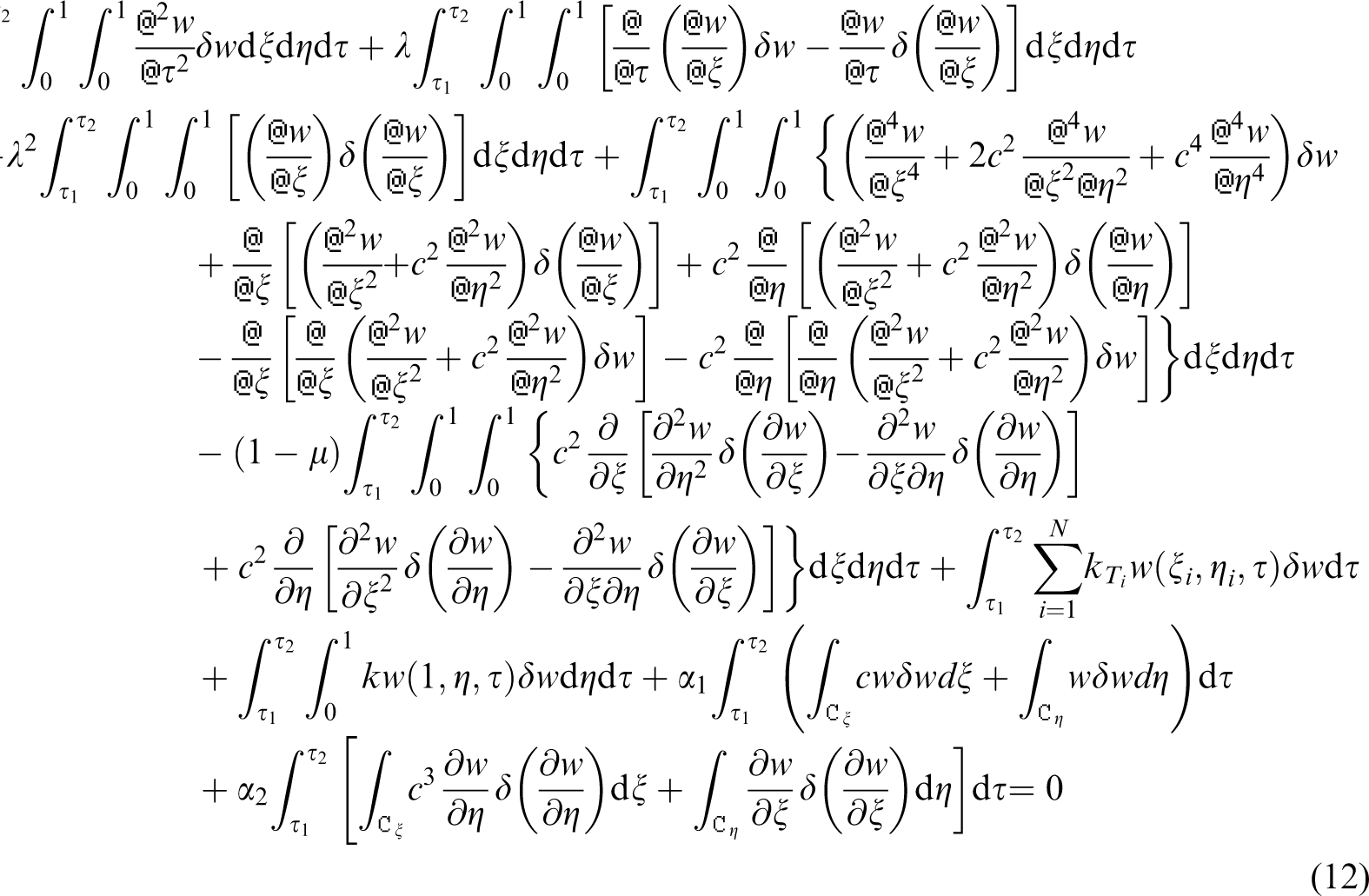
The equations are derived using the element-free Galerkin method. Suppose that 
The dimensionless shape function is given by

The dimensionless generalized displacement is given by

Substituting equation (13) into equation (12), according to the variational principle, the dimensionless equations for the transverse vibration of the moving rectangular paper board with finite elastic point supports and elastic restraints can be expressed as

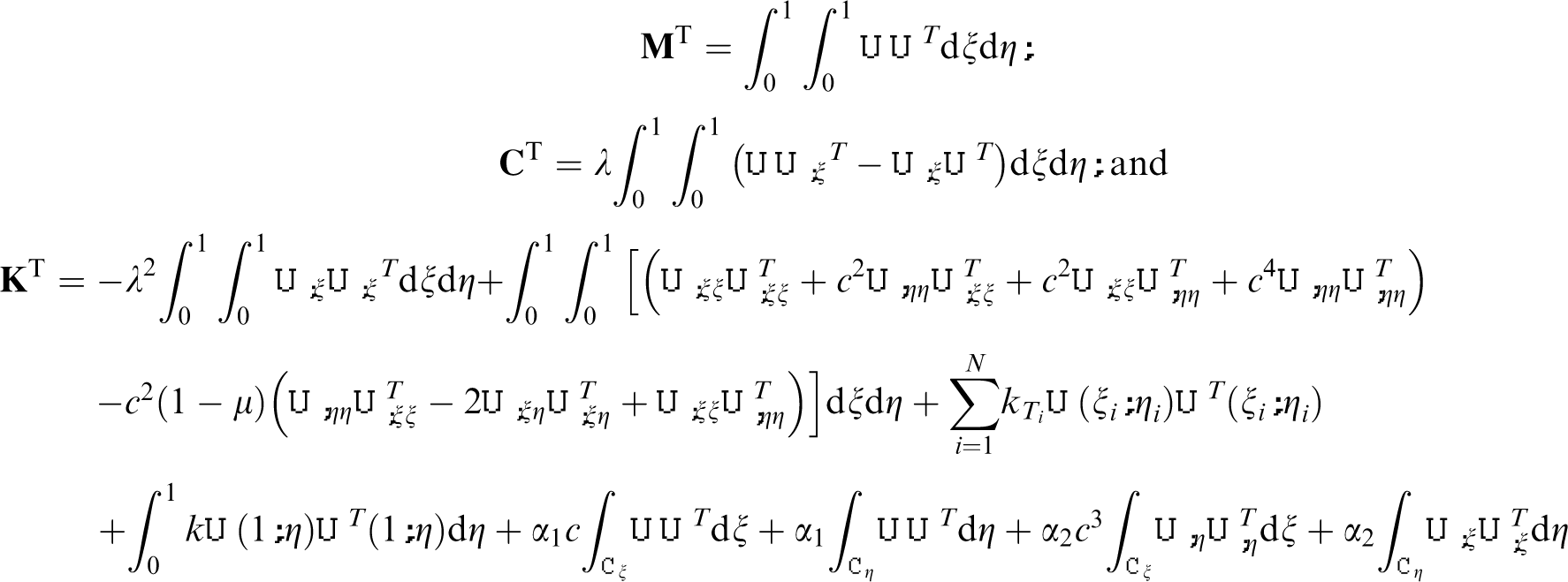

Substituting equation (17) into equation (16) yields the following homogeneous equations


In equation (19),
Using the EFG method the vibration model functions can be expressed as

Numerical calculation and discussion
In order to verify the present formulation, in the case of
The first three natural frequencies of the paper board with different aspect ratio.

Paper board with four simply supported edges and one elastic point support
In Figure 3 when the dimensionless velocity
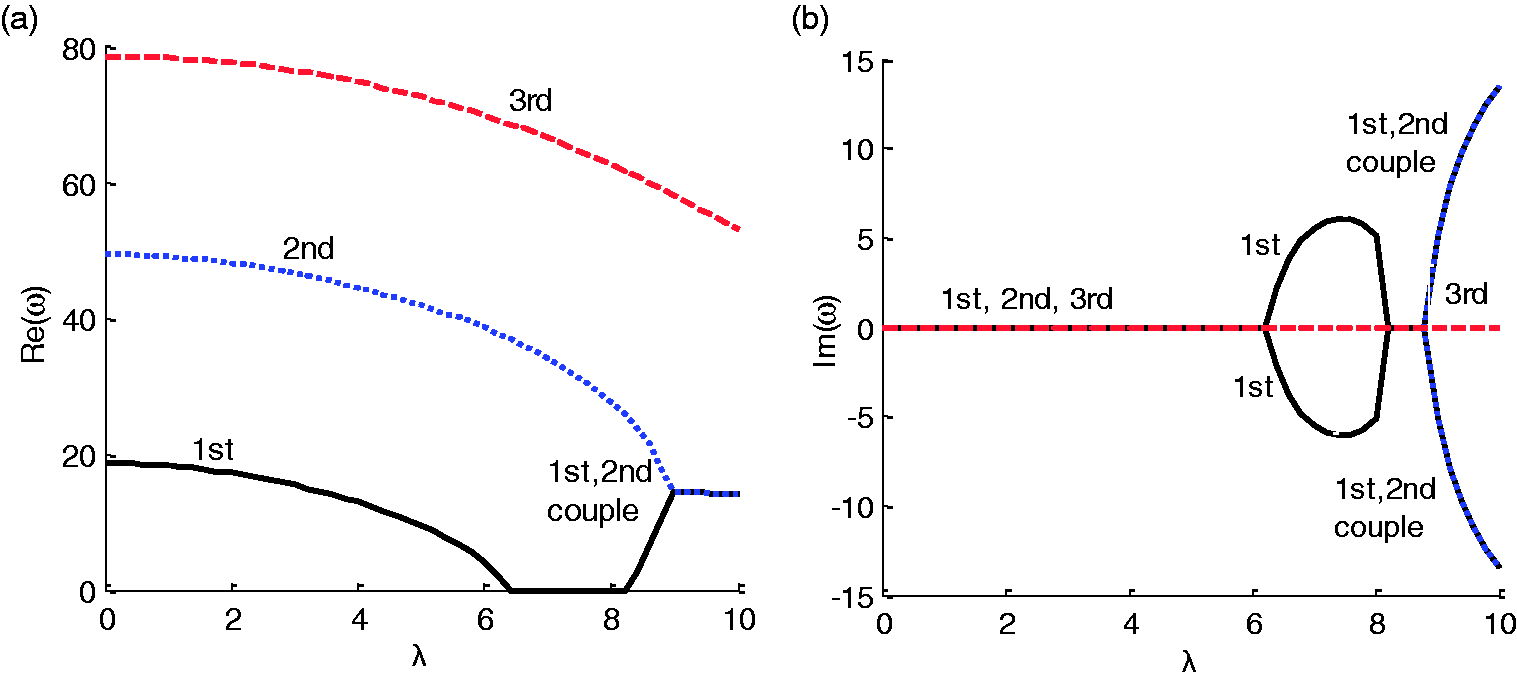
The relation between the first three orders of the frequency and the moving speed λ. (a) Variation of the real part of the complex frequency and (b) variation of the imaginary part of the complex frequency.
In Figure 4 the case of elastic support stiffness
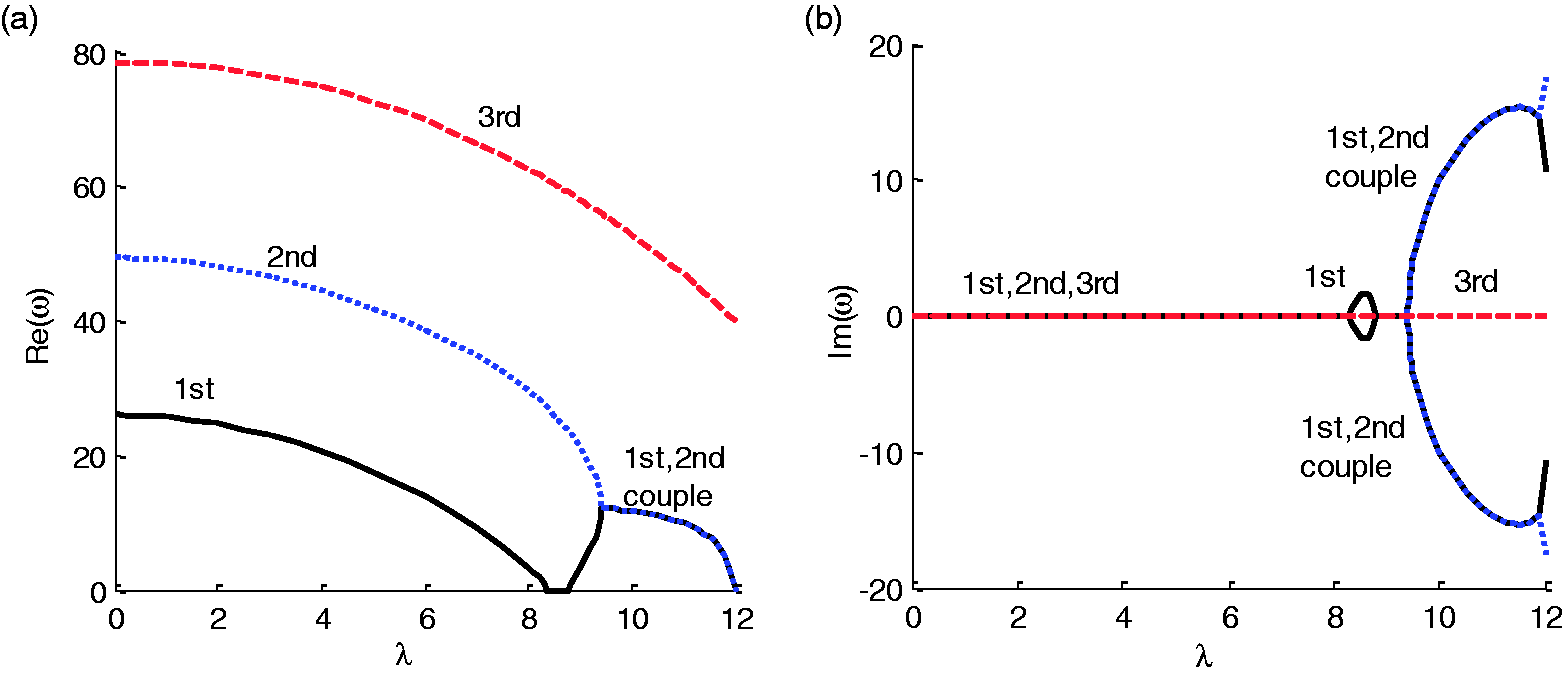
The relation between the first three orders of the frequency and the moving speed λ. (a) Variation of the real part of the complex frequency and (b) variation of the imaginary part of the complex frequency.
Paper board with two elastic point supports
Figure 5 displays the variation of the curve for the case where the elastic supports are located at
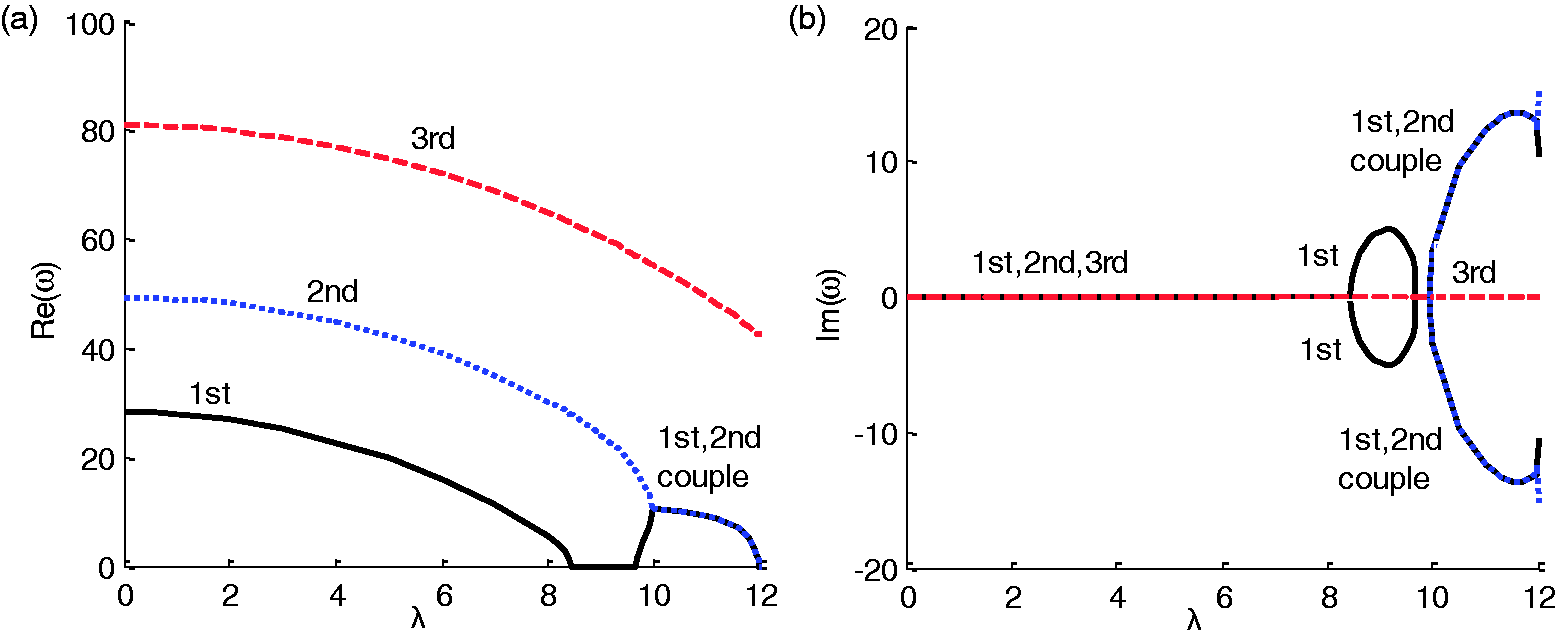
The relation between frequency and the moving speed λ. (a) Variation of the real part of the complex frequency and (b) variation of the imaginary part of the complex frequency.
Paper board with one elastic edge restrained
In Figure 6 the elastic restraint stiffness is
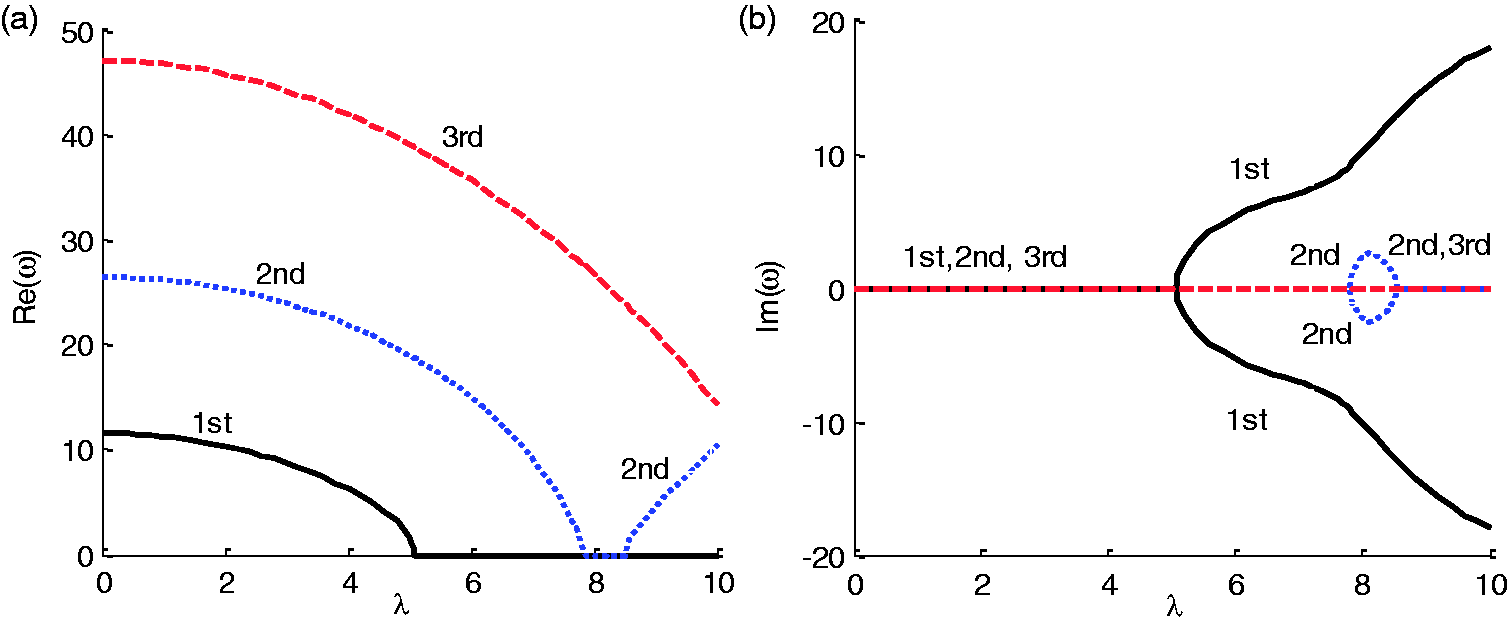
Dimensionless complex frequency versus the dimensionless moving speed λ. (a) Variation of the real part of the complex frequency and (b) variation of the imaginary part of the complex frequency.
In Figure 7 the elastic restraint stiffness is
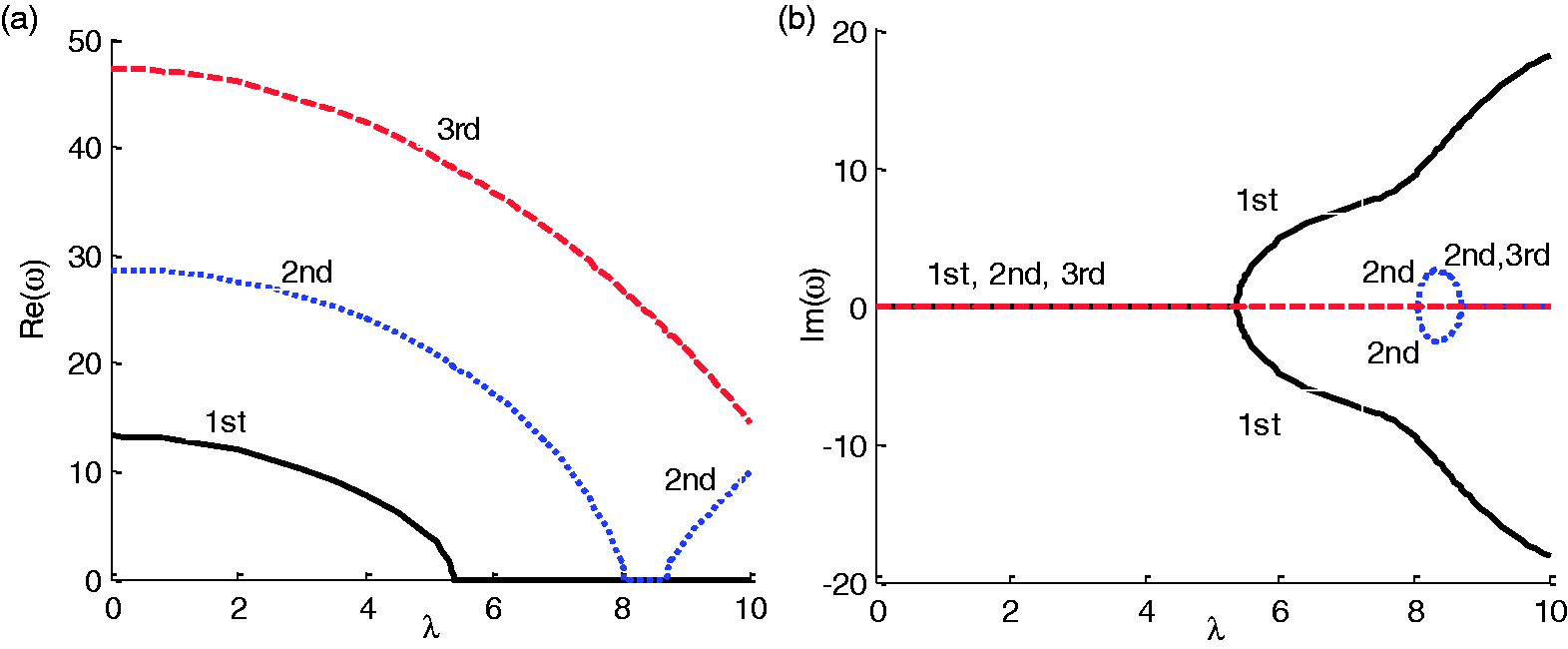
Dimensionless complex frequency versus the dimensionless moving speed λ. (a) Variation of the real part of the complex frequency and (b) variation of the imaginary part of the complex frequency.
In Figure 8 the elastic restraint stiffness is
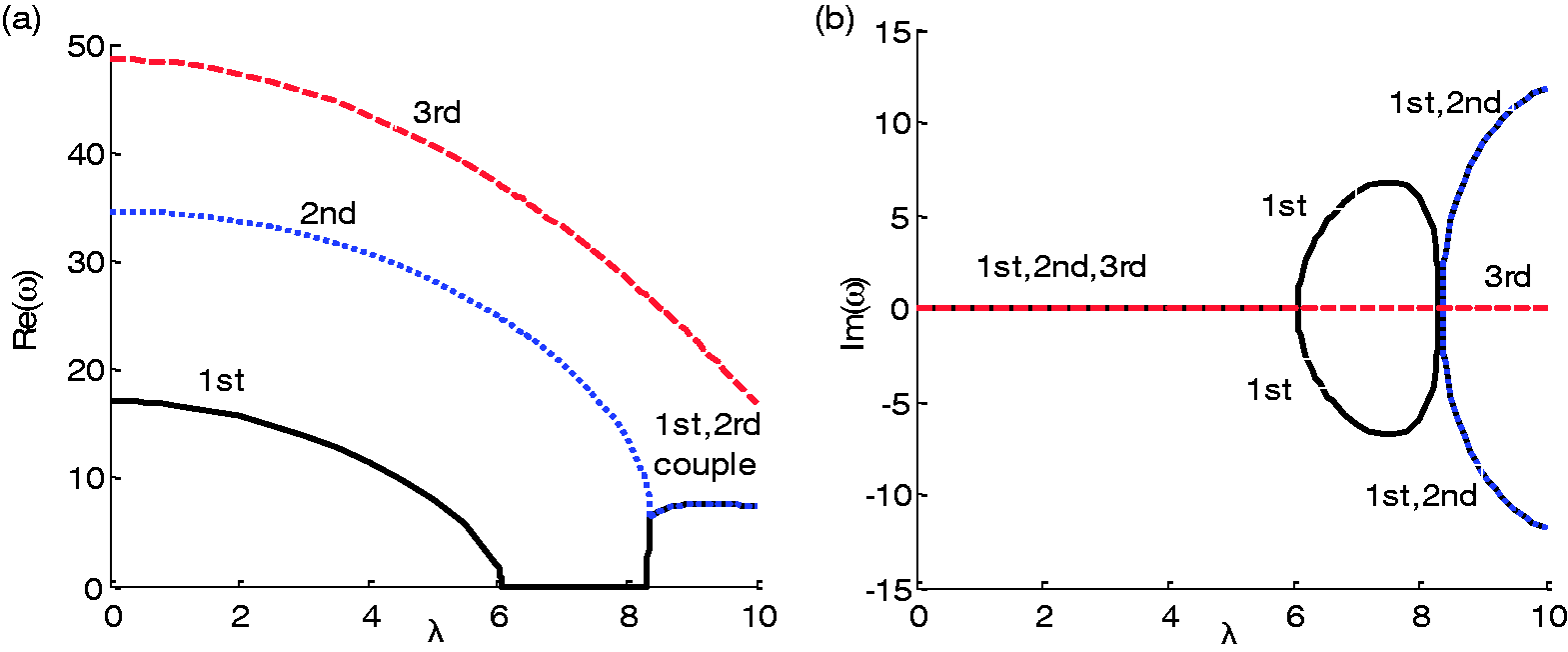
Dimensionless complex frequency versus the dimensionless moving speed λ (
Figures 9 and 10 show the variation of the critical speed of the paper board with the linear elastic stiffness of the elastically restrained edge. With increases in the elastic stiffness of the restraint, the critical speed increases. When the elastic stiffness of the restraint is in the range of
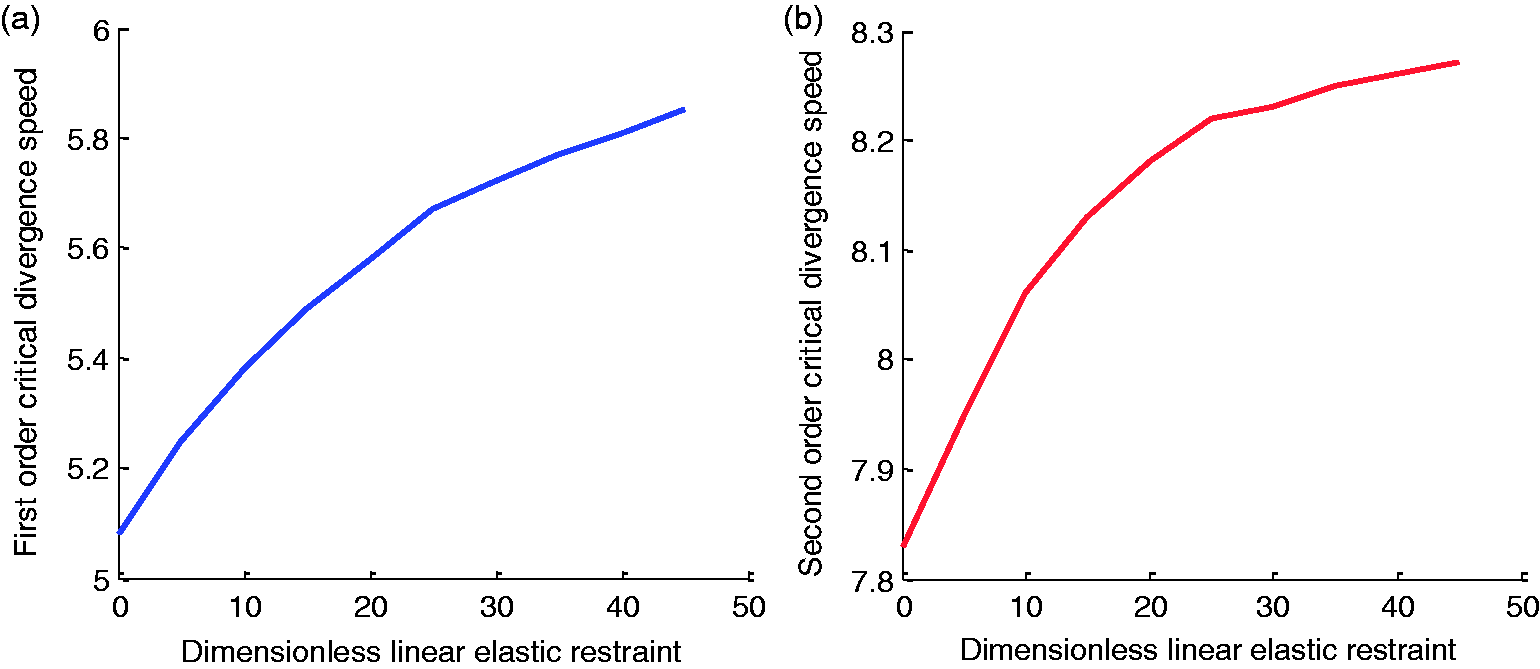
Dimensionless critical moving speed λ versus the dimensionless linear elastic restraint
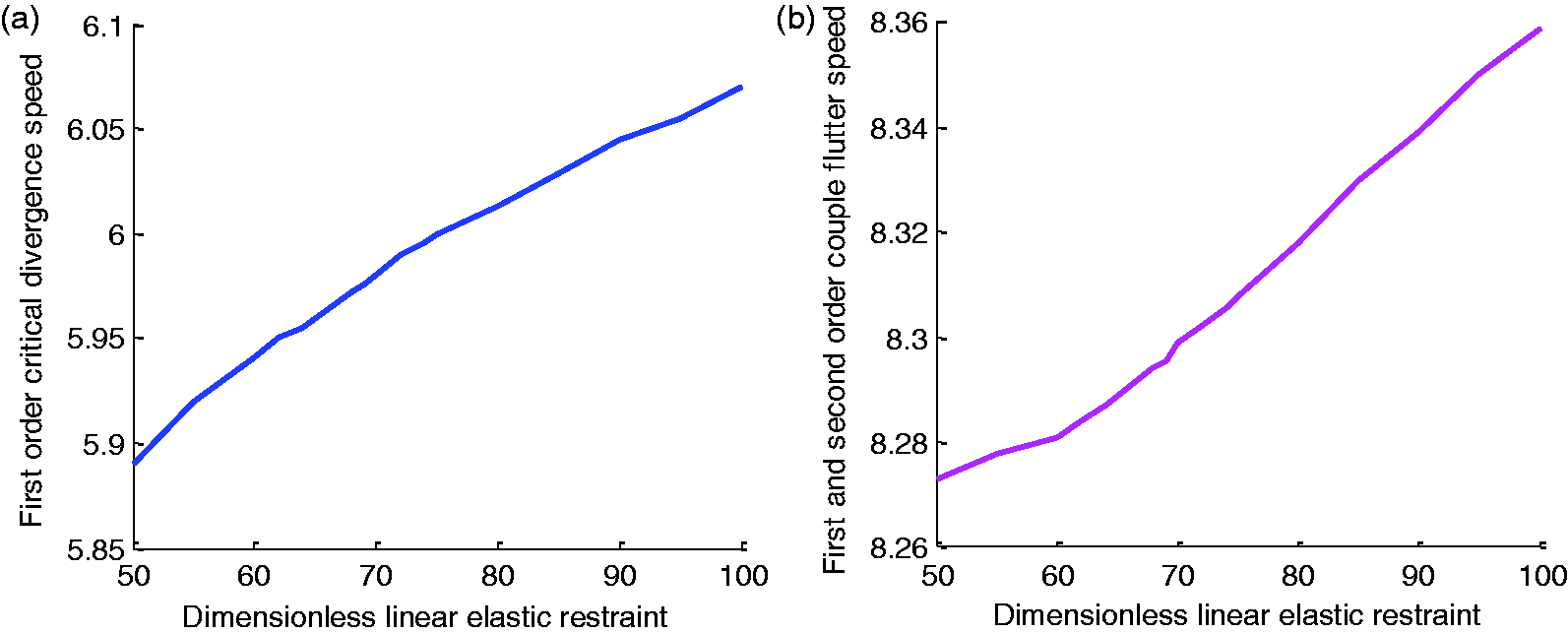
Dimensionless critical moving speed λ versus the dimensionless linear elastic restraint
Figure 11 shows the first three vibration mode of the paper board with the dimensionless speed of motion without elastic point supports for an elastic restraint with

The first three vibration mode figures of the paper board. (a) The first mode, (b) the second mode, and (c) the third mode.
Conclusions
In this paper, the printing material of Shaanxi Bei Ren PRC 250 cigarette package gravure press is taken as the sample. The transverse vibration behavior and stability of moving paper board with finite interior elastic point supports and elastic edges restrained are investigated, considering the effects of the translating velocity. The equation of motion of the vibration system is derived according to the nonmoment theory and variational principle. The results of our analysis are summarized below.
For the paper board with four simply supported edges, the relationships between the dimensionless frequency and the critical dimensionless velocity are analyzed. The critical dimensionless velocity is obtained, and the critical dimensionless is We find that the natural frequencies increase with increase of the elastic restraint on the boundary. However, increases in the elastic point supports do not always increase the natural frequencies of paper board. Furthermore, the natural frequencies are greatly influenced by the location of the point supports. Changes in the location of the elastic point supports along nodal lines do not affect the dynamic stability of the moving paper board. In the case of The study provides the theoretical basis for the optimization of printing equipment and improves the dynamic stability of the paper board in printing process. The study has important significance in practical engineering application.
Footnotes
Declaration of conflicting interests
The author(s) declared no potential conflicts of interest with respect to the research, authorship, and/or publication of this article.
Funding
The author(s) disclosed receipt of the following financial support for the research, authorship, and/or publication of this article: The author gratefully acknowledges the support of the National Natural Science Foundation of China (No. 11272253, No. 11202159) and the PhD Innovation fund projects of Xi'an University of Technology (No. 310-252071702).