




Abstract
This study is based on a real finite element human head–neck model and concentrates on its numerical vibration characteristic. Frequency spectrum and mode shapes of the finite element model of human head–neck under mechanical vibration have been calculated. These vibration characteristics are in good agreement with the previous studies. The simulated fundamental frequency of 35.25 Hz is fairly similar to the published documents, and rarely reported modal responses such as “mastication” and flipping of nasal lateral cartilages modes, however, are introduced by our three-dimensional modal analysis. These additional modes may be of interest to surgeons or clinicians who are specialized in temporomandibular or rhinoplasty joint disorder. Modal validation in terms of modal shapes proposes a necessity for elaborate modeling to identify each individual part’s extra frequencies. Furthermore, it also studies the influence of damping on resonant frequencies and biomechanical responses. It is discovered that damping has an inverse proportionality between damping effect on natural frequency and that on biomechanical responses.
Introduction
When subjected to mechanical vibration either by contact with vibrating structures or by action of an acoustic field, the human head responds by vibrating in certain modes. 1 The knowledge of how and why it vibrates will make a contribution to a normal comprehension of human biomechanics. This may make it easier in evolution of “a new medical instrument for early diagnosis of brain diseases”. 2
Earlier studies on human head–neck vibration chiefly came from experimental dates that involved animals, cadavers or volunteers. Bekesy 3 investigated “the vibration response of a cadaver skull in an acoustic field and reported that the first resonant frequency of the skull to be, 1800 Hz”. The experimental modal study, performed by Franke 1 on both skull filled with gelatin and the same an empty dry human skull, found that “the lowest resonant frequencies were 800 Hz and 500 Hz individually”. Both Hodgson et al. 4 and Sun et al. 5 discovered that “the resonant frequency of a cadaver head in their mechanical impedance analysis was approximately 300 Hz”. At around the same time, Stalnaker and Fogle 6 utilized “an electromagnetic shaker in their experimental tests of a fresh unembalmed cadaver head and discovered that the resonant frequencies were 166 Hz and 820 Hz”. Khalil 7 revealed that “the respective fundamental frequencies found were, 1385 Hz and, 1641 Hz performed by an experimental study on two cadaver heads using an impact hammer”. Hakansson’s 8 in vivo study utilizing “skin penetrating titanium implants on patients’ temporal bone claimed that the lowest undamped natural frequency were about 972 Hz”. By comparison, experimental researches on living human subjects illustrated the frequency spectrum arranged from several Hz to 300 Hz.1,5,9–11 In spite of the bulk of worthful information supplied by experimental information, these tests do not only lead to affairs in ethics and morality, but also induce plenty of research concerns such as restricted flexibility as well as biasness in experimental information owning to nonstandardized experimental procedures and scarce subjects.
At the same time, numeric simulations that use finite element method provides a cost-effective choice to experimental ways, with a possibility for evaluations going beyond the experimental moral limits and would assist in more effectual equipment’s evolution. Nickell and Marcal 12 had executed finite element simulations utilizing a simplified 3D FE skull model with different boundary supports and reported that “the cardinal head-neck frequencies for occipital, frontal and base supports respectively were 86 Hz, 68 Hz and 164 Hz”. Therefore, similar finite element models performed by Ward and Thompson 13 simulated “the fundamental frequency of brain to be 23 Hz and 43 Hz”. Ruan 14 developed “a 2D finite element model using a coronal sectional of human head and discovered that the first natural frequency fell within 49 to 72 Hz”. Chu 15 constructed “two 2D midsaggital head models and discovered that the additional brain in the latter model lowered the fundamental frequency from 286 Hz to 119 Hz”. These researches only analyzed models of the head. Recently, Charalambopoulos 2 developed “an analytical model of the skull–brain–neck system and found that the neck introduced additional frequency in the lower frequency spectrum with the natural frequency of 595 Hz”. Hence, Meyer et al.’s 16 finite element simulations using a rigid-head-neck model demonstrated that the fundamental frequency of a head–neck system was 3.01 Hz. Baroudi 17 executed “a 3D modal analysis of an idealized cylindrical skull–brain–CSF model using both analytical and FE methods and found that the fundamental frequency to be 26.66 Hz”.
These earlier FE studies had provided some insights undoubtedly in the human head’s dynamic characteristics. Nevertheless, numerous simplifications and approximations had been made in the head’s geometry. In the present work, an elaborate finite element model of human being head–neck, which involves the intracranial and facial particulars like the subarachnoid space, has been built and its modal responses have been calculated. Additionally, the simulated modal responses in terms of mode shapes and resonant frequencies are compared with previous literature, unlike most previous studies comparing their resonant frequencies simply and disregarded modal validation in terms of mode shapes. What is more, we likewise inquire into the influence of damping dynamic characteristics, with the introduction of three damping factors in the complex eigenvalue analysis, dissimilar most previous finite element studies using the traditional frequency extraction approach.
Resonance behavior of the finite element model
Governing equation and finite element method
Vibration characteristic utilizing finite element method was executed by Abaqus 6.11 software. The dynamic response's governing equation is given as follows

On the condition of

In this study, three global material damping factors of 0.1, 0.2, 0.4, which are within the scope of damping factors of head–neck that is discovered in the literature,18–20 are embraced in this complex eigenvalue analysis of freedom problem’s multi-degree. Furthermore, the biomechanical parameters like skull stresses and intracranial pressure are assessed. It shall be mentioned that the stresses that are assessed are not due to any outside applied force, as a matter of fact, they are element stresses

Development and validation of the human head–neck system
In the present work, the finite element human head–neck model was developed by means of the semi-automatic method in the human head–neck complex. In the meantime, material properties were assigned to every finite element. The human skull’s geometric information is acquired from a series of a 50th percentile volunteer’s CT and MRI images. The brain is initially segmented into just the cerebellum and cerebrum without gray and white matters’ further differentiation. The model is composed of the cranial skull with elaborate facial bone attributes, cervical vertebrae, teeth, nasal lateral cartilages, nasal septal cartilage; brain components such as cerebellum and cerebrum and the cerebrospinal fluid separating the brain and the skull (Figure 1).
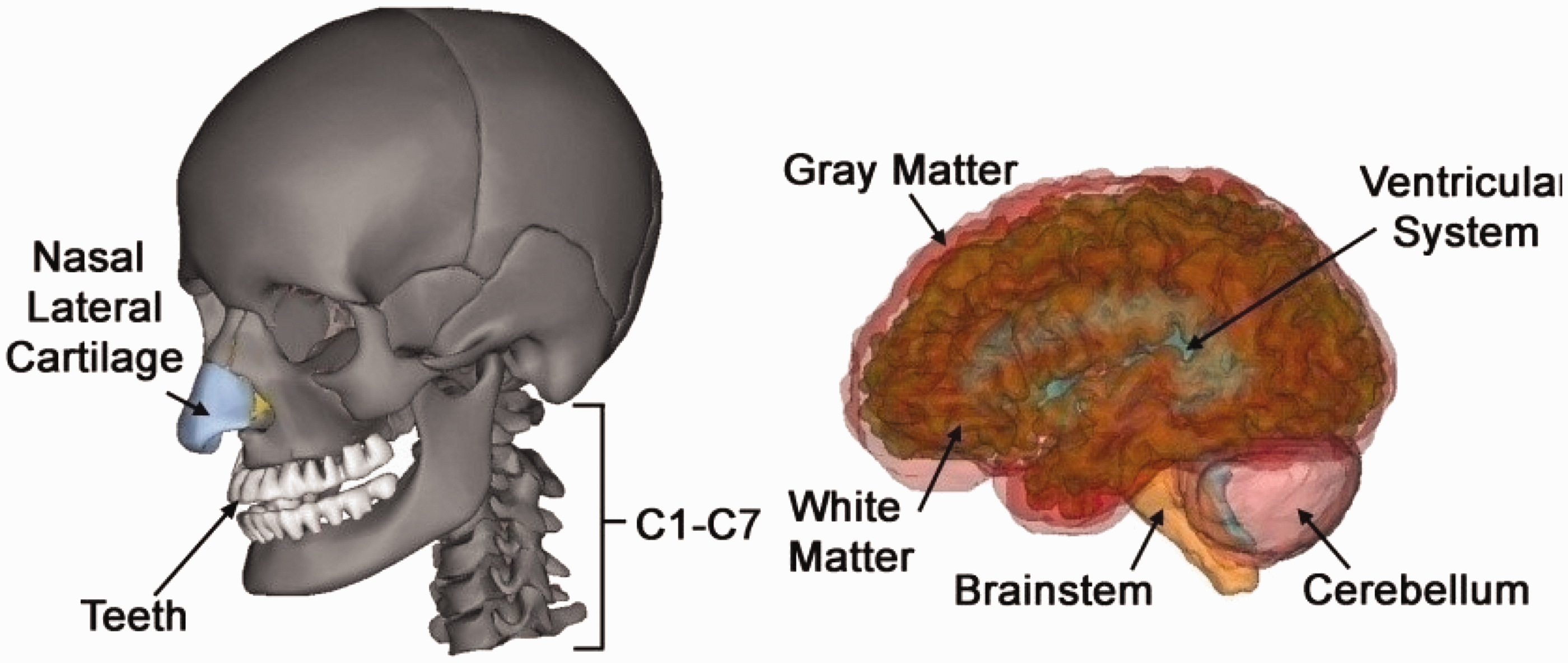
Various components of the human head–neck segmented from CT and MRI data.
An adaptive semi-automatic meshing technique is then utilized to optimize between element quality and computation efficiency with Hypermesh software. Further mesh reparation is executed to get ready for 3D mesh generation. In spite of the cavity-dominant skull’s complex geometry, it is possible to hexahedrally mesh model utilizing isomorphism technique. The surface mesh nodes of the head–neck model are restricted with six degrees of freedom. Before analyzing the numerical results obtained with the finite element method, the reliability of the numerical results themselves could be guaranteed. The head–neck finite element model was validated against intracranial pressure data of Nahum et al.’s21 cadaver experiments, with some that was validated against extra pressure history information for Trosseille et al.’s22 long duration impact. Further, the finite element head model was validated against relative displacement information between brain and skull supplied by Hardy et al. 23 Overall results that were acquired in the validation showed improved biofidelity that was in relation to former finite element models.
Resonance behavior of the finite element model
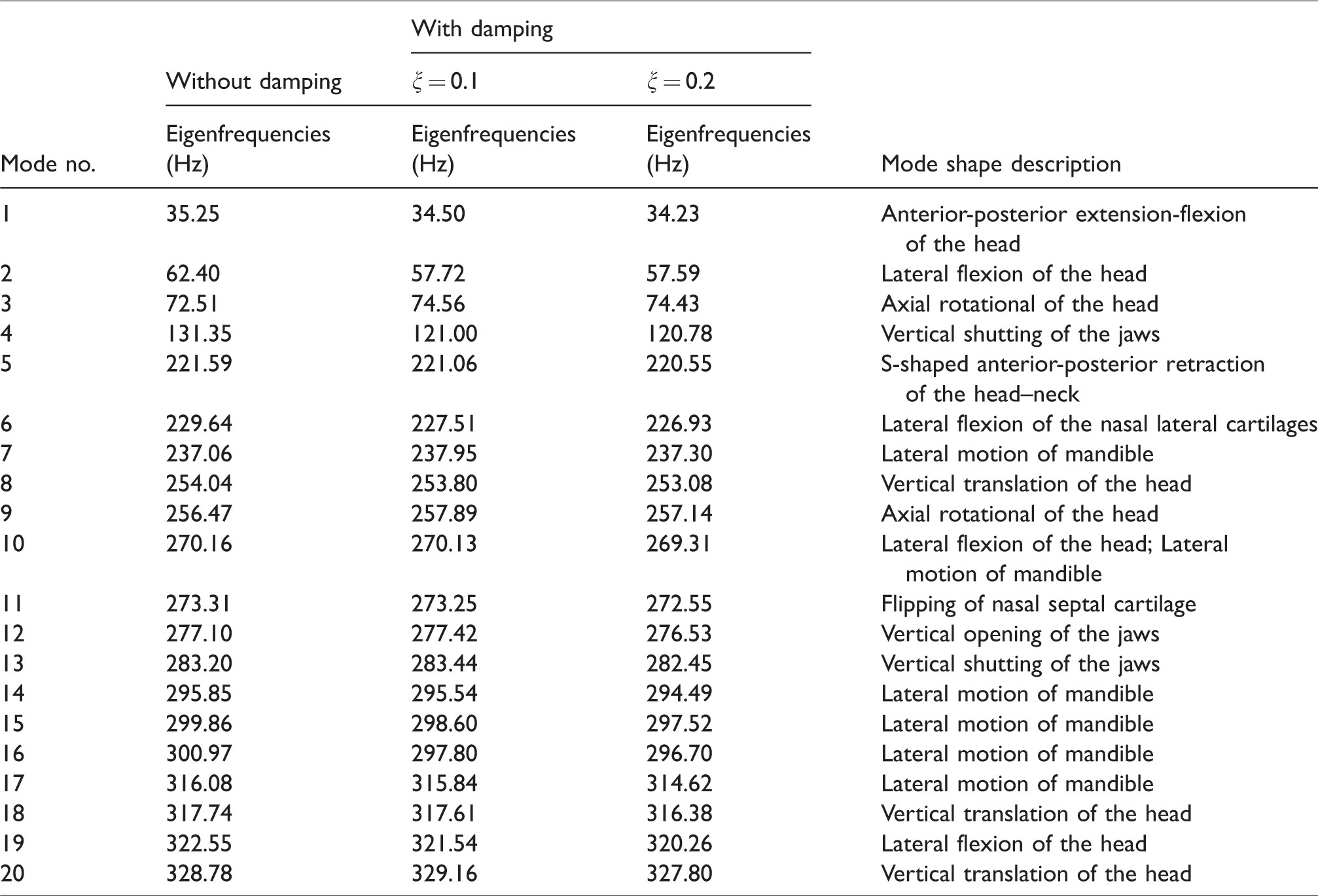
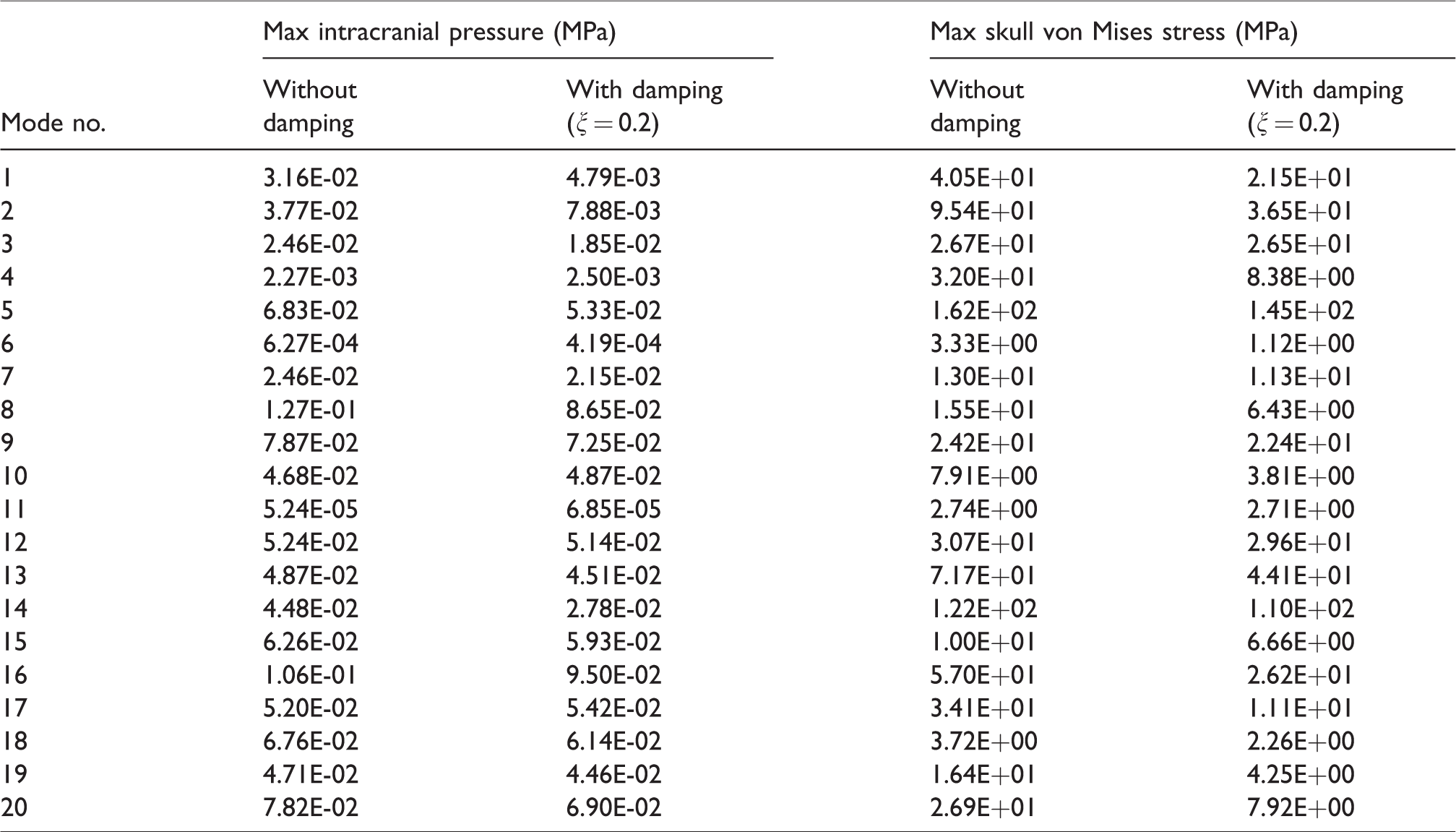
Associated vibration shapes and 20 resonant frequencies are acquired in the range of 35 Hz to 330 Hz (Figure 2 and Table 1). Frequency spectrum is listed in Table 1, with their first resonant frequencies at 35.25 Hz, 34.50 Hz, 34.23 Hz, and 33.38 Hz. Additionally, there is a slight variation in the resonant frequencies between both damped free vibration scenarios and the undamped (Table 1). Within the 20 mode shapes, five various vibration shapes of the head–neck complex are illustrated: the nasal lateral cartilages’ lateral flexion as well as the lateral translation of the mandible, which predominate after the head–neck structure’s chief modes within its first twenty modes, are discovered. The mode shapes for the damped vibration cases are the same as that of the undamped, apart from the difference in biomechanical parameters such as displacement, intracranial pressure as well as skull von Mises stresses (Table 2). Table 2 also indicates the locations of peak skull stress and peak intracranial pressure corresponding to each mode.
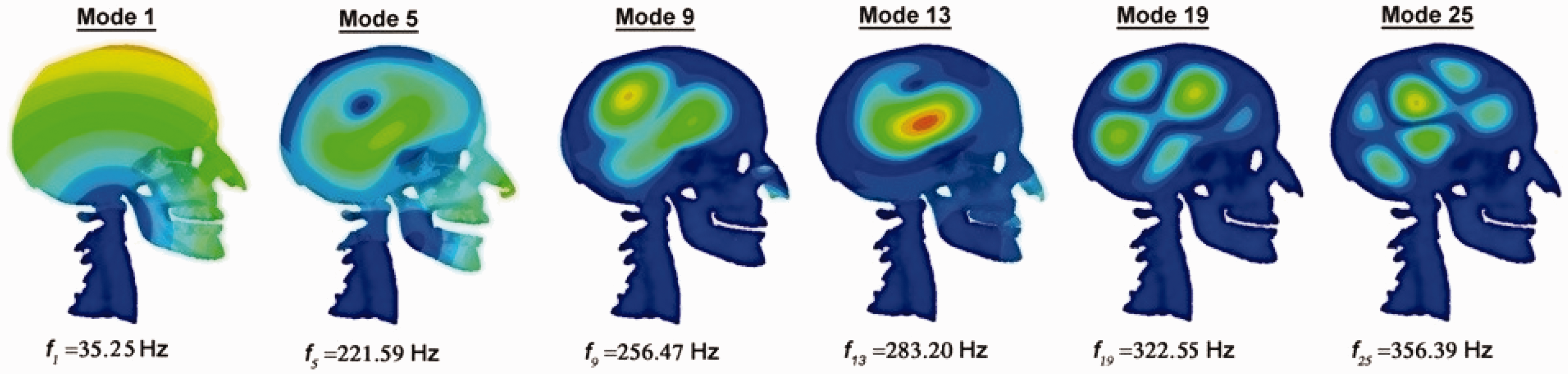
The displacement contour plots of the head–neck model.
Vibration responses of the finite element head–neck model.
Peak skull stress and peak intracranial pressure in both undamped and damped cases.
Discussion
As illustrated in the midsagittal view of the head–neck model’s displacement contour plots (Figure 2), the first two resonant modes happen at 62.40 Hz and 35.25 Hz with the minimal and maximal displacements at the top of the head–neck junction and the head individually. These probably correspond to the entire head's axial elongation. The third mode, which happens at 72.51 Hz, has principal displacements at the rear and front of the head–neck complex, being similar to the head’s longitudinal elongation. It can be found that the head–neck finite element model is more compliant to both the axial rotation about its neck in the third mode and the front-and-back flexure in the first two modes. It is revealed in these displacement plots that the whole head–neck resonate in collaboration in the first three modes. It is then followed by various components’ resonance in the head; the brain resonates at the higher modes while nasal lateral cartilages and mandible resonate at the lower modes. An interesting point to be paid attention to is that displacement contour’s more loops come into sight in the brain for higher frequency modes, likely showing the shearing, torsional or twisting modes within the brain tissues. It appears that rotational traumatic brain injury because of “shearing of brain tissues occurs mainly in the higher frequency modes while translational brain injury occurs in the lower frequency modes”. 24
Most of the published documents showed frequency spectrum of human head using traditional frequency extraction approach ignoring the influence of damping. As previously noted, three damps factors are involved in this complex eigenvalue problem. It is expected that resonant frequencies lower with the damping factor increases. An important fluctuation in the resonant frequencies is mentioned between both the undamped and damped free vibration, particularly in the lower modes where several components’ resonances coexist. As each individual part resonates on its own in the temperate modes, this distinction between damped cases and undamped falls down. Nevertheless, as the mode number rises further, this difference appears to be broadened by a growth in damping factor in all likelihood owning to the complex combination and addition of shearing, torsional and bending modes within the brain tissues in the higher modes. In Table 1, the third undamped natural frequency (72.51 Hz) is lower than the damped natural frequencies (74.56 Hz and 75.43 Hz), that also happens at different modes (7th, 9th, 12th, 13th, and 20th modes), this could be due to the modeling issues or because the system has various components included, and the approach in modeling and material characteristics is more probably to owing to the discrepancy.
With regard to the biomechanical parameters, such as intracranial pressure as well as skull von Mises stresses, damping appears to have important influence on their significances at special modes (Table 2), the introduction of damping in the complex eigenvalue analysis has reduced both maximal skull stresses and the maximal intracranial pressure tremendously, of up to 84.8% and 74.1% respectively, in special modes (Table 2 and Figure 3). These modes with the maximal deviance in vertex intracranial pressure and skull stresses between the damped models and undamped are discovered and illustrated in Figure 3. It is showed that vertex intracranial pressure differs the most in the first few modes when the head–neck flexes or rotates the most as well as in the subsequent modes (14th, 16th, 20th, 21st, and 23rd modes), therefore making the cranium to be moved the most with regard to the brain. The skull–brain relative movement, as previously, brings about intracranial pressure gradients. 25 It is likewise noticed that the skull head’s vertex stress deviates the most in the modes in which the neck undergoes the highest stresses. The “over-stiff” neck in our model on account of the lack of muscle tissues and ligaments may bring about overestimated vertex stresses in the undamped mode. These parameters, nevertheless, are dropped in the damped cases as a result of the coupling between the stiffness matrix and the damping matrix. The significance of identifying the pertinent damping factor in reckoning biomechanical responses in dynamic analyses is evaluated. It ought to be mentioned that this damping influence gets saturated while damping factor is above 0.2, implying that further damping would not have had an effect on the biomechanical responses. Ever since increasing damping factor to the value above 0.2 is discovered to have got amplifying influence in lessening effect and diminishing frequencies of higher modes in lowering peak biomechanical responses, consequently, it is concluded that there is a reverse proportionality between damping influence on natural frequency and that on biomechanical responses.
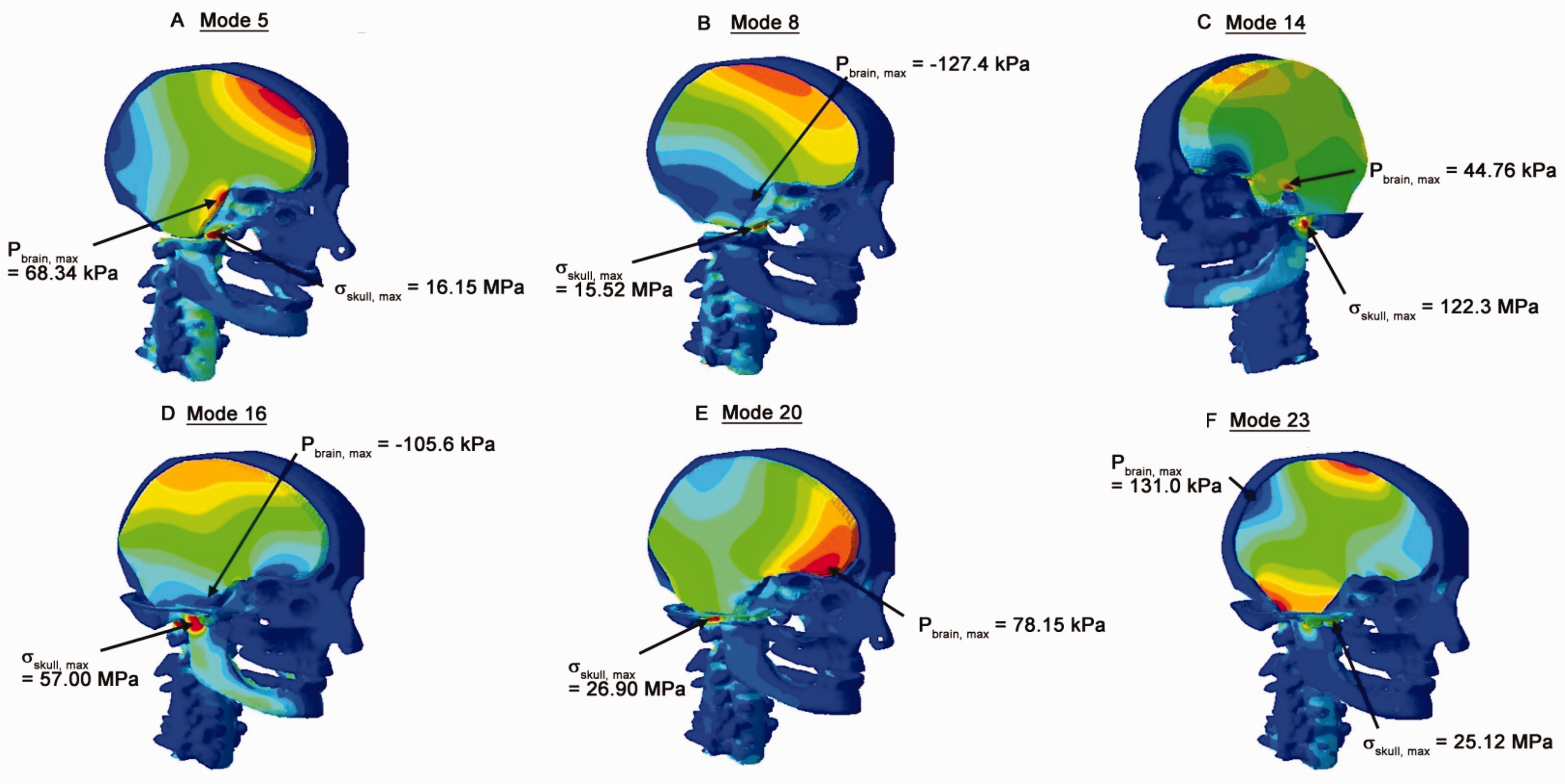
Multiple biomechanical responses’ contour plots of the head–neck model.
Meyer et al.’s16 finite element research is selected for comparison of the modal responses. Our computed fundamental frequency is 35.25 Hz when Meyer et al. 16 discovered that the principal frequency is 3.01 Hz. This discrepancy in the cardinal frequency emerges between the two finite element head–neck models, probably because of the distinction in material characteristics and the approach in modeling, and the approach in modeling is more probably owing to the discrepancy. With the prioritized focal point on the neck harm, the head and all the cervical vertebrae of Meyer et al. 16 were regarded as stiff bodies, with all the individuals’ inertial moment and masses being considered. Simply the intervertebral discs were regarded as deformable bodies. On the other hand, all the components in our finite element head–neck model are regarded as deformable bodies with the capability to disperse outside energy source by means of deformation. Additionally, unlike the rigid head of Meyer et al., 16 our finite element head model consists of subarachnoid area (including cerebrospinal fluid and membranes), skull, cartilages as well as brain tissues. By having the diverse different components in the head model, particularly with sticky intracranial content’s lumped mass, it is expected that the key frequency of the multi-components system will be lower than that of a one-component system as extra natural frequencies. This phenomenon is consonant with comments by Chu et al. 15 and Guarino and Elger. 26
Conclusions
Vibration characteristic simulation, in terms of vibration shapes and frequency spectrum, of the finite element model of human head–neck under vibration have been simulated. Rarely reported modal responses such as “mastication” and flipping of nasal lateral cartilages modes are introduced. These additional modes may be of interest to clinicians or surgeons who are specialized in rhinoplasty or temporomandibular joint disorder. The influence of damping on modal responses utilizing nonconventional complex eigenvalue analysis is also investigated. Damping has a trade-off influence on lessening the resonant frequencies as well as on reducing the vertex biomechanical responses.
Footnotes
Acknowledgment
BY, ZS and QW contributed equally to this study and share the first authorship.
Declaration of conflicting interests
The author(s) declared no potential conflicts of interest with respect to the research, authorship, and/or publication of this article.
Funding
The author(s) disclosed receipt of the following financial support for the research, authorship, and/or publication of this article: This study was supported by the Natural Science Foundation of Jiangsu Province, China (Grant No. BK20161522), Six Talent Peaks Project in Jiangsu Province, China (Grant No. JXQC-023), the State Laboratory of Advanced Design and Manufacturing for Vehicle Body (Grant No. 31415008), and Chinese Postdoctoral Science Foundation (Grant No. 2015M572243).