




Abstract
In industrial and architectural applications, noise can be controlled using sound-absorbing materials. Natural materials are now gaining importance in the noise control engineering as they have advantages like low cost, eco-friendly, easy to produce, etc. Jute is one of such natural materials, which can be used as a sound-absorbing material. Micro-perforated panels along with three different types of jute felts are used in a multilayer sound absorber configuration to improve its sound absorption. The sound absorption performance of these multilayer sound absorbers is evaluated by using the transfer matrix method and experimental method. Dependence of sound absorption performance on the placement of micro-perforated panels in a multilayer sound absorber is also studied. It is observed that the sound absorption performance depends on the position of micro-perforated panels in a multilayer sound absorber.
Introduction
In recent years, noise control has gained tremendous importance due to reasons like strict government norms regarding noise radiation level from transport vehicles, acoustic comfort level of product while in operation, increased concern about noise pollution, etc. Therefore, noise control is an important issue in all engineering applications.
The use of natural fibers like sisal, banana, and coir has increased recently as they have huge potential for their use as sound-absorbing material. 1 Asdrubali et al. have presented an extensive review on the use of acoustical properties of sustainable materials for noise control applications2,3 and demonstrated the use of recycled rubber granules in sound absorption. 4 The potential of jute materials in acoustical applications has been explored first by Fatima and Mohanty. 5 They have experimentally studied the sound absorption characteristics, sound transmission characteristics, and fire retardant properties of jute fiber-based composite material. Furthermore, they also have demonstrated the application of jute in many products such as domestic cloth dryer, refrigerator, vacuum cleaner, etc. as a sound barrier or sound-absorbing material. 6 Jute is a cheap, abundantly available biodegradable material in India, and thus can be used as an effective noise control material.
Synthetic sound-absorbing materials like glass fibers, polyesters, and polyurethane foam have hygiene-related issues. Both natural fibers and synthetic fibers are subjected to erosion, moisture, fire, etc., when put in operation and so their sound absorption performance may deteriorate. To overcome these problems, micro-perforated panel (MPP) with an air gap is used. MPPs are known as the next generation sound-absorbing material which are mainly used as broadband sound absorber in architectural applications.7,8
Delany and Bazley 9 have presented the empirical equations for the prediction of the characteristic impedance and propagation constant of porous materials based on a large number of experiments performed on the fibrous material. Miki 10 presented the equations of the Delany and Bazley model in a modified form and formulated empirical equations for the prediction of the characteristic impedance and propagation constant of porous materials. Berardi and Innace 11 have used the inverse optimization method to obtain the coefficients in the Delany and Bazley model for natural materials like kenaf, wood, hemp, coconut, straw, cane, cardboard, sheep wool, and cork. They have also reported the applicability of natural fibers in the mid- and high-frequency range sound absorption.
Fouladi et al. 12 analytically studied the absorption coefficient of a multilayer structure in the form of coir fiber, air-gap, and MPP using acoustic transfer analysis and validated with the experimental results obtained from impedance tube measurement. Fouladi et al. 13 studied the acoustical properties of coir fiber analytically using the model of Delany and Bazley, Biot,14,15 and Allard et al. 16 and experimentally using impedance tube. Recently, Ying et al. 17 experimentally evaluated the sound absorption performance of a multilayer sound absorber consisting of layers of coir and kenaf fiber. This multilayer sound absorber improved the low-frequency sound absorption of the coir fiber.
Maa18–20 did pioneering work in MPPs and developed the equation for specific acoustic impedance of each hole of panel. Lee and Kwon 21 estimated the acoustic performance of multilayer perforated panel system using the transfer matrix method. 22 They studied the effect of dimension and arrangement of perforated panels on acoustical performance and verified the method with the experimental result. Congyun and Qibai 23 proposed a theoretical method for calculating the absorption coefficient of a multilayer absorbent consisting of perforated plates, air gaps, and porous layer by using electro-acoustic analogy and validated this method experimentally. Recently, Pieren and Heutschi 24 demonstrated the equivalence of the equivalent circuit method and the impedance transfer method for the prediction of sound absorption of lightweight multilayer curtains. Sakagami et al. 25 studied the absorption characteristics of single-leaf MPP absorber backed with a rigid wall with a porous absorbent layer in the cavity using electro-acoustical equivalent circuit model. They found that addition of absorbent layer with suitably adjusted resistance widens the absorption frequency range by additional damping provided by porous absorbent. Vigran 26 experimentally investigated transmission loss of perforated plates and their combination with porous material and compared the results obtained by the method of impedance tube using full transfer matrix method of acoustic element and wave decomposition method. The author found that these two methods gave identical results and agreed well with the theoretical results obtained from the transfer matrix method. Herrin et al. 27 applied MPP with porous material as a liner in the design of an enclosure and predicted the absorption performance using the transfer matrix method and validated experimentally.
In this study, the normal incidence sound absorption of a multilayer sound absorber composed of MPP, jute felt, and air gap is evaluated by using the transfer matrix method and measured by impedance tube. The results of the transfer matrix method and experimental result for different configurations of multilayer arrangement are presented.
Material
Jute material is a natural porous material. It is mainly available in the form of non-woven felts. These felts are categorized based on its thickness, bulk density, and grams per square meter. The details for the three types of felts are given in Table 1. The samples of 100 mm diameter for Type 1, Type 2, and Type 3 felts are indicated in Figure 1.
Categorization of jute felts.
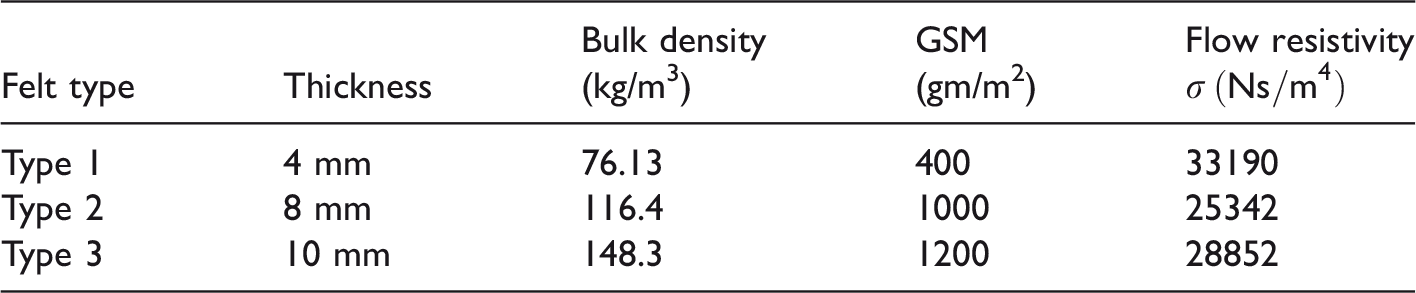
Note: GSM: grams per square meter.
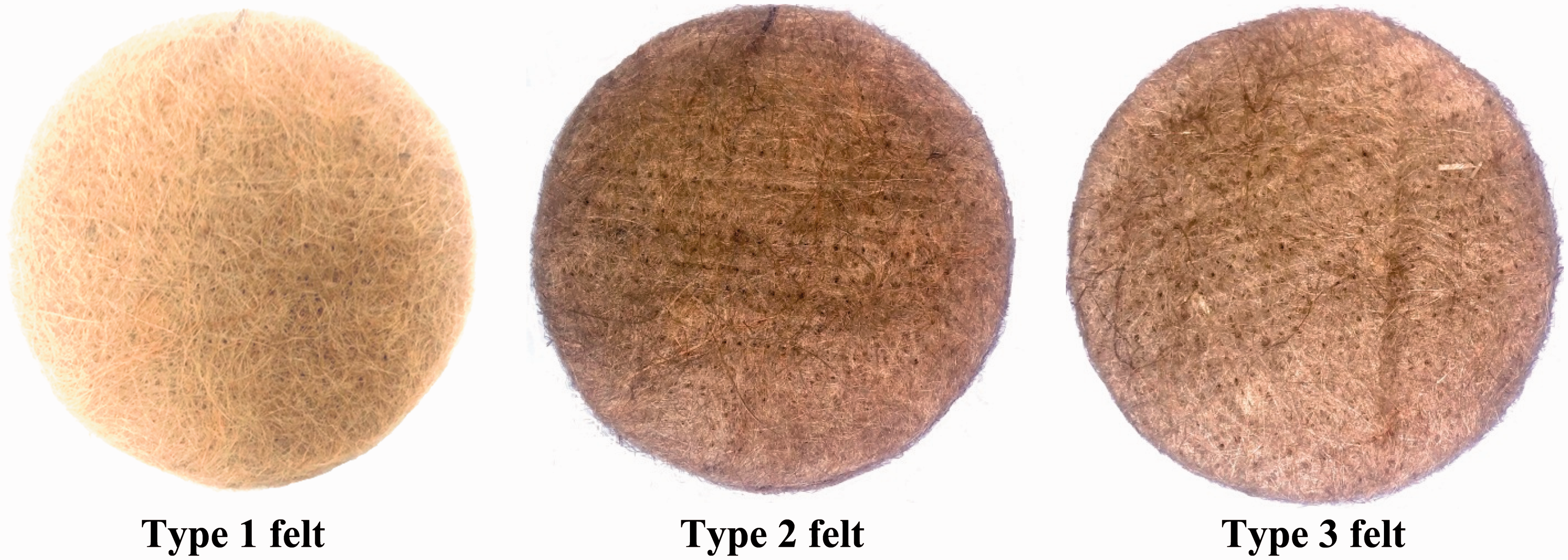
Types of jute felts.
The optical microscopic images of Type 1, Type 2, and Type 3 felts are shown in Figure 2, which indicates fiber diameter of jute felt. The fiber diameter range for jute fiber in all three types of felts is 20–40 µm.
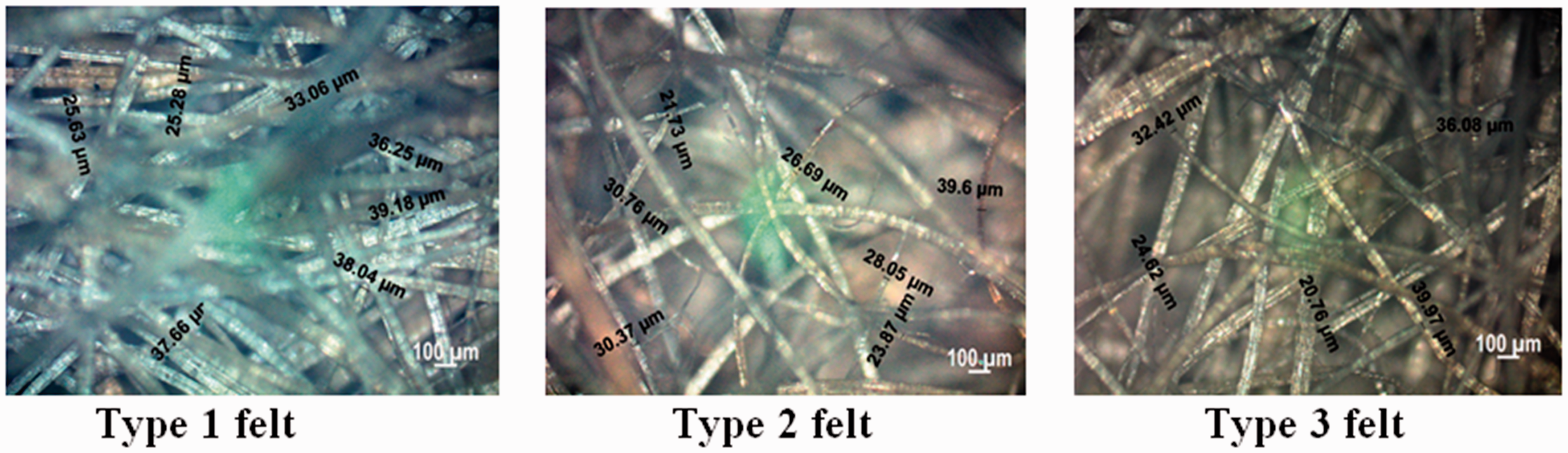
Optical microscope images of the three types of jute felts at 100× magnification.
MPPs used in this study are made from mild steel plates cut into circular pattern with a diameter of 100 mm which is same as the internal diameter of the B&K impedance tube as shown in Figure 3. The hole diameter is 0.5 mm and spacing between the hole centers is kept as 4 mm. The perforation rate is 1.23%. The thickness of MPP is 1 mm.
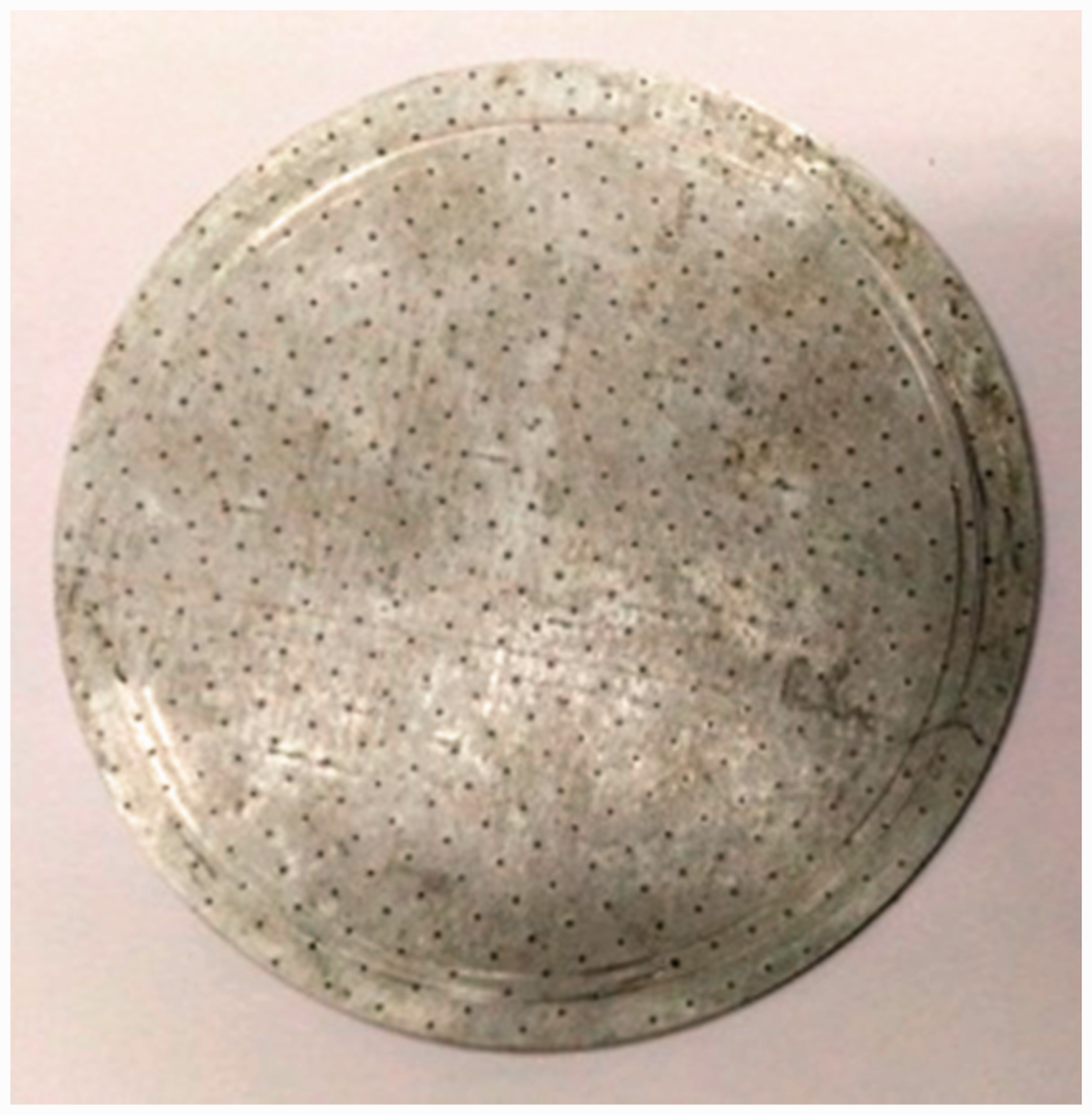
Micro-perforated plate used in this study.
Impedance prediction models
Delany–Bazley–Miki model for fibrous material
Delany–Bazley
9
and Miki
10
generated the empirical model for the prediction of the acoustic impedance of the porous material. The characteristic impedance (z) and the wave number (k) depend on the flow resistivity and frequency.



Acoustic impedance of MPPs
An MPP surrounded by air is modeled using the Maa’s model.18–20 The perforated holes are in the submillimetric size and considered as a parallel connection of the perforated holes. Each perforated hole can be assumed as a short tube. The common layout of MPP with the air back and rigid backing is shown in Figure 4.
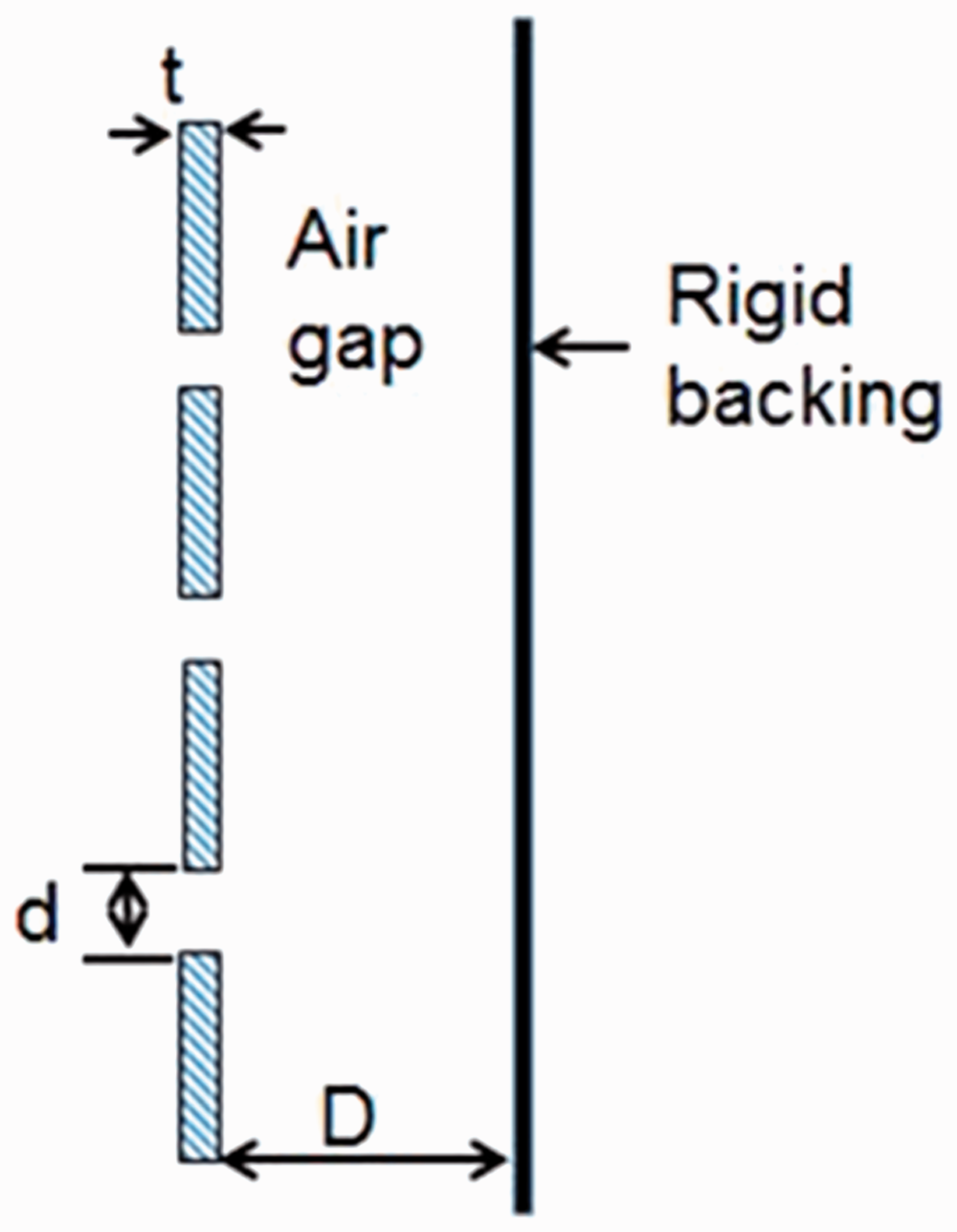
MPP backed by air cavity.
Rayleigh
28
first developed the model of sound transmission through such short tubes. Crandall
29
modified this model by considering tube as short compared to the wavelength and taking into account the viscous effect inside these short tubes. The specific impedance of the short tube is calculated as the ratio of the pressure difference 
According to the Maa theory, the impedance of the MPP is given by
20



Experimental study
Measurement of the sound absorption of multilayer sound absorber
The normal incidence sound absorption coefficient of multilayer sound absorber is measured with B&K 4206 impedance tube as shown in Figure 5 using the transfer function method. The measurement is performed as per the ISO standard 10534-231 using the transfer function between two B&K 4187 microphones. Samples of jute felt and MPP are prepared with a diameter of 100 mm which are same as the internal diameter of the tube. The multilayer sound absorber is arranged in the required configuration. Then the normal incidence sound absorption coefficient is measured in the frequency range from 50 Hz to 1600 Hz.
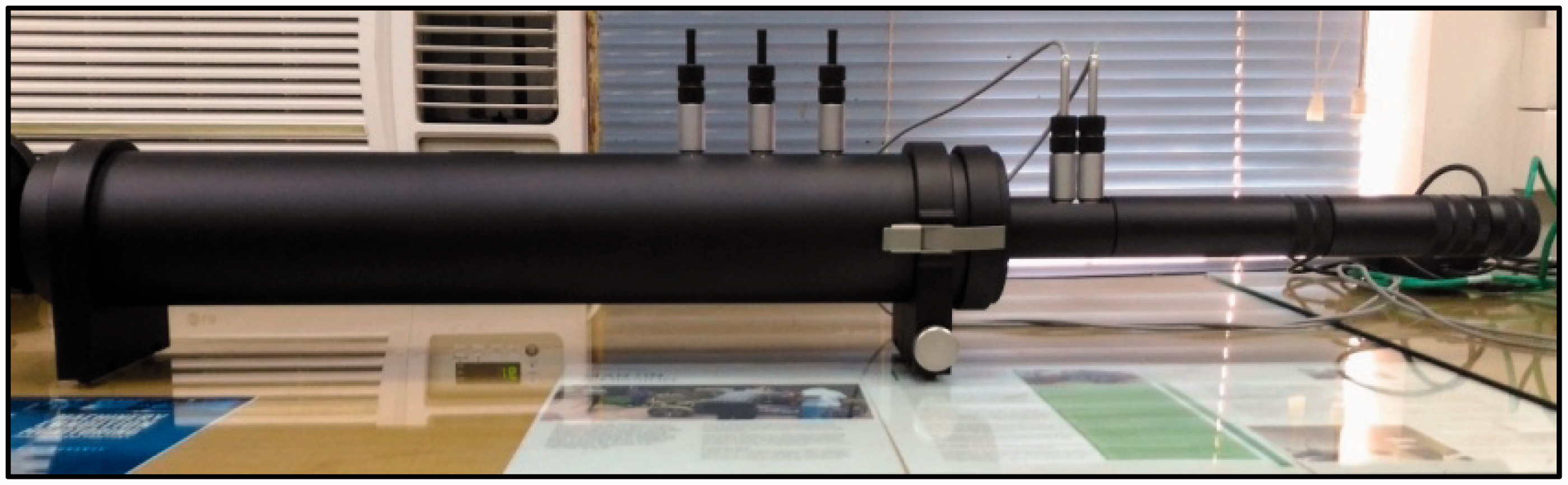
Impedance tube set up for measurement of sound absorption coefficient.
Measurement of air flow resistivity
The air flow resistivity is an important non-acoustical parameter of fibrous material. It mainly governs the sound absorption property of fibrous material. The flow resistivity 
Acoustic performance of multilayer sound absorbers
The transfer matrix method (TMM) is used for the prediction of the acoustic performance of multilayer sound absorbers. Sound waves in the impedance tube are always assumed as stationary plane waves propagating in the air. If the plane wave propagates along the x-axis, the complex acoustic pressure p(x.t) and the associated particle velocity v(x.t) of the medium are given by


The transfer matrix method predicts the acoustic indicators for multilayer structures containing n number of layers. Each layer is assumed to be of infinite transverse dimensions. The total transfer matrix of the system is obtained by the multiplication of the transfer matrix of individual elements. Elements of the transfer matrix are derived assuming the continuity condition of pressure and velocity on each side of a layer.
For one-dimensional acoustical element as shown in Figure 6, the transfer matrix is given as

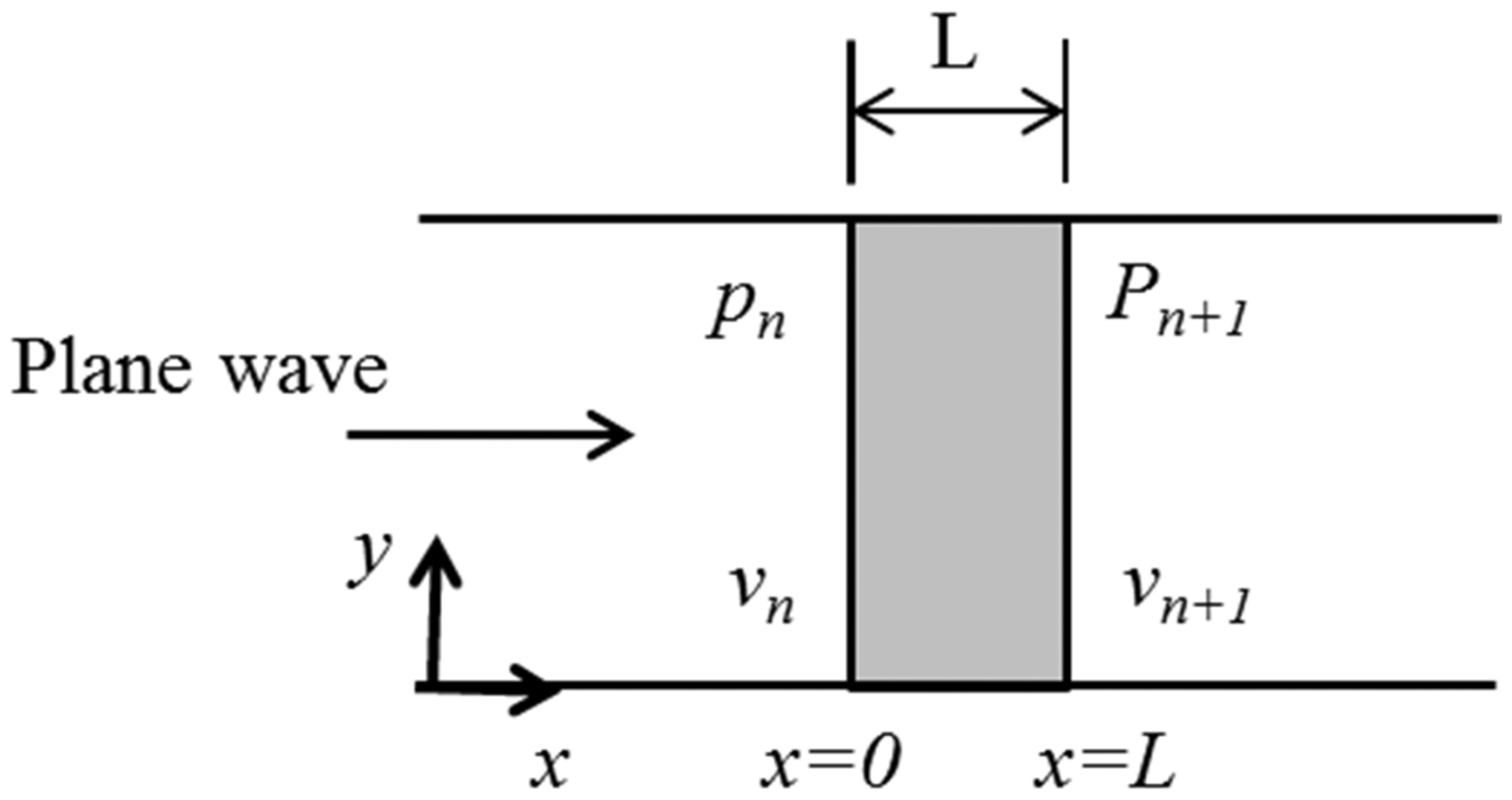
One-dimensional acoustic element.
For air layer, transfer matrix is given by
22

The normal incidence transfer matrix for a fibrous material which can be considered as either limp or rigid frame and of finite thickness is given by
22


The total transfer matrix is a multiplication of the transfer matrix of the individual layer in sequence. For example, for sequence of porous material/MPP/air gap, the total transfer matrix is given by

If T11, T12, T21, and T22 are the elements of the total transfer matrix [T], then assuming the rigid termination, the normal incidence sound absorption coefficient α is given as

Results and discussion
In this study, three different types of jute felts as listed in Table 1 are used. Their thickness, density, and flow resistivity values are also indicated in Table 1. Three types of jute felts deliver different sound absorption performance as their density is different. Experimentally measured normal incidence sound absorption performance for three types of jute felts is illustrated in Figure 7. It is evident from the result that the sound absorption performance of Type 3 felt is better as compared with Type 1 and Type 2 felts.
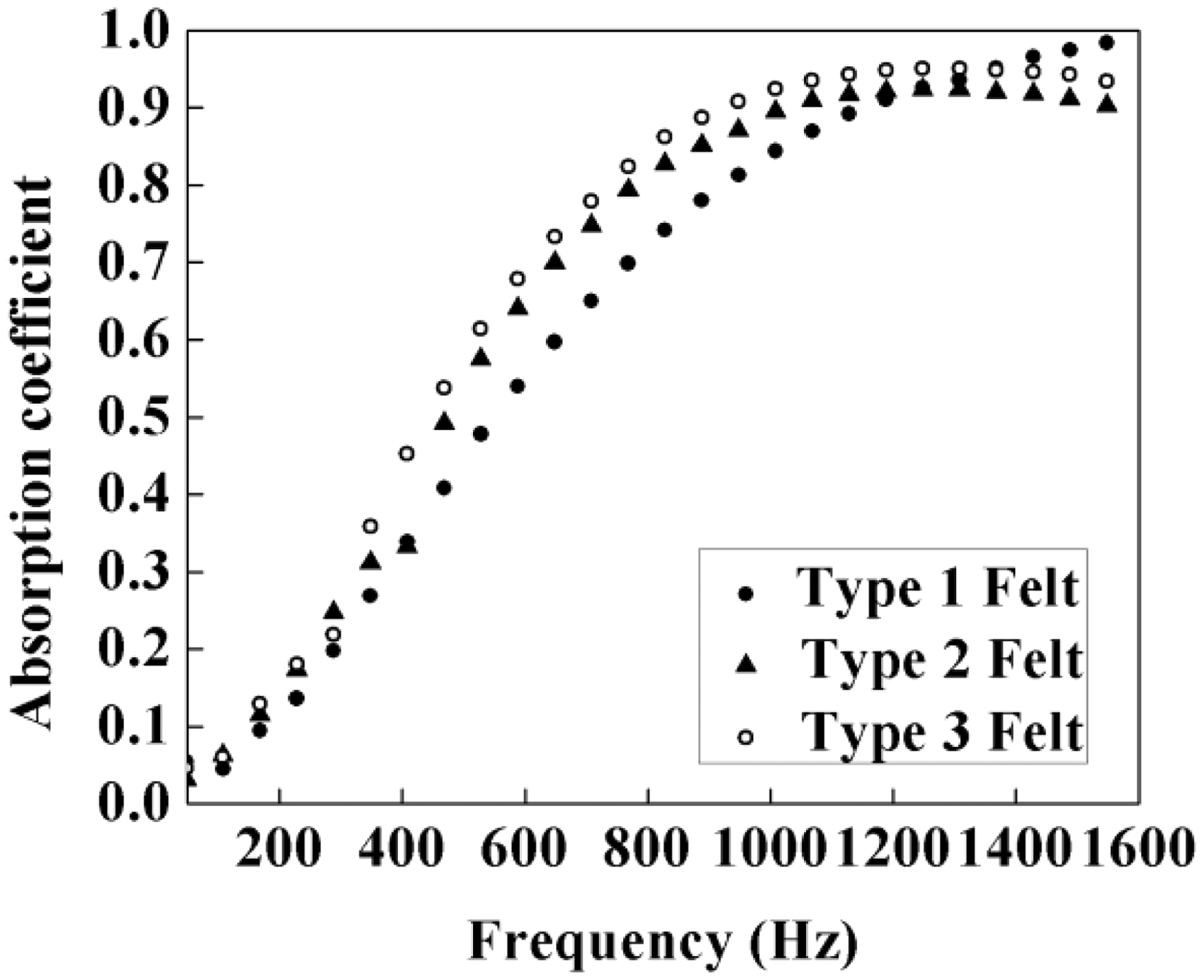
Measurement of normal incidence sound absorption performance of the three types of jute felts.
The sound absorption mechanism of porous material and MPP is different. Porous material absorbs sound by viscous and thermal losses whereas the mechanism of sound absorption of MPP is of resonant type. When MPP is backed with the porous material layer, it gives sound absorption over broader frequency range, but still it remains resonant type. 33 Figure 8 shows the experimental sound absorption results of the sound absorber composed of 25 mm thick jute felt layer with and without MPP. It is clear that the addition of MPP over jute felt layer significantly enhances the sound absorption over broader frequency range. Therefore, MPP helps to improve the sound absorption performance in the low- to mid-frequency region. As the sound absorption performance of MPP can be tuned, it is possible to shift the sound absorption peak towards lower frequencies. Hence, MPP provides good results in low-frequency sound absorption.
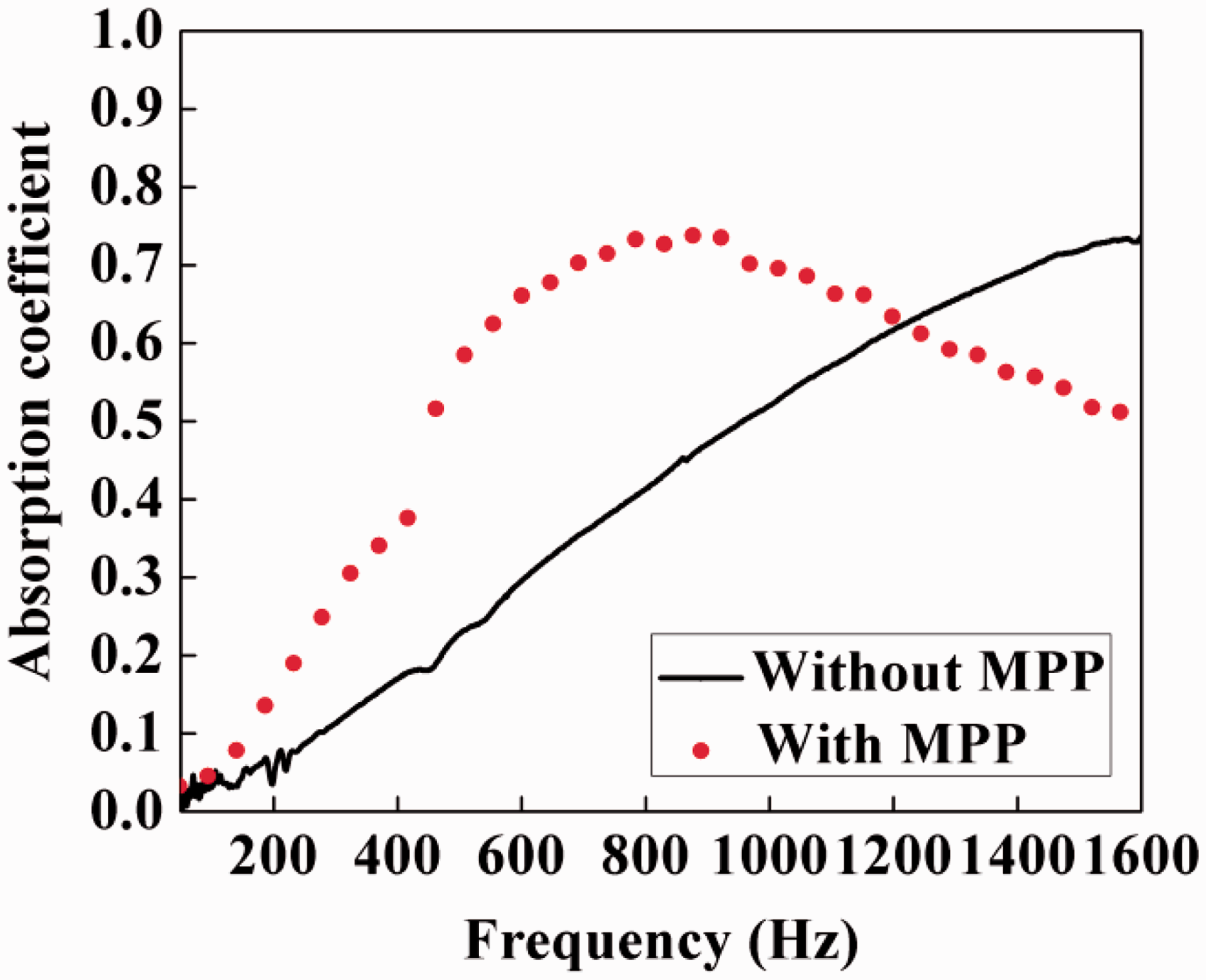
Measurement of normal incidence sound absorption performance of jute felt with and without MPP.
Normal incidence sound absorption coefficient of a multilayer structures consisting of MPP, jute felt, and air gap combinations is experimentally measured using B&K 4206 impedance tube. Different configurations of a multilayer sound absorbers studied in this paper are represented in Figure 9. In configuration I, MPP is backed with jute felt and air gap and terminated with rigid backing, while in configuration II jute felt is backed with MPP and air gap and terminated with rigid backing. Three different types of jute felts are used in multilayer sound absorber configurations and its effect on sound absorption is studied experimentally and theoretically. When MPP is subjected to different end conditions, i.e., when surrounded by air or porous material, the difference caused in sound absorption coefficient because of these end conditions is negligible. Hence, the Maa model can be employed for porous material backed case without any end correction and gives satisfactory results. 33
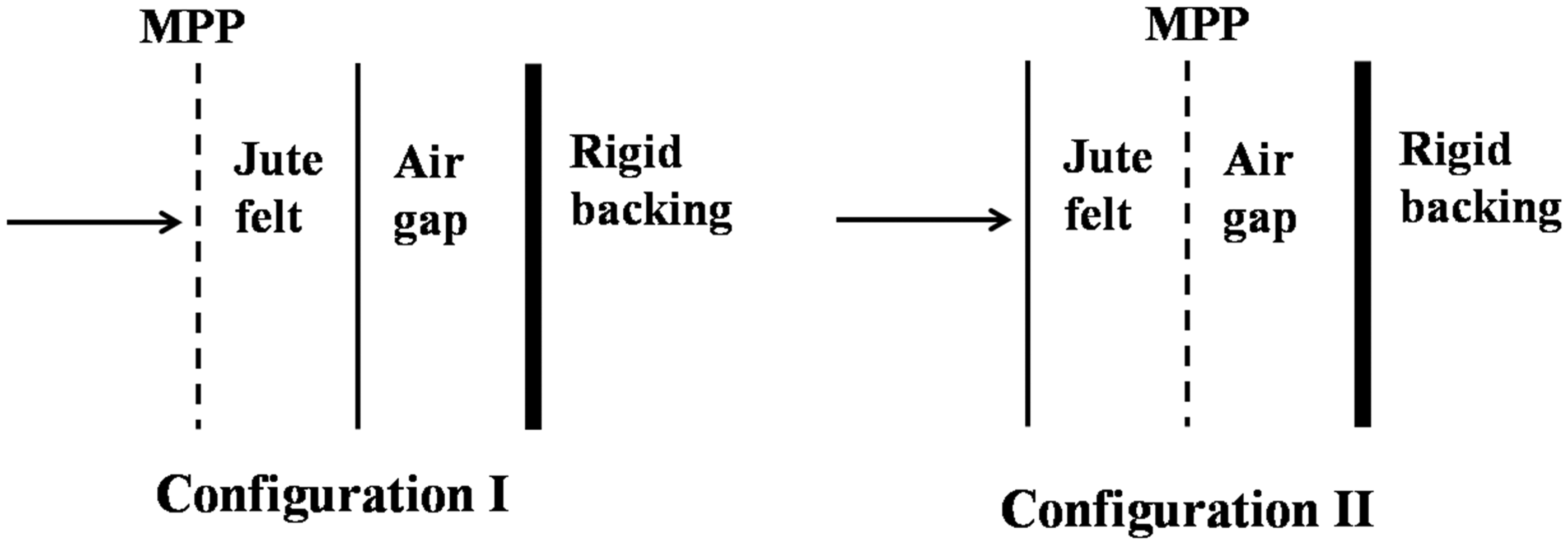
Configurations of multilayer sound absorbers.
Sound absorption of multilayer sound absorber composed of Type 1 jute felt and MPP
Normal incidence sound absorption coefficient of multilayer sound absorber composed of MPP, Type 1 jute felt, and air gap is represented in Figures 10 and 11. In configurations I and II, both the thickness of jute felt and an air gap are changed to study the effect of variation of these parameters on the sound absorption.
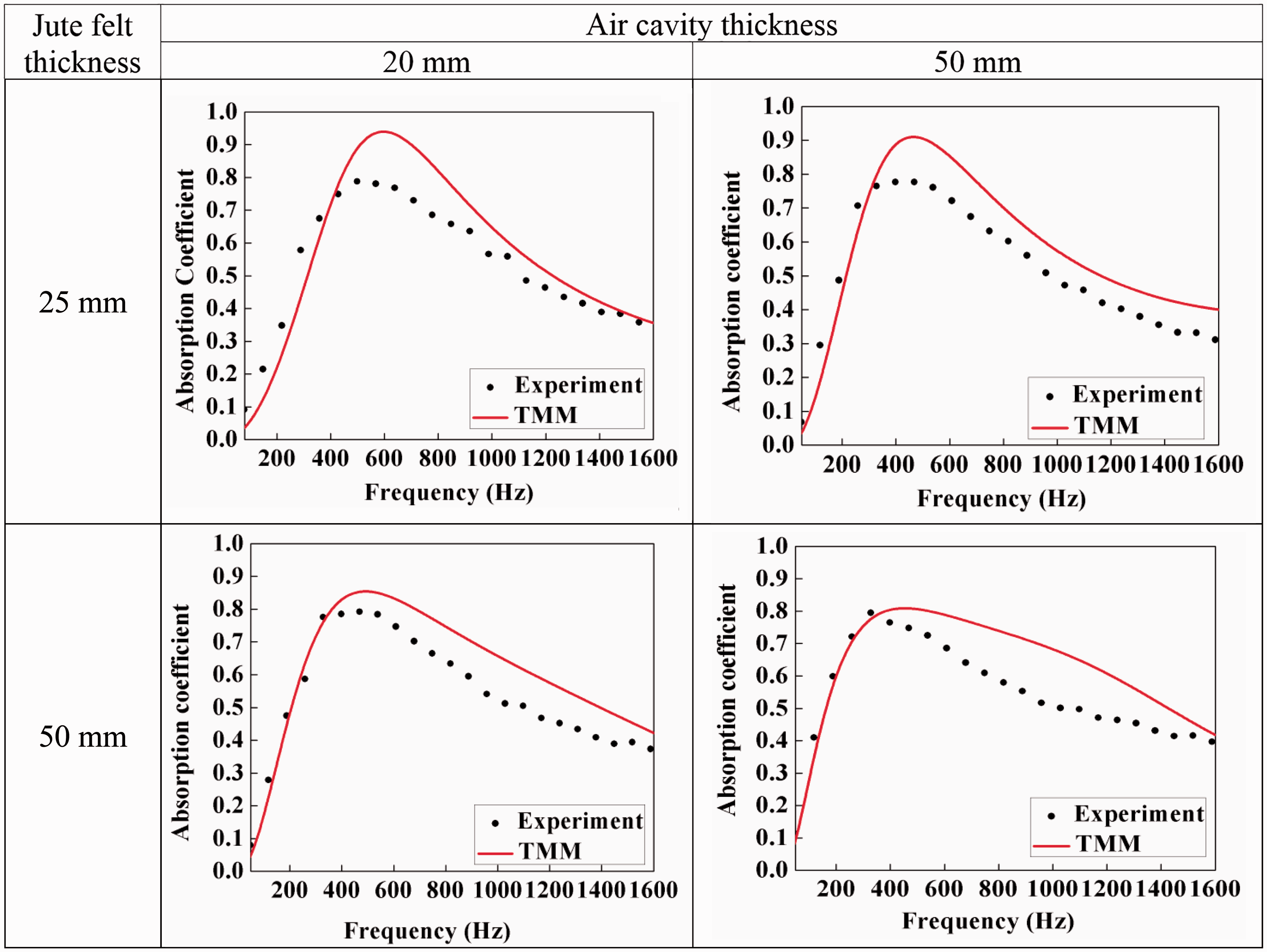
Sound absorption of Type I felt in configuration I.
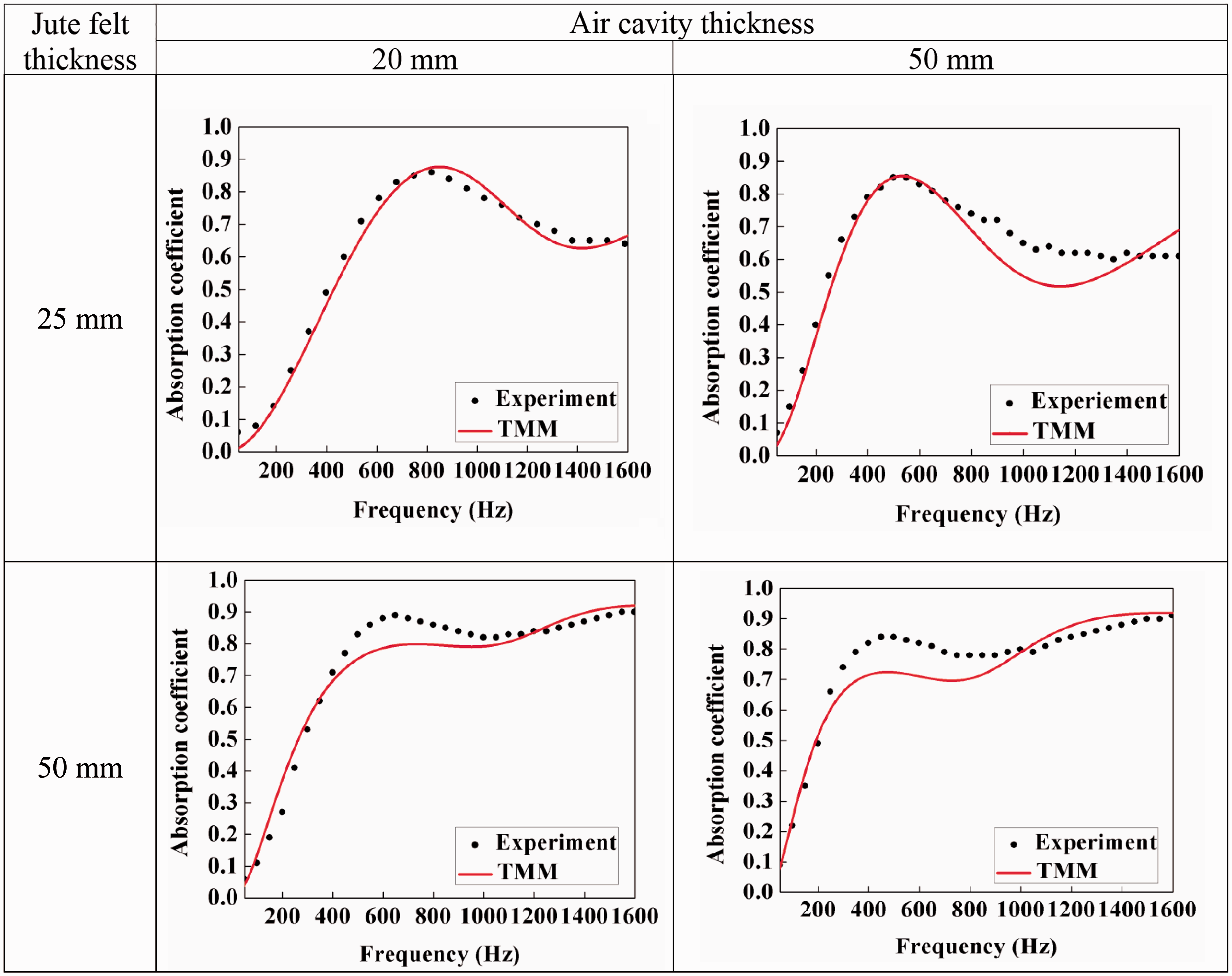
Sound absorption of Type I felt in configuration II.
In case of configuration I, when the thickness of jute felt is increased from 25 mm to 50 mm, the minor reduction in absorption peak due to resonance is observed, but it provides little widening of sound absorption band with slight shifting of this peak towards lower frequencies. In this configuration, MPP is on the incident side of sound waves; therefore, the sound absorption is better towards the low-frequency region. If the perforation rate of MPP is less, most of the incident sound waves will get reflected back and will not reach up to jute felt behind it. In the low-frequency region, there is good matching of the measurement result and TMM results.
In case of configuration II, considerable improvement in the sound absorption is noticed towards the high-frequency region as shown in Figure 11. In this configuration, the felt is on the incident side of sound waves, so most of the high-frequency sound waves get absorbed by the felt before it enters into the MPP. Increase in the air gap thickness shifts the resonance peak due to absorption towards low-frequency region. But increase in the thickness of jute felt shows considerable improvement in the sound absorption towards the high-frequency region.
Sound absorption of multilayer sound absorber composed of Type 2 jute felt and MPP
Normal incidence sound absorption coefficients of multilayer sound absorber consisting of MPP, Type 2 jute felt, and air gap are represented in Figures 12 and 13.
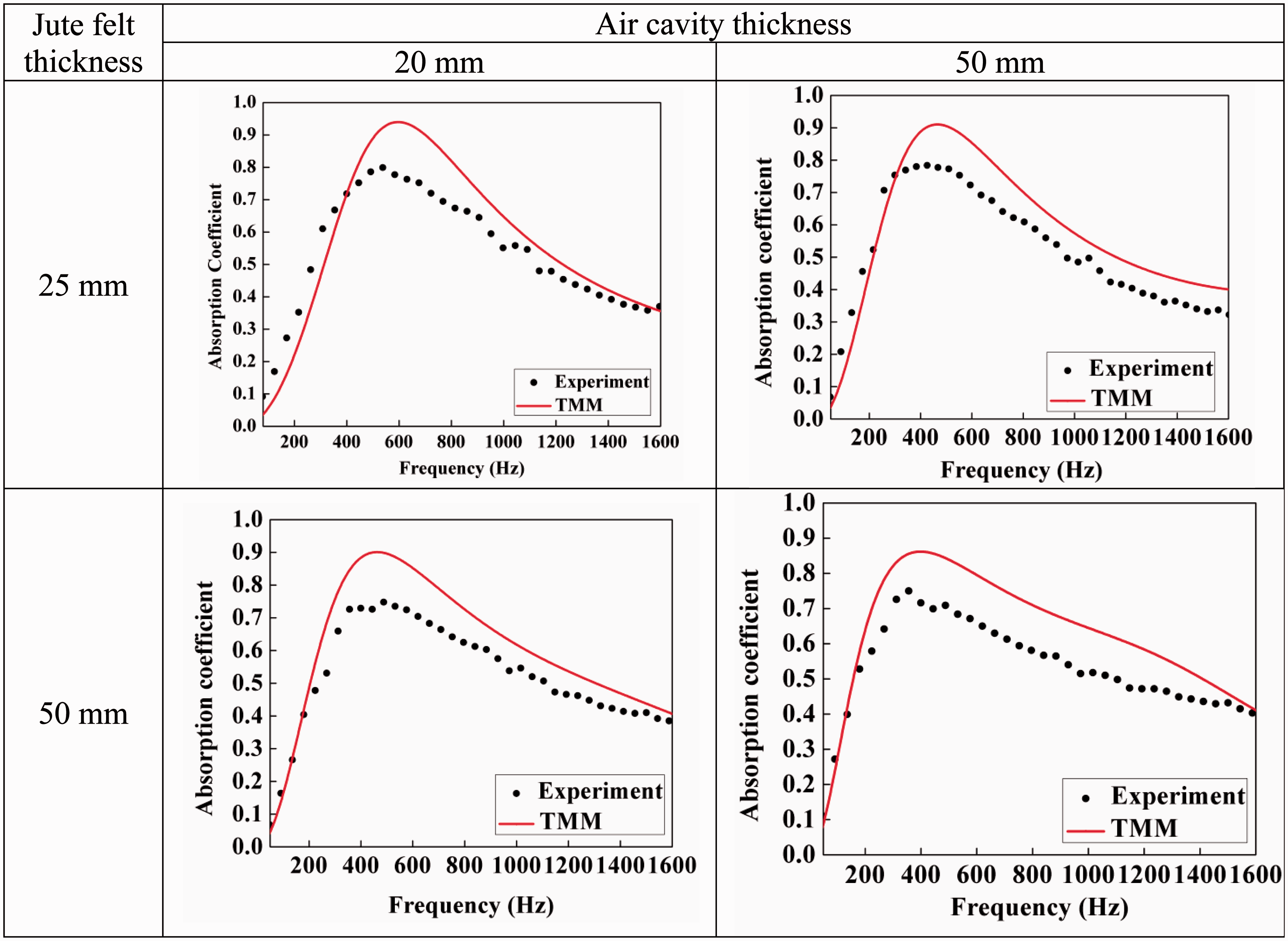
Sound absorption of Type 2 felt in configuration I.
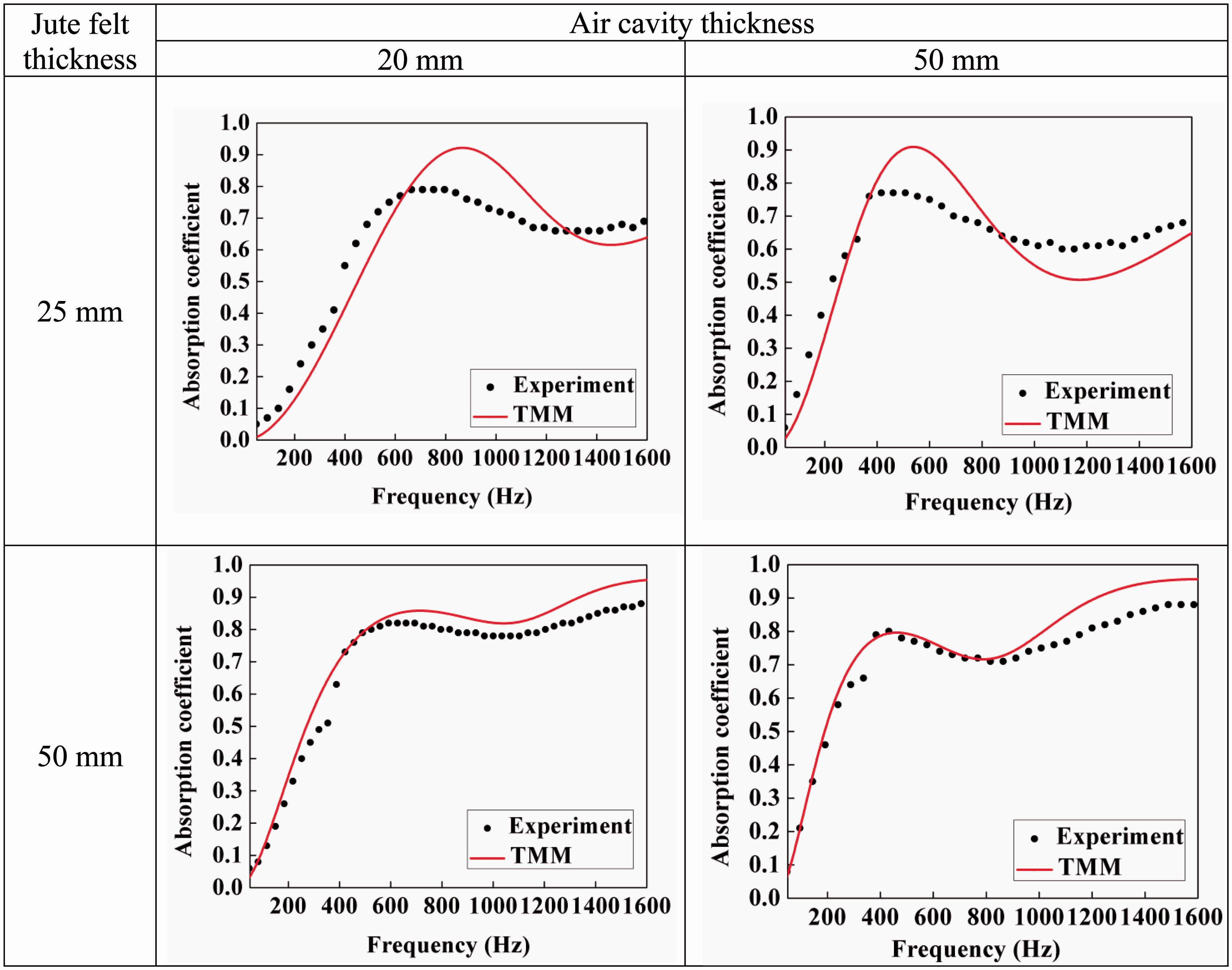
Sound absorption of Type 2 felt in configuration II.
In case of configuration I, when the thickness of jute felt is increased from 25 mm to 50 mm, there is no noticeable difference in the peak of sound absorption. In this configuration, MPP is on the incident side of sound waves. Therefore, most of the sound energy is converted into heat due to the friction between the air and inner surface of the holes. Sound absorption peak can be seen around 500 Hz, and about 70% of the incident sound got absorbed in this configuration. Up to 400 Hz frequency good matching between the measured and TMM results can be found.
In case of configuration II, when the position of MPP and jute felt is altered, considerable improvement in the sound absorption is noticed in the high-frequency region as shown in Figure 13. In this configuration, the felt is on the incident side of sound waves, so most of the high-frequency sound waves get absorbed by the felt before it enters into the MPP. As the felt thickness is increased from 25 mm to 50 mm, more low-frequency sound is absorbed. Maximum sound absorption is around 600–800 Hz frequency.
Sound absorption of multilayer sound absorber composed of Type 3 jute felt and MPP
Normal incidence sound absorption coefficients of multilayer sound absorber consisting of MPP, Type 3 jute felt, and air gap are represented in Figures 14 and 15.
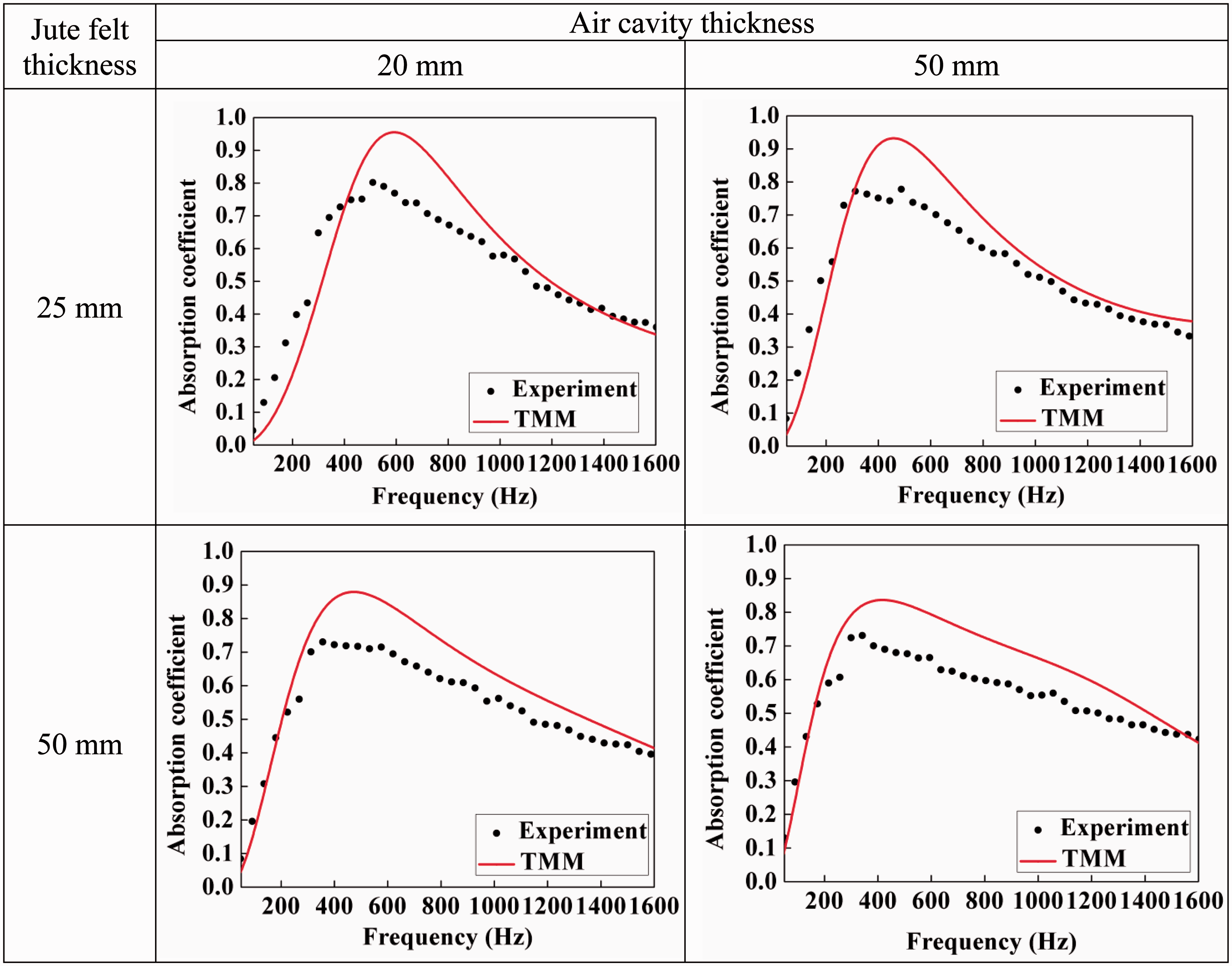
Sound absorption of Type 3 felt in configuration I.
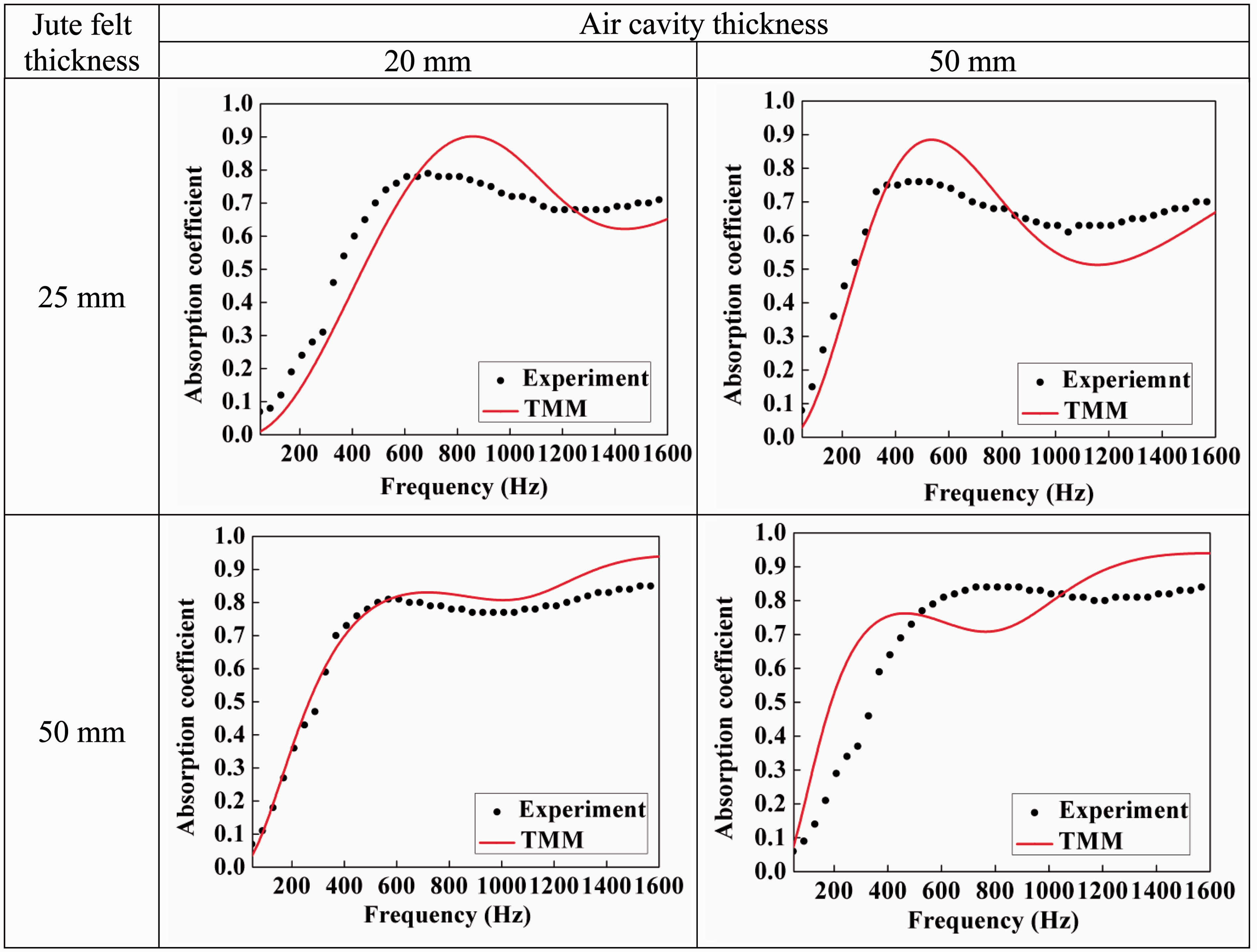
Sound absorption of Type 3 felt in configuration II.
In case of configuration I, when the thickness of jute felt is increased from 25 mm to 50 mm, the sound absorption performance in the low-frequency region has improved and peak of sound absorption shifted towards lower frequencies and broad range of sound absorption. In this case, MPP is on the incident side of sound waves; therefore, the sound absorption is better in the low-frequency region. There is good matching of experimental and theoretical sound absorption performance of the multilayer sound absorber.
In case of configuration II, when the jute felt is backed by MPP, considerable improvement in the sound absorption bandwidth is noticed in the high-frequency region. However, sound absorption in low-frequency region does not change much. In this configuration, the Type 3 felt is on the incident side of sound waves, so most of the high-frequency sound waves get absorbed by the felt before it enters into the MPP. Increase in the air gap thickness improves the sound absorption towards lower frequency region.
Conclusion
In this study, an attempt is made to improve the low-frequency sound absorption performance of the jute felt by using MPP and air gap. The sound absorption of the multilayer sound absorbers is evaluated theoretically by the transfer matrix method and experimentally by using impedance tube. MPP is modeled with the MAA model, while the jute felt was modeled by the flow resistivity-based Delany–Bazley–Miki model. The results indicated that the placement of the MPP in the multilayer configuration mainly governs the sound absorption performance. When MPP is attached on the incident side of sound waves, sound absorption is better in the mid-frequency region and shows wideband absorption with absorption peak around 500 Hz. When the position of MPP is behind the jute felt, the sound absorption towards high-frequency region improves. The use of MPP helped to improve sound absorption towards low-frequency region without increasing the thickness of the jute felt. Hence, the use of multilayer sound absorbers composed of MPP and jute felt can improve sound absorption performance.
Footnotes
Declaration of conflicting interests
The author(s) declared no potential conflicts of interest with respect to the research, authorship, and/or publication of this article.
Funding
The author(s) received no financial support for the research, authorship, and/or publication of this article.