




Abstract
Aero-servo-elastic analysis of a complex hypersonic aircraft is presented in this paper. A structure geometry was designed and built based on the X-43A vehicle. First, a three-dimensional structural finite element model was proposed with effective two-dimensional elements, which can obtain effective modal analysis results without useless local modes. Second, computational fluid dynamic (CFD) simulation was adopted to find aero-heating distribution of thermal mode via this structure. Aero-heating effect was included to study thermal-modal characteristics of the present structure. Influence due to material characteristic change and thermal stress was studied. After structural finite element analysis was completed, flutter of the present vehicle was investigated. Aero-servo-elastic analysis was then started from the definition of an aero-servo-elastic closed-loop system. In this system, the present aircraft is treated as flexible structure, in which the control sensor on the aircraft received not only rigid motion signal but also elastic vibration signal, and this signal can translate into the deflection signal to form aerodynamic control force through this aero-servo control system, and this force can continually influence aerodynamic force. One of the most important steps for this analysis was computation of unsteady aerodynamic force of the present structure, and the related process was developed based on an effective fitting method. Finally, bode diagrams of pitching, rolling and yawing were investigated, form which the law of aero-servo stability of the X-43A vehicle can be observed and analyzed. It can be found from the results of this paper that effective investigation of aero-servo-elastic characteristics of a complex hypersonic aircraft should be based on accurate structural finite element modeling, modal analysis and flutter analysis. The proposed method in this paper can provide effective analysis process for the design of controller for hypersonic aircraft.
Introduction
From the middle of last century, hypersonic aircraft has been a most advanced flight vehicle research subject. 1 This kind flight vehicle faces many serious environment conditions, such as very high temperature due to aero-heating, strong vibration on the main structure, aero-servo-elastic design, etc. 2
Hypersonic flow is the first challenge. Relative to normal flight with subsonic to supersonic (Mach 0.1-3), hypersonic flight vehicle should consider differences such as: (1) thin shock layers; (2) entropy layers; (3) viscous–inviscid interactions; (4) high-temperature effects and extreme heat transfer; and (5) low-density flows. 3 Relying on the development of numerical simulation method, strongly coupled computation of material response, and non-equilibrium flow which led to damage by hypersonic ablation have been predicted by much practical applications of the codes and methods that have been developed in recent years. CFD method is one of the most popular numerical methods. 4 Park 5 proposed a basic work on the modeling of the vibration–dissociation coupling process. Ucar and Basdogan 6 proposed a response prediction method based on subsystem coupling analysis, which is significant for dynamic analysis of complex structures like aircraft. Longo et al. 7 presented a design thought based on CFD modeling of hypersonic re-entry vehicles. Additionally, chemistry effects were also included for aero-heating studies. 8
Usually, thermal–structure coupling effects were non-negligible challenges for analysis of hypersonic aircraft, 9 though different discussion topics exist. 10 With much significant work, aero-heating prediction has been developed by two effective ways including engineering algorithm and CFD methods. 11 Similar to subsonic aircraft, aero-elastic and aero-servo-elastic are still difficult for numerical investigations of hypersonic aircraft. 12 Zenkour 13 developed the Green-Naghdi thermo-elasticity theory without energy dissipation. Li and Zhao14,15 studied the transient energy growth of a thermo-acoustic system with distributed mean heat input, which was based on representative air flow analysis method related to energy studies. 16 Bai et al. 17 presented thermal-vibration analysis for hypersonic aircraft and investigated the related structural response. Gupta et al.18,19 presented constant CFD based work on aero-servo-elastic analysis with hyper-x applications. Danowsky et al. 20 proposed nonlinear analysis method of aero-servo-elastic models with free play using describing functions. It can be seen from existing works that such ASE problem still need to be developed.
This paper proposes an effective simulation of aero-servo-elastic of the complex X-43A fight vehicle based on thermal-fluid–structure coupling analysis. So it is organized as follows. First, a three-dimensional structural finite element model was proposed with effective two-dimensional elements, which can obtain effective modal analysis results without useless local modes. Second, CFD simulation was adopted to find aero-heating distribution of thermal mode via this structure in order to include aero-heating effect which can study thermal-modal characteristics of the present structure effectively. Third, flutter of the present vehicle was investigated. And finally, aero-servo-elastic analysis was then started from the definition of unsteady aerodynamic force and elastic motion equations of the structure. Bode figures are also presented.
Geometry and structure of the X-43A vehicle
Many works have been taken to present the design and manufacture of the X-43A vehicle, and a representative geometry and material are shown in Figure 1.
21
Geometry and material of the X-43A vehicle.
21
AETB: Alumina enhanced thermal barrier.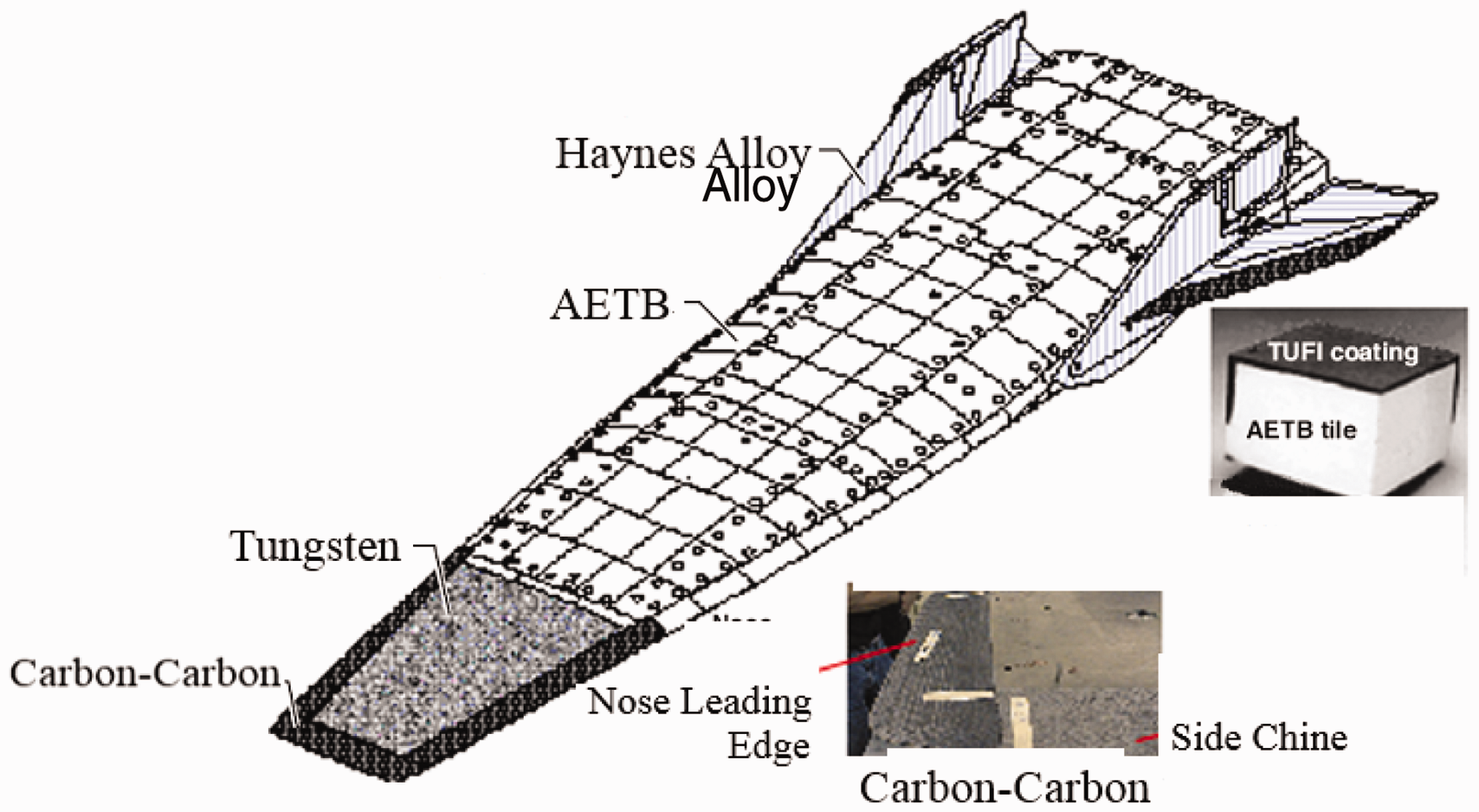
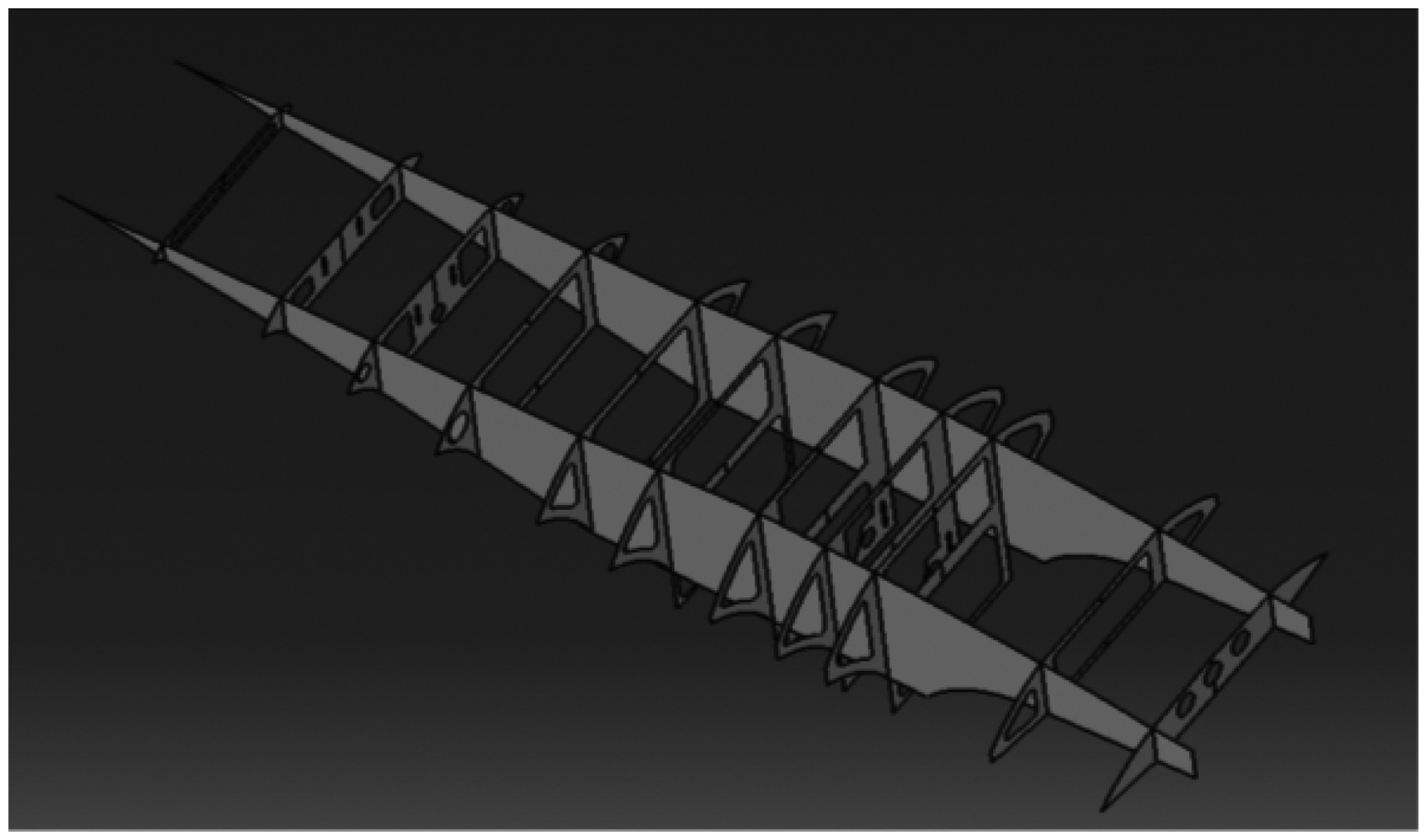
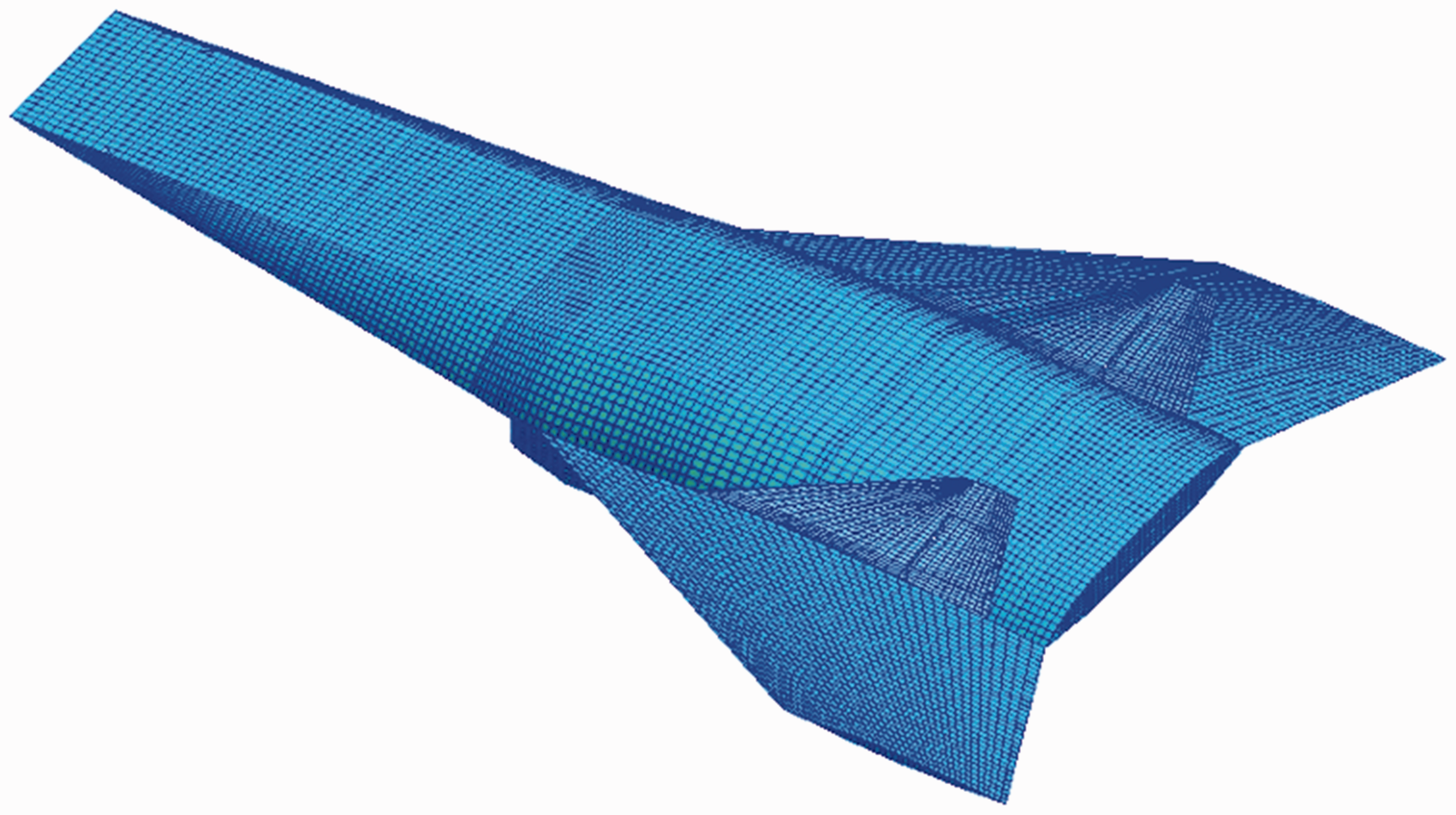
Based on these useful works, a structure was rearranged in this paper, as shown in Figures 2 and 3. The coordinate system is the global coordinate system of the aircraft, the coordinate origin is located at the symmetry surface of the nose, the X-axis is in the direction of the airflow, and the Z-axis is on the axial direction. Unit system used was N-kg-mm-s. With the commercial software MSC Patran, the finite element model of the X-43A is shown in Figure 4. The general algorithm of modeling can be summarized as follow: wing surface, fuselage skin, rib and girder were modelled with shell element; connection between vertical tail and fuselage was modelled with shell or beam element; operating stiffness of horizontal tail and rudder was simulated with spring element; and counterweight of the nose was modelled with volume element. An effective finite element modeling can provide a significant basement for modal analysis.
Structure arrangement of the X-43A. Rib and girder inside the X-43A. Finite element modeling of the X-43A.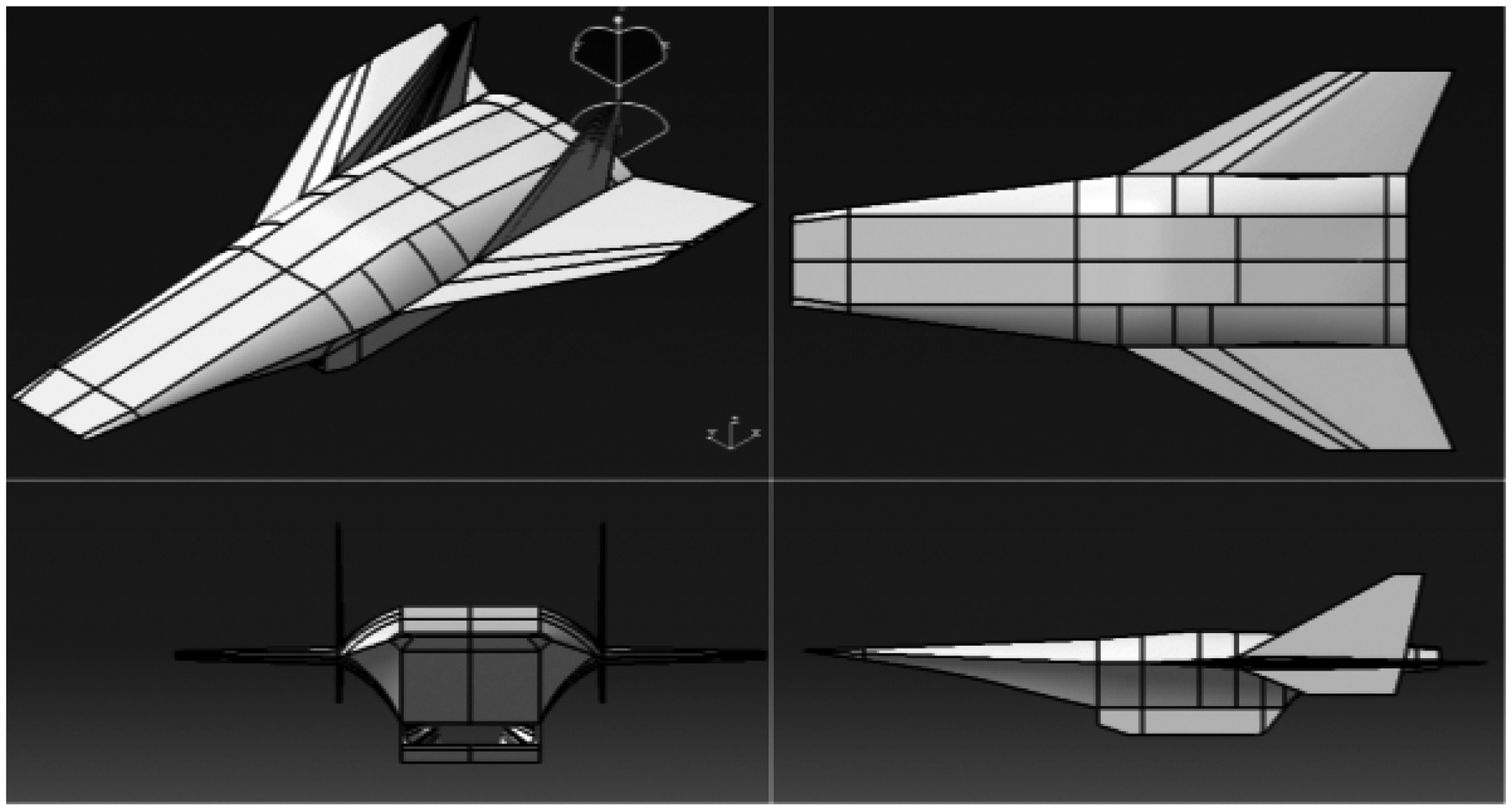
Thermal-modal analysis
Aero-heating effect cannot be neglected for the X-43A. Bai et al. 17 had proposed an effective thermal-fluid-structure analysis method for hypersonic flight vehicle. This paper employed this method to find the coupling effect of the X-43A vehicle.
The parameters of temperature computation were: the flight height was 30 km; Mach number was 6; the degree of angle of attack was 2; the initial temperature was 226 K; and the air pressure was 1197 Pa. A half model was taken to complete mesh generation, and the total mesh was 3,460,000, sketch map of mesh generation was shown in Figure 5.
Sketch map of mesh generation for CFD computation.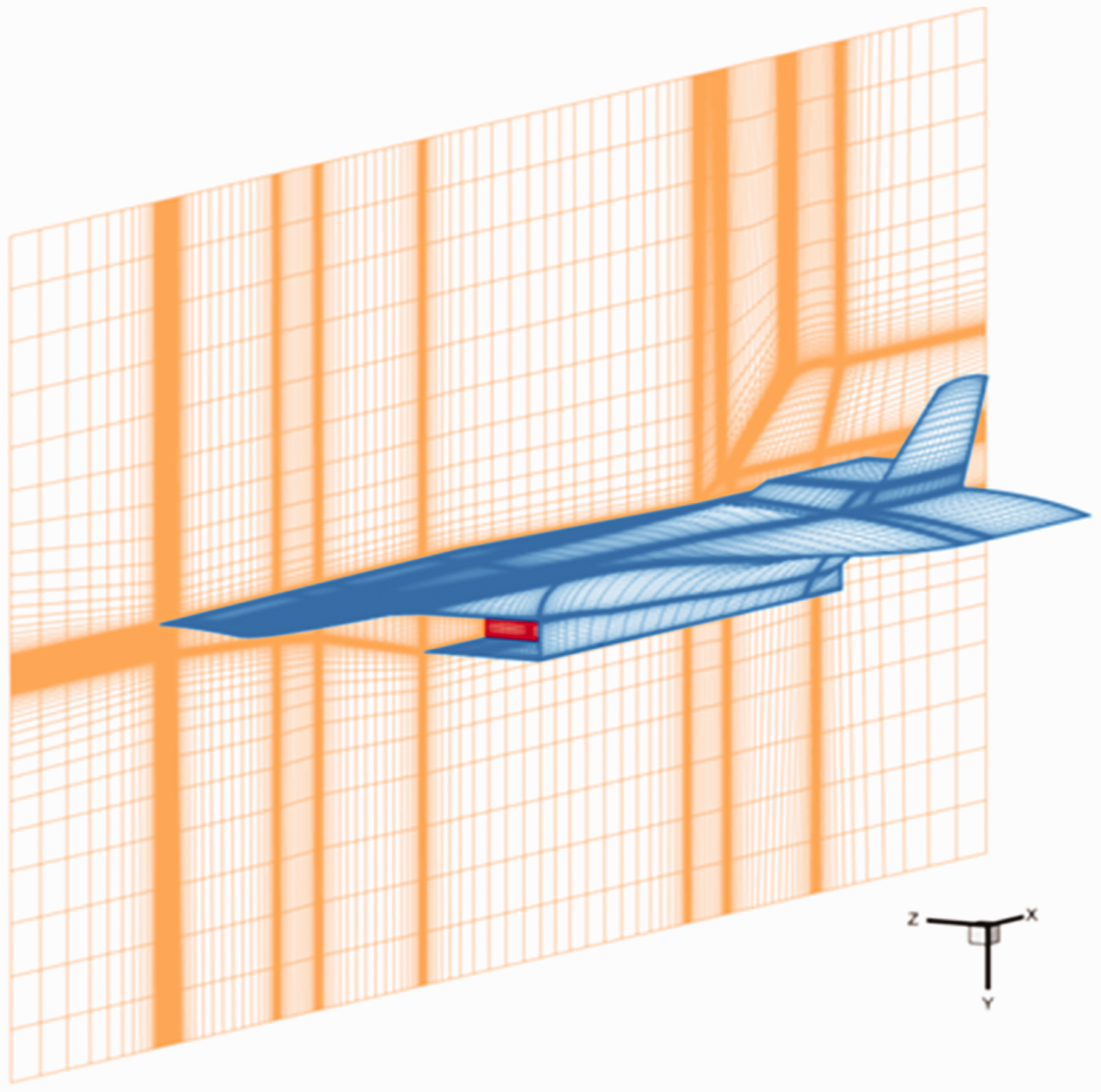
N-S equation was solved based on ROE-FDS (flux-difference splitting) method.22,23 The system of governing equations for a single-component fluid, written to describe the mean flow properties, is cast in integral Cartesian form for an arbitrary control volume V with differential surface area dA as follow


Total energy

Derivation of the preconditioning matrix began by transforming the dependent variable in equation (1) from conserved quantities

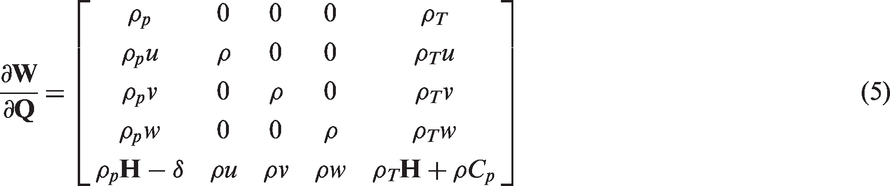


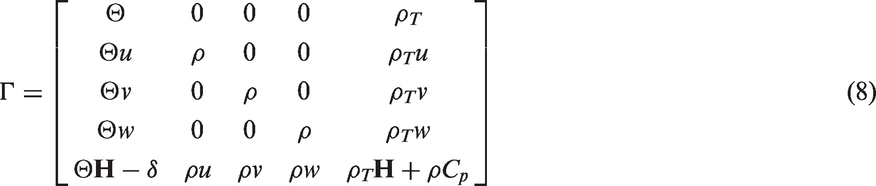
Here Θ is given by

The reference velocity Ur appearing in equation (9) is chosen locally such that the eigenvalues of the system are related to the convective and diffusive time scales. The inviscid flux vector F appearing in equation (7) is evaluated by a standard upwind, FDS. With the ROE-FDS method, temperature distribution of the X-43A is shown in Figure 6. It can be seen that the highest value of temperature on the skin can reach to 2850 K, which is similar to that of the stagnation point of the vehicle. It can be predicted that thermal effect cannot be neglected for modal analysis of this complex hypersonic aircraft.
Temperature field computation results (left: windward side; right: leeward side).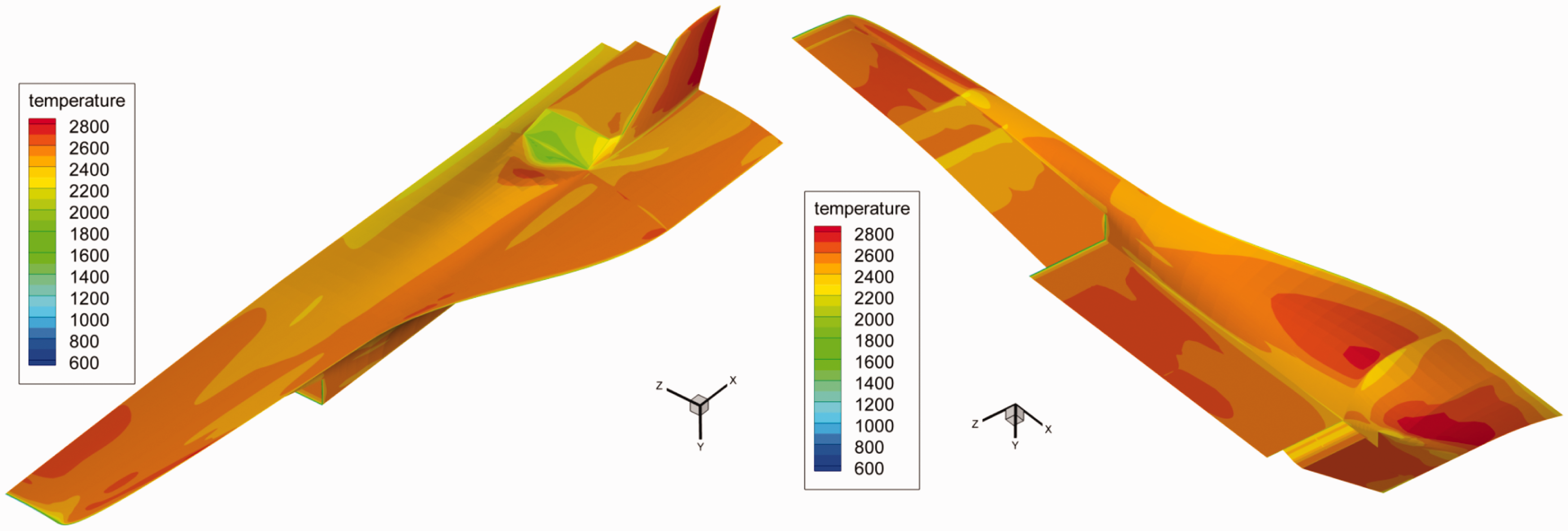
Towards modal analysis, the structural undamped free vibration equation can be written as24,25

Here [M] is the structural mass matrix; [K] is the structural stiffness matrix; and {x} represents the array of the node displacement. It is well known that modes of the structure can be solved by the characteristic equation (10)

Mode values for different kinds of thermal-modal analysis.
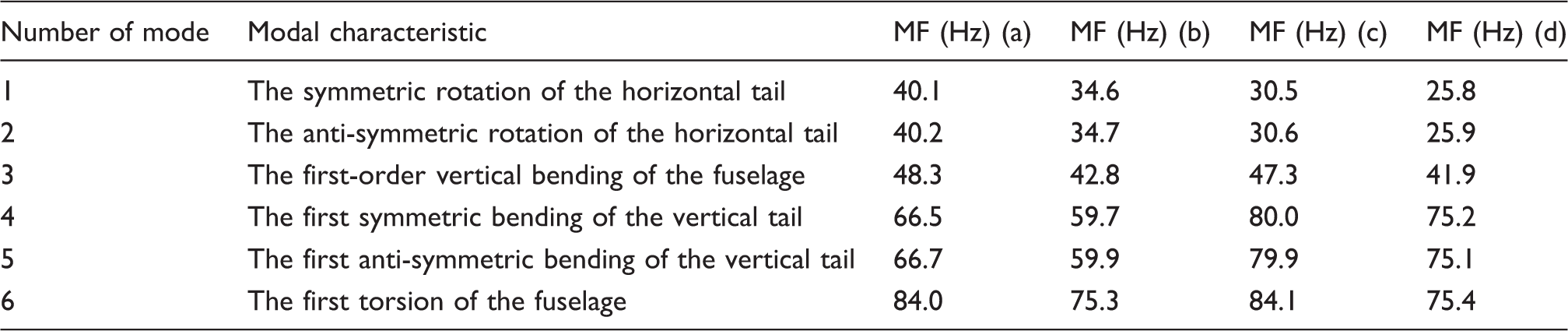
MF: modal frequency.
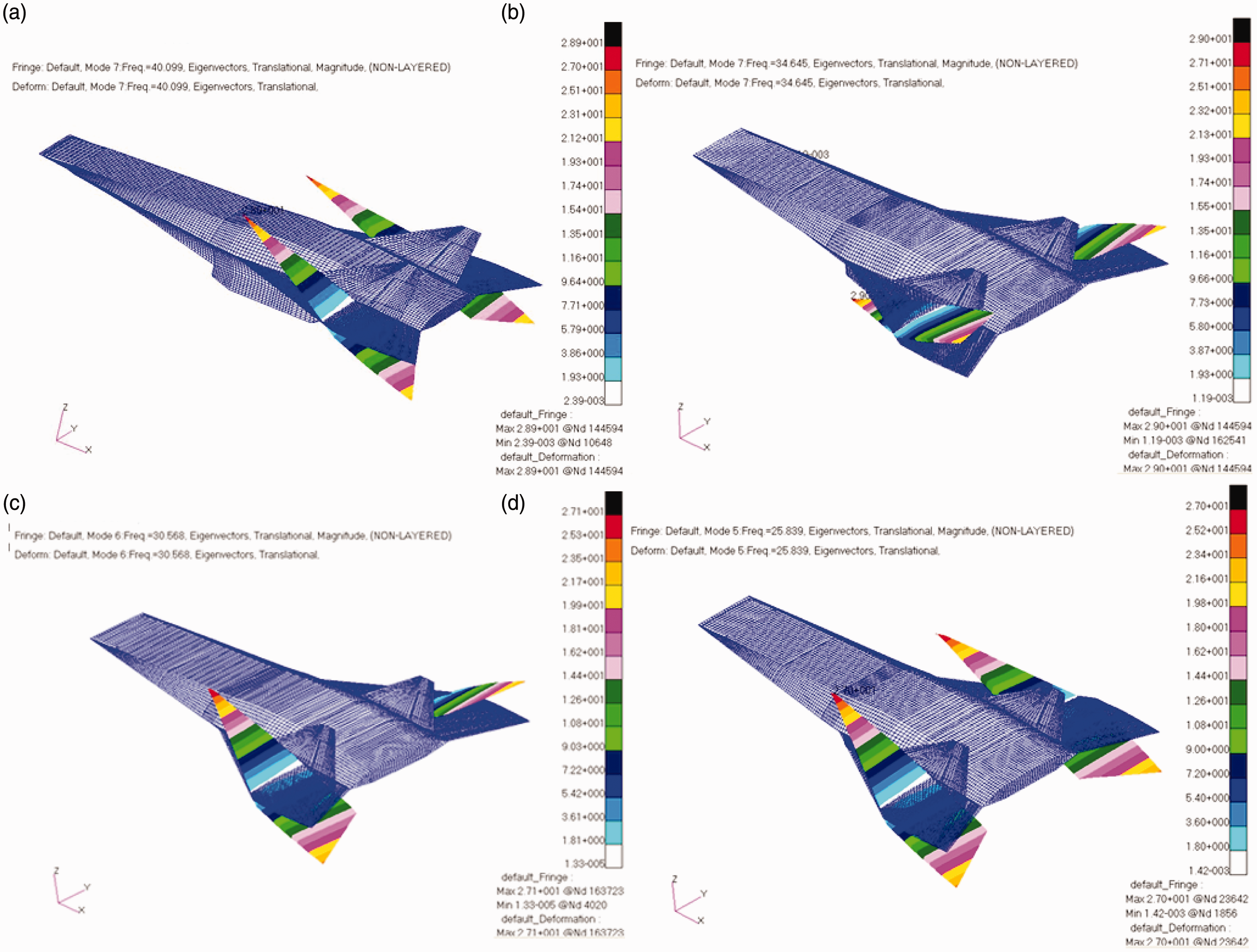
The four kinds of modes of the symmetric rotation of the horizontal tail. (a) normal modal analysis; (b) thermal-modal analysis related to material behavior change due to aero-heating; (c) thermal-modal analysis related to thermal stress due to aero-heating; and (d) thermal-modal analysis related to both material behavior change and thermal stress due to aero-heating.
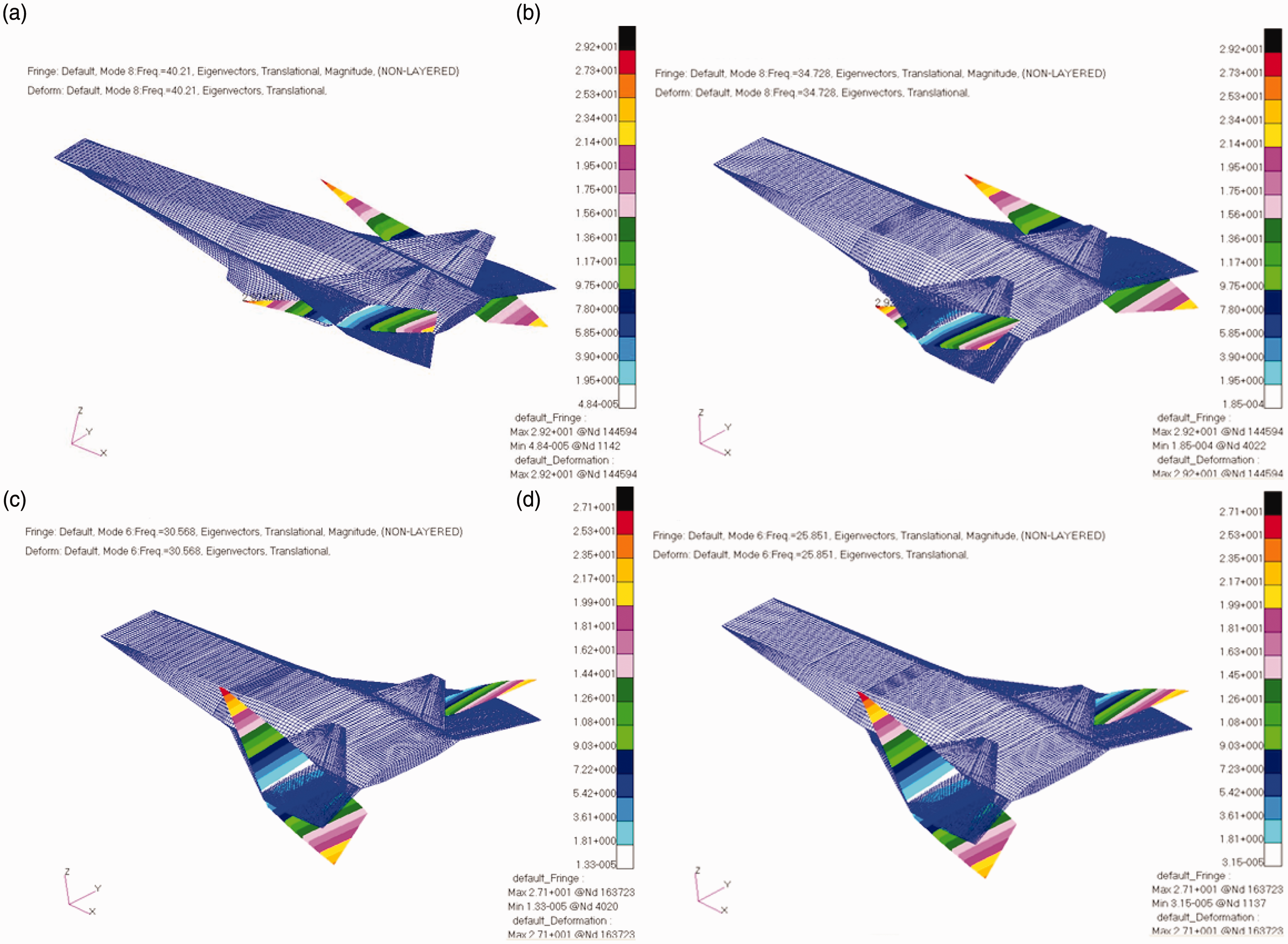
The four kinds of modes of the anti-symmetric rotation of the horizontal tail. (a) normal modal analysis; (b) thermal-modal analysis related to material behavior change due to aero-heating; (c) thermal-modal analysis related to thermal stress due to aero-heating; and (d) thermal-modal analysis related to both material behavior change and thermal stress due to aero-heating.
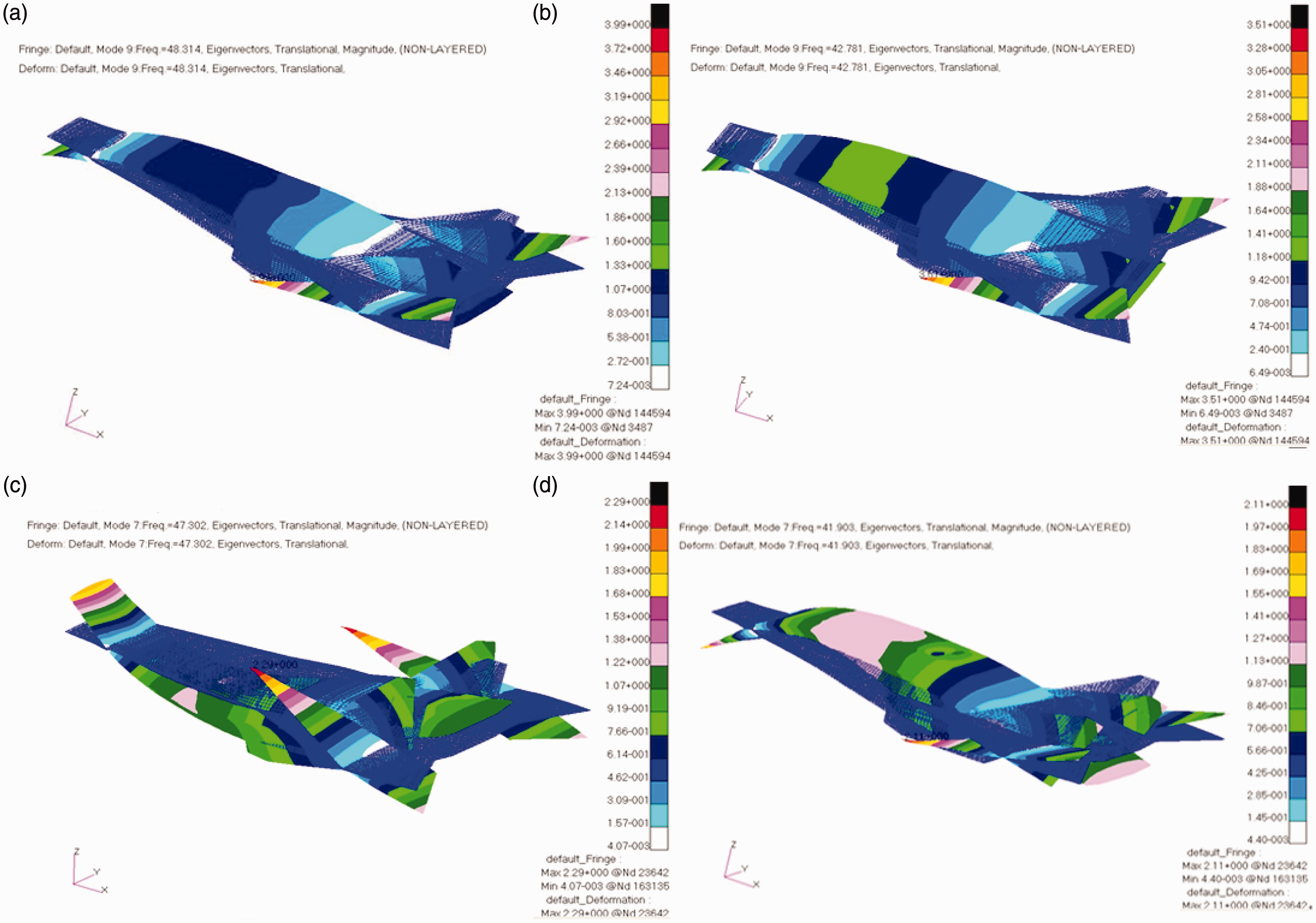
The four kinds of modes of the first-order vertical bending of the fuselage. (a) normal modal analysis; (b) thermal-modal analysis related to material behavior change due to aero-heating; (c) thermal-modal analysis related to thermal stress due to aero-heating; and (d) thermal-modal analysis related to both material behavior change and thermal stress due to aero-heating.
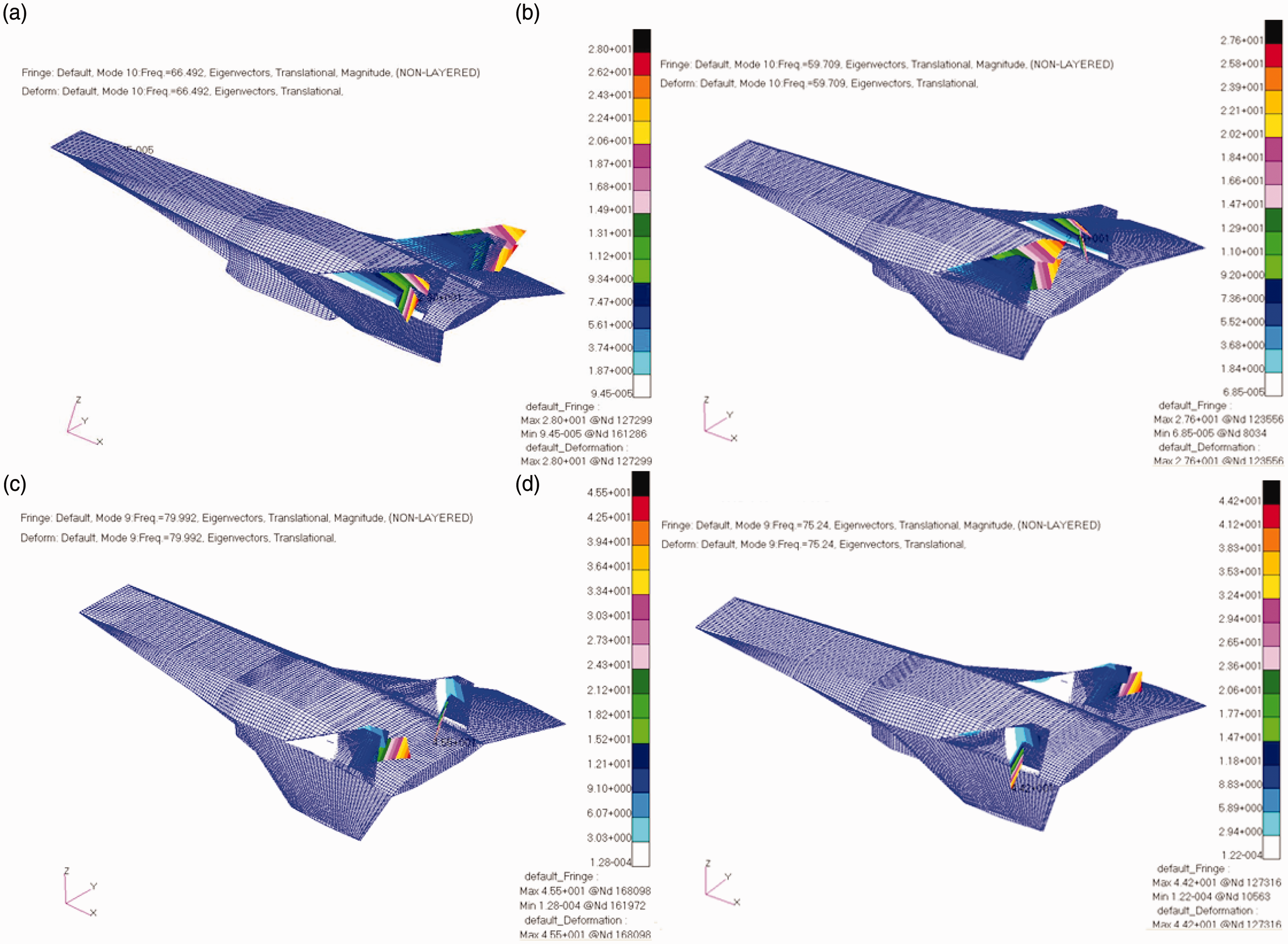
The four kinds of modes of the first symmetric bending of the vertical tail. (a) normal modal analysis; (b) thermal-modal analysis related to material behavior change due to aero-heating; (c) thermal-modal analysis related to thermal stress due to aero-heating; and (d) thermal-modal analysis related to both material behavior change and thermal stress due to aero-heating.
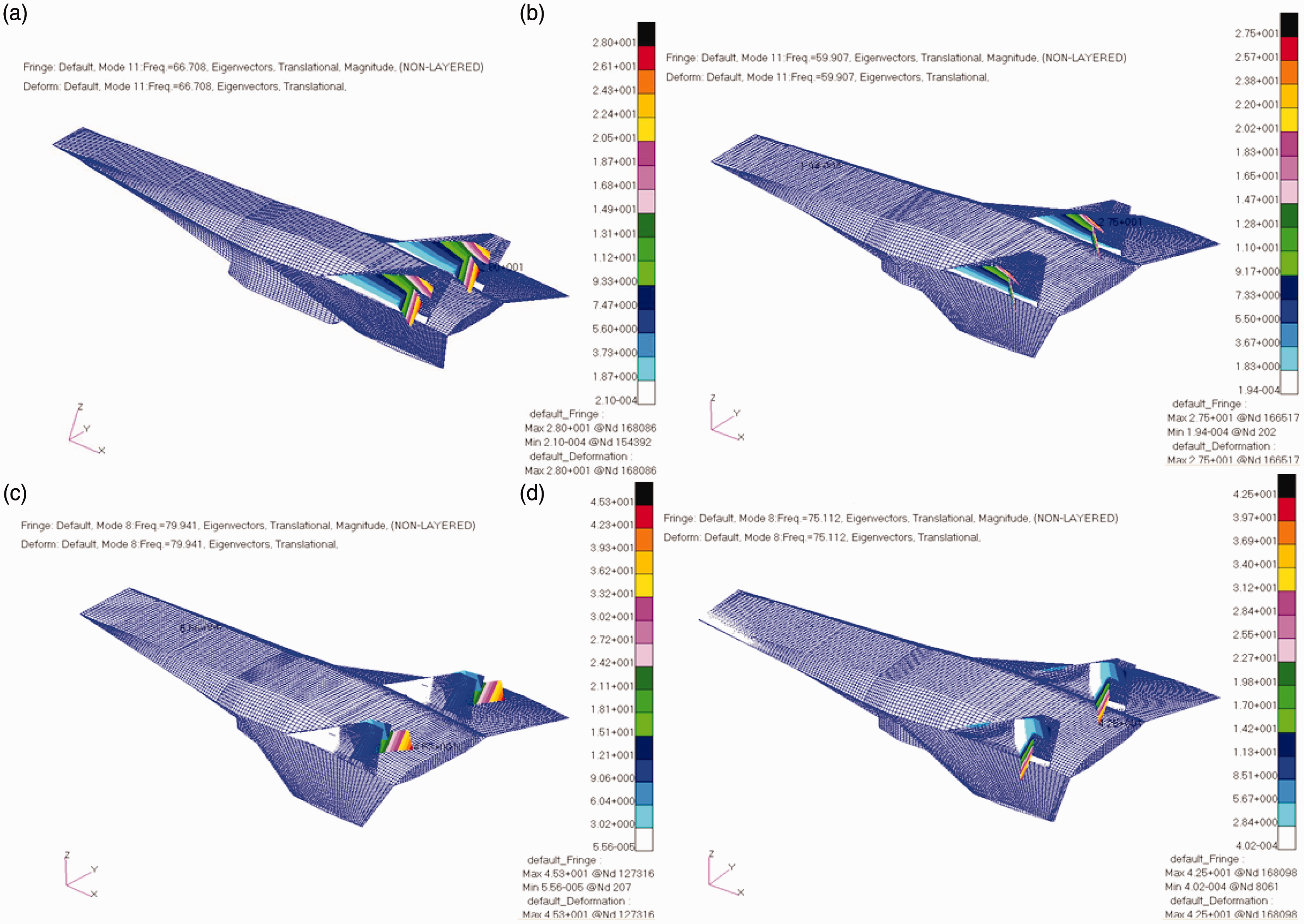
The four kinds of modes of the first anti-symmetric bending of the vertical tail. (a) normal modal analysis; (b) thermal-modal analysis related to material behavior change due to aero-heating; (c) thermal-modal analysis related to thermal stress due to aero-heating; and (d) thermal-modal analysis related to both material behavior change and thermal stress due to aero-heating.
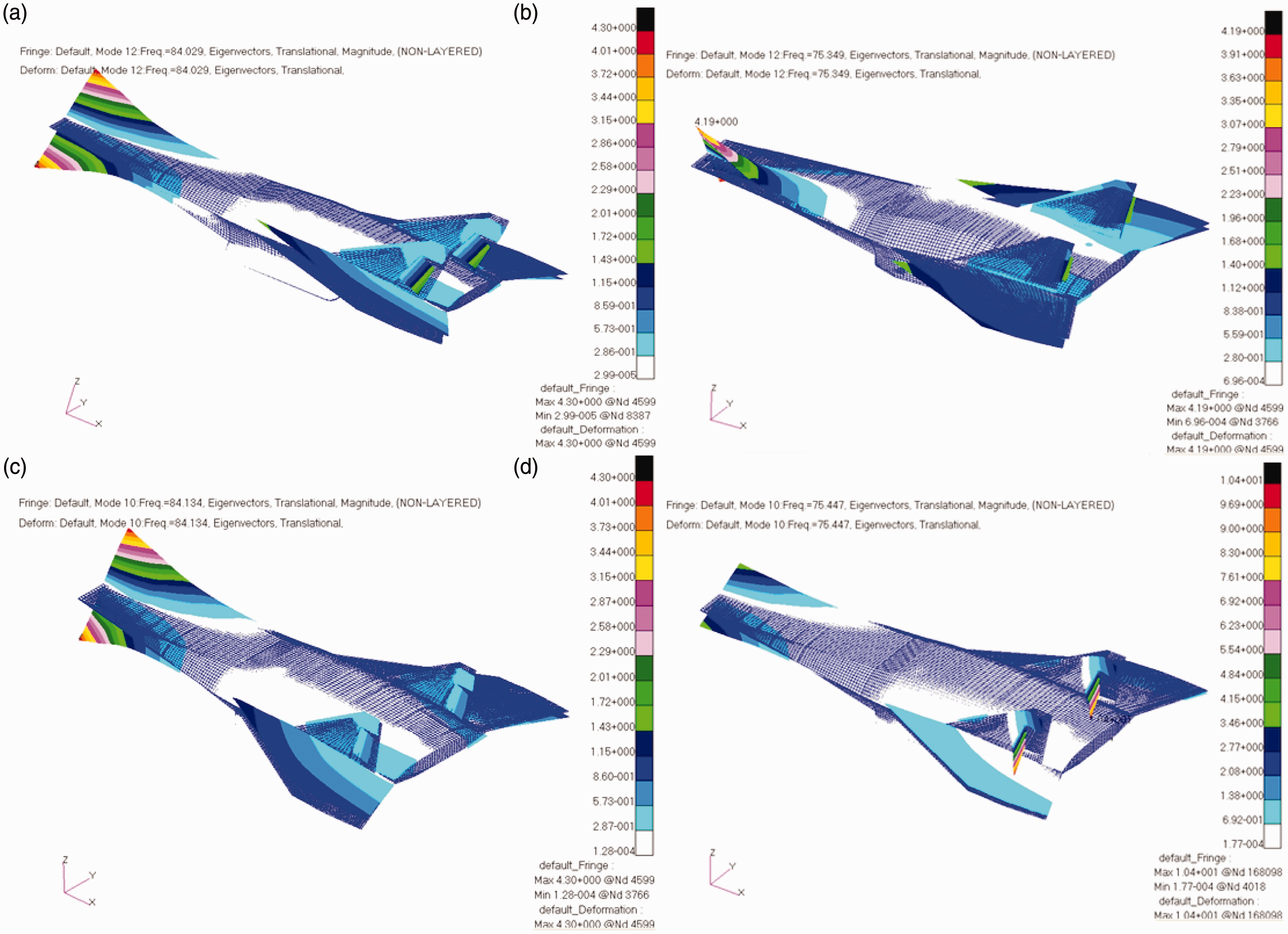
The four kinds of modes of the first torsion of the fuselage. (a) normal modal analysis; (b) thermal-modal analysis related to material behavior change due to aero-heating; (c) thermal-modal analysis related to thermal stress due to aero-heating; and (d) thermal-modal analysis related to both material behavior change and thermal stress due to aero-heating.
For the analysis of the influence of the material behavior change on the aircraft structural dynamics, only the influence of temperature field on material modulus was considered and the thermal expansion coefficient of the material was assumed to be zero when the modal analysis was performed; for the analysis of the influence of thermal stress on the aircraft structural dynamics, it was assumed that the material modulus did not change with the temperature field in the modal analysis, and the linear expansion coefficient of the material was not zero; and when both material behavior change and thermal stress were considered, it was assumed that the material modulus varied with the temperature field, while the linear expansion coefficient of the material was not zero. It can be seen from Table 1 and Figures 7 to 12 that: the modulus of the material decreased with the decrease of temperature due to aero-heating effect on the elastic modulus of materials; due to the influence of thermal stress, the decrease of support stiffness of the horizontal tail led to obvious decline of the rotation frequency of the horizontal tail; due to the influence of thermal stress, increase of support stiffness of the vertical tail led to obvious increase of the first bending frequency of it; there were not obvious influence on both the first bending frequency and first torsion frequency of the fuselage due to the influence of thermal stress; and when considering both the material behavior change and thermal stress, the modal frequency of horizontal tail and fuselage was found to be decreased while that of the vertical tail was found to increase.
Flutter analysis
The present flutter analysis used the classical V-g method.
26
The four kinds related to thermal effect were still considered. Figure 13 presents the flow chart of the proposed analysis process of the X-43A vehicle.
Flutter analysis chart of the present hypersonic aircraft.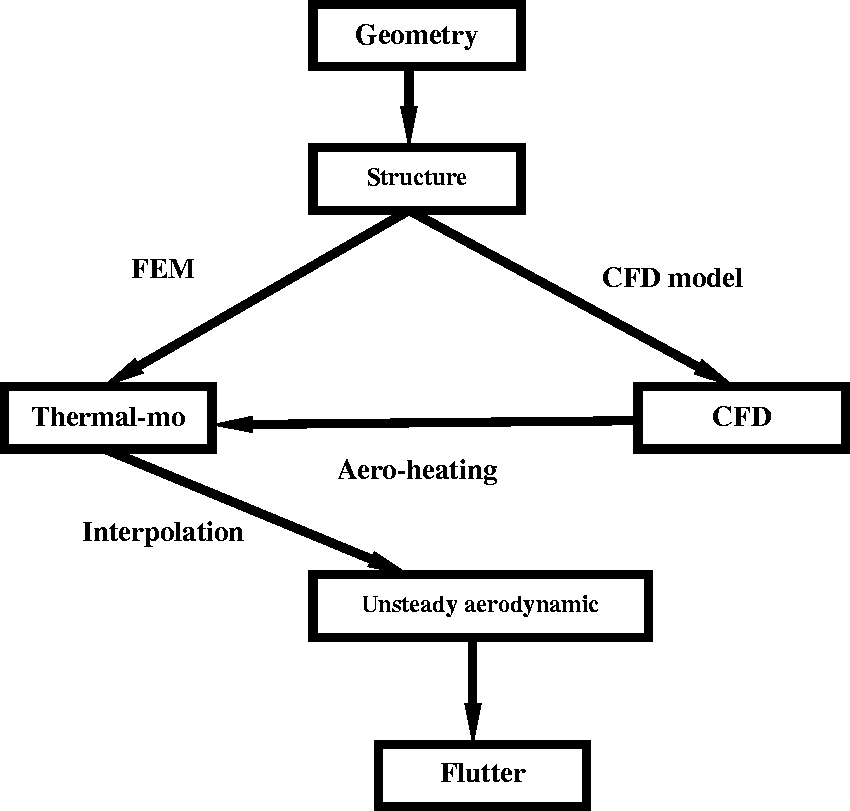
Flutter computation results.

Aero-servo-elastic analysis
Towards the modern control theory, it is necessary to convert the aircraft motion equations to linear time invariant state space. One of the main problems encountered in describing the motion of an aircraft using state equations is the description of unsteady aerodynamic forces, since the expression in the Laplace domain is a transcendental function and it is difficult to be evaluated. The present paper used MS (minimum state) method to study unsteady aerodynamic force. Based on the MS method, approximation of unsteady aerodynamics can be expressed by



Here


When an initial value was applied on matrix D, it made rank(D) ≠ 0. Three constraints were imposed by k = ka, k = kb, k = kc, which can provide a function related to ka, kb, kc, D and E to represent Qi.
Aircraft motion equation with a controlled wing can be expressed as

 Ãc by equation (13), and substitute into equation (17) to get

An equation set is got

Here

If set 
The feedback signal of sensor received by the flight control computer was not only in response to the rigid motion equation of rudder command but also overlapped with the response of aero-servo-elastic (ASE) elastic motion equation of rudder command. So the most important thing for the design of ASE was to establish the elastic ASE motion equation. If the motion equation was determined, the control law design could be carried out in accordance with the conventional method.
In this paper, the arrangement position of sensor is as follow: x: 718.7 mm, y: −151 mm and z: −12.1 mm. It was assumed that the longitudinal control of the aircraft was completed through the horizontal sync deflection (

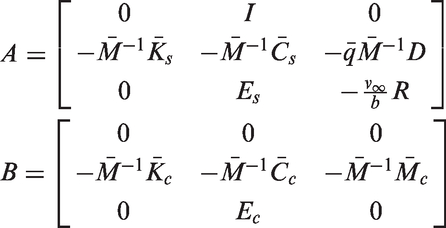
The output matrix A, B, C and D is shown in Appendix 1. There is

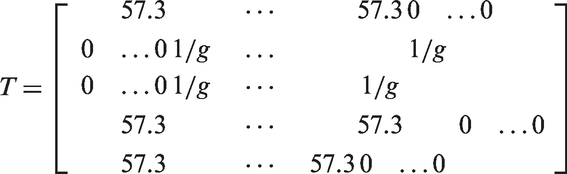
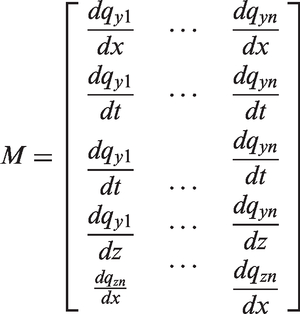
So the output matrix C and D can be got by A, B and T*M.
Bode figures of pitch angular rate Bode figures of pitch angular rate Bode figures of the normal overload ny related to the same direction horizontal tail command response. Bode figures of rolling angular rate Bode figures of yaw angular rate Bode figures of the lateral overload nz related to the differential horizontal tail command response. Bode figures of rolling angular rate Bode figures of yaw angular rate Bode figures of the lateral overload nz related to the control surface command response.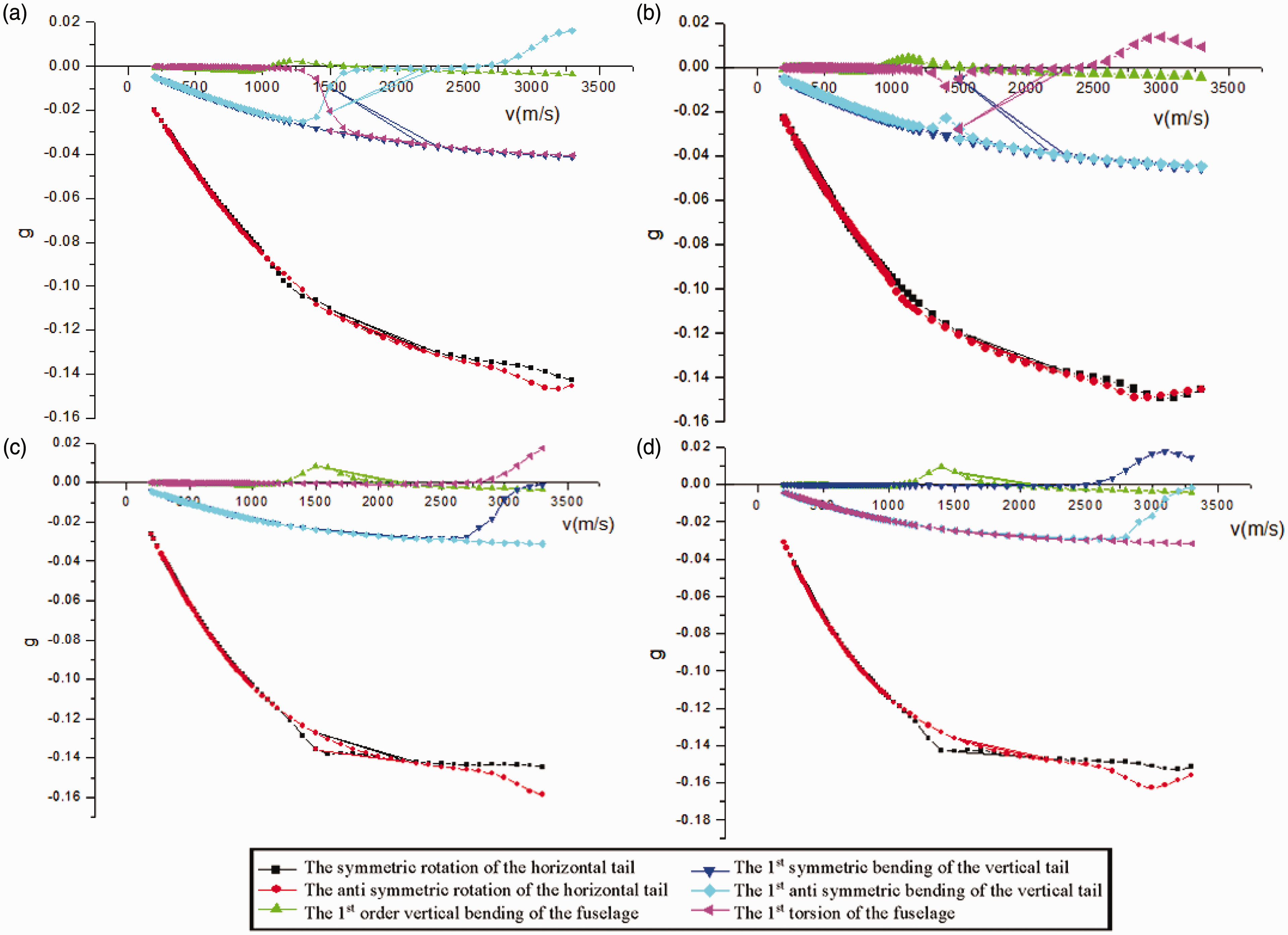
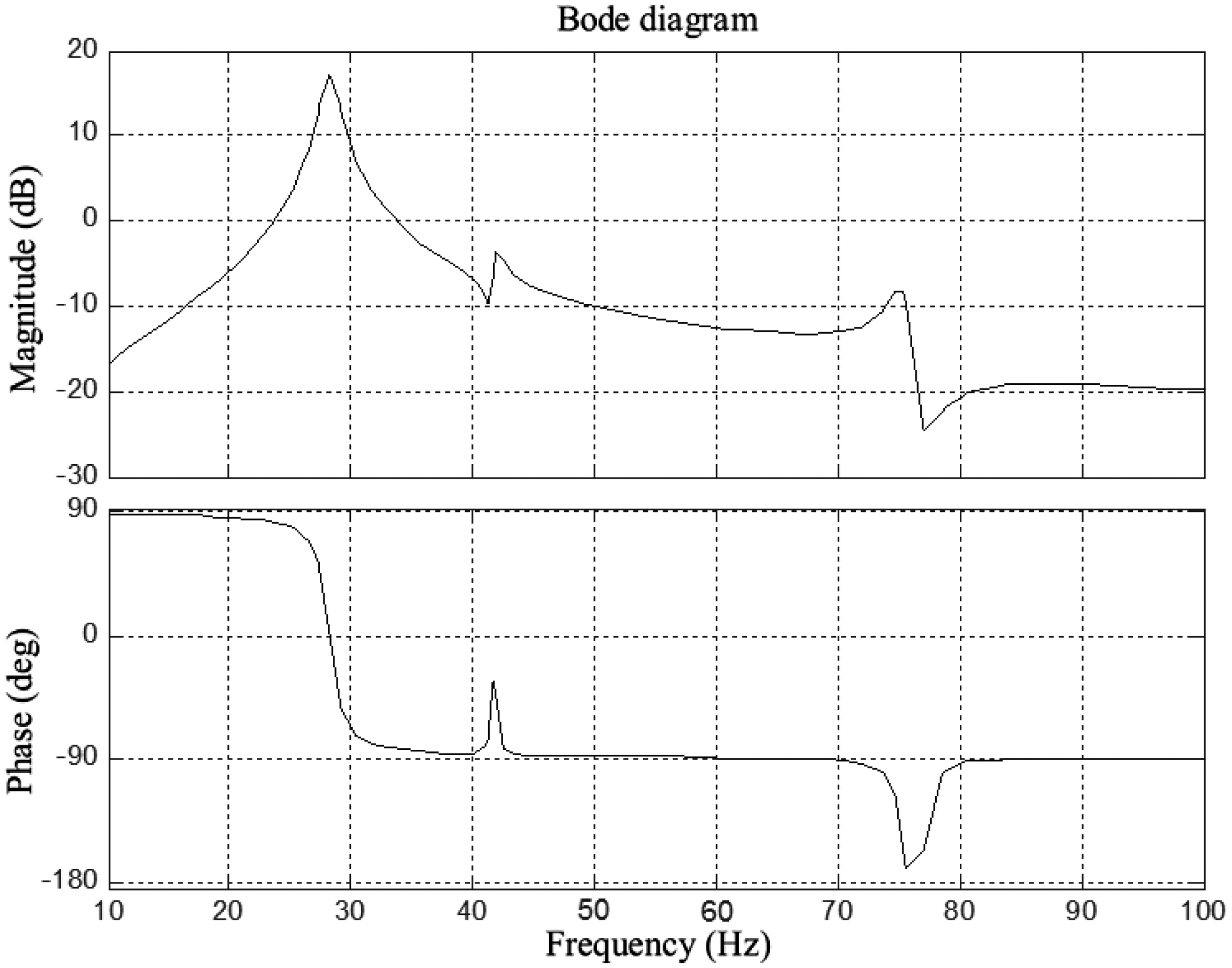
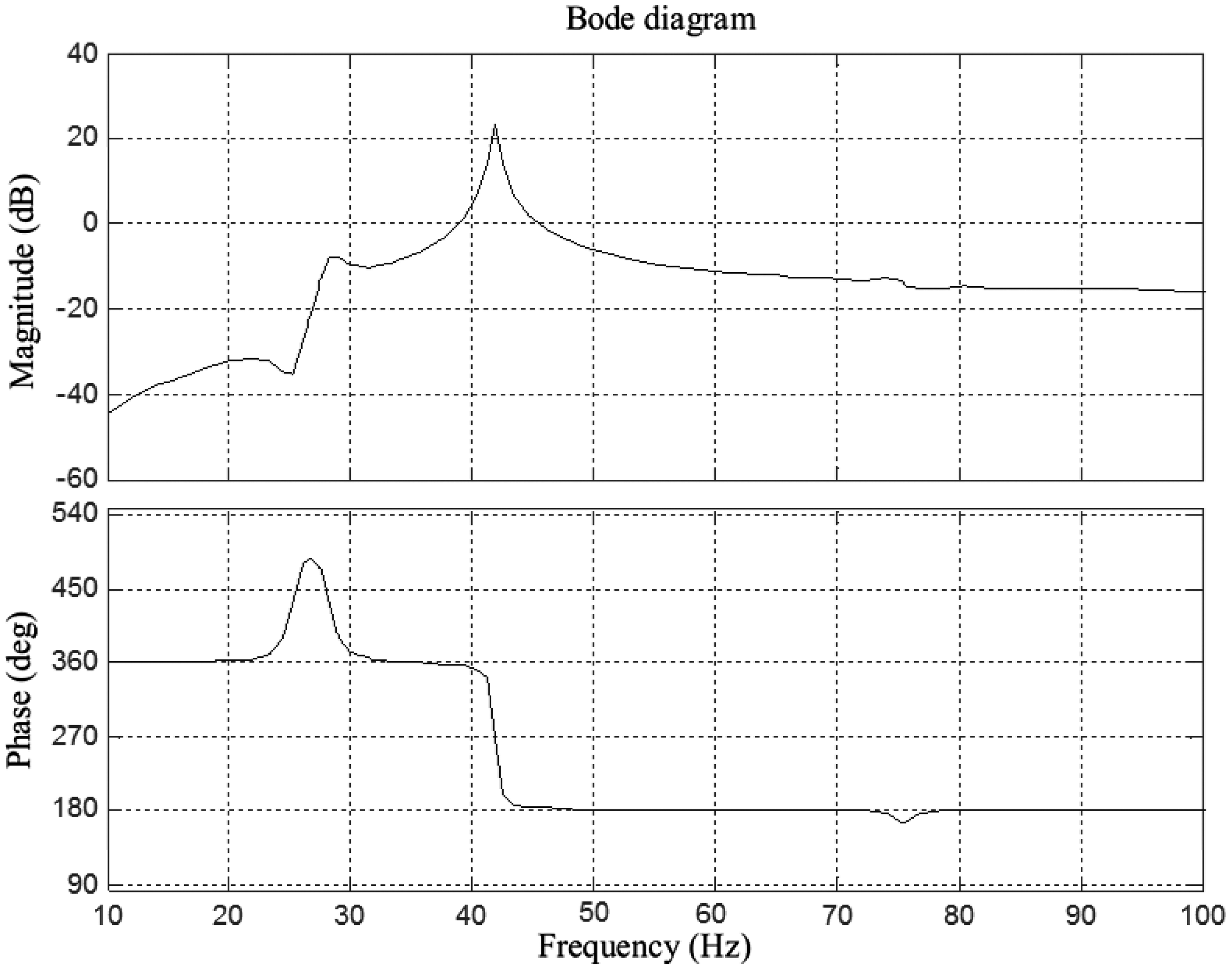
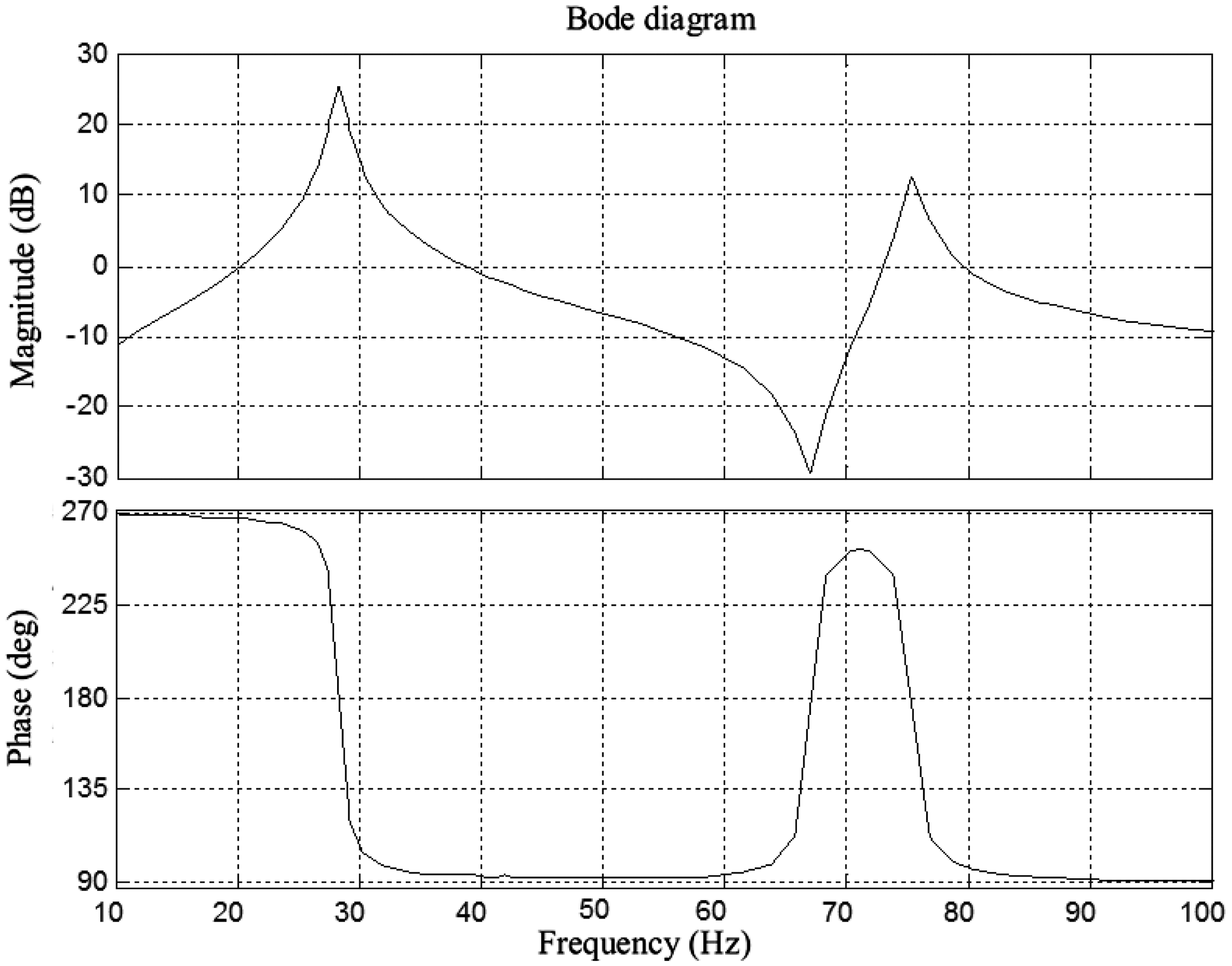
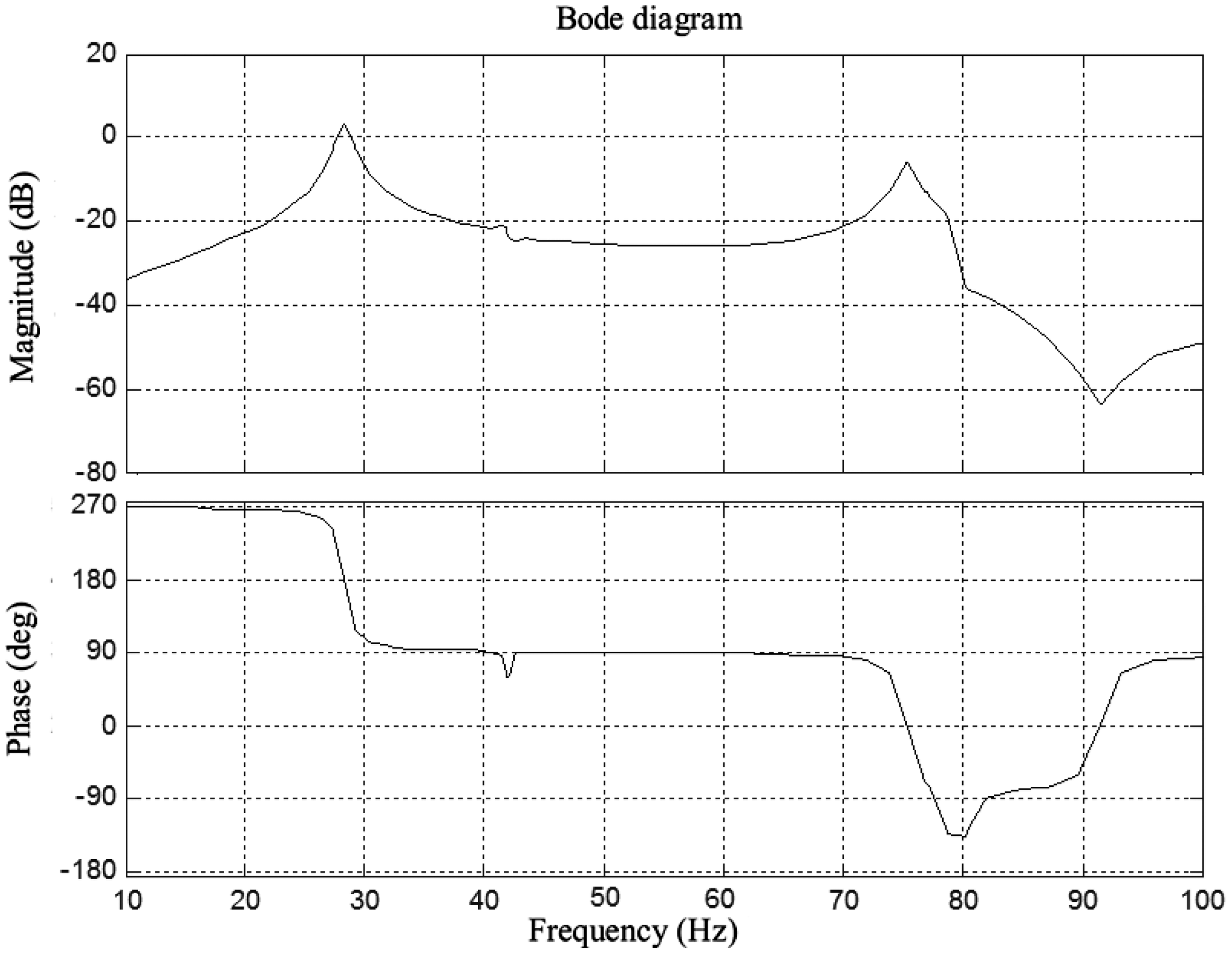
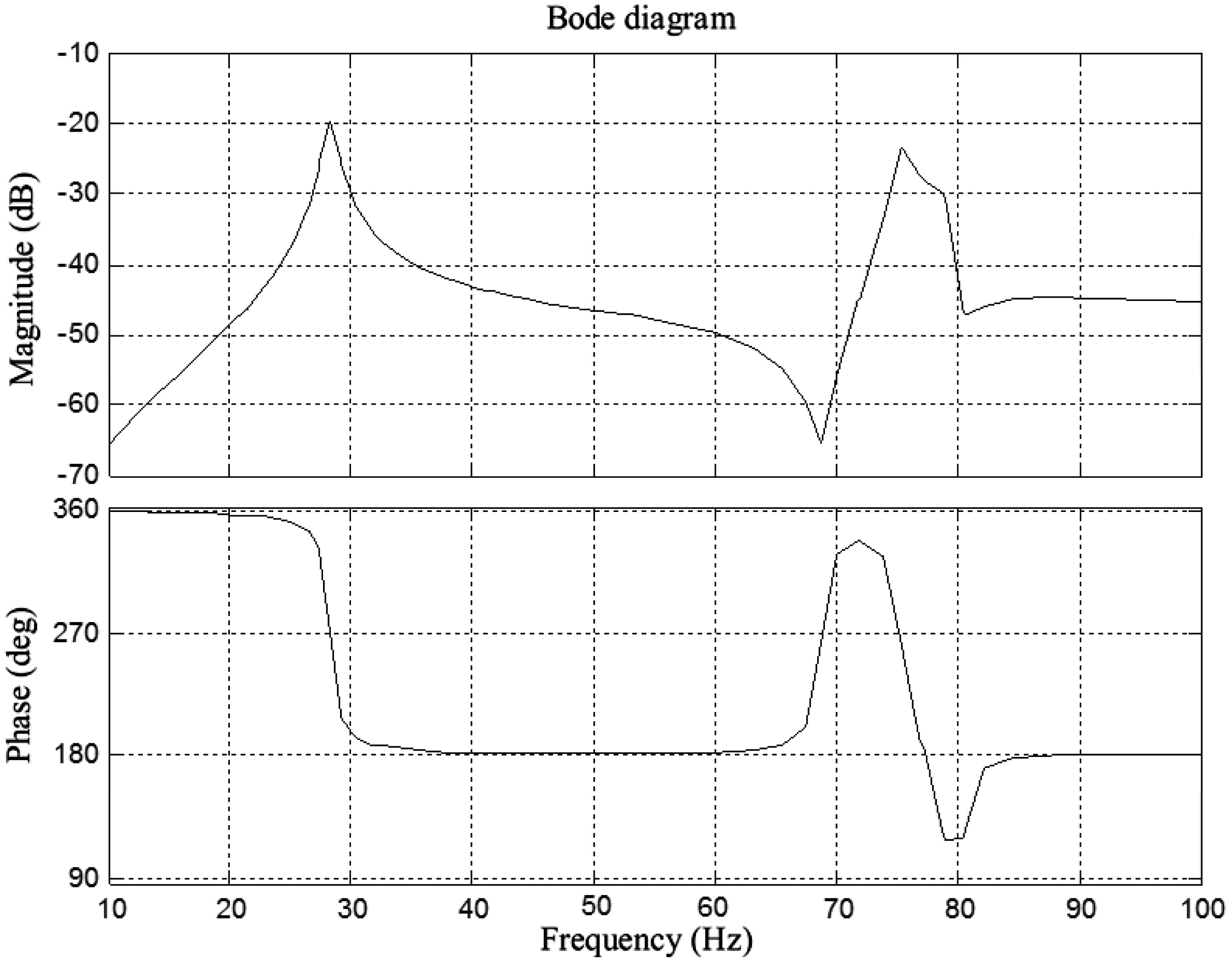
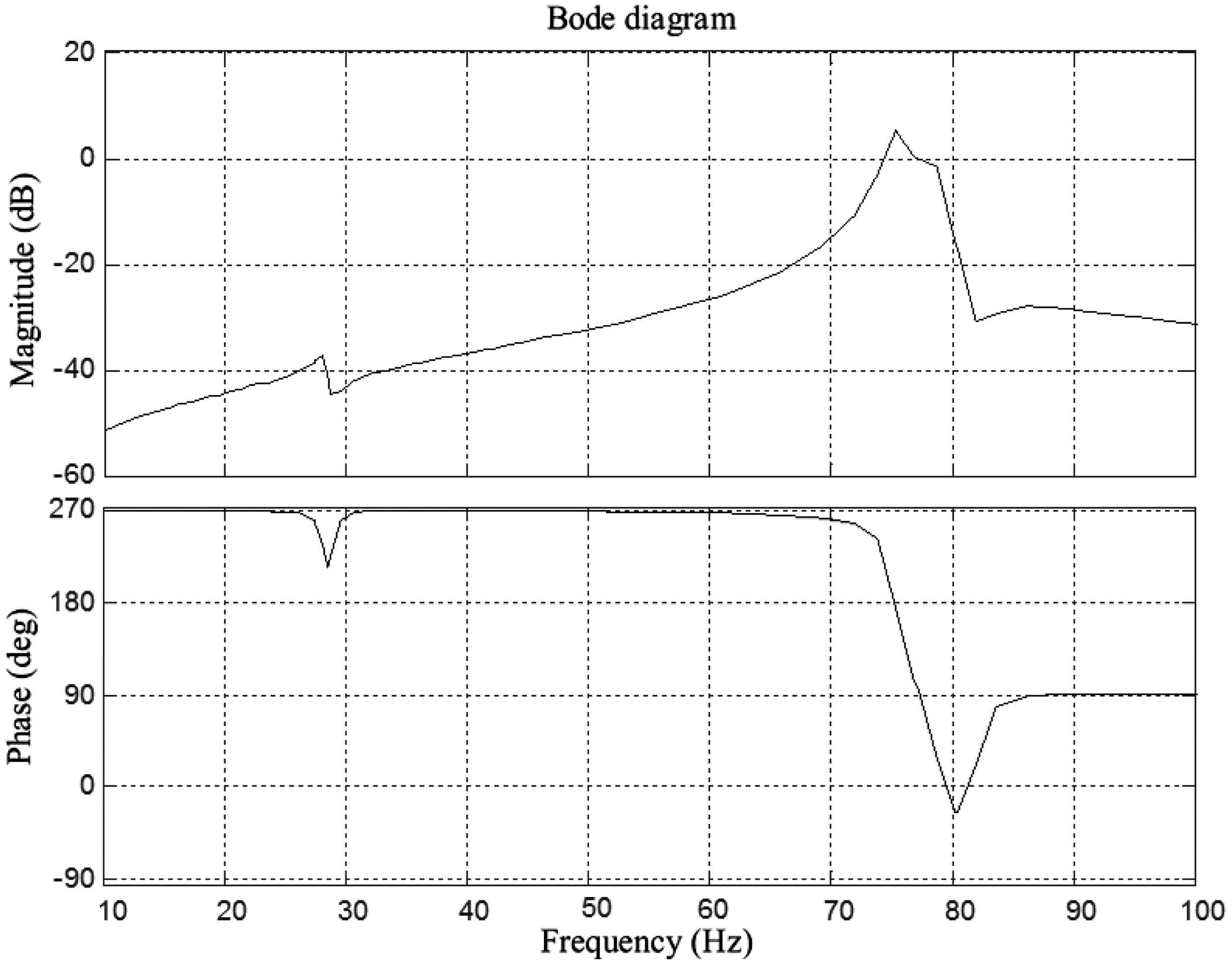
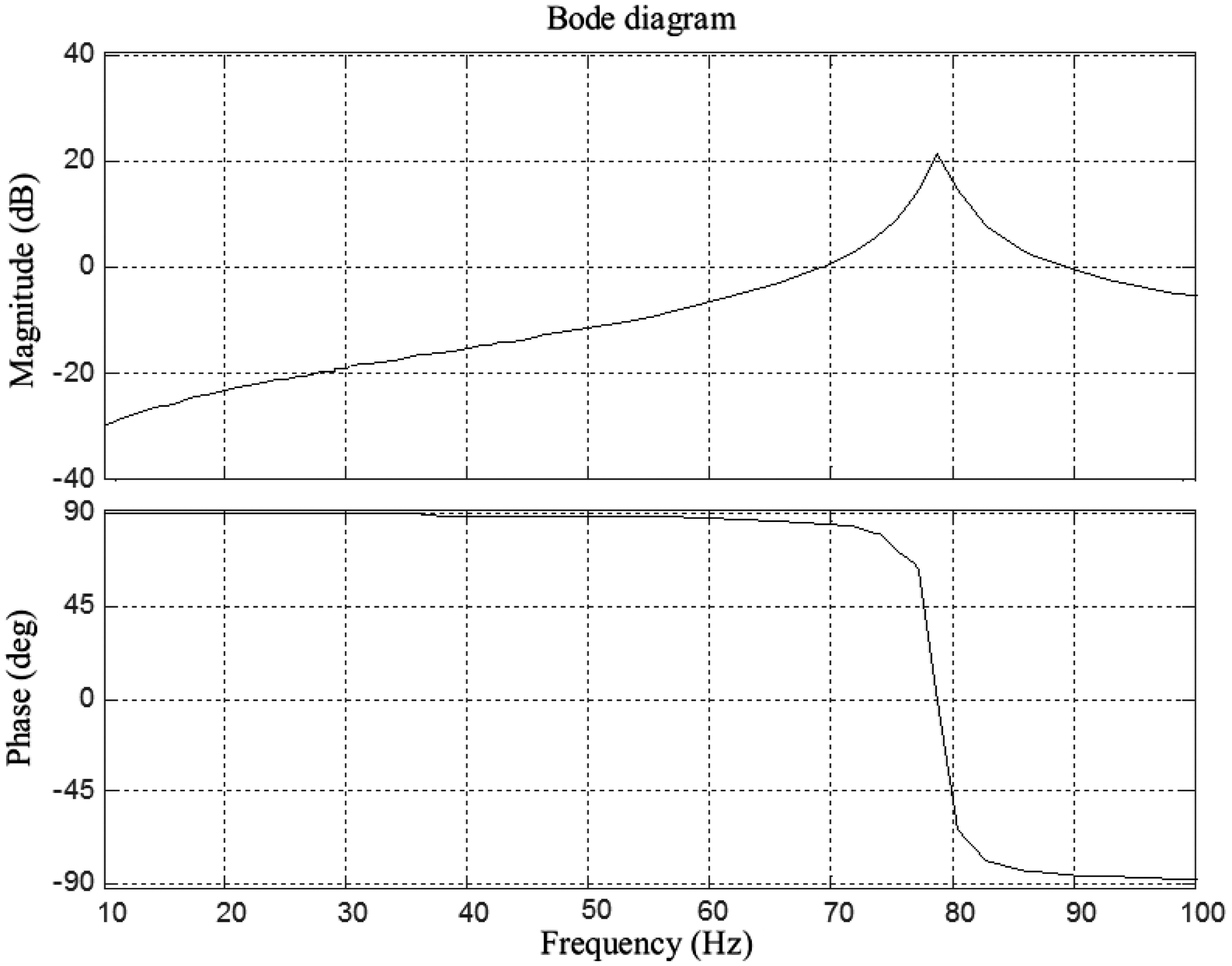
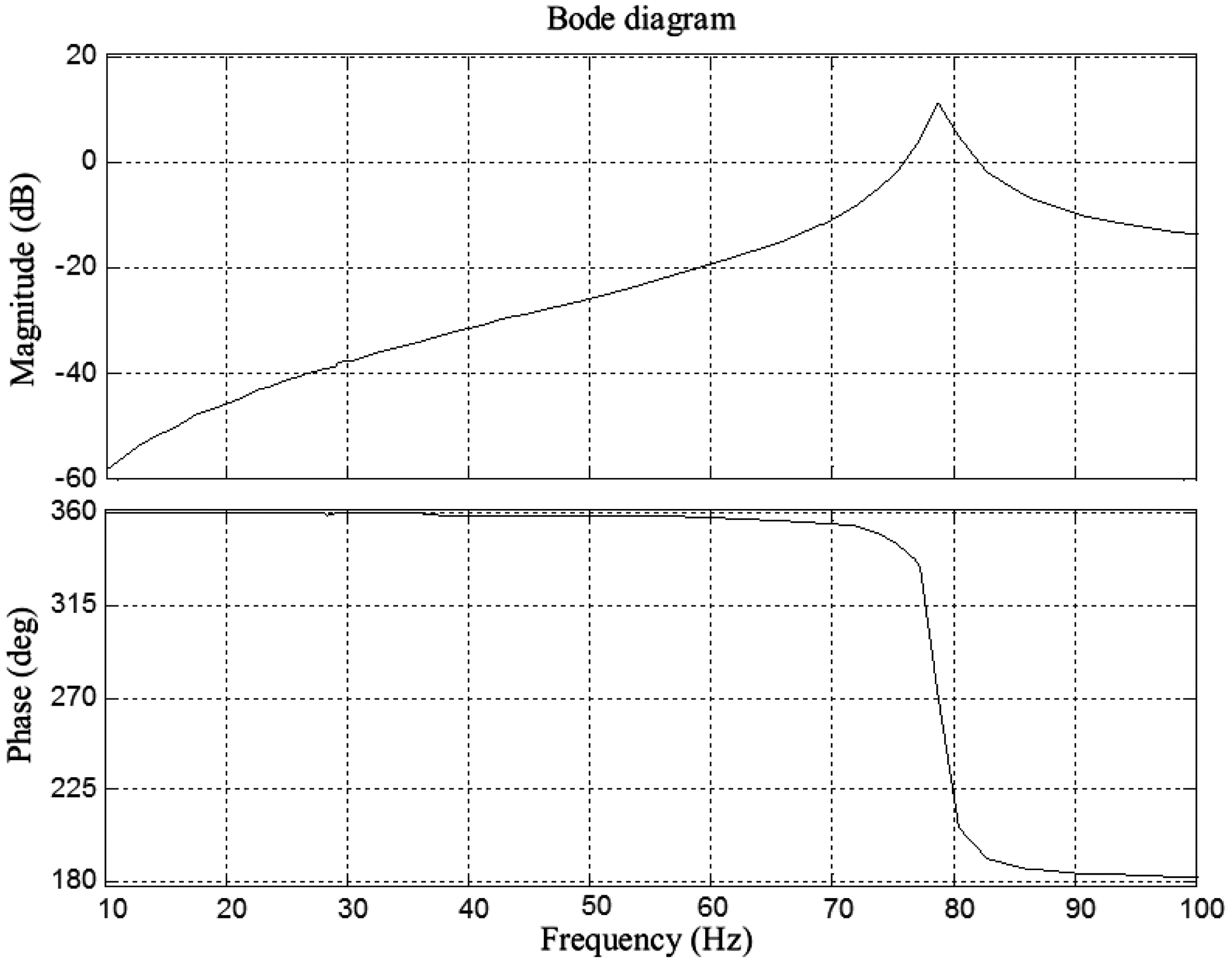
From the ASE analysis results considering thermal-modal analysis, stability margin of the X-43A vehicle can be established.
Conclusion
Aero-servo-elastic of a complex hypersonic aircraft is presented in this paper. The X-43A vehicle was analyzed with detailed thermal-modal and flutter analysis based on thermal-fluid–structure coupling.
In this paper, a finite element modeling of the complex X-43A vehicle is presented. The influence of material characteristic change and thermal stress is studied. Also four different kinds of modal analysis had found the influence on the mode of the X-43A vehicle due to serious aero-heating effect.
After structural finite element analysis was completed, flutter of the present vehicle was investigated. Aero-servo-elastic analysis was then started from the definition of an aero-servo-elastic closed-loop system. One of the most important steps for this analysis was thermal-modal analysis results which were then adopted for ASE computation.
It can be found in this paper that for the ASE discussion on a complex hypersonic aircraft, effective structural modeling, accurate aero-heating prediction and proper evaluation of state equation are all significant. So the proposed method provided an engineering application attempt for such problems.
Footnotes
Declaration of conflicting interests
The author(s) declared no potential conflicts of interest with respect to the research, authorship, and/or publication of this article.
Funding
The author(s) disclosed receipt of the following financial support for the research, authorship, and/or publication of this article: The work was financially supported by the National Program on Key Research Project (grant no. 2016YFB0200705) and the Fundamental Research Funds for the Central Universities (grant no. DUT162D(G)03 & DUT16RC(4)29).