




Abstract
In this paper, the mean first-passage time of a delayed tumor cell growth system driven by colored cross-correlated noises is investigated. Based on the Novikov theorem and the method of probability density approximation, the stationary probability density function is obtained. Then applying the fastest descent method, the analytical expression of the mean first-passage time is derived. Finally, effects of different kinds of delays and noise parameters on the mean first-passage time are discussed thoroughly. The results show that the time delay included in the random force, additive noise intensity and multiplicative noise intensity play a positive role in the disappearance of tumor cells. However, the time delay included in the determined force and the correlation time lead to the increase of tumor cells.
Introduction
Different noise sources are usually interactive. There is color cross correlation between two noises. The correlation time and correlation strength have important role on the output of the system. The noise correlation time can make the stationary probability density function from single peak to double peaks modal. 1 It may also improve the signal-to-noise ratio of the output of the stochastic system.2–4 Moreover, the noise correlation strength usually influences the mean first-passage time of the stochastic systems.5–8
The effect of the time delay cannot be ignored in the dynamical systems in many cases. 9 In recent years, the research of the systems with time delay has been one of the hotspots in the stochastic dynamical field.10–13 The cooperative effects of the time delay and noises were also widely applied in many fields, such as chaos, 12 neural network,14,15 ill spread 16 and so on. The stochastic system is non-Markov process because of the existence of the time delay. This kind of system can be solved through the various approximate methods. Guillouzi et al.17,18 first investigated the stochastic dynamical system with time delay and gave the standard Fokker-Planck equation of the system in the case of small delay. Then, Frank19–21 derived the Fokker-Planck equation corresponding to the stochastic delayed dynamical systems with the extended space method, and provided the probability density approximation to solve the Fokker-Planck equation.
The mean first-passage time describes the index of the escape problem in the stochastic nonlinear system, and aims to characterize the transient property of the stochastic nonlinear system. 22 In this paper, we study the mean first-passage time of the tumor cell growth system driven by colored correlated noise, and analyze the effect of noise parameters and time delay parameters on the number of tumor cells in two different states. Firstly, the system Fokker-Planck equation is obtained through the probability density approximation method. Then the analytic expression of the mean first-passage time is got by the fastest descent method. Finally, we give the main conclusions of this paper.
The model of the tumor cell growth system
The tumor cell growth system is described by the Logistic growth model.
23
Logistic model is a basic differential equation used to describe the growth process. It is widely applied in the fields of economy, biology and population dynamics, etc. The equation is governed by

In equation (1), x is the number of tumor cell, a is the growth rate and b is the decay rate. The growth speed of tumor cell is affected by the chemical reaction of tumor cell interior, immune effect and medical treatment, which is expressed by a multiplicative noise

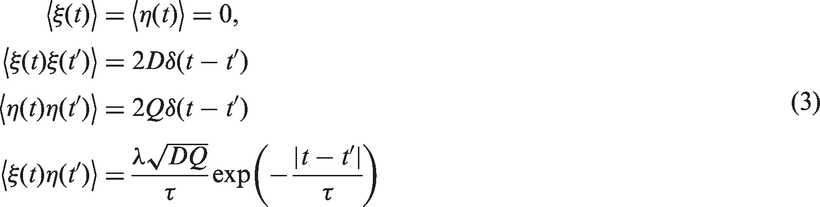
The statistical properties of the noise

The mean first-passage time
Time delays in equation (2) make the stochastic differential system to be a non-Markovian process. The approximation method is applied in the following analysis. To describe, simplify letting

We deal with time delays by the probability density approximation method.19–21 Then, equation (2) can be simplified to the following equation

where


Herein,



where
Through calculating equations (7) and (8), we obtain

As a result, the

where

According to the Novikov theorem
26
and the Fox method,
27
the approximate Fokker-Plank equation of equation (13) is got


Solving equation (15), the stationary probability distribution function is obtained

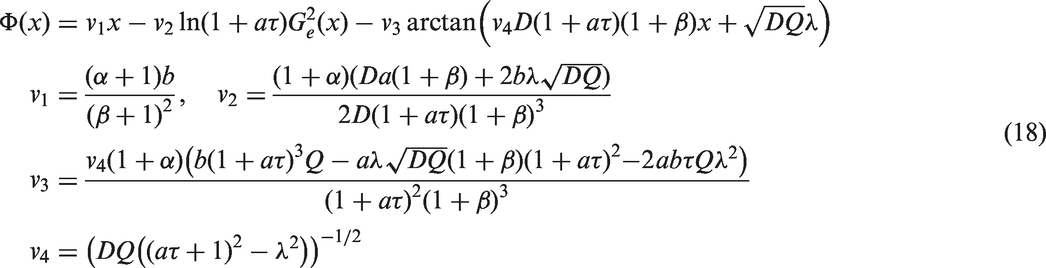
The accurate expression for the mean first-passage time from xs to xu is as follows


The numerical discussion
It can be seen from equation (20) that the analytic expression of the mean first-passage time is very complex. Hence, it is hard to find out the effects of the time delays and noise parameters on the mean first-passage time. Therefore, we discuss the problem via the numerical simulations.
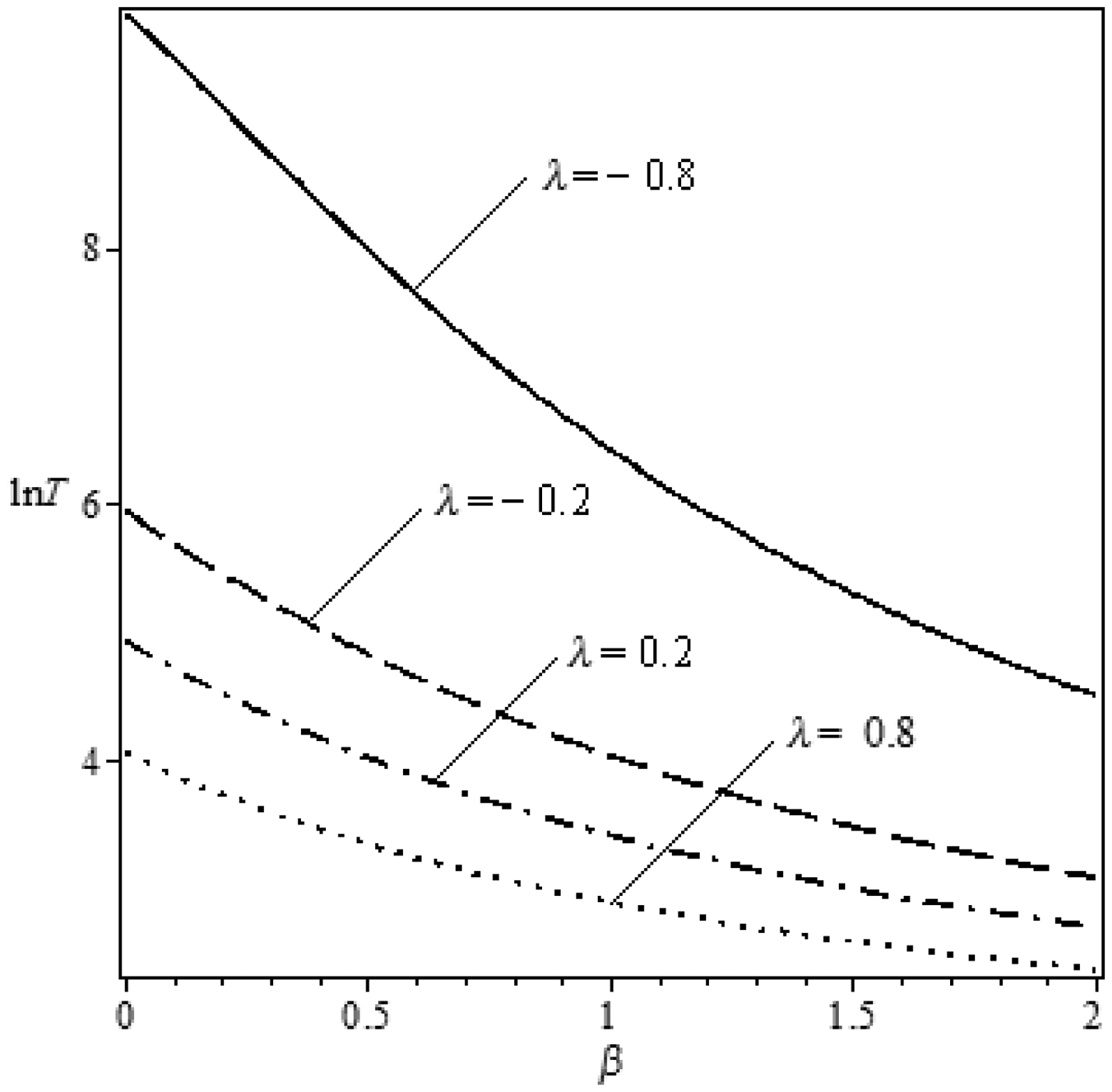
Figures 1 and 2 describe the functional curve of the mean first-passage time T versus the delay α and β, respectively. It can be seen from Figure 1 that the mean first-passage time T is an increasing function of the delay α. Further, the mean first-passage time increases rapidly with the correlation strength becoming smaller. It shows that the increase of the delay α makes the time from massive tumor cells stable state xs to zero tumor cell state xu increase. Therefore, the time delay α hinders the reduction of the tumor cell. Contrary to Figure 1, the mean first-pass time T is decreased with the increase of time delay β that includes in the random force. Further, the larger the correlation strength of the two noises is, the faster T decreases. Therefore, time delay β plays a positive role in accelerating the disappearance of tumor cells. Moreover, it will have a greater impact when the correlated strength λ of two noises is positive.
The mean first-passage time versus the time delay α under the simulation parameters a = 1.5, b = 1, β = τ = D = Q = 0.1. The mean first-passage time versus the time delay β under the simulation parameters a = 1.5, b = 1,α = τ = D = Q = 0.1.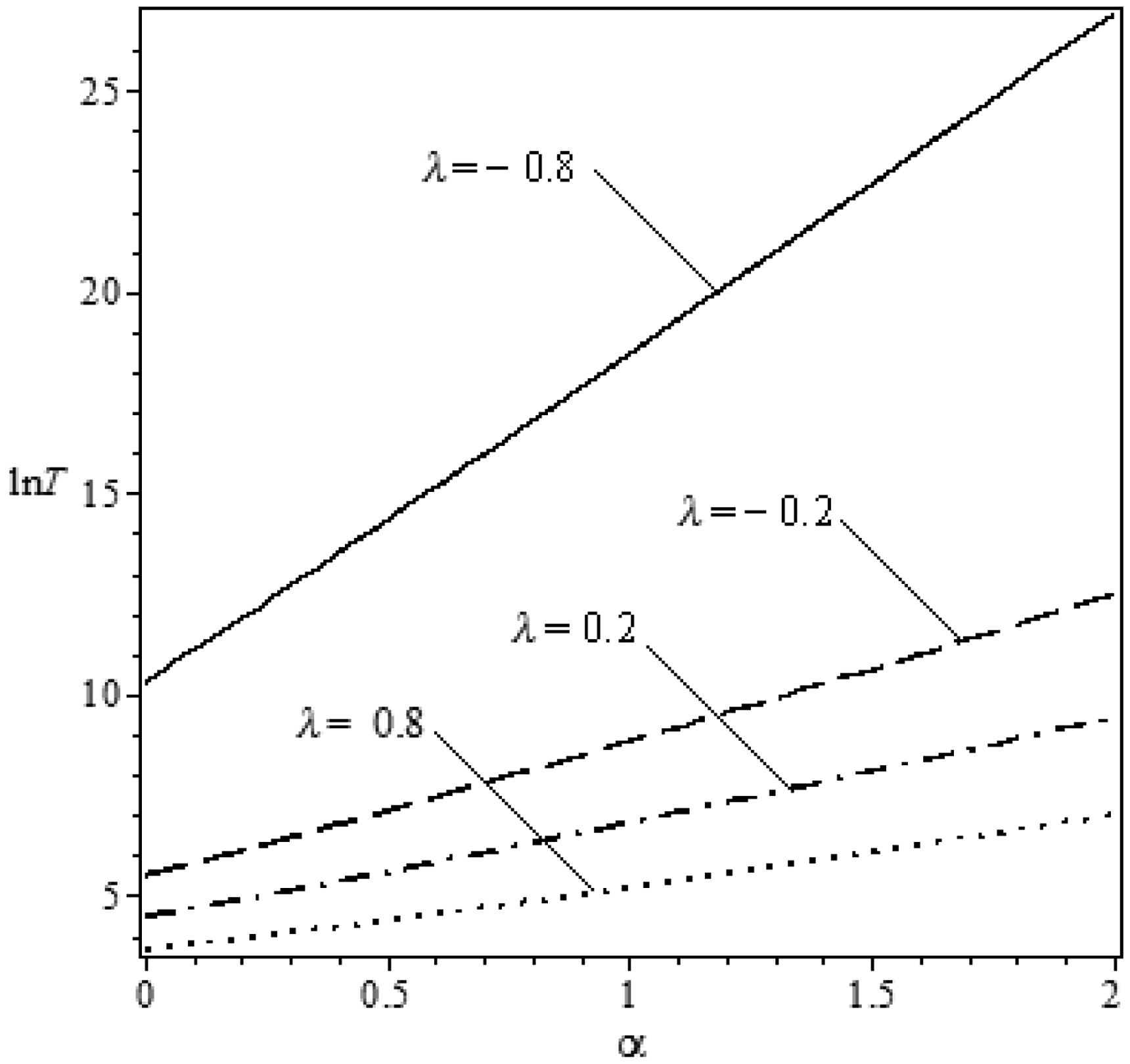
The mean first-passage time T varies with the multiplicative noise intensity D, and the additive noise intensity Q under the different correlation strength values are shown in Figures 3 and 4, respectively. In Figure 3, it can be seen that T is a decreasing function of D when the correlation strength is positive, which implies that the increase of noise intensity D accelerates the disappearance of the tumor cells. As the correlation strength of two noises is negative, T is a nonmonotonic function of D. With the increase of D, T has a maximal value, which is similar to the “resonance” phenomenon. In addition, the larger the absolute value of the negative correlation intensity, the more obviously is the “resonance” phenomenon appearing. Because of the existence of the resonance peak, the stability of the system is enhanced. It indicates that the mean first-passage time from the state xs to xu increases, which can inhibit the disappearance of the tumor cell. Figure 4 shows that the mean first-passage time T is a decreasing function of multiplicative noise intensity Q, and the curve of T declines rapidly with the increase of Q. The mean first-passage time T decreases more slowly as the two noises are negatively correlated than positively correlated.
The mean first-passage time versus the multiplicative noise intensity D under the simulation parameters a = 1.5, b = 1, α = β = τ = Q = 0.1. The mean first-passage time versus the additive noise intensity Q under the simulation parameters a = 1.5, b = 1, α = β = τ = D = 0.1.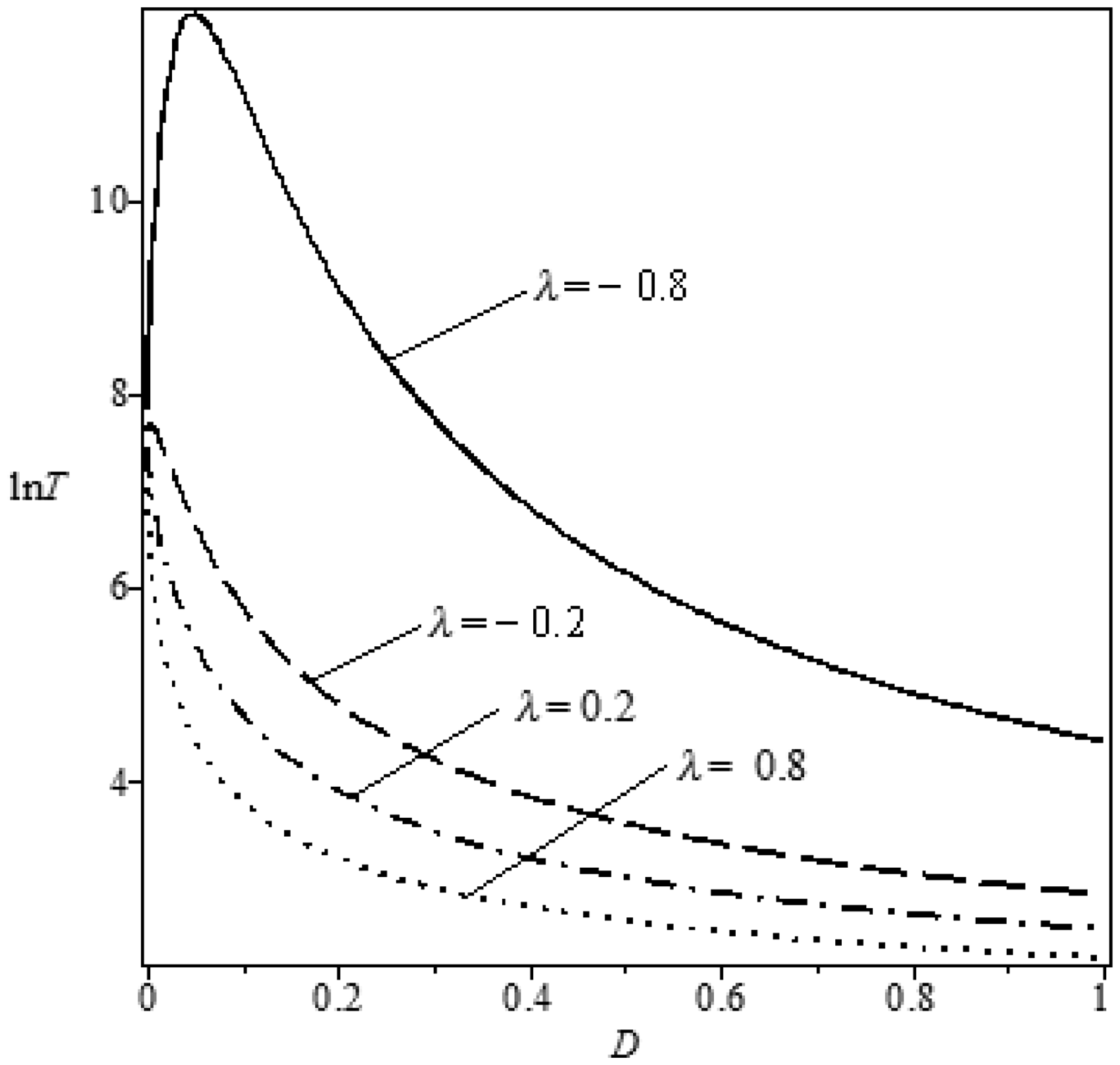
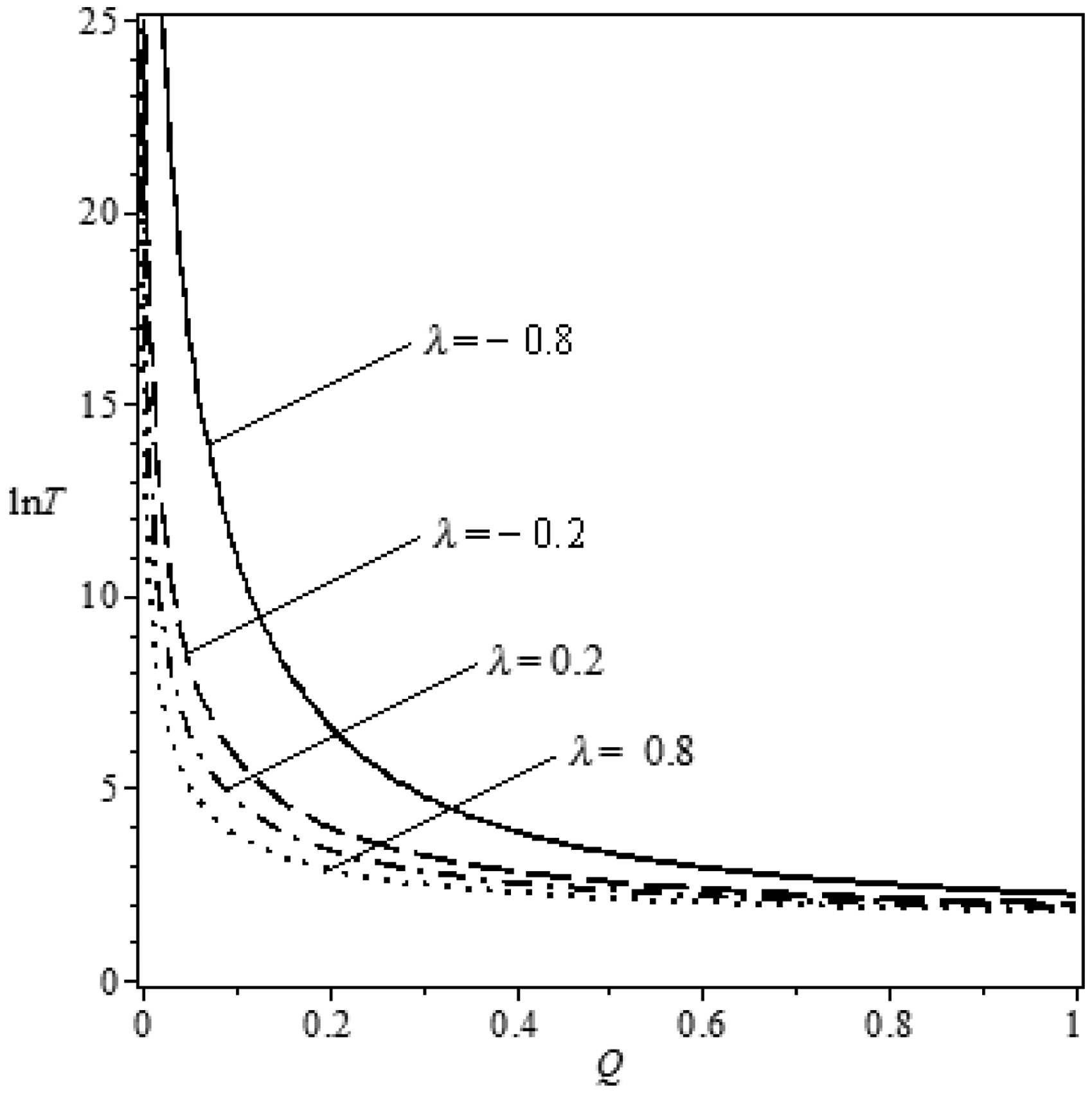
Figure 5 displays the mean first-passage time varies with the noise correlation time τ under different noise correlation intensity values. When the correlation intensity of two noises is negative, T is a decreasing function of τ, which illustrates the increase of τ enhances the phase transformation of the system. In other words, τ plays a positive role in the disappearance of the tumor cell. Moreover, the smaller the absolute value of the correlation intensity, the shorter the mean first-passage time is. When the correlation strength is positive, there is a negative effect on the disappearance of the tumor cell, which is contrary to the former case. At the same time, it can be seen that the mean first-passage time of the positive correlation is smaller than that of the negative correlation case.
The mean first-passage time versus the correlation time under the simulation parameters a = 1.5, b = 1, α = β = D = Q = 0.1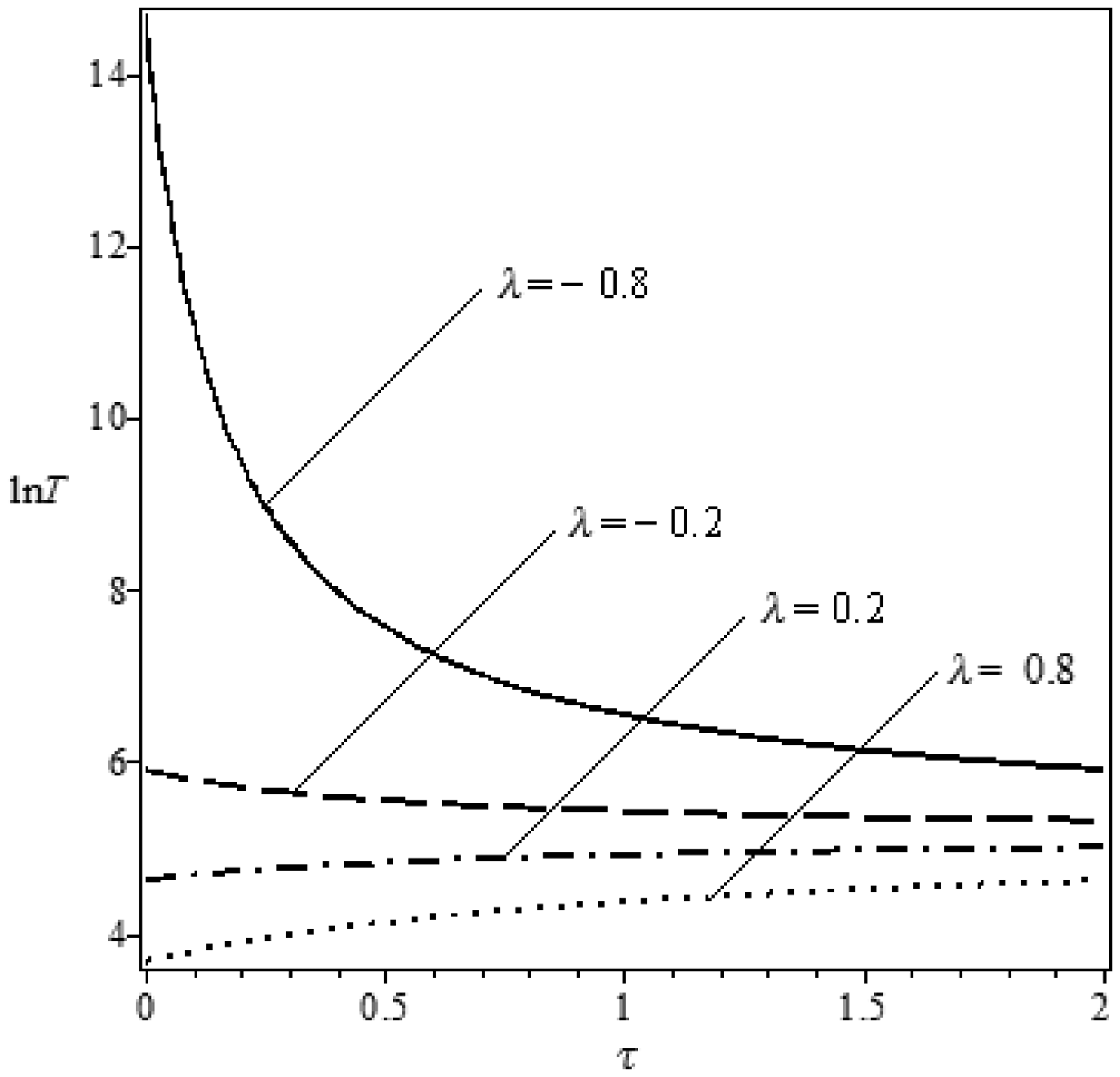
Figure 6 presents the mean first-passage time T variation with the noise correlation intensity λ under the different values of the noise correlation time τ. On the curves, the mean first-passage time T is a decreasing function of λ. Moreover, when the two noises are negatively correlated, T is increased with the decrease of the correlation time τ, and the trend is contrary to the fact when two noises are positive correlated.
The mean first-passage time versus the correlation intensity under the simulation parameters a = 1.5, b = 1, α = β = D = Q = 0.1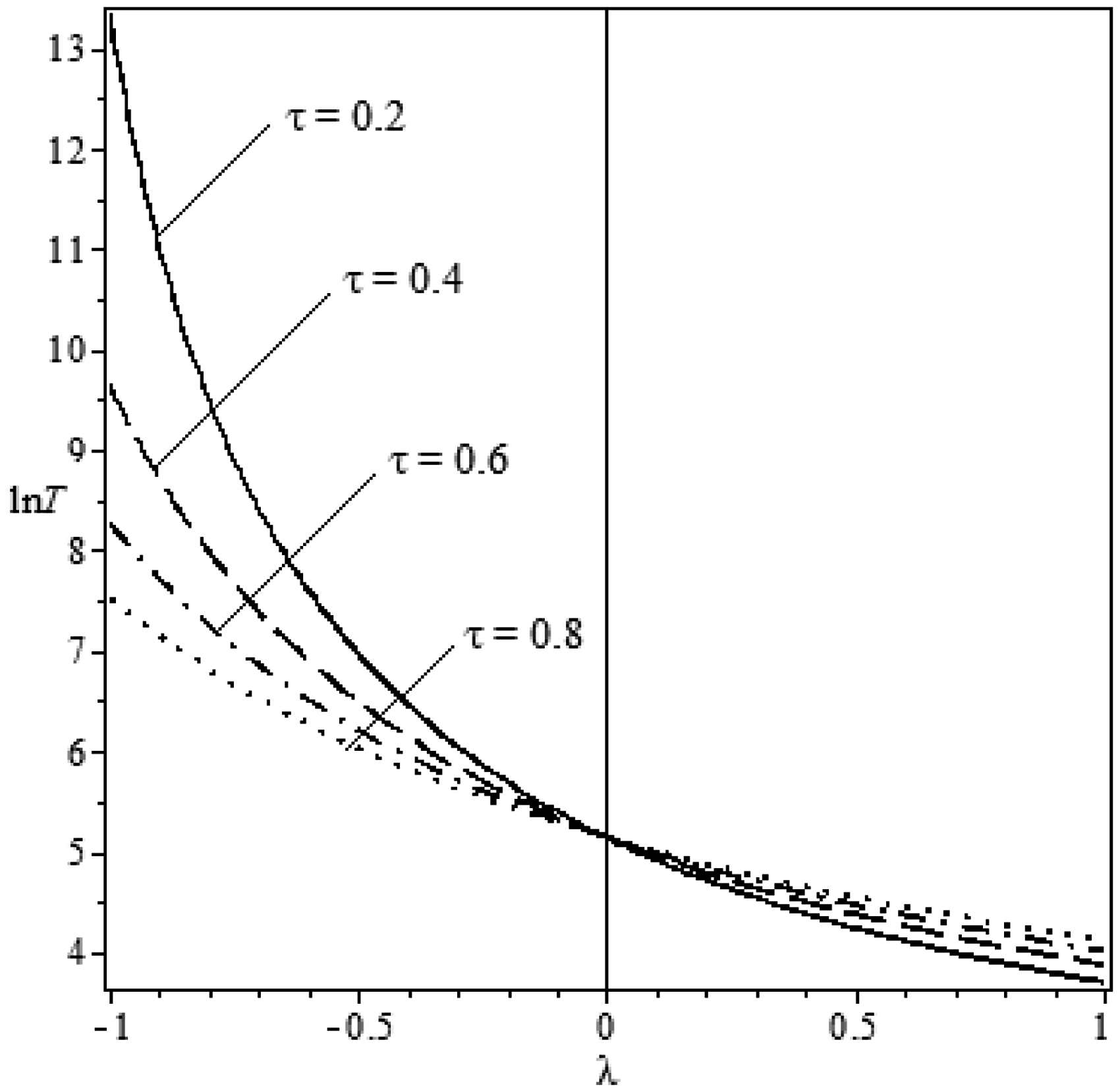
Conclusion
In this paper, the mean first-passage time of a tumor cell system with time delay and colored cross-correlated noises excitation is investigated. The analytical expression of mean first-passage time is given by the fastest descent method. Then, the effects of different time delay and noise parameters on the mean first-passage time of the tumor cell transforming between two different states are analyzed thoroughly.
When the correlation strength of two noises is positive, the conclusions are shown that the mean first-passage time is a decreasing function of some factors, such as the increase of time delay included in the random force, the multiplicative noise strength and the additive noise intensity. However, when the correlation strength of two noises is negative, the mean first-passage time is a decreasing function of the factors such as the time delay included in the random force, the additive noise intensity and correlation time, but an increasing function of time delay included in the determining force, and a nonmonotonic function of multiplicative noise intensity. Meanwhile, the mean first-passage time is smaller in the positive correlation than that in the negative correlation case. Therefore, when two noises are positively correlated, the increase of the time delay included in the random force, additive noise intensity and multiplicative noise intensity can promote the disappearance of the tumor cell. Thus, the mean first-passage time can be reduced by increasing these parameters in the therapy process. Studying the effect of noise on the mean first-passage time of the tumor cell growth system may provide some reference value in the treatment of tumor diseases.
Footnotes
Declaration of conflicting interests
The author(s) declared no potential conflicts of interest with respect to the research, authorship, and/or publication of this article.
Funding
The author(s) disclosed receipt of the following financial support for the research, authorship, and/or publication of this article: This paper is supported by the National Natural Science Foundation of China (Grant No. 11302106 and 11602098), and the Fundamental Research Funds for the Central Universities (Grant No. 30917011329).