




Abstract
The aim of the study was to design and develop a mobile system for better management of children’s oral health by using the internet technology. This study was followed in a three-step approach. (1) Design stage: participatory design (including patients, dentists and computer scientists) was taken in order to adapt the system to the clinical practice of dentistry; (2) Development stage: dentists and computer scientists were involved in this stage to develop the system by using internet technology; (3) Usability testing stage: the quality (MARS), usability (SUS) and satisfaction of the system were assessed by children’s caregivers. The system contains patient-side app, doctor-side app and Web side program for manager. Children and their caregivers could acquire many useful services through the app, such as oral healthcare education, brushing management, dietary record, online consultation, online appointment, feedback of adverse events. The overall value of SUS was 67.75. The final quality mean score was 3.44 ± 0.95, with the highest mean score of functionality. The majority of caregivers were satisfied with the system. They expressed the system could improve the current medical services and their oral health literacy.
Introduction
The smartphone is a revolution that combines mobile communication capability and computing capability together in a handheld-sized device, which is also capable of running various third-party applications (apps). 1 The latest generation of smartphone is increasingly viewed as handheld-sized computer rather than as mobile phone, because of its powerful computing function, capacious memory, large screen and open operating system that encourage the development of apps. 2 In 2013, Apple® announced that customers had downloaded over 50 billion apps from the revolutionary App Store. Customers were downloading more than 800 apps per second at a rate of over two billion apps per month on the App Store. 3 At the same time, the use of medical apps was also more and more common.4,5 By 2015, 500 million smartphone users worldwide would be using a medical app. 6 Studies reported that over 85% of health professionals used a smartphone, and 30–50% used medical apps in clinical practice.7–9 Dental-related app was one important part of those medical apps. In our previous study, all of the surveyed 379 dentists in China owned a smartphone, and 76% of them installed medical apps. Most of them said these medical apps had positive impact on clinical practice, patient education and patient care in dentistry by providing relevant medical information. 10 Other studies also have demonstrated that mobile dental apps could motivate patients’ oral hygiene behavior and improve their oral hygiene.11,12 As a new way of providing education for patients, dental apps also did a great job. In 2016, Pulijala et al. designed a mobile app to provide patients with 3D visualized information about orthognathic surgery. In their study, they found patients receiving 3D visualized information of the app could answered the questions about orthognathic surgery more correctly than the control group. 13 In another study, Ala et al. found dental app was an effective means of providing accessible knowledge to guide laypeople in managing tooth avulsion, and it could be superior to a lecture-based delivery of information. 14 In 2014, Chia-Yung Lin et al. created a dental app in Taiwan combined with cloud services of helping dentists and patients to arrange their scheduled appointment more conveniently. The researchers found that the new dental app could provide efficient service to both dentists and patients, and help to establish a better relationship between them. 15
Data shows that the number of internet users in the world was nearly 4,929,926,187 by Sept 30, 2020. 16 There were 2,555,636,255 internet users in Asia with the highest proportion of 51.8%. And the data is increasing year by year.
However, there are only a few dental apps in China app stores. Many dentists and patients in China said they really wanted to use some useful dental-specialty apps. So it’s urgent to design and develop more useful dental apps in China. Additionally, there is almost no dental app aiming for children’s oral health management in China.
So the aim of this study is to design and develop a mobile system or mobile application (which is involved with patients or their caregivers, oral healthcare providers and computer scientists) for management of children’s oral health. We want to provide children (including their caregivers) and dentists more convenient services, enhance the relationship between them, improve caregivers’ literacy of oral healthcare and improve children’s oral health.
Methods
Design stage
Participatory design was taken in the design stage.17,18 Face-to-face participatory design sessions were conducted, involving dentists, dental nurses, patient representatives and computer scientists. Patient representatives put forward what conveniences and services they hope this system could provide for them. Dentists and dental nurses further optimized these needs based on actual clinical work. The computer scientists designed the structure and business process of the system according to these needs. Additional face-to-face and on-line participatory sessions would be planned during the study when necessary.
Development stage
The system was composed of three tools (patient-side app, doctor-side app and Web-side program for managers). The children oral healthcare tips or knowledge were written by dentists according to many published books, magazines and guidelines. The knowledge is composed of text, picture and animation. The cartoon pictures and animations were made by computer scientists.
Usability testing stage
After the development of the system, 20 children’s caregivers were recruited to use and test the system.
Before using the system, 20 participants were asked to complete questionnaire-1 (Supplementary File 1). They were asked to complete questionnaire-1 again and another 2 questionnaires (SUS and MARS scale, Supplementary Files 2 and 3) after using the system for 12 weeks. The questionnaire-1 was used to get participants’ perceptions of children’s oral healthcare medical behavior and the mobile system. The System Usability Scale (SUS) was used to assess the usability of the system, 19 Mobile Application Rating Scale (MARS) was used to assess the quality of the system. 20
The questionnaire-1 has 13 questions. Each question is based on a 5-point Likert scale: 1 = strongly disagree and 5 = strongly agree. Question 1 and question 6–10 are designed to measure caregivers’ attitudes on the medical services. Question 2–5 are designed to measure caregivers’ oral health litercy. Question 11–13 are used to measure caregivers’ attitude toward the mobile system.
There are 10 questions in SUS, responses to questions are based on a 5-point Likert scale: 1 = strongly disagree and 5 = strongly agree. For questions 1, 3, 5, 7 and 9 the score contribution is the scale position minus 1. For questions 2, 4, 6, 8 and 10, the contribution is 5 minus the scale position. Multiply the sum of the scores by 2.5 to obtain the overall value of SUS. The SUS scores have a range of 0–100. The MARS is designed to evaluate mHealth apps based on 5 key quality categories, including engagement, functionality, aesthetics, information, and subjective quality. Each category includes 3–7 individual questions. Each question has 5 possible answers, with 5 indicating “excellent” and 1 indicating “inadequate.” The numeric answers to the questions in each of the subscales are totaled, and averaged. So the MARS score is ranged from 1 to 5. The questionnaires were all reviewed by an expert panel for content validity and reliability.
Statistical analysis
Data were analyzed using SPSS statistical software (version 17, SPSS, Inc. Chicago, IL, USA). Quantitative Likert scale data are presented as the mean ± standard deviation. A paired t-test was used to examine the changes of participants’ attitudes on oral healthcare medical behavior before and after the use of the mobile system. A p value of < 0.05 was considered significant.
Results
The architecture of the mobile system
The mobile system was designed into five layers: application interaction layer, business application layer, service layer, database layer and infrastructure layer (Figure 1). Composed of Android, iOS and web programs, the application interaction layer interacted with users and the server through the cloud service interface. The business application layer consisted of patient-side app, doctor-side app and Web-side program. The service layer consisted of instant messaging (IM) system, short message platform, data access component and data exchange component. The database layer mainly included system configuration database, user management database, metadata database and query database. The infrastructure layer included network, server and storage system. The architecture of the mobile system.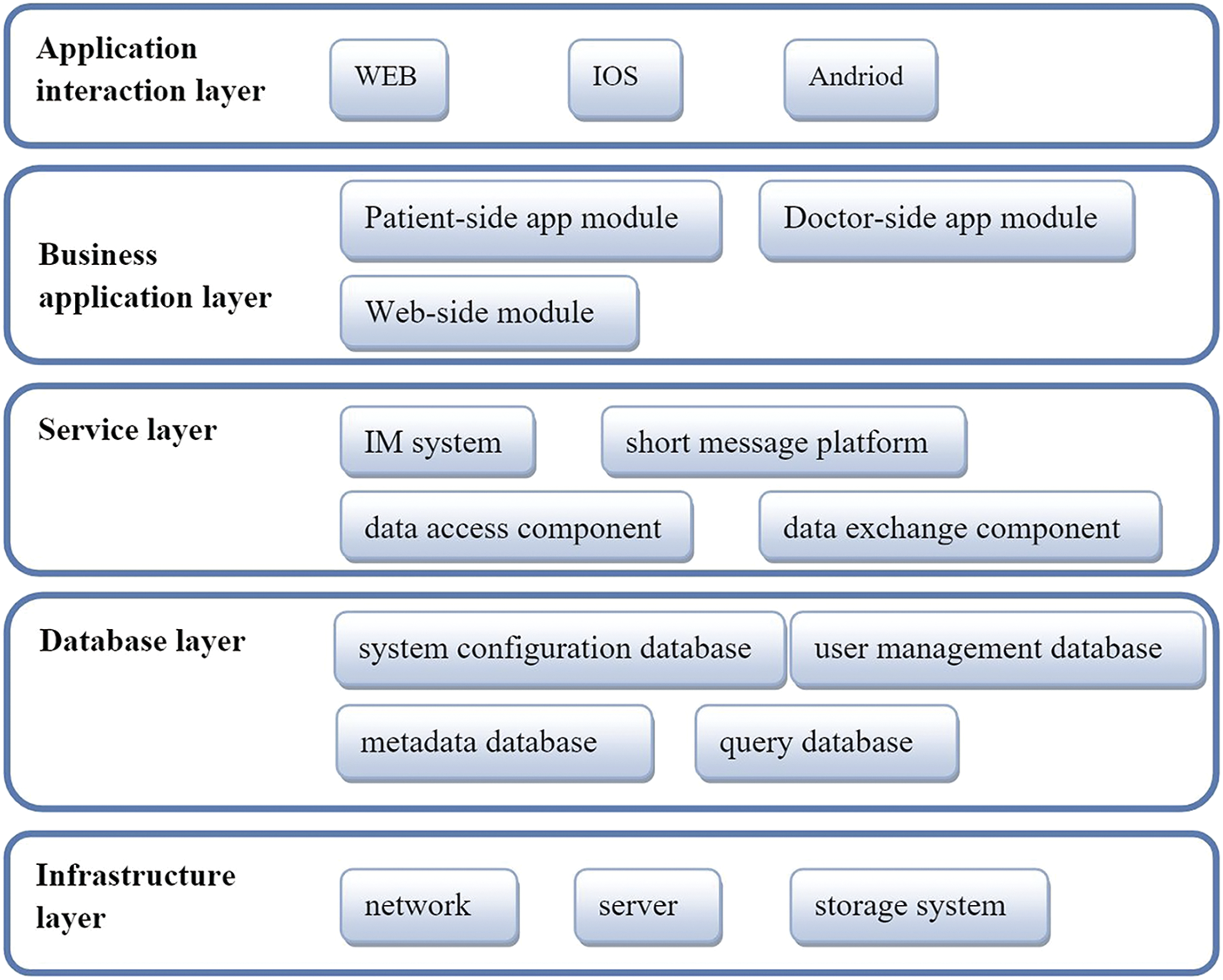
The flowchart of the mobile system
The flowchart of the system was shown in Figure 2. Children and their caregivers could acquire many useful and efficient medical services through the patient-side app. The doctor-side app could assist dentists to manage their patients better. Through the web-side, managers could achieve the management of users and each function modules. The flowchart of the mobile system.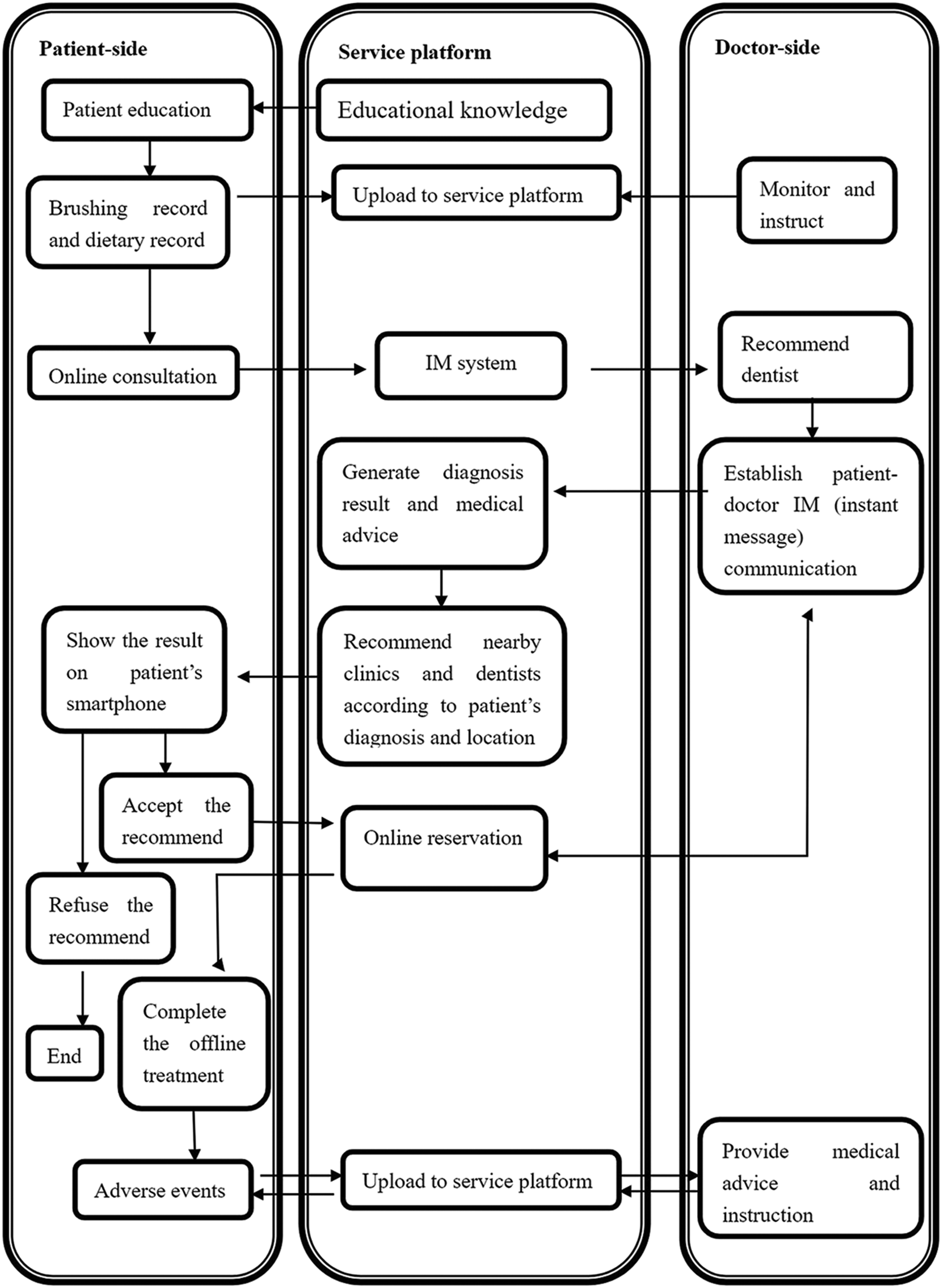
The patient-side app
There are many function modules in the patient-side app, including personal center, oral healthcare education, brushing management, dietary record, online consultation, online appointment, feedback of adverse events (Figure 3). After registering and logging in, users could acquire these modules (Figure 3(a)). In the education module, patients could browse oral healthcare knowledge (Figure 3(b) and (c)). Through the brushing management module, the app will start an alarm clock at the set time to remind patients brushing teeth. Meanwhile, in order to increase users' participation, the app will provide music during brushing and rank all users who use the software according to the duration and frequency of brushing (Figure 3(d)). The dietary record module will help parents record their children’s daily diet (Figure 3(e)). If children have any oral problems, parents could search online consultation through the app. By the instant message function, it will establish the bridge between patients and doctors (Figure 3(f)). Doctors will generate primary diagnosis result and provide medical advice for patients. And the app would assist patients in completing the online reservation (Figure 3(g)). After the treatment, patients could report their adverse events at home through the feedback of adverse events module. And they will receive dentists’ advice and instruction (Figure 3(h)). The main functions of the patient-side app. (a) shows the log in screenshot. (b) shows the oral health education screenshot. (c) shows the searching page for oral healthcare tips or knowledge. (d) shows the brushing management screenshot. (e) shows the dietary record screenshot. (f) shows the communication page between patients and doctors. (g) shows the online reservation screenshot. H shows the feedback page of adverse events.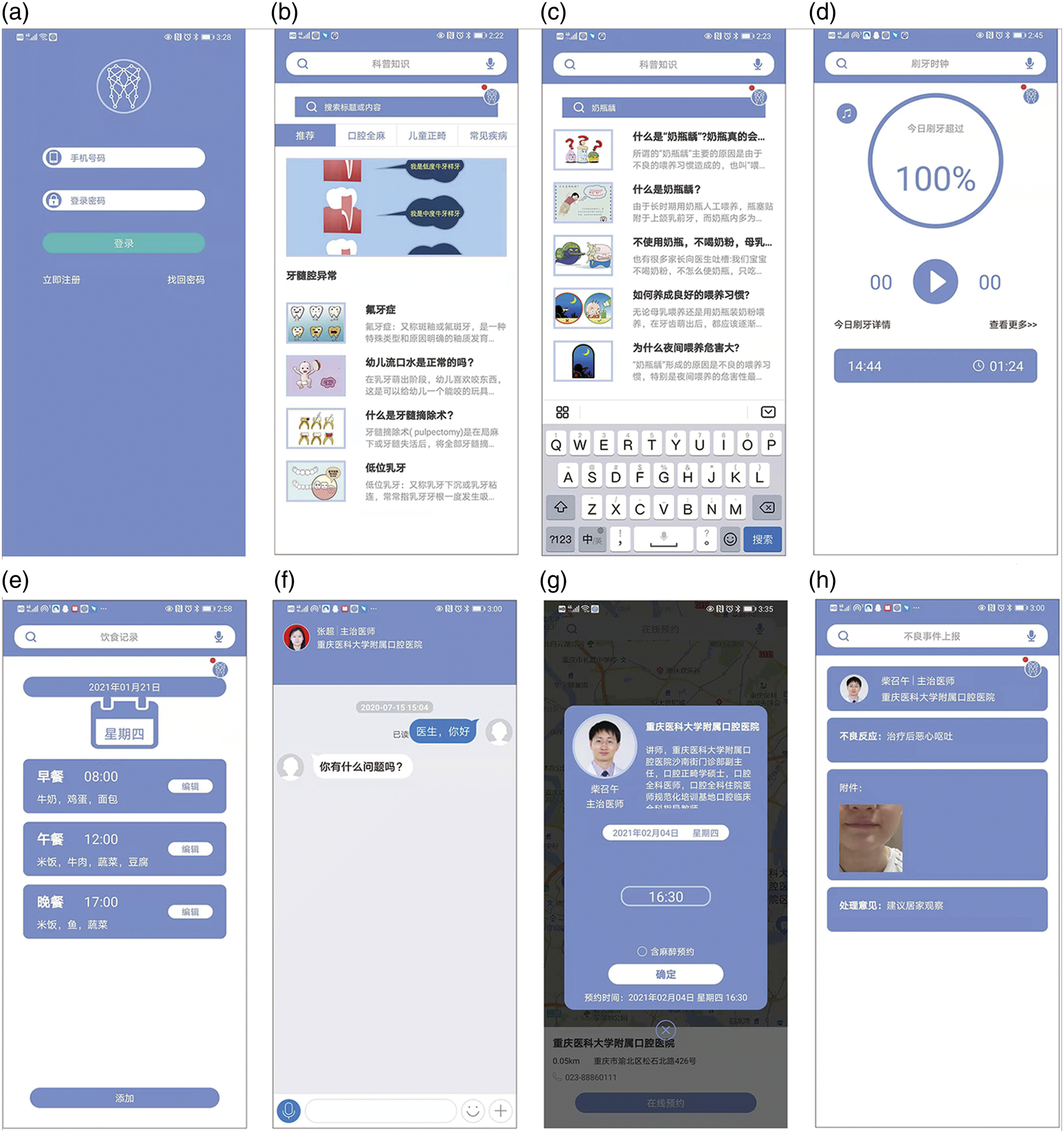
The doctor-side app
There are also many function modules for dentists, including online consultation management, online appointment management, and news center (Figure 4). Through the online consultation management module, dentist would receive patient’s request for consultation (Figure 4(a)). Doctor also could manage the online appointment module (Figure 4(b)), including confirming the time of online appointment, reading the information of patients, and communicating with the patients before they go to the clinic. In the news center (Figure 4(c)), doctors could check the new appointment notification, new consultation request, new adverse events notification and other system news. When patients upload their problems through the patient-side app, doctors would receive the notification and give patient instructions and medical advice through the doctor-side app (Figure 4(d)). The main functions of the doctor-side app. (a) shows the online consultation request screenshot. (b) shows the online appointment screenshot. (c) shows the news center screenshot. (d) shows the doctor’s reply page of patient’s adverse events.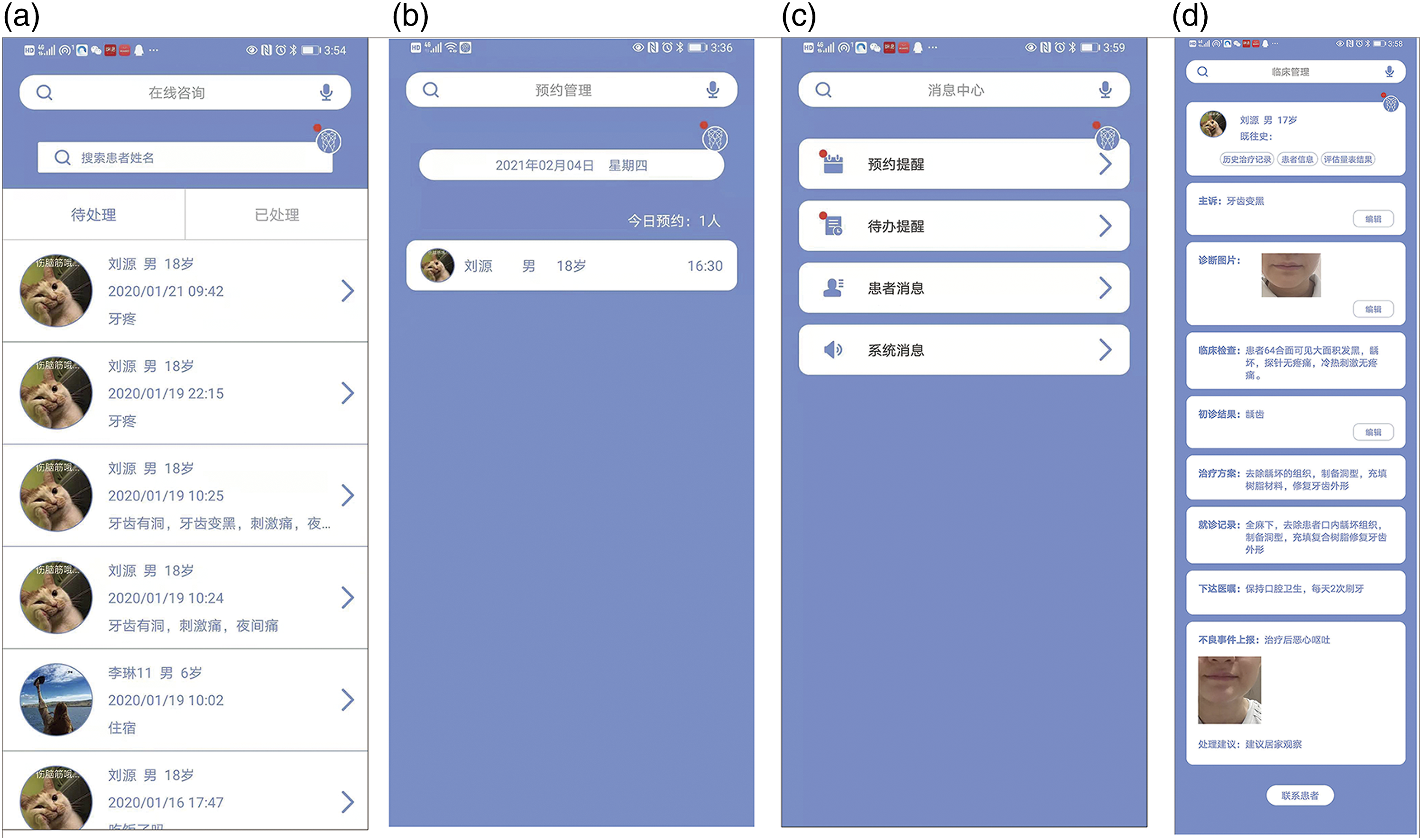
The web-side program
The clinic manager could log in the Web-side program by typing the account and password (Figure 5(a)). Managers could manage the function modules of the app-side. For example, they could create doctor account for new dentist (Figure 5(b)), add or edit new oral healthcare knowledge or tips (Figure 5(c)), check the information of their clinics’ patients (including their brushing records, dietary records, consultation records, appointment records, etc., Figure 5(d)). The main functions of the Web-side program. (a) shows the log in screenshot. (b) shows the page of creating doctor account for new dentist. (c) shows the management page of oral healthcare knowledge or tips. (d) shows the management page of patients.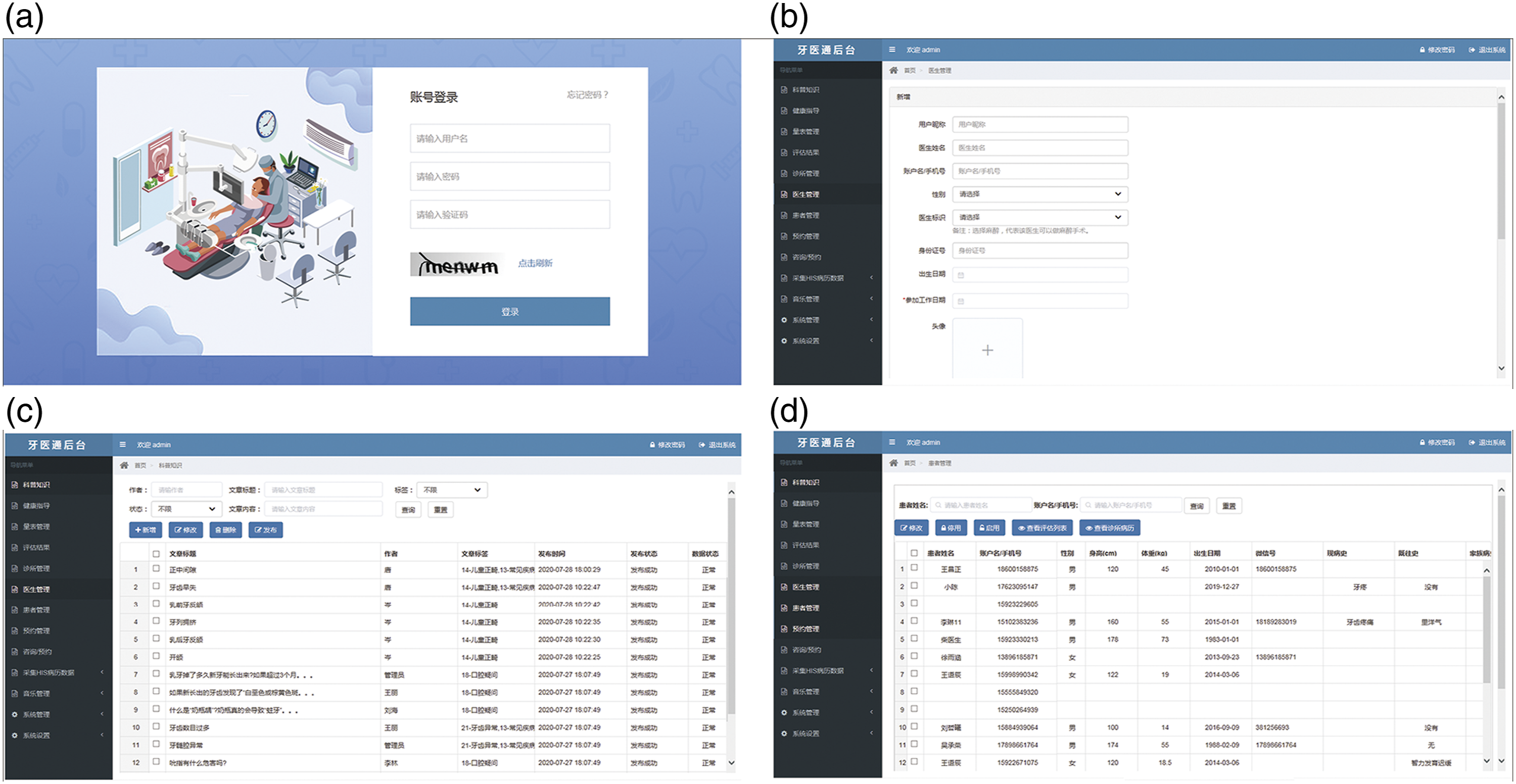
The usability assessment of the mobile system
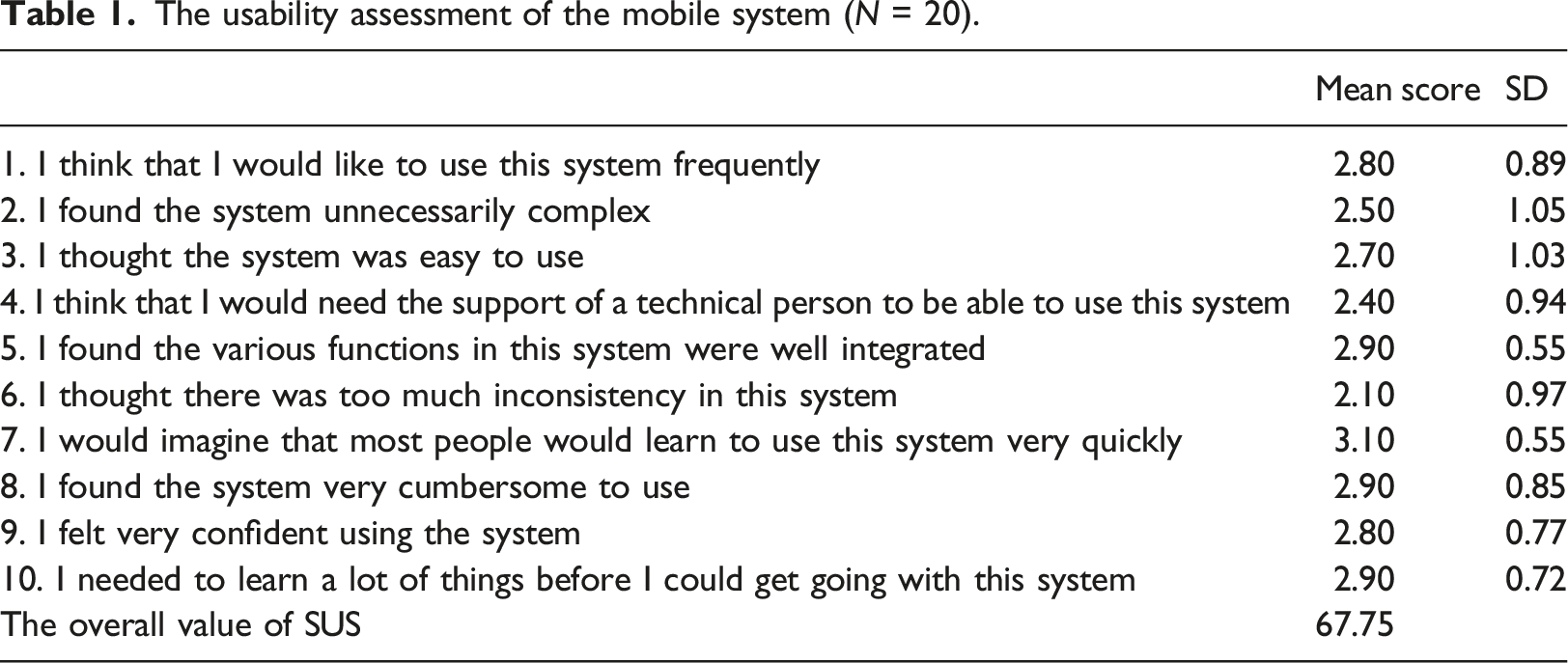
The usability assessment of the mobile system (N = 20).
The quality assessment of the mobile system
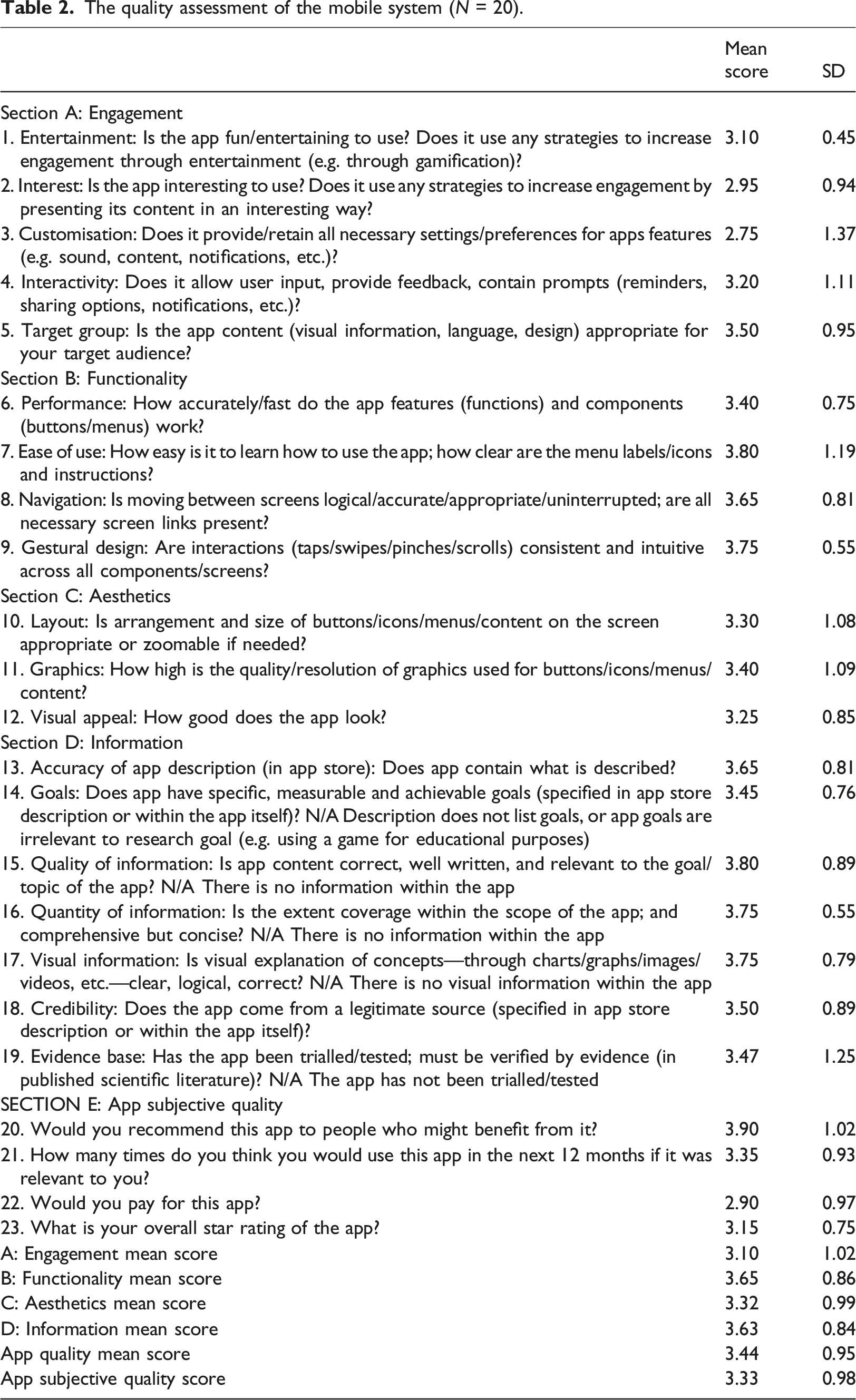
The quality assessment of the mobile system (N = 20).
Caregivers’ perceptions of children’s oral healthcare medical behavior before and after using the mobile system
Caregivers’ perceptions of children’s oral healthcare medical behavior before and after the use of the mobile system (N = 20).
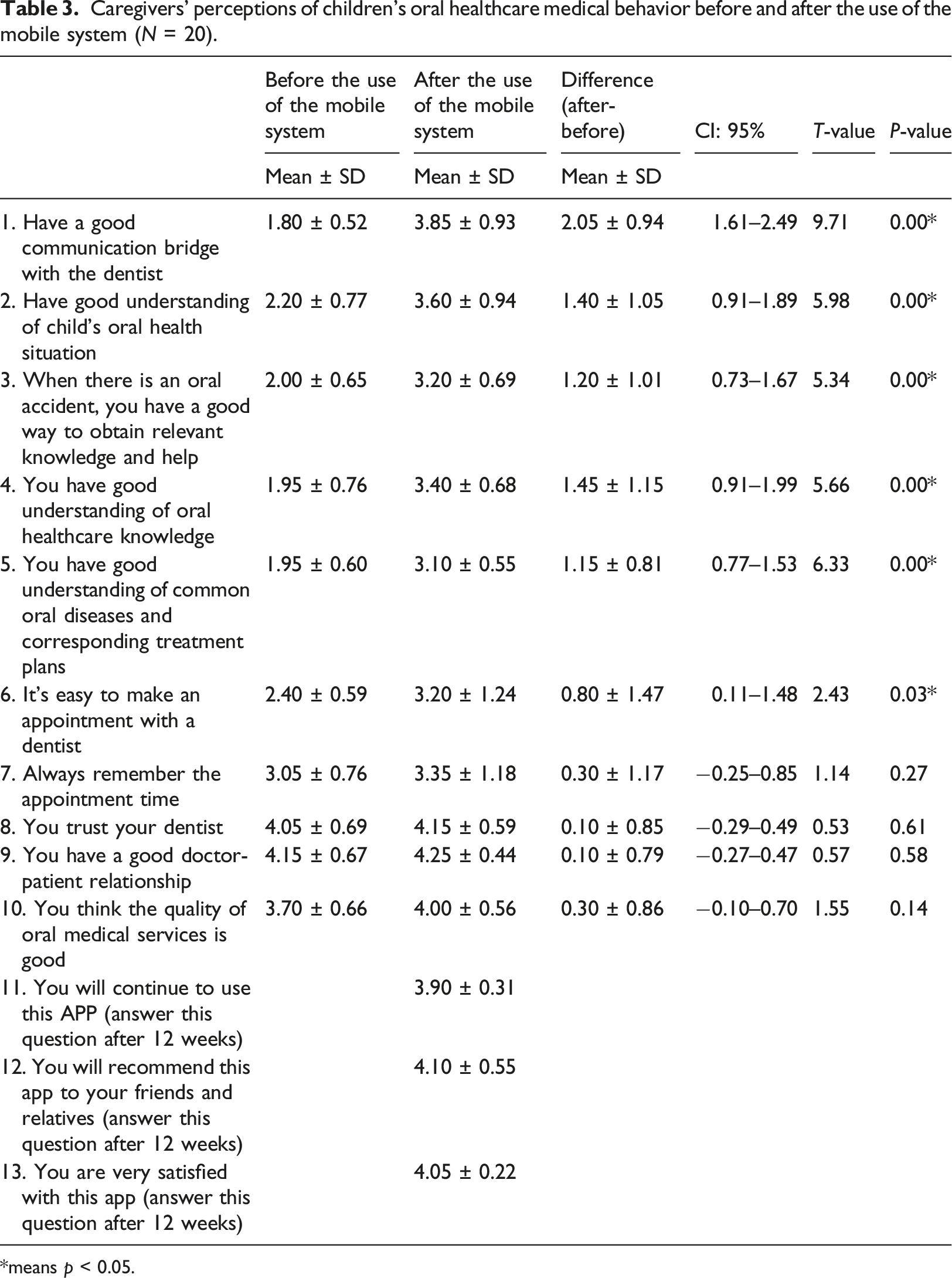
*means p < 0.05.
Discussion
The traditional medical model can no longer meet people’s requirements for medical services. More and more healthcare providers and computer scientists want to use the internet technology to provide patients more efficient and better medical services. By searching in Pubmed, we find there are many articles about healthcare applications in dentistry. In summary, these applications could be divided into three groups according targeted user: dental healthcare professionals, dental students, and dental patients. As for dental patients’ applications, the most common category is oral hygiene promotion applications, followed by perioperative educational applications and other kinds of applications. In general, patients lack good pathways to get oral health guidance and knowledge at home, and it’s difficult for some patients to grasp correct tooth brushing technology, especially for children. So many tooth brushing apps and oral hygiene promotion apps with various behavior management methods are emerging. Studies have demonstrated these apps could motivate patients' evidence-based oral hygiene behavior,11,21–23 improve oral hygiene,24,25 assist children and their parents obtaining oral health knowledge,26,27 prevent gingivitis 25 and periodontitis, 28 and prevent caries.29,30 For patients, it’s always difficult for them to understand many dental surgery procedure and complications directly told by doctors. They need a more vivid and interesting way to understand these issues. So many researchers developed software in order to inform patients some dental surgical techniques and possible complications. Aiming to improve patients’ understanding of the orthognathic surgical procedure, Pulijala developed a orthognathic surgery educational app named “Sur-face” in 2016, and Sousa also developed “OrtogApp” in 2019. 31 In 2016, Canbazoglu et al. developed a mobile application by providing patients with illustrative descriptions of the procedures of dental implantation and the result. 32 The researchers found this method was more effective than traditional verbal form. It’s not difficult to find these dental applications could provide great benefit for dental patients.
Excluding the above applications in articles, a recent review has revealed that there are 1,075 patient-focused oral hygiene apps available on the Apple App Store and Google App (Android) store around the world in July 2018. 33 But in China App Store, the number is very small. And the application aiming to achieve management of children’s oral healthcare is seldom. So in this study, we designed and developed a mobile software system in order to achieve this purpose. The system contains patient-side app, doctor-side app and Web-side program for manager. After installing the application on mobile devices (smartphones or tablets), patients should register an account before using it. And the doctor’s account is created by the clinic manager. After entering the account and password, patients or doctors could acquire corresponding functions in the application. For children or caregivers, they could search and read many children oral healthcare knowledge (including correct tooth brushing technology, general children dental treatment procedures or complications, and other oral healthcare knowledge and skills). The knowledge is composed of text, picture and animation. We think the combination of multiple expressions could help children and caregivers understand the professional dental knowledge and technologies better, improve their interest, and finally improve their oral health and oral health literacy. The brushing clock service could not only remind children that it’s time to brush your teeth, but also could store their brushing record. And the app could also help caregivers store children’s daily dietary record. According to their record, dentists could provide corresponding instructions and professional advice. Besides the above functions, the app could provide patients other more convenient services, such as online consultation, online appointment, and online feedback of adverse events. As for doctor-side app and Web-side program for manager, they all guarantee the successfully operate of each function of patient-side app. Patients’ information (including their pictures, demographic information, messages with doctors and clinic visit information) is stored in a database. The access to the database requires identification. According to the user’s identity, their permissions to the database are also different. The identification of the identity is realized by entering the account and password. In order to maintain the confidentiality of patients, doctor could only check the information of his own patients. As for clinic manager, he also could only check the information of the patients in his own clinic.
In the past few years, many healthcare applications have been increasingly questioned because of the accuracy of information in them. In some studies, the expert involvement rate of the applications was as low as 9% and the medical evidence adherence rate was ().34,35 In our study, the mobile system was mainly conducted by a professional dental medical institute. This could not only satisfy the needs of patients and doctors better, but also could improve the expert involvement and medical evidence adherence in the maximum level. After entering the account and password, users (patients, dentists or clinical managers) could log in the app or web-side program, acquiring respective functional modules. The dentists and clinical managers only could check.
We enrolled 20 children’s caregivers to assess the usability, quality of the mobile system, and their perceptions of oral healthcare medical behaviors by using the system for 12 weeks. The overall value of SUS of this mobile system was 67.75, which was higher than the average score of 50. The final app quality mean score was 3.44 ± 0.95. And the functionality subscale got the highest mean score of 3.65 ± 0.86, the engagement subscale got the lowest mean score of 3.10 ± 1.02. The result was similar with another study which also assessed the quality of 20 commercially available, patient-focused oral hygiene apps using the Mobile App Rating Scale (MARS). 36 In that study, the mean app quality score was 3.4/5 (2.3–4.9), with the highest mean score of functionality. So it’s necessary to improve engagement, aesthetics and most importantly information content of these apps. After using the mobile system for 12 weeks, caregivers expressed that the oral medical services and their oral healthcare literacy were all improved. They thought the system could not only help them make an appointment more conveniently, but also help them remember the appointment time. Under the background of traditional medical model, it’s hard for patients to communicate with doctors again after the offline consultation. But the system provides an effective online communication bridge for them even after the consultation. Caregivers expressed the system could not only make them trust their doctors more, but also improve doctor-patient relationship. In the meanwhile, such effective communication could help them understand their children’s oral health situation better. Through the oral healthcare education module of the system, caregivers expressed they could acquire more useful oral healthcare knowledge, common oral diseases and corresponding treatment plans compared with before. And their oral healthcare literacy was improved significantly. The majority of caregivers are satisfied with this app, and they would continue to use this app and recommend it to their friends and relatives.
Conclusion
In this study, we proposed a smartphone-based mobile system for management of children’s oral health. The system contains patient-side app, doctor-side app and Web-side program for manager. Children and their caregivers could acquire many useful services through the app, such as oral healthcare education, brushing management, dietary record, online consultation, online appointment, feedback of adverse events. We hope to provide them a new way of medical services. Through the assessment of the usability and quality of the mobile system, we found its score is much higher than the average level. And most children’s caregivers are satisfied with the app, and they would continue to use this app and recommend it to their friends and relatives. But in the future, there will be still much room for improvement in many aspects of these dental apps.
Limitation
Although the mobile software system in this study has basically met the needs of children, their caregivers and dentists in China, there are still many aspects that need to be improved. For example, we should continue to optimize each service flow in the app, optimize patient-doctor communication, increase users’ interest of using the app, maintain the accuracy of information in the app, add more AI (artificial intelligence) elements in the app, etc.
Supplemental Material
Supplemental Material - The design, development and usability testing of a smartphone-based mobile system for management of children’s oral health
Supplemental Material for The design, development and usability testing of a smartphone-based mobile system for management of children’s oral health by Chao Zhang, Longkuan Ran, Zhaowu Chai, Cong Yu and Jinlin Song in Health Informatics Journal
Supplemental Material
Supplemental Material - The design, development and usability testing of a smartphone-based mobile system for management of children’s oral health
Supplemental Material for The design, development and usability testing of a smartphone-based mobile system for management of children’s oral health by Chao Zhang, Longkuan Ran, Zhaowu Chai, Cong Yu and Jinlin Song in Health Informatics Journal
Supplemental Material
Supplemental Material - The design, development and usability testing of a smartphone-based mobile system for management of children’s oral health
Supplemental Material for The design, development and usability testing of a smartphone-based mobile system for management of children’s oral health by Chao Zhang, Longkuan Ran, Zhaowu Chai, Cong Yu and Jinlin Song in Health Informatics Journal
Footnotes
Declaration of conflicting interests
The author(s) declared no potential conflicts of interest with respect to the research, authorship, and/or publication of this article.
Funding
The author(s) disclosed receipt of the following financial support for the research, authorship, and/or publication of this article: This work was supported by the Chongqing Graduate Tutor Team 2019 (Grant No: dstd201903) and Natural Science Foundation of Chongqing, China (2021MSXM310).

Supplemental Material
Supplemental material for this article is available online.
References
Supplementary Material
Please find the following supplemental material available below.
For Open Access articles published under a Creative Commons License, all supplemental material carries the same license as the article it is associated with.
For non-Open Access articles published, all supplemental material carries a non-exclusive license, and permission requests for re-use of supplemental material or any part of supplemental material shall be sent directly to the copyright owner as specified in the copyright notice associated with the article.
