



Abstract
To meet future challenges from an older and physically less active population innovative solutions are needed. Modern Technology against Falls (MoTFall) aims to prevent falls, increase physical activity and improve self-rated health among older people by means of an information and communication technology based system. The project has developed technology-based solutions, focusing on person-centred care. A participatory research design was applied in the development of a mobile application, a wearable inertial movement measurement unit (IMMU), called the Snubblometer (‘snubbla’ is ‘stumble’ in Swedish) and a web-based education programme for health care professionals. The mobile application includes a fall risk index, exercises and information related to falls prevention. By linking the app to the IMMU, person-centred interventions can be developed and implemented in various health care settings and with different target populations. The IMMU has shown good validity and reliability for measuring postural sway and high sensitivity and specificity for measuring a near fall. The education programme is directed at non-graduate health care professionals in nursing homes and home care. The technical solutions have potential for use in research and in clinical practice.
Introduction
In addition to the personal negative consequences for people who sustain falls and fall-related injuries there are also high healthcare costs associated with such events. Every year one third of people aged 65+ suffer a fall, and of these 10%–20% have a hip fracture. 1 Approximately 10%–20% of all falls in this age group therefore result in injury, hospitalisation or premature death. 2 A person who has suffered a fall has two to three times the risk of falling again.3,4 Very often, in addition to the actual fall-related injury, falls also have a psychological impact on the faller, such as an increased fear of falling, reduced self-efficacy and less confidence in their ability to balance. 5 In turn, this generates an increased risk of becoming dependent on others for the management of activities in daily life.6,7 With increasing age there is also an increased likelihood of a sedentary life, which in turn leads to a reduction in sense of balance, strength and stamina and also increases the number of near falls, all of which constitute risk factors for falls.
Globally, it is expected that the total number of people aged 80+ will double by 2050, from one to two billion. 8 With an increased proportion of older people in the population, the number of falls and fall-related injuries is expected to escalate, as is the number of people experiencing negative effects, such as increased fear of falling and, potentially, dependence on other people in their daily life. This constitutes a challenge for health care providers and social services, as well as for society as a whole, in terms of the cost of health care and social support after a fall. 9 New solutions are therefore necessary, in order to promote a healthy life for older people and prevent diseases, accidents and disabilities, such as falls and their consequences.
Preventing falls requires early identification of people at risk of falling, even before the first fall has occurred. Hundreds of risk factors for falls have been identified, which have one thing in common – they all affect an individual’s ability to maintain physical balance. Most often older people fall while carrying out everyday activities, such as taking a walk, getting up from or sitting down in a chair or simply just shifting body weight during activities 10 in their homes as well as in various health care contexts. Measuring physical balance can identify deficits in physical balance as well as near falls – important risk factors for real falls and fall injuries. In clinical practice (in Sweden) today, questionnaires (e.g. Downton Fall Risk Index [DFRI], 11 St Thomas’s risk assessment tool in falling elderly inpatients [STRATIFY] 12 ) and tests of physical function (e.g. Timed Up & Go [TUG], 13 Barthel’s Index 14 ) are used to assess people’s risk of falls. However, their ability to detect individuals at risk of falling is questionable, 15 probably because only a fraction of all risk factors is assessed. In real life, factors such as the presence of other persons, furniture, noise distractions etc. add to the complexity of the performance of an activity. Being able to measure the risk of falls in real life situations will therefore extend the knowledge of when and how to intervene to reduce falls. In addition, measuring near fall events in real life situations is probably an important aspect of preventing falls. Near falls have so far only been measurable through self-reporting. 16
It has been estimated that appropriate preventive intervention measures can lead to a reduction of falls by 30%–60%. 1 Such interventions have to be multifactorial and individualized, which necessitates a comprehensive approach, including assessments of risk factors for falls, information and education related to fall prevention, environmental and drug related modifications and physical exercise. 1 However, how to deliver these interventions is under discussion and there are calls for innovative methods based, for instance, on the use of wearable technologies and smartphones. 10 Mobile health technology (mHealth) has the potential to link different elements of health monitoring and information provision and to open up new opportunities for affordable, easy-to-use solutions. The use of mobile health apps has had some effect on improving self-management in people with diabetes 17 and, for people with long-term conditions, 18 on promoting physical activity 19 and improving positive health-related behaviour. 20
There exists an extensive body of research on fall prevention, but in terms of practical solutions, mHealth has not been adequately used and researched. In recent years, mHealth applications have emerged in the field of active, healthy ageing and fall prevention and two ongoing international studies, the PreventIT 21 and the iStoppFalls 22 projects, have been developed to test mHealth systems based on information and communication technology (ICT). These studies focus on measuring and monitoring physical performance in tests of physical function and during exercise. The interventions consist of physical exercise in combination with behavioural and educational components. At the 6-month follow-up, the iStoppFalls programme was considered feasible and safe for older people, and the participants reduced their fall risk, at the same time as increasing their physical performance. However, adherence to the ICT system was low, probably due to the engineering of the new technology. 23 Another example of mHealth for reducing fall risk is delivering the Otago exercises through a mobile application. The Otago exercise mobile application can be feasible for older persons to use, and strategies for behaviour change are recommended to be included as well. 24
Better knowledge of the feasibility, efficiency and effectiveness of using wearable technology among older people is needed. The overall aim of MoTFall is to prevent falls and improve the self-rated health status among older people by means of physical activity. The project has developed technology-based solutions and aims to gain knowledge related to risk factors for falls and how outcomes of fall prevention interventions can be measured, and new interventions implemented. Focus has also been on older people’s wishes, needs, preferences and preconditions regarding fall prevention, as well as on individualising physical activity and exercise, based on sensor data. The project has also addressed how sensor data can be collected in a valid and reliable way and used in research and innovation and the requirements for certification of health care professionals (HCP) and facilities regarding fall prevention interventions. In what follows, we describe the project: Modern Technology against Falls, MoTFall.
Methods
Design
To achieve the overall aim of the MoTFall project, a consortium led by the Research Institutes of Sweden (RISE) and including 15 partners representing the public and non-profit sectors, universities and commercial companies, has collaborated on a number of activities (www.motfall.se [in Swedish]).
The ICT-based system developed for early detection of fall risks includes:
(a) A wearable inertial movement measurement unit (IMMU), called the Snubblometer (‘snubbla’ is stumble in Swedish) that can be used separately or linked to the mobile application (b).
(b) A mobile application with a fall risks index and individually based interventions.
(c) A web-based education programme in falls prevention, directed at non-graduate HCP in nursing homes and home health care and services.
Target groups
The design of the MotFall project makes it possible to target the large population of older people in need of fall prevention and increased physical activity as well as HCP in various health care settings. However, in its initial phase the project will focus on three target groups. The first target group for the MoTFall app is active older people who should, if they exhibit any subtle change, be supported by preventive interventions to remain healthy and maintain a low risk of falling. For this it was necessary to involve users in finding solutions that work and are sufficiently motivating to engage those who are currently ‘too healthy’ to realize they are a target audience. The second target group for the MoTFall app consists of people who currently have a low level of activity and a high risk of falling. Here the solution will be used partly to stimulate exercise and partly as a measuring instrument to determine what interventions are called for, what the individual can do to improve his situation, and to personalize training. The web-based education programme about fall prevention is predominantly directed at the project’s third target group, non-graduate HCP in the community and in nursing homes.
The wearable sensor
The IMMU is attached on the outside of one thigh, approximately 10 cm above the knee, directly on the skin with adhesives. By placing the IMMU on the thigh, information regarding movements of the leg can be obtained and also the possibility to separate sitting from standing for example.
The IMMU can be used together with the MoTFall application, or as a standalone device connected to a platform (Figure 1). Thus, the IMMU can exchange information with the mobile application through Bluetooth, via a router, or via an activity tracker bracelet (Figure 1). Data such as alarm of a fall is delivered immediately while more specified data on movement patterns, physical activity etc can be delivered as a bulk once a week. One of the main concepts of the IMMU is measurement of fall risk indicators, such as movements and postural sway (physical balance), to detect changes in movement patterns and subsequently predict and prevent a fall. Within the MoTFall project, studies of IMMU has shown that the ability to adapt gait to varying surfaces and obstacles, which we call Gait Flexibility, can identify prospective fallers among older healthy persons. We have also shown that the IMMU can be used for measuring postural sway during, for balance, very challenging everyday activity, i.e. while traveling by bus standing up. The IMMU can be used as a warning system for adverse events, such as a fall or unconsciousness, by sending information to a caretaker in case of unexpected inactivity. The time limit for the warning can be individually adapted. The IMMU also has shown to be able to detect near falls.
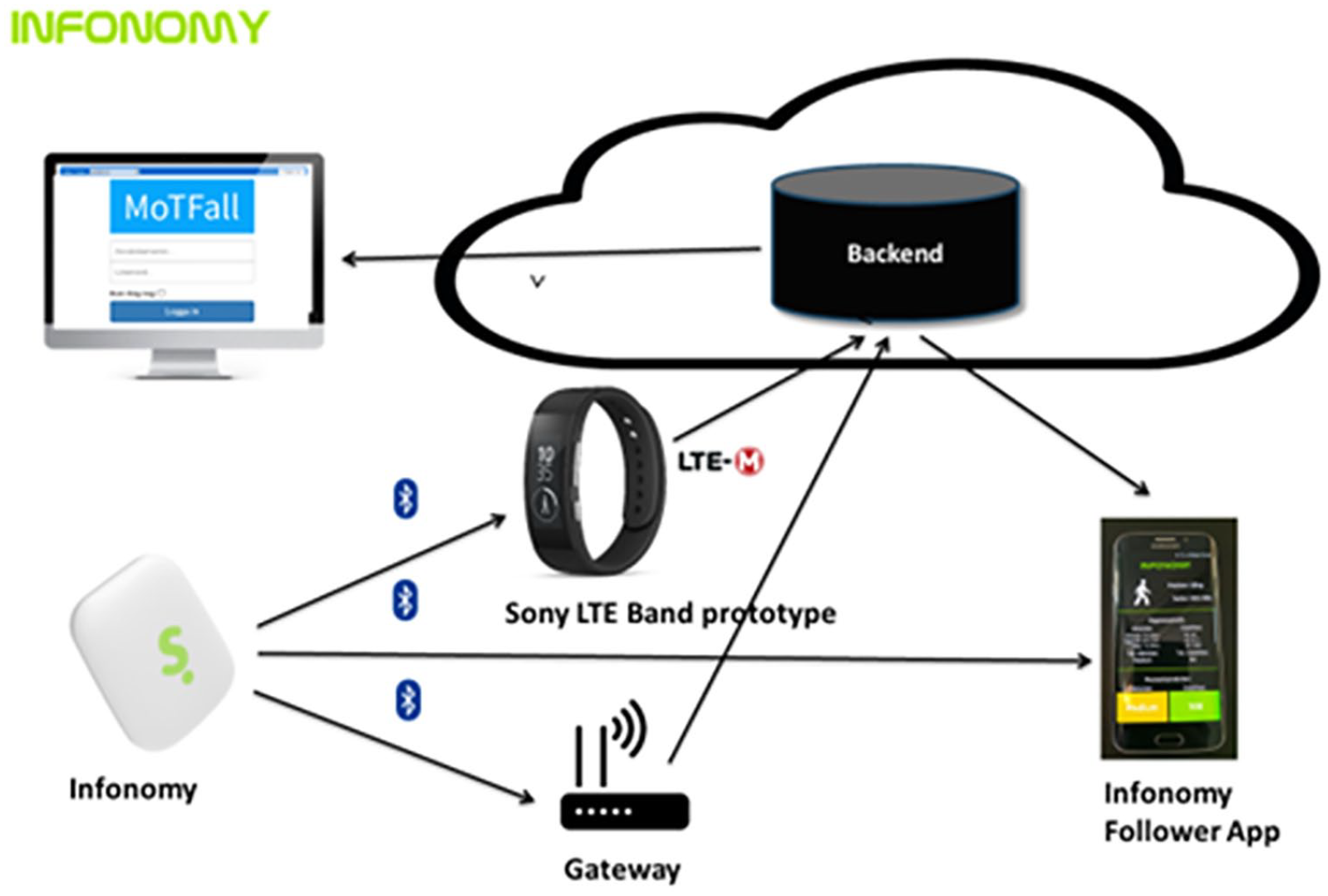
Overview of the system for measuring human movements with the inertial movement measurement unit (with permission from J. Källmén, Infonomy AB, Lund, Sweden).
So far, several tests of the IMMU have been performed within the MoTFall project. Focus groups with older persons regarding the usability of the IMMU was performed and revealed that the users preferred it to be worn under the clothes and that it should be easy to apply and comfortable to wear. These were then followed by pilot testing were older persons wore the IMMU for a longer period. These tests showed that the IMMU is comfortable to wear, possible to use 24 h per day and also use while showering and it does not disturb sleep. Tests of validity and reliability have shown that the IMMU has strong coherence with the gold standard for measuring postural sway (0.84–0.88) and moderate to good intra-trial reliability (Intra Class Correlation 0.50–0.67). 25 It has shown both high sensitivity and high specificity for detecting a near fall. Provoking a near fall among a group of older persons was considered not safe for this group and tests of sensitivity was considered not meaningful if performed on a younger group. Therefore, tests of sensitivity and specificity was performed on two different populations. The test of sensitivity was performed among a group of healthy subjects (n = 25, 14 women and 11 men, mean age 32.7 years, standard deviation 14.4). The participants had the IMMU mounted on the thigh and was instructed to mimic a near fall and try to regain balance when pushed. They then walked on a path, marked on the floor and at a specified place on the path, the participants were pushed sideways by one of the test-leaders. The participants then repeated the walk on the path and this time performed a self-induced stumble in forward direction by hooking one foot in the other leg. Before this, they were again instructed to mimic a near fall and then try to regain balance. Thus, near falls was provoked both in sideway direction and in forward direction. The IMMU has four conditions with possibility to detect a near fall. The first condition (A) is met if the IMMU registers low g, that is acceleration towards the ground, followed by an impact of at least 27 m/s2. The second condition (B) is met if a step deviates in a large extend to the previous step. The third condition (C) is met if a step deviates in a large extend to the median step. The fourth condition (D) is met if a very low g is detected (⩽3 m/s2). Analysing data retrieved from the IMMU during these tests showed that depending on how the conditions were fulfilled, sensitivity varied between 15% to 90% (Table 1).
Sensitivity and specificity of the Inertial Movement Measurement Unit (IMMU) for measuring near falls.
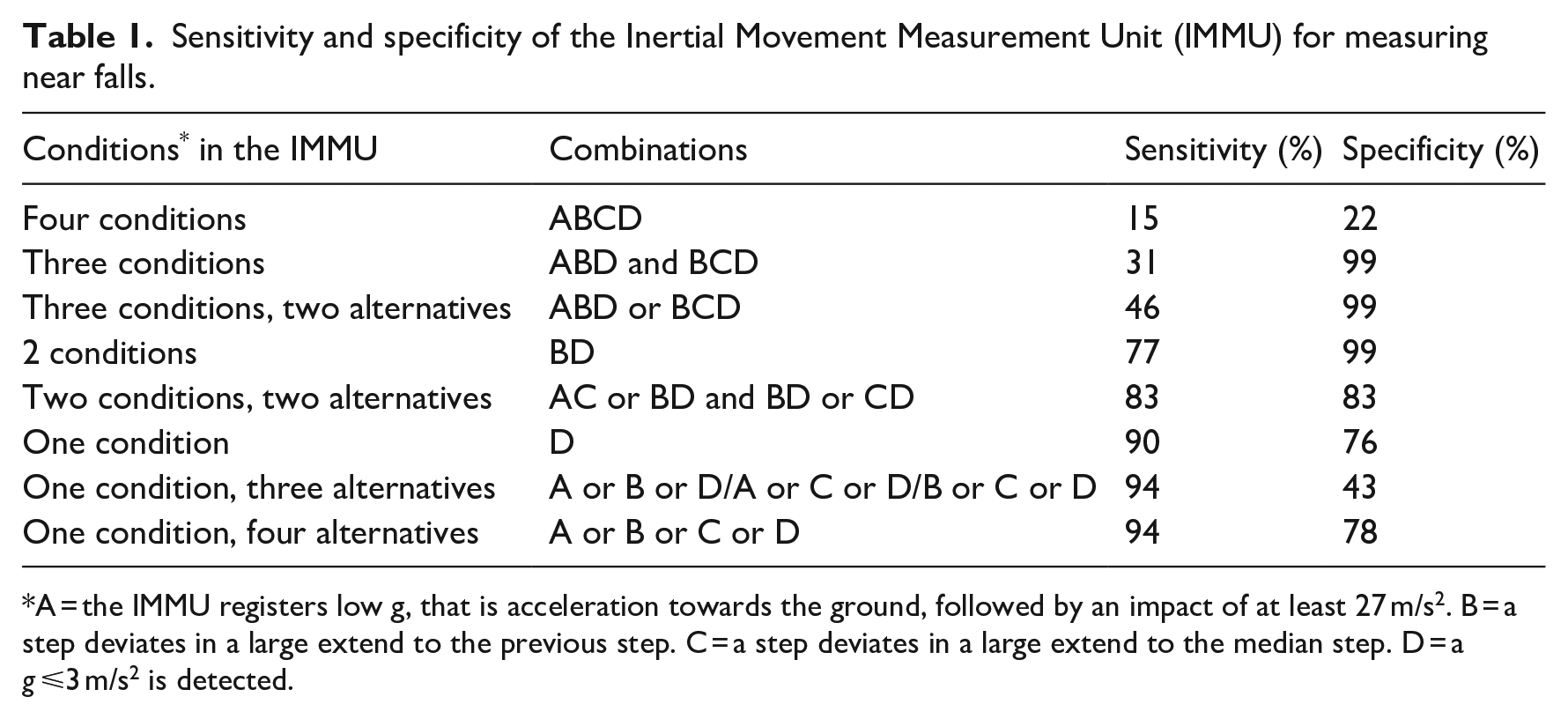
A = the IMMU registers low g, that is acceleration towards the ground, followed by an impact of at least 27 m/s2. B = a step deviates in a large extend to the previous step. C = a step deviates in a large extend to the median step. D = a g ⩽3 m/s2 is detected.
The test of specificity was performed among a group of older persons who considered themselves healthy (n = 113, 101 women and 12 men, median age 64–89, inter quartile range 10). The participants wore the IMMU while walking in an obstacle course which contained five activities including standing up from a chair, walking in narrow (25 cm in width) for 3 m in length, walking on an uneven surface, walking over three 30 cm high obstacles and walking up and down a stair. The five activities were chosen because they include tasks that frequently occur in daily life and are challenging for balance but not too demanding on range of motion or muscle strength. For instance, walking on an uneven surface is very frequent outdoors and can occur in your home if you have a loose carpet. Climbing over obstacles can occur if you must take a step over something lying on the floor. Walking narrow can occur when you move around furniture. Thus, movements including potentially hazardous events that may induce a near fall was simulated.
Using the same four conditions as in the calculation of sensitivity, a near fall was triggered on average 0.01 to 15.6 times in the obstacle course. The participants used an average of 43.9 strides to walk the obstacle course, giving a variation in specificity depending on how the conditions were fulfilled from 22% to 99% (Table 1).
Since high specificity must be considered as important when measuring near falls, the combination BD, giving a sensitivity of 77% and specificity of 99% for measuring near falls, seems to be most appropriate.
The mobile application (The MoTFall app)
In the development of the mobile application, as with the IMMU, a participatory research design was applied. Interviews with individuals and focus groups were conducted throughout the whole project, from the first needs analysis, through the concept phase and including the final pilot studies and the evaluation of prototypes. The purpose was to explore older people’s views on using technology for fall prevention, how to wear the wearable device and what it should look like, as well as preferences regarding the mobile application. The individual and focus group interviews involved a total of 25–30 seniors, 65 years of age and older, living in residential care or in sheltered housing, or attending a meeting place for older people, or being members of the non-profit organisation ‘Friskis&Svettis’ in Malmö, Sweden (www.friskissvettis.se). In the focus groups, the participants tested the exercise programme and other functions included in the MoTFall app and gave feedback. Through the focus groups, the wishes, needs, preferences and preconditions of the participants were elucidated. Most importantly, the participants mentioned the need to feel safe, to avoid falls and to continue to live an active life. In addition, a wish for knowledge concerning exercises that promote balance was identified. About the technical solution, the participants expressed a general view that it was acceptable that information about health was collected in the system, as long as the collection of data was of benefit to the individual. The mobile phone was the preferred means of feedback. Another important insight from the focus groups was that the social aspect was important: socialising is in itself the best reward and also creates a sense of security.
Based on the information from the focus groups, the MoTFall app was developed. It consists of information, workouts and a fall risk index (Figure 2). The information includes strategies for fall prevention, physical activity and general wellbeing under five headings: Environment, Physical Activity, Facilities, Food and Health and After a Fall. Workouts incorporating balance and strength exercises are included as well as information about movement patterns, balance, falls and near falls as measured by the IMMU, thus making it possible to individualize the information and the workouts. Based on previous research,26,27 six fall risk factors were chosen and discussed at a fall risk conference with professionals in the region. After this, additional items were added to the index.
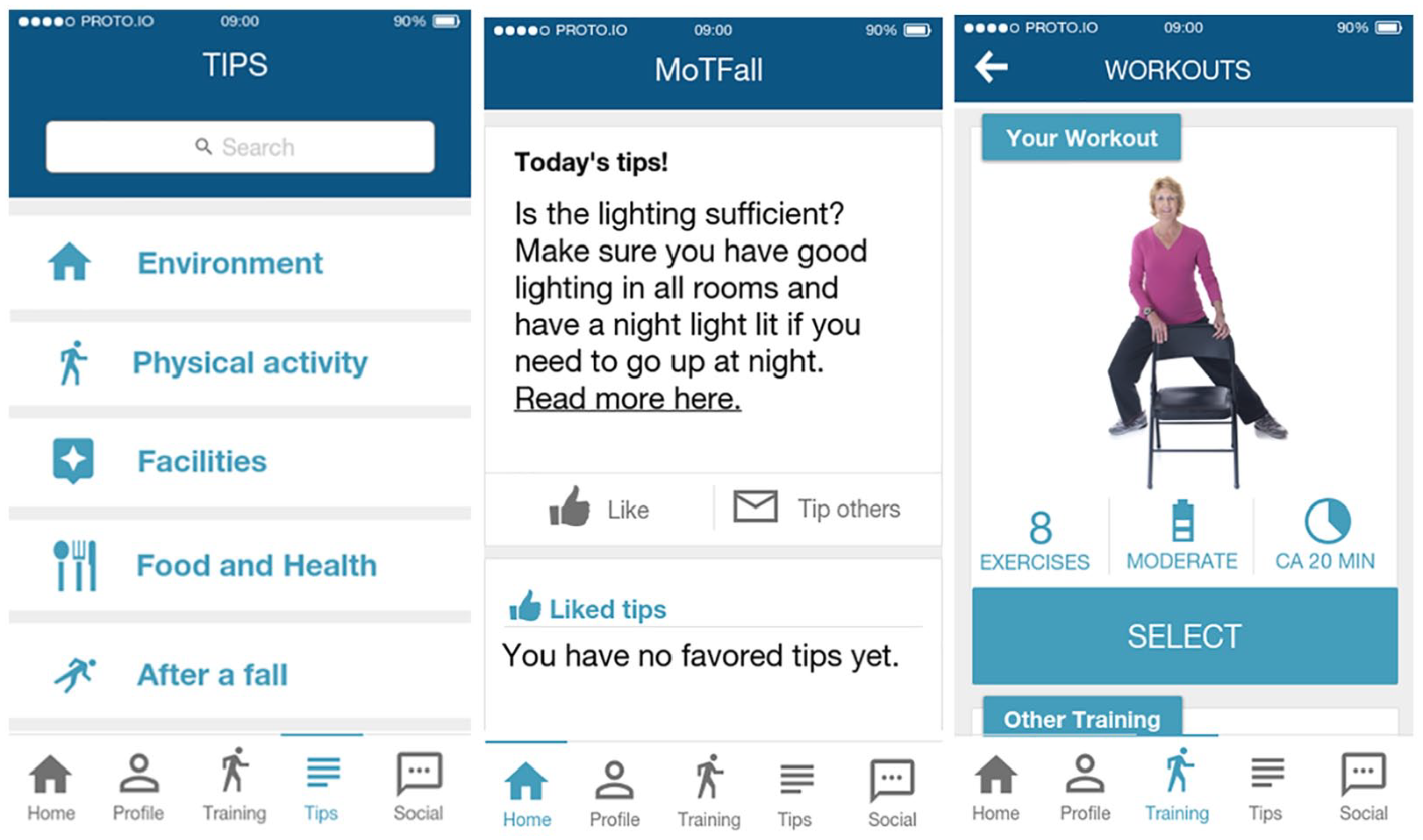
Examples from the MoTFall app.
The web-based education programme
The education programme was developed using an already existing platform for digitally based education 28 and using the teaching concept of constructive alignment. 29 Thereby, learning outcomes were defined and aligned to the different learning activities included in the programme. The programme consists of modules containing videos, graphics and links to additional information that may be of relevance. Each module is followed by a quiz and an assignment, and it is not possible to proceed to the next module until all questions in the quiz have been correctly answered and the assignment completed. 28 The system allows retrieval of information about the proportion of professionals who have completed the programme, how long each person has been logged into the website and how many have completed all the quizzes and assignment. Thus, when for example 90% of professionals have completed the programme it is possible to certify a health care facility as ‘fall preventive’.
A first evaluation of the education programme was carried out, involving nine persons working in geriatric care. The evaluation consisted of a questionnaire that was presented after the whole education programme had been completed, and the indication was that the education programme is relevant. The education programme is available through the publisher’s website. 28 Through the education project, revenue models that encourage proactive instead of reactive approaches to falls have been identified.
Discussion
This paper describes the technology-based project called MoTFall, which aims at preventing falls among older persons. Within the MoTFall project, innovative solutions to increase physical activity and prevent falls in older people have been developed. Preliminary data show that older persons have a need to feel safe, to avoid falls and to continue to live an active life and that the preferred means of feedback aimed at preventing falls and promoting physical activity, is through a mobile application. The project’s technology-based solutions have the potential to affect the wellbeing of older people with various needs and health conditions, through person-centred interventions. The project has developed a mobile application for fall prevention based on the wishes and needs of older people, as well as a wearable device for measuring balance, movements, physical activity and inactivity, falls and near falls and a web-based education programme in falls prevention, targeting HCP.
The MotFall project targets older people with several physical and cognitive disabilities, as well as their relatives and HCP caring for older people, while other studies have a more narrow target group.30,31 The wearable device developed within the MoTFall project is to our knowledge the first one than can measure a near fall with high sensitivity and specificity. Such measurements are highly relevant and innovative since the highest risk of experiencing a future fall is to have fallen before, and the first fall presumable was preceded by several near falls. Thus, identifying persons with high risk of falling is crucial and by means of mobile and wearable digital technology, such as the IMMU, people at risk can be identified even before the first fall. In addition, those everyday activities that pose a high risk of falls can be identified. This opens for new opportunities for falls prevention intervention for specific risk groups, as intended by the MoTFall project. Assistive and personalised technologies, such as the MoTFall mobile application and the IMMU can be important parts to enable patient empowerment in the health care system. 32
A recent Cochrane review shows clear evidence for the importance of exercise in reducing the incidence of falls and risk of falls. 33 Thus, interventions promoting exercise and physical activity directed towards, and reaching, a large part of the targeted population could have considerable impact on society as well as the individual person. The MoTFall mobile app generates knowledge of older and/or impaired persons’ requirements in respect of digital solutions, which in turn may lead to a reduction in digital alienation. The app can be adapted to a public health approach focusing on health benefits in general, preventing illness and enhancing the ability of older and persons with disabilities to participate in society.
Interventions regarding falls prevention, directed at HCP, are urgently needed since this group has been identified as having knowledge gaps in this field. 34 The web-based education programme developed within the MoTFall project provides knowledge and practical solutions in respect of falls prevention, targeting HCP in nursing homes. However, the effect of the education programme on the incidence of falls and the risk of falls has to be evaluated. Furthermore, the IMMU can be used within all the various settings in health care organisations, as well by healthy older persons. For example, it can be connected to the regular alarm system at nursing homes and hospitals or used in rehabilitation settings for planning and assessment of interventions as well as for evaluation of the effects on balance and movement patterns of pharmaceutical interventions. Also, when the IMMU signals a type of unexpected event there are possibilities to elaborate with different channels for communication, such as video calls or voice communication. The close monitoring will enable specific, individualized, person-centred interventions and since the IMMU has demonstrated good validity and reliability, it can also be used in research settings. 25
Conclusion
The MoTFall project has been a collaboration between the university sector, the private sector, health care providers, municipalities, non-profit associations and participants from the target groups. This means that the project’s technical solutions have been developed in close collaboration with those who will gain from the project. In addition, the solutions have been thoroughly tested, also in collaboration with those who will gain from the project and in real life situations. The IMMU has strong coherence with the gold standard for measuring postural sway and moderate to good intra-trial reliability as well as high sensitivity and specificity for measuring a near fall, a measurement that to our knowledge was done for the first time in this study. It has the potential for use in research as well as in clinical practice. Furthermore, the IMMU enables continuous measuring over a longer period of time, thus making it possible to adapt advice and exercises to each individual. The technical solutions developed within MoTFall now have to be tested in randomized controlled trials to explore the effects on incidence and risk of falls as well as on level of physical activity and health-related quality of life. Such studies are currently being planned.
Footnotes
Disclosure
The author reports no conflicts of interest in this work. The abstract of this paper was presented at the European conference arranged by the International Association of Gerontology and Geriatrics (IAGG-ER) in Sweden 2019 as a poster presentation with preliminary results. The poster’s abstract is available from the Conference web-site: https://www5.shocklogic.com/scripts/jmevent/programme.php?Client_Id=%27KONGRESS%27&Project_Id=%27IAGG19%27&System_Id=1.
Declaration of conflicting interests
The author(s) declared no potential conflicts of interest with respect to the research, authorship, and/or publication of this article.
Funding
The author(s) received no financial support for the research, authorship and/or publication of this article.
