




Abstract
The popularity of social networks and the huge number of exchanges have made them immensely important for the communication of information. This French study explored prevention in hereditary breast cancer using a social Internet network to communicate information. The principal objective was to inform French women aged from 20 to 50 years, using the social network Facebook, about the warning signs of breast cancer in cases of a predisposition to the disease due to a genetic mutation. The secondary objectives were to inform people about screening. An information page entitled “hereditary breast cancer: and if I was concerned?” was distributed in 3 different ways: from friend to friend, via groups of persons, and by targeted advertising. Four articles and 11 messages were distributed over 27 days. The total number of visits for this period amounted to 1019. A total of 81 percent of the Internauts were women and 55 percent of the visitors were aged between 25 and 44 years. Other information campaigns concerning public health issues could be conducted using this tool. A legal framework is necessary to preserve the quality of the medical information provided. This new means of communication, used for prevention purposes, will add to other frequently used methods of communication.
Introduction
Teenagers now have at their fingertips a mass of information generated by a new communication tool: Internet. This 2.0 generation surfs and exchanges information on social networks every day. The distribution of information has found a new route and can thus reach an unimaginable number of Internauts.
This study concerns the analysis of the distribution of medical information for prevention purposes. The prevention of hereditary breast cancer was selected to evaluate the use of an Internet social network, Facebook. These choices were made on the basis of different elements: the relatively high incidence of hereditary breast cancer, around 5–10 percent of all breast cancers depending on the study; 1 the need for early screening in young women; the lack of information on breast cancer that specifically targets this population; and the perspectives of a new communication tool that is particularly appreciated by young people (in France, 44% of the population aged between 15 and 64 years have a Facebook account 2 ).
The principal aim was to inform French women aged from 20 to 50 years about the warning signs that could suggest breast cancer triggered by a genetic mutation. The secondary objectives were to give information about this type of cancer and the screening proposed to women with this mutation.
Methods
The criteria used to choose the social network were cost, ease of access to the site, speed to open an account, and the popularity of the site. The Facebook network with its 22 million members in France was chosen. 2 The target was women aged 20 to 50 years. The first step was creation of a home page entitled “hereditary breast cancer: and if I was concerned?”
The pages of information could be presented in three different ways:
Messages of a few lines with or without photographs, distributed on the same day and available to persons who had logged on to the page.
Written articles of one page or more. Those who had logged on were automatically informed about the publication of the articles.
The creation of a video, various applications, and so on.
A number of articles were then written: “ Evaluate your risk according to your family history,” “The follow-up of women with a BRCA 1 or 2 mutation …” The messages were, for example, You could be concerned if several women in your family had breast cancer before the age of 40 years. You could benefit from particular surveillance from the age of 20 years onwards if you have a gene mutation that exposes you to an increased risk of developing breast cancer.
The second step concerns the way information was distributed via this social network. It can take place in three different ways.
From friend to friend
This technique consisted of informing others about the existence of this page directly via Facebook friends. Any of these “friends” who liked the information page could, in turn, inform their Facebook friends.
Via groups of persons
Facebook also made it possible to identify groups of persons united around a central theme (e.g. the group “fight against breast cancer”). By joining this group, it was possible to distribute messages to all the people in this group and thus to communicate the existence of the page on hereditary breast cancer. The existence of this new page was communicated to approximately 10 groups concerned with cancer and health.
By targeted advertising
By using this fee-paying technique, a link to the page thus appeared regularly on the Facebook home page of the target group (i.e. sex, age group), thus approximately 6,888,000 users (women living in France aged between 20 and 50 years) according to Facebook data. To test this system, a budget of €10 was invested for a campaign of 1 week, from 18 November to 25 November 2010. For every click on this page via a Facebook advertisement, the page creators were billed €0.59.
Results
Information was distributed on Facebook from the 2 to 29 November 2010, a total of 28 days. During this period, 4 articles and 11 messages were distributed. The data concerning the personal profiles of the users were available (the distribution was done by age, sex, and location of the users who logged on to our page). A total of 81 percent of the Internauts who logged on were women and 55 percent were aged between 25 and 44 years (Figure 1). The total number of visits for this period amounted to 1019. For example, the message “If you know you have a mutated BRCA gene, it may be important for you to inform other members of your family … ” was seen 855 times between the date it appeared, 14 November 2010 and 29 November 2010.
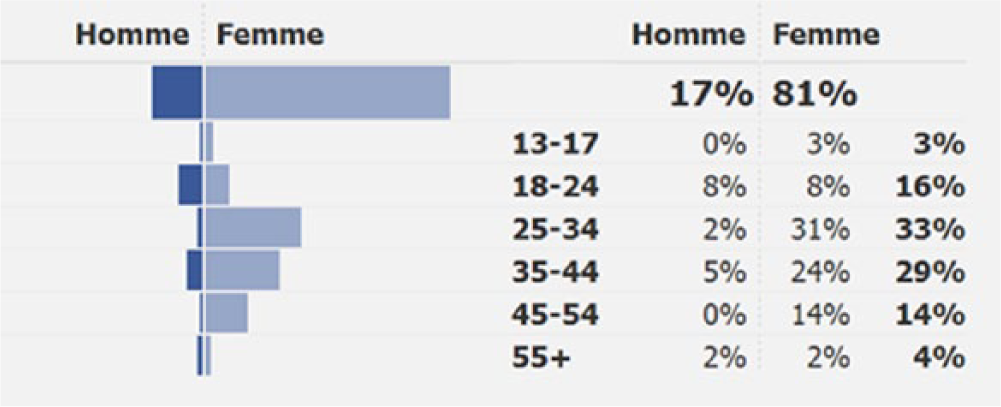
Distribution by age and sex of the persons who had logged on to the page on 28 November 2010.
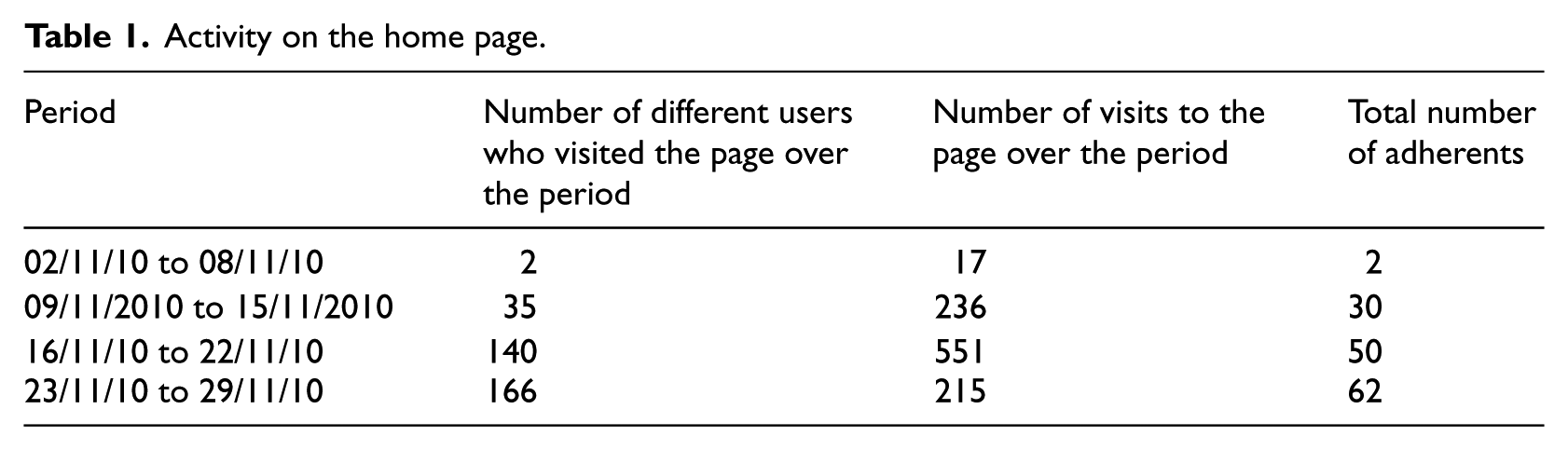
The attractiveness of a page on Facebook can be evaluated using analytical tools made available by the creators of the page. Different parameters were analyzed. These included the number of people who logged on, the number of people who accessed the page, the number of comments posted by other users, the number of times each message was seen, and so on. A weekly report on the activity of the page was sent by mail to the creators of the page (Table 1).
Activity on the home page.
Concerning distribution to the targeted population
Over a period of 3 days (the time to use up the credit of €10), the advertisement for the page of information about hereditary breast cancer was seen by 29,282 users whose profile corresponded to our target (French women between 20 and 50 years). Following this advertisement, 17 people clicked on our page and thus exhausted our predetermined credit of €10. This corresponded to a percentage of access also called click rate of 0.058 percent (Table 2).
Statistics for the fee-paying advertising campaign furnished by the Facebook advertising tool.

CR: click rate, CPC: cost per click.
Discussion
A greater proportion of women than men logged on to the page (81%). This can be explained by the fact that they were the target population, and because women certainly are more concerned about this theme. The age distribution also corresponded to the target (54% of those who logged on were between 25 and 44 years). Concerning the methods of distribution:
Although the communication of information from one friend to another on Facebook has the advantage of not being restricted to a particular population (nontargeted), it depends to a great extent on the desire of those concerned to pass the information on to their friends, which, in fact, is a serious drawback to the communication of the information in question. Moreover, the information page needs to be “renewed” regularly to maintain the interest of the users who initially clicked on the page.
Diffusion by targeting a group of people presupposes that members of the group consult the home page in question regularly. In addition, though this strategy makes it possible to target a specific group of users (e.g. a group focused on cancer will comprise individuals who are receptive to messages on this theme), at the same time, it limits distribution of the information to individuals who are already aware of the subject.
Distribution by fee-paying targeted advertising makes it possible to communicate the information to all Facebook users, on condition that a sufficient amount of money is invested. In this work, with a very small advertising budget, it was very difficult to evaluate what impact such a communication strategy could have. The click rate of 0.058 percent was obviously very small, but as an indication, the mean click rate for online advertisements (all Internet sites included) was only 0.09 percent for the year 2012. 3 Moreover, the click rate does not really reflect the impact of the information but rather the audience of the promoter of the information. This poor result should thus be interpreted with caution.
The concomitant use of the three complementary methods of communication would probably be the best way to ensure that the messages reach the greatest number of people. The different analytical tools provided by Facebook and available to the authors did not allow us to analyze these three strategies independently. It may be possible to optimize these tools by, for example, enlarging the type of contacts to include student representatives, teachers at medical schools, administrators of associations, and personalities with a personal motivation for this cause, thus reaching a larger population.
Facebook was chosen because of its popularity; it is the second most visited site after Google.4,5 Of course, by selecting Facebook, our population was reduced to users of the site, which has approximately 7,900,000 visits per day. 4 One of the limits inherent to this type of campaign is the risk that the information distributed is “drowned” in the mass of messages regular users of Facebook receive every day. Every user has on average 120 friends on this network. These 120 connections, to which can be added the membership of groups or subscriptions to pages like the one in our study, constitute a huge source of information that may quickly saturate the user. The risk is that users may cancel subscriptions to pages they consider least interesting or least amusing.
This system of communication may reveal a lack of direct interaction between individuals, the absence of feedback on the true interest of the information distributed, or the difficulty of writing effective messages. Relationships via a social network often remain anonymous and very limited, and cannot be compared to real exchanges, which, in general, are far more constructive for both parties. Nonetheless, they do make it possible to reach individuals who may not have taken the information brochure presented in the waiting room or handed out in the street. It is also difficult to evaluate the efficacy of the messages distributed via the Internet. Was the information clearly understood? Moreover, this information campaign required no action on the part of the targeted population and was without doubt far less memorable than a prevention campaign that required the active participation of the population, such as a competition or a street interview.
This study allowed us to revisit prevention by using the most recent methods of mass communication. Facebook reflects new communication habits and is perfectly integrated into everyday way of life. It has become an integral part of life in the community. This work, evaluated over a short period with a small budget, shows the potential of Facebook as a means of communication to be exploited. The major interest of such campaigns lies in the fact that they are easy and quick to set up and can have a considerable impact given the very large size of the target population that can be contacted. The number of people who consult medical sites has grown steadily over the last 20 years. One of the reasons expressed by users is to improve their health by seeking personalized information for medical prevention. 6 Chat rooms and other help forums have already demonstrated their interest in the medical field.7–9 Many other information campaigns bearing on public health issues could be conducted using this tool. Its use as a means of prevention must come as an addition to the other frequently used methods of communication, showing that medicine is also able to evolve with the times. The information must, of course, be based on data validated by science and current recommendations so as not to degenerate into the ‘popularized’ medicine found on many sites and forums. A framework needs to be established by healthcare professionals concerning conduct with regard to the use of Internet sites or medical forums 10 . An evaluation of the quality of information available on the Internet could lead to a quality label. Such strategies also need to be assessed to determine how they could be incorporated into the healthcare system. 6
General practitioners, “the gatekeepers to the healthcare system,” are particularly involved in prevention, in their everyday practice (vaccination, follow-up of infants or pregnant women etc.) as well as in their support for screening campaigns for colon or breast cancer, for example. As they are consulted regularly by the majority of the population; benefit from a high level of trust; are concerned with the overall health of the individual; in the patient’s environment and over time, they play a very important role in prevention. 11 Most medical practices are computerized. They thus constitute an important resource for the collection and communication of health-related data with easy access to social networks. However, general practitioners are very often isolated, and it is through the development of such networks of colleagues and other healthcare professionals, through links with National Healthcare Insurance organizations and learned societies, that they will become key actors in prevention.
Conclusion
This new way to communicate medical information thanks to the Internet must be structured and controlled, and should respect ethical rules, patients’ rights, and medical secrecy. The arrival of social networks, like Facebook, offers a new mode of exchange and interaction between individuals and adds to the panoply of tools already used for prevention campaigns (brochures, advertisements, conferences etc.). This method of communication, particularly adapted to young people, can be used to pass on information about hereditary diseases as well as for prevention in general. Social networks could prove to be particularly effective provided that research continues and a quality framework is established.
Footnotes
Acknowledgements
The authors would like to thank the General Practice Department of Dijon for general support. We also like to express our gratitude to the English Department of Dijon specially Mrs Bastable for her writing assistance.
Declaration of conflicting interests
The authors report no conflicts of interest.
Funding
This research received no specific grant from any funding agency in the public, commercial, or not-for-profit sectors.