




Abstract
‘In [paediatric major trauma] is [admission hypocalcaemia] associated with [adverse outcomes]’.
Clinical scenario
A 7-year-old girl has been brought in by ambulance to the emergency department having being involved in a motor vehicle collision. She is tachycardic, has abdominal bruising over her left upper quadrant, and is generally tender and guarding on examination. A venous blood gas on admission demonstrates hypocalcaemia. Since the ionised calcium level on a blood gas measures the physiologically active component of calcium (as opposed to total calcium which includes albumin bound calcium), you wonder whether the ionised hypocalcaemia might be related to adverse outcomes.
Search strategy
Ovid MEDLINE (R) 1946 (inception) to 3 July 2023 using the OVID interface, and Medline Epub
Ahead of Print, In-Process & Other Non-Indexed Citations:
(‘Paediatric hypocalcaemia’/exp OR ‘Pediatric hypocalcaemia’) AND (‘trauma’/exp OR ‘trauma’)
Embase 1974 to July 2023 using the OVID interface:
(‘Paediatric hypocalcaemia’/exp OR ‘Paediatric hypocalcaemia’) AND (‘trauma’/exp OR ‘trauma’)
The Cochrane Library and Google Scholar databases were also searched.
Search outcome
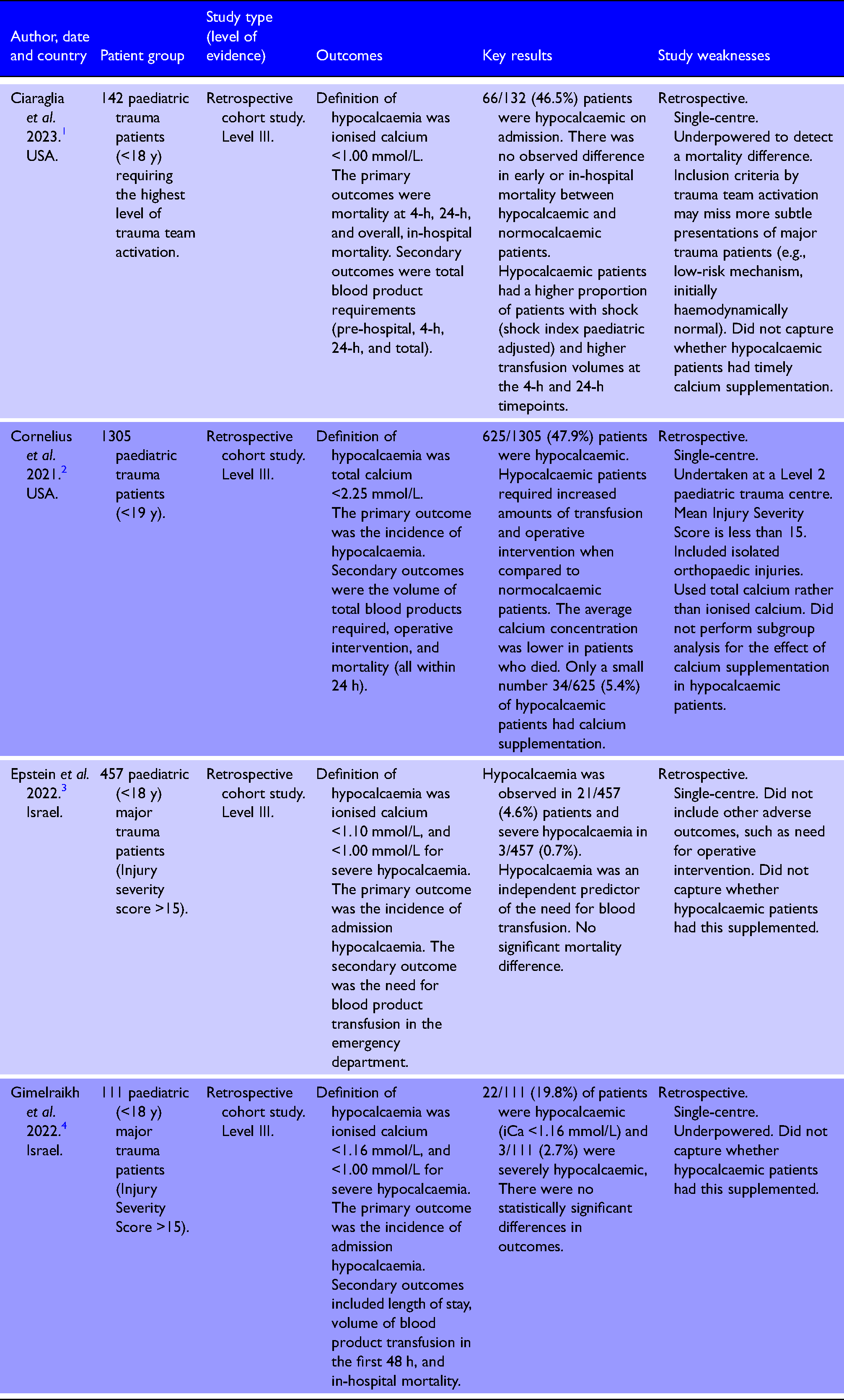
In total, 22 papers were identified, 7 papers were duplicates and a further 11 irrelevant for inclusion following abstract review by a single author. The remaining four papers are summarised in Table 1.
Relevant paper(s)
Comment(s)
Calcium has an essential role in the coagulation cascade and platelet function and is required for cardiac contractility and vascular tone. Hypocalcaemia forms part of the ‘diamond of death’ in haemorrhage, alongside hypothermia, acidosis, and coagulopathy. Admission hypocalcaemia prior to blood transfusion is prevalent in adult major trauma patients. Amongst paediatric major trauma patients, the four retrospective cohort studies identified in this short-cut review demonstrate heterogenous results with regard to the incidence of hypocalcaemia. Definitions of hypocalcaemia also differed between studies (<1.00 to <1.16 mmol/L). The majority of these studies observed an association between admission hypocalcaemia and the subsequent transfusion requirements. There is also potentially increased haemodynamic instability and need for operative intervention amongst hypocalcaemic paediatric major trauma patients. The lack of mortality difference likely reflects the low overall mortality observed in paediatric major trauma, and much larger multi-centre studies would be required to identify any mortality difference. None of the studies explored the effect of calcium supplementation in hypocalcaemic paediatric major trauma patients and this remains an area where further research is required.
Clinical bottom line
The incidence of admission hypocalcaemia in paediatric major trauma remains poorly defined, and hypocalcaemia may be associated with haemodynamic instability, increased transfusion requirements, and a need for operative intervention. Further studies are required, and the included studies may benefit from formal systematic review.
Footnotes
Acknowledgements
The authors would like to acknowledge and thank Catherine Hancox and the Defence Medical Academic Library Team for their assistance with the search strategy.
Declaration of conflicting interests
The authors declared no potential conflicts of interest with respect to the research, authorship, and/or publication of this article.
Funding
The authors received no financial support for the research, authorship, and/or publication of this article.
