




Abstract
Introduction
The regionalized nature of trauma care necessitates interfacility transfer which is vulnerable to delays given its complexity. Little is known about the interval of time a patient spends at the sending hospital prior to when the transfer is initiated—the “decision to transfer” time. This primary objective of the study was to explore the impact of patient, environmental, and institutional characteristics on decision to transfer time.
Methods
This was a retrospective cohort study of injured adult patients who underwent emergent interfacility transfer by a provincial critical care transport organization over a 31-month period. Quantile regression was used to evaluate the impact of patient, environmental, and institutional characteristics on the time to decision to transfer.
Results
A total of 1128 patients were included. The median decision to transfer time was 2.42 h and the median total transport time was 3.12 h. The following variables were associated with an increase in time to decision to transfer at the 90th percentile of time: age >75 (+2.47 h), age 66–75 (+3.70 h), age 56–65 (+1.20 h), transfer between 00:00 and 07:59 (+2.08 h), and transfer in the summer (+2.25 h). The following variables were associated with a decrease in time to decision to transfer at the 90th percentile of time: Glasgow Coma Scale 3–8 (−2.21 h), respiratory rate >30 (−2.01 h), sending site being a community hospital with <100 beds (−4.11 h), or the sending site being a nursing station (−5.66 h).
Conclusion
Time to decision to transfer was a sizable proportion of the patients interfacility transfer. Older patients were associated with a delay in decision to transfer as were patients transferred overnight and in the summer. These findings may be used to support the implementation of geriatric trauma triage guidelines and promote ongoing education and quality improvement initiatives to decrease delay.
Introduction
It is well established that regionalized trauma systems lead to improved outcomes,1,2 but this regionalization necessitates interfacility transfer. Even when accounting for severity of illness, patients transferred to a level I trauma center have a mortality benefit compared to those that stay at non-trauma centers. 3 Despite the improved outcomes, patients requiring interfacility transfer still have a delay in reaching definitive care and have a 30% increase in mortality in the first 48 h compared to those initially presenting to a trauma center, necessitating ongoing research to streamline the interfacility transfer process to reduce time to definitive care. 2
Interfacility transfer is a complex process with numerous steps creating ample opportunity for unintended and modifiable delay (Figure 1). Strides have been made to examine various intervals in the transfer process, especially those delays associated with the transport itself.4–6 The interval of time prior to the initiation of interfacility transfer is less well studied. For this study, we defined the “decision to transfer” time to be the time from patient arrival at the hospital until the healthcare worker made the call to the transport organization to organize transfer. This time interval includes patient registration, assessment, and diagnostic testing. Decisions to transfer are often made in consultation with regional trauma center, burn center, and neurosurgical referral guidelines. Components of transfer.
This study aimed to examine the decision to transfer time and determine if specific patient, environmental, or institutional characteristics are associated with a delay in decision to transfer time.
Methods
This was a retrospective cohort study of injured patients undergoing interfacility transfer transported by a provincial critical care transport organization. This study was approved by the Research Ethics Board at Sunnybrook Health Sciences Centre (REB ID: 236-2019).
Setting
The study was undertaken in Ontario, Canada, with over 13 million people and a landmass of over one million square kilometers. A significant part of the population does not have immediate access to a tertiary care center, relying on a provincial critical care transport organization to provide transport for these patients. 7 Furthermore, some Ontario residents live in remote communities whose only point of access to the healthcare system is a nursing station. Nursing stations have limited resources, often without access to diagnostic imaging or in-house blood testing. Most do not have a physician on site. 8
Ornge is the sole provider of critical care transport (both land and air) in Ontario. Ornge operates the largest air ambulance fleet in Canada. They have nine bases that operate rotor or fixed-wing aircraft. A transport medicine physician triages transfer requests and provides online medical oversight to transporting paramedics.
Study population
This study included all emergent interfacility transfers for injured patients aged 18 years or older transported by Ornge between 1 June 2016 and 31 December 2018. Exclusion criteria were patients who had been admitted to hospital for greater than 24 h, were less than 18 years old, were transferred directly from scene, or had a non-emergent reason for transfer. Patients were excluded if they had been admitted to the hospital for greater than 24 h to decrease the heterogeneity of the population of patients and the times to decision to transfer, focusing on those who were transferred based on their presentation in the emergency department.
Data sources
All patient records were identified in the Ornge electronic patient care records (ePCR). This database includes all patients transferred by Ornge. The ePCR includes patient, environmental, and sending hospital characteristics on each transfer including time stamps at various time points in the transfer. All data gathered were garnered from the ePCR.
Outcome variable
The outcome variable was the time interval from patient presentation to initial call to facilitate transfer. This was measured from the time the patient arrived at the sending facility to the time of request to transfer the patient. This is referred to as the “decision to transfer” time.
Exposure variables
The primary objective of our study was to assess the impact of patient, environmental, and institutional characteristics on the decision to transfer time using quantile regression. The patient variables explored included age, sex, initial vital signs and Glasgow coma scale (GCS) by the transporting paramedics, ventilator dependence at time of transfer request, vasopressor dependence at time of transfer request, and mechanism of injury. The environmental variables explored included time of day and season when the transfer is requested. The institutional variable explored was the classification of the sending facility, academic, community with greater than 100 beds, community with less than 100 beds, or nursing station.
Data analysis
Descriptive statistics were used to characterize the population for all variables of interest. Continuous variables were all found to be non-normally distributed and summarized as medians and interquartile ranges.
Commonly used regression models for determining the association of variables with an outcome, such as ordinary least squares (OLS) or linear regression, assess how the mean of a conditional distribution varies with changes in system or patient characteristics. One major limitation to this type of analysis is that linear regression techniques assume the outcome’s variable is normally distributed. Quantile regression can overcome that assumption of normality. 9 Our outcome, decision to transfer time, is not normally distributed but highly skewed, with the majority of time intervals being shorter. Furthermore, the times we were most interested in characterizing or reducing are longer time intervals, representing delays, which are at the tail end of this distribution. Quantile regression allowed us to break up the data into quantiles and to perform a regression at each quantile. This methodology has previously been used with success to assess interfacility transfer time intervals.9,10
All exposure variables were considered for inclusion of each model. Variable selection was determined using stepwise selection with significance levels to enter and exit the model set at 0.1. Patients with any missing data for one or more of the variables of interest were excluded from the final model. Missing data resulted in exclusion of less than 1% of observations.
Quantile regression models at the 10th, 30th, 50th, 70th, and 90th percentiles were used to describe the effect of patient, environmental, and institutional characteristics on the time to decision to transfer at each centile. p-values less than .05 were considered statistically significant for all analyses. All variables were assessed for multicollinearity using a variation inflation factor (VIF) of 4 as the cut-off for exclusion.
All statistical analyses were conducted using SAS Studio version 3.4 (SAS Institute, North Carolina, USA).
Results
There were a total of 16,797 patients transported during the study period. After excluding patients transferred that were not injured and aged less than 18 years or patients with missing data, our final study population was 1128 patients (Figure 2). The median age of patients was 49 years (IQR 30–63) and 71.2% were male (Table 1). Study flow chart. General patient, environmental, and institutional demographics.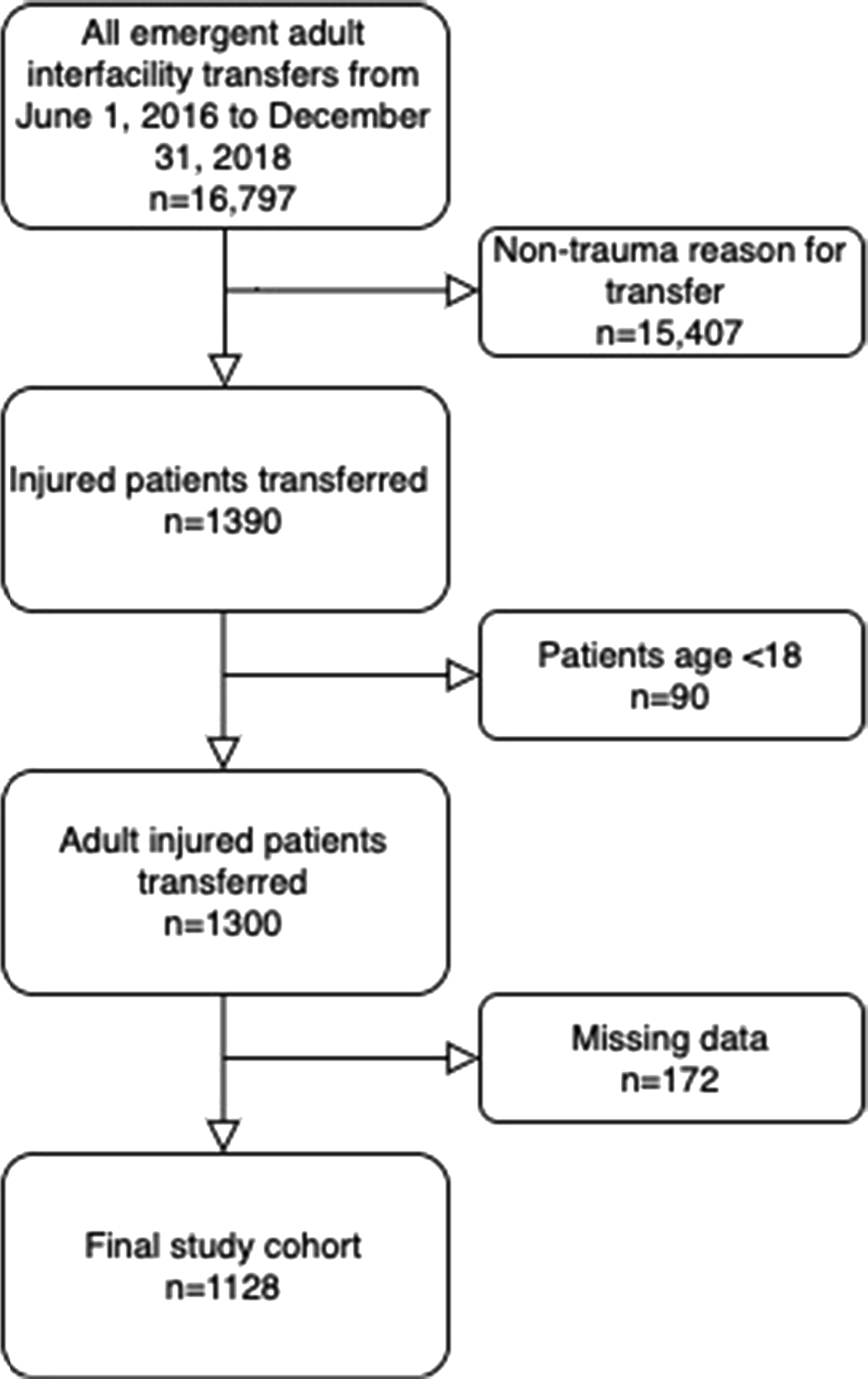
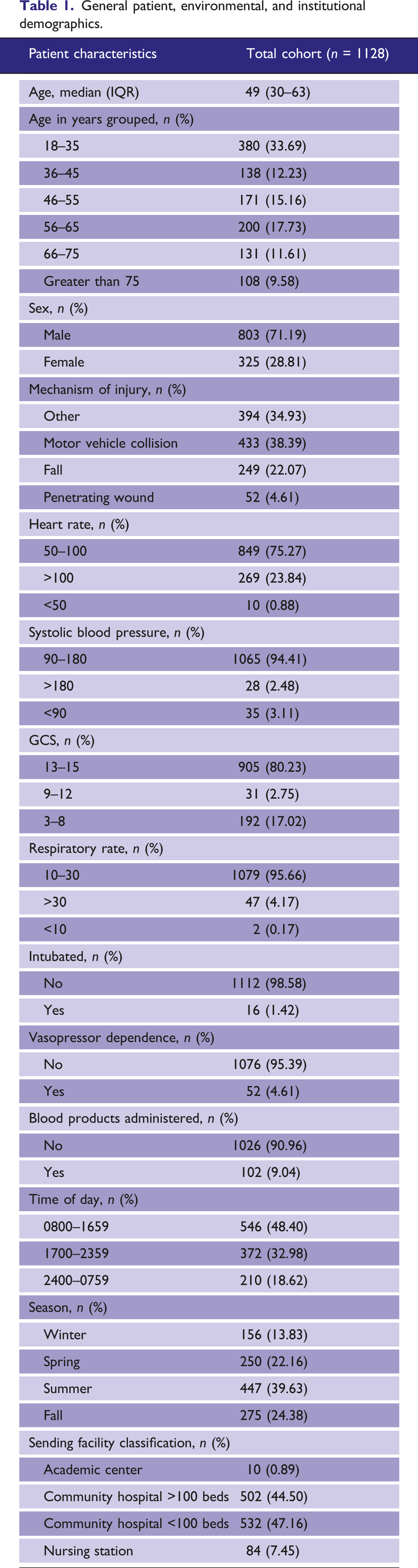
The median decision to transfer time was 2.42 h (IQR 1.23–3.86). The median total transport time, measured from the time of decision to transfer until care was transferred to the receiving hospital, was 3.12 h (IQR 2.35–4.31).
The variables ultimately included in the quantile regression model by use of stepwise selection were age, mechanism of injury, GCS, respiratory rate, time of day, season, and type of sending site.
Results of quantile regression model for variables of interest in time to decision to transfer.
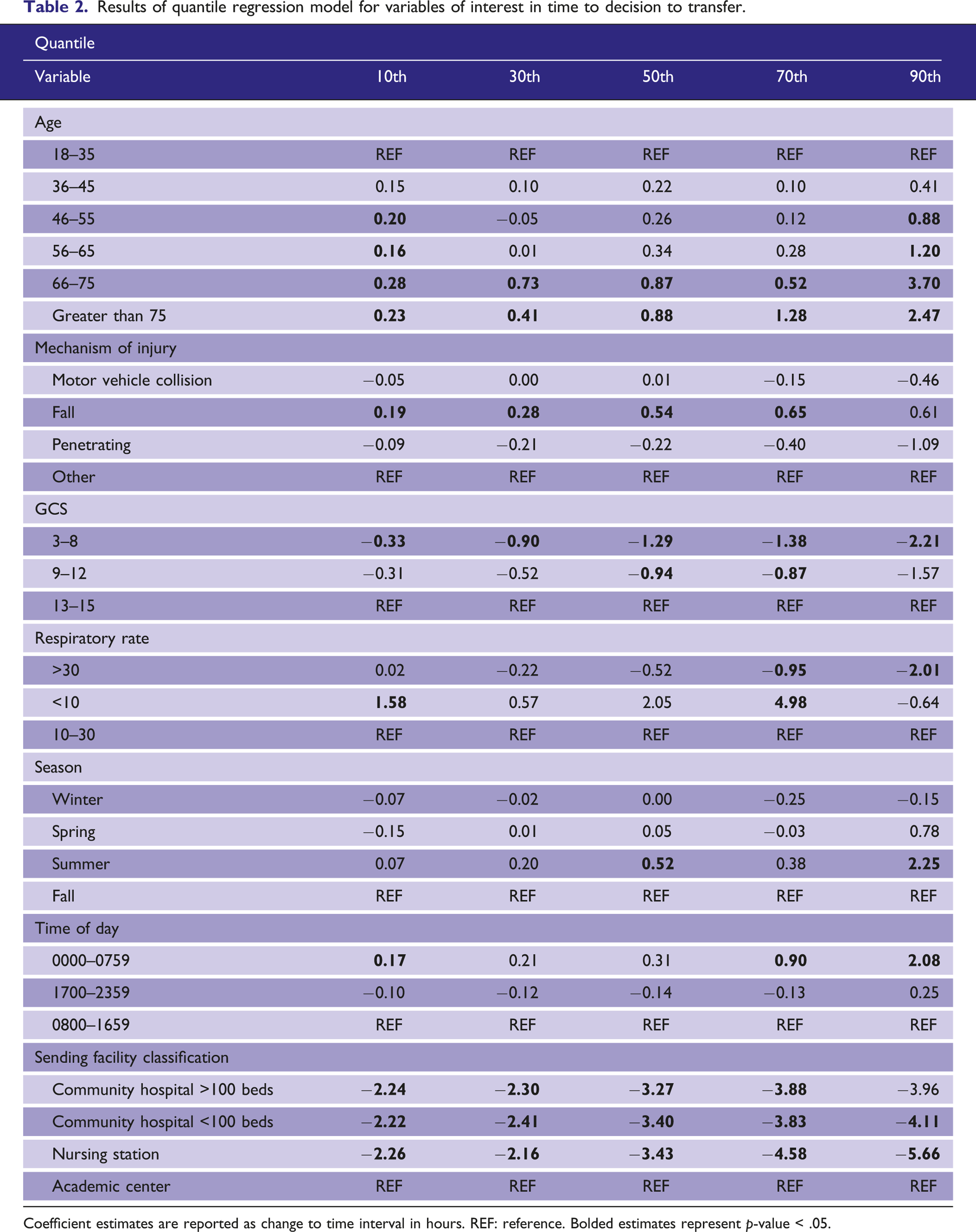
Coefficient estimates are reported as change to time interval in hours. REF: reference. Bolded estimates represent p-value < .05.
Discussion
The results illustrate three important findings in the decision to transfer injured patients; first, the decision to transfer time interval represents a significant proportion of the patient’s medical journey; second, elderly patients are at risk of a delay in decision to transfer; and third, that environmental variables may play a role in delays in decision to transfer.
The median time to decision to transfer was 2.42 h. Given that the median transport time was 3.12 h, the decision to transfer time represents a sizeable portion of the patients overall journey to definitive care. Unfortunately, 2.42 h falls short of the Ontario regional trauma center referral guidelines which recommend decision to transfer be made within the first hour. Previous studies on trauma patients in Ontario demonstrate a median emergency department length of stay of 3.4 h, comparable to this study considering this interval includes time for pickup of the patient. 11 The degree to which our results and previous results fall below the standard in provincial guidelines emphasizes the importance of this study and future research.
The patient variable associated with a significant delay in decision to transfer at the 90th centile was older age. The under triage of geriatric trauma patients has been demonstrated numerous times.12–14 Reasons for under triage are likely multifactorial, including comorbidities, medications blunting physiologic response, and frailty. Standard trauma scoring systems and triage guidelines may not be sensitive enough for this population. There has been advocacy for the creation of geriatric trauma triage guidelines which include a more inclusive list of criteria for transfer of geriatric trauma patients; however, this has not been implemented in our trauma system.15,16 These geriatric specific trauma triage guidelines have been associated with a decreased emergency department (ED) length of stay. 17
Being transferred overnight and in the summer was also associated with delay in decision to transfer in the 90th centile. Merali at al. 18 found that there was a significantly higher number of transfers for head injured patients outside of normal business hours and in the summer, consistent with our findings. In Ontario, there is seasonality to trauma volume with the summer having significantly higher volumes than other times of year which may lead to delays in workup. Many of these EDs are in “cottage country” areas which see an influx of visitors and ED visits in the summer months. With regard to delays in decision to transfer overnight, smallest EDs have single physician coverage overnight, meaning that there may be a delay in physician assessment or reassessment overnight. Additionally, previous qualitative research on decision to transfer found that delays may be related to hesitancy to call specialist colleagues overnight which would delay the decision to transfer. 19
This study is limited in its retrospective nature and the use of a critical care transport database as its sole source of information. There were limited data on injuries, number of systems involved, and injury severity scale which could contribute to the decision to transfer time. There was also limited access to in-hospital data for patients after they had been transferred; important outcomes of these delays, such as effect on in-hospital mortality, could not be assessed. Future studies are needed to characterize if morbidity and mortality are impacted as a result of the delay in transfer. There may also be opportunity for educational initiatives and quality improvement research as similar initiatives have been successful previously in reducing decision to transfer time. 20
Conclusion
In conclusion, this study demonstrated that the decision to transfer time represents a significant time component in patients receiving definitive care. We found that older patients and patients transferred overnight or in the summer were associated with delays in decision to transfer. This study can inform continuing collaboration between transport organizations and hospital systems to enforce referral protocols.
Footnotes
Declaration of conflicting interests
The author(s) declared no potential conflicts of interest with respect to the research, authorship, and/or publication of this article.
Funding
The author(s) received no financial support for the research, authorship, and/or publication of this article.
Ethical approval
This study was approved by the Research Ethics Board at Sunnybrook Health Sciences Centre (REB ID: 236–2019).
Informed consent
Informed consent was not sought for the present study because of the retrospective nature of the study and the significant number of patients in the study making it not feasible to obtain informed consent from each. The research is minimal risk to those charts reviewed and all data are to be presented in aggregate with no identifying features.
Guarantor
BN.
Contributorship
VM contributed to the study by being responsible for the literature search, study design, data interpretation, and writing. BN contributed to the study by being responsible for the literature search, study design, data analysis, and critical revision.
