



Abstract
Background and purpose:
To assess the incidence of vaginal birth -related rupture of the pubic symphysis in Finland from 1998 to 2018.
Methods:
A retrospective cohort study using nationwide data from the Finnish Care Register for Health Care and the Finnish Medical Birth Register. As participants we included all ≥ 22-week pregnancies of women aged between 15 and 49 years from January 1, 1998 to December 31, 2017. Pubic symphysis rupture was classified based on the ICD-10 code S33.4 and operations were gathered with pelvis-specific operation codes of the Nordic NOMESCO-classification. Incidence per 100 000 deliveries with 95% confidence intervals (CI) was calculated for symphysis rupture and surgery using Poisson’s exact test.
Results:
For a total 1 175 326 deliveries, a total of 9 pubic symphysis ruptures occurred during the intrapartum and puerperal periods. All ruptures occurred after vaginal delivery. Of these, 4 ruptures were treated operatively. The incidence of rupture for vaginal delivery was 0.9 per 100 000 deliveries (CI 0.1 to 1.0). No perinatal mortality was observed.
Conclusions:
Birth -related ruptures of the pubic symphysis are rate events and are mostly associated with vaginal delivery with most ruptures being treated conservatively.
Introduction
Rupture of the pubic symphysis is a rare complication of vaginal delivery. Physiological widening during pregnancy is commonly observed, but separation is deemed pathological when the radiological intrapubic gap is greater than 10 mm. 1 Previous studies have reported a wide variation in the incidence of pubic symphysis rupture after vaginal delivery (from 1/300 to 1/30,000 pregnancies).2,3 The majority of these studies have been single institute case reports and small retrospective cohort studies. 1 Using nationwide health care register data, we aim to report the incidence of pubic symphysis rupture injuries related to vaginal deliveries.
Methods
We conducted a retrospective nationwide register-based cohort study in Finland from 1998 to 2018. We included all births from the Medical Birth Register, which covers 99.9% of births in Finland and contains information on all live and stillbirths with a gestational age ⩾22+0 weeks or a birthweight ⩾500 g. 4 Information on injuries and surgical operations were retrieved from the Finnish Care Register for Health Care, which includes all visits and operations in specialized health care in Finland. Due to nationwide publicly funded health care, the coverage and validity of the Care Register is extremely high. 5 Pubic symphysis rupture was classified based on the ICD-10 code S33.4 (Traumatic rupture of pubic symphysis). Information on pubic symphysis operations was gathered based on pelvis-specific operation codes of the Nordic NOMESCO classification. Diagnosis within 60 days of delivery was classified as related to delivery. Incidence per 100,000 deliveries with 95% confidence intervals (CIs) was calculated for symphysis rupture and surgery using Poisson’s exact test. Ethical committee approval was not required due to the register-based study design and because patients were not contacted. This study received research permission from the Finnish Data authority FINDATA, permission number: THL/1756/14.02.00/2020.
Results
We included a total of 1,175,326 deliveries from the Medical Birth Register. Of these, 991,053 (84%) were vaginal (spontaneous or assisted) and 201,414 (16%) were cesarean sections. During our study period, nine pubic symphysis injuries occurred during the intrapartum and puerperal periods and four were operated. For all operated women, surgery was performed during the first hospitalization period. The incidence of rupture was 0.8 per 100,000 deliveries (CI, 0.4–1.5) and incidence of operation was 0.3 per 100,000 deliveries (CI, 0.1–0.9). Corresponding incidences for vaginal deliveries were 0.9 ruptures per 100,000 deliveries (CI, 0.4–1.7) and 0.4 operations per 100,000 deliveries (CI, 0.1–1.0).
All symphysis pubis ruptures diagnosed during the intrapartum and puerperal periods occurred after vaginal delivery (Table 1). Mean birthweight was 3605 g and no perinatal mortality was observed. Outside of the intrapartum and puerperal periods, a total of 19 cases of symphysis pubis rupture were hospitalized during the 21-year study period, with a mean yearly cohort size of 1,181,104 women. Of these, eight women had undergone previous vaginal delivery, and seven nulliparous women had other major concurring fractures at the time of rupture.
Characteristics of women sustaining birth-related symphysis pubis rupture injury and neonatal outcomes in these pregnancies/deliveries.
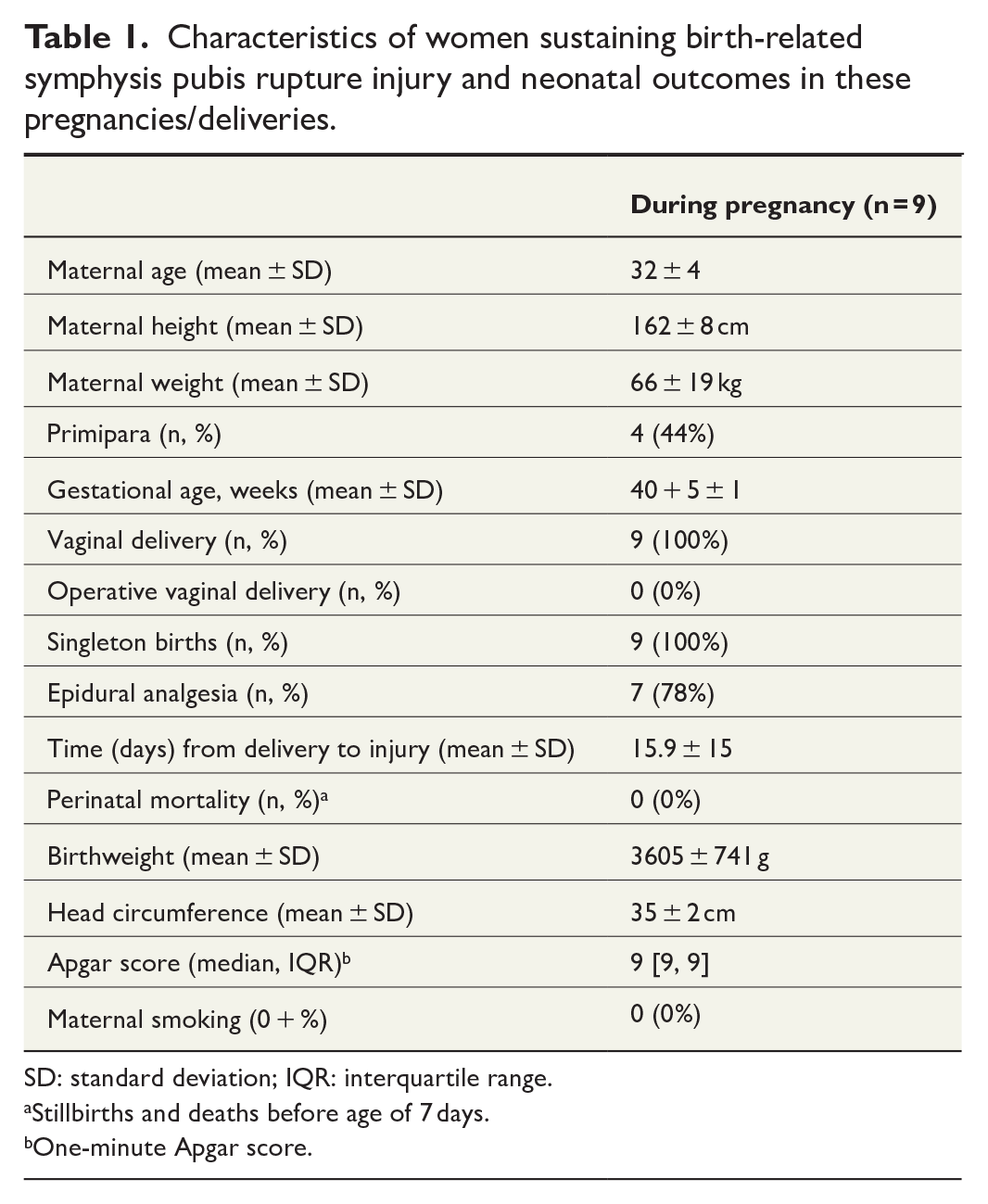
SD: standard deviation; IQR: interquartile range.
Stillbirths and deaths before age of 7 days.
One-minute Apgar score.
Discussion
Our results suggest that birth-related ruptures of the pubic symphysis are rare events with an incidence of 0.8 ruptures per 100,000 deliveries and are mostly associated with vaginal delivery. In concordance with previous reports, ruptures are mostly treated conservatively. These figures are the first nationwide incidence figures published and remain lower than previously defined figures. Due to the predominant diagnostic criteria being a sufficiently widened radiological intrapubic diameter, diagnosis of pubic symphysis rupture does not distinguish between partial and total ligamentous rupture. From our data, we are unable to distinguish the exact cause of rupture, but for all women, the rupture of the symphysis pubis was the only traumatic diagnosis within 60 days of delivery. As a possible limitation of our results, it is plausible our figures only include radiologically verified ruptures possibly limited to highly symptomatic cases. We hope these results serve as a future epidemiological cornerstone for birth-related ruptures of the pubic symphysis.
Footnotes
Declaration of conflicting interests
The author(s) declared no potential conflicts of interest with respect to the research, authorship, and/or publication of this article.
Funding
The author(s) received no financial support for the research, authorship, and/or publication of this article.
