



Abstract
Introduction
Different instruments, such as endoscopic stapler, endoscopic clip, monopolar hook cautery, harmonic scalpel, and vessel sealing instrument, have been described in appendiceal mesentery dissection (1). Cutting the appendiceal mesentery by laparoscopic scissors and suturing take more time and require intracorporeal experience to tie a knot. On the other hand, endoscopic stapler is expensive. Classical bipolar electrosurgical systems and ultrasonic thermal energy are inadequate for the hemostasis of vessels >2 mm in diameter (2). Several shortcomings are associated with the use of conventional monopolar diathermy, such as thermal injury risk, difficulty in hemostasis, smoke production, and the need of use of additional tools, such as bipolar graspers, sutures and clips. Sharp dissection has the advantage of high heat production with thermal spread in surrounding structures and charring. It has some risks of direct coupling to another metal instrument, direct sparking, and the passage of current from recently coagulated, electrically isolated tissue (3).
A simple cost-effective technique is described in this article to provide safe division of the mesoappendix that avoids the use of diathermy with its potential hazards. The technique utilizes a small number of clips. It is particularly useful in cases where the cecum is mobile, as it saves the need for an additional port to achieve control at the base of the appendix.
Technique
Step 1. Establishment of pneumo-peritoneum following insertion of the ports as preferred by the surgeon.
Step 2. The appendix is identified, grasped, and stretched to expose the mesoappendix.
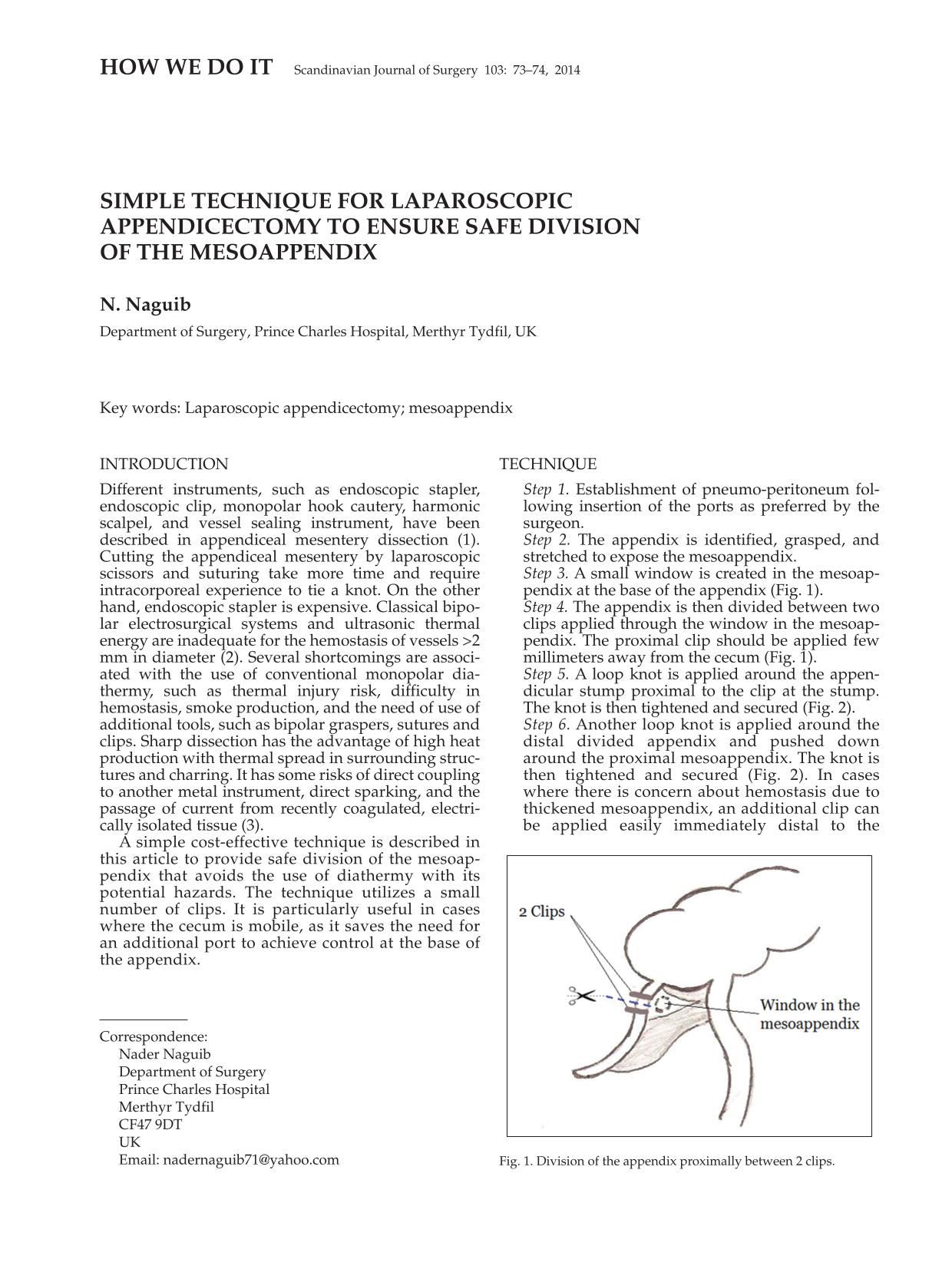
Step 3. A small window is created in the mesoappendix at the base of the appendix (Fig. 1).
Step 4. The appendix is then divided between two clips applied through the window in the mesoappendix. The proximal clip should be applied few millimeters away from the cecum (Fig. 1).
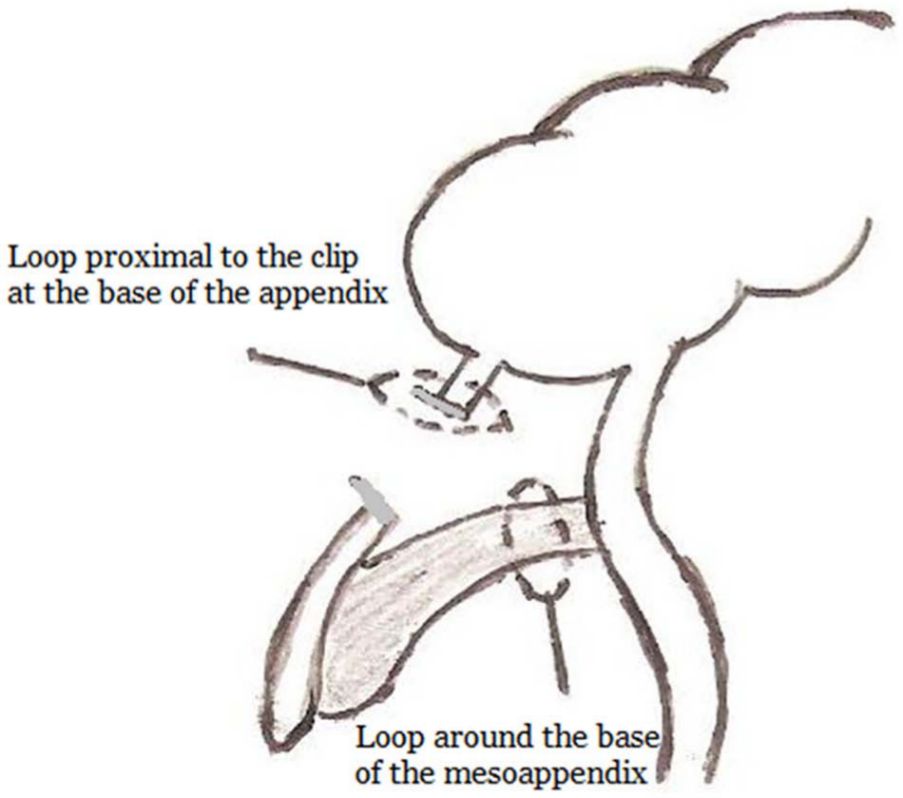
Step 5. A loop knot is applied around the appendicular stump proximal to the clip at the stump. The knot is then tightened and secured (Fig. 2).
Step 6. Another loop knot is applied around the distal divided appendix and pushed down around the proximal mesoappendix. The knot is then tightened and secured (Fig. 2). In cases where there is concern about hemostasis due to thickened mesoappendix, an additional clip can be applied easily immediately distal to the knot where the mesoappendix is narrowed by the tie.
Step 7. The mesoappendix is divided distal to the knot, and the appendix is extracted as usual per the surgeon’s preference (Fig. 3).
Division of the appendix proximally between 2 clips.
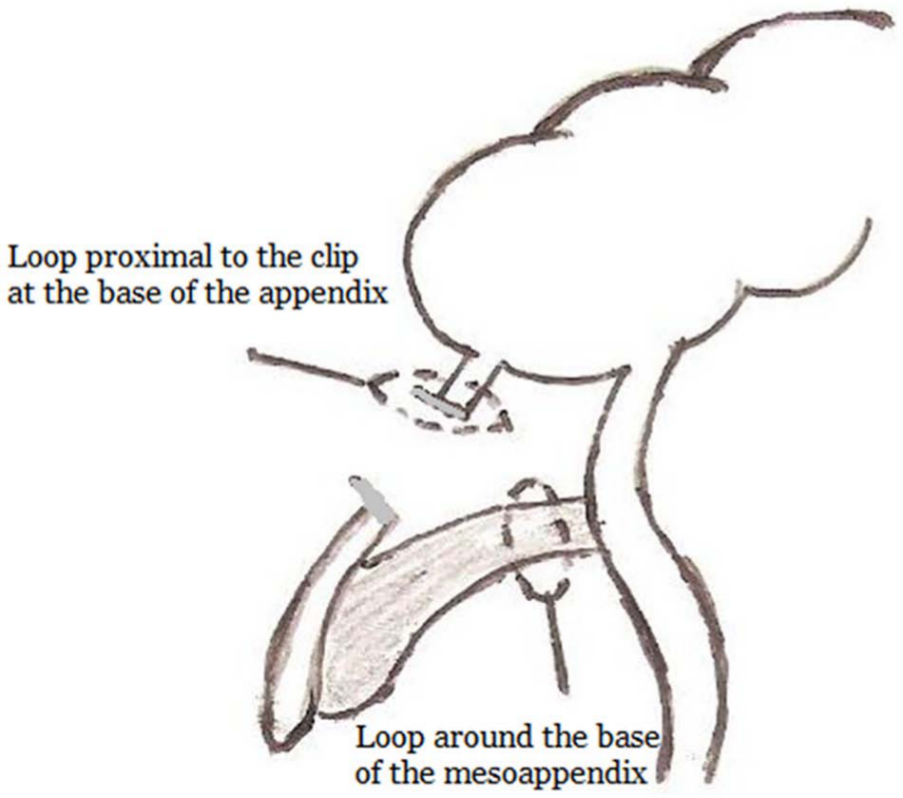
A loop applied at the appendicular stump proximal to the clip and another loop applied at the base of the mesoappendix.
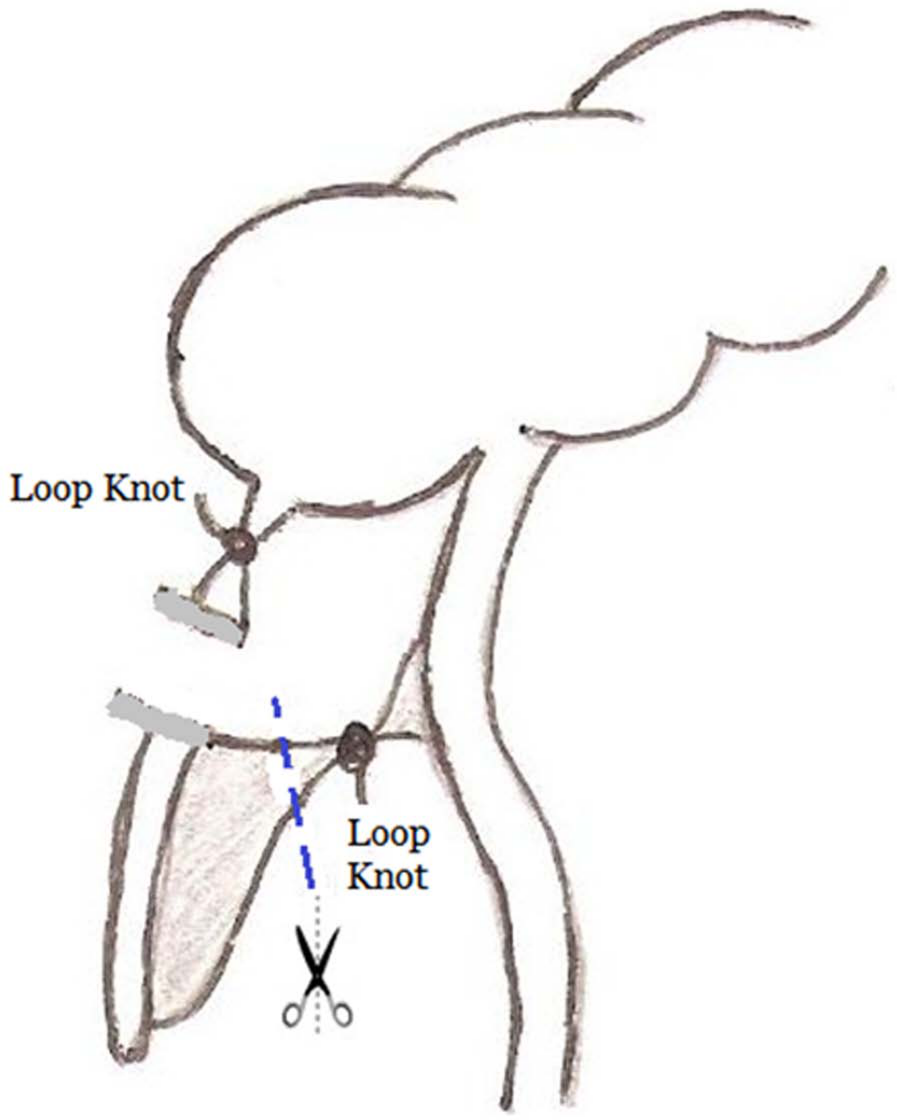
The mesoappendix is divided distal to the loop knot.
In most cases, there is only one clip left at the appendicular stump distal to the loop knot. If the surgeon prefers not to leave clips at all, this clip can be removed by dividing it distal to the knot. In such case, this clip should have been applied more distally to allow for its safe division later.
Footnotes
Declaration of Conflicting Interests
No conflict of interests.
Funding
No funding resources.