




Abstract
Surgery has undergone a significant change and development entering the 21st century. The changes and development have been technology driven, both in therapy and diagnosis. There have been significant changes in the health-care systems as well universally. The changes have created a significant challenge both for the profession and the surgeon. The surgeon should be prepared for further developments and innovations and adapt himself or herself to survive practicing surgery and conserving the humanistic approach of medicine and professionalism including respect to professional values. The profession needs to prepare itself for the future to train good surgeons accordingly for better community health.
Surgery
Surgery is known since mankind. The word surgery is derived from Latin and Greek meaning “hand work”. It is defined in Webster’s Dictionary as a branch of medicine concerned with diseases and conditions requiring or amenable to operative or manual procedures. Gawande (1) defines surgery as “a profession defined by its authority to cure by means of bodily invasion.” Since the evolution, surgery has become more effective with a substantial reduction in violence and complications.
Surgery as all other fields of medicine is composed of two elements: science and art. The art component is related to the applied practice, surgical competencies, craftsmanship, and humanities. The scientific aspect of surgery includes knowledge and information, critical thinking and reasoning, and analytical skills. The knowledge of anatomy, physiology, and pathology are the major frameworks that would transform the empirical medicine into science in surgery (2). Being a scholar is important in practicing scientific surgery. The surgical scholar combines tough-mindedness with critical thinking, promotes the academic ideals of the profession, and deals with basic research and/or clinical medicine (3). Searching and utilizing evidence-based medicine (EBM) has dominated our clinical practice for the past 30 years. We should build our knowledge more on evidence base than experience base. However, we should be aware as well that EBM may have some limitations in certain areas.
The evolution of surgery over the past 200 years has been driven by the technological development, and this evolution has been affected by market-based health reforms over the past 2–3 decades. In the mid 1800s, the introduction of anesthesia, asepsis, pathology, and new instrumentation, defined as the “Industrial Age,” followed by discovery of antibiotics, use of intravenous fluids, and later hyperalimentation, known as the “Information Age,” gave the opportunity to the surgeons to perform radical surgery and complex and invasive procedures with open techniques. The development of video camera systems and monitors led to major revolution in surgery, using minimally invasive approach in the 1990s. With further advancements, robotic surgery, natural orifice transluminal endoscopic surgery (NOTES), and endoluminal surgery were introduced (1, 4). This enhanced technological performance is related to integration of biological, physical, and information sciences (5). This technology and innovation that had a significant impact was termed as “disruptive technology or innovation” by many authors. Further developments in gene technology, three-dimensional preoperative planning, and advances in imaging technology will have dramatic effect on the surgical art in the future.
With the effect of these factors, surgery will not be replaced; rather, it will mature as new techniques are validated with further innovations; we should be open minded yet critical minded. Surgery will need to be adapted to strengthen the defining features of its professionalism: organizing, appraising, and maintaining the quality of work and patient safety (5–7).
The technology-driven development changed the standard approach in surgery, both in treatment and diagnosis, and led to a change in spectrum of surgical diseases as well. The surgeons’ basic skills had to be replaced with the use of emerging technology. Besides the technological advancements and innovation, immense increase in knowledge and information led to another challenge in surgical practice, “subspecialization or superspecialization.” This was inevitable or unavoidable in academia. Subspecialization or superspecialization carries a risk of creating mere technicians. The effect of technological development and innovation on the community needs to be discussed as access to surgical innovation and new technology is generally limited to wealthier countries or wealthier parts of the countries. This has led to disparities in surgical care (8, 9). Besides the innovation and technological development, the impact of market-based health reforms has led to give up or lose some of the professional values in medical practice, at the expense of shifting the humanitarian approach to a business enterprise. Surgery, I believe, is one of the most affected fields of medicine in practice with these changes.
Where will the technology development further go? How will the surgical environment and the art of surgery change? Will nanotechnology have a significant effect on surgery and medicine? We need to wait and see but be well prepared.
The surgeon
The role of the surgeon has evolved with all of these changes because surgical diseases have undergone a significant change as well with the scientific development in the 21st Century. As Atul Gawande (10) has stated, the role of the surgeon has shifted from being a “technician” to a “doctor,” and he gives the example of doing breast operations versus managing breast cancer. Actually, today, there are many more examples that could be given to support this concept, care of any cancer, transplantation, management of trauma and intensive care, surgical infections, obesity, metabolic syndrome, and so on, where science could be involved much more than the surgical technique or procedure.
The traits of a surgeon have been described extensively. In general, these traits could be summarized in three main domains: interpersonal and communication skills, strong work ethics, and passion for learning new things besides clinical competence. Part of strong work ethics in academia includes teaching and training the young generation, transferring the knowledge and experience to the young surgeon, and helping improve the surgical care. The surgeon needs to be a “good mentor” as well. The combination of these traits actually describes the property of a “good surgeon.”
However, description of a “good surgeon” is not that easy unless you accept the definitions given in Spanish proverbs as follows: “A good surgeon has an eagle’s eye, a lion’s heart, and a lady’s hand” or “There is no better surgeon than one with many scars.” Atul Gawande (10) defines the good surgeon as the surgeon who provides humane care with best possible result and defines three components of good surgery as technical skill, safe judgment, and high moral performance. With these general characteristics, the “good surgeon” should be intelligent, self-confident and calm, conscientious, creative, courageous, and logical under stress and should demonstrate perseverance on behalf of the patient. The “good surgeon” should be a good communicator, competent and skilled; know when not to operate or stop operating; be able to manage multiple physiological and psychological problems of the patient; and be a good team worker, educator/“mentor”/leader, researcher, and scholar. Beyond these, the good surgeon should be committed to excellence in practice, feel the responsibility for continuous development to be up to date, and the last but not least, be professional.
To be a team worker is essential in surgery. Besides the surgical care teams, the surgeon should be involved with multidisciplinary and interdisciplinary teams in this era where the development is technology driven. If this does not occur, the gap between scientific and technological advances with the needs of the surgeon and the patient will grow. This should be taken into consideration for training the surgeon as well (11).
These traits as a “good surgeon” should be supplemented with the professional responsibilities or values, such as empathy, honesty, integrity, dedication and devotion, nondiscrimination, compassion, ethics, and professionalism, which form a physician’s identity. These values actually describe a “good doctor.” With the addition of humane approach, the surgeon should be a “good human” as well. This trilogy of being “good” means that being a good technician alone is not enough for a surgeon (Fig. 1). The surgeons must conserve their humanism while continuing to follow technological progress. They should be good technicians and humanists at the same time (12). The profession should be actively involved in technology development to prevent the destructive effects (9).
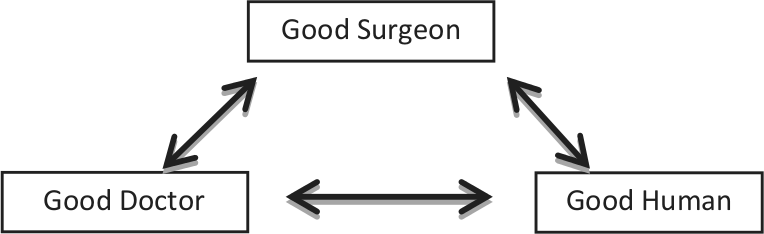
Trilogy of being “good.”
Surgical education
The aim of modern surgical training and education has been stated by Halsted as, “… producing surgeons of highest type, who will simulate the finest youths of their country to study surgery and to devote their energies and their lives to raising the standards of surgical science,” and the trainee is given a progressive graded autonomy (13, 14). In other words, Halsted is describing about educating a “good surgeon,” which has been discussed earlier. The Halstedian approach trained and educated good surgeons who went on to become leaders in surgery and surgical education. However, today, the technological developments, which have changed the standard surgical practice, and changes in health care delivery systems have demanded a change in surgical training to avoid the gap between what is given in training and what is delivered in practice (15). This change needs to meet the need of the surgeon in practice with certain skills. The skills of a surgeon should include active listening with the patient (one-to-one communication), critical thinking with judgment and decision making, and complex problem solving.
In the last century, surgical education has changed from an apprenticeship model to a structured, hospital and time-based program. Now, surgical education has to change toward a competency and outcome base as in the contemporary undergraduate medical education (15, 16). In 1999, Accreditation Council for Graduate Medical Education (ACGME) defined six core competencies that all residents in training must achieve and demonstrate. These competencies are medical knowledge, patient care, interpersonal and communication skills, professionalism, practice-based learning, and system-based practice (17). The competencies and the outcomes need to be defined on the basis of knowledge, skills, and behavior that a surgeon should achieve at the end of the training. The training and education should be skill based, with a formal core curriculum, and evidence based. New learning technologies should be used in training and educating the surgeon outside of the operating room, that is, skills and simulation labs using virtual reality. The assessment and evaluation should be done accordingly on the basis of competency and outcome.
One issue that needs overemphasis is the requirement of including professionalism in the core curriculum as proposed by various organizations. Professionalism can be learned and assessed (18). When assessing professionalism, we should realize that ethical consideration is a part of professionalism but not the entire concept. Ethical considerations should be incorporated with the professional values that were discussed earlier and given in a structured and formal curriculum in training. Although some parts of professionalism could find a place in the hidden curriculum taken from the role models during the training, this should cover three elements of a profession: (1) exclusive right to practice in a defined area of endeavor, (2) right to professional autonomy, and (3) a duty to put the interest of the patient ahead of his or her own (19). Actually, I believe that professionalism is essential for the survival of the practice of surgery.
Another issue to be discussed in surgical training is relating surgery with public health because the areas of interest of these two fields, such as prevention, diagnosis, treatment, and rehabilitation, coincide more than expected. Besides this, the burden of surgery and surgical diseases are much more than anticipated for the community. The overall burden of disease that may be cured, palliated, or treated with surgery is growing. Trauma is a good example for this, especially in areas with low- or middle-income economies. With the public health approach in surgery, we will have a chance to examine the strengths and weaknesses in the delivery of surgical care in the community and be able to formulate balanced policies for resource allocation and access to surgery (8, 20, 21). We should not forget that surgery can also be used as a primary, secondary, or tertiary prevention method for various diseases and pathologies, that is, breast cancer, ulcerative colitis, gastrointestinal polyps, obesity, and so on.
Value and quality of surgeons’ work: can it be measured?
Measuring the value and quality of any work needs complex evaluation. There are various definitions of value in the dictionary. The definition which may suit surgery deserves some thinking. Relative worth, merit, or importance or the worth of something in terms of the amount of other things for which it can be exchanged (http://www.dictionary.com), I think, are suitable for surgery. However, most of the time, the worth and more monetary worth are brought to the front whereas we should be talking about “value-based surgery” more. The value of surgery can be evaluated with the outcome and benefit of any procedure. Economic evaluation is inappropriate when talking about the value of surgery. A definition of a unit value, which includes benefit and utility besides cost, should be done. Benefit of surgery could be of short or long (lifelong) duration and constant. This directly affects the utility as well. Discussing the monetary value of surgery is beyond the scope of this article.
Quality of surgery is an issue that has been discussed besides safety in the last decade more than ever. The patients, payers, and regulatory agencies are more frequently evaluating the quality of surgical care in this era (22). Assessing the quality is more difficult than assessing the value. Structural, process, and outcome measures should be used as quality indicators. A composite scoring is more important in surgery. The procedure itself may be the most important factor in deciding about the most effective approach to quality measurement. The baseline risk of the procedure and how commonly it is performed at individual hospital should be assessed (23). It has been shown that high surgeon volume and specialization are associated with improved patient outcome, while hospital volume has a limited benefit (24). However, volume-based learning within standardized processes will finally lead to a plateauing of quality. Innovations will then further improve quality (25). Other quality measurements such as complications, especially surgical site infections, mortality, quality-of-life scoring, and cost effectiveness should be used as well. Improving surgical quality may ultimately reduce costs and improve outcomes; however, profession-guided innovation will be the most effective approach for a sustainable quality improvement in surgery.