




Abstract
Background and Aims:
Exceptional amount of snow led to snow removal attempts from the rooftops resulting in a relative unique and extraordinary epidemic of accidental falls in winter of 2010.
Material and Methods:
The injury pattern, hospital care, surgical operations, and the total costs of the primary hospital stay of accidentally fallen patients treated in Helsinki University Hospital trauma unit were analyzed.
Results:
Forty-six patients were admitted to hospital during the study period of three months. Majority of the patients were males (N = 43, 93%) with the average age of 52.9 years. Seven patients were admitted to ICU. The average length of primary hospital stay was 4.7 days with 0% mortality. Total amount of fractures was 65 (63%) of all 97 injuries. The most common injuries were fractures of upper and lower extremity, and spinal column.
Conclusions:
Preventing similar unnecessary epidemics of accidental falls in the future it is important to have professional opinion of the need of snow removal along with understanding of the risk of injury. Wearing appropriate safety equipments, and use professional help when necessary is advisable.
Keywords
INTRODUCTION
The average snow accumulation was exceptionally high in the Southern part of Finland during winter 2010 as Finnish Meteorological institute informed (1). It was caused by heavy snow falls and long lasting continuous cold weather period which was observed by Ministry of Environment (2). For example in Helsinki airport area the average snow depth was 60 centimetres which is three times more than expected according to Finnish Meteorological institute (3).
The high amount of snow increases the risk of roof collapses and falling of snow compared to normal winter. To reduce risks of excess snow accumulation, a high number of roof cleaning procedures were carried out in Finland. Attempts to clean snow from rooftops lead to exceptionally high number of accidental fallings during winter 2010. The amount of fallings was observed to be high in the Finnish media also resulting active discussion in public.
Töölö hospital is the trauma unit of Helsinki University Hospital providing care for trauma taking place in the City of Helsinki, and all severe traumas in the Southern Part of Finland. The aim of the study was to identify all the patients treated in Töölö hospital who had accidentally fallen while cleaning snow off from the roofs, and assess their injury pattern, required hospital care and surgical operations. Also the total costs of the primary hospital stay due to this trauma epidemic were analyzed.
METHODS
All patients treated in the trauma unit of Helsinki University Hospital (Töölö hospital) between January 1st and March 31st 2010 due to a falling accident during snow cleaning from rooftops was included in the present study. The age and gender of the patient, the possible influence of alcohol, use of safety equipment, falling height, as well as the possible occupational character of the work were recorded. Moreover, the time and location of the accident, delay in admission, injuries, operations, and length of both intensive care unit (ICU) and hospital stay were retrospectively studied.
The costs of the care were accounted for according to the invoicing of acute care, operations, hospitalisation days, and aftercare in the Helsinki University Hospital special health care units by the end of June 2010. However, the accounting excluded the costs of treatment outside Helsinki University Hospital, those redounded due to disability to work, and those due to rehabilitation.
Results are expressed as means ± SD for continuous non-skewed variables. Differences between groups were compared by Mann-Whitney U test (continuous variables). Statistically significant level was set as P < 0.05 (two-tailed). Finnish law does not require ethical board approval for retrospective study of medical records. Review board of Helsinki University Central Hospital approved the study design.
RESULTS
During the study period of three months, 46 patients fulfilled the inclusion criteria. The average age of the patients was 52.9 years (range 22 to 82 years). Majority (n = 43, 93%) of the patients were males. Ten patients (22%) were older than 65-years of age. Demographics of the patients and accidents are shown in Table 1.
Patient demographics (SD = standard deviation, ISS = injury severity score)
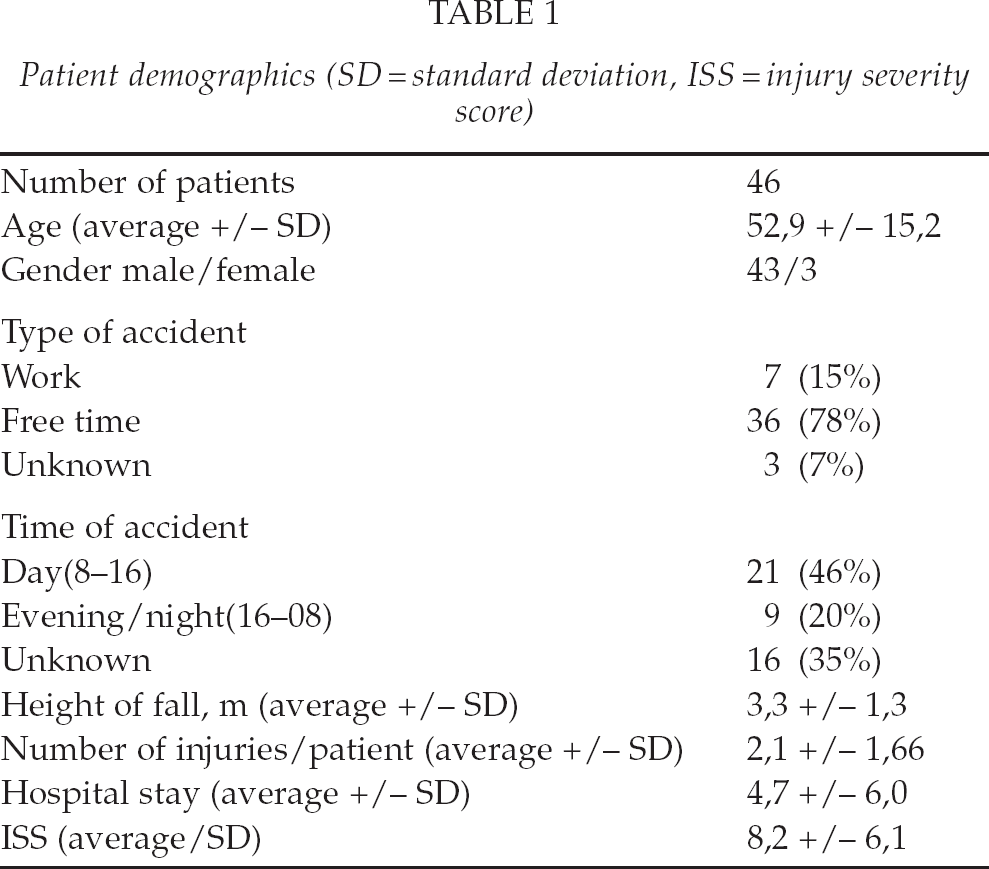
Majority of the patients fell from the roof (n = 30, 65%). Twelve patients fell from the ladder (26%). Three patients fell from the roof but where suspended in the air by safety harness. Only 7 (15%) of the accidents were work related, including the three patients wearing safety harnesses.
Some 41 (89%) of the accidents occurred in February during a five weeks period as shown in Fig. 1. A total of 33 (72%) patients were referred from other health care units and 13 (28%) patients were admitted directly from the scene. Six (13%) of the falls occurred in the Helsinki city area and 36 (78%) accidents occurred elsewhere. For four patients (9%) place of accident remained unknown. After emergency department survey and care, most of the patients were admitted to hospital (n = 35, 76%). Four patients were transferred to further care into other hospitals. Seven patients were discharged from the emergency department. Seven patients were admitted to ICU.
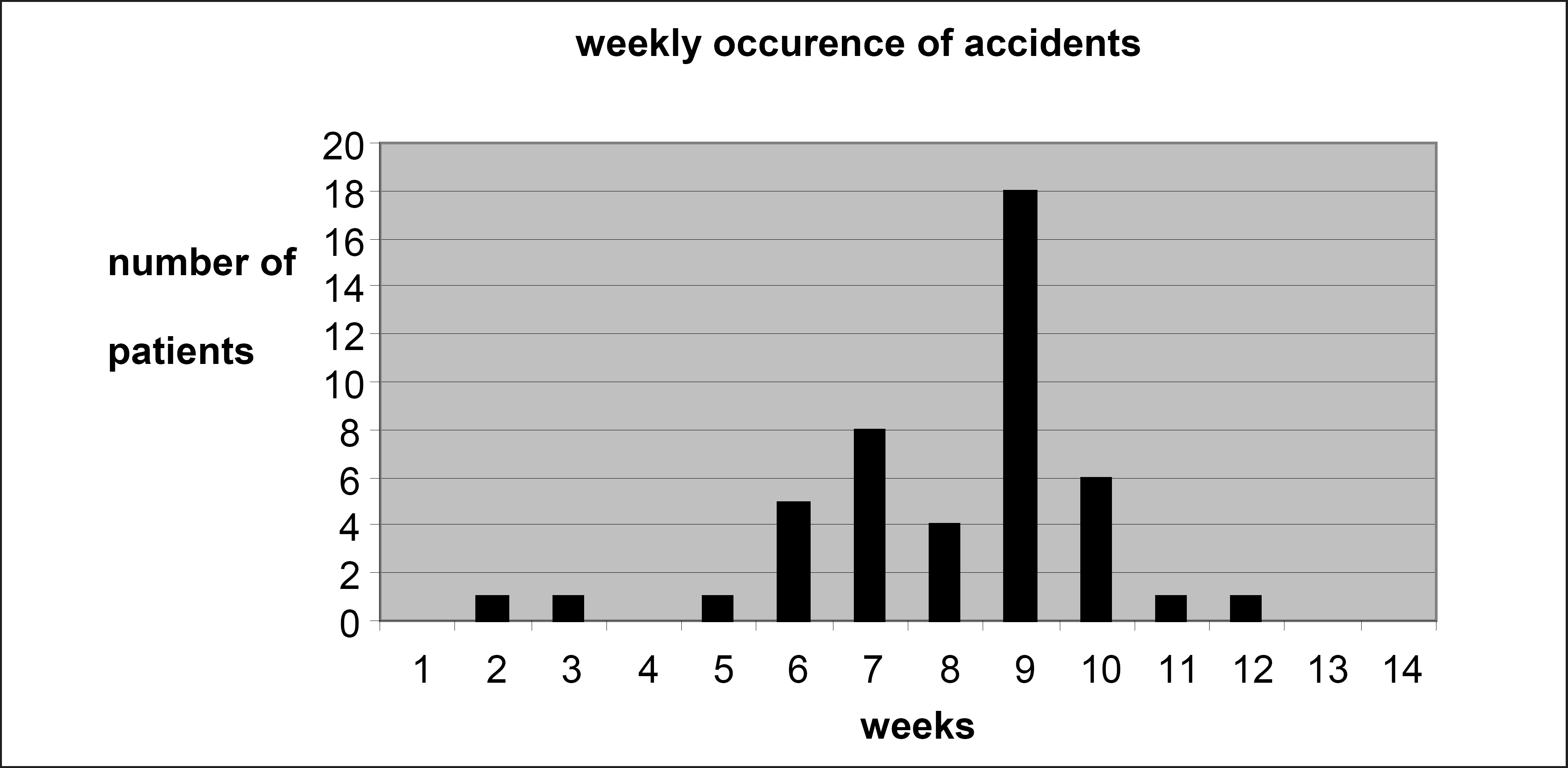
Weekly occurrence of accidents.
There was no difference in the ISS (Injury Severity Score) when compared patients falling from the roof or from the ladders (ISS 8.9 +/− 6.7 vs. 8.0 +/− 4.7). The average height of fall was 3.3 m +/− 1.3 m (range 0–6 m, median 3 m). In work-related accidents the mean age of the patients was significantly lower than in non work-related accidents (33.9 +/− 8.9 years vs. 56.3 +/− 13.5 years). Two patients (4%) were under the influence of alcohol at the time of admission.
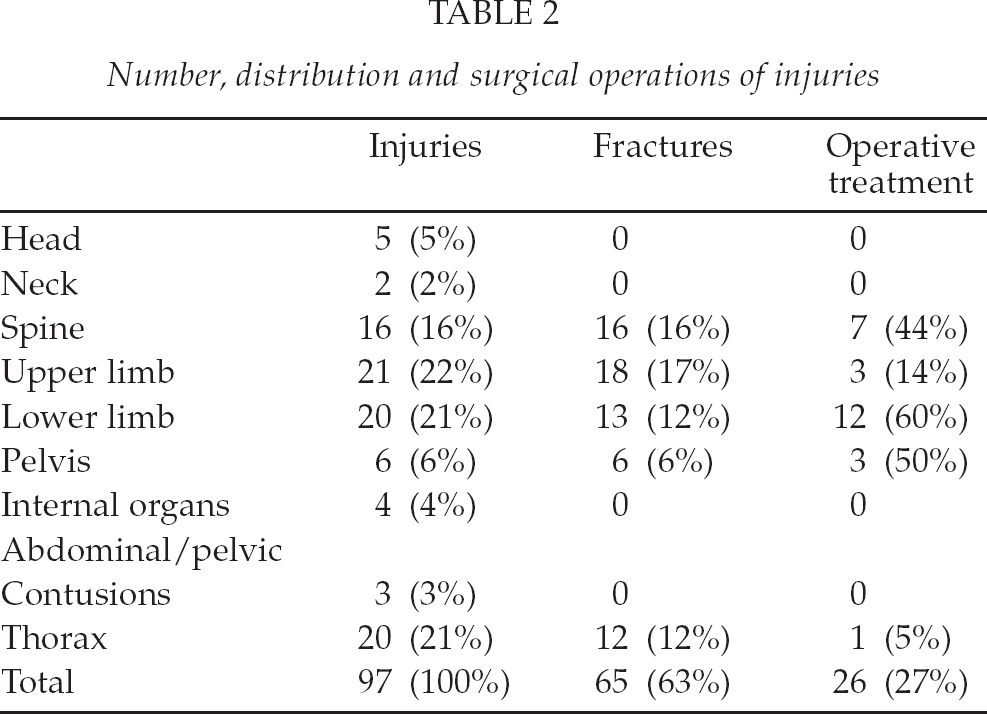
The total number of injuries in the present 46 patients was 97, averaging 2,1 injuries per patient. Of those, 23 patients had only one injury. Injuries of the head and neck were mainly commotions and contusions. Only three patients had intra-abdominal injuries, which all were treated non-operatively. Summary of injuries and performed operations is presented in table 2.
Number, distribution and surgical operations of injuries
The average length of hospital stay in Töölö hospital was 4.7 +/− 6 days (range 1–33 days). The 30-day mortality was 0%. The average length of ICU stay was 7 days (range 1–17 days). On average, patients admitted to ICU were older (62 +/− 15.5 years vs. 51.3 +/− 14.8 years) and fell from higher (3.7 +/− 1.25 m vs. 3.24 +/− 1.33 m) than those not admitted to ICU.
The total cost of the treatment in the reporting university hospital for the 46 patients was approx 540 000 €, with average of 12 300 € per patient. Most of the costs were paid by the public sector and less than 50 000 € were paid by private health insurance companies.
DISCUSSION
Snow accumulation was exceptionally heavy in the winter of 2010 in Southern Finland. It was recommended by authorities in public that snow load of roofs should be lightened. Previously it has been suggested that there is a connection between heavy snow falls and accidental falls from roof tops in New York state area (4).
Majority of our patients fell from the height of their own one-storey house roof of about 3 meters. Earlier study by Risser and colleagues have shown that mortality rises after the height of fall exceeds three floors and usually occurs when distance exceeds five floors (5). That concurs with our finding of zero mortality. On the other hand, mortality associates also to head injuries when height of the fall is lower as suggested in study by Türk et all (6). Head injuries among our patients were reasonably mild and rare. One explanation is that freshly fallen snow on the ground may have decreased the severity of head injuries in certain cases. In addition the high number of lower extremity injuries indicates landing on the feet.
The patient material in the present study is generally similar to other studies related to accidental falls from heights. Male dominance, distribution and seriousness of injuries are similar to earlier studies (4, 5, 7). In our material, only four patients had injury severity score (ISS) over 15, defining their injuries as serious (8). Typical injuries were severe fractures: calcaneal, vertebral column, and pelvis fractures. These kind of injuries often require operational interventions and are associated with long term incapacity for work, rehabilitation needs, and even permanent disability and might cause significant costs to society if occurring epidemic way.
Risk of falling is well acknowledged: for example Finish labour protection administration publishes instructions for safe working habits in the Internet (9). Occupational falls were rare in our material and safety harnesses were used in half of those cases. However, those who fell during free time usually fell from the roof of their own house, and did not use safety equipments indicating that safety instructions are better obeyed at work. Also, falling height from the roof of one's own house might have been estimated low and the risk of injury small. It is likely to be the case with the injury risk, hence, and there may have been much larger number of fallings not leading to injuries.
In Southern Finland (population of approximately one and half million), most seriously injured patients are admitted to Töölö hospital. This material gives an idea of patients, injuries, treatments, and cost of special health care in this area. However, in the present material only six (13%) accidents occurred in the city of Helsinki, while the rest took place in surrounding areas with higher number of detached houses according to Uusimaa regional council (10). Only thirteen (28%) patients were admitted directly from the scene. Thus, it is obvious that high number of patients with mild or moderate injuries were taken care of by other smaller hospitals in the surrounding areas. In the light of the present study, no epidemiological calculations or estimations can be done. Still, it is obvious that number of fallings will increase when the density of detached houses increases, and that the risk of occupational fallings is lower than the one of taking place in free time. Professional workers are typically used for cleaning snow off from the higher buildings, which makes the possible fall more dangerous, which probably also is reflected on the rate of safety equipment usage.
Preventing similar phenomenon in the future, it is important to have professional opinions of structural engineers about load resistance of roofs and the need of snow removal. If shovelling snow from rooftops of detached houses is considered necessary, it is advisable to have a better understanding of the risk of injury, wear appropriate safety equipments, or use professional help in terms of preventing unnecessary injuries with major impact on everyday activity.
Footnotes
ACKNOWLEDGEMENTS
Sari Sulander, Töölö hospital, search for patients from electronic patient database Ulla Haverinen-Shaughnessy, revision of English manuscript