




Abstract
Introduction
Alcohol consumption remains a major global public health challenge (Babor et al., 2022), contributing substantially to morbidity, mortality, and social harm, particularly among those individuals who misuse or overuse alcohol (World Health Organization [WHO], 2024). Excessive use of alcohol is associated with increased risks of non-communicable diseases, injuries, and mental health disorders, with young people especially vulnerable (WHO, 2024). Preventing underage access to alcohol is therefore a public health priority. However, despite legal restrictions, non-compliance with age verification laws is widespread, undermining efforts to limit alcohol-related harm among minors (Grube et al., 2018; Kremer et al., 2022).
Vendor compliance with age verification laws is shaped by multiple factors. Vendor compliance behaviour can be conceptualized within deterrence frameworks, which posit that the likelihood of law-abiding behaviour increases when perceived certainty, severity, and swiftness of enforcement are high (Becker, 1968). The perceived likelihood of enforcement (e.g., inspection frequency, severity of penalties), financial motivations (e.g., reliance on alcohol sales), and the presence or absence of training all influence behaviour (Grube et al., 2018; Kremer et al., 2022; Roodbeen et al., 2018; Van Hoof, 2019). For instance, a Dutch study found compliance increased from 35% to 80% when vendors believed inspections were likely (Roodbeen et al., 2018). Conversely, vendors selling high-profit products were significantly less likely to request age verification (Van Hoof, 2019). Such findings highlight the tension between profit motives and legal compliance.
Compliance also varies by venue type. Evidence from Australia and Lithuania suggests that bars and restaurants are more likely to enforce age restrictions compared with supermarkets, kiosks, or smaller off-premise retailers (Miščikienė et al., 2023; Rowland et al., 2017). Yet, empirical research directly linking financial pressures, competition, and venue characteristics to compliance remains limited, especially in Southern and Eastern European contexts.
Individual transaction characteristics have also been shown to influence vendor compliance. Several studies have found that the perceived gender of the mystery shopper affects the likelihood of age verification, with female shoppers more likely to be sold alcohol or tobacco without ID checks compared to male shoppers (Feltmann et al., 2021; Krevor et al., 2011). The gender of the seller has similarly been identified as a potential predictor of compliance behaviour, though evidence on its direction and magnitude remains mixed across studies (Clark et al., 2000; Feltmann et al., 2021). The type of alcoholic beverage requested may also influence vendor behaviour, as different products carry different social associations (Willner et al., 2000) and profit margins, though this has received limited empirical attention to date.
Recent data from the European School Survey Project on Alcohol and Other Drugs (ESPAD Group, 2025), which surveys 15–16-year-old students across Europe, confirm the continued accessibility and high prevalence of alcohol use among adolescents across Europe. Three in four ESPAD students (75%) reported that alcoholic beverages were fairly or very easy to obtain, with perceived availability highest in countries like Denmark and Germany. In Cyprus, perceived access remains alarmingly high: 78% of girls and 66% of boys reported that obtaining alcohol was easy. Moreover, 42% of Cypriot students reported alcohol use in the past 30 days, and 12% of girls reported at least one instance of intoxication during that period, compared to 4.4% of boys. These figures place Cyprus among the highest in Europe in terms of perceived availability and gender disparities, underscoring the urgency of evaluating and improving compliance with age-verification laws.
Mystery shopping is a widely used method in both observational research and intervention-based studies to monitor and improve compliance with age verification laws. Studies show that structured interventions combining repeated mystery shopping with feedback and training can substantially improve compliance. For example, in the United States, responsible retailing mystery shop interventions increased ID-checking rates from 80% to over 94% (Grube et al., 2018), and a statewide compliance check programme in South Carolina was associated with significant reductions in underage alcohol-involved crashes over a ten-year period(George et al., 2021).Similarly, an intervention of combined compliance monitoring and vendor education in Spain increased ID requests from 15.4% to 72.7% and reduced alcohol sales to minors by more than 30% (Duch et al., 2020).
Comparable intervention effects have been reported in Mexico (Paschall et al., 2020) and Bhutan (Dorji et al., 2016), suggesting that compliance is malleable across diverse regulatory and cultural contexts. Perhaps the most sustained example is Sweden's Responsible Beverage Service (RBS) programme, which combines multi-stakeholder collaboration, server training, and enforcement, and has demonstrated lasting effects on vendor compliance with both underage patrons and visibly intoxicated customers over more than 25 years (Elgán et al., 2024; Feltmann et al., 2025). Evidence also suggests that compliance check interventions are effective beyond alcohol, including for tobacco sales (Feltmann et al., 2022; Krevor et al., 2011), further strengthening the empirical case for systematic enforcement as a public health tool. These findings demonstrate that compliance is malleable when systematic oversight and feedback mechanisms are in place.
In Cyprus, the legal minimum age for purchasing alcohol was raised from 17 to 18 years following parliamentary reform in 2020 (Amendment) Law of 2020 (Republic of Cyprus, 2020). The primary legislation governing alcohol sales in Cyprus is the Sale of Alcoholic Beverages Law (Cap. 144). The most recent amendment, the Sale of Alcoholic Beverages (Amendment) Law of 2020 (Law 87(I)/2020), raised the minimum legal purchasing age from 17 to 18 years to harmonize with the majority of EU member states, and introduced stricter penalties for violations, including imprisonment of up to six months and fines of up to €3,000 (Republic of Cyprus, 2020). Despite this legislative strengthening, underage access to alcohol remains a pressing public health concern. Compliance levels appear to be lower than the European average, where between 15% and 60% of vendors typically request age verification, depending on enforcement practices, and retail setting (e.g., Duch et al., 2020; Miščikienė et al., 2023; van Hoof & van Velthoven, 2015). Contributing factors may include weak enforcement mechanisms, infrequent inspections, and cultural norms that normalize youth drinking in Mediterranean settings (National Addictions Authority Cyprus, 2019). In Southern European contexts such as Cyprus, Spain and Italy, adolescent alcohol use is often socially normalized embedded in peer leisure (Pedrero-García, 2018) and family routines contributing to permissive norms around underage drinking.
This paper presents findings from two mystery shopping studies conducted in Cyprus in 2015 and 2024, providing insights into patterns of vendor compliance with age-verification laws across a nine-year period. To our knowledge, no prior mystery shopping, test purchase, or compliance check studies have been conducted in Cyprus for alcohol or any other age-restricted product, making the present study the first systematic investigation of its kind in the country. By including two aligned mystery shopping studies separated by nine years, this paper provides rare empirical insight into temporal changes in vendor behaviour and the persistence of non-compliance under weak enforcement conditions. Both studies aimed to evaluate vendor adherence to age-verification laws, with the 2024 study incorporating minor methodological adjustments to reflect evolving retail contexts, and to identify factors influencing the likelihood of selling alcoholic beverages to underage-appearing individuals. Together, these findings provide much-needed evidence to inform enforcement strategies, vendor training, and public health initiatives designed to reduce underage access to alcohol in Cyprus.
Methods
Study Design
This research comprises a repeated cross-sectional study with two measurement points (2015 and 2024), aimed to assess vendor compliance with age verification laws in Cyprus. Both studies followed a standardized protocol in which trained underage-appearing shoppers attempted to purchase alcohol. Vendor responses were coded into three categories: (a) no age verification, (b) verbal age confirmation or (c) request for official identification.
Data for the 2015 assessment were collected by the University Centre for Field Studies of the University of Cyprus, with ethical approval granted by the Cyprus National Bioethics Committee. Data for the 2024 assessment were collected by the Behavioural Science in Health (BSiH) Lab at the Cyprus University of Technology, as part of the official actions of the Policy Department of the National Addictions Authority Cyprus, which also funded both assessments. Separate bioethics approval was not required for the 2024 assessment because all mystery shoppers were trained and fully briefed, no personal data were obtained from vendors, and debriefing procedures were followed after each visit to ensure transparency and minimize any potential discomfort or misunderstanding. Although debriefing was conducted by the mystery shoppers themselves rather than by supervizing officials, all shoppers were legal adults (aged 18–19 years) who maintained continuous contact with a research supervisor throughout each visit day. No hostile or confrontational situations were recorded during any debriefing interaction. All observations were conducted in public retail settings with no interference or deception beyond the mystery shopping protocol. Following data collection at both timepoints, training sessions were provided to vendors and managers to raise awareness of the legal framework and responsible retail practices.
Sampling and Setting
Data were collected in the two most populous districts of Cyprus. Nicosia, the inland capital, is home to the central government, numerous universities, and a predominantly residential and commercial population, with relatively limited tourist presence. Limassol, the second largest district, is a major financial and business centre with a significant coastal tourist presence, particularly in its marina and seafront areas.
In both assessments, 200 mystery shopping visits were conducted across licensed venues in Nicosia and Limassol districts (100 per district). Venues were selected to represent a range of retail settings where alcohol is commonly sold, including kiosks/mini-markets, supermarkets, cafés, bars, and restaurants.
In 2015, visits were carried out in April across 12 urban and suburban municipalities. Venues were classified into six categories: restaurants, bars, cafés, nightclubs, mini-markets/kiosks, and supermarkets. Retailers in supermarkets and mini-markets (38% of visits) were randomly sampled from lists of licensed retailers provided by each municipality, whereas other venues (restaurants, bars, nightclubs, and cafés; 62% of visits) were purposively sampled based on popularity among minors (i.e., under 18 years old), as recalled by 98 first-year university students from one public and two private universities in Nicosia and Limassol, who were asked to name venues they had frequented as high-school students. Among the 200 visits, 120 were unique, whereas, for 40 venues, a second visit was conducted at a later time to examine reliability of compliance. Following the 2015 assessment, findings were disseminated at a stakeholder seminar and a training guide on responsible alcohol sales was developed in collaboration with the National Addictions Authority Cyprus. Seven awareness seminars were subsequently delivered to approximately 100 vendors across five districts in 2016. The 2024 assessment was not designed as a formal evaluation of these activities; the two assessments used independently drawn samples and no systematic tracking of training exposure was maintained over the intervening period.
In 2024, visits were conducted between April and June. Updated vendor lists were obtained from municipal authorities and the National Addictions Authority Cyprus. Nightclubs were excluded from the 2024 assessment due to logistical and safety constraints, and venues were selected based on proximity to urban centres to ensure accessibility and representativeness.
Mystery Shoppers and Training
In both assessments, mystery shoppers were recruited on the basis of their physical resemblance to individuals under the legal drinking age and were trained in legal and ethical issues, observation protocols, and role-play scenarios prior to data collection.
In 2015, mystery shoppers were first-year students from a public university in Nicosia. Following an open call, applicants submitted an application and a recent photograph. Three independent reviewers evaluated the applicants, rating them for their resemblance to a high-school student. The youngest-looking candidates were subsequently interviewed, after which nine shoppers (six female and three male), all aged over 17 years old, were selected and trained. A 1-day training session was organized before data collection, covering knowledge of the observation form, the purchase protocol, role-play scenarios simulating interactions with retail staff, awareness of laws on alcohol sales to minors, and understanding of the harms of alcohol for young people. An additional three more senior students served as supervisors, accompanying each shopper pair during visits to provide logistical support and ensure protocol adherence, but did not enter the venues.
In 2024, four first-year students (two male and two female), aged 18–19 years, from a public university in Limassol were recruited and trained by the research team based on their resemblance to individuals under the legal purchasing age. Unlike in 2015, all visits were conducted individually without an observer, to reduce reactivity and improve ecological validity. Mystery shoppers received a flat-rate payment upon completion of the study in both assessments.
Procedure and Measures
In both assessments, mystery shoppers entered the venue and attempted to purchase an alcoholic beverage appropriate to the venue type. The purchase protocol was standardized across venue types but adapted to the service context of each setting. In kiosks and mini-markets, shoppers approached the counter directly and requested a canned beer or other standard alcoholic beverage. In supermarkets, shoppers selected an alcoholic beverage from the shelf and proceeded to the checkout to complete the purchase. In cafés, bars, and restaurants, shoppers approached the bar or were seated and ordered an alcoholic drink from a server or bartender. In nightclubs (2015 only), shoppers approached the entrance and attempted to gain entry, with compliance assessed at the door; if entry was granted, they then attempted to order an alcoholic beverage at the bar.
If the vendor was willing to proceed with the sale, the shopper cancelled the transaction using a pretext, such as stating they had forgotten their wallet or no longer needed the item, and exited the venue (see Supplementary Material S1). When asked for verbal age confirmation, shoppers stated a fictitious age of 17 years; when asked for ID, they indicated they did not have it with them and cancelled the transaction. Immediately after each visit, the shopper completed a structured observation form recording venue characteristics, seller demographics (estimated age and gender), and vendor behaviour, categorized as: (a) no age verification, (b) verbal confirmation of age or (c) request for official ID. Additional contextual information was recorded in both assessments, including the total number of cash registers in the venue, the number of open cash registers at the time of the visit, the number of customers present before and after the shopper, the waiting time, the presence of a visibly displayed alcohol licence, and the presence of warning signs regarding the prohibition of alcohol sales to minors. Shoppers were instructed in both assessments to avoid unnecessary conversation with staff, respond politely and briefly to queries, and maintain a youthful appearance.
Key procedural differences between the two assessments are as follows. In 2015, shoppers worked in same-gender pairs, with one acting as buyer and the other as observer; the primary shopper received €1 from the supervisor prior to each visit; and data were recorded digitally via the NIPO Nfield system, a professional web-based field data collection platform (https://nipo.com/policies/nfield-aup). The shoppers asked the seller for (or picked up from a refrigerator) a beer and a bottle of water. In 2024, shoppers visited venues individually to improve ecological realism. The type of alcoholic beverage requested was also systematically recorded in 2024 (beer, cocktails, wine or other). Beverage categories (beer, cocktails, wine, and other) were selected to cover the majority of alcoholic beverages commonly available and consumed across the venue types included in the assessment. Additionally, following each observation in 2024, the shopper re-entered the venue, debriefed the seller, explained the research purpose, and provided a printed information sheet. Vendors were also asked brief questions via a structured questionnaire assessing their awareness of alcohol legislation, training history, and whether they had ever received official updates on alcohol sales regulations.
Statistical Analysis
In both assessments, descriptive statistics were computed to characterize the mystery shoppers, sellers, venues, and vendor behaviour. The primary outcome was vendor response, categorized as described above. Frequencies and percentages were used to describe the distribution of responses across venue types, shopper gender, seller gender, and time of visit. Logistic regression was used in both assessments to examine associations between vendor compliance in the 200 visits and key predictors: shopper gender, seller gender, and venue type (dummy-coded with mini-market/kiosk as the reference category). Interaction terms were initially tested but removed from the final models due to lack of statistical significance.
Differences between the two assessments in analytic approach are as follows. In 2015, the three-category outcome was retained in the regression model, and patterns were also examined descriptively across Nicosia and Limassol and between unique and repeat visits. In 2024, due to very low frequencies of ID checks, vendor responses were dichotomized (0 = no verification; 1 = verbal confirmation or ID request), and type of alcoholic beverage requested was added as an additional predictor. All analyses for the 2015 assessment were performed using SPSS, version 29 (IBM Corp., Armonk, NY, USA), while analyses for the 2024 assessment were conducted in R Statistical Software, version 3.6.3 (R Core Team, 2022).
Results
Vendor and Visit Characteristics
In 2015, most visits occurred in the afternoon (n = 61; 30.5%) or at night (n = 52; 26%). In 86% of visits, the mystery shopper was the only or first customer in line, and, in 91%, they were not immediately followed by another customer. Only five visits included more than three other customers near the mystery shopper at the point of purchase.
In 2024, additional contextual factors included waiting time (M = 3.0 min, SD = 3.14 min), number of cash registers per venue (total range: 1–23, with 1–14 open at time of visit), and customer presence (0–5 before and 0–6 after). Only 10 venues (5.0%) displayed warning signs, and none visibly displayed an alcohol licence. Descriptive characteristics of visits for both assessments are presented in Table 1.
Descriptive Characteristics of Mystery Shopping Visits: 2015 and 2024 Assessments.
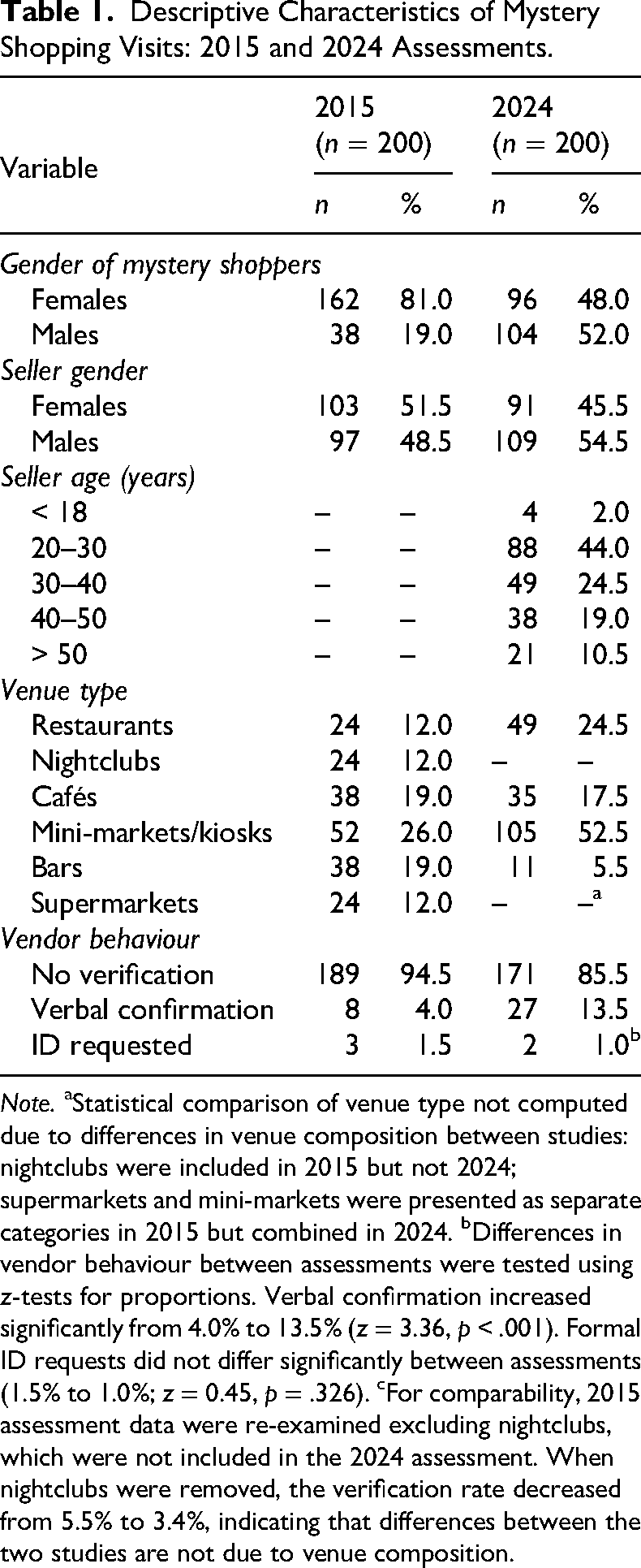
Note. aStatistical comparison of venue type not computed due to differences in venue composition between studies: nightclubs were included in 2015 but not 2024; supermarkets and mini-markets were presented as separate categories in 2015 but combined in 2024. bDifferences in vendor behaviour between assessments were tested using z-tests for proportions. Verbal confirmation increased significantly from 4.0% to 13.5% (z = 3.36, p < .001). Formal ID requests did not differ significantly between assessments (1.5% to 1.0%; z = 0.45, p = .326). cFor comparability, 2015 assessment data were re-examined excluding nightclubs, which were not included in the 2024 assessment. When nightclubs were removed, the verification rate decreased from 5.5% to 3.4%, indicating that differences between the two studies are not due to venue composition.
Vendor Compliance with Age Verification Requirements
Non-compliance was overwhelmingly high in both assessments. Across 200 visits in 2015, 94.5% of vendors proceeding with the sale without requesting any form of age verification (Table 1). Verbal confirmation of age was requested in only 4.0% of visits, in bars and nightclubs. Formal identification was requested in just 1.5% (one in a café, one in a restaurant, and one in a nightclub. Almost all verification attempts occurred in Limassol, while Nicosia vendors rarely challenged underage-appearing buyers. No consistent pattern emerged by seller or shopper gender. Among the 40 revisited venues, 10 verification attempts occurred in original visits and only one in a revisit. Only one venue requested age verification in both the original and repeat visit, while three venues that had reacted in the original visit did not do so in the repeat visit, indicating limited consistency in vendor behaviour across repeated visits to the same venues. In 2024, 85.5% of vendors proceeded without any age verification, 13.5% requested verbal confirmation of age, and only 1.0% requested formal identification. The statistically significant increase in verbal confirmation between 2015 and 2024 (4.0%–13.5%; z = 3.36, p < .001) was not accompanied by any meaningful change in formal ID requests (1.5%–1.0%; z = 0.45, p = .326).
It should also be noted that if verbal confirmation without ID check is considered non-compliant, because a real underage person would simply confirm they were of legal age, as was indeed the case in the two assessments where shoppers stated a fictitious age of 17 years, overall non-compliance rates rise to 98.5% in 2015 and 99.0% in 2024. Although we retain the three-category distinction in our primary analysis because it captures meaningful differences in vendor behaviour, this reframing further underscores the limited effectiveness of current age-verification practices in Cyprus.
Factors Associated with Vendor Compliance
In 2015, the logistic regression predicting one of the seller behaviours (verbal confirmation and ID request) from the shopper's gender, the seller's gender, and the type of venue (dummy variables with the mini market/kiosk as a reference category) was statistically significant χ2 = 24.69, df = 7, p < .001 and had a Nagelkerke R2 = 33.5%. Only the shopper's gender was significant, with males having about five times higher odds of being asked for age confirmation compared to females (OR = 5.50; 95% confidence interval (CI) [1.24, 24.50], b = 1.71, SE = 0.76, p = .025). Seller gender was not associated with compliance (OR = 2.14; 95% CI [0.39, 11.57], b = 0.76, SE = 0.86, p = .379). Dummy variables for the type of venue were also not significant in this model.
In 2024, the logistic regression model was statistically significant χ2 = 30.35, df = 6, p < .001, and explained a moderate proportion of variance in compliance behaviour (Nagelkerke R2 = 25%). Compliance was significantly influenced by shopper gender and venue type. Female mystery shoppers had almost ten times higher odds than male shoppers of being asked for age confirmation or ID (OR = 9.47; 95% CI [3.33, 35.07], p < .001). Seller gender was not associated with compliance (OR = 1.29; 95% CI [0.53, 3.22], p = .575) . Relative to kiosks, bars had higher odds of an age-verification request (OR = 7.16; 95% CI [1.55, 35.03], p = .012), whereas restaurants (OR = 1.37; 95% CI [0.47, 4.00], p = .557), cafés (OR = 0.71; 95% CI [0.18, 2.42], p = .599), and supermarkets/mini-markets (OR = 0.52; 95% CI [0.03, 3.39], p = .563) did not differ significantly. Beverage type (beer, cocktails, wine) was not a significant predictor of compliance (all p > .05).
Sellers’ Awareness of Legislation
This section applies to the 2024 assessment only because equivalent data were not collected in 2015. Most sellers (90.3%) correctly identified 18 years as the legal minimum age for alcohol sales. However, 78% reported never receiving official updates on legislation, and 69% stated they had never been formally informed during employment. Information was generally acquired through informal sources, most often pre-existing knowledge (63%) or managers (27%). Only 15% recalled receiving information upon starting their job, fewer than 10% had received general updates, and a small minority cited other informal sources.
Discussion
The present study provides a temporal comparison of vendor compliance with alcohol age-verification laws in Cyprus, based on two mystery shopping studies conducted in 2015 and 2024. Despite growing awareness of alcohol-related harms among youth, compliance levels remain critically low. In both studies, the majority of vendors sold alcohol without verifying age, and formal ID requests were very rare. Although there was a statistically significant modest rise in verbal age confirmation from 4.0% to 13.5%, this shift is insufficient to meaningfully reduce underage access. Persistently low compliance despite awareness of legislation suggests that deterrence mechanisms are weak or non-salient; vendors may perceive enforcement as unlikely and sanctions as minimal, reinforcing normative tolerance toward underage sales.
Logistic regression analyses revealed that, in 2024, compliance was influenced by the gender of the mystery shopper and venue type, whereas, in 2015, only gender emerged as significant, with males more likely than females being asked for age confirmation. However, these findings should be viewed with caution because the very small number of verification attempts and differences in shopper characteristics may have contributed to the inconsistent patterns across the two studies.
The persistently low compliance observed in Cyprus mirrors patterns reported in other Southern European countries, where permissive attitudes toward youth alcohol use often coincide with weak enforcement infrastructures (Duch et al., 2020; Rowland et al., 2017; van Hoof & van Velthoven, 2015). In such contexts, alcohol is frequently embedded in social and familial routines, which may contribute to vendor complacency and reduced perceived risk of enforcement. The persistently low compliance observed in Cyprus must also be understood against a backdrop of widely shared cultural norms in Southern Europe that frame alcohol use, particularly among youth, as socially embedded and often acceptable. Poor vendor compliance in Cyprus is therefore likely attributable to a combination of factors, including low perceived risk of enforcement, minimal financial or legal consequences for non-compliance, limited access to vendor training, and broader cultural norms that normalize youth alcohol consumption (Duch et al., 2020; Gosselt et al., 2012). Poor compliance with age verification is not unique to Cyprus – resistance to comply by vendors is a widespread issue across the European region (Mulder & de Greef, 2013).
Comparative research has shown that adolescents in Mediterranean and Southern European countries frequently engage in episodic drinking patterns in social settings, such as during weekend gatherings or “botellón”-type events, where peer norms and public practices normalize alcohol consumption (Bräker & Soellner, 2016). Furthermore, qualitative work in Italy, Finland, and Sweden suggests that generational attitudes toward drunkenness are strongly shaped by cultural tolerance: in Mediterranean settings, younger people often perceive moderate drinking as part of daily social life, while perceiving drunkenness itself as less acceptable but more common in certain contexts (Rolando et al., 2020). Such cultural permissiveness, coupled with retail practices that facilitate access without strict verification, may lead vendors to view age verification laws as negotiable or of lower priority in practice. Addressing vendor compliance, therefore, requires not only regulatory enforcement, but also public health strategies that engage social norms, family expectations, and community attitudes toward youth drinking.
In contrast, countries that have implemented systematic inspection regimes, such as the Netherlands, the USA, and Australia, report significantly higher levels of vendor compliance, often exceeding 60%–70% (Grube et al., 2018; Kremer et al., 2022; Roodbeen et al., 2016). Similarly, Sweden's sustained investment in the RBS programme has achieved refusal rates of around 80% for both underage and visibly intoxicated patrons, demonstrating the long-term impact of structured prevention work combining server training, compliance monitoring, and multi-stakeholder collaboration (Elgán et al., 2024; Feltmann et al., 2025). These successes are typically attributed to structured interventions that combine routine compliance checks, feedback mechanisms, vendor training, and clearly communicated legal consequences. For example, studies from Spain and the Netherlands demonstrate that such approaches can elevate compliance to over 80% (Duch et al., 2020; Roodbeen et al., 2018), suggesting that compliance is not only achievable, but also modifiable when enforcement is consistent and vendors are adequately supported.
The observed increase in verbal age confirmations in Cyprus may signal some incremental gains in vendor awareness. However, the continued near-absence of formal ID checks indicates a failure to adopt international best practices. This gap may reflect limited public health infrastructure, lack of vendor training, and the absence of enforcement protocols that create meaningful accountability for alcohol sales to minors. Without regular monitoring or meaningful penalties, vendors have little reason to change their behaviour. Furthermore, even when vendors request identification, this does not guarantee that the sale will be prevented. A Swedish mystery shopping study on cigarette sales found that in 9.7% of attempts where ID was requested but not provided, the purchase was still completed (Feltmann et al., 2021), suggesting that ID requests alone are an insufficient guarantee of compliance.
Strengths and Limitations
A key strength of this study is its methodological consistency across two timepoints, enabling a longitudinal comparison of vendor behaviour in the same national context. The inclusion of diverse retail settings (on and off-premise) and the use of random and purposive sampling further enhances the generalizability of the study. However, several limitations should be acknowledged. The use of different numbers of mystery shoppers and training protocols for mystery shoppers between the two studies, although practically necessary, may have introduced subtle variations in observational rigour or vendor perception. In addition, the 2024 assessment was conducted without an accompanying observer, which, although intended to increase ecological validity, might have influenced vendor behaviour or reduced the accuracy of observational recording. The 2024 assessment lacked repeat visits, which were included in 2015 to assess reliability. The data collection was limited to two urban districts and did not include late-night venues (e.g., nightclubs) in 2024, potentially affecting comparability with the earlier sample. Furthermore, for nightclub venues included in the 2015 assessment, it is reasonable to expect that bartenders may assume age verification has already been conducted at the entrance by security staff, and would therefore not be expected to check ID a second time at the bar. The inclusion of nightclubs in the 2015 sample may therefore have contributed to inflating the overall non-compliance rate for that assessment point, and this should be considered when interpreting between-wave comparisons. A further limitation concerns the possibility that some vendors at off-licence venues (supermarkets and mini-markets) may have intended to request age verification at the point of payment, which mystery shoppers did not reach as purchases were cancelled prior to completion. Non-compliance rates for off-licence venues only may therefore be marginally overestimated.
Policy and Research Implications
The findings point to a systemic failure of enforcement mechanisms in Cyprus. Despite clear legislation, the absence of regular compliance checks, weak penalties, and limited training opportunities for vendors appear to undermine adherence. Policy responses should prioritize the introduction of structured compliance monitoring, with mystery shopping coupled with feedback to vendors and managers, a strategy that has been shown to substantially increase ID checks in international contexts (Grube et al., 2018). Evidence from tobacco sales compliance checks similarly demonstrates that structured monitoring combined with feedback to retailers can substantially reduce sales to minors (Feltmann et al., 2022; Krevor et al., 2011), further strengthening the case for systematic enforcement across substance types. The long-standing RBS programme in Sweden provides a further example of how sustained multi-stakeholder collaboration combining server training, compliance monitoring, and enforcement can achieve lasting improvements in vendor behaviour (Elgán et al., 2024; Feltmann et al., 2025). Mandatory vendor training programmes and consistent communication of legislative updates are also urgently needed, given that most sellers reported never receiving formal guidance. From a public health perspective, stronger enforcement is not only a legal necessity, but also an essential strategy to prevent early initiation into drinking and reduce long-term alcohol-related harms.
From a public health perspective, the continued ease of underage access to alcohol represents not only a failure of law enforcement, but also a missed opportunity for early prevention. Adolescence is a critical period for shaping lifelong drinking patterns, and early exposure increases the risk of later dependence, injury, and mental health problems. Ensuring robust enforcement of age-verification laws is therefore not only a matter of legal compliance, but also an essential preventive strategy to delay alcohol initiation, protect neurodevelopment, and reduce the long-term burden of alcohol-related harm. Strengthening vendor accountability should thus be viewed as a cornerstone of adolescent health promotion and alcohol harm reduction policy in Cyprus and elsewhere.
The debriefing procedure employed in the 2024 assessment may itself be considered a brief educational intervention, and future research should evaluate the effectiveness of such approaches alongside more structured interventions such as compliance checks with feedback and vendor training programmes, aiming to determine which strategies are most effective in the Cypriot context. Future research should investigate the role of financial incentives, enforcement perceptions, and cultural attitudes in shaping vendor behaviour. Mixed-method approaches, including qualitative interviews with sellers and observational studies in rural areas, could provide deeper insights into the barriers to compliance. Comparative cross-country studies in Southern Europe may also help disentangle the influence of shared cultural norms versus regulatory environments.
Conclusions
This study highlights a persistent enforcement vacuum in Cyprus, where, despite almost a decade of policy continuity, vendor compliance remains minimal. The findings call for the institutionalization of structured compliance monitoring, vendor training, and cross-sectoral collaboration between regulatory authorities and public health bodies to close the implementation gap in alcohol control policy.
Supplemental Material
sj-docx-1-nad-10.1177_14550725261452980 - Supplemental material for Adherence to Underage Alcohol Sales Regulations in the Republic of Cyprus: Evidence from Repeated Cross-Sectional Mystery Shopping Study
Supplemental material, sj-docx-1-nad-10.1177_14550725261452980 for Adherence to Underage Alcohol Sales Regulations in the Republic of Cyprus: Evidence from Repeated Cross-Sectional Mystery Shopping Study by Athina Manoli, Angelos P. Kassianos, Leda Christodoulou, Andrea Nicolaou, Charis Psaltis and Michalis Michaelides in Nordic Studies on Alcohol and Drugs
Footnotes
Acknowledgments
We thank the National Addictions Authority Cyprus for commissioning and supporting the 2015 and 2024 mystery shopping assessments, as well as the municipal authorities for providing lists of licensed vendors authorized to sell alcohol. The authors also gratefully acknowledge the contribution of the student mystery shoppers.

Ethical Considerations
Ethical approval for assessment 2015 was granted by the Cyprus National Bioethics Committee. For assessment 2024 was conducted as part of the official actions of the Policy Department, National Addictions Authority Cyprus, which did not require separate bioethics approval. Both studies complied with national legislation and institutional ethical standards.
Consent to Participate
No personal data were collected from vendors. Observations were limited to public interactions during simulated purchase attempts. Therefore, formal consent to participate was not required.
Consent for Publication
Not applicable, as the study did not include identifiable personal data, images, or individual-level information.
Funding
The authors disclosed receipt of the following financial support for the research, authorship, and/or publication of this article: Both studies were funded by the National Addictions Authority Cyprus as part of its national alcohol policy monitoring activities. The funding body had no role in study design, data analysis, or interpretation of results.
Declaration of Conflicting Interests
The authors declared no potential conflicts of interest with respect to the research, authorship, and/or publication of this article.
Data Availability
Anonymized data supporting the findings of this study are available from the corresponding author upon reasonable request.
Supplemental Material
Supplemental material for this article is available online.
References
Supplementary Material
Please find the following supplemental material available below.
For Open Access articles published under a Creative Commons License, all supplemental material carries the same license as the article it is associated with.
For non-Open Access articles published, all supplemental material carries a non-exclusive license, and permission requests for re-use of supplemental material or any part of supplemental material shall be sent directly to the copyright owner as specified in the copyright notice associated with the article.
