




Abstract
Introduction
Stepping out of its traditional use in the Mediterranean, Middle East, India and North African countries, waterpipe smoking has developed into a modern trend among adolescents and young adults all over the world, regardless of their ethnic background. This has prompted alarms about waterpipe smoking as a new global tobacco epidemic in Western countries, triggering a consequent public health concern (Al Ali et al., 2020; Kader et al., 2021; Liu et al., 2021; Maziak, 2011; Sidani et al., 2014). The rising extent of waterpipe smoking has spawned an increasing amount of (bio-)medical studies, which state somatic risks similar to or more severe than cigarette smoking (Al Ali et al., 2020; Kim et al., 2016; Qasim et al., 2019).
The experience of waterpipe smoking has hitherto been examined by several explorative and descriptive qualitative studies, aiming at the level of manifest content. These studies focus on (presumably) ethnically diverse waterpipe smokers, examining their beliefs and views (Griffiths et al., 2011; Kotecha et al., 2016; Rezk-Hanna et al., 2014; Sakuma et al., 2020), attitudes (Arshad et al., 2019; Dadipoor et al., 2019; Kotecha et al., 2016; Rezk-Hanna et al., 2014; Statens folkhälsoinstitut [SFHI], 2010), reasons for smoking (Arshad et al., 2019; Dadipoor et al., 2019; Kader et al., 2021; Nakkash et al., 2011; Sadeghi et al., 2022) as well as the allures and appeal of waterpipe smoking (Liu et al., 2021; Roskin & Aveyard, 2009).
The studies depict waterpipe smoking as a socially promoted, or even coerced, affordable peer-activity (e.g., Arshad et al., 2019; Griffiths et al., 2011; Kader et al., 2021; Kotecha et al., 2016; Liu et al., 2021; Sakuma et al., 2020; SFHI, 2010) or a playful, sometimes exoticised feel-good pastime with pleasurable sensual qualities, often connected to a certain place and time (e.g., Dadipoor et al., 2019; Kotecha et al., 2016; Liu et al., 2021; Nakkash et al., 2011; Sadeghi et al., 2022; SFHI, 2010). Moreover, the practice is presented as usually being perceived as less dangerous by young adults, especially when compared to cigarette smoking (e.g., Arshad et al., 2019; Dadipoor et al., 2019; Griffiths et al., 2011; Liu et al., 2021; Rezk-Hanna et al., 2014; Roskin & Aveyard, 2009; Sadeghi et al., 2022).
Some studies have discussed waterpipe smoking in a more theoretically guided way but appear limited by the theoretical frame they apply. Castañeda and colleagues (2016), for example, applied the integrative model of behavioural prediction, i.e., a factor-like understanding of the phenomenon in terms of positively or negatively rated beliefs. This also applies to Rezk-Hanna and colleagues (2014), whose study was guided by the health belief model. Carroll et al. (2014) conducted a deductive observation study focused on rituals and framed by the Interaction Ritual Model, which originally was developed based on cigarette smoking. Following this model, they examined waterpipe smoking as a tobacco-related social ritual that could be characterised by one or more of the following features: assembling groups; creating barriers to outsiders; and providing a mutual focus of attention as well as a shared mood. “When these ingredients combine, the outcomes of the ritual process include (a) group solidarity, (b) emotional energy, (c) symbols of social relationship (e.g., ‘sacred objects’), and (d) standards of morality” (Carroll et al., 2014, p. 1552). The study showed that some or all of these ritualistic elements may be observed, with the waterpipe often being awarded the status of a sacred object.
Research on topics similar to waterpipe smoking, such as substance use and smoking in general, may provide additional insights. Cigarette smoking has regularly been depicted as a social practice imbued with social capital and community-enhancing meaning (cf. e.g., Antin et al., 2018; Sankır et al., 2022; Scheffels et al., 2023). It may function as a way to gain symbolic benefits, such as status and recognition, even preventing individuals from “contradicting the group and becoming ‘the other’” (Sankır et al., 2022, p. 237). In addition, smoking cigarettes signifies a variety of different ways of exercising agency and taking control (e.g., over mental health) for young people. Smoking might represent a form of resistance by which a power structure is fought, for example by controlling space while smoking. This reminds one of youth groups that “develop subcultures based on values opposed to or resisting the values of the dominant society” (Antin et al., 2018, p. 4). Other meanings are survival (e.g., socially, using smoking as a strategic tool for connection) or defence in terms of promoting other kinds of health than physical, or self-protection by establishing a safe space that symbolises strength (Antin et al., 2018).
The notion of cigarette smoking as place-related has also been reported (Glenn et al., 2017; Glenstrup et al., 2019; Sánchez-Hernández & Pillon, 2011), with the place offering not only spaces for practising but also norms concerning smoking. Brotherhood (2022, p. 1) describes how substance use may then be related to an environment. An “interpreted space” is created in which personal understandings and the perception of a specific space combine into latent qualities and meanings of the space in which substance use is situated and performed, moderated by momentary thoughts and feelings.
Antin and colleagues (2018) conclude that smoking tobacco represents a potential way of living in the here and now, shape one's world, and form one's sense of self and identity. This impact on identity formation, regarding both social and personal identities, has been reported for a range of different kinds of substance use, such as vaping (Scheffels et al., 2023), street drugs (Alvarado-Chacón et al., 2011), cigarette smoking (Aldiabat & Clinton, 2013) and drinking alcohol (Tan, 2012). These identity-constructing influences may occur in relation to not only the practice itself but also knowledge, choice of product and the transgression of (adult) rules (Scheffels et al., 2023). This is displayed nicely by the theme “the search not to be good” in the study by Alvarado-Chacón and colleagues (2011, p. 747). Formative effects of substance use may concern a variety of desirable identities and developments of the self, such as displaying personality traits (e.g., a high-status masculinity) (Aldiabat & Clinton, 2013) or fitting the role of a college student (Tan, 2012), indicating that substance use may be socially functional and beneficial for the self. The influence of substance use on identity formation is often linked to developmental transitions in life (Aldiabat & Clinton, 2013; Scheffels et al., 2023; Tan, 2012). A study on recovering from drug use (Iswardani et al., 2022), moreover, directs attention to the drug-related formation of meaning in life as potentially contributing to the formation of the self.
Research on similar topics is, however, slightly off-target, and neither descriptive nor theory-driven waterpipe studies succeed in characterising the whole of the meaning-imbued waterpipe experience for young adults. In agreement with Nakkash et al. (2011, p. 6), we thus see “a dearth of qualitative research exploring the meaning attributed to WTS [waterpipe smoking]”. This applies especially to Sweden, where only one qualitative study on waterpipe smoking has been published so far (SFHI, 2010). Our study intends to address this dearth of research as a socio-scientifically inspired hermeneutic contribution to health sciences.
Aim
The aim of the present study was to achieve an in-depth understanding of the meaning-imbued reality of waterpipe smoking for young adults, addressing the research question:
What characterises the waterpipe experience for young adults?
An intended implication of the study is to identity potential approaches for prevention.
The constructivist-hermeneutical framework
The analysis is guided by a constructivist-hermeneutical framework. The investigated phenomenon – waterpipe smoking – is thereby understood as a constructed reality that is imbued with and shaped by meaning in the form of an implicit logic that guides reality. This reality is considered to be fabricated in social interactions in an iterative way and represents “accepted ways of understanding [this particular part of] the world” (Burr, 2003, p. 5) as a constructed truth. From a hermeneutical stance, this socially constructed reality may be regarded an accepted social life praxis. This praxis is determined by latent meaning, which works as the implicit logic that imbues and thereby shapes the investigated reality (Oevermann, 2002). This implicit logic can be investigated in analysis by reconstructing how meaning emerges in the interplay of aspects characterising a phenomenon, rather than by dividing the phenomenon into its defining components or impacting factors (Oevermann, 2002).
Methods
An inductive explorative qualitative design (Bryman, 2016, chapter 24) was applied by starting with the empirical interview data (rather than theory) and interrogating the data broadly and without presuppositions regarding our research question. Thereby, the focus lies on subjective understandings of waterpipe smoking, without predetermined theoretical perspectives or pre-conceived notions of waterpipe smoking. Following our constructivist-hermeneutical theoretical framework, the analysis (as detailed below) addresses the latent content level (Graneheim & Lundman, 2004) and is directed at a higher level of hermeneutically guided abstraction (cf. Graneheim et al., 2017). The analysis is thereby presumed to be likely to capture the phenomenon in its entirety. Moreover, a similar framework has been implemented in earlier studies (e.g., Pelters 2014), increasing the likelihood for its reliable application and, hence, the quality of the study.
Data collection
The participants were 18 young adults aged 16–27 years, fluent in Swedish, with diverse self-defined experiences of waterpipe smoking. They represent diverse ethnic backgrounds so as to include cultures with both traditional and modern waterpipe use. With two exceptions, they resided in the larger Stockholm area in Sweden. An overview of the participants is provided in Table 1. Their names are anonymised yet represent their original cultural origin. Age, ethnic background, smoking frequency (from sporadic to frequent use) and variations regarding the stage that persons had reached in their smoking biography (i.e., active or former user) were used as inclusion criteria in order to get as varied a data material as possible and cover the phenomenon of waterpipe smoking comprehensively.
Characteristics of interviewed participants.
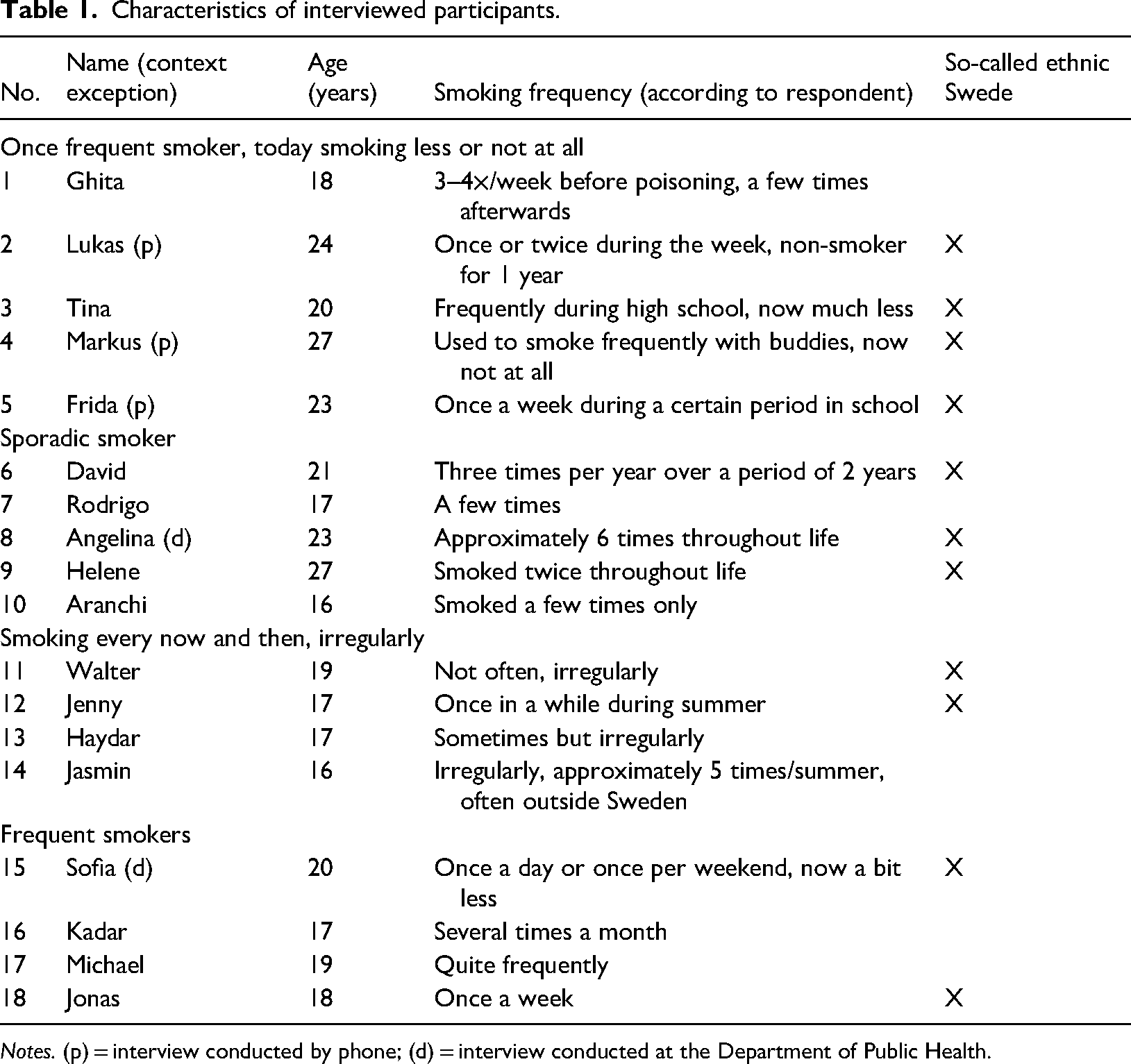
Notes. (p) = interview conducted by phone; (d) = interview conducted at the Department of Public Health.
Contacts were established using snowball sampling with different trajectories for sampling data provided by different informants, for example from within the University's Department of Public Health where the study was based, or from community youth centres in different parts of the larger urban area of Stockholm. This allowed the coverage of different social and ethnic environments.
In total, 18 individual semi-structured interviews were conducted (see Bryman, 2016, chapter 20 for interview procedure) in Swedish by a researcher and a research assistant with non-Swedish ethnic backgrounds, balancing a potentially felt cultural hierarchy. The interviews were typically conducted at community youth centres. Three interviews were done by phone (marked ‘p’ in Table 1) and two at the Department of Public Health (marked ‘d’ in Table 1). Participants could choose the interview setting that offered the most comfortable information exchange. The interviews were tape-recorded and transcribed verbatim. They followed an interview guide with a range of themes (experiences, attraction, meaning, feelings, knowledge, effects, practice of waterpipe smoking and usage of other drugs), starting from the introductory question “How did you get to smoke a waterpipe?” Data collection took place between August and December 2013.
The time passed since the study was conducted may be regarded as a limitation, sparking doubts about whether the described bubble still exists. However, the iterative public recognition of hookah-experienced listeners confirming the researchers’ analytic results, with the last of these confirming presentations having taken place as recently as November 2022, argues for the lasting timeliness of our study results and indicates their trustworthiness through a validity check similar to respondent validation (Bryman, 2016). Moreover, more recent studies (e.g., Liu et al., 2021 or Sadeghi et al., 2022) describe similar features and aspects of waterpipe smoking without indicating a noteworthy change in the meaning-imbued reality of waterpipe smoking. Finally, considering that it took 50 years to change the understanding of cigarette smoking from a popular pastime to a death threat (Mendes, 2014), we argue that the bubble still is, and most probably will be, around for a while longer.
Analysis
An inductive qualitative content analysis (cf. Graneheim & Lundman, 2004) was performed from a hermeneutical stance as a combined effort of the researcher and the research assistant. Coding strategies were directed at manifest and tacit assumptions, implicit actions and latent meanings to capture both “what the text [manifestly] says” and “what the text [latently] talks about” (Graneheim & Lundman, 2004, p. 106). The practical analytic process comprised three sometimes overlapping stages:
Coding: The analysis was guided by the question of what was going on in the data, i.e., what is both explicitly and implicitly constructed in the textual material, hence targeting a “higher logical level” of interpretation (Graneheim & Lundman, 2004, p. 106). The identified meaning units could differ significantly in size, ranging from words to parts of sentences, complete sentences or even several ones, which can be seen in the result section's quoting style. Categorisation: Codes were grouped into categories, which then were probed regarding their meaning by asking ‘what does X mean’ with ‘X’ being a category (e.g., the presentation of time or place in the verbal accounts). This meaning was derived by going back to the codes and to the data that signified place or time with the intention of finding characteristic traits on an implicit level. Theme-building: Overarching themes were identified while continuing the process of capturing the latent meaning of waterpipe smoking by identifying the characteristics of the themes that emerged from the contributing meaning-enriched codes and categories.
After this inductive analysis, it proved valuable to engage with certain selective theoretical resources, directly linked to emerging categories of the hookah experience and its defining features (time, space, social exchange). These could clarify some of the described characteristics of waterpipe smoking and enhance a more detailed, accurate understanding.
Ethical considerations
Ethical approval was obtained from the regional Ethics Committee in Stockholm (no. 2013/1670-31/5), which stated that the study was considered to be in no need of approval. All participants were informed before the interviews about the study and the storage and handling of the data as well as the voluntariness of their participation. They gave their informed consent verbally and received an information leaflet about the study with contact details, in case they wanted further information. Data are stored on university department servers with restricted access for the involved researchers only.
Results
The analysed textual data material provides a comprehensive understanding of waterpipe smoking. The way in which the phenomenon of waterpipe smoking was experienced by the participants can be described in a way that resembles a bubble, represented by the inside of the waterpipe bubble as opposed to the barriers and the outside of the waterpipe bubble as two themes. The inside of this bubble was characterised by the categories of time, community, space and fun. The bubble's boundary and outside was shaped by the three categories of practice-oriented, communication-oriented and Othering-oriented means of control. Figure 1 shows a comprehensive picture of the waterpipe bubble.
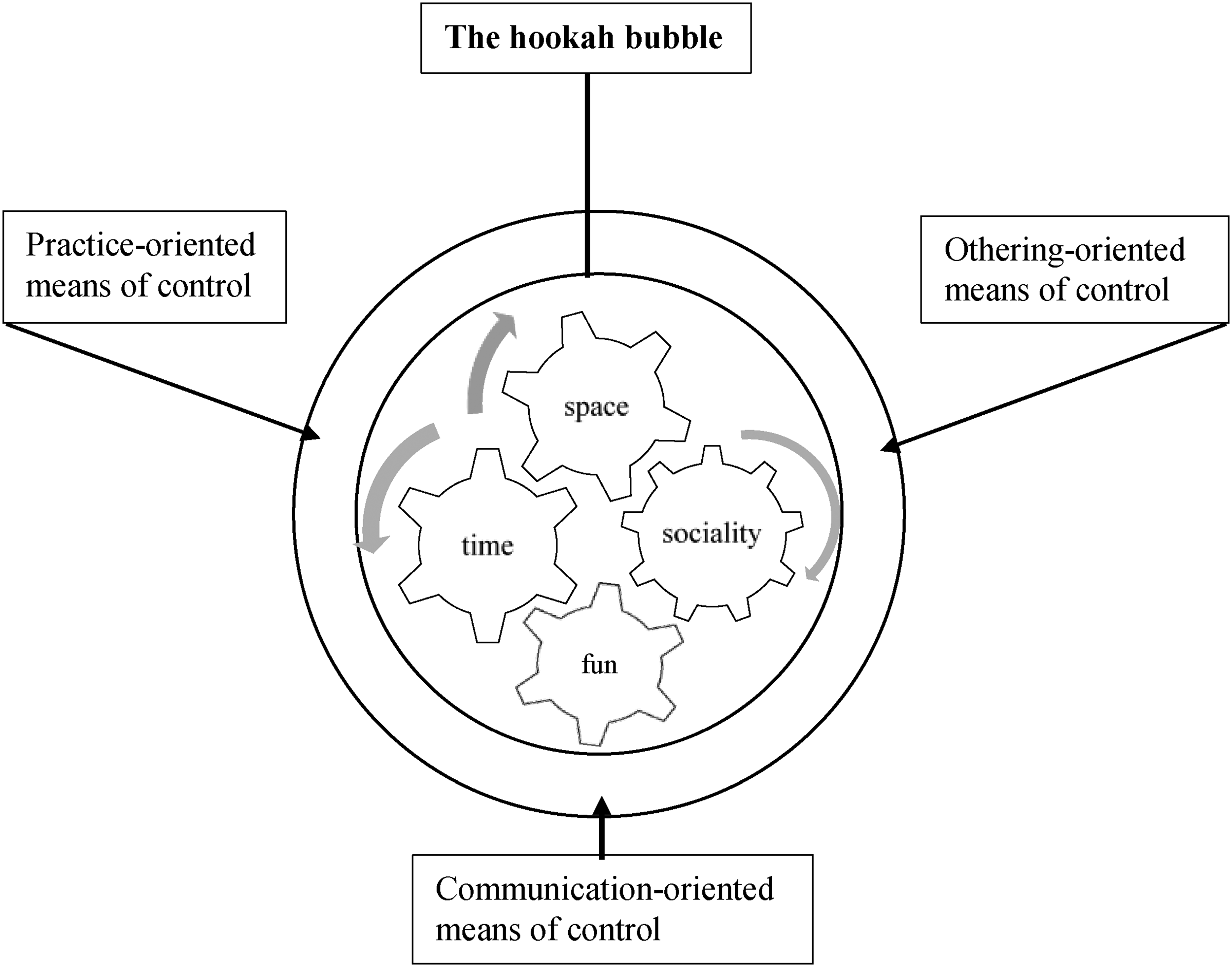
The hookah bubble and its barrier.
Constructing the inside of the waterpipe bubble
Time: A contemplative timeout
Waterpipe smoking takes place in an unstructured, often undemanding, relaxed and relaxing time slot (evenings, holidays, summertime), which facilitates the entry into a calm here and now, a present in which one is free from the outside world and its demands: “I think it's cosy, that is a word I use (…) it's a good description for when it's getting calm, you wind down, you don’t consider so many things, you are here and now.” (Jonas, frequent smoker)
Waterpipe smoking is also described as “festive” (Helene) and exercised in repetitive rounds (cf. Michael: “it usually moves around clockwise”) or in a “circle” (Haydar; Lukas) by passing the hose among the waterpipe smokers. This imbues this social practice with a circular, continuous ritualistic character, as it shows a regulated practice, working as standard of morality. Hereby, the waterpipe as “sacred object” and mutual focus of attention is acknowledged (cf. Carroll et al., 2014, p. 1552).
Byung-Chul Han (2008), a philosopher who builds on Hanna Arendt's and Aristoteles’ thoughts, clarifies the characteristics of waterpipe-related time. He explicates that a festive, ritual, continuous time is different from our everyday work-oriented, disciplined, linear time, which is characterised by stress, performance and change. Waterpipe-related time can thus be seen to entail the opportunity to open up a time slot to transcend everyday life, a time dedicated to contemplation and meaning-making that represents a contemplative life. As such, the time of the waterpipe may be described as a timeout from the young adults’ usual way of living and presenting themselves (cf. the timeout described with regard to alcohol) (MacAndrew & Edgerton, 1969). The study participants showed signs of choosing this contemplative life by using this precious and intimate time in the bubble to ponder, test and develop their adult selves as active adult agents in a world of their creation (cf. Antin et al., 2018): “It's another type of communication when you use the waterpipe than if you just have regular cigarettes, it's more about intimate stuff, not sexually intimate but a more mental type, you get more deep, you talk about life and you feel philosophical and really cosy (laughs) play [being] a bit grown-up (…) [you talk] deeper than just asking how you feel, talk a bit more about how you actually do feel.” (Sofia, frequent smoker)
The waterpipe time may thus be potentially regarded as a time slot for contemplation and development of the smoker's sense of self.
Community: The waterpipe collective
Waterpipe smoking is a social activity that induces the feeling of solidarity and strengthens social relations (as confirmed by Carroll et al., 2014), and is thus also used as a community-building social instrument: Interviewer: “Could you smoke a waterpipe with whomever?”
Jonas (frequent smoker): “No, or it depends, not with someone I don’t know, not with someone I have just met.”
As Jonas points out, the waterpipe is not consumed with whomever, let alone strangers – a waterpipe is something you are invited to join, in its function of providing social safety and manifesting trust, which is also why it is quite often consumed in same-gender groups. The same-gender groups may be regarded as providing conditions for opening up to one another and disclosing personal information, thus promoting the opportunity for developing an identity and sense of self.
The understanding of the social function of smoking can be deepened by regarding it as a gift in Marcel Mauss’ (1922/1990) sense of the word. By this we refer to the sociality of the waterpipe having a give-and-take character: The shared smoking experience builds community by involving everybody in the circular passing around of the hose. This circularity implies the social expectation to accept and return the gift along with the hose. Returning the gift is executed through the simple gesture of passing on the waterpipe hose, and this passing of the hose refers symbolically to the gift of kindness or friendship that is passed along with it. A symbolic part of oneself is hence expected to be passed on as well. This is often achieved by participation in the ongoing deep communication. Kadar presents the effects of the circulating hose as follows: “‘Here you are’ [referring to offering the hose], you show kindness by sharing. (…) It's easy to talk to someone who is sharing something, it's this sense of appreciation that emerges.” (Kadar, frequent smoker)
Passing around the hose to each and everyone in the group confirms that everybody is seen and appreciated by the community, and everybody is an equal to the others, allowing for the individual to communicate openly. This exchange of information may be regarded as fundamental to the formation of the community and of the self as part of this community. It underlines the contemplative temporal character of the waterpipe event and reveals that the festive time also is a collective time given as a gift to someone else in a mutual exchange. This exchange builds a community and simultaneously discards the individually framed linear working-time (Han, 2008).
It can be concluded that the temporal and social qualities of the waterpipe synergistically enhance each other. These qualities depict waterpipe smoking as a timeout and safe space for experiences of communion and identity development.
Space: The double notion of space as shaping and being shaped by the waterpipe
The places that are usually used for waterpipe smoking shape the waterpipe experience. When describing the settings where they smoke, the participants most often name locations that are known to represent privacy at somebody's home, like “the balcony” (Tina) or living rooms. Private homes are the scenery for “private parties” (David) where waterpipe smoking occurs. Other locations are the cosy, regulated atmosphere of a specialised “Shisha bar” (Angelina) or scenic spots out in the open, yet peri-urban civilised nature like “in the park” (Sofia) or “at the beach” (Sofia) close to residential areas. The meaning of these waterpipe places can be illuminated with the help of an ethnographic study by Frykman and Löfgren (1979) on the development of cultural areas in Sweden. Based on this study, the places associated with waterpipe smoking could be described as often being connected with relaxation, control and safety as well as privacy and self-determination, despite their moderately entertaining or adventurous qualities. This enhances the presentation of the waterpipe as a symbol for and mediator of ease and tranquillity. By adding the waterpipe with its particular meaning to these spaces, the two meaning structures complement each other in what then can be called an “interpreted space” (Brotherhood, 2022) for the group assembly (cf. Carroll et al., 2014) as an element of waterpipe smoking as a social ritual.
In a more direct sense, the waterpipe itself, as an object, shapes space as it is a piece of equipment that is located at the centre of a circle defined by the length of its hose. As such, was in the material, it was compared to a “campfire” around which the smoking group sits in a “circle of Indians” (metaphoric wording used by Lukas). This is a situation in which everybody who smokes is included equally, whereas those who do not are excluded. This image creates an in- and an out-group and emphasises the characteristics of social safety and community.
Fun: A combination of pleasure and competence
Smoking the waterpipe allows for an enjoyment on all sensual levels. The taste is described by the study participants as “good” (Helen) or “fruity” (Aranchi) and the smell as “apple or mint or whatever” (Michael). Both taste and smell are depicted as pleasurable and establish the impression of “smoking sweets” (Lukas). Together with the sound of the bubbles, which trigger a “cosy feeling” (Sofia), and its ornamental design reminiscent of “a work of art so it does not feel quite as dangerous [as cigarettes]” (Tina), the understanding of the waterpipe experience as safe, innocent and relaxing is underlined. As the waterpipe smoking is combined with fellowship as well as eating and drinking (mostly soft drinks and finger food/junk food), the smoking session may be regarded as providing for personal needs in terms of instant gratification.
These sensory effects are accompanied by the waterpipe's experimental, playful qualities, expressed for example by “doing smoke rings” (Sofia) or learning new tricks, turning waterpipe smoking into a moderately entertaining, carefree hobby-like activity. This characteristic is complemented by its presentation as a handcraft as it needs some equipment and a bit of practice and is transferred from master to apprentice, as Sofia describes: “I learned from a mate, because he could not do it all the time, so I had to learn so I can start doing it myself”. The mastering of waterpipe smoking, especially as a group project, may also provide a feeling of competence.
Constructing the barriers and the outside of the waterpipe bubble
The bubble is secured by extensive means of control that separate the safe inside from a risky outside by erecting distinct barriers to the outside (cf. Carroll et al., 2014). This is not so much to avoid the partaking of unauthorised persons in the social ritual, but rather to avoid a change of meaning of waterpipe smoking and to underline the significance of the waterpipe that is promoted by the youngsters. This is related to the two major risks perceived by the young study participants: the apparent risk of physical harm related to smoking, as inhaling substances that may pose a threat to the body, and the risk of becoming (socially) dependent, which poses a threat to one's self-realisation and development as an autonomous, responsible human being. Both risks obfuscate the cosy, safe and self-realising significance of waterpipe smoking. This significance appears to build on a double notion of the waterpipe itself: on the one hand, in terms of (health-related) danger, distinguishing between the hazardous and hazard-free waterpipe; and on the other hand, in terms of dependence, opposing the oppressive to the liberating waterpipe. Here, the risk of dependence can be suspected to be the more significant one for the young adults as it is related to the adolescent task of becoming an active agent, controlling not only waterpipe smoking but also their life, among other things, by smoking a waterpipe (cf. Antin et al., 2018).
Practice-oriented means of control
Practice-oriented means of control comprise two major strategies: mastering the device and mastering smoking, which may be understood as establishing standards of morality (cf. Carroll et al., 2014). Mastering the device implies, for example, knowledge about the assembly of the device and about the ingredients that ought to be used. Control may even extend to an instrumentalisation of the waterpipe as a “social instrument” (Rodrigo) to be used at one's own discretion instead of the waterpipe being an object one is being used by (in terms of being dependent on it). A passive version of a mastering type of control includes trusting someone with an assumed expert status to whom the task of control is transferred. This mastering strategy exhibits features of a safety measure to prevent a bad and/or dangerous experience by holding on to its designated use, or as Michael puts it: “You keep to what the waterpipe is intended for”. A special version of this strategy may be labelled the drug-free waterpipe. Despite admitting to having tested different, even illegal substances when smoking, the majority of our participants conclude that it is “stupid” (Michael) or “a waste” (Sofia) to use the waterpipe in a way that could be termed impure (our interpretation). With the support of Mary Douglas’ seminal work Purity and Danger (1966), this drug-free waterpipe use can be considered in the wider context of the social order as Douglas connects notions of purity and dirt to confirmations and contradictions of the social order. In view of the Swedish state's zero tolerance toward alcohol, drugs, doping and tobacco (Government of Sweden, 2010, p. 47), most waterpipe smokers (some others reported consuming alcohol) may thus be regarded as not intending to question or disturb that social order. On the contrary, their way of waterpipe use rather confirms that order and makes them appear in a good light as responsible citizens. Even if epidemiologic studies (e.g., Galanti & Al-Adhami, 2015; Jawad et al., 2014) question this notion, these young adults seem to be convinced of their responsibility as consumers, and as citizens.
Mastering smoking may be described as smoking correctly in a controlled way. For example, this strategy includes not inhaling smoke into one's lungs, using nicotine-free alternatives to tobacco and not smoking too often. This way of acting leads to a pragmatic self-limitation of one's smoking practice and reveals a perceived limitation of the physical risks of waterpipe smoking: “I do not feel that affected because I do not smoke regular cigarettes. I have no habit of smoking. (…) I am 24, since I was 16, I have smoked six times a year, (…) I do not feel that this is often enough to hurt my health.” (Angelina, sporadic smoker)
The aspect of mastery in contrast to being mastered (by the waterpipe or outsiders’ definitions of one's habits) is therefore of crucial importance, because what is at stake is not only the act of smoking the waterpipe in an inoffensive and controlled way, but also the image of oneself as a responsible, aware citizen.
Communication-oriented means of control.
Communication-oriented means of control also comprise two different main strategies: attacking and playing down risks. Attacking denotes a defence of one's waterpipe use, for example by interrogating others’ motives and standpoints when one is in doubt. “Waterpipes are not that uncommon, they’re like everywhere. Are you against waterpipes?” (Jasmin)
Playing down risks occurs in a variety of forms in the material. It refers to both risk information and the waterpipe device and practice, and is expressed, for instance, by declaring the source untrustworthy (risks depicted as too high) or by declaring that the practice is unimportant (device/practice lacks importance). Consequently, waterpipe smoking is constructed as in no way being able to pose a threat: “I do not think the waterpipe is such a big deal, (…) I still think it's a small thing that you can do sometimes (…) it does not feel like it's a thing that makes you addicted, maybe a cool thing which you do sometimes with friends.” (Tina, former frequent smoker)
Another way of playing down the risks includes contextualising, that is, putting the risk of waterpipe smoking in the broader context of other general risk information, which levels the relative perception of risk: “I think there are lots of things that are dangerous (…) I can’t take it, if I quit everything that's dangerous it's not as fun” (Sofia).
Showing general awareness, as represented by describing the risk of waterpipe smoking as something that is “neither really healthy nor something good” (Jasmin), may also be regarded as a way of playing down the risks. This strategy may contribute to attenuating or even rejecting the common notion of the user as uninformed, which can be found in many preventive suggestions directed at transferring correct information (cf. e.g., Arshad et al., 2019; Castañeda et al., 2016; Kim et al., 2016; Liu et al., 2021).
The last playing-down strategy may be called reinterpreting and boils down to replacing, here, the concept of addiction with that of habit: “I do not believe in addiction, I’m a little stubborn, I believe in habits (…) I think you will miss it if you don’t do it [waterpipe smoking], but I think it's the routine you miss and not the actual waterpipe” (Jonas). Replacing the concept of addiction with habit makes the practice appear easily changeable and preserves the waterpipe's harmless image.
Othering-oriented means of control
Othering (cf. Wilkinson & Kitzinger, 1996) is used to construct stereotypic images of practices and personalities that are depicted as being disapproved, inferior and even morally despicable or bad. Study participants use these images as a contrast to their practices and their own self-image, confirming their status of self-reliant, responsible and social users of a harmless product, i.e., of being good in contrast to others. This construction contributes to the preservation of the waterpipe bubble's significance by populating and in other ways construing a world outside that sphere.
The dangerous cigarette is referred to in the significance of a bad “Other product” opposed to the good waterpipe. The bad significance of the cigarette is constructed by describing all its characteristics (taste, smell, etc.) as displeasing and all bad in contrast to the waterpipe, which in turn is upgraded to being all good. “Eh, I thought it [waterpipe] tasted good and I do not like cigarettes, I’m like not a smoker at all, eh, I do not like dragging things into the lungs, but when it's a waterpipe, it's another thing in some way (…) it feels like it's less.” (Angelina, sporadic smoker)
In rejecting this bad product, the waterpipe's hazard-free significance is confirmed.
The addicted waterpipe user is a lonely, endangered character failing to control their waterpipe usage. The “obsessed” waterpipe user, as Kadar calls them, is a person who “sits at home and smokes a waterpipe all the time” (Jasmin). This person is the bad “Other user” as opposed to the controlled, social and responsible good waterpipe user that study participants present themselves as. By excluding that character, all people with whom our participants smoke a waterpipe are automatically included in the group of independent, non-addicted users of the liberating waterpipe. The harmlessness and freedom-preserving function becomes especially apparent in Ghita's accounts. They reveal a transition from an including “everyone smoked [waterpipe] (…) then we tested and then we became used to it” to an excluding “I was so disgusted, I can’t even look at it” after having experienced carbon monoxide poisoning. Her loss of contact with the waterpipe group that followed the poisoning event shows the exclusion that may happen to those who cross the line and become ill and thus become “the Other” (cf. Sankır et al., 2022), but also to those who successfully quit smoking (McVea et al., 2009, with regard to cigarettes), who by quitting confirm the dangers of smoking and subsequently no longer belong to the waterpipe community. Both crossings may endanger the harmless, controlled cultural significance of waterpipe smoking and the significance of the waterpipe as hazard-free and not least liberating, as illness represents a restriction of freedom by this endangerment.
These stereotypes describe who or what young adults do not want to be or do by distancing themselves from negative stereotypes. As a contrast, the next Othering project emanates from constructing a positive social identity. This is achieved by adopting different forms of youth cultural avant-gardes (e.g., connected to rock, reggae or suburban spaces): “We considered ourselves a bit like, like some kind of, eh, not outsiders’ culture, but you know, the rock world and everything that belongs to it” (Markus). The counterimage of the “regular, adult ‘svenne banan’” (Sofia) (equivalent to a Swedish regular Joe) is then created as the somewhat boring “usual Other” as opposed to the unusual/superior members of one's own subcultural group. This notion of the self as “not a typical Swede” (applied by participants with Swedish ancestors) may open up a space (beyond exoticisation) in the waterpipe bubble that is not controlled by norms, which implies a relative freedom of action from the expectations of the majority as a power structure that needs to be fought or at least withstood. Here, a notion of the (self-)defensive resistance of smoking can be detected (cf. Antin et al., 2018). The waterpipe is clearly not only experienced as a pastime device but also a symbol of being special and free, promoting identity development beyond the usual cultural patterns of thinking and behaving. “I know that there are some who do not want this Svensson [the Swedish regular Joe], characterised by having a Volvo, a villa and a dog, and because their parents are like that, they are real Svensson, that's like the norm, and so they don’t want this mark of being typically Swedish but they may actually do other things too [laughs]. It's a bit like that.” (Sofia, frequent smoker)
It is noteworthy that this Othering project is specific to our Swedish participants, whereas participants with Mediterranean backgrounds did not express a similarly strict boundary between adults and peers when it comes to smoking the waterpipe together. But even these participants report different experiential qualities when comparing the two contexts.
While the described Othering project represents a Swedish cultural peculiarity, the waterpipe may also gain two additional functions in this non-Swedish setting: on the one hand it may be a cultural reminder of home, that is, “a decoration (…) it represents the Arabic culture” (Michael) without being smoked. On the other hand, it may be regarded a cultural asset and a positive contribution to Swedish culture due to a cultural competence originating from a traditional, more extensive knowledge, as Michael highlights: “The waterpipe has never been a part of Sweden, it came when we immigrants came here (…) The [Swedes] have not seen the correct function, so it is clear they do not maintain it [correctly] either. We who are from abroad, we know how to maintain it. I do not think Swedes have as much knowledge about it, our ancestors have taught us, our parents have taught us.” (Michael, frequent smoker)
In describing the waterpipe and its maintenance this way, Michael hence reverses the societal hierarchy between a Swedish majority and a non-Swedish minority that is usually invoked. His remarks represent a characterisation of the Swede as the “unknowing Other”, i.e., another Othering project aimed at constructing a positive social identity.
Discussion
Our analysis highlighted similar aspects of waterpipe smoking as previous waterpipe-focused research, such as the social character of waterpipe smoking (as in e.g., Arshad et al., 2019; Kader et al., 2021; Sakuma et al., 2020), its playfulness and pleasurable sensual qualities (cf. for example Dadipoor et al., 2019; Kotecha et al., 2016; Liu et al., 2021) and the notion of waterpipe smoking's reduced harmfulness compared to cigarettes (as in e.g., Rezk-Hanna et al., 2014; Roskin & Aveyard, 2009; Sadeghi et al., 2022). These aspects – the communal character, the playfulness and perceived harmlessness – are also represented in similar research on cigarette smoking (e.g., Aldiabat & Clinton, 2013; Tan, 2013) and especially e-cigarette use (Scheffels et al., 2023).
The description of waterpipe smoking as a social interaction ritual in particular (Carroll et al., 2014) could be confirmed and – focusing on verbal accounts instead of observations – even carved out in greater detail: the waterpipe was presented as a sacred object around which the group assembles and evolves towards solidarity and community. This development is fuelled by communicative, playful and skilled emotional energy in a contemplative collective time (Han, 2008) and specific interpreted spaces that may be understood as “spaces of wellbeing” (Tan, 2013, p. 173). The social success of the ritual is secured by establishing barriers to the outside by which the wrong practice, characterised by harm and oppression (addiction), is held at bay by different tactics. This represents and is reminiscent of drawing a line between acceptable and unacceptable tobacco use (Denscombe, 2001; Johnson et al., 2004; Lennon et al., 2005).
These specific varieties of ritual elements not only construct waterpipe smoking as symbolising community but lend other meanings to the investigated phenomenon as well. Three additional areas of meaning can be described that emerge in a transversal style from the young users’ verbal accounts on time, fun, space, community and barriers. The first area comprises notions of relaxation, ease, tranquillity, modesty and, not least, cosiness. The second area includes notions of safety, harmlessness and even innocence. The third and final area entails notions of control, self-determination and freedom. These meanings, summarised as cosiness, harmlessness and freedom, imbue and shape the constructed reality of waterpipe smoking and contribute to its symbolic understanding. This understanding will most likely permeate all mentions of the waterpipe as well as the interventions aiming at the reduction or cessation of waterpipe smoking. Having highlighted these meanings is one of the main achievements of this study.
Returning to the last area of meaning and the tactics for establishing barriers to the outside of the bubble, a number of Othering projects can be observed that construct positions that need to be avoided: the bad “Other product” cigarette, the bad “Other (ill or addicted) user”, the boring “usual Other” Svensson (ordinary Swede) and the Swedish “unknowing Other”. These Othering projects point towards two interesting perspectives in the construction of smoking a waterpipe that exceed the ritualistic perspective of Carroll and colleagues (2014): the task of balancing harm and excitement on the one hand, and its function for identity and self-formation on the other.
Regarding the balancing task, it can be stated that waterpipe smoking represented a balanced practice for the interviewed young adults. This practice is moderately hazard-free, given its designated hazard-free and cosy significance and distance from both bad products and user positions, and sufficiently distinct and unusual to be a potential part of a youth culture, considering the constructed distance to ordinariness and the assigned meanings of freedom and playfulness – yet without fundamentally questioning the social order. The young adults hence manage to reconcile the “the search not to be good” (cf. Alvarado-Chacón et al., 2011, p. 747) with being/becoming responsible agents who manage to shape their world with control and awareness in the here and now (cf. Antin et al., 2018).
Concerning identity formation, our findings clearly show how smoking a waterpipe in all its characteristics promotes the development of both personal and social identities. Whereas social identities focus on local contexts (such as a certain school setting or suburb) or alternative youth cultures (in combination with styles of music, e.g., reggae), personal identities refer to more comprehensive developmental processes at a time of transition (cf. Antin et al., 2018; Scheffels et al., 2023). These formative processes are achieved and enhanced by the following characteristics:
the contemplative timeout that enables thoughts (and maybe even unusual behaviour, cf. MacAndrew & Edgerton, 1969) and creates a specific, prolonged acting space in time; the interactive, communicative-philosophical community leaves room for thoughts about the meaning of life (which Iswardani et al. (2022) indicate is beneficial for the development of self) and acts as a potentially beneficial resource for playing with self- and lifestyle images (cf. Denscombe, 2001; Ioannou & Pike, 2010; Lennon et al., 2005 with regard to cigarettes); the secured, self-determined space with its specific norms (cf. Glenstrup et al., 2019) as potentially empowering “spaces of well-being” (Tan, 2013, p. 173); the fun zone for the development of competence, with which self-affirmation and status are presumably gained as well, e.g., by being/becoming avant-garde or representing a desirable gender identity (cf. Aldiabat & Clinton, 2013; Denscombe, 2001; Sankır et al., 2022; Stjerna et al., 2004); and the various Othering projects that frame a space for self-formation within the boundaries of what is to be avoided.
The hookah bubble as a formative space and a way of coming of age that may demarcate the boundary between adolescents and adults in a way comparable to cigarette smoking (Stjerna et al., 2004). The achieved identification is also reminiscent of the self-image that cigarette smokers cultivate, presenting themselves as tough, cool or grown-up to signify independence (cf. Denscombe, 2001; Guggenbühl, 2008; Stjerna et al., 2004). Our findings furthermore indicate that the aimed-for identity is characterised as a responsible, independent, sound and agentic, un-Swedish identity. Being un-Swedish appears, in general, to refer to an opposition to the values of the dominant society, creating a potentially norm-expanding social space and being unusual. This is reminiscent of the resistance that has been described as common in youth cultures in general and in groups of smoking minority youth in particular (Antin et al., 2018).
However, our findings show a slight variation concerning the meaning of being un-Swedish with regard to cultural backgrounds: whereas the so-called ethnic Swedes among our participants stick with unusualness, users with (assumed) Mediterranean backgrounds add the notion of knowledgeability. Hence, the latter indicate that the hookah bubble, for them, also may include a safe space in which they are able to experience strength and, probably, self-care. Therefore, this interpretation resembles the aspects of defence and even survival (cf. Antin et al., 2018).
This formative aspect adds to the overall positive, beneficial representation of waterpipe smoking, matching positive ways of presenting the hookah on social media (as in Ben Taleb et al., 2019) or discussing the beneficial outcomes of cigarette smoking (as in Antin et al., 2018), which prevention needs to seriously take into account and deal with actively.
Implications for prevention
According to our results, waterpipe smoking combines beneficial impacts on mental and social health with the well-known detrimental impacts on physical health (Al Ali et al., 2020; Qasim et al., 2019; cf. WHO, 1998 for a definition of health).
Focusing on risks for physical health and pointing out a lack of knowledge or misconceptions about physical risks (e.g., Liu et al., 2021; Sadeghi et al., 2022) as preventable risk factors, classical prevention programmes (e.g., as advocated by Dadipoor et al., 2019; Griffiths et al., 2011; Kotecha et al., 2016) usually implement two approaches: they either target a cognitive level by informing about risks, yet leave behavioural decisions completely to the autonomous individual, or they work with deterrence and hazard removal by using bans and restrictive measures.
According to our study, these approaches may, however, be unrealistic and do not match reality as experienced by young adults. Examples of counter arguments include the following: the waterpipe bubble's significance of tranquillity, security and harmlessness in the eyes of its users; their self-perception as striving toward a balance between harm and harmlessness as a means of risk prevention; or them constituting an avant-garde that is not necessarily law-abiding. Hence, it may actually turn out to be fairly useless to implement classical approaches to prevention (cf. Antin et al., 2018; Lee et al., 2014), not least because of their identity-threatening qualities. Even studies on classical, waterpipe-focused health communication and health promotion interventions show no convincing support for their effectiveness in curbing waterpipe smoking (Gardner et al., 2018; Ross et al., 2019).
Arguing from the point of view of the young adults as it emerged from the data, a third approach to prevention unfolds, inspired by critical education as initiated by Freire (1970) and refined by Matthews (2014) regarding health education: we suggest a general dialogic negotiation about risks that aims at understanding the statistics and summing up different health-dimensional risks with their potential gains and losses in an open-ended, yet facilitated dialogue in a group of peers. Here, a multitude of so-called risk behaviours would concurrently and comparatively be considered in a bottom-up discursive manner instead of a top-down instructive or restrictive way. The aim of this approach is to develop a basic, situated risk competence that can be used when confronted with new health information.
We regard this prevention approach as suitable not only for hookah users but for all (young) people who have to make decisions about risk-taking in social contexts and partake in what may be called a “culture of youth risk-taking” (Tan, 2012, p. 120, referring to Lightfoot, 1997). This dialogic negotiation would represent a summative preventive strategy that covers a broad individual risk landscape. It has the potential to bridge the gap between healthy living guidelines and the complex and socially contextualised everyday life of young (and older) adults (Lindsay, 2010), and agrees with the suggestion to “look more widely at peoples’ [sic] lives in order to understand their smoking” (Robinson & Holdsworth, 2013, p. 47) without taking away the interpretative authority from those whose lives are concerned. Here more participatory research is needed with young people providing active contributions.
Study limitations and further research
Achieving an in-depth understanding of the meaning-imbued reality of waterpipe smoking for young users in its entirety, instead of narrowing the focus to certain details of waterpipe smoking or user groups, was a deliberately chosen focus for this study. As much as narrowing probably would have helped to get a more in-depth understanding of those specific facets – and the potential theoretical perspectives are many – we have opted for providing a broad overview to raise awareness of the extent to which waterpipe smoking may not match alarming scenarios of risk and danger. Further investigations from different theoretical points of departure and with regard to different practice groups may, however, contribute new knowledge.
Moreover, the achieved study results cannot be generalised to the experience of any given person, as this lies beyond the scope of the study. As is usual in qualitative studies, the saturation of data is a challenge. In this study, this goal was seemingly achieved since the final interviews did not provide any new information. Saturation is also supported by the recruitment strategy and our ambition to include people with a broad variety of ethnic backgrounds, even if the group of people aged over 20 years with a migration background was hard to reach. Ethnic belonging has, however, not been considered to be a separate factor of analytical concern, which would represent a difficult task to solve in our Swedish context and render such an analysis questionable at best. That may be a task for further research in a context in which race represents a more commonly applied criterion, especially considering the recent large migration movements into Europe.
Conclusion
Our study has been able to add new knowledge by distinguishing ritualistic and symbolic, meaning-infused aspects of the phenomenon of waterpipe smoking and showing how these aspects merged and co-constructed the hookah bubble as the meaning-imbued reality of smoking a waterpipe. It could also be demonstrated that this bubble functions as a means of constructing community, forming the adult self and exercising agency, enabled by the bubble's implicit logic of harmlessness, cosiness and freedom. This positive notion of the bubble constitutes a challenge for classical models of prevention. Ignoring the reality presented by our young participants may cause a failure to understand why this behaviour remains endemic among young people despite public health messages. The major challenge lies in remodelling preventive strategies, which consider the complexity of benefits and risks of waterpipe smoking and other so-called risk behaviours for its users.
Footnotes
Acknowledgements
All authors take full responsibility for the integrity of the data. We would like to thank Nadine Gaib for her contribution during the process of conducting and analysing the interviews.
Declaration of conflicting interests
The authors declared no potential conflicts of interest with respect to the research, authorship, and/or publication of this article.
Funding
The authors disclosed receipt of the following financial support for the research, authorship, and/or publication of this article: This project was funded by the Swedish Folkhälsoinstitutet (grant number HFÅ 2012/222). The funding agency did not interfere with the conduct of the research or the preparation of the manuscript.
