




Abstract
The aim of the present study was to investigate variations between schools when it comes to gambling and risk gambling, and, in particular, to analyse the links between school collective efficacy and student gambling and risk gambling. The data consists of official register information on schools as well as survey data collected in 2016 among 1,061 teachers and 5,191 students in 46 Stockholm upper secondary schools. School collective efficacy was operationalized on the basis of teacher responses, which were aggregated to the school level. Gambling and risk gambling were based on students’ self-reports. Two-level binary logistic regression analyses were performed. The results show that there is between-school variation in gambling and in all the study’s indicators of risk gambling. Both gambling and risk gambling were more commonly reported by students attending schools with weak collective efficacy, even when adjusting for student- and school-level sociodemographic characteristics. The findings suggest that conditions at school may counteract students’ engagement in gambling and risk gambling.
In Sweden, gambling is legally regulated with an age limit of 18 years. Still, gambling is not uncommon among adolescents. Figures from the Public Health Agency of Sweden suggest that 25% of Swedish 17-year-olds have gambled for money (The Public Health Agency of Sweden, 2018a). For about 3%, the activity is associated with potentially negative social, economic or health-related consequences and can thus be classified as risk or problem gambling (The Public Health Agency of Sweden, 2018b). Most earlier studies on the risk factors of adolescent gambling and risk gambling have focused on determinants at the individual or the family level. Yet, it is well established that in adolescence, individuals become more socially aware and increasingly sensitive to environmental influences (Bronfenbrenner, 1981; Jessor, 1991). In ecological models, the development of young people is described as a result of a complex interplay between individual characteristics and factors at different societal levels (Bronfenbrenner, 1981). From such a perspective, to describe and to understand youth development requires that one takes into account the different social contexts in which individuals are embedded. Beside the family, a context of major importance for young people is school. In addition to the school's official role of transmitting knowledge, it is also an important social arena where relationships, norms and values take form through everyday interactions.
Previous research has shown that there are statistically significant differences between schools with regards to student risk behaviours such as smoking, alcohol consumption and delinquency (Aveyard et al., 2004; Maes & Lievens, 2003; Sellstrom & Bremberg, 2006; Shackleton et al., 2016). With regard to gambling, knowledge on the potential influence of school context is scarcer (Lee et al., 2014). Yet, the few available studies that exist suggest that the school context may well be an interesting and valid context in relation to gambling. For instance, Elgar et al. (2018) found relative deprivation among classmates to be related to disordered gambling, especially if in combination with perceived lack of social support. Lee et al. (2014) found the school-level suspension rate and percentage of African American students in the school to be inversely, although moderately, associated with gambling, but not with risk gambling. However, no significant variation across schools were found. In prior research based on the same data material as the current study (Låftman et al., 2020; Olsson et al., 2021), significant variation across schools and inverse associations between indicators of school effectiveness and gambling as well as risk gambling were found. Hence, although the available studies support the idea of school conditions having a bearing on youth gambling (Elgar et al., 2018; Låftman et al., 2020; Lee et al., 2014) and risk gambling (Låftman et al., 2020), evidence is limited, and more knowledge on school variation and the potential role of the school context for youth gambling is needed. In particular, the identification of conditions in school that can be targeted to lower the risk for gambling problems among youth has been called for (Dowling et al., 2017).
The concept of collective efficacy offers a lens through which the influence of a precise and modifiable characteristic of the school context can be studied in relation to gambling. Traditionally, the concept of collective efficacy has been applied to the field of neighbourhood and crime studies (Sampson et al., 1997). Building on ideas derived from theories of social capital, collective efficacy was originally conceptualised as a neighbourhood property that defines residents’ conjoint ability to intervene for the common good, such as maintaining public order or controlling crime (Sampson et al., 1997). This ability was in turn seen as dependent on conditions of mutual trust, supportive relationships and shared norms in the neighbourhood. Thus, the theory posits that residents in areas characterised by mutual trust and supportive relations are more able to activate the resources necessary to control problem-related behaviours (Sampson, 2003; Sampson et al., 1997).
More recently, the concept of collective efficacy has been extended to school settings. In such studies, the schools’ degree of collective efficacy has been shown to be negatively associated with a range of student risk behaviours, including alcohol consumption, drug use, delinquency (Olsson & Fritzell, 2015; Takakura et al., 2019), bullying (Olsson et al., 2017; Sapouna, 2010; Williams & Guerra, 2011) and misconduct (Sørlie & Torsheim, 2011). Similar to the process in neighbourhoods, it is assumed that schools characterised by strong collective efficacy provide fewer opportunities for engaging in problematic behaviours since these schools are more effectively regulated through mechanisms of collective informal control (Kirk, 2009).
This informal control may have both a situational and an enduring influence on youth behaviour. The situational mechanism involves the direct monitoring of behaviours and interventions in cases of misbehaviours, whereas the enduring mechanism is part of a longer-term process in which individuals are socialised into desired behaviours (Gerell, 2017; Kirk, 2009). Just as in neighbourhoods, the regulation of appropriate behaviour and the enforcement of social norms for desired behaviours is likely to be more effective in school settings with strong ties and trust. Schools are bounded spaces in which the monitoring and regulating of behaviours is an important function, and therefore, they have been suggested as particularly relevant settings for studying collective efficacy (Williams & Guerra, 2011).
The aim of the present study was to explore between-school differences in adolescent gambling and risk gambling. More specifically, we will study the links that school collective efficacy shares with youth gambling and risk gambling with the purpose of furthering the existing knowledge on how schools can serve as a protective context against students’ involvement in risk behaviours. To this end, we used data material with survey data collected in 2016 among teachers and students in 46 Stockholm upper secondary schools and linked official register information on schools. The study was guided by the research question: To what extent is teacher-reported school collective efficacy, referring to the degree of social cohesion and informal social control within a school, related to student gambling and risk gambling?
Methods
Data material
The study is based on data from two sources, the Stockholm School Survey (SSS) and the Stockholm Teacher Survey (STS). The SSS covers topics such as social relations, externalising and internalising problems, family background and conditions in school, such as bullying (Kjellström et al., 2018). The survey is conducted biennially among students in the 9th and 11th grades in all public and most private schools in Stockholm municipality. Participation is mandatory for public schools, whereas private schools take part on a voluntary basis. With regard to the students, it is only those who are present the day of the survey that get to participate. The survey is distributed in classrooms by teachers, and the students are informed of the nature of the study and that participation is voluntary. The questionnaires are completed anonymously and returned in sealed envelopes. In 2016, 6,415 11th grade students (response rate 77.1%) in 68 upper secondary schools took part in the survey (Kjellström et al., 2018). School contextual information from the STS has been added to these data. The primary purpose of the STS was to gather information about the learning, working and social environments in the schools. The survey was carried out among all upper secondary teachers (n = 1,414; response rate 57.9%) in 74 upper secondary schools in Stockholm municipality in the spring of 2016. The pooled data consist of information from 58 upper secondary schools, comprising 6,129 responding students and 1,204 responding teachers. Observations with missing information on any of the variables used in the analyses were omitted (n = 938 in 12 schools), leading to a final study sample of 5,191 students and 1,061 teachers in 46 schools. The analyses of different aspects of risk gambling are based on slightly fewer students due to internal non-response on these questions (n = 4,591–5,128).
The Regional Ethical Review Board of Stockholm granted ethical permission for the STS (reference no. 2013/2188-31/5; 2015/1827-31/5). Since the SSS is completed anonymously and no information on personal identification is provided, the Regional Ethical Review Board of Stockholm decided that these data did not require ethical approval (reference no. 2010/241-31/5).
Variables
Dependent variables
Gambling
Gambling was captured by the question “Have you bought lottery tickets or gambled for money at any time during the last 12 months?” with the specification “(Trisslott, Bingolotto, casino, poker, betting on football, horses or the like, also on the Internet)”. The response categories were “No” and “Yes”. The measure has been used in prior studies (Brolin Låftman et al., 2020; Låftman et al., 2020; Olsson et al., 2021).
Risk gambling
Risk gambling was assessed by a set of questions posed only to the students who responded that they had gambled during the past 12 months: “How many times during the last 12 months have you”: (a) “Tried to reduce your gambling?”, (b) “Felt restless and irritated if you haven’t been able to gamble, and (c) “Lied about how much you’ve gambled?” with the response categories “Never”, “1–2 times”, and “3 times or more”. The responses to each of the three questions were dichotomised and a measure distinguishing between students responding “Never” and students responding once or more often was created. In addition, we constructed a dichotomous overall measure of risk gambling. For this overall measure, students who answered “at least once” to one or more of the three questions were classified as engaging in risk gambling, whereas those who answered “Never” to all three questions (as well as those who reported that they had not gambled at all during the past 12 months) were classified as not engaging in risk gambling. In the present study, the measure renders a Cronbach's alpha value of 0.67. The validity of the dichotomous measure of risk gambling has, however, been more thoroughly examined in a previous study, which reported unidimensionality of the three items (Kaltenegger et al., 2019) and reasonably high internal consistency in line with that of the present study (Cronbach's alpha = 0.66). The measure has been used in prior studies (Brolin Låftman et al., 2020; Kaltenegger et al., 2019; Olsson et al., 2021).
Independent variable (school level)
School collective efficacy was constructed from an index based on teacher responses to the following four statements from the STS: “At this school, adults would intervene, even outside the classroom, if the school rules were being broken”; “At this school, graffiti and vandalism are unusual”; “This is a close-knit school”; and “People at this school can be trusted”. The response categories were on a five-point scale: “Strongly agree” (5); “Agree” (4); “Neither agree nor disagree” (3); “Disagree” (2); and “Strongly disagree” (1). The responses to the four statements were added to a scale in the range of 4–20, with higher values indicating stronger collective efficacy. Exploratory and confirmatory factor analyses demonstrate good model fit (The Root mean Square Error of Approximation (RMSEA) = 0.052, Tucker Lewis Index (TLI) = 0.995, Comparative Fit Index (CFI) = 0.998), and the internal consistency of the items is reasonably high (Cronbach's alpha = 0.74). The mean value of the teachers’ responses in each school was used to measure school collective efficacy at the school level and was linked to the student-level data. In order to detect any potential non-linear associations, these mean values were divided into three groups of approximately equal size to identify schools with weak, intermediate and strong school collective efficacy. The measure has been used previously (Olsson & Modin, 2020; Olsson et al., 2017).
Control variables (school level)
The proportion of parents with post-secondary education was measured using information about the percentage of students with highly educated parents (i.e., at least one parent with tertiary education) in the school. The variable was split into three groups of approximately equal size to identify schools with low, intermediate and high shares of parents with post-secondary education.
The proportion of students with a foreign background was measured using information about the percentage of students in the school born abroad and/or with both parents born abroad. The variable was split into three groups of approximately equal size to distinguish between schools with low, intermediate and high shares of students with a foreign background.
Information about the proportion of parents with a post-secondary education and the proportion of students with a foreign background in the school is official register information and retrieved from the Swedish National Agency for Education.
Control variables (student level)
Gender was measured by the question: “Are you a boy or a girl?” and the response categories “Boy” and “Girl”.
Family structure was measured by the question “Who do you live with?” with a list of options to choose from. Those who responded both “Mother” and “Father” were classified as living with two parents in one household and were compared with all others.
Parental university education was measured by the question: “What is the highest level of education your parents have?” The response categories, which covered mother and father individually, were: “Old elementary school or compulsory school (max 9 years schooling)”; “Upper secondary school”; “University and/or university college”; and “Don’t know”. Those who responded “University and/or university college” for at least one parent were classified as having one parent with a university education and were compared with all others.
Migration background was measured by the question: “How long have you lived in Sweden?” The response categories were: “All my life”; “10 years or more”; “5–9 years”; and “Less than 5 years”. Those who responded that they had lived in Sweden 10 years or more were grouped and compared with the those who responded that they had lived in Sweden 9 years or less.
Method
The method used was multilevel modelling that handles hierarchical data, e.g., students who are nested in schools. Two-level binary logistic regression models were estimated using Stata's melogit command. Odds ratios (ORs) with 95% confidence intervals (CIs) are reported. The analyses were performed in multiple steps. First, an empty model was estimated. The empty model is an intercept-only model with no independent variables, which shows how much of the variance in the outcome that can be attributed to the student level and the school level, respectively. The amount of variation is indicated by the intraclass correlation (ICC) and reported as percentages. In Model(s) 1, the student-level control variables were included (i.e., gender, family structure and migration background). Model(s) 2 added our school-level independent variable of interest (i.e., school collective efficacy). Finally, in Model(s) 3, the school-level control variables were added (i.e., proportion of parents with post-secondary education and proportion of students with a foreign background).
Results
The descriptive statistics of the student-level variables are reported in Table 1. In all, 14.9% of the students reported to have been gambling during the past 12 months. With regard to our indicators of risk gambling, 2.2% of the students reported to have tried to reduce gambling, 1.9% reported to have felt restless or irritated when not able to gamble, 1.4% reported to have lied about gambling and 3.8% reported at least one of these indicators.
Descriptive statistics of student-level variables (n = 5,191).
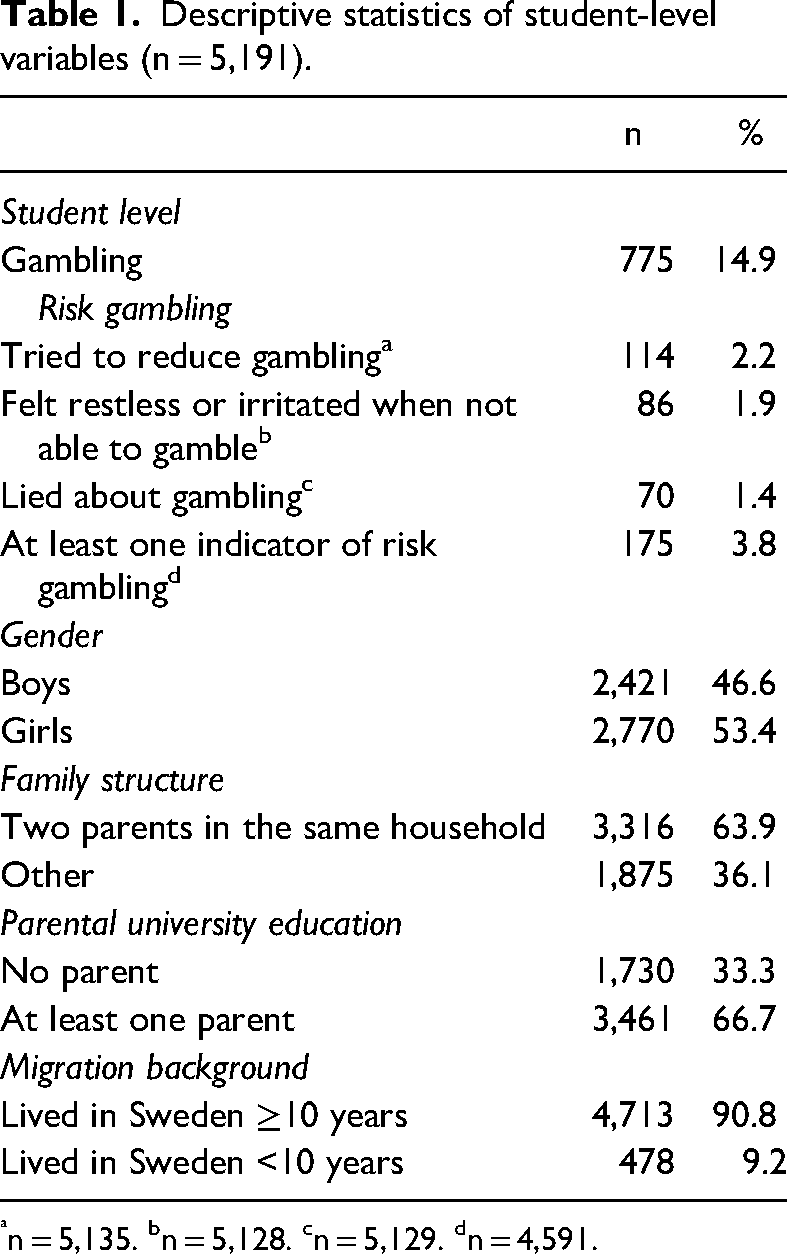
n = 5,135. bn = 5,128. cn = 5,129. dn = 4,591.
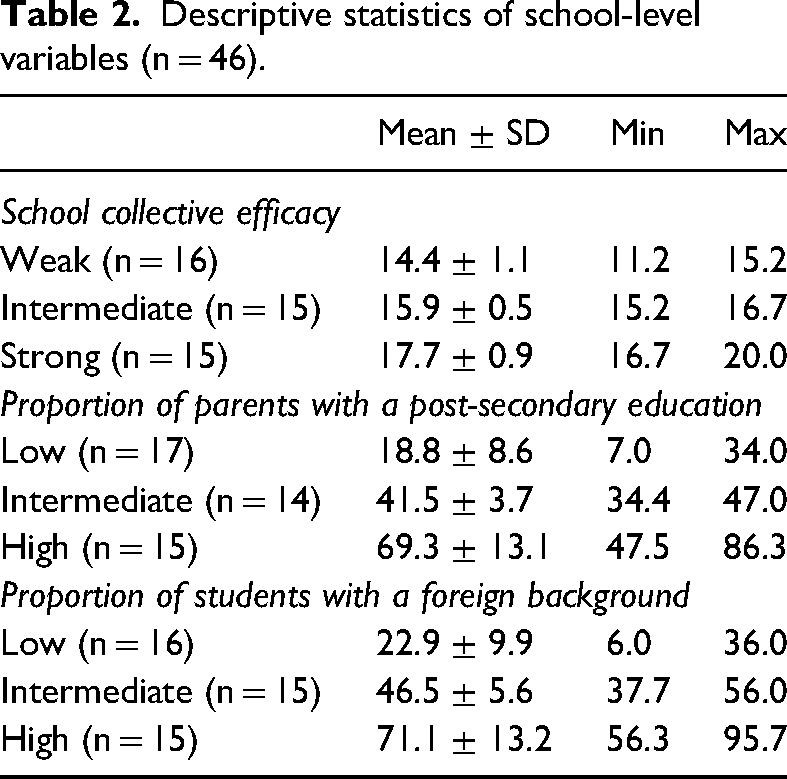
The descriptive statistics of the school-level variables are reported in Table 2. Teachers’ ratings of the school's collective efficacy were in the range of 11–20 (scale range of 4–20). The proportion of parents with a post-secondary education was in the range of 7.0%–85.3% across schools whereas the proportion of students with a foreign background was in the range of 6.0%–95.7% across schools.
Descriptive statistics of school-level variables (n = 46).
Next, the proportions of students reporting gambling and risk gambling, by school collective efficacy, are presented (Table 3). The differences between groups were assessed with chi-square tests. Student-reported gambling was associated with teacher-rated school collective efficacy in an inverse, gradient manner: in schools with weak collective efficacy, 17.5% of the students had gambled, compared to 16.3% of the students in schools with intermediate collective efficacy and 10.4% of the students with strong collective efficacy. In a similar manner, there were clear, inverse associations between each of our indicators of risk gambling and school collective efficacy, with risk gambling consistently being most common among students in schools with weak collective efficacy and least common among students in schools with strong collective efficacy.
Proportions of students reporting gambling and risk gambling by school collective efficacy (chi-square tests).
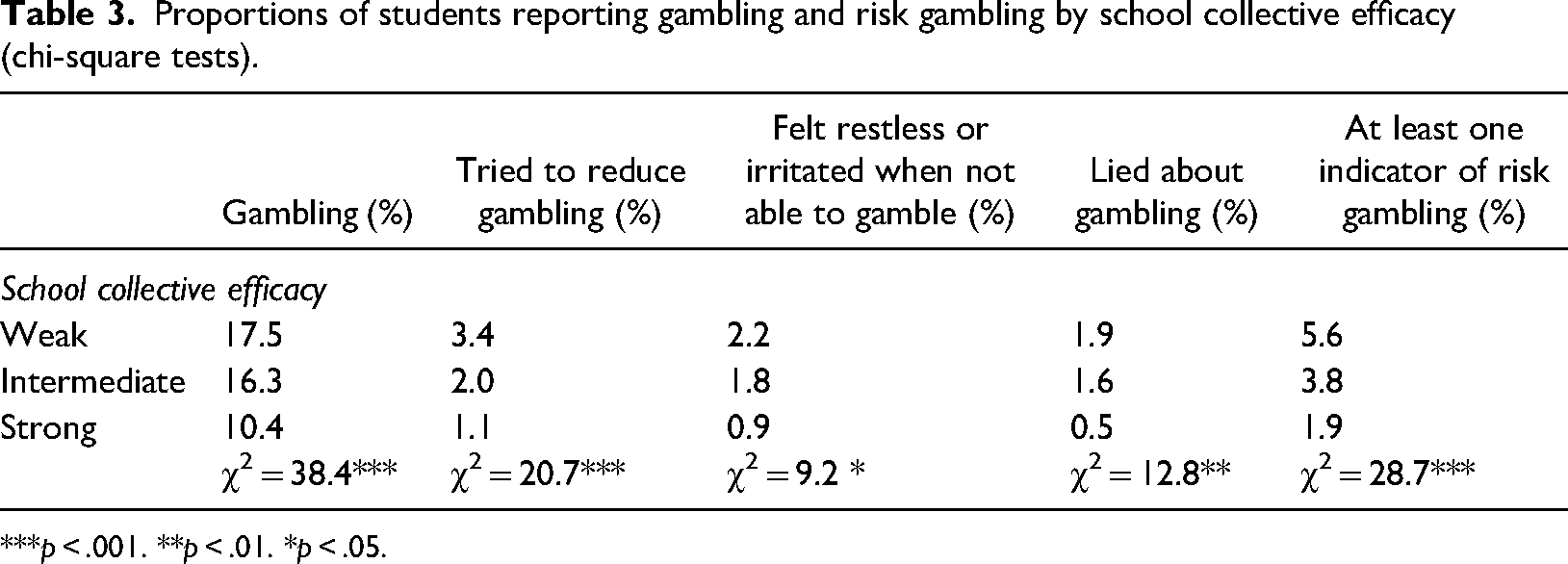
***p < .001. **p < .01. *p < .05.
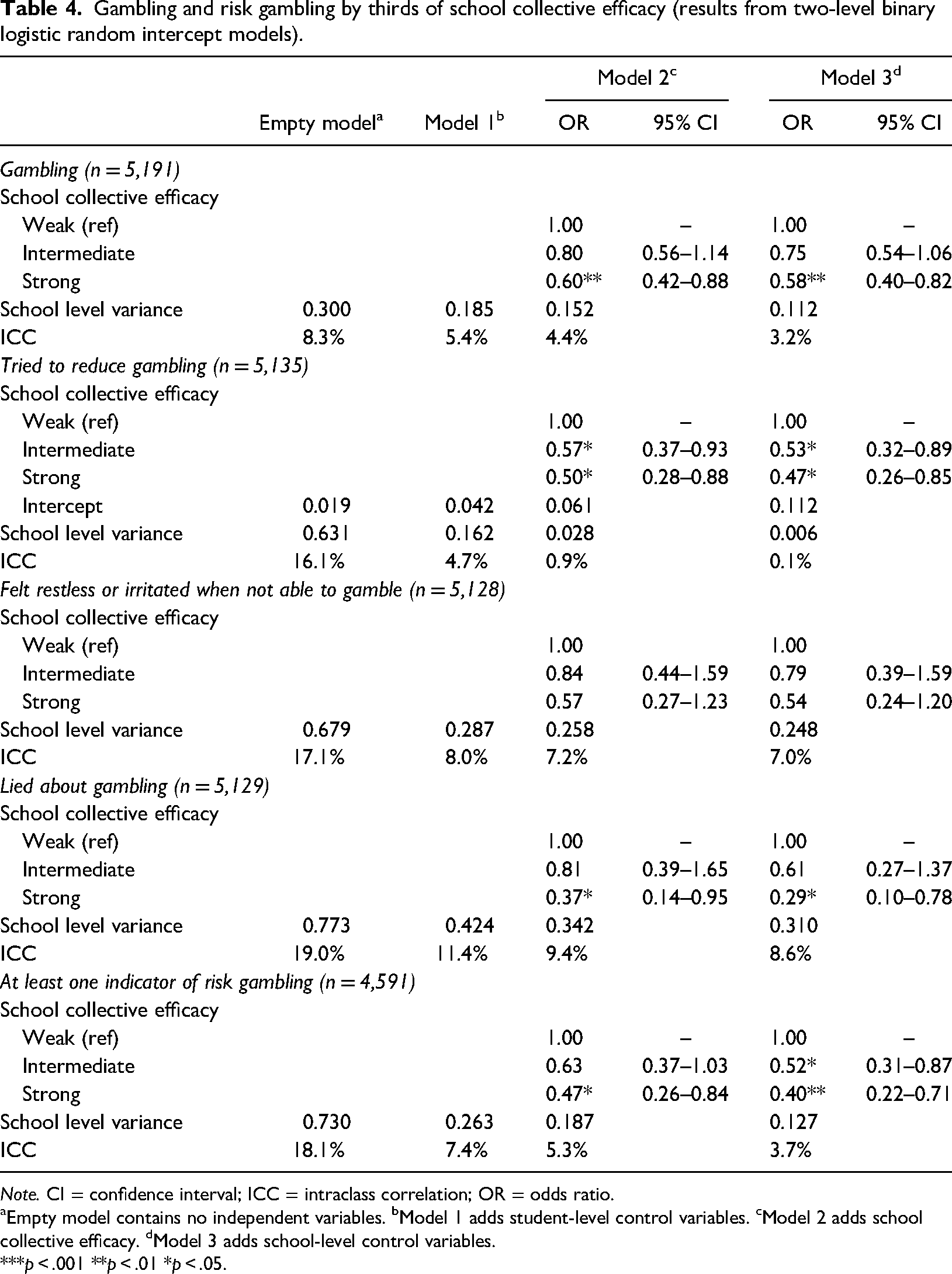
Table 4 shows the results from two-level binary logistic regression analyses of gambling and of our indicators of risk gambling. For gambling, the empty model demonstrates that 8.3% of the variation in gambling could be attributed to differences between schools. When student-level control variables were included in Model 1, the ICC shrank to 5.4%, indicating that part of the initial school-level variation was accounted for by the fact that students with similar individual characteristics to some extent tended to attend the same schools. In Model 2, school collective efficacy was added. A strong school collective efficacy was associated with a lower likelihood of gambling at the student level (OR 0.60, 95% CI 0.42–0.88). Finally, in Model 3, school level control variables were added. The association between strong collective efficacy at the school level and gambling at the student level remained robust and statistically significant (OR 0.58, 95% CI 0.40–0.82).
Gambling and risk gambling by thirds of school collective efficacy (results from two-level binary logistic random intercept models).
Note. CI = confidence interval; ICC = intraclass correlation; OR = odds ratio.
Empty model contains no independent variables. bModel 1 adds student-level control variables. cModel 2 adds school collective efficacy. dModel 3 adds school-level control variables.
***p < .001 **p < .01 *p < .05.
For each of the indicators of risk gambling, there was substantial variation between schools. The empty models showed ICCs ranging between 16.1% (“tried to reduce gambling”) and 19.0% (“lied about gambling”). As shown by the ICCs of Models 1, the school-level variation in the indicators of risk gambling was partly accounted for by student-level characteristics. Models 2 added school collective efficacy. For all indicators of risk gambling, except “felt restless or irritated when not able to gamble”, strong school collective efficacy was statistically and significantly associated with a lower likelihood of risk gambling at the student level. The associations between school collective efficacy and the indicators of risk gambling remained robust in Models 3 when school-level control variables were added. For “tried to reduce gambling”, both intermediate (OR 0.53, 95% CI 0.32–0.89) and strong (OR 0.47, 95% CI 0.26–0.85) school collective efficacy were associated with a lower likelihood of having tried to reduced gambling than in schools characterised by weak collective efficacy. There was still no statistically significant association between school collective efficacy and “felt restless or irritated when not able to gamble”, although the non-significant pattern was in the expected direction. Strong collective efficacy was clearly associated with a lower likelihood of having “lied about gambling” (OR 0.29, 95% CI 0.10–0.78). Finally, there was a clear, graded association between school collective efficacy and our overall measure of risk gambling (intermediate: OR 0.52, 95% CI 0.31–0.87; strong: OR 0.40, 95% CI 0.22–0.71). We also performed analyses with a continuous measure of teacher-rated school collective efficacy, adjusting for individual and school-level controls (not presented). These showed statistically significant or close to statistically significant associations with gambling (OR 0.91, p = .08), tried to reduced gambling (OR 0.80, p = .01), lied about gambling (OR 0.78, p = .09) and risk gambling (OR 0.82, p = .02) but not with felt restless or irritated when not able to gamble (OR 0.91, p = .42).
Discussion
Previous studies on the risk factors of adolescent gambling and risk gambling have mainly focused on determinants at the individual or family level. Yet, it is likely that other social contexts in young people's lives also affect their inclination to engage in gambling and in risk gambling. The aim of the present study was to investigate between-school variation in gambling and in different indicators of risk gambling, and in particular to analyse the associations that school collective efficacy shares with student gambling and risk gambling.
The analyses demonstrated between-school variation in gambling and of risk gambling, even when student-level sociodemographic characteristics were adjusted for. This indicates that differences between schools indeed seem to be attributable to the conditions in schools as such and not only to the characteristics of the students attending them. The share of variance (ICC) in student gambling and risk gambling that could be attributed to conditions in school was 8% for gambling and was in the range of 16%–19% for our different indicators of risk gambling. In a systematic review conducted on school effects (Sellstrom & Bremberg, 2006), the authors found ICCs on risk behaviours such as alcohol consumption and smoking to be in the range of 7%–12% while studies on well-being generally reported lower values. The greater than expected school variation retrieved in the current study for, in particular, student risk gambling could be a result of methodological or measurement bias, such as sampling procedure, what is controlled for and how the outcome is constructed (Sellstrom & Bremberg, 2006). It could, however, also indicate that conditions in school may be particularly relevant for youth gambling behaviours. The fact that studies on alcohol consumption, drug use and delinquency conducted on the same data, using similar control variables and methods as the present study, reported ICCs ranging from 3% for delinquency to approximately 9% for alcohol consumption (Carlson & Almquist, 2016; Olsson & Fritzell, 2015) may somewhat support the latter interpretation.
The results further showed that both gambling and all indicators of risk gambling but one were more commonly reported by students attending schools with weak collective efficacy, and less commonly reported by students attending schools with strong collective efficacy, even when adjusting for student- and school-level sociodemographic characteristics. Why no significant association was rendered between collective efficacy and the indicator “felt restless and irritated when not able to gamble” could be speculated. One likely explanation is that in contrast to the other indicators of risk gambling, “feeling restless and irritated …” is not referring to a behaviour but rather to a cognitive reaction to behaviours that perhaps have been successfully regulated. The somewhat weaker association is from such a perspective, reasonable and in line with what could be expected . Having said that, the overall result of the current study is yet largely consistent with that of other studies in which school collective efficacy was found to be inversely associated with risk behaviours, such as drug use, alcohol consumption, delinquency (Olsson & Fritzell, 2015; Takakura et al., 2019) and bullying (Olsson et al., 2017; Sapouna, 2010; Williams & Guerra, 2011). In other words, the results of the present study extends previous research and support the notion of collective efficacy theory (Sampson et al., 1997) by suggesting that schools with the capacity to socially organise themselves and activate mechanisms of informal control are also better able to protect their students from engaging in gambling and risk gambling, irrespective of the social background of the students .
Environments characterised by trust and social cohesion are the most fertile grounds for collective efficacy (Sampson, 2003; Sampson et al., 1997). Applying interventions aimed at strengthening school social cohesion and trust may thus be one way of promoting informal control functions and effective regulation of unwanted behaviours, notably gambling and risk gambling, among students. Low levels of trust in school may impair both situational and enduring aspects of informal control. Not only is it less likely that people will intervene in troubling situations or engage in common goals in context where people mistrust each other, but people may also be less willing to seek and follow advice and recommendations from other people in settings with low trust. For instance, Eliot et al. (2010) found that students who perceived their teachers as caring, respectful and interested in them were more likely to seek help from adults at school, in this case in relation to bullying and threats of violence. The relation was found at both the individual and school levels. Environments characterised by mutual trust and supportive relations are also the most favourable for open discussions on values and norms. In adolescence, individuals become increasingly socially aware and may tend to engage in behaviours from social pressure in the peer group. In relation to gambling, the attitudes of parents, family and friends have been shown to be a key factor. Adolescents are, for instance, more likely to gamble themselves if they are surrounded by people who gamble or display positive attitudes towards gambling (Riley et al., 2021). Relatedly, young people's concerns that friends or family would judge them negatively have been reported to be a key factor for not engaging in gambling (Riley et al., 2021). To be surrounded by environments that are perceived as safe, where people are willing and allowed to intervene in troubling situations, and where norms are sound and can be openly negotiated is thus central for the efficient regulation of problem behaviours in general and, as shown in this study, also of gambling and risk gambling.
The present study has both strengths and limitations that should be kept in mind when interpreting the results. A main strength is the data material, combining information from students and teachers with official registered information on schools. The data cover all public schools, a substantial part of the independent schools and 11th grade students in Stockholm. The structure of the data limits the risk for common methods variance and is ideal for multilevel analyses. With regard to limitations, it should be kept in mind that the data are based on self-reported measures. This suggests that over- and underestimation cannot be completely ruled out. With regard to the measures used, it should also be noted that the measures of gambling and collective efficacy are not based on established scales. They have, however, been used in previous studies (see for instance Brolin Låftman et al., 2020; Olsson et al., 2021). The statistical properties of the measures of risk gambling (Kaltenegger et al., 2019) and collective efficacy (Kjellström et al., 2018) have also been tested and rendered good model fits. In addition, it should be noted that the measures of gambling do not contain information about what forms of gambling the adolescents were involved in (e.g., slot machines, betting, lotteries), nor on whether the gambling takes place on the Internet or elsewhere. This restricts comparison with other studies. Moreover, selection cannot not be ruled out. Although we have controlled for a range of sociodemographic characteristics at the student and school levels, there might still be omitted variables that are associated with both gambling and school collective efficacy that could be the reason for the associations found. In addition, it should be kept in mind that the study is conducted in schools and among students that were present the day of the survey. It may well be that students who are absent from school are also those who are most inclined to be involved in gambling and other risk behaviours; therefore, gambling rates might be underestimated. Finally, it should be noted that the findings are based on data collected among upper secondary students in Stockholm, Sweden. Generalisations to other populations should thus be done with caution.
To conclude, the present study has shown that students in some schools are more inclined to engage in gambling and risk gambling than students in other schools, irrespective of their social background. Our findings are also consistent with the idea that social processes in schools can be targeted to help prevent students’ engagement in gambling and risk gambling. More precisely, we showed that school collective efficacy seemed to play a protective role in shaping youth gambling behaviours. Enhancing trust and informal social control mechanisms in the school could therefore be one way to help reduce gambling and risk gambling among youth. Such a conclusion expands knowledge on the association between condition in schools and youth gambling and provides knowledge for school intervention strategies.
Footnotes
Declaration of conflicting interests
The author(s) declared no potential conflicts of interest with respect to the research, authorship, and/or publication of this article.
Funding
The author(s) disclosed receipt of the following financial support for the research, authorship, and/or publication of this article: This work was supported by the Svenska Spel Research Council (grant number 2020-0015).
