




Abstract
As a result of the COVID-19 epidemic, the Norwegian government introduced “the strongest and most intrusive measures in Norway in peacetime” on 12 March 2020 (Office of the Prime Minister and the Ministry of Health and Care Services, 2020). People working in healthcare were temporarily banned from traveling abroad on 13 March, and a regulation was passed that introduced quarantine and isolation of persons who came to Norway from abroad, including Norwegians who owned cabins in other countries such as Sweden and Denmark. In addition, on 14 March, the Ministry of Foreign Affairs advised against non-essential travel to all countries (Government.no, 2022) and several airports and seaports were closed (Grosvold & Stenerud, 2020; Mogen, 2020; tu.no, 2020). During spring 2020, the Norwegian Directorate of Health issued several updates to the regulations (Norwegian Institute of Public Health, 2020).
The general advice was that travel abroad not considered necessary should be avoided, although leisure travels between Norway and the other Nordic countries were allowed from 15 June, but with quarantine requirements and entry restrictions if re-entering from regions with a high rate of infection. The most popular border trade destinations in Sweden remained red on the infection map throughout the second quarter of 2020. From 15 July, quarantine at entry was lifted for people traveling to Norway from countries in the Schengen Area and the EU with a satisfactorily low rate of infection. However, in autumn 2020 the infection situation in Europe worsened, and quarantine was reintroduced upon arrival from a number of foreign destinations (Government.no, 2022).
The travel restrictions and the repeated recommendations to refrain from traveling abroad led to a dramatic drop in the number of trips abroad. Statistics Norway's (SSB) Travel Surveys showed a reduction in the number of holidays abroad of 96% in the second quarter and 88% in the third quarter of 2020, compared with 2019 (Statistics Norway, 2020b, 2020c). According to Statistics Norway, restrictions on cross-border travel led to a decrease in cross-border trade of 99% in the second quarter and 96% in the third quarter compared with the previous year (Statistics Norway, 2020d).
It is a political goal to reduce cross-border trade to protect jobs in border regions and reduce loss of revenues to the Norwegian state (Innst. 3 S (2020–2021), 2020). For these reasons, the tax on snus was reduced by 25% in the national budget for 2021. Norway shares much of its eastern border with Sweden, and travel import of tobacco products has for many years accounted for a large share of the total tobacco consumption (Lund, 2004; Lund & Vedøy, 2020), likely because tobacco products are approximately twice as expensive in Norway compared to Sweden (Statistics Norway, 2020a) or duty-free sales. According to a survey from 2017, 21% of snus users and 16% of smokers reported that they had bought their last box of cigarettes or snus in Sweden. In addition, 18% of snus users and 19% of smokers had bought their last box of cigarettes or snus in a duty-free shop (Vedøy & Lund, 2017).
Our hypothesis is that the COVID-19-related travel restrictions led to a shift of the tobacco supply from Swedish and duty-free shops to Norwegian shops, but also to web shops and possibly illicit tobacco, and that this shift was greatest in regions close to Sweden. To examine this hypothesis, we will: (i) describe the proportion of snus users and smokers, and the distribution of six different self-reported places of purchase of cigarettes and snus, by county in the period before COVID-19-related travel restrictions and recommendations (2015–2019); and (ii) examine how self-reported place of purchase of tobacco (cigarettes and snus combined) varied across years and quarters in the period 2015–2021, and whether the variations across all four quarters in 2020 differed by geographic region.
Material and method
Questions about use and purchase of nicotine products were included in an omnibus survey conducted by the polling agency Ipsos with 250 weekly responders aged 15 years or more. For 20% of the sample, primarily those over the age of 60 years, respondents were invited by email to complete a web-based questionnaire. These respondents had previously registered their email addresses at Ipsos. The remaining 80% were contacted by text messages on telephone numbers drawn from population registers provided by a private data provider, Bisnode. The sample was randomly drawn, but continuously examined for under- or over-representation of different population groups (based on combinations of age, gender and region). In those cases, proportionately more invitations were sent out to the relevant groups in the following weeks. The answers were registered on a computer, smartphone or tablet. The respondents were given a quarantine period of one year to avoid repeated answers from the same persons (Eilertsen, 2017).
We based this study on responses from 92,913 people in the period from 12 February 2015 to 31 December 2021. Of these, 13,049 people reported that they smoked daily or occasionally, and 13,346 people used snus daily or occasionally. The numbers of smokers and snus users, and all tobacco users with information about county and supply sources are shown in Figure 1.
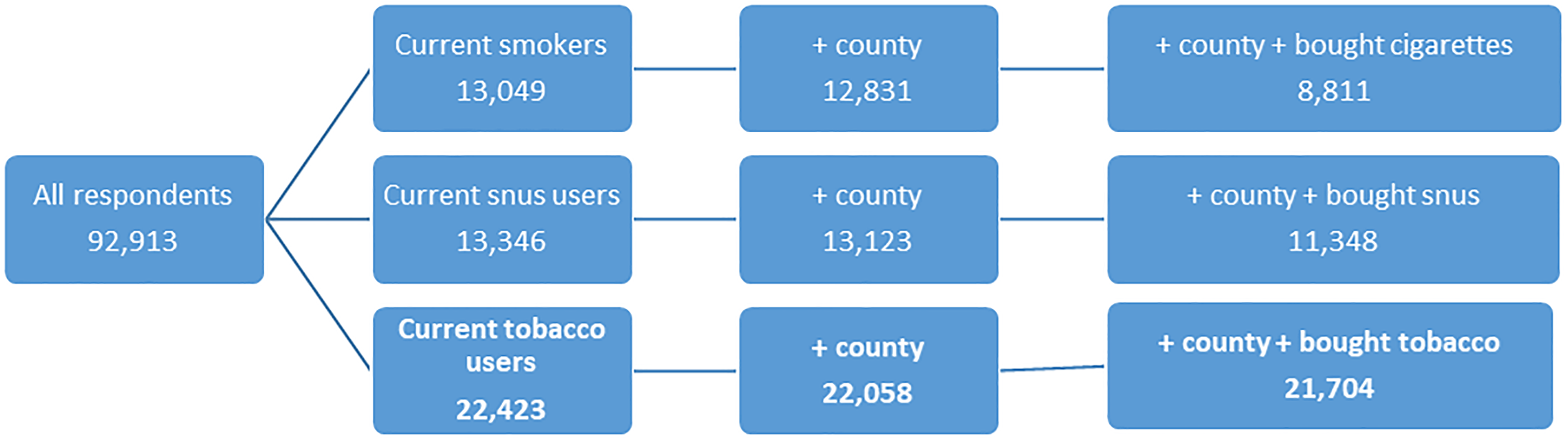
Distribution of respondents with information on smoking/snus use/tobacco use, county and who had bought tobacco during the last 24 hours, 2015 to 2021 combined.
Cigarette smokers who had smoked at least one cigarette during the last 24 hours were asked the question: “If you think about all the cigarettes you have smoked during the last 24 hours – where were they bought?” Eight sources of procurement were listed as response options. Because of size and similarity, we combined Norwegian and foreign web shops into web shops, and Danish and other foreign shops into other foreign shops. The resulting six sources of tobacco were: Norwegian shops; Swedish shops; duty-free shops (both at airports and on boats); purchased in Norway, but at a price far lower than retail price (a proxy for illicit tobacco); shops in other countries (Denmark and other foreign shops) and web shops (both Norwegian and foreign). The place of purchase of snus was measured with an identical question and identical response categories. In cases where respondents had bought tobacco from more than one source, the less popular source took precedence (web shops > possible illicit tobacco > other foreign shops > duty-free shops > Swedish shops > Norwegian shops).
To investigate the variation in place of purchase before and after COVID-19-related travel restrictions and recommendations, we constructed a multinomial logistic regression model in Stata 17 (StataCorp, 2021) in which the dependent variable denoted the six discrete outcomes presented above.
Independent variables were dummy variables for year, quarter and region (see below). In addition, we controlled for the following variables that were likely to be associated with the place where smokers and snus users buy tobacco: gender, age, self-reported education, urban/rural area and income. Table 1 shows the values for all categorical variables. In addition, to control for possible differences in weather between years that could affect the likelihood of buying tobacco from different sources we included normalised mean temperature for each month and year for each county (Norsk Klimaservicesenter, 2022). We did not control for changes in tobacco taxes as these change every calendar year and therefore co-vary perfectly with the dummy variables for year.
Social and demographic characteristic of the full sample, current smokers and current snus users, 2015–2021 combined.
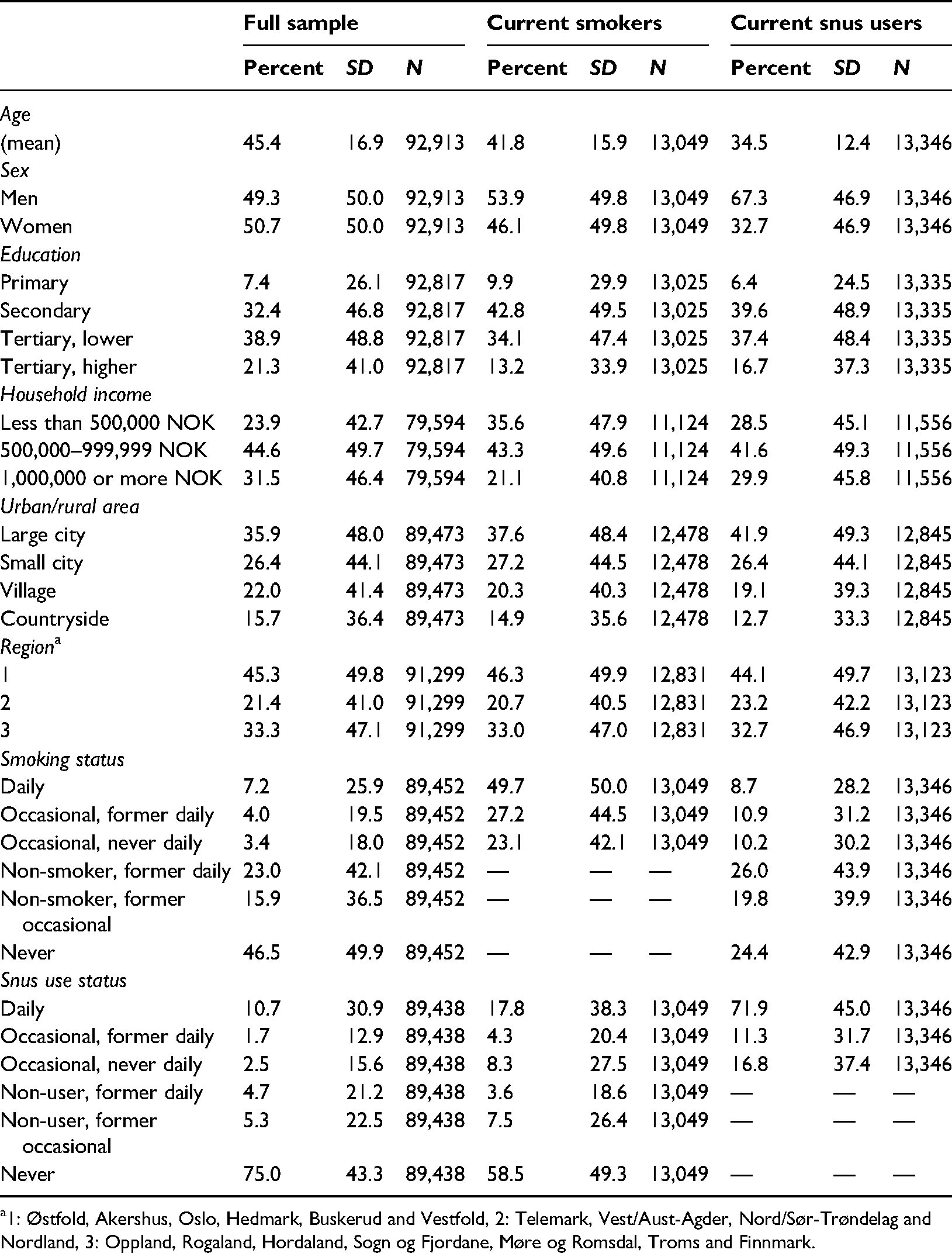
1: Østfold, Akershus, Oslo, Hedmark, Buskerud and Vestfold, 2: Telemark, Vest/Aust-Agder, Nord/Sør-Trøndelag and Nordland, 3: Oppland, Rogaland, Hordaland, Sogn og Fjordane, Møre og Romsdal, Troms and Finnmark.
Since geography is important for where tobacco users buy their tobacco, we initially wanted to investigate tobacco supply sources by county. Given the low number of respondents in some counties, it was more appropriate to divide the sample into three regions (see Table 1) defined by the size of the domestic purchase of tobacco (both snus and cigarettes) in the period before COVID-19-related travel restrictions (February 2015 to December 2019). This provided the opportunity to test whether tobacco users living in regions where tobacco was bought primarily from sources outside Norway or duty-free to a greater extent altered their purchasing behaviour, compared to tobacco users who lived in regions where tobacco was primarily bought from Norwegian domestic outlets.
To test whether the place of purchase varied over the COVID-19-period, and whether the changes were similar in different geographical regions, we included an interaction between year, quarter and region in the model. A nested likelihood-ratio test showed that each additional control variable and the interaction between region, year and quarter increased model fit (p < 0.00), but both Aikakes Information Criterion (AIC) and Bayesian Information Criterion (BIC) strongly supported a model including all variables, but excluding region from the interaction. Consequently, region was not included in the interaction.
From this model (see supplemental online Appendix), we calculated predicted probabilities and 95% confidence intervals for having purchased tobacco from six different sources by year and quarter. We also calculated the probabilities for buying tobacco from each place of purchase for the three defined regions for each quarter in 2020. Differences were tested by calculating average marginal effects (dy/dx).
Results
Of the entire sample, 14% smoked cigarettes (7% daily and 7% occasionally) and 15% used snus (11% daily and 4% occasionally) (Table 1). Among both smokers and snus users, there were more men compared to women (54% vs. 46% for smokers and 67% vs. 33% for snus users). The mean age in the full sample was 45 years. Among current smokers the mean age was 42 years, while snus users were younger, with a mean of 35 years. The percentage who had completed tertiary education (college or university degree) was 60% in the full sample. In comparison, the percentage with tertiary education was 47% among smokers and 54% among snus users. Similarly, 36% of smokers reported having a household income lower than 500,000 NOK compared to 29% among snus users and 24% in the full sample.
In the period before COVID-19-related travel restrictions and recommendations (2015–2019), 16% responded that they smoked daily or occasionally. The county of Telemark had the highest percentage of current smokers (19%), while the county with the lowest percentage of regular smokers was Nord-Trøndelag (14%) (Table 2).
Prevalence of current smoking and distribution of place of purchase of cigarettes bought during the last 24 hours, 2015–2019 combined.
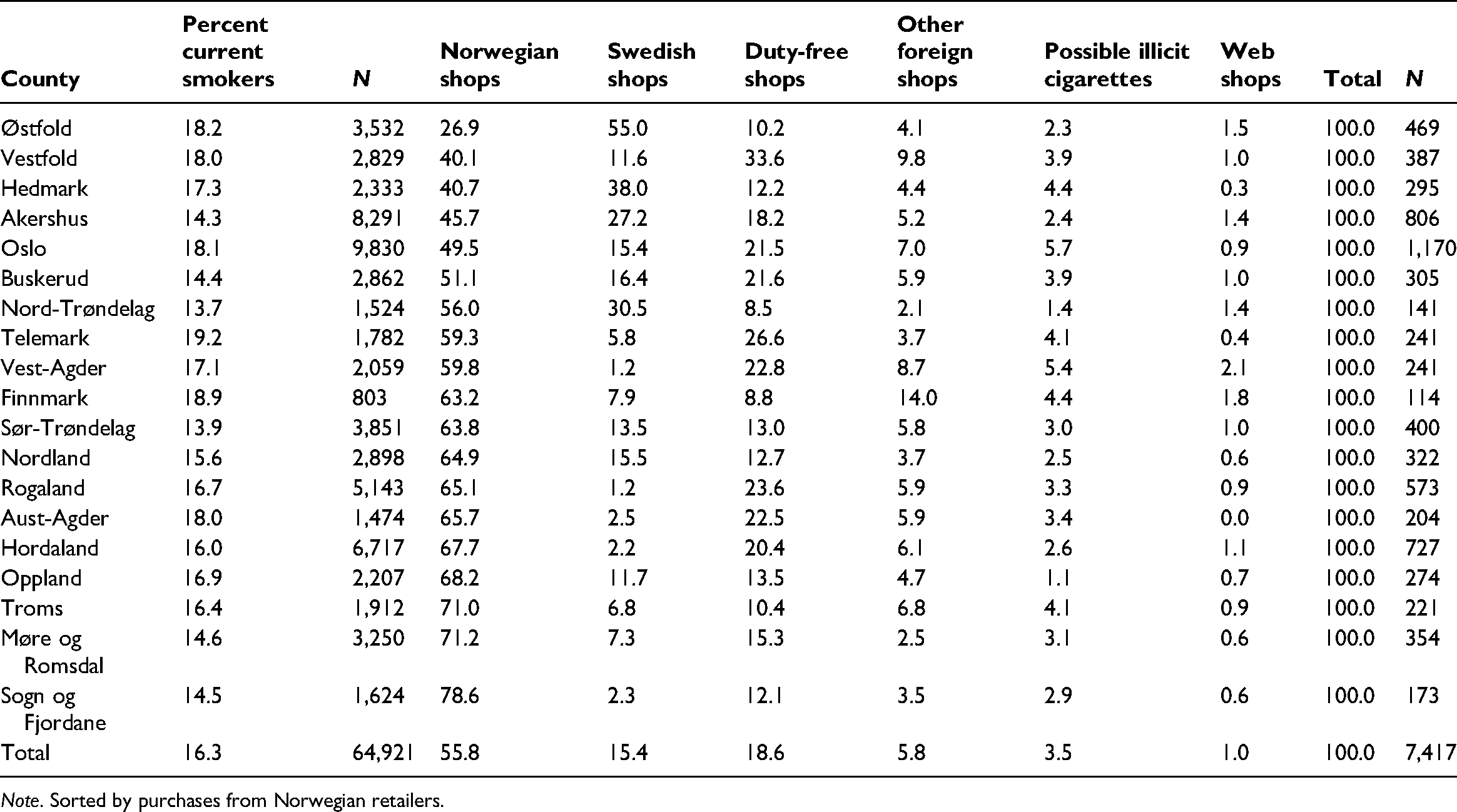
Note. Sorted by purchases from Norwegian retailers.
Among smokers who had reported having smoked during the last 24 hours, 56% answered that the cigarettes had been purchased from ordinary shops in Norway. The second most common source was duty-free shops (19%), followed by Swedish shops (15%), other foreign shops (6%), possible illicit cigarettes (4%) and web shops (1%).
There were large regional differences in where smokers bought cigarettes in the period 2015–2019. Only 27% of smokers in Østfold, a county that shares a border with Sweden, stated that the cigarettes smoked during the last 24 hours had been bought in Norway. The corresponding proportion among smokers living in Sogn og Fjordane, on the opposite side of Norway (west coast), was 79%.
The prevalence of current snus use in the period 2015–2019 was 15%, similar to the prevalence of current smoking (Table 3). The county with the highest percentage of current snus users was Nord-Trøndelag (21%), while Vestfold, a county on the southern coast of Norway, had the lowest snus use prevalence (12%).
Prevalence of current snus use and distribution of place of purchase of snus bought during the last 24 hours, 2015–2019 combined.
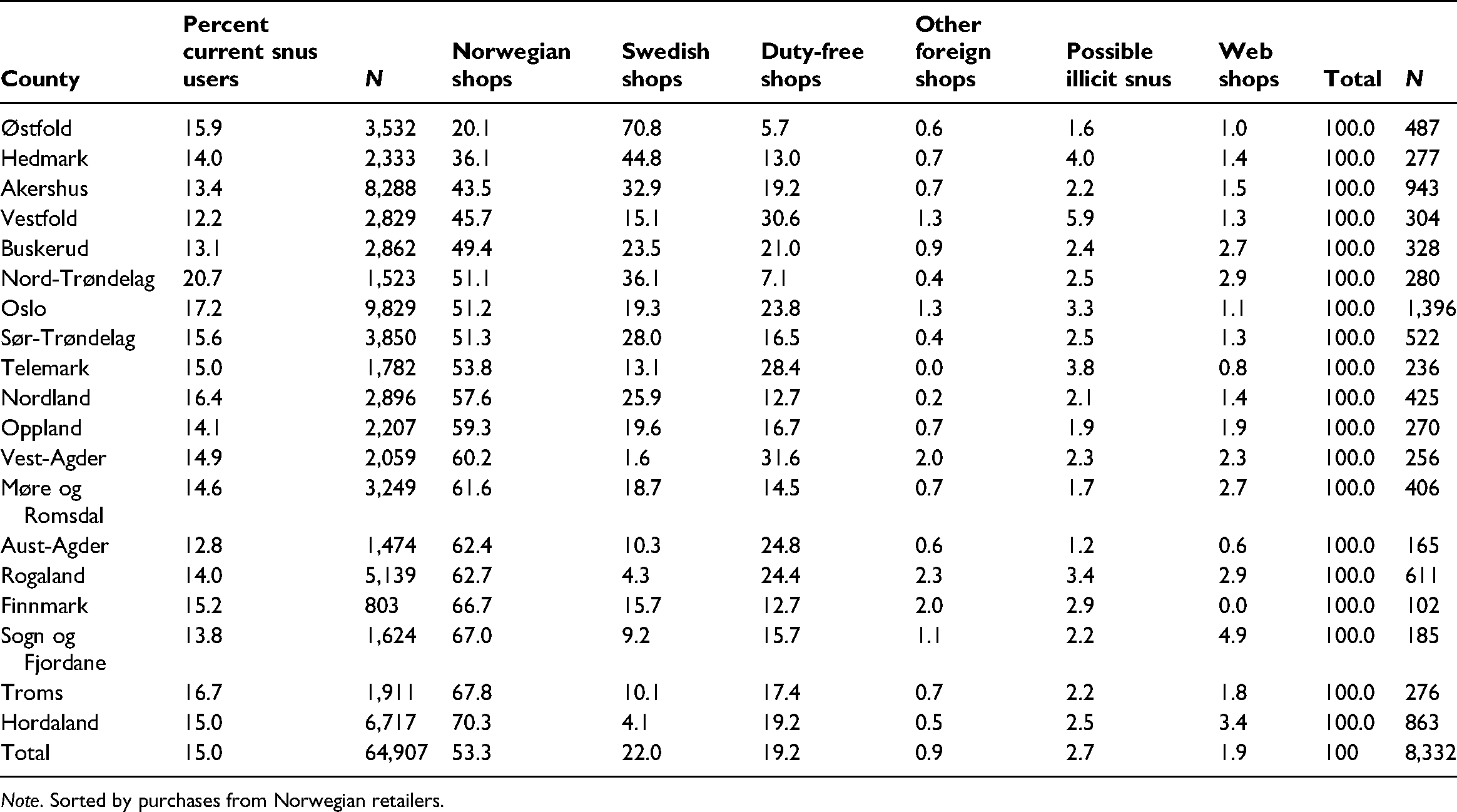
Note. Sorted by purchases from Norwegian retailers.
Among snus users who had used snus during the last 24 hours in the period 2015–2019, 53% answered that the snus products used had been bought form Norwegian shops. The second largest source of snus was Swedish shops (22%) followed by duty-free shops (19%), possible illicit snus (3%), web shops (2%) and other foreign shops (1%). Østfold was the county with the lowest percentage of Norwegian-bought snus (20%), while Hordaland, a county on the west coast, had the highest prevalence (70%).
For both cigarettes and snus, there was a tendency that in counties where a large share of tobacco was bought in Sweden, purchases from duty-free shops were less common, and vice versa. For example, 55% of respondents from Østfold answered that they had bought cigarettes smoked during the last 24 hours in Sweden while only 6% answered duty-free shops. In Sogn og Fjordane, only 2% of smokers reported Sweden as the place of purchase, while 12% answered that the last cigarette consumed had been purchased from duty-free shops. Moreover, use of web shops was more often reported in counties located on the west coast, away from Sweden, but only for snus (5% in Sogn og Fjordane and 3% in Hordaland).
Average marginal effects (dy/dx) calculated from the multinomial logistic regression model showed that the probability of using tobacco bought in Norway during the last 24 hours was 13 percentage points (29%) higher among tobacco users with more than five years of tertiary education, compared to those with primary education, all other variables held constant (p < 0.00). In contrast, the probability of buying tobacco in Norway was seven percentage points (13%) lower among tobacco users having a household income above 1,000,000 NOK compared to those in the lowest income bracket (less than 500,000 NOK) (p < 0.00).
In contrast, the probability of using tobacco bought in Sweden was eight percentage points (47%) lower among respondents with the longest compared to the shortest education (p < 0.00), but only one percentage point (13%) higher among respondents in the highest income bracket compared to the lowest (p = 0.03). Moreover, income was positively associated with duty-free tobacco purchases (seven percentage points/56% higher) among respondents in the highest compared to the lowest income bracket (p < 0.00). In the case of sex, and for all variables in the three remaining outcomes, the associations where either statistically insignificant and/or insignificantly small.
Figure 2 shows the predicted probabilities (and 95% confidence intervals) of using tobacco (cigarettes or snus) during the last 24 hours from each of the six sources, for each quarter (Q) from 2015 to 2020. In the period 2015–2019, the probability of buying tobacco from Norwegian shops was stable and in the range between 0.40 and 0.60. While the probability of buying tobacco in Norway was nine percentage points (20%) lower in Q1 2020 compared to Q1 2019, the probability was 23 percentage points (52%) higher in Q2, 37 percentage points (114%) higher in Q3, and 27 percentage points (65%) higher in Q4 2020 compared to the corresponding quarters in 2019 (p < 0.00 for all differences). The probability was also significantly higher in all quarters of 2021 compared to 2019 but showed signs of decrease in Q4.
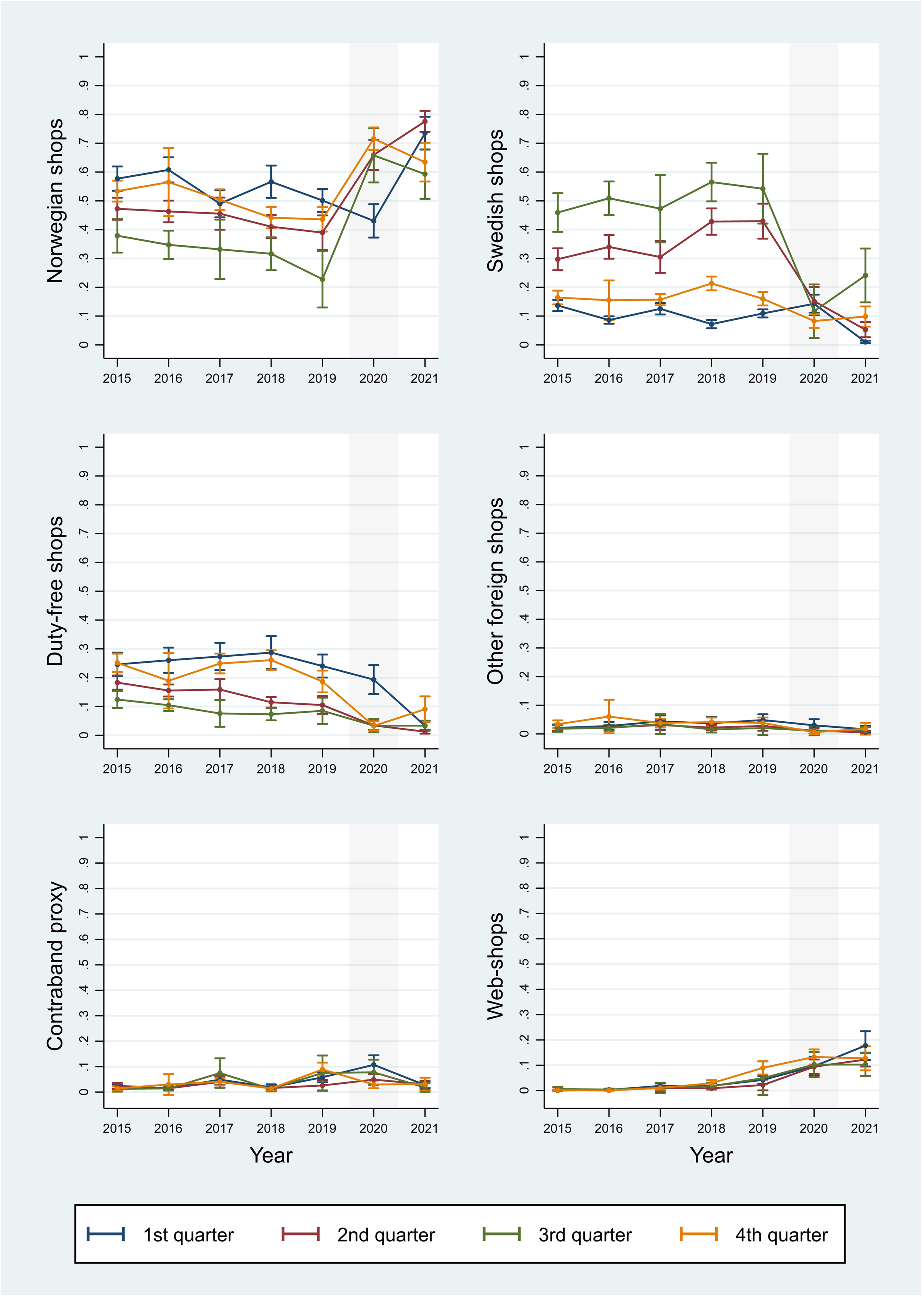
Predicted probabilities of buying tobacco products from six different places of purchase, by year and quarter, 2015–2021.
Correspondingly, there was a sharp drop in purchases from Swedish stores in Q2 (20 percentage points or 80%) and Q3 (21 percentage points or 92%), and a smaller drop in Q4 (nine percentage points or 55%), compared to 2019 (p < 0.00 for all differences), and the significantly lower probability of buying tobacco in Sweden continued into 2021, but differences were less pronounced in Q3 and Q4.
Like purchases from Sweden, the probability of self-reported duty-free purchases decreased by 10 percentage points (71%) in Q2, 13 percentage points (71%) in Q3 and 13 percentage points (84%) in Q4 between 2019 and 2020 (p < 0.00 for all differences) and remained low throughout 2021. For the three remaining places of purchase, there were little or no significant variation across years and quarters, with the exception of buying tobacco from web shops, which increased steadily in the period 2018 to 2021.
Figure 3 shows the predicted probabilities of buying tobacco from each of the six places of purchase across all quarters in 2020 by region. In Q1 2020, the probability of having bought cigarettes or snus consumed during the last 24 hours from a shop in Norway was 0.35 in Region 1 (Østfold, Akershus, Oslo, Hedmark, Buskerud and Vestfold), 0.47 in Region 2 (Telemark, Vest-Agder, Aust-Agder, Nord-Trøndelag, Sør-Trøndelag and Nordland) and 0.54 in Region 3 (Oppland, Rogaland, Hordaland, Sogn og Fjordane, Møre og Romsdal, Troms and Finnmark).
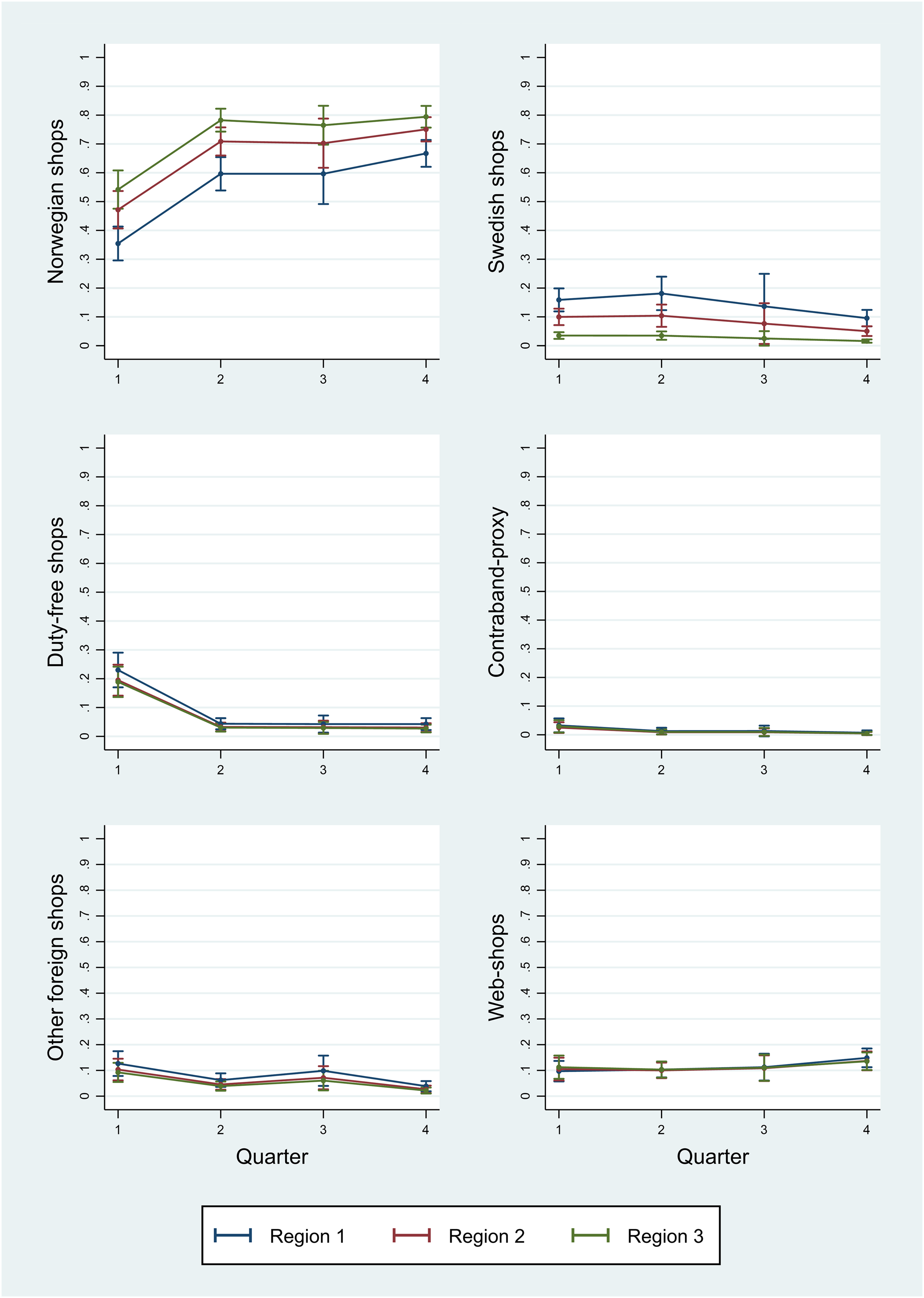
Predicted probabilities of buying tobacco products from six different places of purchase, in each quarter of 2020, by region.
From Q1 to Q4 2020 the probability of buying tobacco in a Norwegian shop increased by 31 percentage points (90%) in Region 1, 28 percentage points (60%) in Region 2 and 25 percentage points (47%) in Region 3 (p < 0.00 for all differences). As a result, the regional differences in the proportion of Norwegian-purchased tobacco was reduced. In the same period, the probability of buying tobacco from Swedish shops decreased by six percentage points (41%) in Region 1, five percentage points in Region 2 (50%) and two percentage points (54%) in Region 3. For the four remaining places of purchase there were no marked differences between the three regions.
Discussion
This study showed that there are regional differences in the prevalence of smoking and snus use in Norway, and large regional variations in where tobacco users buy cigarettes and snus. Prior to COVID-19-related travel restrictions and recommendations, 53–56% of snus and cigarettes were bought from Norwegian shops. Tobacco bought in Sweden and purchases from duty-free shops accounted for most of the remaining tobacco supply. Swedish trade was naturally most common in counties that share borders with Sweden.
If we compare the period with COVID-19-related travel restrictions and recommendations (Q2–Q4 2020) with the corresponding period in 2019, we find that the probability of self-reported purchases of tobacco from Norwegian shops increased from 0.45 to 0.72 (68%). The largest increase took place in regions that had a high degree of supply of tobacco from Sweden before the COVID-19-related travel restrictions. The increase is somewhat larger than what the Norwegian Tax Administration reported for the same period (49% for snus and 31% for smoked tobacco).
When comparing the same periods (Q2–Q4 2019 and Q2–Q4 2020), the probability of buying tobacco in Sweden decreased from 0.23 to 0.06 (77%) and the probability of buying tobacco from duty-free shops decreased from 0.16 to 0.04 (76%). Purchases from other foreign shops and possible illicit tobacco did not compensate for this decrease to any large degree. In contrast, purchases from web shops increased relatively strongly, but this increase was stable and began before the COVID-19-period, and may likely have other underlying causes.
Reducing tobacco consumption is a political goal, and because tobacco purchased in Sweden and from duty-free shops makes up a large share of the total tobacco consumption, limiting these sources of tobacco is important from a public health perspective. Since the COVID-19-related travel restrictions and recommendations were temporary, a more permanent way of increasing the proportion of Norwegian-purchased tobacco may be to reduce or remove the quotas for duty-free trade and travel imports, as some have suggested (Norwegian Cancer Society, 2020). For tobacco consumers who usually purchase tobacco from these sources, the cost of tobacco would increase significantly.
For those who are unable to quit using tobacco, reduced quotas for duty-free trade will lead to a disproportionally large economic burden. The probability of buying tobacco in Sweden was 47% lower among tobacco users with five or more years of tertiary education compared to tobacco users with primary education only. A strong price increase will likely lead to decreased consumption overall, but will have a stronger impact on tobacco users with low socioeconomic status, who are more likely to buy tobacco from Sweden and less likely to quit smoking (Hiscock et al., 2015).
Another way of increasing the relative share of the tobacco supply from sources that provide revenue to the Norwegian state would be to reduce excise duties on tobacco to the level in Sweden, as proposed by The Norwegian Progress Party (2020). For the nearly 50–60% of consumers who usually buy tobacco in Norway, the cost will be drastically reduced. Users who consider stopping or reducing their tobacco consumption for financial reasons will in this scenario have a weaker incentive to do so. For young people with vulnerability traits related to starting using tobacco, but who for financial reasons have refrained from using tobacco, the barrier to initiating tobacco use will be reduced. This is in conflict with health policy objectives. For the Norwegian state, it is also uncertain whether the increase in domestic demand will compensate for the loss of revenue from reduced excise duties.
A weakness of the survey is that it does not provide information about the volume of tobacco consumed. However, respondents were asked to estimate their monthly expenses for cigarettes and snus. We found no significant increases in these expenses during the period of COVID-19-related travel restrictions. This may indicate that tobacco users consumed less tobacco. However, it could also be that consumers’ responses were based on notions of “what they usually pay” and not specifically in the period with COVID-19-related travel restrictions. A third possibility is that tobacco users to a greater extent bought tobacco from outlets with lower prices, such as online stores. This is supported by the present study which showed that there was an increased probability of buying tobacco from web shops across years
Strengths of the survey are that it includes a large number of tobacco users over a relatively long period of time, that the survey was carried out continuously and that the wording of the questions related to different tobacco products were identical throughout the period. This makes it possible to make detailed quarterly analyses and describe county-specific buying behaviour for tobacco.
Conclusion
Travel restrictions and recommendations introduced in the second quarter of 2020 led to more purchases of tobacco from Norwegian shops and less purchases from Swedish and duty-free shops. The increased share of tobacco purchases from shops in Norway means that, for many tobacco users, buying tobacco became more expensive and that taxes on tobacco to a greater extent were paid in Norway. However, whether these extraordinary circumstances will affect future cigarette and snus use, and place of purchase of tobacco products, remains to be seen.
Supplemental Material
sj-docx-1-nad-10.1177_14550725221096911 - Supplemental material for The impact of the COVID-19 epidemic on where tobacco users purchased cigarettes and snus in different Norwegian regions
Supplemental material, sj-docx-1-nad-10.1177_14550725221096911 for The impact of the COVID-19 epidemic on where tobacco users purchased cigarettes and snus in different Norwegian regions by Tord Finne Vedøy and Karl Erik Lund in Nordic Studies on Alcohol and Drugs
Footnotes
Declaration of conflicting interests
The authors declared no potential conflicts of interest with respect to the research, authorship, and/or publication of this article.
Funding
The authors received no financial support for the research, authorship, and/or publication of this article.

Supplemental material
Supplemental material for this article is available online.
References
Supplementary Material
Please find the following supplemental material available below.
For Open Access articles published under a Creative Commons License, all supplemental material carries the same license as the article it is associated with.
For non-Open Access articles published, all supplemental material carries a non-exclusive license, and permission requests for re-use of supplemental material or any part of supplemental material shall be sent directly to the copyright owner as specified in the copyright notice associated with the article.
