




Abstract
Keywords
Drug policy is becoming one of the challenging government interventions for a complex social problem. Since international treaties constitute the main cause of the strict prohibitionist approach, current developments in cannabis legalisation and the demand for extensive harm reduction services are forcing governments to alter their strategies (Unlu et al., 2020). Nevertheless, the pressure of local needs and global trends complicate the development of a balanced drug policy. The rapid change in drug attitudes among young generations frightens mainstream society, resulting in an alignment with conservative thinking and approaches.
In Finland, drug policy was a minor issue until the 1990s. The focus of drug policy was on the control of drug-related criminality, and the police and the Ministry of the Interior played a central role both in policy and practice. Specialised health care services, social support systems, and harm reduction services for problem drug users received little attention. In the late 1990s, however, the policy course took a new direction. There was a significant increase in drug use and related harms in the second half of the 1990s. This forced authorities and politicians to reconsider national drug strategies and policies, which led to the establishment of a Drug Policy Committee, and eventually, in 1997, to the first and only national drug policy strategy in Finland. On this drug policy committee, there were struggles over the definition of drug issues. The two main rival camps were the law enforcement authorities advocating a drug-free society and insisting on policies of strict control and, on the other side, the social welfare, health, and criminal policy alliance that favoured a harm reduction approach. At the time, harm reduction referred to two controversial issues: opioid substitution treatment and needle exchange programmes. The end result – the aims and measures of the drug strategy – was a compromise between the two logics, which has since paved the way for further elaboration of the policy of harm reduction but also stricter criminal controls on drug users. This compromise model has been called the dual-track drug policy paradigm. This drug policy model and the actions that follow it have been prevalent throughout the 21st century. Both repression and harm reduction activities have grown side by side without challenging each other much (Hakkarainen et al., 2007; Tammi, 2007).
Drug consumption rooms (DCRs) have emerged as a local response to insufficient drug policies in many countries. The accumulation of problems created by prohibitionist policies leaves the high-risk group of people who use drugs (PWUD) behind in social and health care services. Social isolation and stigma exacerbate their health and living conditions that are more likely to be characterised by unemployment and homelessness. DCRs are designed to reach marginalised and isolated PWUD at the risk of overdose death and infectious diseases. Besides promoting treatment and increasing the associated economic benefits of harm reduction programmes, DCRs aim to minimise public order problems and crime reduction in certain areas (Belackova et al., 2019; Kennedy et al., 2017; Watson et al., 2013).
Among other harm reduction services, DCRs constitute the most challenging policy choice to adopt. Even in countries implementing decriminalisation policies (such as Portugal), DCRs have either been introduced very lately or are still waiting in line. Since DCRs mainly target users of hard drugs, regulation of the drug allowance requires parliament level decisions for many settings. Since drug policy is a subject of intense political debate, DCRs tend to be discussed beyond their expected health outcomes.
Establishing a DCR in Finland is also a challenging policy initiative since it still adopts a more restrictive drug policy approach than many of its European counterparts, even the Nordic countries. The aim of this article was to evaluate current DCR policy progress in Finland. The qualitative research analyses the policy barriers, opportunities, and mediating factors from John Kingdon’s (2003) policy stream approach.
Theoretical framework and background of DCR policy in Finland
The literature shows that DCRs have generally emerged as a local response to this complex social-political issue (McCann & Temenos, 2015). Despite central governments’ indifference (at best) or resistance (at worst) to DCRs, local actors and their engagement constitute the driving force for DCR policy transformation worldwide (Unlu et al., 2021). A similar initiative, “to explore the possibility to establish a space for supervised injecting”, was filed in March 2018 by a Green Party city councillor in Helsinki (Helsingin kaupunginvaltuusto, 2018). The initiative immediately received a lot of media attention and generated active discussion among professionals and the public. After the preliminary reports, the Helsinki City Council approved the initiative to consider introducing a DCR in the city in November 2018. Next, the city council set up a working group from city social and health experts, city chancellery, representatives from law enforcement, the Finnish Institute for Health and Welfare (THL), and other organisations to produce a report on how and where a consumption room could be established (Municipality of Helsinki, 2019). The working group's report took a positive stance towards DCRs, but they also referred to the Office of the Prosecutor General's statement that a change in the law would be needed. The City Board decided in March 2019 that Helsinki would propose to the government that it would prepare the necessary change in the law (Municipality of Helsinki, 2019). The proposal received a positive reception in the media, and public discussion supporting DCRs has continued since then. However, the initiative is still sitting on the ministry's desk, and no further steps have been taken.
This research project was started to evaluate the policy progress and identify the stakeholders’ priorities, values, and concerns at the sectoral level. Initially, a policy paper aimed to identify the political environment in Finland, the key policy actors, and comparative DCR development analysis was published elsewhere. During this stage, the research outcomes would provide insight into the applicability of the DCRs in Helsinki and discover potential policy barriers and opportunities. Since the initiative is still in the development stage and waiting for a policy window to be discussed in parliament, we thought the policy windows framework better fits and sheds light on this process, since the theory has been widely used in drug and health policy and applied to policies at the national level (Rawat & Morris, 2016).
The main idea of Kingdon’s (2003) approach is to simplify the complexity of public policy-making by dividing the process into cycles or stages, using metaphors such as policy windows or primeval policy soup. The model more likely focuses on agenda-setting and reveals how issues become prominent on the policy agenda (Béland & Howlett, 2016; Howlett et al., 2015, 2017). Kingdon suggests two factors – participants and processes – that make ideas noticeable in government to take actions on particular subjects (Rawat & Morris, 2016). Kingdon (2003) defines processes in three categories of independent (and interdependent) variables interacting to produce windows of opportunity for setting agendas.
The problem stream involves perceptions, opinions, and attitudes of public and policy communities that stimulate the government to take action. It mainly deals with agenda setting – why among many other public matters, only some of them become essential for policy-makers to pay attention to and resolve. Those issues can reach certain levels of awareness through three mechanisms – indicators that assess the scale of particular problems, dramatic events, and crises that focus on attention and formal feedback from existing programmes. Besides, the problem definition also determines which policy solution better fits the perception of framed policy matters and goals (Nicholls & Greenaway, 2015).
The policy stream contains recommendations from researchers, advocates, analysts, and others in the policy community with expertise or prospectus solutions. In this stream, potential policy actions and inactions are identified, assessed, and narrowed down to feasible options. During this stage, decision-makers would have at least one alternative solution before the problem reaches the decision agenda (Guldbrandsson & Fossum, 2009).
The political streams include contextual factors that influence politics, such as ideas and values swinging in the national mood, legislative turnover, interest group campaigns, and public opinion changes. These factors need to be aligned in order for proposed solutions to a policy problem to be enacted (Hawkins & McCambridge, 2020).
According to Kingdon (2003), these streams develop independently. But when coupled simultaneously – such as a problem being recognised, a solution being available, and the political climate being favourable for change – a policy window opens under these conditions and facilitates policy change. Unrelated external “focusing events”, such as a crisis or an accident, may rapidly bring the issue onto political agendas, and then political will seeks a solution blended with the problem definition and the political context. Policy entrepreneurs take advantage of “open windows” to introduce their solutions for policy change. Institutionalised events (such as periodic elections or budget deadlines) also occasionally open these windows.
Policy windows generally open occasionally but might not stay open for a long time. Kingdon (2003) gives policy entrepreneurs an essential role as participants of the policy process, such as shaping the course of the three streams and their intersection. Otherwise, they will have to wait until the next opportunity comes along. They connect policy problems and solutions within political options. Politicians, civil servants, lobbyists, researchers, and private persons (as entrepreneurs) play a central role in an agency in order to couple multiple streams.
Since decision-makers tend to shift their attention rapidly from one problem to another, policy entrepreneurs have a vital role in keeping the issue in the political stream, which gives them a prominent position among other policy actors. By investing time and energy, they promote their ideas and solutions and provide/reorientate a prompt response when decision-makers need it (Guldbrandsson & Fossum, 2009).
The study set out to explore the priorities, values, and concerns of the stakeholders in DCR policy. Given that the issue of DCRs is recognised as an inherently complex policy issue, we believed that it requires an in-depth research method that utilises a qualitative research approach. We apply the multiple streams framework to this case study to analyse the problematisation of DCR, the proposed policy responses, and the political context, identifying the possible coupling of these streams and notions of policy entrepreneurs and opening policy windows.
Methodology
The interview participants were chosen based on their knowledge, reputation, and experience in their field (Table 1). Participants were recruited from multiple professional sectors to capture diverse perspectives – those holding key positions, including law enforcement, health and social workers, non-governmental organisations (NGOs), local decision-makers, and bureaucrats in ministries. Most of the interviewees work at the various facilities that offer services to the most marginalised PWUD. As “key informants”, experts provided a depth of information about the current drug situation, harm reduction services, and public order problems related to PWUD (Bryman, 2015). Local and national politicians representing different political views were invited and included in the research since establishing the DCR(s) is tied to legislation. To get the voices of opponents and proponents, invitations were deliberately sent to politicians and public figures whose views are known.
Distribution of participants.
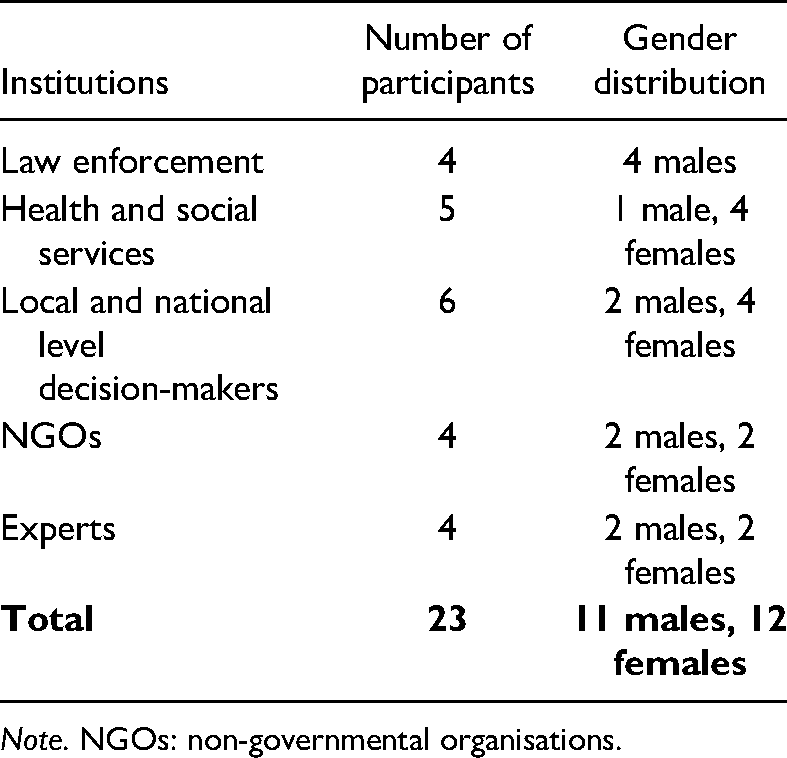
Note. NGOs: non-governmental organisations.
Qualitative interviews started after obtaining approval from the THL Ethical Committee in February 2020. Also, some participants were required to get ethical approval from their institutions. Invitation letters were emailed to key actors in the DCR policy process, and then the sample size was expanded with recommendations through the snowballing technique. Seven candidates refused to participate in the study, while 12 did not respond to the invitations (mostly opposition groups). During the research, COVID-19 had emerged, which affected the time frame of the study and settings. Although the data collection period was planned to last four months, the unexpected situation extended the process to eight months. Thus, the research was conducted between February and November 2020.
Semi-structured interviews were conducted with 23 people (lasting an average of an hour) – 11 males and 12 females (Table 1). While 12 of the interviews were conducted face-to-face, the rest were carried out in online meetings. The participants’ sectoral distribution involves four key actors from law enforcement, five from health and social service providers, six decision-makers (including politicians), four from NGOs, and four from field expert networks (academicians and researchers). The data were analysed using the Structured Framework Analysis technique (Ritchie & Spencer, 2002), which involves a sequential step process of reading and re-reading interview transcripts until the researcher becomes familiar with the content.
Data were then analysed using the NVivo software package (version 12) through line-by-line manual coding of meaning units to create themes in an inductive process. The thematic analysis enables us to identify patterns and themes within the data. After subsequent iterative rounds, themes were merged into the larger parent codes when patterns and links were identified (Evans & Lewis, 2018). Co-authors are involved in validity checking of the analysis and interpretation of the key findings (Cho & Trent, 2006). Finally, the participants’ anonymity was assured by removing personal identifiers, such as their roles and positions, but their sectoral information was kept to shed light on their professions. In the following analysis, we use quotations from the interviews to support and illustrate the analytical findings.
Results
Problem stream
Kingdon argues that the government pays attention to only some of the social problems that reach a certain level of awareness among many other issues. If a condition becomes a defined problem, it might get into the government agendas and necessitate government action (Cho & Trent, 2006). Essential constructs for the problem streams include social and economic indicators, focusing events, crises or symbols, and feedback. Nevertheless, indicators do not speak for themselves; their interpretation plays a significant role in the problem stream. For instance, drug data need expert interpretation to understand what they indicate about the facts (Lancaster et al., 2014).
Since drug prohibition is believed to stigmatise PWUD in Finland, the primary expectation from DCR is to connect these people with public and health institutions. A harm reduction expert says, I think that there are many persons outside of the services, even if we have quite a good network of low-threshold health service centres, needle exchanges in Helsinki and Finland, but we estimate that they can reach around 50 to 60% of injecting drug users in Finland.
While DCRs are mainly developed to reduce overdose drug deaths worldwide, they would not be considered a primary goal in Finland because buprenorphine constitutes the leading substance for drug deaths, where an overdose immediately after injection is unlikely. Nevertheless, over the past five years, the proportion of under-30s in drug-related deaths has risen from 33% to 49%. Moreover, drug-related deaths have increased in the last four years, and are clearly above the European average (The European Monitoring Centre for Drugs and Drug Addiction, 2020). Experts respond to these alarming results mainly with a prohibition drug regime, which inhibits PWUDs from getting timely health support when needed.
A local level decision-maker and field expert in Helsinki municipality simply outlined the expectations for DCR and said, We need this kind of day centre based concept and rooms more here in Finland so that we can … make a connection to these PWUD and … build trust between PWUD and … the system, and we can give services, and we can help them better their life situation and their health and this kind of thing. There is a problem, there is no treatment for stimulant users at all … only opiate users, that's okay … but a lot of people are using amphetamines and stimulants and you don't have any treatment for that one … that's a problem.
The treatment protocols constitute another barrier for service entry, which left problematic users behind. An expert from an NGO health provider describes the difficulties for PWUD, “they have to prove that they earned that treatment. If you have too few points (on a scale), then you are not … sick enough”. Moreover, the minimum requirements for reaching treatment, such as full sobriety or abstinence, are too high to keep these people in the health system. A policy expert says, how you are offering these services … what do you demand from the patients … the whole abstinence … they are defending the whole abstinence, even from … like cannabis. And it's not like reality. And it's not the thing … they are not dying because of the cannabis in Finland right now.
Participants generally agree that the establishment of DCRs would produce several benefits to society and PWUD, including, but not limited to, fewer public order problems and public drug use, fewer residuals of drug injection equipment in public spaces, more treatment demand, and better health care services. Nevertheless, it seems that these issues would not constitute substantial leverage for policy change. It is believed that drug use becomes a policy issue when considered a larger “environmental” problem for society. For instance, more than 20 years ago, HIV and other blood-borne diseases became a public concern during the low-threshold service discussions since it rapidly increased. The costs of expensive HIV treatment and public health risks opened up room for discussion and policy change, but the situation for DCRs is much more complicated (Tammi, 2007).
According to a harm reduction policy expert, That's not the case of course with DCR at the beginning of … I mean the same kind of discussions was much earlier. It included HIV. Maybe it was something that people were not so much against because they were afraid that it would easily spread to the whole population. If you don't get it ready in the beginning … and they stopped … it's a good idea to put money into it even it goes for the drug users … Because then it stays there. And it's not spreading. But you don't have that kind of thing here now.
Perceptions are at the heart of the framing of the problem because only agitated remedies turn to conditions to be problems . During the definition process, problems are categorised and placed in a value context, enabling interest groups to participate actively. Since it is a dynamic process, problems can emerge and fade quickly (Greenfield et al., 2004).
It seems that the public and government sectors do not pay enough attention to the identification and conceptualisation of the problem by the experts. There are certain times in Finland to talk about high-risk PWUD in the media, such as releasing annual drug reports and news related to misconduct by PWUD in public spaces. Remarkably, after the publication of comparative drug-related death figures across Europe, Finland's situation makes people think. One of the field experts depicted this situation that might be used as leverage: … overdose deaths are growing … the number of problematic users is growing … everybody is very unhappy with the situation … and it's an easy way to show that we are trying to do something when we are launching something new.
Kingdon suggests that “problems are often not self-evident by the indicators. They need a little push to get the attention of people” (2003, p. 94). Significantly, media could make the problem more apparent and even create an alternative problem definition by labelling the issue from different perspectives. For instance, media attention and definitions extended the methamphetamine problem in a broader social context when presented as an “ice epidemic” in Australia. It became a national crisis and changed the pre-existing perception of the case compared to the experts’ approach (Lancaster et al., 2014).
An NGO leader says: I am not sure because the problems are perhaps not so big in Finland, in Helsinki, either so … there have been discussions … drug use or drug users in libraries, in the railway station or elsewhere, but the open drug scenes are not very disturbing in Helsinki, so perhaps it would need some more pressure to open the discussion or make it more positive for this kind of opening.
It seems that public order problems, particularly in the downtown area, have the only potential to attract public interest in DCR development. For instance, a stabbing case in the Oodi library between PWUD attracted lots of attention and was discussed for a while in the national media. Even the library manager proposed a DCR as a potential solution for drug injection in public spaces since it is not only limited to libraries but also other public spaces in this area (Sinisalo, 2020). Furthermore, when study participants were asked which is the better strategy for policy success, most of them agreed that the security, safety, and cleanliness path would be better DCR argumentation to initiate public discussions and make progress.
Policy stream
The policy stream is a stage where proposals are generated. In a “policy primeval soup”, some ideas and solutions are selected, developed, and formed for further discussion while the rest are eliminated (Lancaster et al., 2014). It is more likely that problems reach the government agenda when solutions are at hand (Greenfield et al., 2004). Nevertheless, proposals that survive within the political stream need to be technically feasible/doable within budgetary and other constraints that are appropriate to the dominant values and national mood and acceptable for political support (Duke et al., 2013). For instance, among several DCR options, the integrated model seems to fit the Finland context better. The majority of the participants defined DCR as more likely an integrated facility that targets hard-to-reach and hard-to-treat people. A tailored DCR model similar to that in other European countries is inferred, which is believed to “serve the sort of the worst of the users”. Participants conceptualised the DCR as an inclusive institution to reach marginalised people who are out of reach of the current programmes. Based on budget constraints, even extended services such as sheltering, washing machines, and food services are inferred, but essential health and social services that ease the daily lives of PWUD were stated as the core functions.
Kingdon defines the key constructs by policy communities (parliament committees, bureaucrats in government institutions), academics, consultants, and analysts of interest groups. These people are characterised by a relatively small and intimate circle of specialists who know each other well (Greenfield et al., 2004). They recombine ideas in the policy stream from previous research outputs and familiar elements into a new proposal (Lancaster et al., 2014).
A general tendency among stakeholders shows that, except for abstinence-based drug treatment providers, there is a strong willingness to establish a DCR among service providers, with varying expectations.
A police officer revealed a law enforcement stance in this initiative. According to him, a potential opponent would be law enforcement since people “… tend to believe the police are against …” and he defines law enforcement as standing “somewhere in the middle, maybe a bit more on the conservative side” on this issue. Even in the “carefully” crafted law enforcement statement, they did not reflect an opposition to DCR. Instead, they pointed out the legal gap when implementing the programme since: the police force is the one institution or organisation … who's going to handle the things belonging to that grey area. And for us, that's kind of a major problem because … every single action we do as police should be based on law … laid down by the law. I think everybody, in favour of a way, was … on behalf of that idea … but the discussion ended up in legal structures because drug use is still illegal, even in places like that. And we need to change the law first. There is no … when the law says that whenever a crime has happened, the police is obligated to act.
A bureaucrat in a ministry does not expect an institutional level of resistance because according to him, Police opposition would be a little bit surprising since key players who are leading the investigation in law enforcement and even prosecutors see the needs.
Leadership
According to Kingdon, policy entrepreneurs play an essential role in “softening up” the stages in policy development since they negotiate and broker the ideas for alternative solutions. Moreover, when the policy community is not ready for change, they also prepare and educate both the public and specialists on problem recognition and solutions (Guldbrandsson & Fossum, 2009). Besides, they couple these threads since the three streams are disconnected. They are skilful in bringing people together to reach some sort of consensus and agreement on policy change (Duke et al., 2013). Nevertheless, this happens only under exceptional circumstances when the policy windows are open.
Policy entrepreneurs are known for their three distinctive characteristics. First, since they have the expertise, they can claim a representative role, particularly legitimacy for speaking for others, though they hold a decision-making position within their organisation. Second, they have political networks and negotiation skills. And finally, they are persistent in keeping the issue on the agenda (Duke et al., 2013).
An expert network advocated public discussions and government negotiations during low-threshold service development in the 2000s (Tammi, 2007). Nevertheless, there is no such platform or institution behind this initiative that is actively defending and leading discussions. Instead, a couple of individuals, namely policy entrepreneurs, are known for advocating DCR in the public realm. However, since the issue becomes a national issue and requires parliament-level policy change, strong leadership is vital in this initiative.
Many of the study participants underline the importance of leadership at the individual or institutional level in this initiative. For instance, a policy expert from a ministry said that “it would need strong leadership in the sense that it would need a reliable organisation … who would take it forward”. A senior health expert from a private service provider explained the challenge of why institutional leadership is missing, Because those parties who have not taken a clear side on this matter … they are sort of afraid to make up their mind until they know … the general population will sort of … we’ll have enough supporters in the general public.
Drug use is still a conservative issue to discuss in Finland. A female expert in an NGO said, “it's basically the stigma. You don't want to be stigmatised, as a pro-drug person, for example, like politicians, it might be like political suicide if you start advocating …”. A police participant pointed out the risk that institutions could take, Anybody willing to take the flag and carry it … It's gonna label you or the organisation you are representing … This is not the only thing in Finland that is sort of a highly debatable and lacking current clearly defined leadership.
The Finnish Institute for Health and Welfare (THL) is the most preferred organisation by study participants that should take part in the leadership position since it is known as a reliable health authority for the majority. Even some experts from THL are known for advocating DCR policy and have a leading role in public discussion. On the other hand, some senior experts suggest that ministry level advocacy would be a viable option in this policy process. For instance, one member of senior law enforcement said, We as a nation, we are maybe more susceptible to new ideas if they are introduced by the central part of the government system because then it will tell people that this thing has gone far at the government level … the necessary process has been duly noted and taken. And there is necessary backing for legislation, funding, and the actual staff who would be operating in those facilities.
Costs
The costs are referred to as both an opportunity and a barrier for this initiative. While the operating expenses of DCRs will constitute the main barrier to their establishment, particularly after the COVID-19 pandemic, the health-associated costs are cited as a benefit for society. A politician underlined their decision-making challenges, When we build a DCR, it's the money … away from something else. And it's maybe for some politicians; it's difficult to decide where should the money go … from DCR to other children's schools or social other social and health care?
The counter-arguments suggest that besides the drugs, the administration of drugs (filter usage, vein selection, etc.), an abscess leading to amputation, and needle exchanges leading to HIV and Hepatitis C cost a lot to society compared to the operational costs of a DCR. “One case of HIV the country a lot of money. One positive HIV costs a lot of money to take care of, and, you know, treatment in hospital is expensive”, a harm reduction expert said.
On the other hand, the COVID-19 situation has affected governments in many ways during this pandemic, and study participants think that DCR will be in jeopardy. Some estimate that DCR could return to the policy agenda when the COVID-19 issue becomes normal. Since most of the available funds are used for the pandemic, the PWUD subgroup will be the last to get the money, which may take several more years. Even for politicians, it would be challenging to explain spending public resources for this subgroup instead of the general population.
Local initiative
The Helsinki city initiative is also seen as an advantage for DCR development; otherwise, it would be more difficult to initiate this policy from scratch at the national level. By already having a volunteer, the national government does not need to invest much money to test the DCR project. Still, for a complex policy, there would be less resistance during parliamentary discussions. A university professor said that, while Helsinki “is facing the biggest problems in this area in Finland”, it is a very natural response to solve this problem at the local level. Consequently, a local pilot project would not bother the rest of society so much. And if it fails, it will be easier to complete it at the local level without broader consequences. Since the results and social reactions are not foreseen at full range at this stage, politicians are less willing to be involved. Thus, our results indicate that a pilot DCR project best fits the political context to evaluate policy outcomes.
A policy expert emphasised the challenges politicians face: If this is going to be a disaster at some point, it's not going to look good, and you have to pay the price for that in … the next voting or next time.
Could this be … kind of a hot potato that you don't want to put on the table? Now, if there is some bigger problem inside of the government, and they are afraid that this could be a difficult thing? Even though I know that they are aware of that … experts are in favour of this.
Political stream
The political stream is crucial to determine whether a policy idea or proposal is worth enacting and opening policy windows. Critical constructs of this stream are structured by political forces and the national mood, which swings to the left or right of the political spectrum at any one time. It emerged from public opinion, organised political processes, governmental changes, and different consensus-building forms (Duke et al., 2013).
Change in public opinion
According to Kingdon (2003), the national mood affects the political stream since changes in general public opinion lead to political movement and create new ideas. According to the latest national drug survey (Karjalainen et al., 2020), 50% of the participants in Finland totally or partially approve DCRs, and 36% of them said they do not support it, while 13% of them have no idea. Primarily drug use is an urban phenomenon, people living in bigger cities are affected the most by the drug problem (Smith et al., 2019), which shows that the larger the city is, the higher the approval rates are in Finland.
Since problematic drug users are concentrated in certain areas in Helsinki, most city residents have no experience with them. Hence, when some are not even aware that the problem exists, it might be unrealistic to expect them to understand the necessity of DCRs. While they are waiting in long lines at health centres, giving extra services to this subgroup might not seem fair and welcome.
A policy expert in one of the ministries said, We also live in a bubble, where we think that if it's something in Helsinki Sanomat and mentioned five times, everybody knows, but no … not everybody knows … I think Finland doesn't have an opinion because all, like maybe even 10% know that the whole thing exists.
The drug problem is not so visible in Finland; you meet addicts in big cities. We from the police side know … from the wastewater analyses that drug use is everywhere … it is causing problems in the northern part of Finland. But that is not something for … let's say … ordinary people to understand because they don't face the problems.
One of the significant challenges in this policy process is the lack of awareness of the drug problem in society. According to a politician, “Most people who are opposed them have never, ever been involved in the problem more than … moral panic”.
When we investigate the underlining factors of moral attitudes, the main arguments include fear of the unknown, fear of insecurity, prejudice against the drug problem, religious-based attitudes and norms, NIMBYism, and conformity to populist views. According to a health field expert, “they probably don't understand the seriousness of the situations that people are in, and they’re saying that it's … self-caused … so why should we put money into that?”
If the public does not appropriately recognise the problem, they tend to label DCRs as fearful, terrifying, and awful policy decisions. For instance, religious communities tend to be against DCRs. According to a senior politician, “church is quite an authority in moral issues, and even though I think this is a public health issue … there is a part who will say no because God does not want it”. Therefore, it is a safer way for politicians to adopt a stance and attitude that fit social expectations. She explained the rationale of opposition as a safer policy response, “it is a message that we punish them so that nobody thinks that we support drugs”.
A university professor summarised the dilemma that Finnish society faces, Finland is really such a strange thing that we are coming so late in that because otherwise, in social policies, Finland has been very progressive. We have been fighting poverty, homelessness, many things very successfully, but in the drug area, there has been a very tough attitude towards drug users and the sort of very individualistic liberal idea that people are the masters of their own lives, and if you spoil your life, you should not get health (services) …
Our findings show that more discussion is needed to increase public awareness. This is the phase where policy entrepreneurs should participate and “soften up” the ideas and proposals according to their values and ideological preferences. Nevertheless, the limitations mentioned above prevent stakeholders from taking a more vital role in policy development. The media also has a bridging role in the gap between research and policy and legislative change (Lenton, 2007), but their involvement seems to be restricted to sensational news involving PWUD in public disorder problems or individuals who ruin their lives.
Social change
Although resistance exists that is evidently related to a lack of awareness in society, many study participants said that it has been changing. According to a senior health expert, “usually, in Finnish society, there's always something new. Like this comes up or introduced … there's opposition. And then some years pass by, and we will get used to … usually people turn to be favourable.” The most-mentioned progress in the harm reduction field is the opening of low-threshold centres about ten years ago. A CEO of an NGO described the discussion at the time, There was that kind of … debate or discussion going on with law enforcement and social health care people. Is that wise or not? When the law enforcement side realised that a needle exchange programme got the HIV figures down and also in many diseases, so we could see from the figures, the statistics, that is a good thing.
On the drug issue, it is argued that social attitudes have been changing on this issue in Finland. A professor said that “awareness is rising, people are also starting to see that we do nothing, it's also a choice. … people are seeing that these problems do not disappear. And it would be better to simply provide a service”. Nevertheless, a decades-old strategy, expecting PWUD to stop using drugs from a moralistic perspective, is not a realistic approach. Experts agree that society needs to face the facts and the situation and then act. A field expert in municipalities added here that, The concerning situation that we have in Finland with drug users, people are dying more of drugs. I think we’re thinking that we need a new way of thinking. And I think now on the level of people who work in this industry, there are fewer and fewer people who are against DCRs.
A similar observation has been reported by a policy expert, who concluded that society would consider doing something more instead of being unresponsive, Still some, of course, are against them, but most people now realise that that's something that's needed. It's also good for society, not just for drug users. And this consumption room thing, it's a new for Finland, it's no longer new as a concept. And you will probably need more open discussions and meetings.
A politician expressed her experience of how circumstances have changed over the years, but included her opinion that the conditions for transformation have not yet been met. The atmosphere has changed a lot. When we made this suggestion or initiative a few years ago, most of the newspapers (wrote) … an interesting idea and tell me more about it, and then many others (followed). It sounds good, but 10 years ago, there wouldn't be any newspaper or any media that would think this was an interesting idea. So, the atmosphere has changed very much in 10 years, but it still needs maybe another 10 years to do it.
The generational difference is the critical factor in social change, even for policy change. Although social change has been observed in drug attitudes, it is argued that it is more likely related to generational differences. A young activist explains the variation of perspectives between generations, It's a certain generation … certain age group, who may be from the 80s, when it was really aggressive … against drugs. So, people who had it, they’re using the 80s (arguments) … using drugs is dangerous. And so, it's some kind of generation that is against it, but equally, like my generation, from … the beginning of the 2000s. So, my generation is more open about these things.
A young politician identified that if there were a policy change, it would only be possible with the young generation. He asserted that, Younger people have more liberal attitudes about drugs. So, when they grow up and get old, of course they will probably have the same view. So, when time passes, young leaders will come into power, and they will make the changes.
Current government period
The electoral cycle is a natural policy window for stakeholders to change policy (Kingdon, 2003). A ministry expert said that “we now have a government … who is quite favourable to this kind of action at the moment. So, the ones who advocate this should use their … kind of momentum here … within this government period”.
This is also an opportunity for Finland since the current prime minister is one of the world's youngest. It is believed that the five coalition parties led by young female politicians have a chance to enable DCR during their term. A police officer said that “we get more young people to the parliament, as we have now, so the debate might go further on”. Another police officer added “the current government is … in any of the things … it's been so far quite liberal and open-minded. So that's maybe the equalising thing or thing that would enable this thing to go through”. As such, a young politician has high expectations: “the current government … the left … left government is probably the only one who can make this”.
On the other hand, senior-level politicians have some doubts about it. According to a senior decision-maker and local politician, it would not be so easy: What is difficult in the government is that there are five parties, and for instance, Keskusta (the centre party), I could see that there are a lot of people who come from the rural areas … who don't say that this is beneficial at all. So, if they are going to be strongly opposing it in the government, then the others will have difficulties to take that leadership alone.
Legislative changes
Since substances are controlled through criminal law due to the international drug control regime, it is harder to formulate new ways to manage the problem other than legal substances such as alcohol and tobacco (MacGregor et al., 2014). Hence, there is a consensus among stakeholders on the DCR policy that a legislative change is required. Nevertheless, a criminal law professor points out the possibility of establishing DCR without legislation: The drugs crime definition and the sort of drug use … prohibition … is a bit like a contextual thing … that there is a possibility for diversity. So, dropping cases, if the circumstances are such that there's no real motivation for prosecuting the use if it's only consumption for yourself. But then it was sort of cleared and discussed with the state Prosecution Service and with the police, and they took the stance that it would actually still require a legal framework.
This choice, however, is believed to better fit the social structure of Finnish society. A CEO of an NGO said, Finnish society is very legalistic. So, we obey all the laws very carefully, even with the traffic, if you have noticed … so because it's against the law, the use is also against the law, the possession is against the law and criminalised …
There is a broader concept or subject in the drug field to discuss in the background of these legal issues. A young politician said, Now the discussion is more about changing the general narcotics legislation and the crime law. So maybe somehow we first have to have this political discussion about this general attitude towards drugs and narcotics and how we will in the future handle this case.
EU standards
Being an EU member country is also a driving force for policy change in the drug field. Since the EU aims to use comparable indicators for policy efficiency among member states, some results, such as drug-related deaths, are interpreted as a consequence of the strict prohibition regime in Finland. A policy expert defined the motivation for adopting the EU approach in the drug field: We don't want to be … left behind in the European Union, but … we don't offer these services (that are) good and proven to be good … but we are not actually looking very good … in statistics in Europe, comparing how many people are in OST, and how many problematic users we have in Finland … that's one of the main problems.
Finally, a senior politician stated that compared to other harm reduction services, Finland is far behind its counterparts: The usage in Finland changes. That there we have a bit lost or forerunner status because when we started to have the health advice and low-threshold services in Finland, then we were among the first ones in the world, I think … at least in Europe and now we are a bit backward.
Drug strategy
The reformulation of drug strategy is in the current government programme. The latest modification occurred in 1997, which strongly promoted the introduction of low-threshold centres. During those discussions, experts recommended a low-threshold service, which facilitated their establishment. Therefore, there is a similar potential to include DCR progress in this new drug strategy plan. During the reformulation of the more than 20-year-old strategy document, the current drug situation will be evaluated in depth, and new approaches to solve the expanded drug problem will probably be discussed. A policy expert in one of the ministries said, “it could fit in there quite well, but now at the moment … to be honest … I don't see that there is that much interest in the ministry to do that …”.
Discussion
According to the framework all three streams need to converge to open policy windows and determine actions among potential solutions. Each stream has different dynamics and operates mostly independently. Streams are merged when “policy entrepreneurs” take advantage of short opportunities. While the agenda is more affected primarily by the problem and political streams, alternatives are affected more by the policy stream (Greenfield et al., 2004).
Potential opportunities and barriers from the stakeholder perspective are listed in Figure 1. Though most of the indicators are stable, four of them act as mediating factors, including leadership, moral perspective, social change, and generational differences. The lack of leadership and moral issues more likely constitute barriers for DCR, whereas social change and drug attitudes of the young generation are opportunities for policy change. Nevertheless, their positions are highly affected by the political context and how the problem is framed. For instance, Jauffret-Roustide et al. (2013) have presented how consecutive surveys, framing the issue in different ways, showed differing levels of social acceptability of DCRs among the general public in France. A similar study in Canada shows that, although the primary objective of the DCRs is to improve the health outcomes of PWUD, the public is more likely to be in favour of DCRs when they present the facility as effectively reducing public order and nuisance problems (Kolla et al., 2017).
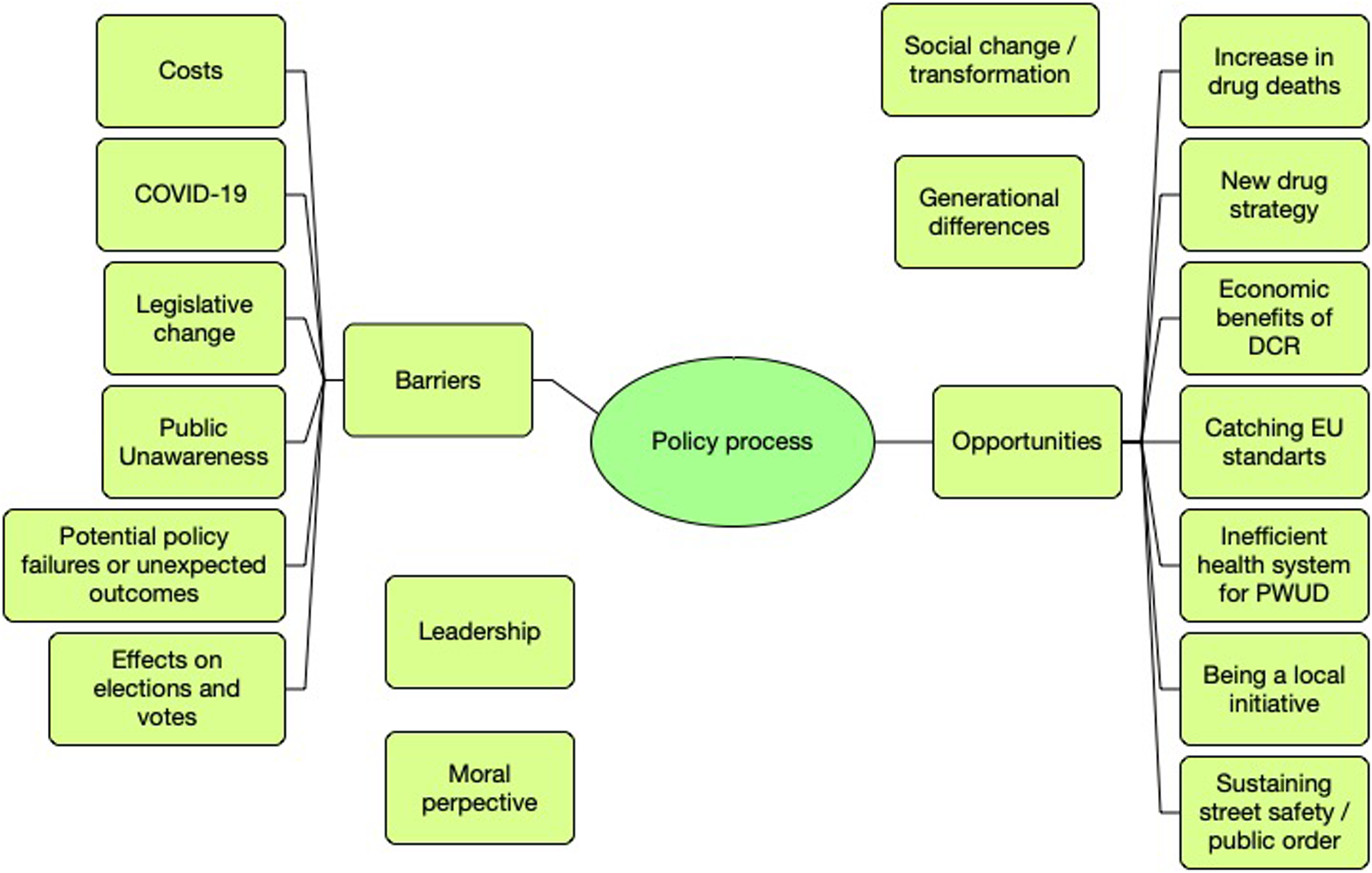
DCR policy opportunities and barriers in Finland.
Nevertheless, there is no clear strategy for framing the initiative at this stage. Despite variations, experts generally agree that framing DCR from a security perspective has the potential to produce better results in its establishment. While there is no visible leadership or coalition network, policy entrepreneurs may initiate forming this type of framework and determine a policy strategy.
The key action for DCR policy success in Finland is the enactment of the law. The statement of law enforcement and the General Prosecutors Office constituted a strong response to the initiative, which puts legislation at the top of the “primeval soup”. It made the initiative politically and technically complicated, which also fits the national mood, which frames the drug issue more likely from the criminal justice perspective.
According to Kingdon, two types of participants have the potential to affect the agenda settings. While visible participants (such as politicians, commentators, political parties, and campaigners) attract media attention, hidden participants (such as researchers, academics, career bureaucrats, government advisors, and staff) work behind the scenes, shaping the details of the policy alternatives (Duke et al., 2013). To put it differently, visible participants have a significant influence on agenda settings, but hidden participants have greater control over policy alternatives (Lenton, 2007). However, our findings show that visible participants (particularly political parties) refrain from taking an active role in policy development and keeping the issue on the political agenda. As the theory suggests, they are waiting for an opportunity to act while the policy windows are open.
According to Kingdon, policy windows are generally open in the problem and political streams. If there is an available solution waiting in the policy stream that matches a problem, advocates and experts can push the proposal to make it possible for its enactment during open windows (Lancaster et al., 2014). An increase in drug-related deaths and public order problems downtown becomes a public concern when they appear in the media. Nevertheless, improving the health of PWUD is still considered a stigmatised and value-oriented issue. While these concerns keep DCRs out of the political agenda, field experts have a model in mind ready to introduce when conditions are available.
However, without active participation, the actors will not find an open policy window. Despite Kingdon's assertion that the three streams operate independently, it is argued that stakeholders’ involvement in one stream increases the likelihood of their participation in another stream (Lancaster et al., 2014). Particularly, the participation of researchers and practitioners affects not only problem identification and definition but also developing policy responses over time. As such, linking readily available solutions to the “problem” and “policy” streams is not an easy task that can be handled in the political stream without them (Lancaster et al., 2014). Thus, in other words, if stakeholders are waiting for an opportunity in the political stream, they need to be more active at another stage to push the DCR issue onto the agenda by increasing public awareness, problem identification, and reframing.
Our results show that the DCR discussion is closely connected to the reformulation of drug laws and drug decriminalisation. While the renewal of the drug strategy plan is on the government agenda, it will be better for policy entrepreneurs to initiate public discussions in a broader context and present the expected outcomes of DCRs. There has already been a citizens’ initiative for cannabis reform, another force pushing for the government to enact a drug strategy. The engagement of public interest will in turn influence politicians on both decriminalisation and the establishment of DCRs.
Lancaster et al. (2014) claim that “Kingdon underestimates the role of the media in influencing the agenda and policy outcomes” (p. 165). Their research findings showed that the policy community and decision-makers were more likely to respond to the media when they identified and framed the problem at the national level. Moreover, the media has a dynamic function in distributing the voice of politicians and the public reciprocally in the political stream. Thus, policy entrepreneurs should also focus on media involvement in the process to trigger the policy process.
The multiple stream framework is criticised for not being a causal theory and undermining the role of the agency impact, particularly political actors as the driver of policy development (Sabatier, 1991). Nevertheless, as seen, even a local initiative can be blocked by national regulation despite local authorities approving it. The viability of DCRs is tied to a parliamentary decision, which requires legislative changes in the law. Thus, national agencies have strong administrative power over local authorities in structuring harm reduction services.
Although it is a non-incremental theory, the multiple stream framework's alternative specifications enable applying it to incremental and non-incremental processes. The softening process opens up space for existing policy options or their combination with alternatives, making the framework incremental to a greater extent. Similarly, it is argued that a policy stream contains several small streams such as strategies, goals, feasible solutions, and resources, which requires greater explanation since it is not a simple model (Rawat & Morris, 2016). Official feedback (such as annual drug reports), comparative statistics among EU member countries, and citizen initiatives for cannabis reform are the major pushing forces to keep the drug problem on the policy agenda. The reformulation of the drug strategy plan has the most potential to open windows for discussing DCR establishment. As experienced in the past, recommendations by the expert committee of the national drug strategy plan may nevertheless keep the issue on the table. As most of the study participants suggest, more public support and discussions are required to motivate politicians. Since the problem stream, the policy stream, and the political stream have already developed towards accepting the DCR, there is still the need for an extra booster such as a crisis or other “focusing event” – e.g., a strong increase in drug deaths or a dramatic public order problem downtown – to get politicians and political parties to make a move and assert leadership in furthering the process.
Limitations
Although English is widely used in the public and private sectors in Finland and participants generally have good language proficiency, expressing ideas in a highly technical and political field out of their mother tongue might bring some limitations. To sustain these limitations, the interview transcript would be available for clarifications and corrections when requested.
The participants interviewed after the emergence of COVID-19 asserted a potential impact on future policy decisions. While the study includes these concerns, the initial interviews did not reflect this progress well. Furthermore, because they belong to a closed network, the participants might have information about the research, and the extension of the data collection period might have affected their responses.
Finally, participants in favour of the DCR were more likely to contribute to the study, while potential opponents refrained from discussing their arguments. Politicians mainly prefer to express their opposition but are not willing to discuss it in detail. We found that they might consider more contextual factors than the potential benefits or harms of DCRs. Their stance may change according to the political circumstances, but they may hesitate to position themselves earlier while no policy window is open.
Conclusion
Multiple streams is a framework that examines how a specific issue is problematised, by whom, and how the solutions emerge as a consequence of stakeholders’ contestations. It allows policy analysis beyond the jurisdictional and institutional boundaries (Lancaster et al., 2014). By applying the multiple streams framework, our results show that experts’ DCR problematisation is still beyond the public and political interest, which needs additional efforts for problem identification and prioritisation. Besides public unawareness, the COVID-19 situation seems to be postponing policy progress since the primary attention and available funds have already been dedicated to public health.
Although auspicious circumstances in each of the three streams are necessary, they are not sufficient for policy change. If they are not converged quickly when policy windows open, the opportunity passes (Greenfield et al., 2004). Already having a local initiative and an upcoming drug strategy plan might be good formal leverage, but unexpected events might also trigger discussions. Better framing will motivate policy entrepreneurs to take an active role and facilitate policy development. When conditions are met, political interest would involve and shape the available solutions based on the national mood and public expectations. When participants were asked to evaluate the time frame for this process, their expectations ranged from two to ten years within the Finnish context.
Footnotes
Declaration of conflicting interests
The authors declared no potential conflicts of interest with respect to the research, authorship, and/or publication of this article.
Funding
The authors disclosed receipt of the following financial support for the research, authorship, and/or publication of this article: This work was supported by The Kone Foundation (grant number 201906595).
