




Abstract

When I became editor-in-chief for Nordic Studies on Alcohol and Drugs (NAD) at the beginning of 2017, one of the first needs I identified was to provide some sort of support for qualitative papers. These papers difficult to orient in the right direction and therefore demanded a lot of resources from the journal. Why this is the case is a question that has been written about extensively both in this and other journals (see, for example, Hellman, 2017; Järvinen-Tassopoulos, 2017).
In the field of addiction research, a main problem for qualitative and theoretical work has been that applied research, psychology, epidemiology, and public health are the epistemic mainstream. These traditions lack a strong engagement in conceptual and constructionist work. The result has been that qualitative research is the stranger in the room that needs to explain who they are and why they are there. When I started publishing in the addiction field, qualitative papers were to declare their colour preferably already in the title of the paper. Also, long explanations about the nature of qualitative research were required in order for editors and reviewers to comprehend what kind of product they were assessing. Today, I advise authors to exclude all paragraphs in which they justify their work in view of the quantitative dogma. Such justifications may have been necessary in the past, but editors at journals such as Addiction Research and Theory; Substance Use & Misuse; Contemporary Drug Problems and the International Journal for Drug Policy decided early on to publish qualitative research. Over the years, these and many other journals have come to contain interesting and meaningful general discussions on the studied sociocultural phenomena. 1
At least on a superficial level, there seems to be a lot of goodwill toward and appreciation of qualitative efforts among addiction journals. A recent study shows that the best-known and established addiction journals publish considerable amounts of qualitative research: 11% of published research articles are qualitative in 40 member journals of the International Society for Addiction Journal Editors (Hellman et al., 2020). Going into my fifth year as editor, I find that this text summarises the experiences of the NAD editorial office on scaffolding qualitative work in 2017–2021: What have we learned and how do we move on in this endeavour?
The process
In the system that we set up for supporting qualitative research in 2017, both reviewers and editors would help the manuscripts along, both with editing and input. I would book meetings with the authors and go through their manuscripts. This intellectual dialogue is important for developing the contribution but also for understanding the potential of the study at hand. It serves the author directly: the more researchers understand their work as part of a continuous academic discussion, the better their products become. It also serves the journal: it is during this conversation that the editorial office tries to communicate in what direction the author should take their work in order to raise the likelihood of becoming accepted. This is part of a very first step in the evaluation process: this is where editors form an opinion of the likelihood of getting a manuscript of publishable quality and where they assess the extent of their own resources in the process.
Table 1 lists the typical questions posed in the different stages of editorial considerations: in the first rounds of evaluations, in the mid-process and in the last stages of the process. Typically, the NAD editorial office shows a lot of goodwill toward its authors, and they are given many chances to show the potential of their work during the evaluation processes.
Typical rounds of considerations in Nordic Studies on Alcohol and Drugs’ handling of qualitative research manuscripts.
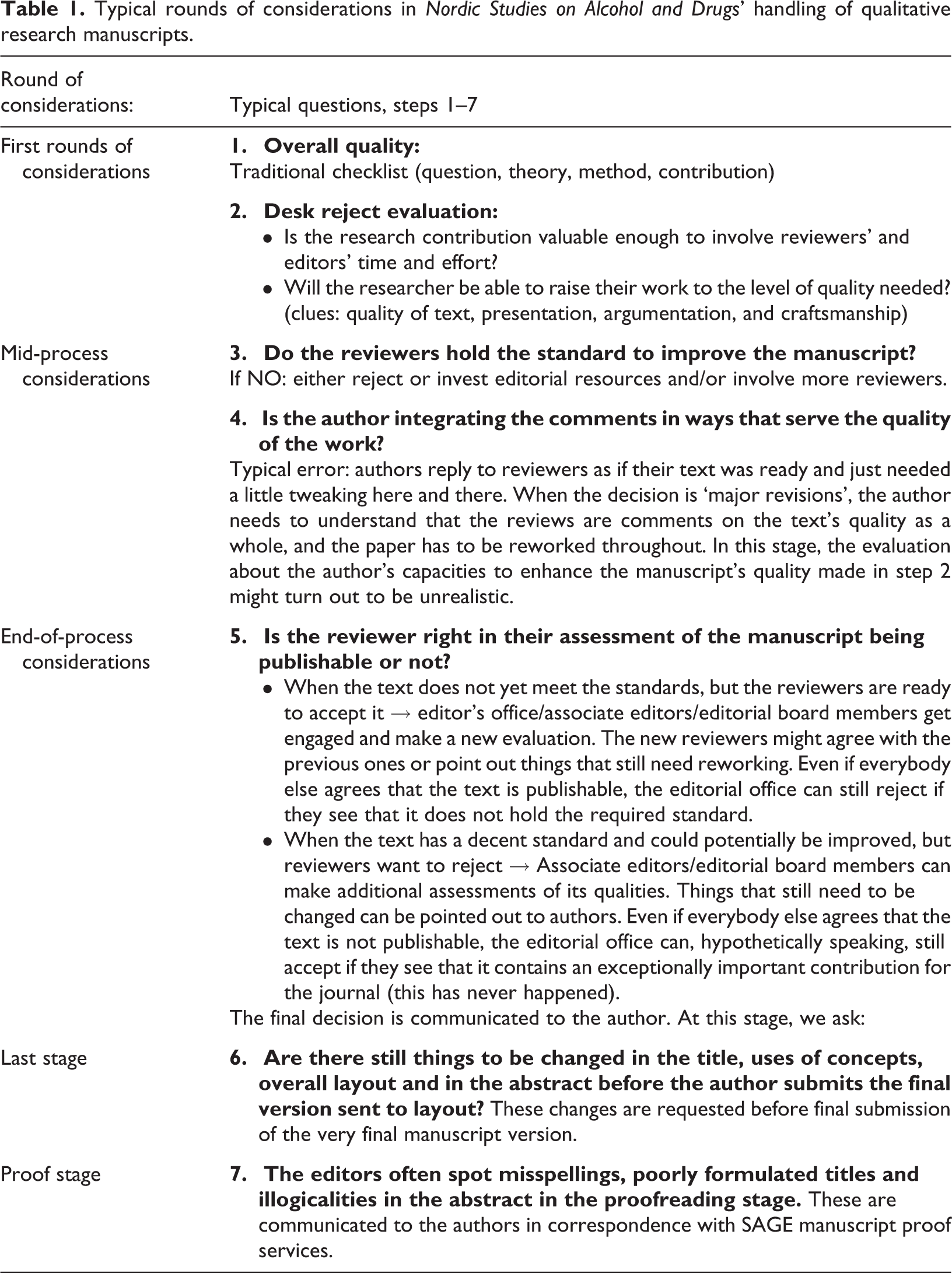
There are several more or less technical checklists and guidelines, both specific for the addiction research field (Neale & West, 2015; Pates et al., 2017) and more general ones, such as Consolidated Criteria for Reporting Qualitative Research (COREQ) (Tong et al., 2007); Qualitative Research Review Guidelines (Clark, 2003); and the Critical Appraisal Skills Programme (CASP, 2018). In the area of medicine, a technical synthesis of criteria has been gathered by, for example, O’Brien et al. (2014). In the area of medicine, Korstjens and Moser (2018) summarise quality criteria “for all qualitative research” as credibility, transferability, dependability, and confirmability (p. 120). They declare that editors tend to use the criteria: is it new, is it true, and is it relevant? In what is described as a historical moment, the APA Publications and Communications Board Task Force published in 2018 standards for qualitative article reporting. Such reporting “describe[s] what should be included in a research report to enable and facilitate the review process.” (Levitt et al., 2018, p. 26). The standards are argued to be useful for “a broad range of social sciences” (Levitt et al., 2018, p. 26), which is far from the truth, as these guidelines take us only through the first stage of the evaluation process outlined in Table 1.
While all of the above guidelines are formulated with good intentions (though often with astounding ignorance and in a paternalistic tone) and are indeed good technical orientations for authors, they only function as checklists for authors before submission and for editors in the early stages of first-round considerations. They can obviously be revisited during and especially at the end of the process, but basically, they do not contain the massive bulk of criteria for assessing qualitative social scientific work. In my estimation, these lacking criteria make up around 70–90% of the criteria upon which the quality of the work is assessed, at least in the social and political sciences (excluding psychology).
Our system of providing support for qualitative research has strengthened the editorial office’s view that quality assessments build on much more subtle and complicated circumstances than the ones covered in the standardised criteria and guidelines. An informative article by Jonsen and colleagues (2018) examines more in depth the characteristics that influential academic journals have published in the area of organisational research. Their descriptions could also be applied in general disciplinary journals in sociology and other social sciences.
From the outset, the authors establish that the text is in focus in qualitative research. As the very writing IS what researching is about, it is not enough to just evaluate the research conduct reported. One should also assess the ability to present the research in a convincing and interesting way. The main qualities are found in rhetoric, craftsmanship, authenticity, reflexivity, and imagination. One can learn skills such as the ability to convince, authenticity, plausibility, and cultivating a critical mind from literary criticism and philosophy. In qualitative research, a convincing quality emerges not only from what messages it conveys but also how the text conveys the message. Jonsen and colleagues (2018) looked at how the articles convinced their readers and how the authors articulated their practices, observations, and insights in a manner that reassured reviewers. We share this experience at NAD in terms of the sense of thickness and richness of the author’s knowledge. The reader needs to experience that the writer is aware of the whole spectrum of relevant concepts and ideas but is, for good reasons, only zooming in on a specific question in their well-crafted work.
In Table 2 we have gathered some criteria and advice based on the article by Jonsen and colleagues (2018). What is typical of qualitative research submissions to NAD is that they only identify themes that appear in the studied material but never make it to the meta-level of analysis or second-order analyses. This is a failure that will likely lead to rejection.
Nordic Studies on Alcohol and Drugs’ assessment criteria and advice to authors of qualitative work, partly built on Jonsen et al., 2018.
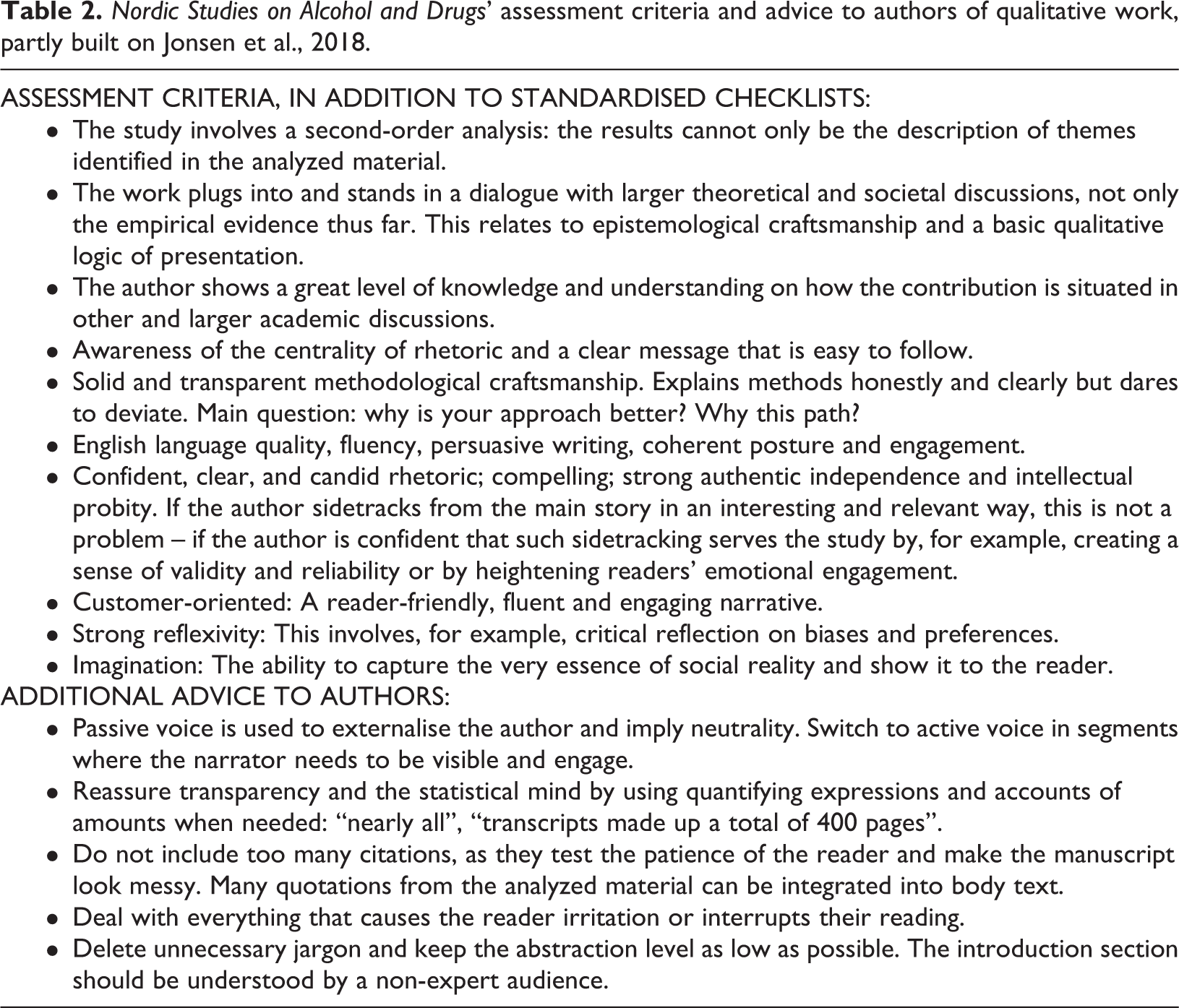
Together, Tables 1 and 2 also help us understand how many elements can go wrong in the review processes. If there are too many people involved with different preferences and tastes and different kinds of standards, the manuscript can become a Frankenstein’s monster filled with different sorts of compromises. If there are too many reviewing rounds, both the author and the editors may become confused about past changes. Sometimes things that were changed at the beginning of the process need to be changed back at the end stage. In these situations the most valuable asset for the author is a robust, responsible editor who is not too much technically and mechanically oriented, who has good editing and writing skills and a clear vision of the standard sought for. A good editor is not always the most demanding, but one who reminds the author that they need not take all of the reviewers’ comments into consideration, as it might weaken the manuscript as a whole.
The way ahead
In the spring of 2021, qualitative papers are still giving us some headaches at the editorial office, and we are becoming increasingly reluctant to use the journal’s resources to compensate for the systemic flaws in Nordic research institutions’ support for conceptual, phenomena-based, and constructionist efforts. We are not alone in these concerns. Colleagues at the International Society for Addiction Journal Editors (ISAJE) have maintained that while they would like to accept more qualitative research, they feel that it does not meet their standards and they do not have the expertise nor the resources to guide it in the right direction.
Now, there certainly other good reasons for why the standard of the papers submitted to NAD is what it is. The best manuscripts are probably sent to generalist and very high-impact journals. Some qualitative work is starting to appear from research milieus which lack a strong tradition of qualitative work. The main issue to be dealt with is making authors aware of the expected standard before submission. If the editors see that there is potential, then they are willing to help the manuscript along. If there is no trust in the abilities of the author to transform their work into something that is publishable, then nobody wants to put in the time and effort to improve the manuscripts. In our editorial office, the goodwill of including qualitative work can only take us so far; often, the main evaluation concerns whether the author will be able to apprehend the flaws in their work and be skilful enough to lift it to the quality standard demanded from a publishable article.
The idea with the system of helping qualitative work along in the NAD journal was that the work would pay off in the end as the standard of the qualitative research would slowly rise and improve over time. Because the targeted scholars were junior researchers, we reasoned that we would see better contributions from qualitative social science research in the field of alcohol, drugs, and addiction. So what we thought we were doing in our small editorial team was compensating for the lack of support and skills in the Nordic universities and addiction research institutions. Nevertheless, and as we have come to realise, this is too ambitious an idea that gives us the wrong role in view of the field that we are serving. Perhaps we are providing artificial respiration to institutions (with more resources than we have) that do not have the capacity to develop high-standard qualitative research. Second, qualitative contributions are now dropping in from authors not trained in the social sciences: sometimes we need to make desk rejection because we see that the authors do not understand themselves what qualitative research work is all about.
NAD’s editorial office has a lot of goodwill: But as the journal is growing, the stakes and ambitions are rising.
In this issue
Ten years after publishing Legalisera narkotika? Ett diskussionsunderlag [Legalise narcotics? A basis for discussion] (Goldberg, 2011), Ted Goldberg (2021) revisits some concepts and events in Sweden’s prohibitionist drug policy model. In this discussion piece, he concludes that, despite the efforts made, Sweden is now further away from the goal of a drug-free society than ever. Access to, and demand for, drugs has continued to increase, and drug policies have caused a great deal of collateral damage.
Sæther and colleagues (2021) identify demographics and substance use among young people in Norway who smoke and use snus. Wenaas and colleagues (2021) have studied the praxis of interprofessional team meetings tailored to the needs of people with substance use disorders (SUD) and concurrent mental health disorders. Surprisingly, users described the interprofessional team meetings as less than useful, and perceived that lacking a targeted process and information hindered their collaboration with professionals. The study identifies the following problems: unclear role responsibilities and unclear professional role functions; unclear practices regarding rules and routines; and absence of user knowledge.
In a study by Mäkelä and colleagues (2021), the phenomenon of alcohol problems is encircled by different types of register data which points out serious underreporting of the total burden of problems. The prevalence of substance-abuse-related healthcare was almost twofold if data on outpatient primary care visits were included in addition to hospitalisations. The authors conclude that there is an evident need to develop recording practices in the healthcare registers regarding substance use disorders.
Johannessen and colleagues (2021) investigate the experiences of health professionals in Norwegian nursing homes in terms of residents’ alcohol consumption and use of psychotropic drugs. Schamp and colleagues (2021) have designed a study for better understanding the barriers and facilitators for seeking treatment as experienced by substance-using women.
Footnotes
Note
Declaration of conflicting interests
The author declared no potential conflicts of interest with respect to the research, authorship, and/or publication of this article.
Funding
The author received no financial support for the research, authorship, and/or publication of this article.
