




Abstract
Aims:
Research has shown that the EU’s politico-legal influence over member states is contained through two political strategies: contained compliance and anticipatory obedience. Previous studies on gambling policies in the EU have quite uncritically presumed that the EU is capable of inducing changes, or even forcing changes, in national gambling policies. In this article, the objective was to investigate whether member states have adopted the two strategies allowing a containment of the EU’s influence on their national gambling policies.
Design:
The politico-legal influence of the Court of Justice of the European Union (CJEU) and the European Commission on national gambling policy is analysed in the case of Finnish monopoly-based gambling policy. The analysis is based on case law and policy documents.
Results:
The results indicate that Finland has adopted both anticipatory obedience and contained compliance when striving to safeguard its gambling monopoly system. Contained compliance was adopted during the early period of Finland’s accession (1995–2001). Anticipatory obedience was exercised between the years 2004 and 2013, a period characterised by several critical legal cases and the infringement procedure commenced by the European Commission against Finland. During the third period (2014-2017), when the merger of three monopoly operators into a single state-owned company was on the agenda, neither strategy was adopted, indicating little EU influence (despite public justifications of the same).
Conclusion:
The EU’s opportunities to induce changes in the gambling policies of member states should not be overemphasised because member states are able to contain the EU’s politico-legal influence. Future analyses of national gambling policies in the EU would benefit from taking the interaction between member states and the EU into account.
This study investigates national gambling policies and their relationship with European Union (EU) law. Several EU member states have reacted to the preliminary rulings of the Court of Justice of the European Union (CJEU) on gambling regulation in widely different ways, even if the legislation applied by the CJEU and the case law based on it are common to all member states. For example, Finnish gambling policy has taken the unique path of strengthening its monopoly system, while many other member states have introduced or are planning to introduce systems based on operating licences. For example, Sweden, France and Denmark have put into force a licencing system in online sports betting. The backdrop to this development is the position of the CJEU and the European Commission, according to which an exception may be made from the principle of free mobility of services, and exclusive rights may be granted in exceptional cases where a member state considers this necessary in order to prevent crime and gambling problems.
In previous research, the national gambling policy objectives have often been seen to reflect EU influence, even though there is no EU-level gambling legislation (Cisneros Örnberg & Tammi, 2011; Järvinen-Tassopoulos, 2011, p. 272; Marionneau, 2015). For example, Marionneau (2015, p. 296) has argued that this is the reason why “France has been forced to open up its gambling markets”. Similarly, in several legal studies of gambling regulation in the EU the CJEU is criticised for being inconsistent in its judgements and for being too deferential to member states, the implication being that the CJEU, if it chooses to use it, has the power to force member states to comply with EU law (Doukas & Anderson, 2008; Lovejoy, 2014). Adam (2015) argues that national differences in responding to the politico-legal influence of the EU can be explained in two ways. First, the “legal pressure” of the CJEU is mediated by the “values, preferences, and views of national judges who either choose to directly subject domestic regulation to legal pressure…or to indirectly upload their assessments to the ECJ [CJEU] by sending references…that already indicate a critical view of national regulation” (Adam, 2015, p. 231). Second, the government ideology explains whether a member state is able to oppose the legal pressure.
These analyses of the politico-legal influence of EU law on national gambling policies are problematic because member states are not presented as actual political actors with the capability to influence the European Commission and the CJEU. In other words, the politics and law nexus is not really addressed. Only Adam (2015) addresses politics through his second explanation (government ideology). However, this explanation does not seem to apply to every member state, because securing national gambling systems has, for example, remained a priority in Finland and Germany regardless of the government ideology (Loer, 2018). Political scientist Michael Blauberger (2014, p. 471) has also suspected that national responses to CJEU decisions “do not correspond to party-political” differences.
According to Blauberger (2012), EU member states have, for their different reasons and in different ways, striven to comply with the CJEU’s decisions while holding on to their national regulatory power as much as possible. Blauberger refers to this phenomenon as regulation “with Luxembourg in mind”. One strategy adopted by member states in the face of legal uncertainty prompted by the CJEU and domestic litigants willing to challenge national policies, is “anticipatory obedience” in which national regulatory autonomy is preserved by revising a policy before legal challenges get worse (Blauberger, 2014; Schmidt, 2008). Lisa Conant (2002), who has analysed the relationship between the CJEU and politics in the EU, refers to the tendency of member states to interpret and implement CJEU decisions from their national perspectives as “contained compliance”. Contained compliance is a second strategy member states can adopt if legal uncertainty emerges in the context of EU law. These two concepts – anticipatory obedience and contained compliance – are important to the study of European gambling policies, because they demonstrate how member states can control the direction of their national policies even in situations where the compliance of national legislation with EU law is questioned. Thus, there seems to be enough evidence to doubt whether the legal or political influence of EU institutions can determine the direction of national gambling policies.
This article is a first attempt to put the politics and law nexus in the EU under critical scrutiny in the field of gambling studies. The objective is to investigate whether member states have adopted contained compliance and/or anticipatory obedience to contain the EU’s influence on their national gambling policies. The Finnish monopoly-based gambling policy is used as a case in point because maintaining a gambling monopoly in the free market environment of the EU is likely to have required political efforts to contain EU influences. The case of Finland thus offers a unique chance to elucidate whether political strategies adopted by member states in other fields of public policy also apply to gambling.
The article is structured as follows. In the following section, theoretical approaches to the relationship between EU law and politics are discussed. The political strategies of contained compliance and anticipatory obedience are elaborated and the way they can be used to limit the CJEU’s opportunities to influence national policies are discussed. After this, the methodological approach based on process-tracing and the analysed material is discussed. The development of Finnish gambling policy in the EU is then analysed in three phases. First comes Finnish gambling policy in the early phase of Finland’s EU accession (1995) up until the new Lotteries Act came into force in 2001. Second, the partial reform of the Lotteries Act in 2004–2012 is analysed. In particular, the analysis is focused on the impact of the infringement procedure initiated by the Commission against Finland. Third, the most recent phase of legislative reform in 2014–2016 is analysed, the end result of which was the merger of three monopoly operators into a single company. Finally, the results are summed up and the influence of the EU on national policy-making in the field of gambling is concluded.
Law and politics in the EU
The Court of Justice of the European Union responds to requests by member states for preliminary rulings on the relationship between national legislation and the EU Treaties or legislation derived from the same. Derived legislation includes directives and regulations. In gambling issues, the relationship between national legislation and the Treaty plays a central role, as there is no explicit legislation on gambling. In addition, the European Commission may initiate an infringement procedure against a member state at the CJEU if the state has not implemented EU law appropriately.
Two strong traditions have been influential in research on politics and law in the EU, especially regarding the CJEU’s activities. The first one is the neofunctionalist tradition, according to which the CJEU has a relatively independent role in promoting the EU’s economic and political integration, especially through its preliminary rulings on the relationship between EU law and national legislation. The preliminary rulings create pressure to draft new legislation, whereas new legislation creates new disputes for the CJEU to resolve (Burley & Mattli, 1993; Martinsen, 2015, pp. 24–32; Stone Sweet, 2010; Wasserfallen, 2010). The key principle of neofunctionalism concerns justice and law as a cover for politics and political decision-making becoming judicialised (Burley & Mattli, 1993; Stone Sweet, 2010). Neofunctionalists see the judicialisation of politics as a process in which a judge produces law in the form of normative interpretations, through his or her justifications, and by applying legal norms to the facts of the case to be decided in a manner that influences the strategic activities of non-legal actors (Stone Sweet, 2010).
For its part, intergovernmentalism, which is incompatible with neofunctionalism, stresses the ability of member states to contain the impact of CJEU decisions by political means. Ultimately, member states may invalidate CJEU decisions or case law by amending the Treaty or refusing to comply with the CJEU’s decisions. The CJEU would take this political influence into account in advance in its decisions to avoid eroding its authority and legitimacy (Carrubba, Gabel, & Hankla, 2008; Höreth, 2013; Martinsen, 2015).
Between these two views, the political dimension and political influence of CJEU decisions have been the subject of active research that has focused on the conditions that must be fulfilled in order for CJEU decisions to have actual political influence (for example, on national or EU policies). Lisa Conant’s (2002) research on “contained compliance”, through which member states strive to contain the impact of CJEU decisions on their national legislation, is an important contribution in this field. According to Conant (2002, p. 5), member states typically resort to contained compliance when the CJEU intervenes in the interpretation of the Treaties or other EU law. The member states frequently comply with individual CJEU decisions, but tend to overlook their broader implications. As a result, different interest groups attempt to mobilise campaigns of legal actions in member states to encourage the CJEU to produce more interpretations of the EU law that challenge the prevailing national interpretations (Conant, 2002). This may put pressure on member states to reform their legislation or, alternatively, the issue becomes politicised at the EU level. In this case, the CJEU’s interpretation of legislation will over time lead either to the codification of changes indicated by this interpretation in the EU Treaties or the secondary legislation derived from them, including directives or, alternatively, to the repealing of existing legislation (Carrubba et al., 2008; Wasserfallen, 2010).
A key precondition for individual CJEU decisions being influential is their de facto implementation in the member states. Some of these decisions may only concern the member state that is the defendant in a case, but often the decisions may be significant for several member states. Should a CJEU interpretation be of importance for them, member states have been inclined to stress that it only applies to individual cases and cannot be generalised to all member states (Davies, 2012).
Anticipatory obedience is a different way of responding to CJEU decisions. Sometimes the ambiguity of CJEU decisions is not favourable to member states, because legal uncertainty triggered by the CJEU might offer interested agents opportunities to pressure member states into policy revision (Blauberger, 2014; Schmidt, 2008). According to Blauberger (2014), contained compliance and anticipatory obedience are alternative strategies for responding to CJEU jurisprudence. The strategy of anticipatory obedience, in other words efforts to adapt national legislation to achieve better compatibility with EU law without any immediate need derived from CJEU decisions, can be understood as a consequence of contained compliance. Contained compliance may have created legal uncertainty as each member state interprets CJEU decisions in the light of their national objectives. This provides an opening for actors who may strive to take legal action to promote their own interests through the CJEU. This threat of legal action further adds to legal uncertainty and hampers the planning of national policy. By means of anticipatory obedience, member states can prevent legal uncertainty and safeguard at least part of their national regulatory power (Blauberger, 2014).
Our understanding of the relationship between gambling policy and EU law can gain immensely from employing the perspective of the two strategies of contained compliance and anticipatory obedience. On the one hand, contained compliance means that policies are revised only to the extent that national regulatory power is guaranteed. This is important because mounting an open political challenge to the CJEU’s authority could be politically difficult, as it might undermine public confidence in and respect for laws and courts in general (Beach, 2005). Anticipatory obedience, on the other hand, also allows national regulatory power to be maintained, but it requires more extensive revision of national policies than contained compliance. It is likely that maintaining a gambling monopoly in the EU would require the adoption of these strategies.
Methodology
The methodological approach adopted here is based on the process tracing approach, in which an effort is made to draw conclusions about causal processes based on observations (for example, event descriptions, categorisation of qualitative data) by linking observations with theoretical generalisations (Mahoney, 2012). Theoretical generalisations are descriptions of causal mechanisms that explain causal links between separate events (Beach, 2016). The process tracing approach focuses on making hypotheses and evaluating them: do the observations support the idea that a certain event or process took place, did a separate event take place after the first observed event, and was the first event the cause of the later event (Mahoney, 2012)? In practice, I have focused only on the necessary conditions that would have to be present if Finland adopted the strategy of contained compliance or anticipatory obedience (Mahoney, 2012). Analysis of the sufficient conditions, that would allow for causal inferences, are outside the scope of this article. The necessary conditions for contained compliance to occur are: (1) the member state has a chance to play for time, (2) the financial costs of legal ambiguity or uncertainty are low in the short or medium term, and (3) the challengers of national policy have to act individually (Blauberger, 2014). The necessary conditions for the occurrence of anticipatory obedience are: (1) the legal uncertainty is exacerbating policy planning, (2) there is a threat of significant costs due to legal uncertainty in the short or medium term, (3) the number of possible litigants is considerable (Blauberger, 2014). In short, if the analysed material indicates that Finland has responded to EU influence in a way that meets these conditions, then the chances of Finland having adopted contained compliance or anticipatory obedience as a response to EU influence are higher.
The material analysed was chosen on the basis of its relevance for the analysis of the relationship between law and politics in the EU. The relevant legal material included CJEU decisions on gambling and those decisions of the Finnish supreme courts on gambling that included extensive discussions on EU law. All the key policy documents related to the Lotteries Act reforms between 1995 and 2017 (reports, committee reports, and government proposals) were included. In addition, the correspondence between the Finnish Government and the European Commission about the infringement procedure concerning sports betting initiated against Finland between 2006 and 2013, was included. In other words, publicly available documents that deal with the relationship between the Finnish legislation and EU law were examined. 1 The documents are approached as evidence of the EU’s politico-legal influence over Finland and as evidence of the responses of Finland to EU’s politico-legal influence.
Finland’s strategies
The Finnish Lotteries Act has been amended almost continuously during Finland’s membership of the EU. In the following section the reforms of the Finnish Lotteries Act are analysed in three phases: in the context of Finland’s accession in 1993–2001, during the period of the EU’s active influence in 2004–2013, as well as in the years during which the single gambling monopoly model was introduced, or 2014–2016.
Containing the EU influence
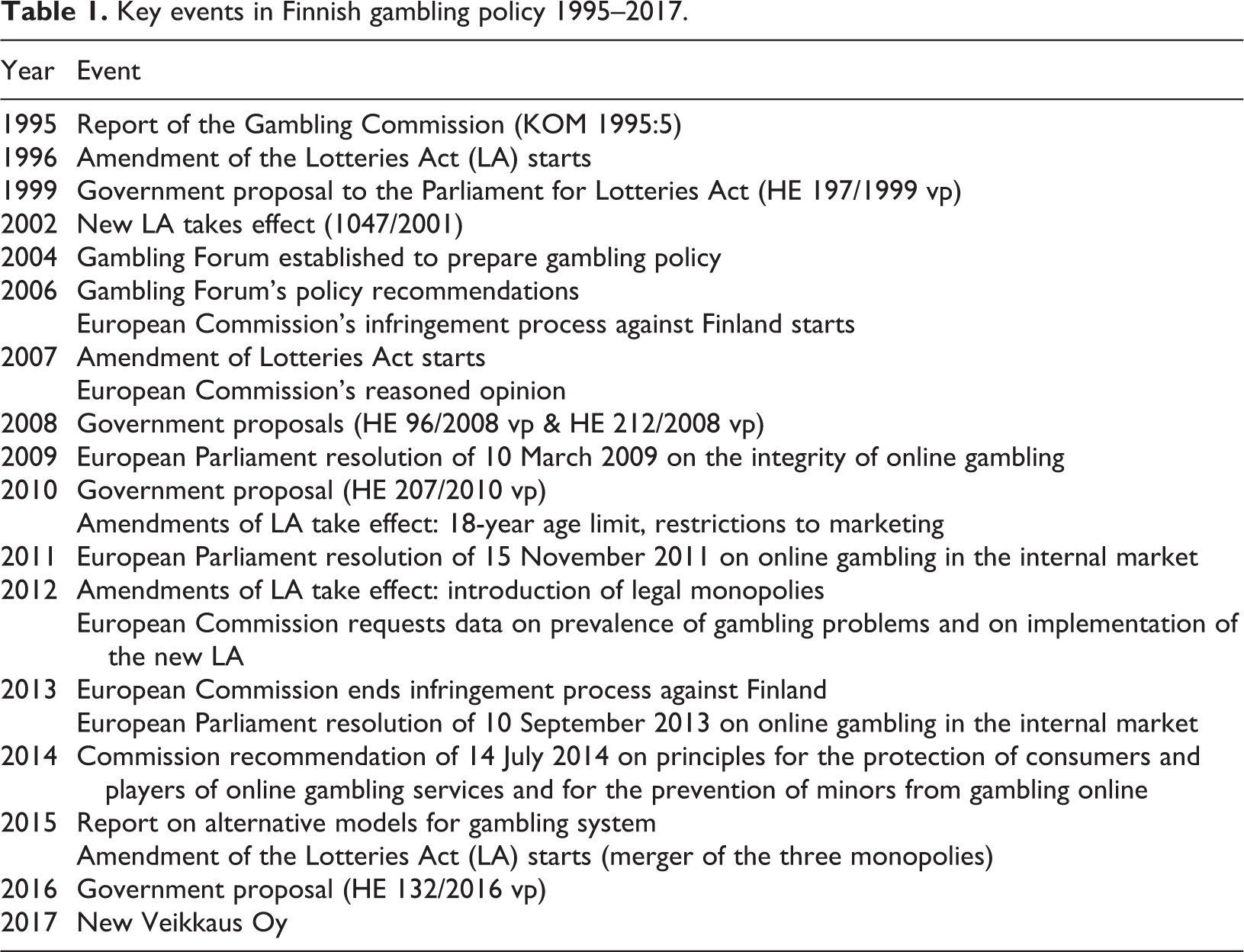
The sustainability of the Finnish gambling policy in relation to EU regulations was evaluated by a Gambling Committee appointed in 1993 (Table 1). In its report, the Gambling Committee undertook a rather extensive review of EU law. The Committee also drew attention to the initiatives made by the Commission in the late 1980s and early 1990s aiming to harmonise gambling legislation across the EU. The Committee concluded that the Finnish gambling system, which was based on three operators with exclusive rights, was compliant with EU law. However, as a new aspect, the Committee proposed that attention should be paid to fraud, abuses and social harms associated with gambling (KOM 1995:5). Drawing attention to these aspects reflected the justifications for restrictions to the free mobility of services given by the CJEU in 1994 in a landmark case on gambling (Schindler C-275/92). The Committee’s report was submitted in 1995, after which the efforts to update the Lotteries Act of 1965 were initiated. However, the new Lotteries Act (1047/2001) was only passed in 2001. A reason for this delay was a case against Finland (Läärä C-124/97) heard by the CJEU.
The Läärä case was about exclusive rights on slot machines granted to Finland’s Slot Machine Association (Raha-automaattiyhdistys, RAY). In its decision, the CJEU found that the restrictions to the freedom to provide services in the Finnish legislation, which were justified as being in the public interest, were acceptable. This decision made it possible to uphold the monopoly system in Finland. The decision also lent support to the view held by Finland that the national legislation was in compliance with EU law (Government Proposal, 1999, p. 56).
In this early phase of its EU accession, Finland practised contained compliance. It clearly attempted to adjust its national legislation to comply with EU requirements while also preserving the basic principles of its gambling policy. It is possible to discern all the three necessary conditions for contained compliance in the responses of Finland to the EU. First, it is clear that by waiting for the CJEU’s decision in the Läärä case, Finland was playing for time. Second, had the CJEU ruled against Finland in the Läärä case, the Finnish Government would have been prepared to maintain gambling profits by increasing the lotteries tax to 65% (Hokkanen, 2016). The costs of the legal uncertainty were controlled, even though they were significant in principle. Third, there was only one litigant challenging the gambling policy and no threat of mass litigation against Finland in the foreseeable future.
Despite the policy revisions, the traditional gambling policy aim of supporting good causes with gambling revenues remained a key policy aim. However, reducing gambling problems became the new official aim of the restrictive gambling policy. As the next phase of updating the Lotteries Act began in 2004 (see Table 1), Finland employed a wider repertoire of means by which to contain the EU’s political and judicial influence.
Key events in Finnish gambling policy 1995–2017.
Contained compliance and anticipatory obedience
The new Lotteries Act took effect on 1 January 2002, but as early as in April 2004, a broad-based Gaming Forum consisting of members of parliament, the permanent secretaries of the ministries managing issues related to gambling as well as representatives of gambling operators, was appointed to shape the future of Finnish gambling policy (Gambling Forum, 2006). A new period, during which the compliance of Finnish gambling policy with EU law was on the agenda, commenced and lasted until the European Commission ended its infringement procedure against Finland in 2013. In November 2013, the Commission announced that it was concluding the infringement procedure that had been ongoing since 2006. The Commission found that, in the aftermath of the new Lotteries Act, the monopoly system systematically and consistently implemented the objectives of public interest that were the justifications for its legitimisation (European Commission, 2013). The amendments made to the Lotteries Act (1047/2001) were an attempt to convince the Commission and other critics that prevention of crimes and addiction were the real reason behind the monopoly system. In practice, the policy revision meant the enactment of a minimum legal age limit of 18 years for buying gambling products, restrictions on marketing of gambling, transition to a legal monopoly system, and assessment of the risk potential of new products introduced to the market by the Finnish gambling operators (Government Proposal, 2008a, 2008b, 2010).
The backdrop to the decision to start the revision of the gambling policy was the CJEU’s decision in the Gambelli case that concerned gambling legislation (Gambelli et al. C-243/01). The CJEU stressed in its Gambelli decision that member states cannot encourage citizens to gamble in order to raise public funds while arguing that gambling needs to be restricted in the name of public order. More legal uncertainty was caused by an application for a gambling licence submitted by the international gambling operator Ladbrokes in 2003. The application was rejected by the Government, and the case was taken to the Supreme Administrative Court (KHO:2005:37) whose decision was to send the application back to the Government who rejected the application again. The Supreme Administrative Court suspected in its second decision in 2007 (KHO:2007:28) that the marketing of Veikkaus products might not be consistent with EU law. Moreover, in early 2005, the Supreme Court issued a decision (KO:2005:27) on the operation of the Slot Machine Association of the Åland Islands (PAF) in continental Finland, in which the Court took a stand on the compliance of the Finnish legislation with EU law. The Supreme Court concluded in its decision that gambling policy in Finland was in compliance with EU law despite the heavy criticism presented by the defendant, PAF. PAF had argued that the real purpose of the gambling monopoly was the funding of public expenses, not the official aim of preventing crimes and gambling problems (KO:2005:27). The Commission’s infringement procedure against Finland exacerbated legal uncertainty related to gambling policy. All in all, the Finnish gambling policy faced legal challenges from several directions (see Table 1.) The fact that there were several litigants criticising Finnish gambling policy and legal cases causing uncertainty on the European level lends credibility to an interpretation that at least one necessary condition existed for anticipatory obedience.
The evidence presented above suggests that the legal uncertainty caused by several legal cases was a major factor when the path of policy revision was chosen. Finland would have thus chosen a strategy of anticipatory obedience in a situation where growing legal uncertainty was assessed to be a problem for maintaining national regulatory autonomy. Finland must have known that infringement procedures typically take a long time and waiting for the result of the process would have sustained the legal uncertainty (see Blauberger, 2014, p. 461). The costs of legal uncertainty could have also been significant in the worst-case scenario: the costs of a sudden collapse of the gambling system would have been approximately 1.1 billion Euro in year 2010 (Avellan, 2013). In short, there is evidence of all the three necessary conditions for anticipatory obedience when Finland decided to amend the Lotteries Act. However, Finland also used tactics related to contained compliance in its interaction with the European Commission.
The European Commission initiated an infringement procedure against Finland and several other member states regarding online sports betting in 2006. The infringement procedure developed in tandem with the amendment process of the Lotteries Act. The infringement procedure is a process that the Commission may initiate when it suspects that a member state has not transposed the required changes into its national legislation. If the member state fails to make changes to its legislation that satisfy the Commission, the Commission will refer the case to the CJEU. The Commission suspected that granting exclusive rights to operate sports betting to Veikkaus was not a necessary and proportionate restriction of the free mobility of services. In the Commission’s view, a significant share of the gambling profits was used for public projects, Veikkaus engaged in excessive marketing operations, and there were no signs of significant actions to prevent gambling addiction. For these reasons, the Commission suspected that prevention of gambling addiction could not be the real reason behind the restrictions (European Commission, 2006).
In its first response Finland focused on pointing out that there were differences between the Finnish and Swedish translations of the Commission’s letter (Permanent Representation of Finland to the EU, 2006). In its second response (Ministry for Foreign Affairs of Finland, 2006a) in June 2006, Finland denied the Commission’s claims in detail but also made an effort to delimit the question at issue. The Commission used the term “gambling”. Instead of “gambling”, Finland wanted to use the term “sports betting games”, as the term “gambling” has a more limited meaning in Finnish.
2
In October 2006, Finland complemented its response to the Commission on its own initiative by sending the Commission a great deal of information on the operation of Veikkaus, and reported that a process to update the Lotteries Act had been launched (Ministry for Foreign Affairs of Finland, 2006b). The Commission, still unsatisfied with Finland’s responses, issued a reasoned opinion in March 2007. In the reasoned opinion the Commission reiterated its previous concerns on the noncompliance of Finnish gambling policy with EU law (European Commission, 2007). In its response (Ministry for Foreign Affairs of Finland, 2007), Finland again rejected the Commission’s claims and argued that there were several factual errors in the Commission’s claims. In its response, for instance, Finland noted (Ministry for Foreign Affairs of Finland, 2007, section 25, emphasis original): Secondly, Finland notes that the Commission’s view, according to which the Finnish authorities set profit expectations for Veikkaus Oy, is mistaken. No profit expectations or targets are set for Veikkaus Oy, and the figure in the State budget is merely an
National interest as a point of departure for gambling policy
Only about a year after the Commission concluded its infringements procedure, a new project to reform the Finnish gambling policy and system was launched. In December 2014, the Cabinet Committee on Economic Policy stated that “the objective is preserving and strengthening the Finnish gambling system based on exclusive rights in compliance with the case-law of the Court of Justice of the European Union” (Ministry of the Interior, 2015). In practice, a decision was made to initiate an examination of possibilities for merging the three gambling operators. A working group that investigated the options for reforming the gambling system submitted its report (Ministry of the Interior, 2015) in March 2015, after which the Cabinet Committee on Economic Policy approved the merger of all three gambling organisations. The government proposal (Government Proposal, 2016) for an act amending the Lotteries Act and certain related acts was passed by the Parliament, and the new Veikkaus started operating on 1 January 2017.
Advancements in technology were used as a justification for the merger (Ministry of the Interior, 2015). New technologies had led to a risk of competition between the three gambling operators as their products could be becoming too similar. This problem of overlap could be eliminated by the single-operator model. In the justifications for the introduction of the single-company model, reference was also made to EU law: According to the case-law of the Court of Justice of the European Union, the monopoly system must operate without discrimination and achieve the objectives set for it consistently and systematically. In the monopoly system, competition is eliminated by preventing the market entry of other gambling operators. If there is competition within the system, this hampers the fulfilment of the preconditions for maintaining an exclusive rights system. To the extent competition within the system does occur, it is apt to increase marketing. This may encourage and incite excessive gambling by the consumers, which conflicts with the objective of preventing and reducing gambling-related harms. (Government Proposal, 2016 vp, p. 6)
Further, there were no domestic or international actors mounting a legal challenge to the Finnish gambling system. Consequently, the likelihood of the occurrence of the worst-case scenario, that is, the collapse of the gambling system, was obviously low. All in all, it must be concluded that the necessary conditions for the occurrence of contained compliance or anticipatory obedience did not exist. Factors associated with EU law cannot explain the decision to transition to a single gambling company system. The reform was not at all, or at least not to a significant extent, motivated by EU influence.
Discussion
The aim of this contribution was to investigate how a member state adopts the strategies of anticipatory obedience and contained compliance to contain the EU’s influence on its national gambling policies. The results indicate that Finland adopted both anticipatory obedience and contained compliance when striving to safeguard its gambling monopoly system. Contained compliance was adopted during the early period of Finland’s accession (1995−2001). Finland adopted anticipatory obedience between the years 2004 and 2013, a period characterised by several critical legal cases and the infringement procedure commenced by the European Commission against Finland. During this period Finland also played for time, a tactic typical of contained compliance. During the third analysed period (2014−2017), when the merger of three monopoly operators into a single state-owned company was on the agenda, neither strategy was adopted, indicating little EU influence.
Finland is the only EU country which has focused on safeguarding a state-owned gambling monopoly. This would not have been possible without a very active way of responding to EU influence. This is also why Finland was such a good case for the purposes of this study. However, it is likely that anticipatory obedience and contained compliance are strategies that member states other than Finland have used when responding to the EU’s politico-legal influence in the field of gambling. The political tradition in Finland and other Nordic countries is consensus-orientated and settling political disputes in court is quite alien to that tradition (Wind, 2010). Finland, Sweden and Denmark are three member states that usually tend to comply with EU law (Falkner, Hartlapp, & Treib, 2007). With that in mind, it would be surprising if Finland was the only member state to adopt the two strategies examined here for containing EU influence in the field of gambling policy.
The European Commission (2017) announced in December 2017 that it will close all ongoing infringement procedures and cease the treatment of complaints in the gambling field. This fact highlights that the EU is currently causing little uncertainty to national gambling policies. The merger of the three operators in Finland might be a case in point: there was no need for either anticipatory obedience or contained compliance. What is specifically interesting in the Finnish merger process is its justification in terms of EU law, although there is no indication of significant EU influence. A reason behind this could be the tendency of member states to use justifications accepted by the EU, such as prevention of gambling problems, as a pretext for protecting their economic and other national interests in the field of gambling (Myllymaa, 2017; Van den Bogaert & Cuyvers, 2011). EU law would thus function as a politically convenient way to justify the necessity of policy revision to domestic actors, not to EU institutions.
This study is the first to analyse a case of a member state’s containment of the politico-legal influence of the EU in the field of gambling policy. Previously, the idea that the EU is able to significantly influence or even to determine the development of national gambling policies has been accepted rather uncritically. Such studies have primarily focused on the judicial aspects of gambling policy and missed the dynamics between law and politics. The results of this study show that the Member States have multiple ways of containing the judicial and political influence of EU institutions. The results of this study highlight the necessity of studying the law–politics nexus in the field of gambling policy in the future.
Study limitations
When interpreting the results, we must bear in mind the nature of the material used. Interpretations of the actors’ intentionality made on the basis of documents such as those used for this study can never be absolutely certain. Moreover, the sufficient conditions for the occurrence of the strategies of anticipatory obedience and contained compliance as a result of EU influence were not investigated. It must also be noted that the perspective of this analysis was carefully delimited: the focus was specifically on the relationship between Finland’s gambling policy and the EU. Due to this delimitation, many key factors influencing national gambling policies (e.g., the digitalisation of gambling, globalisation) have been excluded from the analysis.
Footnotes
Notes
Declaration of conflicting interests
The author declared no potential conflicts of interest with respect to the research, authorship, and/or publication of this article.
Funding
The author disclosed receipt of the following financial support for the research, authorship, and/or publication of this article: The Ministry of Social Affairs and Health, Helsinki, Finland, funded the study (appropriation under section 52 of the Lotteries Act).