




Abstract
Background:
It is often assumed that illicit drug use has become normalised in the Western world, as evidenced for example by increased prevalence rates and drug-liberal notions in both socially advantaged and disadvantaged youth populations. There is accumulating research on the characteristics of young illicit drug users from high-prevalence countries, but less is known about the users in countries where use is less common. There is reason to assume that drug users in low-prevalence countries may be more disadvantaged than their counterparts in high-prevalence countries, and that the normalisation thesis perhaps does not apply to the former context.
Aim:
This article aims to explore to what extent such assertions hold true by studying the characteristics of young illicit drug users in Sweden, where prevalence is low and drug policy centres on zero tolerance.
Material and Method:
We draw on a subsample (n = 3374) of lifetime users of illicit drugs from four waves of a nationally representative sample of students in 9th and 11th grade (2012–2015). Latent class analysis (LCA) on ten indicators pertaining to illicit drug use identified four classes which we termed “Marijuana testers”, “Marijuana users”, “Cannabinoid users” and “Polydrug users”.
Findings:
Indications of social advantage/disadvantage such as peer drug use, early substance-use debut and truancy varied across groups, particularly between “Marijuana testers” (low scores) and “Polydrug users” (high scores).
Conclusions:
Our findings corroborate the idea that the majority of those who have used illicit drugs in the Swedish youth population have tried marijuana a few times only. We discuss whether or not the comparably large share of socially advantaged “Marijuana testers” in a comparably small sample of lifetime users can be interpreted as a sort of normalisation in a prohibitionist drug policy context.
The prevalence rates of illicit drug use (IDU) vary considerably across countries and so do the norms surrounding use. In Sweden, IDU is generally considered a deviant, non-acceptable behaviour. Even if a trend of increased past-month cannabis use among persons aged 15–34 years has been identified in Sweden (EMCDDA, 2015), the use of illicit drugs is uncommon compared to other European countries, both among adults (EMCDDA, 2015) and youth (ESPAD Group, 2016). The figures from the 2015 ESPAD report show a lifetime prevalence of 8% in Swedish youth aged 15 or 16, compared to an average of 18% for the included countries (ESPAD Group, 2016). Furthermore, the prevalence of youth IDU in Sweden has been quite stable across the past two decades (CAN, 2017).
Sweden’s comparably low prevalence rates together with strict laws against illicit drug use provide an interesting and important context for research. Much of the European literature on IDU in youth has during the past two decades centred on how to characterise the users and their incentives, with normalisation being a common point of reference. A number of researchers have claimed that IDU in youth has become normalised, meaning that prior understandings of the behaviour are increasingly becoming obsolete and that drug use in general, and cannabis use in particular, is mainstream rather than deviant (e.g., Duff, 2005; Duff et al., 2012; Measham & Shiner, 2009; Parker, Aldridge, & Measham, 1998; Williams & Parker, 2001). This does not necessarily mean that a majority of young people uses cannabis, but that there is a growing cultural acceptance of the substance among both using and non-using youth (Measham & Shiner, 2009). The so called “normalisation thesis” has been described as “one of the most significant recent theoretical developments to have emerged in the youth and drug studies literature” (Pennay & Measham, 2016, p. 187). Core dimensions of the thesis include trying and usage rates, availability/access to illicit drugs, cultural accommodation, as well as accommodation by non-users and former triers (Parker, Aldridge, & Measham, 2002). The normalisation thesis, however, has been criticised for exaggerating increases in both acceptance of use and actual use (e.g., Erickson & Hathaway, 2010; Sandberg, 2012). A critique that is perhaps particularly relevant in the Swedish prohibitionist context is that normalisation is challenged by the illegality of drug use, as the users risk both stigma and legal sanctions (Ekendahl, Karlsson, & Månsson, 2018; Hathaway, Comeau, & Erickson, 2011). Others maintain that the concept of normalisation is too crude and that “differentiated normalization” – “how different types of drugs and different types of drug use may be normalized for different groups of young people” – may apply better (Shildrick, 2002, p. 36). It has also been argued that the declining rates of IDU among young people since the turn of the millennium can rather be seen as signs of “denormalisation” (Williams, 2016, p. 199).
Most studies that cast light on normalisation come from the UK and other high-prevalence countries and there is comparably little research on how to view the phenomenon in countries with lower prevalence rates (but see Hakkarainen, Tigerstedt, & Tammi, 2007; Rødner Sznitman, 2007). This is a problem when it comes to Sweden. We lack reliable indicators as to whether normalisation has reached Swedish society as well and, if so, the character and extent of it.
In Sweden, IDU is a criminal offence and youth who are caught using illicit substances are more or less forced to engage in treatment at specialised treatment units (e.g., Ekendahl et al., 2018). This structural problematisation yields that the behaviour may mean different things in different countries, and the characteristics of the actual users may therefore also vary. Research suggests that some risk factors for cannabis use are stronger in low-prevalence than in high-prevalence countries (Sznitman et al., 2015) and that IDU in youth is more strongly linked to adverse outcomes in the former (Haskuka, Arenliu, & Kelmendi, 2017). By judging from the strict laws regulating IDU in Sweden and the low prevalence rates, actual users of illicit drugs may be more disadvantaged in Sweden compared to in countries where illicit drugs are more accepted. However, there has been a notable decrease in the number of Swedish youth who associate regular and sporadic cannabis use with a high risk, and the figures are now the same for Sweden as the European average (Guttormsson & Leifman, 2016). To the extent lower risk perceptions serve as a proxy for increased acceptability of drugs – a core tenet of the normalisation thesis – it may indicate that at least parts of the normalisation thesis may apply to Sweden as well. In addition, Swedish lifetime users now seem to use cannabis more frequently than in previous years (CAN, 2017). Hence, there is a need for research to cast light on the issue of normalisation and the profiles of Swedish youth users.
This study aims to characterise the users of illicit drugs in Swedish youth in terms of drugs used and frequency of consumption, using latent class analysis (LCA). We believe that a profiling of the user groups is an important step towards a better understanding of whether and how illicit drug use has become normalised among Swedish youth, and that this makes an important contribution to the broader discussion concerning normalisation. Much of the normalisation debate in Europe and elsewhere has looked at use of different illicit drugs in isolation without considering how IDU clusters in individuals. An alternative approach, which we adopt here, is to look at the characteristics of subgroups of users. Qualitative studies exploring normalisation have identified distinct subgroups of users and, based on these findings, criticised the normalisation thesis for being “overly simplistic” (e.g., Shildrick, 2002, p. 35; see also MacDonald & Marsh, 2002). However, we know of hardly any studies on drug-use normalisation that have tried to identify subgroups in larger nationally representative samples of youth using appropriate statistical techniques. Latent class analysis should be a valuable complement to qualitative methods for addressing “differential normalization” (Shildrick, 2002) as it provides concrete and easy-to-interpret information about typical or common features in different classes. For example, high probabilities for having used a certain illicit drug in a certain latent class is a common denominator among its members, potentially meaning that such experience is normalised in the specific group. Available LCAs on subgroups of drug users (see below), however, have largely been decoupled from studies on normalisation, indicating that these two literatures to a considerable extent have evolved separately. Forging a closer relationship between these strands of research would advance our understanding of how to make sense of the normalisation thesis in light of the policy context in which IDU takes place.
At the onset it should be noted that normalisation cannot be assessed based on consumption patterns only, and that the thesis also considers aspects such as drug availability, acceptance of drug use also among non-users and “cultural accommodation” of illicit drugs (Parker et al., 1998, 2002). The normalisation thesis is also clearly linked to a temporal dimension, as it was developed during a time of increasing drug-use rates in Britain as a way of understanding these trends (Williams, 2016). It is obvious that a full analysis of all aspects of the normalisation thesis cannot be carried out in a single study and some tenets are inherently difficult to capture – particularly with statistical methods (Sandberg, 2012). Indeed, it is not entirely clear what empirical indicators we should look at when assessing normalisation and what weight we should give to different indicators (Williams, 2016). Perhaps as a consequence of normalisation being a multidimensional concept, studies on normalisation include several foci, where not only prevalence rates but also the normative context, cultural references and the availability of illicit drugs are central themes (MacDonald & Marsh, 2002, p. 29). However, the part that is concerned with consumption is arguably at the core and is a reasonable focus. A large share of advanced users (e.g., who have used many drugs) among lifetime users could be seen as support for central tenets of normalisation, whereas a low share would be counter indicative. Further support for the thesis would be given if the advanced users – particularly if this group were to be numerically large – displayed favourable characteristics regarding, for example, truancy, school satisfaction and parental monitoring. By addressing subgroups of users we thus follow the plea for “a more nuanced, group-level differentiated understanding of normalization” (Fitzgerald, Mazerolle, & Mazerolle, 2013, p. 902; see also Shildrick, 2002).
Overview of prior LCAs
Person-centred approaches such as LCA are useful for identifying heterogeneous groups of drug users (e.g., Muthén & Muthén, 2000). Temple, Brown, and Hine (2010, p. 241) with reference to cannabis, underscore that the common “one size-fits-all” approach in the literature and the focus on risk factors should “not blind us to the heterogeneity of cannabis users”. Latent class analyses are increasingly used in drug-use research, for example in prior studies seeking to identify groups of adult cannabis users (Fischer et al., 2010) and for identifying groups with different constellations of IDU diagnoses (Agrawal, Lynskey, Madden, Bucholz, & Heath, 2007). It has also been applied in studies on health behaviours (including drug use) (Laska, Pasch, Lust, Story, & Ehlinger, 2009) and on ideologies regarding drug policy (Matthew-Simmons, Sunderland, & Ritter, 2013).
A growing number of studies have adopted LCA to identify subgroups of young drug users (Bohnert et al., 2014; Chiauzzi, DasMahapatra, and Black, 2013; Conway et al., 2013; Gilreath et al., 2014; Göbel, Scheithauer, Bräker, Jonkman, & Soellner, 2016; Haardörfer et al., 2016; Tomczyk, Isensee, & Hanewinkel, 2016; Tzilos, Reddy, Caviness, Anderson, & Stein, 2016). A recent systematic review focusing on polydrug use found that the majority of the included studies identified three or four classes, ranging from no or little use to polyuse, where the first comprises a majority and the last a minority of the samples (Tomczyk et al., 2016). However, polydrug use is a broad term generally referring to the use of at least two drugs, and it opens up for several types of polydrug users (Tomczyk et al., 2016). While most research is from the US, one large study based on European ESPAD data found a similar class structure across the participating countries, including Sweden (Göbel et al., 2016). The Göbel et al. study is one of the very few LCAs on drug use that includes Swedish data. Of note, the proportions belonging to each class differed substantially across countries and Sweden had quite a low rate of polyusers. The sample in the Göbel et al. (2016) study covered 7th to 9th graders exclusively and we lack knowledge regarding older Swedish adolescents among whom illicit drug use is more common (cf. CAN, 2017).
The current study
This study focuses both on identifying latent classes of young illicit drug users and on characteristics of different classes. In contrast to several prior LCAs, our sample is to be considered large as it includes over 3000 individuals who have used an illicit drug at least once. To provide a rich picture of the classes we also study whether they differ in gender distribution as well as in other characteristics, including, for example, truancy, school satisfaction and parental monitoring, which gives an indication of the extent to which these classes can be characterised as socially advantaged or disadvantaged.
Methods and data
Sample
We pooled samples from CAN's (The Swedish Council for Information on Alcohol and Other Drugs) annual school surveys on substance use for the years 2012 to 2015 for youths in 9th (n = 16,116) and 11th (n = 19,891) grade (total n = 36,007). Each wave consists of a nationally representative sample of students in 9th and 11th grade, comprising approximately 5% of each age group in Sweden. The lifetime prevalence of illicit drug use fluctuated between 6% and 8% for 9th graders across these four waves, and for youth in 11th grade it varied between 15% and 18% (CAN, 2017, Tables 64 and 65). In this study, we only included respondents who reported to have used any illicit drug ever (n = 3974). After removal of individuals who had missing data on any of the variables included in the analyses the sample consisted of 3374 individuals.
Variables
Illicit drug use
We used 10 variables (all binary) measuring illicit drug use. Participants who responded “yes, during the past 30 days”, “yes, during the past 12 months” or “yes, more than 12 months ago” to the question “have you ever used narcotics” were asked to mark the substances that they had tried from a list of common illicit drugs. Seven illicit drugs were covered in our study (hash, marijuana, “Spice”, amphetamine, cocaine, ecstasy and heroin). Some illicit substances listed (LSD, GHB) were not included in the surveys across all four waves and were thus not included in the analysis. The CAN survey also captures use of prescription drugs that are used without physician’s prescription in the list of substances. Non-medical use of painkillers is not included in the survey for all four waves and was thus excluded. Non-medical use of sedatives/hypnotics was included across the waves, but we used this variable in the further profiling of the latent classes rather than as an indicator in the LCA as such (see more below).
Besides these substances, we also included indicators for illicit drug use more than 10 times, illicit drug use during the past 30 days and during the past year. The variable used more than 10 times was created from a question asking about consumption frequency separately for hash and/or marijuana and other illicit drugs. The first asked “How many times have you used hash and/or marijuana”, with seven response alternatives (ranging from 0 to more than 50 times). Based on these two measures, CAN has created a variable that summarises the responses to these two questions using the middle of the intervals as the value for the separate questions (e.g., the response option 5–10 times in the original question is given the value 7.5). These middle values for each of the two separate questions are then combined into a total sum score. Here, we distinguished those who reported IDU more than 10 times from those who reported a lower frequency of use.
Characteristics of latent classes
We compared the latent classes on several characteristics including gender, grade (9th or 11th grade) number of drug-using friends, truancy, satisfaction with school, parental monitoring, early substance-use debut (13 years or younger), binge drinking once a month or more often and lifetime use of sedatives/hypnotics (not prescribed by a physician).
Number of friends who have used illicit drugs was measured by a question asking separately how many of the student’s friends displayed specific characteristics (school capability) or engaged in different kinds of substance use (e.g., smoking). The question read “How many of your friends (in or outside school)…”, with responses ranging from “none” to “most”, with a “don’t know” option also being available. As to number of friends who have used illicit drugs, we distinguished between “most” on the one hand and “none” and “one/a few” on the other hand (“none” and “one/a few” were collapsed to avoid problems with sparse data). Truancy was measured by the question “Do you play truant?”, with six different responses ranging from “never” to “several times a week”. Satisfaction with school was measured by the question “How do you enjoy school?”. Respondents could choose from five options ranging from “very good” to “very bad”. Parental monitoring was measured using two questions. The first was “Do your parents/caregivers know what friends you hang out with?”. Responses ranged from “yes, all” to “no, no one”, with a “don’t know” alternative also being available. The other question regarding parental monitoring addressed parental knowledge about students’ whereabouts during weekends: “Do your parents/caregivers know where you are on Friday and Saturday nights?”. Four responses were available ranging from “always” to “mostly not”. Due to sparse data in the fourth category for parental knowledge about friends we collapsed this category with the third category.
We included two dummy variables pertaining to having an early substance-use debut (binge drinking respective smoking at age 13 years or younger). These were derived from a question addressing several behaviours. The question in the questionnaire was “How old were you when you (if ever) did the following things for the first time?”, with the youngest alternative being “11 years or younger” and the oldest “17 years or older”. A “never” option was available for those who had not engaged in a particular behaviour. Binge drinking once a month or more often as well as lifetime use of sedatives/hypnotics were also entered as dummy variables. Binge drinking was measured by the question “Think back on the past 12 months. How often have you, on one occasion, been drinking alcohol equivalent to four large cans of strong beer/strong cider, or 25 cl of liquor or a whole bottle of wine or six bottles of medium strong beer?”. Responses ranged from “do not drink alcohol” to “weekly or more often”. Those who responded “once a month”, “2–3 times a month” or “weekly or more often” were defined as having engaged in binge drinking at least once a month. Sedatives/hypnotics were listed among the illicit substances outlined above, and respondents were asked whether they had ever used such substances without a physician’s prescription. While we considered including this indicator among the other IDU indicators used for the LCA, we decided to include this “medicine-like” substance in the additional profiling instead.
Statistical analysis
Latent class modelling is known as a person-centred statistical approach that attempts to identify a predefined number of latent classes on the basis of response patterns across two or more categorical, manifest indicators. It is assumed that the way people respond to a set of items is affected by an underlying, unobserved variable and that individuals belong to one and only one latent class (Collins & Lanza, 2010). Latent class modelling sets out to estimate two types of parameters: the unconditional probability of membership in the latent classes and the probabilities of responding in a certain way (called item-response probabilities) to each of the categorical indicators included in the analysis, given latent class membership (Collins & Lanza, 2010). As we included 10 binary, manifest indicators there were 2⁁10 = 1024 potential response patterns.
We explored how well different solutions fitted the data. Because most prior research has identified three or four classes when also including abstainers, we did not expect to find more classes – particularly given the low levels of illicit drug use among Swedish youth (ESPAD Group, 2016). We estimated two, three, four and five-class solutions. The Bayesian information criterion (BIC) and the Akaike information criterion (AIC) were used as the fit indices, with lower values indicating a relatively better fit, but choice of solution was also arrived upon based on theoretical plausibility and interpretability. To reduce the common problem with boundary solutions in LCAs – probability estimates that are precisely 0 or 1 (Wurpts & Geiser, 2014) – we only included respondents who had ever used an illicit drug.
In the results section below we present item-response probabilities (IRPs) and estimated proportions in each of the latent classes. Since the maximum likelihood estimates in LCA may converge to a local rather than the global maxima, we followed the advice to repeat the estimation of the LCA with different starting values (Linzer & Lewis, 2011). We arbitrarily repeated the estimation process 10 times and finally used the model with the highest log-likelihood value.
The respondents’ predicted class memberships were extracted from their posterior probabilities, with a modal assignment rule. The extracted classes were then compared on other variables using cross tabulations. Given our focus on identifying characteristics of latent classes of illicit drug users, we looked at the distributions of different variables within classes (column percentages) instead of the distribution of latent classes within categories of the other variables (row percentages). Thus, we did not treat the other variables as predictors of class membership but, rather, as simple attributes that could potentially be distributed unevenly across classes. Consequently, our analytical strategy when using cross tabulations invoked no causal assumptions; they were merely intended as a further “profiling” of the classes.
Data management was carried out in Stata, v.14 and the LCA was run in RStudio, using the poLCA package (Linzer & Lewis, 2011). Crosstabs were conducted using the “descr” package for R.
Results
Descriptive statistics
Table 1 shows descriptive statistics for the sample. As can be seen, there was a larger share of boys and students from upper secondary school. There was an even spread of respondents from the different survey years. A majority did not play truant or only occasionally played truant, and around 75% seemed at least quite happy with school. More than a quarter said that most of their friends had used illicit drugs. Overall, the level of parental monitoring was high.
Descriptive statistics (n = 3374).
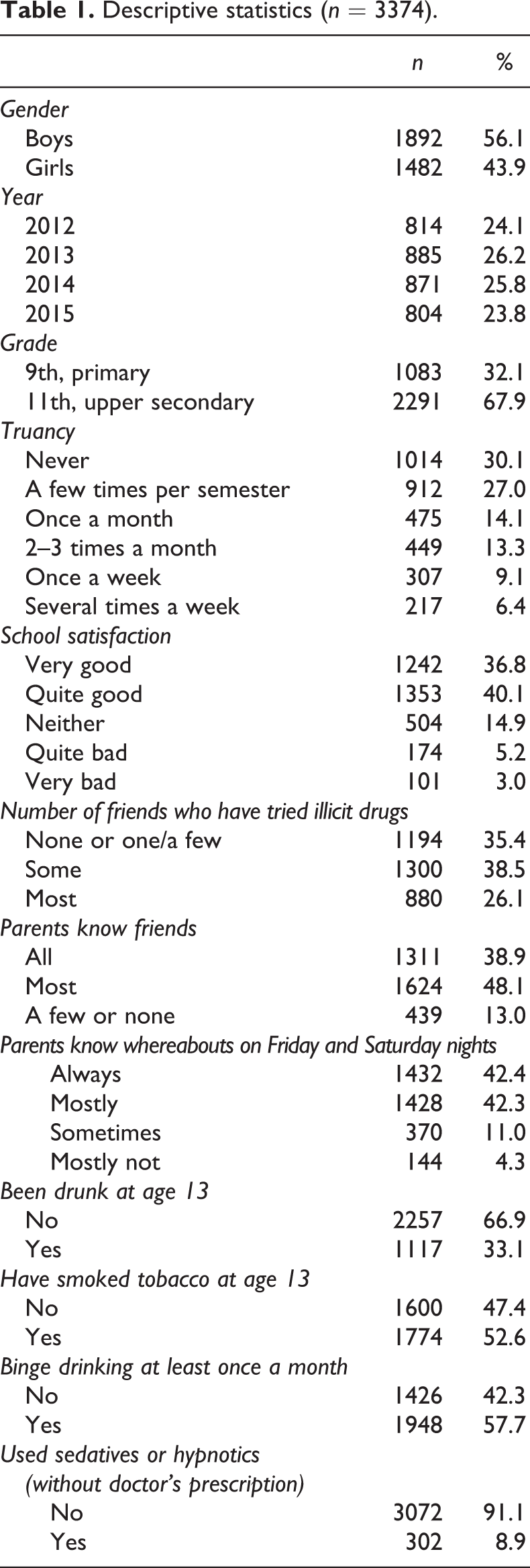
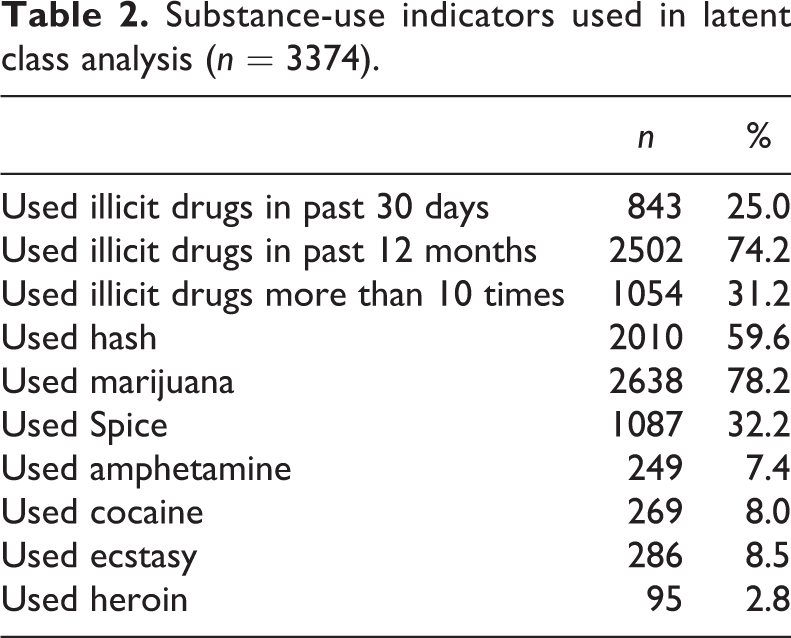
Table 2 presents the drug-use indicators included in the latent class modelling. Not surprisingly, marijuana was the most commonly used illicit drug, and a clear majority had engaged in illicit drug use during the past year. Several of the drugs had been used by less than 10% of the respondents (amphetamine, cocaine, ecstasy, heroin).
Substance-use indicators used in latent class analysis (n = 3374).
Latent classes
Table 3 presents fit indices (BIC and AIC) for 2–5 latent class solutions. The larger classes provided a better fit (i.e., the BICs and AICs were lower in these). However, from a substantive point of view, the latent classes in the analyses with five classes were more difficult to interpret than the four-class solution. A four-class model appeared reasonable when setting the fit indices aside and instead considering parsimoniousness and theoretical plausibility. The BICs and AICs were, however, lower in the four-class model than in the three and two-class models.
Fit indices for different latent class solutions.
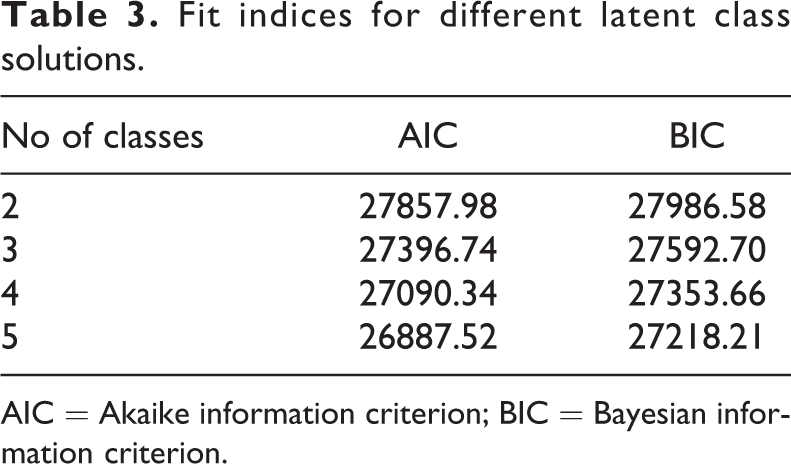
AIC = Akaike information criterion; BIC = Bayesian information criterion.
Figure 1 presents the response item probabilities for each of the four classes. Based on our interpretation of the patterns of response probabilities in each class, we label the classes as follows: “Marijuana testers”, “Marijuana users”, “Cannabinoid users” and “Polydrug users”. Below we describe each class in turn.
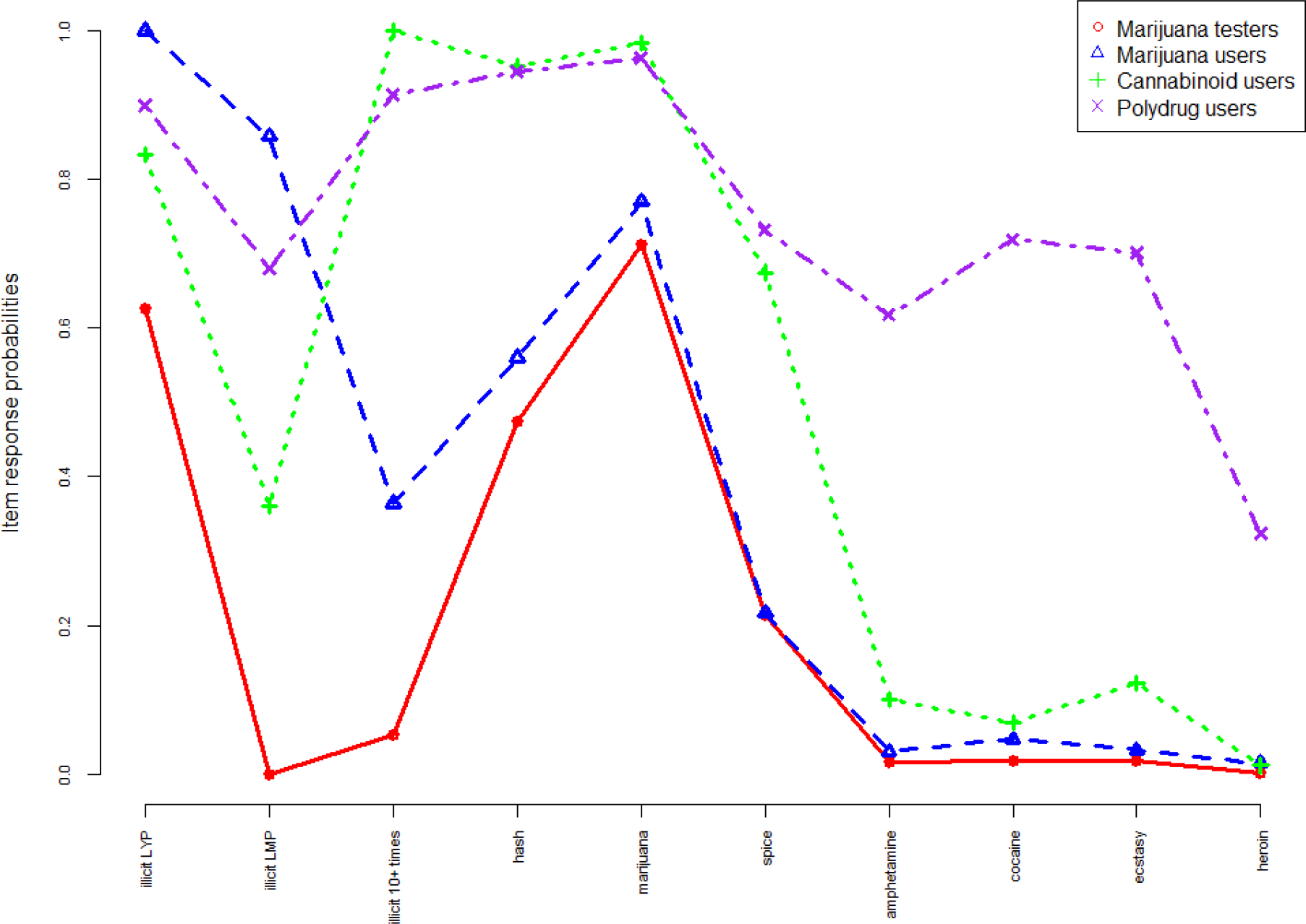
Item-response probabilities for latent classes.
Marijuana testers
The Marijuana testers had lower response probabilities for each item compared to the other subgroups: marijuana was without doubt the most commonly used drug in this group, but it had generally been used seldom (i.e., low probability of having used illicit drugs more than 10 times) and not during the past month. The use of other illicit drugs (amphetamine, cocaine, ecstasy and heroin) was very uncommon. The Marijuana testers comprised 60% of the participants and is by far the largest group.
Marijuana users
The Marijuana users had a similar drug-use profile as the Marijuana testers, but this group was characterised by notably higher probabilities of having used drugs in the past month and the past year compared to the Marijuana testers. In fact, this was the group with the highest probability of having used illicit drugs both the last year and the last month. However, similar to the Marijuana testers, this group was less likely to have tried hash as compared to the two classes described below, and the same held true for Spice and other drugs (amphetamine, cocaine, ecstasy and heroin). The Marijuana users comprised 17% of the sample.
Cannabinoid users
This group had a very high probability of having used hash, marijuana and Spice. Members of this class were thus users of both natural (hash, marijuana) and synthetic cannabinoids (Spice). The Cannabinoid users were most likely to have used illicit drugs more than 10 times among the classes, but the probability of having used in the last month was quite low. Similar to the two marijuana classes, members of this group had generally not used other drugs. This group constituted 15% of the sample.
Polydrug users
This was the smallest of the classes (7% of the sample). This class was characterised by having a high probability on all included indicators. It was not only characterised by being likely to have used cannabinoids, but also of having tried other drugs. The probability of having used amphetamine, cocaine and ecstasy exceeded 0.6. While the probability of having used heroin was much lower in an absolute sense, it was substantially higher than in the three other classes. This group was very likely to have used illicit drugs more than 10 times.
Characteristics of latent classes
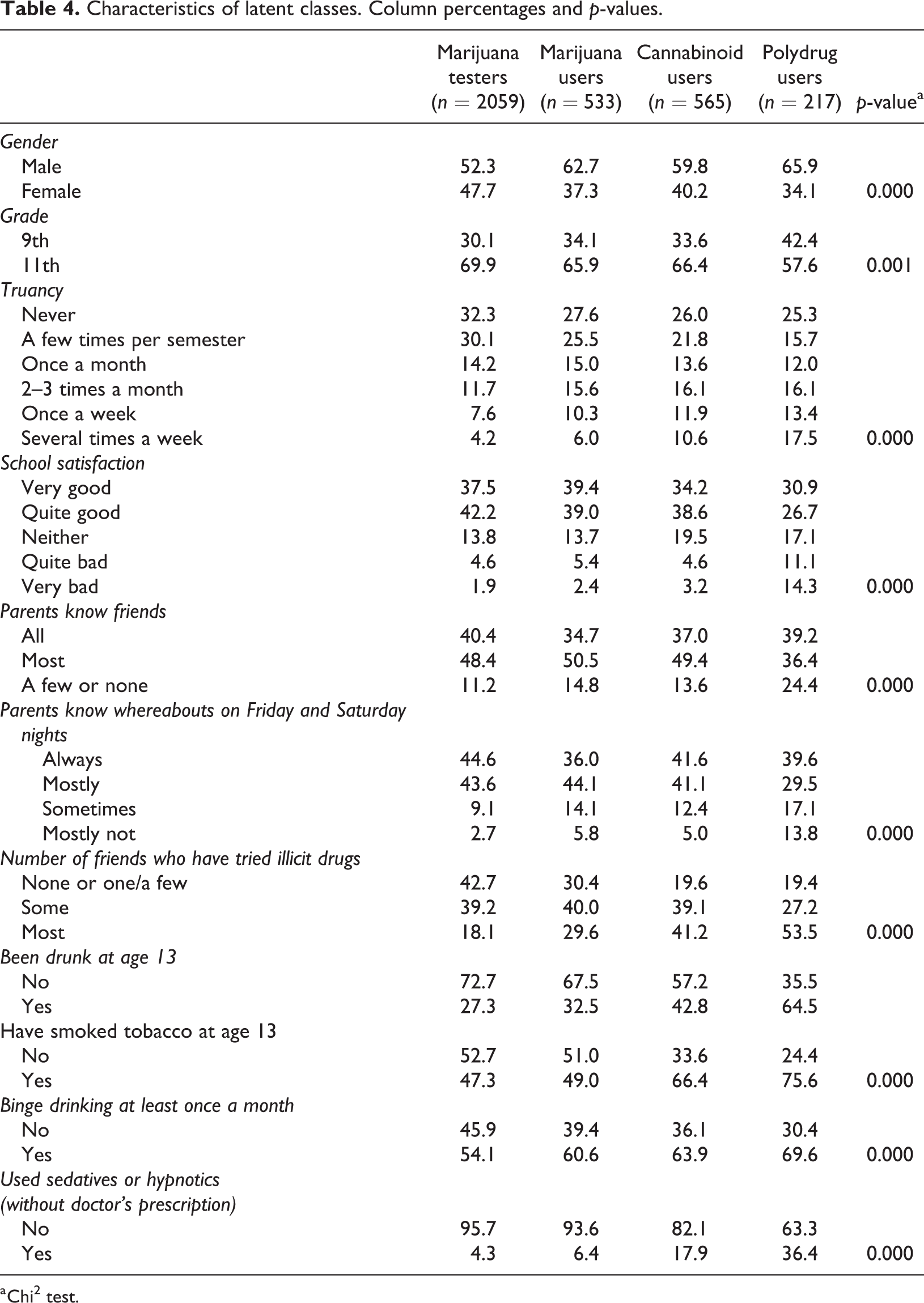
Characteristics of latent classes are shown in Table 4. Class membership was extracted from the LCA using a modal assignment rule. The estimated class proportions in the predicted classes differ slightly from the proportions in the original LCA. The table shows distributions of characteristics within classes (column percentage). As can be seen, there were clear differences in how the characteristics were distributed within the different latent classes, and all were statistically significant (p-values were all 0.001 or lower). The differences were most notable when comparing Marijuana testers and Polydrug users. Polydrug users comprised, to a larger extent than Marijuana testers, males and 9th graders. There was a larger share of individuals frequently playing truant in the Polydrug user group, and also of students reporting being less satisfied with school and having lower levels of parental monitoring. The Polydrug users had a notably larger share of individuals who reported that some or most of their friends had used illicit drugs. Further, the share of individuals who had had an early substance-use debut was much higher among Polydrug users and the difference in use of sedatives/hypnotics was quite dramatic as compared to Marijuana testers.
Characteristics of latent classes. Column percentages and p-values.
a Chi2 test.
Although the differences were not as evident when comparing other classes, we do see some clear patterns. The Marijuana testers scored “better” than the other three classes on features such as truancy, parental monitoring, illicit drug use in peers, monthly binge drinking and substance-use debut. Marijuana users and Cannabinoid users had quite similar distributions on several characteristics but differed in some notable respects. For example, there was a larger share of females in the Cannabinoid user group and its members had more illicit-drug-using peers. The group also had a larger share of individuals with an early substance-use debut and with use of sedatives/hypnotics.
Discussion
Summary of findings
This study set out to identify subgroups of illicit drug users among Swedish youth and to shed light on the relevance of the normalisation thesis in Sweden with its prohibitionist drug policy context. Illicit drug use is relatively uncommon in Sweden and there has been little research on the characteristics of different user groups. We identified four classes of youth illicit drug users that we referred to as Marijuana testers, Marijuana users, Cannabinoid users and Polydrug users. This number of classes is similar to what have typically been found in prior LCA studies in this area (Tomczyk et al., 2016).
The classes we identified each presented distinct attributes, confirming the importance of distinguishing different user groups from each other also in a low-prevalence country such as Sweden. In terms of drug-use experiences, Marijuana testers were the most inexperienced group and comprised 60% of the respondents. Members of this group generally had tried marijuana but their probabilities of having used other illicit drugs were lower than among members of the other groups. They had not used illicit drugs more frequently, and the probability of having used during the past month was miniscule. The bivariate analyses further showed higher levels of social adjustment in this group compared to the other latent classes. For example, Marijuana testers were more likely to report lower levels of truancy, higher satisfaction with school, fewer illicit-drug-using peers and higher levels of parental monitoring. While about half of the respondents in this group had smoked when they were 13 years old or younger, less than 30% had been drunk at this age. All in all, this suggests that the majority of Swedish youth who have used illicit drugs are relatively well-off.
As could be expected, the LCA also identified a more experienced class of illicit drug users. The Polydrug users – comprising a small minority (7%) of the users – had high probabilities of endorsing the items included in the analysis, and they were in particular characterised by high item-response probabilities for use of amphetamine, cocaine and ecstasy. This class was most likely to have used illicit drugs during the past year and the past month, and its members had a high propensity for frequent IDU. Compared to the other latent classes, there were larger shares of respondents who reported an early substance-use debut among the Polydrug users, and they reported higher levels of illicit drug use in peers as well as use of sedatives/hypnotics. Thus, they had not only used more illicit drugs than other classes, they also reported higher levels of social disadvantage.
The LCA also identified two intermediate groups, Marijuana users and Cannabinoid users. A main difference between these two groups was that the latter was much more likely to have used Spice on top of other cannabis use and to have used illicit drugs more than 10 times. While both these groups were similar in having low probabilities of reporting use of other drugs, they differed in some notable respects. The gender distributions differed across the classes, with Cannabinoid users having a larger share of females than the Marijuana users. There was also a higher prevalence of early substance-use debut among Cannabinoid users. Thus, this class appears to be somewhat more disadvantaged than the two marijuana classes. It should be noted that Spice, during the years covered in this study, was commonly framed as a very dangerous and destructive drug, which suggests that the Cannabinoid user group may potentially “move on” to the Polydrug user group further on.
Normalisation of IDU in Swedish youth?
The overall prevalence of youth IDU was miniscule in the larger sample of all students in the years covered by this study (CAN, 2017). This is far from the prevalence rates of 50% reported from the UK in the late 1990s when Parker et al. (1998) launched the normalisation thesis. However, the vast majority (93%) of drug users in our sample was characterised by primarily using cannabis and by showing few signs of social disadvantage (measured by, e.g., truancy, school satisfaction and parental monitoring). From a cultural perspective on normalisation, it could therefore to some extent be argued that experimentation with cannabinoids has become normalised among Swedish youth. As the use of cannabis does not seem to violate young people’s commitment to conventional society, this indicates that the activity is not necessarily seen as deviant. Instead, it is possible that it is considered “normal” or at least relatively unproblematic to experiment with cannabis use in some youth groups. In reference to Shildrick (2002, p. 44), these results could indicate that sporadic cannabis use may cause low levels of social stigma.
Thus, depending on what is meant by normalisation, this study may both contradict and support the normalisation thesis as originally outlined by Parker et al. (1998). When considering prevalence of IDU and patterns of use, our results provide little evidence to support the normalisation thesis among Swedish youth. Overall, IDU does not seem to be an integrated part of the lives of Swedish youth; it is clearly an activity that most young Swedes have limited experience of. However, as has been indicated before, normalisation of drugs is an issue much too complex only to be measured by number of users, and it has been argued that the field may be better served by avoiding sweeping statements as to whether normalisation is present or not and instead focusing on “differentiated normalization” (Shildrick, 2002). The results indicate the importance of further investigating the relation between drug use and social accommodation as well as youth sense-making in low-prevalence countries to understand the different dimensions of normalisation.
Strengths and limitations
A strength of this study is the large sample size including over 3000 individuals who have used an illicit drug at least once, and the data are nationally representative of Swedish youth in 9th and 11th grade. We also had access to rather specific questions related to the use of different illicit drugs. The development of the CAN survey in 2012 also means that we had information on other characteristics based on which we could characterise the latent classes further. Thus, we were able to provide a rather rich characterisation of subgroups of young illicit drug users in Sweden.
Limits of the study include a lack of data on the frequency of use of each of the different illicit drugs covered. We included a generic question of how many times respondents had used illicit drugs in general and this measure may be too crude to capture important nuances in respondents’ IDU. The same holds true for the prevalence measures of use during the past year and the past month. As with all school surveys, respondents with a more disadvantaged social situation may have participated in the survey to a lesser extent than more socially adjusted individuals. In addition, the study is strictly descriptive and it should be underscored that no causal inferences can be drawn between class membership and the additional characteristics which we focused upon.
Conclusion
This is to our knowledge one of the first attempts to identify subgroups of young illicit drug users in Sweden using latent class analysis (but see Göbel et al., 2016). Our sample of youth who have used an illicit drug at least once comprised only a small minority of all students across the years 2012 and 2015 and in terms of frequency and drugs used, they were generally inexperienced users who reported having tried marijuana a few times. The probability that individuals from the class of Marijuana testers had tried illicit drugs more than 10 times or had ever tried other drugs than cannabis was miniscule. However, other, numerically smaller, subgroups differ in important respects from this majority group, and this is most clearly evidenced among Polydrug users. This advanced group of users were more “experienced” than the other groups and they displayed a more disadvantaged profile overall. Interventions targeting IDU in Swedish youth may benefit from considering these differences across user groups.
Footnotes
Declaration of conflicting interests
The authors declared no potential conflicts of interest with respect to the research, authorship, and/or publication of this article.
Funding
The authors disclosed receipt of the following financial support for the research, authorship, and/or publication of this article: FORTE (Grant/Award Number: 2015-00283).