




Abstract
Aims:
High alcohol consumption among young adults is of great concern. About half of all young adults in Sweden are university students, and high alcohol consumption is common in this group. This makes student unions a potential arena for alcohol prevention. Little is known about attitudes toward alcohol prevention and to what extent Swedish student unions have written alcohol policies. The aim of the present study was to investigate whether student union representatives consider alcohol to be a problem, their attitudes toward alcohol prevention, the presence of written alcohol policies at student unions, and factors possibly associated with the existence of such policies.
Methods:
During November 2014, student union representatives (n = 95) were invited to participate in a web-based questionnaire; data were obtained from 78 unions.
Results:
The majority (93%) reported positive attitudes toward alcohol prevention, and many also recognised that alcohol consumption could be a problem (47%). Furthermore, 81% reported having an alcohol policy at their student union. Unions that frequently arranged pubs were more likely to have a policy (OR = 1.9).
Conclusions:
Many participants recognised that alcohol consumption could be a problem and reported positive attitudes toward alcohol prevention in the student union setting. This, together with the fact that the majority of student unions had written alcohol policies, suggests that the student union setting is a promising arena for alcohol prevention.
Heavy drinking among university students is a significant public health concern and is often characterised by binge drinking (Andersson, Wirehn, Olvander, Ekman, & Bendtsen, 2009; Hingson, Zha, & Smyth, 2017; Knight et al., 2002). Many college students also drink well beyond the binge drinking cutoff (four drinks on one occasion for women, five for men) (White, Kraus, & Swartzwelder, 2006). Research conducted in the United States indicates that about 23% of college students engage in frequent heavy drinking (Wechsler, Lee, Kuo, & Lee, 2000). More recent research further suggests that 37.4% of college students engage in heavy episodic drinking (i.e., consuming five or more alcoholic drinks on one occasion in the past 30 days) (Hingson et al., 2017). In Sweden, where the legal drinking age is 18 years, survey data suggest that, among young people between 16 and 29 years old, the proportion of men and women who have engaged in binge drinking during the past 30 days is 44% and 27%, respectively (Ramstedt, Lindell, & Raninen, 2013). In line with this, a Swedish report including college students within the student health setting found that 45% of the participating students scored above the limit for risky alcohol consumption (assessed by the alcohol screening instrument AUDIT), and many also expressed a concern regarding alcohol consumption among students (Folkhälsomyndigheten, 2014).
It is well known that heavy drinking is associated with negative consequences both in the short and long term, including poor study skills, violence, injuries, sexual risk-taking and accidents (Abbey, 2002; Bellis et al., 2008; Gill, 2002; Grann & Fazel, 2004; Hughes, Anderson, Morleo, & Bellis, 2008; Karam, Kypri, & Salamoun, 2007; Mohler-Kuo, Dowdall, Koss, & Wechsler, 2004; Norström, 1998; Wechsler et al., 2002). Students who engage in heavy episodic drinking are also more likely to meet the criteria for an alcohol-use disorder (Knight et al., 2002), and excessive alcohol consumption during younger years may also increase the risk for future problematic alcohol use and dependence (Jennison, 2004; O’Neill, Parra, & Sher, 2001; Perkins, 2002).
During recent years, the average age of university entrants has decreased, and today almost half of Sweden’s young adults are entering the higher education system before the age of 23 years. Moreover, during the academic year 2012–2013, participation in higher education was highest among young people between 21 and 23 years old (Universitetskanslerämbetet, 2014). This is also the age group with the highest alcohol consumption (Ramstedt et al., 2013), and there is a need to reach this group with preventive efforts. However, surveys reveal that this group is difficult to reach through preventive measures (Ramstedt et al., 2013).
In Sweden, the higher education system encompasses 14 state universities, 17 state colleges and 17 private higher education organisations. This makes the higher education system the largest governmental function in the country and, thereby, a highly influential institution (Universitetskanslerämbetet, 2014). During the autumn term of 2014 (when the present study was conducted), a total of 344,085 students were registered for higher education at any Swedish university (Universitetskanslerämbetet, 2018). Each university/college in Sweden has one or several student unions. In November 2014, there were a total of 69 student unions in Sweden. Student unions are engaged in issues such as the organisation of education, gender equality as well as in organising many social activities for students. In addition to the student unions, there are also student organisations (nations, in Swedish: nationer) at two of Sweden’s universities (Uppsala, n = 13, and Lund, n = 13) that resemble, in some respects, the sororities and fraternities in the United States (Studentlund, 2015; Studentnationer, 2015). In the present article, we will refer to both of these organisations as student unions. Student unions organised within state universities/colleges are bound to have a democratic structure, even though the internal organisation may differ between different unions. At Swedish universities, membership of a student union has been voluntary since the summer of 2010 (before that it was mandatory for all students). However, at some private institutions of higher education membership can be compulsory. According to the student union regulations, the aim of the unions is to facilitate and promote members’ education and the context within which it is organised. Often, student unions divide their activities into two areas; educational activities and social activities. Educational activities encompass issues such as gender equality, diversity and international affairs and also student representation in the various institutions of education. Social activities include issues relating to the social and economic situation of students, and also the organisation of social activities for students, such as pubs and sports activities (Statens offentliga utredningar, 2006).
Alcohol is present and available at many of the pubs, clubs and large parties arranged by the student unions (Elgán, Gripenberg, Jalling, Jägerskog, & Källmén, 2014; Sveriges studentkår, 2015). Many Swedish student unions run their own pubs, which are often located on campus, where the price of alcohol is generally less than at licensed premises. This means that university students have easy access to alcohol at a low cost, which increases the risk of high alcohol consumption (Babor, 2010). It is also common for students to feel a pressure to drink and for alcohol consumption to be expected (Elgán et al., 2014; Sveriges studentkår, 2015). The high availability of alcohol, the high alcohol consumption and associated risks in this age group make university settings, and more specifically the student unions, an important target for alcohol preventive efforts. Previous alcohol prevention research has shown that alcohol policy work is an important part of the efforts to limit alcohol-related harm, together with pricing and limiting alcohol availability (Babor, 2010; Room, 2002; Wallin, Gripenberg, & Andreasson, 2005). However, there is a lack of knowledge about attitudes toward alcohol prevention and the existence of written alcohol policies at the student unions at Swedish universities.
Against this background, the aim of the present study was to increase our knowledge about the presence of alcohol policies at Swedish student unions, and to explore factors possibly associated with the existence of such policies. A further aim was to explore respondents’ opinions regarding the issue of alcohol and prevention in student life. The specific research questions addressed were: (1) What are the respondents’ attitudes toward working with alcohol prevention? (2) To what extent is alcohol consumption considered a problem in student life? (3) To what extent is alcohol consumption considered a problem at the respondents’ own student union?
Methods
On 27 November 2014, an introductory email was sent to potential key respondents (e.g., the chairperson and vice chairperson) at each of Sweden’s student unions (n = 69) and nations (n = 26), including a link to a web-based questionnaire. Up to four reminders were emailed to non-responders at three- to four-day intervals. The last reminder was sent on 11 December 2014. Participants received two movie tickets upon completion of the questionnaire. The study was approved by the Ethics committee of the Karolinska Institutet (No. 2018/127-31/5).
Measures
The questionnaire used in the present study was developed by STAD (Stockholm Prevents Alcohol and Drug Problems) in collaboration with the IQ-initiative (an independent subsidiary of the Swedish Alcohol Retailing Monopoly) during autumn 2014. It was pilot tested by two persons at the SFS (The Swedish National Union of Students) and four former chairpersons of two student unions. The questionnaire was adjusted based on both the pilot test and discussions between the IQ-initiative and chairpersons of the SFS.
Alcohol policy and action plan
Respondents answered four questions regarding the existence of an alcohol policy and an action plan at their student union: “Is there a written alcohol policy at your student union?” “Is there a written action plan describing how the policy should be put into action at your student union?” “Does the written alcohol policy include guidelines on how the student union should work preventatively with alcohol issues in student life?” “Does your alcohol policy/action plan include guidelines on how student life should be made attractive to all students, regardless of whether they drink alcohol?” The three response alternatives were “yes/no/don’t know”. In addition, there were two questions on compliance with the alcohol policy/action plan: “To what extent do you think the written alcohol policy is followed at your student union?” and “To what extent do you think the written action plan is followed at your student union?” The response alternatives were presented on a five-point scale from “To no extent whatsoever” to “To a very high extent”.
Prediction of the presence of an alcohol policy
Bivariate and multivariate logistic regressions were run using SPSS 22.0. The binary-dependent variable (alcohol policy present or not present) was modelled as logistic regressions of the ordinal predictor variables. Respondents were asked whether there was a written alcohol policy at their student union and given the three response alternatives “yes/no/don’t know”. Responses were dichotomised so that 0 represented “no alcohol policy” and 1 “alcohol policy”. The third response alternative “Don’t know” was excluded from the analysis (n = 3). One item covering frequency of pub arrangements was included; the response alternatives were 1 = yes, almost every night, 2 = yes, a few times a week, 3 = yes, about once a week, 4 = yes, about once a month, 5 = yes, about twice a year, and 6 = no. Three items measured beliefs about the role of alcohol in student life and attitudes toward alcohol prevention: “To what extent do you think the student union can do something to influence alcohol consumption in student life?” “To what extent do you think alcohol consumption among students at Swedish universities/at your student union can be a problem?” The response alternatives were presented on a five-point scale from “To no extent whatsoever” to “To a very high extent”. These items were reversed so that higher values represented a stronger belief in the student union’s influence on alcohol consumption and in alcohol consumption being a problem.
Multicollinearity
When testing the predictors for multicollinearity, the predictors were only weakly to moderately correlated, with r-values ranging from –.159 to .396. The highest correlation was between “alcohol can be a problem among students in the university setting” and “alcohol can be a problem among students at your own union” (r = .396).
Alcohol in the student union setting
Three items measured opinions regarding alcohol in student life: “To what extent do you think alcohol in moderation plays a positive role in social settings in student life?” “To what extent do you think alcohol consumption can be a problem among students at Swedish universities/at your own student union?” The response alternatives were presented on a five-point scale from “To no extent whatsoever” to “To a very high extent”. Respondents also answered an open-ended question on possible problems associated with alcohol consumption in student life/at their own student union.
Attitudes toward alcohol prevention in the student union setting
Two items tapped into attitudes toward alcohol prevention in the student union setting: “Do you think the student union should work with alcohol prevention in student life” (response alternatives “Yes/No”) and “To what extent do you think the student union can do something to influence alcohol consumption in student life?” The response alternatives for the latter question were presented on a five-point scale from “To no extent whatsoever” to “To a very high extent.”
Results
Description of the sample
Survey data were obtained from key respondents at 78 student unions. The 78 student unions that participated represented 82% of Sweden’s 95 student unions and had, according to their own reports, between 60 and 11,053 members (mean = 2312). The participating unions represented a range of different disciplines (e.g., medicine, technology, behavioural science, law, art and theology) and geographical locations. The 78 respondents thereby represented a total of 175,684 university students (these represent 51% of the total number of students registered during the same semester). The majority of the respondents reported that pubs were arranged at their student union, with only seven (9.3%) reporting that their student union did not arrange pubs at all. Thirteen respondents (17.3%) reported that pubs were arranged almost every night, while 24 (32%) and 18 (24%) reported that pubs were arranged a few times a week and about once a week, respectively. Eight respondents (10.7%) reported that pubs were arranged about once a month and five (6.7%) that pubs were arranged about twice a year. The reported number of premises available for pub arrangements varied between 0 (n = 3, 4.4%) and 20 (n = 1, 1.5%), the most common response being one available site (n = 38, 55.9%). The majority of student unions (n = 67) reported on the opening hours of their pubs; the most common arrangement was for the pub to be open seven days a week (n = 60), often until after midnight on both weekdays (n = 23) and weekends (n = 51). However, we do not know whether alcohol was served every day the pub was open.
Participants
The sample includes 78 respondents: 44.9% female, 53.8% male, with 1 person (1.3%) self-identifying as having another gender. Respondents were between 20 and 35 years of age, with a mean age of 24.4 (SD = 2.5). They had been active in the student union for a mean number of 6.3 semesters (SD = 2.8). The most common roles in the student union organisation were chairperson (65.8%), chairperson of nations (31.6%), vice chairperson (1.3%), head of pubs/clubs (1.3%) or other position (6.6%). Each respondent was able to report more than one position.
Presence of an alcohol policy
The majority of respondents (81.1%, n = 60/74) reported having a written alcohol policy at their student union. In addition, 83.3% (n = 50/60) reported that the policy was followed to a high or very high extent, while 10% (n = 6/60) reported that the policy was only followed to some extent. Only 6.7% (n = 4/60) reported that the alcohol policy was followed to a limited extent. Also, 61.7% (n = 37/60) reported that there were written guidelines concerning how staff and students should be informed about the alcohol policy. At 48.6% (n = 36/74) of the student unions, there was a written action plan describing how the policy should be put into effect, while at 44.6% (n = 33/74) no such plan existed. Thirty-one respondents (86.1%, n = 31/36) answered that the action plan was followed to a high or very high extent. Slightly more than 80% (n = 29/36) of respondents reported that the alcohol policy included guidelines on how the student union should work with alcohol prevention in student life, while 16.7% (n = 6/36) reported that such guidelines did not exist. Almost 56% (n = 20/36) reported that the policy included guidelines on how to make student life inclusive for all students, regardless of whether they consume alcohol, while 12 respondents (33.3%, n = 12/36) reported that the policy did not include such guidelines.
Prediction of the presence of an alcohol policy
The results from the multivariate logistic regression model predicting presence of a written alcohol policy showed that one predictor was significantly associated with the existence of such a policy, i.e., student unions that arranged pubs more often were more likely to have a written alcohol policy (OR = 1.9). None of the other variables in the univariate or in the multivariate analyses was significantly associated with the presence of an alcohol policy. The results from the logistic regression models are displayed in Table 1.
Results from bivariate and multivariate analyses using logistic regression modelling.
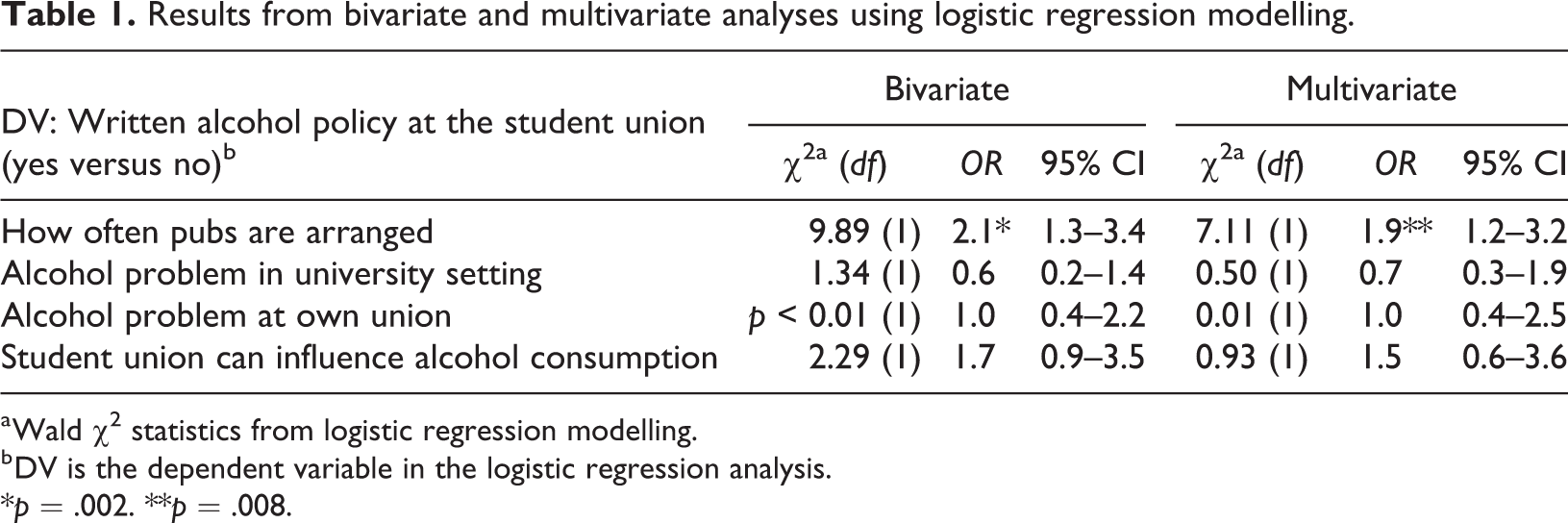
a Wald χ2 statistics from logistic regression modelling.
b DV is the dependent variable in the logistic regression analysis.
*p = .002. **p = .008.
Alcohol in the student union setting
About 40.5% (n = 30) of respondents reported that moderate alcohol consumption played a positive role in student life to a high or very high extent, while 47.3% (n = 35) reported that it did so to some extent. About 12% (n = 9) reported that alcohol played a positive role to a limited extent, or to no extent at all. Almost half of the respondents (47.3%, n = 35) believed that alcohol consumption could be a problem among students at Swedish universities to a high or very high extent, while 44.6% (n = 33) believed it could be a problem to some extent. About 8% (n = 6) believed that alcohol could be a problem to a limited extent. Regarding whether alcohol consumption could be a problem among students at the respondents’ own student unions, 16.2% (n = 12) reported believing that it could be a problem to a high or very high extent, while 48.6% (n = 36) reported that it could be a problem to some extent. About 35% (n = 26) believed it could be a problem to a limited extent, or not at all.
Respondents’ views and opinions were further illustrated in the responses (n = 17) to an open-ended question asking them to describe problems associated with alcohol consumption in student life. The responses suggest that alcohol is a common feature in the student union setting and that there is a norm that sometimes requires alcohol consumption. The following are illustrative excerpts from the responses: The culture that exists in student life today often encourages high [alcohol] consumption, which is a problem… …the social norm demands that you drink alcohol… …consumption among some students can be a bit too high, with a glorifying attitude toward alcohol… …many activities “require” alcohol consumption… …usually students drink unreasonable amounts and get very drunk, very often… …students can tell about how they woke up on a lawn not knowing what happened and your friends laugh and you think it’s funny, though actually it’s dangerous… …many can get caught up in dependence without knowing it… Students drink a lot, especially because we have a very active social life on our campus… …It [alcohol consumption] can sometimes be high, but only among certain individuals. In certain groups/contexts there is too much drinking… …we have a relatively good policy on alcohol management, with more focus on the party (for example) being fun, where we market several alcohol-free options much more than the alcohol… …have begun extensive work to see how we can reduce the focus [on alcohol]. The union is working to promote alcohol-free alternatives…
Attitudes toward alcohol prevention in the student union setting
The vast majority (93.2%, n = 69) of respondents reported believing that the student union should work with alcohol prevention in student life. Furthermore, 62.2% (n = 46) also reported believing that the student union could have an influence on alcohol consumption in student life to a high or very high extent. Twenty-one respondents (28.4%) reported believing that the student union could have an influence on alcohol consumption to some extent.
Discussion
At present, little is known about attitudes toward the issue of alcohol and alcohol prevention at student unions at Swedish universities/colleges, or about the extent to which student unions have written alcohol policies. Against this background, the aim of the present study was to increase our knowledge about the presence of alcohol policies at Swedish student unions, and to explore factors possibly associated with the existence of such policies. A further aim was to explore respondents’ opinions regarding the issue of alcohol and prevention in student life.
The results are encouraging, and show that a written alcohol policy is present at eight out of ten Swedish student unions, and respondents also reported that the policies were followed to a large extent. Most alcohol policies also included guidelines for how the student union should work with alcohol prevention. In addition, regarding the item on guidelines for making student life more inclusive for all students, about half of respondents reported that such guidelines did exist. However, it should be noted that despite the presence of such policies at student unions, high and risky alcohol consumption among university students is still a major public health problem. Comprehensive policy work includes not only developing a written alcohol policy, but also implementing the policy. Implementation entails training and informing students about the policy (Babor, 2010). Having a policy stating that the unions should work with alcohol prevention does not mean that such work is actually being pursued. This is especially important in an organisation with a high turnover, and the turnover of chairpersons at the student unions is indeed high. Furthermore, successful policy work also includes having available action plans that describe how to put the policy into effect. The present data reveal that not even half of the student unions have a written action plan. This suggests that there is room for improvement in the student unions’ policy work.
A further aim was to identify factors associated with the presence of an alcohol policy at the student unions. The results showed that the frequency of arrangement of pubs at the student unions was significantly associated with the presence of an alcohol policy. This is not surprising, as arranging pubs and serving alcohol probably raises these issues, thus leading to policy development.
The majority of respondents have positive attitudes toward alcohol prevention in the student union setting, believing that the student unions should work with alcohol prevention. They also believed that the student union could have an influence on alcohol consumption among students. They viewed moderate alcohol consumption as a positive feature in student life, while also recognising that alcohol consumption could be a problem. It is interesting to note that fewer respondents regarded alcohol consumption to be a problem among students at their own student union, compared to the proportion who believed alcohol consumption could be a problem among university students in general.
Responses to the open-ended questions on possible problems associated with alcohol consumption show that the student unions have knowledge about and insights into the risks associated with high alcohol consumption. Respondents reported that alcohol consumption was often expected and might involve risks both in the short and long term: “the social norm demands that you drink alcohol”, “many can get caught up in dependence without knowing it”.
Strengths and limitations
Given the current lack of knowledge regarding attitudes toward alcohol prevention and presence of alcohol policies at Swedish student unions, the present article makes an important contribution to this area of research. Another major strength is the high response rate; the study includes data from key representatives from 82% of Sweden’s 95 student unions. In addition to the quantitative data, we also collected respondents’ opinions in open-ended questions, which also generated important knowledge. One limitation is that the study relied on self-reports. However, the questionnaire did not include any items of a personal or sensitive nature, which probably increased the credibility of the responses. Another limitation is that, although the majority of respondents reported having an alcohol policy at their student union, we did not ask to see the policy. Future research could include an examination of actual alcohol policies, thus increasing our knowledge about their content. Future research could also focus on actual policy work and implementation.
Conclusion
The majority of student union representatives in the present study reported that alcohol consumption could be a problem among students at Swedish universities to some extent, or to a high or very high extent. The respondents also seemed to be aware of the risks associated with high alcohol consumption, and reported positive attitudes toward alcohol prevention in the student union setting. This, together with the fact that the majority of student unions had written alcohol policies, suggests that the student union setting may be a promising arena for alcohol prevention. The present results also suggest that there is room for improvement in policy work, as only about half of the student unions reported having a written action plan for putting the policy into effect.
Footnotes
Acknowledgements
We are grateful to the participants who took the time to complete the questionnaire and to provide us with the information needed to make this study possible.
Declaration of conflicting interests
The authors declared no potential conflicts of interest with respect to the research, authorship, and/or publication of this article.
Funding
The authors disclosed receipt of the following financial support for the research, authorship, and/or publication of this article: The present study was funded by The Swedish Research Council for Health, Working life and Welfare (FORTE). The funding institution was not involved in planning the study design, collecting the data, writing the manuscript or deciding to submit the paper for publication.
Supplemental material
The data that support the findings of this study are available from Centre for Psychiatry Research, an organized collaboration between Karolinska Institutet and Stockholm county council, but restrictions apply to the availability of these data, which were used under ethical permission for the current study, and so are not publicly available. However, data are available from the authors upon reasonable request and with permission from Centre for Psychiatry Research.