




Abstract
Narrative advertising dominates contemporary brand communications, with its effectiveness often attributed to psychological mechanisms such as transportation and identification. However, the relationship between narrative structure and customer engagement and purchase intention remains underexplored, particularly in explaining why identical narratives are interpreted differently by brand users and non‑users. This study examines how the structural elements of narrative advertising shape customer engagement through the customer hero journey framework, using a deductive analysis of semi-structured interviews with these two customer groups exposed to a social media carousel advertisement. The findings reveal that each narrative phase aligns with distinct engagement mechanisms: cognitive reflection in the departure phase, affective and sensorial immersion in the journey phase, and emotional fulfilment and social belonging in the return phase. Sensorial experience emerges as a fifth, empirically distinguishable dimension of engagement. A single narrative also produced divergent interpretive pathways: non‑users followed aspirational, discovery‑oriented readings, whereas current users engaged through recognition and confirmation of existing brand relationships. These results show how a stage‑based narrative structure can evoke differentiated engagement across customer segments. The study extends narrative advertising by specifying phase‑specific mechanisms and usage‑based interpretive pathways and offers design principles for structuring stories that effectively engage both brand users and non‑users.
Keywords
Introduction
Narrative advertising – brand messages structured as stories – is increasingly valued by consumers: 92% report preferring story-based formats, and 68% indicate that brand stories influence their purchase decisions (Dessart, 2018; McMurtrie, 2023). In a digital environment where consumers spend over 6 hr per day online (Deloitte, 2025), such formats consistently outperform purely informational appeals (Dessart, 2018; Hamby & Escalas, 2024; Orazi et al., 2025), enhancing purchase intention (Brechman & Purvis, 2015; Crespo et al., 2023), willingness to pay a premium price (Lundqvist et al., 2013; Valenzuela & Galli, 2024), and sharing, advocacy, and viewing intentions (Coker et al., 2021; Farace et al., 2017; Yang & Kang, 2021).
These effects are typically attributed to narrative transportation – the immersive experience of absorption into the story world (Green & Brock, 2000) and character identification (Escalas, 2004a). Yet neither mechanism specifies which story structures and elements generate engagement or why the same narrative resonates differently across audiences. Emerging work on argument quality further suggests that persuasion depends on narrative design, not content alone (Hamby & Escalas, 2024; Krause-Galoni & Rucker, 2024).
Recent studies have shifted towards the structural qualities of stories, recognising that coherence, sequencing, and narrative arc shape reasoning, memory, and emotional engagement (Dessart & Pitardi, 2019; Gordon et al., 2018; König, 2020; Sanders & van Krieken, 2018). Yet research continues to prioritise outcomes over elements. While narratives are persuasive, far less is known about how specific structural components drive engagement or how their effects differ between brand users and non-users (Dessart & Pitardi, 2019).
Therefore, the purpose of this study is to explore how individual elements of the structure of narrative advertising affect customer engagement and purchase intention and whether their effects differ between brand users and non-users. The investigation first examines the relationship between the arc of the customer hero journey narrative and customer engagement, identifying patterns and themes through which narrative structure shapes consumer responses. It then explores how specific narrative elements – characters, conflict, message, and plot – are interpreted by brand users and non-users, to understand how these components resonate with each group.
This study develops and illustrates the customer hero journey – a stage-based structural model that connects plot, characters, conflict, and message to cognitive, affective, emotional, and social engagement across the phases of departure, journey, and return, and shows how these connections differ between brand users and non-users (Campbell, 2003; Dessart & Pitardi, 2019; Lemon & Verhoef, 2016). The customer hero journey is distinct from existing approaches to branding and journeys. Traditional customer journey mapping focusses on service touchpoints, whereas the customer hero journey foregrounds the narrative arc that structures those experiences. StoryBrand emphasises character roles and brand positioning (Miller, 2017), while the customer hero journey explicitly links plot, characters, conflict, and message to multidimensional customer engagement and makes visible how these links play out differently for brand users and non-users (Campbell, 2003; Dessart & Pitardi, 2019; Lemon & Verhoef, 2016).
This study makes four contributions to the literature on narrative advertising. First, it formalises the customer hero journey as an integrative framework that links hero-journey stages (Campbell, 2003) with customer experience theory (Lemon & Verhoef, 2016), offering a systematic model for analysing how story structure relates to engagement across brand users and non-users (Dessart & Pitardi, 2019). Second, it advances narrative advertising research by examining message, plot, characters, and conflict not in isolation but in interaction, demonstrating how coherence across elements generates deeper consumer involvement (Fog et al., 2005). Third, it extends narrative theory by examining how brand users and non-users respond differently to story structure, bringing an audience perspective that is largely absent from existing research. Fourth, it offers clear implications for practice by presenting a structured framework for designing narrative advertising campaigns that align story phases and elements with consumer journeys, providing guidance on balancing consumer protagonism with brand presence within the customer hero journey.
The paper first develops the theoretical foundation, then presents findings from a deductive analysis of semi-structured interviews conducted with participants exposed to a social media carousel advertisement promoting a physical service venue and concludes with theoretical and managerial implications and avenues for future research.
Literature Review
Theoretical Background
Stories enhance memory encoding and retrieval because human cognition is often organised in narrative form. Narrative elements serve as retrieval cues that facilitate recall and influence how consumers process brand communications (Dessart & Pitardi, 2019; Fog et al., 2005; Sanders & van Krieken, 2018; Woodside, 2010). Well-structured narratives provide coherence and clarity, which are particularly critical for experiential goods, where mismatched imagery reduces persuasion (Gallo et al., 2024). Persuasion depends on argument quality and structural design rather than content alone (Krause-Galoni & Rucker, 2024).
Consumers use associative processing to compare new stories with existing mental scripts (Abelson & Schank, 1995) and observational learning to draw lessons from how characters resolve challenges, thereby transferring meaning to the brand. Sensory-rich narratives further strengthen elaboration and recall by simulating real-world experiences (Van Laer et al., 2014). This sensorial dimension is consistent with experiential marketing and brand experience research, which conceptualise experiences as sensory, affective, intellectual, behavioural, and social responses to brand-related stimuli (Brakus et al., 2009; Schmitt, 1999). In this view, narrative structure does not create a new type of experience but orchestrates when and how sensory cues in stories (e.g. vivid imagery, sound, and setting) are activated and integrated with other experiential dimensions.
Emotional engagement in narrative persuasion reflects not only the emotions depicted by characters but also audiences’ own appraisals of story events; readers may experience emotions that diverge from those of the focal character when they interpret events differently (Hamby & Jones, 2022). Furthermore, narrative thought helps consumers organise experiences, gain perspective, and make evaluations, and Hamby and Escalas (2024) discuss narrative thought as influencing consumers via mechanisms such as transportation, comprehension, connection, and agency (Hamby & Escalas, 2024). Empathy involves adopting the character’s perspective and “feeling with” them (Escalas & Stern, 2003), and narrative processing often elicits autobiographical memories and self-generated stories as consumers fit advertised narratives into their own life experiences (Dessart & Pitardi, 2019; Escalas, 2004). Brand-related emotions in turn strengthen attachment, loyalty, and purchase intention (Escalas, 2004a; Tuškej et al., 2013), and narrative processing can enhance emotional engagement, a sense of fulfilment, and behavioural intentions (Hamby et al., 2015). Narrative transportation is cited as a primary mechanism through which stories persuade (Escalas, 2007; Green & Brock, 2000; Van Laer et al., 2014), yet transportation presupposes a coherent narrative structure: without a well-arranged sequence of message, conflict, characters, and plot, immersion is unlikely to occur.
Customer Experience
Customer experience is viewed as a multidimensional construct involving cognitive, emotional, behavioural, sensorial, and social responses to a firm’s offerings across the customer journey (Lemon & Verhoef, 2016; Schmitt, 1999, 2003; Verhoef et al., 2009). Customer experience is defined as a holistic phenomenon that unfolds across multiple interactions between the customer and the business, encompassing cognitive elements (customer knowledge and interpretations), affective elements (general feelings towards the experience), emotional elements (the degree to which the experience arouses those feelings), and social elements (connections to the customer’s social environment, identity, and relationships) (Bolton, 2018; Lemon & Verhoef, 2016). Consistent with experiential and brand experience research, the sensorial dimension refers to sensory responses (e.g. visual, auditory, tactile, gustatory, and olfactory cues) evoked by brand-related stimuli such as design, imagery, and atmosphere (Brakus et al., 2009; Schmitt, 1999). Becker and Jaakkola (2020) refine this view, defining customer experience as “customers’ non-deliberate, spontaneous responses and reactions to offering-related stimuli along the customer journey” (p. 637) and emphasising that experiences range in intensity from ordinary to extraordinary. This is why responses to advertising narratives are shaped by accumulated brand touchpoints and personal histories: a message of resilience may resonate strongly for a current user whose brand experiences have been rewarding, but weakly for a non-user with no relational foundation.
Customer experience theory thus anchors narrative persuasion in the lived trajectory of brand engagement – meaning arises from how the story integrates with the customer journey, not from narrative immersion alone. In line with experiential marketing and brand experience work, we therefore treat sensory processing as one facet of customer experience that can be selectively activated by the core narrative elements (Brakus et al., 2009; Schmitt, 1999).
Although sensorial aspects are acknowledged in this broader customer experience and brand experience literature, they have received limited empirical attention in narrative advertising contexts, particularly in relation to how specific narrative structures orchestrate sensory cues across the customer journey. While customer experience theory explains the context of narrative reception, it does not specify which structures elicit engagement; the hero’s journey provides that complementary lens.
The Hero’s Journey in Narrative Advertising
Campbell’s (2003) hero’s journey describes a narrative arc in which a protagonist leaves the ordinary world, undergoes trials and transformation, and ultimately returns. This arc is mapped into three stages: departure, journey, and return. This archetypal map mirrors consumer struggles and triumphs, making it a powerful tool for persuasion. When consumers are positioned as heroes and brands assume the role of mentor or guide, stories resonate more deeply, eliciting stronger cognitive and emotional engagement (Sanders & van Krieken, 2018; Woodside et al., 2008). This framing has been widely translated into practice, most notably in Miller’s (2017) StoryBrand framework, which places the customer at the centre of the narrative while the brand enables transformation.
Narrative processing allows consumers to construct personal stories from branded content, enhancing self-relevance, identification, and transportation (Escalas, 2004b; Kim et al., 2017; Woodside et al., 2008), which in turn can increase emotional engagement, a sense of fulfilment, and behavioural intentions (Hamby et al., 2015). Archetypal enactment further prompts consumers to participate cognitively, emotionally, and morally in the story through active role-taking and meaning-making, rather than passive emotional contagion (Efthimiou, 2016; Mar & Oatley, 2008; van Krieken & Sanders, 2023).
Despite its influence, the hero’s journey is not without critique. Its widespread adoption has sometimes led to reductive applications, portraying consumers exclusively as heroes and relegating the brand to the background, thereby risking brand dilution and limiting co-creation (Pereira, 2019). More nuanced approaches propose that brands balance their mentor’s role with an active narrative presence, ensuring they remain integral to consumer transformation (Sciarrino & Roberts, 2018; Woodside, 2010).
The Formation of Propositions
The Role of Narrative Elements in Driving Customer Engagement
Customer engagement encompasses emotional, cognitive, and behavioural involvement, including direct contributions and indirect ones such as brand advocacy and word-of-mouth (Hollebeek, 2011; Pansari & Kumar, 2017; Prentice & Loureiro, 2018; Vivek et al., 2014). Narrative advertising activates these dimensions through structural elements: plots stimulate attention and reflection (cognitive engagement), characters foster identification and empathy (emotional engagement), and verisimilitude prompts sharing and imitation (behavioural engagement; Dessart & Pitardi, 2019), with evidence linking these effects to purchase intention and brand loyalty (Coker et al., 2021). However, existing frameworks centre on three elements and do not incorporate message and conflict. The present study extends this work by examining all four elements – message, conflict, characters, and plot – in interaction (Fog et al., 2005). These elements are discussed in detail in the following sections.
Message
The message articulates the brand’s values and purpose and anchors the narrative in its identity (Aaker, 2018; Fog et al., 2005; Walter & Gioglio, 2018). Whether explicit or implicit, it guides consumers’ interpretation of the story and its relevance. Meaningful and authentic messages – particularly those that move beyond purely positive framing – elicit stronger emotional reactions and improve brand attitudes (Carnevale et al., 2018) and can increase willingness to pay (Lundqvist et al., 2013). Clarity and credibility further encourage engagement and action, reinforcing brand equity and long-term relationships (Aaker, 2018; Brechman & Purvis, 2015; Gilliam & Zablah, 2013).
Effective message communication also depends on the coherence between narrative content and presentation. Visual storytelling formats, including short-form video, symbolic imagery, and infographics, can convey complex meanings more effectively than text alone (Grigsby et al., 2023; H. Lim & Childs, 2020; Megehee & Woodside, 2010). When imagery or messaging lacks consistency, persuasion declines – particularly for experiential offerings (Gallo et al., 2024). Moreover, engagement depends on the quality and coherence of arguments rather than their quantity, underscoring the structural role of message within narrative advertising (Krause-Galoni & Rucker 2024).
Conflict
Conflict generates narrative tension and represents the consumer’s struggle, positioning the brand as a potential resolution (Abbott, 2021; McKee & Gerace, 2018). Stories that progress from tension to resolution increase involvement, evoke emotion, and sustain attention, thereby encouraging loyalty, purchase, and advocacy (Fog et al., 2005; Kim et al., 2017; Woodside, 2010). By addressing pain points, brands reinforce their role as problem-solvers and highlight product utility, strengthening satisfaction, and engagement (Bagozzi & Nataraajan, 2000; Godin, 2009; Mills & John, 2021). The persuasive effect of conflict also varies by product category. Yin et al. (2020) show that man-against-self, man-against-man, and man-against-society conflicts are more effective for experience products, whereas man-against-nature is more persuasive for search products. These findings indicate that the type of conflict shapes audience response. However, conflict must be carefully calibrated; excessive tension risks fatigue, while insufficient tension weakens involvement (Fog et al., 2005).
Characters
Characters drive narrative action and function as the primary relational link between brand and audience (Igartua, 2010). Through likeability and access to characters’ thoughts and emotions, consumers identify with them, eliciting empathy and emotional involvement (Mar et al., 2011; Van Laer et al., 2019). Such identification enhances persuasive impact by increasing empathy and reducing counter-arguments (De Graaf et al., 2012; Stern, 1994).
In narrative advertising, the brand is often personified as a guide or mentor to the consumer-protagonist (Garretson & Niedrich, 2004; Herskovitz & Crystal, 2010). Strong and consistent brand personas support narrative continuity, foster trust, and strengthen positive brand attitudes (Dessart & Pitardi, 2019; Hoeken et al., 2016). Identification in social media and advertising contexts further stimulates engagement, electronic word-of-mouth, and behavioural intentions (Chu & Sung, 2015; Dessart, 2018). Introducing characters that deviate from expectations can broaden appeal and deepen emotional resonance (Houghton, 2023). However, over-reliance on identification may result in superficial connection if characters lack authenticity (Pereira, 2019). Moreover, audiences do not simply mirror character emotions; their responses depend on how they appraise narrative events (Hamby & Jones, 2022).
Plot
Plot refers to the structured sequence of events that guide audiences through a narrative journey aligned with their experiences or aspirations (Avery, 2019; Mills & John, 2021). In brand storytelling, plots frequently mirror problem-solving trajectories in which tension builds towards climax and resolution, positioning the brand as a response to consumer challenges (Cawelti, 1972; Fog et al., 2005).
Different plot configurations generate distinct forms of engagement. Sanders and van Krieken (2018) distinguish between singular hero-journey plots, which evoke emotional catharsis, and embedded plots, which stimulate reflection and value alignment (phronesis). Empirical work shows that cohesive, classical plot structures elicit stronger emotional responses – such as sympathy and empathy – than fragmented formats, thereby enhancing engagement and attitudes towards the advertisement (Escalas & Stern, 2020). More complex plots can also deepen narrative transportation and persuasion (Hamby & Brinberg, 2016), while capturing attention and encouraging reflection on how the brand resolves consumer problems (Dessart & Pitardi, 2019; Ryu et al., 2019). Introducing unexpected challenges further sustains interest (Houghton, 2023). Aligning plot development with the customer journey allows brands to frame the consumer experience coherently (Pereira, 2019).
Thus, message, conflict, characters, and plot form the structural architecture of the narrative arc, guiding how audiences interpret and respond to brand stories. Building on this, it is proposed: P1: In the departure, journey, and return phases of the customer hero journey, the four core element of the narrative structure is linked to different forms of cognitive, affective, emotional, and social engagement, which are related to purchase intention.
The Role of Brand Usage in Narrative Advertising
Brand usage refers to interaction with a brand, segmented into current users, former users, and never-triers (Bird et al., 1970; Romaniuk et al., 2012). Research consistently shows that brand-image associations are ordered by usage history: current users hold more positive brand-image associations than former users, who in turn hold more positive associations than never-triers (Romaniuk et al., 2012) – a pattern suggesting that advertising responses cannot be fully understood without accounting for prior brand experience.
Current brand users are systematically more likely than non-users to recall, recognise, and respond positively to advertising, a pattern known as the usage-bias effect (Bird et al., 1970; Romaniuk & Wight, 2009; Vaughan et al., 2016). This effect has been replicated across product categories and media formats, showing that users are often more than twice as likely as non-users to remember advertising exposure (Rice & Bennett, 1998). The explanation lies in associative network theories of memory: prior brand experience strengthens brand-linked memory structures, making it easier for users to encode and retrieve advertising stimuli, while non-users struggle to anchor new information in memory (Anderson & Bower, 1974; Nedungadi, 1990).
Simmonds et al. (2020) demonstrate that although users and non-users may devote similar levels of visual attention to video advertising, the effectiveness of that attention differs: for light and non-users, increased attention improves recall, whereas for heavy users, additional attention yields little incremental benefit. Similarly, Nguyen et al. (2018) show that when two brands are jointly presented in advertising, recall is highest among dual users, while single-brand users experience reduced recall due to limited cognitive capacity when processing a second, unfamiliar brand.
What remains unclear is how the four narrative elements influence customer engagement and purchase intention differently for brand users and non-users. Building on this, it is proposed: P2: Brand usage (current versus non-users) is associated with different interpretations of the four narrative elements and, in turn, different forms of customer engagement.
Figure 1 presents the conceptual structure guiding this study. It depicts narrative advertising organised across the three phases of the customer hero journey, linking each phase to the four core narrative elements, which activate distinct customer experience dimensions. It further illustrates the interpretive role of audience context – distinguishing between brand users and non-users – and how these processes connect to customer engagement and purchase intention.
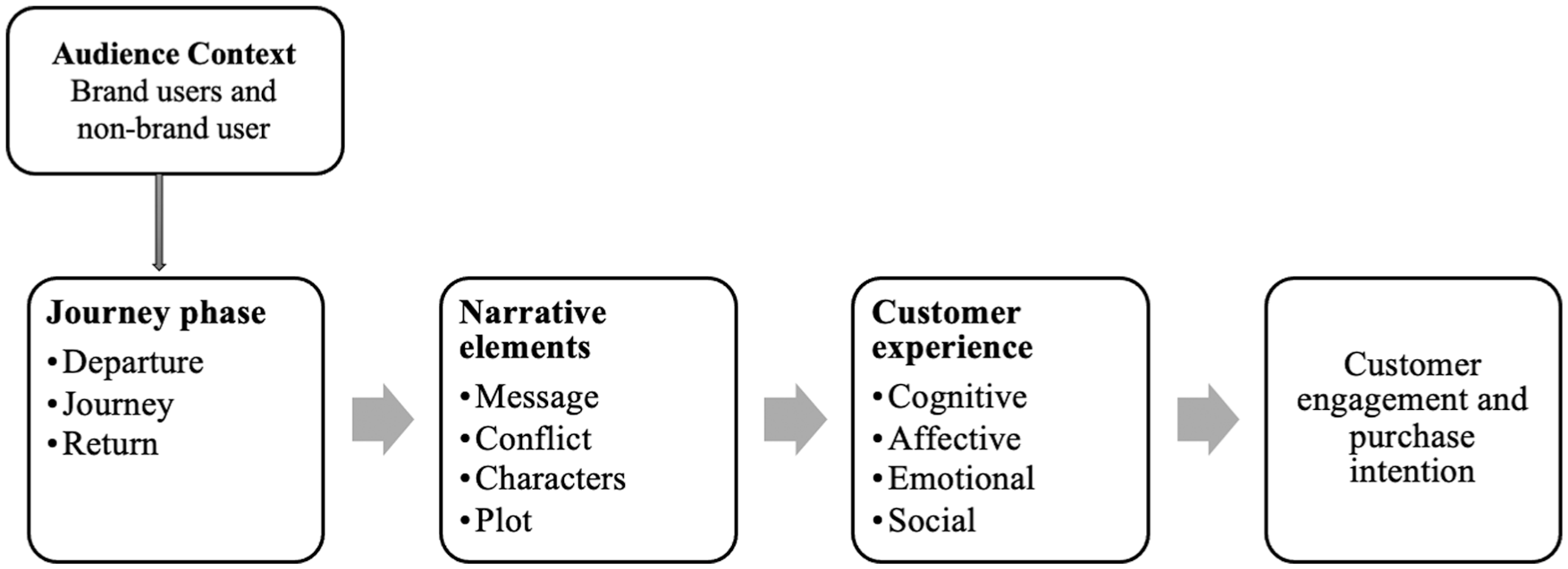
Conceptual framework developed by the authors.
Methods
Context of the Research
This study adopts a qualitative methodology, using semi-structured interviews to explore how narrative structure shapes customer engagement across brand users and non-users (Eisenhardt, 1989; W. M. Lim, 2025; Strauss & Corbin, 1990). Qualitative inquiry allows for interpretive depth in examining context-rich, subjective responses (Deshpande, 1983; Mintzberg, 1979) – particularly important when investigating how identical stimuli produce divergent patterns of meaning-making across audience segments.
Sample
This study employed convenience and purposive sampling to ensure participation from individuals both familiar and unfamiliar with the brand (Gubrium & Holstein, 2002). Potential customers residing within a 10-km radius of the venue were recruited via a targeted Facebook advertisement (n = 6; Etikan et al., 2016), while existing customers were selected purposively (n = 10) based on visit frequency, expenditure patterns, and loyalty ranking over the preceding 6 months. This comparative design prioritised interpretive depth and subgroup contrast over statistical representativeness (W. M. Lim, 2025; Lundqvist et al., 2013).
The asymmetric segmentation (6 non‑users and 10 users) reflects the venue’s customer base and aligns with qualitative evidence that many core themes in relatively homogenous samples emerge within the first 6 to 12 interviews (Guest et al., 2006; Hennink & Kaiser, 2022), providing sufficient depth for subgroup comparison. While thematic sufficiency was reached overall, dividing participants into current and potential customer groups constrained subgroup saturation, which is acknowledged in line with broader discussions of qualitative adequacy, saturation, and generalisability (Baker & Edwards, 2012; W. M. Lim, 2025; Saunders et al., 2018).
Instruments and Data Collection Procedures
The study employed a storyboarded carousel advertisement (Lien & Chen, 2013), developed in collaboration with Club Tweed’s marketing team and structured around the customer hero journey (see Supplemental Appendix A). The 10 sequential images represented milestones in a typical customer experience, reflecting the venue’s ambience and service offering. Characters portrayed typical consumers to facilitate identification and self-projection. The narrative depicted a transition from occupational stress to social leisure, with subtle conflict resolved through shared enjoyment with friends. The overarching message positioned Club Tweed as a venue for relaxation, reconnection, and quality food, beverages, and entertainment.
Using a storyboarded carousel advertisement as a vignette stimulus allowed participants to respond to a bounded narrative stimulus under conditions approximating natural exposure, enabling rich interpretive responses (Lien & Chen, 2013; W. M. Lim, 2025).
Interview Procedure
The interview guide (Supplemental Appendix B) addressed five domains: narrative structure, emotional response, character identification, perceptions of format and message clarity, and behavioural intention and customer engagement. Interviews were recorded and anonymised (e.g. A1 and R1) and included open- and closed-ended questions. Pilot interviews were conducted with two potential and two existing customers to refine question clarity and sequencing. Feedback from two subject-matter experts informed minor revisions to the guide (M. Q. Patton, 2014). During data collection, participants were invited to view the carousel stimulus under conditions approximating natural exposure before responding to interview prompts.
Data Analysis
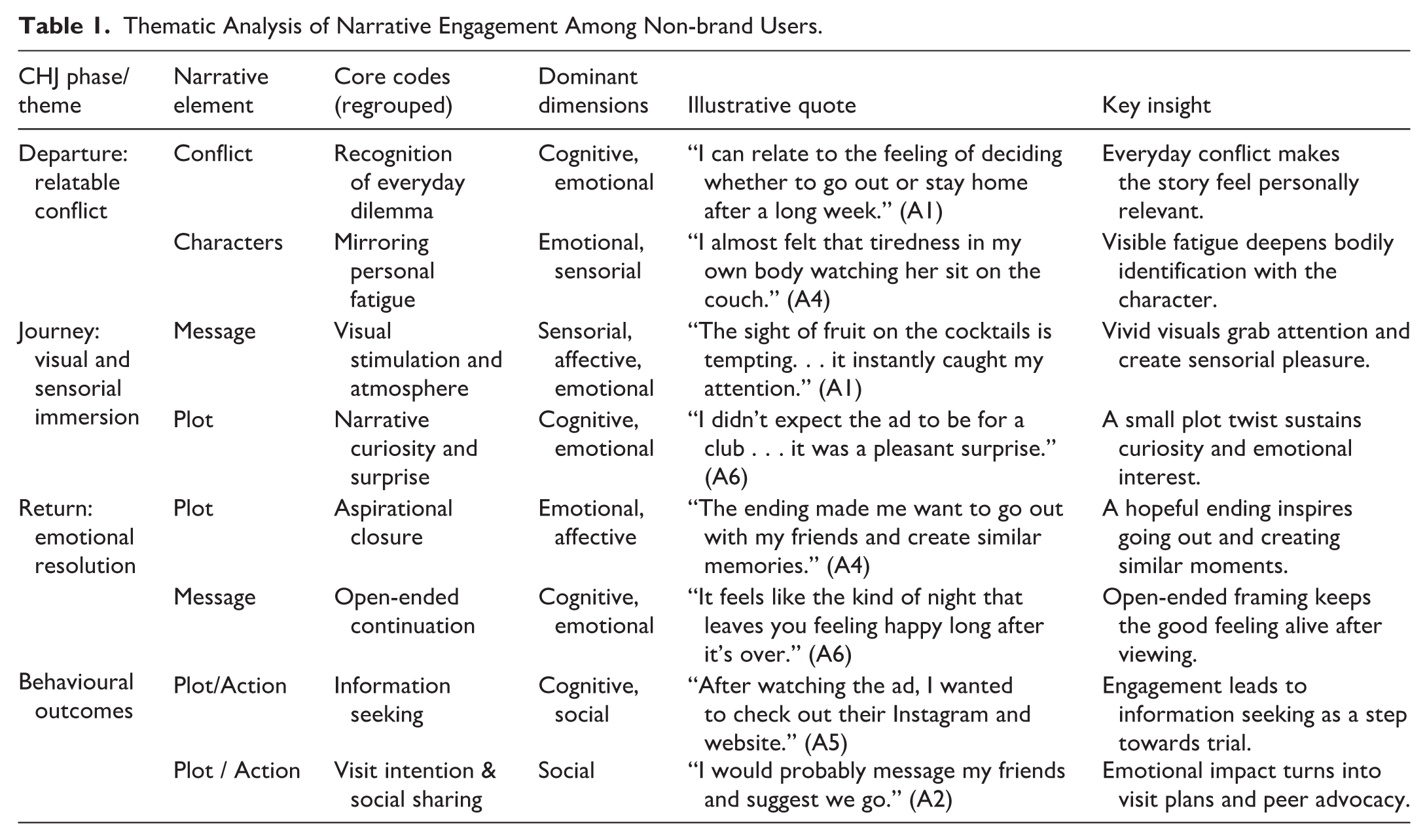
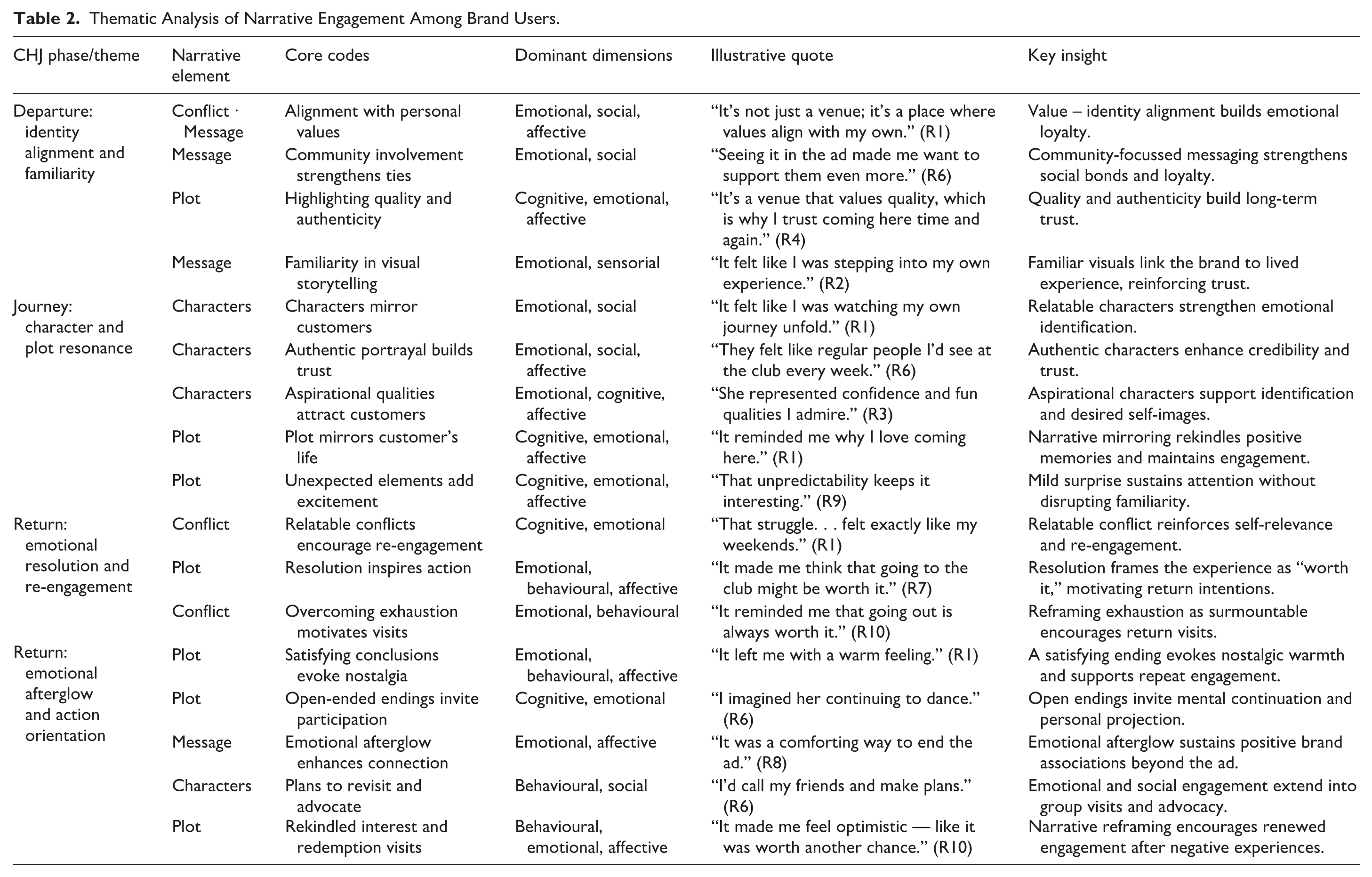
Template analysis was employed to identify principal themes within the interview data, supported by NVivo 11 (Crabtree & Miller, 1999; Thaichon et al., 2020). The analysis followed Braun and Clarke’s (2006; Clarke & Braun, 2013) six-step framework: (1) familiarisation, (2) coding, (3) theme development, (4) refinement, (5) definition, and (6) reporting. Guided by a deductive orientation, coding was informed by the customer hero journey framework and customer experience theory (Brakus et al., 2009; Campbell, 2003; Lemon & Verhoef, 2016; Schmitt, 1999), with codes mapped to the three journey phases and customer experience dimensions. The sampling and coding structure is presented in Tables 1 and 2. Coding guidelines were developed through independent analysis of a subset of interviews, with discrepancies resolved through iterative discussion (Krippendorf, 1982).
Thematic Analysis of Narrative Engagement Among Non-brand Users.
Thematic Analysis of Narrative Engagement Among Brand Users.
The primary researcher has professional marketing experience and previously held a marketing role at the focal venue, which enhanced sensitivity to narrative mechanisms but also introduced potential expectancy bias regarding the influence of story structure on engagement (Funder, 2005; Rao & Perry, 2003). To monitor and mitigate this bias, reflexive analytic memos were maintained throughout data collection and analysis, emerging interpretations were discussed with co‑researchers not involved with the venue, and member checks with selected participants together with peer review of the coding framework were used to challenge initial readings and strengthen the credibility and confirmability of the themes (W. M. Lim, 2025; Lincoln & Guba, 1985; C. Patton et al., 2015).
Findings
This section presents how the structural components of the narrative advertisement relate to customer engagement and purchase intention. The analysis is organised in two parts. The first examines how each phase of the customer hero journey stimulates distinct dimensions of the customer experience. The second compares how these mechanisms differ between current users and non‑users, showing how prior brand experience shapes narrative interpretation and response. Tables 1 and 2 summarise the key findings in each group.
The Customer Hero Journey Across Customer Experience Dimensions
Departure Phase: Conflict and Identification
In line with the departure stage of the hero’s journey, a conflict is introduced, providing an initial basis for customer engagement. Participants meet the exhausted protagonist, who deliberates between going out or remaining at home after a lengthy workday. This internal conflict resonated strongly with participants, many of whom recognised the same tension in their own routines. A3 expressed, “I often struggle with deciding whether to go out or stay at home, particularly when I am tired after work. It is that constant back-and-forth between wanting to recharge and not wanting to miss out. This advertisement seemed to address me directly.” This response illustrates cognitive engagement, as participants recognised and reflected on the dilemma, as well as a social element because the decision is associated with spending time with others.
Character identification emerged as a multi-layered engagement mechanism. Participant empathy with the protagonist’s conflict reflected cognitive recognition of the dilemma, affective resonance with her struggle, and emotional arousal. At the same time, sensorial cues of fatigue (e.g. muted lighting and domestic settings) and the implied social context of “going out” reinforced this identification, deepening personal relevance and relational meaning. These sensorial cues and the implied bodily inertia of exhaustion contrasted with the potential vitality of going out, inviting kinaesthetic engagement as participants projected themselves onto the protagonist’s energy shift. As A4 noted, “The challenge she faced mirrors my own experience every weekend. I could empathise with her dilemma, caught between the want for relaxation and the urge to venture forth. I almost felt that tiredness in my own body watching her sit on the couch, like I could sense the heaviness of her day before the lift of energy when she finally decided to go.” Similarly, R3 remarked, “Her struggle between wanting to stay in and choosing to go out felt exactly like my weekends. I could see myself sitting there, thinking the same thing, then giving in to the idea of going. It’s almost comforting to see that indecision shown so honestly.”
Beyond recognition and empathy, several participants described immediate behavioural follow-up, such as checking menus or the club’s social media after recognising their own dilemma. As A5 noted, “After watching the ad, I wanted to check out their Instagram and website to see more about the place.” This suggests that the departure phase of the customer hero journey not only stimulated empathy but also prompted information-seeking behaviours as an early stage of customer engagement and a precursor to purchase intention.
Journey Phase: Visual and Sensorial Dimension
Consistent with the journey stage of the hero’s journey, the narrative shifts from conflict to action as the protagonist chooses to venture forth. For participants, this shift was communicated through vibrant visuals that heightened affective, emotional, and sensorial engagement. A4 stated, “The visuals, especially the drinks and the settings, made me want to be there with my friends. The lighting changed, the energy picked up, and it almost felt like I was stepping into that atmosphere. I could see myself in that situation, laughing and chatting.” This demonstrates both a cognitive element (recognition of the scenario) and an affective element (favourable evaluation of the imagery).
The venue’s sensory experience was particularly impactful. R8 observed, “Seeing those fresh cocktails and vibrant settings reminded me of my love for the venue, the colours, the textures, even the condensation on the glass. It’s like you can almost taste it. It brought back memories and that feeling of being there.” This reflects an emotional element (joy and nostalgia) as well as a sensorial element (colour and freshness cues as sensory triggers). Similarly, A1 commented, “The sight of fruit on the cocktails is tempting because it looks delicious, refreshing and colourful. It instantly caught my attention and made me think of summer nights out.” Here, visual details (colour, freshness, and condensation) captured attention and evoked anticipation and desire, linking imagery to remembered or imagined experiences at the venue.
While participants most frequently referenced visuals, the implied ambience of music and laughter, together with the suggestion of movement and social energy, invited kinaesthetic and auditory engagement, reinforcing immersion in the club atmosphere. Several participants reported making tentative plans with friends (e.g. “we should go next weekend”), indicating that sensorial storytelling converted affective pleasure into forward-looking social engagement. In this sense, the journey phase highlights how visual and ambient cues not only support immersion but also support concrete steps towards trial and visitation intentions.
Return Phase: Resolution and Belonging
Reflecting the return stage of the hero’s journey, the protagonist resolves the conflict and embraces the communal experience. For participants, this resolution encouraged reflection on their own choices and intentions. A6 remarked, “The ending made me want to go out with my friends and create similar memories.” This demonstrates an affective evaluation of the positive outcome and an emotional response of joy and aspiration, as well as a social element (imagining shared experience).
For others, emotional closure directly became purchase intention. A4 explained, “I would book a table after watching the ad. It looks like a place I’d want to spend a night with friends, fun but relaxing, not too forced.” Similarly, A2 emphasised the advocacy dimension: “I would probably message my friends straight away and say, ‘Let’s go there next time’. It just looked genuine, like a good vibe rather than a staged ad.” The sense of community was reinforced across responses. R1 observed, “The ad perfectly captures the essence of the club community, fresh local food, friendly faces, and that sense that everyone’s welcome. It’s not just about the venue; it’s about being part of something.” This reflects the social dimension (shared identity and community values) alongside the emotional element of belonging. Similarly, A3 explained, “It made me feel like this is the kind of place where I belong, where I could unwind and still feel connected with my group.” Here, emotional fulfilment and social identity intertwined to show how narrative resolution fostered both individual and collective engagement.
Participants also translated these responses into behavioural intentions. A5 stated, “I couldn’t help but think of people I want to bring with me next time. It’s not just about me going; it’s about bringing others into the experience.” This illustrates how emotional resolve and social connection convert private enjoyment into advocacy for the brand. A1 further added, “I want to be with them; they look like they’re having so much fun. Their energy and chemistry make the scene feel inviting and inclusive, reinforcing the idea that the brand is about creating shared experiences.” This highlights how emotional satisfaction and social belonging work together to strengthen behavioural intention.
Therefore, these responses show how the emotional closure of the return phase nurtured long-term affiliation and loyalty. This demonstrates how narrative resolution transforms private recognition into durable customer engagement, extending beyond the individual to encompass group identity, shared memory, and brand advocacy. Participants also implied the sensory atmosphere of music, laughter, and shared movement, underscoring how multisensory cues contributed to feelings of inclusion and belonging by engaging visual, auditory, and kinaesthetic aspects of the experience. When comparing across groups, both brand users and non-users described emotional closure and social belonging as central outcomes of the return phase. However, non-users more frequently emphasised aspirational evaluation (imagining future visits), whereas current users highlighted continuity of loyalty and community identity (reaffirming the venue as “their place”). This suggests that while the hero’s journey engages both groups, it operates through slightly different pathways: aspirational anticipation for potential customers and relational reinforcement for current
Narrative Elements Across Brand Users and Non-Users
Message
Both groups emphasised the primacy of the visuals in the ad, but their interpretations diverged.
Non-users saw the visuals as aspirational triggers. A2 described: “The cocktails looked so colourful and refreshing; it made me think of summer nights out with friends. The pictures and videos got the message across instantly.” A3 added: “The visuals spoke for themselves. The colours, the energy, even the drinks made it clear what the vibe was, without needing any words.” These responses demonstrate sensorial engagement (visual appeal and imagined taste and atmosphere), emotional arousal (desire and anticipation), and cognitive efficiency (processing the message quickly).
Brand users, in contrast, connected the visuals with memory cues. R2 recalled: “The fishpond at the entrance instantly reminded me of my last visit. It felt personal, like the ad was speaking to me directly.” R10 agreed: “The positive vibe reflected the welcoming atmosphere I already associate with the club. It felt like home.” Here, visuals reinforced affective trust (familiarity) and emotional loyalty (comfort and belonging). Therefore, while non-users relied on visuals to imagine future experiences, users interpreted the same visuals as reminders of past experiences, highlighting the dual role of imagery in initiating engagement for potential customers and consolidating engagement for existing ones.
Conflict
The central conflict of whether to stay home or go out engaged both groups but produced distinct interpretations. Non-brand users focussed on curiosity and possibility. A6 explained: “I wondered if I’d feel the same way if I went there. Maybe it would be worth trying, especially because the ad showed her enjoying it in the end.” This reflects cognitive engagement (evaluating the scenario), affective evaluation (judging it as worth considering), and the social element (imagining going with friends). It also points to behavioural consideration, with non-users describing the conflict as a prompt to weigh up a potential visit.
Brand users recognised the conflict in their own recurring choices, reinforcing established behaviours. R1 remarked: “That decision hit home for me. I go through it all the time after a long week.” Similarly, R7 said: “I recognised that tired feeling, but like her, I know if I make the effort, I’ll enjoy myself. It reassured me about my own choices.” These responses highlight emotional empathy (relating to the character’s fatigue) and cognitive validation (confirming their own behaviour).
For non-users, the conflict stimulated trial-oriented consideration (“Maybe it would be worth trying”), whereas for users it provided reassurance, strengthening commitment to their existing routine. These responses highlight emotional empathy (relating to the character’s fatigue) and cognitive validation (confirming their own behaviour).
Characters
Perceptions of the characters also diverged across groups. Non-users viewed the characters through an aspirational lens. A3 described: “The woman in the red dress really caught my attention. She looked confident, stylish, and fun, everything I’d want for a night out. It made me think about the kind of experience I’d like to have there.” A6 agreed, adding: “It wasn’t forced; the people felt natural, like friends I could have. That authenticity made me trust the ad, even though I’ve never been to the place before.” These responses highlight the affective element (positive evaluation of authenticity), the emotional element (desire and excitement), and the social element (seeing oneself joining the group). They also suggest persuasive potential, as aspirational portrayals fostered curiosity and nudged participants towards trial intentions.
Brand users, meanwhile, emphasised recognition and trust. R2 commented: “The characters felt real, like regulars at the club. They weren’t actors, and that made it more relatable.” R1 reinforced this point: “I recognised the type of people; they are the same kind I usually see there. It felt like watching my own group.” In these cases, cognitive processing (recognition) combined with emotional fulfilment (comfort in familiarity), demonstrating that the characters’ apparent loyalty reflected the customers’ own experiences.
The brand itself also functioned as a character, embodying values such as community and authenticity. As R1 noted: “The ad captures the essence of the club perfectly, not just as a place to hang out, but as a reflection of who I am when I’m with my friends.” This illustrates the social element of identity alignment, encouraging long-term brand engagement.
Overall, for non-users, aspirational characters operated as persuasive triggers, fostering trust and desire and nudging them towards trying the brand. For users, recognition of familiar types confirmed a sense of belonging and, for many, translated into advocacy behaviours, such as recommending the venue or affirming it as “their place.”
Plot
The two groups differed in how they engaged with the plot. For both brand users and non-users, the central dilemma of whether to stay home or go out resonated strongly, but they interpreted it in distinct ways. Non-brand users responded aspirationally, imagining themselves in the situation. They described the plot as encouraging them to think about future experiences. As A2 reflected: “It could easily be my friends and me on a Saturday night; it felt familiar. That exact moment of deciding whether to stay in or go out is something we do all the time. Seeing it in the ad made me think, ‘Yes, this could be us next weekend’.” Similarly, R8 explained: “The story left me wondering what it would feel like if I went there myself. It made me imagine trying the place with my friends – the laughter, the buzz, even the walk in. It’s not often that an ad makes me picture myself so vividly in the moment. It felt like a scene I’d want to step into, not just watch.”
These responses reflect cognitive engagement (processing a familiar dilemma), affective evaluation (finding it relevant), and the social element (imagining shared experiences). They also reveal behavioural precursors, as imagining themselves in the scenario led some participants to describe planning future visits with friends.
Brand users, by contrast, tied the plot back to memory and routine. They highlighted how the storyline mirrored their own choices. R2 stated: “It reminded me of times I’ve already been there before. That whole decision about going out or staying home; it’s my routine. The ad really captured that.” R7 added: “That struggle hit home for me. After a long week, I always debate it, but like in the ad, I know if I go, I’ll end up enjoying myself. It felt like my own story.” These reactions reveal cognitive recognition and emotional resonance, as the users identified their established behaviours in the narrative. Several users also described the ad as reassuring, noting that it confirmed their choices and encouraged repeat visits.
Thus, although similar experiential dimensions were evident for both groups, the behavioural implications diverged: for non‑users, the plot acted as an invitation to trial, whereas for users it reinforced habitual loyalty and advocacy.
Table 3 summarises how potential and current customers engage with the same narrative elements in different ways. For potential customers, cues stimulate curiosity and trial, whereas for current customers they reinforce familiarity, memory, and identity, supporting emotional attachment and repeat engagement.
Comparative Thematic Analysis of Narrative Engagement Among Brand Users.
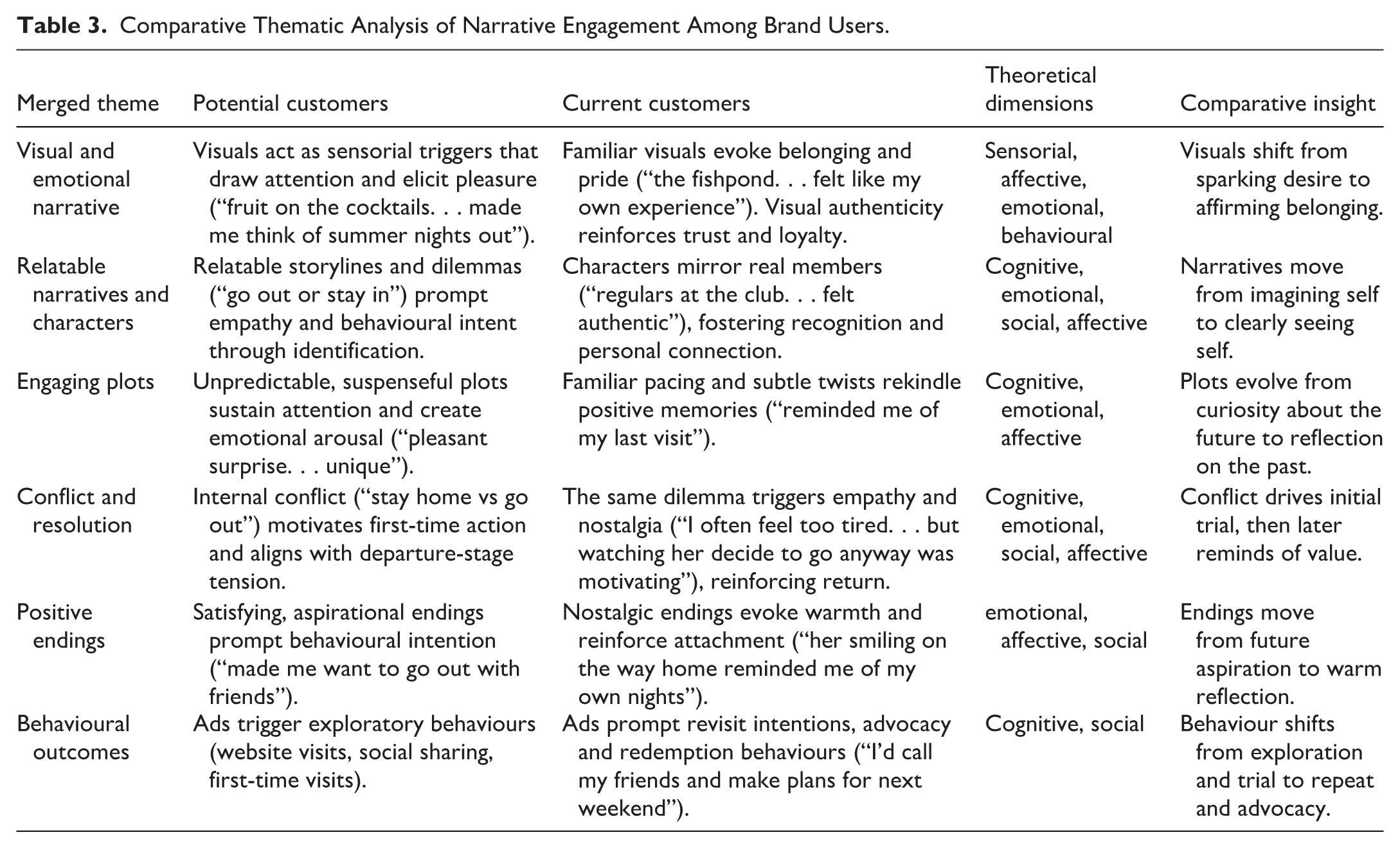
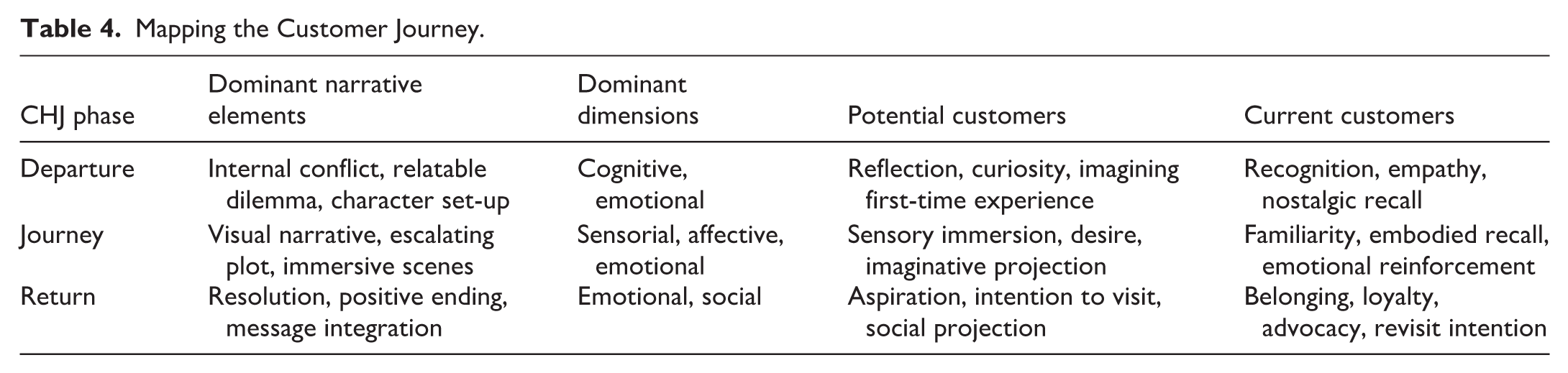
Table 4 maps the customer hero journey phases to dominant narrative elements, engagement dimensions, and segment-specific responses. It shows that engagement builds from cognitive – emotional entry, through sensorial immersion, to emotional and social resolution, with potential and current customers differing in whether they respond aspirationally or through recognition and reinforcement.
Mapping the Customer Journey.
Discussion
This study provides an in-depth understanding of how narrative structure links to customer engagement and purchase intention in advertising by examining the customer hero journey and the interplay of its four core narrative elements. The findings for Proposition 1 indicate that narrative advertising activates multiple dimensions of customer experience through the sequential phases of the customer hero journey, rather than generating a uniform response. In line with experiential and brand experience research, the sensorial dimension refers to sensory responses (e.g. visual, auditory, tactile, gustatory, and olfactory cues) evoked by brand-related stimuli such as imagery, setting, and atmosphere (Brakus et al., 2009; Schmitt, 1999). Within this framework, sensorial experience is clarified as a fifth, empirically distinct dimension of customer experience in the narrative advertising context, demonstrating how visual, auditory, and kinaesthetic cues sustain attention, enhance immersion, and support behavioural intention.
Across all phases, customer response was generated by the interaction among the four elements rather than by any single feature. The plot structured anticipation and transformation across the journey, conflict provided the emotional and cognitive entry point that provoked reflection and empathy, characters enabled identification and social projection, and the message integrated these components into coherent brand meaning. Together, these mechanisms translated narrative structure into multidimensional customer experiences and intentions to act.
The findings for Proposition 2 reveal divergence between audiences. Non-users engaged aspirationally, treating the narrative as an invitation to imagine future brand relationships, whereas current users engaged through recognition and memory, reinforcing loyalty and social identity. Consequently, the customer hero journey operates as a dynamic and multisensory mechanism that channels the five customer experience dimensions along distinct interpretive pathways depending on prior brand experience. In digitally saturated environments, where consumers spend more than 6 hr per day online, this structural coherence – rather than the mere presence of a narrative – becomes central to sustaining engagement.
Theoretical Implications
This paper makes four theoretical contributions. First, it introduces the customer hero journey as an integrative framework that combines hero’s journey (Campbell, 2003) and customer experience theory (Lemon & Verhoef, 2016). By embedding message, conflict, characters, and plot within an expanded, multidimensional view of customer experience elements, the customer hero journey provides a systematic basis for analysing how story structure guides customer engagement and purchase intention across brand users and non-users (Dessart & Pitardi, 2019; Lemon & Verhoef, 2016). This study also extends Pereira’s (2019) work by moving beyond the view of the brand as a purely passive mentor and showing how the customer hero journey positions the brand as a co-protagonist. By embedding the brand in moments of conflict, transformation, and resolution, the framework illustrates how brands actively guide engagement and meaning in narrative advertising, while still allowing the customer to remain the experiential focal point.
Second, the study extends brand usage literature by demonstrating how narrative structure interacts with prior brand experience to shape engagement pathways. Existing research documents a usage-bias effect, whereby current users recall and evaluate advertising more positively than non-users and explains this largely through memory-based mechanisms (Romaniuk & Wight, 2009). The present findings show that narrative design itself can channel responses along distinct pathways: for non-users, the customer hero journey operates aspirationally, inviting imaginative projection and trial consideration; for current users, it operates through recognition and reinforcement, confirming loyalty, social identity, and advocacy. This highlights narrative structure as a mechanism through which usage bias is expressed and potentially amplified.
Third, the research advances narrative advertising theory by demonstrating that customer engagement and purchase intention are formed not by isolated narrative elements, but by the interaction of plot, characters, conflict, and message within the arc of the customer hero journey. This holistic view extends prior work on narrative coherence, which has highlighted the importance of story structure for consumer engagement. By situating coherence within a stage-based journey (departure, journey, return), the customer hero journey clarifies how structural design translates into multidimensional engagements and subsequent action (Dessart & Pitardi, 2019; Escalas, 2004b).
Fourth, the paper extends customer experience research by clarifying the role of sensorial engagement within narrative advertising. Although prior work recognises multiple dimensions of customer experience, empirical studies of narrative advertising have rarely examined sensorial experience as a distinct dimension (Brakus et al., 2009; Lemon & Verhoef, 2016). The findings show that, within the customer hero journey, sensorial experience emerges as an empirically distinguishable dimension of customer experience, through which visual, auditory, and kinaesthetic cues sustain attention, deepen immersion, and contribute to behavioural intention.
Practical Implications
The findings offer several implications for advertisers designing narrative advertising. A common thread is that the same narrative elements operate differently for brand users and non-users, eliciting aspiration among prospective audiences and recognition among existing customers, so campaigns should be planned to work on both registers simultaneously (Lemon & Verhoef, 2016).
The customer hero journey can serve as a campaign blueprint rather than a stylistic device. Creative teams can map narratives explicitly around departure, journey, and return, specifying how plot, characters, conflict, and message activate cognitive, emotional, social, and sensorial responses at each stage, so that audiences move from recognition of a relatable problem to a resolution connected to the brand (Van Laer et al., 2014). The Club Tweed carousel illustrates this sequencing, with the protagonist’s hesitation, entry, and shared closing moment tracking the three phases within a consistent brand world; a comparable arc can be observed in Starbucks’ (2022) Every Table Has a Story.
Within that arc, the brand should be embedded in both the conflict and its resolution rather than positioned as a background symbol, so that setting, tone, product, and atmosphere evolve alongside the protagonist’s decision-making. In Club Tweed, lighting, music, and drinks carry the emotional tension and its release; Tesla’s (2021) Feel It offers an analogous pattern in which the product itself – silence, vibration, reconnection moves the story forward. Across the arc, relatable conflict at departure supports cognitive recognition, kinaesthetic motion during the journey sustains affective and sensorial engagement, and resolution through belonging at the return prompts behavioural intention, indicating that structural design – not volume of content – distributes engagement across experience dimensions (Lemon & Verhoef, 2016).
Characters, message, and resolution should work simultaneously for non-users and current users. A single story can carry trial-framing for newcomers and recognition-framing for loyal customers without requiring two executions, as illustrated by IKEA’s (2021) Feel Alive Again, in which the same transformation reads as novelty for non-users and as return to a familiar lifestyle for existing customers. Sensorial orchestration and open-ended resolution further extend engagement beyond the ad itself: in Club Tweed, the ambiguous final frame (“the night continues”) invites viewers to project a future visit, prompting curiosity among non-users and affective recognition among loyal customers (Van Laer et al., 2014). Three design principles therefore follow: (1) staging conflict and transformation with the brand as a co-protagonist, (2) orchestrating sensorial cues along the story arc, and (3) designing a single narrative that speaks simultaneously to brand users and non-users.
Limitations of the Research and Future Research
This study acknowledges several limitations that open avenues for future research. The use of a co-designed static carousel advertisement for a single hospitality venue situates the findings within a specific narrative and industry context. However, this focussed design also provided a controlled, context-rich stimulus that enabled nuanced insights into narrative engagement processes (Hirschman, 2010; Woodside et al., 2008). Future research should extend this work by examining the customer hero journey across different industries and narrative contexts to assess the transferability and applicability of the framework beyond a single experiential setting.
The insights into sensorial engagement were derived from a static narrative sequence that relied primarily on visual cues. While appropriate for qualitative exploration, this format limited the range of sensory inputs available to participants. Future research could explore sensorial engagement across alternative advertising formats, such as video, interactive, or immersive media, to better understand how different sensory configurations influence narrative interpretation and engagement (Brakus et al., 2009; Schmitt, 1999).
This study employed a small sample, which limits the generalisability of the findings, particularly for comparisons between brand users and non-users. Nonetheless, small samples are standard in qualitative research, and prior studies on consumer brand stories have used even fewer participants while still yielding rich and meaningful insights (Lundqvist et al., 2013; Schembri et al., 2010). At the same time, dividing participants into brand usage segments constrained subgroup saturation. Future research could build on these findings through larger comparative samples or cross-cultural qualitative designs to further explore segment-based differences in narrative interpretation.
Supplemental Material
sj-docx-1-anz-10.1177_14413582261451275 – Supplemental material for Inside the Story: How Narrative Structure Drives Customer Engagement Among Brand Users and Non-Users
Supplemental material, sj-docx-1-anz-10.1177_14413582261451275 for Inside the Story: How Narrative Structure Drives Customer Engagement Among Brand Users and Non-Users by Emilie Gachassin, Catherine Prentice and Park Thaichon in Australasian Marketing Journal
Footnotes

Funding
The authors received no financial support for the research, authorship, and/or publication of this article.
Declaration of Conflicting Interests
The authors declared no potential conflicts of interest with respect to the research, authorship, and/or publication of this article.
Supplemental Material
Supplemental material for this article is available online.
References
Supplementary Material
Please find the following supplemental material available below.
For Open Access articles published under a Creative Commons License, all supplemental material carries the same license as the article it is associated with.
For non-Open Access articles published, all supplemental material carries a non-exclusive license, and permission requests for re-use of supplemental material or any part of supplemental material shall be sent directly to the copyright owner as specified in the copyright notice associated with the article.
