




Abstract
The rapid adoption of virtual and hybrid work arrangements has reshaped the workplace, presenting unique challenges for employee and customer experiences. This study investigates how work arrangements influence employee service quality, focusing on the mediating roles of knowledge sharing and employee experience, and the moderating effects of growth mindset and psychological safety. Drawing on Conservation of Resources (COR) Theory, three interconnected studies were conducted. Study 1 reveals that virtual and hybrid work arrangements lead to lower employee service quality compared to onsite work due to the spatial distance that impedes knowledge sharing and diminishes employee experience. Study 2 demonstrates that a strong growth mindset mitigates these adverse effects, enabling employees to maintain knowledge sharing and service quality across diverse work arrangements. Study 3 highlights the critical role of psychological safety, showing that when psychological safety is high, employees in virtual and hybrid settings achieve levels of service quality comparable to their onsite counterparts. The findings extend COR Theory by integrating individual and contextual factors that influence employee resilience and adaptability. This research offers theoretical and practical insights into optimising work arrangements, emphasising strategies to enhance employee and customer experiences in increasingly flexible work environments. Organisations are encouraged to foster growth mindsets and psychological safety to mitigate the challenges of remote and hybrid work, ensuring sustained service excellence.
Keywords
Introduction
As work arrangement has been evolving at an unprecedented speed, driven by technological progressions, as well as changing work priorities, the dynamics between employee experience and customer experience has undergone a globally exceptional transformation (Mortensen & Haas, 2021). In service industries, where the “product” is largely intangible and co-created in real time with the customer, any disruption to employee experience is immediately felt by the customer at the point of delivery (T. Zhang et al., 2018). Front-line service staff must simultaneously manage operational tasks and the emotional labour of interacting with clients, making them uniquely sensitive to changes in work design (Wu et al., 2023). The global shift towards remote and hybrid work models, accelerated by the COVID-19 pandemic (Chen et al., 2025; Trinh et al., 2025; Y. Zhang et al., 2026), has presented organisations with a dual challenge: getting productivity sustained and ensuring high quality service supplied to customers. Despite their flexibility and cost efficiency, virtual and hybrid work arrangements create spatial distance that breaks existing ways of collaboration, knowledge sharing, and employee engagement (Petani & Mengis, 2021; Rupcic, 2024). For service firms, this spatial distance jeopardises the moment-to-moment coordination required to deliver consistent, personalised experiences; it also makes it harder for managers to coach employees in complex interpersonal skills such as empathy, active listening, and service recovery (Lamovšek et al., 2024; R. Yu et al., 2023). These disruptions also pose questions of fundamental importance in how the psychological and organisational factors that affect both employee experience and customer experience operate in many less complementary settings.
Customer-facing roles are dependent on a critical determinant of service quality: employee experience (Plaskoff, 2017). Much of this cannot be measured in training; rather, it emerges from daily interpersonal interactions, mutual knowledge sharing, and employees’ perceived support within their work environments (Lemon, 2019; M. Nguyen et al., 2023). Superior customer experiences tend to follow superior employee experiences, as engaged and well supported employees tend to have what it takes to meet customer needs and build a lasting relationship (Michel et al., 2023). However, service encounters often hinge on spontaneous knowledge sharing (“moment of truth” problem-solving) and emotional contagion; both are dampened when colleagues are dispersed and interact mainly through digital channels (K. Wang et al., 2025). Virtual and hybrid work arrangements inherently limit on-the-fly interactions and informal communications that are critical to knowledge sharing and group problem solving (Rupcic, 2024). Recent studies have documented that these limitations significantly weaken employees’ sense of belonging, decrease spontaneous collaboration, and negatively impact service quality delivered to customers (Höcker et al., 2024). This body of research highlights the urgent need to understand psychological factors that may buffer these detrimental effects.
Although research on work arrangements and their effects on employee performance has increased (Mortensen & Haas, 2021; Naqshbandi et al., 2024), little is known about the role of psychological and contextual factors, such as growth mindset and psychological safety, in moderating the effect of change in work arrangements on employee performance. To date however, work on growth mindset in organisational contexts, especially within high‑contact service settings, including its association with knowledge sharing and service quality, is lacking; specifically, researchers have paid especially little attention to the link between growth mindset and service quality (Q. Liu & Kamioka, 2024). The potential for growth mindset to mitigate the negative effects of remote and hybrid work on employee experience and service quality is underexplored, leaving a gap in understanding how individual adaptability influences outcomes in diverse work environments.
Growth mindset, referring to the belief that abilities and intelligence can be developed through effort and learning (Dweck, 2014), has recently attracted significant scholarly attention in organisational contexts. It is recognised for promoting adaptability, persistence, and collaborative behaviours (Duy Cuong et al., 2025). In service settings, growth mindset is particularly pertinent, as frontline roles frequently involve ambiguous customer needs, high task interdependence, and ongoing, real-time learning (Rapp et al., 2016; Xie et al., 2025). Existing research indicates that growth mindset facilitates greater knowledge sharing, encourages learning from errors, and enhances service quality (Heslin et al., 2021). However, limited research has examined whether and how growth mindset mitigates the challenges associated with virtual and hybrid work arrangements. Despite its relevance, the specific link between growth mindset and service quality remains insufficiently explored (Q. Liu & Kamioka, 2024), resulting in a gap in understanding the impact of individual adaptability within diverse work environments.
Psychological safety, defined as a shared belief that individuals can take interpersonal risks without fear of negative consequences, has been consistently associated with team performance, innovation, and effective collaboration (Frazier et al., 2017; Newman et al., 2017). Within the organisational behaviour literature, psychological safety enables open dialogue and reduces apprehension regarding mistakes, both of which are essential for spontaneous knowledge sharing and creative problem-solving (Kim et al., 2024; Murugavel & Reiter-Palmon, 2023). In service and hybrid work contexts, psychological safety is vital for sustaining consistent, high-quality interactions, even when opportunities for face-to-face feedback and social cues are limited (Vallabh et al., 2024; Yin et al., 2019). Nevertheless, most existing research has focused on psychological safety in traditional, co-located teams, leaving its moderating effects in dispersed, digitally mediated environments underexplored.
Growth mindset and psychological safety are selected as focal constructs in this study due to their robust theoretical foundations in the organisational behaviour literature and their direct relevance to the challenges posed by contemporary work arrangements. Specifically, growth mindset addresses the need for adaptability amid change, while psychological safety relates to the maintenance of interpersonal trust and risk-taking in the absence of physical proximity. Both constructs offer actionable pathways for organisations seeking to enhance resilience and service quality in hybrid and virtual work settings.
Growth mindset and psychological safety are adopted as the focal moderators in this study because they align closely with the core logic of Conservation of Resources (COR) theory and the distinctive demands of service work under spatial distance (Hobfoll, 1989; Hobfoll et al., 2018). From a COR perspective, virtual and hybrid work arrangements can deplete both personal and interpersonal resources by reducing spontaneous interaction, limiting immediate feedback, and disrupting the informal exchanges through which employees maintain coordination and support (Mortensen & Haas, 2021; Petani & Mengis, 2021; Rupcic, 2024). In service contexts, such losses are particularly consequential because service quality depends not only on task execution, but also on real-time responsiveness, tacit knowledge sharing, and emotionally attuned customer interaction (Michel et al., 2023; K. Wang et al., 2025; T. Zhang et al., 2018). Within this context, growth mindset is conceptualised as a personal resource that supports adaptive interpretation, persistence, and learning when employees face the constraints of remote and hybrid work (Burnette et al., 2023; Howe & Menges, 2022). Employees with a stronger growth mindset are more likely to interpret communication barriers and coordination difficulties as manageable challenges rather than fixed obstacles, thereby sustaining motivation, knowledge sharing, and service delivery (Heslin & Keating, 2017; Q. Liu & Kamioka, 2024).
Psychological safety, by contrast, is conceptualised as a contextual interpersonal resource that enables employees to speak up, seek help, and engage in collaborative problem-solving without fear of negative consequences (A. C. Edmondson & Lei, 2014; Frazier et al., 2017; Newman et al., 2017). This is especially important in dispersed service environments, where reduced social presence may heighten interpersonal uncertainty and inhibit the communication necessary to sustain employee experience and service quality (Lee, 2021; Vallabh et al., 2024; Yin et al., 2019). Taken together, growth mindset and psychological safety represent two complementary mechanisms through which the resource-depleting effects of spatial distance may be mitigated: the former reflects employees’ adaptive capacity, whereas the latter reflects the relational conditions that support communication and coordination (Guo et al., 2021; Howe & Menges, 2022; Lechner & Tobias Mortlock, 2022). Their inclusion is therefore theoretically grounded and particularly appropriate for explaining how service employees maintain performance in digitally mediated work arrangements (Lamovšek et al., 2024; Naqshbandi et al., 2024).
This study addresses these gaps by investigating how growth mindset and psychological safety moderate the relationship between work arrangements, knowledge sharing, employee experience, and service quality. Specifically, this research explores the following questions: (1) How do different work arrangements (onsite, virtual, and hybrid) influence employee service quality through the mediating effects of knowledge sharing and employee experience? (2) How does an employee’s growth mindset moderate the relationship between work arrangements, knowledge sharing, employee experience, and service quality? (3) How does psychological safety serve as a boundary condition that moderates the effects of work arrangements on knowledge sharing, employee experience, and service quality?
To provide a clearer and cumulative examination of these relationships, this research is organised into three interconnected studies. Study 1 establishes the main serially mediated effect of work arrangements on employee service quality through knowledge sharing and employee experience. Building on this foundation, Study 2 investigates whether growth mindset, conceptualised as a critical personal resource, mitigates the negative effects of spatial distance in virtual and hybrid work settings. Study 3 then extends this logic by examining whether psychological safety, conceptualised as a key contextual interpersonal resource, functions as an additional boundary condition that helps preserve knowledge sharing, employee experience, and service quality across work arrangements. Together, these three studies offer a progressive test of how structural work conditions, personal resources, and contextual resources jointly shape employee service performance in contemporary work environments.
This study contributes to the existing literature by extending COR Theory to the context of diverse work arrangements, emphasising the interdependence of employee and customer experiences. It highlights the role of growth mindset and psychological safety in fostering resilience and adaptability, enabling employees to maintain high service quality despite the constraints of spatial distance. The findings offer practical insights into optimising work arrangements to enhance both employee engagement and customer satisfaction, ensuring organisational success in an era of increasingly flexible work environments.
Literature Review and Hypotheses Development
Conservation of Resources Theory
The Conservation of Resources (COR) Theory provides a comprehensive framework for understanding how individuals acquire, protect, and use resources to adapt to stress or improve performance (Hobfoll, 1989). The COR Theory posits that objects, personal characteristics, conditions, and energies that are valued by people, or that are means to valued ends, are the essential resource in human behaviour and well-being (Halbesleben et al., 2014). The theory emphasises the importance of resource gain specifically in situations where resources are threatened or lost; and where loss of resources disproportionately weighs more heavily than the equivalent gain of resources (Hobfoll et al., 2018). Organisational settings highlight the merit of keeping a balance of resources to continue getting positive outcomes (Nguyen, 2023).
COR Theory has been widely applied in the workplace to understand resource management in changing environments of stress and demand (Nguyen, 2022). Challenges inherent to the work environment, including high workload, limited social support, or unfair distribution of technological tools, are resource-depleting and can lead to bad employee affective outcomes (Hobfoll et al., 2018), for example, job satisfaction, commitment, and performance. Conversely, resource-depleting environments, where psychological safety, supportive leadership, and professional development are scarce, prevent employees from recharging their resources, which results in less resilience and adaptability (Prapanjaroensin et al., 2017). The duality associated with this makes COR Theory especially relevant for studying modern work arrangement practices such as onsite, virtual, and perhaps most germane, hybrid models, all of which present different resource challenges as well as opportunities (Spreitzer et al., 2017).
An important aspect of COR Theory is its attention to resource caravans and resource passageways (Hobfoll et al., 2018). Resource caravans involve to the collection of interwoven resources that commonly travel together (e.g. knowledge, skills, and social support) (Egozi Farkash et al., 2022). For example, employees that work for example in onsite environments may profit from spontaneous interaction and informal knowledge sharing which may promote the creation of resource caravans faster and better that the individual experience and performance (T. M. Nguyen et al., 2022). In contrast, such interactions in virtual or hybrid work settings are mostly restricted and alternative mechanisms are needed to build and sustain resources (Mortensen & Haas, 2021).
Further, COR Theory shows how personal and contextual resources can buffer harmful resource depletion effects (Guo et al., 2021). Nguyen (2022) suggests that empowering employees to deal with stressors and maintain the performance under adverse conditions relies on personal resources, such as psychological safety. The availability and utilisation of resources is created by contextual resources, including supports and collaborative work environments (Egozi Farkash et al., 2022). Regarding hybrid or virtual work, one of the personal resources that can help employees see challenges as opportunities for development and therefore minimise the negative impact of remote work on knowledge sharing and employee experience is a growth mindset (Howe & Menges, 2022). Just as psychological safety is a contextual resource that promotes open communication and collaboration that counters remote work’s traditional isolation, so is the resource of physical safety (Lechner & Tobias Mortlock, 2022).
Work Arrangement, Knowledge Sharing, and Employee Experience
Human-services-oriented industries depend on employee service quality as a critical determinant for organisational success (Vredenburg & Bell, 2014). Thus, it is essential to understand which factors impact this outcome, as this will help organisations optimise their workforce dynamics (Chu et al., 2024; Hoang, 2022). One crucial factor is the type of work arrangement: onsite, virtual, or hybrid, where the spatial distance between employees and their workplace or colleagues differs (Smite et al., 2022). Onsite work refers to arrangements in which employees are physically co-located, enabling direct, face-to-face interactions (Jung & Lee, 2022). In contrast, virtual work involves employees operating remotely without physical co-location, while hybrid work combines elements of both onsite and remote settings (Li et al., 2025; Menshikova et al., 2025; Vinueza-Cabezas et al., 2022). Physical proximity is known to promote spontaneous knowledge exchange, and research suggests that it can also facilitate informal interactions. Better information sharing is more likely to occur in settings with closer spatial distance, as typically found in onsite work arrangements, compared to remote or hybrid settings (X. Wang et al., 2022). Such knowledge sharing is essential for transferring explicit and tacit knowledge within teams (T. M. Nguyen et al., 2022).
Employee experience in the present study refers to employees’ overall evaluation of their work environment and day-to-day interactions within it, including the extent to which they feel supported, included, connected, and able to perform their roles effectively (Lemon, 2019; Mehta, 2023). Although employee experience is related to employee engagement, the two constructs are not conceptually equivalent. Employee engagement generally refers to an employee’s motivational investment, enthusiasm, and psychological involvement in work, whereas employee experience captures a broader assessment of how employees perceive and make sense of their organisational environment across multiple touchpoints (M. Nguyen, 2025). In this sense, employee experience provides a more holistic perspective because it encompasses not only energy and involvement, but also perceptions of support, communication quality, belonging, and the broader conditions under which work is carried out (Lemon, 2019).
This distinction is especially important in the context of virtual and hybrid work arrangements. The effects of spatial distance are unlikely to operate solely through changes in motivational intensity; rather, they also shape how employees experience communication, collaboration, organisational support, and inclusion in everyday work processes (Mortensen & Haas, 2021; Petani & Mengis, 2021; Rupcic, 2024). In service contexts, these broader experiential conditions are particularly consequential because service quality depends on coordinated knowledge sharing, timely problem-solving, and effective interpersonal interactions (Michel et al., 2023; K. Wang et al., 2025; T. Zhang et al., 2018). Accordingly, employee experience is more appropriate than employee engagement as the mediator in the present model, as it better captures the broader organisational and relational consequences of work arrangements that ultimately influence employee service quality (Gilson et al., 2015; T.-M. Nguyen & Malik, 2022).
Knowledge sharing has been widely recognised as a key predictor of employee experience (Gong et al., 2025). Effective knowledge sharing can enhance employees’ sense of inclusion, foster collaboration, and create opportunities for professional growth, thereby contributing positively to employee experience (Khan et al., 2025; Nguyen, 2022). On the other hand, virtual or hybrid work arrangements with greater spatial distance may reduce face-to-face interactions necessary for rich and nuanced knowledge exchange (T. M. Nguyen & Malik, 2020). Knowledge sharing affects employee service quality indirectly through its influence on employee experience (T.-M. Nguyen & Malik, 2022). Knowledge sharing is positioned as the more proximal mediator in the present framework because it reflects the immediate interactional consequences of work arrangements. Changes in spatial distance directly shape employees’ opportunities for spontaneous communication, informal exchange, and collaborative problem-solving, all of which are central to knowledge sharing in everyday work processes (Mortensen & Haas, 2021; T. M. Nguyen et al., 2022; X. Wang et al., 2022). Employee experience, by contrast, is conceptualised as a broader evaluative response to the work environment, encompassing employees’ perceptions of support, inclusion, connection, and their ability to perform effectively (Lemon, 2019; Mehta, 2023). From this perspective, employee experience is shaped not only by structural work conditions themselves, but also by the quality of day-to-day interactions through which employees access informational and interpersonal resources (Khan et al., 2025; Nguyen, 2022). Accordingly, the serial mediation structure reflects a theoretically ordered process in which work arrangements first influence knowledge sharing by altering patterns of communication and exchange, and these changes subsequently shape employee experience as a more cumulative assessment of the work environment (M. Nguyen et al., 2026). This sequence is especially relevant in service contexts, where coordinated knowledge sharing often provides the foundation for employees to feel supported, capable, and connected in delivering customer value (Hoang, 2022; T. Zhang et al., 2018). A deterioration in knowledge sharing is therefore expected to precede and contribute to a poorer employee experience, which in turn reduces employee service quality. Although alternative structures, such as parallel mediation, may also be plausible, the present sequence is more closely aligned with the COR perspective that resource disruption begins with reduced access to interpersonal and informational exchange and then extends to broader experiential and performance-related outcomes (Guo et al., 2021; Hobfoll, 1989; Hobfoll et al., 2018). When employees have a fulfilling experience, characterised by robust organisational support and a clear sense of purpose in delivering superior customer service, they are more likely to deliver superior service to customers (Hoang, 2022). However, a suboptimal employee experience, for example, in virtual or hybrid work settings that frequently cause miscommunication or feelings of isolation may jeopardise service quality (Gilson et al., 2015).
Based on this reasoning, we hypothesise that the type of work arrangement indirectly influences employee service quality through the mediating roles of knowledge sharing and employee experience. Specifically, we argue that onsite work arrangements are more conducive to effective collaboration, as the physical proximity they afford facilitates spontaneous communication, informal knowledge exchange, and stronger social bonds. These advantages foster a more enriching employee experience, which in turn enhances the quality of service provided to customers. In contrast, virtual and hybrid arrangements, characterised by greater spatial distance, tend to hinder such interactions, thereby weakening both knowledge sharing and employee experience, and ultimately reducing service quality.
Moderation of Growth Mindset
Growth mindset is referred to as the belief that ability or intelligence can be developed through effort and learning, determine the way in which people think and adapt to change (Burnette et al., 2023). Employees with a growth mindset will be more apt to take advantage of opportunities for learning and collaboration, even in the least desirable environment, for example, virtual or hybrid work (Yeager et al., 2021).
Because of decreased face-to-face interaction, technological barriers, and feelings of social isolation, knowledge sharing has experienced many obstacles in virtual and hybrid work arrangements (Nguyen, 2022). While there is a natural curation of the concept among the minds, those with a growth mindset can see challenges as opportunities to create, and improve their problem solving skills (K. M. Xu et al., 2021). Individuals with a growth mindset are more proactive in the behaviours that compensate for the spatial and interactional restrictions of virtual or hybrid work including seeking feedback and utilising of digital tools for communication (Heslin & Keating, 2017).
Similarly, the employee experience may be worse in virtual or hybrid settings than in on site arrangements. But challenges, including miscommunication, a lack of visibility and lack of camaraderie, can detract from the entire employee experience (Gilson et al., 2015). But some employees with a growth mindset are more resilient and flexible and can continue to experience a good employee experience in response to these challenges (Dweck &Yeager, 2019). Because of all this, they are more likely to be driving resources, seeding new connections, and taking initiative to make the work experience better, regardless what work arrangement you are using (Burnette et al., 2023).
Employee service quality in the long run, which is a primary outcome that depends upon knowledge sharing and employee experience (T.-M. Nguyen & Malik, 2022), may be less variable among employees with a growth mindset under work arrangements. However, adaptive and proactive behaviours of these individuals (Dweck, 2016) may lessen the deleterious impact of spatial distance inherent to virtual or hybrid work, thereby narrowing the gap in service quality versus onsite work. Based on this theoretical foundation, we posit that the relationship between work arrangement and employee service quality is moderated by an employee’s growth mindset. Specifically, we argue that employees who endorse a strong growth mindset are more resilient when facing the challenges associated with virtual or hybrid work, thereby maintaining higher levels of service performance. This is because a growth mindset fosters adaptive learning behaviours, openness to feedback, and persistence in the face of obstacles, which collectively help sustain knowledge sharing and a positive employee experience under less structured work conditions. Among employees who consider themselves to have a strong growth mindset, the negative effect of virtual or hybrid work (compared to onsite) on employee service quality, through the mediating role of knowledge sharing and employee experience, is mitigated or weakened. In other words, for employees with a strong growth mindset, the difference in employee service quality across the three work types becomes less pronounced or non-significant.
Moderation of Psychological Safety
The type of work arrangement—the onsite, virtual, or hybrid—can also heavily influence employee outcomes such as service quality. Nevertheless, the degree to which the impact of this occurs is dependent upon the context in which the employee addresses the challenges of the work environment in which they work (Toscano et al., 2026). The first of such factors is psychological safety, that is, the perception of being able to express one without fear of negative consequences to self-image, status or career (Newman et al., 2017).
Knowledge sharing suffers when virtual and hybrid work arrangements lessen informal interactions, diminish proximity, and diminish chances for spontaneous collaboration (Iogansen et al., 2024). However employees with high psychological safety then surmount these barriers (Frazier et al., 2017). Psychological safety fosters true communication, allows for the sharing of ideas, and decreases the fear of judgment or reprisal (Carmeli & Gittell, 2009). According to A. C. Edmondson et al. (2016), when employees are psychologically safe, they are more likely to take active roles in online discussions, use digital tools productively, and participate in the collective knowledge sharing needed to balance the drawbacks of spatial distance in virtual or hybrid settings.
Virtual and hybrid work contexts negatively affect psychological safety through decreased social presence, reduced opportunities for spontaneous feedback, and greater ambiguity in interpersonal interactions (Tkalich et al., 2024). These factors elevate perceived interpersonal risks and uncertainty among employees, highlighting the heightened importance of psychological safety in dispersed team environments (Hincapie & Costa, 2024; Santana et al., 2025). Psychological safety is conceptualised as a context-dependent construct rather than a purely individual-level predisposition, shaped by team dynamics, interpersonal relationships, organisational norms, leadership style, and work design (A. C. Edmondson & Lei, 2014; Frazier et al., 2017). These contextual antecedents differ notably across onsite, hybrid, and virtual work arrangements (Seeber et al., 2024). Specifically, onsite settings naturally foster psychological safety through frequent interpersonal interactions, richer communication channels, and immediate feedback mechanisms (Benabid & Abdalla Mikhaeil, 2024; Mukerjee & Metiu, 2021). Conversely, virtual and hybrid arrangements predominantly rely on mediated communication methods, complicating efforts to establish trust, provide reassurance, and clearly convey organisational support (Edvardsson & Gardarsdottir, 2023). Consequently, sustaining psychological safety becomes simultaneously more challenging and more critical under conditions of increased spatial distance (Lee, 2021). Given that virtual teams frequently operate with greater task autonomy and less formalised leadership structures compared to traditional, onsite teams (O’Donovan & McAuliffe, 2020), the maintenance and cultivation of psychological safety become particularly vital to counteract the potential negative impacts of virtuality (Hao et al., 2022).
Like employee experience, the virtual or hybrid arrangement also can impact negatively employee experience, which includes employee satisfaction, engagement, and organisational support by factors like isolation, breakdowns in communication, and feelings of a lack of being (Gilson et al., 2015). However, while employees with high psychological safety may be more resilient and adaptable in these contexts (O’Donovan & Mcauliffe, 2020), it is especially important that those key stakeholders who possess lower psychological safety thrive as well. Employees can feel psychologically safe to ask for help, call out problems, and create connections, the absence of which does not have to lead to a bad experience (Frazier et al., 2017). We argue that ultimately, the variation in employee service quality, which is tied to knowledge sharing and employee experience, will be less among employees with high psychological safety. Such individuals have the capabilities to work and to deliver the service consistently to the customers (Newman et al., 2017), however, within the limitations of virtual or hybrid work. Therefore, psychological safety works as a buffer (Delizonna, 2017) that removes the negative consequences of spatial distance on employee service quality.
Therefore, psychological safety is hypothesised to moderate the relationship between work arrangement and employee service quality. Specifically, psychological safety is expected to reduce the negative impact of virtual or hybrid work arrangements, in comparison to onsite arrangements, on employee service quality by preserving knowledge sharing and employee experience. When psychological safety is high, employees are more likely to maintain consistent service quality regardless of whether they work onsite, virtually, or in a hybrid format. As a result, differences in service quality across the three work arrangements are expected to be minimal or statistically non-significant among employees with strong perceptions of psychological safety.
The conceptual framework is presented in Figure 1.
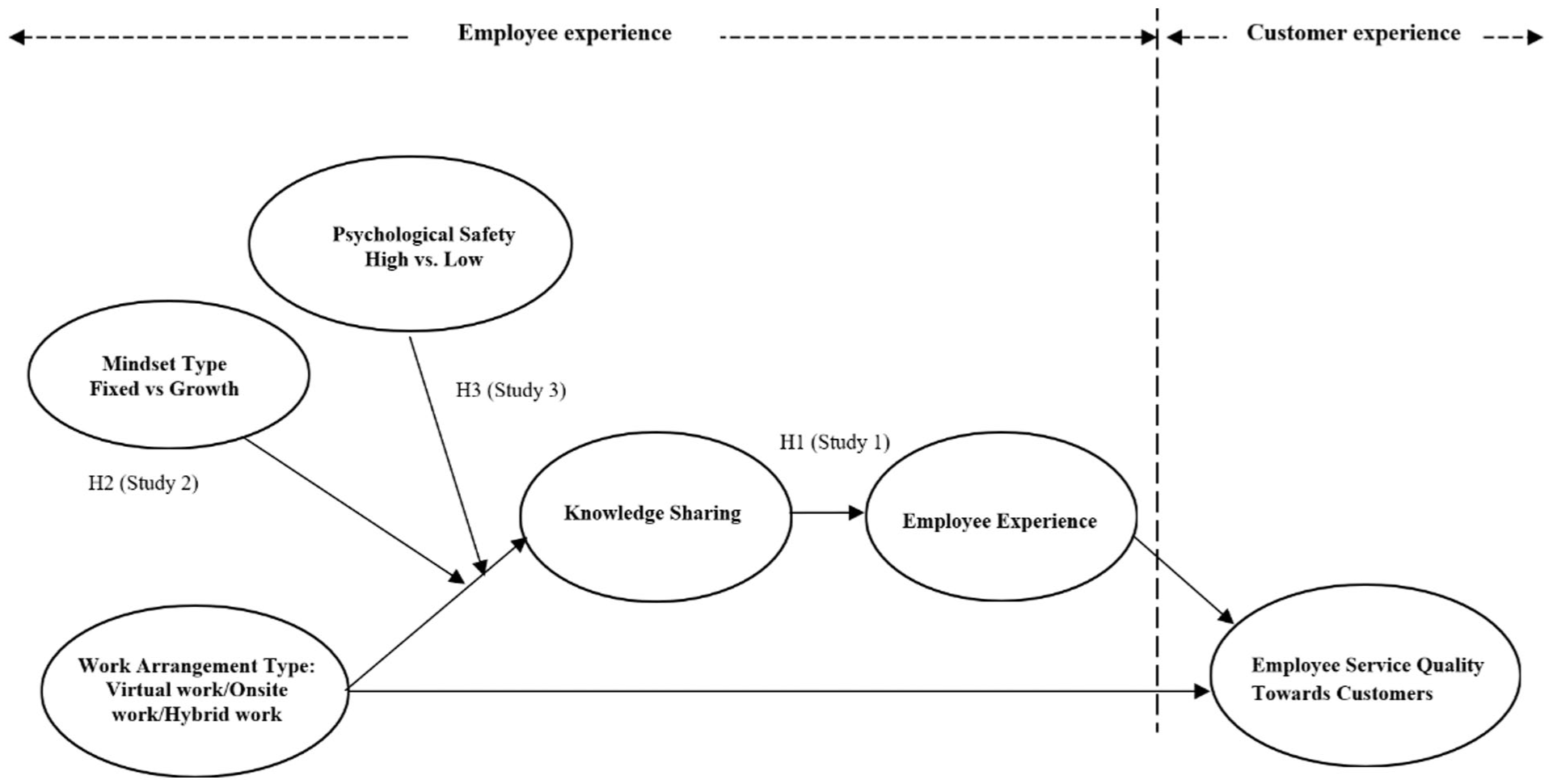
Conceptual framework.
Methodology
The hypotheses were tested through three consecutive studies. Study 1 examined the main effect of work type (Onsite/Virtual/Hybrid) on employee service quality, mediated by knowledge sharing and employee experience (H1). Study 2 explored the boundary condition by testing the moderating effect of growth mindset on the relationship between work type and knowledge sharing (H2). Finally, Study 3 investigated the moderating effect of psychological safety on the relationship between work type and knowledge sharing (H3). All three studies were conducted using a series of online experiments with US employees recruited through Prolific.
This study evaluates the reliability and validity of the measurement scales across three studies, using Cronbach’s alpha, convergent validity (factor loadings, composite reliability, and AVE), and Confirmatory Factor Analysis (CFA). Cronbach’s alpha values above 0.7 indicate satisfactory reliability, while convergent validity is confirmed with factor loadings exceeding 0.6, AVE values above 0.5, and CR values above 0.7 (Yuan, Nguyen, et al., 2025; Yuan, Surachartkumtonkun, & Shao, 2025). We conducted an assessment of common method bias across three studies, and the results of Harman’s single-factor test indicated that the first factor accounted for the largest variance, with values of 36.981% (Study 1), 39.237% (Study 2), and 36.352% (Study 3), respectively, all of which fell below the 50% threshold. CFA results, along with comparisons to a single-factor model, demonstrate the robustness of the measurement instruments and indicate no significant common method bias, with fit indices for the measurement model outperforming those for the single-factor model (Yuan et al., 2026a). Detailed results for each study are provided in Supplemental Appendices D and E.
Pretest
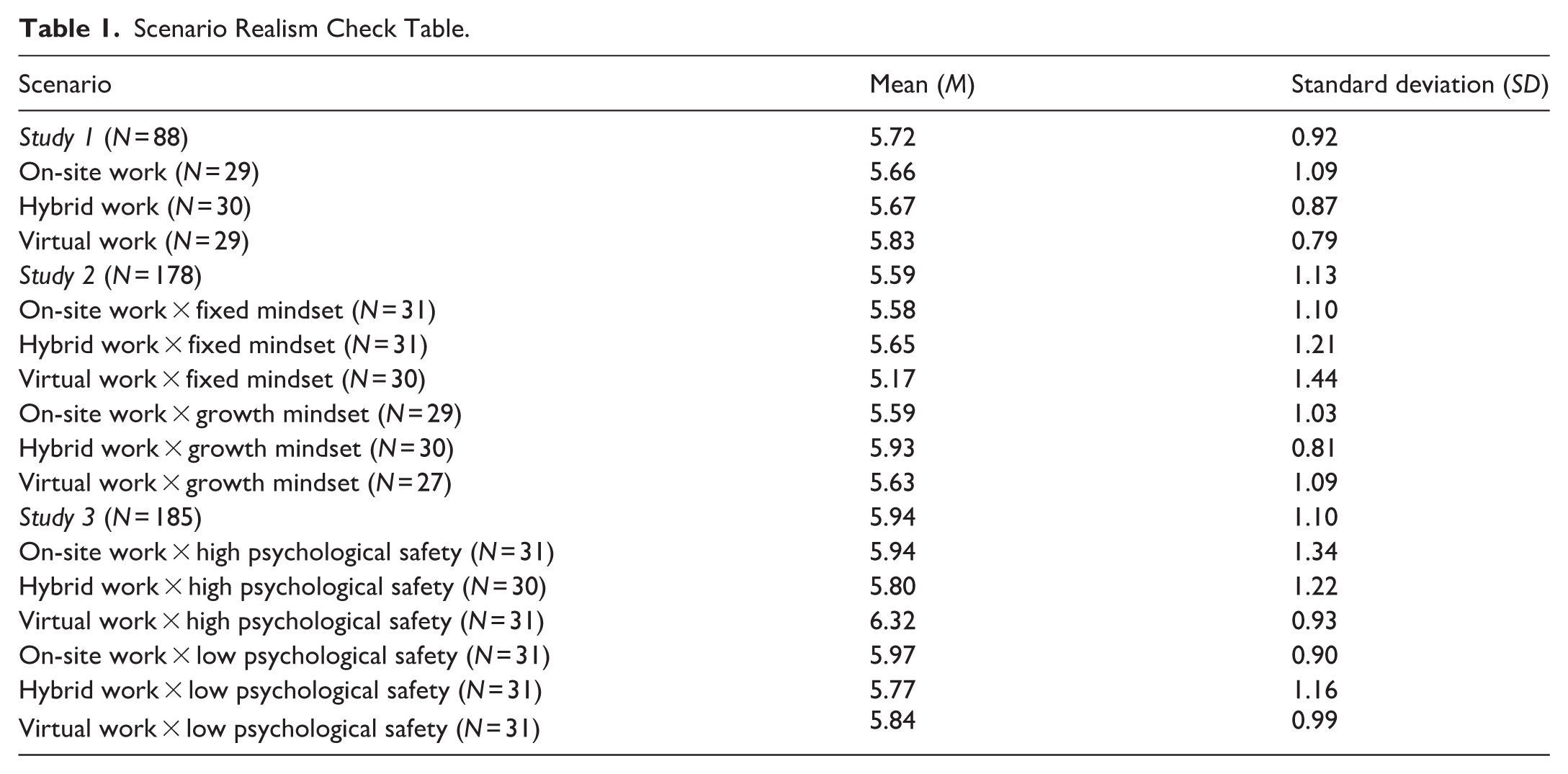
To assess the realism of our experimental scenarios, we conducted a pilot test across all conditions used in Studies 1–3. Participants (N = 451) were randomly assigned to one of the vignette conditions and rated its realism using a 7-point Likert scale (1 = strongly disagree, 7 = strongly agree). The realism measure was adapted from Karande et al. (2007) and included the item, “How realistic was the problem that was described to you in this situation?” Study 1 included three work arrangement conditions (on-site, hybrid, virtual); Study 2 tested six combinations of work arrangement and mindset (fixed vs. growth); and Study 3 tested six combinations of work arrangement and psychological safety (high vs. low).
As shown in Table 1, all scenarios received mean realism ratings above 5.1, with standard deviations generally within an acceptable range. Across all 15 conditions in Studies 1–3 (N = 451), the overall weighted mean realism rating was M = 5.76, SD = 1.08, indicating that participants generally perceived the scenarios as realistic (Chang et al., 2018). These results support the ecological validity of our manipulations and suggest that participants had little difficulty imagining themselves in the described situations.
Scenario Realism Check Table.
Study 1
Experiment Design and Stimuli
We conducted a randomised between-subjects experimental design, manipulating the factor of work arrangement with three conditions: on-site work, hybrid work, and virtual work. Participants were randomly assigned to one of the three conditions. In the on-site work condition, participants read a scenario describing a marketing team at Lysine Technologies where everyone works in the same office building. In the hybrid work condition, participants read a scenario illustrating a team in which some members work on-site and others work remotely. In the virtual work condition, participants read a scenario depicting a fully remote marketing team working exclusively from home. The full text of each scenario is presented in Supplemental Appendix A.
At the beginning of the experiment, participants received a brief description of the study, indicating that they would read about a hypothetical workplace scenario and answer questions about their perceptions and attitudes. However, they were not informed of the specific hypotheses or the existence of other experimental conditions to minimise demand characteristics. This approach ensured that participants’ responses would more accurately reflect their genuine impressions rather than perceived researcher intentions.
Participants
This study employed a randomised experimental design with three conditions of the Work Type factor (virtual, on-site, hybrid). A prospective G*Power analysis for a factorial design indicated that a sample size of 158 was required to achieve an effect size of 0.25, with a statistical power of 0.90 at an α level of 0.05 (Faul et al., 2007). A total of 191 US participants were recruited for the study, with 5 invalid responses excluded, resulting in a final sample size of 186 participants (77 male, 105 female, 4 other). Participants were randomly assigned to one of three conditions: OW (n₁ = 61), Hybrid work (n₂ = 61), and Virtual work (n₃ = 64).
The sample was demographically diverse. Participants spanned a wide age range (22% aged 18–24, 32% aged 25–34, 26% aged 35–44), and identified primarily as White (51%) or Black/African American (34%), with smaller proportions identifying as Asian (7%) or other ethnicities. Educational attainment was high, with 71% holding at least a university degree (45% undergraduate; 26% postgraduate). Participants reported varied professional backgrounds, including business and marketing (13%), information technology (13%), and healthcare (10%). Notably, 31% of respondents had more than 15 years of work experience. A full demographic profile is presented in Supplemental Appendix B.
Measures
After reading the experimental scenario, participants completed a structured questionnaire comprising validated scales measuring knowledge sharing (adapted from Nguyen & Malik, 2022; α = 0.943, CR = 0.944, AVE = 0.688), employee experience (adapted from Mehta, 2023; α = 0.959, CR = 0.960, AVE = 0.683), and employee service quality (adapted from Nguyen & Malik, 2022; α = .958, CR = 0.95, AVE = 0.690). All items were rated on a 7-point Likert scale (1 = strongly disagree, 7 = strongly agree). Demographic information was also collected. Full scale items and sources are provided in Supplemental Appendix C.
Results
Onsite Work Versus Hybrid Work
We ran a PROCESS Model 6 and 83 with 5,000 bootstrap samples. Gender, Age, Ethnicity, Work Experience, Education, Income, and Industry were included as control variables to account for their potential influence on the study outcomes. These variables were controlled for to eliminate their confounding effects. As depicted in Table 2, the analysis revealed that Hybrid Work did not significantly affect Employee Service Quality Towards Customers (β = −0.176, p > .05). However, Hybrid work negatively impacted Knowledge Sharing (β = −0.278, p < .01) while having no significant effect on Employee Experience (β = 0.055, p > .05). In the combined model, only Employee Experience significantly predicted Employee Service Quality Towards Customers (β = 0.311, p < .01).
Regression Analysis (Study 1, OW vs. HW; OW vs. VW).
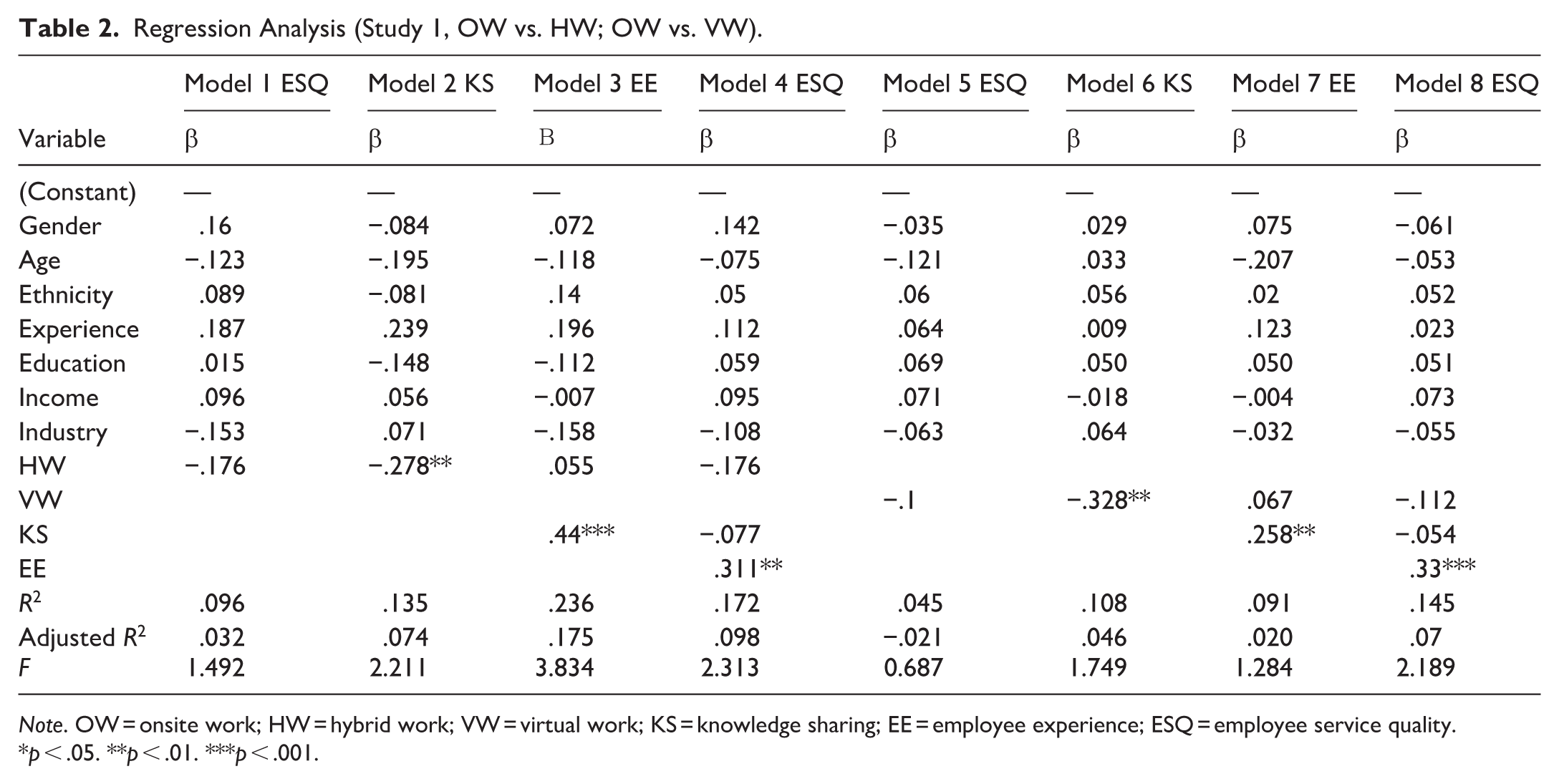
Note. OW = onsite work; HW = hybrid work; VW = virtual work; KS = knowledge sharing; EE = employee experience; ESQ = employee service quality.
p < .05. **p < .01. ***p < .001.
As shown in Table 3, mediation analysis identified a significant sequential mediation (Hybrid work → Knowledge Sharing → Employee Experience → Employee Service Quality Towards Customers; β = −0.099, 95% CI: −0.266 to −0.015), indicating that Hybrid work negatively affects Employee Service Quality Towards Customers through Knowledge Sharing and Employee Experience. Additionally, none of the control variables had a significant impact on Employee Service Quality Towards Customers, Knowledge Sharing, or Employee Experience, confirming that their potential confounding effects were effectively controlled.
Mediation effects of Knowledge Sharing and Employee Experience (Study 1, OW vs. HW; OW vs. VW).
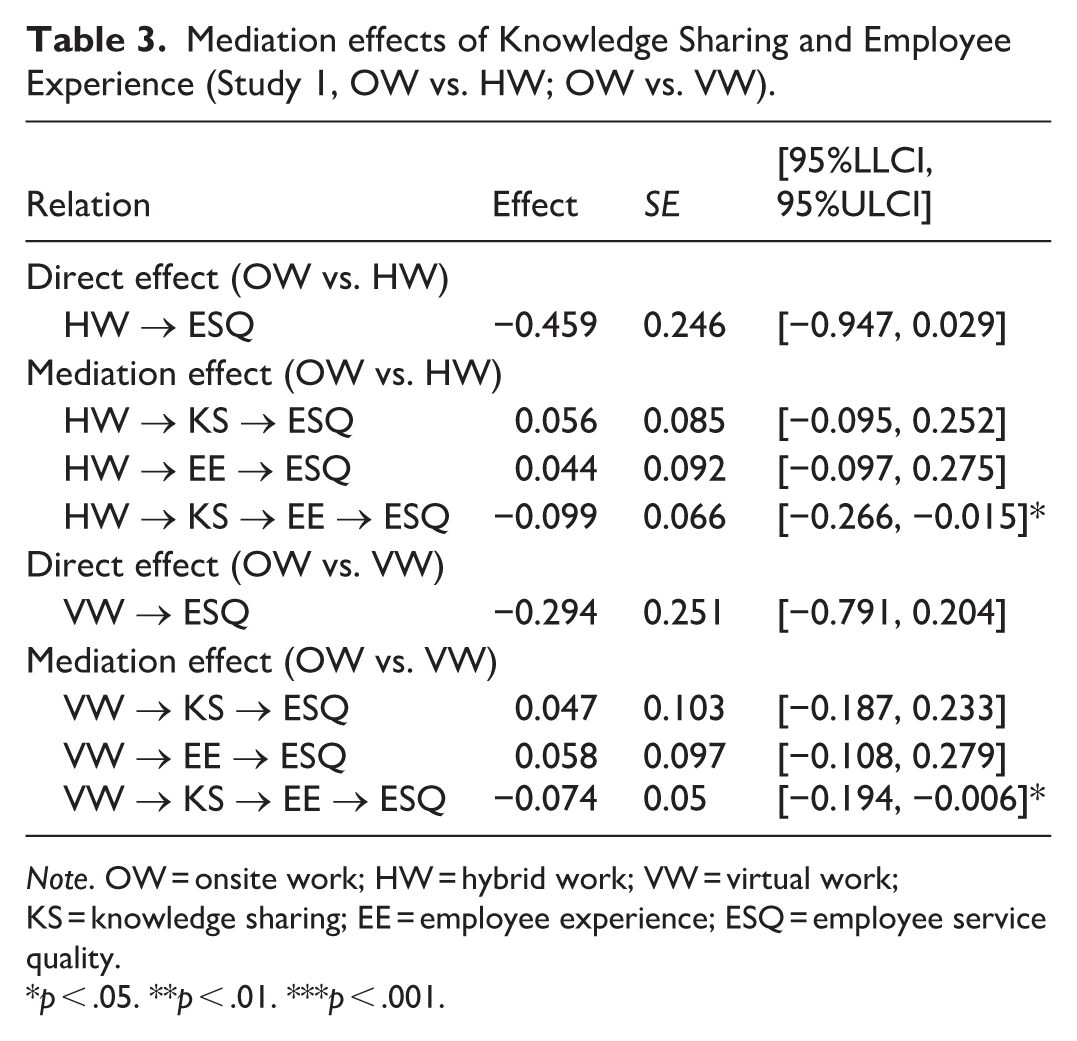
Note. OW = onsite work; HW = hybrid work; VW = virtual work; KS = knowledge sharing; EE = employee experience; ESQ = employee service quality.
p < .05. **p < .01. ***p < .001.
Onsite Work Versus Virtual Work
As shown in Table 2, the analysis showed that Virtual work did not directly affect Employee Service Quality Towards Customers (β = −0.100, p > .05) but negatively influenced Knowledge Sharing (β = −0.328, p < .01). Virtual work also had no significant effect on Employee Experience (β = 0.067, p > .05). In the combined model, only Employee Experience remained a significant predictor of Employee Service Quality Towards Customers (β = 0.330, p < .001).
As depicted in Table 3, the mediation analysis revealed a significant sequential mediation (Virtual work → Knowledge Sharing → Employee Experience → Employee Service Quality Towards Customers; Effect = −0.074, 95% CI: −0.194 to −0.006), supporting that Virtual work negatively impacts Employee Service Quality Towards Customers through Knowledge Sharing and Employee Experience. Similar to the OW versus Hybrid work comparison, the control variables did not significantly influence Employee Service Quality Towards Customers, Knowledge Sharing, or Employee Experience, ensuring their role as effective covariates.
Discussion
Regression analyses support Hypothesis 1, showing that Hybrid and Virtual work types indirectly reduce employee service quality by decreasing knowledge sharing and employee experience. There were no significant direct effects of Hybrid work and Virtual work on Employee Service Quality Towards Customers, highlighting the mediating roles of Knowledge Sharing and employee experience. Additionally, control variable did not significantly affect the outcomes, confirming their effective control. These findings suggest that onsite work fosters better knowledge sharing and enhances employee experience, thereby improving service quality compared to virtual or hybrid work.
Study 2
The purpose of our study is to investigate whether employees’ growth mindset can mitigate the negative effect of Virtual/Hybrid work (compared to Onsite) on employee service quality, particularly through the mediating role of knowledge sharing and employee experience.
Experimental Design and Stimuli
We implemented a 3 × 2 between-subjects design, with the first factor being the work arrangement type (virtual, on-site, hybrid) and the second factor being the mindset type (growth vs. fixed). Participants were randomly assigned to one of the resulting six conditions.
Similar to Study 1, participants in the work arrangement manipulation read a short scenario depicting Lysine Technologies’ marketing team operating either (a) Virtual work, (b) Onsite work, or (c) Hybrid work. Immediately afterward, participants were presented with a mindset manipulation. In the Fixed Mindset condition, participants read passages emphasising the idea that individuals have stable, unchanging core dispositions. Dr. Medin’s keynote highlighted that while people may learn new skills over time, their foundational traits—such as communication styles and problem-solving strategies—are largely ingrained by early adulthood and remain mostly fixed. In the Growth Mindset condition, participants instead read passages emphasising malleability. Dr. Medin’s keynote suggested that even well into adulthood, people can substantially alter their attitudes, communication patterns, and fundamental beliefs through focused effort, supportive environments, and self-reflection.
In both mindset conditions, participants were asked to imagine themselves in a work environment consistent with the scenario and mindset passages. Full texts of these manipulations are provided in Supplemental Appendix A.
Participants
This study used a 3 (Work Arrangement Type: virtual, on-site, hybrid) × 2 (Mindset Type: Fixed/Growth) experimental design. A G*Power analysis indicated a required sample size of 212 for an effect size of 0.25, with 0.80 power at α = 0.05 (Faul et al., 2007). A total of 554 samples were collected, with 542 valid responses after excluding 12 invalid ones. Participants were randomly assigned across six conditions. The sample was demographically diverse, including 52% female, 46% male, and 2% identifying as other. Participants ranged in age, with 24% aged 18–24, 35% aged 25–34, and 28% aged 35–44. In terms of ethnicity, 48% identified as White, 33% as Black or African American, and 9% as Asian. Regarding education, 42% held an undergraduate degree and 27% a postgraduate qualification. Participants were employed across various sectors such as business/marketing (14%), IT/software (11%), and healthcare (9%). Demographic details are in Supplemental Appendix B.
Measures
After reading the experimental scenario, participants completed a questionnaire consisting of established multi-item scales measured on a 7-point Likert scale (1 = strongly disagree, 7 = strongly agree). The constructs included mindset (adapted from Dweck, 2006; α = 0.938, CR = 0.939, AVE = 0.836), knowledge sharing (adapted from Nguyen & Malik, 2022; α = 0.933, CR = 0.933, AVE = 0.638), employee experience (adapted from Mehta, 2023; α = 0.966, CR = 0.966, AVE = 0.722), and employee service quality (adapted from Nguyen & Malik, 2022; α = .973,CR = 0.973, AVE = 0.782). Demographic information was also collected. Full scale items and sources are provided in Supplemental Appendix C.
Results
Manipulation Check
To verify the success of the mindset manipulation, a t-test was conducted with 542 participants. Using a 7-point Likert scale (1 = “strongly disagree” to 7 = “strongly agree”), the results revealed a significant difference in mindset scores between the Fixed and Growth mindset groups (M_growth = 5.628, SD = 1.366; M_fixed = 5.042, SD = 1.786; t = 4.291, p < .001), confirming the effectiveness of the manipulation. Additionally, scenario realism was pilot-tested across the six conditions. The overall realism rating for Study 2 was 5.59 (SD = 1.13), with condition-level means ranging from 5.17 to 5.93 on a 7-point scale, indicating strong perceived realism (see Table 1).
Onsite Work Versus Hybrid Work
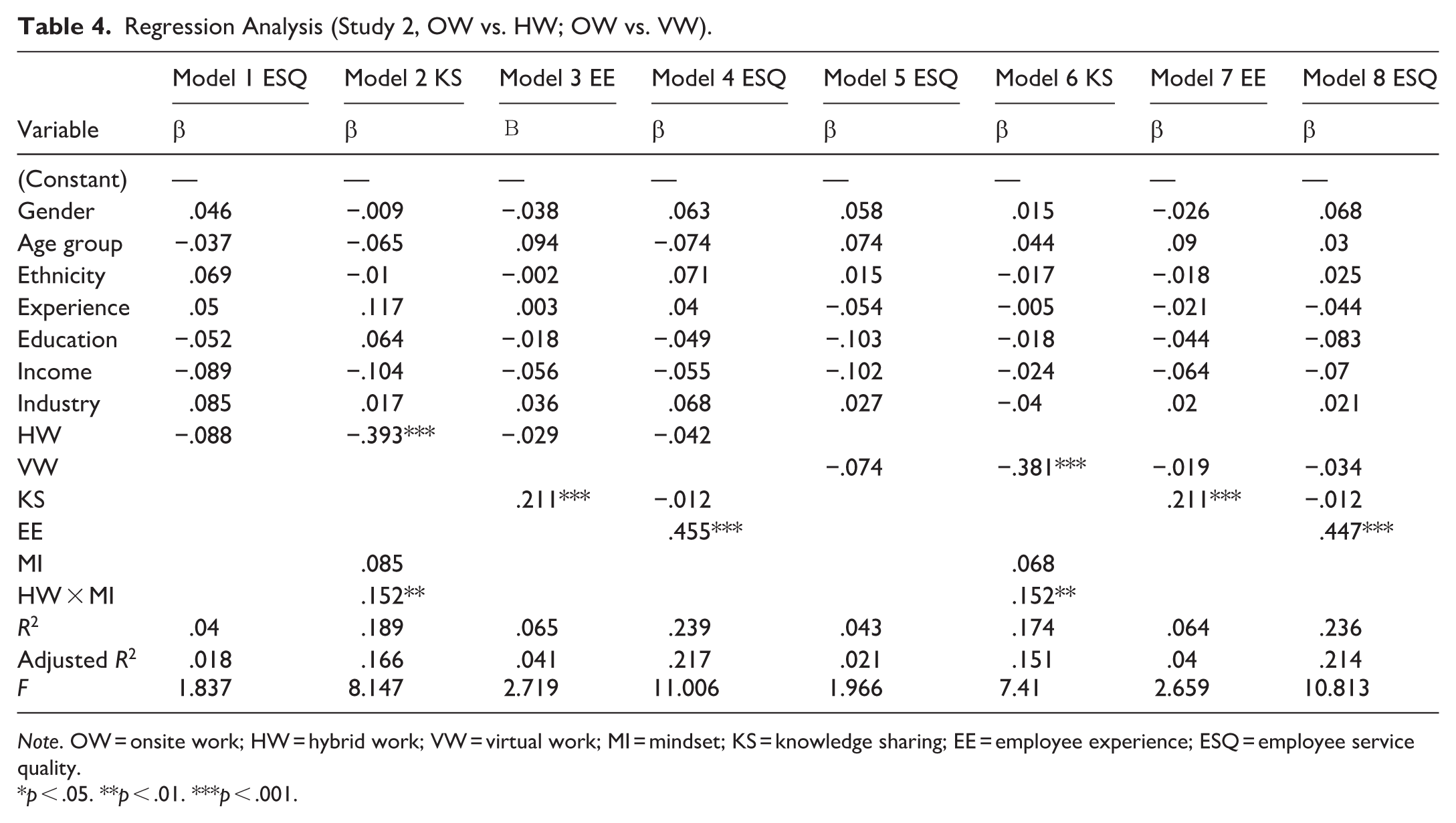
We ran a PROCESS Model 6 and 83 with 5,000 bootstrap samples. Gender, Age, Ethnicity, Work Experience, Education, Income, and Industry were included as control variables to account for their potential influence on the study outcomes. The results are presented in Table 4.
Regression Analysis (Study 2, OW vs. HW; OW vs. VW).
Note. OW = onsite work; HW = hybrid work; VW = virtual work; MI = mindset; KS = knowledge sharing; EE = employee experience; ESQ = employee service quality.
p < .05. **p < .01. ***p < .001.
In regression Model 1, Hybrid Work had an insignificant effect on Employee Service Quality Towards Customers (β = −0.088, p > .05). Model 2 revealed that Hybrid Work had a significant negative effect on Knowledge Sharing (β = −0.393, p < .001), and the interaction term between Hybrid Work and Mindset (MI) had a significant positive effect on Knowledge Sharing (β = 0.152, p < .01), indicating that MI has a significant moderating effect, as illustrated in Figure 2. In Model 3, Hybrid Work had an insignificant effect on Employee Experience (β = −0.029, p > .05), whereas Knowledge Sharing had a significant positive effect on Employee Experience (β = 0.211, p < .001). In Model 4, controlling for the combined effects of Hybrid Work, Knowledge Sharing, and Employee Experience, Hybrid Work still had an insignificant effect on Employee Service Quality Towards Customers (β = −0.042, p > .05), Knowledge Sharing had an insignificant effect on Employee Service Quality Towards Customers (β = −0.012, p > .05), but Employee Experience had a significant positive effect on Employee Service Quality Towards Customers (β = 0.455, p < .001).
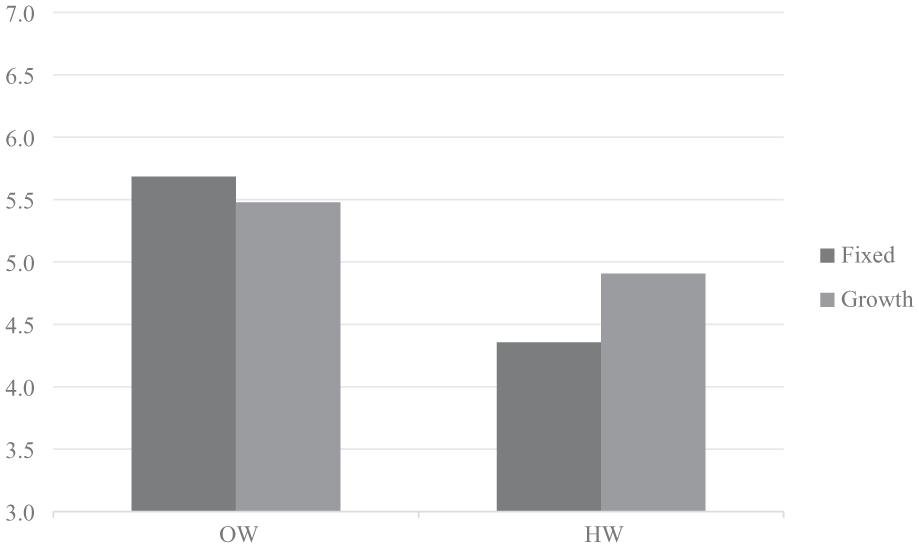
Moderating role of mindset in hybrid work–knowledge sharing relationship (study 2).
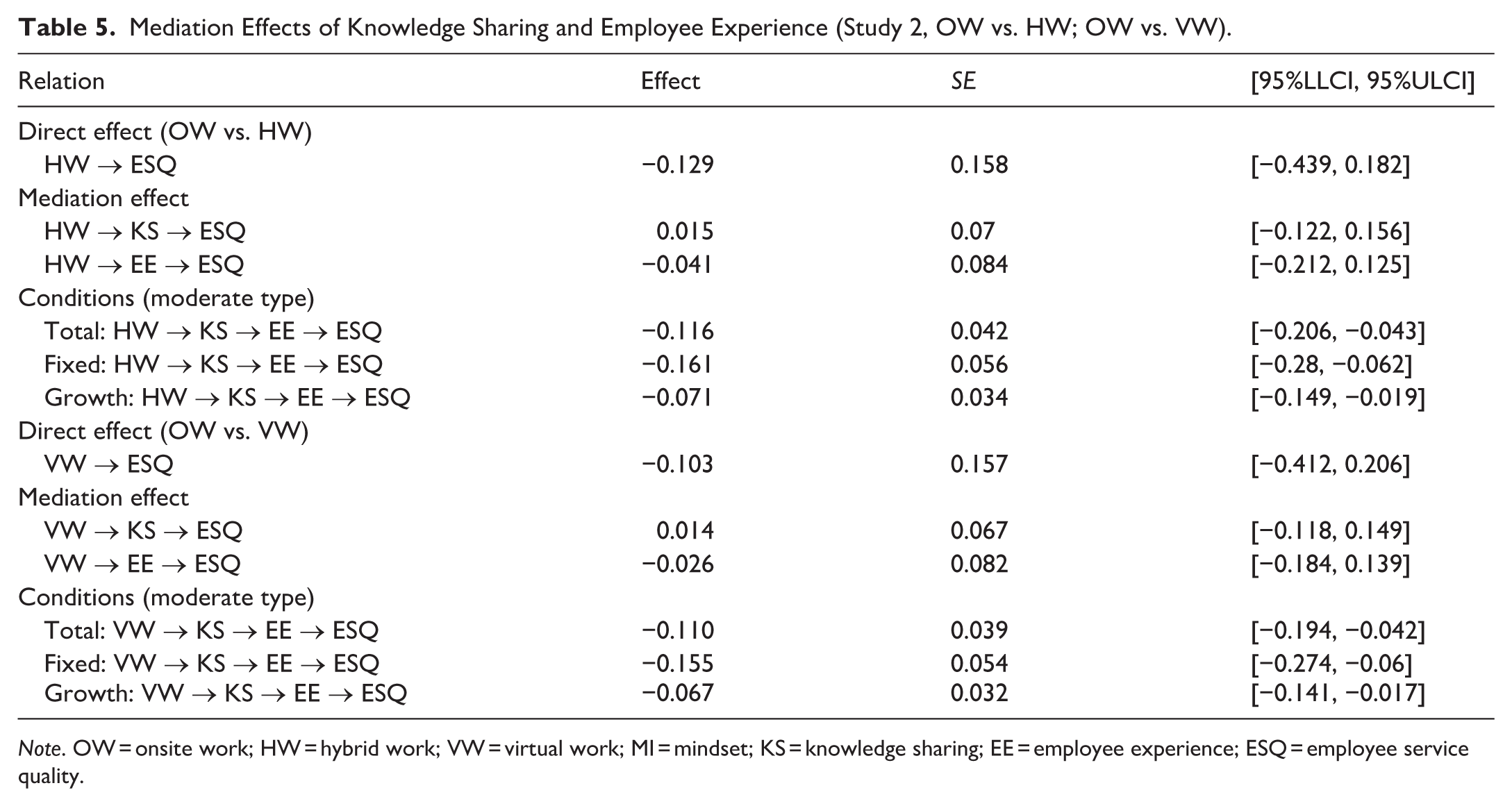
As illustrated in Table 5, The sequential mediation analysis results indicated that the direct effect of the path “Hybrid Work → Employee Service Quality Towards Customers” (−0.129, 95% CI: −0.438 to 0.182) was not significant. The mediation effect of the path “Hybrid Work → Knowledge Sharing → Employee Service Quality Towards Customers” (0.015, 95% CI: −0.122 to 0.156) was also not significant, as was the mediation effect of the path “Hybrid Work → Employee Experience → Employee Service Quality Towards Customers” (−0.041, 95% CI: −0.212 to 0.125). However, the mediation effect of the path “Hybrid Work → Knowledge Sharing → Employee Experience → Employee Service Quality Towards Customers” was significant (−0.116, 95% CI: −0.206 to −0.043), supporting the hypothesis that Hybrid Work negatively affects Employee Service Quality Towards Customers through Knowledge Sharing and Employee Experience as mediators.
Mediation Effects of Knowledge Sharing and Employee Experience (Study 2, OW vs. HW; OW vs. VW).
Note. OW = onsite work; HW = hybrid work; VW = virtual work; MI = mindset; KS = knowledge sharing; EE = employee experience; ESQ = employee service quality.
Specifically, for the Fixed group, the mediation effect along the path “Hybrid Work → Knowledge Sharing → Employee Experience → Employee Service Quality Towards Customers” was significant (−0.161, 95% CI: −0.280 to −0.062), supporting the hypothesis that Hybrid Work negatively affects Employee Service Quality Towards Customers through Knowledge Sharing and Employee Experience as mediators. For the Growth group, the mediation effect along the same path (“Hybrid work → Knowledge Sharing → Employee Experience → Employee Service Quality Towards Customers”) was also significant (−0.071, 95% CI: −0.149 to −0.019), further supporting the hypothesis that Hybrid work negatively impacts Employee Service Quality Towards Customers through Knowledge Sharing and Employee Experience as mediators.
Onsite Work Versus Virtual Work
As presented in Table 4, in regression Model 5, Virtual work had an insignificant effect on Employee Service Quality Towards Customers (β = −0.074, p > .05). Model 6 revealed that Virtual work significantly negatively impacted Knowledge Sharing (β = −0.381, p < .001), and the interaction term between Virtual work and MI had a significant positive effect on Knowledge Sharing (β = 0.152, p < .01), indicating that MI moderates the relationship between Virtual work and Knowledge Sharing, as shown in the Figure 3. In Model 7, Virtual work had an insignificant effect on Employee Experience (β = −0.019, p > .05), whereas Knowledge Sharing significantly positively affected Employee Experience (β = 0.211, p < .001). In Model 8, controlling for the combined effects of Virtual work, Knowledge Sharing, and Employee Experience, Virtual work still had an insignificant effect on Employee Service Quality Towards Customers (β = −0.034, p > .05), Knowledge Sharing remained insignificant (β = −0.012, p >.05), but Employee Experience had a significant positive effect on Employee Service Quality Towards Customers (β = 0.447, p < .001).
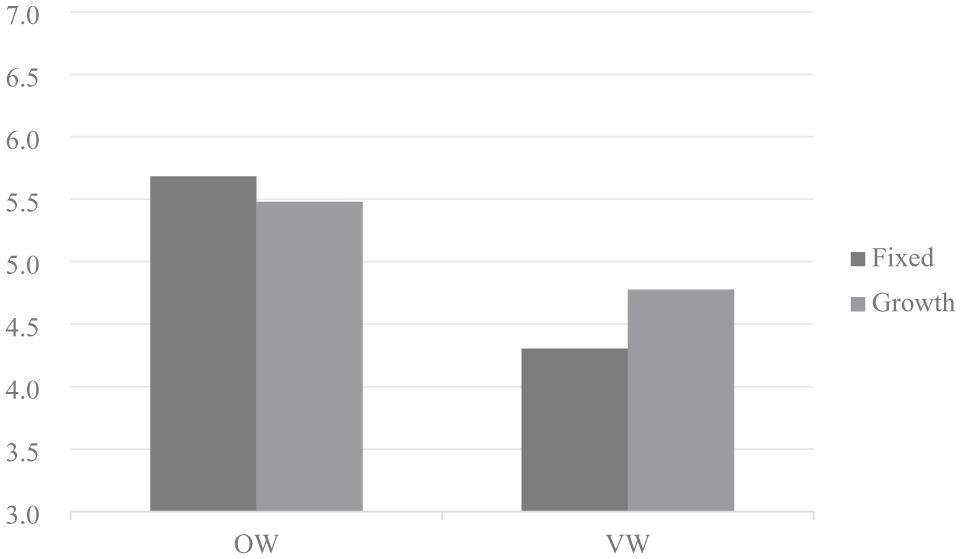
Moderating role of mindset in virtual work–knowledge sharing relationship (study 2).
As shown in Table 5, the sequential mediation analysis results indicated that the direct effect of the path “Virtual work → Employee Service Quality Towards Customers” (−0.103, 95% CI: −0.412 to 0.206) was not significant. Similarly, the mediation effects of the paths “Virtual work → Knowledge Sharing → Employee Service Quality Towards Customers” (0.014, 95% CI: −0.118 to 0.149) and “Virtual work → Employee Experience → Employee Service Quality Towards Customers” (−0.026, 95% CI: −0.184 to 0.139) were also not significant. However, the mediation effect of the path “Virtual work → Knowledge Sharing → Employee Experience → Employee Service Quality Towards Customers” was significant (−0.110, 95% CI: −0.194 to −0.042), supporting the hypothesis that Virtual work negatively affects Employee Service Quality Towards Customers through Knowledge Sharing and Employee Experience as mediators.
Specifically, for the Fixed group, the mediation effect along the path “Virtual work → Knowledge Sharing → Employee Experience → Employee Service Quality Towards Customers” was significant (−0.155, 95% CI: −0.274 to −0.060), supporting the hypothesis that Virtual work negatively affects Employee Service Quality Towards Customers through Knowledge Sharing and Employee Experience as mediators. For the Growth group, the mediation effect along the same path (“Virtual work → Knowledge Sharing → Employee Experience → Employee Service Quality Towards Customers”) was also significant (−0.067, 95% CI: −0.141 to −0.017), further supporting the hypothesis that Virtual work negatively impacts Employee Service Quality Towards Customers through Knowledge Sharing and Employee Experience as mediators.
Discussion
The results support H2, showing that for employees with a growth mindset, the negative impact of Virtual/Hybrid work on Employee Service Quality Towards Customers through Knowledge Sharing and Employee Experience is mitigated, resulting in either no significant difference or a smaller difference in Employee Service Quality Towards Customers across work types.
Study 3
Experimental Design and Stimuli
We employed a 3 × 2 between-subjects experimental design, manipulating Work Type (virtual, on-site, hybrid) and Psychological Safety (high vs. low). Participants were randomly allocated to one of the six conditions. The Work Type scenarios were adapted from Study 1, detailing whether team members at Lysine Technologies primarily collaborate remotely, in person, or through a hybrid model. To manipulate Psychological Safety, participants read descriptions that portrayed either a supportive team environment or a risk-averse culture. In the High Psychological Safety condition, the scenario emphasised an atmosphere where new ideas were welcomed, uncertainties were acknowledged without judgement, and mistakes were treated as chances for growth and shared learning. Team members felt comfortable seeking clarification or proposing adjustments, trusting that their colleagues would be receptive and supportive. In the Low Psychological Safety condition, the scenario described a workplace climate where employees avoided suggesting innovations out of fear of criticism or dismissal. Hesitation and subtle discouragement were prevalent, undermining trust and reducing the likelihood of seeking help or offering feedback.
After reading their assigned scenario, participants were instructed to imagine themselves working in that environment. Full texts of these manipulations are provided in Supplemental Appendix A.
Participants
This study employed a randomised experimental design with a 3 (Work Type: OW/Hybrid work/Virtual work) × 2 (Psychological Safety: Low/High) framework. A priori power analysis using G*Power indicated that a sample size of 212 was needed, with an effect size of 0.25, and a power of 0.80 at α = 0.05 (Faul et al., 2007). A total of 540 participants were recruited, with 535 valid samples after excluding 5 invalid responses.
Participants were demographically diverse, including 54% female and 45% male, with ages ranging from 18 to 60 (26% aged 18–24, 34% aged 25–34, and 28% aged 35–44). Regarding ethnicity, 50% identified as White, 32% as Black or African American, and 8% as Asian. Educational background was similarly varied, with 46% holding an undergraduate degree and 25% a graduate degree. Participants reported employment across multiple sectors, such as marketing (13%), healthcare (11%), and education (9%). Detailed demographic information is presented in Supplemental Appendix B.
Measures
After reading the assigned scenario, participants completed a questionnaire comprising four constructs, each measured using established multi-item scales on a 7-point Likert scale (1 = strongly disagree, 7 = strongly agree): psychological safety (adapted from A. Edmondson, 1999; α = .979, CR = 0.979, AVE = 0.902), knowledge sharing (adapted from Nguyen & Malik, 2022; α = 0.930, CR = 0.930, AVE = 0.625), employee experience (adapted from Mehta, 2023; α = 0.965, CR = 0.965, AVE = 0.716), and employee service quality (adapted from Nguyen & Malik, 2022; α = 0.972, CR = 0.972, AVE = 0.779). Demographic information was also collected. Full scale items and sources are provided in Supplemental Appendix C.
Results
Manipulation Check
To verify the success of the psychological safety manipulation, a t test was conducted with 535 participants. Using a 7-point Likert scale (1 = “strongly disagree” to 7 = “strongly agree”), the results revealed a significant difference in psychological safety scores between the high and low psychological safety groups (Mlow = 4.342, SDlow = 2.279, MHigh = 4.976; SDHigh = 2.026, t = 3.346, p < .001), confirming the success of the manipulation and the reliability of the experiment. In addition, realism ratings were collected across all six experimental conditions. The average realism score for Study 3 was 5.68 (SD = 1.05), with all individual conditions rated above 5.2, indicating strong ecological validity (see Table 1).
Onsite Work Versus Hybrid Work
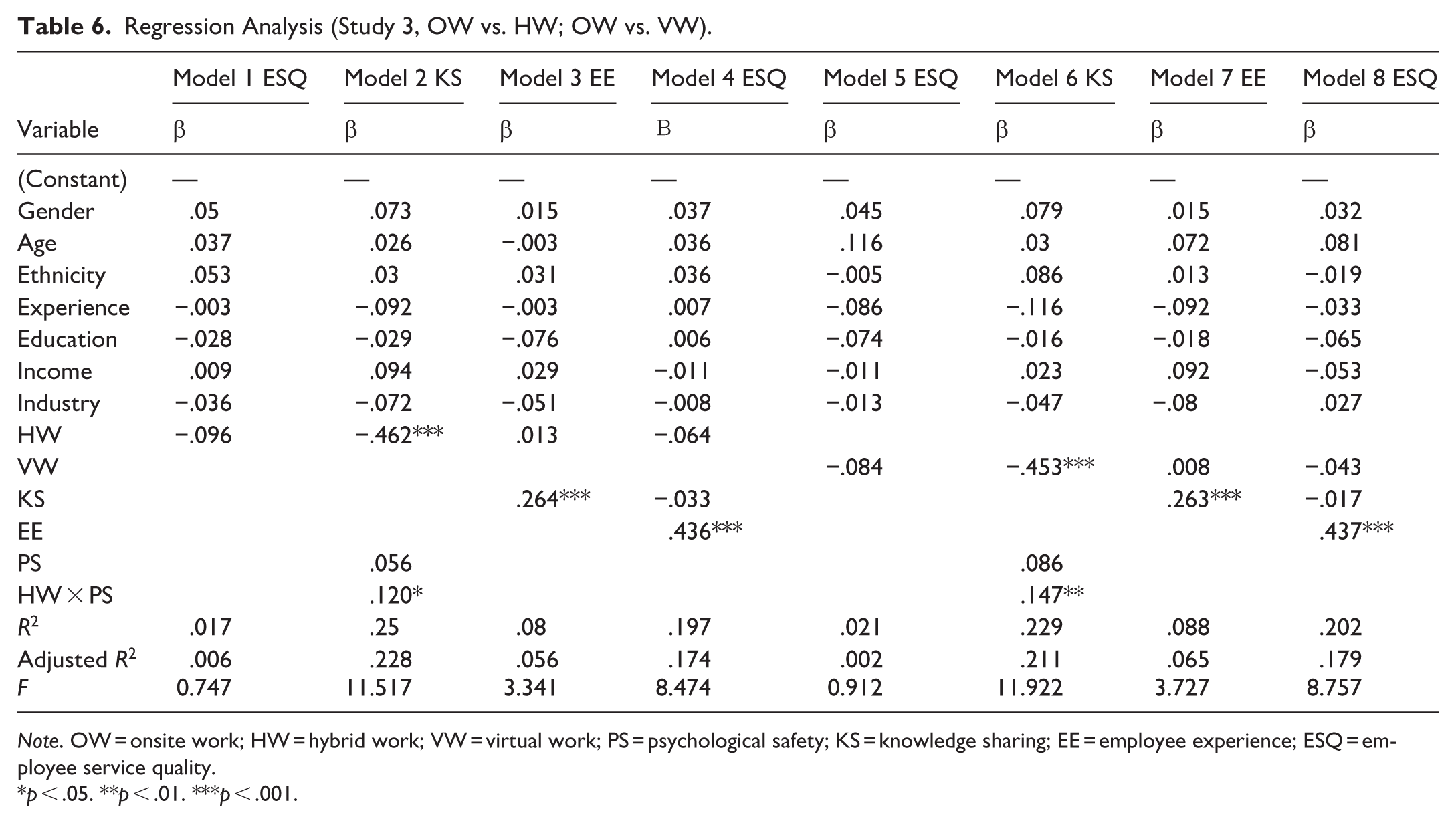
We ran a PROCESS Model 6 and 83 with 5,000 bootstrap samples. Gender, Age, Ethnicity, Work Experience, Education, Income, and Industry were included as control variables to account for their potential influence on the study outcomes. The results are presented in Table 6.
Regression Analysis (Study 3, OW vs. HW; OW vs. VW).
Note. OW = onsite work; HW = hybrid work; VW = virtual work; PS = psychological safety; KS = knowledge sharing; EE = employee experience; ESQ = employee service quality.
p < .05. **p < .01. ***p < .001.
In regression Model 1, Hybrid Work (Hybrid work) had an insignificant effect on Employee Service Quality Towards Customers (β = −0.096, p > .05). Model 2 revealed that Hybrid work had a significant negative effect on Knowledge Sharing (β = −0.462, p < .001), and the interaction term between Hybrid work and Psychological Safety had a significant positive effect on Knowledge Sharing (β = 0.120, p < .05), indicating that MI moderates the relationship, as shown in Figure 4. In Model 3, Psychological Safety, Hybrid work had an insignificant effect on Employee Experience (β = 0.013, p > .05), while Knowledge Sharing had a significant positive effect on Employee Experience (β = 0.264, p < .001). In Model 4, controlling for the combined effects of Hybrid work, Knowledge Sharing, and Employee Experience, Hybrid work still had an insignificant effect on Employee Service Quality Towards Customers (β = −0.064, p > .05), Knowledge Sharing had an insignificant effect on Employee Service Quality Towards Customers (β = −0.033, p > .05), but Employee Experience had a significant positive effect on Employee Service Quality Towards Customers (β = 0.436, p < .001).
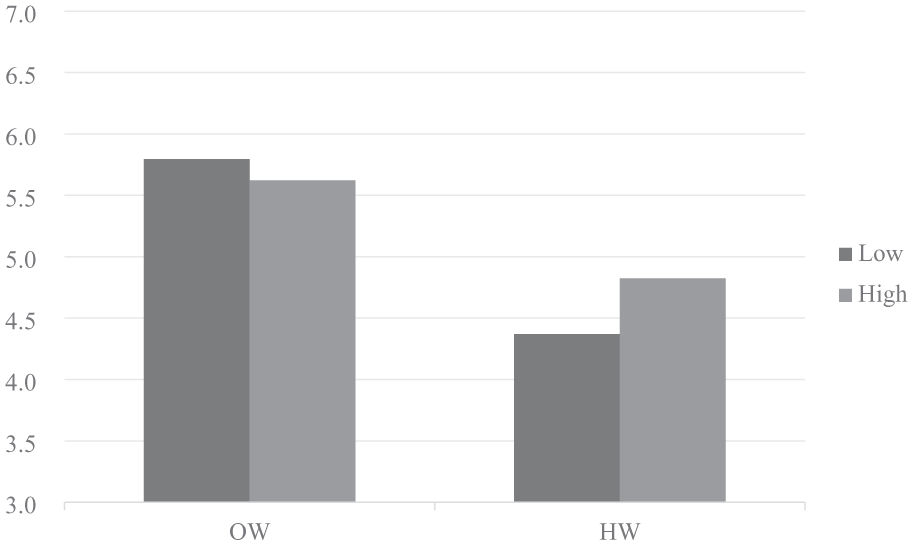
Moderating role of psychological safety in hybrid work–knowledge sharing relationship (study 3).
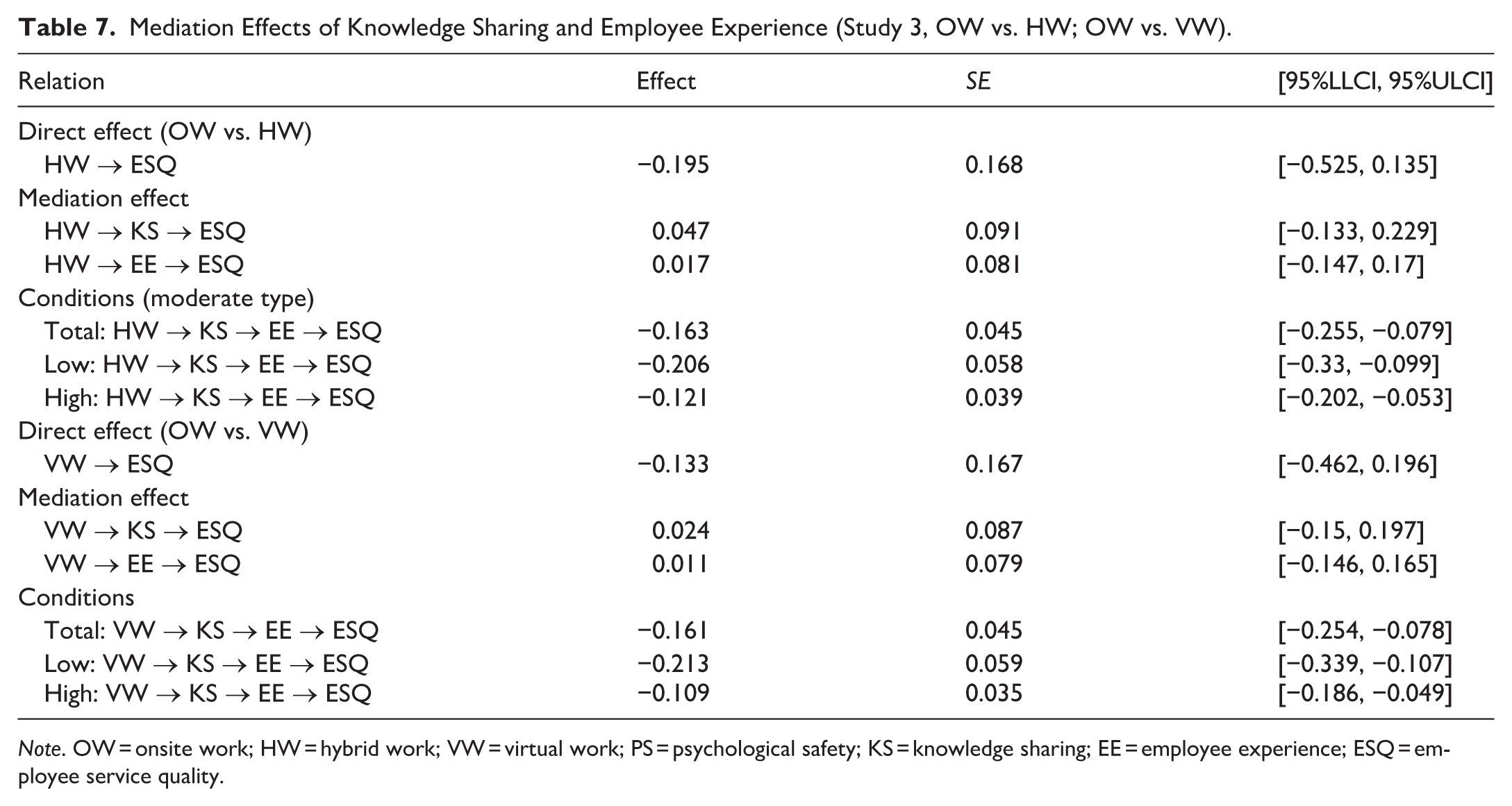
As presented in Table 7, the sequential mediation analysis results indicated that the direct effect of the path “Hybrid work → Employee Service Quality Towards Customers” (−0.195, 95% CI: LLCI = −0.525, ULCI = 0.135) was not significant. Similarly, the mediation effect of the path “Hybrid work → Knowledge Sharing → Employee Service Quality Towards Customers” (0.047, 95% CI: LLCI = −0.133, ULCI = 0.229) was also not significant, as was the mediation effect of the path “Hybrid work → Employee Experience → Employee Service Quality Towards Customers” (0.017, 95% CI: LLCI = −0.147, ULCI = 0.170). However, the mediation effect of the path “Hybrid work → Knowledge Sharing → Employee Experience → Employee Service Quality Towards Customers” was significant (−0.163, 95% CI: LLCI = −0.255, ULCI = −0.079), supporting the hypothesis that Hybrid work negatively affects Employee Service Quality Towards Customers through Knowledge Sharing and Employee Experience as mediators.
Mediation Effects of Knowledge Sharing and Employee Experience (Study 3, OW vs. HW; OW vs. VW).
Note. OW = onsite work; HW = hybrid work; VW = virtual work; PS = psychological safety; KS = knowledge sharing; EE = employee experience; ESQ = employee service quality.
Specifically, for the Low group, the mediation effect along the path “Hybrid work → Knowledge Sharing → Employee Experience → Employee Service Quality Towards Customers” was significant (−0.206, 95% CI: −0.330 to −0.099), supporting the hypothesis that Hybrid work negatively affects Employee Service Quality Towards Customers through Knowledge Sharing and Employee Experience as mediators. For the High group, the mediation effect along the same path (“Hybrid work → Knowledge Sharing → Employee Experience → Employee Service Quality Towards Customers”) was also significant (−0.121, 95% CI: −0.202 to −0.053), further supporting the hypothesis that Hybrid work negatively influences Employee Service Quality Towards Customers through Knowledge Sharing and Employee Experience as mediators.
Onsite Work Versus Virtual Work
As presented in Table 6, in regression Model 5, Virtual Work did not significantly impact Employee Service Quality Towards Customers (β = −0.084, p > .05). Model 6 showed that Virtual work had a significant negative effect on Knowledge Sharing (β = −0.453, p < .001), and the interaction term between Psychological Safety and Virtual work had a significant positive effect on Knowledge Sharing (β = 0.147, p < .01), indicating that Psychological Safety plays a significant moderating role, as shown in Figure 5. In Model 7, Virtual work did not significantly affect Employee Experience (β = 0.008, p > .05), whereas Knowledge Sharing had a significant positive effect on Employee Experience (β = 0.263, p < .001). In Model 8, which controlled for the combined effects of Virtual work, Knowledge Sharing, and Employee Experience, Virtual work still did not significantly impact Employee Service Quality Towards Customers (β = −0.043, p > .05), and Knowledge Sharing also did not significantly affect Employee Service Quality Towards Customers (β = −0.017, p > .05). However, Employee Experience had a significant positive effect on Employee Service Quality Towards Customers (β = 0.437, p < .001).
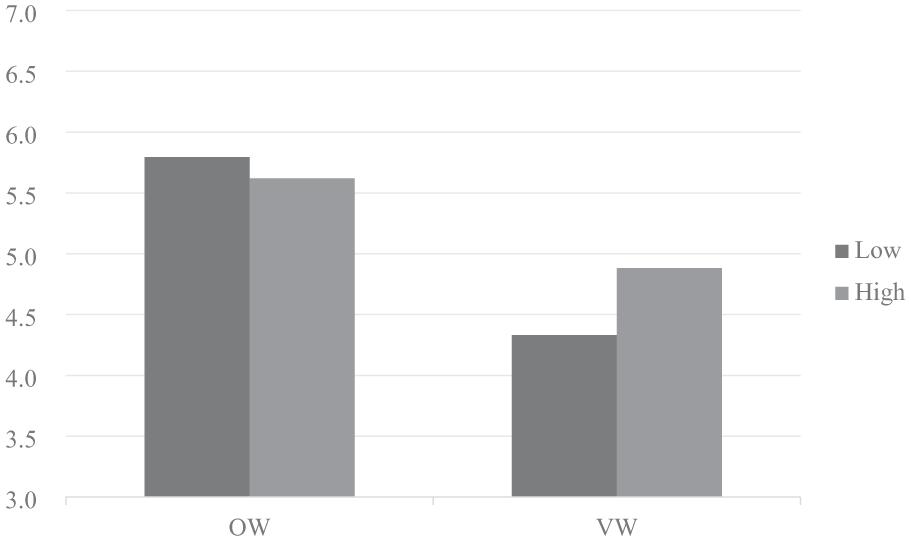
Moderating role of psychological safety in virtual work–knowledge sharing relationship (study 3).
As depicted in Table 7, the sequential mediation analysis indicated that the direct effect of the path “Virtual work → Employee Service Quality Towards Customers” was not significant (−0.133, 95% CI: LLCI = −0.462, ULCI = 0.196). Similarly, the mediation effect of the path “Virtual work → Knowledge Sharing → Employee Service Quality Towards Customers” was not significant (0.024, 95% CI: LLCI = −0.150, ULCI = 0.197), nor was the mediation effect of the path “Virtual work → Employee Experience → Employee Service Quality Towards Customers” (0.011, 95% CI: LLCI = −0.146, ULCI = 0.165). However, the mediation effect of the path “Virtual work → Knowledge Sharing → Employee Experience → Employee Service Quality Towards Customers” was significant (−0.161, 95% CI: LLCI = −0.254, ULCI = −0.078), supporting the hypothesis that Virtual work negatively affects Employee Service Quality Towards Customers through Knowledge Sharing and Employee Experience as mediators.
Specifically, for the Low group, the mediation effect along the path “Virtual work → Knowledge Sharing → Employee Experience → Employee Service Quality Towards Customers” was significant (−0.213, 95% CI: −0.339 to −0.107), supporting the hypothesis that Virtual work negatively affects Employee Service Quality Towards Customers through Knowledge Sharing and Employee Experience as mediators. For the High group, the mediation effect along the same path (“Virtual work → Knowledge Sharing → Employee Experience → Employee Service Quality Towards Customers”) was also significant (−0.109, 95% CI: −0.186 to −0.049), further supporting the hypothesis that Virtual work negatively influences Employee Service Quality Towards Customers through Knowledge Sharing and Employee Experience as mediators.
General Discussion
Through three interconnected studies, we investigated how different work arrangements affect employee service quality, focusing on the underlying psychological mechanisms, drawing explicitly upon Conservation of Resources (COR) Theory. In Study 1, consistent with COR Theory, we demonstrated that employees in virtual and hybrid work arrangements exhibited lower service quality compared to their onsite counterparts. This finding is attributed to spatial distance, a contextual resource loss inherent in remote work, which hinders effective knowledge sharing and diminishes employee experience, ultimately reducing service quality. Our results reinforce and extend previous research by highlighting spatial distance as a key contextual factor contributing to resource depletion in remote and hybrid work environments (Marstand et al., 2025).
Study 2 expanded our understanding by exploring the moderating role of employees’ growth mindset, which functions as a critical personal resource, in mitigating the negative effects of spatial distance (Burnette et al., 2023). Aligning with COR Theory, we found that employees with a strong growth mindset experienced less resource depletion in virtual and hybrid contexts, thereby maintaining higher levels of knowledge sharing and service quality. This indicates that psychological resources related to adaptability and continuous learning significantly buffer against resource losses associated with remote working conditions.
Further building upon these insights, Study 3 investigated psychological safety as another crucial boundary condition moderating the impact of spatial distance on employee outcomes. Psychological safety, representing an essential interpersonal resource, was found to facilitate communication and knowledge sharing even when physical proximity was lacking (Frazier et al., 2017). Our findings underscore that high psychological safety helps employees preserve and replenish their resources, enabling consistent service quality irrespective of work arrangement. Conversely, environments low in psychological safety exacerbate resource loss due to spatial distance, further reducing communication effectiveness and service quality.
Collectively, these studies advance COR Theory by demonstrating how spatial distance in different work arrangements constitutes a significant contextual threat to resources, and identifying psychological safety and growth mindset as critical resources moderating the impact of these threats. Practically, these insights suggest targeted interventions aimed at enhancing psychological safety and fostering a growth mindset among employees to sustain high service quality in increasingly prevalent virtual and hybrid work contexts.
Implications, Limitations, and Future Directions
Theoretical Implications
This research contributes to the broader theoretical understanding of work arrangements and employee performance by drawing on Conservation of Resources (COR) theory (Hobfoll, 1989; Hobfoll et al., 2018). In particular, it advances understanding of how the spatial distance inherent in virtual and hybrid work arrangements influences employee service quality through the sequential mechanisms of knowledge sharing and employee experience. By examining these relationships systematically, this study highlights the importance of resource availability, resource depletion, and resource preservation in sustaining employee performance across diverse work settings.
First, this study extends COR theory by conceptualising spatial distance in virtual and hybrid work arrangements as a significant contextual resource-draining demand (Hobfoll, 1989; Hobfoll et al., 2018). Specifically, spatial distance restricts employees’ access to critical interpersonal and informational resources, such as spontaneous communication, informal knowledge exchange, and real-time coordination, all of which are essential in service contexts. The findings show that such resource loss is manifested in lower knowledge sharing and poorer employee experience, which in turn reduce employee service quality. In this way, the study goes beyond merely confirming COR theory and instead refines it by identifying spatial distance as a distinctive contextual demand in digitally mediated work. The findings also extend COR theory’s emphasis on resource gain and buffering processes by showing that employees with stronger growth mindsets and higher psychological safety are better able to preserve and replenish resources under these conditions, thereby mitigating the adverse effects of remote and hybrid work on service performance.
Second, this study contributes to the growth mindset literature by demonstrating its importance in contemporary work arrangements. Whereas prior research has primarily examined growth mindset in educational or more conventional organisational settings, the present findings show that it also functions as an important personal resource in virtual and hybrid work environments. Employees with a stronger growth mindset are better able to respond adaptively to the challenges created by spatial distance, maintain knowledge sharing, and sustain service quality. These findings extend growth mindset research by showing how this psychological resource operates in work settings characterised by reduced co-location, digital mediation, and resource constraints.
Third, this study advances the literature on psychological safety by clarifying its role as a contextual interpersonal resource in remote and hybrid work settings. Existing research has established the importance of psychological safety for team learning, innovation, and communication. The present study extends this understanding by showing that psychological safety is particularly critical when spatial distance weakens informal interaction and increases interpersonal uncertainty. Under such conditions, psychological safety helps preserve communication, collaboration, and help-seeking, thereby reducing the negative effects of spatial distance on knowledge sharing, employee experience, and service quality. This finding highlights the importance of psychologically safe environments in work arrangements where physical separation may otherwise disrupt interpersonal resource exchange.
Finally, this research contributes to the broader organisational behaviour literature by offering a more nuanced understanding of how work arrangements shape employee outcomes. By integrating structural work conditions with personal and contextual buffering resources, the study provides a more holistic explanation of how employee performance is sustained or undermined in remote and hybrid environments. In doing so, it identifies new avenues for understanding how organisations can design supportive work environments that protect resources, strengthen resilience, and sustain employee service quality across increasingly flexible work arrangements.
Practical and Managerial Implications
This study offers several important practical and managerial implications for organisations managing diverse work arrangements. Our research provides managers with insights into how different work arrangements including on-site, hybrid, and remote formats impact employee service quality. This has far-reaching implications for work organisation and the establishment of organisational policies related to different forms of work and their combinations. First of all, our research has shown that proximity matters for knowledge sharing among individuals, and our findings indicate that employees in virtual and hybrid work arrangements exhibit lower service quality than those working onsite because spatial distance disrupts spontaneous communication and informal knowledge exchange. This may suggest that proximity promotes social relations among colleagues and reduces barriers to knowledge sharing, thereby strengthening the interpersonal foundations of service delivery. For example, collaborative spaces or coworking spaces, whether physical or virtual shared spaces, can be deliberately designed to support more frequent interaction and exchange. For hybrid teams, managers may implement scheduled anchor days, cross-functional co-location periods, or rotating in-person problem-solving sessions to preserve informal communication and tacit knowledge transfer. For fully remote teams, where spontaneous corridor interactions are unavailable, managers may need to create digital substitutes more intentionally, such as virtual office hours, persistent team chat channels for real-time problem solving, and short peer knowledge-sharing routines embedded in weekly workflows. This type of workplace arrangement would also allow managers to rotate desk assignments where employees are then exposed to different colleagues, further promoting cross-team learning. Therefore, workplace design and location of employees are tools that can be used by managers to promote knowledge sharing. Managers are therefore advised to implement practical spatial strategies, such as organising regular in-person team-building sessions or scheduled anchor days for hybrid teams, to sustain informal knowledge exchange and relational connectedness that are critical to service quality.
Secondly, given that fixed mindsets are potentially toxic to engagement, what can be done to foster growth mindsets? Potential sources of growth mindsets often stem from organisational culture in which employees work, as well as managerial actions and self-development initiatives that employees deploy. Based on our empirical findings, organisations should prioritise psychological resource development by integrating learning opportunities into the flow of work. As such, an investment in technology to cultivate a growth mindset in remote and hybrid work environments would be a way forward for those organisations struggling with the complexities of spatial distance in their work environments. For instance, AI-driven learning platforms such as “Degreed” or “Coursear for Business” could offer personalised learning paths that would support employees to upskill and adapt to dynamic work settings more effectively. Additionally, managers can foster growth mindsets through regular developmental feedback, peer mentoring, and the public celebration of learning from failure. More specifically, our findings suggest that such interventions are especially important for employees who may approach virtual work with a more fixed mindset and therefore be less likely to initiate communication, seek help, or share knowledge proactively. In virtual settings, managers can reduce these barriers by using structured developmental check-ins, assigning peer mentors or knowledge buddies, breaking complex tasks into learning-oriented milestones, and explicitly rewarding improvement, experimentation, and help-seeking rather than only outcomes. These targeted interventions may help employees reinterpret communication difficulties and reduced visibility as manageable learning challenges rather than as fixed constraints.
Thirdly, the importance of emotional and psychological safety at work suggests that managers and senior leaders must aim to create a safe working environment where employees feel comfortable sharing ideas, seeking feedback and taking risks especially in remote and hybrid settings. However, the way psychological safety is fostered may need to differ across work arrangements. For example, for a fully remote team, managers may need to create psychological safety through highly intentional communication practices, such as regular one-to-one check-ins, explicit turn-taking in virtual meetings, anonymous input channels, and clear norms that encourage questions, requests for help, and the discussion of mistakes without blame. In hybrid teams, by contrast, managers may need to focus more strongly on inclusion across locations, for instance by ensuring that remote employees are not excluded from informal conversations, giving equal voice to remote and in-person members during meetings, and documenting key decisions transparently so that information is not concentrated among those who are physically co-located. Furthermore, managers designing work across all forms should also be encouraged to design work in a social/relational manner by increasing task interdependence, providing collegiate support, and creating opportunities for interaction within and outside the organisation. Our findings show that such relational designs help replenish interpersonal resources depleted by spatial distance, allowing employees to maintain service quality despite physical separation. Taken together, these recommendations suggest that managers should not treat psychological safety as a generic cultural value alone, but as an operational practice that must be adapted to the communication constraints and coordination risks of each work arrangement.
Based on the above managerial implications, it is essential to note that managers should view our suggestions as guidelines, while necessarily adapting them to their employees’ nature of work, individual characteristics and preferences, and organisational characteristics. Ultimately, by acknowledging the psychological mechanisms identified in this research, such as knowledge sharing, growth mindset and psychological safety, managers can build resilient teams capable of sustaining high service quality under any work arrangement. More broadly, the findings imply that effective management of remote and hybrid service work requires not only structural flexibility, but also deliberate investments in interpersonal resource exchange, developmental support, and psychologically safe communication systems.
Limitations and Future Research Directions
This research provides a significant and unique perspective on different forms of work environment; however, this study has some limitations. First, this study only measured the frequency of knowledge sharing among individuals. Neither individual nor organisational outcomes of knowledge sharing were explicitly considered in this study, so it is hard to tell whether close or distant relations are most valuable in terms of knowledge sharing. More research is needed to understand how employees may make a trade-off in their knowledge sharing efforts, for instance so that easily accessible knowledge (from the most proximate colleagues) is preferred to the less accessible, but more valuable, knowledge (from more distant colleagues). Second, future research should explore industry-specific variations in how work arrangements impact service quality. Understandably, different industries particularly those with varying demands for interpersonal interaction and knowledge sharing (e.g., healthcare vs. IT services), may experience distinct challenges and opportunities in virtual and hybrid work environments. As such, investigating sector-specific dynamics could offer more targeted insights for managerial practices (Zhao et al., 2025). In addition, future research should investigate hybrid work arrangements in a more fine-grained manner. In the present study, hybrid work was treated as a single category; however, hybrid arrangements vary considerably in practice, such as split-week, at-will, or remote-first models. These different configurations may create distinct conditions for communication, coordination, and informal knowledge exchange, and may therefore have different implications for employee experience and service quality. Examining such variation would provide a more nuanced understanding of which forms of hybrid work are more or less detrimental to knowledge sharing and broader employee outcomes. Third, the impact of work design configurations (i.e., ergonomics, physical demands, work conditions, and equipment use) that are most beneficial for task performance vary between on-site, hybrid, and remote work would be interesting to explore in a follow up study. For instance, future research should examine the characteristics of ICT-enabled work compared to on-site work for the same job. Fourth, future studies should investigate additional psychological and organisational factors that may buffer or exacerbate the impact of spatial distance on service quality. Factors such as leadership style, cultural variations, constant connectivity, and team cohesion may interact with work arrangements in complex ways. Exploring these factors could uncover better ways to support employee performance and manage remote and hybrid teams more effectively. Finally, although scenario-based experiments offer strong internal validity and allow for controlled manipulation of key variables, they may not fully capture the complexity, ambiguity, and contextual richness of real-world workplaces. Participants’ responses may partly reflect pre-existing assumptions or stereotypical perceptions of different work arrangements, rather than how employees would actually think and behave in organisational settings. In addition, some scenarios, such as those describing on-site work, may have inadvertently emphasised certain benefits, such as easier knowledge sharing, more clearly than potential drawbacks, thereby introducing possible framing bias. These limitations suggest a trade-off between experimental control and real-world applicability. Future research should therefore test the proposed model in field settings and adopt multi-method approaches, such as combining experiments with survey, longitudinal, qualitative, or organisational field data, to triangulate the present findings and enhance ecological validity and generalisability (Yuan et al., 2026b).
Conclusion
The rapid diffusion of virtual and hybrid work has reshaped how service is produced, coordinated, and delivered, raising important questions about how organisations can sustain employee and customer experiences when employees are spatially dispersed (Iogansen et al., 2024; Mortensen & Haas, 2021). Drawing on Conservation of Resources theory, this research integrates evidence from three studies to show that spatial distance can undermine employee service quality by weakening the interpersonal exchanges through which service excellence is created, particularly knowledge sharing and employee experience. However, these effects are neither inevitable nor uniform. Employees with stronger growth mindsets appear better able to interpret the constraints of remote and hybrid work as manageable challenges rather than fixed barriers to performance. Similarly, psychologically safe work environments enable employees to communicate openly, seek assistance, and coordinate effectively even when co-presence is limited. These findings position growth mindset as a personal resource and psychological safety as a contextual resource that together mitigate the resource-depleting effects of spatial distance. In doing so, this study helps reconcile mixed evidence on the consequences of flexible work for service delivery.
More broadly, this study advances a more agentic account of service work in the post-pandemic workplace by showing that work arrangement alone does not determine service outcomes. Whether employees work on-site, remotely, or in hybrid arrangements, the quality of the experiences they create for customers depends substantially on the developmental beliefs they hold and the relational climate in which they operate. Organisations that cultivate growth-oriented mindsets, psychologically safe communication, and structured opportunities for knowledge exchange can preserve, and potentially enhance, service excellence across different work configurations. As physical and digital workplaces become increasingly intertwined, the central managerial question is therefore not simply where employees work, but how organisations develop the psychological and interpersonal resources that allow both employees and customers to thrive.
Supplemental Material
sj-docx-1-anz-10.1177_14413582261451274 – Supplemental material for Bridging Distances: The Role of Growth Mindset and Psychological Safety in Enhancing Employee and Customer Experiences Across Work Arrangements
Supplemental material, sj-docx-1-anz-10.1177_14413582261451274 for Bridging Distances: The Role of Growth Mindset and Psychological Safety in Enhancing Employee and Customer Experiences Across Work Arrangements by Mai Nguyen, Yanzhe Yuan, Isaac Cheah and Liem Viet Ngo in Australasian Marketing Journal
Footnotes

Funding
The authors received no financial support for the research, authorship, and/or publication of this article.
Declaration of Conflicting Interests
The authors declared no potential conflicts of interest with respect to the research, authorship, and/or publication of this article.
Supplemental Material
Supplemental material for this article is available online.
References
Supplementary Material
Please find the following supplemental material available below.
For Open Access articles published under a Creative Commons License, all supplemental material carries the same license as the article it is associated with.
For non-Open Access articles published, all supplemental material carries a non-exclusive license, and permission requests for re-use of supplemental material or any part of supplemental material shall be sent directly to the copyright owner as specified in the copyright notice associated with the article.
