



Abstract
Amid the rise of livestream commerce as a next-generation retail model, this study investigates how different forms of interaction, including customer–livestreamer (C2L), customer–customer (C2C), and customer–business (C2B), impact customer-centric outcomes. Drawing on Social Presence Theory and Parasocial Interaction Theory, the research adopts a mixed-method approach to examine these relationships. Quantitative analysis using survey data from 267 respondents confirms that both C2L and C2C interactions significantly enhance C2B interaction, which in turn positively influences customer satisfaction, engagement, and loyalty. The primacy of C2L interaction over C2C interaction is also highlighted. Qualitative interviews add depth to these findings. This research contributes to the livestream commerce literature by offering a comprehensive interaction framework and providing actionable insights for enhancing relationship quality and strategic customer outcomes in interactive shopping environments.
Keywords
Introduction
The rapid rise of livestreaming platforms has significantly transformed digital commerce and the ways in which customers engage with businesses (X. Luo et al., 2025). According to a market report by Grand View Research (2025), the global live commerce market was valued at US$128.42 billion in 2024 and is projected to reach US$2,469.06 billion by 2033, with a compound annual growth rate of approximately 39.9% from 2025 to 2033. The Asia–Pacific region dominates the market, representing about 66% of global share in 2024 (Grand View Research, 2025). Unlike traditional e-commerce, livestreaming allows consumers to interact directly with broadcasters and experience products in real-time (Shi et al., 2025). This strategy helps businesses lower customer acquisition costs, while simultaneously boosting conversion rates and accelerating sales (Hu & Chaudhry, 2020; Wongkitrungrueng et al., 2020).
Given the socially dense and multi-actor nature of livestream commerce, a deeper understanding of the psychological and relational mechanisms underlying customer responses is essential (X. Luo et al., 2025). Grönroos (2016) provides a triangle model, emphasizing three main participants who include employees, customers, and the business in customer-oriented. Accordingly, relationships are formed not merely through transactional behaviors but through customers’ subjective interpretations of how they are treated within ongoing interaction and communication processes (Grönroos, 2016). Customer-centric research has generated substantial benefits for firms (Sheth et al., 2023). As evidenced by Deloitte’s (2024) research, organizations that adopt customer-centric strategies achieve 60% higher profitability than non–customer-focused firms. Adopting an interaction-based perspective is particularly important, as value is co-created through real-time, socially embedded exchanges between customers and businesses (Lemon & Verhoef, 2016).
In the setting of the ever-increasing volume of social media interactions, Labrecque (2014) suggests that parasocial interaction (PSI) is a key mechanism enabling brands to maintain personalization and intimate relationships with customers, thereby allowing brands to appear as personal entities. However, early livestream commerce research largely emphasized technological affordances and economic efficiencies, conceptualizing interactivity primarily in functional terms while overlooking its social and relational dimensions (Yun et al., 2023). Recent studies have shifted attention toward interpersonal interactions. Studies such as W. Liu et al. (2024) and Vu et al. (2025) have advanced our understanding of influencer–follower relationships by unpacking parasocial interaction and stickiness; however, this stream of research predominantly conceptualizes such relationships as dyadic and accumulative. In addition, parasocial interaction has been extended to consumer-to-consumer video-based contexts, showing that PSI can emerge even during single encounters with unfamiliar reviewers (Penttinen et al., 2022). Yet such studies are typically situated in asynchronous review settings and do not capture the real-time, socially interactive nature of livestream commerce (R. Liu et al., 2024). Guan et al. (2022) show that the socially interactive nature of livestreaming enhances flow experience and purchase intention, yet these effects are not explicitly theorized through a parasocial interaction lens, nor are the relative roles of different interaction layers examined. Similarly, although Fu and Hsu (2023) acknowledge both streamer–viewer and viewer–viewer interactions, PSI is primarily treated as a direct effect of streamer influence on impulse buying rather than as an integrative psychological mechanism linking multiple social touchpoints.
X. Luo et al. (2025) also highlight the need to explore the dynamics of interactive relationship quality and its mediating effects in livestream commerce, noting the complexity of multi-stakeholder social exchanges. However, existing studies often treat these social layers separately rather than examining how they interact and differ in shaping consumer perceptions and behaviors. For example, J. Wang et al. (2025) investigate interactions among consumers while Xiao et al. (2025) focus on the role of livestreamers, leaving a gap in understanding the business as an interaction partner. Furthermore, while the concept of parasocial interaction has been widely applied to explain customer–streamer (i.e. influencer) relationships (e.g. Liao et al., 2023; Vu et al., 2025), few studies extend this perspective to consider customers’ perceptions of the business itself as a socially present actor.
Addressing these gaps, the present research proposes and empirically tests an integrated model of customer interaction at three levels: individual (with the livestreamer), social (with other customers), and organizational (with the business). It investigates how interactions among all relevant stakeholders in livestream commerce contribute to customer-centric outcomes and whether their influences differ in strength. Specifically, the study is guided by the following research questions:
Through the lens of Social Presence Theory, integrated with Parasocial Interaction Theory, this research emphasizes the mediating role of C2B interaction as an emergent perception of the business as a socially present and emotionally resonant entity. Using a mixed-methods approach, it not only quantifies these multi-level interaction effects but also explores how customers emotionally and cognitively experience them. This perspective provides new insights into the social mechanisms underpinning livestream shopping and advances theory on stakeholder relationships that enhance customer-centric outcomes in digitally mediated environments. This research advances livestream commerce literature by clarifying the relational mechanisms through which multi-level interactions foster customer satisfaction, engagement, and loyalty, while offering managerial insights into designing interaction-rich, customer-centric livestreaming strategies.
Literature review
Fundamental theories
Social Presence Theory refers to the salience of others in mediated communication and the perceived intensity of interpersonal interaction (Short et al., 1976). In social media environments, customers do not merely receive product information but actively observe, respond to, and participate in multidirectional interaction flows (Tao et al., 2024). Social cues such as verbal expressions, facial displays, real-time streamer responsiveness (J. Kim & Song, 2016), along with public comments, viewer counts, and symbolic behaviors (e.g. reaction emojis), heighten customers’ awareness of others’ presence and responsiveness within the shared consumption space (Guan et al., 2022). When customers perceive that their contributions are acknowledged and integrated into the interaction flow, they are more likely to experience meaningful participation rather than remain passive observers (J. Chen & Wu, 2024). From this perspective, Social Presence Theory provides a perceptual foundation for customer-centric value creation in livestream settings, where value arises not only from products but also from customers being socially visible, heard, and connected throughout the interactive journey (Lemon & Verhoef, 2016; Sheth et al., 2023).
Parasocial Interaction Theory was first introduced by Horton and Richard Wohl (1956) to explain viewers’ experiential perceptions of mediated relationships as if they were direct, personal, and reciprocal. However, these qualities are essentially illusory and are not genuinely shared by the media persona (Horton & Strauss, 1957). Building on this foundation, later psychological research provides a micro-level explanation by arguing that parasocial experiences are driven by highly automatic mindreading processes, through which individuals intuitively infer the intentions, attention, and responsiveness of others in social encounters (Hartmann & Goldhoorn, 2011). In mediated contexts, such as livestreaming, viewers similarly engage in automatic mindreading when streamers address the camera, respond to comments, or display socially contingent behaviors, thereby generating a subjective feeling of being involved in an interpersonal interaction (J. Kim & Song, 2016).
In livestreaming commerce, real-time feedback, visible audience reactions, public comments, and interactive affordances heighten the salience of others and create a shared social space. This heightened social presence serves as an antecedent that amplifies parasocial interaction by making mediated actors, such as streamers and even the business itself, appear psychologically present and socially responsive (Lim et al., 2020; Yang et al., 2025). Social Presence Theory and Parasocial Interaction Theory, widely recognized as foundational in livestream commerce research (X. Luo et al., 2025), provide a complementary framework for explaining how multi-level interactions shape customer-centric outcomes.
Customer-centric outcomes in livestream shopping
Customer-centricity is an approach in which all organizational activities, decisions, and strategies are designed around customers’ needs, desires, and experiences (Hamilton & Price, 2019). Unlike earlier forms of e-commerce (websites, apps, and online stores), livestreaming enables customers to engage directly and in real time with sellers (X. Luo et al., 2025). Interpreted through a customer-oriented view, prior research highlights the importance of integrating functional benefits and affective engagement to enhance customers’ long-term relational experiences (Wongkitrungrueng et al., 2020). Notably, in the context of e-commerce, the cost of acquiring new customers is consistently higher than the cost of retaining existing ones; therefore, customers occupy a central position in firms’ strategic priorities (V. Kumar & Reinartz, 2018).
Livestream shopping is a form of e-commerce that is further complicated because of the integration of social elements, creating an interactive environment where interpersonal engagement becomes key to shaping perceptions and outcomes (Giertz et al., 2022). Livestream shopping platforms provide a real-time, multisensory, and participatory experience (Y. Chen & Prentice, 2025), where customers engage not only with products but also with livestreamers and fellow viewers (J. Wang et al., 2025). This social layer enhances customer-centric outcomes such as satisfaction, engagement, and loyalty.
Previous studies have discussed several customer-centric metrics, such as customer engagement (Pansari & Kumar, 2017; Wongkitrungrueng et al., 2020), customer satisfaction (Lin, 2021; Ng et al., 2023), and customer loyalty (Li et al., 2024), to evaluate the effectiveness of a company’s marketing activities. Satisfaction in this context is derived from how well the livestream meets viewers’ expectations in terms of content relevance, clarity of product information, responsiveness, and audiovisual quality (Y. Chen et al., 2025; Ng et al., 2023). Customer engagement refers to the cognitive, emotional, behavioral, and social involvement that emerges through communicative interactions between the customer and the business (Fakhimi et al., 2023). Loyalty, meanwhile, is demonstrated through repeated visits to the same store, preference for a specific livestreamer, and resistance to competitors (Yun et al., 2023). Collectively, satisfaction, engagement, and loyalty represent essential customer-centric outcomes that signal the success of livestream shopping experiences.
Interactions within livestream shopping environments
Customer–livestreamer (C2L) interaction
C2L interaction is crucial in the livestream experience as customers are more likely to trust livestreamers (i.e. influencers) over brands, perceiving their messages as more credible than brand communications (A. Kumar et al., 2025). Motivated and creative content delivered by influencers can create endorsements that customers perceive as more authentic and believable (Kapitan et al., 2022). The linguistic style of the livestreamer, including word choices and communication methods, can directly influence viewers’ outcomes such as perceptions, behaviors, and purchasing decisions (Z. Liu et al., 2023; Xie et al., 2022).
Streamers who share personal stories, address viewers by name, and respond to comments actively contribute to the construction of a virtual social context that simulates real-life interpersonal relationships, like those in a family (C. P. Chen, 2021). This sense of being recognized and acknowledged fosters perceived emotional closeness and trust, thereby anchoring consumer perceptions in relational intimacy (C. P. Chen, 2021). Aw and Labrecque (2020) found that livestreams characterized by higher levels of perceived intimacy significantly enhance emotional bonding and attachment between viewers and streamers.
Customer–customer (C2C) interaction
C2C interaction commonly occurs in the livestreaming business environment (J. Wang et al., 2025). In an online environment, interactions can be expressed through recognizable actions such as greetings, questions, or comments, as well as through implicit events like viewers perceiving others’ emotions through visual reactions, such as emojis (Choi & Kim, 2020; Lee & Lee, 2017). These forms of interaction foster a sense of co-presence and community among viewers, which can enhance the emotional and social aspects of the shopping experience (Choi & Kim, 2020). Peer reviews, shared excitement, or mutual discovery of products contribute to a communal shopping atmosphere (Yin et al., 2025).
Online communities not only foster engaging interactions but also provide rich psychological and emotional experiences (Azad Moghddam et al., 2025). Active members of such communities tend to share information proactively, receive feedback, and develop social connections, which in turn leads to feelings of recognition and self-affirmation (Hu et al., 2017). Tools such as live chat rooms, in-stream polls, and social media sharing further enhance the attractiveness of livestreaming platforms and strengthen the sense of community (Guo et al., 2021; X. Xu et al., 2020).
Customer–business (C2B) interaction
Parasocial Interaction Theory helps explain the nature of C2B interaction in this context, which has expanded to include the relationship with the business as a whole (Labrecque, 2014). C2B interaction represents the perceived emotional bond (Choi & Kim, 2020; Shen et al., 2022) and psychological closeness (Labrecque, 2014) that consumers perceive with the business itself (e.g. brand and advertisements; T. Zhang et al., 2024), social networking site (Men & Tsai, 2013). Parasocial interaction, thus, helps explain the nature of C2B interaction, extending it to encompass the relationship with the firm as a whole (Labrecque, 2014). Customers often form emotional, symbolic, and even para-social bonds with businesses and their representatives (Kong & You, 2026). Consequently, regardless of who is presenting, customers perceive the business as a consistent and socially present entity that demonstrates responsiveness and care (T. Zhang et al., 2024). This includes the livestreamer’s content, along with the business’s responsiveness, promotional mechanics, and operational consistency (Vu et al., 2025). Especially when livestreamers are influencers (e.g. celebrities), interaction between customers and livestreamers is grounded in the livestreamer’s self-driven engagement and personal influence, whereas C2B reflects the broader, customer-centric goals and consistent identity of the business (A. Kumar et al., 2025). Through interactive technologies, businesses can provide smooth experiences and deliver additional value to customers (Choi & Kim, 2020; H. Kim & Fung So, 2024; Thaichon et al., 2024).
C2B interaction can thus serve as a psychological bridge that amplifies the effects of C2L and C2C interactions by transforming fragmented emotional and cognitive responses into a seamless customer experience (Tsai et al., 2021; X. Wang & Zhang, 2025). This is particularly significant in digital environments, where the closeness and trust generated by this interaction can foster meaningful connections with audiences, ultimately enhancing their overall experience (Yang et al., 2025).
When the companionship with the business is perceived, interactions with the livestreamer can result in a significantly amplified impact on key consumer outcomes, including positive evaluation (T. Zhang et al., 2024), engagement (Hu & Chaudhry, 2020), and loyalty (Choi & Kim, 2020). Through this, livestreamers can be more empowered to build stronger connections with their audiences, facilitate positive community interactions, and ultimately enhance viewer loyalty and satisfaction (Yun et al., 2023) engagement (X. Wang & Zhang, 2025). This also explains why repeated, seemingly minor interactions with different employees are perceived as consistent and trustworthy when aligned under a unified business identity (Labrecque, 2014).
C2C interactions, such as compliments, emotional expressions, and even small donations, act as social cues that foster emotional alignment and promote a sense of trust and inclusion (Lee & Lee, 2017), enhancing the perceived identity of the business. Beyond individual expression, these responses, through sharing, comments, or reaction videos, serve as public signals of affiliation, strengthening community cohesion and deepening parasocial relationships (Penttinen et al., 2022). In livestream shopping, customers co-create value by actively engaging with the business through interactive features and feedback, rather than passively receiving information (Xiao et al., 2025). When they perceive that these interactions are handled by the business with care, their experience is enhanced, resulting in mutual benefits for both customers and the business (Choi & Kim, 2020; Yang et al., 2025). Therefore, we propose the following hypotheses:
While both C2L and C2C interactions contribute to building social presence and immersive experiences, they differ fundamentally in terms of communication modality, degree of personalization, and emotional depth (Lim et al., 2020). According to Guo et al. (2021), C2L interaction is not merely an opportunity for consumers to share information but also serves as an essential feedback channel that helps improve the customer experience and strengthens the connection between consumers and businesses. In contrast, C2C interaction involves peer-level exchanges, such as casual chats or reactive comments among viewers (Yin et al., 2025). While such interactions foster a sense of community and group identification (Choi & Kim, 2020), C2L, being more emotionally resonant and personalized, has a more direct impact on trust and purchase intentions (Wongkitrungrueng et al., 2020). This aligns with findings from Y. Chen et al. (2025) and Yang et al. (2025), which suggest that C2L serves as a central mechanism driving consumer behavior, whereas C2C plays a complementary role by enhancing group cohesion and ongoing engagement. Furthermore, R. Liu et al. (2024) emphasize that consumers actively seek media experiences that fulfill their emotional and psychological needs, which aligns with empirical findings demonstrating that hedonic gratification significantly mediates the relationship between interactivity and user stickiness in livestream shopping contexts. Compared to C2C interactions, C2L interactions possess a unique responsive and intimate nature, enabling businesses to provide personalized and timely communication tailored to individual consumers (X. Xu et al., 2020). This enhanced level of interaction effectively addresses consumers’ emotional and psychological needs, fostering a stronger sense of perceived companionship with the business (T. Zhang et al., 2024). Such perceived companionship has been empirically shown to act as a critical antecedent to emotional engagement (Shen et al., 2022; Tao et al., 2024). Therefore, the superior ability of C2L interactions to fulfill emotional needs plays a vital role in cultivating lasting customer loyalty.
Recent empirical studies further support the role of social interaction in value creation. For example, He et al. (2023) found that both C2L and C2C interactions increase stickiness, a behavioral proxy for loyalty, in livestream settings. Extensive research on C2C interactions within the social media context has shown the crucial role of these interactions in influencing purchase intentions (Penttinen et al., 2022). However, accordingly, Fu and Hsu (2023) observed that parasocial interaction with co-viewers can exert a stronger impact than that with streamers on both utilitarian and hedonic values, which in turn shape purchase behavior. These findings imply that the psychological effects of interaction types are not necessarily linear consistent and may be mediated through distinct mechanisms. These contrasting pathways suggest that the indirect effects of C2L and C2C interactions on consumer outcomes through C2B interaction may differ in strength. Therefore, we propose the following hypothesis:
The research model with the proposed hypotheses is illustrated in Figure 1.
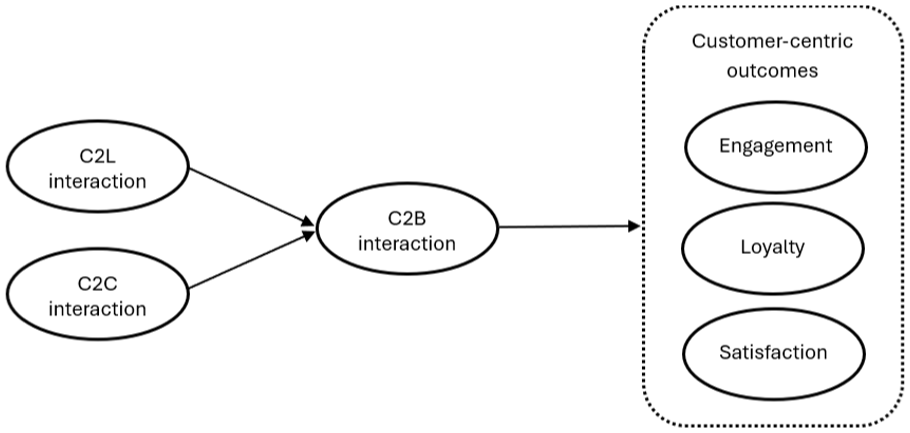
Proposed research framework.
Methodology
This research employed an explanatory sequential mixed methods design, beginning with quantitative data collection and analysis, followed by a qualitative phase to further interpret and elaborate on the initial findings (Creswell & Creswell, 2018). In the first phase, survey data from livestream shopping customers were analyzed using the PROCESS macro to test the proposed mediation hypotheses after establishing measurement validity and reliability. The second phase comprised in-depth interviews with frequent livestream shoppers to validate and enrich the quantitative findings. All participants were informed about the objectives of the research and had their information kept anonymous. Their consent was obtained to ensure voluntary participation.
Study 1
The objective of Study 1 was to empirically test three proposed hypotheses. Specifically, it examined the mediating role of C2B interaction in the relationships between C2L and C2C interactions and customer-centric outcomes, namely, satisfaction, engagement, and loyalty. It also aimed to compare the relative influence of C2L and C2C on C2B to determine which interaction type exerts a stronger effect.
Measures, data collection, and sample characteristics
The measurement instruments employed in this study have been validated in prior research. The C2L and C2C interaction scales were adopted from H. Kim and Fung So (2024), while the C2B interaction scale was adopted from Labrecque (2014). For customer-centric outcomes, the loyalty scale was adopted from Wu et al. (2019), the satisfaction scale from Slack et al. (2020), and the engagement scale from Cambra-Fierro et al. (2014). The questionnaire used a 5-point Likert scale with responses ranging from “Strongly disagree” to “Strongly agree.” An additional item “Have you ever experienced shopping via livestream?” was included to filter out irrelevant responses.
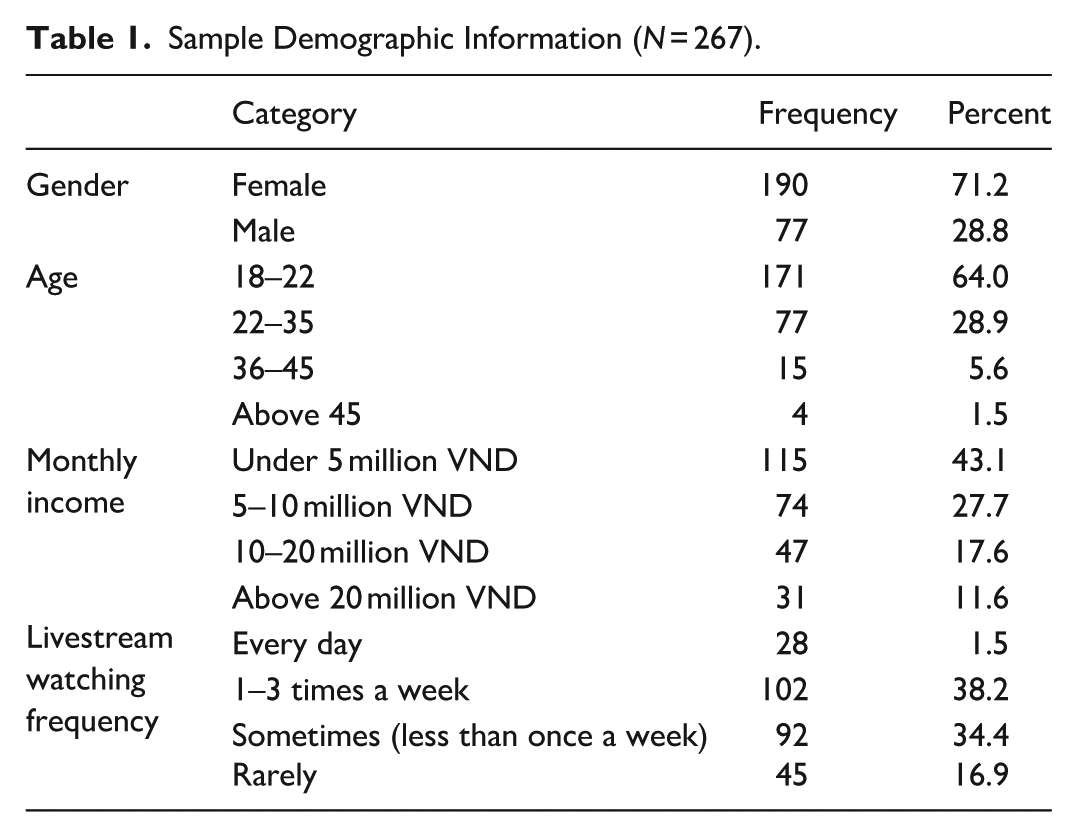
Prior to data collection, the questionnaire was pre-tested with four scholars to ensure the clarity and appropriateness of the translated scales. The feedback obtained was used to refine the questionnaire, ensuring the content validity of the measurement instrument. In January 2025, an online survey was conducted over 2 weeks in Vietnam and distributed to individuals familiar with livestream shopping via social media, with a request to forward the survey to others using a snowball sampling method. This technique is particularly useful for reaching specific population groups in online commerce research and appropriate for exploratory research (Baltar & Brunet, 2012). Respondents were required to have prior experience with livestream shopping to be eligible. A total of 332 responses were received, with 267 valid responses retained for final analysis. Demographic details of the sample are shown in Table 1.
Sample Demographic Information (N = 267).
Common method bias was assessed using the marker-variable technique (Lindell & Whitney, 2001). In this study, attitude toward the color blue was used as a marker variable, which was perceptual, measured on the same 5-point Likert scale as the substantive constructs, and theoretically unrelated to them, so any observed association could reasonably be attributed to method variance (Miller & Simmering, 2023). The results showed a mean correlation change of less than .01 when partialled out. Therefore, common method bias was not an issue in this study.
Measurement assessment
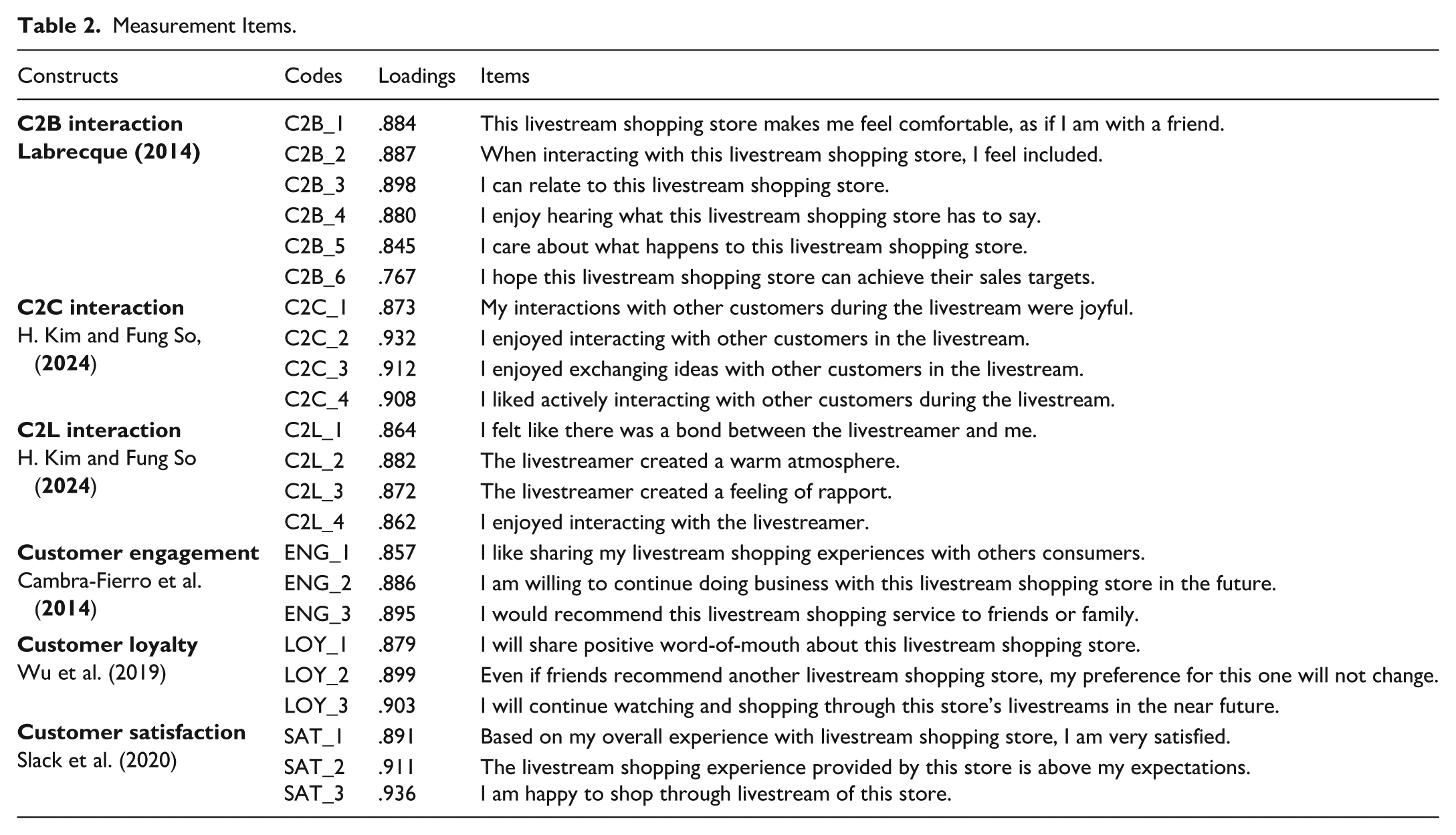
The reliability of the measurement items was evaluated using composite reliability (CR) values. The results indicated that all constructs had CR values exceeding the threshold of .70 (Hair et al., 2022). Additionally, the outer loadings of all measurement items exceeded .708 and were statistically significant, confirming the reliability of these items (see Table 2). For convergent validity, the average variance extracted (AVE) values for each construct exceeded the threshold of .50, demonstrating the convergent validity of the research model. Discriminant validity was confirmed using the Fornell-Larcker criterion, with each construct’s square root of the AVE exceeding its correlations with all other constructs, as demonstrated in Table 3. In addition, the SRMR value of the estimated model was .068, which is lower than the threshold of .08, indicating a low standardized residual between the observed and modeled correlation matrices and reflecting a good model fit (Hu & Bentler, 1998).
Measurement Items.
Reliability and Convergent Validity, and Discriminant Validity of Measurement.
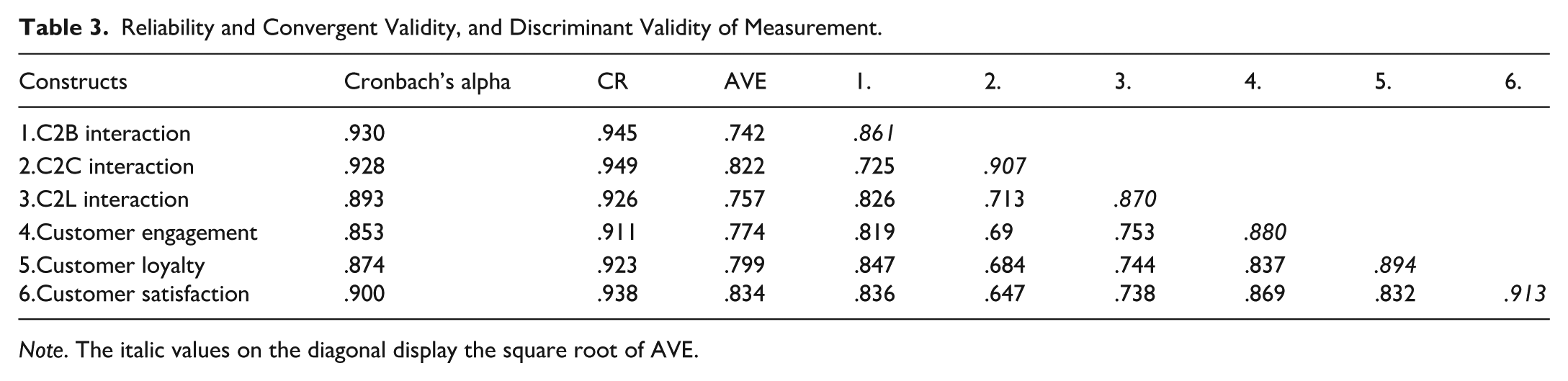
Note. The italic values on the diagonal display the square root of AVE.
Hypotheses testing
A mediation analysis using PROCESS macro Model 4 was conducted to test the hypotheses (Hayes, 2022). From the results in Table 4, the total effects in all six tested models are significant (p < .001), indicating that both C2C and C2L interactions positively influence the customer outcome variables, including engagement, loyalty, and satisfaction. The indirect effects, all within significant confidence intervals and accounting for a substantial portion of the total effects, suggest that C2B interaction acts as a significant mediator in each relationship.
Results of Hypotheses Testing.
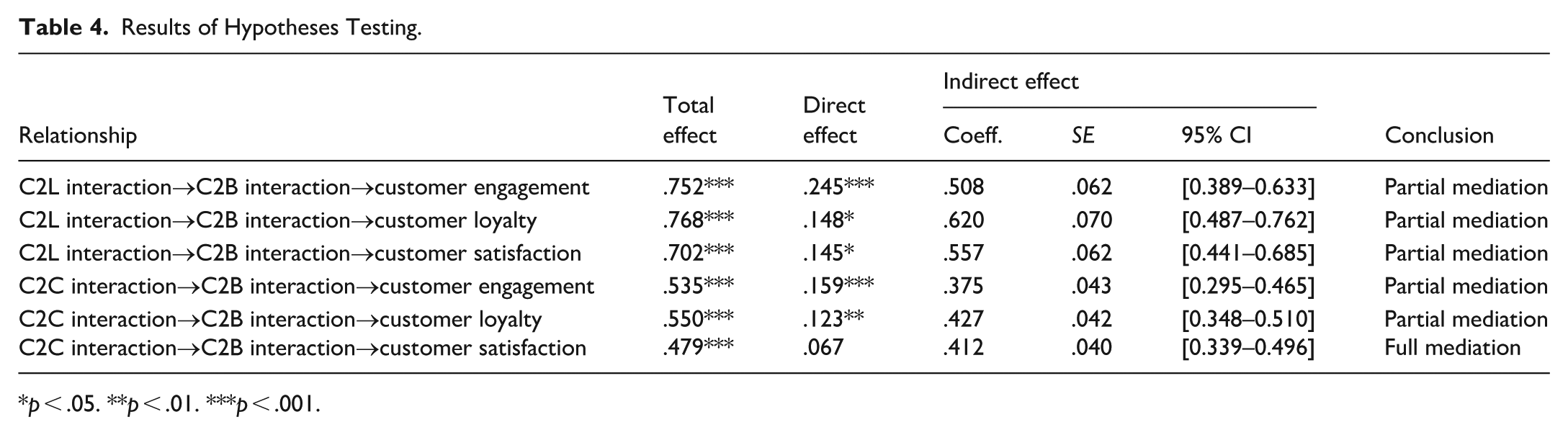
p < .05. **p < .01. ***p < .001.
In five of the six models, partial mediation is observed, meaning that both direct and indirect paths are significant. However, in the case of C2L interaction influencing customer satisfaction, the direct effect is not significant (β = .067, p > .05), while the indirect effect is strong and significant, indicating full mediation. Therefore, both
To further examine whether the strength of the indirect effects of C2L and C2C interactions on customer outcomes via C2B interaction differ, a z-test was utilized (Paternoster et al., 1998). Comparisons were made across three outcomes, including engagement, loyalty, and satisfaction. The results show that the mediated impact of C2L interaction was significantly greater than that of C2C interaction for loyalty (z = 2.36, p < .05) and satisfaction (z = 1.97, p < .05), but not for engagement (z = 1.76, p > .05). These findings provide partial support for
Study 2
The objective of Study 2 was to deepen the understanding of the quantitative findings by exploring how customers perceive and experience C2L, C2C, and C2B interactions during livestream shopping. This phase aimed to validate the survey results and provide richer contextual insights into the emotional and psychological dynamics underlying these interactions.
Data collection procedure and data analysis
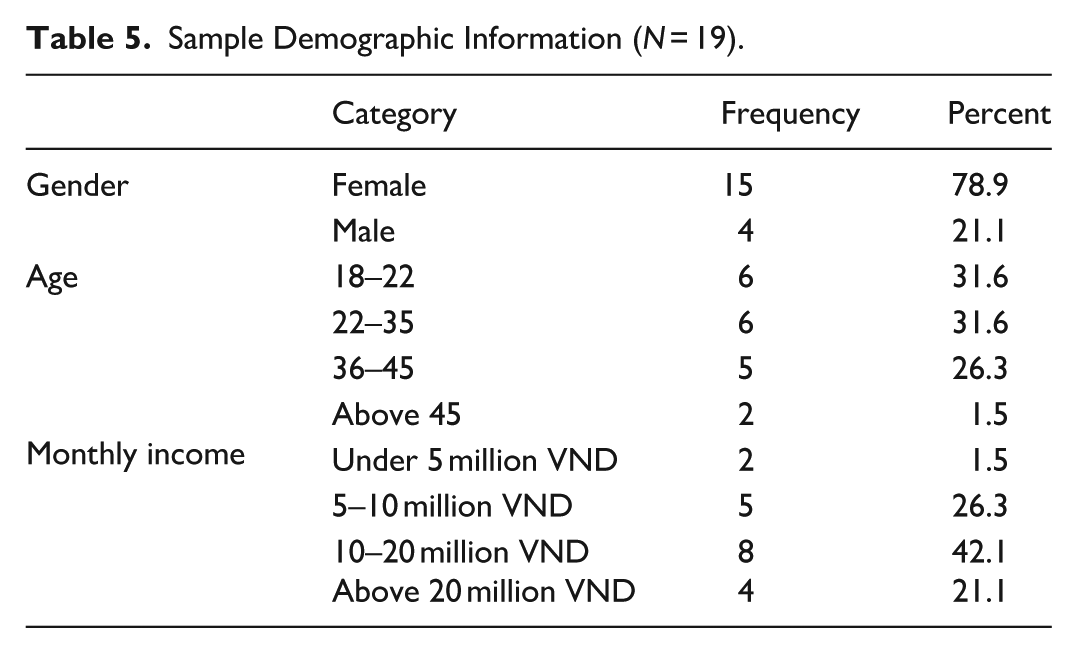
Data were collected through semi-structured interviews conducted either online or in person. A purposive sampling strategy was employed (Hennink & Kaiser, 2022) to recruit 19 frequent livestream shoppers during 1 week in June 2025. This sampling method ensured that the interviewees had sufficient experience related to the topic while also allowing for diversity in age (see Table 5).
Sample Demographic Information (N = 19).
Guided by open-ended questions, each interview lasted 30 to 45 min. The interviews focused on participants’ experiences with livestream shopping, particularly the interactional aspects they perceived as helpful or unhelpful and how these shaped their overall experiences and outcomes (see Appendix 1). Interview data were then analyzed using reflexive thematic analysis following the six-phase guide of Braun and Clarke (2006) to inductively identify patterns of meaning across participants’ account. To ensure analytic rigor, all interviews were transcribed verbatim. The coding process was conducted independently by the researchers, who possess backgrounds in consumer behavior and digital marketing, ensuring the interpretations were grounded in both the data and the theoretical framework. Codes and themes were developed and refined through iterative engagement with the data, moving from initial semantic codes to a finalized thematic map. Reflexive memos were used to support analytic sense-making and enhance transparency. Data collection ceased when thematic saturation was reached, indicated by three consecutive interviews yielding no new codes (Hennink & Kaiser, 2022).
Findings
C2L interaction: The foundation of emotional bonding
Participants consistently emphasized that the livestreamer plays a critical role in shaping their shopping experiences. Several interviewees expressed a sense of being personally addressed and emotionally engaged by the livestreamer. Participant C, for example, recalled that when she asked, “the livestreamer proactively introduced a few more items that suited my style based on what I shared. It felt like being taken care of wholeheartedly, not just being sold to superficially.” Similarly, during a promotional checkout process, Participant H shared that “the livestreamer quickly read my comment and carefully guided me step by step to do it. This made me feel their professionalism and dedication, making me want to stick around more, and continue to follow the livestream of this store.”
This sense of bonding extended to affective loyalty and repeat intention. Participant F, who had been recognized during multiple livestreams, reported feeling prioritized by the shop, which created a sense of familiarity and trust. Additionally, Participant J noted that “the factor that makes me wait for the next livestream is when the livestreamer responds to my questions quickly, and when they create a sense of attachment and familiarity for me,” reinforcing the idea that rapport-building enhances customer retention.
C2C interaction: Collective experience and peer validation
Although less intimate than C2L, C2C interactions were still described as influential, especially in building communal enjoyment and trust through peer validation. According to the interview data, participants often evaluated other customers’ questions, reactions, and product reviews as indicators of store credibility and product quality. For example, Participant G explained, “If there is praise, I trust more. If there is too much criticism, I don’t trust, don’t buy.” Participant C also said that “other customers also enthusiastically shared their experience using the product, which helped me have more confidence in the quality.”
However, C2C interaction was generally seen as playing a more supporting role. Few participants reported initiating conversations with other customers or directly influencing others’ behavior. Most interaction was observational, with participants reading comments rather than directly exchange ideas. Still, C2C interactions did have notable effects on engagement, especially when there were interactive activities in livestream sessions. Participant A shared her experience that “If there are many of us watching the livestream and a lot of people are typing “mine” for the product, I tend to become very competitive and attentive. I mean, I really pay close attention so I can be the next one to “mine” the product I like. This especially happens with clothing products. I type “mine” quickly so that others won’t get ahead of me.” Participant H believed that interactions among customers can shape customers’ perception of the store’s livestream shopping environment. She explained that “When the interaction between customers is lively, cheerful, and full of useful information, it will make me feel that the customers in this store seem decent, creating a healthy, useful, and focused environment for shopping, making me feel that this store is attractive and trustworthy. But there are livestreams where viewers just comment randomly, irrelevantly, or even with negative content, which can make me feel that this store is not trustworthy, possibly fraudulent, or not serious.”
C2B interaction: The bridge to customer outcomes
The qualitative findings reinforce the role of C2B interaction as a key mediator, not merely through the personal charm of the livestreamer, but through the broader perception of the business’s identity during livestream sessions. Many participants described experiences that went beyond the livestreamer and reflected an emotional connection with the store’s images and operations. Participant J remarked that her trust grew when the business handled customer concerns transparently on livestream, creating a sense of professionalism and reliability. Similarly, Participant E said she got “full information quickly” and felt “happy when I find a satisfactory item,” suggesting a perception that the store was responsive and cared about helping her make a good choice.
Participant H added that although the livestreamer initiates attention, her long-term attachment is shaped by the perceived consistency and professionalism of the store. She explained, “the livestreamer represents the store . . . [but] interaction with other customers is an objective factor, not controlled by the store.” Participant G also provided similar information that “I feel satisfied, when I see the livestream of that person/store and I will continue to watch. While the customers of each livestream are different,” emphasizing that what builds lasting satisfaction is the business’s intentional design of the customer experience, how it supports customers, delivers value, and solves problems. Several participants mentioned store-level practices such as timely order support, freebies, discount mechanics, and comment moderation as elements that made them feel the business cared about them. Participants A and D appreciated the surprise free gifts and detailed advice, saying that this made them feel “attended to.” Participant I similarly noted that C2B interaction meant the business “understands what customers want,” not just by answering questions, but by doing so in a way that conveys inclusion, effort, and alignment with customer values. In this way, C2B serves as the emotional container through which the store becomes more than a transaction point. It is perceived as familiar, trustworthy, and worth supporting. When customers perceive the business as something they “follow,” “care about,” or “feel included by,” they develop a deeper, parasocial attachment to the business.
Participants also stated that while other customers’ input was helpful, the final satisfaction derived more from the store’s response and service quality. Participant F noted, “interacting with other customers I don’t see any significant benefit for me,” while Participant H emphasized that although customer comments are interesting, they are not always credible, especially compared to the perceived responsibility and consistency of the business. This supports the interpretation of C2B interaction as a central mechanism that bridges the influence of other interactions on the overall customer experience. This is consistent with the results of the mediation analysis in study 1.
Relative importance of C2L versus C2C
Participants overwhelmingly favored interaction with livestreamers over interaction with other customers in terms of trust, loyalty, and satisfaction. Participant C summarized this well: “The livestreamer directly represents the store . . . when they chat friendly, remember regular customers’ names, and give enthusiastic advice, I feel like I’m being taken care of personally.” Participant G added that livestreamers must “respond quickly and convincingly,” or else trust quickly erodes.
In contrast, interactions with other customers were described as fleeting, impersonal, or potentially misleading. Participant H provided further nuance, explaining that livestreamers are visibly present and personally accountable for what they say during livestreams, making them more trustworthy than user-generated content from “unidentified commenters.” She also noted that “interactions with customers are only through words in comments, so it is unclear whether they are real customers, seeders, chatbots creating content, or just random viewers,” whereas livestreamers are “attached to the store.” While other customers are mostly visible only through comments, Participants F and J agreed that a livestreamer’s “good-looking” or “cute” appearance provides a huge added advantage. When livestreamer interactions are effective, they create expectations for future sessions and deepen customer connection with the store’s identity which in turn enhances customer outcomes. Participant J, who acknowledged the value of a lively customer chat, ultimately attributed her emotional attachment and repeat intention to the emotional presence of the livestreamer, as well as the professionalism and attentiveness of the store’s operations. These findings are consistent with the results of study 1, which tested and compared the relative strength of C2L and C2C interactions in driving customer-centric outcomes.
Discussion
This study provides a understanding of the social interaction mechanisms in livestream shopping environments by examining how C2L and C2C interactions affect key customer-centric outcomes, namely satisfaction, engagement, and loyalty. The analysis confirms that both C2L and C2C interactions significantly enhance C2B interaction, which subsequently leads to more favorable customer responses. However, the strength and nature of these influences differ, shedding light on the varying roles of social actors in shaping customer experiences.
Regarding
To discuss
Qualitative findings enrich this understanding by offering contextualized explanations of these patterns. Customers consistently described livestreamers as emotionally engaging, trustworthy, and entertaining, attributes that align with theories of parasocial interaction and source credibility (Vu et al., 2025). Livestreamers are not merely product presenters; they are charismatic anchors who humanize the brand, answer real-time questions, and co-create a shopping experience with their audiences (H. Chen et al., 2023; Y. Zhang & Xu, 2024). These affective and relational bonds help explain the stronger mediated effects on satisfaction and loyalty.
In contrast, C2C interaction, while statistically significant, was often described as passive, observational, or occasionally performative (Lu et al., 2018). Many interview participants reported reading peer comments but not actively contributing, and some questioned the authenticity or motivations behind peer behaviors. These insights point to a critical gap between visibility and influence, peer interactions are seen and sometimes emotionally resonant, but they lack the perceived trust and authority of livestreamers (Shahbaznezhad et al., 2021). This may account for their relatively weaker role, especially in shaping deeper emotional outcomes like loyalty.
Theoretical implications
Based on Social Presence and Parasocial Interaction Theory perspective within the context of livestreaming, this study proposes and tests a new integrated model in which three main levels of interaction in the livestreaming commerce context shape customer-centric outcomes. Whereas previous studies have primarily focused independently on factors such as streamer attractiveness (C. P. Chen, 2021), community engagement (Coelho et al., 2018), or service quality (Lee & Lee, 2017), this research marks a theoretical advance by following Labrecque (2014) and Ko (2024) in clarifying the essential mediating role of C2B interaction in translating social and personal drivers into positive customer outcomes, namely satisfaction, engagement and loyalty.
One of the key theoretical contributions is the establishment of a three-tier model, which elucidates the causal pathways linking different interaction levels to customer behavioral outcomes. While these relationships have previously been studied in isolation or without clear stratification, this study integrates quantitative and qualitative data to not only test these links with robust statistical coefficients but also enrich our understanding by analyzing consumers’ perceptions and real behaviors. Consequently, this research acts as a bridge between digital consumer behavior theories and relationship marketing, particularly within the distinctive context of livestream commerce.
Another contribution is clarifying the differentiated roles of C2L and C2C in shaping C2B interaction and related outcomes. The findings show that C2L, evidenced by emotional presence, trustworthiness, and attractiveness of the livestreamer (Vu et al., 2025), exerts stronger direct and indirect effects on customer engagement, loyalty, and satisfaction than C2C. Although C2C still has a positive influence, its effect is predominantly indirect and weaker. This highlights a crucial theoretical contribution: in modern livestream shopping, the streamer functions not merely as an information provider but as a social figure capable of high-level personalization of the customer experience (Y. Chen et al., 2025; Yang et al., 2025), an aspect that traditional social commerce or 1:1 marketing theories have not fully exploited (X. Luo et al., 2025).
Furthermore, qualitative findings indicate that customers tend to experience C2C interaction passively and express skepticism about the authenticity of other users’ comments. This challenges the common assumption that online communities always foster trust and commitment (Azad Moghddam et al., 2025; J. Wang et al., 2025). These results offer a fresh theoretical perspective on the shifting nature of trust and information authority in peer-to-peer mediated environments, showing that in livestream commerce, the role of peers can be diminished when customers place their trust and emotional investment in the streamer-who is viewed as the “face” of the brand or product (Kong & You, 2026; Xiao et al., 2025).
This also opens a new theoretical direction toward mediation in digital consumer behavior, positioning C2B as a “psychological converter” that transforms social attractiveness and emotional cues from streamers or consumer communities into tangible outcomes of satisfaction, engagement, and loyalty. This approach helps explain why many livestream brands, despite having large follower communities, struggle to maintain high levels of interaction or conversion: they lack effective strategies to drive meaningful C2B interactions (H. Chen et al., 2023; Giertz et al., 2022). The findings also suggest that customer relationships develop through interactions with the livestreamers and peers through emotional and social mechanisms, and are effectively governed by C2B. This represents a significant contribution to contemporary theories of customer journey and engagement, emphasizing that in livestream contexts, the customer journey is socially embedded and involves multi-dimensional interactions.
Practical implications
Findings from this research suggest that when optimizing C2B interaction to position the business as a “companion” in livestream commerce, the business is no longer hidden behind a logo, a name, or a slogan, it becomes a “living entity” in the consumer’s mind. When customers feel at ease, enjoy listening to the messages from businesses, or even care about their success, it signals the emergence of a strong emotional bond. Therefore, businesses should increase personalization, for example, by maintaining a natural and conversational tone, sharing behind-the-scenes content or their development journey (L. Luo et al., 2024). Additionally, enhancing meaningful interaction, such as inviting customer feedback, voting, or emotional expression, can help consumers feel included. Moreover, conveying deeper values by consistently communicating the business’s missions, beliefs, or social responsibility through livestream sessions can help shift the focus from merely selling products to telling its stories. C2B interaction emphasizes nurturing a long-term relationship between customers and the business itself. When customers feel a sense of belonging, they are not only more likely to return and repurchase, but also to become advocates who naturally spread the business’s values (e.g. Coelho et al., 2018).
Moreover, one of the strategic advantages of livestream commerce is its ability to foster a sense of community (Azad Moghddam et al., 2025; Hu et al., 2017). When customers feel they belong to a group with shared interests, their level of attachment to the business increases (J. Chen & Wu, 2024). Therefore, businesses should design livestream interfaces that facilitate easy interaction and encourage users to share personal experiences, product reviews, or ask open-ended questions to sustain two-way communication. Incorporating gamified elements, such as comment competitions, product voting, or reward points for social participation, can also enhance customer engagement (L. Luo et al., 2024). Additionally, consumers tend to trust feedback from other buyers more than branded advertising (Fu & Hsu, 2023), but they may also be cautious of anonymous or unverified comments. Thus, businesses may consider utilizing livestreaming platform features to organize “live review” sessions conducted by real customers and encourage behaviors such as sharing livestream links or tagging friends to boost reach through electronic word-of-mouth.
Enhancing emotional connections between consumers and livestreamers is central to the livestream commerce model (Wongkitrungrueng et al., 2020). Expressions such as “a sense of relationship,” “warm atmosphere,” or “emotional bonding” suggest that the livestreamer acts as a shopping companion in the consumer journey. First, livestreamers represent the emotional tone and personality of the brand (Shao et al., 2024). Creating a warm and empathetic experience helps humanize the relationship with customers. Businesses should invest in training livestreamers in sales techniques, emotional connection-building, situational handling, and authentic expression (X. Xu et al., 2025). Skilled livestreamers can effectively navigate challenging situations and guide viewer comments to create a cohesive and engaging shopping environment. Selecting key opinion leaders should focus on their ability to engage and emotionally resonate with audiences rather than merely on their follower count (Shao et al., 2024). Second, when consumers feel emotionally attached to a livestreamer, they tend to develop loyalty to the individual and leverage to the associated brand. Brands or stores should consider establishing long-term partnerships with livestreamers to ensure consistency in their image. Additionally, developing fan clubs or membership programs for loyal followers can enhance engagement and provide exclusive benefits. Third, triggering purchases through personalized emotional experiences, such as being addressed by name or receiving direct responses, can accelerate consumer buying behavior. Livestream commerce offers a sense of intimacy and social presence, making consumers feel seen and valued (Lim et al., 2020). This is a key area businesses can leverage to personalize the experience and increase purchase conversion rates.
Limitations and future directions
This research has several limitations to consider. Regarding the research context, it focuses on livestream platforms in a specific region, limiting the generalizability of the results. Future studies could expand to other emerging or developed markets. Moreover, the sample was predominantly young and female, reflecting a segment highly engaged in livestream shopping but potentially restricting the applicability of the results across broader demographic groups. Moreover, the absence of subgroup or moderation analyses limits the examination of heterogeneity in how different consumers perceive and respond to C2L and C2C interactions. Future studies may employ multi-group analysis or moderation models to assess whether these effects vary across demographic characteristics (e.g. age and gender) or levels of livestream familiarity, thereby enhancing external validity.
Nonprobability sampling used in this research may introduce sampling bias and limit the generalizability of our findings. Therefore, we suggest that future research employ probability-based approaches to capture a more diverse and representative consumer population. In addition, the cross-sectional design captures data at a single point in time, making it unable to account for changes over time or during special events. Future research should use longitudinal methods to understand how customer experience evolves. Finally, no moderating effects were examined in the model. Some psychological factors, such as social phobia, trust in technology, may also significantly impact the relationships among stakeholders in livestream shopping. Exploring these factors in future studies could offer deeper insights.
Footnotes
Appendix 1: Interview protocol
Declaration of Conflicting Interests
The authors declared no potential conflicts of interest with respect to the research, authorship, and/or publication of this article.
Funding
The authors disclosed receipt of the following financial support for the research, authorship, and/or publication of this article: This research was supported by the University of Economics Ho Chi Minh City (UEH), Vietnam.
