



Abstract
Film tourism represents a growing opportunity for destination marketers, yet limited research examines how specific filmic components within a film’s dramatic architecture influence destination image and travel intention. This study addresses this gap through a sequential explanatory mixed-methods design comprising three phases. First, a pre-test (n = 360) using exploratory factor analysis identified and validated four film components: plot, culture and tradition, scenery, and humanism. Second, a between-subjects quasi-experimental study with Vietnamese viewers (n = 792) employed partial least squares structural equation modeling to test how Korean versus Vietnamese films differentially influence domestic and international travel intentions. Third, semi-structured interviews (n = 22) with thematic analysis provided contextual depth and theoretical extension. Results reveal that plot significantly influences both destination image and travel intention for both film types, while culture and tradition affects travel intention only indirectly through destination image. Scenery exhibits paradoxical effects, negatively impacting destination image for Vietnamese films but positively for Korean films, yet positively influencing travel intention for both. Humanism influenced destination image only for Vietnamese films. These findings extend dramatic theory and narrative transportation literature into tourism contexts, demonstrating that film components operate through distinct pathways. Destination marketing organizations should prioritize narrative integration over scenic product placement and develop differentiated strategies for domestic versus international audiences.
Keywords
Introduction
For as long as they have existed, films have been important communicators of culture, identity, and social norms at any given moment. As a result, films have become one of the primary agents that motivate people to travel abroad to foreign destinations (Oshriyeh & Capriello, 2022). Because of this, over the past 30 years, destination marketing organizations (DMOs) have increasingly looked to film tourism initiatives as a way to increase awareness of their destination, engage audiences, and generate visitor numbers (Connell, 2012; Croy et al., 2018; Hao et al., 2024).
To understand the power of film tourism, one only has to recall the park bench in Savannah, Georgia where Forrest Gump sat and pondered life. Four years after its release, tourists were still making the journey to see the famous bench and relive moments made famous in the movie (Economist, 1998). While it might be the novelty in seeing Forrest’s bench, the prestige of visiting a famous location, or the ability to experience a personal moment (Macionis & Sparks, 2009), the presence of the destination in film clearly resonates with the audience and has a significant impact on travel decisions. Despite that, limited research has been conducted to identify the specific film components—such as plot, characters, or scenery—that generate such responses in viewers. Because of this, we turn to literature on dramatic theory, storytelling+ narrative transportation to better understand the way different filmic components influence viewer attitudes.
Dramatic theory: The human desire for a narrative
Humans love stories. Stories capture our attention, elicit both positive and negative emotions, and can flood our brains with neurotransmitters like oxytocin and cortisol that influence our mood (Zak, 2015). That might explain why famous Romanian-American author Elie Wiesel once wrote “God made man because he loves stories.” Wiesel even went so far as to call humans “homo fictus” or “fiction man” and described humans as great apes with storytelling minds. However, the love for a good narrative isn’t a recent thing in human history. In fact, it has been suggested that language evolved in Stone Age tribes primarily to swap stories or gossip. However, storytelling as we know it, particularly in written form, really started to blossom around 3,000 years ago, through ancient writers like Plato and Aristotle. However, it was Homer and his two major works—The Iliad and The Odyssey—that shaped Western literature and are still seen as the foundation of storytelling.
As a result, for the past 2,000 years, the narrative has become the root of education, rhetoric, literature, religion, law, and history (Wilson, 1989). This is evident in the works of Renaissance writers like Shakespeare, Chaucer, Petrarch, and Machiavelli, as well as later authors like Austen, Emerson, and Hemingway. Thus, history suggests humans have long used the narrative to entertain, educate, communicate, and challenge the reader. However, in the early 20th century, a more concrete theory of narrative evolved (Draper, 1924), so that by mid-century, “dramatic theory” emerged, which proposed a set of principles required for a successful story (Halline, 1944). From this came the fundamentals of creative writing and the birth of “dramatic architecture.”
Dramatic architecture
In literature, a narrative will often have a typical structure that includes fundamental story elements such as characters, plot, setting, and theme (Tarlow, 1998). Together, these elements form what is known as the “dramatic architecture” (Letwin et al., 2008). In relation to film tourism, the dramatic architecture may influence viewer attitudes toward any destination or location shown (Hudson et al., 2011). Thus, the elements of dramatic architecture like the characters, themes, and locations can become icons that drive viewer feelings and motivate travel intentions (R. Riley et al., 1998). Yet, this is not a new phenomenon. In fact, research (Levin, 2017) suggests travel books—complete with riveting tales of distant places—have been popular since the time of Marco Polo in the 13th century. However, in modern times, the narrative has become an essential element in tourism advertising, because not only does the narrative engage the audience, it also facilitates what is known as “narrative transportation” (Cao et al., 2021).
Narrative transportation
Narratives are powerful because they activate existing stored narrative structures that allow the human brain to “live stream” a memory, thus encouraging viewers to process new messages according to stored narrative structures (Plassmann et al., 2007), thereby triggering mental imagery (Phillips et al., 1995). Mental imagery is initiated by exposure to verbal and visual representations of objects and is central to comprehension (Barsalou, 2008; Elder & Krishna, 2012). Before that happens, though, mental imagery allows the viewer to mentally “transport” themselves into the destination. Transportation occurs when viewers become absorbed in a narrative and immersed in a created world of imagery, emotion, and attentional focus (Green & Brock, 2000). When mental transportation occurs, people will often report being “lost in a story” (Nell, 1988) or “hooked” by an idea (Escalas et al., 2004). Importantly, transportation situates the viewer in the moment and has the power to elicit whatever emotion might be relevant to the given context (Escalas, 2004), and this influences downstream attitudes and behaviors relating to travel decisions.
Research motivation and purpose
Despite the growing body of literature on film tourism (Connell, 2012; Croy et al., 2018; Hao et al., 2024), several critical gaps remain. First, existing research has predominantly focused on the overall impact of films on destination image and travel intentions (Hudson et al., 2011; R. Riley et al., 1998), treating films as holistic stimuli rather than examining the discrete components of dramatic architecture that drive these effects. While scholars acknowledge that elements like characters, themes, and locations can influence viewer feelings (R. Riley et al., 1998), this aggregated approach limits our understanding of which specific film elements—whether plot, cultural representations, scenery, or humanistic themes—most effectively influence viewer perceptions and behaviors. Second, prior studies have overwhelmingly emphasized international travel intentions (Macionis & Sparks, 2009; Oshriyeh & Capriello, 2022), with insufficient attention paid to how film components might differentially influence domestic versus international tourism decisions. This is particularly problematic given that domestic tourism represents a substantial portion of the global tourism market and may be influenced by different psychological mechanisms than international travel. Furthermore, while previous research has established that destination image mediates the relationship between film exposure and travel intention (Hudson et al., 2011), and narrative transportation theory suggests films can influence attitudes and behaviors (Escalas, 2004; Green & Brock, 2000), the empirical evidence supporting this mechanism remains limited and often methodologically weak. Many studies rely on post-hoc surveys of tourists who have already visited film locations (e.g. Economist, 1998), introducing self-selection bias and making it difficult to establish clear causal relationships. Additionally, the majority of film tourism research has been conducted in Western contexts, with Asian markets—despite their significant and growing film industries—remaining underexplored in the academic literature.
Given these gaps, this research addresses the following primary research question: How do specific components of a film’s dramatic architecture (plot, culture and tradition, scenery, and humanism) differentially influence destination image and travel intentions for domestic versus international destinations? To answer this question, this study employs a between-subjects experimental design using Korean and Vietnamese films with a Vietnamese sample, allowing for controlled examination of causal relationships while comparing domestic and international tourism contexts.
This research makes several important theoretical contributions. First, it extends dramatic theory and narrative transportation literature into the tourism domain by unpacking the “black box” of film influence and identifying which specific components of dramatic architecture drive destination perceptions and travel behaviors. Second, by comparing domestic and international travel contexts, this study advances our understanding of how cultural proximity and psychological distance moderate the relationship between film components, destination image, and travel intention. Third, this research contributes to destination image theory by providing experimental evidence for the mediating role of destination image in the film-to-behavior pathway, addressing methodological limitations in prior research.
From a managerial perspective, the findings offer actionable insights for DMOs and film commissions seeking to leverage film tourism as a marketing tool. By identifying which film components most effectively influence travel intentions for domestic versus international audiences, destination marketers can make more informed decisions about film partnership opportunities, product placement strategies, and post-release promotional campaigns. Understanding the differential effects of plot, cultural elements, scenery, and humanistic themes enables DMOs to strategically align their destinations with film projects that feature components most likely to resonate with target audiences. Furthermore, the findings provide guidance on how to tailor marketing messages and promotional materials differently for domestic versus international markets, optimizing return on investment for film tourism initiatives.
Together, the findings from this research show that the various film components influence destination image and travel intention differently for domestic and international destinations. Furthermore, while the findings do support prior research showing destination image as a key driver for travel intention, differential effects are observed when comparing the role of destination image as the driver for domestic versus international travel intention.
Conceptual development
What is film tourism?
Throughout history, different forms of media have not only developed the images of global destinations but also shaped international travel patterns (Butler, 1990; Oshriyeh & Capriello, 2022). From the mid-20th century, the most influential form of media has been film. As a result, the film industry has been credited as a driving force of tourism for many destinations (Lee et al., 2019). Part of this is due to the fact that by participating in cinema, we also participate in the myth and fantasy that comes with the story (Hill, 1992). The myth and fantasy enable viewers to become engaged, attached, and psychologically committed to the film they view. This can have a profound influence on viewer attitudes toward the setting or location and motivate viewers to engage in film tourism.
Film tourism is when an individual visits a site or location that has been used in filming or is somehow associated with a film (Buchmann et al., 2010). Importantly, film-tourism destinations can be classified as either a setting or a location (Li et al., 2021), in that a setting is where the story is set, and the location is where it was filmed (Tooke & Baker, 1996). Thus, when traveling abroad, film tourists may look to visit location sites where movies have been filmed, as well as other places associated with the film, such as studios and production houses as well as film-related theme parks (Beeton, 2005).
Interestingly, the notion that popular culture influences tourism is not new, given different forms of media have motivated travel throughout the ages. For example, literary enthusiasts have long been inspired to visit sites associated with favorite authors. From the late 1800s, literary pilgrims were found visiting sites related to Shakespeare, Robert Burns or the home of the Bronte sisters in Haworth (Watson, 2009). In modern times, such “literary pilgrims” use the source text to guide their travels and will often use the travel to enrich their experience when re-reading the text (MacLeod et al., 2018). Alternatively, there is an increasing willingness for people to travel to locations or regions associated with specific food or food production (S. Kim, Park, & Lamb, 2019). Similarly, the growing popularity of Japanese anime has given rise to “anime tourism” as an emerging tourism market (Liu et al., 2022), where anime fans will visit “holy places” or “sacred sites” in what is referred to as “anime pilgrimage” (Yamamura, 2009). During their pilgrimage, anime fans, known as “anime otaku,” visit real locations that resemble fictional scenes or locations from various anime (Ono et al., 2020). Moving from animation and film into the digital world, we now see media-related tourism that occurs because gamers are exposed to images of various cities or destinations during gaming (Dubois & Gibbs, 2018). In fact, some dedicated gamers and “e-sport” fans are so motivated that they are willing to travel and attend physical events to see or meet star players, demonstrate team loyalty, or because of a self-congruity with the event (Thompson et al., 2022).
Influence on tourist attitudes and behaviors
Any form of media, be it film, print, or some other form, will typically highlight relevant issues or topics and frame them in a way that is then interpreted by the viewer (Hansen, 2020). This is because media captures the attention of potential tourists through “imagined portrayals” of both people and place (White et al., 2019). It is this exposure to media that generates awareness and influences travel intentions (S. Kim, Park, & Lamb, 2019). Part of this is because exposure to the destination not only elicits some form of positive emotion, but also allows the viewer to develop a deep sense of attachment to the location itself (Hosany et al., 2020).
When individuals develop a sense of attachment to the location, the physical location serves as a symbolic anchor for viewers’ imagination (Reijnders, 2011), making the locations “Lieux d’imagination” or “imaginative places.” When this occurs, film tourists visit a location and engage in behaviors that signify that location as distinct from surrounding areas (Milazzo & Santos, 2022). In doing this, tourists not only engage with the physical location, but with the imagined world it represents. Whether that location is a non-descript place in a city or a designated theme park, visitors can create their own “storyworld” that blends the story, the location, and the overall tourist experience (Moscardo, 2020). Ultimately, tourists will immerse themselves in the location and the story, which facilitates a form of “narrative transportation” (Alyahya & McLean, 2021), creating a “hyperreal” experience that blurs reality and fantasy so the tourist experiences a sense of being in the fictional world (Liu et al., 2021). Such “mental transportation” takes place because transportation is a convergent process (Green & Brock, 2000) where all of the viewer’s mental systems and cognitive resources are wholly dedicated to events occurring in the narrative. Because of this, the narrative shapes the viewer’s concept of a location being portrayed, influencing their image of the destination in the real-world.
Film tourism and destination image
The concept of a “destination image” began with the research by Hunt (1975). He pointed out that customers buy a product based on the product’s “image” as well as its inherent characteristics. Based on this, he posed the question whether a destinations image would influence the willingness of travelers to “buy” a travel experience in a given region.
In the years following the work of Hunt (1975), various definitions were proposed for destination image. For example, destination image was initially defined as the sum of beliefs, ideas, and impressions an individual has of a given destination (Crompton, 1979). By contrast, it was broadly suggested it could simply be someone’s perceptions or impressions of a place (Phelps, 1986) or specifically about a place in which they do not reside (Gartner & Hunt, 1987). The idea that destination image was dependent on non-resident status was a recurring theme in the early literature, where some even took this further and suggested destination image was the perception of specific “vacation attributes” (Richardson & Crompton, 1988). From this came the concept that destination image consisted of two primary components that are either attribute-based or holistic (Echtner & Ritchie, 1991). More recently, researchers appeared to draw on various theories of attitude formation, suggesting destination image consisted of both cognitive and affective components (H. Kim & Richardson, 2003). In this respect, it was suggested cognitive components specifically refer to destination attributes (Gartner, 1994), while affective components refer to the subjective attitudes and emotions experienced by the viewer (Baloglu & Brinberg, 1997). This concept has been confirmed in research by San Martín and Del Bosque (2008), where the findings demonstrate the multidimensional nature of destination image and the presence of cognitive and affective substrates that shape destination image. Importantly, this is not unique to leisure travelers, given that business travelers have shown destination image is formed by the traveler’s perceived overall destination attractiveness, functionality, and ambience (Hankinson, 2005). No doubt, there are many more definitions but the key takeaway is that destination image is a voluntary, multisensory, conscious experience that relates to a destination (Lai & Li, 2016). Ultimately, that makes destination image a “fluid concept” (Litvin & Mouri, 2009) because not only will different market segments have markedly different destination images, but at the individual level, our own personal experiences will influence how we view a destination. Importantly, some of those personal experiences come about from seeing a destination in a film or television show.
While there is prior research that examines destination image formation in relation to films (Akarsu et al., 2019; Chen, 2018; Croy, 2010; Hudson et al., 2011; Larsen & George, 2006; Michopoulou et al., 2022; Shani et al., 2009; Yen & Croy, 2016), there appears to be limited research that has examined how the actual filmic components contribute to the formation of destination image. That said, prior research (Hudson et al., 2011) has shown influence travel intention. Similarly, it has been shown that a “character-centered” narrative (Sampaio, 2014), where the storyline or plot recounts some life-changing experience, has a positive influence on travel motivations. This concept of personal transformation is a resounding theme linked to film tourism (Harrill et al., 2022) because the film provides a vehicle for emotional, humanistic accounts of life. Ultimately, film creates “icons” of locations, characters, and themes (R. Riley et al., 1998) and this increases destination awareness and appeal for viewers. But what are the specific filmic components that influence viewer attitudes and intentions?
Filmic components and “dramatic architecture”
In literature, a narrative will often have a typical structure that includes fundamental story elements such as characters, plot, setting, and theme (Tarlow, 1998). Together, these elements form what is known as the “dramatic architecture” (Letwin et al., 2008). Prior research (Hudson et al., 2011) has suggested some of these elements—such as scenery, landscapes, and cultural attractions—influence viewer travel intentions. Similarly, a “character-centered narrative,” where travel leads to a “life-changing experience” (Sampaio, 2014) and some form of “personal transformation” (Harrill et al., 2022) can motivate viewer intentions. This can be a powerful influence, because the lead actor takes on the role of the primary protagonist, which resonates with audiences and influences their attitudes (Busby et al., 2013). When this happens, the characters, themes, and locations become icons that drive viewer feelings (R. Riley et al., 1998). Together with music and scenery backdrops, viewers can develop a sense of nostalgia that influences both psychological and behavioral involvement (S. Kim, Kim, & Petrick, 2019). Despite this, there appears to be limited research that has examined whether or how specific elements of dramatic architecture influence viewer attitudes and behaviors. Because of this, a review of prior research (e.g. Iwashita, 2006; S. Kim et al., 2007, 2008; R. W. Riley & Van Doren, 1992) was undertaken and identified four filmic components (plot, culture and tradition, scenery, and humanism) that might have a significant, positive influence on a viewer’s perceived destination image.
Plot—the power of a storyline
When considering the role that film or television may play in developing a destination’s image, many people would naturally think scenery and tourist icons dominate. However, this is little more than destination as product placement. Rather, there is now a broad body of research that encourages destination marketers to think outside the box and go beyond standard landscape shots and destination placement (Horrigan, 2009). Instead, when film or television are being considered as media vehicles, destination marketing organizations (DMOs) should be involving themselves at the conceptual development stage, so the film script aligns with the intended brand or destination image. As Horrigan (2009) points out, the difference between branded entertainment and product placement is the level of integration between brand and plot. Even if DMOs were to consider the inclusion of their destination in film as a form of product placement, to create attitudinal change and increase brand recall, it still requires a meaningful connection to the plot (Russell, 2002).
The benefit of this is that it creates a kind of “masked art” hybrid (Balasubramanian, 1994), where the brand (or destination) is integrated within the film in a deliberate but not obvious way. In fact, the more integrated the destination is with the plot or storyline, the greater the impact it will have on the audience (Hudson & Hudson, 2006).
Embedding the destination within the storyline or plot means both the cognitive and affective attributes of the film extend to the destination image. Similar effects are seen with video game players. For example, gamers can become so engrossed in a game’s storyline they feel physically, cognitively and emotionally engaged, to the point where they feel “transported” into the game setting (Nelson & Waiguny, 2012). As a result, this transportation or “telepresence” has a positive influence on brand awareness, attitudes, and purchase intent (T. Kim & Biocca, 1997). Likewise, a form of telepresence occurs when people visit museums, primarily because visitors have a degree of sovereignty in setting the scene and freedom to imagine (Hede & Thyne, 2010). In film, this kind of imagination is often linked to characters, where the audience considers the characters’ movements and actions, and then imagines how they, personally, might have acted in a similar situation (Rose & Wood, 2005). Because the focus of audience attention is the character and the storyline, the influences on destination image may be subtle or subconscious. However, in many cases, the film’s protagonist may be experiencing some kind of physical or emotional journey. As such, the destination becomes an integral part of the journey or transformation and any positive (or negative) effects on the character will be transferred to the destination image. This is certainly the case in literary tourism, where “literary tourists” will often set off on real journeys to track the route of an imaginary character (O’Connor & Kim, 2014). Ultimately, the journey the reader (or viewer) shares with the character creates a “parasocial relationship’ so that the attitudes felt about the character are then reflected in their attitudes toward the destination (H. Su et al., 2011). In this respect, not only does the plot create some form of “telepresence” or immersion for the viewer, but the audience also becomes one with the character. For example, in research on films shot in the Australian outback, Frost (2010) points out that successful films shot in the location are generally shot through the eyes of someone visiting the area for the first time. As a result, the audience shares this first experience with the character, and this creates the impression that if they were to visit the area in the future, they too will experience a similar life-changing event. As a result, the following hypotheses are proposed:
In other words, when a film’s plot effectively showcases a destination’s attractions, culture, and experiences, it creates a more favorable destination image in viewers’ minds, which in turn motivates them to consider visiting that location themselves.
Two films where this portrayal of life-changing movement is demonstrated are The Beach and The Motorcycle Diaries, where the idea of travel in the film supports the notion that travel is a source of transformation (Sampaio, 2014). This is a particularly salient point because not only is the destination woven into the plot, but the plot also involves some significant, life-changing travel. The integration of these themes is what enables the viewer to experience empathy for the character, share their emotional transformation and link this to the destination image that is created along the journey.
Culture and tradition
The culture and tradition that represent a destination are likely to have an impact on travel intentions. A classic example of this is Northern Ireland, where the Northern Ireland Tourist Board (NITB) has acknowledged the region’s history to build the destination’s image and raise awareness as a travel option. On the one hand, the NITB has embraced a degree of “dark tourism” where tourists visit not for the scenery, but to witness places that have become part of British folklore (Brown et al., 2013). Interestingly, the NITB used a different strategy to coincide with the release of “The Lion, The Witch and The Wardrobe,” when they promoted Northern Ireland as the birthplace of author C.S. Lewis, even though the film was predominantly shot in New Zealand (O’Connor & Bolan, 2008). Likewise, the Italian towns of Volterra and Montepulciano have blended these strategies by simultaneously recognizing their existing cultural heritage and blending this with elements of fantasy from the “Twilight” trilogy (Larson et al., 2013). From this, the following hypothesis is proposed:
This hypothesis suggests that the depiction of cultural authenticity and traditional customs in films acts as a dual-influence mechanism, simultaneously enriching the destination’s perceived image while also serving as a motivational trigger for actual visitation intentions among audiences.
It is natural to think these different strategies will have an effect not just on travel intentions, but also on the potential tourists’ perceived destination image. However, in a study on film-induced tourism in the UK, O’Connor et al. (2008) purport that destination image is of less importance to domestic travelers, given they take shorter breaks. This would seem to be in contrast to the evidence offered by Young and Young (2008), who claim that in 2005 “Basildon Park” (the site of Pride and Prejudice) had a 200% increase in visitors within a week of airing. While they stop short of identifying the influence of domestic/international tourists on the increase, the very short time frame for such a significant increase must be interpreted as containing a large percentage of local, mobile visitors.
In addition to visiting an area, there is also evidence that culture portrayed in film can provide some aspirational goals for viewers. If they approve of the movie and like it, viewers may then look to adopt a range of material goods that stand out as icons and metaphors for the destination, as a way of emulating the lifestyle of that culture (Craig et al., 2005). This has certainly happened because of the Korean wave. Similar instances have occurred, such as the spike in sales of Ray-Ban “Predator 2” sunglasses following the release of Men in Black. Following release, Ray-Ban sales were estimated to have increased by 20% globally (Pringle & Binet, 2005).
Scenery
Despite research suggesting there is more to film tourism than simple landscape shots, destination scenery and backdrops are still critical drivers for destination image. Prior research (S. Kim et al., 2008) suggests a country’s scenery and background have a significant, positive impact on destination image. Not only do tourists want to experience the beautiful scenery, they want to confirm and validate landscapes and architecture witnessed in film (Chan, 2007). In the Lord of the Rings films, for example, the combination of plot, fantasy, and epic portrayal of the New Zealand countryside has given the New Zealand landscape iconic status (Jones & Smith, 2005). Similar effects from destination scenery have been seen in Al Fayoum, Egypt, site of the 2008 film “Captain Hima” (Soliman, 2011) and Cephalonia, Greece where Captain Corelli’s Mandolin was filmed (Hudson & Ritchie, 2006). In such situations, the destination scenery acts as a “pull” motivation, which influences “push” motivations (visitor attributes such as intellect, social predisposition, and stimulus avoidance), thus shaping the destination image (Pan & Tsang, 2014). From this, the following hypotheses are proposed:
Thus, captivating visual portrayals of a destination’s natural scenery are expected to both elevate its perceived image and motivate viewers to travel there to experience the landscape firsthand.
Yet, it isn’t just the scenery that can be appealing. In fact, the attractiveness of the actors can also have a major influence on viewer perception. In what may be some form of gestalt grouping, the actors become one with the scenery, where their combined beauty (or lack thereof) has a downstream effect on viewer attitudes. In research looking at the effects of the Korean television drama “Winter Sonata” on Japanese viewers (S. Kim et al., 2007), it was found Japanese women rated the lead actor Yong-Jun Bae as more popular than the Japanese prime minister, as well as baseball hero Ichiro Suzuki and western stars David Beckham and Tom Cruise. Despite Yong-Jun Bae being from another country, the ladies saw him as the ideal of a traditional man who matched courtesy with his “dreamy good looks.” This type of “celebrity worship” leads to the viewers transferring any bonds they feel with the actor onto the destination (Yen & Croy, 2016). What is more, the attractive physical properties of the film are not just limited to the landscape and characters, but extend across the storyline and emotions generated in the viewer (Iwashita, 2006), as well as the associated music. In the case of “Winter Sonata,” for instance, this also meant viewers became enamored with the associated soundtrack. In addition, it created a wave of interest in Korean music independent of the show. Together, then, the aesthetic qualities of the landscape, actors, and soundtrack come together to form a combined, multi-sensory “scenery” that will have affective, cognitive, and behavioral implications for destination image and future travel.
Humanism
The power of film is that it can provide a form of escapism for the viewer, while also providing insight and narrative to the human condition. For destinations then, movies that portray human endeavor and intimacy are often successful at inducing travel to the featured location (R. Riley et al., 1998). This inclusion of “humanism,” where experience and belonging are preferred over materialistic nature and individual pursuits, has been shown to entice tourists. As S. Kim et al. (2007) so eloquently point out, people may wish to visit a destination not just for its natural beauty and cultural attributes, but “to reminisce about pure love and to retrace nostalgia which they viewed” (p. 1351). As such, the following hypothesis is proposed:
The emotional resonance and human stories embedded within a film are anticipated to work synergistically: deepening the audience’s appreciation of the destination while simultaneously converting passive viewers into prospective travelers eager to forge their own connections with the locale.
No doubt, the humanism elements of a film may be tightly woven with the actions, travels, and transformation experienced by the characters. This link to elements of the human condition enables viewers to identify with the various players, and the emotions they experience will be transferred to the destination image. What is more, the combination of such intimacy, emotional depth, and attractive, accessible characters will not only influence destination image, but will have a positive influence on the viewers’ intention to travel to the destination (R. Riley et al., 1998).
The four film factors identified are expected to have a positive influence on any potential shift in a viewer’s perception of the destination. At the same time, it is hypothesized the four film factors will impact on travel intentions, while the overall destination image created by the four film factors will act as the mechanism driving the audience’s intention to travel (Maghrifani et al., 2022). As such, the following hypothesis is proposed:
With these five hypotheses forming the conceptual foundation of our research model, we now turn to the methodology employed to validate these relationships and assess the mediating role of destination image in the film-tourism context. From the literature review, the authors provide a conceptual framework (Figure 1) incorporating the hypotheses.
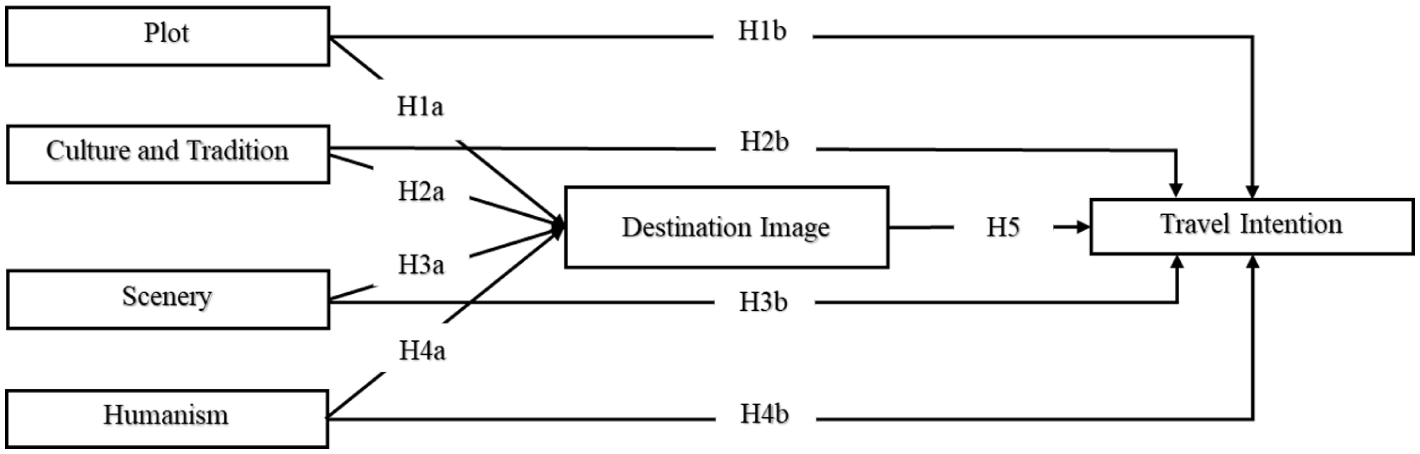
Conceptual model.
Methodology
This research adopts a pragmatic, mixed-methods approach to achieve both breadth and depth in understanding film-induced tourism phenomena. The methodology integrates quantitative and qualitative components: beginning with a pre-test phase, followed by a large-scale quasi-experimental survey (N = 792) to test the proposed structural model, and culminating in 22 semi-structured interviews that provide rich contextual insights and theoretical extension beyond what the survey data alone could reveal.
Quantitative phase (pre-test)
The pre-test involved an initial literature review (S. Kim et al., 2007, 2008; R. Riley et al., 1998; R. W. Riley & Van Doren, 1992) to identify scale items for measuring determinants of destination image. From the literature review, a focus group (n = 12) was run to validate selections. Once the initial set of scale items had been identified, a survey was conducted (n = 360) to allow for factor analysis and refinement of scale items.
For the pre-test survey, four primary factors were identified as possible antecedents for destination image—Plot; Culture and tradition; Scenery; and Humanism. The items in each factor were taken from the available literature outlined, with the component variables for each factor detailed in Table 1. All variables were measured on a 5-point Likert scale with anchors at 1 (strongly disagree) and 5 (strongly agree). Originally, the survey questionnaire was written in English, then translated into Vietnamese and subsequently checked by a group of independent subjects to test translation and comprehension.
Sources of Measurements.
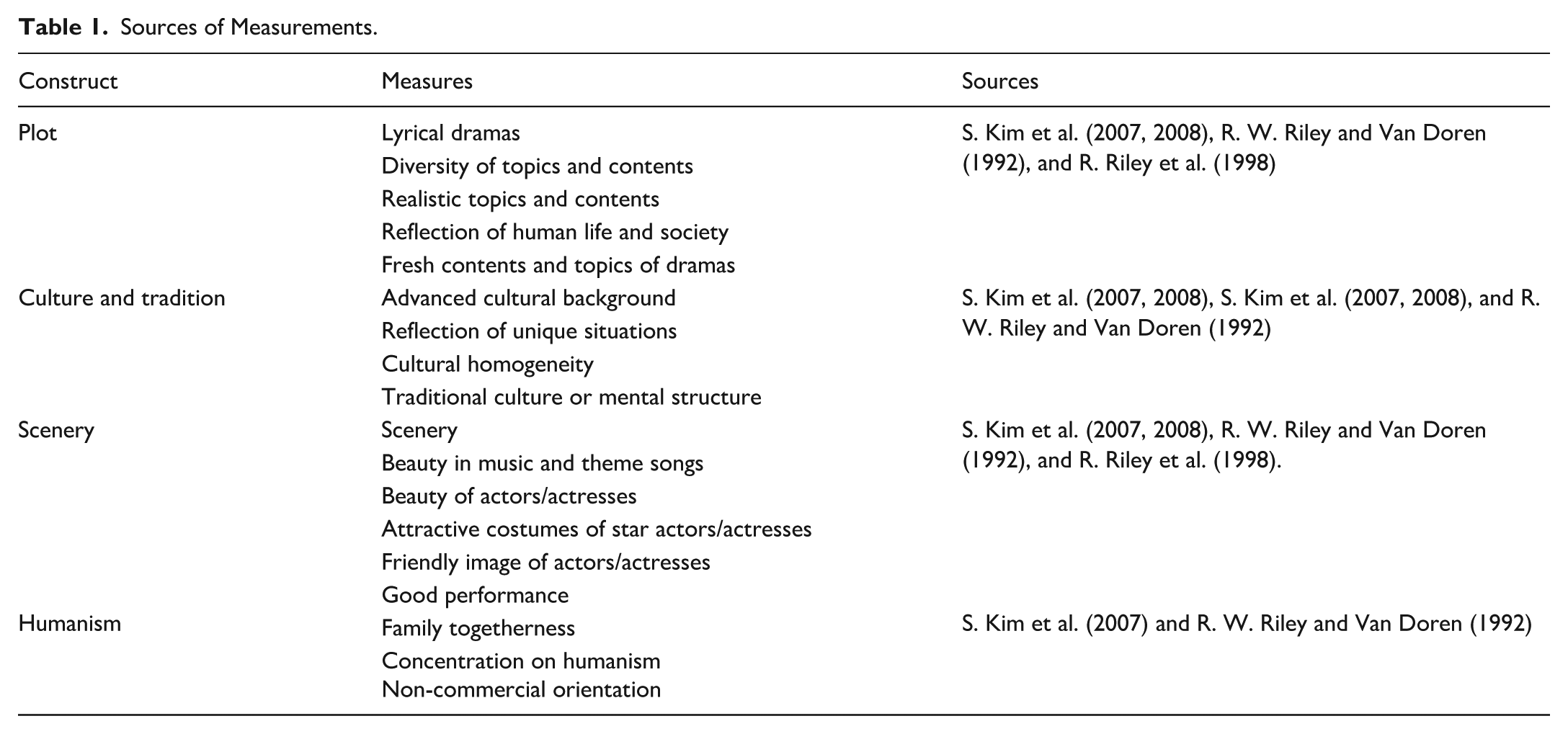
The pre-test survey was then administered to 360 subjects, with 180 subjects each for Korean and Vietnamese films. Exploratory factor analysis was conducted on the data, with one humanism item being removed due to its low item-total correlation (.26 and .18). All other variables satisfied the requirement (>.3) of item-total correlation. For Vietnamese films, reliability coefficients were assessed for Plot (.79), Culture and tradition (.69), Scenery (.75), and Humanism (.61). For Korean films, reliability coefficients were assessed for Plot (.77), Culture and tradition (.71), Scenery (.78), and Humanism (.52). The results from EFA (principal components with varimax rotation) proved that all unobserved concepts satisfied the requirement for loadings (>.5) and total variance extracted (>.5) with eigen values greater than 1.0 for both film industries. As a result, all items were included in the survey for the main study. Table 1 shows the source of items included in the final survey.
Quantitative phase (main study)
To recruit a sample that was representative of the Vietnamese population, a quota sampling method was employed with three criteria; age, gender, and income. Responses were collected in Ho Chi Minh and Hanoi, with only subjects that had experienced both Vietnamese and Korean film or television allowed to participate. Following data collection, responses with missing data were removed providing a final sample of 792 subjects. Table 2 provides a summary of the sample distribution across treatments.
Profile of Respondents (Number of Respondents).

Results
Measurement validation
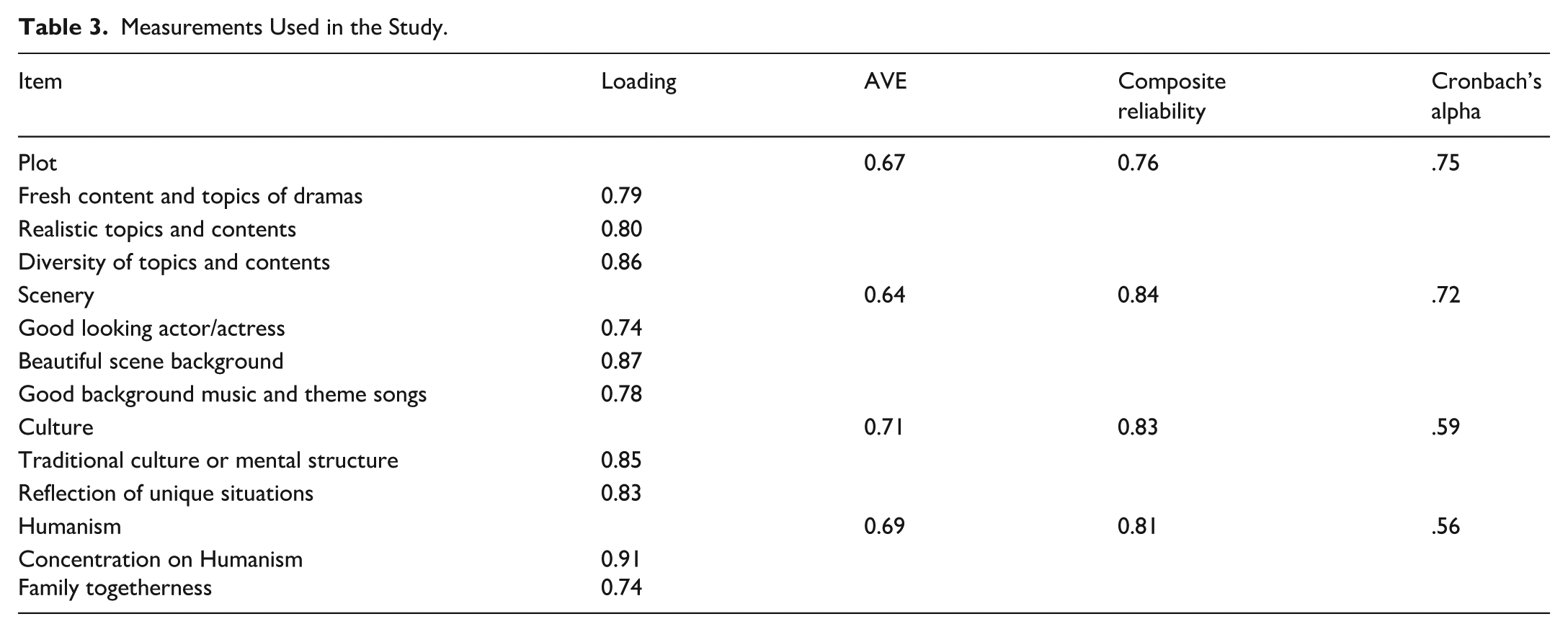
Following exploratory factor analysis, partial least squares (PLS), using Smart PLS 4 (Ringle et al., 2022) was used to validate the measures and examine the hypotheses. Measures were included on latent constructs with loadings greater than 0.7. Table 3 shows the measures used in the analysis. As can be seen, all measures were above the 0.50 cut-off of average variance extracted (AVE) and composite reliabilities greater than 0.70. Two measures, though, had Cronbach’s alphas less than 0.70: Culture (α = .59) and Humanism (α = .56). Given that these measures still had high composite reliabilities of above 0.80, and the AVEs were also high (0.71 for Culture and 0.69 for Humanism) it was decided to retain these measures in the analysis. Both Culture and Tradition and Humanism had only two items, which also affects the calculation of Cronbach’s alpha by reducing its score due to a low number of items (Peterson et al., 2020; Taber, 2018). There is also an emerging argument that with multi-factor studies, structural equation modeling (SEM) or PLS-based measures such as composite reliability should be preferred, as it takes into account cross-loadings and correlated error terms (Cho & Kim, 2015).
Measurements Used in the Study.
Common method bias
The authors used Harmon’s one-factor test to check for common method bias, wherein all items of the latent variables are loaded onto one factor. The factor combined explained less than 50 percent (16.37) of variance, indicating that common method variance did not pose a problem to the data (Podsakoff & Organ, 1986). Average variance inflation factor (VIF) scores on all paths in the study (1.39) were also found to be well below the critical cut-off of 3.3, with scores ranging from 1.39 to 1.69 (Kock & Lynn, 2012). This indicated a lack of multicollinearity often associated with response bias. As shown in Table 4 there was evidence for discriminant validity, as the square root of AVE of measures exceeded the correlations between constructs (Fornell & Larker, 1981).
Examination of Discriminant Validity.
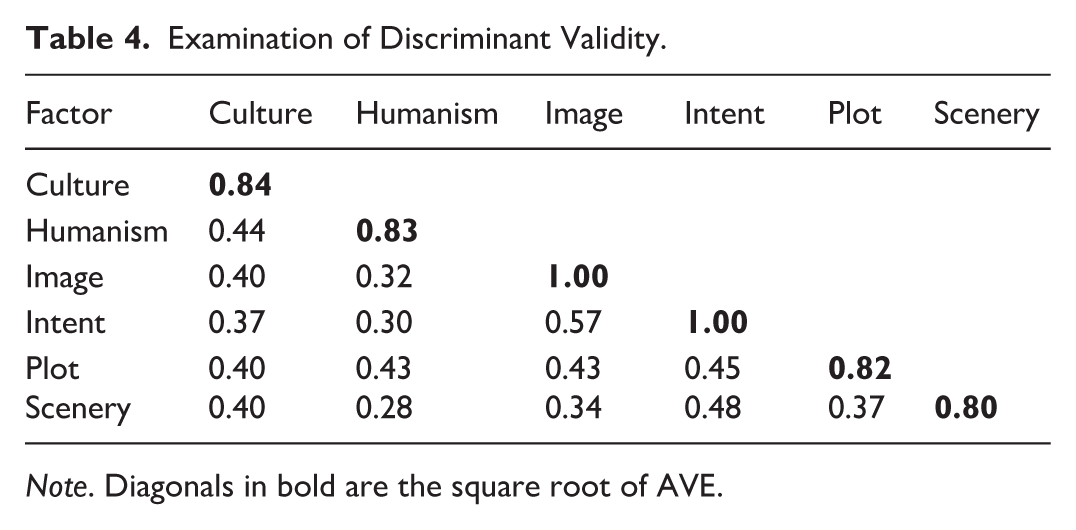
Note. Diagonals in bold are the square root of AVE.
Analysis of structural model and hypotheses
Following the CFA analysis, PLS was used to test the theoretical model and hypotheses. The standardized Beta coefficients are reported in Table 5.
Path Loadings.
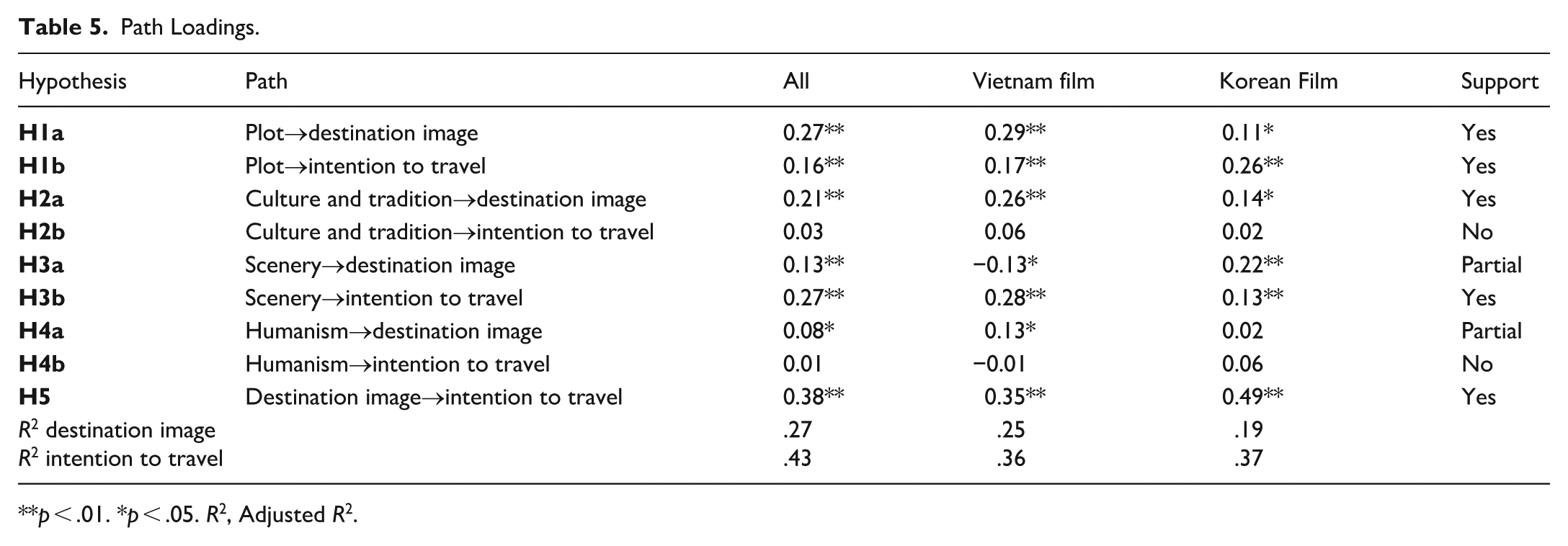
p < .01. *p < .05. R2, Adjusted R2.
Plot
Results show that for both Vietnamese (β = .29, p < .01) and Korean (β = .11, p < .01) films, plot has a significant, positive influence on destination image (DI), confirming hypothesis
Culture and tradition
In relation to culture and tradition (C&T), results from the data confirm (
Scenery
Analysis of the data showed that, for Vietnamese films (β = −.13, p < .05), scenery has a significant, yet negative influence on the audience’s perception of Vietnam’s destination image. By contrast, scenery in Korean films (β = .22, p < .01) had a significant, positive impact on the destination image, providing conditional support for the hypothesis (
However, when looking at the influence of scenery on intention to travel, the scenery shown in both Vietnamese (β = .28, p < .01) and Korean (β = .13, p < .01) film influences travel intention, providing support for the hypothesis (
That said, one thing that does stand out is the paradoxical finding for Vietnamese films. This is particularly noteworthy, as it contradicts both the hypothesized relationship and the positive effect observed for Korean films. While scenery negatively impacts domestic destination image formation, it simultaneously maintains a strong positive influence on travel intention (β = .28), suggesting that scenic elements may operate through different psychological mechanisms depending on whether the destination is familiar (domestic) or aspirational (international). This divergent pattern warrants careful consideration in understanding how visual representations function differently across domestic versus international tourism contexts.
Humanism
In terms of humanism, results show the humanism aspects in Vietnamese films have a positive, significant relationship with destination image (β = .13 p < .05). Interestingly, humanism contents in Korean films failed to reach statistical significance (β < .02 p > .05), once again offering partial support for the hypothesis (
Finally, it was proposed (
Qualitative phase (thematic exploration)
Study 2 qualitatively investigated how film factors influence destination image and travel intention, validating and extending the quantitative findings from Study 1. The research adopted an explanatory sequential mixed-method design (Creswell & Plano Clark, 2023). The thematic analysis illuminated how films evoke both cognitive evaluations and emotional responses that shape destination image and transform it into travel intention.
Data collection procedure
Data were collected through semi-structured interviews; the qualitative sample consisted of 22 participants, with a balanced representation of gender (45.5% male, 54.5% female). All participants reported having watched at least one Vietnamese or Korean film featuring recognizable destination-related content within the past year.
A semi-structured protocol was divided into four parts: recall of a specific film, exploration of film factors shaping destination image, discussion of how these images influenced intention to travel, and examination of the pathway from film factors to travel intention. Interviews lasted approximately 25 to 35 min, were conducted in private settings to encourage candid responses, and continued until data saturation was achieved. This format balanced consistency across interviews with the flexibility needed to capture diverse perspectives, ensuring methodological rigor in line with best practices for sequential explanatory mixed-method studies (Ivankova et al., 2006).
Findings
The integration of a mixed-method design enhanced the quantitative results, producing more comprehensive and rigorous findings. After interviews, transcripts were analyzed, with each interviewee coded by number to protect privacy. To enhance impartiality and accuracy, the themes identified through manual coding were cross-validated with NVivo 15.0 auto-coding. This confirmatory analysis supported the quantitative results and added narrative insights into the mechanisms underlying them.
From film factors to destination image
Films shaped participants’ perceptions of destinations through four interrelated dimensions: plot, cultural elements, visual scenery, and humanistic values. Plotlines frequently acted as interpretive anchors for how audiences imagined specific locations. For example, one participant recalled: “The entrepreneurial struggles in Itaewon Class made Itaewon feel like a dynamic space full of opportunities.” (Respondent 15). Similarly, the narrative of Mat Biec (Dreamy Eyes) encouraged associations with Central Vietnam, as another explained: “The scene where Ngan watches Ha Lan leave immediately made me imagine a melancholy yet beautiful Central Vietnamese village.” (Respondent 5). Cultural and traditional details such as rituals, food, and festivals reinforced a sense of authenticity, with one student emphasizing: “Hearing the local dialects and seeing traditional festivals gave me a sense that the place was genuine.” (Respondent 12).
Scenic visuals and cinematic aesthetics worked as powerful affective triggers. Wide-angle shots, landscapes, and background music were frequently mentioned as leaving lasting impressions. One participant described: “The wide-angle shots of Seoul’s skyline at night made the city appear glamorous and modern.” (Respondent 9). Another added: “The blue sea and wooden boats, with gentle background music, made the fishing village feel like a dream.” (Respondent 7). Beyond these visual effects, humanistic values embedded in films created emotional connections with destinations. Family bonds and community life conveyed warmth and familiarity. As one respondent reflected: “The family bond in Reply 1988 made the Seoul neighborhood feel warm and worth visiting” (Respondent 3). Together, these insights show that films shape destination image not only through visual appeal but also through narrative, cultural authenticity, and humanistic values, consistent with prior research in film tourism (Hudson & Ritchie, 2006; S. Kim, 2012).
From destination image to travel intention
The second theme demonstrates how destination images generated by films are translated into travel intentions. Participants frequently described a seamless progression from cinematic imagination to concrete desire to visit. Affective dimensions, particularly those evoking nostalgia, warmth, or authenticity, were especially influential in this process. One explained: “I want to visit Hue city to find the same nostalgic vibe as in Mat Biec.” (Respondent 14). Another reflected on the impact of Toi Thay Hoa Vang Tren Co Xanh (Yellow Flowers on the Green Grass): “It inspired me to visit Phu Yen province for its peaceful countryside.” (Respondent 21). These accounts suggest that while cognitive images provide awareness of a destination, it is affective resonance that drives the actual intention to travel. This qualitative evidence directly complements the results of Study 1, where both cognitive and affective destination images significantly predicted intention, with affective elements playing a particularly strong role in motivating planning behavior. These qualitative insights provide explanatory depth for Study 1’s finding, illustrating why affective resonance, such as nostalgia, warmth, and authenticity, emerged as stronger drivers of intention than cognitive awareness alone. For example, participants repeatedly described how nostalgic or emotionally charged scenes translated directly into concrete travel desires.
Beyond the four core film factors, participants identified additional influences that amplified or constrained their travel desires. Celebrity presence and soundtrack resonance were commonly cited as amplifiers of enthusiasm, with one participant noting: “The music still plays in my mind - it makes me want to be there.” (Respondent 10). Social media also served as a reinforcing factor: “If everyone is posting about it, I feel like I should go too.” (Respondent 18). At the same time, practical concerns such as cost, visa requirements, and safety emerged as significant constraints. As one respondent explained: “I would go if it’s safe and affordable; otherwise, I’ll just keep it on my list.” (Respondent 20). These findings highlight that film-induced travel intention is shaped not only by narrative and affective appeal but also by contextual conditions, suggesting that future conceptual models should incorporate such situational moderators for more comprehensive explanatory power.
From film factors to travel intention
The qualitative findings highlight a coherent pathway from film factors to the formation of destination images, which subsequently informed participants’ intention to travel. Films shaped perceptions of place through interrelated dimensions, including plot, cultural authenticity, visual scenery, and humanistic values, which resonated strongly with young viewers. For instance, narratives of everyday life in Korean dramas, such as Hometown Cha-Cha-Cha, create images of a peaceful fishing village: “The blue sea and wooden boats, with gentle background music, made the fishing village feel like a dream.” (Participant 19). Similarly, the Vietnamese war film Mưa Đỏ (Red Rain) forged solemn images of the Quang Tri Ancient Citadel, where one participant reflected: “The wide-angle shots of the citadel, with the Thach Han River dyed red, made me see Quang Tri as both tragic and sacred.” (Participant 5).
These destination images, once emotionally charged, translated into concrete travel desires. Participants emphasized affective resonance over cognitive awareness, echoing Study 1’s quantitative results. As one interviewee explained: “I want to visit Hue to find the same nostalgic vibe as in Mat Biec (Dreamy Eyes).” (Participant 23). Another shared: “After watching, I want to go to the Quang Tri Ancient Citadel and the Thach Han River to light incense and pay tribute.” (Participant 7). Similarly, Toi Thay Hoa Vang Tren Co Xanh (Yellow Flowers on the Green Grass) inspired associations with the peaceful countryside of Phu Yen, reinforcing the role of affective images in shaping travel motivation. Such statements underscore how cinematic storytelling moved participants beyond passive spectatorship toward envisioning themselves in those locations.
At the same time, contextual conditions moderated these intentions. Celebrity presence, soundtrack resonance, and social media amplification were cited as amplifiers of enthusiasm, “The music still plays in my mind, it makes me want to be there.” (Participant 10), whereas practical concerns such as affordability, visas, and safety constrained action: “I would go if it’s safe and affordable; otherwise, I’ll just keep it on my list.” (Participant 18).
Taken together, these insights corroborate the statistical evidence that affective images are stronger predictors of intention than cognitive ones. They further reveal that film-induced travel desire is situated at the nexus of emotional resonance, cultural authenticity, and pragmatic considerations, thereby extending the explanatory depth of Study 1 and contributing to a more comprehensive understanding of film-induced tourism.
In conclusion, Study 2 reveals that films shape destination images through plot, cultural cues, scenic visuals, and humanistic values, which, when affectively charged, translate into concrete travel intentions. Extended influences such as celebrity appeal, soundtrack resonance, social media, and practical concerns further condition these desires. By complementing the quantitative results of Study 1, the qualitative findings underscore the value of explanatory sequential designs and offer useful implications for destination marketing and future research (Creswell & Plano Clark, 2023; Duy Cuong et al., 2025).
Discussion and implications
The current research investigated the effect of a film’s dramatic architecture (plot, culture, scenery, and humanism) on a destination’s image and whether the destination image influences travel intention. Results from three studies (pre-test, a between-subjects experiment, and semi-structured interviews) provide strong evidence the components of a film’s dramatic architecture have a positive impact on destination image and the destination image acts as a causal mechanism driving travel intention. The integration of qualitative insights from Study 2 provides rich contextual depth to the quantitative findings, revealing the underlying mechanisms through which film components influence viewer cognition, affect, and behavioral intentions.
Theoretical implications
The findings from this research have several important theoretical contributions. First, this research has identified and tested the specific components of the “dramatic architecture”—plot, scenery, culture, and humanism—that might influence viewer attitudes and behaviors. Second, the current research establishes a film’s plot—which is the primary storyline or narrative—is the driving force influencing both destination image and travel intentions in viewers. These findings are consistent with prior research, given the narrative has become the prevalent communication tool across education, rhetoric, literature, religion, law, and history (Wilson, 1989). In relation to film tourism, the plot is the foundation of the “dramatic architecture” that influences viewer attitudes toward any destination or location shown (Hudson et al., 2011). As a result, the engaging plot allows viewers to experience a form of “narrative transportation” (Cao et al., 2021; Escalas, 2004), where they are mentally transported into the scene or destination setting (Nelson & Waiguny, 2012).
The qualitative findings from Study 2 extend this understanding by revealing that plot functions specifically as an “interpretive anchor” through which audiences imagine and construct mental representations of destinations (Respondent 15). For example, participants described how entrepreneurial narratives in Korean dramas made destinations “feel like a dynamic space full of opportunities,” while life-changing journey narratives in Vietnamese films encouraged associations with specific regions and their emotional qualities (Respondent 5). This provides empirical evidence for the mechanism through which narrative transportation operates, not merely through passive absorption, but through active cognitive construction where viewers use the plot as a framework for destination imagination.
Importantly, the findings from the current study build on prior research (Akarsu et al., 2019; Chen, 2018; Croy, 2010; Hudson et al., 2011; Larsen & George, 2006; Michopoulou et al., 2022; Shani et al., 2009; Yen & Croy, 2016) by showing that not only does the narrative motivate travel intentions, it also has a significant positive influence on the viewers’ perception of the destination image.
Third, the findings from this study provide a much more nuanced understanding of the influence scenery can have on viewer perceptions. Prior research (S. Kim et al., 2008) suggests a country’s scenery and background have a significant, positive impact on destination image. However, it would appear most of the prior research (such as Maghrifani et al., 2022) has primarily examined the influence of scenery on international travel intentions. The findings from the current study show while scenery is an important antecedent for destination image and travel intentions relating to an international location, it can have a negative influence on viewer attitudes toward domestic locations. Study 2 provides important explanatory depth to this finding by revealing that scenery operates through affective, rather than purely cognitive, mechanisms. Participants emphasized how “wide-angle shots,” “beautiful landscapes,” and “gentle background music” created emotional responses that made destinations “feel like a dream” (Respondents 7 and 9). This multi-sensory, aesthetic experience—combining visual, auditory, and emotional elements—explains why scenery has such powerful yet context-dependent effects. That said, the results from Study 1 are fascinating, because the negative scenery coefficient for Vietnamese films (β = −.13*) presents a theoretically intriguing contrast to the positive coefficient for Korean films (β = .22**), suggesting that overly aesthetic or stylized portrayals of familiar domestic locations may create psychological reactance or perceptions of inauthenticity among local viewers. This finding extends Litvin and Mouri’s (2009) work on “iconic” versus “generic” destination imagery by demonstrating that the effectiveness of scenic representations is moderated by viewers’ prior familiarity with the destination, where domestic audiences may find heavily produced scenic elements discordant with their lived experiences. This is supported in the qualitative data, with the findings suggesting that for domestic destinations, overly stylized scenic representations may create dissonance with viewers’ existing familiarity, potentially explaining the negative coefficient observed in the quantitative analysis.
Fourth, an unexpected finding is the culture and tradition shown in film does not directly influence travel intention. Prior research (Brown et al., 2013) has suggested tourists visit historic or cultural locations not for the scenery, but to witness places that have become part of folklore. However, our findings indicate such historical or cultural significance is what shapes the destination image, and any intention to travel to the location hinges on the destination image as the driving mechanism. The qualitative findings strongly support and extend this insight. Participants consistently described how cultural elements—local dialects, traditional festivals, and rituals—functioned primarily to establish perceptions of authenticity and genuineness (Respondent 12). These cultural cues contributed to forming a destination image characterized by authenticity, which then mediated the relationship to travel intention. This suggests that culture and tradition operate as “authenticity signals” that enrich destination image rather than directly motivating travel, adding theoretical nuance to our understanding of how different film components function through distinct psychological pathways (S. Kim, 2012).
Fifth, the qualitative study reveals a critical theoretical insight regarding the differential roles of cognitive versus affective destination image. While both the quantitative and qualitative studies confirm destination image’s mediating role, the interview data demonstrate that affective dimensions—particularly nostalgia, warmth, and emotional resonance—are substantially more influential than cognitive awareness in converting destination perceptions into concrete travel intentions. Participants repeatedly articulated desires to visit destinations “to find the same nostalgic vibe” (Respondent 14) or “to reminisce about pure love” rather than simply to see specific attractions (S. Kim et al., 2007). This extends San Martín and Del Bosque’s (2008) conceptualization of destination image’s cognitive-affective duality by providing empirical evidence that affective components serve as stronger behavioral drivers, particularly in film-induced tourism contexts.
Sixth, Study 2 identified boundary conditions and contextual moderators not captured in the quantitative model. Participants identified celebrity presence, soundtrack resonance, and social media as amplification mechanisms that strengthen film-induced travel desires (Respondents 10 and 18), while practical constraints such as cost, visa requirements, and safety concerns emerged as significant inhibitors (Respondent 20). This finding contributes to theory by suggesting that film tourism models should incorporate situational and resource-based factors that moderate the translation of intention into actual behavior, extending beyond the traditional attitude-behavior frameworks to include contextual feasibility assessments.
Finally, our research provides a much more nuanced understanding of destination image, in general. Rather than being a terminal DV or outcome, our findings support the notion destination image is a “fluid concept” (Litvin & Mouri, 2009). As such, the findings extend our understanding of destination image, where it acts as a decision-making mechanism that drives future travel intentions in viewers. In addition, it would appear few studies have specifically examined how destination image might influence domestic travel for local residents. In fact, domestic travelers have been overlooked to the point that, even when domestic and international visitors have been surveyed (for example, D. N. Su et al., 2020), the different responses have not been compared. The qualitative data provide important insights into this domestic-international distinction, revealing that Vietnamese participants processed domestic destination imagery through frameworks of cultural familiarity and nostalgia, while international (Korean) destination imagery evoked aspirational desires and cultural exploration. This suggests fundamentally different psychological processes underlie domestic versus international film-induced tourism, warranting separate theoretical treatment in future research.
Managerial implications
The integration of quantitative and qualitative findings offers destination marketing organizations (DMOs) and film commissions several actionable insights for leveraging film tourism strategically.
First, DMOs should prioritize partnerships with film productions that feature strong narrative integration rather than merely scenic product placement. The findings suggest that when destination marketing organizations consider film or television as media vehicles, they should be involving themselves at the conceptual development stage, so the film script aligns with the intended brand or destination image. As Horrigan (2009) points out, the difference between branded entertainment and product placement is the level of integration between brand and plot. The qualitative evidence demonstrates that viewers specifically recall and are influenced by how destinations are woven into character journeys and transformative narratives (Respondents 15 and 23). Therefore, DMOs should seek “narrative co-creation” opportunities where destinations become integral to plot development rather than passive backdrops, maximizing the ‘interpretive anchor” effect identified in Study 2.
Second, the differential effects of film components on domestic versus international audiences require distinct marketing strategies. While scenery positively influences international destination image but negatively impacts domestic perceptions, DMOs should tailor promotional materials accordingly. For international markets, DMOs should emphasize sweeping landscape visuals, aesthetic cinematography, and scenic beauty that creates aspirational “dream-like” qualities (Respondents 7 and 9). For domestic markets, marketing should instead emphasize plot-driven narratives, cultural authenticity, and emotional resonance that leverages familiarity while revealing new dimensions of known places. The qualitative findings suggest domestic audiences respond to nostalgic, humanistic narratives that reframe familiar locations through emotional rather than visual novelty.
Third, given that culture and tradition influence travel intention only indirectly through destination image, DMOs should focus on communicating cultural elements that enhance authenticity perceptions rather than assuming cultural content directly motivates visits. Marketing campaigns should position cultural and traditional elements as “authenticity signals” that enrich the overall destination brand, making the location feel “genuine” (Respondent 12) rather than treating cultural content as standalone attractions. Post-release promotional materials should amplify the cultural authenticity established in films, using behind-the-scenes content, local expert interviews, and cultural context explanations to deepen the authentic destination image created by the film.
Fourth, the strong role of affective destination image suggests DMOs should develop marketing materials that evoke emotional responses rather than providing purely informational content. Campaign materials should emphasize emotional storytelling, personal transformation narratives, and opportunities for visitors to create their own meaningful experiences. Specifically, DMOs should leverage user-generated content and testimonials that capture emotional experiences like nostalgia, warmth, and connection—the affective dimensions that Study 2 identified as primary drivers of behavioral intention. Social media campaigns should encourage visitors to share emotionally resonant stories rather than standard travel photographs, amplifying the affective pathway from destination image to visitation.
Fifth, recognizing the amplification effects of celebrity presence, soundtrack, and social media, DMOs should develop integrated campaigns that leverage these elements synergistically. When films feature destinations, DMOs should:
Negotiate soundtrack licensing for promotional use, given participants’ strong recall of music associations (Respondent 10)
Develop celebrity partnership opportunities for destination promotion when actors have strong connections to the location
Create social media campaigns that encourage sharing and discussion, leveraging FOMO (“fear of missing out”) effects mentioned by participants (Respondent 18)
Develop “pilgrimage guides” that help fans recreate specific scenes or experiences, facilitating the transformation of affective resonance into concrete travel plans
Sixth, to address practical constraints that inhibit conversion of intention to behavior (cost, visa, safety), DMOs should:
Develop targeted information campaigns addressing safety perceptions, particularly important given participants stated concerns (Respondent 20)
Create partnership programs with travel agencies offering “film tourism packages” that reduce cost barriers through bundled services
Work with national tourism authorities to streamline visa processes for film tourism markets
Provide transparent, easily accessible practical information on official websites, recognizing that removing friction from the planning process is critical for converting intention to actual visitation
Finally, DMOs should adopt sequential marketing strategies that mirror the “film factor → destination image → travel intention” pathway revealed in both studies. Initial campaigns (during film release) should focus on building rich, multi-dimensional destination images through narrative, cultural, and aesthetic content. Subsequent campaigns (post-release) should then activate these established images by providing concrete travel opportunities, practical information, and social proof, facilitating the conversion from image to intention to actual behavior.
Limitations and future research directions
While this research provides valuable insights into film-induced tourism, several limitations warrant acknowledgment. First, the quantitative study employed a between-subjects design using Vietnamese viewers only, examining their recalled responses to Vietnamese versus Korean films. This design, while allowing controlled comparison between domestic and international contexts, limits generalizability across different cultural markets. Future research should replicate this study with diverse national samples to test whether the differential effects of film components on domestic versus international travel intentions hold across cultural contexts, or whether they reflect Vietnamese-specific viewing patterns.
Second, the study examined films as complete stimuli rather than manipulating individual dramatic architecture components independently. While the mixed-methods design provided rich insights into how these components function, experimental designs that systematically vary individual elements (e.g. plot complexity, cultural authenticity, and scenic beauty) would strengthen causal claims about each component’s unique contribution. Such designs would also enable testing of potential interaction effects between components.
Third, although Study 2 identified important contextual moderators—celebrity presence, soundtrack resonance, social media influence, and practical constraints—these factors were explored qualitatively rather than tested quantitatively. The quantitative model explains 27% of variance in destination image and 43% of variance in travel intention, suggesting additional unmeasured factors influence these outcomes. Future research should empirically test these moderating effects using experimental or longitudinal designs to build more comprehensive predictive models.
Fourth, this research focused on films likely to elicit positive emotions, consistent with typical destination marketing objectives. However, narrative transportation theory suggests stories can transport viewers while evoking various emotional valences (Escalas, 2004). Future research could examine whether narratives involving conflict, tragedy, or negative emotions (e.g. war films, disaster movies) similarly shape destination perceptions, or whether they activate different psychological mechanisms—a question with implications for “dark tourism” and heritage site marketing.
Fifth, the study measured travel intentions rather than actual visitation behavior. While intention-behavior relationships are well-established in tourism literature, the conversion rate from intention to actual travel remains an important gap. Longitudinal designs tracking participants from film exposure through actual visitation would illuminate the temporal dynamics of film-induced tourism and identify additional barriers or facilitators in the intention-behavior pathway.
Finally, the distinct psychological processing mechanisms underlying domestic versus international film tourism deserve deeper theoretical development. Future research should explicitly incorporate psychological distance theory (Trope & Liberman, 2010) and cultural proximity constructs to explain why and how film components operate differently across these contexts, potentially revealing boundary conditions that inform destination marketing strategy.
Conclusion
The findings from this research suggest interesting directions for future research. The current research draws on theory involving “narrative transportation” (Cao et al., 2021; Escalas, 2004) to inform our understanding how plot influences viewer responses. When mental transportation occurs, people will often report being “lost in a story” (Nell, 1988) or “hooked” by an idea (Escalas et al., 2004) and the transportation elicits whatever emotion might be relevant to the given context (Escalas, 2004). Given the current study focused on films that would generally elicit positive emotions, future research could examine whether narratives that drive transportation while eliciting negative emotions also shape destination image and travel intentions. Additionally, future research should empirically test the moderating effects of the contextual factors identified in Study 2—celebrity presence, social media influence, soundtrack resonance, and practical constraints—using experimental or longitudinal designs. Finally, the distinct psychological processing revealed for domestic versus international film tourism warrants dedicated theoretical development, potentially drawing on psychological distance theory (Trope & Liberman, 2010) to explain why film components operate differently across these contexts.
Footnotes
Declaration of conflicting interests
The authors declared no potential conflicts of interest with respect to the research, authorship, and/or publication of this article.
Funding
The authors received no financial support for the research, authorship, and/or publication of this article.
Ethical considerations
Ethics approval (2021/602) was granted by the lead author’s ethics committee.
