



Abstract
Customer citizenship behaviours (CCBs), such as advocacy and helping, are critical in self-service environments where peer assistance substitutes for employee support. Yet, gaps persist in understanding how perceptions of peer helpers’ competence, post-interaction comfort and trust drive further CCBs. Integrating the cognitive-affective-behavioural (CAB) framework and social exchange theory, this study examines these dynamics through a survey of 264 South African fast-food app users. Results reveal that interaction competence (approachability and accommodation) and comfort are primary drivers of post-assistance CCBs, with trust amplifying the link between competence and outcomes. Task competence and informational support exert weaker effects. Theoretically, the study positions peer helpers as quasi-employees whose social skills and emotional rapport sustain reciprocity. Practically, findings advocate for self-service designs that prioritise interpersonal fluency – such as gamified recognition for empathetic contributors – and trust-building mechanisms like verified user badges. By bridging post-interaction gaps, this work equips firms to harness peer driven advocacy, enhancing customer-driven advocacy networks.
Keywords
Introduction
Customer citizenship behaviours (CCBs), defined as voluntary actions such as advocacy and helping (Yi & Gong, 2013), are integral to self-service environments where direct employee interaction is minimal, enabling firms to reduce operational costs while fostering loyalty (Van Tonder et al., 2018). Previous studies indicate that customers rely on peer help in app-based services (Bansal & Thakur, 2024; Van Tonder et al., 2020), highlighting CCBs’ economic impact. The strategic value of CCBs is well-documented, particularly in contexts where customers act as quasi-representatives of service providers, bridging gaps in service delivery (Groth, 2005; Van Tonder & Petzer, 2018). However, scholarly understanding of the mechanisms driving such behaviours after customers receive assistance from fellow patrons remains fragmented, leaving a gap in service marketing literature.
Existing research on CCB motivations bifurcates into two distinct streams. The first emphasises antecedents tied to customer-provider relationships, such as affective commitment, perceived value and brand identification (Choi & Lotz, 2018; Fatma et al., 2022; Woo, 2019). The second explores peer helper dynamics, including the role of credibility and normative social influences in shaping reciprocity (Van Tonder & Petzer, 2018; Yi et al., 2013). While these streams provide foundational insights, they inadequately address the cognitive and affective evaluations customers make after receiving peer assistance. For instance, social exchange theory posits that reciprocity drives beneficial behaviours, such as CCBs (P. Blau, 2017; Gong & Yi, 2021), yet it remains unclear how perceptions of peer helpers’ competence – whether task-oriented or interactional – or the emotional comfort derived from such interactions influence subsequent advocacy and helping. Similarly, trust, a cornerstone of information-sharing contexts (Lin et al., 2018; Lu et al., 2021), has yet to be rigorously examined as a moderator in post-assistance CCBs.
This omission is particularly consequential in self-service settings, where peer assistance often substitutes for employee support. Customers who act as informal representatives of service providers may significantly shape others’ perceptions of the firm, yet the antecedents of sustained advocacy and helping post-interaction remain poorly understood. Specifically, the CAB framework elucidates the psychological mechanism (cognition → affect → behaviour), while SET provides the sociological rationale (reciprocity for perceived benefits). Questions persist about whether a peer helper’s approachability outweighs their technical skill in driving reciprocity, or how the comfort of a positive interaction translates into ongoing citizenship behaviours. Addressing these questions is crucial for optimising self-service technologies while nurturing customer-driven support networks that enhance service adoption and retention.
This study integrates the cognitive-affective-behavioural (CAB) framework (Bagozzi, 1992; Oliver, 1997) with social exchange theory (P. Blau, 2017) to examine post-assistance CCBs. The CAB framework posits that cognitive evaluations, such as perceptions of peer competence, trigger affective states like comfort, which subsequently shape behaviours. Social exchange theory complements this by framing CCBs as reciprocal acts, where customers ‘repay’ perceived benefits received during peer interactions. Together, these theories provide a robust lens for untangling the interplay of cognition, affect and reciprocity in self-service contexts.
Thus, we ask: How do cognitive evaluations (informational support, task/interaction competence) and affective states (comfort), moderated by trust, drive CCBs after peer assistance in self-service contexts? The study assesses three core relationships. First, it evaluates how cognitive evaluations of peer helpers – informational support, task competence and interaction competence – directly influence post-assistance CCBs. Second, it examines comfort as both an affective outcome of these cognitive evaluations and a mediator of their effects. Third, it tests the moderating role of trust in peer helpers, hypothesising that trust amplifies the direct and indirect relationships. These objectives are tested using survey data from 264 South African fast-food app users, a context characterised by high self-service adoption and frequent peer assistance (Van Tonder et al., 2024). Regression analysis reveals that interaction competence and comfort emerge as primary drivers of CCBs, with trust strengthening the link between competence and outcomes.
The findings challenge conventional assumptions that prioritise technical competence over interpersonal rapport (Lucia-Palacios et al., 2020). For instance, while task competence (e.g. proficiency in using a food delivery app) is valued, interaction competence – embodied in approachability and accommodation – exerts a stronger influence on post-help advocacy. This underscores the importance of fostering peer interactions that emphasise social and communicative skills, rather than solely technical guidance. Furthermore, the mediating role of comfort highlights the emotional underpinnings of reciprocity, suggesting that positive affective states are critical in translating cognitive evaluations into sustained CCBs.
Practically, these insights guide firms in designing self-service ecosystems that encourage peer driven support. For example, platforms could integrate features that highlight peer helpers’ interpersonal strengths, such as user-generated tutorials emphasising empathetic communication, or forums that reward approachable contributors. Trust-building mechanisms, such as verification badges or transparency in peer interactions, may further amplify the impact of competence on CCBs. By prioritising both technical and interpersonal dimensions of peer assistance, firms can cultivate communities that enhance service adoption and customer satisfaction.
Theoretically, this study advances CCB literature by contextualising social exchange and CAB dynamics within peer assisted service environments (Van Tonder et al., 2020). It extends prior work on reciprocity by demonstrating that comfort and trust are not merely ancillary factors but central to sustaining advocacy and helping behaviours. For scholars, this underscores the need to examine post-interaction affective states as critical mediators in service models. For practitioners, it offers a blueprint for leveraging customer interactions as a sustainable competitive advantage in an increasingly self-service-oriented marketplace.
Theoretical background
Customer citizenship advocacy and helping behaviours
As defined earlier, CCBs encompass voluntary actions and may benefit service providers in many ways, such as positive organisational performance and customer satisfaction (Gong & Yi, 2021; Mitrega et al., 2022). Accordingly, this study was specifically interested in the citizenship behaviours customers perform when voluntarily helping other customers with a service issue and advocating the benefits of the service to them (Yi & Gong, 2013).
Further investigation of advocacy and helping is beneficial, given the study’s context and the fact that greater service adoption may result from customers sharing knowledge with other customers in a self-service context (Van Tonder et al., 2020). Moreover, customer helping behaviour may lead to more favourable service experience evaluations and customer loyalty (Ho et al., 2020; Weretecki et al., 2021), as well as customers receiving direction and support in completing their transactions (Bettencourt, 1997; Van Tonder et al., 2024).
Advocacy addresses aspects like positive service recommendations (Yi & Gong, 2013), while customer helping behaviour typically underscores the assistance provided to others to find solutions to specific service or product questions. During the helping process, personal experiences may be shared to aid others in dealing with their difficulties and customers may directly address other customers’ questions (Chou et al., 2022). Previous research has shown that in face-to-face service settings and on social commerce platforms, customers with personal experiences may share their know-how with other customers needing assistance (Lin et al., 2018; McGrath & Otnes, 1995). In this investigation, further customer citizenship behaviours, focussing on advocacy and helping, relate to aspects like willing to provide advice, share experiences and offer recommendations to other customers (Lin et al., 2018).
The cognitive-affective-behaviour framework and hypotheses development
The CAB framework (Bagozzi, 1992; Oliver, 1997) explains the relationships between three primary elements of consciousness in humans: cognition, affect and behaviour. Cognition underscores the thoughts and beliefs one has about an object. The affective component is associated with emotional responses, while the behavioural component relates to one’s inclination to display a given behaviour. The CAB framework denotes that individuals’ thoughts affect their feelings and behaviours (Soomro et al., 2024).
Accordingly, the CAB framework is useful in studies examining consumer behaviours and addressing cognition, affect and behaviours. The CAB framework has been applauded as presenting a rigorous and organised approach for investigating a given consumer behaviour model (Soomro et al., 2024). Previous scholars have applied this framework in their examinations of consumer cognition, affect and resulting customer citizenship behaviours (Nguyen & Chiu, 2023; Soomro et al., 2024). Among these earlier investigations, scholars also found significant direct relationships between the cognition and behaviours investigated. For example, in a study addressing customer brand engagement as a mediator, it was found that customers with a given mindset may directly engage in customer citizenship behaviours (Soomro et al., 2024). Additionally, when emotional attachment and a feeling of gratitude were examined as mediators, perceived CSR authenticity was found to directly influence customer citizenship behaviours (Nguyen & Chiu, 2023). These findings suggest that while the mediation process is significant, direct relationships between cognition and behaviours may also need to be accounted for in models addressing customer citizenship behaviours.
Direct effects
The current research model accounted for direct relationships between the three cognitive factors of this study (informational support, and interaction and task competence) and further advocacy and helping behaviours. The three cognitive factors all related to customers’ views about fellow customers who assisted them.
Informational support is grounded in social support theory (Cutrona, 1990; Cutrona & Russell, 1990) and relates to the transfer of facts or suggestions from one individual to another (C. Li et al., 2022). Informational support involves customer views that help is provided when problems are experienced and assistance is needed (Lin et al., 2018). Of further importance is that informational support tends to be stronger when being assisted by peers (Cassia & Magno, 2021) and may lead to benefits, including customer satisfaction (Zhu et al., 2016) and self-efficacy (Cassia & Magno, 2021). Informational support could also influence goal setting and resilience behaviours (Park et al., 2020). Accordingly, guided by these perspectives, perceived informational support in this study related to perceptions that when difficulties were encountered, fellow customers provided the necessary support to customers (Lin et al., 2018).
Interaction competence concerns individuals’ social and communication capabilities (Lucia-Palacios et al., 2018; N. Sharma et al., 2024). Marketing scholars previously approached this construct to examine customers’ perceptions of the sales associates they dealt with. Specifically, customers viewed their sales associates as having interaction competence if they perceived them as enjoying assisting others and being approachable and cooperative (Lucia-Palacios et al., 2018). As customer helpers act as ‘partial employees’ of service providers (Van Tonder & De Beer, 2018), it is plausible that customers would also judge their social and communication capabilities when receiving assistance from them with a self-service issue. Subsequently, this study followed a similar approach to Lucia-Palacios et al. (2018) and studied the perceived interaction competence of customer helpers as the extent to which customers believe customer helpers enjoyed assisting them and were approachable and accommodating (Lucia-Palacios et al., 2018).
In a sales context, task competence addresses aspects including employee product or service knowledge and their capability to help customers doing shopping (Lucia-Palacios et al., 2018; N. Sharma et al., 2024). Sales employees’ task competence is measured by aspects, such as a belief in the capability of the employees and that the employees are experts in each product category (Lucia-Palacios et al., 2018). Kohli (1989) further denoted that individuals with expert power in each area possess high levels of knowledge, competency and expertise. Employee task competence may provide diverse benefits, including higher return intentions, store recommendations, satisfaction and assisting customers in rapidly meeting their shopping goals (Lucia-Palacios et al., 2020). Employee task competence may also promote greater perceived attractiveness (Chan et al., 2022). Accordingly, like the interaction competence construct, it was expected that customers would judge the task competence of fellow customer helpers, fulfilling their assistance duties as ‘partial employees’ of service providers (Van Tonder & De Beer, 2018). Given the focus of this study on fellow customer assistance with self-service, fellow customer helpers’ task competence in operating the food delivery app was of interest. However, it was further argued that task competence would more likely serve as a motivational factor if customers perceived the level of task competence of fellow customers to be greater than their own level of task competence. Hence, for the purpose of this study, task competence was measured as the extent to which customers believe fellow customer helpers possess greater competence, knowledge and expertise in using various food delivery apps.
The study was also interested in the direct relationship between comfort and further customer citizenship behaviours. As explained earlier, comfort was studied as a positive emotion customers may experience after their citizenship interactions with fellow customers. Comfort is a deep-seated human desire (Spake et al., 2003). Comfort is associated with customers feeling pleasant and not tense (P. Sharma et al., 2012) and, as an affective attitude, has also been described as ‘the most important factor of service quality’ (Lloyd & Luk, 2011, p. 178). Comfort is key for producing enjoyable customer experiences (Becker et al., 2023). The comfort customers experience when a service is delivered may influence the extent to which the service delivery is successful. Customers may reveal more personal information when they experience comfort, which is essential to service providers delivering customised services. Additionally, self-disclosure could contribute to customers and service providers sharing stronger bonds (Spake et al., 2003).
Thus far, studies on customers’ feelings of comfort in the service environment have mainly concentrated on customers’ interactions with service providers (M. Li & Ma, 2022; Roongruangsee et al., 2022) and service robots (Becker et al., 2023; Pitardi et al., 2024; Van Pinxteren et al., 2019). Research has not centred on the comfort customers may experience when they interact with customer helpers. This form of comfort is also significant, as customers may act as ‘partial employees’ when assisting other customers. M. Li and Ma (2022) noted that service personnel’s interactive orientation may affect the comfort levels of the customers they are dealing with. Accordingly, comfort was included in the model as a factor that captured customers’ feelings when they interacted with fellow customer helpers. Specifically, comfort was measured as the extent to which customers felt comfortable, relaxed and pleasant when they had the conversation with the fellow customers (P. Sharma et al., 2012).
The three cognitive factors and the affective factor comfort were expected to directly influence further advocacy and helping behaviours, given the underlying premises of social exchange theory (P. Blau, 2017). The term ‘theory of social exchange’ (initially introduced by P. M. Blau in 1964) has become widely accepted as a theory of social behaviour (Cropanzano et al., 2017). Individuals involved in social exchanges believe they will be rewarded with financial or social benefits. Accordingly, it is assumed that individuals have a duty to reciprocate the benefits received from others (Chang et al., 2015). Individuals may exchange tangible or intangible goods as well as material or non-material goods, but it is assumed that individuals start and keep a relationship with the anticipation of experiencing more rewards than costs incurred (Cortez & Johnston, 2020).
Furthermore, service marketing literature has identified several benefits that may lead to reciprocating behaviours within social exchange relationships in the service environment, such as perceived support from other customers (Rosenbaum & Massiah, 2007), deviant customer-orientated behaviours (Jung & Yoo, 2019), relational benefits on firm-hosted virtual communities (Chou et al., 2022) and service employees’ cultural competency (Hsiao et al., 2023). Additionally, it seems that customers’ reciprocating behaviours may be directed towards service providers or other customers. Reciprocating behaviours directed towards service providers may include loyalty behaviours and recognition of staff (Hsiao et al., 2023), while reciprocating behaviours directed towards other customers may include customer helping behaviours (Chou et al., 2022).
Considering the above perspectives, it seems plausible that customers experiencing benefits, such as perceived informational support, interaction competence (fellow customer helpers being approachable and accommodating), task competence (fellow customer helpers having more expertise in using various food delivery apps) and comfort after the interaction, may feel obliged to return the favour. Supported by the premise of social exchange theory (P. Blau, 2017), customers being advantaged by fellow customer helpers who acted in the capacity of representatives or ‘partial employees’ of service providers may want to reciprocate with actions that could benefit the service providers. Customers reciprocate towards helpers as de facto agents of the service provider, thereby indirectly benefiting the firm (Groth, 2005). As such, these customers may engage in further customer citizenship advocacy and helping behaviours to assist other customers with their self-service transactions and to promote greater adoption and use of service providers’ self-service. Accordingly, it is hypothesised that:
Mediation and moderation effects
Given the underlying premises of the CAB framework (Bagozzi, 1992; Oliver, 1997), comfort could mediate the relationships between the three cognitive factors of interest and further customer citizenship advocacy and helping behaviours. Previous investigations addressing the relationships between cognition, affect and behaviour lend further support to this perspective. For example, scholars have indicated that perceived social support from others may lead to reduced stress levels (Chung et al., 2017; Lucia-Palacios et al., 2018; Rosenbaum & Massiah, 2007). Prior research has established that social support (including perceptions of informational support) could significantly influence positive emotions (Ning & Hu, 2022). Customers’ views of the actions of service employees (e.g. if they were helpful) may impact their feelings of comfort (Lloyd & Luk, 2011). Moreover, sales associates’ competencies could influence customers’ emotions. Sales associates with task competence can improve shopping experiences and reduce stress levels, making customers feel more relaxed. Interaction competence, underscoring good communication abilities, may lead to positive emotions and lower stress (Lucia-Palacios et al., 2018). Previous research suggests that in a service environment, customer comfort can be improved by service personnel’s interpersonal skills (Gaur et al., 2019).
Moreover, positive emotions often activate intrinsic motivation for prosocial action readiness. Prosocial action readiness may include aspects like helpfulness and cooperation (Zhao et al., 2018). Customers experiencing comfort may not want to defect to another service provider (Spake et al., 2003). Individuals tend to actively strive to improve and sustain their feelings of comfort about their environments and interactions with others (Roongruangsee et al., 2022). Comfort may lead to lower perceived risk and confidence (Lloyd & Luk, 2011), enhanced relational exchange, an active voice in a service relationship context (Gaur et al., 2019) and word of mouth (Becker et al., 2023).
Customers’ perceptions of service employees may also impact their positive emotions and the extent to which they engage in customer co-production behaviours that include customer citizenship types of actions (Yi & Gong, 2013; Zhao et al., 2018). Additionally, perceptions of social support could elicit customer citizenship behaviours, such as advocacy and helping, through positive emotions (Ning & Hu, 2022).
Given these perspectives, it is plausible that when customers experience benefits, including informational support as well as the task and interaction competence, their stress levels may be reduced. Knowing customers are in good hands and receive support from fellow customer helpers who also display competence could result in more positive emotions, as the customers may feel relaxed and experience comfort. Having the advantage of comfort after the interaction with fellow customers who effectively acted on behalf of service providers, the customers who received help may be motivated to engage in relational exchanges and become involved in further customer citizenship advocacy and helping behaviours that could benefit the service providers in return. Customers may intend to be helpful and recommend providers’ service offerings to other customers.
However, it is important to also consider trust in fellow customer helpers, given that it could further perform a significant role in influencing the model outcome. Trust is established within a social exchange relationship when one individual has faith in another’s integrity and reliability (Morgan & Hunt, 1994). Accordingly, this study examined trust in fellow customer helpers as referring to beliefs that helpers can be relied upon and do not intend to harm another party (Lin et al., 2018).
Trust has been found to successfully moderate individuals’ knowledge sharing behaviours (Ozlati, 2015). Previous research has denoted that trust may act as a moderator in service models and may influence consumers’ behavioural intentions (Kaur & Arora, 2020) and loyalty types of behaviours (Javed et al., 2021). Trust is important in a service environment characterised by intangible services and customers not being able to view the product upfront. Following interactions with service providers, when trust is fostered, customers may have a valid cause for continuing their relationships with the providers (Berry, 1995). Moreover, research addressing online service brand communities indicates that a trusting environment may indirectly support comfort by lowering customers’ anxiety with the uncertainty and information gaps that may exist in the interpersonal interaction process. Customers may have greater perceptions of psychological safety and become supporters of the community (Chi et al., 2022). In addition, customers tend to distribute information from sources they believe they can trust (Lu et al., 2021).
Subsequently, potential relationships between the cognitive and affective benefits in the proposed model and further customer citizenship behaviours could be strengthened by the extent to which customers trust the fellow customers who helped. When customers who experience the benefits trust fellow customer helpers who assisted them with the service issue, it may provide sufficient cause to engage in further efforts involving service providers. Customers experiencing comfort may feel less uncertainty about reciprocating when trust is high and feel more inclined to support the community. Knowing they can trust the source who assisted them and from whom they experienced benefits, customers may be more likely to share what they know with other customers having self-service issues.
Considering the above, there is also a possibility for a moderated mediation effect. In summary, customers judging fellow customer helpers (who represent the service providers) favourably, believing they provided informational support and are competent, may experience comfort as a positive emotion. Having this advantage, customers may decide to reciprocate and engage in further customer citizenship advocacy and helping behaviours. They could assist other customers of service providers to the latter’s benefit. This proposed indirect effect may then be moderated by trust in fellow customer helpers, if it moderates the relationship between comfort and further customer citizenship advocacy and helping behaviours. Considering previous research addressing trust, as noted above, it seems that trust in fellow customer helpers is more likely to mediate the indirect effect when customers have high levels of trust in their fellow customer helpers (See Figure 1). While trust may indirectly correlate with comfort by reducing anxiety (Chi et al., 2022), we position it as a moderator (not an antecedent) for two reasons. First, comfort is an immediate affective outcome of cognitive evaluations (e.g. interaction competence), per the CAB framework (Oliver, 1997). Second, trust validates the helper’s reliability, which strengthens the translation of comfort into CCBs by mitigating perceived relational risks (e.g. fear of misplaced advocacy; Morgan & Hunt, 1994). Thus, trust does not drive comfort but amplifies its behavioural consequences. Therefore, the study hypothesises that:
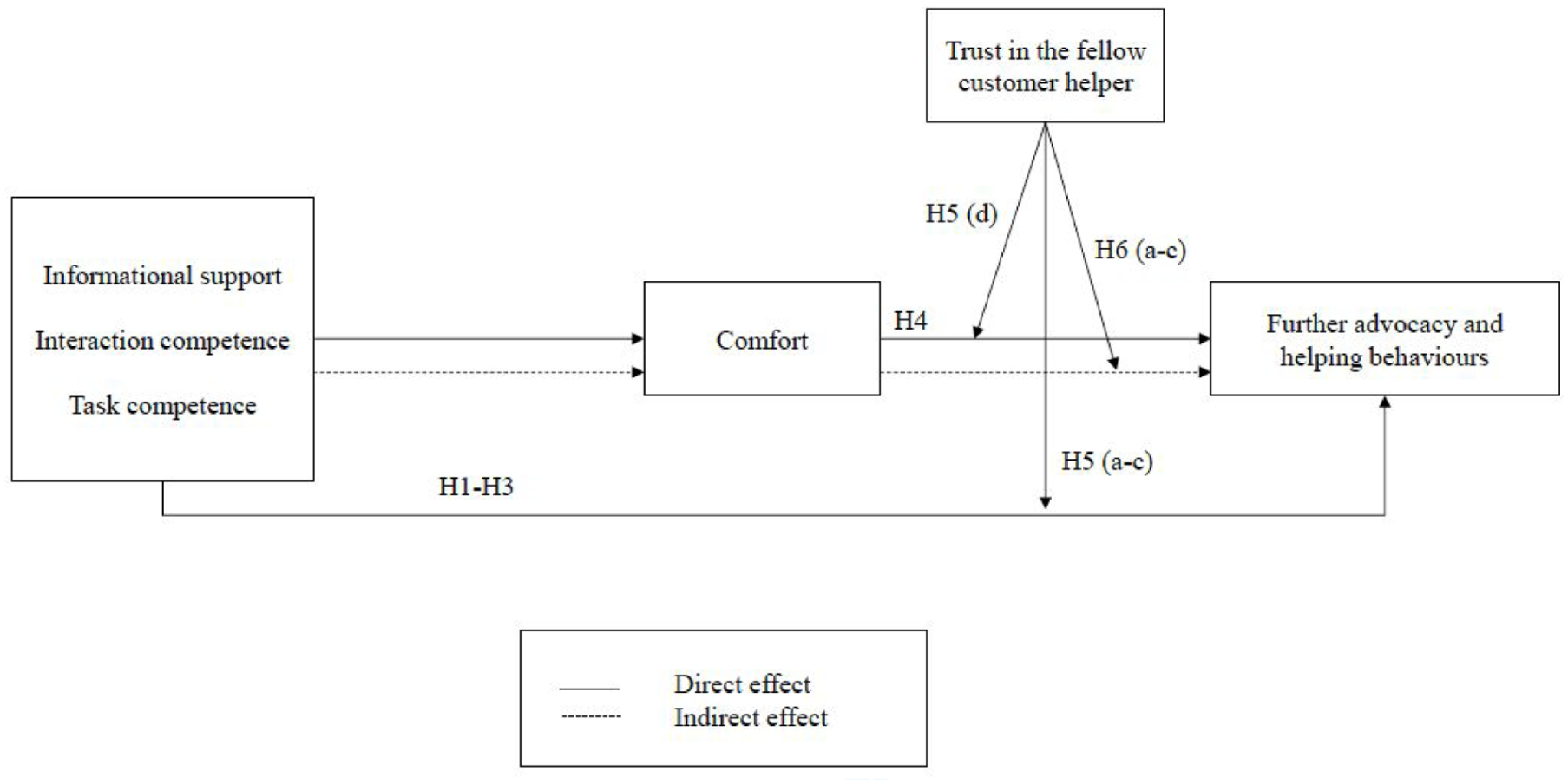
Conceptual model.
Methodology
Participants, data collection procedures and analysis
Data were collected via an online survey targeting adults (18+) who received peer assistance using a food delivery app in the past year (N = 264). Screening confirmed prior peer assistance via a yes/no question; only 'yes' respondents continued. A priori power analysis (GPower) confirmed 95% power to detect medium effects. The survey instrument underwent pilot testing with South African fast-food app users to assess clarity, face validity and internal consistency. All constructs exceeded a Composite Reliability score of 0.70. Example items are provided in Table 1. Almost two-thirds of the respondents had a post-high school qualification (64.8%), while just over two-thirds worked full time (68.9%). More women (62.9%) than men (36%) participated in the study, with two respondents selecting the gender-neutral/non-binary option and one respondent preferring not to answer the question. Most respondents were aged 18 to 40 years old (69.3%) and indicated that they had used a food delivery app before to order fast food (97%). Accordingly, the findings indicated that the respondents surveyed were well-educated individuals who could afford fast-food meals. Furthermore, majority of the respondents surveyed were relatively young, with some experience in using food delivery apps.
Assessment of Latent Variables.
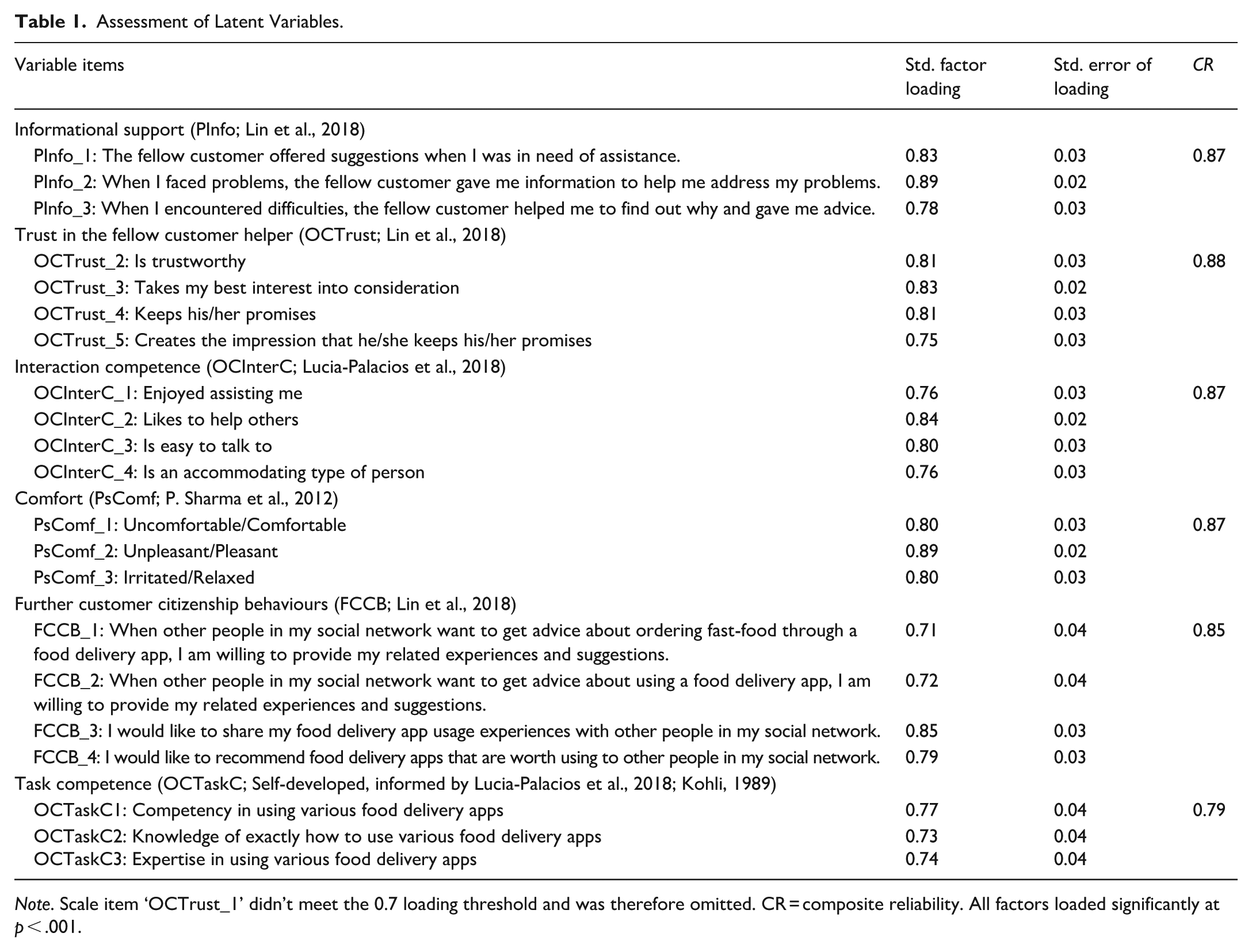
Note. Scale item ‘OCTrust_1’ didn’t meet the 0.7 loading threshold and was therefore omitted. CR = composite reliability. All factors loaded significantly at p < .001.
Qualtrics was employed to collect research data. The agency contacted its consumer panel via email and invited them to complete the online survey, using the link provided. Respondents voluntarily consented to participate in the study and received a small incentive. The researchers received the data file from Qualtrics and were unable to contact the respondents directly.
A confirmatory factor analysis was conducted in the first stage of the analysis. The measurement model, comprising the six latent factors investigated, was tested in Mplus 8.5, using the maximum likelihood procedure (Byrne, 2001). Standardised factor loadings, composite reliability (CR) scores, average variance extracted (AVE) values and shared variances between construct pairs aided in the assessment of measurement model validity and reliability (Hair et al., 2019). Subsequently, factor scores were saved and served as input into the regression model analysis in RStudio (RStudio Team, 2020). The hypothesised relationships were tested using Model 15 of the Hayes (2017) PROCESS macro. Bootstrap confidence intervals (5,000 draws and 95% confidence interval) aided in the assessment of all direct, indirect and moderating effects. This method was favoured due to its potential to provide more accurate results (Hayes, 2017).
Measurement
Comfort was measured using the P. Sharma et al. (2012) comfort scale. Respondents were requested to indicate the feelings they had experienced when they had the conversation with the other customer who assisted them. Emotional response options ranged from ‘uncomfortable’ to ‘comfortable’, ‘unpleasant’ to ‘pleasant’ and ‘irritated’ to ‘relaxed’, as measured on a five-point unlabelled Likert scale. The scale that measured task competence was self-developed. As addressed earlier, task competence underscores perceived capability and being an expert in a subject matter (Lucia-Palacios et al., 2018). Kohli (1989) denoted that individuals with expert power in each area possess high levels of knowledge, competency and expertise. Accordingly, three items were developed to measure perceived competency, knowledge and expertise in using various food delivery apps. This scale was informed by Kohli’s (1989) conceptualisation of expert power and Lucia-Palacios et al.’s (2018) task competence measures. Pilot testing confirmed uni-dimensionality (EFA loadings >0.70) and composite reliability (>.70).
Each respondent was asked to consider the characteristics presented and to rate the customer with whom they had the conversation in comparison to themselves. Responses were captured on a five-point Likert scale, ranging from 1 (‘Is at a much lower level than mine’) to 5 (‘Is at a much higher level than mine’). The remaining constructs were measured on a six-point Likert scale, where 1 represented ‘strongly disagree’ and 6 represented ‘strongly agree’. While the midpoint in the previous two scales was meaningful, a midpoint neutral response category in the scales that measured level of agreement was avoided to force the respondents to select and not steer away from more difficult questions and decisions (Kankaraš & Capecchi, 2025).
Informational support was measured using the three items of the Lin et al. (2018) informational support scale. Reference to WeChat friends were replaced by support received from fellow customers. Further customer citizenship behaviours involving advocacy and helping were measured utilising the Lin et al. (2018) three-item social sharing intention scale. Like the original scale, this study measured customer willingness to offer related experiences and suggestions to those needing advice and willingness to make recommendations to other customers. However, reference to other WeChat members were replaced with other people in customers’ social networks.
Moreover, in the context of the current investigation, it was plausible to give advice in relation to ordering fast food through a food delivery app and using the app itself. Subsequently, one extra item was added to the scale to ensure advice giving would be measured in both food contexts. The four-item interaction competence scale of Lucia-Palacios et al. (2018) was used to measure other customer interaction competence, while trust in the fellow customer helper was measured using the five-item trust scale of Lin et al. (2018). In both instances, the context of the scale items was slightly modified to relate to the fellow customer helper who helped the respondent.
Analysis
Construct validity, reliability and common-method bias assessment
The investigation commenced with an examination of the six-construct measurement model. All factors met the 0.7 loading threshold (Hair et al., 2019), except one trust item, which was excluded. The reported indices for the new measurement model met the required cut-off values and presented a good fit (Hair et al., 2019): χ²(df = 174) = 282.173; χ²/df = 1.62; comparative fit index = 0.97; Tucker-Lewis index = 0.96; and root mean square error of approximation = 0.049.
For each construct, the standardised factor loadings in the new measurement model exceeded the minimum cut-off value of 0.7 and were significant at p < .001 (Hair et al., 2019). The corresponding CR value for each construct surpassed the suggested threshold level of 0.7 (see Table 1), thereby verifying adequate construct reliability.
The assessment of convergent and discriminant validity also delivered satisfactory results. As per Table 2, the AVE value for each construct met the minimum threshold value of 0.5 and were never below the squared correlations of any two constructs investigated (Fornell & Larcker, 1981; Hair et al., 2019).
Latent Factor Correlation Matrix With AVE on the Diagonal in Brackets.
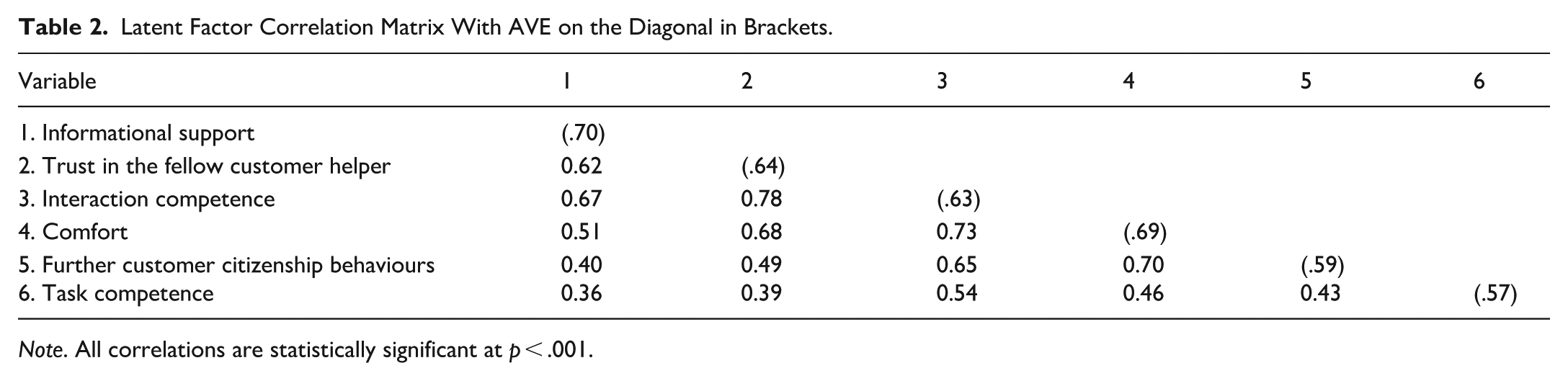
Note. All correlations are statistically significant at p < .001.
Subsequently, Harman’s single-factor test (Podsakoff et al., 2003) was performed to assess the necessity for accounting for common-method bias in the six-factor model. To address method variance from mixed response formats, all items were standardized before analysis, and Harman’s test (41%) confirmed CMV was minimal. Substantial likelihood for common-method bias is only apparent if the identified common-method variance nears 70% or more (Fuller et al., 2016).
Regression results and hypotheses testing
Model 15 of the Hayes (2017) PROCESS macro in RStudio was run in the regression analysis. The regression results are presented in Table 3. Model 15 tested the relationships in Figure 1. As denoted in Table 3 (Model 15, Stage 1), only interaction competence had a positive and significant effect on comfort. The effect size obtained was relatively large (coefficient = .61; p < .001). Table 3 (Model 15, Stage 2) further indicates that interaction competence also had a positive and significant effect on further customer citizenship advocacy and helping behaviours when it served as an independent variable as well as when it was included as a covariate within the model. Again, the effect size obtained was relatively large and varied between 0.55 and 0.59 at p < .001. Informational support and task competence did not have a significant effect on further customer citizenship advocacy and helping behaviours when they served as independent variables or covariates within the model. This may reflect that technical competence is a baseline expectation in self-service apps, diminishing its role in driving reciprocity. Conversely, informational support’s weaker effect could stem from the transactional context (fast-food), where emotional rapport outweighs factual aid.
Regression Results.
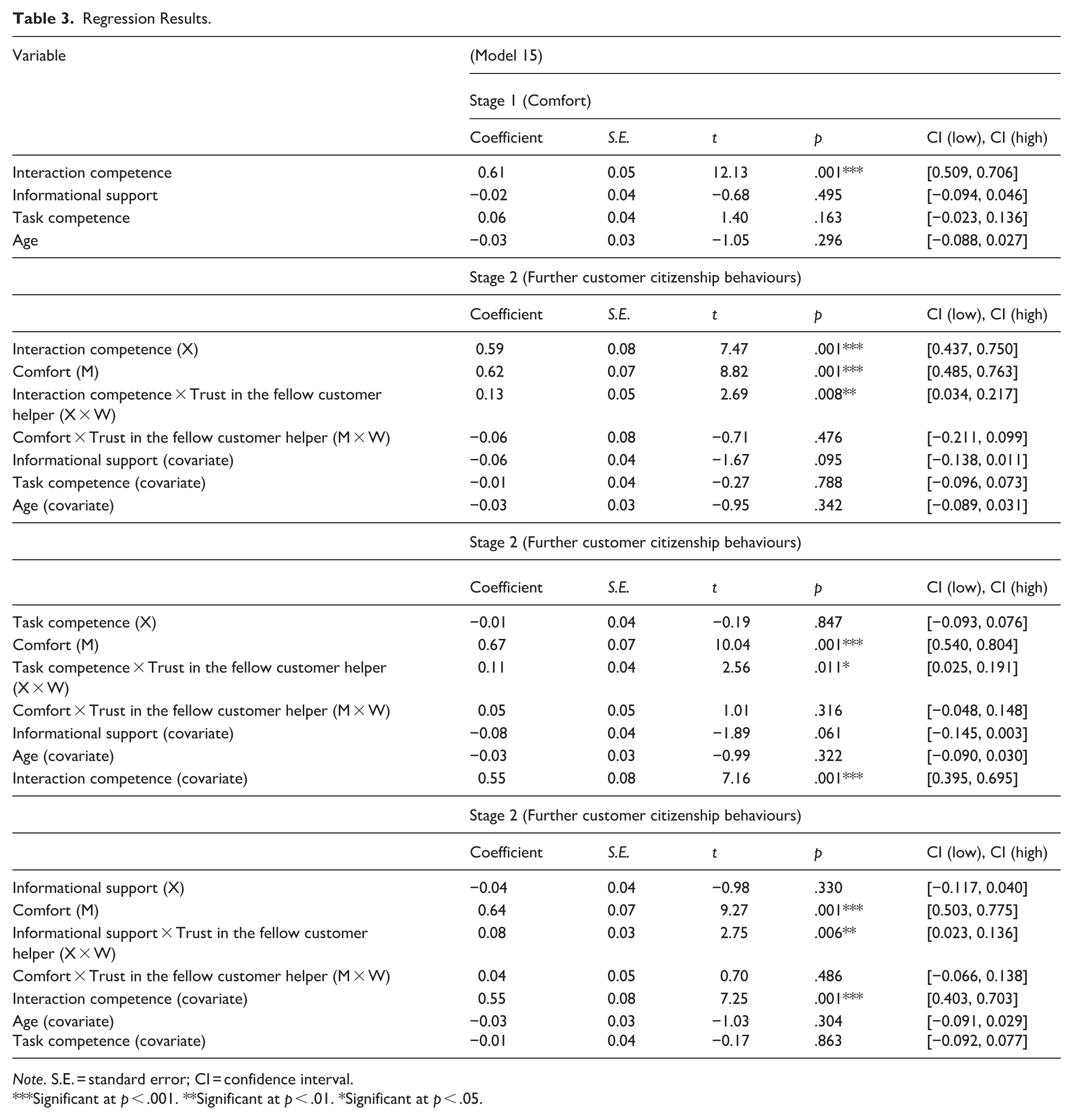
Note. S.E. = standard error; CI = confidence interval.
Significant at p < .001. **Significant at p < .01. *Significant at p < .05.
Accordingly, the above results may be attributed to the relatively large effect size produced by interaction competence that resulted in the other regression effects not being significant. When interaction competence was removed from the model, informational support and task competence produced significant effects. Nonetheless, the decision was made to retain the interaction competence construct, due to its important contribution to the model.
Table 3 further indicates that, in all instances, comfort had a positive and significant effect on further customer citizenship advocacy and helping behaviours. The effect size varied between 0.62 and 0.67 at p < .001. Age did not have a significant effect on comfort or further customer citizenship advocacy and helping behaviours.
Regarding the moderating effects assessed, trust in the fellow customer helper did not moderate the relationship between comfort and further customer citizenship advocacy and helping behaviours in any of the models specified. The index of moderated mediation was also not significant in any instance. However, trust in the fellow customer helper moderated all direct effects (x → y), though only its influence on the relationship between interaction competence and further customer citizenship advocacy and helping behaviours was meaningful, due to the statistical significance of this direct effect. Trust selectively amplified interaction competence’s effect (but not comfort’s), likely because competence is a cognitive evaluation that trust validates, whereas comfort, as an affective state, operates more autonomously (Bagozzi, 1992). Accordingly, the moderated direct effect of interaction competence on further customer citizenship advocacy and helping behaviours varied between high (point estimate = 0.70, SE = 0.01, 95% bootstrap CI [0.504, 0.891]), moderate (point estimate = 0.61, SE = 0.08, 95% bootstrap CI [0.449, 0.769]) and low (point estimate = 0.50, SE = 0.08, 95% bootstrap CI [0.344, 0.647]) levels of trust in fellow customer helpers.
Overall,
Theoretical implications
The findings reveal that customer citizenship behaviours in self-service environments are driven foremost by peer helpers’ interaction competence and post-interaction comfort, with trust selectively moderating these relationships. While prior research prioritises customer-provider relationships (Choi & Lotz, 2018) or peer credibility (Van Tonder & Petzer, 2018), this study extends the cognitive-affective-behavioural framework (Oliver, 1997) by positioning comfort as a critical mediator between cognitive evaluations and behavioural outcomes. Social exchange theory (P. Blau, 2017) is similarly advanced, demonstrating that reciprocity in peer assisted contexts hinges on interpersonal rapport rather than transactional benefits alone. Trust amplifies interaction competence’s impact but does not govern comfort’s direct influence, underscoring the affective autonomy of post-interaction states.
These theoretical contributions emphasise the need to reconceptualise service models to account for peer driven dynamics, where emotional comfort and social competence supersede technical proficiency in sustaining advocacy. Notably, task competence and informational support exerted weaker effects, suggesting that in low-complexity services (e.g. fast-food apps), technical aid is table stakes, while interpersonal dynamics sustain advocacy. For practitioners, fostering trust and interactional fluency in peer communities offers a strategic pathway to reduce reliance on formal service infrastructure while enhancing customer-driven engagement.
Managerial implications
Service providers should prioritise fostering interaction competence in peer helpers, given its primacy over task proficiency in driving post-assistance advocacy (Lucia-Palacios et al., 2020). Platforms could integrate features that highlight approachable contributors, such as award ‘empathy badges’ to helpers who use accommodating language (e.g. ‘Happy to help!’; Lin et al., 2018). Additionally, transparent feedback mechanisms and verified user badges may mitigate uncertainty in peer interactions, reinforcing trust and reciprocity (Lu et al., 2021). Implement drag-and-drop tutorials co-created with high-competence users (Van Tonder et al., 2024) and promoting peer led tutorials that emphasise social rather than technical guidance can further amplify comfort-driven CCBs. These strategies align with findings that emotional comfort operates independently of trust, underscoring the need to design environments where peer rapport complements technical efficiency. By embedding these insights, firms cultivate customer advocacy, reducing dependency on formal support structures while sustaining engagement in self-service ecosystems.
Conclusions and directions for further research
This study demonstrates that customer citizenship behaviours in self-service contexts are predominantly driven by interaction competence and post-interaction comfort, moderated selectively by trust. While technical proficiency (task competence) and informational support hold lesser influence, the primacy of interpersonal rapport challenges conventional service models prioritising transactional efficiency over relational dynamics (P. Blau, 2017; Oliver, 1997). Future research should validate these findings in diverse service industries, such as banking or retail. The role of social ties – strangers versus acquaintances – in moderating trust and reciprocity warrants exploration, given evidence that familiarity amplifies influence (Lin et al., 2018). Longitudinal studies could further examine trust’s evolution in peer interactions, particularly in digital environments where repeated exchanges may strengthen relational outcomes (Lu et al., 2021). Comparative analyses of human versus service robot assistance (Van Pinxteren et al., 2019) and investigations into communication skill training for peer helpers would deepen theoretical and practical understanding of post-interaction advocacy. Finally, our cross-sectional design precludes causal claims. Future work should employ longitudinal methods to examine how trust evolves through repeated peer interactions or experimental designs manipulating helper competence traits. Additionally, our sample’s demographic homogeneity (primarily young, educated South African fast-food app users) limits generalisability to other cultures, age groups or service industries. Future research should test this model in contexts like banking or retail, and across cultures where peer help norms may differ (e.g. collectivist vs. individualist societies). Addressing these gaps will refine service frameworks in an era increasingly reliant on customer-driven support networks.
Footnotes
Author’s Note
Yuanyuan (Gina) Cui, Patrick van Esch are now affiliated with North-West University Business School, Potchefstroom, South Africa.
Declaration of conflicting interests
The authors declared no potential conflicts of interest with respect to the research, authorship, and/or publication of this article.
Funding
The authors disclosed receipt of the following financial support for the research, authorship, and/or publication of this article: This work is based on research supported in part by the National Research Foundation of South Africa (Grant No. 127148). Any opinion, finding and conclusion or recommendation expressed in this material is that of the authors and the National Research Foundation of South Africa does not accept any liability in this regard.
Ethical considerations
All authors are aware of the Ethics guidelines. We confirm that all co-authors meet the journal’s criteria for authorship.
