




Abstract
Charities often use storytelling to communicate, connect with people and evoke unselfish concern for others. Personal resonance and narrative transportation are recognised as mechanisms for storytelling's impact on altruism, yet little is known about the effect of different narrative modes on these relationships. An online survey required participants (n = 338) to read a story of a person experiencing homelessness in one of three different narrative modes: first-, second- and third-person narration, and measured respondents’ personal resonance, narrative transportation, emotions and altruistic behaviours towards others. The results confirm that personal resonance and narrative transportation lead to altruistic behaviours, yet the extent and nature of the impact are moderated by the way a story is told. Stories evoke altruistic behaviours either through narrative transportation (first-person narrative), personal resonance (second-person narrative) or both (third-person narrative). This research enhances the existing literature on the prosocial effects of storytelling. By employing narratological lenses and positioning theory, the study explores how narrative mode moderates the influence of personal resonance and narrative transportation on altruistic behaviours. The insights gained from this research can aid charity organisations in effectively utilising stories as a means of encouraging customers to adopt altruistic behaviours for the betterment of others.
Introduction
Charities and other service-providing not-for-profit organisations make a pivotal, albeit often undervalued, contribution to the global economy annually, with an estimated $2.4 trillion in investable assets (Citi GPS, 2023). The Australian charity sector, with assets totalling approximately $489 billion (ACNC, 2025), is responsible for 4.8% of gross value added in the country’s economy (BERG, 2024). These organisations, especially smaller charities with only 8.1% of total revenue being from the government’s support (ACNC, 2025), typically rely on people voluntarily providing their time and resources to enable the service provision, where altruistic motivation affects the delivery of public services (Francois & Vlassopoulos, 2008). Altruistic behaviours, as a unique form of value co-creation, involve individuals focussing on value within service rather than simply in exchange, co-producing the service provision for a beneficiary and enhancing the value-in-use in the service system (Ranjan & Read, 2019). On average across the world, people primarily support those in need directly; 36% of their donations go to charities, most likely local ones. Yet, in high-income countries, only 0.7% of people’s annual income is given away (Charities Aid Foundation, 2025). As the charity landscape shifts to more informal approaches, driven by technology and declining trust (Citi GPS, 2023), charities face the pressure to compete for contributors’ attention and need guidance on attracting altruistic supporters. Storytelling has become one of the key tools used for this purpose.
Researchers recognise the impact of narratives on attitudes (Boukes & LaMarre, 2021), learning outcomes (A. K. Moore & Miller, 2020) and in various domains such as health (Cole, 2010); however, the role of storytelling in the altruistic context is not widely explored. The challenges of prosocial storytelling are related to the uneven distribution of the benefits (Lay & Hoppmann, 2015), the likelihood of evoking negative emotions and the lack of clarity when it comes to desired behaviours (M. M. Moore et al., 2021). Nonetheless, storytelling is a widely recognised communication tool employed by charities and social purpose organisations to convey their cause, raise awareness and drive positive change. When sharing stories, charities aim to establish meaningful connections, engage supporters and elicit altruistic responses (Atkinson et al., 2019). Through drawing people into the story world, narratives help transfer information (Weedon, 2018), understand and explore reality (van Laer et al., 2019), share emotions, perspectives and goals through personal resonance with story characters (Cohen, 2001), and eventually, change attitudes and beliefs (Green, 2004). Using stories to identify victims without providing any personalised information, crucial for vulnerable beneficiaries of charity organisations, proves to be more effective than statistics in evoking support behaviours (Small & Loewenstein, 2003). Although attention and emotions play a significant role in that process, there is a need for a cognitive, reason-oriented approach to monitor the quality of intuitive reactions (Small et al., 2007). Empathy, understood as the capacity to understand the feelings, thoughts and experiences of others (Yalçın & DiPaola, 2020), encompasses both affective and cognitive aspects of people’s responses to a story. The benefits of empathy can spill over to various (individual, organisation and society) levels of service settings (Bove, 2019) and should be considered by charities in their marketing communication strategies. Drawing on the empathy-altruism hypothesis (Batson et al., 1991), which suggests that when individuals feel empathy for someone in need, they are motivated to help, we explore how individuals who become immersed in a cause-related narrative and feel transported (through cognition, affection and imagery) into the story (i.e. narrative transportation theory (Green, 2008)), consequently demonstrate altruistic behaviours.
Before the dominance of market-driven exchanges in goods and services, transactions were inherently moral, with cultural and symbolic significance for communities’ social functioning (Alcock, 2001). Such sociality can be expressed through altruism, defined as acting to benefit another with net costs to the self (Wittek & Bekkers, 2015). Even if it requires distancing the other from the self, individual altruism is a step towards recognising human relatedness and interdependency (Dean, 2023). Altruism is perceived as a pattern of behaviour learned and maintained through relationships, establishing emotional bonds and empathy and can be supported by language that facilitates sharing experiences with others (Buck, 2002). A commitment to altruistic behaviours is developed over time through instruction and imitation (Pfaff, 2015) and under certain conditions: community support (social norms and expectations), identification with others and psychosocial transformation (personal norms, moral obligation to give back to one’s community; Forte, 1997). In storytelling, understanding these conditions is facilitated by a concept of personal resonance. It reflects the interactions between a story and its receiver: considering or sharing emotions, perspectives and goals with others (i.e. story characters) by mapping them onto the story recipients’ own representations of these experiences and norms (Buchanan et al., 2012), with separation of the self and other. Storytelling literature considers either identification (T. Chen & Lin, 2014; Hoeken & Sinkeldam, 2014), empathy (Eisenberg & Miller, 1987; Turner & Felisberti, 2018) or both constructs (Atkinson et al., 2019; Bailey & Wojdynski, 2015) as separate mechanisms evoking altruism. A story receiver resonates with story content (characters, situations or metaphors; Klimmt & Rieger, 2021), and therefore, personal resonance goes beyond empathy or identification, embracing both notions often used in storytelling research (Sikora et al., 2010). It also differs from a more self-oriented (Stojanova et al., 2023) and narrower concept of personal relevance (Hamby et al., 2017). Such resonance, those vibrant connections with the story world, can transform story recipients and encourage them to cognitively and affectively envision and practise (altruistic) actions and experiences related to the story (Vorderer & Halfmann, 2019).
The choice of narrative mode, represented by pronouns such as first person, second person and third person, plays a pivotal role in defining perspectives and characterising readers’ mental stimulation (Brunyé et al., 2009) and facilitates self-referencing in persuasive communication (Pogacar et al., 2022). Pronouns act as determinants of the narrative mode and, thus, the way a story is told. Understanding the impact of narrative mode on the outcomes of personal resonance and narrative transportation is crucial for charities and service organisations. Narratology lenses and positioning theory provide valuable frameworks to examine how the narrative mode affects the perception of a story (Czarniawska, 2010) and shapes the repertoire of possible social actions (James, 2015). Positioning theory describes how individuals define themselves and others in social contexts and assumes that people have unequal access to rights and responsibilities to perform certain meaningful actions (Harré, 2012). It focusses on how people position themselves and are positioned by others and recognises that they actively engage in and change positions within ongoing discourse and social interactions (Baert, 2012). Positioning towards the story’s characters is based on the relative distance to the story world and changes in emotions and thoughts. Rather than fully merging identities (Cohen & Klimmt, 2021), people resonate or overlap with the story, drawing from their real-life experiences. Through this connection, the story and its characters can affect how people position themselves and behave in the real world. The way a story is told (narrative mode) determines the relationship between the story and the reader (Bundgaard, 2010; Stanzel, 1984), shapes how we connect with the story content and subsequently influences our actions outside the story – for example, altruistic behaviours. Thus, positioning theory enables us to consider how narrative mode affects the impact of personal resonance and narrative transportation (connection to the story) on subsequent altruistic behaviours.
While service marketers can utilise stories to foster altruistic behaviours, research in this field brings mixed results (Bailey & Wojdynski, 2015; Kossowska et al., 2020). Recognising the close relationship between personal resonance and narrative transportation and their potential to drive changes in attitudes and behaviour (van Laer et al., 2014), we identify these constructs as key mechanisms through which storytelling impacts altruistic behaviours, with narrative transportation serving as a mediator. Despite extensive theoretical and empirical research on altruistic behaviours (see Appendix A), few studies discuss storytelling and narrative transportation and none explore whether the way a story is told affects these relationships. On the other hand, studies on narrative modes (see Appendix B) often refer to identification, empathy and narrative transportation that align with our choice of constructs. Nonetheless, despite some considerations of behavioural intentions, these studies do not refer to altruism, which creates a research gap worthy of addressing. We, therefore, hypothesise both the influence of storytelling on altruistic behaviours through personal resonance and narrative transportation and the different effects of these relationships in various narrative modes. This paper addresses the following research question:
RQ: How does the way of telling a story (narrative mode) influence the impact of personal resonance and narrative transportation on altruistic behaviours?
The study contributes to marketing literature by understanding how the use of storytelling can encourage individuals to demonstrate altruistic behaviours and hence provide valuable resources to charities. We add to extant knowledge of the prosocial outcomes of storytelling, identifying altruistic behavioural intentions resulting from personal resonance and multidimensional (cognitive, affective and imagery) narrative transportation. We aim to address the conflicting arguments related to empathy and negative emotions, as well as the scarcity of research on the altruistic outcomes of storytelling. Narratology and positioning theory are employed to understand the moderating role of narrative mode in these relationships and to guide organisations in their communication using different ways of telling stories to evoke altruistic behaviours among individuals in a charity context.
Theoretical Background and Hypothesis Development
Storytelling as a means of evoking altruistic behaviours
Altruistic behaviours are a key driver of charity (Otto & Bolle, 2011), and not-for-profit organisations are interested in who (Knowles et al., 2024) and why (T. D. Wilson et al., 2022) engages in prosocial causes and what conditions can support that. Altruism results from empathy and most likely stems from social interactions (Barragan & Dweck, 2014) and human interconnectedness (Taylor, 2019). Empathy adds an altruistic impulse (a concern for others’ outcomes) to already existing selfish (one’s own outcomes) and egalitarian (equality in outcomes) motivation (van Lange, 2008). Clear emphasis on intentions in a motive-based definition of altruism places this concept among conscious dispositions to specific behaviours (Wittek & Bekkers, 2015), crucial from the prosocial organisations’ point of view.
The prosocial context brings challenges for storytelling’s impact: the benefits are often shared, delayed or given up (Lay & Hoppmann, 2015), societal problems are more likely to evoke negative emotions, and there is no clarity about what behaviours are expected (M. M. Moore et al., 2021). These challenges impacted the choice of the mechanisms explored in this study. Despite substantial research on altruism (see Appendix A), few studies consider the impact of storytelling and narrative transportation (T. Chen & Lin, 2014) on altruistic behaviours. While most studies mention either identification or empathy (sometimes both), most conclude that they do not affect altruism (Bailey & Wojdynski, 2015), are accompanied by additional factors (Atkinson et al., 2019) or are emotion-dependent (Hoeken & Sinkeldam, 2014). Emotional responses, especially negative ones (which are of importance in the context of this study), require a closer examination due to the contradictory studies of their impact (Cuadrado et al., 2015; Graham et al., 2008). In addressing these gaps, we contribute to the literature on the altruistic outcomes of storytelling.
This study puts forth a conceptual framework, drawing on principles of narrative transportation theory (Green, 2008), the empathy-altruism hypothesis (Batson et al., 1991) and positioning theory (Baert, 2012). To understand how storytelling in different narrative modes leads to altruistic behaviours, we investigate the audience’s personal resonance with the story character and narrative transportation into the story in its affective, imagery and cognitive dimensions. Since affective perspective-taking is of particular importance for empathic reactions (Gorbatai et al., 2021) that lead to altruistic behaviour (Lay & Hoppmann, 2015), the examination of emotional responses will be used to deepen the analysis of the studied relationships. The conceptual model developed in the following discussion is presented in Figure 1.
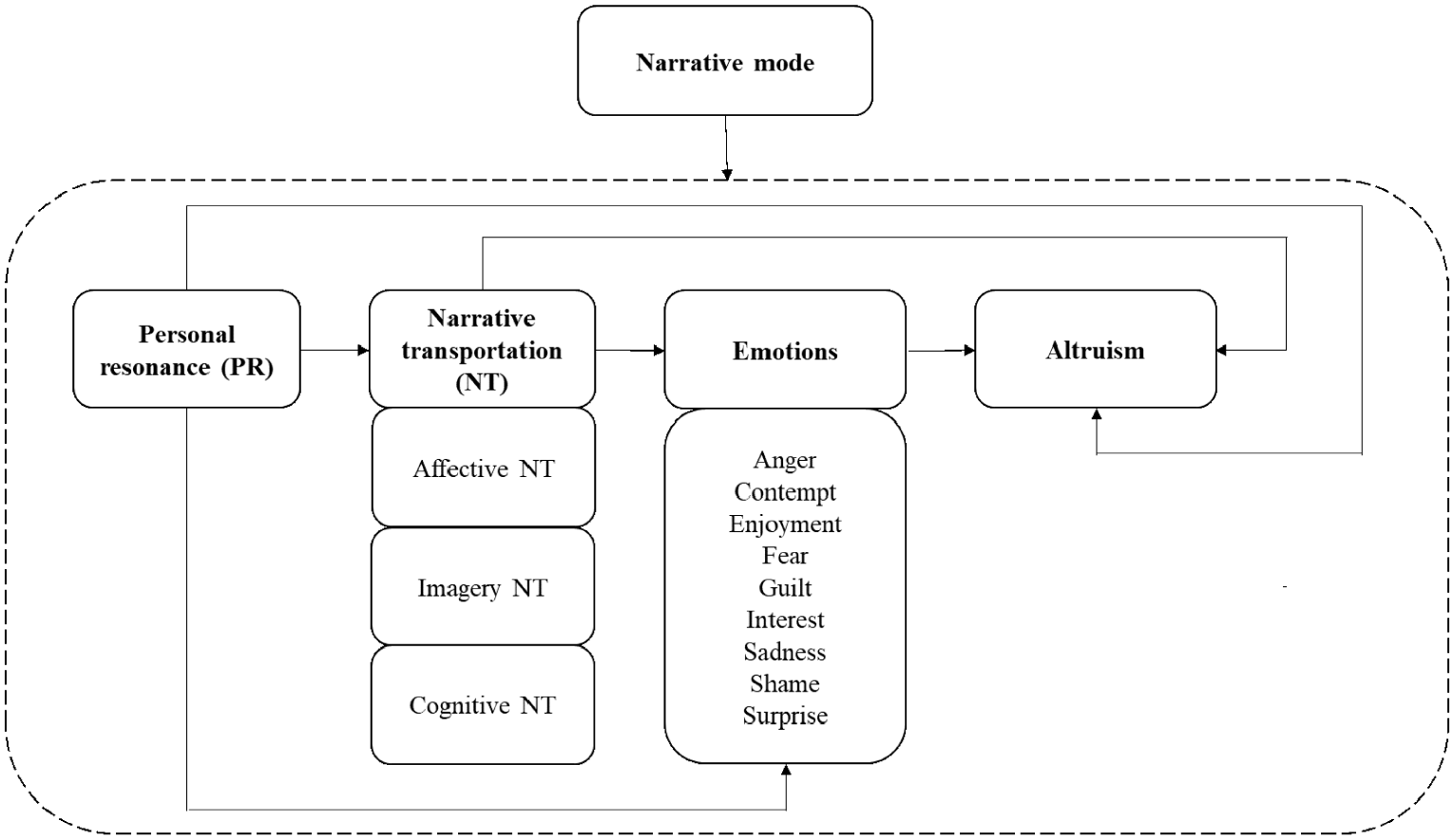
Conceptual framework.
Personal resonance and altruistic behaviours
Although factual texts can be associated with empathic concern and altruism, charities often choose storytelling to strengthen empathic responses (Turner & Felisberti, 2018). Communication and narrative features aim to provoke and facilitate the identification with story characters and trigger the gradual loss of self-awareness and temporary replacement with emotional and cognitive connections with the narrative (Tal-Or & Cohen, 2010). Therefore, personal resonance reflects not an attitude, emotion or perception but rather internalisation and consideration of someone else’s point of view. The measurement of personal resonance adopted in our study considers four dimensions: empathy (sharing emotions), cognitive (sharing perspective), motivational (internalising and sharing goals) and absorption (loss of self-awareness; Cohen, 2001), and takes into account story recipients’ emotional and cognitive responses to events presented in the story. Empathy reflects the capacity to understand the feelings, thoughts and experiences of others and to perceive another’s point of view by resonating with their emotions (Yalçın & DiPaola, 2020). Both cognitive and affective perspective-taking (van Krieken et al., 2017) are engaged and go beyond simple identification of the self with the other by engaging self-other awareness and resources to identify the other’s condition and act accordingly (Decety & Meyer, 2008). Story recipients’ perception of similarity with a story character can lead to personal resonance (Ooms et al., 2019) and may trigger a self-image shift towards character traits (Sestir & Green, 2010). Nevertheless, the perceived resemblance of the story characters is not a necessary factor (Cohen et al., 2018), and strategic use of language can lead to identifying with less similar characters (Hoeken et al., 2016), which may be of particular importance in the context of homelessness used in this study. Experiencing narratives can play out as anticipatory self-referencing (being part of the story world) or retrospective (referring the narrative to one’s own experiences; Bonus et al., 2022). Such duality is another argument for adopting personal resonance as a broader concept than empathy or identification with story characters.
A better perception and understanding of others’ feelings and needs underlie a strong relationship between cognitive skills and prosocial behaviour (Guo et al., 2019); therefore, empathic reactions increase the willingness to help. Interaction between self-other resonance and cognitive controlling processes is an important component of prosocial inclinations towards others (Christov-Moore & Iacoboni, 2016). Personal resonance with story characters may make their experience of particular importance to the story receiver (Green, 2008) and play a significant role in changing beliefs, also by disconnecting from existing ones (Green, 2004; Green & Brock, 2000). Through emotional appraisal and theory of mind, cognitive mechanisms of empathy enhance perspective-taking and prompt altruistic helping (Yalçın & DiPaola, 2020). The extent to which people resonate with a story character affects the degree of experiencing emotions; this, in turn, impacts people’s attitudes towards the issue conflicted with the character’s (shared) goal (Hoeken & Sinkeldam, 2014). Emotional reactions to empathy can be either other-oriented (and prosocial in nature) or self-directed when empathic overarousal can cause personal distress and aversive reactions. Empathy may result in personal emotional distress and limit other-oriented prosocial behaviour (Eisenberg et al., 2010). However, studies regarding this relationship are inconsistent (Yagmurlu & Sen, 2015), and we argue that, according to the empathy-altruism hypothesis, personal resonance should evoke prosocial motivation directed towards increasing the welfare of the person in need (Batson et al., 1991). Therefore, we posit:
Narrative transportation and altruistic behaviours
Storytelling is an effective form of communication; the story plot activates the recipients’ imagination and leads to experiencing suspended reality and resonating with the characters in a process called narrative transportation (van Laer et al., 2014). According to narrative transportation theory (Green, 2008), story recipients can detach from existing beliefs (Green, 2004) and adopt story-consistent beliefs (Marsh & Fazio, 2006), attitudes and intentions (van Laer et al., 2014). Invited to a narrative, people develop and live their own story, but the possibility of attitudinal change depends on the experiences that foster desired behaviours (Passon, 2019). Referring to one’s own experiences and values that resonate with a story increases the chances of the long-term or even delayed narrative transportation impact (van Laer et al., 2014) and facilitates behavioural patterns.
A captivating story with a clear purpose should lead the audience to the desired actions (Bublitz et al., 2016), and the story-consistent behaviour increases proportionally to narrative transportation (van Laer et al., 2014). This research expands and refines considerations on the impact of storytelling on engagement with the prosocial cause and charity support behaviours (Kaczorowska et al., 2023) and responds to the call to differentiate cognitive, affective and behavioural responses to a story (van Laer et al., 2014) in analysing the affective, imagery and cognitive dimensions of narrative transportation and altruistic intentions evoked by a story. Narrative transportation is more than an experience of being lost in the story (de Graaf et al., 2009), and various story characteristics may influence the effects of its different dimensions (Quintero Johnson & Sangalang, 2017). Mental imagery helps visualise future behaviours and makes possible actions easier and more probable to be taken (Schlosser, 2003). Affective responses are key in maintaining interest in the narrative (Nabi & Green, 2015), but also inspire the search for new experiences, cause mood-induced changes in the processing of the information (Appel & Richter, 2010) and help remember the message (Green & Brock, 2002). They are also more often shared with others and influence behaviour, catalysing the selection of the learned, established norms (Ajzen, 2011). Narrative transportation reduces counterarguing with the issues raised in the story (Slater & Rouner, 2002) and leads to story-consistent beliefs (Marsh & Fazio, 2006), attitudes (Green & Donahue, 2011) and narrative thoughts (van Laer et al., 2014). Therefore, we posit:
The mediating role of narrative transportation
Some researchers argue that even nonnarrative information can elicit identification (Clementson, 2020), and stories, despite evoking narrative transportation and empathy, have no advantage regarding behavioural outcomes (Sun et al., 2019). Although many studies treat narrative transportation as a mediator (V. L. Thomas & Grigsby, 2024) and several studies recognise both narrative transportation and identification (Boukes & LaMarre, 2021; Ganassali & Matysiewicz, 2021) or empathy (Hester & Schleifer, 2016) as mechanisms of storytelling’s impact, the relationship between them remains unclear. Further, other researchers have shown conflicting findings when linking both personal resonance and narrative transportation (Breves, 2020; Herrera et al., 2018; Walkington et al., 2020), a negative impact (Dessart, 2018) or mixed results by separating identification and empathy (Steinemann et al., 2017). We recognise and address this lack of clarity and follow an alternative stream of research proposing that narrative transportation is a mediator between personal resonance (its antecedent) and altruistic behaviours. A temporary escape from the self (through empathy and identification) enhances narrative transportation. Resonances between the story character and the reader, and being transported into the story world, drive the behavioural outcomes (Slater et al., 2014).
Personal resonance affects the enjoyment of experiencing narration, its perception and correlation with attitudes and beliefs (Igartua, 2010). Empathy, as one of the dimensions of personal resonance (Cohen, 2001), plays a significant role in the narrative transportation effect (Bal & Veltkamp, 2013) and leads to altruistic behaviour (Batson, 1981; Sun et al., 2025). Stories evoke compassion and, through multidimensional narrative transportation, more favourable attitudes towards stigmatised groups and beneficial behavioural intentions (Oliver et al., 2012). Understanding characters encourages narrative transportation (van Laer et al., 2014) and makes a story more personally relevant (Green, 2004). Both cognitive (understanding the events and actions of characters) and affective (mirroring and sharing emotions) perspective-taking processes reflected in personal resonance stimulate and require imagination (Green et al., 2006) and therefore interact with narrative transportation in all dimensions. We, therefore, consider narrative transportation as a mediator of the impact of personal resonance on altruistic behaviours:
Mediating role of emotions
Emotions are known to moderate the effect of narrative transportation (Kang et al., 2020); however, little is known about their impact on how people engage prosocially (Conduit et al., 2019). Each person has a unique collection of emotion schemas and memories to refer to; hence, emotional experiences and responses differ across individuals (LeDoux, 2020). Recognising the need to examine the effects of mixed emotions (Appel & Richter, 2010), and due to the complexity of the model, we group them together. Emotional shifts built into the stories facilitate narrative transportation. Story recipients’ emotional responses change along with these shifts (Schmidt et al., 2023), and therefore, they may experience a variety of emotions while reading a story. Experiencing mixed feelings is natural, especially in the face of bittersweet events (Larsen & McGraw, 2014). Emotional responses change and evolve during interaction (in this case, with the story events and characters), can complement or oppose each other, and therefore affect empathy (Mason et al., 2018).
Emotions corresponding with a storyline predict a story-consistent mindset (Appel et al., 2019) and mediate empathy’s impact on altruistic intentions (De Waal, 2008). The extent to which people identify with a story character affects the degree of experiencing emotions, which in turn impacts people’s attitudes towards the issue conflicted with the character’s (shared) goal (Hoeken & Sinkeldam, 2014). Empathy, one of the dimensions of personal resonance (Cohen, 2001), defined as ‘in-feeling’, stems from merging with another’s feelings (Escalas & Stern, 2003). Emotion recognition, expression and representation, expressed in mirroring and affective matching with a story character, is the core of communication competence (Yalçın & DiPaola, 2020) and, through self-awareness and emotion regulation, is related to empathic concern (Decety & Jackson, 2004). Empathy (in both its cognitive and affective aspects) can evoke at least two different emotional responses: sympathy and personal distress (Yagmurlu & Sen, 2015) – the respondents’ emotions can be mirrored or not correspond to the story character’s emotions, but evoked by identification.
Even if the evoked emotions are not in line with the previous experience (Mahood & Hanus, 2017), the transported recipient simulates the experience and emotions of the story character, at the same time maintaining their own identity (Coplan, 2004). Such a psychological movement between different perspectives can exist independently of empathy and lead to asymmetry of emotions. Because this lack of symmetry can be a source of discomfort, emotion regulation is a crucial phase in response to this dissonance. It involves cognitive and behavioural processes aimed at maintaining, strengthening or alleviating emotional arousal and the resulting motivational tendencies (Izard et al., 2011). Cognitive reappraisal, an emotion regulatory strategy, involves one’s interpretation of an emotional situation to change the reaction to it and can increase empathetic concern and decrease personal distress. While hopeful appraisals promote prosocial behaviour, avoidant, distancing appraisals may lead to inaction; both can reduce negative empathic affect (Brethel-Haurwitz et al., 2020). Affective narrative transportation, supported by imagery, fosters emotional arousal and contagion, while the cognitive dimension facilitates understanding and regulation.
Negative emotions often have a stronger impact on social implications than positive ones (Gross, 2002), and such behaviours as volunteering or donations can result from moral guilt (McKay et al., 2013). Unfair story events can trigger negative emotional states in the story recipients, leading to corrective actions (Graham et al., 2008), for instance, supporting a victim (Greenbaum et al., 2020). Awareness, action and altruistic tendencies can arise from negative emotional responses (Borum Chattoo & Feldman, 2017; X. Chen et al., 2021). Altruistic behaviours help recover power and mitigate the negative affective state through personal gratification and mood enhancement (Khalil et al., 2020). We assume, therefore, that emotional responses will not be without significance for altruistic outcomes analysed in this study:
The moderating impact of narrative mode
Narrative mode is a product of different relations between a narrator and a reader (Bundgaard, 2010; Stanzel, 1984) that influences the representation of identity, since the reader can see through the eyes of the narrator or the character (Dancygier, 2008). The extent of a narrator’s participation in the story is a vital factor in the reader’s understanding of the story and attitude towards it (Rimmon-Kenan, 2002). We use principles of positioning theory to analyse how three narrative modes (first-, second- and third-person narration) not only facilitate the story perception, recipients’ resonance with characters and transportation into the story world but also affect the relationships between personal resonance, narrative transportation and altruistic behaviours.
In social psychology, empathising with other people’s social positions is a basic skill; putting ourselves in others’ roles and positions helps anticipate responses in social interactions (Abercrombie et al., 2000). People’s identities are contextual and are negotiated in the dynamic process of positioning (Rochira, 2014), a discursive practice exercised through various types of speech or pronoun choices (Harré & Dedaic, 2012). The same kinds of intellectual interventions (e.g. texts) might bring about different positioning even when involving the same people (Baert, 2012). Narratives provide space and context for assigning a position (D. Herman, 2007), defined as an individual’s beliefs regarding their rights and responsibilities guiding possible social acts (James, 2015). People’s continuous shifts in perception of themselves and others open the field for prosocial behaviour, which is a product of a person-situation interaction (Simpson & Willer, 2008). In the application of positioning theory, social sciences emphasise how positions are created through words, as both perceived rights and duties and storylines form starting points for the dynamics of social life (McVee et al., 2021). Although the distribution of rights and responsibilities stems from asymmetries of people’s powers and vulnerabilities, positioning itself does not determine help (Harré & Dedaic, 2012). Therefore, we look at it not as a driving force but as a process moderating the altruistic effects of storytelling.
Research on narrative modes (see Appendix B) often refers to identification, empathy and narrative transportation, which aligns with our choice of the mechanisms of storytelling’s impact. However, the fact that both constructs are rarely considered together, and therefore, the literature finds conflicting effects, creates a gap we aim to address. Some researchers claim that the narrative mode does not affect personal resonance (M. Chen et al., 2016; Ma et al., 2023) or narrative transportation (Christy, 2018), yet other studies argue with this statement. For example, a first-person narrative mode promotes empathy even when story receivers read about unfamiliar events (Mulcahy & Gouldthorp, 2016). First-person narration encourages identification with the story character (M. Chen & Bell, 2022), while second-person narration demands it (Kress, 1995; Rembowska-Płuciennik, 2022). Although it might be confusing and too confronting, second-person narration increases empathy and encourages identification (Fludernik, 1993; Fludernik & Olson, 2011) through communication (being addressed by the narrative) and immersion (emotions and identification with characters; Mildorf, 2012). Stories with first-person narration lead to a higher level of transportation and mental imagery, whereas third-person narration requires additional processing involving ‘translation’ to fit the first-person experiencing system people are used to (Hartung et al., 2016). A third-person narrative evokes more systemic thoughts and cognitive effort than a first-person narrative (Nazione, 2016). The distancing character of a third-person narrative gives a reader a choice of different perspectives towards story characters: observing their thoughts and actions either by identifying with them or by observing them from without (Kim et al., 2020; Segal et al., 1997), and may lead to significantly more positive attitudes compared to first-person narratives (Christy, 2018). Therefore, a third-person narrative is less claustrophobic and allows for keeping the reader’s own identity, position and distance from the character (Kress, 2000). Second-person narratives create space for co-creating and co-thinking (Rembowska-Płuciennik, 2018), expand the referential capacity through an interactive environment and inviting the reader into the construction of the narrative (Bell & Ensslin, 2011). Given the option, readers identify more strongly with the character whose inner consciousness is represented (in first-person narration); however, emotional identification may be stronger in third-person narratives (van Krieken et al., 2017). It stems from the ability to take the external perspective (Brunyé et al., 2009), and monitor changing characters’ emotions (Mulcahy & Gouldthorp, 2016).
The process of imagining, feeling and understanding the perspective of the story’s characters as representatives of a particular social group that takes place through resonating with them and being transported into their world is crucial for prosocial outcomes. We assume that the way in which the narrative mode reveals and shapes the perspective influences the audience’s altruistic responses. Genuine empathy goes beyond simple emotion sharing and depends greatly on self-other awareness that allows for the correct identification of the other’s condition and freeing up resources to help (Decety & Meyer, 2008). While some narrative modes strongly facilitate sharing emotions, other modes allow for one’s own perspective and the intentional ‘feeling for’ may also be turned into support for those whose situation and emotions differ significantly (Bailey & Wojdynski, 2015). Such an asymmetry of emotions (Coplan, 2004), stemming from dissimilar perspectives and positions, echoes the asymmetries of human powers and vulnerabilities, resources available (Harré, 2012), and therefore distributions of duties and rights to perform social action (Harré & Dedaic, 2012). Changes in the narrative can alter people’s initial positions of perceived rights and responsibilities (van Langenhove, 2017). Exposure to a narrative can make the readers feel personally responsible (Marais, 2024), change the meaning of their actions (Harré et al., 2009), help them step out of their fixed roles (Baert, 2012), accept new social positions and meet social expectations through prosocial behaviour. Therefore, we posit:
Method
Research Context and Sample
Charities recognise the need for altruism as a motivation for helping behaviour and use storytelling to create empathy for the people they support. The story of one of the beneficiaries of a local organisation supporting people experiencing homelessness was used in this study. The problem of homelessness was chosen as the research context because of its social significance, complexity, potential ambiguity of attitudes towards it and, most importantly, its alignment with the key phenomena of storytelling and altruism.
A positivist, empirical approach was deemed most suitable to examine the hypotheses, and an online panel provider, Qualtrics, was used to construct and administer a quantitative online survey with closed-ended scale responses. Respondents, drawn from the online panel, represent a general Australian population sample over 18 years and under 75 years old. In Australia, the not-for-profit sector contributes $222 billion in revenue to the Australian economy and employs 10.7% of the workforce (ACNC, 2025). Responses from not-for-profit organisations workers were excluded to avoid bias. The study participants were 53.3% female and 46.7% male and represented all age categories between 18 and 75 years. Most respondents (52.4%) completed tertiary education. The data is comparable to the population distribution in Australia (Australian Bureau of Statistics, 2021). 83.1% of participants reported a lack of personal experience with homelessness, and 87.0% were unfamiliar with the organisation mentioned in the story. Sixty-six percent of all respondents claimed to support charity more frequently than once a year, and 23.7% – once a year or less, with only 7% stating that they never support charity. Three hundred thirty-eight usable responses were obtained, adequate for the chosen method (Delice, 2010). Prior to completing the survey, three groups of participants were asked to read a true story about a person experiencing homelessness, written in three different narrative modes (Scenario 1 – first-person, Scenario 2 – second-person and Scenario 3 – third-person narration; see Appendix C).
Measures and Analyses
The relations between observed variables were examined by applying a quantitative method using an online survey, and structural equation modelling. The survey was developed using existing measurement scales adapted to the research context (see Appendix D). The original self-report altruism scale included very specific statements about the respondents’ past behaviours (Rushton et al., 1981). Following the authors’ suggestion, we have modified the measurement (by replacing ‘’I have’’ with ‘I would’ in the statements) to estimate the probability of engaging in proposed altruistic behaviours rather than prior engagement in such actions. Identification with media characters scale (Cohen, 2001), transportation scale (Green & Brock, 2000), self-reported altruism scale (Rushton et al., 1981) and differential emotions scale (Izard et al., 1993) were adapted and used to measure respectively: personal resonance, narrative transportation, altruistic behaviours and emotions.
Constructs assessed using SmartPLS3 were found to be reliable; rigorous scale purification was applied, including a minimum item loading of 0.7 and composite reliability scores ranging from 0.935 to 1.00 (Hair et al., 2011). Discriminant validity was assessed using the HTMT matrix (Henseler et al., 2015), and all HTMT ratios met the 0.9 criterion (see Table 1). Moreover, all average variances extracted (AVE) exceeded the squared correlations (Fornell & Larcker, 1981). Collinearity among latent variables was assessed using VIF scores for each indicator less than a critical value of 10 (Hair et al., 2019), with the highest value being 7.94.
Composite Reliability (CR), Average Variance Extracted (AVE) and HTMT Matrix – Scenarios 1 to 3.

Both the context of the study and the fact that the collected responses to an online survey were self-reported, could have subjected the data to a potential bias. To limit social desirability bias, direct (e.g. anonymity and confidentiality assurances) and indirect (selected questions with answer options including face-saving alternatives, for example, about the experience of homelessness) measures were used (Larson, 2019). Procedural measures were applied to address common method bias: adding an interrupting question to reduce respondents’ tendency to use prior answers to inform subsequent answers, anonymity protection, careful survey design reducing the risk of pattern responses, using alternating scale formats and reversed items (Podsakoff et al., 2012). The variance inflation factors (VIF) were considered to detect potential common method variance (Kock, 2015). Considering the complexity of the statistical model, the VIF threshold of 10 was employed (Kock & Lynn, 2012), and all the variables met this criterion, confirming that common method bias did not contaminate the data.
Data Analysis
Partial least squares structural equation modelling (PLS-SEM), allows for estimating complex relationship models with latent variables (Latan & Noonan, 2017) and was used for data analysis. Participants were informed about anonymity and the possibility to withdraw at any point of the survey. The quality of the responses was assessed in terms of patterns, failure in quality checks, response timing and participants outside the targeted sample. As reading the narrative before completing the survey was vital for the study, respondents were alerted to the need to spend sufficient time on a question containing the text, and timing was used for some of the questions to ensure participants had enough time to complete them.
Results
The hypotheses were assessed through prediction accuracy (R2 and adjusted R2) and predictive relevance (Q2) of exogenous constructs in the path model. To test the impact of personal resonance on narrative transportation and personal resonance, and narrative transportation on altruism, the coefficient of determination (R2) was examined and found to have satisfactory predictive accuracy (see Table 2). The Q2 values, indicating the predictive relevance of the structural model, were greater than zero and showed adequate predictive validity (Hair et al., 2019; Henseler et al., 2015). Mediation analysis was conducted by measuring the significance of indirect effects considering cognitive, affective and imagery narrative transportation and emotions (Nitzl et al., 2016).
Research Model Assessment (R2 and Adjusted R2) – Scenarios 1 to 3.
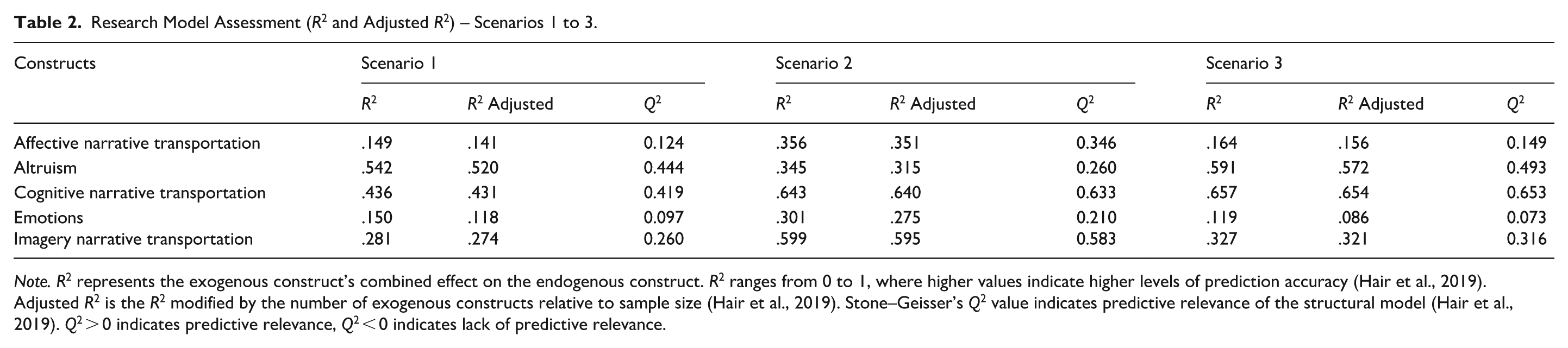
Note. R2 represents the exogenous construct’s combined effect on the endogenous construct. R2 ranges from 0 to 1, where higher values indicate higher levels of prediction accuracy (Hair et al., 2019). Adjusted R2 is the R2 modified by the number of exogenous constructs relative to sample size (Hair et al., 2019). Stone–Geisser’s Q2 value indicates predictive relevance of the structural model (Hair et al., 2019). Q2 > 0 indicates predictive relevance, Q2 < 0 indicates lack of predictive relevance.
Path coefficients and their significance levels were used to investigate the strength of the relations and individual effects of exogenous constructs (Table 3).
Path Coefficients – Scenarios 1 to 3.
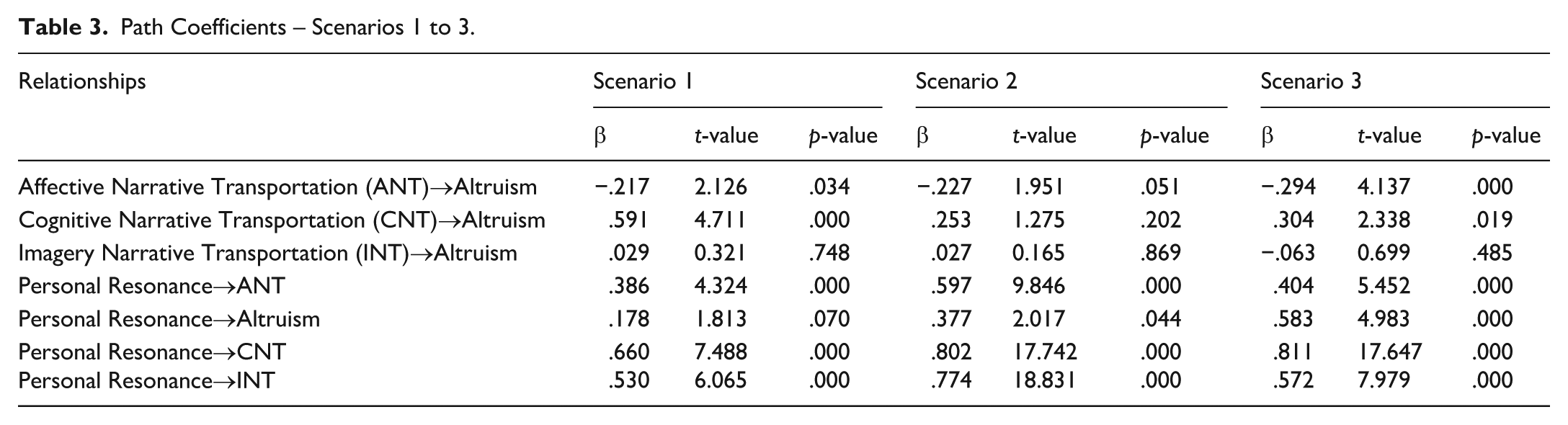
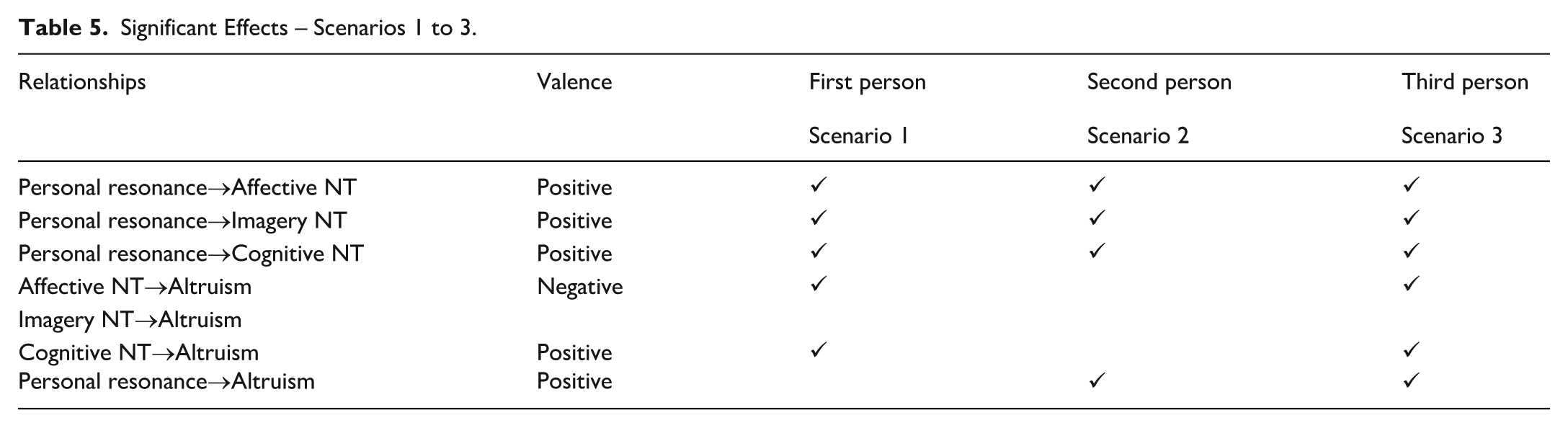
Personal resonance was a strong predictor of affective (.386 < β < .597, p < .001), imagery (.530 < β < .774, p < .001) and cognitive (.660 < β < .811, p < .001) narrative transportation in all three scenarios. The direct effects were significant, confirming the strong relationship between these two constructs.
The direct impact of personal resonance on altruism was different across the scenarios. The direct effects of personal resonance on altruism were significant in Scenario 2 (β = .377, p < .05) and Scenario 3 (β = .583, p < .001). In Scenario 1, the direct effects of personal resonance on altruism (β = .178, p > .05) were not significant.
The impact of narrative transportation on altruism also varied across individual dimensions and scenarios. The direct effects of affective narrative transportation on altruism were negative and significant in Scenario 1 (β = −.217, p < .05) and Scenario 3 (β = −.294, p < .001). In Scenario 2 (β = −.227, p > .05), the direct effects of affective narrative transportation on altruism were negative and not significant. The direct effects of imagery narrative transportation on altruism (−.063 < β < .029, p > .05) were not significant in all scenarios. The direct effects of cognitive narrative transportation on altruism were significant in Scenario 1 (β = .591, p < .001) and Scenario 3 (β = .304, p < .05). However, in Scenario 2 (β = .253, p > .05), the direct effects of cognitive narrative transportation on altruism were not significant.
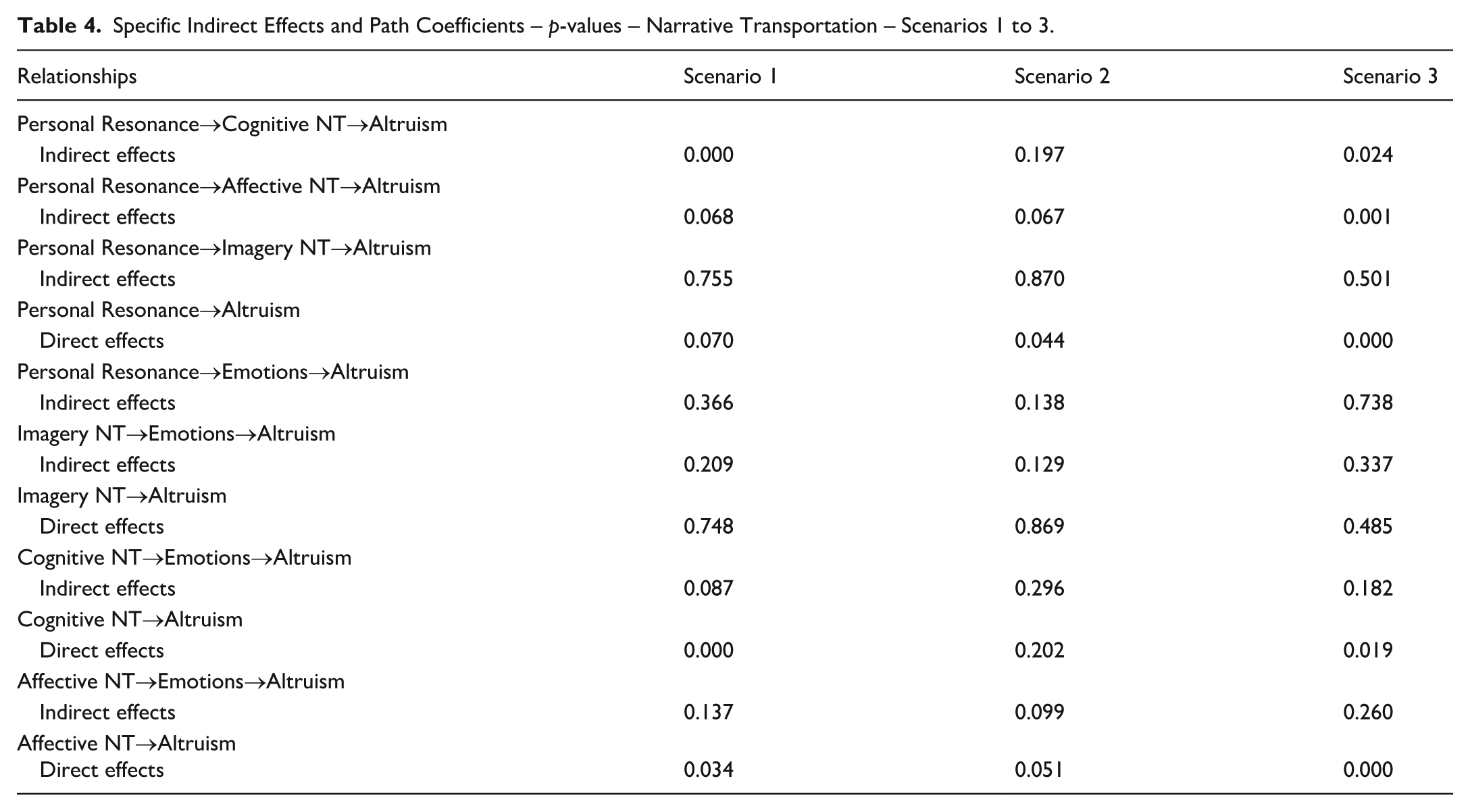
The specific indirect effects were significant (p < .05) for cognitive narrative transportation in Scenario 1, and for cognitive and affective narrative transportation in Scenario 3 (see Table 4), and hypothesis
Specific Indirect Effects and Path Coefficients – p-values – Narrative Transportation – Scenarios 1 to 3.
To test for variations between the three groups of participants exposed to different narrative modes, multigroup analysis (MGA) in PLS-SEM was employed as one of the most efficient ways to assess moderation across multiple relationships (Hair et al., 2016). Prior to conducting MGA, the three-step measurement invariance of composite models (MICOM) procedure was used to ensure at least partial invariance (Memon et al., 2019) and the validity of conclusions (Hwa et al., 2020). MICOM-MGA analysis offers a more complex picture by shifting the focus on the moderator’s impact from one specific relationship to all the modelled relationships (Cheah et al., 2020). In the first step, configural invariance was established by using equal indicators in all groups when checking reliability and validity, similar data treatment and similar PLS-SEM algorithm settings. In the second step, composition invariance assessment, all the permutation’s p-values (except for comparing personal resonance between scenarios 2 and 3; p = .021) were larger than .05. In step three, we compared all the composite mean values and variances and found no significant differences between groups, confirming full measurement invariance.
Group comparisons using MGA were conducted through a series of procedures: Henseler’s bootstrap-based MGA test, parametric test and Welch-Satterthwait test (Hwa et al., 2020). When comparing Scenario 2 to Scenario 1 and 3, the results revealed statistical differences in the relationships between personal resonance and affective (Henseler’s test; p = .044 for Scenarios 1–2 and p = .047 for Scenarios 2–3 comparison) and imagery narrative transportation (Henseler’s test; p = .007 for Scenarios 1–2 and p = .009 for Scenarios 2–3 comparison). The bootstrapping results were also compared to assess the difference between the scenarios’ path coefficients. Results show that Scenario 2 had stronger path coefficients than Scenario 1 and 3 (β = .597 vs. β = .386 in Scenario 1 and β = .404 in Scenario 3 for affective narrative transportation; β = .774 vs. β = .530 in Scenario 1 and β = .572 in Scenario 3). No other differences were identified.
Table 5 shows the summary regarding significant effects across all scenarios.
Significant Effects – Scenarios 1 to 3.
Discussion and implications
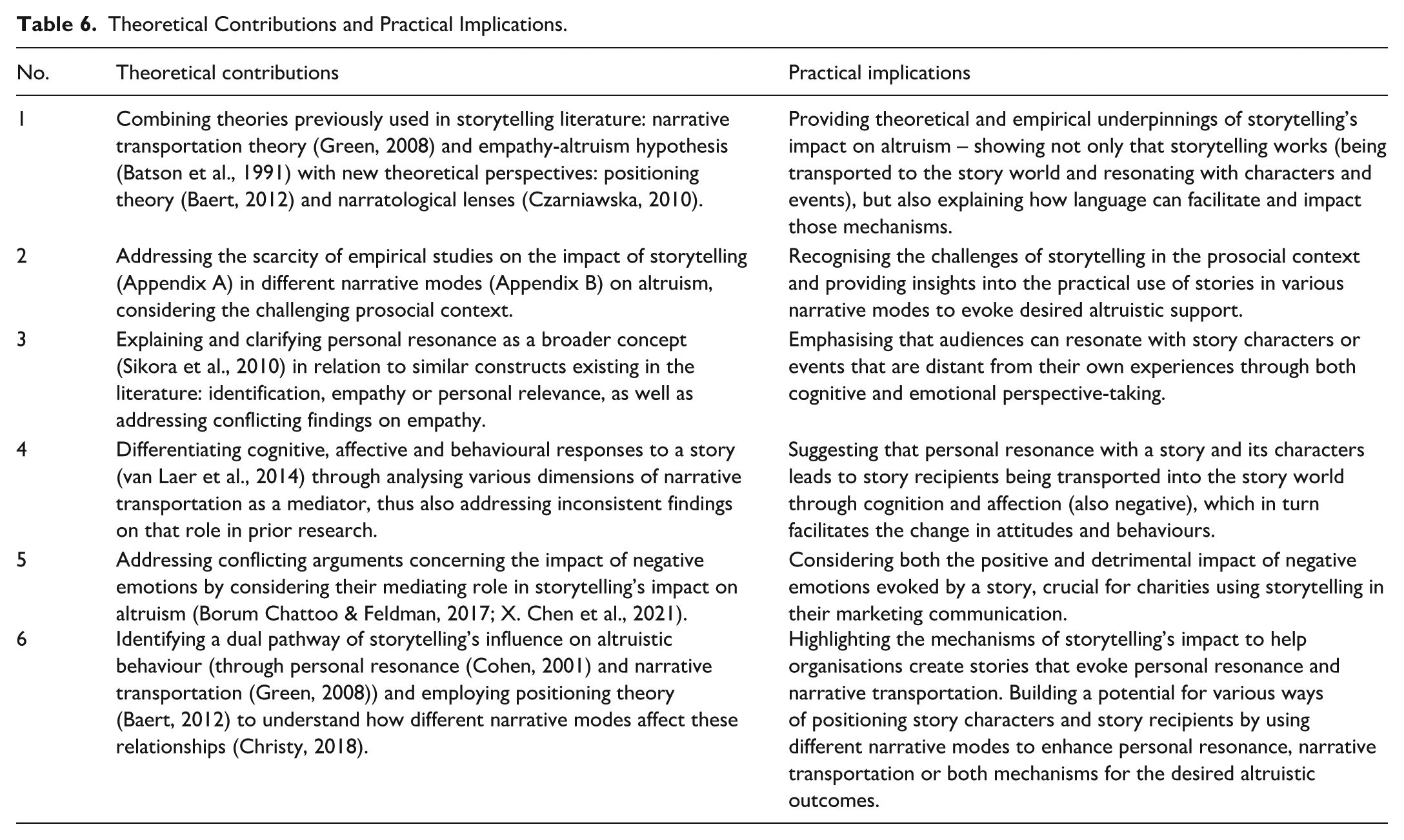
This paper considers how organisations such as charities can use storytelling to evoke altruistic behaviours and thus encourage individuals to contribute resources to the cause underlying the provision of services. In doing so, it broadens the empirical research on narrative transportation outcomes (van Laer et al., 2014), and examines the impact of personal resonance and narrative transportation on altruistic behaviours. Further, it considers the dimensionality of narrative transportation, the role of emotions and different ways of telling a story, as suggested by Appel and Richter (2010). The results bring both theoretical and managerial contributions (summarised in Table 6) and show that both direct and indirect effects of personal resonance on altruistic behaviours vary across individual dimensions of narrative transportation and are moderated by different narrative modes.
Theoretical Contributions and Practical Implications.
Theoretical contribution
Services marketing literature recognises altruistic behaviours as a manifestation of loyalty in the service provider-customer relationship (Jones & Taylor, 2007) and a factor in enhancing well-being (Zheng et al., 2016). Researchers assert that empathy and altruism fuel reciprocity (Gilliam & Rayburn, 2016); while others suggest that empathy is not a salient driver of helping behaviours (Bove, 2019). Although non-narratives can be associated with identification (Clementson, 2020), charities often use storytelling to transport people into the story world (Green, 2008) and elicit empathic responses (Turner & Felisberti, 2018). Some researchers argue, however, that stories, despite evoking narrative transportation and empathy, have no advantage when it comes to behavioural effects (Sun et al., 2019). We address conflicting arguments and the scarcity of empirical studies on storytelling to understand how to evoke altruistic behaviours in a service marketing context. This study uniquely combines theories previously utilised in storytelling literature (e.g.narrative transportation theory (Green, 2008), empathy-altruism hypothesis (Batson et al., 1991) with new theoretical perspectives (e.g. positioning theory (Baert, 2012), narratological lenses (Czarniawska, 2010)), providing a more comprehensive framework for understanding the prosocial effects of storytelling. While narrative transportation and the empathy-altruism hypothesis were employed to explain the audience’s responses to a story, positioning theory enabled linking those responses to the story itself. The way of telling a story, narrative mode, reflects different relations between a narrator and a reader (Bundgaard, 2010) and can influence the reader’s understanding of the story and attitude towards it (Rimmon-Kenan, 2002). We apply principles of positioning theory to analyse how three narrative modes (first-, second- and third-person narration) affect the story perception, recipients’ resonance with characters and transportation into the story world, and how they lead to altruistic behaviours.
Theoretical and empirical research on altruism is extensive (as presented in Appendix A); however, findings about the role of empathy are inconsistent, only a few studies discuss storytelling and narrative transportation (T. Chen & Lin, 2014), and none of them explores the impact of the way a story is told. Narrative mode, on the other hand, is underexplored in the context of altruism (see Appendix B), despite some considerations of empathy (Mulcahy & Gouldthorp, 2016), narrative transportation (Hartung et al., 2016) or behavioural intentions (Packard et al., 2018). We addressed those research gaps by examining both the influence of storytelling on altruistic behaviours through personal resonance and narrative transportation, as well as the different effects of these relationships in various narrative modes. In contrast with Aji (2024), claiming that storytelling positively influences pleasure-based (desire to help) and pressure-based (sense of obligation) prosocial motivations (both egoistic in nature), we found that stories can be used to evoke altruism. Narrative modes facilitate personal resonance and narrative transportation through presenting the story world from various perspectives (Cohen & Klimmt, 2021). The influence of both on altruistic behaviours stems from the positions the story recipients encounter and accept (Littlejohn & Foss, 2009) that correlate with their social roles, enabling them to take action. Despite the challenges that the prosocial context brings for storytelling’s application, mainly related to an uneven distribution of benefits (Lay & Hoppmann, 2015), our study shows that it is an effective tool to encourage altruistic behaviours.
We contribute to the storytelling literature by explaining and clarifying the concept of personal resonance and addressing how it corresponds with similar constructs. Existing studies examine either identification (Hoeken & Sinkeldam, 2014), empathy (Turner & Felisberti, 2018) or both constructs (Atkinson et al., 2019) as mechanisms evoking altruism. Our conceptualisation goes beyond both notions by considering story recipients’ resonance with story content (characters, plot and metaphors; Klimmt & Rieger, 2021), and is broader than a more self-oriented idea of personal relevance (Stojanova et al., 2023). We also address conflicting findings on empathy (as one of the dimensions of personal resonance; Cohen, 2001). Most studies on empathy or identification show no impact on altruism (Bailey & Wojdynski, 2015), the need for additional factors (Atkinson et al., 2019) or dependence on emotions (Hoeken & Sinkeldam, 2014). Our research shows that personal resonance leads to altruism, in line with the empathy-altruism hypothesis (Batson et al., 1991), confirmed in recent studies by Sun et al. (2025). This impact can be both direct and through narrative transportation. The results confirm that personal resonance is a significant antecedent of narrative transportation, consistent with Green (2004) and van Laer et al. (2014), regardless of the narrative mode used to tell a story.
Although existing studies consider narrative transportation as a mediator (V. L. Thomas & Grigsby, 2024), with conflicting findings linking both personal resonance and narrative transportation (Breves, 2020; Herrera et al., 2018; Walkington et al., 2020), showing a negative impact (Dessart, 2018) or mixed results by separating identification and empathy (Steinemann et al., 2017), the relationship between those constructs remains unclear. When addressing this inconsistency, we recognise and confirm the mediating role of narrative transportation in the impact of storytelling on altruistic behaviours. Cognitive (understanding story events and actions of characters) and affective (reflecting and sharing emotions) perspective-taking processes encompassed in personal resonance encourage narrative transportation (van Laer et al., 2014) through stimulating imagination (Green et al., 2006), and our results show that personal resonance impacted all dimensions of narrative transportation.
We contribute to extant storytelling research by responding to the call to differentiate cognitive, affective and behavioural responses to a story (van Laer et al., 2014) and analysing multidimensional narrative transportation and altruistic intentions evoked by a story. Sine narrative transportation goes beyond an experience of being lost in the story (de Graaf et al., 2009), different story characteristics (including its characters) may influence the effects of its particular dimensions (Quintero Johnson & Sangalang, 2017). The imagery dimension of narrative transportation did not affect altruistic motivations in any of the scenarios. Mental imagery helps people visualise behaviours and makes actions more likely to occur (Schlosser, 2003). The narrative transportation effect in first- and third-person narratives proved to be strongly driven by cognition, confirming that, in line with narrative transportation theory, an individual’s ability to process information is through a cognitive self-referencing process (Rutledge, 2015). Stories are regarded as effective in triggering affective responses and encouraging action-taking (Morris et al., 2019). However, heightened emotions (both positive and negative) suppress desired outcomes when it comes to sensitive topics (Murphy et al., 2013). Moreover, when people perceive a story character as responsible for their misfortune, they might express negative emotions towards them (Small & Loewenstein, 2003), are less likely to help (Kogut, 2011) or even refrain from getting involved in the story to avoid the anticipated mood change (Sabato & Kogut, 2021). This was reflected in the negative impact of affective narrative transportation on altruism in first- and third-person scenarios. Although the mediating role of emotions has not been confirmed in our study, considering them in the analysis facilitated our understanding of those negative effects.
We contribute to the discussion on the role of emotions in storytelling’s prosocial outcomes and address conflicting arguments by proposing that different ways of telling a story can facilitate regulation of affective responses. Because maintenance and regulation of the personal and social self are emotionally and cognitively demanding, people use the potential of stories to expand beyond their characteristics and social roles, which can diminish social distance and expand human sympathies (Slater et al., 2014). The interplay of cognitive and affective responses to the story can reflect two ways of down-regulating emotions. Reappraisal (changing the situation to decrease its emotional impact, for example, by helping others) is more effective and associated with positive outcomes. Suppression (inhibiting the expression of inner feelings without reducing emotional experience) is associated with adverse effects (Gross, 2002). Cognitive reappraisal is an antecedent-focussed strategy, whereas expressive suppression focusses on a response. Both affect emotional, cognitive and interpersonal functioning (S. A. Moore et al., 2008), crucial for altruistic outcomes investigated in this paper.
While negative emotional states can lead to corrective actions (Graham et al., 2008) and attract attention to social causes, they can also cause feelings of helplessness and inertia, inhibiting mobilisation efforts (Naimi et al., 2023). Our results show that in the first-person narrative mode, altruistic behaviours were driven by cognitive narrative transportation; however, negative affective responses diminished the inclination to help. This mode, where a story recipient takes a natural position as an interlocutor in a discourse, favours sympathy (‘with-feeling’), without too much overlap of identities) that stems from the perspective of an interlocutor, an observer conscious of both another’s and one’s own feelings (Escalas & Stern, 2003). This narrative mode creates space, allows for other-oriented (including negative) emotions and helps control and understand the possibilities and consequences of one’s own position and, subsequently, behaviour. Second-person narration, forcing the story recipient to change their position, to become the character (Kress, 1995; Rembowska-Płuciennik, 2022), enables empathy (i.e., sharing feelings and cognitive perspective taking, ‘’in-feeling’ (Escalas & Stern, 2003)), yet makes a story recipient suppress one’s own, especially other-oriented, action-provoking emotions. In this scenario, with the need for a significant overlap of identities, understanding of events and assessment of the story recipient’s position (Parker, 2018), altruistic responses were driven by strong personal resonance with no significant impact of negative emotions. Finally, third-person narration, as natural and common, leaves the most freedom to feel either empathy or sympathy, monitor and express emotions (including those other-oriented and negative; Mulcahy & Gouldthorp, 2016), negotiate and change positions through understanding and assessment of the possibilities, costs and benefits of potential behaviour. Despite the negative emotional impact, altruistic outcomes remained significant, confirming how various narrative modes facilitate emotion regulation and the interplay between cognitive and affective responses.
Finally, this study identifies a dual pathway of storytelling’s influence on altruistic behaviour (through personal resonance and narrative transportation) and highlights how different narrative modes (first-, second- and third-person narration) affect these relationships (as a moderator). While the findings confirm storytelling’s impact on altruism through those mechanisms, positioning theory helps to understand how narrative modes enable various perspectives on a story world, and how positioning towards story characters and the story world (James, 2015) can spill over into perceived social roles that story recipients hold and use to act altruistically. This is because narrators attribute certain positions to characters in their stories, as well as to the audience and to themselves, but also in relation to the cultural world outside of the story (Kayı-Aydar, 2019).
The results confirm that personal resonance is a significant antecedent of narrative transportation, consistent with Green (2004) and van Laer et al. (2014), regardless of the narrative mode used to tell a story. The multigroup analysis revealed the strongest impact of personal resonance on affective and imagery narrative transportation in the second-person scenario, confirming this narrative mode’s emotionally demanding and highly co-creative nature (Rembowska-Płuciennik, 2018). Interestingly, in this second-person narrative scenario, the altruistic outcomes were only driven by personal resonance, and the narrative transportation effect was insignificant. Although second-person narrative passages are increasingly used in literature (Parker, 2018), their extensive use enhances the impression of artificiality (Jeziorska-Haładyj, 2019) and may hinder the effects of narrative transportation. Story recipients are more familiar with the third-person narrative mode used in literary works and the first-person narrative mode with its conversational nature. Using second-person pronouns may interrupt the narrative (Bell & Ensslin, 2011) or create a confusing effect when the story recipient must establish who the narrator refers to (Fludernik, 1993; Fludernik & Olson, 2011). Readers may feel alienated or annoyed (Mildorf, 2012), and this can prevent them from being transported into the story world. The second-person narrative mode relates to co-participation rather than observation, like in the case of first- and third-person narration (Rembowska-Płuciennik, 2022), which influences emotional expression and regulation. Although stories in first- and third-person narration enhanced the narrative transportation effect mainly through cognition, they also triggered emotional responses that potentially could have suppressed desired altruistic outcomes in the sensitive context of this research (Murphy et al., 2013). First-person narrative mode activates affective connection (increasing resonance with the story character) while simultaneously facilitating cognitive elaboration (Igartua & Rodríguez-Contreras, 2020). Similarly, third-person narratives can evoke strong emotional identification (van Krieken et al., 2017), and more systemic thoughts (Nazione, 2016), which stems from the ability to take the external perspective (Brunyé et al., 2009). Our findings argue with prior research showing no impact of narrative mode on personal resonance (M. Chen et al., 2016; Ma et al., 2023) or narrative transportation (Christy, 2018) by confirming its moderating impact on the altruistic outcomes of storytelling through both mechanisms.
In conclusion, this research contributes to marketing literature by demonstrating how altruistic behaviours, essential for charities and social purpose organisations in their service provision, can be elicited through storytelling. We confirm that personal resonance and multidimensional narrative transportation are mechanisms of storytelling’s impact on altruistic behaviours. Further, we demonstrate that narrative mode has different effects on these relationships, effectively facilitating personal resonance, narrative transportation or both. With the narratological lenses and positioning theory from social psychology, we aim to deepen marketing considerations of the prosocial effects of storytelling.
Practical implications
Dissemination of the core values within an organisation and in the service-provider-customer relationships is perceived as imperative to fostering altruistic and voluntary behaviours (Chou et al., 2021). Charity campaigns congruent with the promoted product, service or cause are more effective in evoking altruistic customer behaviour (Leonhardt & Peterson, 2019). Storytelling can support these processes, assist with the alignment of an organisation’s and customers’ values, and elicit altruistic behaviours vital for integrating resources to co-create value in a prosocial context (Klafke et al., 2023).
By extending the theoretical and empirical underpinnings of storytelling’s impact on altruism, we aimed not only to confirm that storytelling changes people’s attitudes through being transported into the story and resonating with its characters and events, but also to explain how language can facilitate and impact those mechanisms. Narratives have the capacity to transport their receivers in time and space and allow them to go beyond their assumed roles by creating dynamic positions (McVee et al., 2021) capturing identity related to psychological, biographical and moral characteristics (L. Herman & Vervaeck, 2019). Such interdependent positioning within social relations (Pratten, 2023) forms a basis for (also altruistic) contributions. Charity organisations can actively participate in intentional, strategic positioning to facilitate achieving their goals (James, 2015) and practise storytelling to engage people in the prosocial causes they stand for, to encourage supporting behaviours (Kaczorowska et al., 2023). Individuals can use narratives to make their actions more purposeful and significant – both to themselves and others (van Langenhove, 2017) since stories can evoke altruistic behaviours through elevation experienced when witnessing others’ virtuous acts (Atkinson et al., 2019).
We recognise the challenges of storytelling in the prosocial context and that people may be reluctant to act altruistically (Vu & Molho, 2025) or be driven by extrinsic motivators like practicality or personal gain (Nuttall et al., 2025). However, altruism should be regarded as potential preferences, dispositions (Folbre & Goodin, 2004) and both nature and nurture are responsible for the extent and expression of altruism. This creates an opportunity for not-for-profit organisations to use the power of storytelling to evoke altruistic motivations effectively, as shown in our study. To benefit from such intentions, charities can go a step further and create conditions conducive to the real behavioural expression (D. S. Wilson et al., 2007), for example, through increasing transparency of the impact or reducing costs of altruistic choices (Vu & Molho, 2025). Evoking and respecting people’s altruism without exploiting it is a strategy worth pursuing (Folbre & Goodin, 2004), especially given the potential long-term effects of narratives on attitudes (Oschatz & Marker, 2020).
Storytelling provides victims of societal issues with an identity that people can resonate with and proves to be more effective in evoking support behaviours than statistics (Small & Loewenstein, 2003). While identifiable beneficiaries can encourage smaller donations than unidentified ones (Regasa et al., 2024), identifying victims alleviates the impact of psychological distance by making them more human and allowing stronger emotional responses towards them (Kogut et al., 2018). Our findings show that audiences can resonate with story characters or events that are distant from their own experiences through both emotional and cognitive perspective-taking. The perceived resemblance of the story characters is not a necessary factor (Cohen et al., 2018), and charities can facilitate resonance with less similar characters by strategic use of language (Hoeken et al., 2016). This is crucial in the context of homelessness used in this study, where over 80% of participants reported a lack of personal experience with homelessness. Despite the criticism of empathy as an emotionally burdened, biased, narrowed and myopic approach to others (Bloom, 2014), it seems to be one of the most effective aspects of interpersonal relationships underpinning altruism, as confirmed by this study. Understood as the capacity to understand the feelings, thoughts and experiences of others (Yalçın & DiPaola, 2020), encompasses both affective and cognitive aspects of people’s responses to a story. While emotional empathy is argued to be the only predictor of values driving altruism (Persson & Kajonius, 2016), and emotional mechanisms are suggested as a basis for helping identified victims (Lee & Feeley, 2016), the relationships governing human motivations to help are more complex. Our findings suggest both (affective and cognitive) aspects play a role in predicting charitable support and should be taken into account when creating stories for social impact.
The practical application of the results must consider the strong relationship between personal resonance and all the dimensions of narrative transportation, as well as the significant role of affective responses in storytelling. Enhancing emotional resonance with story characters may increase immediate helping behaviour, while strengthening cognitive empathy may promote long-term prosocial actions (Sun et al., 2025), crucial from the point of view of organisations competing for the audience’s attention and support. Crafting stories facilitating customers’ perception and understanding of a social issue can help them relate to the story, resonate with and develop their own narrative, accept the prosocial message and shift their attitudes and behaviours (Hu et al., 2023). Relating closely to customers’ values and morals increases their cognitive effort devoted to understanding and relating to the message (Orazi et al., 2025). To evoke altruistic responses, not-for-profit organisations can use first-person narratives to ‘transport’ audiences, second-person narratives to enhance personal resonance or third-person narratives to leverage both mechanisms. Still, they must consider the enormous and sometimes devastating effects of emotions that such narrative modes evoke.
Considering both the positive and detrimental impact of negative emotions evoked by a story is crucial for charities using storytelling in their marketing communication. While emotions presented in the story can be mirrored and shared (Yalçın & DiPaola, 2020), the story receivers’ affective responses do not always correspond with those of the story character or can be regulated (Izard et al., 2011). In the case of such a sensitive context as homelessness, negative emotions seem unavoidable and perceiving a story character as responsible for their situation (Small & Loewenstein, 2003) can decrease the likelihood of support (Kogut, 2011). Social-cognitive intervention can enhance empathy and decrease this negative affect (Cuadrado et al., 2015) through education about social issues, and fostering mutual understanding and perspective-taking in interpersonal service interactions (Abney et al., 2017). This could be accompanied by an opportunity to help and confirmation of the impact that the individual’s action has made (Merchant et al., 2010). Altruistic behaviours help recover power and mitigate the negative affective state through personal gratification and mood enhancement (Khalil et al., 2020). Charity organisations are encouraged to use various ways of telling a story to reduce negative responses and facilitate supporting behaviours.
We highlight the mechanisms of storytelling’s prosocial impact to help organisations create stories that evoke personal resonance and narrative transportation for the desired altruistic outcomes. This can be achieved through various ways of positioning story characters and story recipients by using different narrative modes. While charities are urged to work on their narratives, they also need to allow the narratives to work on people (Clancy et al., 2015). The voice of the narrator can moderate the mechanisms and outcomes of storytelling by moving beyond merely transmitting the message (Walsh, 2020). The shift towards more dialogic storytelling can allow organisations to build interactive communication with their audience, which, through dynamic positioning, can lead to altruistic behavioural outcomes (Beech et al., 2009). To resonate with a story character’s emotions, perspective and goals may mean feeling, understanding and staying motivated to act towards the shared view of the future. To be transported into a story may mean changing the point of view, seeing the world differently, and shifting previously occupied social position into one entailing a wider range of possible supportive behaviours. Finally, to respond to linguistically refined storytelling may mean not being manipulated but discovering one’s innate altruism and recognising behavioural patterns beneficial to the broader society.
Limitations and Future Research
The sensitivity of the topic of homelessness may impact cognitive, affective and imagery appeals and, consequently, responses to them. We encourage using the proposed framework to study other socially significant topics, and future research embedded in other contexts would help to explore the narrative transportation effect in more detail. Respondents’ answers were related to the likelihood of altruistic behaviour, which may not reflect future behavioural expressions of their motivation. The planned nature of many of the altruistic actions people choose to perform requires greater conceptual work to find the determinants of people’s actual actions rather than their intentions (White et al., 2023), and we strongly encourage exploring these factors. Research into the creation of extended patterns of behaviour that warrant people’s departure from preferred case-to-case decision-making (Buck, 2002) could be beneficial to understanding the long-term effects of storytelling. Since enhancing emotional empathy can increase immediate helping behaviour, and strengthening cognitive empathy may lead to long-term prosocial outcomes, exploring those dimensions could be addressed in future studies (Sun et al., 2025).
The imbalance between negative and positive emotions (resulting from the scale used (Izard et al., 1993)) is a limitation of this project. Additional positive emotions (such as pride, hope, gratitude, joy, compassion or happiness) would have allowed examining other dependence paths and possibly more substantial altruistic effects. A detailed analysis of specific types of emotions evoked through the story’s reception and their regulation would allow for more insight into behavioural outcomes of emotion-specific empathy (Olderbak et al., 2014) and the affective dimension of narrative transportation. Future research could examine the internal dimensions of personal resonance and altruism (Otto & Bolle, 2011) and the impact of declared altruistic tendencies on actual behaviour. Given the plethora of observed relationships, it may be an exciting avenue to investigate the effect of storytelling on storytellers’ emotions and behaviour and how the cognitive, emotional and behavioural exchanges and reinterpretations of stories underlie a larger meta-story co-created for prosocial outcomes.
Conclusion
Inviting service users to share their stories as a part of an organisation’s marketing communication can inform and influence others (Voronka & Grant, 2022). Our findings confirm that storytelling impacts altruistic behaviours through two main mechanisms: personal resonance and narrative transportation. Further, we demonstrate that how a story is told, that is, which narrative mode is applied, affects these relationships. First-person narratives ‘transport’ audiences and second-person narratives enhance personal resonance. The third-person narrative mode evokes altruistic behaviours through both mechanisms. More detailed studies on these processes and research on using stories for effective altruism (Caviola et al., 2021) can bring the tangible prosocial outcomes of storytelling to light for charities and other social purpose organisations.
Footnotes
Appendix A
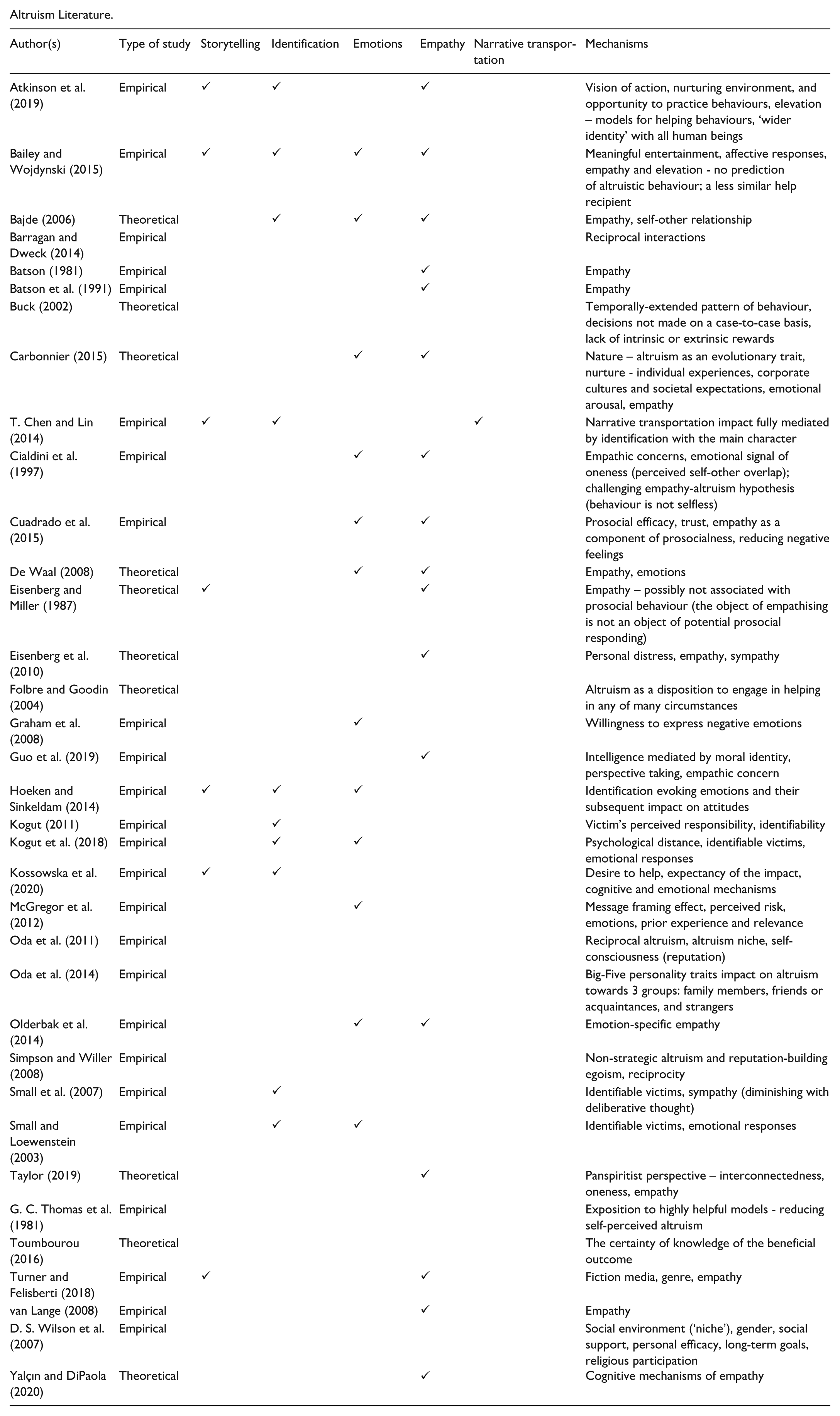
Altruism Literature.
| Author(s) | Type of study | Storytelling | Identification | Emotions | Empathy | Narrative transportation | Mechanisms |
|---|---|---|---|---|---|---|---|
| Atkinson et al. (2019) | Empirical | ✓ | ✓ | ✓ | Vision of action, nurturing environment, and opportunity to practice behaviours, elevation – models for helping behaviours, ‘wider identity’ with all human beings | ||
| Bailey and Wojdynski (2015) | Empirical | ✓ | ✓ | ✓ | ✓ | Meaningful entertainment, affective responses, empathy and elevation - no prediction of altruistic behaviour; a less similar help recipient | |
| Bajde (2006) | Theoretical | ✓ | ✓ | ✓ | Empathy, self-other relationship | ||
| Barragan and Dweck (2014) | Empirical | Reciprocal interactions | |||||
| Batson (1981) | Empirical | ✓ | Empathy | ||||
| Batson et al. (1991) | Empirical | ✓ | Empathy | ||||
| Buck (2002) | Theoretical | Temporally-extended pattern of behaviour, decisions not made on a case-to-case basis, lack of intrinsic or extrinsic rewards | |||||
| Carbonnier (2015) | Theoretical | ✓ | ✓ | Nature – altruism as an evolutionary trait, nurture - individual experiences, corporate cultures and societal expectations, emotional arousal, empathy | |||
| T. Chen and Lin (2014) | Empirical | ✓ | ✓ | ✓ | Narrative transportation impact fully mediated by identification with the main character | ||
| Cialdini et al. (1997) | Empirical | ✓ | ✓ | Empathic concerns, emotional signal of oneness (perceived self-other overlap); challenging empathy-altruism hypothesis (behaviour is not selfless) | |||
| Cuadrado et al. (2015) | Empirical | ✓ | ✓ | Prosocial efficacy, trust, empathy as a component of prosocialness, reducing negative feelings | |||
| De Waal (2008) | Theoretical | ✓ | ✓ | Empathy, emotions | |||
| Eisenberg and Miller (1987) | Theoretical | ✓ | ✓ | Empathy – possibly not associated with prosocial behaviour (the object of empathising is not an object of potential prosocial responding) | |||
| Eisenberg et al. (2010) | Theoretical | ✓ | Personal distress, empathy, sympathy | ||||
| Folbre and Goodin (2004) | Theoretical | Altruism as a disposition to engage in helping in any of many circumstances | |||||
| Graham et al. (2008) | Empirical | ✓ | Willingness to express negative emotions | ||||
| Guo et al. (2019) | Empirical | ✓ | Intelligence mediated by moral identity, perspective taking, empathic concern | ||||
| Hoeken and Sinkeldam (2014) | Empirical | ✓ | ✓ | ✓ | Identification evoking emotions and their subsequent impact on attitudes | ||
| Kogut (2011) | Empirical | ✓ | Victim’s perceived responsibility, identifiability | ||||
| Kogut et al. (2018) | Empirical | ✓ | ✓ | Psychological distance, identifiable victims, emotional responses | |||
| Kossowska et al. (2020) | Empirical | ✓ | ✓ | Desire to help, expectancy of the impact, cognitive and emotional mechanisms | |||
| McGregor et al. (2012) | Empirical | ✓ | Message framing effect, perceived risk, emotions, prior experience and relevance | ||||
| Oda et al. (2011) | Empirical | Reciprocal altruism, altruism niche, self-consciousness (reputation) | |||||
| Oda et al. (2014) | Empirical | Big-Five personality traits impact on altruism towards 3 groups: family members, friends or acquaintances, and strangers | |||||
| Olderbak et al. (2014) | Empirical | ✓ | ✓ | Emotion-specific empathy | |||
| Simpson and Willer (2008) | Empirical | Non-strategic altruism and reputation-building egoism, reciprocity | |||||
| Small et al. (2007) | Empirical | ✓ | Identifiable victims, sympathy (diminishing with deliberative thought) | ||||
| Small and Loewenstein (2003) | Empirical | ✓ | ✓ | Identifiable victims, emotional responses | |||
| Taylor (2019) | Theoretical | ✓ | Panspiritist perspective – interconnectedness, oneness, empathy | ||||
| G. C. Thomas et al. (1981) | Empirical | Exposition to highly helpful models - reducing self-perceived altruism | |||||
| Toumbourou (2016) | Theoretical | The certainty of knowledge of the beneficial outcome | |||||
| Turner and Felisberti (2018) | Empirical | ✓ | ✓ | Fiction media, genre, empathy | |||
| van Lange (2008) | Empirical | ✓ | Empathy | ||||
| D. S. Wilson et al. (2007) | Empirical | Social environment (‘niche’), gender, social support, personal efficacy, long-term goals, religious participation | |||||
| Yalçın and DiPaola (2020) | Theoretical | ✓ | Cognitive mechanisms of empathy |
Appendix B
Narrative Mode literature.
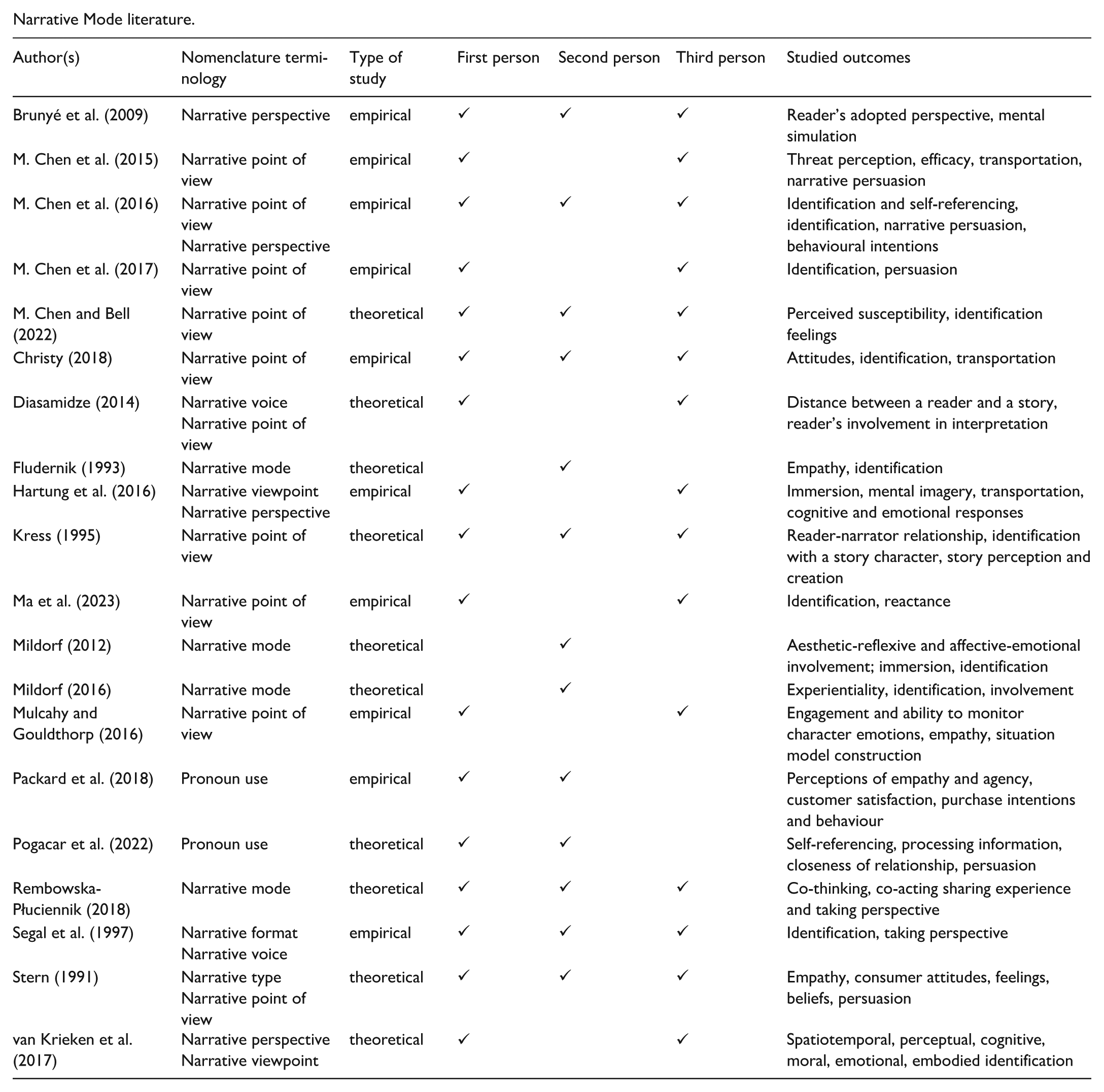
| Author(s) | Nomenclature terminology | Type of study | First person | Second person | Third person | Studied outcomes |
|---|---|---|---|---|---|---|
| Brunyé et al. (2009) | Narrative perspective | empirical | ✓ | ✓ | ✓ | Reader’s adopted perspective, mental simulation |
| M. Chen et al. (2015) | Narrative point of view | empirical | ✓ | ✓ | Threat perception, efficacy, transportation, narrative persuasion | |
| M. Chen et al. (2016) | Narrative point of view |
empirical | ✓ | ✓ | ✓ | Identification and self-referencing, identification, narrative persuasion, behavioural intentions |
| M. Chen et al. (2017) | Narrative point of view | empirical | ✓ | ✓ | Identification, persuasion | |
| M. Chen and Bell (2022) | Narrative point of view | theoretical | ✓ | ✓ | ✓ | Perceived susceptibility, identification feelings |
| Christy (2018) | Narrative point of view | empirical | ✓ | ✓ | ✓ | Attitudes, identification, transportation |
| Diasamidze (2014) | Narrative voice |
theoretical | ✓ | ✓ | Distance between a reader and a story, reader’s involvement in interpretation | |
| Fludernik (1993) | Narrative mode | theoretical | ✓ | Empathy, identification | ||
| Hartung et al. (2016) | Narrative viewpoint |
empirical | ✓ | ✓ | Immersion, mental imagery, transportation, cognitive and emotional responses | |
| Kress (1995) | Narrative point of view | theoretical | ✓ | ✓ | ✓ | Reader-narrator relationship, identification with a story character, story perception and creation |
| Ma et al. (2023) | Narrative point of view | empirical | ✓ | ✓ | Identification, reactance | |
| Mildorf (2012) | Narrative mode | theoretical | ✓ | Aesthetic-reflexive and affective-emotional involvement; immersion, identification | ||
| Mildorf (2016) | Narrative mode | theoretical | ✓ | Experientiality, identification, involvement | ||
| Mulcahy and Gouldthorp (2016) | Narrative point of view | empirical | ✓ | ✓ | Engagement and ability to monitor character emotions, empathy, situation model construction | |
| Packard et al. (2018) | Pronoun use | empirical | ✓ | ✓ | Perceptions of empathy and agency, customer satisfaction, purchase intentions and behaviour | |
| Pogacar et al. (2022) | Pronoun use | theoretical | ✓ | ✓ | Self-referencing, processing information, closeness of relationship, persuasion | |
| Rembowska-Płuciennik (2018) | Narrative mode | theoretical | ✓ | ✓ | ✓ | Co-thinking, co-acting sharing experience and taking perspective |
| Segal et al. (1997) | Narrative format |
empirical | ✓ | ✓ | ✓ | Identification, taking perspective |
| Stern (1991) | Narrative type |
theoretical | ✓ | ✓ | ✓ | Empathy, consumer attitudes, feelings, beliefs, persuasion |
| van Krieken et al. (2017) | Narrative perspective |
theoretical | ✓ | ✓ | Spatiotemporal, perceptual, cognitive, moral, emotional, embodied identification |
Appendix C
Appendix D
Items – Means, Standard Deviation (SD) – Scenarios 1 to 3.
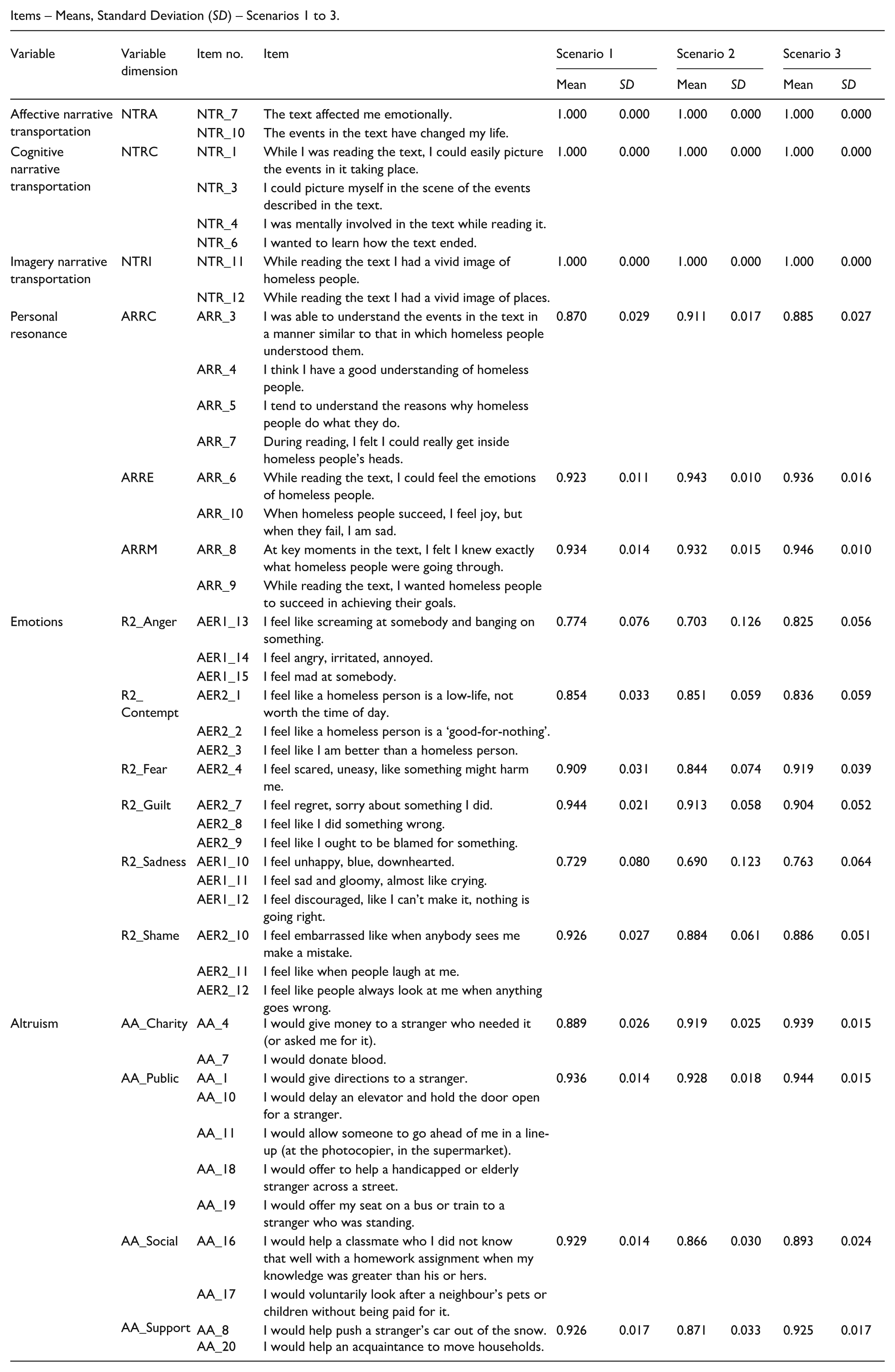
| Variable | Variable dimension | Item no. | Item | Scenario 1 | Scenario 2 | Scenario 3 | |||
|---|---|---|---|---|---|---|---|---|---|
| Mean | SD | Mean | SD | Mean | SD | ||||
| Affective narrative transportation | NTRA | NTR_7 | The text affected me emotionally. | 1.000 | 0.000 | 1.000 | 0.000 | 1.000 | 0.000 |
| NTR_10 | The events in the text have changed my life. | ||||||||
| Cognitive narrative transportation | NTRC | NTR_1 | While I was reading the text, I could easily picture the events in it taking place. | 1.000 | 0.000 | 1.000 | 0.000 | 1.000 | 0.000 |
| NTR_3 | I could picture myself in the scene of the events described in the text. | ||||||||
| NTR_4 | I was mentally involved in the text while reading it. | ||||||||
| NTR_6 | I wanted to learn how the text ended. | ||||||||
| Imagery narrative transportation | NTRI | NTR_11 | While reading the text I had a vivid image of homeless people. | 1.000 | 0.000 | 1.000 | 0.000 | 1.000 | 0.000 |
| NTR_12 | While reading the text I had a vivid image of places. | ||||||||
| Personal resonance | ARRC | ARR_3 | I was able to understand the events in the text in a manner similar to that in which homeless people understood them. | 0.870 | 0.029 | 0.911 | 0.017 | 0.885 | 0.027 |
| ARR_4 | I think I have a good understanding of homeless people. | ||||||||
| ARR_5 | I tend to understand the reasons why homeless people do what they do. | ||||||||
| ARR_7 | During reading, I felt I could really get inside homeless people’s heads. | ||||||||
| ARRE | ARR_6 | While reading the text, I could feel the emotions of homeless people. | 0.923 | 0.011 | 0.943 | 0.010 | 0.936 | 0.016 | |
| ARR_10 | When homeless people succeed, I feel joy, but when they fail, I am sad. | ||||||||
| ARRM | ARR_8 | At key moments in the text, I felt I knew exactly what homeless people were going through. | 0.934 | 0.014 | 0.932 | 0.015 | 0.946 | 0.010 | |
| ARR_9 | While reading the text, I wanted homeless people to succeed in achieving their goals. | ||||||||
| Emotions | R2_Anger | AER1_13 | I feel like screaming at somebody and banging on something. | 0.774 | 0.076 | 0.703 | 0.126 | 0.825 | 0.056 |
| AER1_14 | I feel angry, irritated, annoyed. | ||||||||
| AER1_15 | I feel mad at somebody. | ||||||||
| R2_Contempt | AER2_1 | I feel like a homeless person is a low-life, not worth the time of day. | 0.854 | 0.033 | 0.851 | 0.059 | 0.836 | 0.059 | |
| AER2_2 | I feel like a homeless person is a ‘good-for-nothing’. | ||||||||
| AER2_3 | I feel like I am better than a homeless person. | ||||||||
| R2_Fear | AER2_4 | I feel scared, uneasy, like something might harm me. | 0.909 | 0.031 | 0.844 | 0.074 | 0.919 | 0.039 | |
| R2_Guilt | AER2_7 | I feel regret, sorry about something I did. | 0.944 | 0.021 | 0.913 | 0.058 | 0.904 | 0.052 | |
| AER2_8 | I feel like I did something wrong. | ||||||||
| AER2_9 | I feel like I ought to be blamed for something. | ||||||||
| R2_Sadness | AER1_10 | I feel unhappy, blue, downhearted. | 0.729 | 0.080 | 0.690 | 0.123 | 0.763 | 0.064 | |
| AER1_11 | I feel sad and gloomy, almost like crying. | ||||||||
| AER1_12 | I feel discouraged, like I can’t make it, nothing is going right. | ||||||||
| R2_Shame | AER2_10 | I feel embarrassed like when anybody sees me make a mistake. | 0.926 | 0.027 | 0.884 | 0.061 | 0.886 | 0.051 | |
| AER2_11 | I feel like when people laugh at me. | ||||||||
| AER2_12 | I feel like people always look at me when anything goes wrong. | ||||||||
| Altruism | AA_Charity | AA_4 | I would give money to a stranger who needed it (or asked me for it). | 0.889 | 0.026 | 0.919 | 0.025 | 0.939 | 0.015 |
| AA_7 | I would donate blood. | ||||||||
| AA_Public | AA_1 | I would give directions to a stranger. | 0.936 | 0.014 | 0.928 | 0.018 | 0.944 | 0.015 | |
| AA_10 | I would delay an elevator and hold the door open for a stranger. | ||||||||
| AA_11 | I would allow someone to go ahead of me in a line-up (at the photocopier, in the supermarket). | ||||||||
| AA_18 | I would offer to help a handicapped or elderly stranger across a street. | ||||||||
| AA_19 | I would offer my seat on a bus or train to a stranger who was standing. | ||||||||
| AA_Social | AA_16 | I would help a classmate who I did not know that well with a homework assignment when my knowledge was greater than his or hers. | 0.929 | 0.014 | 0.866 | 0.030 | 0.893 | 0.024 | |
| AA_17 | I would voluntarily look after a neighbour’s pets or children without being paid for it. | ||||||||
| AA_Support | AA_8 | I would help push a stranger’s car out of the snow. | 0.926 | 0.017 | 0.871 | 0.033 | 0.925 | 0.017 | |
| AA_20 | I would help an acquaintance to move households. | ||||||||
Declaration of conflicting interests
The authors declared no potential conflicts of interest with respect to the research, authorship, and/or publication of this article.
Funding
The authors received no financial support for the research, authorship, and/or publication of this article.
