



Abstract
While firms encourage their employees to engage in organizational citizenship behavior toward others (OCBI), there can be negative consequences when employees go too far and become exhausted. Little research has looked at how OCBI can lead to emotional exhaustion and how that carries over to next-day work engagement. Using conservation of resources and self-determination theories, a model was tested to examine the double-edged effect of daily OCBI on employees’ end day emotional exhaustion and their next-day work engagement. Using multi-source data collected across five consecutive workdays from 153 employees and 40 managers working in 20 bank branches in Vietnam, results of multilevel structured equation model (MSEM) suggests that daily OCBI has a U-shaped association with daily emotional exhaustion. When OCBI levels are low and moderate, engaging in OCBI helps reduce emotional exhaustion; however, when the level of OCBI exceeds the useful resources achieved, it increases emotional exhaustion. Additionally, while organization identification helps to mitigate, employee autonomy intensifies the negative impact of previous-day emotional exhaustion on next-day work engagement. This study provides managers with strategies to tackle the lagged effect of end-work emotional exhaustion so that they can provide a supportive next-day work environment.
Keywords
Introduction
As organizations become more flexible, they increasingly require employees to engage in behaviors that assist individuals within the organization (OCBI). OCBI includes such things as giving advice, guidance, mentorship, and/or encouragement to colleagues, and occurs almost every day in interaction at the workplace yet is rarely captured and studied. Despite the benefits, recent research on OCBI has illustrated detrimental costs to employees engaging in OCBI. Extra-role activities puts employees in increasing risks of job stress, role overload, and work-family conflict which can create emotional exhaustion (Bolino et al., 2010; W. Lin et al., 2020). This suggest that OCBI creates a potential double-edged sword for employees as they may receive both recognition and exhaustion from their efforts (Glomb et al., 2011; Koopman et al., 2016; Lilius et al., 2011). Gaining or losing benefits is analogous to the process of accumulating or consuming resources in the conservation of resources theory (Halbesleben et al., 2014). This resource-based view is commonly applied to explain both the good and bad effects of OCBI (Aw et al., 2021; Jang et al., 2020; W. Lin et al., 2020). This theory explains how employees allocate resources between task performance and OCBIs to achieve the most value. Given the mechanism of resource accumulation and consumption, firms have the insight into the double-edged effects of OCBI so as to better manage their resources (Halbesleben & Wheeler, 2015; W. Lin et al., 2020).
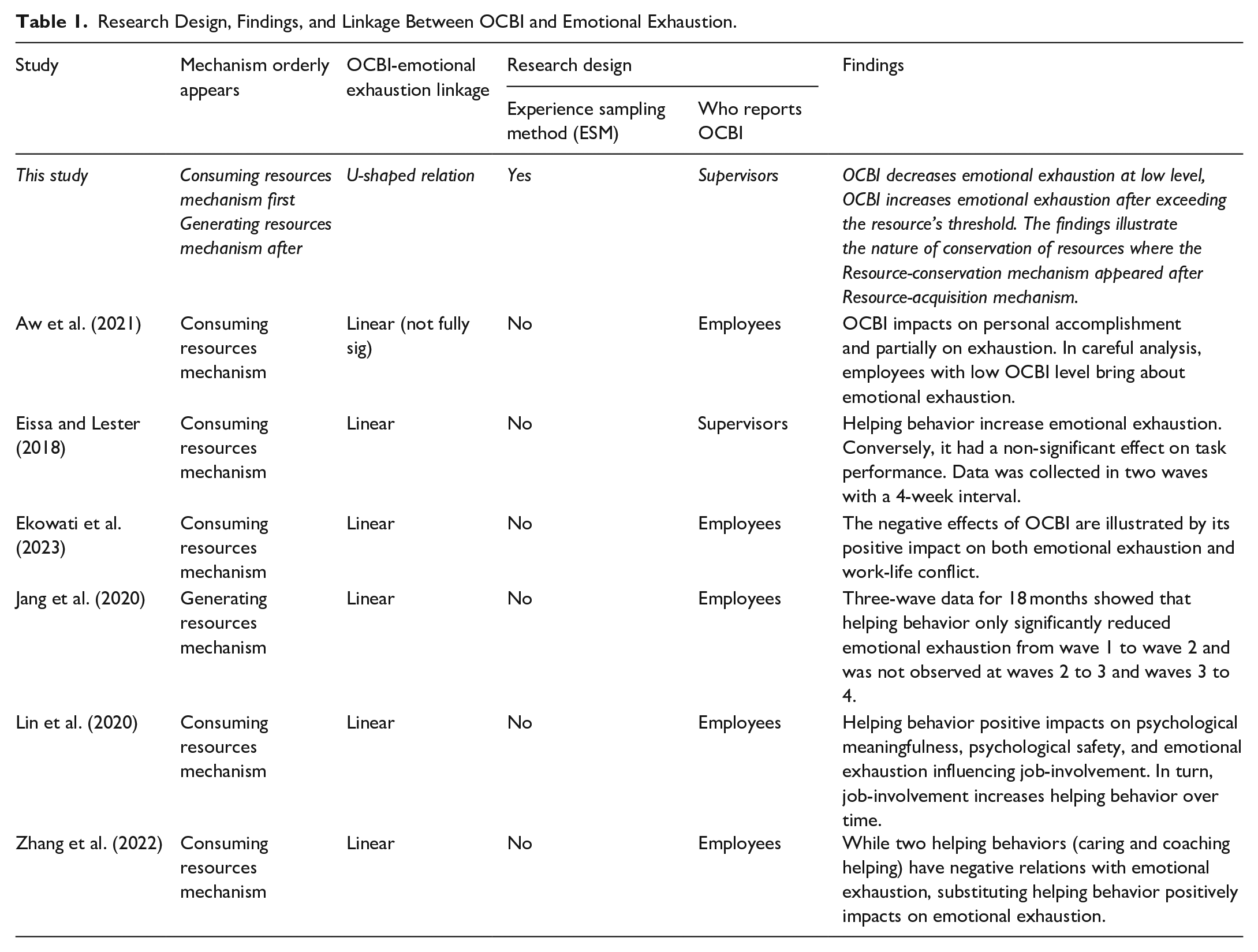
Emotional exhaustion represents the psychological resources that workers draw upon in their work (Lanaj et al., 2016; W. Lin et al., 2020). On the positive side, OCBI can help workers increase their psychological resource availability, leading to increased engagement in their work (Jang et al., 2020; W. Lin et al., 2020). But consuming too many scarce and limited resources (time/energy) will cause workers to reduce their available psychological resources, leading to exhaustion and disengagement (Lin et al., 2020). The linkage between OCBI (helping behaviors) and emotional exhaustion has received much attention in the literature, yet produced mixed results (Eissa & Lester, 2018; Jang et al., 2020; Kersten et al., 2022). The effects of OCBI on emotional exhaustion ranged from positive to negative and even no effects (see Table 1 summarizing past research). Most notable is that past studies test only the linear relationship between OCBI and emotional exhaustion, neglecting possible non-linear relationships, as well as using only a single self-reported source (e.g. employees). As such, our study uses multiple sources (both supervisors and employees) and explores not only positive/negative linear effects but focuses on the potential curvilinear effect of OCBI on emotional exhaustion over time. The resources theory group explains the curvilinear effects of OCBI, whether as cause (Scott et al., 2018) or effect (Lanaj et al., 2016; Rapp et al., 2013; F. Xu et al., 2021). Previous inconsistent and nonlinear results of OCBI, with task performance (Rapp et al., 2013) and ego depletion (Lanaj et al., 2016), suggest the potential for a nonlinear relationship between daily OCBI and daily emotional exhaustion.
Research Design, Findings, and Linkage Between OCBI and Emotional Exhaustion.
Previous research acknowledges that a dynamic approach is necessary to study work engagement due to its day-to-day fluctuating nature (Bakker, 2014; Stollberger & Debus, 2020). The need to study the factors leading to daily fluctuations in work engagement demonstrates a deep interest in the root or mediating mechanism evoking it (Bader et al., 2023; Pap et al., 2025). But little is known about the conditions which intensify or attenuate how single emotional exhaustion carries over to next-day work engagement. The available resources of employees are the means by which they overcome or exacerbate emotional exhaustion at the end of the day. Self-determination theory was incorporated to explain the effects of helping pressure (Koopman et al., 2020) or OCB (Yam et al., 2017). However, the above studies only approach two general groups of motivation, including intrinsic motivation and extrinsic motivation. We wanted to approach the combination from a different perspective, which is the recovery of employees in a state of emotional exhaustion. In this state, they are able to leverage available resources to recover emotionally more quickly. Motivation from self-determination theory is further detailed through three aspects, encompassing autonomy, relatedness, and competence. According to this theory, autonomy is one of three resources that a person employs to maintain work motivation (Deci & Ryan, 2000), and is often promoted especially in increasingly volatile work environments. Job autonomy is the sense that employees have the right to choice about their tasks, such as what tasks to do and how to do them (Hackman & Oldham, 1980). Autonomy is often seen as a valuable resource that organizations provide to their employees. Doblinger and Class (2023) warned that the positive effect of job autonomy on job engagement depends on employee characteristics. When a worker’s perceived autonomy is higher than the ideal level, autonomy diminishes well-being (Stiglbauer & Kovacs, 2018). And when employees are too emotionally exhausted, they disengage themselves from work. Therefore, autonomy emerges as a potential factor to intensify the negative consequence of emotional exhaustion on next-day work performance.
The connection employees have with the organization (organizational identification) also affects the emotional exhaustion—work engagement relationship. Organizational identification refers to the belongingness that an individual sees the success or failure of the organization as similar to his/her own success (Mael & Ashforth, 1992). This study examines organizational identification as a factor to mitigate the spill-over effect of emotional exhaustion on work engagement. Previous research suggests that organizational identification has a buffering effect on reactions to workplace stressors (Wegge et al., 2012). Due to higher sense of belonging to the organization, employees with higher organizational identification will have more internal resources and motivation to maintain next-day work engagement despite their end-day emotional exhaustion.
This research makes several contributions. First, we extend the literature by looking into OCBI in an emerging economy, Vietnam. Vietnamese culture is significantly influenced by Confucianism and collectivism, both of which lends to some alternative interpretations of the role of OCBI. For instance, as a collectivist Confucian culture, helping others normally gets more attention and is socially encouraged/expected, implying OCBI is a norm and will operate at high levels. Additionally, employees place more importance on organizational identification (House, 2004), which tends to hide actions that are not accepted by the collective (e.g. emotional exhaustion). This demonstrates that Vietnam would be an interesting environment to examine the potential moderating roles of job autonomy and organizational identification. Second, our study addresses an important research gap by examining the change from positive to adverse effects of daily OCBI on daily emotional exhaustion and the potential non-linear effects over time. Third, we explore possible intervening factors that could alter these relationships, specifically organizational identification and employee autonomy (Fürstenberg et al., 2021; Karanika-Murray et al., 2015). Fourth, a methodological strength of our study is that we collect data through a diary study for five consecutive days, with data collected from multiple sources (supervisors and employees) reducing single respondent and socially desirable biases (Podsakoff et al., 2003). Finally, our study offers insights into moderating influences, providing managers with suggestions about the potential tools they can use to reinvigorate exhausted employees and provide a more supportive next-day work environment.
Theoretical background and hypothesis development
Organizational citizenship behavior-A double-edged sword
According to Organ (1988, p. 4), organizational citizenship behavior (OCB) is defined to be “individual behavior that is discretionary, not directly or explicitly recognized by the formal reward system, and that in the aggregate promotes the effective functioning of the organization.” Decades of research provide evidence for benefits of OCB (Chang et al., 2007). OCB has had its personal and professional costs revealed in several studies (Aw et al., 2021; Lin et al., 2020). Employees may face the problem of escalating citizenship when their OCB becomes normative. They are under pressure to do further beyond their current OCB to be seen as “going the extra mile.” As a result, the value of OCB may deteriorate and be outweighed by the involved costs such as time or energy (Bergeron et al., 2013; Bolino et al., 2013). Furthermore, citizenship behavior may lose its discretionary quality when some managers or organizational members even request employees to go beyond their job responsibilities (Bolino et al., 2004). Increasing efforts to show up their citizenship behavior provoke negative outcomes for employees such as job stress, negligent behaviors, role overload, work-family conflict, or intentions to quit (Bolino et al., 2010; Vigoda-Gadot, 2006). OCBI (OCB at the individual level), prevails and engages more easily and relates strongly to the interests of organizations.
As previous research has found considerable evidence for both the bright and dark sides of OCBI (N. Chi et al., 2024; Gabriel et al., 2018), it begs the question whether the relationship is purely linear or whether there a curvilinear effect of OCBI? In this regard, Rapp et al. (2013) demonstrated an inverted U-shaped association between OCBI or helping behavior and task performance. Ellington et al. (2014) found that interpersonal helping has a diminishing return relationship with task performance. However, to date, researchers know very little about the curvilinear effect of OCBI on the emotional exhaustion of employees engaging in such activities. This study aims at investigating the curvilinear effect of OCBI on one of the most frequently used indicators of well-being, emotional exhaustion, at the daily level (Ilies et al., 2006; Koopman et al., 2016). Furthermore, this study examines how end-day emotional exhaustion influences next-day work engagement, under different levels of employee-organization identification and employee autonomy. Our research model and hypotheses are in Figure 1.
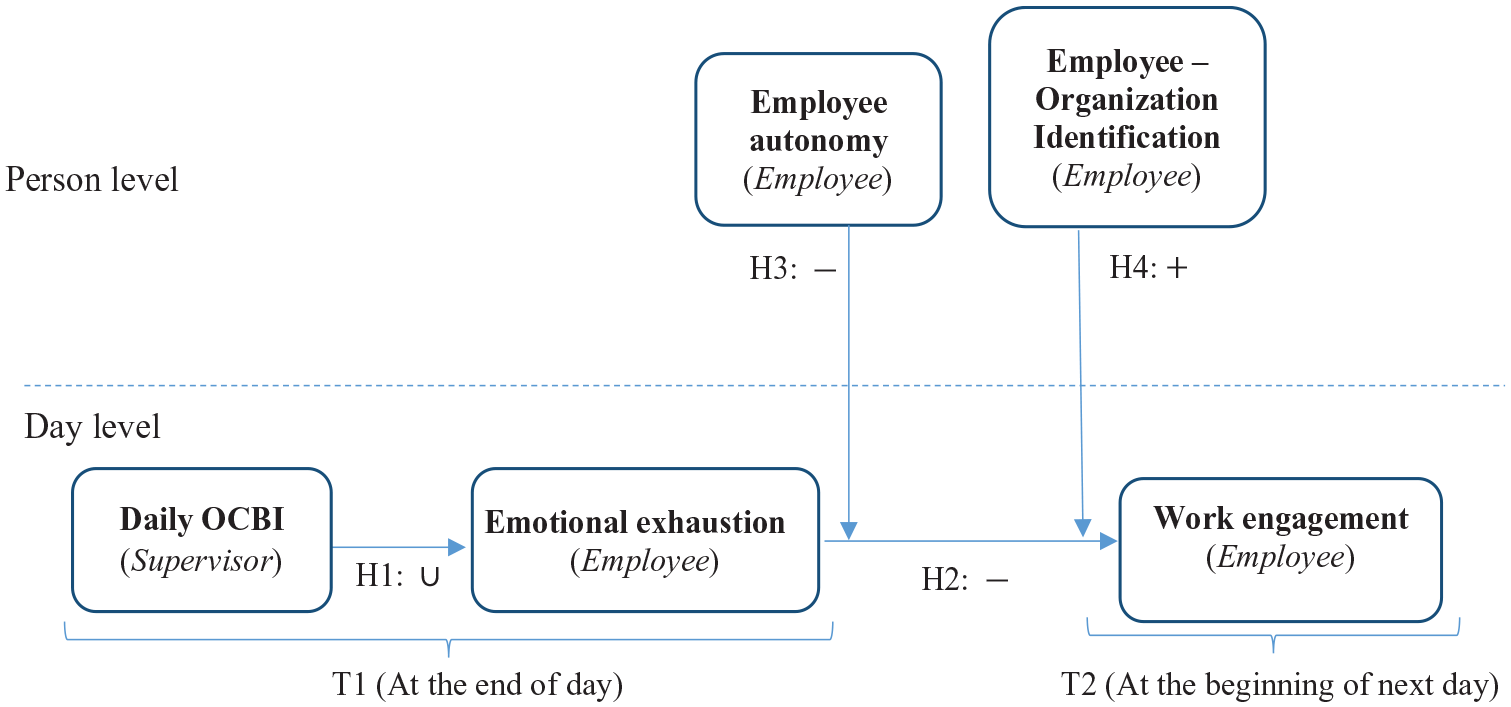
Research model and hypotheses.
Emotional exhaustion refers to the state of emotionally drained and physically depleted as a result of excessive and continuous job hassles (Wright & Cropanzano, 1998). When employees engage in more OCBI, they will be more likely to have their needs for relatedness and competence satisfied (Weinstein & Ryan, 2010). Also, the more helping behavior activities they do, the more likely they are to experience a positive affect (H. W. Lee et al., 2019). Positive effect comes from perceptions of helping others’ lives and the expressed gratitude from recipients. Based on the enrichment perspective, Lam et al. (2016) found that daily OCB can help actors perceive more meaningfulness in their work and increase their vigor at the end of workday. Helping behaviors (e.g. OCBI) also positively influences two dimensions of psychology including psychological meaningfulness and psychological safety (Lin et al., 2020). Employees engaging in daily OCB will be less likely to get emotional exhaustion on the ground of valuable resources they get from the environment around them (Jang et al., 2020). While some benefits may be reaped through helping behavior, employees are always in the consciousness that tasks’ results are important to advance in their careers. However, there is also a downside to OCBI. Performing simultaneously behaviors in and out of their role tasks causes employees to feel overwhelmed and prone to emotional exhaustion (Lin et al., 2020; Montani & Dagenais-Desmarais, 2018). Emotional exhaustion is a state that does not appear until the job demands and hassles reach excessive levels (Wright & Cropanzano, 1998). When employees engage in high levels of OCBI, they will be more likely to get overloaded with extra work (Bolino et al., 2013). The positive affect benefited from OCBI activities can be outweighed by the costs from work overload (Lanaj et al., 2016).
Furthermore, the conservation of resources theory proposes that people have the motivation to acquire and protect resources. They will get stressed as a result of a threat to their resources or the actual loss of their resources (Halbesleben, 2006; Halbesleben et al., 2009). When spending excessive resources on OCBI, employees have increasing fear for their out-of-role activities not to be acknowledged and for their spent resources to be lost. As a result of such a rising fear, employees will be more likely to get drained at the end of the workday (D. Wang et al., 2021). In summary, when employees’ daily OCBI is at low to moderate levels, they will be less emotionally exhausted. When daily increases from moderate to high levels, they will expose themselves to more risks of emotional exhaustion. Thus, we hypothesize that:
Hypothesis 1: Daily OCBI—End-day emotional exhaustion relationship will be U-shaped.
Emotional exhaustion and next-day work engagement
According to motivation theory, attributions lead to emotions that drive behaviors (Rudolph et al., 2004). Previous research has found negative consequences of emotional exhaustion such as increased employee withdrawal (Deery et al., 2002), reduced job satisfaction and increased employee voluntary turnover (Wright & Cropanzano, 1998), decreased job performance (Cropanzano et al., 2003), loss of productivity (Cui et al., 2023), and reduced work engagement (Sahi et al., 2022). Work engagement, a most desired state of work, is likely to contribute to organizational and individual success (Bakker & Albrecht, 2018; Bakker et al., 2023). Since resource deficit is a decreasing common antecedent of work engagement, it is likely that emotional exhaustion will promote decreased work engagement (Bakker, 2017).
The effect of end-day emotional exhaustion on next-day work engagement is theoretically premised on the conservation of resources theory (Hobfoll & Wells, 1998). This theory posits that given the actual net loss of resources, psychological stress will occur, which reduces employees’ capabilities to engage in work in the next working day (Halbesleben & Bowler, 2007; Hobfoll & Wells, 1998). Furthermore, the loss of resources not only decreases individuals’ capabilities to spend more resources but also their willingness to do so. As emotional exhaustion represents a significant depletion of resources, people will have to be careful in how they use their remaining resources (Lin et al., 2020). When employees feel drained because of excessive work at the end of the workday, they will decrease their work engagement the next day. Disengaging from work is an effective method to help employees both protect the remaining valuable resources and recover lost resources. Accordingly, they tend to reduce their work engagement the next day to get their resources reimbursed by the organization. Therefore, we hypothesize the following:
Hypothesis 2: End-day emotional exhaustion will negatively impact on next-day work engagement.
Employee autonomy as an exacerbating moderator
The role of motivation in the process of work recovery has attracted considerable attention in the literature (Sonnentag et al., 2012; Van Hooff & Baas, 2013). To recover from emotional exhaustion at the end of a workday, employees need motivation to engage in their work in the next workday. According to self-determination theory, the nutrients for such motivation come from satisfaction of competence, relatedness, and autonomy (Deci et al., 2017; Gagné & Deci, 2005). The satisfaction of these three basic psychological needs can improve affective organizational commitment, job performance (Greguras & Diefendorff, 2009), work engagement (Trépanier et al., 2015), and individuals’ well-being (Milyavskaya & Koestner, 2011).
The need for autonomy “refers to the desire for choice and volition over one’s activities and goals, without externally-referenced pressures and threats, actively engaging in the process of decision-making and attaining a sense of agency in one’s environment” (González-Cutre et al., 2016, p. 160). Autonomy helps people feel confident and comfortable when performing a certain task in a diverse environment (Griffiths et al., 2018) and is found to weaken the negative impact of emotional exhaustion on early retirement intentions (Cui et al., 2023).
The more autonomy individuals perceive, the more freedom and discretion they experience in carrying out their tasks. Such conditions, on one hand, can foster positive attitudes and behavior (Chan & Lam, 2011; Greguras & Diefendorff, 2009; Thompson & Prottas, 2006). On the other hand, it can engender unconstrained feelings and instigate individuals to commit unethical behaviors in accordance with their interests. High autonomy can lead employees to use organizational resources for their own benefits, doing their work with less effort or lying about work hours (Lu et al., 2017). High job autonomy can also lead to higher work intensification which causes employees to consume more resources (Chan & Lam, 2011; Kelliher & Anderson, 2010). Autonomy provides employees a sense of freedom from organizational rules and a sense of comfort when they engage in deviant behaviors (Gino & Wiltermuth, 2014). This is similar to finding that work effectiveness is higher in low-autonomy work environments (Baltes et al., 1999). Therefore, when exhausted at the end of a workday, the feeling of being unconstrained will induce them to decrease their work engagement the next day. Therefore, we have the third hypothesis:
Hypothesis 3: The negative impact of end-day emotional exhaustion on next-day work engagement is stronger when employee autonomy is greater.
Employee-organization identification as a mitigating moderator
Employee-organization identification reflects “perception of oneness with, or belongingness to, an organization where the individual defines him or herself in terms of the organization in which he or she is a member” (Mael & Ashforth, 1992, p. 105). Organizational identification is strongly and positively correlated with work-related attitudes such as attitudinal organizational commitment, occupational attachment, work group attachment, and job involvement (E. S. Lee et al., 2015; Riketta, 2005). It is also strongly and negatively correlated to intention to leave but only moderately correlated with extra-role performance (Riketta, 2005). In contrast to employee autonomy, the high need for relatedness to the organization is expected to reduce the negative effect of end-of-day emotional exhaustion on next-day work engagement.
Organizational identification strengthens how the interaction between procedural and distributive justice influences cooperation (De Cremer, 2005) or how employees’ perception of autonomy at work influences their expression of challenging but constructive work-related opinions (Tangirala & Ramanujam, 2008). Meanwhile, it weakens the positive effect of transformational leadership on employees’ adaptability (H. J. Wang et al., 2017) and the negative effect of abusive supervision on employees’ personal initiative (Q. Xu et al., 2019).
Previous research suggests that organizational identification has a buffering effect on reactions to workplace stressors (Decoster et al., 2013). Satisfaction of relatedness can yield a greater sense of vitality and energy for workers to deal with day-to-day challenges (Ryan et al., 2010). For employees with low employee-organization identification, negative effects of stressors become stronger than for employees with high employee-organization identification (Wegge et al., 2012). With low organizational identification, employees are less likely to take the organization’s goals as their own. On the other hand, employees with high organizational identification perceive that the organization’s goals they have spent extra resources on are also their own. Furthermore, high level of organizational identification reduces the likelihood of employees’ withdrawal cognitions over time (Edwards et al., 2024). Therefore, employees feel less inclined to decrease their next day work engagement to cover their resources spent. In other words, when employee-organization identification is higher, the association between emotional exhaustion and next day work engagement is diminished (less negative). Thus, we hypothesize that:
Hypothesis 4: The negative impact of end-day emotional exhaustion on next-day work engagement is weaker when employee-organization identification is greater.
Method
Participants and procedure
We recruited participants from 27 branches of financial institutions (banks) in Vietnam. After obtaining consent from the directors of the participating branches, we collected the names and contact details of managers and employees in each branch. Prior to collecting data, we had face-to-face meetings with employees and their managers to provide a brief description of the study objectives and to explain the procedures for participating in the study. The data collection was conducted with proactive support from line managers, so they were given very detailed instructions. Each supervisor/line manager received forms to collect employees’ level of OCBI at the end of the day. Daily questionnaires were also distributed to employees to indicate their feelings of emotional exhaustion at the end of the day. We imposed strict data collection requirements to ensure that other impacts affecting employees’ emotions were limited. For instance, end-of-day diary questionnaires were required to be done within 2 hr after finishing work and before leaving the branch for the day. And start-of-day questionnaires at the beginning of the next day were only accepted when completed within 30 min of starting work, that is from 7:30 to 8:30 am.
All employees participating in the survey were full-time employees and have worked at the bank for a minimum of 6 months. We only used paper and pencil surveys to collect data from both employees and their line managers at different time points. At the end of each of five consecutive workdays, supervisors/line managers provided their assessment of each employee’s OCBI activities during each of the 5 days. Meanwhile, data collected from employees was done in two ways. First, employees provided their demographic information such as age, gender, income, tenure, and person-level ratings for job autonomy and employee-organization identification. Second, for five consecutive workdays, employees provided their daily ratings for emotional exhaustion and work engagement. We coded employee questionnaires to match responses from their supervisors. After eliminating surveys that didn’t meet requirements such as not having five consecutive working days, not meeting the deadline, or lacking in content, the final sample included 612 daily ratings from 153 employees and 40 managers, a 71% (employee level) and 64% (supervisor/line manager level) response rate, respectively. Among the 153 employees, there were 55 men (36%) and 98 women (64%). The 40 supervisors/line managers were 17 males (42.5%) and 23 females (57.5%). The number of employees evaluated by any one supervisor ranges from 1 to 7. In other words, since supervisors are responsible for no more than seven employees’ OCBI levels, the validity of their assessments is much higher than if they had to report on large numbers of employees.
Measures
Initial survey
The initial survey administered to employees used multi-item scales anchored by 1 = Very strongly disagree, 7 = Very strongly agree. Employee autonomy (EAN) was measured at person level using four items adapted from the scale in (Chan & Lam, 2011). For example, items included “I am permitted to use my own judgment in solving customer problems” and “I have complete freedom in my work to serve customers.” (Cronbach’s alpha = .83). Organization identification (OID) was measured at person level using the six-item scale in (de Roeck & Delobbe, 2012), developed from Mael and Ashforth (1992). Items included “When someone criticizes my organization, it feels like a personal insult” and “I am very interested in what others think about my organization” (Cronbach’s alpha = .86). Person-level control variables included employee’s age, income, and tenure.
Daily surveys
The daily survey measures several day-level variables. Daily OCBI had supervisors/line managers as respondents. As they had limited time to provide ratings for each of their employees, we followed Lam et al. (2016) and used the shortened version (K. Lee & Allen, 2002) which includes six items that would be likely to occur on a daily basis. The items measured the extent to which the managers agree with the following statement about each subordinate such as “Today, this employee willingly gave his/her time to help others who have work-related problems” and “Today, this employee showed genuine concern and courtesy toward co-workers, even under the most trying business or personal situations” (Cronbach’s alpha = .87). Emotional exhaustion (EME) at the end of workday was assessed when each employee responded to the items of emotional exhaustion at the end of the workday. The variable included eight items adapted from the scale of Maslach and Jackson (1981) and Koopman et al. (2016), for example “Today, I feel emotionally drained from my work,” and “Today, I feel used up at the end of the workday” (Cronbach’s alpha = .94).
Work engagement
Work engagement (WEM) had its questions answered by each employee at the beginning of the next workday. We measured next-day work engagement using a 5-item scale adapted from the Utrecht Work Engagement Scale (UWES) by Bledow et al.(2011), adapted from Schaufeli et al. (2002), for example, “This morning, I feel strong and vigorous in my work,” and “This morning, I’m happily engrossed in my work at my work” (Cronbach’s alpha = .88). This scale was used by Uy et al. (2017) to measure the next-day work engagement. Day-level control variables included employees’ work engagement in the previous day as the control variable for the models with next-day work engagement as the dependent variable (Cronbach’s alpha = .91).
Results
Table 2 provides demographic information about the survey respondents. The results show that on average, employees are quite young, under 30 years old, and the tenure and salary are commensurate with their experience and contribution. These results were consistent with the young workforce and the higher proportion of women than men, as well as the higher salary than average in the financial industry in Vietnam.
Descriptive Statistics and Correlations.
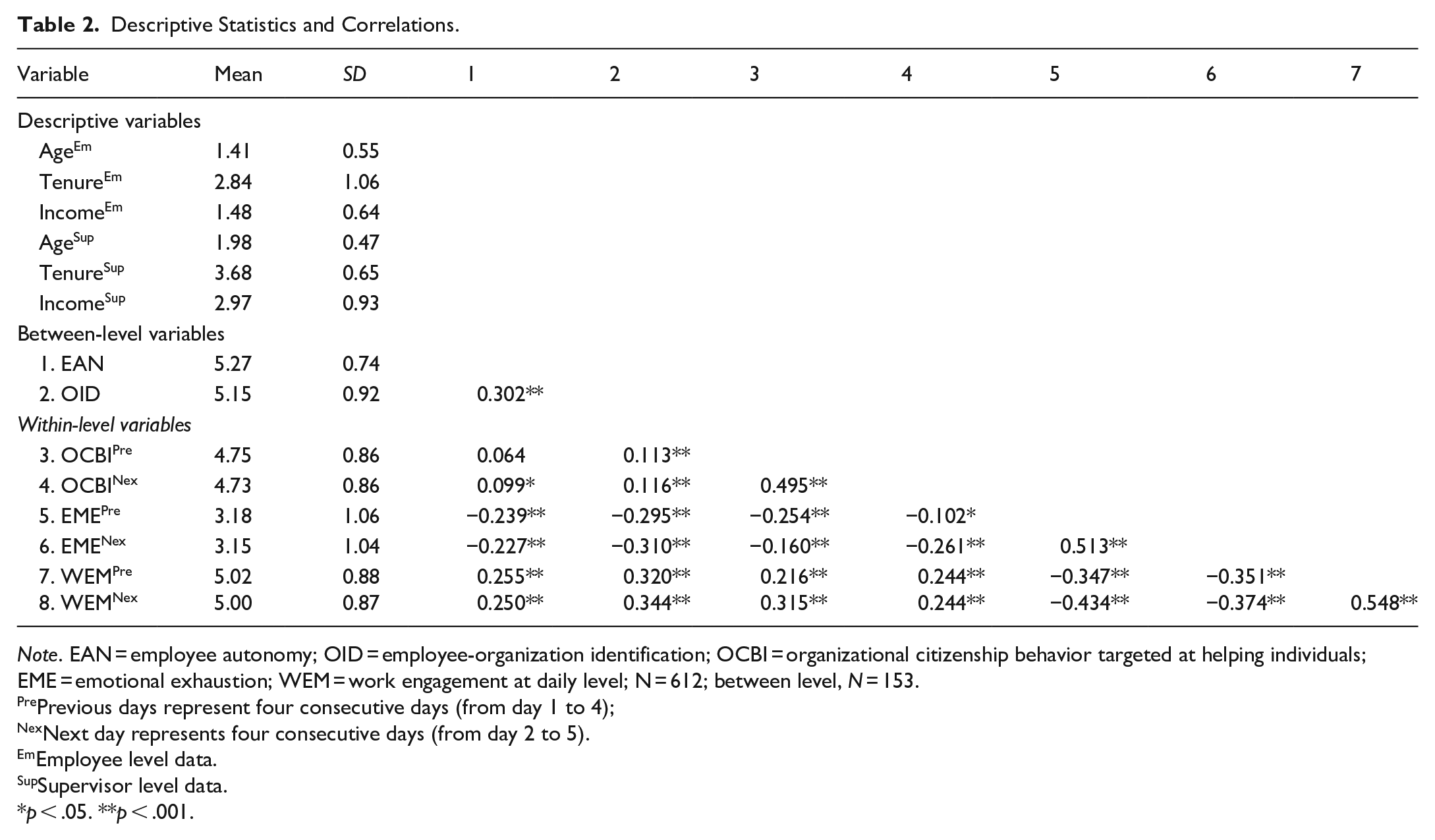
Note. EAN = employee autonomy; OID = employee-organization identification; OCBI = organizational citizenship behavior targeted at helping individuals; EME = emotional exhaustion; WEM = work engagement at daily level; N = 612; between level, N = 153.
Previous days represent four consecutive days (from day 1 to 4);
Next day represents four consecutive days (from day 2 to 5).
Employee level data.
Supervisor level data.
p < .05. **p < .001.
Means, standard deviations, and correlations between five research concepts in this study including employee autonomous (EAN) and organizational identification (OID) at between-person level; and organizational citizenship behavior individual (OCBIPre), emotional exhaustion (EMEPre), and work engagement (WEMNex) at the within-person level, all can be found in Table 2.
To test the discrimination, paired correlation analysis concepts were conducted between research concepts and OCBINex, emotional exhaustion (EMENex), and work engagement (WEMPre). The pairwise correlations between different concepts are quite low (<.4) between investigating concepts. The correlation between three pairs of related concepts including OCBIPre and OCBINex, EMEPre and EMENex, and WEMPre and WEMNex is 0.495, 0.513, and 0.548 respectively. Correlation results below 0.8 show that the degree of discrimination between measurement concepts is acceptable (Rönkkö & Cho, 2022).
Table 3 shows the variance of three daily measurements. The minimum value is 37.87% of work engagement. The highest within-level proportion belongs to emotional exhaustion with 41.98%. It is worth verifying the daily level to bring about the fluctuation of OCBI and workplace emotion. The larger this variance value, the more important it is to study concepts at the individual within-person level (Gabriel et al., 2018; Heck & Thomas, 2020).
Percentage of Within-Individual Variance among Daily Variables.
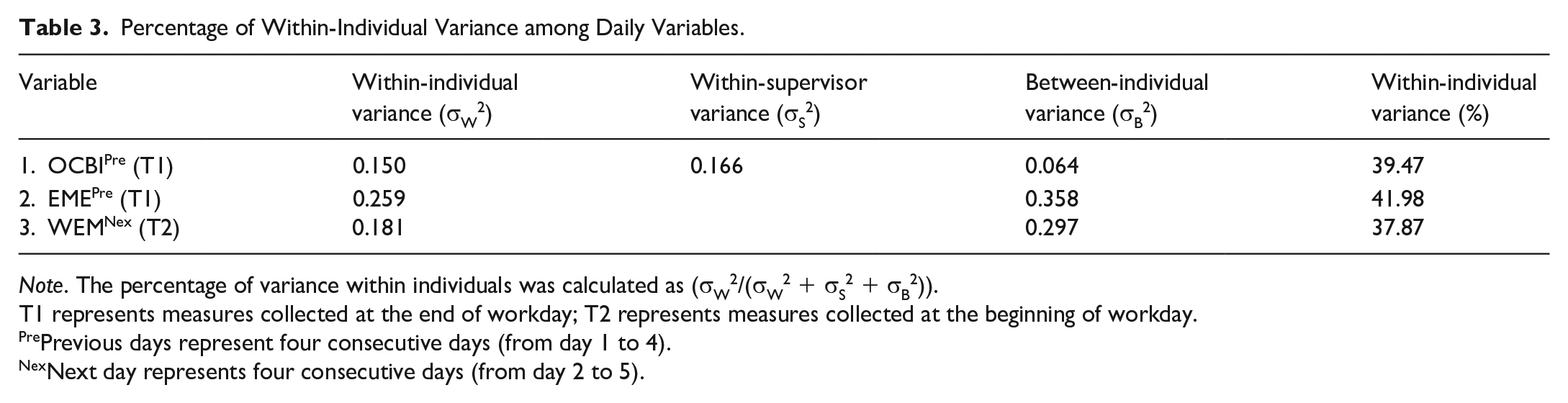
Note. The percentage of variance within individuals was calculated as (σW2/(σW2 + σS2 + σB2)).
T1 represents measures collected at the end of workday; T2 represents measures collected at the beginning of workday.
Previous days represent four consecutive days (from day 1 to 4).
Next day represents four consecutive days (from day 2 to 5).
To assess the dimensionality and discriminant validity of five measures including two between level and three within level, multilevel confirmatory factor analyses (MCFAs) were conducted by Mplus 7.4 (Muthén & Muthén, 2020). Seven models in Table 4 reveals the divergent combination from two factors to five factors with criteria. Out of seven models, the model with five factors is the best fitting one with χ2 = 1,247, df = 707, CFI = 0.917, TLI = 9.12, RMSEA = 0.035, and SRMR = 0.025. The CFI and TFI is good fit because of their values which are over 0.90 (Hu & Bentler, 1999). Aside from CFI and TFI indices, all model evaluation indicators are very good. Furthermore, the results of Multilevel confirmatory factor analysis (MCFA) show that the factors’ conceptual values achieve convergence and discrimination to test the model.
Measurement Models.
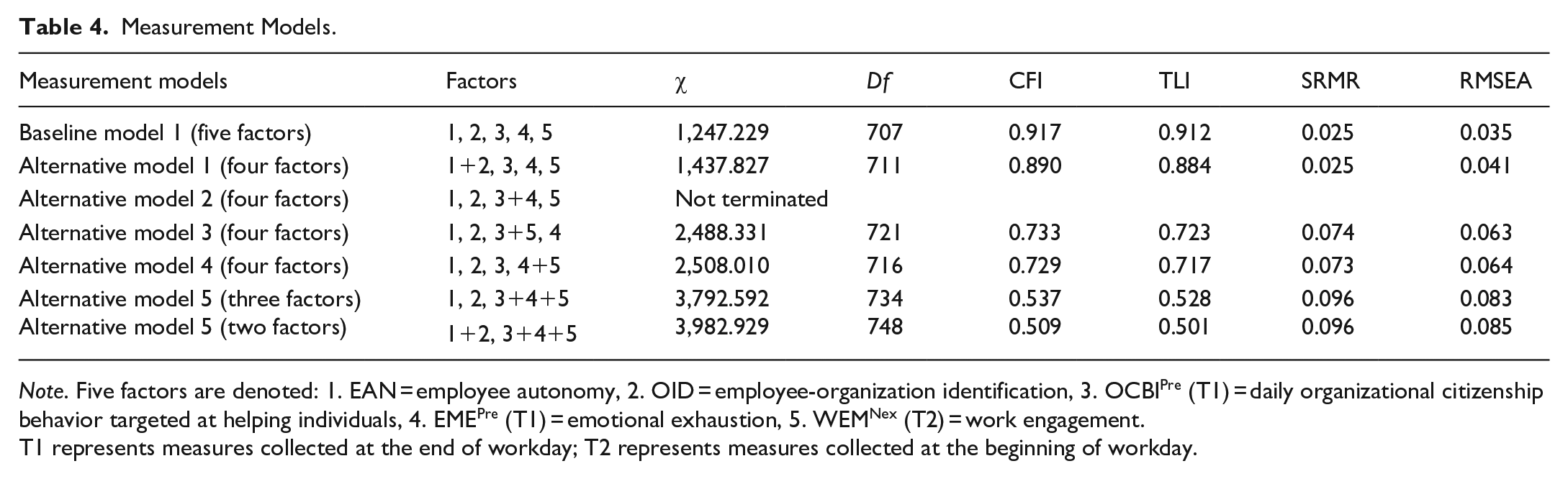
Note. Five factors are denoted: 1. EAN = employee autonomy, 2. OID = employee-organization identification, 3. OCBIPre (T1) = daily organizational citizenship behavior targeted at helping individuals, 4. EMEPre (T1) = emotional exhaustion, 5. WEMNex (T2) = work engagement.
T1 represents measures collected at the end of workday; T2 represents measures collected at the beginning of workday.
Hypothesis testing
Given the nested nature of the study with days nested within employees, nested within managers, we used Mplus 7.4 to test our hypotheses. The results of model testing are presented in Table 5. Person-level variables were centered on the grand mean, whereas day-level variables were centered on the respective mean (Enders & Tofighi, 2007; Hofmann & Gavin, 1998; Lam et al., 2016). To assess the first- and second-order effects of daily OCBI on emotional exhaustion, we used conventional and accepted methods for analysis (Lanaj et al., 2016; Rapp et al., 2013).
Results of Hypothesis Tests of Daily OCBI, End-day Emotional Exhaustion, Next-day Work Engagement, Employee autonomy, and Employee-Organization Identification.
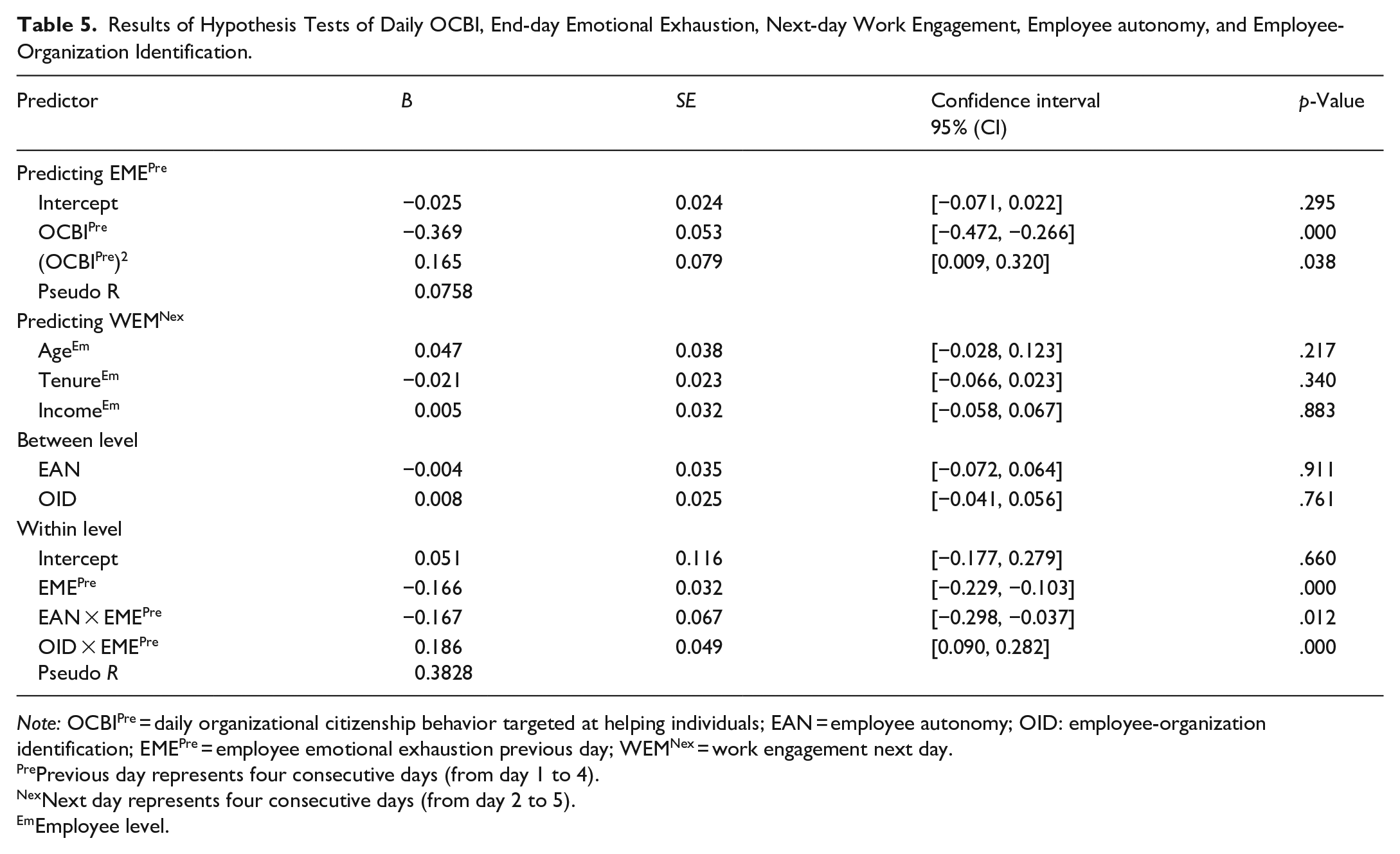
Note: OCBIPre = daily organizational citizenship behavior targeted at helping individuals; EAN = employee autonomy; OID: employee-organization identification; EMEPre = employee emotional exhaustion previous day; WEMNex = work engagement next day.
Previous day represents four consecutive days (from day 1 to 4).
Next day represents four consecutive days (from day 2 to 5).
Employee level.
Hypothesis 1 stated that daily OCBI would have a U-shaped impact on end-day emotional exhaustion. As seen in Table 5, the coefficients of both linear and squared terms of daily OCB are significant, and the coefficient of the linear term is negative (γ = −.369, SE = 0.053, p < .01) while the coefficient of the squared term is positive (γ = .165, SE = 0.079, p < .05). These results provide support for Hypothesis 1. Figure 2 shows the impact indices of OCBI on daily emotional exhaustion including quadratic, first-order, and intercept. It illustrates the potential simultaneous generating and consuming resources capabilities of OCBI participation. Initially, when OCBI levels are low, engaging in OCBI helps reduce emotional exhaustion. However, when the level of involvement exceeds the useful resources achieved, it increases emotional exhaustion.
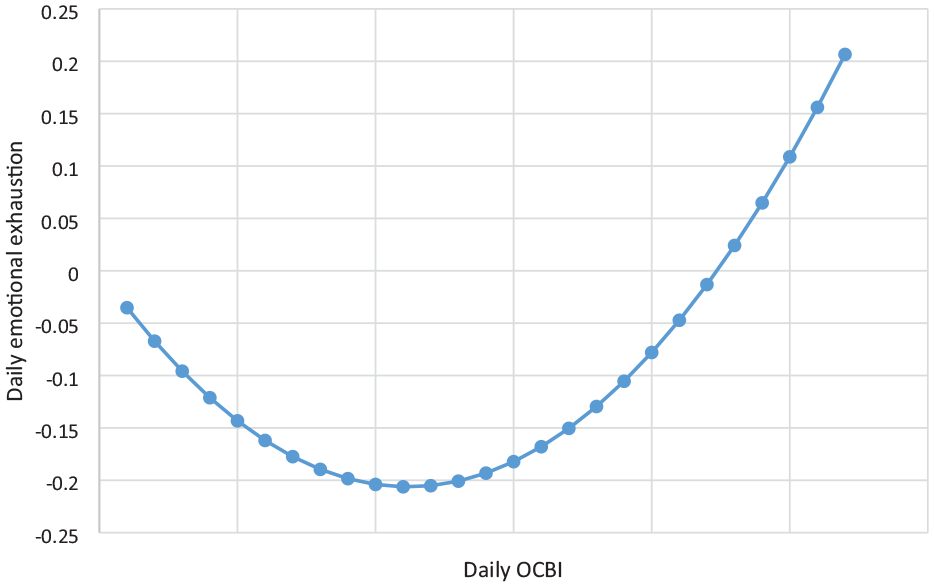
The U-shaped effect of daily OCB on end-day emotional exhaustion.
To test the effect of emotional exhaustion, Hypothesis 2 proposed that previous end-day emotional exhaustion negatively impacts on engagement in next working day. As shown in Table 5, the coefficient of end-day emotional exhaustion is negative and significant (γ = −.166, SE = 0.032, p < .01); thus, providing support for Hypothesis 2. The next two hypotheses investigate the conditioning roles of employee autonomy (H3) and organizational identification (H4) in the daily relationship of emotional exhaustion and work engagement. Hypothesis 3 proposed that the negative effect of end-of-day emotional exhaustion upon next-day work engagement is stronger when employee autonomy is higher. The interaction between end-day emotional exhaustion and employee autonomy was significant and negative (γ = −.167, SE = 0.067, p < .01). This confirms the negative moderating effect of employee autonomy on the effect of previous end-day emotional exhaustion next-day work engagement. Figure 3(a) depicts high and low autonomy and assesses the impact of emotional exhaustion on work engagement. It illustrates the need for caution when granting workers too much autonomy (Dettmers & Bredehöft, 2020). It shows a steeper slope (negative effect) of end-of-day emotional exhaustion on early-next-day work engagement for high-autonomy versus low-autonomy employees.
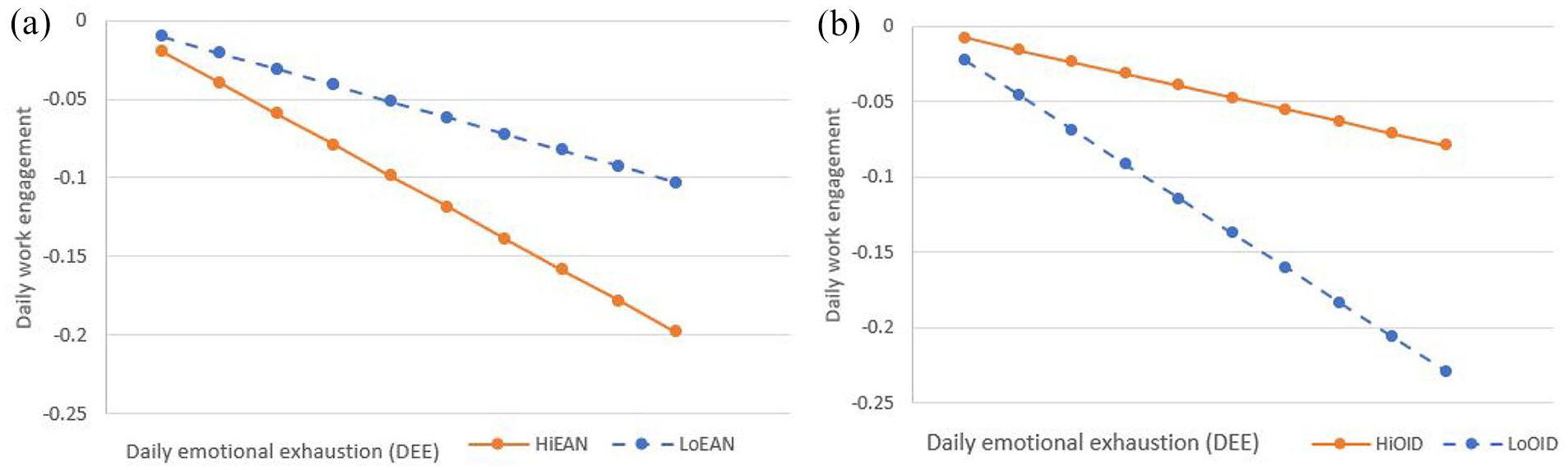
Moderation effects on the end-day emotional exhaustion (EME) and next-day work engagement (WEM) linkage: (a) moderating effects of employee autonomy (EAN) and (b) moderating effects of employee-organization identification (OID).
Hypothesis 4 predicted that the negative impact of end-day emotional exhaustion on next-day work engagement is weaker when employee-organization identification is greater. The interaction between end-day emotional exhaustion and employee-organization identification was significant and positive (γ = .186, SE = 0.049, p < .01). Figure 3(b) depicts high and low organizational identification and assesses the impact of emotional exhaustion on work engagement. Together, these results provide support for Hypothesis 4 about the positive moderating effect of employee-organization identification on the association between end-day emotional exhaustion and next-day work engagement.
Post-hoc analysis
To test the indirect effect of daily OCBI on daily work engagement we followed guidelines by Preacher et al. (2010) and ran model replications to establish a confidence interval. The results from model estimates allow us to conclude, though not predicted, that emotional exhaustion played a complete mediating role in the relationship between OCBI and daily work engagement (γ = .067; SE = 0.017; 95%CI [0.039, 0.096]; p < .01). It was noteworthy that the direct effect of OCBI on work engagement was found to be statistically insignificant (γ = .058, SE = 0.054, p > .1).
To ensure a causal effect of OCBI on emotional exhaustion from days 1 to 4, we tested a model including end-of-day OCBI from days 1 to 4, end-of-day EME from days 2 to 5, and early work engagement from days 2 to 5, and two interpersonal factors, employee autonomy (EAN) and organizational identification (OID). Multilevel CFA analysis shows that results ensure discrimination between concepts to ensure SEM analysis with values such as with χ2 = 1,216, df = 707, CFI = 0.921, TLI = 9.16, RMSEA = 0.034, and SRMR = 0.026. The CFI and TFI are good fit because of their value which are over 0.90 (Hu & Bentler, 1999). Values were also taken as grand-mean centered for daily variables and group-mean centered for inter-individual variables. MSEM analysis results show that there is no correlation between OCBI and emotional exhaustion at linear relation (γ = .077, SE = 0.058, p > .1) as well as curvilinear relation (γ = −.130, SE = 0.090, p > .1). Similarly, there was no correlation between end-of-day emotional exhaustion and corresponding beginning-day work engagement (γ = .03, SE = 0.032, p > .10).
According to previous research, employee autonomy and organizational identification do not exist in isolation and may have an interaction effect (Bell & Menguc, 2002). We conducted post-hoc analysis to investigate whether the interaction between autonomy and organization identification moderates the relationship between end-day exhaustion and next-day work engagement. The analysis showed that the three-way interaction between end-day exhaustion, employee autonomy, and employee-organization identification does not have a significant influence on next-day work engagement (γ = .093, SE = 0.088, p > .10). Such results suggest that when employee autonomy and employee-organization identification interact with each other, such interaction does not affect the moderating effects of end-day exhaustion on next-day work engagement.
Discussion
Using a multilevel and multisource sample, our results revealed that an employee’s daily OCBI has a U-shaped association with their emotional exhaustion, with excessive levels of helping behaviors leading to exhaustion and having a negative effect on next-day work engagement. In comparison with other studies using two or more variables for demonstrating the positive and negative impact of OCBI at the same time but not confirming the transition from positive to negative at a daily level (Aw et al., 2021; Lin et al., 2020; D. Wang et al., 2021), this study goes beyond using just one indicator to demonstrate transition. We also found that the negative association between end-day emotional exhaustion and next-day work engagement is contingent on work autonomy and organizational identification, such that the impact is stronger when employee autonomy is greater and weaker when employee-organization identification increases.
Theoretical implications
The findings of this study advance our theoretical understanding in various literatures. First, our study provides an important contribution to the ongoing debate about the positive and negative effects of OCBI. On one hand, the study confirms that on the daily level, OCBI is beneficial to the well-being of people engaging in the workforce. At lower and moderate levels OCBI decreases emotional exhaustion at the end of the workday. Emotional exhaustion is one of three components that contribute to employees’ well-being (Ilies et al., 2009) as well as their psychological resources (Lin et al., 2020). As a positive interpersonal activity, OCBI fulfils one’s needs for autonomy, meaningfulness, personal reputation (N.-W. Chi & Tu, 2023; Lam et al., 2016; Q. Wang et al., 2023). At appropriate levels OCBI allows employees to feel they are making a difference in others’ lives (Koopman et al., 2016; Weinstein & Ryan, 2010). Our finding is partly consistent with previous studies which argue how citizenship behavior has a beneficial effect on people engaging in OCB (Koopman et al., 2016; Lam et al., 2016; Lin et al., 2020). However, this result is only partially similar to the results of Lin et al. (2020) because it shows that helping behavior not only increases psychological meaningfulness and psychological safety but also increases emotional exhaustion.
Our study extends the helping behavior literature by showing that the bright side of OCBI fades and its dark side emerges when employees’ engagement in OCBI becomes excessive (Lanaj et al., 2016; Rapp et al., 2013). As demonstrated in Figure 2, when daily OCBI surpasses the optimal point, it becomes a burden and a catalyst for stress and work overload (N. Chi et al., 2024). Over workload increases the emotional exhaustion employees experience at the end of the workday. This study contributes to the emerging line of literature which emphasizes the double-sided effects of daily OCB on performance indicators (Le et al., 2011; Rapp et al., 2013). This study also improves on the design of previous research (Koopman et al., 2016) by using supervisors’ ratings of employees’ daily OCB rather than using employees’ own ratings. This improvement can help significantly mitigate concerns of common method variance (Lam et al., 2016).
Second, in the emotional exhaustion literature, our empirical results enrich our understanding of the immediate effect of emotional exhaustion by supporting its significant and negative effect on next-day work engagement. The study confirms the harmful effects of emotional exhaustion in previous research. It increases subsequent voluntary employee turnover (Wright & Cropanzano, 1998) or early retirement intentions (Cui et al., 2023), decreases job performance (Cropanzano et al., 2003), and extra-role performance (Montani & Dagenais-Desmarais, 2018). However, the extant emotional exhaustion literature has little examination into its short-term effect at the daily level. Our study extends previous research by finding that emotional exhaustion, manifested by both physical fatigue and emotionally drained state, in the previous day can hinder employees from work engagement in the next day. The finding adds to the limited research by examining how end-day emotional exhaustion imposes its negative effect on job performance in the next working day (Ferreira et al., 2019). This study is among the first to investigate the lagged effect of emotional exhaustion at the end of workday on next-day work engagement. We believe these findings add to the body of knowledge on conservation of resources (COR) theory by demonstrating how employees spend and use resources and how the impact of their conservation of resources can rapidly change over time.
Third, this study advances our understanding of the role of employee autonomy when confirming its negative moderating role in the end-day emotional exhaustion—next-day work engagement link. Figure 3(a) shows that emotional exhaustion decreases next-day work engagement more when employee autonomy is higher. This result is an important extension to the current literature on autonomy which mostly focuses on how autonomy can bring about such benefits for employees and organizations as greater employee well-being, enhanced creativity, and favorable work attitudes and behaviors (Baard et al., 2004; Doblinger and Class, 2023; Liu et al., 2011; Parker et al., 2001). Our findings provide evidence for the argument about the dark side of autonomy that the lack of constraints by rules can increase employees’ unethical behaviors (Lu et al., 2017). On the other hand, when employees perceive less autonomy to do their assigned tasks, they are aware that they are working under the rules and managerial supervision. In addition, low autonomy reduces the burden of job choice (Dettmers & Bredehöft, 2020). Therefore, they feel less inclined to decrease their work engagement in the next day to get reimbursed for the “lost” resources in the previous working day. This research contributes to the literature on autonomy by being the first study to confirm that at daily level instead of mitigating, job autonomy exacerbates the effects of daily emotional exhaustion. These findings add to the body of knowledge on self-determination theory by demonstrating that employees can engage in self-correction actions (engaging in organizational identity for instance) that can mitigate the effects of exhaustion on next-day work engagement.
Fourth, our study contributes to the organizational identity literature by supporting the contingent effect of organizational identification on the effect of end-day emotional exhaustion on next-day work engagement. Figure 3(b) demonstrates that employee-organization identification positively moderates the effect of end-day emotional exhaustion upon next-day work engagement. When employees have more employee-organization identification, they will feel more attached to the organization (E. S. Lee et al., 2015; Riketta, 2005). With the special connection with the organization, they will be less likely to feel that the organization must compensate for the extra resources that have been drained and have less rationale to reduce their work engagement in the next working day. Furthermore, the high employee-organization identification is a positive resource which offsets the stress and overload caused by emotional exhaustion. This result supports previous findings that organizational identification can act as a buffering factor for reactions to workplace stressors (Decoster et al., 2013). This research extends previous research by confirming the buffering role of employee-organization identification even in the daily effect of previous emotional exhaustion upon next-day work engagement. This study provides a different perspective on building the personal relatedness of employees performing helping behaviors. Harari et al. (2021) and Tai et al. (2023) argued that helping behavior likely turns the relationship between the helper and the recipient to negative relationship.
Finally, this study can be considered the first to examine the nonlinear relationship between OCBI and emotional exhaustion at the daily level in the Vietnamese context. With the characteristics of Confucianism and collectivist culture, helping behavior sometimes becomes the norm and puts great pressure on workers. These expectation pressures may even make workers feel that the drain on positive resources is greater than the loss of resources caused by helping (Koopman et al., 2020). Collectivist culture also appears to be reflected in two variables that moderate the relationship between daily emotional exhaustion and next-day work engagement. Job autonomy conditioned an increase in the negative relationship between emotional exhaustion and work engagement because employees avoid speaking up about the need for rest to restore lost resources. They fear being undervalued, differentiating from their peers, or thinking only of their interests. In contrast, organizational identification energizes employees to overcome exhaustion at the end of the day and to engage in their work the next day. This finding illustrates the negative and positive aspects of the group-first culture in Vietnam.
Practical implications
Our study offers several insights for managers on the impact of end-day emotional exhaustion on next-day work engagement, along with implications on how to provide a nurturing and supportive work environment. First, our study gives a warning about the double-sided effects of OCBI on emotional exhaustion at daily level. When employees engage in OCBI activities, they can experience satisfaction from being able to help others or getting meaningfulness and less emotional exhaustion. However, managers should be mindful and not encourage employees to engage in too much OCBI as it can be harmful to employees’ feelings. This warning is particularly important to line managers in the sense that it implies the effects of OCBI are curvilinear. When the level of OCBI engaged by employees is at an optimal level, its benefits will decline. A recent study found that while OCBI has a positive role in strategy effectiveness, excessive participation in OCBI reduces strategy effectiveness (Riedl & Thomas, 2019). It is hard to identify the optimal level of engaging in organizational citizenship behavior because of the discrepancy in work difficulty, amount of helping time available, and other employees’ interests. However, organizations should be careful to create a culture that encourages people to engage in helpful behavior with respect to individual or departmental work goals.
Second, supervisors should be careful not to let employees get emotionally exhausted at the end of a workday. This study found that when employees feel drained at the end of the workday, the effect of exhaustion can last until the next workday and decrease their work engagement. Such findings confirm the importance of managers paying attention to and supporting their employees’ wellbeing, as the deterioration can have an immediate negative effect on their next-day work performance.
Third, the results also suggest that managers can mitigate the negative effect of employees’ emotional exhaustion on their next-day work engagement by nurturing employee-organization identification. Even when feeling exhausted from work, employees with high organizational identification perceive that the extra efforts they have spent on the organization are spent on themselves as well. Engaging in group bonding, social events, and team building activities all create higher levels of organizational identification. These strategies increase employee oneness with the company and make them more ready to continue work engagement the next day. Supervisors need to pay particular attention to employees with low identification with the organization to make extra efforts to include them in team-oriented tasks, especially if they show signs of emotional exhaustion at the end of the workday. Such employees perceive that the organization owes them the lost resources and they decrease work engagement the next day to get back these resources. Supervisors should create the freedom where workers feel comfortable voicing their opinions about their energy for work.
Limitations and conclusion
The study limitations are unavoidable and should be improved in the future. First, our study only examines the effect of one type of daily OCB (OCBI) on emotional exhaustion at the end of a workday (Kelemen et al., 2023; D. Wang et al., 2021). Previous research confirmed that both OCBI and OCBO are related to the well-being of people who engage in such activities (Kelemen et al., 2023; D. Wang et al., 2021). Therefore, we suggest future research examine whether daily OCBO also has a curvilinear effect on emotional exhaustion at the end of a workday like OCBI. Second, the study is limited in that it only examines the moderating effects of employee autonomy and organizational identification on the emotional exhaustion and next-day work engagement link. Future studies can expand this study by exploring additional moderators for this association based on social influence theory. The influence from colleagues or families likely help employees mitigate the negative effect of end-day emotional exhaustion on their next-day working performance (Cole & Bedeian, 2007). Furthermore, future research could build upon the theory of distributive justice or organizational ethical climate. The extent to which employees are treated justly by the organization moderates the link between emotional exhaustion and next-day work engagement (Sahi et al., 2022). Future research can also extend our findings and explore the curvilinear association between OCBI and emotional exhaustion at daily level in different working environments, across different industries, and in different countries. Indices generated from calculating optimal OCBI levels (Figure 2) could be useful in determining ideal OCBI levels as well as recognition when such levels have been exceeded. We also encourage future research to extend our study by exploring other moderators for the OCBI-emotional exhaustion link and for the end-day emotional exhaustion—next-day work engagement link.
Footnotes
Appendix
OCBI adapted from Lee and Allen (2002)
Emotional exhaustion adapted from Maslach and Jackson (1981)
Work Engagement adapted from Bledow et al. (2011)
Job autonomy adapted from Chan and Lam (2011)
Organizational identification adapted from Mael and Ashforth (1992)
Declaration of conflicting interests
The author(s) declared no potential conflicts of interest with respect to the research, authorship, and/or publication of this article.
Funding
The author(s) received no financial support for the research, authorship, and/or publication of this article.
