




Abstract
Innovation has traditionally been studied under a goods-dominant (G-D) logic perspective, focusing on product designs and innovations in production, manufacturing, and traditional value chain functions. However, with the development of information technologies and the increasingly competitive business service environment, a services-dominant (S-D) logic has emerged, emphasizing relational interactions among network stakeholders (e.g. partners, suppliers, and customers). Using a services-dominant (S-D) logic perspective coupled with a resource-based perspective, this study examines how resources and capabilities influence innovative strategy, leading to enhanced innovative performance. Employing 200 valid survey data using questionnaires from firms located in Vietnam, this study confirms that basic operant resources and dynamic capabilities significantly affect firms’ innovation performance either directly or indirectly through a mediation effect of S-D logic orientation.
Introduction
Innovation is one of the most important factors that drive firm growth and improvement (Darroch, 2005; Ngo & O’Cass, 2013). Scholars and practitioners for years have shown particular interest in applying a dominant logic perspective to explain innovations and innovative success (Carlborg et al., 2014; Mele et al., 2014; Rubalcaba et al., 2012). Dominant logic refers to a mental set or cognitive orientation that is acted by scholars and practitioners. This innovation follows a sequential and distinguishable process of idea generation, idea assessment, design, testing, validation, and market launch (Gupta et al., 1986; Knight, 1967; Utterback & Abernathy, 1975).
Over the past few decades, innovation has been conceptualized and implemented under a goods-dominant logic (G-D logic), which focuses on a traditional manufacturing perspective that views innovation as a new good that has been assembled with new embedded values that can be delivered to customers (i.e. value-in-exchange; Vargo & Lusch, 2004a). Many authors saw this innovation process as internal and fully controlled by the firm, while the innovative products or outputs are the end-product of this innovation process from a marketing perspective (Mele et al., 2014). This meant innovation was fully controlled and managed by firms using tangible resources, such as technology, patents, and financial resources (Mele et al., 2014). The locus of innovation both in terms of idea generation and new product/service development, remained strictly inside the company itself (Mele et al., 2014). Customers had very limited control of or participation in this innovation process and acted primarily as the final recipients of innovation (Ordanini et al., 2011).
The perspective of innovation under G-D logic, while dominant in the past; has become less relevant in recent years due to several key factors, such as rapid development of information and communication technologies, higher engagement with customers/stakeholders, rising market collaboration, and increasing market competition. Specifically, under such a competitive business environment, new technologies, especially new information and networking technologies, have blurred the boundaries between individual value network members so that firms can no longer be an actor in innovative products or services. Instead, collaboration among companies, customers and stakeholders is required essentially to sustain innovation (Ebner et al., 2009; Von Hippel, 2005). This means that innovation results from close collaboration among actors to jointly enhance value delivery in the innovation process (Vargo et al., 2008). The trend of customer co-creation in innovation and customer engagement in products or service delivery suggests that customers and other stakeholders are not outside the innovation process anymore (Verma et al., 2012; Romero & Molina, 2011). The inclusion of innovations in the broader framework of supplier-customer relationships has been acknowledged by scholars such as Cantista and Tylecote (2008).
Under an S-D logic perspective, service is the central mechanism of any economic exchange, while products under the traditional G-D logic are merely an appliance and distribution mechanism of services (Vargo & Lusch, 2004a, 2008a). The S-D logic signifies a fundamental change in the underlying framework for comprehending exchange rather than a change in the focus of the specific output being examined (Akaka et al., 2019). The rise of S-D logic and analogous service-driven approaches has brought to light the potential for “service-oriented models of value generation and innovation to not only offer more substantial advancements in service innovation but also to enhance our comprehension of innovation as a whole.” Furthermore, these models have the potential to shed light on the processes of market formation and re-formation (Hansen, 2019). Service innovation is an outcome of a network process that requires the co-involvement of customers, competitors, suppliers, and all other relevant stakeholders (Russo-Spena & Mele, 2012). Value, by contrast, is not added throughout the manufacturing process but is co-created by customers, firms, and other actors and assessed by actors in this context (Skålén et al., 2015). Unlike G-D logic, which argues innovation as an end product of the innovation process based on tangible resources (Ordanini et al., 2011), S-D logic suggests that the innovation process largely depends on the deployment of intangible or operant resources and capabilities in a dynamic environment (Ordanini et al., 2011; Vargo & Lusch, 2004a).
While S-D logic seems to be more relevant than G-D logic in explaining products and services innovation dynamics in such a competitive and changing business environment (Michel et al., 2008), most current research adopts a G-D logic framework in explaining factors and processes that determine the innovation success (Miozzo & Soete, 2001; Rothwell, 1992; Verganti, 2009). Results from this stream of innovation research are inconclusive and mixed due to the dynamic nature of factors of innovation success in such a competitive and rapidly changing business environment, such as R&D investment and patents (Berchicci, 2013, Shefer & Frenkel, 2005), customer orientation (Atuahene-Gima, 1996; Salomo et al., 2003), innovation orientation (Siguaw et al., 2006; Simpson et al., 2006), and knowledge management mechanisms (De Luca & Atuahene-Gima, 2007). Chandler et al. (2019) raised a concern using service-dominant logic with innovation research to display the systemic process that allows innovation to occur in the scope of a service ecosystem, which has received less attention from an empirical perspective.
Our intended contributions are revealed based on gaps from two research strands that the current research mainly belongs to. The first strand is related to the significant resource-based concept under the S-D logic background. The S-D logic framework places significant emphasis on the meticulous configuration of resources (Yu et al., 2019). The resources discussed in this service provision are derived from two types of resources: operant resources, which are resources that exert an influence on other resources to generate benefits, such as human skills, knowledge, and competencies, and operand resources, which are resources that need to be acted upon in order to be beneficial, such as natural resources, goods, and money (Ngo & O’Cass, 2009). The S-D logic proposes the perspective of considering the customer as an operant resource, which refers to a resource that possesses the ability to influence and interact with other resources. In this framework, the customer is seen as a collaborative partner who actively participates in the value-creation process alongside the firm (Vargo & Lusch, 2004b). Value creation is widely acknowledged as a collaborative process involving the joint efforts of numerous partners in a co-creative manner, and goods in and of themselves are no longer the primary means of generating value (Kryvinska et al., 2013).
It can be theoretically observed that S-D logic emphasizes the significance of resources in value co-creation, notably through its actors as resource integrators perspective (Ajmal et al., 2023). The definition of S-D logic of operant resources (e.g. resources that act on other resources to create value, such as knowledge and skills) resembles dynamic capabilities that work with other resources and capabilities to create value by sensing and seizing opportunities and redeploying and reconfiguring a company’s resource base (Teece et al., 1997; Wilden & Gudergan, 2015). A successful S-D logic-informed strategy is contingent on a company’s capacity to cultivate ongoing, dynamic, cooperative relationships that facilitate access to and integration of resources, resulting in new resources (Lusch & Vargo, 2014d). Theoretical analysis by Wilden et al. (2017) suggests that resource-based concepts have become less significant in recent years of S-D logic thought. The author also suggests that future research should combine S-D logic and the study of dynamic capabilities (an evolution of the resource-based view). From a broader view of innovation, S-D logic moves from causation, a linear approach, to a more relational, dialogical one (Barrios et al., 2023). However, there is very little empirical evidence regarding the relationship between various types of resources and S-D logic. In addition, the distinction between operand and operant resources, as well as how resource integration influences value co-creation under the S-D logic framework, remains essential (Ghatak, 2020). There, it comes to the first question under S-D logic background: “Do operant resources affect S-D logic orientation?”.
The other strand refers to the implication of S-D logic orientation for innovation performance. The field of service innovation research has experienced significant transformations as a result of a transition from an emphasis on internal innovation resources and capabilities to a perspective that prioritizes networks or ecosystems (Frey et al., 2019; Häikiö & Koivumäki, 2016). As a pioneering perspective of innovation management in the value co-creation process, Blazevic and Lievens (2008) provided insights on how to manage innovation in the context of customer participation and how this participation influences the value co-creation process. According to the literature (Michel et al., 2008; Vargo & Lusch, 2008b), the level and adoption of the S-D logic of an organization contribute to the company’s innovative capability. For instance, Lusch and Nambisan (2015) proposed that S-D logic orientation results in service innovation because S-D logic orientation can contribute to the three essential aspects of service innovation, namely the service ecosystem, the service platform, and value co-creation. Lusch et al. (2007) postulated that a company’s S-D logic orientation can boost innovation performance because it emphasizes collaboration and coordination. More recently, Yiu et al. (2020) disclosed that service-dominant oriented firms’ high innovation performance is a result of their partner relationships’ learning. This indirect effect of S-D logic orientation on innovation performance motivates the testing of the neglected direct effect between the two variables. However, this study did not empirically examine the connection between S-D logic orientation and innovation performance. From a different view using the S-D logic framework, M. Li et al. (2022) found that firms’ S-D orientation positively influences customer participation behaviors through customer psychological need satisfaction. According to Xie et al. (2021), consumers and service users play a significant role in facilitating a firm’s service innovation through the provision of their creative ideas. Additionally, Åkesson et al. (2016) suggest that customers and service users contribute to a firm’s service innovation by proposing ways to integrate new services into current service ecosystems. While there has been theoretical discourse on the potential competitive advantage that enterprises might gain through the adoption of the S-D logic, there remains a lack of empirical investigation into the relationship between S-D orientation and service innovation performance (Yiu et al., 2020). Under the S-D logic framework, the second question is raised: “Does S-D logic orientation have an impact on innovation performance?”.
Drawing from the above-said arguments on two research strands, one should point out that while the S-D logic has been discussed as an alternative perspective to explain the process and success of innovation, most past research purely focused on conceptual development, but few empirical studies have been conducted to explore and validate the concept of S-D logic and its application in innovation research (e.g. Ordanini et al., 2011; Yiu et al., 2019).
Moreover, companies’ abilities in managing operant resources and capabilities are the fundamental basis for establishing and developing an S-D logic of innovation (Vargo & Lusch, 2004a) and service innovation can be a strength when value creation activities integrate resources (K. Nam & Lee, 2010). In addition, the progression of marketing toward a service-dominant logic necessitates a concentration on intangible and dynamic resources, which are central to competitive advantage and performance (Lusch & Vargo, 2004, 2014b). Hollebeek and Andreassen (2018) highlight the significant contribution of organizational resources in facilitating service innovation. These resources are crucial in interacting with various players involved in service innovation, such as consumers and employees, hence leading to the development of effective service innovations. These critical perspectives, along with limited empirical evidence on S-D logic orientation—resources nexus and S-D logic orientation—innovation nexus, give rise to empirically and comprehensively integrating the two above strands by testing the link among resources, S-D logic orientation, and innovation performance in the current study.
One of the dimensions of service innovation suggested by Hertog (2000) is typically new customer–firm interface. Additionally, Lin (2013) argues that no matter what kind of innovation inputs (human resource input, ICT input, etc.), they would play their role through this dimension (among others). This perspective shows the implication of resources for innovation performance. The S-D logic framework conceptualizes innovation as the integration of dynamic resources that are both innovative and helpful. It emphasizes the significance of institutionalization as a crucial catalyst for driving innovation (Kaartemo et al., 2018). However, there is somewhat insufficient understanding of a certain factor translating the impact of operant resources on a firm’s innovation performance. Therefore, this integrated (connected) perspective of two research bodies can shed light on the mediator role of S-D logic orientation in shaping the relationship between a firm’s resource types and innovation.
Therefore, by adopting an integrated approach under the S-D logic framework, the overall objectives of this study are to examine the effects of firms’ operant resources, dynamic capabilities innovation performance, and business performance and to investigate whether these nexuses are moderated by S-D logic orientation. By doing so, this research contributes to the current literature in the following ways. First, it empirically examines the innovation of products and services from an S-D logic perspective and demonstrates the applicability of S-D logic in explaining innovation success. By doing so, it extends the innovation literature from an S-D logic perspective and also provides empirical evidence to validate the S-D logic approach. Second, this study provides an integrated approach by examining the roles of firms’ operant resources, S-D logic orientation, and firm innovation performance in affecting a firm’s performance in general. By doing so, it systematically examines how different types of firms’ resources and capabilities would facilitate innovation processes and how they would prompt firms’ S-D logic orientation. Last, this study provides further empirical evidence to support the applicability of the S-D logic approach in explaining firms’ innovation processes and success in a developing and emerging economy.
The rest of the paper is organized as below. First, the conceptual foundations of S-D logic and firms’ resources and dynamic capabilities are discussed, and hypotheses of the proposed model are discussed. Next, the methodology of the study is described, and results from the analysis are presented. Finally, a discussion of the study and its theoretical, empirical, and managerial implications are offered.
Conceptual background and hypotheses
Innovation and S-D logic
It is usually observed that innovation is a systemic, formal, and technology-driven process that consists of several sequential and distinguishable stages, including idea generation, idea assessment, design, testing, validation, and market launch (Gupta et al., 1986; Knight, 1967; Utterback & Abernathy, 1975). This process is internal and fully controlled by firms, while new products or services are the output of this process (Mele et al., 2014). In this structured view of the innovation process, service is a special kind of good that is value-embedded and delivered to either the customers or other stakeholders who have little impact in shaping the value of services (Vargo & Lusch, 2008a).
While this view of innovation was popular in the last century, it has become more irrelevant given the rapid development of information communication technologies (Russo-Spena & Mele, 2012). Customers and other stakeholders can easily be involved and engaged in the innovation process through new technologies and communication mediums (Mele et al., 2014). Customer co-creation and co-innovation have become prevalent practices among many technology companies or even traditional manufacturing companies (Lee et al., 2012; Verma et al., 2012). The S-D logic captures this trend of innovation and redefines innovation from a dynamic value co-creation perspective (Vargo & Lusch, 2008a). The transition from a goods-dominant logic to a service-dominant logic can be explained as follows: “process is informed between understanding the purpose as selling things to people and understanding it as serving the exchange partner’s need” (Lusch & Vargo, 2014c). This transition can define the innovation process from the S-D logic perspective. Hence, the potential of service-dominant logic as a framework for explaining innovation processes is considered (Huarng et al., 2018). This new conceptualization of service innovation based on service-dominant logic emphasizes the central role of social system actors. These actors create changes in structures that are articulated in novel ways, allowing actors to co-create value (Edvardsson & Tronvoll, 2013; Koskela-Huotari et al., 2016).
This approach suggests that innovation is not just a formal process that is technology-driven but rather is a process of re-bundling of diverse resources with the efforts of all partners in the value network to create novel resources (Lusch & Nambisan, 2015). Customers, together with other stakeholders, contribute to the innovation process by reshaping the value network (Mele et al., 2014). Innovation is no longer an extraordinary event but a continuous and systemic process that results from a deep interaction and coordination among all the value network partners (Skålén et al., 2015). This innovation process is not only limited to services but also can apply to tangible goods, as goods are the physical bundle of values that are co-created throughout the value creation network (Ordanini & Parasuraman, 2011). This implies that innovation is not about inventing objects but instead developing systems for the co-creation of value (Vargo & Lusch, 2017).
In addition, Shaw et al. (2011) suggest the critical importance of implementing the value creation process from the producers’ perspectives as being linked to the principles of designing the customer experience through the innovation process, which could be significantly strengthened by the co-creation processes embedded with S-D Logic. Customers are co-creators of value in the sense that the supplier can only make a value proposition, while the customers (i.e. beneficiaries) must use the offering to determine the emergent value (Hartwig et al., 2021).
S-D logic orientation
A service-dominant (S-D) logic orientation describes a concept that service is the central core of all business exchanges and all the business stakeholders, including customers, firms, and suppliers, co-create in the process of service (Vargo & Lusch, 2004a). Therefore, unlike good-dominate (G-D) logic orientation, which emphasizes the role of firms in delivering and proposing “values” to the customers via products or services, S-D logic proposes that values are co-created by all stakeholders involved in the value creation process and that a firm’s competitive advantage lies in its capability in enhancing and facilitating the value co-creation process (Karpen et al., 2012).
The S-D logic, proposed as a substitute for the G-D logic, is a conceptual framework that enables organizations to see and comprehend the intricacies of the business environment from a service-oriented perspective (Williams, 2012). The reasoning presented in this argument principally aims to reconcile the conventional differentiation between products and services based on their provision of benefits (Lusch & Vargo, 2014b). According to the S-D logic, service is conceptualized as the utilization of specialized competencies, encompassing knowledge and abilities, with the intention of benefiting another entity, as opposed to the mere production of quantifiable output from the G-D logic view (Vargo et al., 2010; Vargo & Lusch, 2004b). In essence, the term “service” refers to the act of performing a task or providing assistance to another individual. It encompasses a set of procedures that constitute the act of offering a service (K.-C. Nam et al., 2008). The S-D logic introduces a revised interpretation of service, hence redefining the process of value generation.
From this point of view, the traditional G-D logic became irrelevant, while a more service-focused and relation-embedded S-D logic seems to be more predominant in explaining and guiding the innovation process. Under S-D logic, service is the central element of business exchange, while innovation resides in the continuous interaction among the network partners, including customers, suppliers, competitors, and other stakeholders (Vargo & Lusch, 2008a). Value is not added throughout the process but rather co-created along with the continuous interaction among all the partners (Vargo & Lusch, 2004a).
According to Karpen et al. (2012), S-D logic orientation refers to a capability or skill portfolio that enables a firm to co-create value in products or services exchange with other stakeholders involved in the value-creation process, including customers, suppliers, or employees. The ability to facilitate and enhance value co-creation, therefore, largely depends on the capability of managing and enhancing interactions among key stakeholders (Ballantyne & Varey, 2006). In other words, to enable S-D logic in managing and delivering values, S-D logic orientation must provide a set of interaction capabilities that facilitate and enhance the reciprocal integration of value co-creation resources (Karpen et al., 2015). Specifically, there are six different types of interaction capabilities that are defined: individuated, relational, ethical, empowered, developmental, and concerted interaction.
Individuated interaction capability refers to an organization’s ability to “understand the resource integration processes, contexts, and desired outcomes of individual customers and other value network partners” (Karpen et al., 2012). It is crucially important to understand customers individually in terms of their resource integration goals, usage, preferences, experiences, and/or requirements (Karpen et al., 2012) in order to better co-create values since the values of customers are individually determined and subjectively measured (Lusch & Vargo, 2014a). Therefore, customers must be measured and served at the individual level rather than an aggregate level following the S-D logic (Hoekstra et al., 1999). A recent movement from mass marketing or segmented marketing to individual marketing implicates such a trend (e.g. Arora et al., 2008; Y. Chen et al., 2001).
Relational interaction capability refers to an organization’s ability to facilitate and enhance social and emotional connections with customers and other stakeholders (Karpen et al., 2012). According to S-D logic, all exchanges are relational (Vargo & Lusch, 2004a). However, customers will not be forced to enter into an unwanted relationship with firms; they will, however, be willing to participate and further a relationship if they feel comfortable doing so (Lusch et al., 2006). Therefore, unlike relationship management strategies under the G-D logic, which primarily focus on the control of customer relationship management by firms, according to S-D logic, the firm’s role is to facilitate conversation and provide a comfortable psychological context for ongoing value co-creation (Schneider & Bowen, 2010). Relational interaction capability under S-D logic requires firms to become the catalyst in prompting ongoing conversations and facilitating engagement with their customers during the value co-creation process (Kumar et al., 2010).
Ethical interaction capability refers to an organization’s ability to act fairly and ethically toward its customers and other value co-creators in the value-creation networks (Karpen et al., 2012). From an S-D logic perspective, customers, firms, and other stakeholders are all equitable contributors to value co-creation (Lusch et al., 2006). Therefore, being honest and ethical will foster valued customers and other stakeholders to build up trust with the firm, which will, in turn, encourage customers and other stakeholders to continue engaging in the value co-creation process (Bejou et al., 1998). Scholars generally agree that firms that behave honestly and ethically with customers will have a healthy relationship with customers (e.g. Bejou et al., 1998; Román, 2003). Several studies have criticized unethical marketing practices, including unethical sales behavior (M.-F. Chen & Mau, 2009), unfair pricing strategy (Matute-Vallejo et al., 2011), and/or opportunistic behaviors (Blois, 1996), that discourage customers from continuing their relationship with firms.
Empowered interaction capability refers to an organization’s ability to empower customers and other value co-creators in shaping the nature and content of exchange (Karpen et al., 2012). Under the S-D logic perspective, customers are no longer passive recipients of services or products that are produced at the end of the value chain but are also a source of operant resources who carry knowledge and skills for shaping the value delivery network (Vargo & Lusch, 2008a). However, under a traditional G-D logic, the participation of customers in the process of value delivery is limited as customers are not empowered (Karpen et al., 2012). To better utilize this knowledge or resources, it is critically important to empower customers and engage them for mutual benefit (Normann & Ramirez, 1993). Customer engagement may include various activities during the process of value delivery, ranging from giving opinions and comments to controlling and shaping the final output (Ordanini et al., 2011). Therefore, firms need to institutionalize their approaches that aim to get customers or other stakeholders involved and engaged during the value-creation process (Fuchs & Schreier, 2011). As a consequence, the empowered interaction capability allows firms to absorb new knowledge and resources from their business partners during an outside-in process and improve their overall value delivery capability (Lusch et al., 2007).
Developmental interaction capability refers to an organization’s ability to help its customers and other stakeholders in developing their own knowledge and capabilities (Karpen et al., 2012). Since knowledge and information from customers and other stakeholders are important for firms to co-design and co-produce products or services (Karpen et al., 2012), it is also important to have their knowledge and skills developed and updated (Vargo & Lusch, 2008a). Companies not only create value through designing and making better products or services but also motivate their customers to create and develop better knowledge so that they can create more value for themselves (Normann & Ramirez, 1993). For instance, in the new product development process, customer knowledge development fosters new product/service success (Joshi & Sharma, 2004). Apple regularly provides sessions to their users, such as photo-taking, video, and coding sessions, helping them improve their skills and knowledge of using Apple products. While empowered interaction capability is an “outside-in” strategy that absorbs knowledge from customers and other stakeholders, developmental interaction capability is an “inside-out” strategy aiming at improving the skills and knowledge of external partners (Karpen et al., 2012).
Concerted interaction capability refers to an organization’s capability to integrate and coordinate service processes with customers and value network partners (Karpen et al., 2012). From an S-D logic perspective, all value network partners, including customers, possess valuable resources, including knowledge and skills, that can shape the value actualization process (Vargo & Lusch, 2008a). Meanwhile, network partners need to coordinate and collaborate deeply to better deploy capabilities for the whole value network (Vargo & Lusch, 2008a). Therefore, firms need to be capable of coordinating those interactions and synchronizing multiple platforms so that network partners can interact with and integrate resources with minimum effort (Karpen et al., 2012). By achieving this capability, the whole value network can benefit from a more integrated value actualization system, a more dynamic value creation network, and a more flexible innovation process (Karpen et al., 2012).
Operant resources and dynamic capabilities
From a resource-based view (RBV), a firm’s resources comprise both tangible and intangible assets that are valuable, rare, costly to imitate, and non-substitutable (Barney et al., 2001; Wernerfelt, 1984). Studies have found that a firm’s resources are the sources of competitive advantage over other competitors and sustain long-term growth and business performance (Peteraf, 1993; Ray et al., 2004; Richard, 2000). Taken a step further, RBV theory argues that resources can be grouped into two main categories: operand resources and operant resources (Madhavaram & Hunt, 2008). Operand resources are typically physical (e.g. goods, plant, and equipment), financial (e.g. cash), and legal (e.g. patents), while operant resources are more intangible, flexible, and hard to be imitated and substituted (Madhavaram & Hunt, 2008; Vargo & Lusch, 2008a). Madhavaram and Hunt (2008) further clarify operant resources into three hierarchical levels of resources: basic, composite, and interconnected operant resources. They argue that operant resources are more dynamic and interconnected, which makes them hard to imitate, acquire, and develop by their competitors.
Operant resources encompass various elements, including human resources (such as the skills and knowledge possessed by individual employees), organizational resources (such as controls, routines, cultures, and competencies), informational resources (such as knowledge about market segments, competitors, and technology), and relational resources (such as relationships with competitors, suppliers, and customers; Hunt, 2004). Similarly, Madhavaram and Hunt (2008) also show that there are four different types of basic operant resources, including human (e.g. skills or knowledge of employees), informational (e.g. knowledge of customers and other stakeholders), relational (e.g. coordination with suppliers/customers), and organizational (e.g. organizational culture; Madhavaram & Hunt, 2008). Based on both perspectives, four sub-items of core operant resources are employed in the current testable model: human, organization, information, and relation.
These types of basic operant resources are the building blocks of a firm’s portfolio of operant resources, which form more complex and highly contextual composite and interconnected operant resources. Composite and interconnected operant resources are hierarchical resources, which are the combination of two or more distinct low-level basic operant resources that collectively enable firms to produce efficient and effective market offerings (Madhavaram & Hunt, 2008). The difference between composite and interconnected operant resources is the level of interactivity: composite operant resources have a relatively lower interactivity, while interconnected operant resources have a higher level of interactivity with other operant resources (Madhavaram & Hunt, 2008). For more details, composite operant resources can be defined as a combination of two or more separate basic or higher-order operant resources. These resources work together to enable a firm to efficiently and effectively develop market offerings that are highly valued. Acquiring and developing these resources pose a moderate level of difficulty, and their formative measurement can be achieved by a combination of resource A, resource B, and resource C. In the context of organizational resources, the term “interconnected operant resources” pertains to the integration of multiple fundamental or advanced operant resources. These resources, when combined, interact, and mutually support one another, hence facilitating the firm’s ability to generate market offerings that are both efficient and effective. Acquiring and developing these resources can pose challenges, and their measurement can be approached in two ways: as a first-order factor, including individual resources, or as a network of interactions that explore how resources interact and mutually reinforce one another.
Within the framework of the S-D logic, ideas such as competencies, capabilities, and dynamic capacities can be regarded as operant resources. According to Ngo and O’Cass (2009), capacities can be understood as higher-order resources, as they encompass bundles of fundamental resources. For more details, capabilities can be described as intricate and interconnected combinations of tangible resources, such as machinery, computer software and hardware, and intangible resources, such as organizational policies, procedures, and the skills, knowledge, and experience of employees. These resources work together in a synergistic way to enable firms to efficiently and effectively produce market offerings that are valued (Ngo & O’Cass, 2009).
Zollo and Winter (2002) show that a dynamic capability can be defined as an acquired and enduring pattern of collective behavior that enables an organization to consistently develop and adapt its operational routines with the goal of enhancing overall performance. Nenonen et al. (2018) define dynamic capabilities as a specific instance of operant resources that serve as the foundation for the institutional activities carried out by actors. A firm’s dynamic capabilities are the most important high-level operant resources. Teece et al. (1997) define dynamic capabilities as a complex and high-level capacity that allows reconfiguring, integrating, and building internal and external resources to address the rapidly changing business environment. Zahra et al. (2006) state that dynamic capabilities are hard to imitate and costly to acquire. Based on the definition provided by Madhavaram and Hunt (2008), capability can be classified as dynamic if it allows a firm to adapt and adjust itself in order to consistently and efficiently develop market offerings for the specific market segment(s), particularly in highly dynamic and fast-changing contexts.
D.-Y. Li and Liu (2014) further comment that there are three different types of dynamic capabilities, which are strategic sense-making capacity, timely decision-making capacity, and change implementation capacity. First, the strategic sense-making capacity refers to the cognitive process of constructing mental representations, known as cognitive maps, in order to perceive and interpret stimuli or changes within reference frameworks. This skill enables individuals to efficiently gather and analyze information from both internal and external environments (Neill et al., 2007; Pandza & Thorpe, 2009). The fundamental purpose of business is to generate profits through the provision of products or services that satisfy the demands of customers. Hence, it is imperative for organizations to exhibit a heightened awareness of external environmental dynamics in order to identify emerging market prospects and potential risks. Consequently, the ability to effectively interpret and comprehend these strategic cues becomes a critical organizational capability for ensuring company longevity amidst a dynamic and evolving business landscape (Zahra & George, 2002). Considering the internal environment, the ability of enterprises to make strategic sense aids in identifying the strengths and weaknesses of existing resource bases, hence facilitating the enhancement of asset orchestration (Helfat et al., 2009). Based on a complete examination of environmental change and the current resource base, enterprises are able to develop a deeper understanding of their own operations as well as those of their competitors.
Second, the ability to make timely decisions refers to the process of rapidly formulating, evaluating, and selecting strategic directions in order to adapt promptly to changes in the environment (Sharfman & Dean, 1997). In order to ensure that decision-making is in line with the dynamic nature of the environment, organizations should establish a suitable information system, whether tangible or intangible, utilizing information technology. This system will serve as an efficient platform for prompt and accurate decision-making, enabling timely adjustments to operational activities and staff conduct (Sher & Lee, 2004). Moreover, it is imperative for organizations to promptly address various conflicts that arise during the strategic decision-making process and implement swift solutions to address customer dissatisfaction.
Third, change implementation capacity refers to the organizational ability to effectively carry out and manage strategic decisions and corporate changes. This encompasses a range of managerial and organizational procedures, which may vary based on the specific objectives and tasks at hand (Harreld et al., 2007; Helfat et al., 2009). Similarly, firms with a strong change implementation capacity can quickly respond to changes, including opportunities and threats, through resource development, configuration, and acquisition (Lavie, 2006).
Hypotheses
This study begins by hypothesizing that basic operant resources have a positive nexus with dynamic capabilities. From the S-D logic perspective, it is argued that a firm’s basic operant resources determine a firm’s dynamic capabilities, both of which affect a firm’s S-D logic orientation. Operant resources are essential to the firm’s S-D logic orientation, which requires continuous investment (Vargo & Lusch, 2008a). Operant resources can also be classified into two broad sub-types: the basic operant resources and the higher-order operant resources (e.g. dynamic capabilities; Madhavaram & Hunt, 2008). Dynamic capabilities are built from the basic operant resources, which are inter-connected, interactive, and difficult to imitate (Madhavaram & Hunt, 2008). As higher-order operant resources, dynamic capabilities are configured from the lower-order basic operant resources, which are distinct but highly interactive and integrated (Madhavaram & Hunt, 2008). Therefore, the lower-order basic operant resources serve as building blocks to higher-order dynamic capabilities. Strategic sense-making capacity requires firms to have strong information operant resources to acquire information relating to business opportunities and also strong relation resources to manage the channels of information (Madhavaram & Hunt, 2008; D.-Y. Li & Liu, 2014). Timely decision-making capacity requires firms to have strong human and organizational operant resources so that decisions can be quickly made and effectively implemented. Finally, change implementation capacity requires firms to have strong organizational, human, and relation resources so that changes can be quickly implemented not only within the organization but also throughout the value network, including other suppliers and stakeholders. Therefore, it is hypothesized that:
H1: There is a positive relationship between basic operant resources and dynamic capabilities.
In a dynamic and rapidly evolving market characterized by fluctuating demand and frequent technological advancements and innovations, formerly advantageous factors can potentially transform into obstacles. Consequently, it is imperative to engage in strategic sense-making, make timely decisions, and execute dynamic implementation in order to reconfigure and regain the advantage (D.-Y. Li & Liu, 2014). Vargo and Lusch (2008) posit that operant resources are the fundamental sources of a firm’s competitive advantage, which drives the firm’s innovation performance. The degree of innovation largely depends on the application of a firm’s operant resources (Michel et al., 2008). Enhancing and improving operant resources would have a positive impact on a firm’s innovation performance (Hsieh & Hsieh, 2015). For example, basic operant resources such as relations with customers and suppliers can enable continuous improvement of value delivery, which ultimately drives the competitive advantage of a firm over other competitors in the marketplace (Karpen et al., 2015). Success in innovation also requires firms to actively seek opportunities and implement changes when necessary (Darroch, 2005; Ordanini & Parasuraman, 2011). Firms with strong sense-making capacity may take a more active search and interpretation to get more information and a better understanding of the environment they face (Neill et al., 2007), whicensuresre faster response to competitor initiatives, better understanding of customer needs, more creativity in new product development and ultimately, a competitive innovation advantage.
In sum, a firm’s dynamic capabilities are extremely important as they ensure firms can meet the changing business environment, sense business opportunities, and sustain long-term growth. (Rothaermel & Hess, 2007). Therefore, it is hypothesized that:
H2: There is a positive relationship between basic operant resources and innovation performance.
H3: There is a positive relationship between dynamic capabilities and innovation performance.
A firm’s availability of operant resources is also fundamental to the firm’s S-D logic orientation. Vargo and Lusch (2008) argue that in order to adopt an S-D logic approach in delivering services, firms need to continuously invest and improve their operant resources since the “move toward an S-D logic is grounded in an increased focus on operant resources and specifically on process management” (p. 10). To develop an S-D logic orientation, firms need to invest in their relationships with customers, stakeholders, suppliers and even competitors within the value network so that knowledge and skills can be exchanged fluently, deeply, and frequently and, in consequence, value can be enhanced and improved through the delivery of products or services (Karpen et al., 2012). Without proper investment and improvement in relational operant resources, for example, managers would be unable to deploy relational interaction capabilities, which are one of the factors of S-D logic orientation. Similarly, if firms do not achieve a good level of organizational culture (e.g. openness to innovation), employees may not be motivated to interact with their customers and suppliers, nor will the customers be empowered to provide feedback and participate in the innovation process (Acharya et al., 2017). Improving S-D logic orientation not only requires investment in basic operant resources but also requires firms to sense opportunities, make decisions, and implement changes quickly and proactively (D.-Y. Li & Liu, 2014). Prompting deep and active interaction among partners within the value network requires firms to strategically sense and respond to any changes within the network and implement new approaches to manage the network so that each partner’s individual needs are continuously addressed, their relationships are continuously supported, and the development of networks are continuously progressed. Therefore, it is hypothesized:
H4: There is a positive relationship between basic operant resources and S-D logic orientation.
H5: There is a positive relationship between dynamic capabilities and S-D logic orientation.
As previously argued, innovations today are more dynamic due to extensive competition in the business environment and the development of new interactive technologies (Mele et al., 2014). Given the nature that innovation today requires deep interaction and coordination among all value network partners (Vargo & Lusch, 2008a), it is essential to adopt an S-D logic orientation. Firms with S-D logic orientation will possess capabilities of managing value creation networks, including managing relations among network partners, prompting interactions and coordination among network partners, empowering network partners contributing to the value creation process, and facilitating interaction, coordination, and collaboration by establishing and maintaining platforms (Karpen et al., 2012). Based on this argument, it is hypothesized:
H6: There is a positive relationship between S-D logic orientation and innovation performance.
Finally, it can be argued that a firm’s S-D logic orientation mediates the relationship between the firm’s basic operant resources and innovation performance, as well as the relationship between the firm’s dynamic capabilities and innovation performance.
H7: S-D logic orientation mediates the relationship between a firm’s basic operant resources and innovation performance.
H8: S-D logic orientation mediates the relationship between a firm’s dynamic capabilities and innovation performance.
Following on from H1 and H4, it is reasonable to expect that a firm’s dynamic capabilities mediate the relationship between the firm’s basic operant resources and the firm’s S-D logic orientation. Figure 1 summarizes the conceptual model of this study.
H9: The firm’s dynamic capabilities mediate the relationship between the firm’s basic operant resources and S-D logic orientation.
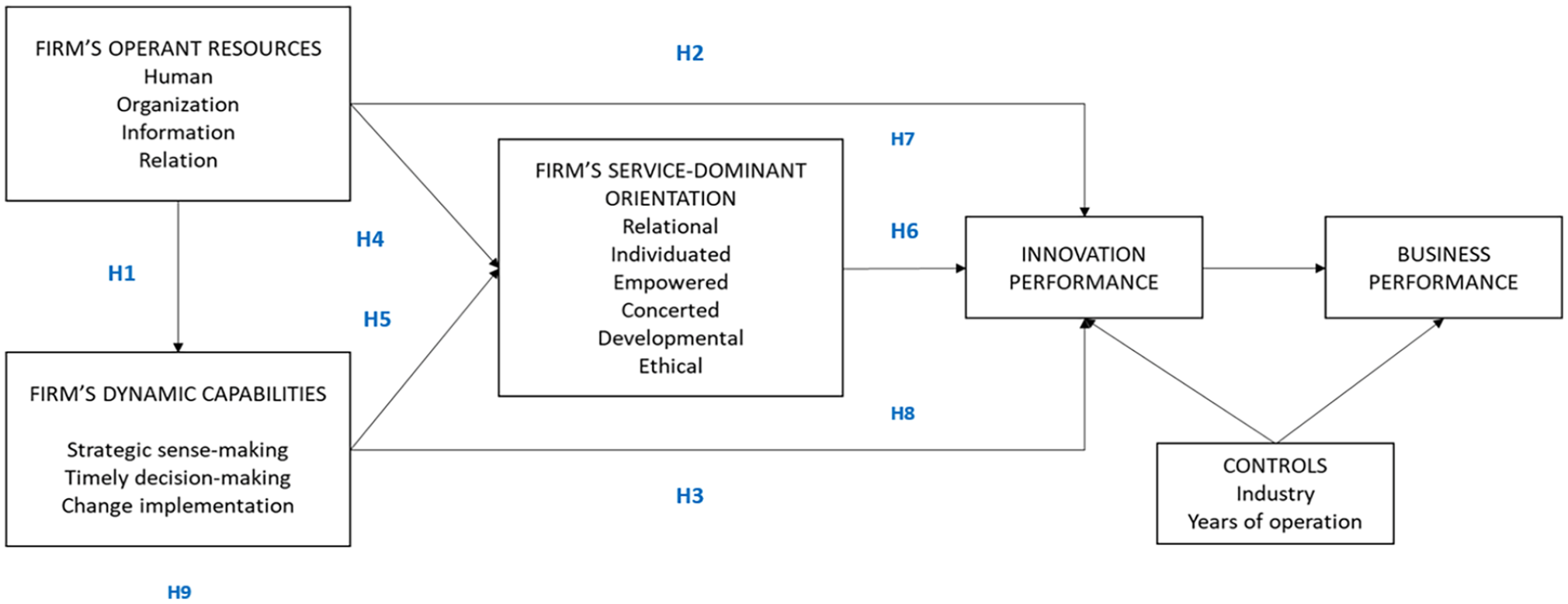
Conceptual model.
Methodology
Data collection
The country selected for data collection was Vietnam. In the contemporary era of globalization and worldwide economic integration, the survival and growth of Vietnamese firms are contingent upon their ability to attain a competitive advantage. The essential underpinnings and determining aspects of competitive advantage lie in the capacity for innovation. The existence and growth of contemporary enterprises in Vietnam are contingent upon the practice and implementation of innovation (Lang et al., 2012; Le et al., 2023). Additionally, the economy of Vietnam is mainly reliant on foreign direct investments in order to promote growth. The largest industries here are services. With annual economic (GDP) growth rates at 7.1% in 2018, Vietnam is one of the fastest-growing and most dynamic emerging countries in the East Asia region. These combinations of factors (high growth, reliance on FDI, and service domination) make Vietnam an ideal country to examine as a fast-growing emerging market. Over the course of the past 20 years, Vietnam has undergone a transformation from a centrally planned economy to a market-based economy (Hau et al., 2013). According to Narver and Slater (1990), market orientation has the potential to generate the requisite behaviors that lead to enhanced performance for sellers and increased value for purchasers (e.g. value co-creation).
Data were collected from firms in Ho Chi Minh City, Vietnam. This is the biggest city in Vietnam, which contributes about one-third of the country’s GDP. These firms are listed in an innovation hub in Vietnam, which provides a platform for manufacturing and service firms to collaborate, innovate, and develop new products and services. For more details of firms’ characteristics, the presence of a substantial number of highly skilled individuals in the human resource pool is a crucial determinant of innovation inside Vietnamese firms (T. H. Nam et al., 2017). For each firm, a key informant approach was employed (Campbell, 1955), in which respondents comprised managing directors (vice-director) or sales (marketing) managers who were deemed to know well about the firm’s operations and performance. To select firms into the sample, a judgment-based convenience selection technique was employed, balancing selection across industry (i.e. manufacturing and service) and firm size (i.e. diversity in revenue). It means that from the perspective of the purposive sampling technique (also called judgment sampling), random firms are chosen from a convenience sample to cover both typical types, such as manufacturing and service and heterogeneity in revenue. The inherent limitation of this study is in its utilization of purposive sampling, which poses challenges in terms of generalizability (Hristov & Reynolds, 2015).
A survey-based approach was employed using a structured questionnaire to collect data from the firms. The questionnaire was initially designed in English, then translated into Vietnamese language using a committee-based collaborative approach (Douglas & Craig, 2007) to ensure the equivalence in conceptual meaning. A field pre-test was then undertaken to check the comprehension and clarity of questions. Feedback was obtained, and some minor wording adjustments were made accordingly. Final surveys were delivered to firms to complete, and after 2 months, 208 surveys were collected. After reviewing, eight surveys were discarded due to patterned choices or having many unanswered questions, leaving a final sample of 200 firms.
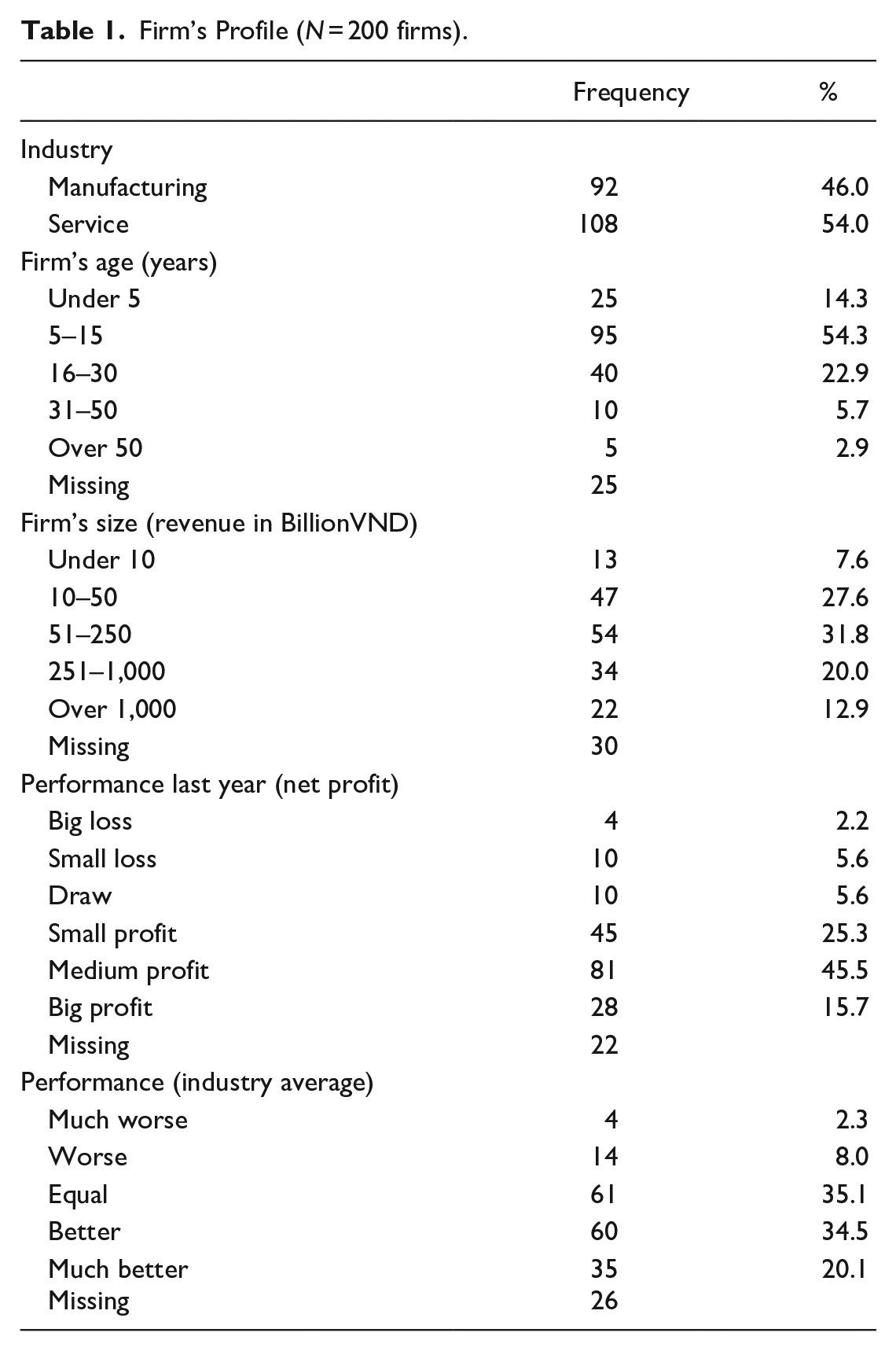
The sample was relatively balanced, which included 46% manufacturing and 54% service firms. Their sizes (i.e. annual revenue) ranged widely from less than 10 Billion VND ($ 40,000 USD) to more than 1,000 Billion VND ($ 4 million. USD) per year. They have been operating from less than 5 years (14.3%) to more than 50 years (2.9%), with about 54.3% having 5 to 15 years of operation. In terms of business performance (in their own evaluation), 2.2% reported a big loss last year, 15.7% thought that they got a big profit, while the main proportion (45.5%) received a medium profit. Comparing their own performance with the industry average, 2.3% thought that they were much worse, 35.1% were equal, and 20.1% were much better than the industry average (Table 1). This sample is diverse in terms of industrial sector, age, size, and business performance (see Table 1).
Firm’s Profile (N = 200 firms).
Measures of constructs
All the measures were adapted from the current literature and operationalized in 7-point Likert scales. Firm’s operant resources were constructed as a reflective-formative second-order construct with four first-order constructs, namely human operant resources (four items), organizational operant resources (three items), informational operant resources (four items), and relational operant resources (three items), adapted from Madhavaram and Hunt (2008) and Raddats and Burton (2014). The firm’s dynamic capability was constructed as a reflective-formative second-order construct with three first-order constructs, namely strategic sense-making capability (four items), timely decision-making capability (four items), and change implementation capability (three items), adapted from D.-Y. Li and Liu (2014). The firm’s service-logic orientation was constructed as a reflective-formative second-order construct with six first-order constructs, namely relational interaction (four items), ethical interaction (three items), individuated interaction (three items), empowered interaction (four items), concerted interaction (four items), and developmental interaction (four items), adapted from Karpen et al. (2015).
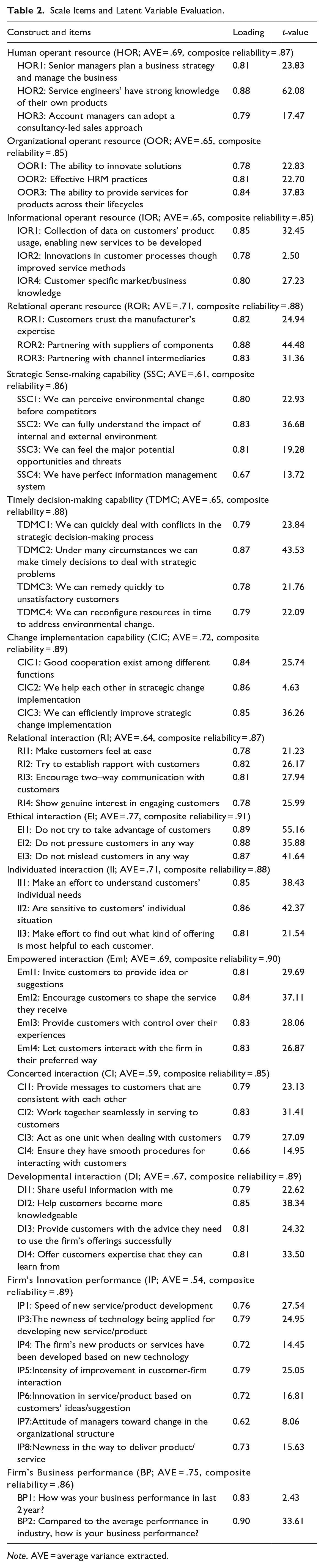
The firm’s innovation performance was measured using eight measurement items adapted from Lin (2013), Prajogo and Sohal (2003), and Den Hertog et al. (2010), measuring firm innovation performance from four aspects, including idea, technology, customer-firm interface, and value delivery system. Sample items include “Speed of new service/product development.” “The newness/novelty of new product/service.” “Intensity of improvement in customer-firm interaction.” And “Newness in the way to deliver product/service.” Finally, the firm’s business performance was measured using two measures: “How was your business performance in the last 2 years?” and “Compared to the average performance in the industry, how is your business performance.” See Table 2 for a complete list of measurement items.
Scale Items and Latent Variable Evaluation.
Note. AVE = average variance extracted.
Results
Following from prior literature, three focal constructs, the firm’s operant resources (Madhavaram & Hunt, 2008; Raddats & Burton, 2014), the firm’s dynamic capabilities (D.-Y. Li & Liu, 2014), and the firm’s service-dominant (SD) orientation (Karpen et al., 2015), were operationalized as second-order formative constructs. A reflective-formative type II model was adopted for all three second-order constructs, that is, the lower-order constructs measured as “constructs that do not share a common cause but rather form a general concept that fully mediates the influence on subsequent endogenous variables” (Chin, 1998, cited in Becker et al., 2012). For a firm’s operant resource, there are four first-order reflective constructs: human operant resource, organizational operant resource, informational operant resource, and relational operant resource. A firm’s dynamic capability has three distinct first-order reflective constructs: strategic sense-making capability, timely decision-making capability, and change implementation capability. Finally, the firm’s SD orientation has six distinct first-order reflective constructs: relational interaction, ethical interaction, individuated interaction, empowered interaction, concreted interaction, and developmental interaction.
Given three constructs, including two exogenous constructs and one endogenous construct, are consisting of lower-order constructs, a two-stage approach was adopted to analyze the data (Ringle et al., 2012; Wetzels et al., 2009). The reasons for choosing a two-stage approach are two-folded: first, while a repeated approach has the advantage of testing all first-order and second-order constructs simultaneously, it cannot successfully estimate the path coefficients when one or more of the higher-order constructs are endogenous (Ringle et al., 2012; Wetzels et al., 2009). This problem does not occur when a two-stage approach is used for formative hierarchical constructs (Becker et al., 2012). Second, the two-stage approach has the advantage of estimating a more parsimonious model on the higher-level analysis without needing the lower-order constructs (Becker et al., 2012). The procedure of running the model is outlined as follows: first, a repeated indicator model is estimated in the first-stage to obtain latent variable scores; next, the latent variable scores are used to generate path coefficients in the second-stage higher-order construct model (Ringle et al., 2012).
The research model is evaluated using PLS analysis consisting of two distinct steps. The first step includes the assessment of the measurement model (outer model), and the second step includes the assessment of the structural model (inner model). As suggested by Anderson and Gerbing (1988), the measurement model is assessed, validated and purified at the first stage. Using the partial least square method in structural equations models (PLS-SEMs; Hair et al., 2006), the data is analyzed where the estimation of measurement models and the structural model occur simultaneously. As suggested by Hair et al. (2006), the use of PLS-SEMs is appropriate given the small sample sizes relative to the number of parameters to be estimated and a non-normal distribution of data with model complexity.
Measurement model
The first part of the evaluation is to present the outer model results to assess the reliability and validity of the construct measurements (Hair et al., 2006). Given that reflective measures are distinct from formative measures in terms of the validity and reliability assessment the following section will first represent the results of first-order reflective measurements and then the second-order formative measurements.
Reflective measurement
The convergent reliability and discriminate validity for the first-order reflective measurements is first assessed. As shown in Table 2, all the items in the outer-measurement models had acceptable bootstrap t-values (>1.96) with loadings (0.62–0.90) greater than the recommended .5, therefore demonstrating adequate individual item reliabilities (Henseler et al., 2015). Average variance extracted (AVE) values for all constructs were uniformly acceptable, ranging from .54 to .77, greater than the cut-off value .5 (Fornell & Larcker, 1981). Moreover, the composite reliability values ranged between .85 and .93, indicating that the scale items possess high reliability.
Next, the discriminant validity of the key variables following procedures outlined by Fornell and Larcker (1981) was assessed. As shown in Table 3, the square roots of the AVE values are consistently greater than all corresponding correlations, demonstrating good discriminate validity. To further examine the discriminate validity of all constructs, the correlation between two variables (the off-diagonal entries) with their respective composite reliability estimates were compared. Table 3 demonstrates that no absolute values of individual correlations (from .00 to .69) exceeded their respective reliabilities (from .85 to .93), therefore indicating satisfactory discriminant validity of all variables. Additionally, to see whether the correlations between each of the pairwise constructs are significantly different from 1, t-values were calculated. The results show that all pairwise correlations are significantly different from one as all t-values are well above the critical value of 1.96. 1 The cross-loadings of the indicators were also checked. Thus, the analysis conducted demonstrates that all the primary constructs are different to each other.
Construct correlations.
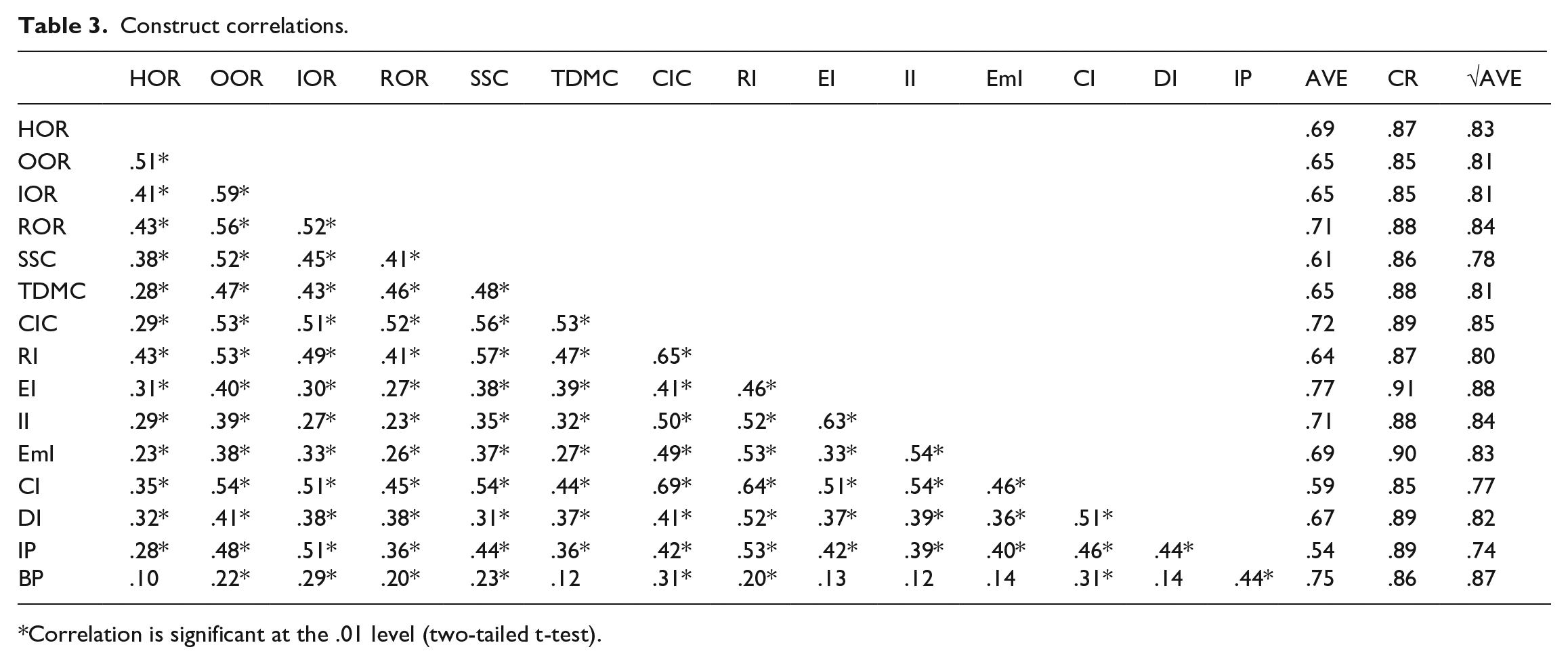
Correlation is significant at the .01 level (two-tailed t-test).
Formative measurement
The weights and the significance of the second-order formative measurements (Hair et al., 2006) were assessed. For a formative higher-order construct, the weights of the lower-order constructs are especially important as they represent actionable drivers of the higher-order construct (Becker et al., 2012). Results from Table 4 indicate that all first-order construct weights (range from .19 to .41) are significant, demonstrating a sufficient level of validity for the construction of second-order constructs as theoretically conceived (Becker et al., 2012). Moreover, the weights are higher than .10, and their signs are consistent with the underlying theory (Becker et al., 2012).
First-order Constructs Weights.
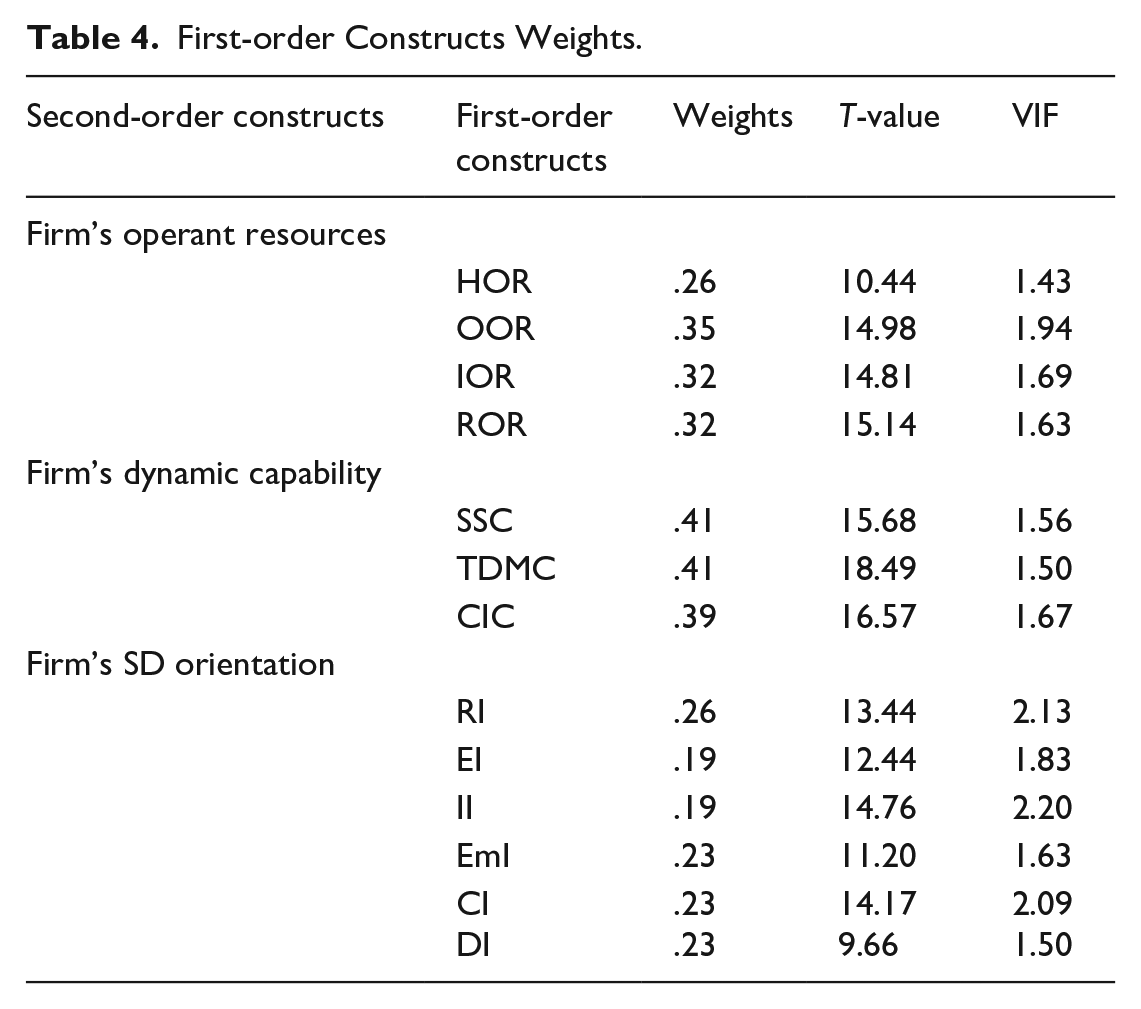
Another important criterion for assessing the validity of the second-order formative constructs is the multicollinearity assessment. Unlike reflective measures, where multicollinearity between indicators is desirable, excessive multicollinearity between the formative first-order constructs can destabilize the model and confound the weights of other indicators (Diamantopoulos & Winklhofer, 2001). If the first-order constructs are highly correlated, it may suggest they are tapping into the same aspect of the second-order construct, and therefore, a formative nature of the second-order construct would be questioned (Hair et al., 2006). Results from Table 4 show no evidence of multicollinearity since the VIF scores ranged between 1.00 and 4.72, which were far below the critical value of 5 (Hair et al., 2006).
Common method bias
Since the data collected are cross-sectional data using a single-informant approach, there might be common method bias effects that lead to spurious relationships among the variables (Podsakoff et al., 2003). Therefore, a marker variable (MV) technique was conducted (Lindell & Whitney, 2001). One indicator was chosen (HOR3: Account managers can adopt a consultancy-led sales approach) as the marker variable as it has the lowest absolute value of correlation with the outcome variable (i.e. business performance; Lindell & Whitney, 2001). The average absolute correlation between the MV and all other constructs in the model was .25 (rm). The average difference between the correlations among all constructs in the model after parting out the effect of rm was .17, and 93 of 120 intercorrelations between all the constructs in the model remained significant after partialing out the effect of rm. This suggests that “the results cannot be accounted for by common method variance” (Lindell & Whitney, 2001, p. 118).
Structural model
After purifying the measurement model in Stage 1, the latent variable scores generated in Stage 1 were used to run the structural model, as suggested by Ringle et al. (2012). First, a base model was developed that excluded all hypothesized relationships and only included control variables (year of operation and industry) to predict the outcome variable (business performance). Then, in Stage 2, all the hypothesized relationships were added by linking the second-order constructs, as formatively indicated by the first-order constructs, to the outcome variable.
Overall model fit
The model fit was assessed by examining the model fit indices provided by PLS, namely, the average path coefficient (APC) and average R-squared (ARS). For the APC and ARS, it is recommended that p-values should be lower than .05. The fit indices for the data: APC = 0.37 (p < .01), ARS = 0.40 (p < .01) indicate a good fit of the model to the data. The overall model controlled for the year of operation, industry, and the value offered to customers. The base model (model 1) only explains .2% of the variance in business performance and 4% of the variance in innovation performance. The main effects model, along with the control variables (model 2), explained a 10% variance in business performance and a 40% variance in innovation performance, and none of the control variables are statistically significant when included in the main effects model. Finally, the predictive relevance of the model was assessed by examining the Stone-Geisser Q2 coefficient (Stone, 1974). The Q2 coefficient is a nonparametric measure and represents how well the observed values are reconstructed by the model and the model parameters. The calculated Q2 coefficients for all endogenous variables included in the model were greater than zero (from .21 to .33), suggesting acceptable predictive validity for the model.
Hypothesis testing
Hypothesis 1 predicts that there is a positive linkage between basic operant resources and dynamic capabilities. The results confirm this hypothesis (Model 2, β = .69, t = 14.60, p < .01). Hypothesis 2 and 3 predict that there is a positive linkage between basic operant resources/dynamic capabilities and innovation. The results from the structure model confirmed Hypothesis 2 (Model 2, β = .29, t = 2.99, p < .01) but not Hypothesis 3 (Model 2, β = -.04, t = .35, p > .05). Hypothesis 4 and 5 predict that there is a positive linkage between operant resources/dynamic capabilities and S-D logic orientation. Results confirmed both hypotheses (Model 2, β = .25, t = 3.85, p < .01; β = .60, t = 9.04, p < .01). Hypothesis 6 predicts that there is a positive nexus between the firm’s S-D logic orientation and innovation. The results confirm this hypothesis (Model 2, β = .42, t = 4.70, p < .01). The results also confirmed a positive and indirect nexus between the firm’s operant resources and innovation performance via the mediator firm’s S-D orientation (Model 2, βa = .25, t = 3.96, p < .01; βb = .42, t = 4.63, p < .01). Since both the direct and indirect effects are significant, it can be concluded that a firm’s S-D orientation partially mediates the nexus between firm’s operant resources and innovation performance, therefore H7 is supported. Since the indirect linkage between the firm’s dynamic capabilities and innovation performance is significant while the direct linkage is insignificant (H3, Model 2, β = -.04, t = .35, p > .05), this supports a full mediation effect of the firm’s S-D orientation in the linkage between the firm’s dynamic capabilities and innovation performance, thus supporting H8. Finally, Hypothesis 9 predicted a positive and indirect mediating effect of the firm’s dynamic capabilities in the nexus between the firm’s operant resources and the firm’s S-D orientation. Results confirmed this mediating effect (Model 2, βa = .69, t = 15.16, p < 01; βb = .60, t = 9.42, p < .01). Given both the direct nexus and the indirect nexus between firm’s operant resources and firm’s S-D orientation is significant, overall results support a partial mediation of firm’s dynamic capabilities in the nexus between firm’s operant resources and firm’s S-D orientation; thus H9 is supported. In sum, the effect of a firm’s operant resources on innovation performance has three paths: the direct effect, the indirect effect via the firm’s S-D orientation, and the indirect effect via the firm’s dynamic capabilities and the firm’s S-D orientation (see Table 5 and Figure 2). The total effect of the firm’s operant resources on the firm’s S-D orientation is .66 (t = 4.32, p < .01), and the effect on innovation performance is .55 (t = 7.73, p < .01). The total effect of the firm’s dynamic capabilities on innovation performance is .22 (t = 2.43, p < .05). Finally, although not hypothesized, a positive nexus between innovation performance and business performance is observed (Model 2, β = .31, t = 5.54, p < .01). It is worth noting that none of the control variables are significant in any of the models.
Partial Least Squares for Theoretical Model.
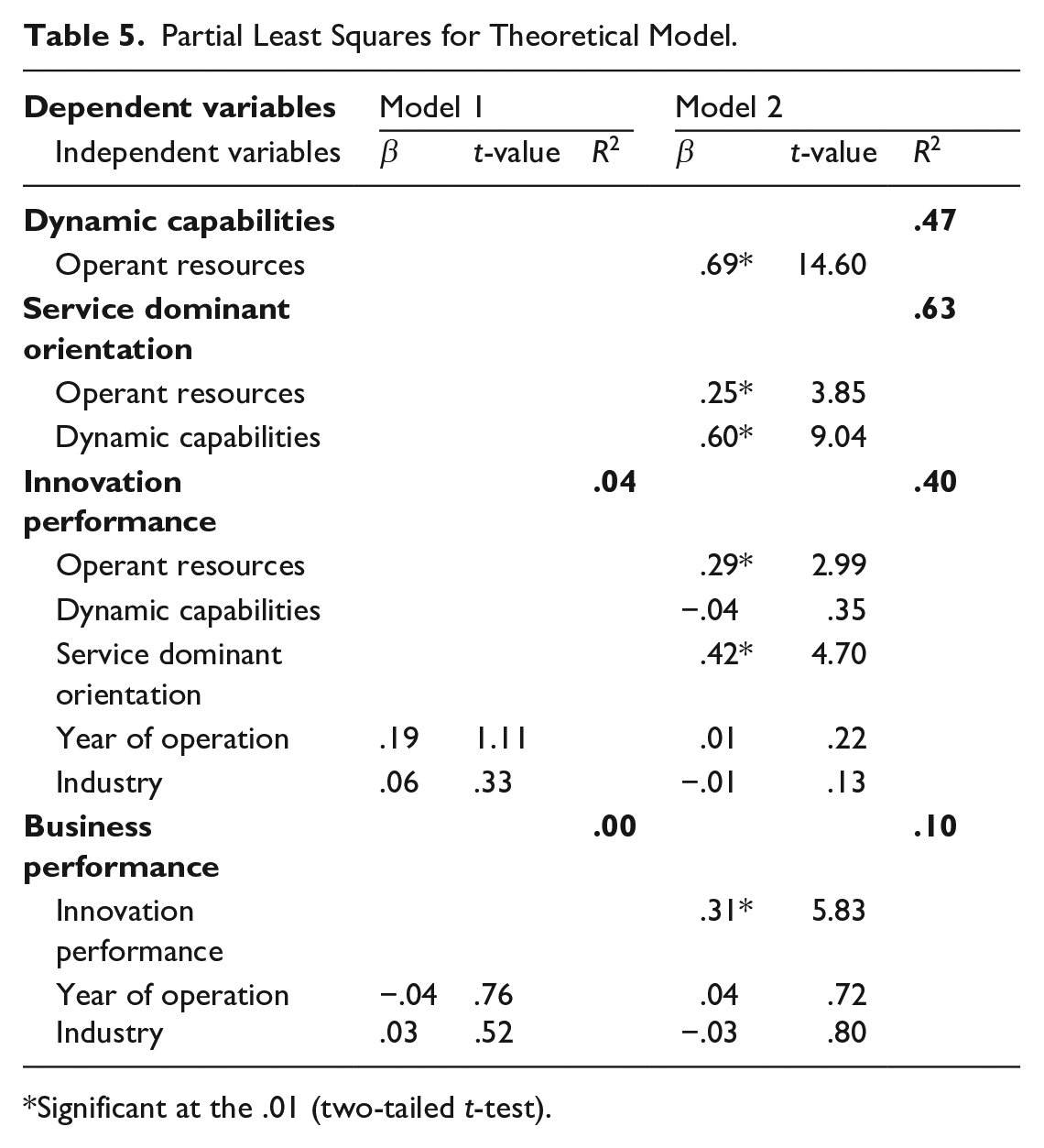
Significant at the .01 (two-tailed t-test).
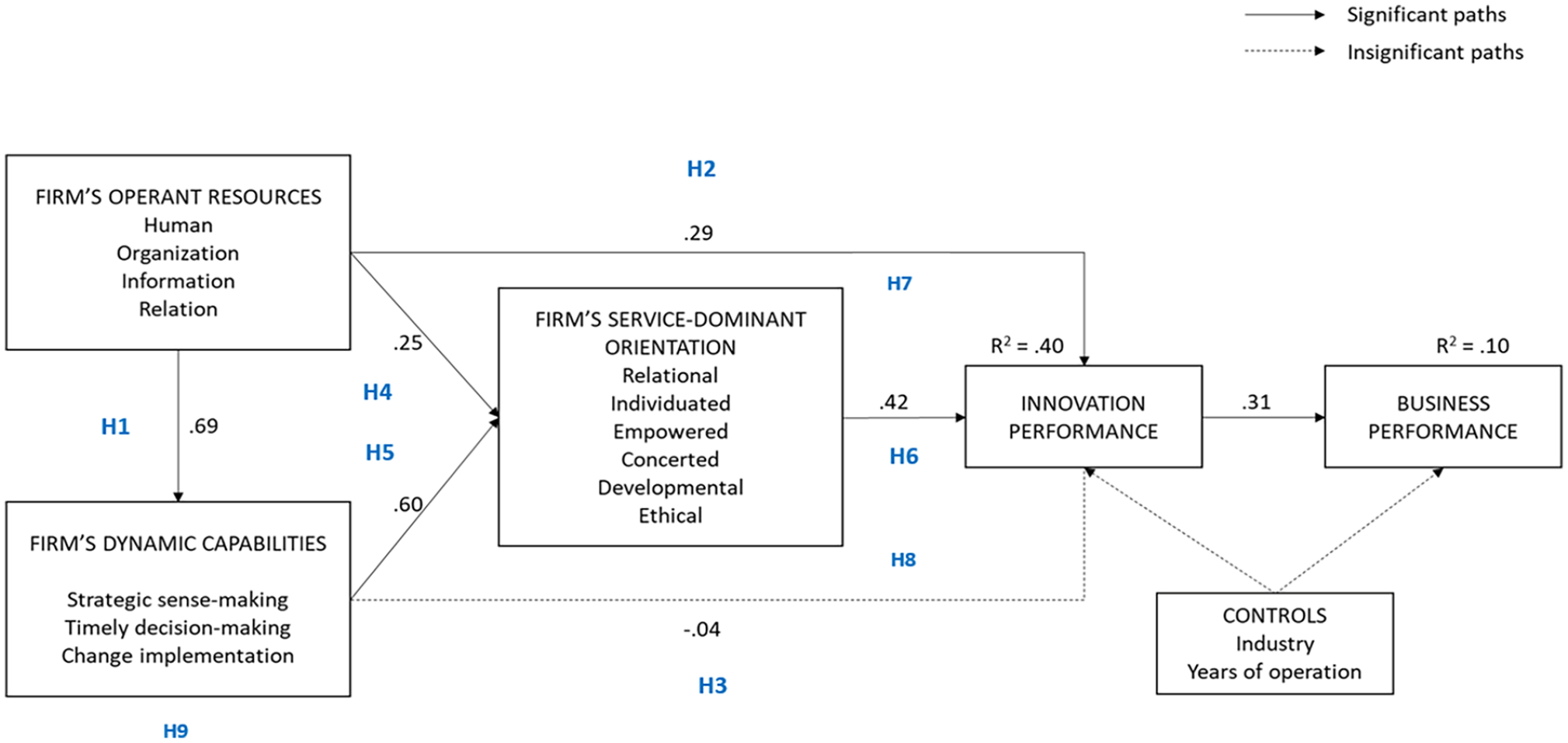
Structural model.
Discussion and implications
Extending the S-D logic perspective, the current study examines the role of S-D logic orientation in transforming a firm’s internal and external resources and capabilities into innovations. Specifically, this study examined how a firm’s operant resources, including basic operant resources and higher-order dynamic capabilities, affect a firm’s innovation as mediated by a firm’s S-G logic orientation. Results confirmed that a firm’s basic operant resources affect a firm’s dynamic capabilities, and both affect a firm’s S-D logic orientation. Both resources and capabilities affect innovation either directly or through a mediating effect of S-D logic orientation. From one aspect, operant resources can affect innovation directly. Operant resources such as dynamic capabilities determine the level of innovation because innovation requires firms to actively seek opportunities and implement changes when necessary (Darroch, 2005; Ordanini & Parasuraman, 2011). On the other side, operant resources can affect innovation indirectly via a firm’s S-D logic orientation. This is because both basic operant resources and dynamic capabilities are essential requirements for a firm’s S-D logic orientation, while S-D logic orientation affects a firm’s innovation positively since it possesses capabilities of managing value creation network dynamically and interactively (Karpen et al., 2012). results also confirmed that basic operant resources affect a firm’s innovation directly and indirectly through S-D logic orientation. The relationship between a firm’s dynamic capabilities and a firm’s innovation is fully mediated by the firm’s S-D logic orientation. Moreover, results suggest a significant partial mediation of a firm’s dynamic capabilities between a firm’s basic operant resources and S-D logic orientation. Finally, although not hypothesized, a positive and significant relationship between the firm’s innovation performance and business performance exists, supporting the importance of innovation in supporting a firm’s long-term market performance.
This study contributes to the innovation literature in the following ways. First, it sheds light on the conceptualization of the innovation process from an S-D logic perspective and provides empirical evidence that S-D logic orientation has a positive effect on a firm’s innovation performance. Most of the prior research on innovation has been based on a G-D logic perspective (e.g. Gupta et al., 1986; Knight, 1967; Utterback & Abernathy, 1975), while very few studies introduce S-D logic in examining innovation (e.g. Lusch & Nambisan, 2015, Mele et al., 2014, Michel et al., 2008). While an S-D logic approach seems to be more relevant in explaining innovation success in the current business environment, most of the literature is conceptual, with only a few having provided empirical evidence to support this new logic in explaining innovation performance. Therefore, the current study fills an important gap in the literature by empirically testing the relationship between S-D logic orientation and innovation performance, providing convincing empirical evidence to support this new conceptualization in explaining innovation performance. Second, this study provides an integrated approach by examining the roles of a firm’s operant resources in determining innovation performance either directly or indirectly through the mediating effect of S-D logic orientation. Prior research rarely provides an integrated approach by examining resources, S-D logic and innovation performance together. This integrated (connected) view can address calls for future research raised from the work of Wilden et al. (2017) under the S-D logic framework, including (i) innovation-related attributes in its conceptualization and (ii) the integration of S-D logic with research on dynamic capabilities. This study also contributes to the S-D logic literature by examining the mediating role of S-D logic orientation in the relationship between a firm’s operant resources and innovation performance. It provides empirical evidence that basic operant resources are the building blocks of higher operant resources, such as dynamic capabilities, and both are fundamental to the S-D logic orientation, which in turn determines innovation performance (Lusch & Vargo, 2014a; Madhavaram & Hunt, 2008; Vargo & Lusch, 2004a, 2008a). Last but not least, prior studies mostly focused on firms that operate in developed countries. As the current study empirically examines the S-D logic model in one of the fast-growing emerging markets, the results provide further empirical evidence to support the applicability of the S-D logic approach in explaining firms’ innovation process and success from a different economic and cultural context.
Managerial implications
Managers today are facing strong pressure in managing product or service innovation in such a competitive business environment. The current study has some important and meaningful implications for managers to improve their management of innovation. First, this study demonstrates the importance of adopting the S-D logic orientation in managing product and service innovation. Many firms still follow a traditional G-D logic in organizing and managing innovation processes, while this study clearly demonstrates that S-D logic orientation is more relevant and appropriate in achieving better innovation performance in today’s business environment. To transform from G-D logic to S-D logic orientation, firms need to reconsider the role of service in their product or service delivery process, redefine the meaning of value and value network in the market exchange, and re-configure their resources and capabilities to focus on relationship building and management among its customers, suppliers, competitors, and other key stakeholders who are engaged in the value network. In particular, firms need to understand the individual value of each partner in the value network, promote relationship building and engagement among the network partners, empower customers, suppliers, and other stakeholders in the process of innovation, help them to develop knowledge and skills which are necessary for them to be part in the innovation process, and provide and maintain a good communication platform where network partners can communicate, coordinate, and collaborate freely with minimum effort. This is not purely for service companies but also for traditional manufacturing companies as well.
Second, this study confirms the importance of developing and managing operant resources, including basic operant resources and dynamic capabilities, in supporting S-D logic orientation and facilitating innovation performance. Managers need to consistently put effort into developing and managing basic operant resources such as human, informational, relational and organizational operant resources so that firms can better capture opportunities and maintain good value networks with their customers, suppliers, and other stakeholders. For example, managers need to continuously invest in relational resources with customers so that customers will be more willing to be engaged in the development process of innovation and provide support to the firm’s innovation success. Firms also need to continuously develop and maintain good dynamic capabilities, such as strategic sense-making capacity, timely decision-making capacity, and change implementation capacity. Firms with strong dynamic capabilities can respond to environmental changes quickly and proactively implement new business strategies quickly to sustain long-term innovation performance. The investment and development in operant resources will not only strengthen a firm’s innovation performance but also provide support to the firm’s S-D logic orientation.
Limitations and further research
Like all studies, this study has some limitations. First, this study does not compare S-D logic orientation with G-D logic orientation regarding the effects on innovation performance. Although the theoretical framework studied assumes that S-D logic is more relevant than G-D logic in the current business context, this assumption is not empirically tested. The results indicate that S-D logic has a positive relationship with innovation performance but do not conclude whether and how S-D logic is better than G-D logic in improving innovation performance. Further research could follow this suggestion and investigate comparatively how S-D logic is more relevant and better in the current business context than G-D logic when examining innovation. Second, this study mainly focuses on the main and mediating effects of resources and S-D logic orientation on innovation; however, other factors may also affect innovation performance. Past studies have examined various (Deshpandé et al., 1993) factors that could affect innovation, such as market orientation or customer orientation (Han et al., 1998). How these factors interact with S-D logic and affect innovation performance would be an interesting topic to explore further. Third, this study concentrates on the argument for the hypotheses among the major variables. Thus, the detailed linkages between different elements of the major variables need to be studied as a potential future research topic. Fourth, this study collected and used data from only one fast-growing emerging market—Vietnam. As such, it is difficult to generalize the findings to other countries that have a distinct cultural and economic background to Vietnam. Further research could also collect data from other countries and examine the generalizability of this study. Finally, further research could compare S-D logic and G-D logic in the current business context when examining innovation as well as the dominant role of S-D logic orientation in the scope of service innovation compared to that of G-D logic perspectives.
Footnotes
Declaration of conflicting interests
The author(s) declared no potential conflicts of interest with respect to the research, authorship, and/or publication of this article.
Funding
The author(s) received no financial support for the research, authorship, and/or publication of this article.
