




Abstract
To prepare students for multicultural environments and understand consumers from different backgrounds, marketing educators must incorporate diversity into their curricula and recognise the importance of decolonisation by considering First Nations’ perspectives to promote reconciliation and better outcomes. This paper reports on a novel approach of students working directly with First Nations businesspeople to gain an applied understanding of Indigenous cultural learning. The study examines the influence of this approach on students’ learning and cultural understanding, as well as how the teaching approach and authentic assessment design within the unit improve the confidence of students to apply these learnings and engage in culturally informed practices, both presently and in their future careers. Through embracing an applied learning experience and critical self-reflexivity, students gained a greater appreciation and respect for First Nations peoples resulting in a transformational shift in their attitudes, leading to greater empowerment, respect, competence and confidence in their cultural awareness to work with First Nations. The paper fills a gap in the literature by highlighting a teaching and learning approach that engages and builds students’ Indigenous cultural competencies within the marketing discipline through a strength-based approach, thus promoting cultural sensitivity and effective communication with diverse populations.
Keywords
Introduction
There is a growing demand for marketing educators to emphasise diversity in their curricula to equip students with the essential abilities to operate effectively in multicultural environments and comprehend consumers from a variety of backgrounds (Alahakoon et al., 2024; Grier, 2020; Raciti, 2022). Business education also needs to deal with the historical legacies of decolonisation and recognise its impact on First Nations people. In doing so, business (and therefore marketing curricula) needs to consider First Nations perspectives. Courses that include diverse voices in the classroom and marketing curricula through a case study approach are a teaching and learning method that involves the in-depth analysis of real-life situations or scenarios. It is a valuable tool that allows students to apply theoretical business and marketing knowledge to real-world situations in an empathetic manner, developing a deeper understanding of complex issues. A case study approach instils students with a stronger sense of inclusivity in the real-world application of marketing strategies (Rivera et al., 2020). This is necessary for the facilitation of reconciliation and better outcomes for First Nations people due to greater Indigenous cultural competencies being included in business education (Behrendt et al., 2012; Bodkin-Andrews et al., 2019; Universities Australia, 2011, 2017). By incorporating more diverse content into marketing education, students can enhance their readiness to lead in dynamic and intricate marketplaces creating a Force for Good as well as a Force for Growth (Oakenfull, 2021).
Historically universities in the Western world have facilitated an environment whereby knowledge is largely governed ‘by the West for the West’ as discussed by Bhambra et al. (2018). The calls for decolonising universities as an important mode of engagement provide an opportunity for universities to transform learning, teaching and research practices. Eckhardt et al. (2022) highlighted that this shift represents a transition from a culture of exclusion to one of inclusion, one that disrupts and reinvents the traditional ways of thinking, teaching and learning. This study aims to play a role in the evolving paradigm shift within Indigenous research, focusing on exploring the valuable insights that can be gained by embracing a strength-based approach. There have been many barriers and deficit discourse identified which discusses barriers such as the lack of relevant curriculum through recognition of Aboriginal and Torres Strait Islander worldviews (Martin, 2009), lack of role models and representation in higher education, and poor educational processes that perpetuate the gap in educational achievements between Indigenous and non-Indigenous Australians (Aseron, 2013) including languages that frame Indigenous Australian identities through a narrative of deficiency (Bullen et al., 2023; Buxton, 2017).
The design of the marketing curriculum, starting with a cultural briefing delivered by an Aboriginal and/or Torres Strait Islander facilitator, exemplifies an admirable approach that adheres to best practices in developing Indigenous cultural competencies. It is an excellent way to facilitate a deeper understanding of Indigenous culture, perspectives and experiences. Students are provided with the opportunity to learn directly from Indigenous voices in an authentic and meaningful manner. The study recognises the presence of barriers and a deficit-focused narrative within the marketing and business sectors. It emphasises the importance of addressing these issues by adopting a decolonisation approach to transform the marketing discipline and curriculum and harness its inherent strengths. This approach provides a space that allows students to reflect and engage with content, teaching materials, examples and a process of teaching that engages students in critical reflexivity (Eckhardt et al., 2022). Further, as Bullen and Roberts (2021) highlight, when it comes to the curriculum in which Australian Indigenous studies are applied, taught and learned, it is crucial to transform the attitudes, beliefs and behaviours of non-Indigenous students towards First Nations.
As Raciti (2022) calls for, this study focuses on highlighting First Nations perspectives in marketing and takes a purposeful approach to infuse First Nations’ voices into the discipline knowledge to heighten the learning experience for students. It embraces an approach that overcomes the traditional academic fears associated with embedding First Nations knowledges and perspectives which include finding information, knowing how to include this information, misappropriating knowledge, coming across as patronising, potential resistance from students or merely getting it wrong (Raciti et al., 2018). It reports on a novel approach of students working directly with First Nations businesspeople to gain an applied understanding of Indigenous cultural learnings whilst reiterating discipline learnings in a natural and realistic work environment.
Authentic assessments with First Nations retail business owners were implemented into a second-year marketing unit to foster Indigenous perspectives and embrace the richness and diversity of First Nations cultures within the marketing curricula through a strengths-based approach that is positive, uplifting and inspiring. To date, there have been limited discussions of learning and teaching strategies pertaining to Indigenous cultural competencies within the marketing discipline which as Raciti (2022) acknowledges, ‘an epistemology of ignorance regarding Aboriginal and Torres Strait Islander peoples is prolific in the marketing academy’ (p. 210). The study fulfils a gap in the literature by highlighting a teaching and learning approach that engages and builds students’ Indigenous cultural competencies within the marketing discipline, an area previously dominated by health sciences, human services disciplines (Carey, 2015) and education (Bodkin-Andres & Carlson, 2016).
To examine this approach, the study had two key objectives. Firstly, to explore whether individual students’ learning and cultural understanding undergo a transformation as a result of completing a marketing unit whereby Indigenous knowledges and perspectives are infused throughout. Secondly, to examine how the teaching approach and authentic assessment design within the unit improve the confidence of higher education students to apply these learnings and engage in culturally informed practices both presently and in their future careers. Using a qualitative reflective methodology, this study offers a deeper insight into the implementation of a decolonisation approach to marketing, and its impact on student learning and the development of cultural competency. Our research shows by embracing an applied learning experience working directly with First Nations peoples and through critical self-reflexivity, students gained a greater appreciation and respect for First Nations peoples resulting in a transformational shift in their attitudes, leading to greater empowerment, respect, competence and confidence in their cultural awareness to work with First Nations.
Background
Developing student’s Indigenous cultural competencies
In 2011, Universities Australia commenced investigating the scope for the higher education sector to be competent in executing a best practices framework for Indigenous cultural competencies. A key element of the framework is ‘to embed in non-Indigenous graduates the knowledge and skills necessary for them to provide genuinely competent services to the Australian Indigenous community’ (Universities Australia, 2011, p. 6). The report also found at the time, Australian universities have been traditionally non-existent, weak and disjointed when it came to including ‘Indigenous Content’ into the curriculum. This review continually called for enhanced cultural competence training for professionals and surmounting the unreasoning reliance on neo-colonial frameworks which have constantly been unsuccessful in remedying Indigenous disadvantage. Furthermore, to also employ accurate knowledges relating to distinctive Indigenous contexts. In 2017, Universities Australia introduced the first whole-of-sector strategy advocating for the advancement of Indigenous peoples in and through Australia’s universities. In 2022 this strategy evolved to focus on implementation over aspiration and to reinforce the genuine inclusion of First Nations peoples and knowledge into teaching and research will broaden, deepen and improve what Universities do (Universities Australia, 2022).
Yet although the focus on Indigenous cultural competencies has significant potential, typically policy, practice and positive outcomes do not necessarily align. As Bodkin-Andrews et al. (2019) acknowledge, this is further complicated by the different and wide variety of disciplines within universities and the very contested space of cultural competencies and cultural responsiveness within Indigenous Studies (Page et al., 2016; Rigney, 2017). Furthermore, it imposes additional challenges and pressures on the curriculum, with academics already struggling with an exploding program. Marketing disciplines are also challenged with determining the optimal balance between generic and marketing-specific skills when designing the curriculum. The Australian Qualifications Framework (AQF, 2019) calls for educators to also provide students with the opportunities to acquire diverse knowledge but also offer them varied learning opportunities to develop the necessary skills and competencies needed for the future workforce. When it comes to embedding Indigenous cultural competencies Bodkin-Andrews et al. (2019, p. 232) warn this focus can be ‘a highly contested space where colonial and Indigenous knowledge collide’ and highlight the need for universities to successfully contribute to the realisation of Indigenous Graduate Attributes. Universities Australia also recommends Indigenous content must have internal consistency and be naturally incorporated into the student’s wider field of study in settings appropriate to their future professions.
Bullen and Roberts (2019) recognise that students come into Australian undergraduate education with a range of opinions and experiences concerning First Nations. Earlier studies have indicated that students’ perceptions of Indigenous individuals and their interactions with culturally diverse individuals upon beginning university studies can predict their readiness to work with Indigenous Australians in healthcare settings (Bullen et al., 2017). While certain disciplines, such as health and education, have made progress, others like marketing and business studies have struggled to do so.
Transformative learning and decolonisation
Transformative learning is attributed as one avenue to drive change in attitudes in educational settings. Transformative learning has been defined as ‘learning that transforms problematic frames of reference – sets of fixed assumptions and expectations (habits of mind, meaning perspectives and mindsets) –to make them more inclusive, discriminating, open, reflective and emotionally able to change’ (Mezirow, 2003, p. 58). It is founded on principles of openness and readiness to acknowledge the perspectives, experiences, beliefs and views of others and self and promotes the significance of empathetic listening and understanding when doing so (Mezirow, 2003). The typical impetus for this process involves introducing dissonance-inducing information, followed by stimulating critical examination of and reflection on existing schemas and their incongruence with the freshly introduced information (Mezirow, 2000). In essence, the premise of the theory provides a good position to expand our comprehension of how Australian Indigenous Studies can influence students’ perspectives and thus students’ abilities to work with First Nations.
The depiction and conceptualisation of the Australian Indigenous Studies curriculum as transformative has gained popularity and usage in recent times (Mackinlay & Barney, 2014). This is especially evident in the case of curricula that is based on Indigenous knowledge and perspectives, plus created and implemented with the potential to transform student attitudes and behaviours (e.g. McDonald et al., 2018; Mills et al., 2018). An important aspect of decolonisation in Australian Indigenous Studies is the transformation of student attitudes and behaviours. It is about the development and creation of ‘safer spaces in higher education’ between teaching staff and students through culturally appropriate teaching methods (Anderson & Riley, 2021).
Decolonisation in its most basic form signifies the end of a foreign power and a move to an independent nation, a process that is also known as the ‘transfer of power’ (Gopal, 2021). The meaning of decolonisation continues to be contested over citizenships, borders, migration and asylum of former colonies and imperial power. In Australia, the end of formal colonial rule brings to the surface the importance of true reconciliation in driving an equitable path forward towards achieving Indigenous sovereignty.
Eckhardt et al. (2022) acknowledge the fundamental parts of colonialism in capitalism and seek to connect the various forms of capitalism to the curriculum. Eckhardt and colleagues. pointed out that ‘Capitalism in its different forms- colonial, slave, mercantile, financial, market–has used racist logic to demarcate whiteness from others and to distribute wealth and privileges along racial lines’ (p. 176). In terms of the emergence of Eurocentric nation states from invasion, such as in Australia, First Nation People’s characteristics, skills, knowledge, policies and practices were eliminated over time until they became normalised (Fforde et al., 2013; Moodie, 2017; Weuffen et al., 2023). Decolonisation then is the assertion of First Nations cultures, advancement of self-determination, recognition, representation and reconnection (Chow et al., 2022; Tuck & Yang, 2012). In traditional postcolonial societies, Indigenous people could be politically independent with the successful resistance of colonisers and having them leave the land. However, for settler colonial societies, such as Australia, where governance is considerably influenced by colonial ideas and institutions; Indigenous peoples must move towards decolonisation and strive for a relationship of equality (Chow et al., 2022).
The discussion around decolonisation, although topical, can sometimes be a controversial debate (Ngugi wa Thiong’o, 1986; Smith, 2021) amongst many stakeholders within marketing education, research and industry. Smith (2021) argued that although reconciliation, diversity and inclusivity have shifted, there has been little progress in decolonising knowledge and the institution of academia. There is a strong need to deconstruct and, more importantly, transform the system of knowledge in academia and western universities.
Strength-based approach
Engagement with Indigenous communities through research can take many forms, from consultation to research conducted by Indigenous researchers, organisations and more. In health research, there were four rationales put forward by Kowal et al. (2005), which are pragmatic, moral, interventionist and epistemological. The pragmatic rationale states that without Indigenous community involvement, research would not be possible. The moral rationale states that Indigenous people should be in control of research that concerns their communities and have a participation role in research that forms part of decolonisation. The interventionist rationale focuses on participation itself and the concept of empowerment. It defines participation itself as a form of intervention and therefore Indigenous participation in health research leads to improved health benefits. The epistemological rationale refers to the knowledge of Indigenous people being unique and should be fundamentally shaping the projects. Kowal et al. (2005) went on to argue the unique perspective and knowledge of Indigenous people applies to many other disciplines and that ‘the concept of Indigenous knowledge/s is gaining influence’ (Kowal et al., 2005, p. 469). Debates and discussions such as these form a part of the bigger narrative and push towards a strengths-based approach as the way to work with Indigenous people.
To truly understand a strengths-based approach, we must understand ‘deficit discourse’. Deficit discourse can be explained as a way of thinking that frames First Nations people in a ‘narrative of negativity, deficiency and failure’ (Fforde et al., 2013; Fogarty et al., 2018). Colonial ideology has based assumptions of deficits about Indigenous people in the agenda which based ‘Aboriginality’ as a ‘problem to be solved’ (Dodson, 1994, p. 3). Strengths-based approaches offered a way to claim back the truths and a way to challenge and decolonise these practices.
A strengths-based approach may include various themes such ‘asset-based approaches, resilience, cultural appropriateness, social determinants of health and ecological theories, protective factors, empowerment, holistic approaches, wellness and wellbeing, strength-based counselling, positive psychology, decolonisation methodology and salutogenesis’ (Fogarty et al., 2018). It is an approach that recognises the capabilities of Indigenous people (Bryant et al., 2021). In public health, it is important to understand the difference between strengths-based rhetoric and practice to successfully close the gap (Askew et al., 2020). Researchers are increasingly embracing genuine strengths-based approaches to research as not only the culturally appropriate way, but the holistic way to conduct respectful research with First Nations people.
Fundamental to a strengths-based approach is the reconfiguration of relationships within a project, the centring of people and a practice that gives nuanced insights and voice. In this project, the power of the relationship and sharing of information between Indigenous business owners and marketing students through an authentic approach to the curriculum and assessments in the unit proved to have been a transformational experience for many. The experiential approach allows a way for the students to see both the challenges faced by First Nations businesses and people and the strengths of Indigeneity.
Method
The context of this study is a retail marketing unit at an Australian metropolitan university. This is a second-year core undergraduate unit of the marketing program. The unit has historically examined retail marketing predominantly from the Western perspective but was intentionally altered to incorporate Indigenous perspectives and knowledges, embracing a decolonisation marketing approach throughout the unit. In this study, a decolonising approach is represented by an authentic assessment design (Forsyth & Evans, 2019). The modifications to the unit included two main elements, first was adding various immersive cultural experiences as part of the unit content infused with an authentic assessment strategy, and second, using reflection for learning. It is important to acknowledge that the concept of authentic assessments in higher education is not a recent innovation; it was originally introduced by John Biggs in 1996 (Biggs, 1996). Nevertheless, in recent years, there has been a growing interest among educators in exploring innovative approaches to bridge the gap between employers’ expectations and the skills students acquire (Gault et al., 2010). What distinguishes the current study’s approach, especially within the field of marketing, is the application of a strengths-based approach to overcome perceived barriers, making it a novel and distinctive approach. This approach aligns with the widely accepted definition of authentic assessment in higher education, which involves ‘real-world’ tasks (Ashford-Rowe et al., 2014; Karunanayaka & Naidu, 2021), and places a strong emphasis on preparing students to address the practical challenges they are likely to encounter in their professional lives (as emphasised by Wiewiora & Kowalkiewicz, 2019).
Immersion in culture is an important scaffolding step to consider ‘whose authenticity is at stake’ (Forsyth & Evans, 2019, p. 748). It was important that students experienced the opportunity to look beyond the task and experience ‘moments outside mainstream society’ (McArthur, 2022, p. 96). Including reflection in a marketing curriculum actively engages students and creates potential for students to consider varying perspectives (Catterall et al., 2002), to question their existing assumptions (Alexander et al., 2019; Peltier et al., 2005) and to challenge their current outlooks (Mason, 2014). As part of the authentic assessment, students also utilised contemporary digital marketing and customer relationship management software to execute websites and email campaigns for the First Nations businesses. This provided them with vital industry skills to enhance their work readiness.
Immersive cultural experience and authentic assessment
For cultural immersion, students were provided with a cultural briefing from the University’s Indigenous Centre early in the unit to enhance their cultural awareness before they worked alongside First Nations retail business owners on an authentic assessment, where they applied their discipline learnings to the context of the focal First Nations’ business. Students were also provided with First Nations resources such as the use of inclusive and respectful language and the 2021 State of Reconciliation in Australia report. The application of Indigenous and marketing knowledge was scaffolded in an authentic manner through the introduction of many current local and international retail business case studies, including examples of thriving First Nations businesses and most importantly, the respectful collaboration and industry partnerships with First Nations retailers. First Nations business owners joined the class at the start of the unit to provide a briefing on their business and share their journey and towards the end of the unit, students presented their work back to the First Nations business owner. Connecting the First Nations business owners with the students through a purposeful assignment is how McArthur (2022) re-imagined authentic assessment. McArthur (2022) argues for authentic assessment to have a societal impact, validate the student’s social belonging, and use authentic assessment to ‘embrace a transformative relationship with society. . .propelling us on to a better future for all’ (p. 93).
Reflection for learning
We share the view that reflection is a meta-learning tool (Graham & Phelps, 2002), essential to student’s academic and personal development (Bennett et al., 2016; Heymann et al., 2022; Rogers 2001), particularly when working cross-culturally (Bringle et al., 2011). We value reflection as a ‘source of knowledge’ (Rogers, 2001, p. 52) and therefore purposefully included reflection-based activities, and an assessment task in a way that could afford students the space to ‘shape [their] experiences into meaningful learning’ (Rogers, 2001, p. 52) and to ‘create new understandings’ (Peltier et al., p. 250) through deeper consideration (Henderson et al., 2004; McKinney & Sen, 2012). We facilitated reflection for learning encouraging students to keep a learning diary and designing a reflection task as part of the assessment strategy in the unit. We encouraged the use of a learning diary to prompt student reflection around the immersive experiences and build critical thinking skills (Henderson et al., 2004; Suphasri & Chinokul, 2021).
Learning diary
We followed a carefully planned approach to encourage and develop critical thinking using a reflective practice approach (Graham & Phelps, 2002; Heymann et al., 2022; Rogers, 2001). One element of this approach took the form of a learning diary kept by the students throughout the unit. We used clear and specific guidelines to foster reflection (Rogers, 2001). As a starting point, we provided specific opportunities early in the unit (weeks 1 and 2) to write and reflect on various aspects of marketing using prompts like Reflect on your most recent retail marketing purchase. Furthermore, students were encouraged to think about the key learning points after each week of teaching and were guided to probe what they have learnt through questioning how their understanding has developed and to identify what they want to know more about. Then, later in the semester (weeks 10 and 11), an opportunity was given to students to analyse their initial ideas and thoughts, critically comparing them to what they had learnt. Students were guided by the DIEP reflective framework. The DIEP formula is based on Kolb’s description of the learning cycle (Boud et al., 2013) and guides the student through four phases: first, students are to describe objectively and openly what happened, then interpret their experiences by explaining their observations and connecting these with their previous learning, then evaluate the information, observations and conclusions to gain insight, and finally to articulate a plan of how their insights are useful to their future actions (Dwyer, 2016). Henderson et al. (2004) confirmed that the consequence of reflective learning is that students gain a deeper understanding of material learnt through authentic contextualisation of their learning.
Reflection task
Another element of the planned reflective practice approach took the form of a graded assessment item. Students wrote a highly personal 750-word reflection task where they could probe and synthesise their earlier thoughts and learning (Gosling & Mintzberg, 2004). The goal was for students to highlight and discuss how their new-found learnings will influence their future practice at a personal and/or professional level. Furthermore, students were strongly encouraged to be honest and genuine in their reflections; to evidence their newly gained discipline and cultural knowledge; to question their own bias, stereotypes and assumptions; and to connect the evaluation of their learning to materials from their courses, both previously and recently learned. Students were guided by the now familiar DIEP reflective framework, so they could draw on their personal experience to construct new perspectives, better-informed understandings and develop reconciled mindsets (Billett, 2011). Apart from serving as a learning tool, the reflection task was further utilised for data analysis to capture insights into students’ immersive cultural experience and learning journey throughout the marketing discipline unit (Mezirow, 2003).
Findings
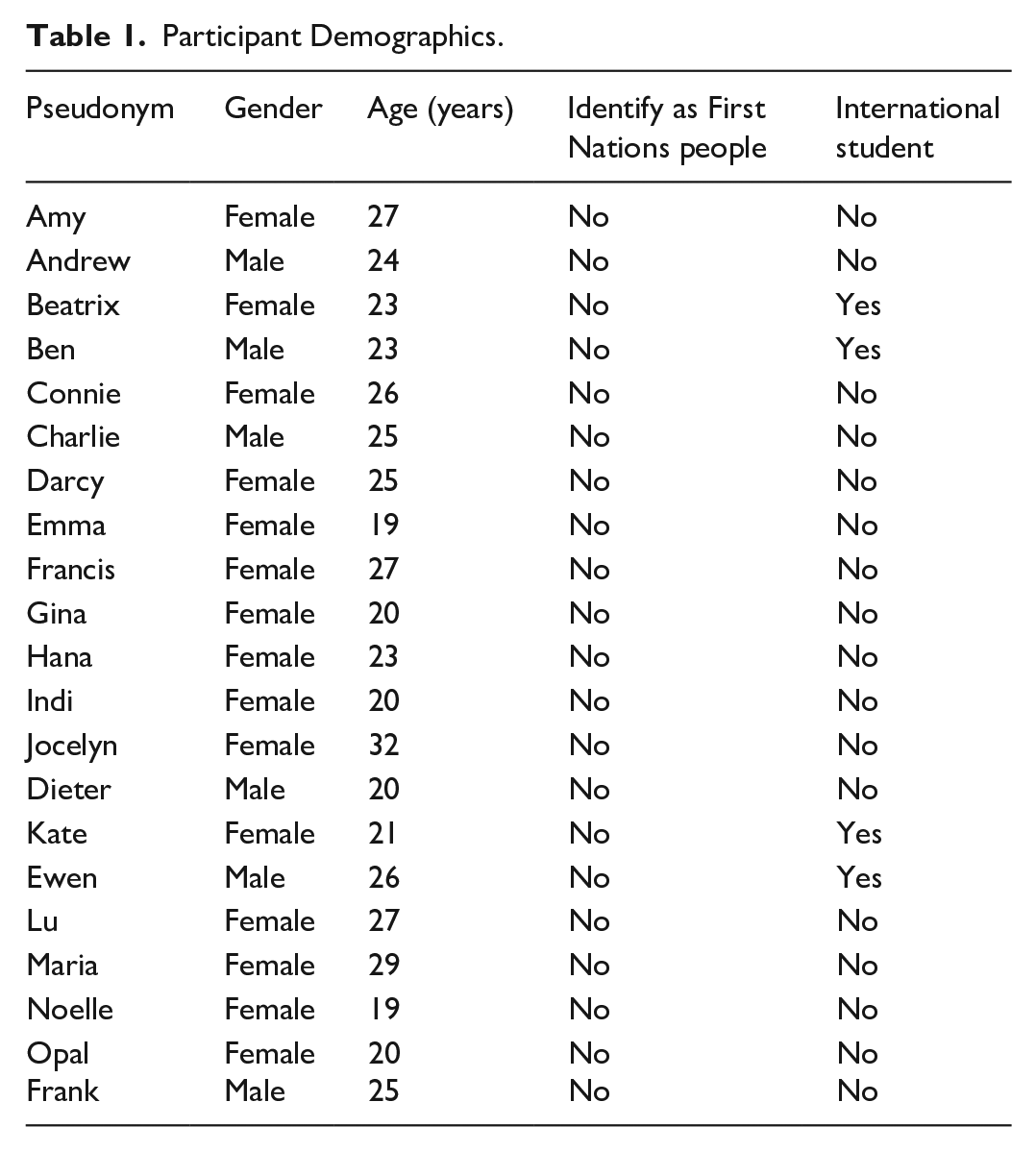
Following ethics approval, students were provided with an information letter explaining that participation in the study is voluntary and requesting consent to utilise their reflection. Participants were assured of their anonymity, and it was stipulated that providing consent (or not) will have no impact on their assessment grading for the unit. A pseudonym was then assigned to each consented reflection. Of the 21 participants, aged between 19 and 32 years, over 70% identified as female (n = 15), and 81% were domestic students (n = 17). None of the participants identified as First Nations people, and 23% were born outside of Australia (n = 5; see Table 1).
Participant Demographics.
All 21 reflection pieces were analysed using content analysis. One member of the research team employed manual coding techniques to create initial codes and generate a framework of themes which were recorded in Excel. These themes were reviewed by another researcher with differences discussed until a consensus was reached with the final themes recorded (see Braun & Clark, 2006). Participant quotes have been incorporated to exemplify and represent the identified themes. Four key themes transpired: valuable learning; transformative student learning; developing competence and confidence to work with Indigenous Australians; and a future practice.
Valuable learning experiences
Recently, McArthur (2022, p. 97) reaffirmed the value of authentic assessment in higher education but strongly advocated for designers to critically justify the authentic tasks in the first place, writing ‘students, and society, gain more from engagement in these tasks because that engagement has enriched sense of purpose’. The current study found that students consistently expressed the value of the authentic assignments, commenting on their deeper understanding of marketing and valuing the experiential learning and its potential to positively influence their career future. An example of a great validation of the value in the authentic way the assessment design was deployed comes from one of the youngest respondents, 19-year-old Emma, who wrote: ‘The assignments throughout this unit were very hands-on and practical [for example] being given a small business to analyse gave us a taste of what we will be working towards in the future’. Other respondents concurred: Indi described the assignments as ‘meaningful’ while Francis felt the assignments ‘gave [her] so much insight’. Hana explained how the assignments had ‘started to resonate’ with her while Dieter shared his delight at doing the assignments writing that ‘these experiences get me excited about marketing and finding the class content in the real world adds to that excitement’.
Andrew expressed how the assignments made him more invested in his learning, expressing that he ‘enjoyed assignment two, where we had the opportunity to create a Shopify store on an existing brand. Doing that assignment made me invested in the future success of [First Nations retail business] because of the knowledge and understanding I have gained from writing about them’. Others shared similar comments about fully immersing themselves in the assignments as Francis wrote ‘Working on assignments for a real small business, [First Nations retail business], gave me so much insight into all that is involved in retail marketing’. Hana also expressed her growing engagement as she explained: ‘When starting the assignment, I was focusing on more of the strategy, and theory we had learnt in class. However, progressing through the assessments, I really started to explore the retailer, and research the market itself, and why this type of product range is so unique and important to build in the market’. Like Hana, Kate shared her insights ‘Before re-designing this website, conducting a critical analysis of the business enhanced my understanding of how audiences were attracted to these products and how to navigate a more suitable website for these consumer groups’.
Transformative student learning
Bullen and Roberts (2019) reported that critical reflection is essential for transformative learning. There are strong examples taken from the reflections where students self-reported the questioning of their personal beliefs, ideas and assumptions, suggesting they were challenged, and some students shared how their actions have changed as a result. Most students had emotional responses to the history of First Nations people as Gina shared: ‘Like many of my classmates, the Kevin Rudd apology speech was when I cried. I got overwhelmed by sadness and guilt watching how relieved First Nations were when they received an apology – an apology that should have been given many years prior. It is evident that this changed my perspective, challenged my thought process, and impacted how I viewed societal issues. This was something that I absolutely did not expect from a Retail Marketing unit’. Noelle echoes an emotional reaction explaining how being confronted with the facts compelled her to question what she thought she knew ‘At the beginning of this ‘event’ the guest speaker began by questioning what we already knew about the First Nations culture and past. . . opening my eyes and made me question how much I truly knew about the rich culture of my country’. Others described how the insight they gained changed the way they make decisions as Indi revealed ‘It was in discovering this reality [Indigenous artists’ livelihoods continue to be jeopardised], which I would not have known otherwise, that I began to feel strongly about supporting First Nations businesses through my marketing assignments and formed an opinion about the ever-present condition’. She explained further that ‘the selling of inauthentic Aboriginal art and souvenirs in Australia is just one of many issues that have shifted my perspective on the society we live in today by challenging my assumptions’.
Students born outside of Australia appreciated the opportunity to learn more as expressed by Lu (born in England) who wrote ‘Assessment 2 also enabled me to research and expand my knowledge on First Nations businesses and the Aboriginal Visual Arts and Craft Sector. This was very eye-opening as I had never conducted research into these events before. I learnt about the struggles First Nation’s communities and Indigenous artists had experienced due to the COVID-19 pandemic. Knowledge of these issues has allowed me to gain further respect and cultural understanding of First Nations culture’. Similarly, another student, Connie (born in South Africa) revealed that ‘. . .through the course of this Retail Marketing unit, I have uncovered a level of ignorance about myself’.
Developing competence and confidence to work with First Nations
The researchers purposefully designed an assessment strategy that would support students in developing their competence and confidence in responding in a culturally aware way when working with First Nations people (Bullen & Roberts, 2021). Extracts from two prominent reflections suggest that students did develop this awareness. The first extract is from Connie, a 26-year-old, who explains she is now much more aware of her bias and subsequently changed her approach when working with the First Nations business:
‘Prior to commencing assessment two, I was unaware of the differing challenges First Nations business owners face when approaching marketing strategies. I was under the impression majority of businesses obtained a similar level of creative freedom and execution, irrespective of cultural influences. However, through the research required to execute assessments two and three, I now acknowledge this was a grossly uninformed and stereotype-based interpretation. . .Through research, I have come to recognise that the Western business world is, respectively, highly competitive, driven by individual gain, and accumulation of personal wealth. Whereas First Nations business practices tend to be oriented towards strengthening culture and benefiting the community. For many First Nations professionals, success is noted by evidence of community advancement, awareness and relationship building. This conceptualised understanding led me to re-frame the way I approached the development of the retail marketing report for the First Nations retail business, but more prominently impacted my thought process for the business-to-business product pitch.’
The second extract comes from 21-year-old Kate, an international student, who recognises the valuable experience and confidence she gained because of completing the assignments:
‘In addition to gaining an understanding of retail market strategy, this unit has also afforded an invaluable insight into and knowledge of First Nations business practices and the immense value they bring to society. After researching ways to further promote these businesses I have gained experience in seeking ways to increase the awareness of these smaller, bespoke businesses, and the importance effective marketing can provide.’
Future practice
It is clear from the reflective writings that students were profoundly impacted by the authentic assignments and that they gained new knowledge that they believe they will be able to use in the future. Emma explained how she discovered new brands she will invest in ‘Working alongside a First Nations business was a great learning experience, being educated by admirable guest speakers was a useful opportunity that I was grateful for. Not only did the First Nations aspect of this unit teach me a lot, but it also introduced me to new small Australian brands that I’ve fallen in love with and have become a consumer of’. Connie pledges her commitment to continued cultural education as she describes ‘Indigenous culture is centred on the power of coming together and remaining together, which I believe is a fading concept in Western culture. With that being said, I plan to continue to encourage and partake in cultural education to facilitate a more harmonious and inclusive future’. Lu looks forward to her placement now that she is across First Nations businesses, stating ‘Overall, the unit has been extremely insightful and taught me so much about retail marketing, as well as aspects of the importance of Indigenous culture and First Nations businesses. I am looking forward to commencing my summer work placement at a digital marketing agency so I can apply the knowledge I have acquired in new and innovative ways’.
Discussion and implications for practice
The study’s authentic approach adopted is situated within the ‘nothing about us without us’ principle, fostering a connection between students and First Nations retailers for collaborative learning. It ‘normalises’ the strength perspective in embedding Indigenous knowledge into the marketing curriculum, underscoring the significance of Indigenous learning and First Nations standpoints. The approach plays a role in improving students’ attitudes, self-assurance and competence in engaging with First Nations, in line with Mackinlay and Barney’s (2014) assertion that Indigenous Studies curricula can be transformative. It fosters a collaborative and experiential learning environment, enabling students to directly engage with Indigenous knowledge through informal yarns with First Nations retail owners, discussions of marketing case studies and contemporary retail examples. These authentic ways of teaching, learning and assessment enhance the overall educational experience by offering students opportunities to address real-world challenges and seize real-world opportunities. This approach is in harmony with the guidelines outlined in the Universities Australia Indigenous Strategy for 2022 to 2025, underscoring the authentic and seamless integration of First Nations peoples and their knowledge into educational settings and effective preparation of students for their future careers (Universities Australia, 2022). It exemplifies the effectiveness of a well-structured strength-based approach in incorporating Indigenous knowledge as an integral part of an immersive cultural experience and in promoting diversity within marketing education and practice.
This approach goes beyond self-reference; it is transformative, reshaping one’s understanding of the world (Popoveniuc, 2014). By empowering students to make a meaningful social impact and equipping them with marketing skills to be a Force for Good and a Force for Growth, it encourages a profound shift in perception through critical reflection (Mezirow, 2003). This transformation leads to increased empowerment, competence and confidence in students’ cultural awareness, enabling them to engage effectively with First Nations.
The decolonisation approach employed in this context creates a culturally safe learning environment, aligning with the principles advocated by Anderson and Riley (2021) and contributing to advancements in marketing education (Smith, 2021). It affords students the chance to engage in cross-cultural dialogues and actively partake in the responsibility of lessening the ‘cultural load’ carried by Indigenous communities, achieved through research, engagement, learning and collective efforts.
In this study, the primary objective was to enhance the Indigenous cultural competence of marketing students through employing a strength-based method which acknowledges the inherent strength, inspiration and admirable entrepreneurial skills of the First Nations business owners. It achieves this through authentic experiential learning, providing students with direct opportunities to collaborate and learn directly from First Nations. This approach to teaching, learning and research is consistent with Indigenous Australians’ empowerment and self-determination (Brown, 2021; Sweet, 2015). Moreover, it illustrates a respectful partnership between the field of marketing academia and First Nations communities.
Crucially, this approach offers a more seamless integration of Indigenous knowledge into the curriculum, aligning it with cultural and disciplinary relevance. What sets this approach apart is the researchers’ thorough examination of their course material and their thoughtful consideration of how to incorporate Indigenous teachings organically. It does not represent a drastic departure from traditional teaching methods but rather leverages common pedagogical tools in marketing education, such as case studies and authentic assessments, by centring them around First Nations perspectives. Consequently, it presents a method that empowers numerous marketing educators to adopt a similar approach in their courses and dispels the conventional apprehensions often tied to incorporating First Nations wisdom and viewpoints (Raciti et al., 2018).
From a managerial perspective, this research highlights the importance of employing a decolonisation approach to integrate cultural learning, ultimately enriching students’ cultural understanding and competencies. The process of building cultural awareness, knowledge and capability is an ongoing, lifelong journey. Our analysis and findings have delineated the advantages of delivering marketing education in a distinct and more collaborative fashion, resulting in high-quality learning outcomes derived from the educational experience.
Limitations and future research
The limitations of this study should be taken into consideration when interpreting the findings. One limitation of this study is the lack of insights collected from First Nations business owners and other marginalised groups in the student cohort. This could provide further nuances, particularly around barriers faced by First Nations business owners which may provide a more comprehensive understanding and theorisation of the decolonisation approach to marketing education and its impact on student learning.
The existing strategy has primarily emphasised the positive impact of a strengths-based approach to enrich students’ understanding of Indigenous cultural knowledge. Nevertheless, it is equally imperative to acknowledge the importance of understanding deficit models and the benefits of strength-based approaches in diverse contexts. In Indigenous narratives and marketing, it is generally considered more ethical and culturally sensitive to adopt a strength-based approach, however, it is crucial for marketers to engage in meaningful consultation and collaboration with Indigenous stakeholders, including community leaders and cultural advisors, to ensure that their marketing strategies are culturally appropriate and respectful of Indigenous perspectives and values. Future marketers would benefit from an adaptable approach, selecting the most appropriate strategy based on the circumstances and objectives. Future research should explore the circumstances and importance of recognising that both strengths and deficits can serve as valuable assets in marketing, with their effectiveness hinging on the specific context and objectives of the application.
Future research could extend to longitudinal qualitative analysis and critical reflection of graduates, exploring the long-term impact and transformation of their learning, competence and confidence in their cultural awareness and engagement with First Nations. There are also opportunities to further examine the marketing curriculum in higher education. Research could be designed to consider the decolonisation of marketing and communication content, the experiences of First Nations business owners engaging with students in this study and embracing the insights emerging from Indigenous methodologies in future marketing practice. For example, this can include examining marketing communication content in higher education and in the marketing industry and understanding the differences in marketing strategies for First Nations business owners and marginalised groups. As communities become more diverse, marketing strategies need to adapt. Future studies can lead to a robust analysis of current and future marketing curriculum design to improve the knowledge and skills of higher education students to meaningfully engage in their personal and professional careers.
Footnotes
Declaration of conflicting interests
The author(s) declared no potential conflicts of interest with respect to the research, authorship, and/or publication of this article.
Funding
The author(s) received no financial support for the research, authorship, and/or publication of this article.
