



Abstract
In an era where corporate social responsibility (CSR) dominates organizational agendas, the dimension of team diversity remains largely overshadowed. Despite its transformative potential, the interplay between team diversity and consumer product acceptance has been under-represented in the literature. This study illuminates the potency of team diversity as a critical CSR dimension, revealing its impact on bolstering product acceptance. In the context of clean meat, two experimental studies demonstrate that consumers are more willing to try a product developed by a company with a more diverse team (e.g. race and gender), as such firms are likely to account for a diversity of perspectives, thus enhancing consumer trust. Additionally, perceived authenticity moderates this effect, in that consumers of more authentic brands will be more trusting, regardless of the level of team diversity. The study provides critical insights into how consumers’ perception of team diversity within the firm influences product adoption, and how both team diversity and perceived authenticity drive trustworthiness. The findings offer practical implications for marketers of clean meat and other novel products to accelerate market acceptance and consequently, address broader societal challenges, whilst emphasizing the importance of fostering diversity and promoting brand authenticity.
Diversity has increasingly been recognized as a vital civic value (Song, 2020). Efforts to promote the inclusion of marginalized groups, including women, elderly individuals, religious and cultural minorities, African Americans, the LGBTQ community, and people with disabilities, among others, highlight the ongoing commitment of modern societies to foundational democratic principles, such as justice and equality (Faist, 2010; Fox et al., 2023; Kukathas, 2002; Spinner-Halev, 2001). From a business lens, contemporary research underscores that workplace diversity is associated not only with ethical considerations but also with improved financial outcomes (Manyaga & Ammar, 2021; McMahon, 2011; Porcena et al, 2021; Rock & Grant, 2016). Such findings challenge the adoption of perfunctory efforts to promote diversity, like tokenism, advocating instead for genuine and comprehensive inclusivity strategies (Dobbin & Kalev, 2016; Guldiken et al., 2019).
Even though a fair amount of scholarly knowledge has been produced on how corporate social responsibility (CSR) impacts consumers’ firm advocacy (e.g. purchase and loyalty; Baskentli et al., 2019; Bhattacharya & Sen, 2004; Sen et al., 2016), consumer responses to diversity —a core dimension of CSR—remain mostly underexplored (Baskentli et al., 2019; Bhattacharya & Sen, 2004; Khan & Kalra, 2022; Sen & Bhattacharya, 2001). Specifically, there is limited understanding of how perceptions of corporate diversity influence the acceptance of the products manufactured by a company (Khan & Kalra, 2022). In this work, we explore this area by bringing to the fore the case of clean meat.
Clean meat, also known as in vitro, cell-based, synthetic, or cultured meat (hereafter, clean meat), has the potential to revolutionize the meat industry by providing a more sustainable and ethical alternative to traditional animal farming (Bryant et al., 2020). Despite its potential benefits, especially in comparison to other meat alternatives like algae, pulses, and plant-based foods, clean meat faces low levels of consumer acceptance (Onwezen et al., 2021). One of the reasons for this is that new technologies often trigger several concerns among consumers. In the case of food production and processing, new technologies have been a polarizing issue, with consumers expressing concerns about, for instance, their safety and healthfulness (Cardello, 2003; Siegrist, 2007; Wai Lee et al., 2012).
Against this backdrop, harnessing perceptions of corporate diversity appears as a promising route to promote new technologies and, in consequence, clean meat. For one, recent research suggests that when consumers perceive a corporate team as diverse, it elevates their view of the firm’s morality. This, in turn, results in more favorable attitudes and behaviors toward both the company and its offerings (Khan & Kalra, 2022). These findings align neatly with research on CSR more generally indicating that “CSR initiatives [including efforts to promote diversity] are tantamount to signals sent by a company to reduce the uncertainty that can weigh upon consumers’ purchasing decisions.” (Swaen & Chumpitaz, 2008, p. 14). Additionally, previous work indicates that the adoption of emerging technologies is partly driven by perceptions of institutional or organizational trustworthiness (Farquharson, & Critchley, 2004). Building on the connection between organizational diversity and perceived firm morality—and using clean meat as our case study—we posit that perceptions of corporate diversity can bolster acceptance of an innovative product by enhancing perceptions of trustworthiness.
In particular, we show that when consumers know a company is diverse, the perceived trustworthiness of the company is increased, and consumers are more accepting of products developed by the company (clean meat, in our case). We, additionally, demonstrate that this mediating role of trust is moderated by brand authenticity. Because perceived brand authenticity can serve as a heuristic to evaluate the trustworthiness of a company and its products (Brockhaus et al., 2017), when brand authenticity is heightened, consumers will be more trusting, regardless of the level of diversity of the company team.
Our research provides several noteworthy contributions to the existing literature. First, while prior studies have explored the positive impacts of organizational diversity on firm performance (e.g. Homan et al., 2020; Huse & Grethe Solberg, 2006), there is limited understanding of how consumer perceptions of firm diversity, a core CSR dimension, influence their willingness to adopt the company’s products. In general, even though a fair amount of knowledge has been produced on how perceptions of CSR efforts influence consumer responses, the effect of the CSR diversity dimension has been mostly overlooked. Furthermore, we also contribute to the literature on clean meat. Here, studies on consumer acceptance have mostly focused on the product itself (Pakseresht et al., 2022). For example, studies have looked into familiarity with the product (e.g. Lupton & Turner, 2018; Valente et al., 2019) or emotions triggered by it (e.g. fear and disgust: Shaw & Mac Con Iomaire, 2019; Siegrist & Hartmann, 2020). Our research is the first to investigate how diversity perceptions, an external factor to the product, can shape consumer acceptance of an emerging food technology like clean meat. Third, we enrich the literature regarding barriers to novel product adoption by identifying the role of both team diversity and perceived authenticity in driving trustworthiness. Finally, the insights from our study provide invaluable guidance for marketers aiming to drive the adoption of new technologies and emphasize the critical importance of promoting diversity and inclusion within organizations.
The next section presents the literature review and hypothesis development, followed by a description of the research design used for the two experiments to provide support for our theorizing. The paper concludes with a discussion of the research’s contributions and practical implications, its limitations, and future research directions.
Theoretical development
Diversity and inclusion
In recent years, organizations have increasingly recognized the influence corporate social responsibility (CSR) can have on consumers’ attitudes and behaviors toward them. Companies, in general, are much more aware of how a commitment to some, or all, of the CSR dimensions (Baskentli et al., 2019), for example philanthropic, community, or environmental efforts, can lead to positive consumer reactions, for instance, loyalty or increased purchase intentions (e.g. Al-Haddad et al., 2022; Boronat-Navarro & Pérez-Aranda, 2019; Grimmer & Bingham, 2013). One core CSR dimension—according to the most popular taxonomy, the one by Kinder, Lydenberg, Domini Research & Analytics (Baskentli et al., 2019)—is diversity (Kang, 2015).
Issues related to diversity and inclusion have long been a prominent topic in organizations, particularly since the enactment of equal employment and affirmative action legislation in the mid-1960s (Anand & Winters, 2008). The public conversation surrounding diversity and inclusion has gained significant traction in recent years, fueled by social media and a growing recognition of the need for social justice and equality (Labroo et al., 2023). Organizations have increasingly recognized the importance of promoting diversity and inclusion in the workplace not only from a moral or ethical standpoint but also due to its positive impact on various aspects of organizational performance, including financial outcomes (Herring, 2009), organizational effectiveness (Cox & Blake, 1991), and innovation (Nishii & Özbilgin, 2007).
However, in contrast to the large body of literature documenting the effects of diversity on organizational performance, little is known about how corporate diversity impacts consumers’ responses to the firm (Essa, 2023). Based partly on the theory of impression formation and the pivotal role of moral considerations in this process (Wojciszke et al., 1998), recent research has shown that organizational diversity can have a positive impact on consumer perceptions of a firm, leading to more favorable attitudes and behaviors toward the company and its products (Khan & Kalra, 2022). This is because diverse companies are perceived to be better at taking different perspectives into account, something that in turn results in perceptions of the firm as a more ethical and inclusive entity (Khan & Kalra, 2022). In line with this, we contend that the assessments of a company as an ethical/moral entity, driven by diversity perceptions, will result in an increased willingness to adopt the products developed by it, something we illustrate with the case of clean meat as we later elaborate.
Notably, we also uncover the role of trust as a mediating variable between diversity perceptions and positive consumer responses. Previous findings indicate that corporate social responsibility perceptions have a positive impact on trust in a company (e.g. Iglesias et al., 2020; Kang & Hustvedt, 2014; Pivato et al., 2008; Tian et al., 2020). These findings mirror others in the study of cooperation in interpersonal settings, where moral judgments have been shown to be linked to trust (Doebel & Koenig, 2013; Doloswala, 2014; Simpson et al., 2013). In general, research suggests that entities, whether individuals or organizations, perceived as more moral, are trusted more (Doebel & Koenig, 2013; Mayer et al., 1995). In this context, ethical behavior, whether at the organizational or individual level, fulfills a positive signaling function (Spence, 1974; Swaen & Chumpitaz, 2008). Not surprisingly, trust has been found to mediate the effect of perceived corporate social responsibility on positive consumer responses to a company, such as patronage and recommendation intentions (Vlachos et al., 2009).
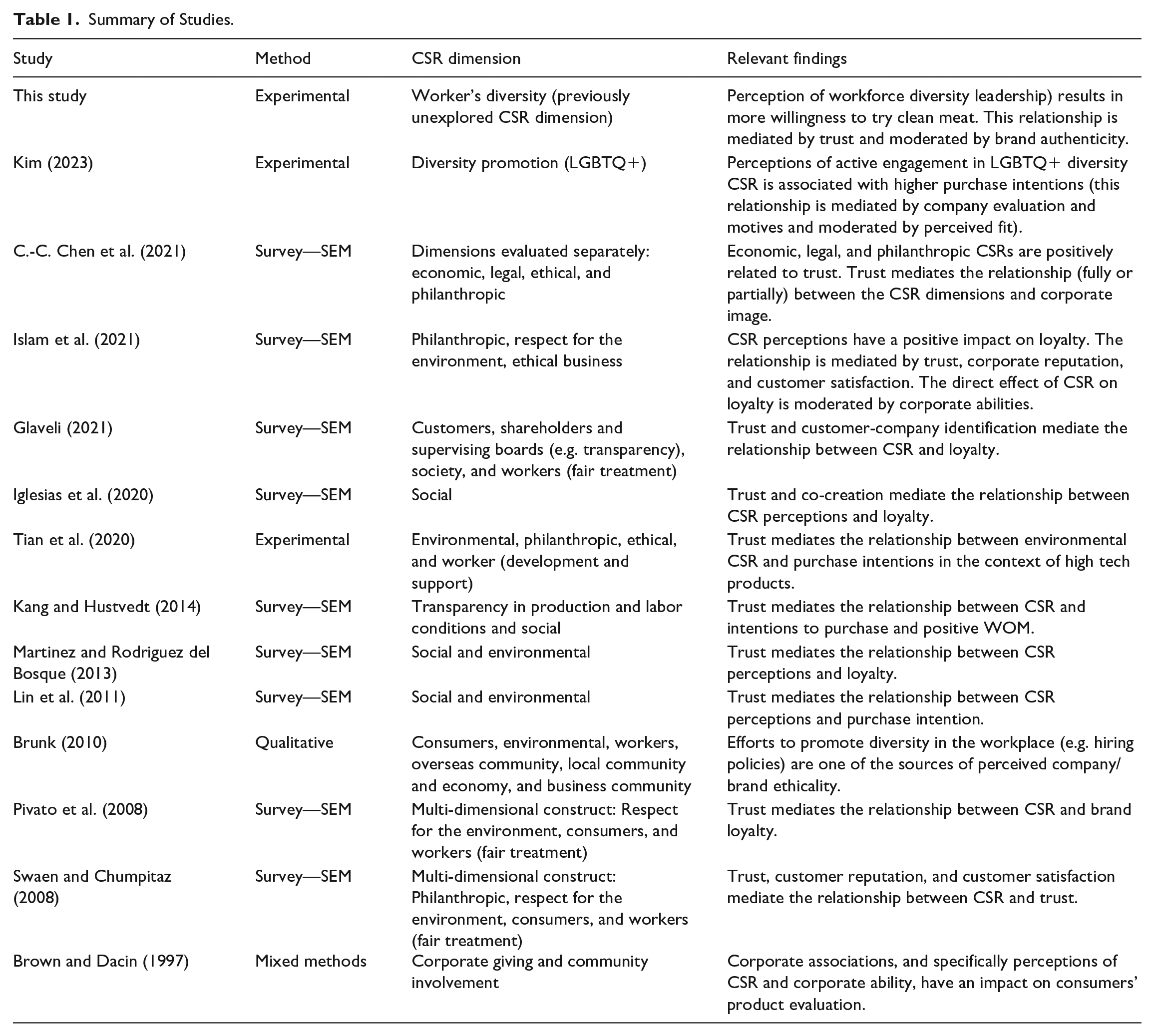
Nonetheless, studies on CSR and its relationship to trust have, for the most part, examined CSR in general by collapsing measures of social, ethical, and environmental CSR dimensions (among others) into a single construct. The diversity dimension of CSR (see Table 1), on the other hand, has been overlooked. Our focus on diversity is justified by findings showing that consumer responses vary depending on the specific CSR dimension considered (Baskentli et al., 2019). On the other hand, we align with existing literature and hypothesize that diversity (as perceptions of CSR in general) will have a positive relationship with trust, as we formally state in the next sections.
Summary of Studies.
Clean meat acceptance
Clean meat technology has the potential to revolutionize the food industry by offering a more sustainable and ethical alternative to traditional meat production. By culturing animal cells in a laboratory setting, clean meat eliminates the need for raising and slaughtering animals, which has come under increasing scrutiny due to its negative impact on the environment and animal welfare (Lin-Hi et al., 2022; McCarthy & Liu, 2017). According to Leip et al. (2015), the livestock sector is responsible for nearly 80% of terrestrial biodiversity loss, 80% of air pollution, and over 70% of water pollution generated by the agricultural industry. Despite this, the global demand for meat products continues to rise (Weinrich et al., 2019).
Mostly disregarding the potential benefits of clean meat, consumer acceptance of this new technology remains low in comparison to other meat alternatives such as algae, pulses, or plant-based foods (Onwezen et al., 2021). It is widely acknowledged in the literature that clean meat faces challenges in gaining consumer acceptance, as consumers often express low levels of trust in the product (Hocquette et al., 2015; Verbeke et al., 2015). Concerns about the safety, healthiness, and long-term effects of clean meat consumption are commonly cited by consumers (Gómez-Luciano et al., 2019; Shaw & Mac Con Iomaire, 2019). As such, understanding how to increase consumer trust in clean meat is critical.
Scholars have tested the effectiveness of numerous approaches designed to increase the acceptance of clean meat. In addition to market strategies that exploit basic supply and demand mechanisms (e.g. dropping its price: Grasso et al., 2019), tactics including acquainting consumers with the product (Verbeke et al., 2015), challenging views about the importance of naturalness (Arango et al., 2023), highlighting its ethical advantages (Weinrich et al., 2019; though see Lupton & Turner, 2018), or emphasizing its safety and healthiness—compared to traditional meat (Bryant et al., 2020)—have been studied (for a review, see Pakseresht et al., 2022). Yet gaining consumers’ trust has not been easy to accomplish; many of the previously introduced strategies exhibit limited success (e.g. Lupton & Turner, 2018; Van Loo et al., 2020; Wilks et al., 2019), indicating the need for new approaches to increase consumer trust and subsequent acceptance of clean meat.
Building upon the research previously reviewed on the role of diversity and its relationship to trust, we hypothesize that the diversity of a company will have a positive effect on the acceptance of clean meat and that the mechanism explaining this effect will be trust. We focus here on gender and race diversity considering that they have been shown to be central in the workplace. Formally, we hypothesize that:
Finally, we propose that the effects previously specified in H1a and H1b will be attenuated after heightening perceived authenticity, something that will provide further support for the proposed mechanism and establish a boundary condition for the mediation effect.
The moderating role of perceived authenticity
Authenticity assessments by consumers are consequential. Indeed, authenticity positively influences several marketing outcomes that drive purchase intentions and behavior, such as customer satisfaction (Uysal & Okumuş, 2022), brand loyalty (Uysal & Okumuş, 2022; Xu et al., 2022), brand attachment (Choi et al., 2015), brand preference (Cop & AstekİN, 2022), brand engagement (Kapitan et al., 2022; Kumar & Kaushik, 2022), and brand love (Manthiou et al., 2018). In the food domain, authenticity has also been found to influence purchase intentions (Assiouras et al., 2015; Loebnitz & Grunert, 2022); however, as stated by Sidali et al. (2021, p. 2) studies in this area are few and far between: “Despite the number of studies on authenticity, very few focus on food marketing”—something that makes the choice of context (clean meat) ideal.
Authenticity is defined in this work following the integrative work by Morhart et al. (2015, p. 203) as “the extent to which consumers perceive a brand to be faithful toward itself (continuity), true to its consumers (credibility), motivated by caring and responsibility (integrity), and able to support consumers in being true to themselves (symbolism).” Inauthentic brands, in contrast: (i) lack “timelessness and historicity” (continuity deficiency); (ii) do not necessarily deliver on their promises (credibility deficiency); (iii) do not consistently adhere to ethical or moral standards (integrity deficiency); and, (iv) do not play an active role in the construction of the self (symbolism deficiency; Morhart et al., 2015; for a similar approach, see Campagna et al., 2022).
We argue that the relationships previously explicated, between diversity, trust (mediator), and willingness to try clean meat, will be moderated by perceptions of brand authenticity. As it is evident from the previous discussion, trust, even if not subsumed under the multidimensional construct of brand authenticity, shares several conceptual links with it (Hernandez-Fernandez & Lewis, 2019; Morhart et al., 2015). Indeed, this conceptual relationship is evident in grammatical constructions where authenticity is employed in its adjectival form (e.g. “The witness statement is unlikely to be authentic,” i.e. reliable or trustworthy), and which evince the etymological origin of the word (authentikós: genuine). Authentic brands are trustworthy in at least an instrumental and moral sense: First, authentic brands reliably live up to customers’ expectations; second, their actions respect, even promote, ethical and moral standards and values (Kennedy et al., 2016; Morhart et al., 2015; Napoli et al., 2014). Accordingly, research has found that markers of trust, such as engaging in corporate social responsibility efforts (Childs et al., 2019) or delivering quality products (Napoli et al., 2014), positively predict brand authenticity perceptions.
Thus, we predict that heightening perceptions of brand authenticity will mitigate the indirect effect of diversity on willingness to try clean meat. The reason is that consumers who perceive a brand as authentic also tend to find it trustworthy. Then, highlighting the diverse composition of a team involved in the development of a clean meat product is not expected to be of much value for consumers who, to begin with, perceive the brand as authentic. In opposition to this, we predict that consumers who judge a brand as inauthentic will find diversity cues highly valuable, something that will be translated into more willingness to try clean meat by leveraging trust. Formally,
Testing this moderation is critical, particularly in the case of clean meat as it is a novel food technology that is primarily developed and marketed by small startups (Research and Markets, 2023). Since startups are young companies, they lack the advantages of established track records possessed by more mature organizations, such as continuity and historicity, which makes it difficult for them to establish authenticity and credibility. This challenge is relevant even for startups that have received significant investment from major corporate investors, such as Upside Foods from Cargill and Tyson Foods. Thus, understanding how team diversity influences consumer perceptions of clean meat products and how perceived authenticity moderates this relationship is crucial for marketers of clean meat and small startups seeking to promote consumer trust and adoption of their products (see Figure 1).
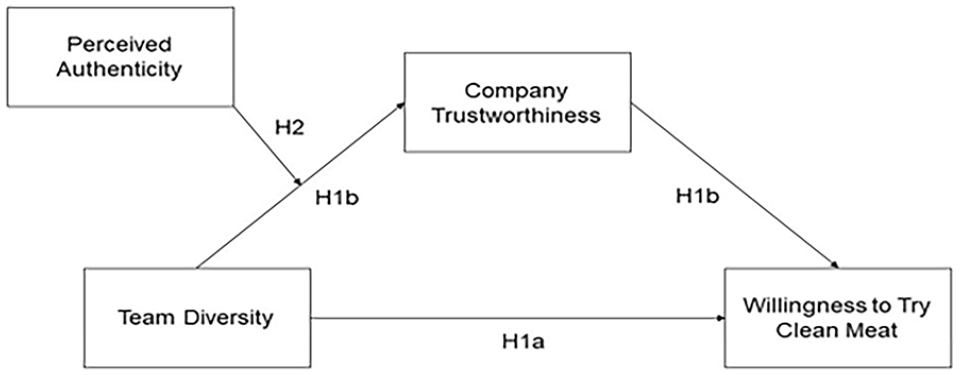
Conceptual model.
We conducted two studies to test our predictions. Study 1 sought to test Hypotheses 1a and 1b. In this study, we examined the context of racial diversity in a team. Consistent with our predictions, we expected that consumers would report higher levels of trust toward a company with a more (vs. less) diverse team, leading to a higher willingness to try clean meat developed by the company. Study 2 had two important objectives. First, we wanted to replicate the findings of Study 1 in the case of gender diversity. This is because diversity in business is typically indicated as the inclusion of racial and gender segments in teams (Khan & Kalra, 2022). Second, we sought to provide evidence on the boundary condition of our prediction—that is, the moderating role of perceived authenticity (H2).
Study 1
Method
Study 1 employed a one-factor, two-level (racial diversity: diverse amd non-diverse) between-subjects design. As calculated using G*Power software, we needed a minimum of 128 participants to detect an estimated medium-sized effect (f = 0.25) at 0.80 power and α = .05. Hence, we recruited 155 participants located in the U.S. via Prolific (50% females, Mage = 39.37, SD = 11.74). Prolific was employed based on research indicating that the platform provides high-quality data for online behavioral research (Litman et al., 2021; Pe’er et al., 2021).
Participants were asked to read a short description of clean meat from a fictitious company (see the Appendix; adapted from Anderson & Bryant, 2018). Depending on the experimental condition, participants were then informed about the diverse or non-diverse team who developed clean meat (see the Appendix; Khan & Kalra, 2022). As the dependent variable, participants rated three statements, measured on a 7-point scale (1 = “not at all,” 7 = “very much”). The statements were: “If the product were available now,” . . . “I am willing to try the product,” “I am willing to buy the product,” and “I am willing to eat the product” (α = .97; Anderson & Bryant, 2018). To measure trustworthiness (Ohanian, 1990), participants rated their perceptions about the company based on their claims and description of clean meat on five items (“trustworthy,” “reliable,” “dependable,” “honest,” and “sincere”; α = .96), measured on a 7-point scale (1 = “not at all,” 7 = “very much”). As a manipulation check (Khan & Kalra, 2022), participants indicated their agreement about whether the team who developed the product was diverse (1 = “strongly disagree,” 7 = “strongly agree”).
Results and discussion
Manipulation check
As expected, participants perceived the diverse team (M = 4.85, SD = 1.77) to be more diverse than the non-diverse team (M = 2.05, SD = 1.23, F(1, 153) = 129.31, p < .001, ηp2 = .46).
Willingness to try
Participants evaluating the diverse team (M = 4.87, SD = 1.70) reported a higher willingness to try clean meat, as compared to those evaluating the non-diverse team (M = 4.25, SD = 2.08, F(1, 153) = 4.13, p = .044, ηp2 = .03), supporting Hypothesis 1a.
Trustworthiness
Participants evaluating the diverse team (M = 4.45, SD = 1.39) reported higher levels of trust toward the company, as compared to those evaluating the non-diverse team (M = 3.94, SD = 1.56, F(1, 153) = 4.62, p = .033, ηp2 = .03). We then conducted a mediation analysis using PROCESS Model 4 with 10,000 bootstrap resamples (Hayes, 2017), examining the indirect effect of team diversity on willingness to try via trustworthiness (see Figure 2). The indirect effect was significant with B = 0.43, SE = 0.20, 95% CI [0.05, 0.83], supporting Hypothesis 1b.
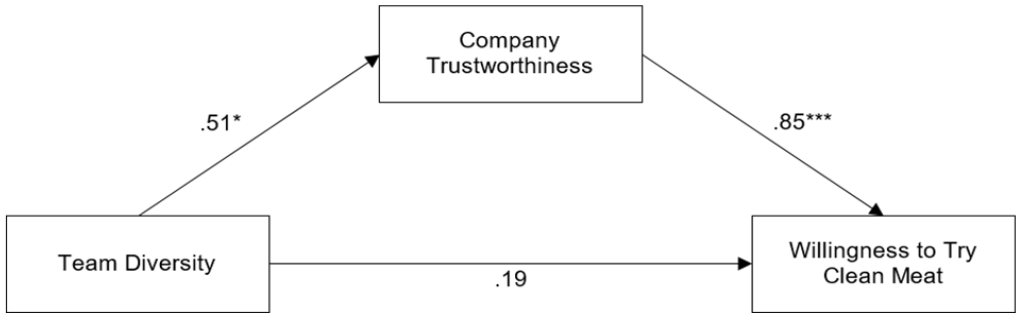
Mediation analysis (study 1).
Study 2
Method
Study 2 employed a 2 (gender diversity: diverse, non-diverse) × 2 (authenticity: heightened, control) between-subjects design. As calculated using G*Power software, we needed a minimum of 256 participants to detect an estimated medium-sized effect (f = 0.25) at 0.80 power and α = .05. We recruited 300 participants located in the U.S. via Prolific (49% females, Mage = 39.33, SD = 11.41).
Similar to Study 1, participants were asked to read a short description of clean meat and then were shown the diverse or non-diverse team who developed clean meat (see the Appendix; Khan & Kalra, 2022). To manipulate authenticity, we included additional background information about the company. Specifically, participants in the heightened perceived authenticity (or the control) condition read that the company was founded in “1995” (or “2020”) by “food scientists” (or “businesspeople”) who “acquired a proprietary food technology” (or “developed and patented a proprietary food technology”; adapted from Morhart et al., 2015). Afterwards, participants completed the same dependent variable (α = .97) and mediator (α = .96) measures as those in Study 1. In addition to a manipulation check for team diversity, participants also rated whether the company developing clean meat was authentic (1 = “strongly disagree,” 7 = “strongly agree”).
Results and discussion
Manipulation checks
A 2 × 2 ANOVA revealed a significant main effect of diversity (F(1, 296) = 10.42, p = .001, ηp2 = .03; other effects were non-significant), such that participants perceived the diverse team (M = 3.75, SD = 1.72) to be more diverse than the non-diverse team (M = 3.11, SD = 1.68). In contrast, a 2 × 2 ANOVA revealed a significant main effect of authenticity (F(1, 296) = 8.43, p = .004, ηp2 = .03; other effects were non-significant), such that participants in the heightened authenticity condition perceived the company (M = 4.83, SD = 1.31) to be more authentic than those in the control condition (M = 4.35, SD = 1.53).
Willingness to try
We conducted a two-way ANOVA and found a significant interaction effect between diversity and authenticity (F(1, 296) = 5.21, p = .023, ηp2 = .02). In the control condition, participants evaluating the diverse team (M = 4.80, SD = 1.72) reported a higher willingness to try clean meat, as compared to those evaluating the non-diverse team (M = 4.17, SD = 1.87, F(1, 296) = 4.32, p = .038, ηp2 = .01), hence replicating Study 1 and supporting Hypothesis 1a. However, such effects were attenuated in the heightened authenticity condition (Mdiverse = 4.59, SD = 1.88, Mnon-diverse = 4.93, SD = 1.91, F(1, 296) = 1.31, p = .254). These findings supported Hypothesis 2.
Trustworthiness
A two-way ANOVA revealed a significant interaction effect between diversity and authenticity (F(1, 296) = 5.97, p = .015, ηp2 = .02). In the control condition, participants evaluating the diverse team (M = 4.53, SD = 1.22) reported a higher willingness to try clean meat, as compared to those evaluating the non-diverse team (M = 4.05, SD = 1.55, F(1, 296) = 4.98, p = .026, ηp2 = .02), replicating the findings of Study 1. However, such effects were attenuated in the heightened authenticity condition (Mdiverse = 4.47, SD = 1.22, Mnon-diverse = 4.60, SD = 1.21, F(1, 296) = 1.48, p = .224).
Next, we conducted a moderated mediation analysis using PROCESS Model 7 with 10,000 bootstrap resamples (Hayes, 2017), examining the indirect effect of team diversity, moderated by authenticity, on willingness to try via trustworthiness (see Figure 3). The results indicated a significant index of moderated mediation (B = -0.55, SE = 0.24, 95% CI [-1.05, -0.10]). Specifically, the indirect effect was significant in the control condition, with B = 0.36, SE = 0.18, 95% CI [0.03, 0.74], whereas the indirect effect was non-significant in the heightened authenticity condition, with B = -0.19, SE = 0.15, 95% CI [0.49, 0.10]. These findings provided evidence for Hypothesis 2.
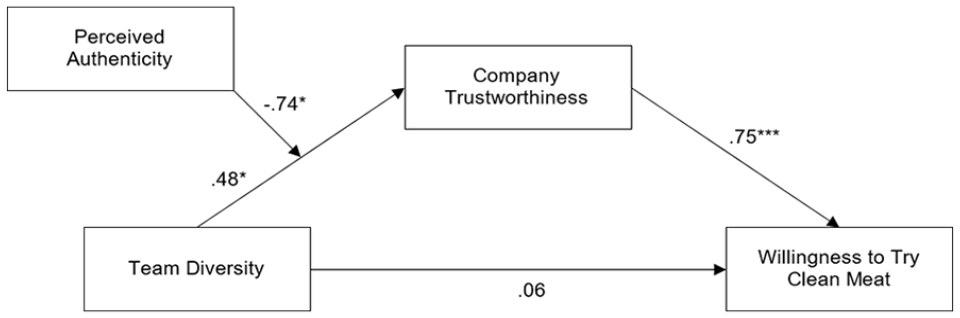
Moderated mediation analysis (study 2).
General discussion
The current research investigates how team diversity influences product acceptance employing the case study of clean meat. Specifically, across two experimental studies, we demonstrate that consumers will report a higher willingness to try clean meat developed by a company with a more (vs. less) diverse and gender-diverse team, both in terms of racial (Study 1) and gender (Study 2) diversity. Moreover, this effect emerges because consumers have higher levels of trust toward a more diverse team (Studies 1 and 2). We also identify a boundary condition of the predicted team diversity effect, such that it is attenuated when perceived authenticity is heightened (Study 2).
Theoretical and practical implications
Our research provides valuable insights into the intersection of food marketing, diversity, and societal challenges related to sustainability and ethics. While prior research has examined the positive effects of corporate social responsibility endeavors on consumer reactions to a firm and its offerings (Baskentli et al., 2019; Bhattacharya & Sen, 2004; Sen et al., 2016), the influence of the core CSR diversity dimension remains underrepresented in marketing research. We contribute to this underexplored body of knowledge by examining how customer perceptions of diversity in firms impact the adoption of their products (Khan & Kalra, 2022).
Additionally, although numerous studies have investigated consumer acceptance of clean meat, most of these have focused primarily on the product itself and its attributes (Pakseresht et al., 2022), neglecting the potential impact of the team responsible for developing and promoting it. Our study bridges these gaps in the literature by investigating how the composition of the team responsible for developing and promoting clean meat can influence consumer perceptions and behavior toward this novel food product. In particular, our study is the first to investigate how team diversity, a factor that is not directly related to the product itself, can impact consumer acceptance of clean meat. Our research builds upon prior literature that suggests greater diversity in a corporate team can enhance consumer perceptions of the firm’s morality and trustworthiness, leading to more favorable attitudes and behaviors toward the firm (Khan & Kalra, 2022). Diversity is associated with higher perspective-taking abilities, allowing for better understanding and appreciation of diverse perspectives and values, and more ethical and inclusive decisions. The findings of our study add to the literature pertaining to team diversity by providing evidence that a firm’s team diversity can enhance consumers’ perceptions of company trustworthiness which, in turn, translates into acceptance of its products.
Secondly, our study contributes to the literature on barriers to product adoption by identifying the role of both team diversity and perceived authenticity in driving trustworthiness. For example, previous research has shown that consumer acceptance of clean meat is influenced by a range of factors, including taste, safety, and environmental sustainability (for a review, see Pakseresht et al., 2022). Our study adds to the literature by demonstrating that team diversity and perceived authenticity are both important factors that can impact consumer trust and product adoption, as we illustrate with the case of clean meat. Specifically, we find that the positive effect of team diversity on clean meat acceptance is attenuated when perceived authenticity is heightened. This finding is consistent with prior research that suggests consumers increasingly value brands that are seen as genuine, honest, and ethical, and they often use perceived authenticity as a heuristic to evaluate the trustworthiness of a company and its products (Brockhaus et al., 2017). This finding has important implications for marketers of clean meat and other novel products, as it suggests that efforts to promote product adoption must consider a range of factors beyond just the product itself.
Finally, our study offers important practical implications for marketers promoting clean meat, as well as other innovative products, in their efforts to gain market acceptance. Specifically, our findings suggest that investing in diversity and inclusion initiatives can be a valuable strategy for building consumer trust and driving the adoption of products. By highlighting the importance of team diversity in enhancing consumer perceptions of firm trustworthiness, our study underscores the need for firms to prioritize diversity and inclusion in their hiring and marketing practices. This is particularly relevant for startups, which may face challenges in gaining consumer trust due to the novel nature of the companies’ history as well as their products. Companies can, for example, use social media to showcase their commitment to diverse hiring practices or incentivize customers to familiarize themselves with the company’s leadership by promoting their About Us webpage (e.g. Impossible Foods, 2023). Companies in other industries (e.g, United and Emirates, 2022) have successfully utilized YouTube ads to spotlight their employees and emphasize their diversity and employees have also been featured in promotional videos for alternative protein companies (Beyond Meat, 2018). Clean meat manufacturing environments, in contrast to slaughterhouses, present ideal opportunities to familiarize consumers not only with the product but also with the potentially diverse team involved in its production.
Moreover, our study has broader societal implications for addressing challenges related to food sustainability and ethics. Clean meat has the potential to address many of the environmental and ethical concerns associated with traditional animal agriculture (Tuomisto & Teixeira de Mattos, 2011). However, for this technology to achieve its full potential, it must be widely adopted by consumers. By identifying the role of team diversity in promoting clean meat adoption, our study contributes to the development of strategies to increase the uptake of this important technology and, in turn, address some of the most pressing challenges facing our global food system.
In conclusion, our study makes important theoretical and practical contributions to the literature on diversity, trust, and adoption of clean meat. By highlighting the importance of team diversity and perceived authenticity in shaping consumer attitudes and behavior towardsthis novel food technology, our study provides valuable insights for marketers of clean meat and other novel products, as well as for organizations seeking to build consumer trust and promote diversity in their operations. Ultimately, our study underscores the potential of clean meat to contribute to a more sustainable and ethical global food system and highlights the critical role of diversity in achieving this vision.
Limitations and future research
We now list some of the limitations of the present work and suggest avenues for future research. First, we have provided strong evidence for trust as a mediating mechanism. This closely aligns with the findings by Khan and Kalra (2022) which, again, suggest diversity perceptions drive morality assessments, and is also supported by the attenuation of the mediating effect of trust when authenticity, a closely related construct, is brought into the picture (Study 2). Additionally, the mediating role of trust is theoretically supported by research establishing its role as a crucial determinant of consumers’ responses to novel food technologies (Siegrist, 2008) and to an extensive body of literature that relates trust to CSR perceptions (e.g. Iglesias et al., 2020; Kang & Hustvedt, 2014; Pivato et al., 2008; Tian et al., 2020). Future research, however, should explore other mechanisms that might be at play in the context of novel food acceptance, and that have been shown to influence consumer responses to novel foods, such as perceptions of risk or quality assessments (Hundschell et al., 2022; Pakseresht et al., 2022).
Second, we used a measure of intention as the dependent variable. Clean meat supply is currently restricted and, accordingly, it is for the most part impractical to conduct research in more naturalistic settings. Future research efforts could attempt a replication of these findings employing measures of actual behavior once the product is widely available.
Third, it is fundamental to realize that diversity is a multivocal concept. We have employed stimuli that embody types of diversity that are fundamental in the workplace—gender and race (Khan & Kalra, 2022)—but it remains to be seen whether highlighting other types of team diversity translates into additional benefits for a company. For instance, recent findings suggest that laws intended to prevent discrimination based on gender identity (LGBTQ identities) spur firm innovation (Hossain et al., 2020). This immediately begs the question of how consumers perceive products manufactured by gender-identity-diverse firms (e.g. as more creative). Future research should explore questions such as this and, correspondingly, come up with methodologies that can appropriately reflect types of diversity that are not evident visually (e.g. disparate worldviews or belief systems).
Finally, moderators should be examined. Diversity tactics targeted at consumers displaying marked ingroup favoritism and biases (Abbink & Harris, 2019) or embracing conservative values (Jensen et al., 1988; Lee & Ostergard, 2017) might backfire. It is critical to keep in mind that certain consumer groups could straightforwardly oppose diversity efforts. In general, more research is needed to understand how perceptions of organizational diversity influence consumer preferences and product choice and evaluation.
Footnotes
Appendix
Declaration of conflicting interests
The author(s) declared no potential conflicts of interest with respect to the research, authorship, and/or publication of this article.
Funding
The author(s) disclosed receipt of the following financial support for the research, authorship, and/or publication of this article: This work was supported by the Australian Research Council (DE220100100).
Ethical approval
This study received ethical approval from The University of Queensland’s Human Research Ethics Committees, approval number: 2023/HE000351.
