



Abstract
This research examines how retailers convey messages to target customers and facilitate purchase decisions in physical settings. To establish a clear organizing framework for communications in physical settings, the current article examines both how and why retailers communicate with customers. Specifically, the authors address “how” questions from the perspective of whether messages are static or dynamic and “why” questions according to whether the communication is inspirational or informative.
Marketers have begun to regard retailers as not just sellers of products but also a distinct media communication channel for reaching consumers. Retailers communicate with customers through in-store media vehicles, such as digital displays, kiosks, end-caps, physical signage, and flyers; through online channels like their websites, Facebook store, Instagram store, social media sites; and with mailed offerings, including both personalized email offers and mailed flyers. In addition to leveraging these abundant media vehicles for their own messages, retailers can sell this available ad space to others.
The media divisions of many major retailers (e.g. Nordstrom, Michaels, ICA, Giant Eagle) actively work with marketers and manufacturers of relevant products and services to provide them with media space across a range of paid online and offline properties (Petrak, 2023; Wiener et al., 2022; personal interviews conducted by authors). With these media opportunities, actors higher up in the supply chain can effectively connect with customers at the appropriate stage of the customer experience journey (Grewal & Roggeveen, 2020). Accordingly, marketers appear increasingly willing to spend on this media channel, and the media divisions of many retailers have become very profitable; recent estimates by the Boston Consulting Group suggest the retail media market will grow to a value of more than $100 million by 2026 (Wiener et al., 2022).
In this evolving retail environment, retailers also are finding new opportunities in their function as a media communication channel, such that they seek novel ways to raise awareness, interest, desire, action, and purchases among consumers. New communication media, such as digital displays, enhance their ability to engage with customers in complex and personalized manners, though traditional sign-based communications also remain as effective, standard forms of communications in stores. Amid such changes and growth in the retail media channel, we seek to clarify precisely how retailers, manufacturers, and marketers can convey messages to target customers and facilitate purchase decisions in physical settings. We propose an organizing framework for communications in physical settings that centers on both how and why retailers communicate with customers. To address the “how” factor, we consider messages that are static versus dynamic; regarding the “why” element, we investigate the relevance of communication that is inspirational versus informative. In turn, our framework can help retailers, manufacturers, and marketers define their advertising objectives and then select the communication method that is most likely to help them achieve those goals. Furthermore, the framework provides a roadmap for retailers and advertising agencies to assess their advertising message goals and design in-store communication accordingly (e.g. providing inspiration or communicating information). Retailers also can identify where to allocate investments in effective technologies that align with their communication approach and thereby allow for optimal returns. Finally, the framework axes—pertaining to how to communicate information and why—can facilitate the design of clearer marketing communication to customers, who then can find the information they need more quickly and enjoy better in-store experiences.
To initiate this effort, we offer definitions of the axes in our proposed framework. Static communication involves messages that do not change; dynamic communication implies that messages change or move (e.g. videos) and even might be interactive, such as those that allow for two-way communication (e.g. touchscreens). Some parallels arise—static content with non-digital communications and dynamic content with digital versions—but we argue that static and dynamic communication are not limited to any medium. A live cooking demonstration is a dynamic communication method, but it is not necessarily digital in nature. Furthermore, communication goals appear on a continuum, from informative to inspirational. With informational communication, the messages provide information to customers. Inspirational communication instead aims to spark ideas or motivate interest in the product. The former is critical for conveying specific product or service details, such as features, price, and benefits. The latter serves to prompt interest and excitement about the product or service, so it can exert powerful influences on customers’ purchase decisions.
To introduce this framework of in-store communications, we highlight the four quadrants, provide examples of in-store communication, and present current research pertaining to these types of in-store communication. One of the quadrants features relatively mundane but also necessary communication, typical of regular communications in retail and service settings. Two quadrants instead entail incremental benefits (or bright sides) that retailers and service providers can emphasize to engage consumers. The fourth quadrant is relatively unexpected and novel. We also note some moderating factors that retailers should account for when designing their in-store communication.
Conceptual framework
The organizing framework in Figure 1 includes how (static/dynamic) and why (informational/inspirational) dimensions. Because dynamic communication evokes movement or vividness, it can create consumer perceptions of change. As Roggeveen et al. (2015) highlight, dynamic communication like videos prompts greater vividness and a sense of movement that helps consumers imagine using the product or service. Dynamic communication might contain movement, the messages themselves might change, or it could allow for two-way communication or other interactions with systems (e.g. iBeacons, intelligent screens). Static communication does not evoke a sense of movement or vividness; as an example, Roggeveen et al. (2015) refer to pictures.
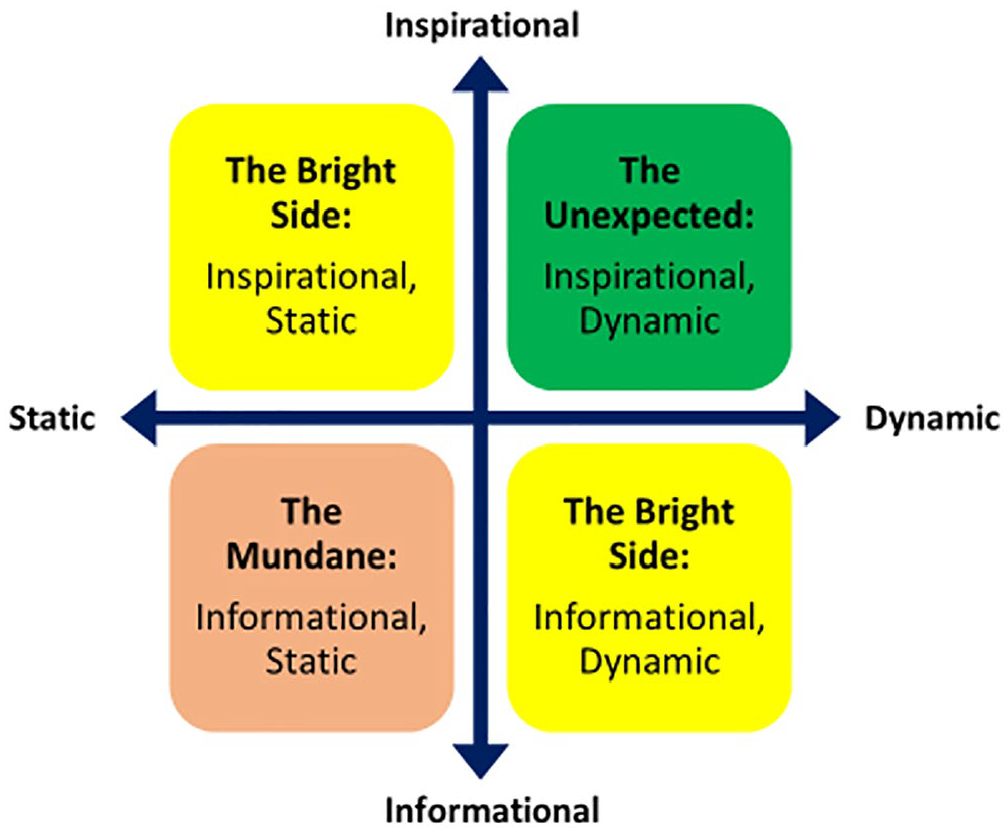
In-store communication organizing framework.
Inspiration is “something that makes someone want to do something or that gives someone an idea about what to do or create” (Merriam-Webster, 2022). As Grewal et al. (2022, p. 2) propose, consumers “can be inspired by inspirational content when their imagination and creative ideas are stimulated . . . activates consumption thoughts, attitudes, or actions, such as those related to cooking a recipe, gardening, taking a vacation . . . undertaking a project or enrolling in a program.” Consequently, inspirational content is communication designed to spark ideas or motivate interest in the product, whereas informational content is communication that provides information to consumers, without necessarily piquing their interest in a product or activities.
These four notions (static/dynamic, informational/inspirational) create quadrants that we label as the mundane (static and informational), the bright side (static and inspirational, and dynamic and informational), and the unexpected (dynamic and inspirational). We define the informational–static quadrant as mundane because communication in this quadrant provides typical, traditional information for retail settings (e.g. prices), so it might seem dull or unexciting to consumers. The two bright-side quadrants evoke either inspirational content or dynamic content, both of which can engage and excite consumers. Finally, the unexpected quadrant involves communication that is both inspirational and dynamic; because it is novel, such communication likely captures consumers’ attention immediately and breaks through the clutter of messages that consumers encounter daily. The Appendix contains further illustrations of communications in each quadrant.
The mundane: Static and informational
In-store communication with static information content is standard. Retailers use it to share informative offers or guide customers through stores (e.g. directional signs, information about location of departments). The goal of such communication is to inform people. For example, price tags have long provided basic price information; more recent versions might provide more information, such as about the sustainability of the product’s production process by citing carbon pricing for items like jeans and sneakers (Vetter, 2020), but they remain mundane.
Such communications vary in terms of whether they focus on focal or contextual information cues (Helson, 1964). Focal information cues evoke direct responses from consumers and can be either intrinsic (e.g. product attributes such as nutrition content) or extrinsic (e.g. brand name, price) (Dawar & Parker, 1994; Grewal & Compeau, 2007). Although the latter convey pertinent information about the product, they are not intrinsic to it, and they can be more easily changed. Some extrinsic cues rarely change, like brand names, but price is another extrinsic cue that tends to change frequently in certain categories (Levy & Grewal, 2023). As an illustration, fashion clothing, such as Kate Spade or Marc Jacobs, regularly becomes available at significant discounts. Even if the brand name stays constant, the prices change with each clothing season. But in the same sector, products such as Gucci designer bags or Rolex watches generally maintain their prices. Finally, despite the potential for the information to change, we still consider the communication static, because the quadrant refers to the actual message, not whether the information it represents can be subject to change.
Contextual information cues reflect the context in which the consumer encounters the product offering (Grewal & Compeau, 2007). In more pleasant physical surroundings for example, consumers tend to develop more positive quality perceptions of a product or a service (Baker et al., 2002; Bitner, 1990). A store sign indicating a product’s location or information about the product and where it was produced (e.g. banana displays at Tesco) are cues that can provide extensive information, such as when signs feature QR codes that consumers can use to find additional information. Consumers must actively scan the QR code with their phone, but the QR code itself is a static communication.
Thus, with focal and contextual cues, retailers and service providers can communicate information that helps move consumers along the path to purchase. In this quadrant, the informational communications are static and require some notable effort to update or change.
The bright side, part 1: Dynamic and informational
When informative in-store communication is presented dynamically, such as in videos that demonstrate how a product works, kiosks and menus that display a changing array of products, digital signage that features different offers and prices based on shopping conditions or customer input, or touchscreens that support ordering tasks, the communications constantly move and change. Dynamic information also can be conveyed by words and pictures that convey motion. For example, headlines in ads can convey movement, such as if a shoe ad contains the phrase “More Movement. Better Movement,” coupled with still images of a person moving, and such cues can influence evaluations and purchases (Farace et al., 2020). With such dynamic information, the marketer moves beyond simply conveying information and seeks to increase shoppers’ mental involvement with the communicated messages. As previous research has shown, dynamic communications increase mental involvement, which enhances preferences for products (Roggeveen et al., 2015). Dynamic information also creates a sensorially rich, mediated environment (Steuer, 1995), which is relevant considering the findings that rich, mediated tools such as video (Coyle & Thorson, 2001) create vividness and increase mental involvement (Li et al., 2001). In turn, people can better visualize future outcomes (Shiv & Huber, 2000) and imagine using the product or service (Nowlis et al., 2004).
Examples of dynamic informative communications include in-store kiosks in ICA grocery stores that display product promotions, provide additional information via touchscreens, and change prices according to the conditions. Apple provides a range of daily informative talks and directed learning in Apple Stores (Apple, n.d.). These demonstrations, whether provided through videos or by frontline employees, share ideas for integrating Apple Watch functionalities into people’s lives for example, so they provide informative content in a dynamic environment. In each 30-min session, customers learn how to use key features, manage notifications, and get familiar with the hardware, but they also likely discover new ways to optimize their fitness tracking or enhance their connectivity with other devices—which then might alert them to other items available for purchase. Returning to the fashion industry, the retailer Reformation displays just a few items on shopfloors and only one size per item, but when customers enter its changing rooms, a touchscreen display allows them to browse all available items and select their size, after which the chosen pieces get delivered to their changing room (Robinson, 2018). Once an item is selected, the inventory system updates in real-time so that frontline employees know where all items are located (Robinson, 2018). This dynamic display enables customers to gather information about care instructions for each piece of clothing, see images of how items are likely to fit, and discover additional offers not available on the shopfloor.
The bright side, part 2: Static and inspirational
Inspirational communication content affects shoppers’ motivation. In this quadrant, the communication serves as motivational force that activates (consumption) goals. For example, static signage can feature inspirational quotes or recipes; in-store displays can reveal an appealing array (e.g. rainbow displays at M&M World); and mannequins can feature the latest styles and clever combinations of accessories. The ideas provided by these inspirational communications, such as a recipe to make chocolate chip cookies, include all the necessary steps, as well as the sense of pleasure that consumers are likely to experience by making the cookies, serving them to friends and family, and consuming the cookies themselves.
In more detail, inspirational messages consist of an “inspired-by” dimension and an “inspired-to” dimension (Böttger et al., 2017; Thrash & Elliot, 2003, 2004). The inspired-by dimension refers to how inspirational communications mentally stimulate ideas (Thrash & Elliot, 2003) and spark imagination (Grewal et al., 2022) (e.g. making the cookies). The inspired-to dimension instead pertains to the resulting goal-completion mindset (Elliot & Thrash, 2002) that triggers consumers to work to actualize the idea (Böttger et al., 2017; Thrash & Elliot, 2003, 2004) and activates their consumption behaviors (Grewal et al., 2022) (e.g. buying the cookie-making ingredients). Retailers also might evoke inspiration by displaying complementary products together, which tends to stimulate their simultaneous purchase (Sarantopoulos et al., 2019).
Inspirational communications might focus on the product, the process involved to use it, or the experience resulting from such use. Notably, inspirational content does not necessarily prompt an impulse purchase; rather, the consumption goal it evokes leads consumers to gather necessary items to match the inspiration they sense. When Waterstones uses in-store displays to promote different book categories, it highlights examples of reading categories that might draw the consumer in. For example, one sign reads “Find a new way to escape?” to advertise adventure and fiction novels, while another one says “Turn over a new leaf” in a section for non-fiction self-improvement books (see Appendix). Such signage primes customers to think about how to escape reality and achieve self-improvement, respectively, highlighting how the books can help transform readers. As Grewal et al. (2022) demonstrate, inspirational communications (e.g. recipes available on in-store kiosks or consumers’ mobile phones) increase interest in goal completion, which then increases the likelihood that they buy items included in the recipe (or substitutes).
The unexpected: Dynamic and inspirational
Finally, dynamic forms of inspirational in-store communication increase viewers’ mental involvement (Roggeveen et al., 2015) and motivate them toward a consumption goal (Grewal et al., 2022). Augmented reality (AR) is a powerful way to help shoppers visualize the product in their homes (or other setting) and thereby better appreciate its benefits. At IKEA, AR technology shows customers how a sofa would look in their living room (Klavins, 2022); at Nike stores, they can scan an item in stores to learn more about it. Moreover, they can use VR technology to experience Nike’s supply chain dynamically and experience the making of their shoes (Marr, 2021).
Contemporary examples of mixed or AR applications in stores include cooking demonstrations with tasting components, interactive product displays, and in-store communication that encourages shoppers to take “Instagrammable” pictures to share with friends. In hibachi restaurants, chefs prepare and serve food while also engaging customers in their performance (Kershner, 2023). Because the dynamic communications prompt consumers’ mental involvement, it also might reinforce their inspired desire to achieve a particular outcome. Thus, communications in this quadrant arguably are the most effective at moving consumers into the actual purchase stage. However, more research is needed to establish the precise impacts of dynamic informational and inspirational communications, which continue to evolve with emerging technologies. The displays tend to attract attention but do not always translate into sales (Schweiger et al., 2023). For example, when ICA supermarkets installed video screens that showed items falling off endcaps and into a virtual pan for a recipe demonstration, the dynamic, inspirational communication appeared less effective than dynamic, informational communication (Schweiger et al., 2023). In this sense, we note the need to consider moderating factors.
Moderating factors
Various factors inform both the effectiveness and the usage of inspirational, informative, dynamic, and static in-store communication. The usefulness of informative versus inspirational communication content depends on in-store environmental factors and the inherent attributes and types of products being advertised. The decision to employ static or dynamic communication tools also depends on what is available to retailers and possible in the store environment.
Store environment
Because we predict that it moderates all the elements in the framework, we start with the store environment, which strongly determines the type and format of communication that is most relevant to customers and thus most beneficial for retailers to adopt. Some store environments are extremely hectic, such as small grocery stores in central locations; others have sparse foot traffic per square meter. Accordingly, they vary in the amount of space available to install elaborate, dynamic, in-store communications. Furthermore, customers in these distinct store environments have varying degrees of capacity to process the in-store communication. If they are visiting very busy stores, customers likely have fewer resources available to devote to in-store communication and might be more pressed for time to get their shopping done. In such busy environments, informative (e.g. price tag) rather than inspirational messages are preferable, to reduce the time customers must take to understand the message. However, extensively informative communications, such as reading a recipe, might be too cognitively taxing, such that an inspirational message may be more effective.
The store environment also determines how customers perceive dynamic versus static displays. In busy store environments, static displays can communicate essential points to customers briefly. Signage (digital or traditional) can display deals, product information, and insights efficiently. Uses of more dynamic in-store tools, like AR, instead might prevent busy customers from understanding all the information provided, especially considering the likelihood that they are distracted by other customers, their shopping lists, and various other in-store communications. Some research accordingly has determined that very dynamic displays, such as the use of mixed reality to enhance grocery endcap displays, initially might attract customers’ attention, but such attention does not translate into sales, because customers regard the communication as too much to process, so they neither consider the deal advertised nor move into a buying mindset (Schweiger et al., 2023).
Product attributes and types
The offering being promoted also should define the optimal in-store communication. We consider both the nature of the product (hedonic or utilitarian) and its type (luxury or standard). Hedonic products tend to be experiential and sensational, whereas utilitarian products are practical, functional, and instrumental (Lu et al., 2016). As prior communication research has shown, assertive language (e.g. Nike’s “Just do it” slogan) is more effective when advertising hedonic products (Kronrod et al., 2012), so we anticipate that inspirational content similarly might be more appropriate. Matching utilitarian communication with utilitarian products increases communication effectiveness (Klein & Melnyk, 2016). Informative communication is utilitarian, in the sense that it prioritizes informational and functional details about the product or store. Thus, we recommend that to communicate the benefits of their utilitarian products in stores, retailers should use informative communication.
If instead they mostly market hedonic products, dynamic presentation formats appear more beneficial for communicating key information (Roggeveen et al., 2015). When customers encounter either a dynamic video or static pictures that advertise hotel rooms, they choose the hedonically superior hotel room when it is presented dynamically over a utilitarian hotel room option (Roggeveen et al., 2015), reflecting their enhanced involvement with the hedonic version due to its dynamic presentation.
Turning to the type of product, we consider luxury versus standard products. In-store communication is essential for luxury stores because the visual elements in the retail atmosphere communicate a luxury appeal to customers (Schweiger et al., 2020). The store environment itself, including large empty spaces (Dion & Borraz, 2017), classical music (Areni & Kim, 1993), and warm ambient scents (Madzharov et al., 2015), implicitly conveys a luxury appeal to customers. Accordingly, luxury stores tend to use inspirational and dynamic store communications, in line with our recommendations in the previous section. For example, large video screens might display fashion week shows, providing inspirational content in a dynamic setting. Luxury brand marketing communication also needs to incorporate trendiness and entertainment (Godey et al., 2016), both of which can be achieved through dynamic and inspirational in-store communication.
Conclusion
The proposed framework offers a new way to think about communication in physical settings; it explicitly highlights the importance of both communication presentation and content. The four quadrants—static and informational, static and inspirational, dynamic and informational, and dynamic and inspirational—are defined by these communication features. This understanding is useful for marketers as they consider what the most effective type of retail communication might be for their product or service. With such insights, retailers can better navigate the busy retail media market and identify opportunities for selling ad space to others.
The static and informational quadrant is the most widely used form of communication in retail settings. It provides required information about prices, product attributes, and sustainability. It can convey contextual cues that enhance consumers’ quality perceptions too. The static and inspirational quadrant, though less commonly used, can help spark customers’ interest in a product or service. We note that the dynamic and informational quadrant is increasingly being used by retailers and service providers to engage customers and increase their mental involvement (e.g. in-store kiosks, digital signage, touchscreen ordering). Finally, the dynamic and inspirational quadrant helps create a sensorially rich, mediated environment that aims to inspire customers by helping them visualize future outcomes, including their enjoyment of the product or service.
In turn, this framework has relevant implications for retailers and service providers. First, it highlights the importance of considering both the presentation and content of communication when designing marketing strategies. They must strategically decide when to use static or dynamic communication and when to focus on informing or inspiring customers. Second, the framework reveals opportunities for retailers and service providers to innovate by using dynamic and inspirational communication. For example, retailers might create immersive experiences that allow customers to interact with products or services and thus inspire them to make a purchase. Ultimately then, we hope this framework enables retailers and service providers to create more appealing in-store experiences that inform and inspire customers, in ways that make them more likely to purchase valuable offerings.
Footnotes
Appendix
Examples.
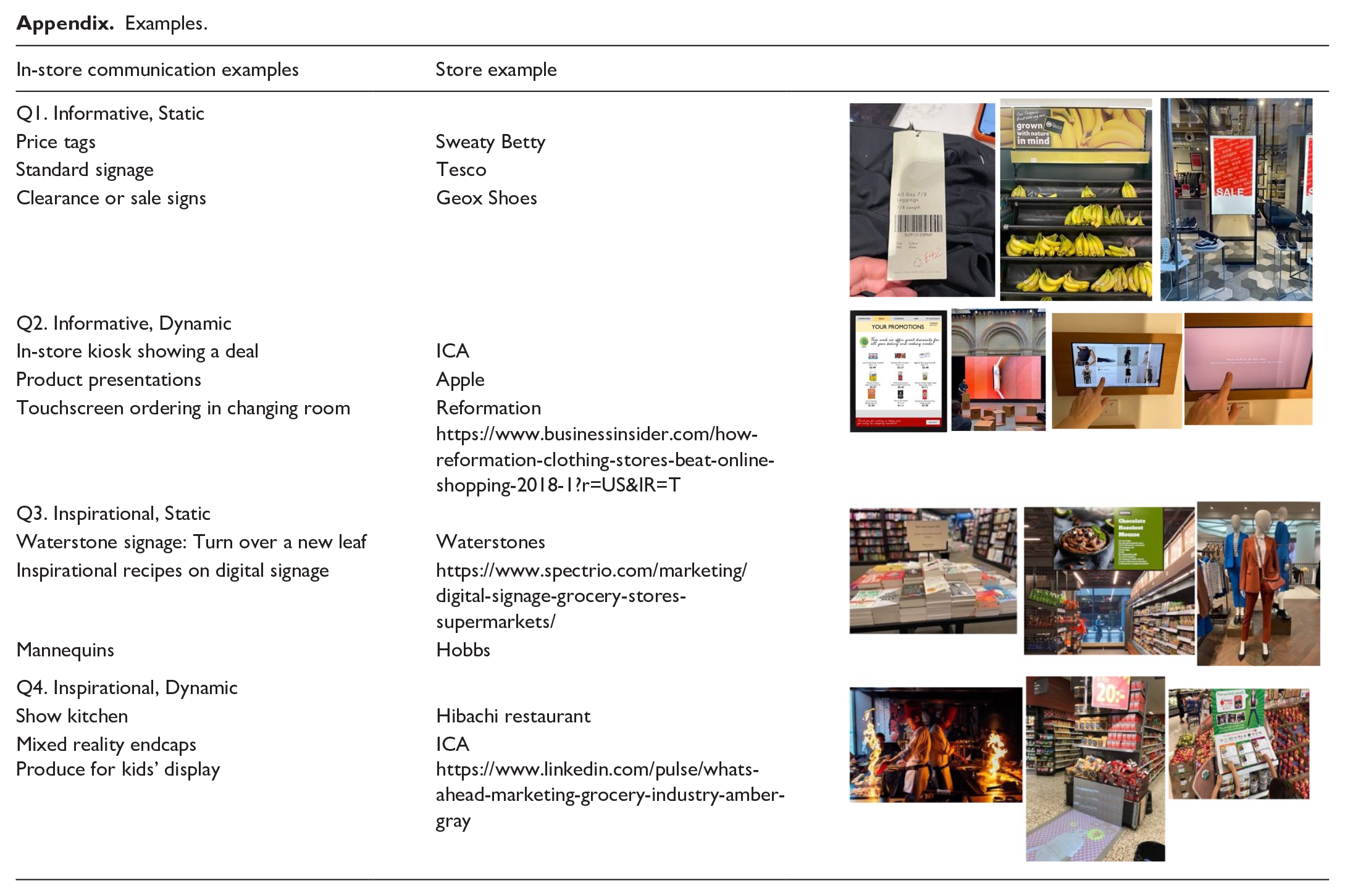
| In-store communication examples | Store example | |
|---|---|---|
| Q1. Informative, Static | ||
| Price tags | Sweaty Betty | |
| Standard signage | Tesco | |
| Clearance or sale signs | Geox Shoes | |
| Q2. Informative, Dynamic | ||
| In-store kiosk showing a deal | ICA | |
| Product presentations | Apple | |
| Touchscreen ordering in changing room | Reformation https://www.businessinsider.com/how-reformation-clothing-stores-beat-online-shopping-2018-1?r=US&IR=T |
|
| Q3. Inspirational, Static | ||
| Waterstone signage: Turn over a new leaf | Waterstones | |
| Inspirational recipes on digital signage | https://www.spectrio.com/marketing/digital-signage-grocery-stores-supermarkets/ | |
| Mannequins | Hobbs | |
| Q4. Inspirational, Dynamic | ||
| Show kitchen | Hibachi restaurant | |
| Mixed reality endcaps | ICA | |
| Produce for kids’ display | https://www.linkedin.com/pulse/whats-ahead-marketing-grocery-industry-amber-gray | |
Declaration of conflicting interests
The author(s) declared no potential conflicts of interest with respect to the research, authorship, and/or publication of this article.
Funding
The author(s) received no financial support for the research, authorship, and/or publication of this article.
