




Abstract
This paper examines the influence of socialisation agents in shaping digital competence in older adults (aged 65+ years). Data was collected from the University of the Third Age (U3A) Network Victoria, a volunteer organisation that provides courses and programs for the retired and semi-retired community. We used a two-stage approach; focus groups as a sensitising tool, followed by 21 in-depth interviews. The research identifies three distinct consumer socialisation processes: reciprocity, self-socialisation and outsourcing, and details the central socialisation agents influencing these processes and how these processes influence learners to reach different socialisation outcomes. Overall, this study sheds light on the complex socialisation processes that influence how older adults become digitally competent and the barriers they face in this process, illuminating the need to address negative attitudes, improve access to devices and support older adults in maintaining their independence.
Keywords
Introduction
While there is a growing need to understand how older consumers (aged 65+ years) relate to information and communication technology (ICT), there is a paucity of research that examines how older consumers learn new skills from their social contexts (Moreira et al., 2018). Changes brought on by modern technology usage have been influenced by new technologies integrated into social and cultural life: texts and emails have replaced other forms of written communication, conversations take place on Zoom or Skype and memories are collected via Facebook or Instagram rather than in photo albums. Adapting to these marketplace changes occurs through socialisation; for example, offspring teaching parents about ICT (Watne et al., 2011). However, extant research addressing the needs of older adults has primarily focused on cognition (Moschis, 2012), particularly individual decision-making that leads to optimal choices which deter consumers’ vulnerability to persuasive or fraudulent messages (Yoon et al., 2009). Indeed, very little has been written about older consumers’ socialisation processes when bridging the digital divide to prepare for and perform their roles as digitally competent consumers.
Most older adults choose to live independently in their own homes as they age (Matsumoto et al., 2016) – a preference exacerbated by the Covid pandemic, which negatively impacted perceptions by older Australians about living in aged care facilities (Brydon et al., 2022). Independent living allows people the freedom to choose their lifestyles, even if they get support for some needs (Brisenden, 1986). However, older adults must be able to perform a number of essential daily activities to live independently at home including social engagement online to help prevent loneliness and marginalisation (X. Wang et al., 2021). Many older Australians adopt a hybrid model engagement which includes online activities. A national survey by the eSafety Commissioner (www.esafety.gov.au) found a significant level of interest among older adults in doing more online activities and acquire new digital skills. Despite persistent stereotypes, many older adults enjoy engaging with the digital environment (Bracken et al., 2015; Mitzner et al., 2010); from shopping to information searching, social connection and having fun (Kuoppamäki et al., 2017; Vulpe & Crăciun, 2020).
Improving the inclusion and engagement of older adults in digital technology is becoming increasingly important (Oh et al., 2021; Scheerder et al., 2017), and there is a need to improve the digital competency of older Australians (Thomas et al., 2020). Ochoa Pacheco and Coello-Montece (2023) define digital competencies as; ‘the set of knowledge, abilities, skills, attitudes, and other characteristics regarding digital technologies that are fostered by an individual’s personal, cognitive, social, and global competencies for communicating, collaborating, creating, and sharing content, managing and sharing information, solving problems, and adopting and spreading the digital culture, taking into account ethical and sustainable practices’ (p. 3). This paper investigates older adults’ socialisation processes as they prepare for and perform their roles as digitally competent consumers – hereafter referred to as the ‘digital consumer’ role.
We draw on consumer socialisation theory (Grauerholz & Swart, 2012; Moschis, 2019) which stresses the processes by which people develop norms relevant to various roles they are expected to assume – it considers the demands that other members of society make upon the individual (Moschis, 2019, p. 6). These society members are referred to as socialisation agents (Grauerholz & Swart, 2012). Through the process of socialisation, demands from the marketplace shape attitudes, motivations, interests, values and behaviours relevant to social roles consumers prepare for or perform (Moschis, 2019). Any individual or institution involved with improving the inclusion and engagement of older adults in ICT are part of the network of socialisation agents that demand role preparation and performance as digital consumers.
Studies of consumer socialisation have primarily been focused on the study of a select age group (e.g. children, adolescents and older adults), in isolation from other age groups (see Bodkin et al., 2013; Epp & Price, 2008; John, 1999; Smith & Moschis, 1984), with the assumption of unidirectional effects of socialisation agent and learner and outcomes viewed as normative and impervious to change (e.g. Bodkin et al., 2013; Moschis, 1987). Consequently, recent calls for research in consumer socialisation stress the need to acknowledge the dynamics of micro-level processes and treat the socialisation process as reciprocal, whereby the learner is recognised as a co-socialisation agent and not just a passive recipient (Moschis, 2019, 2021). Research on older adults learning ICT is typically unidirectional, focused on the learning needs and deficits of vulnerable older consumers (e.g. McDonough, 2016; Menéndez Álvarez-Dardet et al., 2020). As such, investigating the socialisation process as dynamic where older adults can be both learners and socialisation agents helps channel the focus of older adults learning ICT towards a strengths based approach and focusing on abilities that support learning and engagement (Raciti et al., 2022).
Through four focus groups and 21 interviews with older adults, we extend extant research by uncovering the socialisation processes influencing older adults as they gain digital competencies. The research explicates the ways in which older adults are socialised, describing the key agents involved in this process and how these agents affect older learners to achieve various socialisation results. We offer three distinct contributions. First, the study expands on the family socialisation process (Perez et al., 2019) by identifying additional sources of reciprocal socialisation and highlighting that reciprocity differs between older adults and their offspring and peer-to-peer socialisation processes. Second, the study contributes to older consumer socialisation literature (Pang et al., 2021). It explains how older adults engage in self-socialisation, allowing them to learn at their own pace and avoid interaction with others whi might undermine learning and confidence. Third, we extend consumer socialisation theories (Moschis, 2019, 2021) by demonstrating that digital consumer role preparation for older adults extends beyond acquiring new competencies but also learning when and how to outsource some activities to other family, friends or professionals, in contexts beyond ambient assisted living (Schneider-Kamp & Askegaard, 2022). Finally, by addressing barriers and supporting positive socialisation agents, we can empower older adults to become more digitally competent and ensure they remain active participants and consumers in an increasingly digital world.
Theoretical background
Older consumers often face disadvantages as they strive to socialise into a world of increasingly faster technology products innovations (Perez et al., 2019). Hill et al. (2015) note that the efforts to keep up with technological innovations leave many older adults feeling disempowered and excluded from the marketplace and fearing social exclusion. Indeed, age is a central contributing factor to consumers’ resistance to adopting new technology (Talwar et al., 2020). Further, ageism and stereotyping of older consumers as technologically disadvantaged are commonplace, leaving older adults even further behind younger consumers (Cutler, 2005). This generational ‘digital divide’ becomes even more problematic in an increasingly aging world population (Beard & Montawi, 2015). Consequently, it is essential to understand better the intergenerational socialisation processes when older consumers learn ICT.
Consumer socialisation process involving older adults and ICT
Consumers often obtain relevant marketplace skills and knowledge through the socialisation process, that is, learning related to consumption and defined as acquiring skills, knowledge and attitudes to function in the marketplace (Ward, 1974). This process includes learning, relearning or adjusting any aspect of the consumer role (Ekström, 2006) and as such, understanding the socialisation process is central to the field of consumption studies (Moreira et al., 2018). Furthermore, it is widely acknowledged that consumer socialisation is a series of life-long processes wherein consumers continue to update and adjust skills and knowledge throughout their lives (Moschis, 1987). However, although consumer socialisation processes in childhood are well documented (John, 1999), the various socialisation processes that older consumers undergo are not well understood.
Role preparation and performance, including occupational roles, gender roles and roles in institutions such as marriage and parenthood, is a central goal of socialisation (Arnett, 1995; Grusec & Hastings, 2015). Through the socialisation process, people develop norms based on demands from other members of society relevant to various roles they are expected to prepare for and perform (Moschis, 2019).
Functioning in the ICT marketplace in a digital consumer role demands skills and knowledge, including using search engines, online banking, online shopping/selling, making appointments/bookings and connecting via social media (Quan-Haase et al., 2016). Enacting such roles means gaining digital competencies underpinned by basic technical use of computers and the internet (Ochoa Pacheco & Coello-Montecel, 2023). To function in the ICT marketplace, one must learn and maintain the digital competencies required for participation. Many older adults have fears related to this socialisation process (Figueiredo et al., 2022) as they were not exposed to ICT as children and had to socialise into the role at a mature age.
Prensky (2001a, 2001b) introduced the widely accepted distinction of digital natives as those born after 1980 and digital immigrants as those born earlier. The assumption is that the natives have a fluency using ICT that the immigrants find almost entirely foreign (Bennett et al., 2008). Prensky’s (2012) use of the immigrant/native metaphor further suggests that those born before 1980 seek to come and live permanently in the foreign country of the digital natives. Differences in perceived skill levels between immigrants and natives help explain some intergenerational friction that may occur when the young are assumed to be educating the old. Digital natives have created social networks through technology and therefore have more social media contacts than digital immigrants (Sensis, 2018). For digital natives, online contacts are as real to them as their face-to-face contacts (Prensky, 2012), but for digital immigrants, technology may merely be a means to reach their existing networks (Ransdell et al., 2011). Thus, native socialisation agents may not teach what immigrant learners are interested in learning because of differing perceptions of anticipated roles. The result is that the young often express frustration with what they perceive as older adults’ unwillingness to learn technology (Bodkin et al., 2013).
The perception of older consumers as digital immigrants is fuelled by stereotypes of an inability to function in the ICT marketplace (Westberg et al., 2021). However, evidence suggesting that older consumers stubbornly refuse to adopt technology and are ‘stuck in their ways’ is mixed (Thompson & Thompson, 2009). Niemelä-Nyrhinen (2007) found that older consumers are less anxious and more confident around ICT than the stereotypes suggest. However, older consumers have more risk and psychological barriers to adopting ICT than younger consumers (Talwar et al., 2020). Older consumers’ slow adoption of ICT innovations may be related to an assumption that ICT innovations are for the young and that there are limited benefits of adoption for older adults (C. Lee & Coughlin, 2015). That is, the immigrant stereotype and consequent socialisation roles may be a barrier to older adults’ further engagement, which may manifest in preferences or avoidance of specific socialisation processes.
Much is known about how older adults learn ICT, but the focus has mainly been on training of individuals. For example, O’Connell et al. (2022) shows how remote telephone-based training helped older adults overcome fears of technology and stay connected during the Covid pandemic. Similarly, Pang et al. (2021) argues that older adults prefer self-paced flexible learning of new technology with remote support. Further, Neves et al. (2018) shed light on the interconnected nature of internal and external structures in the process of technology adoption and use/non-use among older adults. These insights have advanced the understanding of ICT adoption and use, and how specific digital competencies are gained through training and courses. However, the wider socialisation processes in which the consumer prepares for and performs a different role is often ignored or overlooked. This missing perspective is more expansive because adopting new consumer roles impacts how individuals function in the marketplace, as well as how the marketplace can interact with individuals. Acquiring skills, knowledge and attitudes to perform the digital consumer role, means new ways of social interactions and consumption (e.g. using social media to connect with friends and family, online banking and online shopping). This perspective is different from extant ICT studies, where the insights on learning do not take into consideration the consumer socialisation outcome of functioning in the marketplace. Thus, we pose the following research question:
Consumer socialisation agents involving older adults and ICT
This acquisition of skills, knowledge and attitudes is aided by a variety of sources known as socialisation agents (Grusec & Hastings, 2015). Socialisation agents influence how individuals learn to function in society (Grauerholz & Swart, 2012). These agents include people, groups or institutions that influence a change in the learners’ self-concepts, emotions, attitudes and behaviour (Bandura, 1977) and consumers obtain different knowledge from different socialisation agents (Moore & Bowman, 2006). Traditionally, family, peers and the media are regarded as essential consumer socialisation agents (Moschis, 1985), with the internet added to the list more recently (Anderson & McCabe, 2012; Grossbart et al., 2002). Consumer socialisation theory suggests that socialisation agents make demands upon the individual, shaping attitudes, motivations, interests, values and behaviours relevant to the social roles they prepare for and perform (Moschis, 2019). Even for older consumers, socialisation agents (e.g. media, peers and relatives) affect the acquisition of role-related norms (Barnhart & Peñaloza, 2013; Karp, 1988). In particular, younger family members often play a central role when older adults acquire new skills, knowledge and attitudes related to technology (Schneider-Kamp & Askegaard, 2022). However, the different agent’s roles in the socialisation processes are not well understood.
Although younger family members are considered essential socialisation agents for older adults, these roles challenge established family roles, leading to conflict (Perez et al., 2019). ICT-related conflicts are more likely to occur between older adults and their offspring, who intentionally exert influence driven by concerns for their parent’s well-being, in contrast to the grandchildren’s emphasis on entertainment and pleasure (Luijkx et al., 2015). Intergenerational friction occurs between younger people as socialisation agents and older adults striving to accept their new roles as older consumers (Bodkin et al., 2013). Indeed, a person may at first be an agent and then become a learner, all within the same relationship (Perez et al., 2019). The ‘young educating the old’ concept is considered a role-reversal of previous situations (Y. Wang, 2020), as parents usually tend to be the most important socialisation agent for young children (Laible et al., 2015). Extant consumer socialisation studies focused on role reversal often take the young’s perspective; the older adult’s consumption patterns are adapted to their offspring to function in a new and different marketplace (Gentina & Muratore, 2012; Grossbart et al., 2002). Social interactions around consumption are also a means for maintaining a good relationship (ibid), allowing offspring to take an agent role in some consumption areas while parents maintain their agent role in other areas. For example, older adults may socialise their offspring to be independent and confident by allowing role-reversal and inviting them to be socialisation agents for ICT products. However, the familial relationship can simultaneously be a source of conflict, frustration and assistance between parents and children regarding ICT (Bodkin et al., 2013; Ekström, 2007).
With age, people increasingly become responsible for their own socialisation, which means that they freely choose their own socialisation agents (Luong et al., 2015). Many older adults seek peer-to-peer support with ICT (Sheahan et al., 2023), as there are ongoing challenges with support from remote younger family members (Pang et al., 2021). Peer groups have similar lived experiences with ICT and sit on the same side of the digital divide. Peer-to-peer ICT mentoring between seniors has been said to be effective (Dezuanni et al., 2019; Woodward et al., 2013), and volunteer senior organisations offering such support are popular. For example, the University of the Third Age (U3A) represents 33,000 members in Victoria, Australia, and ICT courses are among their most popular offerings (www.u3avictoria.org.au). Being around peers who use a device or technology makes older adults feel more comfortable using their own devices (Astell et al., 2020), which suggests that peers are critical ICT socialisation agents for older adults.
Older consumers are also influenced by various socialisation agents. Other than family, when preparing for and performing new consumer roles, these commonly include partners and service professionals (Aleti et al., 2023). It is expected that the way older adults utilise various socialisation agents in their surroundings to assist their role preparation and performance will differ and depend on their relationship with the agents. Indeed, older adults value the advice they receive from various agents differently and perceive self-initiated online sources as more valuable than their own offspring (Aleti et al., 2023). There may be friction across the digital divide between parents and their offspring, while different dynamics may exist in peer-to-peer socialisation processes. Thus, our second research question is:
Methodology
This study’s context is Australia, a Western country where older adults (65+) make up 15% of the population. Although families with children are the most common household type, increasing life expectancy means older Australians will likely live longer at the end of their life without their children at home (Australian Bureau of Statistics, 2019). Most older Australians now have internet in their home, with 93% having access in 2020 and 78% accessing the internet via mobile phones Nonetheless, among the Australian population, older adults are the lightest users of ICT in general and social media in particular (Sensis, 2018). Older Australians often find the online environment challenging, with 80% reporting that they find technology difficult to keep up with (Australian Communications and Media Authority, 2021). The situation of living without children at home and being challenges by ICT makes Australia an ideal context for our study as the need and opportunity exists for varied use of socialisation agents.
We heed Ekström’s (2006) call for consumer socialisation researchers to move beyond surveys and use interpretive methods to understand the underlying socialisation processes better. We chose to collect the data using focus groups (face-to-face) and personal interviews (online). Focus groups allow researchers to examine older adults’ shared socio-cultural meanings (Catterall & Maclaren, 2006), their experiences as digital immigrants, and their engagement with various socialisation agents. Focus groups are also helpful in investigating complex behaviours and motivations, wherein group interactions allow participants to query each other and explain themselves to other members (Morgan, 1996). We conducted four groups to understand how older adults experienced ICT, potential barriers to continuous engagement and who influences their learning and engagement.
Participants were from The University of the Third Age (U3A) Network Victoria: a 33,000-member not-for-profit organisation for seniors in the state of Victoria Australia which focuses on facilitating learning and sharing knowledge for older adults. U3A offers classes based on local demand and relies on members volunteer tutors. Although members are not required to volunteer or contribute by teaching or mentoring, many of the more active members hold dual teacher/student roles. Drawing from this context allows us to investigate a broad range of socialisation processes, including those occurring between older adult peer groups. Participants in U3A vary widely in terms of ethnic background, and social class. The median age was 74, and 18 women and 12 men participated (see Table 1). Demographics of the focus group participants are indicative the median age and gender distribution of the broader organisational membership.
Profile of Focus Group Participants.
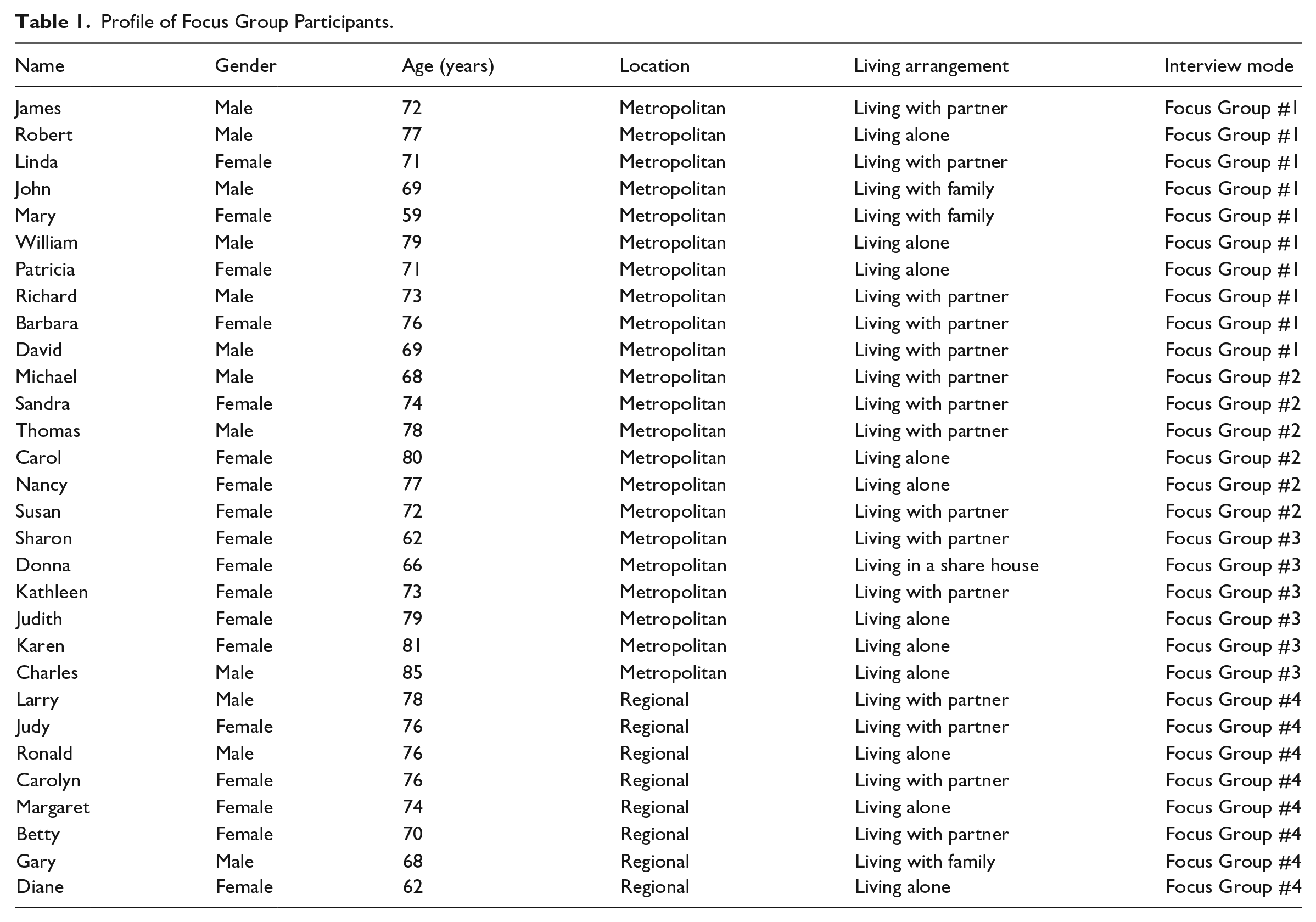
Each focus group session lasted about 2 hours and was held in a metropolitan or regional setting. Following Stewart and Shamdasani’s (2015) advice, the focus groups included seven or eight people with diverse levels of ICT understanding. Many of the older adults participated in various computer classes, either as students or tutors. We included participants with varying levels of expertise within each group to explore older adults’ understanding of socialisation agency from both peer tutors’ and learners’ perspectives. Luong et al. (2015) note that older adults typically engage in both roles interchangeably. The focus groups allow us to become sensitised to emerging concepts relevant to older adults’ relationship to technology. The role of socialisation agents became very clear in this initial setting, informing the items for the interview guide.
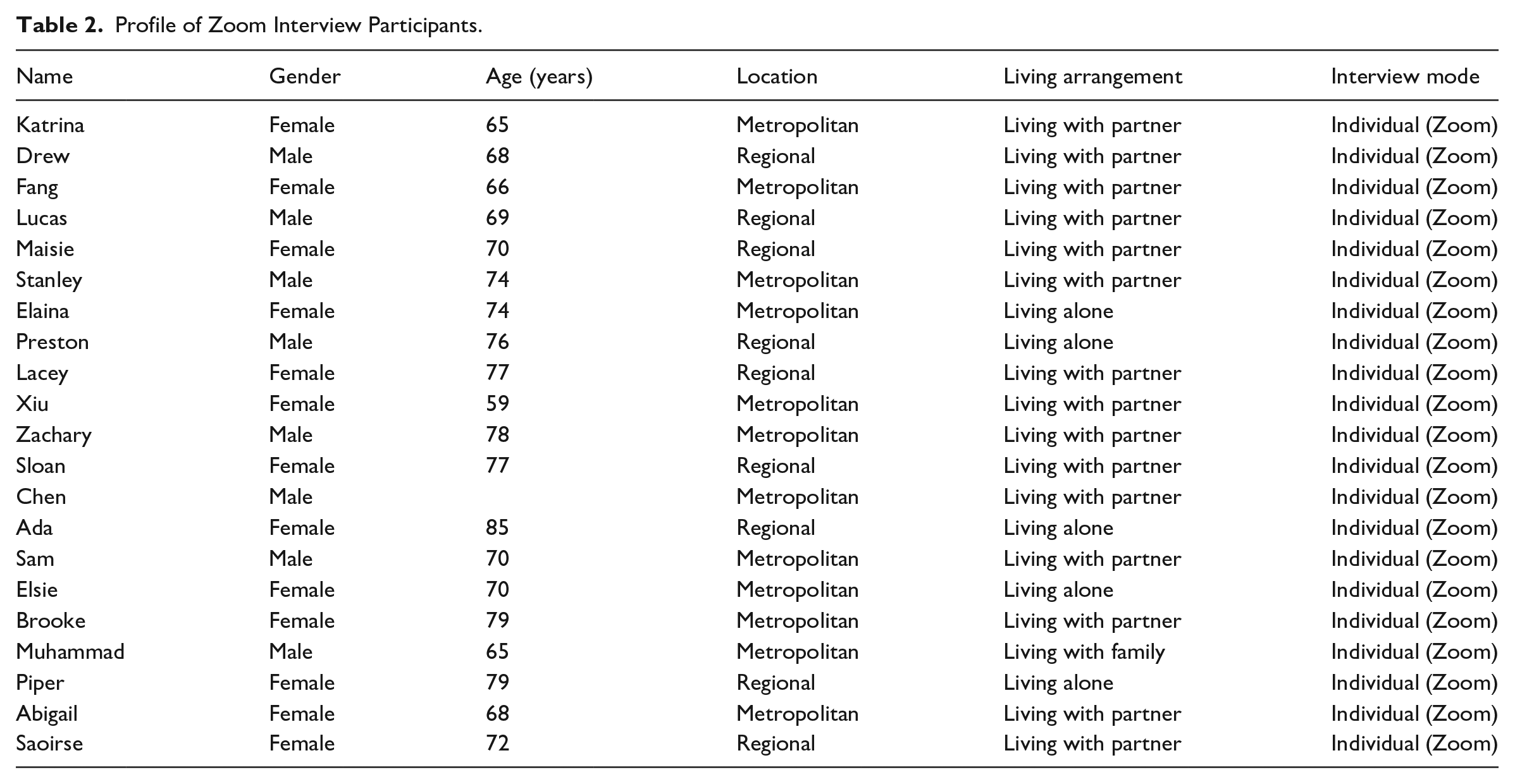
Following the focus groups, we conducted 21 interviews with older adults via Zoom to confirm and supplement the findings of the focus groups. These participants were also recruited through U3A. We conducted preliminary analysis exchanging notes between interviewers following each interview, and conducted additional interviews until theoretical saturation was reached (Baker & Edwards, 2017; Glaser & Strauss, 1967). Pseudonyms were assigned to participants to preserve their identities. Participants’ median age was 71 years, and 13 women and 8 men were interviewed (see Table 2).
Profile of Zoom Interview Participants.
All focus groups and interviews were recorded and transcribed verbatim using a transcription service. Focus groups were recorded with audio only, while the Zoom interviews were video recorded using the function within the application. Focus group participants received drinks and snacks as a token of appreciation, while interviewees via Zoom received a $30 gift voucher as compensation. Two researchers conducted the focus groups, taking turns asking questions and probing. We used similar interview guides for both focus groups and Zoom interviews. Questions centred around how older adults learn about ICT, what difficulties they face, how they learn, where they learn from and how they learn from different sources. The data transcripts were analysed for themes about socialisation processes related to ICT and the agents involved in the processes.
We triangulated the data set (Belk et al., 2013), by comparing and contrasting the different ways socialisation agents emerge in older adults’ stories. First, through an abductive approach (Dubois & Gadde, 2002), we examined breakdowns when the empirical data differed from what was expected based on current theoretical understanding, noting new insights (e.g. YouTube as a socialisation agent). Then, through several iterative movements between theorisation and close readings of the data (Spiggle, 1994), we arrived at the three processes and frameworks on. Finally, we examined participants’ reports of how different agents most commonly involved in each process, to understand the roles of these agents in facilitating and hindering the process. This analysis also led us to the discovery of key barriers to socialisation our participants encountered, as well as a clear idea of the role of the agents in overcoming these barriers.
Findings
Our analysis of the consumer socialisation processes older adults undergo in preparing for and performing the digital consumer role (RQ1) reveals that older adults undergo three main processes when preparing for and performing the digital consumer role: (1) reciprocal socialisation, (2) self-socialisation and (3) outsourcing. Furthermore, we illuminate the roles of various socialisation agents under these processes (RQ2). Below we present the findings for each of the different agent roles involved in the socialisation process. We also uncover differences in teaching and learning styles, outsourcing ICT services and multiple barriers to finding and developing consumer socialisation opportunities.
Reciprocal socialisation
Reciprocal consumer socialisation comprises bidirectional consumer learning. Reciprocal socialisation may relate to agents and learners exploring and learning together or interchangeable agent/learner roles within close relationships where skills and knowledge in one area are exchanged for skills and knowledge in another area (Perez et al., 2019). Three socialisation agents emerged from our data as fundamental to reciprocal socialisation in late life: offspring, grandchildren and peers.
Offspring
Socialisation exchanges within families were often based on the premise of reciprocal socialisation. Our participants frequently mention close family members as those who influence their ICT engagement and from whom they sought reciprocity. Some older adults feel a sense of entitlement to assistance from their offspring. That is, older adults may expect a certain level of reciprocation for the socialisation agency they provided when their offspring were young. While reciprocal socialisation often relates to aging parents’ consumption needs (Sorce et al., 1989), friction often occurs when there is a lack of socialisation reciprocity. For older adults, reciprocity goes back to when their offspring were in their early childhood. However, their offspring do not always see things the same way. Susan, 72, recalls a heated conversation with her son when she had asked for ICT help as reciprocity for socialisation with life skills:
My youngest son, who’s now 40, once said to me . . . ‘you never told us anything, Mum.’ I just raised my eyebrows. . . I did teach him . . .but he didn’t listen. It went in one ear and out the other. . . . He could do it all, even from a young age. So, he thought. . . I get this all the time.
This quote highlights Susan’s perspective on her son’s perception of her efforts of providing socialisation agency. It indicates a disconnect between Susan’s memory of providing agency and her son’s inclination to rely on his own abilities. The quote suggests a recurring pattern where Susan’s son may underestimate the value of Susan’s socialisation agency when he was younger and overlook the importance of reciprocity.
Muhammad, 65, viewed ICT as a source of embarrassment in front of his offspring because the roles of socialisation agent and learner had reversed. He felt he should be able to solve ICT problems on his own and not ask his children for advice:
There is a big distance in technology [between parents and children], which is something I can’t say [to my children]. It’s embarrassing . . . . Because the children always think their father can do anything. Should do anything.
Muhammad was reluctant to ask his children for advice because he felt embarrassed by role reversal and reciprocity in socialisation. In his mind, he should remain a socialisation agent for his children, and they should remain in the role of learners. Moreover, the reciprocity between older adults and their adult offspring is delayed and reflects their relationships dating back to the offspring’s early childhood.
Grandchildren
Older adults recognise the differences in consumer socialisation processes from childhood between them and their grandchildren. Brooke, 78, recognises a ‘lack of self-confidence using technology’ and a ‘feeling of inferiority’ because;
The next generation coming on has been introduced to technology much earlier and much younger age. To take up computers when you’re 60 is quite different from taking it up when you’re four, which my grandkids can do.
Brooke reflects an awareness of the generational discrepancy in technology usage and the impact it has on her self-perception and confidence. She conveys a sense of understanding the limitations she faces due to her later entry into the digital world and the resulting feelings of inadequacy compared to those who grew up immersed in technology.
The exchange and dynamics in the grandparent/grandchild relationship differ from that of older adults’ offspring. Many older adults mention their grandchildren, particularly those aged 10 to 12 years, as their preferred socialisation agents. Kathleen, 73, explains: ‘My grandchild is far more tolerant than what my grown-up adult children are’. Grandchildren often focus on the entertainment capacities of technology rather than productivity capacities. During entertainment consumption, grandchildren explore ICT together with their grandparents and experience reciprocated socialisation concurrently, trading life skills education for ICT help. Susan, 72, explains: ‘I will teach her [granddaughter] how to swim, and she helps me with the iPad’. In these situations, reciprocity in socialisation is more immediate than the delayed reciprocity between older adults and their offspring. For offspring, the life skills learned from their parents are long-ago lessons unrelated to the current ICT socialisation process.
Peers: Elsie, 70, admitted, ‘I do get frustrated [with ICT]’. She further stated that after joining an ICT class for older adults with a senior’s organisation U3A, she felt she was ‘catching up with you guys [referring to the younger interviewer], and I’ve found the whole experience absolutely amazing’. Reciprocity between peers provides another avenue for older adults’ ICT socialisation. Some peer relationships are formalised, as in computer classes. Karen, 81, reflected on how reciprocity operates in the class she runs: ‘Being a tutor. . . I’ve also learned a lot from my students. . . . [The class] I take is a self-help group, and I’ve learned so much from other people in the class too’. Michael, 68, also a tutor, found specifying the relationship between class members helped with learning effectiveness: ‘You [individual student] come in with your problem; if we have ten problems [together as a group] and only solve two in a session [that is] absolutely fantastic’.
During peer classes, knowledge exchange occurs concurrently, and students are expected to participate actively in the exchange through reciprocal socialisation. Consequently, older adult students and tutors socialise each other in preparing for and performing the digital consumer role with constantly overlapping agent/learner roles. Linda 71 noted:
Sometimes you may have people in your class that look a bit more knowledgeable than yourself, and then they’ll say, this is how it’s done, and then we might go home and do research [to catch up to our peers].
Piper, 79, also strongly preferred ICT classes for older adults over her own children. When asked whether she preferred her family or her peers in the class, she said:
The family are too quick . . . He [son] tries to teach me, and I don’t know, and he’ll get annoyed at me . . . So better to get it done somewhere else.
Peer socialisation differs from intergenerational situations where the exchange would often be ICT knowledge in return for something else with clearly defined agent/learner roles in the relationship. First, the exchange between peers is immediate rather than delayed, as is often the case with offspring. Second, the exchange revolves around the same socialisation topic, so pertinent learning occurs. Third, the roles between learners and agents are fluid and interchangeable. Thus, the nature of reciprocity differs between peer groups and family.
Overall, our findings about reciprocal socialisation in older adults show that reciprocation’s nature differs based on the agent’s and the learner’s relationship. Reciprocal socialisation takes different forms, depending on the agent/learner relationship. Paradoxically, the most common agent/learner relationship older adults use when preparing for the digital consumer role (Aleti et al., 2023) is also the most complicated regarding reciprocity.
Self-socialisation
Older adults are also socialised through self-initiated and voluntary efforts (Wheeler, 1966). Negative experiences from prior socialisation attempts with family members often catalysed older adults to seek self-sufficiency by turning to online self-socialisation agents. Sharon, 62, explained: ‘The first thing I do is Google because I hate asking [family]’. Offspring often encourage their parents to try self-socialisation. For example, Susan, 72, told us about her son; ‘He says always to me, “YouTube’s your best friend, Mum”’. Susan’s son encourages her to self-socialise and proactively solve her ICT problems independently.
Some participants report initially utilising self-socialisation to avoid unsettling the relationship with their offspring. Ronald’s 76 mantra is ‘Google first, son second’. This encouragement suggests that the internet, in general, and Google, in particular, opens up further self-socialisation and connections with new socialisation agents, including formal or semi-formal senior ICT education. Two types of socialisation agents are revealed to be central to this research: online agents and educational programmes.
Online agents
Many older adults are adept at using online tools for ICT education and furthering digital skills. Thomas, 87, explained, ‘We’re using Google all the time for different things. You got a problem; you Google the problem. And the thing that I like with Google is you can put it in your own words’. Judy, 76, agrees, ‘You just got to ask the question differently if you don’t get the answer the first time’. In addition to Google, YouTube has emerged as another critical non-human socialisation agent. YouTube is used for a range of activities and enables older adults to avoid tensions in familial relations. Susan, 72, noted, ‘I go to YouTube a lot’. Searching YouTube for help with ICT also allows older adults to control their learning rhythm. Thomas, 78, explained: ‘You can run a YouTube, and as you’re running it, you can stop it, do what you’ve got to do, and then come back and run it a bit more and do the next part of it’.
Older adults’ ICT self-socialisation depends on their digital competency level; those with ‘the confident and critical use of ICT for work, leisure, learning and communication’ (Bejaković & Mrnjavac, 2020, p. 924) are more likely to use online non-human socialisation agents. A knowledge threshold seems to exist, separating older adults who can proactively seek knowledge independently and search for solutions online and those who cannot. For many older adults, role preparation for effective self-socialisation needs to occur outside the online environment before the internet can become an agent of socialisation for further role performance.
Educational programmes
Utilising the internet as an agent for self-socialisation allows older adults to avoid engaging human socialisation agents (cf. Tsai et al., 2017). Sharon, 62, explained, ‘Before I even ring that service person, which I don’t, I look up on Google to see if I can find out about it’. However, necessary digital information searching skills do not always mean immediate success and a feeling of competence. Robert, 77, found searching can be a waste of time; ‘Google or YouTube [gives me] a lot of videos. Then you spend so much time to find [what you need]’, and sometimes prefers to save his inquiry for his senior’s computer class. This suggests that a preference for self-socialisation on the internet may depend on which human socialisation agent the internet replaces. For example, older adults may have an aversion to utilising family or ICT professionals for help yet are happy to discuss computer issues in class with their peers.
Outsourcing
Many older adults outsource some aspects of the socialisation process by allowing others to perform tasks on their behalf. Older adults do not have the same need for internal control and are often comfortable outsourcing control to the environment with greater reliance on external sources (Mayr et al., 2015). In contrast to direct avoidance, outsourcing is a form of fence-sitting, an extension of role preparation and delaying role performance.
Partners may play an important part in hindering older adults’ role preparation as digital consumers. For example, Betty, 70, told us, ‘My husband is very good at it [ICT]’, providing her access and knowledgeable support. Similarly, Sandra, 74, noted: ‘I can make phone calls. I can Skype. I can text. I can do all those things, but anything deeper than that . . . That’s why I have a husband’. These comments reflect an appreciation of outsourced support and an unwillingness to prepare further for the digital consumer role. Susan, 72, provided outsourcing for her husband: ‘My husband has a laptop. He doesn’t know how to use anything else, but I’ve shown him how to use the laptop for whatever he wants’. Judith, 79, also helped her husband: ‘My husband is not [competent with] technology at all. . . . he goes, ‘my computer’s not working, it’s not working!’ I say, “push the F”’ These older adults rely on their partners to be the gatekeeper and ICT-knowledgeable persons in the relationship.
Older adults may also ‘play the digital immigrant card’ to justify receiving ongoing support. They accept their roles as immigrants and use this to justify outsourcing role performance to digital natives. However, outsourcing sometimes exacerbates intergenerational friction. For example, Carol, 80, said about her son:
. . . I’ve asked him to do or show me something, and he’ll say, ‘but I showed you that last week.’ And I say, ‘Yeah, that was the last week; that’s not today.’ . . . I need to be shown a second time, and sometimes a third time and maybe a tenth time.
Carol emphasises the importance of patience and understanding from her son as she reflects on her own learning journey. She acknowledges that her learning process often requires repeated explanations and demonstrations.
Outsourcing allows participation in some aspects of ICT consumption without having to prepare for the role altogether. Offspring can also be complicit in outsourcing and often resort to ‘fixing the problem’ for the parent rather than teaching the parent to fix the problem independently. In some cases, outsourcing seems to be the only option. Xiu, 59, taught Zomba classes via Zoom. She explained:
[one student] refused to join Zoom classes because pressing that link was difficult . . . but [when] her daughter was there with her . . . she was comfortable [clicking the link]. But when [the daughter] is not with her, she goes into panic mode again.
Outsourcing can be seen as a coping strategy with unfamiliar products (Mick & Fournier, 1998). For example, offspring often assist their parents in using technological products when parents show reluctance to learn how to use the products themselves (Ekström, 2007). Technology can arouse strong, negative emotions; the behavioural response is to let the younger generation deal with it. Indeed, Bodkin et al. (2013) found that many offspring expressed frustration over their parent’s unwillingness to learn new technology, noting that they sometimes needed to teach the same things repeatedly.
Figure 1 outlines how reciprocal and self-socialisation contribute to older adults being socialised into the role of digitally competent consumers. Outsourcing is a process seen as part of the pathway to socialisation because it requires learning when and how to outsource to complete digital tasks. However, it falls short of enabling sustainable role preparation in the same way that reciprocal and self-socialisation do. Consequently, the outsourcing ‘pillar’ does not reach the ‘roof’ in our framework.
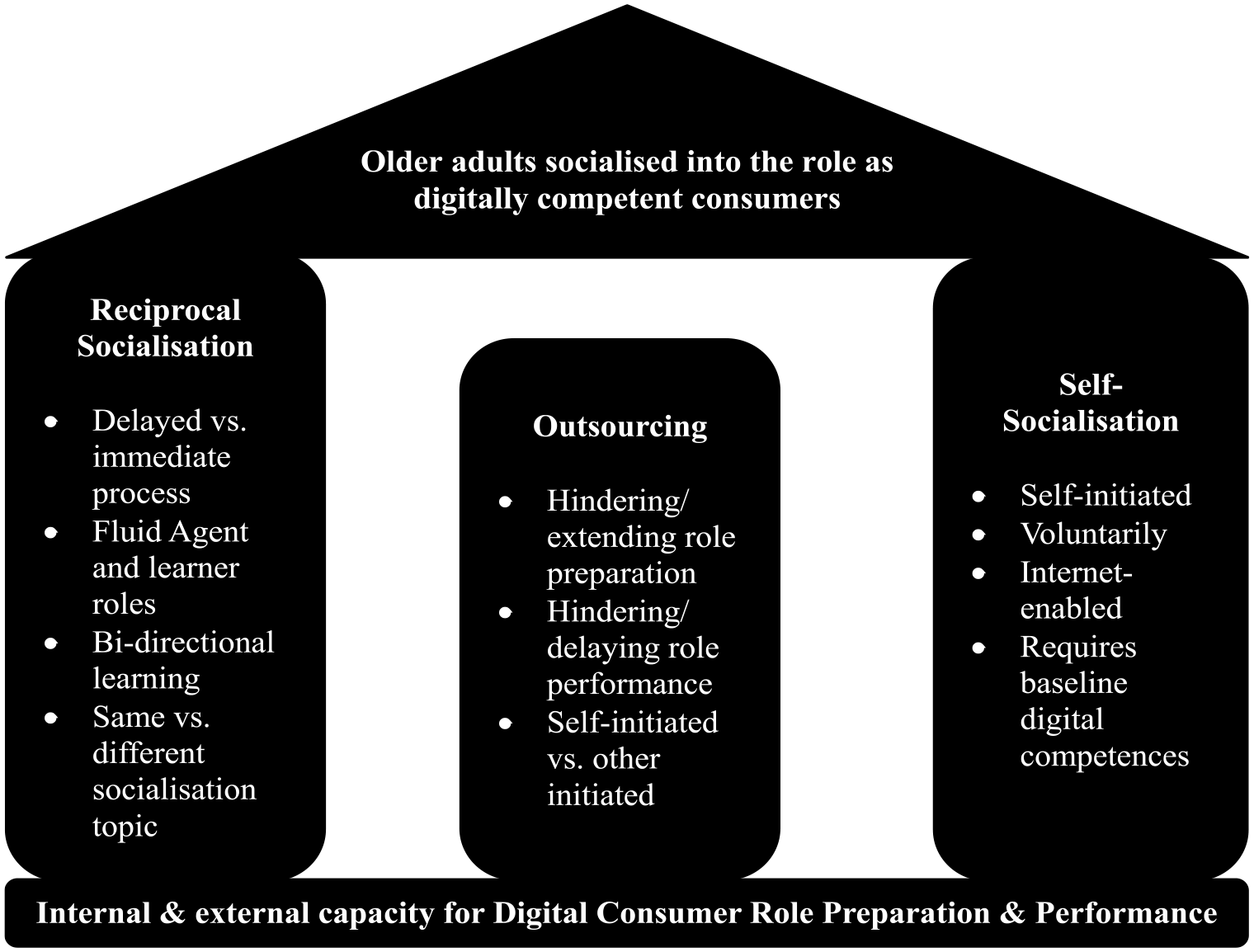
Consumer socialisation processes for older consumers preparing for and performing the digital consumer role.
Barriers to socialisation
All socialisation results from interaction with socialisation agents, either as the agent hoped for or through unintended side effects (e.g. anger, low self-esteem and refusing further engagement in the process; Grusec & Hastings, 2015). As such, any friction in the agent/learner relationship may cause barriers to socialisation. This research uncovered three critical barriers to socialisation: negative agent attitudes, limited access to appropriate devices and a fear of losing independence.
Socialisation agents’ negative attitudes and stereotypes
Younger people’s attitudes may thwart older adults’ efforts to find and engage socialisation agents, as discriminatory stereotyping in the native/immigrant divide is common. Elaina, 74, commented about how she felt when being advised about ICT by younger people:
My family all patronise me. . . . I don’t get embarrassed in front of them because they all pat me on the head anyhow. But when I was working, and the IT guys used to come, and it would take them ages to work out what the hell I’d done and how to fix it, I always felt really dumb, really stupid, and I’m not stupid, but I don’t connect with the concepts behind these things.
Elaina shows frustration with her family’s patronising behaviour, her experiences of being misunderstood by IT support at work, and her own struggle to comprehend and navigate technology. These experiences have an emotional impact, leading to a sense of inadequacy and self-doubt despite her intelligence. The statement ‘My family all patronise me’ indicates that Elaina feels her family treats her in a condescending or belittling manner, suggesting a lack of respect or recognition for her abilities. Despite this treatment, Elaina explains that she doesn’t feel embarrassed in front of her family because they consistently underestimate her, as symbolised by the metaphorical action of patting her on the head.
Thomas, 78, noted the paradox of the ‘know it all’ attitude from the young, but when ‘you ask them a question, and they don’t know. So, they don’t know at all’. Sandra, 74, added, ‘But they think they do, and they think that we know nothing. Because we’re old’. Patricia, 71, told us that her son was the first person she asked for ICT advice but that ‘My son’s in security, so I get told off [for being inept] constantly’. This suggests that some younger consumers recognise that they have a different relationship with technology, and as such, they struggle to provide socialisation agency to older consumers or will avoid it altogether.
Issues with access to appropriate devices
Older adults’ offspring often hand down technology they no longer use to their parents, yet these gestures may be problematic. When older adults do not initiate or choose devices independently, they experience less role preparation and are put directly into role performance because they have not chosen a device that suits their needs and addresses what they want out of the device.
Older adults also experience limited access to devices. Offspring sometimes serve as gatekeepers to equipment access, adding another restraint to older adults’ ICT access (Neves et al., 2013). Carol, 80 noted, ‘I don’t have a computer, and I don’t have an iPad. . . . [because] my family told me I didn’t need one’. Karen, 81, taught computer classes for older adults, knows Carol’s offspring, and noted, ‘They will not let her buy a computer. Because they reckon she’s too stupid to do it’. Carol’s family actively hinders her role preparation, circumventing the socialisation process by denying equipment access. Thus, older adults may have to either overcome attitudinal barriers without their offspring’s assistance to ‘prove’ they are prepared for the digital consumer role or utilise other socialisation agents. This discrimination exemplifies the native/immigrant digital divide and highlights how assumptions that older adults do not know how to engage with technology act as a barrier to digital competence. However, confidence with technology may be a more salient issue. Digital natives often have confidence in performing the digital consumer role but have little perception of how one prepares for it because they were born with the technology.
Fear of losing independence
Older adults accumulate their areas of interest and expertise from previous life stages – which becomes part of their feeling of self (Luong et al., 2015). If ICT has not been an area of interest and expertise earlier in life, older adults may avoid it altogether to maintain their status and independence. Abigail, 68, explained, ‘There’s social risk, and people are averse to using technology because they’re afraid to look stupid in front of others because they don’t know how to do it’. Such aversion to engaging with ICT in an attempt to stay in control was observed by Xiu, 59, who taught Zumba classes for older adults online and explains how many older adults feel:
I can do everything by myself. I don’t need [ICT] to make me look stupid. Yeah. Because they want to be independent. They feel they are in control. With technology, they’re losing control. They can’t control what is happening. So, if things do not turn out that way, they don’t know how to fix it. I’m lost. So that is out of control.
Finally, ICT usage may force older adults to confront their cognitive limitations. Our participants frequently mentioned the need to ‘go slow’ and ‘repeat’ when engaging older adults with ICT. Moreover, some older adults fear ICT because it may expose declining brain functions. Brook, 79, explained:
I’m afraid to notice that I’m losing my intellectual skills that I used to have. . . . as you get older, you have to sacrifice some of those things [ICT devices], . . . Is it normal to be as dumb as I am at 80, or should I be doing something or thinking something differently? I’m afraid of losing my intellectual capacity.
Brook expresses a fear of using ICT devices because she is unsure whether difficulties in using them are due to the complexity of the devices or her own comprehension abilities. This fear is common among older adults, who often worry about declining brain function (French et al., 2012). Consequently, they tend to actively avoid unfamiliar situations that require learning and remembering new things.
Discussion
This research sought to uncover older adults’ socialisation processes in improving their digital competencies and how different socialisation agents influence these processes. Social changes and expectations around ICT use put pressure on adults to prepare for and perform new roles (Arnett, 2007), but as people age, the very nature of their social roles also changes (Grauerholz & Swart, 2012).
We contribute to the consumer socialisation literature in three ways. First, we uncover the ways that older adults engage in reciprocal socialisation with offspring, grandchildren and peers. Next, we show how older adults engage in self-socialisation by utilising online socialisation agents such as Google and YouTube. Third, we describe the option of outsourcing ICT activities to trusted others as a way for older adults to meet their needs without directly engaging in role preparation as digital consumers. We also note that barriers to older adults’ socialisation processes include limiting agent attitudes, limited access to workable devices and a fear of losing independence.
Reciprocal socialisation: Offspring, grandchildren and peers
Our intergenerational consumer socialisation analysis uncovers friction between older consumers and their most frequently used socialisation agents. We note that despite the frequent negativity used to describe younger people as socialisation agents (Bodkin et al., 2013), offspring are still the most preferred and trusted agents (Nelissen & Van den Bulck, 2017). From both the learner’s and the agent’s perspectives, consumer socialisation across generations is not always pleasant.
We extend extant research on the family socialisation process (e.g. Perez et al., 2019) and identify additional sources of reciprocal socialisation. Perez et al. (2019) argue that older adults’ resistance to change enables barriers to acquire their offspring’s skills. Our findings augment these results and suggest that older adults’ expectations of reciprocal socialisation and offspring resistance also limit technology adoption. Older adults taught their offspring life skills and often felt that their offspring should return the favour and teach their parents, yet some offspring do not feel obliged to socialise their parents into ICT consumption.
We also unveil the role of grandchildren as socialisation agents. The relationship between grandparents and grandchildren allows for less friction in reciprocal socialisation. We add to previous work that suggests that entertainment and pleasure are prominent drivers for ICT socialisation between older adults and their grandchildren (Luijkx et al., 2015). While previous work has viewed this as a one-dimensional relationship, we demonstrate how these more pleasurable socialisation processes occur reciprocally. Grandparents may offer similar life skills socialisation to their grandchildren as they gave their children in the previous generation. Grandchildren then reciprocate, providing ICT knowledge for their grandparents. A further interpretation of why there seems to be less friction in the socialisation process with grandchildren could be because they are learning and exploring ICT with their grandparents. Without memories of previous agent and learner roles in socialisation processes, it may be easier for older adults and their grandchildren to accept the learner role and explore ICT together.
Our findings contribute to industry (Dezuanni et al., 2019) and academic research (Woodward et al., 2013) that suggest that peer-to-peer mentoring is effective for older adults to improve their digital competencies by noting that in learning from tutors and peers in a computer class, the exchange of socialisation agency and learning is a two-way reciprocal process of mutual role preparation as digital consumers. Moreover, when peer groups focus on solving their ICT problems together, it has the potential to create a can-do mentality where individuals may continue additional role preparation and performance at home and return to class with new knowledge to share.
These insights about reciprocity help us better understand critical issues in ICT consumption regarding socialisation processes and family communication related to older adults. Our insights help those interested in older adults’ ICT consumption rethink the family’s role in consumption. Furthermore, by considering how socialisation agency is reciprocated in different agent/learner relationships, marketers are better equipped to provide products, services and experiences for older consumers.
Self-socialisation: Self-sufficiency, online agents and education
Our findings verify that older adults are confident ICT consumers and support Niemelä-Nyrhinen’s (2007) claim that older consumers are less anxious around ICT than the stereotypes suggest. We contribute to this line of research by focusing on a socialisation process outcome – role preparation – we delineate the interplay between socialisation agents and self-initiative in the consumer socialisation process towards the digital consumer role. That is, we demonstrate that older adults take a self-initiated active role in this consumer socialisation process, which means they are not at the mercy of external socialisation agents. Those who find reciprocal socialisation with external agents untenable look to online agents and education to self-socialise as functioning ICT consumers.
Through engagement with online agents and education, self-socialisation efforts allow older adults to process information in their own time, thereby overcoming limitations of less efficient information processing than younger consumers (Bodkin et al., 2013) as barriers to their capacity to update skills and knowledge. Adding to the research on older adults and self-initiated use of internet platforms (J. Lee et al., 2022; Pang et al., 2021; Tsai et al., 2017), we uncover how the socialisation process unfolds, including what motivates use and how and why other socialisation agents influence the process. By offering search-engine-appropriate targeted ICT advice in text, image and video format, marketers (social or commercial), can better inform and enable older adults.
Outsourcing
Third, we extend consumer socialisation theories (Moschis, 2019, 2021) by showing that when it comes to engaging in the digital consumer role, older adults not only need to acquire new skills but also understand when and how to delegate certain tasks to family, friends or professionals. Our research suggests that outsourcing allows older adults to achieve ICT consumption goals without making efforts to become competent digital consumers. That is, they allow others to prepare for and perform the role on their behalf. Hill et al. (2015) note that marketplace and social exclusion often result from a lack of digital competencies. Still, some older adults do not mind relying on others, particularly their partners, to manage ICT tasks. These older adults may not be burdened with anxiety about preparing for the digital consumer role. Eschewing efforts to develop ICT skills may reify assumptions that ICT innovations are for the young, with limited adoption benefits by older adults (C. Lee & Coughlin, 2015). Family members who ‘help by doing’ things may lead to frustrated older adults who want to learn but cannot progress because their socialisation agents do the task for them. However, older adults are also more comfortable outsourcing control to their environment and relying on external sources (Mayr et al., 2015). Consequently, our research proposes that outsourcing can be an active strategy to curb social exclusion by allowing close relatives to perform the digital consumer role vicariously.
By highlighting that the outsourcing process is intrinsic to the socialisation process among older adults, we note that marketers might be better equipped to provide products, services and experiences for older adults (e.g. family accounts as opposed to individual log-ins) when they include both outsourcer (older adults) and the outsourced (family member, peer and professional).
Barriers to socialisation: Attitudes and devices
Perpetuation of negative attitudes and divisive stereotypes exacerbate the generational fissures of ICT socialisation. While negative attitudes towards digital immigrants are among the main determinants of ICT adoption for older adults (Neves et al., 2018), our analysis also uncovers negative attitudes towards young people as socialisation agents. Service professionals can be intimidating because older adults may fear asking ‘dumb questions’ and avoid these socialisation agents altogether. Moreover, older adults find young people patronising and sometimes less tech-savvy than stereotypes suggest. The lack of agency to choose and use devices also foments fissures between youths and older adults. In some cases, younger family members obstruct the socialisation process in older consumers, limiting access to usable equipment (Neves et al., 2015; Tsai et al., 2015). While physical factors such as age-related limitations of reduced dexterity and visual acuity are commonly addressed through product design and adaptation (Czaja & Lee, 2007), the failure of socialisation agents to assist in role preparation is a critical barrier to older adults’ ICT adoption.
Our research highlights that older adults are both able and willing to prepare for and perform the digital consumer role. Nevertheless, unhelpful stereotypes prevail that hinder the socialisation process. Device access may be limited, and some fear ICT may expose age-related decline. Organisations for seniors can benefit from directly promoting their learning environment to older adults. These insights contribute to rethinking the role of the family in consumption – and looking for alternatives for consumer socialisation outside of the most used framework.
Limitations and future research
Although the findings extend our current understanding of older adults’ socialisation into the world of information and communication technology products and services, some limitations must be considered. The first of these is the methods: focus groups and interviews via Zoom. Focus groups and interviews with older adults and peer teachers help capture their collective voices, but they overlook other perspectives, particularly those of offspring and other socialisation agents (Stewart & Shamdasani, 2015). Future researchers employing a more comprehensive data set could examine additional nuances of self and reciprocal socialisation and agent/learner relationships.
The findings have important implications for older consumers as digital immigrants seeking to prepare for the digital consumer role. Socialisation relationships with many of their closest allies and trusted agents may purposely or unintentionally hold them back. This could perpetuate a perception of heightened risk associated with ICT. Future research is needed to examine ways older adults can seek socialisation agents that reinforce positive attitudes and risk reduction for ICT engagement. One way to investigate this could be through impression management theory considering the self-presentation older adults use when describing their level of digital competencies.
ICT companies and service providers may consider employing special support for digital immigrants. Our data showed a positive interaction with service professionals from older adults who had taken on the digital consumer role and negative attitudes from those who had not. As such, older adults who have taken on the role may be utilised as ‘social connectors’ for other older adults. To reach this growing market segment in countries with aging populations, service providers may benefit from having older consumers employed to assist digital immigrants with their products and services, similar to the general ICT assistance in some public libraries.
Finally, policymakers must consider promoting access to free services and assistance for those preparing for the digital consumer role. Digital government services are often complex, bureaucratic and difficult to access without above-average ICT skills and knowledge (Helbig et al., 2009) Yet, many countries continue to invest in and rely on online platforms to deliver a wide range of services (Ojha & Pandey, 2017). Consequently, governments need to make sure that citizens are well-functioning digital consumers. Instead of current approaches that focus on encouraging the young to educate the old (e.g. the Australian government’s ‘Be Connected’ website), it may be better to encourage the young to promote and support the old to self-socialise and seek help from other digital immigrants’ networks. Further research should investigate how socialisation agents can assist older adults by enabling them to reach the threshold level where the internet can be utilised as a non-human agent for self-socialisation.
Conclusion
This research shows that older adults are challenged by ICT, but are also interested in learning and are actively involved in their own socialisation processes of role preparation and performance as digitally competent consumers. Ageing means socialisation into additional social roles as an older adult. These roles are incongruent with the digitally competent consumer role because of prevailing stereotypes associated with age and ICT use. This could lead to conflict and frustration between older adults and the socialisation agents they need advice from to prepare for the new roles. We show that older adults use three strategies to address these challenges: reciprocal socialisation, self-socialisation and outsourcing. Depending on socialisation agent availability, confidence, interest and prior digital competencies, older adults will utilise one or more of these strategies. This paper shows who and why each strategy is used and points out differing relationships between socialisation agents and learners within each strategy.
Footnotes
Consent to participate and consent for publication
All participants volunteered to participate in the study and gave the authors explicit permission to use their responses for publication purposes.
Declaration of conflicting interests
The author(s) declared no potential conflicts of interest with respect to the research, authorship, and/or publication of this article.
Ethics approval
The RMIT University Human Research Ethics Committee (HREC) has approved this research project.
Funding
The author(s) disclosed receipt of the following financial support for the research, authorship, and/or publication of this article: This research was supported by a grant from the University of the Third Age Network Victoria.
