




Abstract
As Autonomous Vehicles (AVs) on public roads today becomes an increasingly realistic possibility, there is growing need to better understand the factors that will facilitate their successful introduction. This study focuses specifically on Australia and investigates various micro and macro environmental factors that may either hinder or support their adoption in the country. The study comprised 18 in-depth interviews with experts from both the public and private sectors who possess direct experience working with AVs. These experts provided valuable insights into several areas, including the legislation and regulations governing AV use, the technical and infrastructure requirements necessary for safe operation on public roads, and the importance of public sentiment in driving AV adoption and introduction. Based on the study’s findings, an integrated framework has been developed to identify and classify the key factors related to AV adoption, as well as their interrelatedness with each other. This framework seeks to guide the development of national strategies to accommodate the necessary political, legal, and social adjustments required for the successful implementation of AVs.
Introduction
Autonomous vehicles (AVs) are becoming increasingly common every year and their introduction is expected to significantly disrupt the motor industry, with forecasts suggesting that AVs could become available in the not-too-distant future (Bert et al., 2016; Chottani et al., 2018). Their introduction is expected to bring about increased road safety and crash prevention (Fagnant & Kockelman, 2015; Milakis et al., 2017), improved environmental impact and emissions reductions (Fagnant & Kockelman, 2014; Greenblatt & Saxena, 2015; Milakis et al., 2017), increased travel accessibility for the elderly and disabled people (Pettigrew et al., 2018), reduced costs to commercial operators (Wadud, 2017), and reallocation of land (such as parking areas) for other uses (Fagnant & Kockelman, 2015). However, barriers to their introduction and adoption, including the facilitating conditions, need to be understood to foster a smooth transition into this transportation revolution.
To understand the progress of AV development, SAE J3016 (2019) has developed six stages of automation to describe different autonomous capabilities and driver input requirements in vehicles. Levels 0–2 describe traditional vehicles with little or no automated features while drivers operate most driving responsibilities. Level 3 describes partially AVs, with drivers required sometimes, but not continuously. Levels 4 and 5 describe fully AVs, requiring no driver input. This paper follows this classification and examines the drivers and barriers to Level 5 AV adoption in Australia. Globally, various AV trials are being conducted on public roads with vehicles varying from Levels 3 to 5. For instance, the United States (US) has more than 80 companies testing over 1,400 self-driving vehicles across 36 states (Bert et al., 2016; Etherington, 2019). Alongside trials, global cooperation efforts are also proceeding, with a United Nations division on automated/autonomous and connected vehicles working to propose vehicle regulations for internationally use and to promote harmonized regulations (UNECE, 2020).
Although there is a growing interest in AVs, the feasibility of introducing these vehicles to the market on a global scale remains unclear. Major investments by companies such as Tesla and Google have been made, however, high-profile accidents involving AVs have the potential to erode public confidence in the technology (National Transportation Safety Board, 2018). Furthermore, different global regions may face unique barriers to the introduction of AVs, which could slow down their uptake. Research has shown that AVs require more power to support critical in-vehicle technologies than traditional petrol cars can provide (Baxter et al., 2018). As a result, it is highly probable that most AVs will run on battery-electric technology when they become commercially available. In Australia, while the government and legislators are showing an active interest in AV introduction, low investments in supporting infrastructure such as electric charging stations, could impede its widespread adoption (Theoto & Kaminski, 2019).
With AVs touted as the next transport revolution, it is important to fully understand the contextual and macroenvironmental factors that impact their introduction and adoption. Hawkins and Nurul Habib (2019) highlight that the adoption of AVs will have effects on both transportation and urban systems, with ramifications on the consumption of land and energy by future cities. Such changes will be impacted by the government’s position and willingness to amend and develop new policies and legislations. For AVs to enter the market, there is need for clarity around what and how changes will be implemented.
To the best of our knowledge, existing research on AV adoption predominantly centers around the consumer or end-user. Specifically, these studies investigate how attitudes and perceptions can impact the intention to adopt or use AV technology. Common theoretical frameworks such as the Technology Acceptance Model (TAM) (Golbabaei et al., 2020; Nastjuk et al., 2020; Park et al., 2021; Yuen et al., 2021; Zhang et al., 2019), Theory of Planned Behaviour (TPB) (e.g. H.-K. Chen & Yan, 2019; Dai et al., 2021; Golbabaei et al., 2020) and the Unified Theory of Acceptance and Use of Technology (UTAUT) (e.g. Golbabaei et al., 2020; Kaye et al., 2020) have been utilized for this purpose. Moreover, other frameworks such the Innovation Diffusion Theory (Yuen et al., 2021), Behavioural Reasoning Theory (Huang & Qian, 2021) have also been used to understand acceptance and behavioral intention toward the technology.
However, the successful diffusion and adoption of any new technology is not solely dependent on consumer demand. For example, regulative action can accelerate the diffusion of the technology such as in the case of Air Bags (Wiener, 2004). For AVs, additional considerations such as liability attribution (i.e. determining liability during accidents involving AVs) and infrastructure requirements (i.e. assessing the need for investments to upgrade existing infrastructure to accommodate AVs on public roads) are necessary. Hence, it is important to recognize the role of other stakeholders, including governments, policymakers, and vehicle manufacturers (Duboz et al., 2022; Hamadneh et al., 2022) in facilitating the successful diffusion and adoption of the technology. For example, studies such as Raj et al. (2020) and Tan and Taeihagh (2021) have found that the widespread adoption of AVs is contingent on the ability of policymakers and governments to effectively address challenges around infrastructure development and liability attribution. Furthermore, both studies also highlight that the various issues affecting AV adoption relevant to the different stakeholders should be perceived as a component of a bigger eco-system of AV adoption which mutually influences each other. Hence, this study proposes a framework for the investigation of the diffusion and adoption of AVs. Specifically, the framework seeks to capture the different factors that impact on AV adoption and their interrelationships.
To our knowledge, there is limited research that examines how these different factors work together to drive AV introduction and adoption in Australia (Sun et al., 2017). Furthermore, most research focuses on one specific factor rather than examining the different factors collectively. For example, Manivasakan et al. (2021) focuses on infrastructure requirements relating to autonomous vehicle integration, while others mostly focus on end-users’ attitudes and behavioral intentions toward AVs in Australia (e.g. Cunningham et al., 2019; Kaye et al., 2020; Pettigrew et al., 2018). To gain a better understanding of the interplay of the factors in the Australian context, this study aims to gather insights and perspectives from industry experts and stakeholders on the critical factors and challenges for the successful implementation and adoption of AVs. The expert interviews in this paper allows for a more nuanced understanding of the unique challenges and opportunities for AV adoption in Australia.
Review of relevant literature
Policy and legislation factors
Government legislations are vital in the adoption of new technologies (Hooks et al., 2022). For AVs, issues include regulation of automated vehicles on public roads and during trials, insurance and liability, data privacy, and cybersecurity. Regulatory action may hinder or propel the progress of AVs, with good policy and legislation balancing the needs of innovation and regulation to maximize positive AV outcomes (Fagnant & Kockelman, 2015). The specifics of such regulation can also influence which technologies are developed as developers can more easily pursue areas not in conflict with, or constrained by, regulations (Fagnant & Kockelman, 2015). Therefore, governments need to be thoughtful and purposeful in their regulatory actions.
Before AVs can be introduced to the market, they must be tested and trialled on public roads. These tests, conducted under real traffic conditions, help developers improve and fine-tune systems and assess safety (Kalra & Paddock, 2016b). However, government regulations dictate which trials can be conducted and how. In Australia, AV trials are ongoing, but each state and territory has its own regulations and processes. As of writing, fully automated vehicles are prohibited from public roads without permits or exemptions. Exemption processes and applications differ between states, introducing barriers to trial introduction, cross-border trials, and information sharing (National Transport Commission, n.d.).
Further, in non-automated driving, liability in accidents is generally attributed to a human driver. However, as vehicles become fully automated, drivers are no longer responsible for driving activities, and laws will need to be revised; liability will be transferred to the manufacturers instead (Alawadhi et al., 2020; Wu, 2018). With partially automated vehicles, however, liability is more complicated, with both vehicle and human driver potentially contributing to accidents. For instance, in a crash between a Google self-driving car and a bus in 2016, fault was assigned to both the AV and driver (Bowles, 2016). The vehicle predicted the oncoming bus would yield but the human driver did not respond in time to avoid the collision. For a successful AV implementation, governments and legislators will need to address these circumstances and clarify the issue of liability.
The nature of insurance will also need to adjust with motor insurance anticipated to undergo a paradigm shift as fully AVs enter the market. A 2014 actuarial analysis by KPMG in the US predicted that the personal automotive insurance sector could shrink by as much as 40% over 25 years due to a reduction in accident numbers of up to 80%; insurance premiums would therefore drop by 21%–41% by 2040 (KPMG, 2019). To adapt, insurers would need to shift focus from personal to commercial ownership and liability (Karp et al., 2017; Wu, 2018). The number of manufacturers and corporations requiring insurance for vehicle fleets will be fewer than today’s number of private owners and drivers, earning them more bargaining power with insurers (Karp et al., 2017; Wu, 2018). To ensure success in the insurance sector, formulation of these future liability schemes will need to be done before these vehicles are implemented (Bellet et al., 2019).
When AVs get introduced, they will generate and collect large amounts of potentially sensitive information. This will bring opportunities and risks which will need to be balanced by regulation. Governments can use data to improve the traffic system and plan for future infrastructure needs (Fagnant & Kockelman, 2015; Kohler & Colbert-Taylor, 2015). For insurance companies, crash data will likely become invaluable to the claim evaluation process (Dhar, 2016; Rannenberg, 2016; Wu, 2018). Companies could also use data to reach potential customers (Glancy, n.d.; Kohler & Colbert-Taylor, 2015). However, good regulation will be needed to protect consumers’ privacy and prevent data misuse. For instance, data could be used for surveillance, both by individuals and governments (Schoonmaker, 2016). Data might also be used to calculate insurance premiums and credit scores, which are error-prone, and likely to exacerbate inequalities (Rannenberg, 2016). Without proper protections, the potential for targeted marketing becoming excessive or intrusive is also a risk (Glancy, n.d.; Kohler & Colbert-Taylor, 2015). As such, governments are taking different approaches to privacy with many opting to apply existing laws to this new technology or developing new guidelines altogether (Lim & Taeihagh, 2018). Australia (National Transport Commission, n.d.), for instance, has been working on guidelines with a privacy-by-design approach, solving privacy issues by placing limits on personal data generation.
As technology advances and incorporates more communication with external networks, the risk of cybersecurity and interference from third parties increases (Lim & Taeihagh, 2018). Hacking and viruses have devastating potential. Attacks could be for theft, where personal data is stolen, or to target vehicle functions, such as jamming or altering internal systems (Lim & Taeihagh, 2018). Connections to networks could also be disrupted, with important information from digital infrastructure unable to reach AVs (Lim & Taeihagh, 2018). The potential threat to safety is high; as it was demonstrated that remotely hacking into a 2014 Jeep Cherokee and switching its engine off while on the road was possible (Miller, 2019). Hacking has the potential to erode public trust, particularly when dealing with safety (Lim & Taeihagh, 2018). As AVs develop, they will become connected with the broader traffic network, making safety risks of hacks even larger (Lim & Taeihagh, 2018). Ongoing safety evaluation and assurance of AVs and their networks will be paramount for their successful introduction and adoption.
Based on the preceding discussion, it is evident that there is a need for further research to understand the complexities involved in developing a regulatory framework governing AVs that can account for cross-border scenarios and ensure its safe adoption in Australia. This is particularly important given that each state and territory have its own regulations and processes, and a lack of standardization could present a barrier for vehicle manufacturers seeking to introduce AVs into the market.
Technology and innovation factors
As interest in AVs increases, so does work on improving and innovating transportation technology. For many, the future transport system will comprise connected, autonomous, electric vehicles. These Level 5 AVs will run on electricity and connect to digital networks that share information to optimize the entire fleet (NRMA, 2017). However, to achieve this, reliable, safe, and commercially viable technologies need to be developed and supported; technologies helping vehicles sense their environment, navigate, and communicate with other vehicles and digital networks. However, before the introduction to public roads, their reliability and safety need to be examined and tested (Kalra & Paddock, 2016a). Important to the speed of this process will be support and investment in technology, particularly from governments. For instance, KPMG’s 2019 AV readiness index ranked Israel first among 25 countries in technology and innovation, recognizing the country’s 500–600 automotive start-ups and technology development. Once technology has been developed and tested, commercial viability of the final AV product will influence adoption speed and success. While technology progressively becomes cheaper, initial AVs will be more expensive than traditional vehicles, and minimizing these costs will be important to increasing AV saturation on the roads (Fagnant & Kockelman, 2015).
Alongside developments in driving automation, fuel source innovations are being explored. The anticipated health benefits of AVs can only be increased by using electricity for power (NRMA, 2017). A transition to EVs is supported by global trends moving to hybrid and electric and bans on petrol and diesel being contemplated and planned for (Dugdale, 2018, 2019; World Economic Forum, 2015). The development of connected AVs is likely to accelerate and depend on improved EV functioning (e.g. range and charging infrastructure) (T. D. Chen & Kockelman, 2016; Webb, 2019). Furthermore, AVs are likely to be powered by battery-electric technology due to the high-power demands of AVs which petrol cars are not able to support without exceeding current emissions standards (Baxter et al., 2018). For these reasons, many experts are anticipating that EVs will saturate the market with the introduction of AVs (NRMA, 2017).
To better understand and facilitate the adoption of AVs within the domain of technology and innovation, it is crucial to focus on key areas, such as the importance of charging infrastructure due to AVs’ reliance on battery-electric technology and how its uptake will depend on the ease of access to charging stations, making this a critical factor to consider. Additionally, government support, investment, and funding are also significant factors that can significantly impact AV adoption rates.
In Australia, the anticipated cost savings from crash prevention alone is forecasted to be $16 billion (AUD) per annum (Pettigrew, 2017). However, while the government is aware of the benefits and is receptive to fully AVs on public roads (Parliament of Australia, 2017; Pettigrew & Cronin, 2019) there remain unique conditions and barriers that need further consideration. Australia’s regulatory system for AVs and AV trials has not yet been harmonized across states and territories, despite guidelines having been developed (National Transport Commission, n.d.; KPMG, 2020).
Infrastructure factors
Beyond the technological advances in automated driving tasks, infrastructure upgrades will be essential for AV introduction. For a fully connected AV system, roads, signage, and digital communications will require consideration (Liu, Tight et al., 2019). Transitional infrastructure requirements will also need planning, with mixed fleets of both conventional and automated vehicles sharing roadways in the initial stages (Liu, Zhang et al., 2019).
Road surfaces will need to have clear line markings and road signs, with visible markings being necessary to support AV lane-keeping and navigation (Johnson, 2017). This requirement alone means that many roads will need major upgrades, including in Australia where many regional and rural roads are not delineated (Peiris et al., 2020). Road signage will need to be replaced and harmonized with formats that AVs are programed to recognize across all regions (Liu, Tight et al., 2019; Lyon et al., 2017). Plans for maintaining sign visibility will be important, with obstructions from objects such as roadside vegetation potentially interfering with AV functionality. Street lighting may also need re-examination, to ensure day and night sign visibility (Liu, Tight et al., 2019).
Infrastructure to support connections for AVs will need to be fast, reliable, and safe. Connected AVs will be fitted with technology allowing them to communicate with other vehicles, infrastructure, and broader digital networks (Liu, Tight et al., 2019). For full functionality, input sensors will be needed in-road and above-road to monitor conditions and optimize travel (Liu, Tight et al., 2019; Lyon et al., 2017). Further, the use of digital maps with real-time information can provide network support (Liu, Tight et al., 2019). Ensuring continual, reliable access will require modification to some existing infrastructure, such as underground car parks, where Wi-Fi signals may fail to reach (Liu, Tight et al., 2019).
Initial introduction of AVs will see a mixed fleet scenario where conventional, partially automated, and fully autonomous vehicles share roadways. During this period, road users will be traveling in vehicles with differing automation profiles and maintaining safety will be important as conventional drivers may not understand the behaviors of automated vehicles, while drivers of partially automated vehicles will potentially have to control their vehicles (Martínez-Díaz & Soriguera, 2018). During this transition, retaining and implementing appropriate safety infrastructure will allow safe use of roadways by all vehicle types. For instance, exploration of the feasibility of segregating conventional and Avs for a time, retaining emergency stopping areas, and ensuring all-important road information is visible to those not connected to network infrastructure will be important (Johnson, 2017; Liu, Tight et al., 2019). Once a sufficient saturation of Level 4 and 5 Avs is reached, a full transition to AV driving can be made, and new purpose-built infrastructure is adopted (Liu, Tight et al., 2019).
The country’s expansive road network also presents an issue with most roads requiring major upgrades before AVs can drive on them (Peiris et al., 2020). The most in need of upgrades will be rural and regional roads, which account for 80% of roads and two-thirds of road fatalities (Department of Infrastructure, Transport, Regional Development, Communications and the Arts, 2021; Peiris et al., 2020). The impacts of planning for AVs in a country that lacks an automotive industry and is not currently incentivizing EVs will also need attention, with Australia likely to import overseas technologies (Theoto & Kaminski, 2019).
Public perceptions and awareness factors
Without public acceptance and a desire for AVs, the number of AVs on the road will remain low, and the benefits of a connected AV system will not be realized (Golbabaei et al., 2020). Fostering broad uptake of AVs will involve participation from several stakeholders, including government, industry, and the public themselves (KPMG, 2019). Within the general population, early adopters of innovative and disruptive technologies are important in influencing broader uptake. They increase technology visibility and can provide positive user reviews (Pettigrew et al., 2019).
Research has identified several demographic, psychological, and mobility factors that are associated with more positive views and adoption intentions toward AVs (Golbabaei et al., 2020). AV early adopters are likely to be male (Bansal et al., 2016; Hudson et al., 2019; Piao et al., 2016), younger (Haboucha et al., 2017; Hudson et al., 2019; Liu, Guo et al., 2019), highly educated (Haboucha et al., 2017; Hudson et al., 2019; Montoro et al., 2019), affluent (Bansal & Kockelman, 2017; Bansal et al., 2016; Kyriakidis et al., 2015), and live in densely populated urban areas (Bansal et al., 2016; Cunningham et al., 2019; Hudson et al., 2019). Psychological factors include being more knowledgeable about AVs (Kyriakidis et al., 2015; Penmetsa et al., 2019), tech-savvy (Bansal et al., 2016; Haboucha et al., 2017; Nordhoff et al., 2018; Sener et al., 2019; Zmud et al., 2016), and believing AVs to be safe (Zmud et al., 2016). People who currently have vehicles with automated features (Kyriakidis et al., 2015; Zmud et al., 2016) have been in car accidents (Bansal et al., 2016), commute long distances (Montoro et al., 2019; Nordhoff et al., 2018; Shabanpour et al., 2018), and have higher intentions to use AV.
Studies exploring interventions to improve attitudes have found promising avenues to promote change. Increasing people’s awareness and knowledge of AVs by conveying information about the potential benefits has shown to increase willingness to ride in them (Anania et al., 2018). Providing people with the opportunity to have hands-on experience with AV technology, such as being a passenger, has also shown to increase positive attitudes and acceptance (Feys et al., 2021). However, research warns that negative information, such as potential risks, could reduce riding intentions (Anania et al., 2018). The way that AVs are adopted is also likely to be influenced by public perception.
Many of the anticipated benefits of AV introduction have an underlying assumption that a shared-ownership or ride-sharing model will be predominant, compared to privately-owned (Fagnant & Kockelman, 2014; Stoiber et al., 2019). A shared model scenario could also be where AVs become part of the public transport system in the form of robotaxis—already a reality in China (Dai et al., 2021). In a shared model, AVs will operate more efficiently as accessibility will be broader, with the financial burden of purchasing AVs not required. Where a privately-owned AV might spend time stationary or driving to unoccupied parking locations, shared vehicles can be redirected to other users. Likewise, a pooled shared-ownership model can further enhance benefits by reducing overall vehicle miles traveled and preventing increased road congestion (Fagnant & Kockelman, 2015).
Research by Li et al. (2022) suggests that these robotaxis (shared ownership) could serve as a useful transitional option for consumers. Specifically, by providing consumers an opportunity to experience the benefits of AVs through robotaxis, this has the potential to help alleviate and existing concerns or hesitations they (the consumer) may have about purchasing their own AVs for private use. Once more, this underscores the significance of consumer education in influencing AV adoption in the future.
In Australia, further research into understanding the role of public sentiment will be important, as current research has suggested that awareness of AVs is low, and a large portion of people do not intend to use them (Pettigrew et al., 2019). One of the primary reasons is that the Australian public’s exposure to autonomous vehicles is limited to shuttle buses (National Transport Commission, n.d.). In contrast, countries such as China have already conducted large-scale testing of the technology through robotaxis (Li et al., 2022).
Methodology
A qualitative approach was chosen to understand the key drivers and barriers to the adoption and implementation of AVs. Additionally, the study aimed to determine the relevance of previously identified drivers and barriers from past research for Australia. This was achieved through semi-structured expert interviews focused on the four areas of interest, derived from the literature review: Policy and Legislation, Infrastructure, Technology, and Public Acceptance.
Participants and sampling
A total of 18 experts from private and public organizations deemed to have vast industry experience in AV adoption were interviewed. Judgment sampling and experts were recruited based on: (1) each having a minimum of 3 years of work or research experience in at least one of the four areas; and (2) having had been involved with work on Australia’s overall “readiness” for AVs. Key characteristics of the experts are provided in Appendix 1. While there is no prescribed sample size requirement for qualitative research (Boddy, 2016), a widely accepted criterion for discontinuing data collection and/or analysis is data saturation, which began occurring around 18 interviews. Further, with the study being exploratory, the sample size was deemed appropriate.
Research instrument and data collection procedure
Face-to-face and over-the-phone interviews were conducted. The face-to-face interviews took place in Western Australia (where the research team is based in). Each interview lasted 30–60 min. The interviews were audio-recorded with permission obtained by the interviewees and transcribed verbatim for the qualitative analysis.
The semi-structured interview guide was developed through a workshop consisting of experts from the research team and three industry professionals that worked in the automotive industry with prior experience with AVs. The workshop was aimed at ensuring the questions were appropriate, relevant to research objectives, and comprehensible. The first three interviews were treated as pilot tests and minor improvements to question structure and order were made. The final set of questions are in Appendix 2.
Method of analysis
Reflexive thematic analysis (Braun & Clarke, 2006) was used to identify themes from the data collected. The coding and theme development process, involving six researchers, followed the six-phase process: data familiarization; coding; generating initial themes; reviewing themes; defining and naming each theme; and writing up. Steps 1–3 were conducted individually while steps 4–6 were performed collaboratively in a workshop to reduce individual researcher bias.
Results and analysis
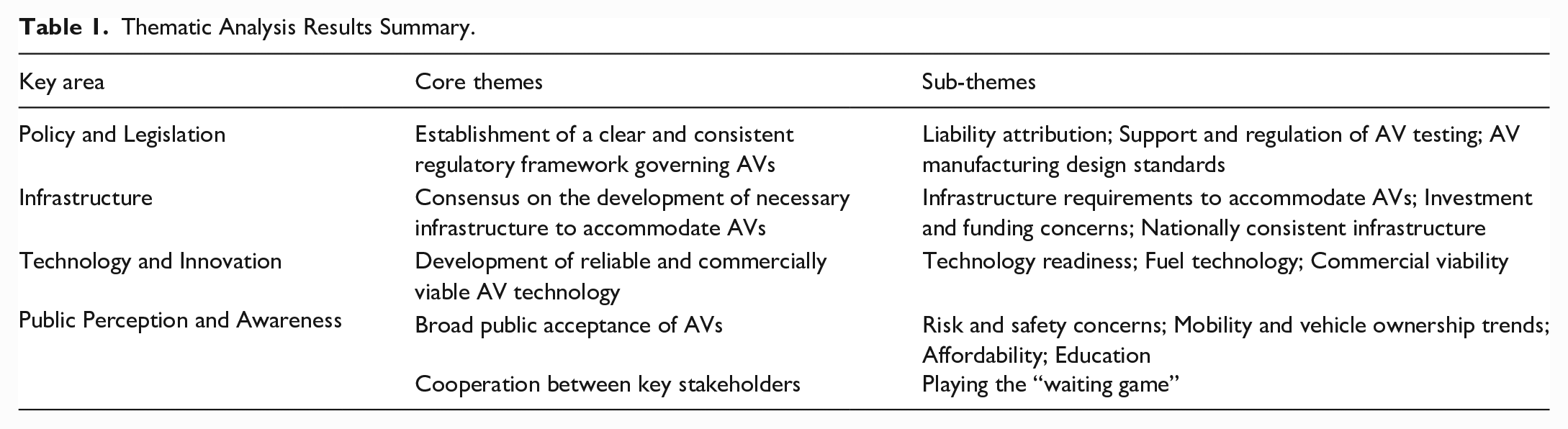
Five core themes and 11 sub-themes emerged from the analysis (Table 1), representing important drivers and barriers that need addressing for AVs to be introduced and adopted successfully in Australia.
Thematic Analysis Results Summary.
Theme 1: Establishment of a regulatory framework governing AVs
The results supported past research which indicated that regulatory action may either hinder or propel the progress of AVs (Fagnant & Kockelman, 2015).
Sub-theme: Risk and liability attribution
Risk & Liability attribution was identified as one of the key barriers to AV introduction and adoption in Australia. The findings support that, for a fully automated vehicle, the driver relinquishes controls to the vehicle’s operation and therefore transfers any liability to the manufacturer. However, attributing liability becomes complicated with partial automation, where the driving role is shared. In these cases, identifying the party at fault becomes much complicated. This complexity is highlighted by the response of R3: “How do you determine at which point, if the car mentions that it needs help, it is your fault for not responding? It gets really messy because nobody wants to be held liable.”
Aside from human error and the possibility of software malfunction, respondents raised the issue of “cybersecurity.” For AVs to function effectively, they combine cameras, sensors, and onboard computers to communicate with their surroundings to sense potential dangers. This would require AVs to be connected to a network where large data transfers between a vehicle and its environment can take place, putting the vehicle at risk of attacks from malicious hackers. R3 indicated that “there is the threat of cybersecurity if the vehicle is hacked. Who will fault be attributed to?”
As such, agreeing on a standardized legal framework to manage these complex liability issues is important toward the large-scale introduction of AVs. For instance, R8 said: “A clear liability framework needs to be established. For example, when Uber had an accident in the US, they settled out of court for $10 million in the matter of days. What that means is that a precedent hasn’t really been set. Vehicle manufacturers are essentially continuing to press forward to test their vehicles, and what they are risking is a massive liability suit if something goes wrong.”
Sub-theme: Support and regulation of AV testing
Findings also highlighted the need for convincing evidence proving that AVs can perform safely and effectively under real-world conditions. However, respondents have echoed concerns about how Australia’s policies and legislations hinder the testing of AVs compared to other countries, where legislative requirements to test AVs on public roads are less restrictive. For instance, R13 said: “Today you can’t be on the road in an autonomous vehicle without breaking the law.” This is echoed by R16: “We tried to do some autonomous vehicle trials in [Western Australia] and it was just so difficult to do an open road test. The restrictions on this were so severe we decided to drop that part of the program. . . It’s really tough in Australia, and you don’t see that in the US and Europe.”
Sub-theme: Establishment of AV manufacturing design standards
Some respondents highlighted that a unified design standard for AVs would represent an important step toward successful adoption in Australia. Without a national standard in place, manufacturers will struggle to obtain the necessary certification to export AVs into Australia. R1 suggests that: “A critical signpost is when the Commonwealth has in place design rules that recognize an appropriate software system. When these design rules are in place, and when they call for manufacturers to certify their vehicles, that would be the turning point in Australia.” Specifically, Australia will need to harmonize national vehicle standards for AVs with international regulations. R2 supports this by indicating: “Because these things are going to be universal, there is a move to align with the world standard in terms of design rules. The European system will be the standard that Australia will follow and that would then enable the vehicle manufacturer to be fairly confident that they are facing the same regulatory system no matter which country they are going into; Australia should not get ahead of international development. We don’t want to put in place [rules] that may not be appropriate and go our own route.” This harmonization is also important for AV manufacturers from a financial perspective, as R4 suggested: “We need to look at the best practices that are being implemented around the world and try to harmonize with the other countries. . .if the country is different from the rest of the world, it will cost more money to get certified; it doesn’t justify the introduction of AVs.”
Theme 2: Consensus on necessary infrastructure to accommodate AVs
Existing AV research has indicated that upgrades to existing infrastructure are necessary before AVs can be introduced on roads (Liu, Tight et al., 2019). However, the interviews revealed mixed views, with some respondents stating that AV technology is likely to advance to a point where it can adapt to existing infrastructure.
Sub-theme: Understanding infrastructure requirements to accommodate AVs
An AV relies on its ability to communicate and perceive what is happening in its surrounding to function effectively. For example, AVs use camera systems to detect, read, and interpret traffic signs and line markings to safely navigate. Specifically, some respondents have highlighted the importance of quality road infrastructure. For instance, R7 said: “AVs like to have clear line markings, consistent signage, and good quality roads.” However, the extent of road infrastructure changes required to accommodate AVs is still unclear. This is highlighted by contrasting views between respondents over the ability of AVs to adapt to existing infrastructure. For instance, R9 indicated that: “It seems like the vehicle manufacturers are saying AVs will be able to drive on existing road infrastructure.” However, R16 said: “Three to four years ago, the view was that AVs would be infrastructure-free, but the reality is that we are not likely to get there, so we will need to change all the infrastructure that we currently have in place.”
Moreover, the type of vehicle communications technology the vehicle uses impacts its ability to communicate effectively. Specifically, the type of communication infrastructure required would depend on the type of vehicle communications technology, or V2X technology, that would be installed. The two main options are DSRC and C-V2X. However, consensus was lacking among respondents. R16 indicated that: “In the US, it is going to be mandated that every vehicle will be equipped with a V2X system by 2021 or 2022. The current dominant technology used for the V2X system is DSRC, which is backed by Toyota and GM. However, there is currently a push to switch to 5G (C-V2X) over DSRC. R11 concurred with this lack of consensus: “We have put in place DSRC communication both to help in terms of positioning and augmentation as well as in terms of communicating traffic light phases. But we are looking at 5G (C-V2X) as well.”
Sub-theme: Investment and funding responsibility concerns
Nevertheless, our findings show that some level of investment into improving existing infrastructure is still necessary to accommodate AVs. However, what these changes or upgrades are and the extent of transformation is still unclear. Due to this uncertainty, the Australian government has been hesitant in making infrastructure investment decisions. R15 suggested that “From the government’s perspective, it’s important not to invest too early because there are uncertainties in the technology that will be used.”
Some respondents also highlighted the issue of funding to support changes/upgrades. R3 indicated: “Budgeting is a big issue. Where does the money come from to accommodate this technology?” This issue of funding responsibility is further complicated by the fact that not all roads are government owned. R4 indicated: “In Sydney, there is nothing has been done to accommodate AV. They are now identifying what needs to be done. It will be [a] massive change because a lot of roads are not controlled by [the] government, it is controlled by private government partnership. Proper road upgrades will be very difficult.”
Sub-theme: Need for nationally consistent infrastructure
There needs to be a consistent and standardized approach to infrastructure decisions across Australia’s states and territories. R4 highlighted that “The implementation of AVs in Australia will be in a very long time because our road infrastructure is different from state to state. We need to achieve harmonization in terms of infrastructure.” Encouragingly, there is some evidence that efforts are underway in creating consistency in the infrastructure nationally. R18 said: “There’s currently a line–marking project in Australia looking at making the road markings consistent nationally.”
Theme 3: Development of reliable and commercially viable AV technology
For AVs to be deemed market-ready, manufacturers need to prove that their technology is reliable and can handle complex road scenarios without requiring human intervention (Kalra & Paddock, 2016b).
Sub-theme: AV technology readiness
The current state of AV technology indicates that AVs are not yet market ready. The technology has not reached a point at which vehicles can handle all possible road scenarios safely and efficiently. For instance, R11 indicated: “There needs to be a self-driving algorithm that can handle streets where traffic is complex. However, the technology is not quite there yet when you’re talking about city driving.” R7 concurred: “From what I have seen from AVs, they are still unable to deal with unexpected situations such as unscheduled roadworks or a tree that has fallen onto the road. Human intervention is still required in these instances.”
The only way for technology to improve is through more AV trials across a range of driving conditions. While many of these trials are happening overseas, Australia appears to be lagging. R4 said “We need to get some real-life AV trials happening. We are currently running trials in Korea, California, and Europe. The problem with Australia is that we have done a very poor job in preparing ourselves for electric and AVs.” More specifically, while there is evidence of AV trials happening in Australia, they have been conducted in restricted, controlled settings and environments. AVs must be exposed to real traffic and driving conditions to facilitate further technological fine-tuning. R1 indicated that: “More data and evidence is still needed around AVs operating in high traffic areas. Specifically, AV trials are constrained to restricted areas that are tightly controlled.”
Sub-theme: Fuel-technology requirements
The preceding sections have presented compelling evidence indicating that autonomous vehicles (AVs) are most likely to be powered by battery-electric technology (NRMA, 2017). This is primarily due to the high-power demands of AVs (Baxter et al., 2018), which necessitates a reliable and sustainable power source. Furthermore, many EU countries have committed to phasing out the production and import of new petrol and diesel vehicles over the next two decades, reinforcing battery-electric and other zero-emission alternatives as the preferred fuel source for AV manufacturers (Dugdale, 2018, 2019; World Economic Forum, 2015).
This is also corroborated by the respondents. R15 suggested that: “There is a high chance that automated vehicles will be EVs. What you see quite quickly, before high levels of automation, is an increasing electric vehicle fleet around the world.” R16 expressed a similar sentiment: “In the future, all AVs are going to be electric and connected. They are the two fundamental components that regulators in the US and Europe are tackling now.”
Sub-theme: Commercial viability of AVs
Another common theme from the interviews is the commercial viability of AVs where manufacturing costs are currently a significant barrier; particularly for associated in-vehicle technologies. R8 indicated that: “Most AVs currently use LiDAR, which makes manufacturing AVs very costly. Cheap sensor solutions need to be found to make AVs commercially viable.”
Theme 4: Achievement of broad public acceptance of AVs
For AVs to be adopted, broad acceptance among the public is needed. For this to happen, the value propositions for AVs alongside the risks involved need to be communicated and addressed. Specifically, respondents have highlighted several factors that would influence public acceptance.
Sub-theme: Risk and safety concerns
Research has found that AVs perceived as being unsafe is one of the biggest barriers to adoption (Autonomous Vehicle Survey Report, 2019). This safety concern begins with those inside the AV and extends to others as well. This is corroborated across the interviews, whereby R12 said: “Safety is one of the critical things the public wants to be assured of. Not only for their own safety, but also the safety of other people.” Furthermore, some respondents also emphasized how the tolerance of error for an AV compared to a non-AV is much lower. R7 highlighted that: “The tolerance for error in the public’s eyes will be extremely low. . .the key difference is they are not in control in an AV compared to a non-AV. This is one of the biggest challenges.” Aside from the physical risks that AVs pose, respondents also highlighted other societal concerns such as job losses for those in transportation. R14 suggested that: “The introduction of AVs will have a significant impact on employment. What needs to be addressed will be around the jobs that will go away and the jobs that will be created.” This concern was shared by R9: “It will have an impact on jobs, so there may need to be a skill shift.”
Sub-theme: Mobility and vehicle ownership trends
How AVs will be adopted is likely to depend on how mobility and vehicle ownership preferences evolve (Pettigrew et al., 2019; Wang et al., 2020). Specifically, the two main pathways for adoption are: AVs introduced as an on-demand mobility service (e.g. taxis, ride-share); or mass-marketed for private consumption. Most respondents anticipate the first pathway, as R8 indicated: “AVs are more likely to be offered by on-demand mobility services as opposed to being available for private consumption.”” While R13 highlighted that: “The use for AVs for public transport [may be a social trend which would accelerate the intro of AV]. An AV bus for example.” However, whichever pathway is eventually taken will also likely depend on the associated costs of using or owning an AV. R10 indicated that “There are a bunch of trends suggesting that people are willing to use on-demand services and tailored services if there can be a cost-competitive proposition.”
Sub-theme: Affordability
While positive public perception of AVs is important, its affordability will ultimately determine its uptake (Bansal & Kockelman, 2017; Rahimi et al., 2020). Currently, it is still relatively expensive, and while economies of scale will gradually occur, there is a chance that wide-scale adoption may be limited to a select affluent few. R4 indicated that: “We are working to make AVs affordable for the public. Our goal is to make the technology affordable and widely accepted.” Furthermore, R12 highlighted: “I think if we’re not careful, AVs will become something only the rich can afford and use or the tech-savvy will use because they’re comfortable or people who are in that early adoption phase of the curve will be willing to embrace.”
Sub-theme: Educating consumers
Research has shown that familiarity and knowledge have a positive influence on consumer acceptance of AVs (Berliner et al., 2019). Hence, the importance of educating consumers about the technology is critical. R4 said: “In order to take the AV technology to the next level, the right education is needed, remembering we already have different levels of autonomy in current cars, but not many people have been exposed to it.” Unfortunately, the respondents indicate that very little has been done in consumer education within Australia. R16 indicated that: “Currently in Australia, public exposure to AVs has been limited to autonomous shuttle buses. It’s a good soft introduction; however, it doesn’t inform the public about things such as the necessary changes required to support AVs. That’s one of the reasons why we don’t have a strong take-up of smart infrastructure and electric vehicles, which are important components to driving AV adoption in Australia.” This is also expressed by R4: “The government is currently doing a poor job at preparing and educating the public about AVs.” While some respondents have identified the government as the one that should be driving information dissemination and building awareness for AVs, others have suggested that consumer advocacy groups such as motoring clubs may be better positioned to nurture positive perceptions. R6 indicated that: “Automobile clubs are in the prime seat to educate the public about AVs. They are more likely to be perceived to have the public’s best interests at heart. . .”
Theme 5: Cooperation between key stakeholders
Another major barrier and driver of AVs in Australia is the cooperation between key stakeholders. Due to the potential impact that the introduction of AVs can have, respondents have highlighted that coordinated effort between key stakeholders such as the government, AV manufacturers, and consumer advocacy groups is needed. R11 indicated that: “For AVs to be successfully adopted, both industry and governments need to work together. It shouldn’t be just transport authorities that drive this; it is also our economic agencies, the police, public transport operators, insurance companies, and so on. The wider public also needs to be involved in the discussions.”
Sub-theme: Playing the “waiting game”
From the interviews, however, there is a general sense that AV manufacturers and governments are playing a “waiting game.” For example, AV manufacturers are waiting on the government to establish policies and guidelines before they can commit to introducing AVs. Whereas governments are waiting for AV manufacturers to clarify the technological readiness and specific infrastructure changes required for AVs to function safely and effectively. R16 mentioned that “Vehicle manufacturers are only moving at the speed of legislation” and R4 also indicated that “From our company’s perspective, we have the technology right now, but we just can’t deploy it anywhere. The regulation, agreed standards, and infrastructure are not ready to accommodate AVs.” This sentiment is also shared by R9: “Infrastructure and technology are a little bit like the chicken-and-egg dilemma. At this stage, it’s hard to determine whether it’s the changes/upgrades in infrastructure or the improvements in AV technology that needs to occur first before AVs can be successfully implemented on public roads.”
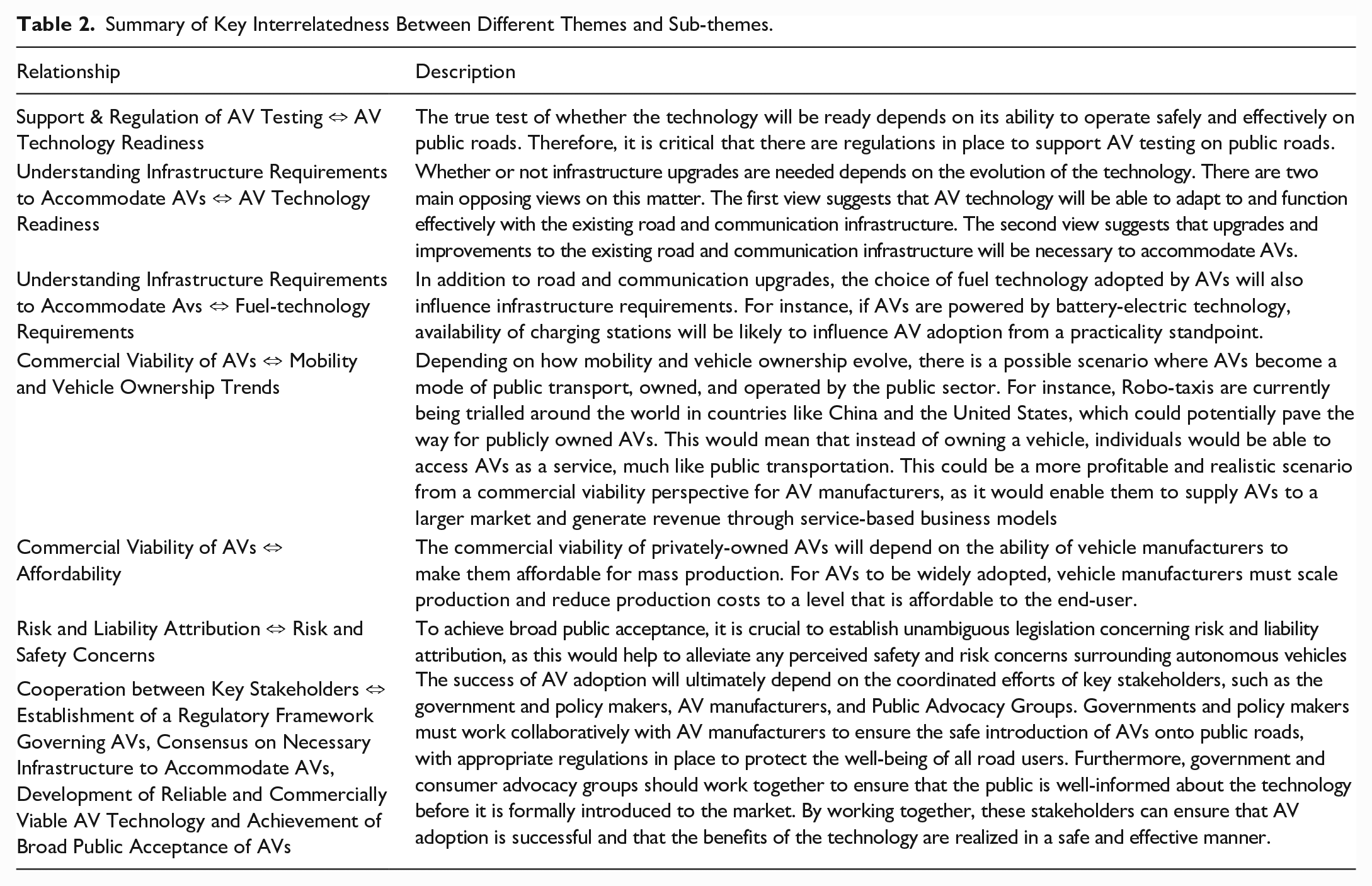
Figure 1 represents a thematic framework that summarizes the key themes and sub-themes according to our subject experts. The graphic depicts the interrelatedness between the different themes synthesized from the qualitative data from the interviews. Table 2 provides a summary of the interrelatedness between specific themes and sub-themes discussed earlier. It aims to illustrate the connections between the different concepts and how they impact each other in the context of AV technology adoption.
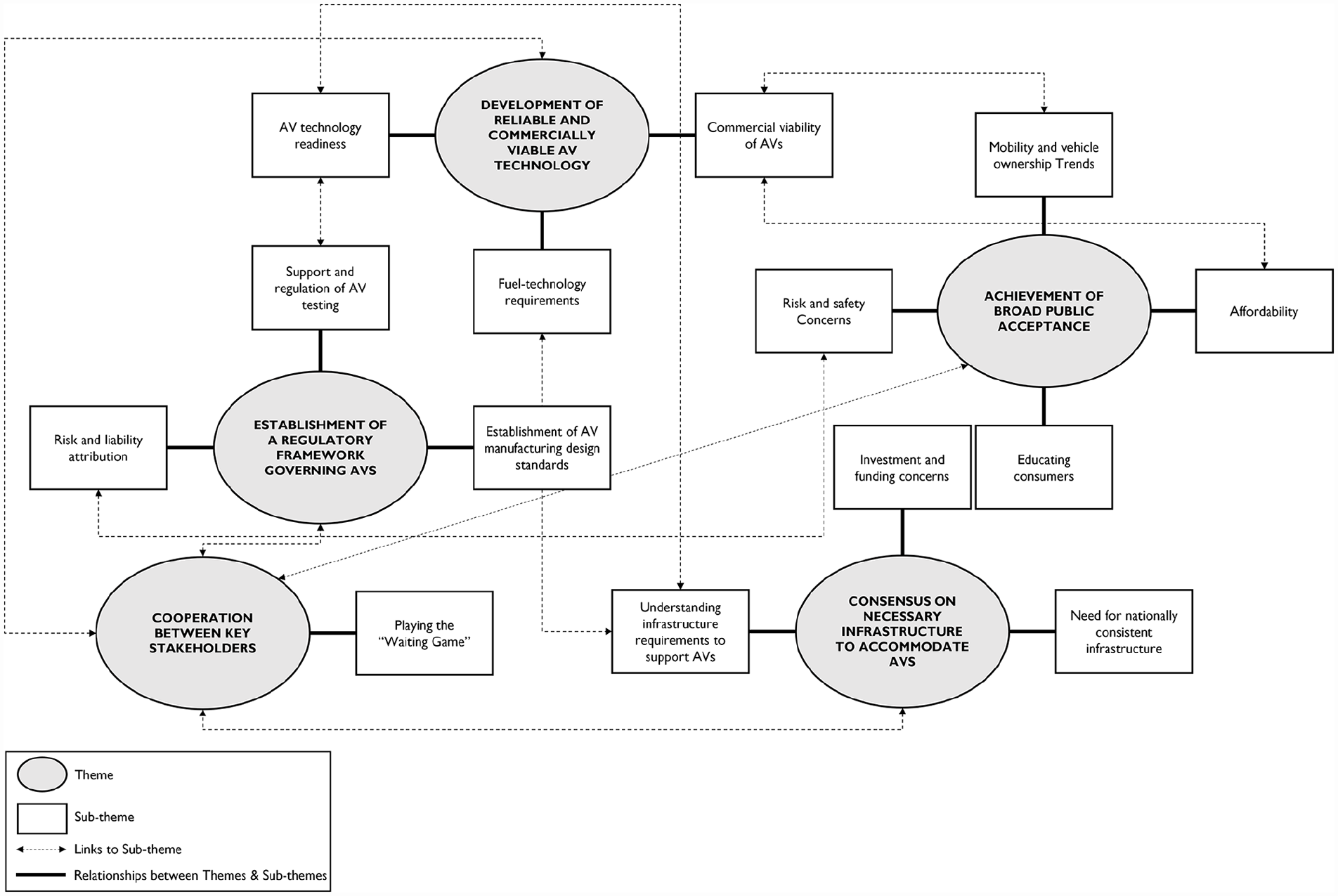
Thematic conceptualization of factors influencing AV adoption.
Summary of Key Interrelatedness Between Different Themes and Sub-themes.
Discussion and implications
Most existing studies on AV adoption have focused on the end-user’s attitudes and perceptions as well as their influence on user acceptance and adoption preferences. However, the existing literature remains limited in terms of considering the perspectives of key stakeholders, including government, policy makers, technology providers, and vehicle manufacturers. These stakeholders are ultimately responsible for the development and deployment of AVs and making them available for end-users. Moreover, most of the existing literature focuses on each stakeholder group independently, rather than exploring their interrelationships and interdependencies. Our study addresses the gap in the literature by utilizing a qualitative approach and a highly specialized sample of key opinion leaders to provide a more holistic and inclusive framework for the introduction and adoption of AV in Australia. Our results offer important insights for the challenges and opportunities facing these stakeholders, highlighting the need for a collaborative approach that involves all relevant parties in establishing a regulatory framework, building necessary infrastructure, developing reliable and commercially viable AV technology, achieving broad public acceptance, and promoting cooperation among key stakeholders. Furthermore, our findings demonstrate seven key conclusions that have significant implications both theoretically and practically.
Conclusion 1: Significant role of government role in regulating and facilitating AV adoption
This study highlights that governments will be essential in facilitating the development and pace of adoption of AVs. This can only occur through the establishment of a clear and consistent regulatory framework governing AVs that encompass design guidelines, testing policies, and infrastructure investments. Furthermore, liability attribution becomes more complex during the partial automation (Levels 3 and 4) stages, therefore a clear review of policies and legislation around the attribution of liability is necessary. This notion is supported by Pöllänen et al. (2020), who found that respondents attributed more blame for crashes involving fully AVs to manufacturers and the government as opposed to the driver compared to non-autonomous and semi-AVs.
This extends existing literature on innovation adoption and technology diffusion models (Yuen et al., 2021), which have traditionally focused on consumers and end-users. Specifically, our study demonstrates that the adoption of complex innovations such as AVs requires a much broader perspective that accounts for the roles and perspectives of key stakeholders such as the government and policy makers, as well as the consideration of macro-environmental factors such as economic, political, and social conditions. This is particularly important given that the adoption and diffusion of AVs is likely to have significant implications for society. Practically, this means that AV manufacturers need to take into account the regulatory requirements and guidelines set forth by the government while designing and testing their AVs. Moreover, they need to collaborate with government agencies and policy makers to address the complex liability issues that arise during the partial automation stages. On the other hand, government agencies and policy makers need to create a regulatory framework that promotes the development and adoption of AVs while ensuring the safety of road users. Such a framework should include guidelines for AV design, testing policies, and infrastructure investments.
Conclusion 2: Addressing safety, liability, and data privacy issues through policy harmonization
Our findings emphasize the importance of addressing two critical concerns, data privacy and security, that AV manufacturers and policy makers need to work together to resolve before introducing the technology to the market. The operation of AVs depends on an intricate network of sensors, cameras, and onboard computers that interact with the surrounding environment. As a result, AVs must be connected to a network to enable large data transfers, making them vulnerable to cyber-attacks from malicious hackers (Sheehan et al., 2019). The views expressed by respondents on privacy concerns regarding data usage, sharing, and storage echo the findings of Jannusch et al. (2021), who emphasized the need to regulate personal data usage to protect human life.
From a theoretical perspective, existing literature has examined the acceptance of AVs using various frameworks, including TAM, TPB, and UTAUT (e.g. Golbabaei et al., 2020). However, these theories predominantly focus on the perceived benefits of the technology and do not adequately address individual factors such as trustworthiness and privacy concerns (Lancelot Miltgen et al., 2013). Therefore, our study highlights the need for more research to integrate knowledge from technology adoption theories with trust and privacy research fields (e.g. Hegner et al., 2019; Kaur & Rampersad, 2018) to provide a more holistic understanding of AV acceptance.
Australia’s limited exposure to AVs and the complexity of safety and liability issues pose significant challenges (Lyon et al., 2017). As other countries are already conducting actual testing on public roads, it is even more critical for Australia to develop policies based on real-world testing specific to the country. For instance, in the US, regulation to permit the introduction of AVs on public roads require evidence gathered from operational testing in real traffic situations (Lee & Hess, 2020). To ensure effective policies, it is essential to harmonize them with international best practices while also considering local conditions. Therefore, gleaning from international best practices can be a useful starting point for Australia to develop appropriate AV policies. However, due to the complexity of safety and liability issues, it is crucial to conduct actual testing in real-world conditions within the country.
Conclusion 3: Regulating AV testing and establishing unified design standards in Australia
Additionally, the regulation of testing AVs needs to be adaptive as technology evolves so as not to hinder or unintentionally restrict its development (Kalra & Paddock, 2016b). In Australia, the National Transport Commission has been working toward a national framework to regulate AV testing and allow for more flexibility in where and how AV trials can take place (National Transport Commission, n.d.). However, the general sentiment from the interviews is that the current policies and regulations are insufficient because (1) most AV trials take place in restricted and controlled settings, and (2) current Australian policies and legislation only accommodate limited deployment of vehicles for testing.
Further, the Australian government requires all road vehicles, whether manufactured in Australia or imported, comply with the relevant ADRs (Australian Design Rules) which are national standards for vehicle safety, anti-theft, and emissions (Department of Infrastructure, Transport, Regional Development and Communications, n.d.). A unified design standard for AVs was cited in the interviews as an important step toward their successful adoption in Australia. Specifically, respondents highlighted that Australia should work in tandem with overseas governments so that there are no conflicting design standards for manufacturers when importing AVs. Hence, it is important for AV manufacturers, the government and policy makers to work collaboratively to ensure that policies and regulations keep up with technological advancements. This includes actively engaging in the development of adaptive regulations that allow for flexibility and evolution as the technology advances. By doing so, this creates a conducive environment for the successful adoption and deployment of AVs in Australia while minimizing regulatory and compliance risks.
Conclusion 4: Navigating the uncertainty of AV infrastructure requirements and funding in Australia
The findings show that there is uncertainty around infrastructure requirements necessary to accommodate AVs on public roads. Specifically, the interviews indicate mixed views on whether infrastructure upgrades/changes are necessary. Some respondents believe that AVs will be infrastructure-free (i.e. adapting to existing infrastructure), whereas others assert that AVs will be infrastructure dependant (i.e. infrastructure upgrade/changes needed). Respondents highlighted the government’s decisions about infrastructure investments are dependent on how AV technology evolves. Furthermore, differences in state regulations and infrastructure funding add complexities around who (i.e. federal, state, or local government) will fund upgrades/changes and how the associated costs will be distributed among different stakeholders. The speed of innovation and technological advancement will also determine when AVs will emerge on public roads in Australia. However, existing research (Batsch et al., 2022) and this study suggest that AV technology is still unable to handle complex scenarios safely and reliably in public road conditions. To achieve this, AV trials are required in improving their reliability and functionality. Unfortunately, AV trials in Australia are currently hindered by existing policies and regulations. Managerially, it is necessary for the Australian government to advocate for adaptive policies and regulations that allow for AV trials in real-world conditions.
The findings align with previous research (NRMA, 2017), with respondents favoring zero-emission alternatives (such as battery-electric) as the most likely power source for AVs. Baxter et al. (2018) also found that AVs require more power to support critical in-vehicle technologies, which traditional petrol fuel cannot provide. Equipping petrol cars with autonomous systems would result in considerably higher fuel consumption, exceeding current emission standards. Therefore, a country’s preparedness in terms of EV infrastructure and technology is likely to have a significant impact on its ability to adopt AVs successfully. This implies that the Australian government and industry partners needs to prioritize the development of infrastructure to support EV deployment to facilitate AV adoption.
Discouragingly, EVs in Australia only represent 0.78% new car sales in 2020 compared to the global average of 4.2%, which is reflected in Australia ranking last for “government leadership and the maturity of its EV market” and second last for “availability of charging infrastructure” in the Arcadis Annual Global EV Catalyst Index (Read, 2021). At the time of writing, there are only three hydrogen-car refueling stations in Australia. This would mean a significant expenditure to installing alternative fueling stations to support the successful introduction of AVs in Australia. Swift action is needed from the government and policymakers to encourage the adoption of EVs through the introduction of government incentives and rebates for EV purchases and increased investment charging infrastructure.
Conclusion 5: Communication and education key to improving public acceptance
Consumer education is integral to the acceptance of innovative technology (N. Liu et al., 2020). Recent reports show that both industry experts and regulators view consumer concerns as one of the biggest threats to AV growth (Autonomous Vehicle Survey Report, 2019). As emphasized by one of the respondents, “Safety is one of the critical things the public wants to be assured of.” Respondents highlighted that this aspect of safety is not limited to those operating the AV but extends to others as well. With current public sentiment being somewhat negative, largely fueled by several highly publicized fatal accidents (Wakabayashi, 2018), the ability of AV manufacturers to demonstrate that AVs will reduce road crashes and fatal accidents through the elimination of driver error is paramount (Thorpe & Motwani, 2017). Moreover, respondents also highlighted that consumers are more likely to have a lower tolerance of error for AVs compared to non-AVs; Bennett et al. (2020) found that as the level of automation increases, the blame on the vehicle manufacturer increased.
Unfortunately, respondents have highlighted that little effort has been made to educate the public about AV technology in Australia. Currently, exposure to Avs within Australia is limited to autonomous shuttle buses, as noted by the Automated Vehicle Program at the National Transport Commission (n.d.). Given this limited exposure and educational outreach efforts within the country (Austroads, n.d.), it is imperative to implement increased public education and awareness campaigns to create greater exposure and alleviate perceived risks. Additionally, integrating research on privacy and trust is essential to better understand the acceptance of this complex technology, as highlighted by Hegner et al. (2019) and Kaur and Rampersad (2018). To ensure positive consumer responses, two key stakeholders—governments and consumer advocacy groups must work collaboratively to communicate the benefits of AVs to the public.
Conclusion 6: Private versus public ownership models of AVs
Past research suggests that public perception will influence how AVs are adopted. For the anticipated benefits to be realized (e.g. reduced emissions, mobility increases for elderly and disabled populations, and a more efficient transport system), there is an underlying assumption that a shared-ownership or ride-sharing model of AVs will be predominant, compared to a privately-owned model (Fagnant & Kockelman, 2014; Stoiber et al., 2019). This view is corroborated in the interviews suggesting that AVs would serve as an “on-demand mobility service” as opposed to private consumption, partly influenced by growing concerns about environmental sustainability, parking, and congestion alongside the high costs of purchasing and maintaining a vehicle. The data also indicates that consumers consider alternative ways of commuting and are gradually becoming less interested in private car ownership. However, in Australia, the case for AVs being available for private consumption is still viable, as car ownership is still perceived as important. For example, a study by Moody et al. (2021) found that consumers value the freedom and flexibility to travel whenever the need arises, and the perceived status associated with owning a vehicle.
Theoretically and managerially, these current findings are novel and significant. Existing research has primarily focus on consumers’ adoption intention of AV for private ownership. However, the current research highlight that AV adoption is a complex and multifaceted, and the technology can be adopted in different models such as a public ownership and even services such as on-demand mobility. The findings therefore prompt researchers and practitioners within the AV or vehicle industry to consider possible scenarios and product and/or service as well as consumers acceptance of these different facets that can arises from AV technology. Furthermore, our findings highlight the crucial role of public acceptance not only in driving but also in consuming private or public services afforded by AV. Practically, AV manufacturers and policymakers should also consider the need to tackle concerns of co-sharing AV such as hygiene and safety. At the same time, they should also explore how shared-ownership models can promote environmental sustainability, increase mobility options for elderly and disabled populations, and create a more effective transportation system.
Conclusion 7: Cultivating a culture of openness and collaboration between key stakeholders
Finally, our findings emphasize the significance of adopting a holistic and interdisciplinary approach to examine the adoption of AVs. Key stakeholders such as governments and policymakers, AV manufacturers, and consumer advocacy groups together all play a role in determining the successful adoption of AVs in Australia. Specifically, it necessary that these key stakeholders work together to address key issues relating to policy and legislation, infrastructure, technology and innovation, and public acceptance. For example, before the government can commit to infrastructure upgrades/changes, there needs to be clarity on the technology evolution. Furthermore, AV manufacturers must work closely with policy makers and consumer advocacy groups to develop technologies that meet regulatory and consumer needs, while also ensuring that public acceptance is considered. To foster this collaboration, a culture of openness and knowledge-sharing needs to be encouraged and promoted through ongoing open forums, industry roundtables, and bilateral discussions.
Limitations and future directions
The research has its limitations. First, this study used qualitative data from in-depth interviews conducted with expert and key opinion leaders in the AV field, however, the limited sample size (18 experts) and context (Australia) limits the generalizability of the findings. Future studies should consider a larger sample size and involve experts from wider geographical context. Furthermore, quantitative studies may be useful to develop hypotheses and test the identified factors more objectively. Second, while due diligence was taken in developing the interview guide, additional dimensions associated with AV adoption may have been omitted. Figure 1 provides future studies a useful framework to help guide question development for future studies.
Finally, we acknowledge that although our paper aims to focus on Level 5 automation, there may be technological challenges that prevent this level of automation from being achieved. Therefore, future studies should consider investigating the influence and impact of each of the factors identified in Figure 1 within the context of Levels 3 and 4 individually. This could provide valuable insights into the challenges and opportunities presented by partial automation and provide a solid foundation for the potential achievement of Level 5 automation. Such insights can further contribute to the development of a comprehensive framework that considers the various aspects of AV technology and its adoption.
Footnotes
Appendix
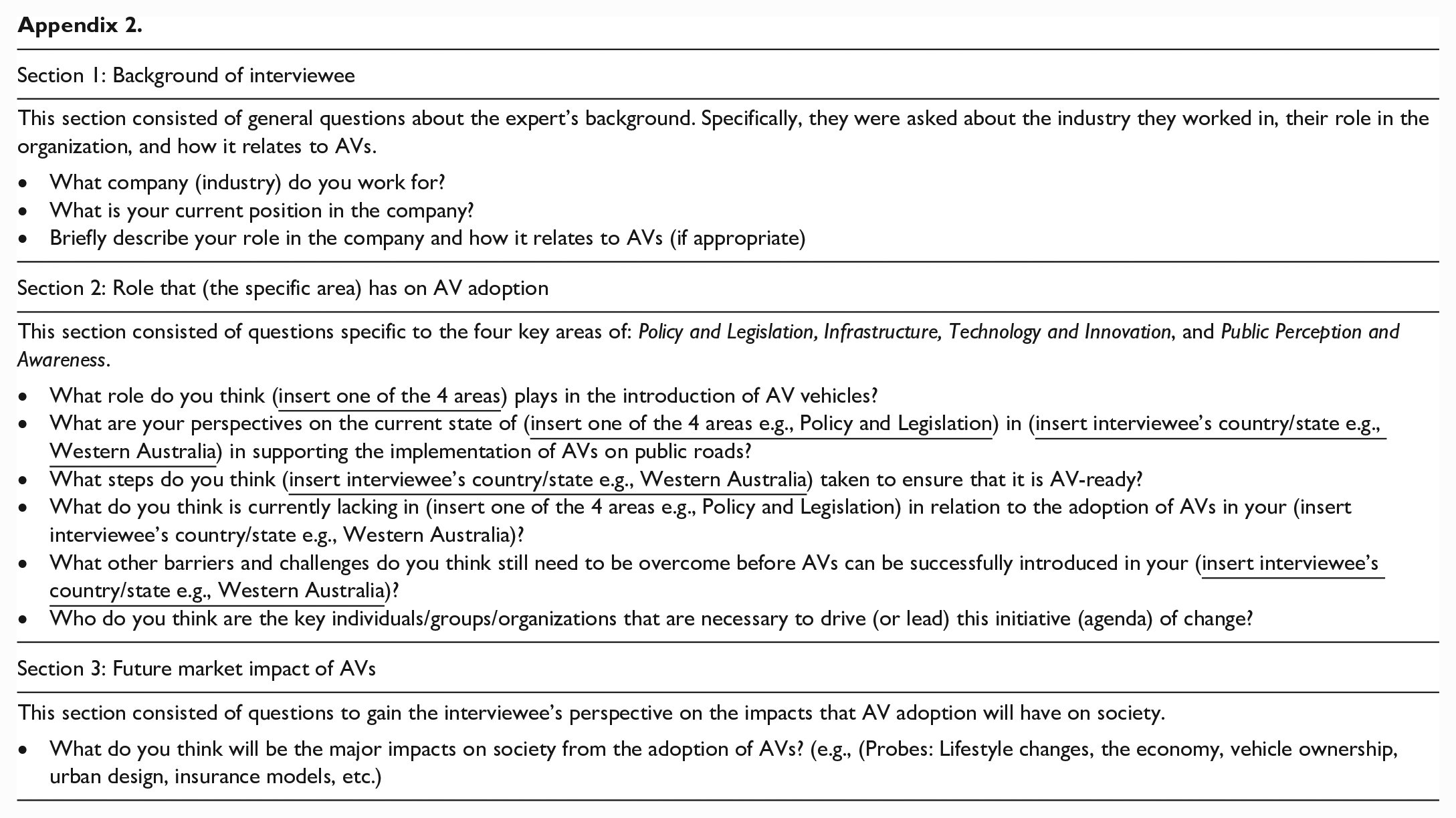
| Section 1: Background of interviewee |
|---|
| This section consisted of general questions about the expert’s background. Specifically, they were asked about the industry they worked in, their role in the organization, and how it relates to AVs. • What company (industry) do you work for? • What is your current position in the company? • Briefly describe your role in the company and how it relates to AVs (if appropriate) |
| Section 2: Role that (the specific area) has on AV adoption |
| This section consisted of questions specific to the four key areas of: Policy and Legislation, Infrastructure, Technology and Innovation, and Public Perception and Awareness. • What role do you think ( • What are your perspectives on the current state of ( • What steps do you think ( • What do you think is currently lacking in (insert one of the 4 areas e.g., Policy and Legislation) in relation to the adoption of AVs in your (insert interviewee’s country/state e.g., Western Australia)? • What other barriers and challenges do you think still need to be overcome before AVs can be successfully introduced in your ( • Who do you think are the key individuals/groups/organizations that are necessary to drive (or lead) this initiative (agenda) of change? |
| Section 3: Future market impact of AVs |
| This section consisted of questions to gain the interviewee’s perspective on the impacts that AV adoption will have on society. • What do you think will be the major impacts on society from the adoption of AVs? (e.g., (Probes: Lifestyle changes, the economy, vehicle ownership, urban design, insurance models, etc.) |
Declaration of conflicting interests
The author(s) declared no potential conflicts of interest with respect to the research, authorship, and/or publication of this article.
Funding
The author(s) disclosed receipt of the following financial support for the research, authorship, and/or publication of this article: We would like to acknowledge RAC Insurance for funding and supporting this research.
