




Abstract
The proliferation of social media resulted in less control over who shares brand content. While brand content sharing by micro-influencers is sought by many firms, the effects of such an activity on brands’ personality remains unknown. This study combined context effects and schema theories to demonstrate that assimilation occurs for novice brands, while contrast and ceiling effects take place for established brands due to micro-influencer-brand (in)congruence against the existing brand schemas. Currently, managers target consumers under an assumption that a match between a brand and an influencer is beneficial. We demonstrate that such targeting is advantageous only for novice brands. Established brands paired with congruent micro-influencers experienced no boost in brand personality (ceiling) with a boost occurring only when micro-influencers and brands were incongruent (contrast). Our results raise questions about the effectiveness of current branding strategies and caution about novice brands assimilating undesirable personalities.
Introduction
Brand personality encompasses a set of human characteristics that consumers associate with brands (Aaker, 1997), which represents an important area of brand management (Keller, 1993; Lara-Rodríguez et al., 2019). Brands with established (salient) personalities help firms maintain a unique brand image, build trust, commitment and a greater differentiation from competitors (Aaker, 1996a; Louis & Lombart, 2010). Brand personality also has positive effects on brand attachment and purchases (Ambroise et al., 2014). Not surprisingly, understanding how brands acquire personality traits has long been an interest of scholars, as well as practitioners (Aaker, 1997).
Brand personality is rooted in different sources (Ambroise et al., 2014; Plummer, 2000). To create brand personalities, managers can co-present brands with other brands (Simonin & Ruth, 1998; Voss & Gammoh, 2004) or use individuals, such as company’s employees, CEOs, celebrities, or social media mega-influencers to imbue personality traits (Aaker, 1997; Belanche et al., 2021; McCracken, 1989; Sundar & Noseworthy, 2016). While substantial research has been dedicated to how celebrities and mega-influencers transfer personality traits onto brands (Ambroise et al., 2014; Kamins, 1990; McCracken, 1989; Mishra et al., 2015; Törn, 2012), managing brand personality is becoming increasingly challenging due to the rise of micro-influencers who have fewer followers (Park et al., 2021), but still share brand content. While such content sharing could be beneficial for brands when micro-influencers voluntarily endorse brands (earned media), brand managers have little control over such activity and need to be aware of the consequences of such unprompted sharing. Likewise, when managers approach micro-influencers for sponsored endorsements, they need to know how to select micro-influencers to yield best returns for brand personality.
The importance of micro-influencers had been steadily increasing over the past decades, as well as the advertising spending allocated to this channel (Kim & Kim, 2021; Park et al., 2021). The emerging research on micro-influencers only suggests that they are more effective than mega-influencers in triggering brand authenticity and trust (Park et al., 2021; Schouten et al., 2020) with most research on personality transfer being conducted on celebrities (Aaker, 1997; Belanche et al., 2021; McCracken, 1989; Sundar & Noseworthy, 2016). The latter are believed to transfer personality traits when they are credible and attractive (source credibility model explanation; Kamins, 1990; Mishra et al., 2015), when they exhibit product category similarity (an attractive celebrity is used for an attractive product; match-up hypothesis explanation; Kamins, 1990; Mishra et al., 2015), or exhibit celebrity-brand personality congruence (Ambroise et al., 2014; Kamins, 1990; McCracken, 1989; Mishra et al., 2015; Törn, 2012). Compared to research on celebrities and mega-influencers (Mishra et al., 2015; Törn, 2012), it is still unclear how micro-influencers affect brand personality. Overall, it may be challenging for consumers to ascertain expertise-based traits of micro-influencers, suggesting that source credibility model may not be fully applicable. Micro-influencers may also exhibit brand-matching (congruent) or mis-matching (incongruent) personalities, but the effect of such pairing on real brands that have varying brand personality salience (an established brand with salient personality or a novice brand with less salient personality) still remains unclear despite their managerial relevance.
This study addresses the above-mentioned gaps and posits that micro-influencers impact brand personality just like celebrities or mega-influencers do. While past research relied on source credibility and product category match-up (Mishra et al., 2015), this study used context effects (Stapel et al., 1997) and schema theories (Fiske & Linville, 1980) to account for micro-influencer-brand (in)congruence to explain how consumers appraise the personality of established and novice brands. We argue that brands displayed on micro-influencers’ social media profile pages will be judged according to the principle of context effects (Stapel et al., 1997), where attributes of the context (pictures, activities and posts of micro-influencers) will project specific personalities that will provide frames of reference for brands’ personality. Brands with less salient personalities will be subjected to an assimilation effect (Stapel & Winkielman, 1998) and would assimilate the personality of micro-influencers due to trait accessibility and brand personality ambiguity. When brands with salient (established) personalities appear next to incongruent micro-influencers, they should be subjected to a contrast effect, where brand personality perceptions will move away from micro-influencers’ personality due to schema incongruence. Finally, we extend context effects theory by adding a ceiling outcome, explaining that pairing congruent micro-influencers with brands that exhibit salient personalities will neither damage nor benefit brands because micro-influencers (frame of reference) corroborate existing brand schemas.
This study provides a number of contributions. First, it explains how consumers infer brand personality from micro-influencers, providing timely insights into the underlying information processing triggered by micro-influencers, which has been ignored in the literature. Second, by including a ceiling outcome, we explain what will happen to brand personality when brands lack ambiguity and are placed in a congruent context, which occurs daily on social media. This conceptualisation goes beyond the assimilation (which occurs due to object ambiguity) and contrast effects (which occurs due to object knowledge and its incongruence with the context [micro-influencer]). These three effects provide a comprehensive theoretical explanation of the effects that are likely to take place when brands are displayed next to micro-influencers, explaining what novice and established brands should expect from unprompted endorsements (earned media) or sponsored endorsement initiated by firms. We also examine how inferred brand personality subsequently relates to purchase intentions controlling for self-brand connection, highlighting why personality inferences made from micro-influencers matter for brands. Finally, while past research on celebrities used either fictitious brands (Törn, 2012) or brands with established (salient) personalities (Mishra et al., 2015), this study examines the effects of micro-influencers using real brands with both salient and less salient personalities, providing a more comprehensive assessments of brand personality outcomes.
Two experiments were carried out. Study 1 examines the effect of micro-influencers on brands that have less salient personalities (novice brands), confirming that the latter are subjected to an assimilation effect. Study 2 examines the effect of micro-influencers on brands that have salient personalities, demonstrating that they are subjected to a contrast and ceiling effect, rather than an assimilation effect. Both studies used real brands and manipulated profiles of fictitious influencers to project certain personalities. Experiments controlled for micro-influencers’ credibility, attractiveness and expertise to rule out alternative explanations.
Theoretical framework
Context effects and schemas
To explain how brand personality can be inferred from micro-influencers, we draw on context effects and schema theories. Context effects theory explains how individuals judge stimulus depending on the characteristics of the environment in which it is placed or encountered, which have been applied to retail context (Schnurr et al., 2017). Two effects have been discussed within the context effects theory – assimilation and contrast, which are contingent on viewers’ knowledge about the stimulus and characteristics of the context (Bless & Schwarz, 2010; Schnurr et al., 2017; Stapel et al., 1997).
When respondents lack well-formed knowledge about the stimulus, characteristics of the context become assimilated (encoded) into the stimulus because the context provides an interpretation frame of reference (Stapel et al., 1997). For example, unfamiliar to the viewers products are perceived to be expensive (Lee & Suk, 2010), attractive (Schnurr et al., 2017) or aesthetically appealing (Kirk et al., 2009) when they are presented in a luxurious, attractive or aesthetically appealing retail environment (Schnurr et al., 2017). This occurs because these stimuli are open for interpretation (Schnurr et al., 2017), which is further explained by schema theory. The latter states that individuals possess cognitive structures composed of organised prior knowledge (schemas) about objects (Fiske & Linville, 1980). This knowledge guides processing of new information and retrieval of stored information when objects are encountered again (Fiske & Linville, 1980). When schemas are absent, stimulus will assimilate the characteristics of the context (Schnurr et al., 2017). When individuals are familiar with the stimulus and the latter is placed in a dissimilar context, a contrast effect occurs, where perceptions of the stimulus move away from the context (Stapel et al., 1997).
Two conditions need to be present for context effects to take place. Namely, the context needs to be: (a) cognitively accessible to the viewer and (b) should contain information that links context to the target stimulus (context is relevant for stimulus interpretation) (Bless & Schwarz, 2010; Schnurr et al., 2017; Stapel et al., 1997). If both of the above-mentioned conditions are met, the attributes associated with the context affect target stimulus perceptions (Bless & Schwarz, 2010).
Applying context effect principles (Bless & Schwarz, 2010; Stapel et al., 1997) to the social media context, we propose that when viewers are exposed to micro-influencers, their profile characteristics become cognitively accessible and will act as a point of reference, affecting the personality of brands shown on the same webpage. This should occur because influencers’ profiles act as the environment in which brands are encountered. Building on schema theory (Fiske & Linville, 1980), we further argue that depending on brand personality salience (being a novice brand/brand with less salient personality, or an established brand with an already salient personality) and micro-influencer-brand (in)congruence, brands will be subjected to either an assimilation or contrast effect. We also argue that when brands with salient personalities are paired with matching micro-influencers, a ceiling effect will occur as a result of brand schema congruence (Fiske & Linville, 1980), which has not been previously considered within the context effects theory.
Brands with less salient personalities: No brand schemas = assimilation effect
Social media profiles are typically created to present a desired or idealised personality via a careful choice of images, lifestyle or activities (Back et al., 2010). Consumers also post brand information on their profiles to actively express their identities (Muntinga et al., 2011). Social psychology literature suggests that individuals tend to constantly ascribe personality characteristics to people from the attributes they observe (Park, 1986). Similarly, social media profiles can be used by consumers to ascribe personality traits to micro-influencers, which in turn, should provide a frame of reference for brands that are shown on the same webpage. In other words, micro-influencers should be capable of transferring meaning onto brands because their personality can be observed from the information presented on their profiles (activity or pictures), providing an easily accessible frame of reference.
Extant literature suggests that consumers develop schemas associated with specific brands via associative learning (Pourazad et al., 2019; Till, 1998). Brand schemas typically take time to develop, but once formed, they represent powerful associations in the minds of consumers that help recover stored brand information to make decisions (Aaker, 1992; Saavedra, 2004). Brands with less salient personalities, such as novice brands or brands that have not yet developed distinctive personalities, should prompt limited brand schemas in consumers’ minds due to lesser knowledge about brand traits. As a result, they should assimilate the personality of a micro-influencer due to: (a) the accessibility of personality traits and (b) a link between the brand and the context (Stapel et al., 1997). The accessibility of the personality traits condition should be met because consumers do not possess substantial knowledge that can be retrieved from memory about the personality of the encountered brands. Furthermore, because individuals are known for using brands to express themselves and brand posts on social media are very common (Muntinga et al., 2011), there should be a link between the brand and the micro-influencer, which would satisfy the second condition for the context effects to occur (Stapel et al., 1997).
Given these considerations, consumers should rely on the micro-influencer’s personality to make inferences about brands because their display on a webpage would suggest an intended proximity between the brand and the influencer. This will result in information encoding and the assimilation of the influencer’s personality onto a brand. In this case the perceived congruence or incongruence between influencer’s personality and the brand is irrelevant because brand personality schemas are minimal. In this case, pairing brands with less salient personalities with micro-influencers should prompt associative learning (Till, 1998), prompting consumer to think that brands should exhibit similar personality traits because they are endorsed by a micro-influencer. This assimilation should create new knowledge (schema) about brand’s personality in consumers’ minds, ultimately influencing brand personality perceptions. Therefore, it is expected that brand personality will move towards the context reference point (Figure 1):
H1: Brands with less salient personalities paired with a micro-influencer will be subjected to an assimilation effect where their personality will be rated similarly to the personality of the influencer.
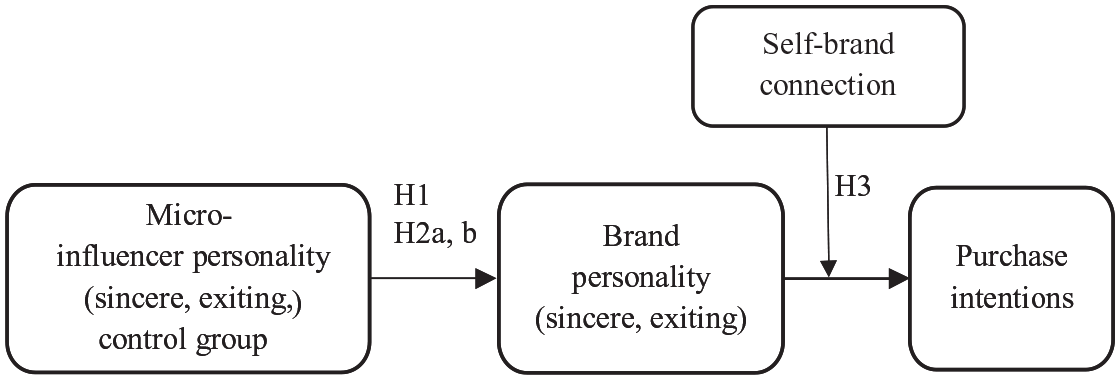
Conceptual framework.
Brands with salient personalities: Brand schemas = contrast and ceiling effects
Once brand schemas are formed, individuals recover stored brand information (Aaker, 1992; Saavedra, 2004), which should affect brand personality judgements when they are encountered in new contexts. While context prompts assimilation as a result of stimulus ambiguity, context effect theory predicts an opposite effect when objects are familiar to viewers and are encountered in the context which is dissimilar to the stimulus (Stapel et al., 1997). The above-mentioned scenario should occur when consumers encounter brands with salient or well-known personalities, which are shared by the micro-influencers whose personality does not match brands’ personality. Building on context effects (Bless & Schwarz, 2010; Stapel et al., 1997) and schema theories (Fiske & Linville, 1980), pairing brands with salient personalities with an incongruent influencer, should prompt a comparison against the existing brand schema. When pairing contradicts the existing schema, the personality of the influencer should facilitate a contrast effect (brand’s personality would move away from the frame of reference). This should occur because individuals strive for cognitive consistency between their knowledge structures and encountered information, favouring congruity in information processing (Osgood & Tannenbaum, 1955).
Context effects theory is silent on what will occur when stimuli lack ambiguity and are shown in a congruent (similar) context. Building on brand schema theory (Fiske & Linville, 1980), this study proposes that when the personality of a micro-influencer and the brand match, the reference frame offered by the context would only corroborate the existing schema. This should occur because brands with salient personalities already have encoded knowledge structures in consumers’ minds, which were accumulated from past exposure to marketing communication. Because schemas guide the retrieval of stored information, as well as information processing (Fiske & Linville, 1980), pairing salient brands with the micro-influencer who exhibits a congruent personality should result in minimal boosts in brand personality, producing a ceiling. In this case, information input, which is consistent with existing schemas should not prompt any further improvements in brand personality because no new information is presented (Dawar & Pillutla, 2000; Fiske & Linville, 1980) (Figure 1). Therefore:
H2: Brands with salient personalities paired with an incongruent micro-influencer will be subjected to a contrast effect where brands’ personality will be rated less similarly (a) to the personality of the influencer. When brands are paired with a congruent micro-influencer, a ceiling effect will occur (b).
Consequences of brand personality
Practitioners have become increasingly aware of the importance of distinctive brand personalities because they stimulate brand differentiation and influence purchase decision-making (Aaker, 1997). For instance, numerous studies have observed that there is a positive relationship between brand personality ratings and brand purchase intentions (Ambroise et al., 2014; Toldos-Romero & Orozco-Gómez, 2015; Wang & Yang, 2008). However, to become more meaningful to consumers, apart from distinctive personality, there needs to be a fit between brands’ personality and consumer’s personality, which is typically referred to as self-brand connection (Escalas & Bettman, 2003). The importance of self-brand connection is explained by consumers’ innate drive to achieve self-identity goals and present their self-images to others using brands (Escalas & Bettman, 2003). When brand’s personality resonates with how consumers see themselves, they should be more inclined to acquire such a brand. Building on past literature, a similar effect should occur when consumers are exposed to brands on social media shared by micro-influencers – that is, the inferred brand personality will influence purchase intentions only when there is a congruence between the viewer’s and brand’s personality (Figure 1). Therefore:
H3: Brand personality will be positively associated with purchase intentions when self-brand connection is high as opposed to low.
Methodology
Pilot tests
The assimilation, contrast and ceiling effects were tested using the sincerity and excitement brand personality dimensions. The latter have been prominent in marketing studies (Aaker et al., 2004; Swaminathan et al., 2009) and capture the highest percentage of variance across all personality traits (Aaker, 1997). A series of pilot studies were carried out to select experimental stimuli. In pilot study 1, four sincere and four exciting micro-influencer profiles were developed using photos from fotolia.com. Photos were given to 390 individuals (240 females, Mage = 25 years) who ranked each profile from 1 (‘most sincere’/‘most exciting’) to 7 (‘least sincere’/‘least exciting’). All participants in pilot study 1 were recruited through a public university network in Germany. Based on the results of pilot study 1, one sincere and one exciting micro-influencer profile was chosen (Figure 2).

Micro-influencer profiles.
In pilot study 2, another group of 50 individuals (25 females, Mage = 23 years) were recruited to select a brand with less salient brand personality from a pool of automotive industry brands (Daihatsu, KIA and Fiat). The participants were recruited using the same procedures as in pilot study 1 and were asked to rank each brand’s personality using Aaker’s (1997) sincere (down-to-earth, honest, reliable and sincere) and exciting (spirited, daring, exciting and cool) brand personality scales measured from 1 (‘attribute does not describe brand at all’) to 9 (‘attribute describes brand very well’). One brand with the lowest sincere and exciting personality scores was chosen – KIA. The brand was integrated into two influencers’ profiles (Figure 2) displayed in the top-right corner.
Pilot study 3 served to identify brands with highly salient sincere and exciting personalities using another sample of 34 participants (25 females, Mage = 22 years) recruited as per pilot study 1 procedures. The participants rated eight randomly selected automotive brands (BMW, Opel, Mercedes Benz, Ferrari, Porsche, Audi, Land Rover and Lamborghini) using Aaker’s (1997) sincere and exciting personality scales as in pilot test 2. Based on the results of pilot study 3, Ferrari was selected as a brand with a salient exciting personality (paired samples T-test: Msincere brand personality = 4.75, Mexciting brand personality = 6.42, t[15] = −3.943, p < .05) and Mercedes Benz was chosen as a brand with salient sincere personality (paired samples T-test: Msincere brand personality = 5.92, Mexciting brand personality = 4.22, t[15] = 3.943, p < .001). Each brand was displayed in the top-right corner of the profiles. Ethics approval was granted to conduct all pilot tests by authors’ institution.
Study 1
Design and measures
Study 1 tested H1 and H3 and used a 3 (micro-influencer personality: exciting vs. sincere vs. control group [no profile]) between-subjects experimental design (Figure 3). Participants were advised that the study was about general consumer product perceptions and were assured of data confidentiality. Data were collected using an online survey with random allocation to experimental groups. The experiment started with a section on demographics, followed by an exposure to a micro-influencer’s profile (Figure 2; except for control group) after which respondents appraised the perceived personality of the influencer, its credibility, and attractiveness. Participants completed their social media usage as a filler task. Then, they were exposed to the micro-influencer’s profile again, but this time the profiles featured the brands (Figure 3). After viewing the mock-ups, participants rated brands’ personality.
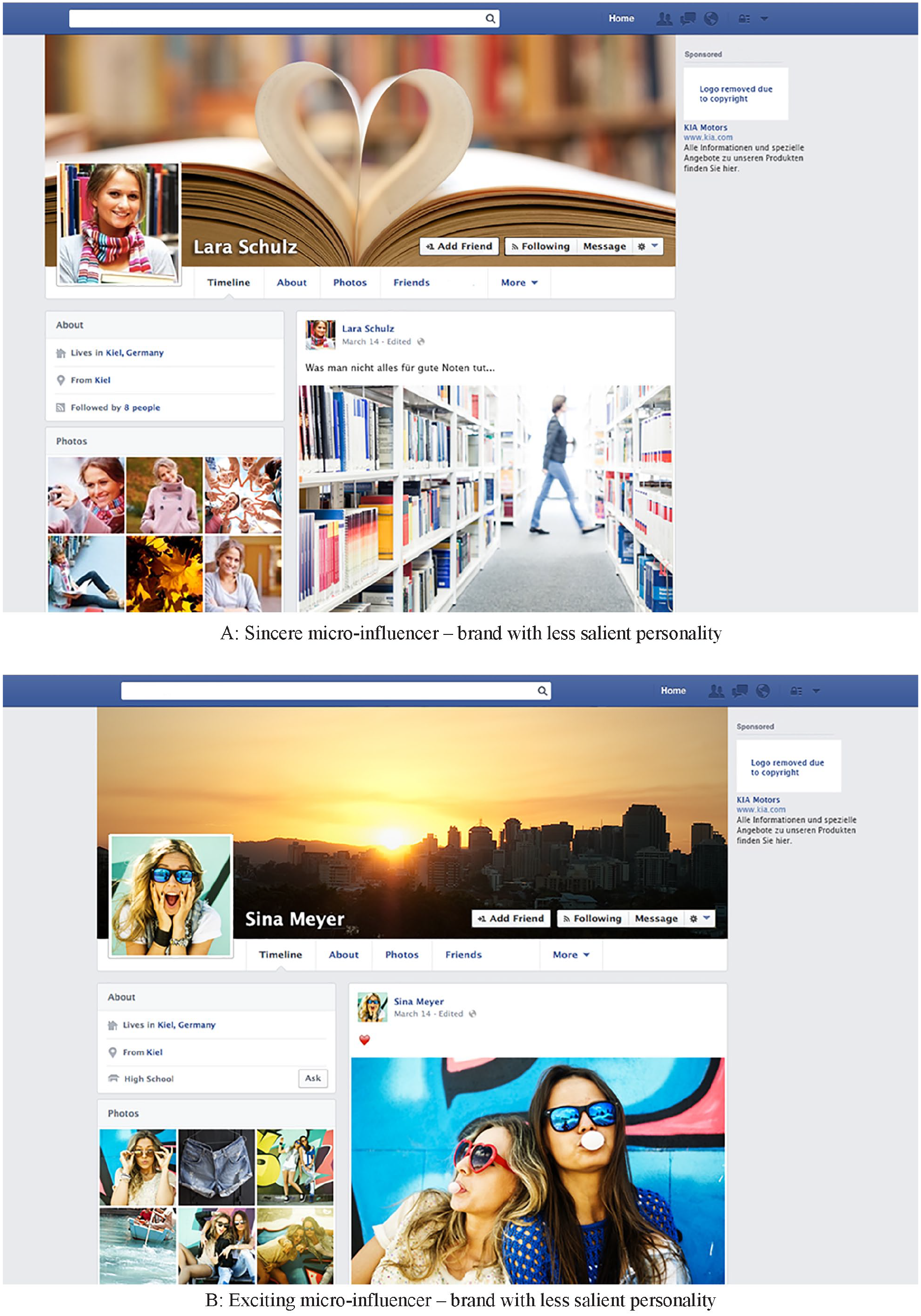
Experimental stimuli – Study 1.
The sincere and exciting personality of the influencer and of the brand were assessed using Aaker’s (1997) brand personality scales ranging from 1 (‘attribute does not describe user/brand at all’) to 9 (‘attribute describes user/brand very well’). Influencer’s credibility, attractiveness and expertise were assessed using the measures developed by Ohanian (1990) (1 = ‘untrustworthy’ − 9 = ‘trustworthy’; 1 = ‘unattractive’ − 9 = ‘attractive’; 1 = ‘reliable’ − 9 = ‘unreliable’, Table 1). Purchase intentions were measured on a scale from 1 (‘not at all descriptive’) to 9 (‘extremely descriptive’) using Coyle and Thorson’s (2001) items (‘It is very likely that I will buy Brand X’; ‘I will purchase Brand X the next time I need a car’; and ‘I will definitely try Brand X’). Self-brand connection was assessed using an existing scale (‘I can use Brand X to communicate who I am to other people’; ‘I can identify with Brand X’; and ‘Brand X suits me well’; 1 = ‘not at all’ − 9 = ‘extremely well’; Escalas & Bettman, 2003). All constructs exhibited acceptable reliability (Supplemental Appendix 1) and were averaged for the main data analysis. Ethics approval was granted to conduct this research by authors’ institution.
Means, Standard Deviations and Interquartile Ranges – Study 1.
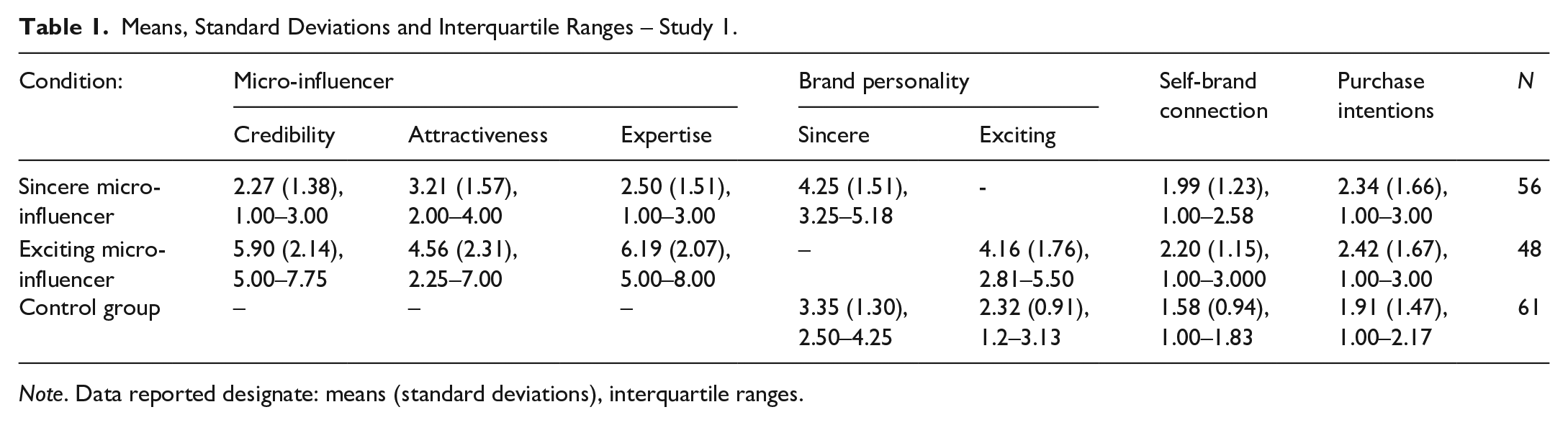
Note. Data reported designate: means (standard deviations), interquartile ranges.
Sample and manipulation check
One hundred sixty-five participants (85 females, Mage = 22 years; 80 males, Mage = 23 years) were recruited using a consumer network panel from German universities for Study 1. Descriptive statistics for all constructs are shown in Table 1 (also see Supplemental Appendix 2). There were no gender differences across tested constructs except for exciting brand personality in the exciting micro-influencer condition (Mmales = 3.45 vs. Mfemales = 4.82, t[46] = −2.916, p < .011).
An Independent samples T-test showed a significant difference in respect to how influencers were appraised. The respondents exposed to the sincere micro-influencer, were more likely to rate it as sincere (M = 7.26) compared to the exciting micro-influencer (M = 3.04, t[102] = 18.932, p < .001). The participants allocated to the exciting micro-influencer condition were more likely to rate it as more exciting (M = 6.08) than the participants who viewed the sincere influencer (M = 4.14, t[102] = 7.853, p < .001), suggesting that manipulation of the profiles worked as intended.
Results
Hayes (2013) PROCESS model 14 was used to test the hypotheses. As predicted, there were differences in sincere brand personality perceptions depending on experimental conditions (ß = .92, t = 3.29, p < .01, Supplemental Appendix 3). The brand with less salient personality was viewed as more sincere (M = 4.14) when it was paired with the sincere micro-influencer compared to the control group (M = 3.23, F[1, 101] = 10.831, p < .001, η2 = .10). Similar effect was observed for exciting brand personality (ß = .72, t = 2.21, p < .05, Supplemental Appendix 3) where the brand with less salient personality was rated as more exciting next to the exciting micro-influencer (M = 4.16) compared to the control group (M = 3.44, F[1, 92] = 4.868, p < .05, η2 = .05), supporting H1.
In line with H3, sincere brand personality exerted a positive effect on purchase intentions when self-brand connection was high as opposed to being low (ß = 1.03, t = 2.04, p < .05, Supplemental Appendix 3). The path between experimental conditions and purchase intentions was not significant (ß = .19, t = 0.92, p > .05, Supplemental Appendix 3), suggesting a full mediation via sincere brand personality. The conditional indirect effect of experimental manipulations on purchase intentions via sincere brand personality was significant with participants reporting 1.13 greater purchase intentions when they were exposed to the sincere micro-influencer compared to the control group when self-brand connection was high (moderated mediation = 1.13, p < .05, CI: 0.23, 2.91). Overall, 48% of variance was explained in purchase intentions.
Similarly, exciting brand personality exerted a positive effect on purchase intentions only when self-brand connection was high (H3: ß = .24, t = 3.73, p < .01, Supplemental Appendix 3). Again, the path between experimental conditions and purchase intentions was not significant (ß = −.01, t = −0.04, p > .05, Table 2), suggesting a full mediation via exciting brand personality. The conditional indirect effect on purchase intentions via exciting brand personality was also significant with participants exposed to the exciting micro-influencer reporting 0.40 greater purchase intentions compared to the control group when self-brand connection was high (moderated mediation = 0.40, p < .05, 95% CI [0.042, 0.832]). Overall, 48% of variance was explained in purchase intentions.
Means, Standard Deviations and Interquartile Ranges – Study 2.
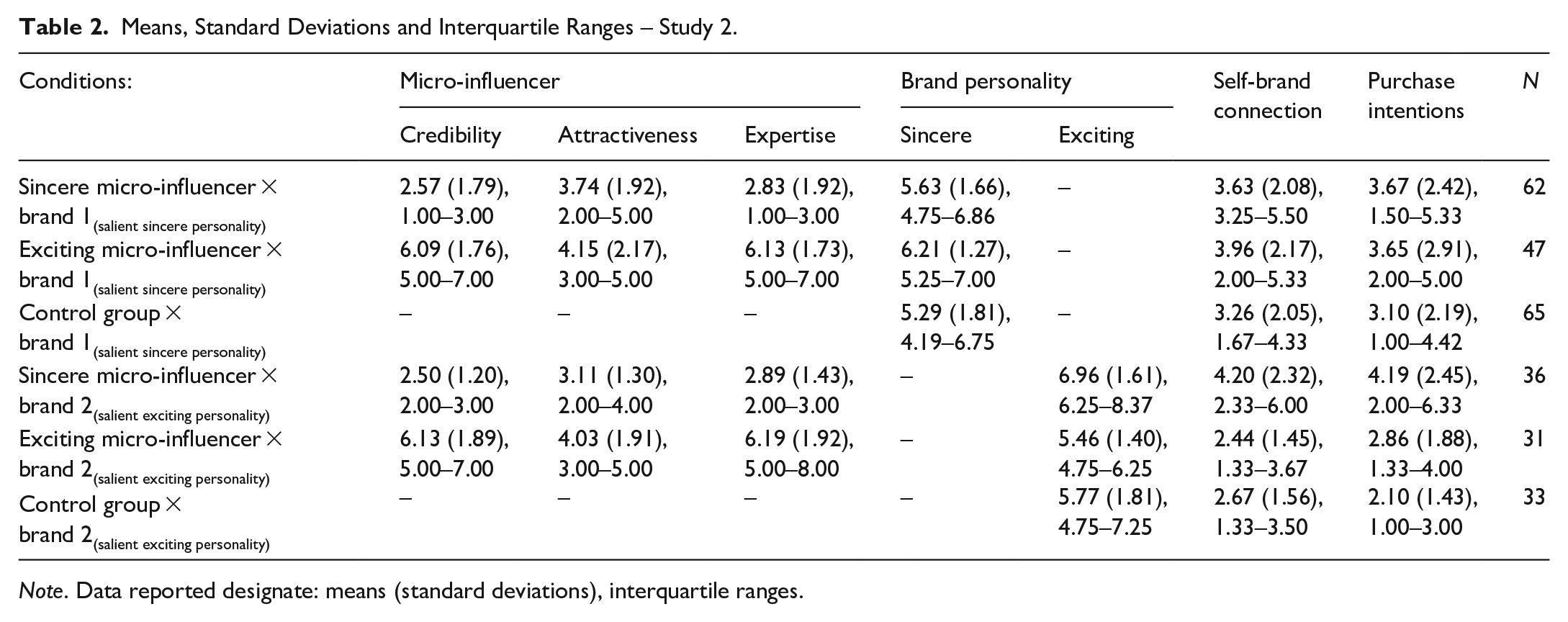
Note. Data reported designate: means (standard deviations), interquartile ranges.
A two-way ANCOVA showed that the influencer’s credibility (F[1, 46] = 0.00, p > .05), attractiveness (F[1, 46] = 0.949 p > .05) and expertise (F[1, 46] = 0.019, p > .05) did not influence sincere brand personality perceptions. The influencer’s credibility (F[1, 48] = 0.288, p > .05), attractiveness (F[1, 48] = 0.018, p > .05) and expertise (F[1, 48] = 0.134, p > .05, Supplemental Appendix 3) also did not influence exciting brand personality, ruling out alternative explanations.
Study 2
Design and measures
Study 2 used a 3 (micro-influencer personality: exciting vs. sincere vs. control group [no profile]) ×2 (brands with salient personalities: sincere brand [brand 1] vs. exciting brand [brand 2]) between-subjects experiment to test H2 and H3. Study 2 followed the same procedures and used the same measures as in Study 1. Participants were first exposed to a micro-influencer profile (Figure 2) (except for control group), appraised its personality, perceived source credibility and attractiveness, completed a filler task. Then, they viewed the profiles again with brands (Figure 4). All scales exhibited acceptable reliability (Supplemental Appendix 1). Ethics approval was granted to conduct this research by authors’ institution.
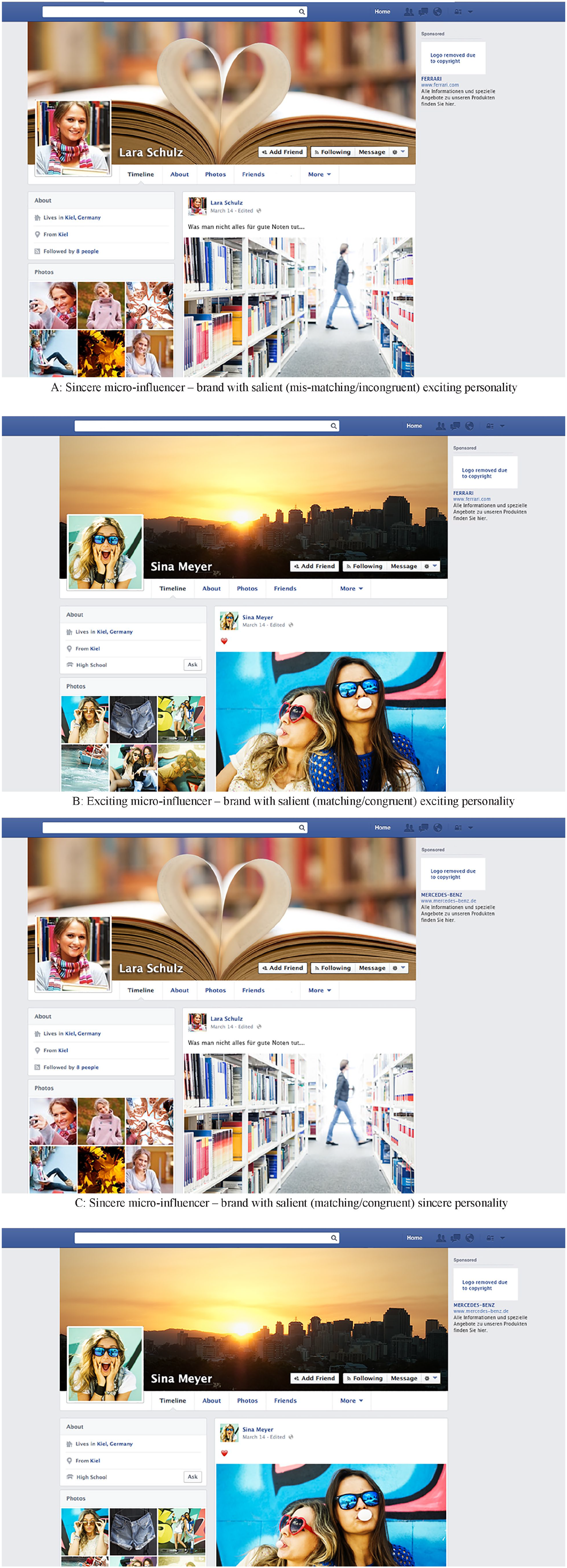
Experimental stimuli – Study 2.
Sample and manipulation check
In total, 274 participants (144 females, Mage = 22 years; 130 males, Mage = 24 years) were recruited by invitations to complete an online survey. All participants were students studying at various German universities. Descriptive statistics are shown in Table 2 (also see Supplemental Appendix 4). Gender differences across tested constructs were observed only for credibility (Mmales = 3.39 vs. Mfemales = 2.41, t[63] = 2.112, p < .05), attractiveness (Mmales = 4.32 vs. Mfemales = 3.30, t[63] = 2.189, p < .05), expertise (Mmales = 3.07 vs. Mfemales = 2.19, t[63] = 2.020, p < .05) and sincere brand personality (Mmales = 6.11 vs. Mfemales = 5.28, t[63] = 2.063, p < .05) in the exciting micro-influencer condition for brand 1.
An Independent samples T-test showed that respondents allocated to the sincere influencer (brand 1) condition rated the influencer as more sincere (M = 6.63), and the exciting influencer as less sincere (M = 3.72, t[110] = −9.677, p < .001). They also rated the exciting influencer as more exciting (M = 5.66) compared to the sincere influencer (M = 3.95, t[110] = 6.168, p < .001). Similar results were observed in respondents allocated to the salient exciting brand condition (brand 2), where the sincere influencer was rated as more sincere (M = 6.84) compared to the exciting profile (M = 3.29, t[65] = −11.585, p < .001) and the exciting social influencer was rated as more exciting (M = 5.38) compared to the sincere profile (M = 4.01, t[65] = 4.320, p < .001). This suggested that the manipulation of the profiles worked as intended.
Results
Similar to Study 1, Hayes (2013) PROCESS model 14 was used to test the hypotheses. There were differences in sincere brand personality perceptions depending on experimental conditions that respondents were allocated to, as well as user-brand (in)congruence (ß = .92, t = 2.94, p < .05, Supplemental Appendix 5). In line with H2a, the brand with highly salient sincere personality (brand 1) was evaluated as more sincere when it was placed next to the exciting micro-influencer (M = 6.21) compared to the control group (M = 5.28) or sincere micro-influencer (M = 5.63, F[2, 171] = 4.335, p < .05, η2 = .05). In line with H2b, there was no difference in brand personality ratings between the control group (M = 5.28) and sincere micro-influencer (M = 5.63, p > .05), suggesting a ceiling effect.
As predicted, sincere brand personality was positively related to purchase intentions when self-brand connection was high (H3: ß = .43, t = 2.16, p < .05, Supplemental Appendix 5). The path between experimental conditions and purchase intentions was not significant (ß = −.19, t = −0.54, p > .05), suggesting a full mediation via brand personality. Compared to the congruent (sincere) micro-influencer or control group, greater purchase intentions for the already exciting brand were 0.72 points higher among the respondents who were exposed to incongruent (exciting) influencer and exhibited greater self-brand connection (moderated mediation indirect effect = 0.72, p < .05, 95% CI [0.17, 1.43]). The indirect effect of the congruent (sincere) micro-influencer on purchase intentions was not significant (moderated mediation = 0.27, p > .05, 95% CI [−0.19, 0.86]).
A two-way ANCOVA showed that the credibility (F[2,112] = 0.646, p > .05), attractiveness (F[2, 112] = 1.396, p > .05), and expertise of the micro-influencer (F[2, 112] = 2.568, p > .05) did not influence sincere brand personality perceptions. Overall, the model explained 44% of variance in purchase intentions for brand 1.
Similar results were observed for the brand with salient exciting personality (brand 2) (H2a: ß = 1.19, t = 3.05, p < .01, Supplemental Appendix 5), which was rated as more exciting (M = 6.96) when it was paired with the sincere micro-influencer compared to the control group (M = 5.77), or exciting micro-influencer (M = 5.46, F[2, 100] = 8.167, p < .001, η2 = .14). In line with H2b, there was no difference in personality perceptions of the already exciting brand when it was paired with the exciting influencer (M = 5.45) or in the control group (M = 5.77, p > .05), suggesting a ceiling.
Consistent with Study 1, exciting brand personality was related to purchase intentions when self-brand connection was high (H3: ß = .08, t = 1.99, p < .05, Supplemental Appendix 5). The path between experimental conditions and purchase intentions was not significant (ß = .72, t = 1.93, p > .05, Supplemental Appendix 5), suggesting a full mediation via brand personality. Similar to brand 1, respondents reported 0.53 points greater purchase intentions for the already exciting brand (brand 2) when self-brand connection was high and when they were exposed to the incongruent (sincere) micro-influencer compared to control group or congruent (exciting) micro-influencer (0.53, p < .05, 95% CI [0.08, 1.17]). The indirect effect of congruent (exciting) influencer (ceiling) on purchase intentions was not significant (moderated mediation = 0.13, p > .05, 95% CI [−0.60, 0.22]).
A two-way ANCOVA showed that micro-influencer’s credibility (F[2,67] = 0.091, p > .05), attractiveness (F[2, 67] = 0.161, p > .05), and expertise (F[2, 67] = 0.339, p > .05, Supplemental Appendix 5) did not influence exciting brand personality perceptions, ruling out alternative explanations. Overall, the model explained 58% of variance in purchase intentions for brand 2.
Discussion
Consumers tend to make purchase decisions based on brand images that have been formed in their minds (Dick et al., 1990) and the importance of stored brand schemas has been extensively documented for consumer decision-making (Keller, 1993). Although brand personality tends to be distinctive and enduring (Aaker, 1996b), it takes time and effort to develop. While the use of celebrities and mega-influencers remains popular, a lot of micro-influencers also voluntarily share brand content on social media are approached by companies to endorse their brands. Yet, the effects of their personalities on the personality of brands has remained poorly understood.
Theoretical contributions
The main objective of this research was to investigate how the personality of micro-influencers affects the personality of brands displayed on their profiles. To the best of our knowledge, this study is the first to examine the implications of such content display for brands’ personality, which firms have little control over when micro-influencers voluntarily share brand content.
First theoretical contribution of this study relates to the application of context effects (Stapel et al., 1997) and schema theories (Fiske & Linville, 1980) to the micro-influencer context to show that not only the retail setting (Lee & Suk, 2010; Schnurr et al., 2017), but also the profiles of micro-influencers can act as a context to influence brands, thus adding to the emerging literature on micro-influencers’ effects (Park et al., 2021; Schouten et al., 2020). We explain that the personality of micro-influencers is inferred from their profile activities and pictures, which affects the personality of brands displayed on the same webpage due to high accessibility of personality traits.
Second theoretical contribution relates to a more detailed explanation of what happens to brands that lack ambiguity when they are placed in a congruent context (the personality of brands and micro-influencers match). Context effects theory (Stapel et al., 1997) predicts only an assimilation effect (which occurs due to object ambiguity) and a contrast effect (which occurs due to object knowledge and its dissimilarity from the context). By combining context effects with schema theory (Fiske & Linville), this study explained that a ceiling effect will occur in the above-mentioned scenario because the perceived personality of the micro-influencer (context in which a brand is encountered) is congruent with the schema that consumers hold about the brand. This conceptualisation allowed us to expand context effects theory by demonstrating that the third effect, ceiling, is plausible when context is not dissimilar, which has important theoretical and managerial implications for brand managers. These three effects (assimilation, contrast and ceiling) provide a more comprehensive theoretical explanation of brand personality outcomes considering both the nature of the context (micro-influencers’ congruity or a lack of thereof with a brand) and brand personality (being a novice or an established brand). We also demonstrate that the postulated three effects are conditioned by the perceived personality of a micro-influencer, which are independent from source credibility, attractiveness and expertise, which has been previously used in brand personality research.
Managerial implications
Several managerial implications emerge from this study that advance knowledge about the benefits and caveats of brand endorsement by micro-influencers. First, we show that not just the characteristics of consumers (measured through self-brand connection) and brands (measured through brand salience) are important to create purchase intention, but also the personality of micro-influencers (the context in which brands are presented).
Second, given the increasing popularity of micro-influencers (Park et al., 2021), which is unlikely to lessen in the future, it is important that managers know which micro-influencers will yield best returns for brands’ personality when they are approached for sponsored endorsements. Also, because micro-influencers may voluntarily share brand content, managers need to be aware of the implications of such earned media. Overall, we demonstrate that there is a more complex interplay between what consumers know about brands and how they appraise brands’ personality against micro-influencers’ personality, demonstrating that brand personality can be inferred from, compared to, or corroborated by micro-influencers with different implications for novice and established brands.
The first effect observed in this study was assimilation. We show that novice brands assimilate the personality of micro-influencers because they do not possess salient personality traits, and, thus, borrow the projected personalities from the influencers, which can be effectively used by marketing managers. The importance of brand personalities that were assimilated from micro-influencers was also evident through greater purchase intentions when brands resonated with how consumers felt about themselves. This suggests that many brands that struggle to develop salient personalities to position themselves in the eyes of consumers can benefit from micro-influencers’ voluntary endorsements (earned media). However, because brand managers have little control over the personality of micro-influencers in this case, potential caveats for novice brands include an assimilation of undesirable personalities. Therefore, unprompted endorsements may be risky for novice brands. To mitigate this risk, managers are encouraged to monitor which micro-influencers voluntarily share brand content and could also increase advertising spending across paid (controlled) channels to solidify desired personalities to avoid wrong assimilations.
In contrast to novice brands, established brands have a lower risk considering the two effects that might take place, the ceiling or the contrast effect. Ceiling effect occurs when consumers possess sufficient knowledge about brand personalities and are exposed to brand content, which is shared by micro-influencers with congruent personalities. This means that if an influencer with an exciting personality shares brand content of an exciting brand, such sharing may not boost the exciting personality dimension. When such endorsements are done voluntarily, there are no financial implication for firms. However, if it is a sponsored endorsement, firms’ investments into congruent micro-influencers will only maintain the existing status quo with no return on investment due to a reached ceiling. While ceiling effect from earned media may not represent a threat for established brands, not all consumers possess sufficient knowledge about brands, which again highlights the need for consumer education. Another shortcoming of the ceiling effect is that it does not seem to boost purchase intentions when brands are paired with congruent micro-influencers.
The contrast effect that was observed in this study also has a number of implications for brand managers. On the one hand, the fact that incongruent micro-influencer-brand pairing did not trigger brand erosion, but instead boosted the existing personality in established brands is reassuring. If an exciting brand is appraised as more exciting next to a sincere micro-influencer, and a sincere brand gets rated as more sincere next to an exciting micro-influencer, such voluntary endorsements do not represent a threat for established brand. However, obvious lack of control over who shares brand information could again pose a danger for established brands when consumers lack well-formed brand schemas, which could result not in a contrast, but an assimilation of undesired personalities. Hence, annual or quarterly brand personality surveys are recommended to advise firms on any actions required to correct misperceptions. In comparison to novice brands, established brands experienced greater purchase intentions when they were paired with incongruent micro-influencers when self-brand connection was high, which could occur due to an element of surprise. However, companies are encouraged to carefully consider whether they should reach out to mis-matching micro-influencers when considering long-term sponsored endorsements as more research is needed in this area.
Overall, brand personality can be influenced both positively and negatively by micro-influencers and firms must give more thought to all possible consequences as consumers spend substantial amount of time on social media and become exposed to different micro-influencers.
Limitations and directions for future research
This research has several limitations that provide directions for future studies. First, it used sincere and exciting personalities and future research needs to include other personality dimensions to study assimilation, contrast effects and ceiling effects. Second, there is merit to extend investigation to other social media platforms, such as Instagram or Twitter rather than Facebook. This study used female micro-influencers. Therefore, assimilation, contrast and ceiling effects need to be further tested using gender incongruent influencers. We have not observed any significant effects of micro-influencers’ credibility, attractiveness, or expertise (perhaps because the developed profiles did not exhibit ‘less credible’ features) and further research is encouraged to identify which features can result in lower credibility, attractiveness, or expertise. This study used one item to capture each of the three Ohanian’s credibility, attractiveness and expertise dimensions and future studies are encourages to use the full scales as control variables. Future studies also need to examine whether continuous endorsement of established brands by incongruent micro-influencers damages brand personality long-term, which would provide further insights into long-term consequences of contrast effects. Finally, future studies need to test the proposed conceptual framework using other product categories because the purchase intensions measure used in this study could potentially be unrealistic as it was applied to a high-priced item.
Supplemental Material
sj-docx-1-anz-10.1177_14413582231153191 – Supplemental material for How Micro-Influencers’ Personality Influences the Personality of Novice and Established Brands
Supplemental material, sj-docx-1-anz-10.1177_14413582231153191 for How Micro-Influencers’ Personality Influences the Personality of Novice and Established Brands by Sebastian Zwicker, Liudmila Tarabashkina, Michael Proksch and Marco Hardiman in Australasian Marketing Journal
Footnotes
Declaration of conflicting interests
The author(s) declared no potential conflicts of interest with respect to the research, authorship, and/or publication of this article.
Funding
The author(s) received no financial support for the research, authorship, and/or publication of this article.
Ethics approval/consent,data
Ethics approval was granted to conduct this research by authors’ institution.

Supplemental material
Supplemental material for this article is available online.
References
Supplementary Material
Please find the following supplemental material available below.
For Open Access articles published under a Creative Commons License, all supplemental material carries the same license as the article it is associated with.
For non-Open Access articles published, all supplemental material carries a non-exclusive license, and permission requests for re-use of supplemental material or any part of supplemental material shall be sent directly to the copyright owner as specified in the copyright notice associated with the article.
