




Abstract
Social media has impacted child well-being in paradoxical ways. Yet, our understanding of this paradox remains piecemeal. To address this gap, this conceptual article endeavors to delineate the interplay between child well-being and contradictions associated with social media consumption and the ways to manage these contradictions. Using paradox theory, we develop a theoretical framework that explains the relationships and dynamics surrounding conflicting demands between empowerment and protection and the cyclical responses to paradoxical tensions involving social media that are affecting child well-being. Using this framework, we offer a collection of propositions to stimulate further research on the empowerment–protection paradox and a set of mediating pathways to manage paradoxical tensions arising from social media consumption and promote children’s well-being in the digital era.
Introduction
Social media—which we define as the digital communication channels that facilitate the dialogic creation, consumption, interaction, and sharing of information across virtual social networks—has engendered an immense influence on children. On the one hand, news headlines revealed the harmful effects of social media on child development, claiming that “Social media use may harm teens’ mental health” (CNN, 2019). On the other hand, captions such as “Social media can help teens develop skills” (The Hays Daily News, 2015) presented somewhat contrasting views of social media effect, indicating the potential of social media in promoting children’s learning. These headlines illustrate two sides of the same coin: one warns about the toxic effects of social media, whereas the other implies its promise, and thus, representing a paradox. This love-hate debate takes center stage in this conceptual article, wherein the complexities of social media consumption among children becomes a subject for theoretical exploration.
Many stakeholders debate if social media supports or undermines children’s well-being. While policymakers’ decisions tend to protect children welfare (Livingstone & Bulger, 2014), some scholars found no meaningful association between digital technology use (e.g. social media) and children’s well-being (George et al., 2020; Przybylski & Weinstein, 2019), yet others favor empowerment over the protection of children (Bruggeman et al., 2019). We construe these polarized perspectives as a paradox, which we argue deserves scholarly attention as a paradox is essentially “contradictory yet interrelated elements that seem logical in isolation but absurd and irrational when appearing simultaneously” (Lewis, 2000, p. 760). To address the gap where “paradox was dubbed extensively used, but underspecified” (Niesten & Stefan, 2019, p. 233), this conceptual article moves beyond treating paradox as a label and explore the following research questions: How might a paradox lens be applied to develop novel understandings around the interplay between child well-being and contradictions associated with social media consumption? How do we manage these contradictions to achieve a balanced position that allows us to realize the social goals of child welfare advancement?
In this article, we define “well-being” as a state of being happy, comfortable, or healthy, covering the physical, intellectual, social, and mental aspects (Sinclair & Tinson, 2021), and “children” based on three periods of a child’s development: preschooler (ages 2–5 years), school-aged child (ages 6–13 years), and adolescent (ages 14–19 years) (Kail, 2011). While we acknowledge the social-cognitive sophistication at each age level and that the factors producing welfare for one group might not have the same outcome for another group (Nadan & Kaye-Tzadok, 2019), a comprehensive analysis of aged-related children’s development is beyond the scope of this article. Therefore, rather than confining the scope of discussion to one specific children age group, we opt to include the three age-related development periods while being mindful of its implications on our theorization and proposition development.
This conceptual article contributes to the marketing literature in several ways. First, we theorize the nature and dynamics surrounding the empowerment–protection dilemma and explain the cycles and management of the paradoxical tensions affecting child welfare as a result of social media consumption. We identify what renders the contradictory tensions more salient and the factors that promote the acceptance of a “paradox mindset” (i.e. embrace tensions and foster creative solutions). Our model deepens the understanding of how cyclical responses to paradoxical tensions and a balancing act via purposeful resolution strategies can enable child well-being promotion over time without making empowerment an expense, which is critical to guide informed policy implementation. Second, we offer a set of propositions designed to provoke additional thoughts and stimulate further research on the empowerment–protection paradox. Third, we provide insights into the mediating pathways necessary to manage paradoxical tensions and promote the well-being of children, who are susceptible to various vulnerabilities on social media. In doing so, we offer implications that address the agenda of how we can best empower children to capitalize on the opportunities while concurrently protecting them from the potential risks of social media consumption.
Methodology
This article is conceptual in nature (MacInnis, 2011). Unlike empirical articles, conceptual articles do not rely on nor provide any data (Rana et al., 2020, 2022), and unlike systematic literature reviews, conceptual articles do not rely on a systematic procedure or protocol (Kraus et al., 2022). Instead, conceptual articles, which are an established and recognized form of scholarly research (Lim et al., 2022), weave together relevant literature based on extant knowledge guided by the “3Es” of exposure, expertise, and experience (Kraus et al., 2022), wherein key insights, inconsistencies, tensions, and gaps are identified, discussed, and used to provide a consolidation of existing research and present an agenda for future research (Gilson & Goldberg, 2015; Hulland, 2020). Jaakkola (2020) suggests four designs that conceptual articles can pursue: (1) theory synthesis, which focuses on conceptual integration across multiple perspectives; (2) theory adaptation, which involves a change in perspective informed by existing theories; (3) typology, which pertains to categorizing variants of concepts as distinct types; and (4) model, which refers to building theoretical frameworks that predict relationships between constructs. This conceptual article is a combination of all four conceptual designs, as it: (1) summarizes and integrates current understanding on social media consumption and child well-being (i.e. theory synthesis); (2) revises current understanding using a theoretical lens in the form of paradox theory (i.e. theory adaptation); (3) explains the differences in paradoxical conditions, managing of paradox, and child well-being outcomes (i.e. typology); and (4) presents propositions informed by a theoretical framework (i.e. model). The integrated design used to develop conceptual articles, which Hulland (2020) calls as a “process,” enables this article to make a theoretical contribution by reshaping existing ways of understanding social media consumption and child well-being through paradox theory.
A paradox lens to understanding children’s social media consumption and well-being
The contradictions of empowerment vis-à-vis protection concerning children’s social media consumption are fraught with tensions; hence, scholars tend to hinge on the “either/or” logic. However, considering empowerment and protection as two incompatible contrasting assumptions or priorities misses the opportunity to truly understand the complex nature of children’s social media consumption. Departing from this traditional dichotomous approach, we put forward conceptual arguments that a paradox perspective uses “both/and” (Gnyawali et al., 2016) and opens a new way of thinking concerning children’s social media consumption and well-being. The notion of paradox understood as “contradictory yet interrelated elements that exist simultaneously” (Smith & Lewis, 2011, p. 386) has long been established in the fields of philosophy and psychology (Lewis, 2000), and its application as a theoretical lens in social science has proliferated over the past two decades (Cunha & Putnam, 2019). Unlike dilemma, which involves tradeoffs and “either/or” propositions, paradoxes tend to persist over time and resolved with “both/and” strategies (Smith, 2014).
Our paradox perspective comprises three premises. First, social marketers and policymakers should accept the contradictory nature of children’s social media consumption and understand the coexistence and interrelationships between the polar opposites (Smith, 2014). Second, rather than resolving tensions or making “either/or” decisions, paradox theory offers insights into how we could embrace tensions and create synergies between the paradoxical elements (Waldman et al., 2019). Third, a paradox perspective emphasizes a cyclical dynamic process rather than “antecedent–process–outcome relationships” (Wilhelm & Sydow, 2018, p. 25). The logic of paradox can lead to vicious cycles that enforce tensions or virtuous cycles that facilitate creative opportunities (Gabl et al., 2013), provided that we manage paradoxes successfully.
Based on Smith and Lewis’s (2011) dynamic equilibrium model of organizing, we present a paradox-based theorizing framework that depicts how cyclical responses to contradictions over time enable sustainable management of children’s social media consumption and well-being in the long run (Figure 1). Our conceptual arguments focus on the nature, processes, cycles, and management of paradoxical tensions surrounding children’s social media consumption and well-being, whereby we will outline propositions that clarify the underlying assumptions of each of these aspects.
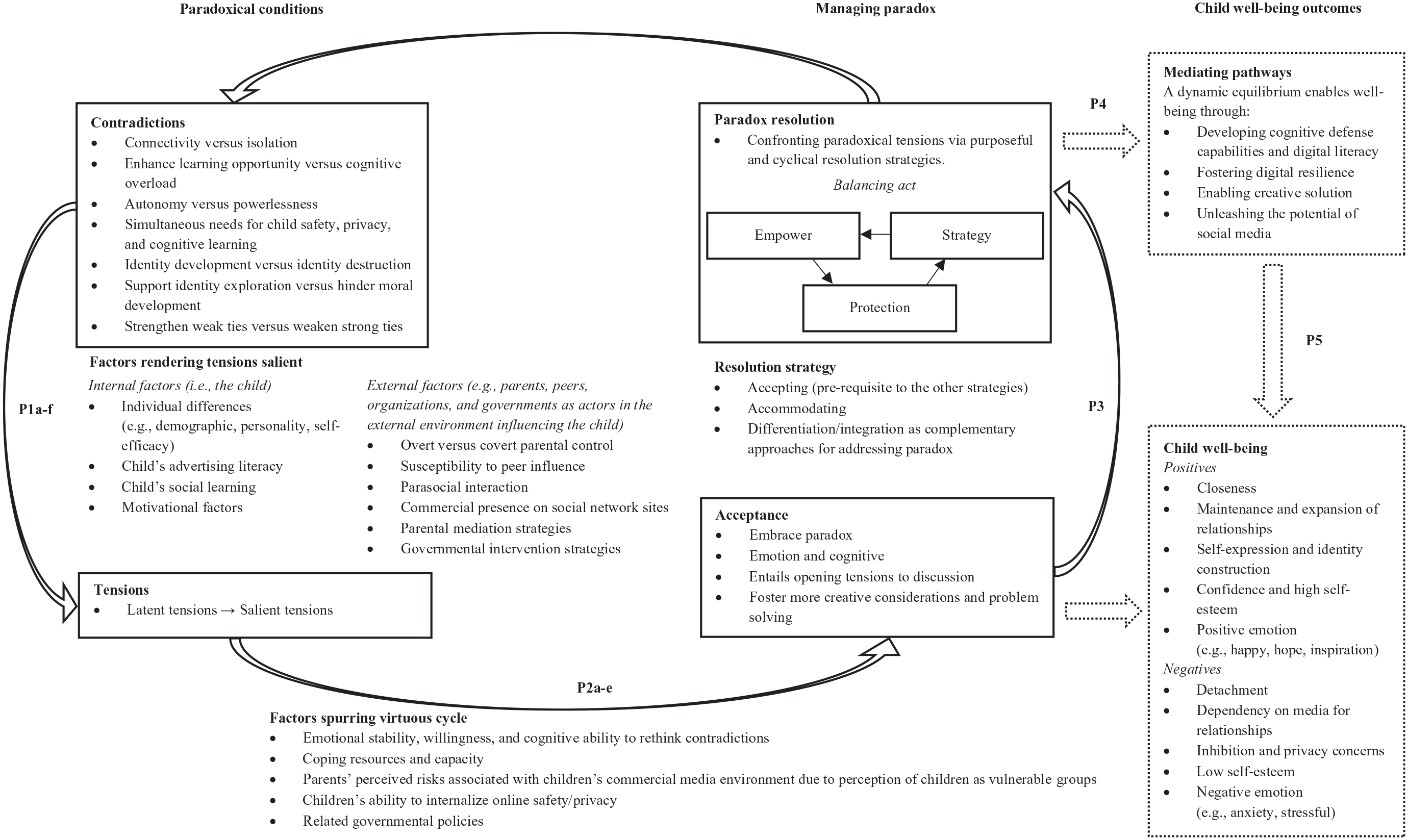
Theoretical framework for social media consumption and child well-being through a paradox lens.
Paradoxical conditions
Our cycle-like process model begins with the contradictions that underlie the logic of the empowerment-protection paradox. Such contradictions include connectivity versus isolation, autonomy versus powerlessness, identity development versus identity destruction, simultaneous need for safety, privacy, and cognitive learning, among others. Successful initiation of balancing act lies in recognizing the interdependency of these contradictions and creating synergies between them rather than treating these paradoxical elements as separate phenomena (Andriopoulos, 2003). These contradictory demands increase tensions between empowerment and protection, which can be latent, salient, and transit from one state to another (Keegan et al., 2019). Various contextual factors make paradoxical tensions salient. We offer the following propositions to illuminate various internal and external factors that render latent tensions salient. These propositions, in turn, reflect the opportunities for in-depth exploration and empirical validation, and thus, constitute the directions for future research.
Internal factors
Individual-level factors such as demographic (e.g. age group, gender, and socio-economic status), personality, and self-efficacy may shape children’s social media habits and activities. In branding and advertising contexts, older children (i.e. adolescent) are found to have a better understanding of bias and promotional intent of advertisements (Moses & Baldwin, 2005), and advertisement-generated brand beliefs (Moore & Lutz, 2000), and possess better cognitive responses to television advertising (Brucks et al., 1988) as well as higher levels of self-brand connections (Chaplin & Roedder John, 2005) compared to younger children (i.e. preschooler and school-aged child). This line of research is aligned with the view that children’s age levels reflect their cognitive development and have implications for their ability to process information (Petty & Cacioppo, 1986). Moreover, scholars have reported that girls are more concerned about self-presentation (Calvert et al., 2003), showing more depressive symptoms (Angold et al., 2002; Twenge, 2019), possess better social skills, and are more likely to seek support when dealing with stress (Rose & Rudolph, 2006) compared to boys. Following social role theory, a social psychological theory concerning gender differences and similarities in social behavior (Eagly, 1987), we expect gender influences in social media consumption and the level of child vulnerability.
Moreover, personality traits such as extroversion and neuroticism are found to be associated social media engagement (Yu et al., 2020) and addiction (Dalvi-Esfahani et al., 2021; Rosales et al., 2021), and thus, they could explain the nexus between social media consumption and well-being (McNamee et al., 2021; Smith et al., 2021) among children. Within Bandura’s framework for social learning, self-efficacy (i.e. individuals’ belief about their capabilities to attain a goal) (Bandura, 1989) is arguably an important consideration in understanding social media consumption. For instance, past research has established the moderating role of self-efficacy on the relationships between upward social comparison on social network sites and depressive symptoms (Li, 2019), as well as the effect of social media consumption on depressive symptoms, affective well-being, and life satisfaction (Calandri et al., 2021) among children. Taken together, we conclude that children of different gender and age groups with different personality traits and levels of self-efficacy may respond to and be impacted differently by the potential threat arising from their online engagement and the exposure to commercial-related exploitation, thereby affecting the level of contradictory tensions involved in social media consumption. While we acknowledge the diverse individual factors, a comprehensive discussion is beyond the scope of this article. Based on the literature on individual differences mentioned above, we expect the following:
In addition to relatively stable characteristics such as demographic, personality, and self-efficacy, children’s advertising literacy, social learning, and motivational factors can influence and be influenced by their social media consumption. Based on Piaget’s theory of cognitive development, younger children aged below 5 years old tend to regard advertising as entertainment and learn to identify the persuasive intent of advertising at about 7 or 8 years of age; they can articulate the concept of advertising in early adolescence (i.e. from about 12 years of age) (Lawlor et al., 2016; Livingstone & Helsper, 2006). Considering their limited advertising literacy, defined as individuals’ conceptual knowledge and skills related to advertising and their ability to critically reflect on the advertising messages (De Veirman et al., 2019; Livingstone & Helsper, 2006), the widely held belief is that children under age 8 are deemed especially vulnerable to advertising persuasion (Calvert, 2008). The level of child vulnerability is exacerbated in the face of the interactive and entertaining nature of online engagement through social media that presents opportunities for promoting embedded commercial messages that have persuasive effects on children, such as influencer marketing (Boerman & van Reijmersdal, 2020; Lawlor et al., 2016). For instance, past studies found that children under 12 have difficulties recognizing embedded advertising content (e.g. De Pauw et al., 2018; Hudders et al., 2016). Scholars have also demonstrated that older children aged 9 to 12 years (Martínez & Olsson, 2019) and 12 to 16 years (van Dam & van Reijmersdal, 2019) lack awareness and understanding of the presence of hidden advertising in influencer videos. The literature suggests that different persuasion processes operate at different child ages (Livingstone & Helsper, 2006).
In addition to cognitive abilities, the emotion regulation, identity formation, and moral development of children can be influenced by their exposure to the digital environment (De Veirman et al., 2019) through observational learning and behavioral modeling, according to the social learning theory (Bandura et al., 1966). A variety of learning occurs as children engage through online interactions with others through social media. Furthermore, the way children engage with social media depends on their motives (e.g. social interaction and entertainment, escapism, information sharing) (Jarman et al., 2021). For example, children motivated by digital status-seeking (i.e. investment of significant effort pursuing online social status via indicators such as likes, comments, and followers) (Nesi & Prinstein, 2019) on social media are susceptible to the development of addictive digital behaviors (Marengo et al., 2019), risk of cyber victimization (Longobardi et al., 2020), and health-risk behaviors (e.g. substance use and sexual risk) (Nesi & Prinstein, 2019). Other relevant motivational factors include the intensity (i.e. the frequency of social media consumption) and level of social media engagement (i.e. active participation in interactive activities such as commenting, posting, and sharing, and passive use such as browsing or viewing the content of others without interacting) (Jarman et al., 2021). In general, past research reported the intensity of social media use to be associated with social comparison and envy (Charoensukmongkol, 2018), cyber victimization (Underwood & Ehrenreich, 2017), and depressive symptoms (Frison & Eggermont, 2017; Heffer et al., 2019) among children. Furthermore, passive social media use was associated with higher anxiety symptoms (Thorisdottir et al., 2019) and predicted harmful effects on well-being (Jarman et al., 2021) among children. This body of knowledge attests to the implications of motivational factors for children’s online safety, mental health, and disadvantaged exposure to persuasive commercial content, which heighten the tensions involved in social media consumption.
External factors
Beyond micro-level influences discussed above, developments in consumer socialization are also affected by actors in the environment such as family, peers, organizations, and governments. Children are often influenced by peers, given their desires to fit in socially and gain social approval (Andrews et al., 2020). Peer influence manifested through online social networks strongly impacts the behavioral outcomes that children develop from social media consumption (Charoensukmongkol, 2018). The nature of peer influence can be explained by social comparison theory, which posits individuals’ tendency to compare themselves to others to ascertain their success and capabilities (Festinger, 1954). Social comparison in the online context may be harmful to mental health when children judge others to be superior to themselves (Fardouly et al., 2018), leaving them a sense of inferiority. This upward social comparison raises body image concerns (Jones, 2001), decreases self-esteem (Valkenburg et al., 2006), and generates envy that undermines mental well-being (Appel et al., 2016) among children. In line with consumer socialization research, children’s internalization process and understanding of social meanings develop with age (John, 1999), which may affect their susceptibility to peer influence (Steinberg & Silverberg, 1986), persuasive advertising tactics (Andrews et al., 2020), and commercial-oriented influencer marketing (Boerman & van Reijmersdal, 2020). The impact of influencer marketing increases when children develop a parasocial relationship (i.e. the connections consumers develop with social characters; Yuan et al., 2016) with the message source (i.e. social media celebrities) (De Veirman et al., 2019). TikTok, YouTube, Instagram, Twitter, and Snapchat are among the popular social media platforms that facilitate parasocial interactions between children and social media personalities, contributing to kidfluencers (child influencers) marketing that targets children (De Veirman et al., 2019). When children identify with a social media celebrity, they often perceive them as role models (Te’Neil Lloyd, 2002) and will likely regard their advertisements as credible information sources (Labrecque, 2014), which raises concern regarding the authenticity of the commercial content as well as children’s online safety. As social media engagement continues to proliferate (Lim & Rasul, 2022), we expect commercial presence on social media, destructive peer influence, and parasocial relationships developed will expose children to risks, thereby rendering latent tensions to become salient.
Recognizing the importance of parental and governmental roles in children’s lives, the next three propositions focus on parents and governments as socialization agents (i.e. actors in the social environment). The literature regarding parental control (i.e. parental efforts to regulate children’s behavior; Pugliese & Okun, 2014) over children’s social media consumption has produced somewhat mixed findings. On the one hand, scholars have reported positive outcomes of parenting control over social media consumption, such as improved mental health (Fardouly et al., 2018), protective measures against cyberbullying (Floros et al., 2013), an opportunity for offline physical activities (Biddle & Asare, 2011), and reduced exposure to idealized images that may promote upward social comparison (Brown & Tiggemann, 2016). On the other hand, past studies found restrictive parental supervision may stimulate children’s risky behavior online (e.g. harassment and bullying) (Meter & Bauman, 2018), increase child-parent relationship conflicts (Baldry et al., 2019), and distress symptoms (Jacobson & Crockett, 2000). One plausible explanation of these mixed findings could be that child age affects parental involvement and control. For instance, parents of older children are less likely to monitor child’s online behavior (Wang et al., 2005) and use blocking software (Mitchell et al., 2005), and tend to allow more autonomy (Rosen et al., 2008) compared to parents of younger children. As children transit into the adolescent phase, parental control over social media consumption is deemed less effective (Fardouly et al., 2018) and more challenging at the same time given their desire for autonomy during this period (Eccles, 1999). In sum, constraints and pressure tend to result in children reacting adversely to restrictions placed on their desires (Moore et al., 2017). Thus, a less intrusive form of parental supervision (e.g. co-viewing, equip children with knowledge, reasoning) may be more effective than overt parental control (e.g. remove or shut down devices, strict rules) that increases child-parent relationship distant (Baldry et al., 2019; Fardouly et al., 2018).
Another concern is the socializing influence of persuasive marketing communications in digital formats (e.g. advergames) on children (Evans et al., 2018). A growing body of literature focuses on how parental mediation (i.e. intentional actions undertaken to teach children how to cope with media content) can improve children’s advertising literacy, thereby mitigate subsequent brand attitude and preferences (Evans et al., 2018) as well as potential negative effects of social media (Hudders & Cauberghe, 2018). While past studies indicated that parental mediation is not always effective in teaching children to cope with advertising (De Veirman et al., 2019), it is argued that the outcome might be dependent on child age intervals and the types of mediation strategies, for example, active (i.e. actively discussing to children about media content) versus restrictive (i.e. protecting children from persuasive advertising by regulating social media consumption) mediation (Buijzen & Valkenburg, 2005). For instance, children may respond to commercial content and parental mediation differently as their cognitive abilities develop, and that active (vs. restrictive) mediation may be more effective as children grow older (Vijayalakshmi et al., 2019). Recently, governments have also begun to play a more active role by rolling out interventions aiming to crack down on social media usage among children. For example, China has limited social media use among teens through “youth mode” features (Ye, 2021) that (1) allow users under 18 to watch videos no more than 40 minutes at a time and (2) limit their access to social media such as Douyin (or more popularly known as the “Chinese TikTok”) between 10pmand 6am (Cong & Jia, 2021), as teens in the country have been reported to have greater social media addiction and poorer mental health as a result of spending significantly more time on their phones due to the COVID-19 pandemic (Conklin, 2021). Taken together, we expect that parental and governmental mediation/intervention can weaken the adverse effects of social media use and that active (vs. restrictive) mediation/intervention will have different impacts on children at various age intervals.
We now turn to broader macro-level elements that influence how children socialize in the complex environment where social media operates. The increasingly accessible and diversified social media environment enables exposure to commercial messages, violent content, and potentially harmful information via multiple mediums (Livingstone & Helsper, 2006; Vijayalakshmi et al., 2019). This evolving media environment provides opportunities for bi-directional media socialization (Vijayalakshmi et al., 2019), wherein providers via hand-held devices often collect information specific to the device, which raises concern about children’s online data privacy (Brown & Pecora, 2014). Besides, circulation of digital misinformation (i.e. false or misleading information that is unconsciously shared) and disinformation (i.e. false or misleading information that is deliberately created/distributed to deceive others) can have harmful consequences (e.g. violence against ethnic minorities, cybervictimization), considering the lack of literacy and maturity among children to judge the reliability of information (Howard et al., 2021). Educational environment that facilitates the development of digital literacy, defined as the skills and capabilities (e.g. search strategies, practicing privacy measures and identity theft protection, using a safe password) required to navigate in a digitally enabled society (Yue et al., 2019), can help children to internalize the importance of online safety and privacy (Andrews et al., 2020). Education systems and policies can also support or undermine digital inequality that can lead to unequal accumulation of social and cultural capital, which has implications for children’s digital literacy development (Darvin, 2018). Moreover, other macro-environmental factors such as educational and learning spaces (Kidd & Carpenter, 2014), government policies about and investments in technology infrastructures (Bolton et al., 2013), and digital inequality owing to economic development (Hargittai & Hinnant, 2008) have a direct bearing on children’s online welfare. Based on these arguments, we present the following proposition.
Managing paradox
Tensions can trigger either vicious or virtuous cycles, depending on the types of handling strategies. Vicious cycles arise when people compromise and make “either/or” decisions, leading to the neglect of one contradictory element (Keegan et al., 2019), while virtuous cycles emerge as actors (e.g. policymakers, educators, social workers, child welfare agencies) engage with both opposites and work through tensions to achieve creative solutions (Gaim & Wåhlin, 2016). Virtuous cycles trigger the acceptance of the paradox mindset (Vafeas & Hughes, 2020), which involves learning to live with and work through paradoxes to embrace the tensions (Smith, 2014). Accepting paradoxes enables transformation and opportunities, ultimately leading to paradox resolution (Smith & Lewis, 2011). It is worth noting that even though salient tensions can fade, paradoxical tensions remain latent and could be triggered again by contextual factors since the cycle could be repeated (Niesten & Stefan, 2019). Scholars have developed several responses to paradoxical tensions categorized broadly as proactive and defensive, which may affect whether virtuous cycles can be fostered and vicious cycles avoided (Lê & Jarzabkowski, 2015). The defensive responses include suppressing (i.e. allows one contradictory demand to overrule the other one), opposing (i.e. involves active confrontation that polarize contradictory elements), separating or splitting (i.e. separate paradoxical elements either temporally or spatially), while adjusting (i.e. accommodates the demands of both poles) is clustered as a proactive strategy (Jarzabkowski et al., 2013; Poole & van de Ven, 1989). In general, proactive responses to paradox are more likely to foster virtuous cycles compared to the defensive responses (Keegan et al., 2019). While acknowledging the diverse nature of possible factors that may spur vicious and virtuous cycles, we focus on the following:
Smith and Lewis’s (2011) metaphor of dynamic equilibrium takes a positive view to paradoxical tensions by considering conflicting demands as inherently present and highlights the cyclical responses to paradoxes that allow sustainability over time. The central idea of this metaphor is to enable virtuous cycles through acceptance and resolution strategies (also termed as paradox management strategies). To achieve a “dynamic equilibrium” that enables long-term social goals, actors should first accept the paradoxical tensions around children’s social media consumption as inherent (Ozanne et al., 2016) rather than defensively stigmatize such consumption as a completely negative phenomenon. Resolution strategies involve transforming the paradox into “a more manageable situation as they offer ways to attend to seemingly contradictory positions simultaneously while the underlying tension remains” (Hahn et al., 2015, p. 300). In other words, resolution does not imply dissolving tensions but rather it becomes possible to discover the synergies and linkages between these conflicting elements by embracing them (Smith & Lewis, 2011).
Paradox scholars proposed several resolution strategies, or a combination of strategies, for managing paradoxical tensions, including accepting, accommodating, and differentiating/integrating. Accepting (i.e. embrace the coexistence of contradictory elements) is viewed as the pre-requisite for the strategies of accommodating and differentiating/integrating (Vafeas & Hughes, 2020). A paradox perspective construes that tensions can coexist and persist over time (Lewis, 2000), posing competing demands for empowerment and protection as inherent aspect of children’s digital life. The acceptance of the “paradox mindset” (i.e. the willingness and ability to rethink the existing polarities) creates the contexts and opportunities for stakeholders to engage in creative solutions (Keegan et al., 2019) for managing children’s digital welfare. Accommodating involves exploring a creative solution that simultaneously accommodates opposing sides of the tensions (Smith & Lewis, 2011). A typical example of accommodating is the breakthrough idea of Toyota’s just-in-time philosophy that accommodates both conflicting demands of having zero inventory and access to it at the right time (Eisenhardt & Westcott, 1988).
By favoring empowerment over the protection of children, it overlooks the need to foster children’s online safety. Likewise, without empowerment, we limit children in their opportunities of the digital. Essentially, both empowerment and protection are mutually reinforcing, demanding our attention to balancing both poles. Past research identifies differentiating (i.e. separate conflicting elements and acknowledge the distinction of each pole) and integrating (i.e. emphasize synergistic outcomes and linkages) as complementary strategies for managing paradoxes (Smith, 2014). Integration involves encouraging actors to find meaningful linkages between contradictory elements, thereby leveraging their synergies (Andriopoulos & Lewis, 2009). For example, actors can work on designing policies, education curricula, technology infrastructures, and literacy programs that create synergies between ensuring children’s online safety and simultaneously enhance their digital literacy and skills development. In doing so, actors should consider the age implications and not implement a standard strategy across age groups. In contrast, differentiation strategy entails distinctive efforts on each pole to maximize the distinct benefit of opposing poles (Poole & van de Ven, 1989). Accordingly, this strategy spatially splits the tensions of empowerment and protection, enabling the pursuit of each strategic goal. As we demonstrated in propositions 1 and 2, the identified factors rendering tensions salient and spurring virtuous cycle operate across micro, meso, and macro levels. Thus, a multilevel approach is essential to reflect this complexity (Andriopoulos & Lewis, 2009) and that sustainable management of children’s digital well-being becomes the responsibility of all stakeholders involved. These paradox management strategies seek to continuously meet multiple divergent demands and yet not eliminate the paradoxical tensions. While stakeholder collaborations are common in a free market, we concede that this may not be possible in certain markets, especially those that may be subjected to a high level of regulation (e.g. command-and-control systems). Nonetheless, we believe that such stringent conditions are likely to be relaxed over time as the world continues to globalize and internationalize (Mandrinos et al., 2022) albeit in cycles and waves (Lim, 2022). Accordingly, we offer the following proposition:
As tensions are the fundamental source of paradox (Lewis, 2000; Vafeas & Hughes, 2020), we posit that salient tensions manifest the empowerment–protection dilemma in children’s social media consumption. A processual perspective that reflects cyclical interactions can facilitate understanding the dynamics between actors’ responses to the tensions and reactions they trigger (Vafeas & Hughes, 2020). As depicted in Figure 1, the cyclical responses to salient tensions allow us to link the paradox view with internal and external issues that render tensions salient and illuminate the capabilities needed to embrace and confront these contradictions. Long-term success in sustaining children’s digital well-being requires actors to find equilibrium among the competing demands (Ozanne et al., 2016). One way to deal with the paradox is to manage empowerment and protection at different periods (Poole & van de Ven, 1989). For example, actors may facilitate short-term protection measures to address the most pressing issues while pursuing empowerment in the medium or long term. As the cycle continues, actors attend to the conflicting demands of empowerment vis-à-vis protection from a time-variant perspective over time, thereby reaching a dynamic equilibrium that positions to meet the strategic goals of both poles (Smith & Lewis, 2011). Over time, a balancing act via cyclical, purposeful, and ongoing strategies enables sustainable management of children’s digital well-being in the long term.
Child well-being outcomes
Our conceptual discussion highlights four mediating pathways that leverage different empowerment–protection balance, which ultimately enables sustainable children’s digital well-being. First, the success of paradoxical resolution strategies depends on the development of a set of capabilities among children, such as their cognitive defense skills and digital literacy (Andrews et al., 2020). This can be achieved by empowering children to protect their online privacy and safety. Second, the capacity of resilience to deal with digital-related challenges and stress forms an essential pathway to sustaining children’s digital well-being. Successful implementation of resilience-building at the micro, meso, and macro levels enhances individuals’ capacity to navigate their way to the social, cultural, physical, and psychological resources that contribute to positive outcomes (Wood, 2019). Third, the acceptance of the paradox mindset creates an opportunity to push cognitive limitations and spark creative solutions, leading to beneficial well-being outcomes (Tse, 2013). Lastly, effective paradox management also depends on the actors’ ability to unleash the potential of social media in promoting digital well-being among children, thereby highlighting the importance of stakeholders in the digital environment and the materials that they develop and disseminated to children (Howard et al., 2021). Based on the above reasoning, we propose the following:
In summary, our paradox-based theoretical framework emphasizes the importance of balancing between empowerment and protection and reveals important insights into the dynamism and complexities of children’s digital well-being.
Conclusion
Policy and consumer education programs tend to take the risk-protection perspective to protect children from harm; however, the demands placed on children’s social media consumption are more complicated today. Bruggeman et al. (2019) speculate that children who are exposed to social media at young age might become more resilient to potential adverse effects (e.g. Internet addiction, sexting) in later life. If so, ignoring child empowerment may lead to a loss of power and capabilities to gain control over their social media consumption and to take advantage of opportunities in a positive way that can lead to better-adjusted digital lives. While most scholars, practitioners, and policy makers lean toward the protective view, our conceptual arguments point to the balanced perspective in promoting children’s digital well-being. This conceptual article extends existing research streams in social marketing, paradox management, and child developmental psychology. We identified a particular type of paradox—that is, empowerment and protection—and delved deeper to understand the nature of contradictory demands surrounding children’s social media consumption and what factors spur salient tensions and virtuous cycles. Such understanding enabled us to unpack the pathways through which paradoxical resolution strategies impact children’s well-being outcomes.
Central to our conceptual article is the premise that actors (e.g. child developmental educators and psychologists, policymakers, and social workers) should think beyond a dichotomous model that tends to polarize into either empowerment or protection propositions. By doing so, we question the dialectic approach that adopts the “either/or” stance and lay the foundation for further conceptual and empirical developments on the paradoxical perspective of children’s screen consumption. Taken together, we advance current theorizing on this topic by developing a paradox-based theory that clarifies the interplay between the conflicting perspectives of empowerment vis-à-vis protection associated with children’s social media consumption and their welfare. Our integrative theorization enriches the scholarly understanding of the paradox inherent in children’s social media consumption, thus advancing a significant step in managing the competing demands of empowerment and protection.
We also provide a set of propositions designed to provoke thought among scholars and practice communities alike. Stakeholders such as child developmental scholars, content creators, educators and psychologists, parents, welfare agencies, policymakers, and social workers often face challenges in understanding and managing the complexity of children’s social media consumption. Our theoretical discussion offers insights into how they can achieve a dynamic equilibrium that facilitates child welfare through mechanisms such as cognitive capabilities and digital literacy development as well as fostering digital citizenship and resilience. This brings us to several important implications arising from this conceptual article.
First, paradox management is a shared responsibility of all stakeholders who have direct and indirect contact with children at the micro, meso, and macro levels in the social media environment. Direct stakeholders at the micro (e.g. parents, social workers) and meso (e.g. content creators, educators and psychologists, welfare agencies) levels are responsible for educating children (i.e. micro—individual level; meso—community level) and ensuring that the content that children are exposed to through social media are appropriate and empowering, whereas indirect stakeholders at the macro level (e.g. child development scholars, policymakers) are responsible for shaping the ways in which the social media environment can be functioning and regulated effectively so that children are protected against malicious intent and remain as empowered beneficiaries of social media. This viewpoint, which takes a holistic micro, meso, and macro approach, also advances existing consumer culture-oriented research on paradoxes, which is typically focused at either the individual or community level without delving into the interplay between the consumer and the stakeholder across levels in a single study (Skandalis et al., 2016; Waldman et al., 2019).
Second, stakeholders must remain cognizant of and proactively manage the internal and external factors that render tensions in social media salient. Such factors include children’s differences such as demographic, personality, and self-efficacy (P1a); children’s advertising literacy, social learning, and motivational factors (P1b); children’s susceptibility to peer influence, commercial presence on social network sites, and parasocial relationships (P1c); types of parental control (P1d); and types of parental and governmental mediation strategies (P1e). In this regard, any strategies (e.g. accommodating, differentiation/integration) undertaken by direct or indirect stakeholders will need to be customized according to children’s inherent differences (P1a–P1c), including the periods of childhood development (i.e. preschooler, school-aged child, and adolescent), whereas parents, in particular, are better off pursuing covert (over overt) controls (P1d) and active (over restrictive) mediation strategies (P1e).
Third, stakeholders should equip themselves and pursue strategies that spur virtuous cycles that foster initial and continued acceptance of the paradox mindset and curation of creative opportunities for paradox resolution. To do so, stakeholders can foster emotional stability, willingness, and cognitive ability rather than behaving defensively toward paradoxical tensions (P2a), and families, in particular, should equip themselves with coping resources such as a sense of mastery, optimism, self-esteem, and social support to develop self-regulation capacity in order to sustainably manage and empower children’s ability to manage their own exposure to such tensions in a highly dynamic and rich social media environment (P2b). To avoid falling into the trap of “dilemma” (over embracing of “paradox”), it is important that stakeholders do not overly perceive and react toward children as vulnerable groups (P2c) and the risks associated to children’s exposure to social media (P2d). Instead, stakeholders should work toward fostering children’s ability to internalize the importance of online safety (e.g. using strategies stipulated by P1a–P1d and P2a–P2b) while leveraging on the benefits that entail via social media consumption (P2e), which should prove beneficial in the long run.
Finally, paradox management should approach the factors causing tensions (empowerment, protection) as interdependent and engage in cyclical responses to address the tensions that these factors create so that a dynamic equilibrium for their existence as a paradox can be achieved. Noteworthily, this conceptual article makes clear that stakeholders are most effective in dealing with the empowerment–protection paradox confronting social media consumption among children when they accept the issues of empowerment and protection as interdependent and engage in a combination of dynamic, purposeful, and ongoing strategies by means of accommodating and differentiating/integrating as novel solutions that lead to sustainable digital child’s well-being (P3). This a balancing act that can be done cyclically where stakeholders proactively develop their capabilities and implement strategies to confront the empowerment–protection paradox (P4). Such strategies, which act as mediating pathways, can include developing children’s cognitive defense capabilities and digital literacy, fostering children’s digital resilience, pursuing creative solutions to empower children and manage their own engagement with social media, and guiding content creators to curate content ethically so as to truly unleash the potential of social media in ways that enhance and sustain children’s welfare and well-being (P5).
Notwithstanding the aforementioned implications, which represent the main contributions of this conceptual article that were derived based on our theory-informed discussion that sought to reconcile the tensions around social media consumption and children’s well-being in the extant literature, we concede that several limitations remain, which could nonetheless inspire new exploration in future research. First, we did not specify the exact tactics that each stakeholder can pursue. Nonetheless, the strategies and mediating pathways that we provide through our theoretical framework and the accompanying propositions can serve a starting point to derive new ideas via scholarly or applied research to enable the effective management of the empowerment–protection paradox confronting children’s consumption of social media in a virtuous cycle. Second, we acknowledge that not all governments create, facilitate, and maintain free markets; instead, they could be operating with command-and-control systems. In this regard, not all governments—especially those that prefer to direct and control behavior (e.g. regulation)—would be willing to play a collaborative role in the pathways stipulated in our theoretical framework. Therefore, the propositions we put forth (e.g. P3) should be treated with caution as they may not be entirely generalizable to all contexts, though we can reasonably expect them to hold in most contexts on the basis of hyperconnectivity, globalization, and internationalization in the world. Third, we concede that it may not be possible for a single empirical study to address all propositions that we presented. Instead, we opine that multiple studies could be developed to tackle each proposition. This could take the form of a multi-study research that can be reported in a single article, or an independent scrutiny reported across multiple articles and subsequently consolidated through a meta-analysis or a systematic literature review. More importantly, to move the field forward, we encourage future study of children’s social media consumption to progress with an interdisciplinary approach, which involves creative collaboration and better integrations between various schools of thought, as espoused by the holistic and systemic approach to study herein.
Footnotes
Statement of contribution
This conceptual article clarifies and reconciles the debate surrounding the complexities of social media consumption among children through a paradox theory of social media consumption and child well-being.
Declaration of conflicting interests
The author(s) declared no potential conflicts of interest with respect to the research, authorship, and/or publication of this article.
Funding
The author(s) received no financial support for the research, authorship, and/or publication of this article.
Author biographies
 .
.