




Abstract
This research examines the effects of gift prices on recipients’ gratitude. Five studies show an inverted U-shaped relationship between gift price and recipients’ gratitude. Recipients are more likely to appreciate gifts of monetary value that align with their expectations than inexpensive or expensive gifts whose values do not meet the recipients’ expectations. Two parallel underlying mechanisms explain the inverted U-shaped relationship: when gift prices are lower than expected, recipients perceive givers as inconsiderate, and when gift prices are higher than expected, recipients feel indebted. Additionally, we examine two boundary conditions. Compared to North Americans, Asians are more likely to show an inverted U-shaped relationship. In addition, close friends, rather than distant friends, are more likely to show an inverted U-shaped relationship. The paper concludes with a discussion of contributions to the literature on gift-giving and practical implications.
Introduction
Gift-givers usually hope that the receiver will appreciate their gifts, but they often incorrectly gauge receivers’ preferences or expectations (Aknin & Human, 2015; Givi & Galak, 2019; Givi et al., 2021). Poorly chosen gifts may irritate recipients, damage relationships, or even sever connections (Otnes et al., 1993; Roster, 2006; Ruth et al., 1999, 2004; Sherry, 1983; Ward & Broniarczyk, 2016).
When a gift is given, recipients are often expected to reciprocate the gift in the future (Givi, 2020). Importantly, the norm of reciprocity obliges gift receivers to repay with reciprocal gifts of equal monetary value (Gouldner, 1960; Mauss, 1967). The economic exchange model predicts that expensive gifts evoke more gratitude, but research has failed to find supporting evidence. Although it is assumed that gift price has a linear relationship with appreciation, recipients’ gratitude is not significantly affected by gift price (Flynn & Adams, 2009). Although there is increasing evidence showing that social, economic, and emotional dimensions affect gratitude (e.g., Sherry, 1983), only a few researchers have empirically investigated the effects of gift prices on recipient’s gratitude (Belk & Coon, 1993; Flynn & Adams, 2009; Givi et al., 2021; Joy, 2001).
The objective of this research is to fill this gap in the literature and reconcile seemingly inconsistent results by proposing an inverted U-shaped relationship between gift price and recipients’ appreciation, especially when reciprocity is expected. Specifically, close friends or Asians who tend to feel obligated to reciprocate are more likely to show an inverted U-shaped relationship than distant friends or North Americans (Hofstede, 1980; Shen et al., 2011).
Our research makes several contributions to the literature on gift-giving. First, despite general recommendations that gifts should be of appropriate value (e.g., Sherry, 1983), there is a lack of consensus or direct evidence to support this notion. By revealing an inverted U-shaped curve regarding gift appreciation dynamics, we explain why Flynn and Adams (2009) find insignificant differences in the appreciation of gifts perceived as either too cheap or too expensive. Second, we deepen our understanding of recipients’ psychological reactions to gifts by identifying two distinct mechanisms that affect the inverted U-shaped relationship. Third, we demonstrate that an inverted U-shaped relationship is likely to occur for Asians because they are more subject to reciprocal norms, in contrast to North Americans, who are not. Furthermore, individuals have higher expectations regarding gift exchanges with closer friends, and thus, such exchanges are most likely to show an inverted U-shaped relationship.
Literature review and hypothesis development
Gifts can evoke different cognitive and affective reactions from recipients as they symbolize the relationship between givers and recipients (Sherry, 1983; Ward & Broniarczyk, 2016). Building on prior research, we posit an inverted U-shaped relationship between gift prices and recipients’ appreciation, and introduce two critical moderators. In the following sections, we first review the general effects of gifts and gift prices on recipients’ affective reactions. Then, we discuss the possible moderating roles of culture and relationship closeness.
Gift and affective reactions
Gratitude is the feeling of appreciation for benefits received (Watkins et al., 2006). When individuals receive help, favors, or gifts, they experience positive feelings of gratitude toward the benefactor (Emmons & McCullough, 2003). Gift receivers appraise the intrinsic value of the gift, the effort expended by the benefactor, the reason for the gift, and what is expected to do in return (Shen et al., 2011).
Although givers generally anticipate that their gift will evoke appreciation, recipients might have negative affective reactions if the gift evokes a feeling of indebtedness (Greenberg & Westcott, 1983), “a state of obligation to repay” (Greenberg, 1980, p. 4), which creates emotional discomfort and a desire to reduce the distress (Watkins et al., 2006). To maintain equity in social relationships, humans tend to feel strong obligations to reciprocate (Gouldner, 1960; Greenberg, 1980). Thus, when a recipient receives a gift from a friend and the gift is more valuable than any gift the recipient has ever given to the friend in the past, the recipient may feel indebted (Gouldner, 1960) rather than appreciative (Heider, 1958).
Effects of gift prices
Prior research has used economic and social exchange models to explain the dynamics involved in gift exchanges (Belk & Coon, 1993). The economic exchange model focuses on the economic values of gifts. It posits that factors such as scarcity and monetary price determine the worth of a gift exchange, suggesting that expensive gifts are more preferred and appreciated (Belk & Coon, 1993). Following this logic, the economic exchange model predicts that givers intend to send strong signals of commitment by offering expensive gifts and expect the recipient to react positively, although expensive and inexpensive gifts may evoke similar levels of appreciation (Flynn & Adams, 2009).
Gift-giving is a symbolic ritual in which givers attempt to communicate positive attitudes toward recipients and commitment to invest resources into enhancing the relationship (Camerer, 1988; Mauss, 1967). The social exchange model centers on the symbolic meanings of gifts rather than their economic value. This suggests that gifts convey symbolic meanings, indicating the level of caring and thoughtfulness behind the gift and the amount of reciprocity required (Belk & Coon, 1993; Burgoyne & Routh, 1991). The symbolic meanings reflected in the price or quality of a gift can create, maintain, change, or even sever interpersonal relationships (Sherry, 1983).
Despite scarce empirical evidence regarding appropriate prices for gifts, research states that appropriate gifts in terms of price and category should evoke positive recipient reactions (Sherry, 1983), including reciprocity to equalize exchanges (Belk & Coon, 1993; Belshaw, 1965; Cancian, 1966; Cropanzano & Mitchell, 2005). Accordingly, reciprocal gifts of equal or similar values are considered appropriate (Mauss, 1967) for eliciting appreciation (Sherry, 1983).
Following the social exchange model, we predict that gift prices are likely to be influential, and recipients may judge the giver’s thoughtfulness based on the monetary value of the gift. When gifts appear to have low monetary values, recipients may feel ungrateful, perceiving that the giver is thoughtless, inconsiderate, and has weak commitment towards the relationship (Ames et al., 2004; Flynn & Adams, 2009). Generally, people are highly averse to feeling indebted (Greenberg & Westcott, 1983); hence, when expensive gifts make them feel indebted to the giver, they feel resentment rather than gratitude and appreciation (Giesler, 2006; Godelier, 1999; Joy, 2001). Consequently, we propose that gift prices have an inverted U-shaped relationship with appreciation.
Cultural differences in reciprocal norms
Culture refers to shared beliefs or standards (Shen et al., 2011) that shape a wide range of behaviors and determine how individuals interpret the behaviors of others (Brislin, 2009). One possible source of misunderstanding in interpersonal relations is gift exchange (Shen et al., 2011). Norms and values vary across cultures and social groups to govern interpretations of gift-giving behaviors as a form of social communication (Shen et al., 2011). Thus, cultural differences influence how people interpret and react to gifts (Park, 1998).
The most prevalent cultural difference between Asians and North Americans is that Asians generally hold collectivist views about relations, whereas North Americans generally construe themselves as independent from others (Markus & Kitayama, 1991; Shen et al., 2011). This cultural difference has particular implications for understanding reactions to gifts (Shen et al., 2011). North Americans are more likely to focus on the attractiveness or value of a gift, apart from considering connections with givers. Without salient cues calling for reciprocity, they feel less obliged and indebted. In contrast, as Asians focus on deep interpersonal connections, are pressured to meet others’ expectations, and are sensitive to reciprocal norms (Chen & Rau, 2016; Park, 1998), they are more likely to feel obligated to reciprocate than North Americans (Hofstede, 1980; Shen et al., 2011). For example, Green and Alden (1988) suggest that collectivistic orientations lead people to consider appropriate reciprocation in gift exchanges. More importantly, research on cultural differences suggests that Asians have a greater desire to balance the benefits obtained and benefits offered than North Americans in gift exchanges (Green & Alden, 1988; Shen et al., 2011). Because of the greater desire to balance the benefits received and given and the consideration of appropriate gift reciprocation, we predict that Asians (vs. North Americans) would be more likely to appreciate moderately priced gifts whose values meet their expectations than those whose monetary values are excessively high or low. We thus hypothesize:
Closeness and gift price
Gifts can express emotions, symbolize social closeness (Otnes et al., 1993; Ward & Broniarczyk, 2016), confirm recipients’ expectations, and foster intimacy (Aknin & Human, 2015; Ruth et al., 1999). Reciprocity is valuable in communicating appreciation for the benefits received. This shows that the receiver cares about the giver and wants to maintain the relationship (Molm et al., 2007). When parties exchange gifts, they desire to reciprocate appropriately and equally to maintain the relationship (Gouldner, 1960; Joy, 2001).
Although romantic partners and close friends occasionally show communal relationships like family (Joy, 2001), reciprocal exchange is still compatible with and prominent in close relationships especially for close friendships (Molm et al., 2007, 2012). Research indicates that inappropriate gifts are riskier for closer friends because they are more aware of interpersonal expectations and the outcome of gift exchange is more emotionally charged (Joy, 2001). Consequently, gift givers will expend significant effort in selecting gifts for close friends to ensure that the gift gives pleasure and symbolizes intimacy (Otnes et al., 1993; Ward & Broniarczyk, 2016). By contrast, distant relationships involve a greater emotional distance between gift givers and recipients (Komter & Vollebergh, 1997), weakening the feelings of personal involvement.
Likewise, to the extent that gift exchange plays a more significant role in closer relationships (Komter & Vollebergh, 1997; Sherry, 1983), close friends would attach greater importance to the symbolic meanings of gifts than distant friends (Otnes et al., 1993; Ward & Broniarczyk, 2016). For example, while a distant friend may not carefully consider the monetary value of a gift he/she received, a close friend may feel more burdened when receiving an expensive gift based on expectations of equal reciprocation (Greenberg, 1980; Greenberg & Westcott, 1983). In the case of gifts that fall below expectations, when a giver presents a cheap gift, they are more likely to be seen as inconsiderate. Furthermore, a cheap gift is more likely to generate intense emotions when given by a close friend rather than a distant friend.
Based on the points discussed above, we propose that relationship closeness moderates the inverted U-shaped relationship between the monetary value of gifts and the gratitude felt by the receiver. Formally, we hypothesize the following.
Pre-test
We ran a pre-test to confirm that individuals expect equitable gift exchanges in which gifts have an appropriate monetary value. We also examined whether gift recipients paid attention to gift prices and other aspects of the gifts. We used Amazon MTurk to recruit 232 participants (Mage = 39.40; 132 women) who had received an online gift within the last 6 months.
Participants specified the gift and the giver, and reported up to five thoughts generated by the gift. The thoughts were divided into six categories according to what they focused on: 1 = gratitude, 2 = the giver’s effort, 3 = price, 4 = usefulness, 5 = quality, and 6 = other. 1 Next, on a seven-point scale, participants revealed whether they gave importance to the affordability of the gift (1 = not at all, 7 = to a great extent). 2 Next, we asked participants to search the internet for gifts and report the prices. We also asked them whether they had reciprocated. If the answer was yes, we asked how much they had paid for the gift and whether the price was similarly priced, cheaper, or substantially higher than the gift that they had received; this question was answered on a seven-point scale (1 = cheaper, 4 = similar, 7 = more expensive). Those who had not reciprocated indicated whether they would do so in the near future and whether the reciprocal gift would be similarly priced, cheaper, or more expensive. Participants then reported their relationship with the giver (1 = friend, 2 = romantic partner, 3 = family, 4 = other) and the perceived power balance in the relationship. 3 Finally, participants indicated how often they checked gift prices (1 = never, 2 = rarely, 3 = sometimes, 4 = usually, and 5 = always). Finally, they provided demographic information on age and sex. 4
Confirming the pervasiveness of reciprocity, we found that 64% (N = 149) of the participants had reciprocated for a gift within the past 6 months. In addition, those who had not yet reciprocated (N = 83) showed relatively high intention to do so (M = 5.66). Although reciprocity intentions slightly varied across relationships, the difference was not significant (Mfriendship = 5.08, SD = 1.82 vs. Mromantic = 5.85, SD = 1.68 vs. Mfamily = 5.938, SD = 1.44; F(2, 80) = 2.15, p = .124). Separate t-tests comparing the median (4) for each type of relationship further supported the high intention to return a gift across various relationships (ts > 2.92, ps < .009). We examined whether a “right” gift price exists. That is, whether a reciprocal gift should be priced roughly equal to the previously offered gift. The gifts received (M = 111.55, SD = 175.56) were priced similarly to reciprocal gifts (M = 99.12, SD = 143.62; F(1, 230) = 2.50, p = .116). Similarly, perceptions of gift prices were not significantly different from the median (4 = similar) (M = 3.88, SD = 1.70; t(231) = −1.04, p = .299). These results indicate that reciprocal gifts are likely to have prices that are similar to those of previously exchanged gifts.
Although reciprocal norms are common in all types of relationships, friends and romantic partners are more likely to reciprocate with equivalent gifts, perhaps because family members are more likely to have communal relationships (Clark & Mills, 1993). 5 In romantic relationships, desire, relationship satisfaction, and commitment can influence gift-exchange behavior (Belk and Coon 1991). To minimize these effects, we focused on friendships in this research.
Study 1
We conducted Study 1 to test our prediction that gift recipients are more appreciative when gift prices align with their expectations and disapprove of gifts that are either cheaper or more expensive than expected. Second, we demonstrate why prices that are lower or higher than expected would decrease appreciation. To test the proposed mechanisms, we used a three-level (price levels: lower, similar, vs. higher) between-participants design and measured recipient perceptions regarding giver thoughtfulness and burdensome reciprocal obligations.
Method
We recruited 431 college students (241 women, 91% from 20 to 35 years old, 2% younger than 20 years, 7% older than 35 years) by sending the link to an online questionnaire via WeChat, an online social network application in China, for a small monetary compensation. We asked the participants to imagine a scenario in which they received a birthday gift from a friend. Participants in the lower (higher) price-level condition were told that the gift was less (more) expensive than they expected, and participants in the similar price-level condition were told that the gift was as expensive as they expected. They then used three items to indicate their appreciation of the gift; for example, “To what extent do you appreciate the gift?” (Flynn & Adams, 2009) on a seven-point scale (1 = not at all, 7 = to a great extent). We then measured their perceptions of the giver’s thoughtfulness by their responses to statements such as “This would be a thoughtful gift” and “This would be a considerate gift”
Results
An analysis of variance (ANOVA) revealed that gift prices significantly impacted appreciation (α = .84; F(2,428) = 16.41, p < .001; Figure 1). Consistent with H1, participants in the similar-price condition appreciated the gift more (M = 6.09, SD = .82) than participants in the lower-price condition (M = 5.46, SD = .94; t(428) = −5.73, p < .001), as well as participants in the higher-price condition (M = 5.77, SD = .98; t(428) = 2.91, p = .004). Participants in the higher-price condition appreciated the gift more than participants in the lower-price condition (t(428) = −2.87, p = .004). Regression analysis further confirmed an inverted U-shaped relationship by showing a positive coefficient of price (β = 2.03, p < .001) and a negative coefficient of price2 (β = −.47, p < .001). We conducted an additional regression analysis to test whether materialistic tendencies interact with price to affect appreciation. Materialism had a non-significant interaction effect with the quadratic form of price (β = −.15, p = .121). Although marginally significant, the interaction of materialism and price showed a positive coefficient (β = .71, p = .071), suggesting that materialistic individuals have a greater appreciation for more expensive gifts.
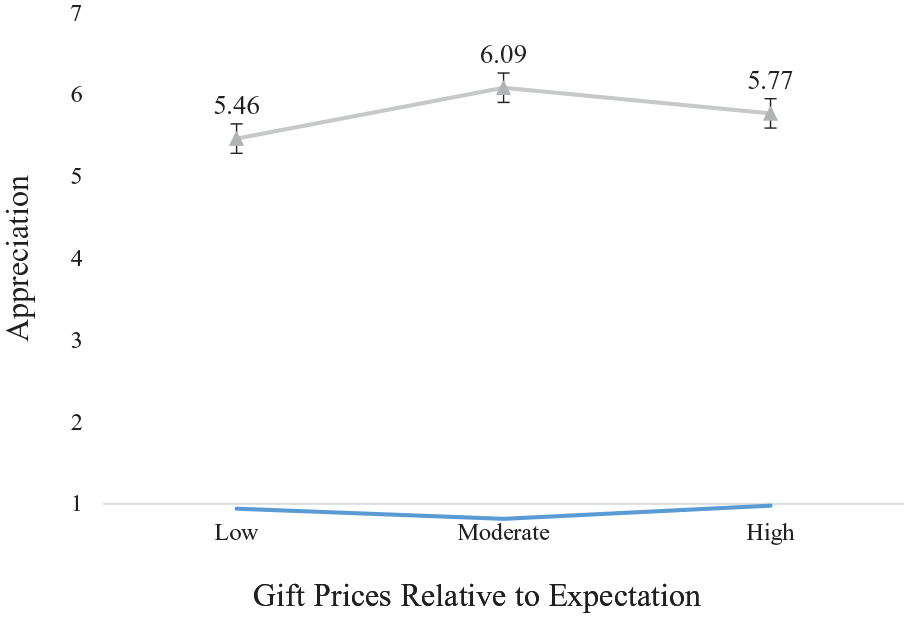
Feelings of appreciation across three gift-price levels (Study 1).
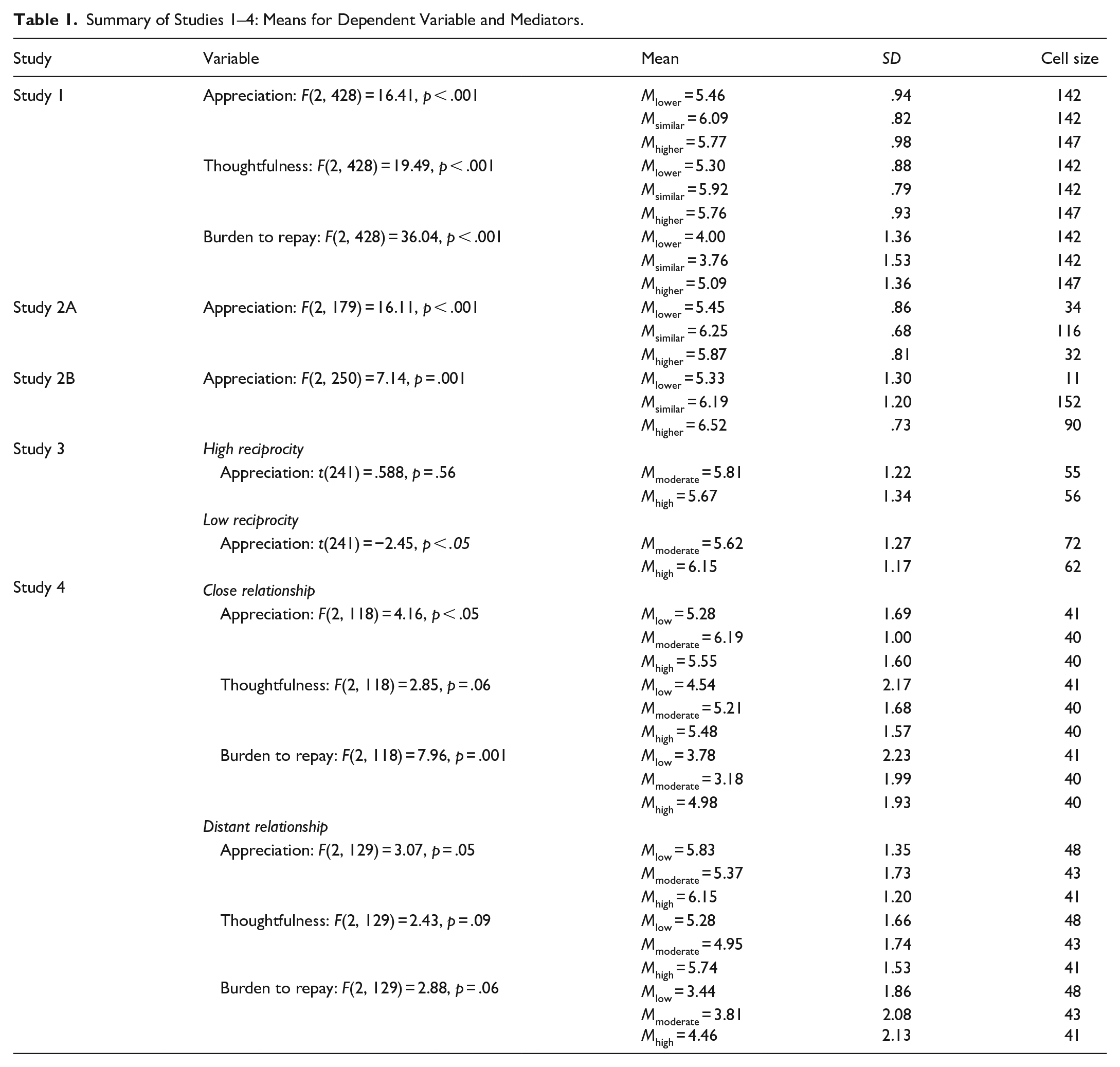
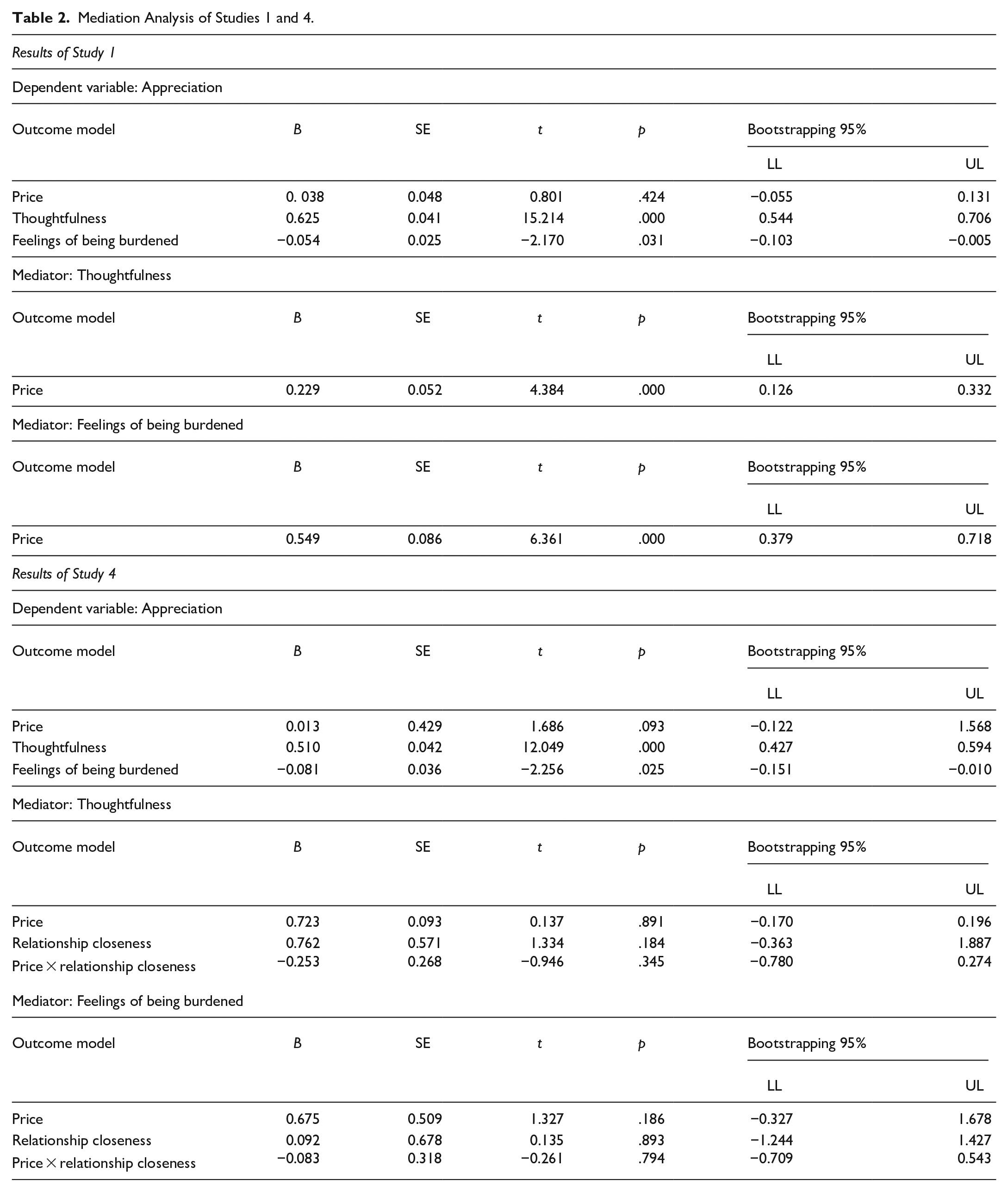
Next, we tested the underlying mechanisms of gift-price effects. One-way ANOVAs revealed significant differences in perceptions of both thoughtfulness (α = .88; F(2,428) = 19.49, p < .001; Table 1) and burdened feelings (F(2, 428) = 36.04, p < .001) across the conditions. Planned contrasts further confirmed that participants in the lower price condition (M = 5.30, SD = .88) considered the giver less thoughtful than did those in the similar (M = 5.92, SD = .79; t(428) = −6.00, p < .001) and higher price conditions (M = 5.76, SD = .93; t(428) = −4.52, p < .001). In addition, participants in the higher price condition (M = 5.09, SD = 1.36) perceived greater burdens than those in the similar (M = 3.76, SD = 1.53; t(428) = −7.94, p < .001) and lower price conditions (M = 4.00, SD = 1.36, t(428) = −6.51, p < .001). We further conducted a mediation analysis that included the proposed mediators by following the bootstrapping procedure (Preacher & Hayes, 2004). Supporting our predictions, perceptions of thoughtfulness (95% CI [.074, .219]) and feelings of being burdened (95% CI [−.060, −.003]) showed significant indirect effects (see Table 2 for the detailed mediation results).
Summary of Studies 1–4: Means for Dependent Variable and Mediators.
Mediation Analysis of Studies 1 and 4.
Finally, gender did not significantly interact with either price or its quadratic form (ps > .10), suggesting that men and women respond similarly to gift prices.
Study 2A
To replicate the findings of Study 1, Chinese participants were recruited for Study 2A. Instead of using a scenario, we asked the participants to recall an actual gift-receiving experience.
Method
As in Study 1, college students in China accessed our online questionnaire through a link to an online social networking application. There were 182 participants (113 women, 95% aged 20–35 years, 2% younger than 20 years, and 3% older than 35 years). They were provided a monetary compensation for participation. Participants first recalled a gift they received from a friend for their most recent birthday and indicated their appreciation using the items as in Study 1. Next, they indicated whether they estimated the gift price to be lower than, similar to, or higher than their expectations (1 = lower than expected, 2 = similar to the expected price, and 3 = higher than expected).
We also tested potential impact of gift characteristics. Recipients usually care more about their consumption experience than about the motives behind the gift, and thus prefer useful gifts (Baskin et al., 2014; Teigen et al., 2005). To test whether usefulness attenuates the impacts of the symbolic meanings of gifts, we asked participants to report the usefulness of the gift (1 = not at all, 7 = very much). In addition, we measured materialistic tendencies as in Study 1.
Results
We divided the participants into three groups based on whether gift prices met their expectations and averaged the three items measuring appreciation (α = .79). One-way ANOVA showed a significant difference in appreciation across the three groups (F(2, 179) = 16.11, p < .001; Table 1). Planned contrasts also confirmed that when gift prices were similar to expectations, participants appreciated the gift more (M = 6.25, SD = .68) than participants who thought the gift was less expensive (M = 5.45, SD = .86; t(179) = −5.52, p < .001) or more expensive than expected (M = 5.88, SD = .81; t(179) = 2.52, p = .013). Regression analysis further confirmed the inverted U-shaped relationship between gift price and appreciation by showing a positive coefficient of price (β = 2.55, p < .001) and a negative coefficient of its quadratic form (β = −.58, p < .001). These findings replicate the findings of Study 1, but use Chinese participants. Additional regression analyses tested whether usefulness, materialistic tendencies, and gender interact with price to influence appreciation. However, these three factors showed no significant interaction effects with either gift price or the quadratic form of price (ps > .334).
Study 2B
Study 2B examined the role of cultural differences in reciprocal norms. If North Americans are less likely than the Chinese to be influenced by reciprocal norms, they would appreciate expensive gifts more than gifts that are priced similar to or lower than their expectations. The overall procedures and measures were similar to Study 2A, except that we counterbalanced the order of two key variables, appreciation and estimation of gift price, to control the measurement order effect.
Method
We recruited 253 participants (Mage = 39.24; 135 women) from Amazon MTurk. We asked participants to recall a gift they received from a friend on their most recent birthday. They then indicated their appreciation using the three items from Study 2A (α = .94), and reported whether the gift price was lower than, similar to, or higher than their expectations. We randomized the order of these two variables across participants. Next, we asked participants to report their perceptions of the usefulness of the gift and their materialistic tendencies, as in Study 2A.
Results
The interaction effect and main effect of the measurement order were not significant (ps > .442). Therefore, we ignored this factor in further analyses.
One-way ANOVA showed a significant difference in appreciation across the three price conditions (F(2, 250) = 7.14, p = .001; Table 1). Planned contrasts also confirmed that when gift prices were similar to expectations, participants (M = 6.19, SD = 1.20) appreciated the gift more than did participants who thought the gift was less expensive (M = 5.33, SD = 1.30; t(250) = −2.58, p = .010). However, inconsistent with Study 2A, participants who thought the gift prices were similar to expectations appreciated the gift less than participants who thought the gift was more expensive (M = 6.52, SD = .74; t(250) = −2.32, p = .021). Regression analysis showed a marginally significant positive coefficient of price (β = 1.65, p = .064) and a non-significant coefficient of price2 (β = −.27, p = .166), not supporting the inverted U-shaped relationship. These results support a positive relationship between gift prices and appreciation.
We additionally performed regression analyses to determine whether usefulness, materialistic tendencies, and gender might have interacted with price to affect appreciation. Consistent with Study 2A, usefulness, materialism, and gender showed no significant interaction effects with gift prices and the quadratic form of price (ps > .130).
Study 3
Study 3 aimed to find further support for cultural differences in the relationship between gift prices and appreciation. If North Americans care less about reciprocal norms and, thus, have greater appreciation for expensive gifts, high expectations of reciprocity should lower appreciation. We focused on similar and high price levels, where cultural differences occur, and used a 2 (price levels: moderate vs. high) × 2 (levels of reciprocity: low vs. high) between-participants design.
Method
We recruited 245 participants (Mage = 41.30, 139 women) from Amazon MTurk. We diverge from earlier studies by implicitly manipulating gift prices. The participants read a scenario in which they imagined receiving a birthday gift from a friend. Participants in the low reciprocity condition imagined that the friend had recently celebrated a birthday and would soon move to another country. Participants in the high reciprocity condition imagined that their friend would have a birthday in a week and recently moved back to the United States after living abroad. Participants in the high (moderate) price condition read that the gift was a T-shirt from the designer (mediocre) brand. After participants read the scenario, we measured their appreciation, as in earlier studies. To check our manipulations, we asked participants whether the gift was more or less expensive than their expectations (1 = less expensive, 7 = more expensive). The participants also indicated how likely they were to reciprocate in the near future (1 = very unlikely, 7 = very likely). Finally, we measure the usefulness of gifts and materialism.
Results
Confirming our manipulation of price levels, participants in the high-price condition (M = 2.907, SD = .320) reported that the gift was more expensive than expected, compared with participants in the moderate-price condition (M = 2.28, SD = .56; F(1,243) = 111.55, p < .001). Furthermore, participants in the high-reciprocity condition (M = 5.50, SD = 1.80) perceived that they were more likely to reciprocate in the near future than participants in the low-reciprocity condition (M = 4.87, SD = 1.94, F(1, 243) = 6.64, p = .011).
A two-way ANOVA showed that gift prices interacted significantly with reciprocity levels on appreciation (α = .90; F(1, 241) = 4.35, p = .038; Table 1 and Figure 2). Consistent with Study 2B, participants in the high-price condition (M = 6.15, SD = 1.17) appreciated the gift more than participants in the moderate-price condition (M = 5.62, SD = 1.27; t(241) = −2.45, p = .015) when expectations to reciprocate were low. In contrast, under high expectations of reciprocity, price level differences became non-significant (Mhigh = 5.67, SD = 1.34; Mmoderate = 5.81, SD = 1.22; t(241) = .59, p = .557). Supporting cultural differences in reciprocity, the high-price gift significantly decreased appreciation in the high reciprocity condition (M = 5.67, SD = 1.34) compared to the low reciprocity condition (M = 6.15, SD = 1.17; t(241) = −2.08, p = .039). This finding suggests that the lack of consideration of reciprocity may have led North Americans to appreciate expensive gifts in our earlier study. However, they do not have increased appreciation when reciprocity is expected.
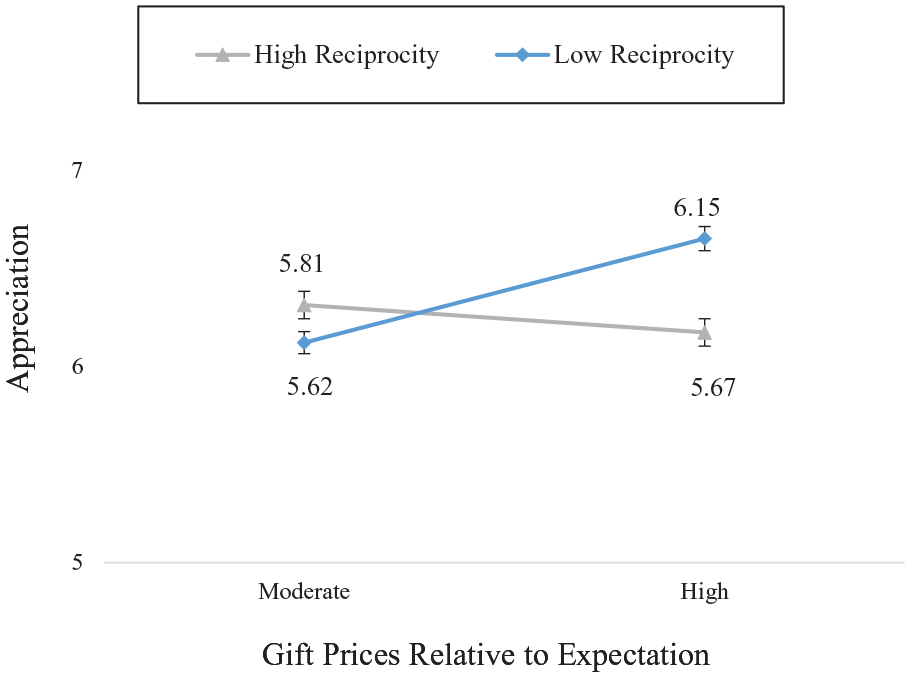
Interaction effect of gift price and reciprocity on feelings of appreciation (Study 3).
Varying income may affect the perceptions of gift prices. The ANCOVA showed consistent results when controlling for income (F(1, 240) = 5.29, p = .021). Regression analyses showed that gift usefulness and materialistic tendencies do not significantly interact with gift prices, reciprocity, or quadratic forms (ps > .178).
Post-hoc test
We conducted a separate study to test our assumption that Asians care more about reciprocal norms than do North Americans, thus showing stronger gift price effects. We recruited 104 Chinese participants (Mage = 30.33; 69 women) on Credamo (credamo.com), a Chinese data collection platform, and 99 North American participants (Mage = 38.61; 54 women) on Amazon MTurk. To test cultural differences in reciprocal norms, we asked participants to indicate the extent to which they felt they needed to reciprocate a gift after receiving it on a seven-point scale (1 = not at all, 7 = to a greater extent). Additionally, we measured the importance of equivalence in gift exchanges using two items 6 (r = .667, p < .001) on a seven-point scale (1 = not at all, 7 = to a greater extent). Supporting our assumption, we found that Asians (M = 6.07, SD = .90) are more likely to feel obliged to reciprocate a gift than North Americans (M = 5.29, SD = 1.47; t(201) = 4.55, p < .001). Furthermore, Asians (M = 6.15, SD = .78) consider equivalence in gift exchanges more important than North Americans (M = 5.18, SD = 1.40; t(201) = 6.16, p < .001).
Study 4
In Study 4, we tested whether closer relationships are more likely to display the gift-price effect. Thus, we manipulated gift prices and social closeness using a 3 (price levels: low, moderate, vs. high) × 2 (social closeness: close vs. distant) between-participants design.
Method
We recruited 300 participants (Mage = 41.30, 139 women) from Amazon MTurk. We asked the participants to specify a close or distant friend who would probably give them a gift on their next birthday. We filtered out 47 participants who specified a family member or a romantic partner instead of a friend, leaving 253 participants (Mage = 34.85; 131 women). 7
As in Study 3, we modified Flynn and Adams’s (2009) scenario to manipulate the gift prices. We chose three clothing items: a basic tank top (low price), branded T-shirt (moderate price), and designer T-shirt (high price). We asked participants to imagine receiving one of the items randomly assigned as a birthday gift from a friend, as specified earlier. Next, we measured perceptions of appreciation, feelings of burdensome reciprocal requirements, and perceptions of the giver’s thoughtfulness, as in Study 1. We then checked our manipulation of gift prices by asking participants whether they considered the gift to be more or less expensive than their expectations (1 = less expensive, 7 = more expensive). In addition, we checked the manipulation of social closeness using three statements (e.g., “Our relationship is not important to me” [reverse-coded]: 1 = strongly disagree, 7 = strongly agree).
Results
Confirming our manipulation of social closeness, participants in the close condition perceived a closer relationship with the friend (α = .62; M = 5.37, SD = 1.33) than did those in the distant condition (M = 4.05, SD = 1.39; F(1, 251) = 59.620, p < .001). As predicted, participants perceived gift prices to be significantly different across the three conditions (Mlow = 2.82, SD = 1.77 vs. Mmoderate = 5.11, SD = 1.22 vs. Mhigh = 6.42, SD = .89; F(2, 250) = 153.99, p < .001).
A two-way ANOVA revealed that only price significantly interacted with social closeness for appreciation (α = .91; F(2, 247) = 6.43, p = .002; Figure 3). For close relationship conditions, participants in the moderate price condition appreciated the gift more (M = 6.19, SD = .10) than did participants in the low- (M = 5.28, SD = 1.69; t(118) = −2.82, p = .006) and high-price conditions (M = 5.55, SD = 1.60; t(118) = 1.96, p = .052), supporting the inverted U-shaped relationship. Confirming our underlying mechanisms, participants in the close relationship and low price conditions considered the giver to be less thoughtful (M = 4.54) than those in the moderate (M = 5.21, SD = 1.68; t(118) = −1.66, p = .099) and high price conditions (M = 5.48, SD = 1.57; t(118) = −2.31, p = .023). Thus, recipients consider socially close givers less thoughtful as gift prices decrease. In addition, participants in the close relationship and high price condition perceived greater burdensome obligations to repay (M = 4.98) than those in the moderate (M = 3.18, SD = 1.99; t(118) = −3.92, p < .001) and low price conditions (M = 3.78, SD = 2.23; t(118) = −2.62, p = .010). Regression analysis revealed a significantly positive coefficient of price (β = 3.25, p = .005) and a significantly negative coefficient of quadratic form (β = −.78, p = .007), further supporting an inverted U-shaped relationship. In contrast, in the distant relationship condition, the expensive gift drew more appreciation (M = 6.15, SD = 1.20) than the moderate-priced gift (M = 5.37, SD = 1.73; t(129) = −2.46, p = .015). Lower gift prices did not evoke impressions of a thoughtless giver (M = 5.28, SD = 1.66; ps > .129). High gift prices (M = 4.46, SD = 2.13) evoked greater burdened feelings when compared with low prices (M = 3.44, SD = 1.86; t(129) = −2.39, p = .018) but not when compared with moderate gift prices (M = 3.81, SD = 2.09; ps > .142). Consistently, regression analysis failed to find an inverted U-shaped relationship for distant relationship conditions (βprice = −2.31, p = .033; βprice2 = −.62, p = .023). Consistent with Study 3, our regression results remained consistent after controlling for income.
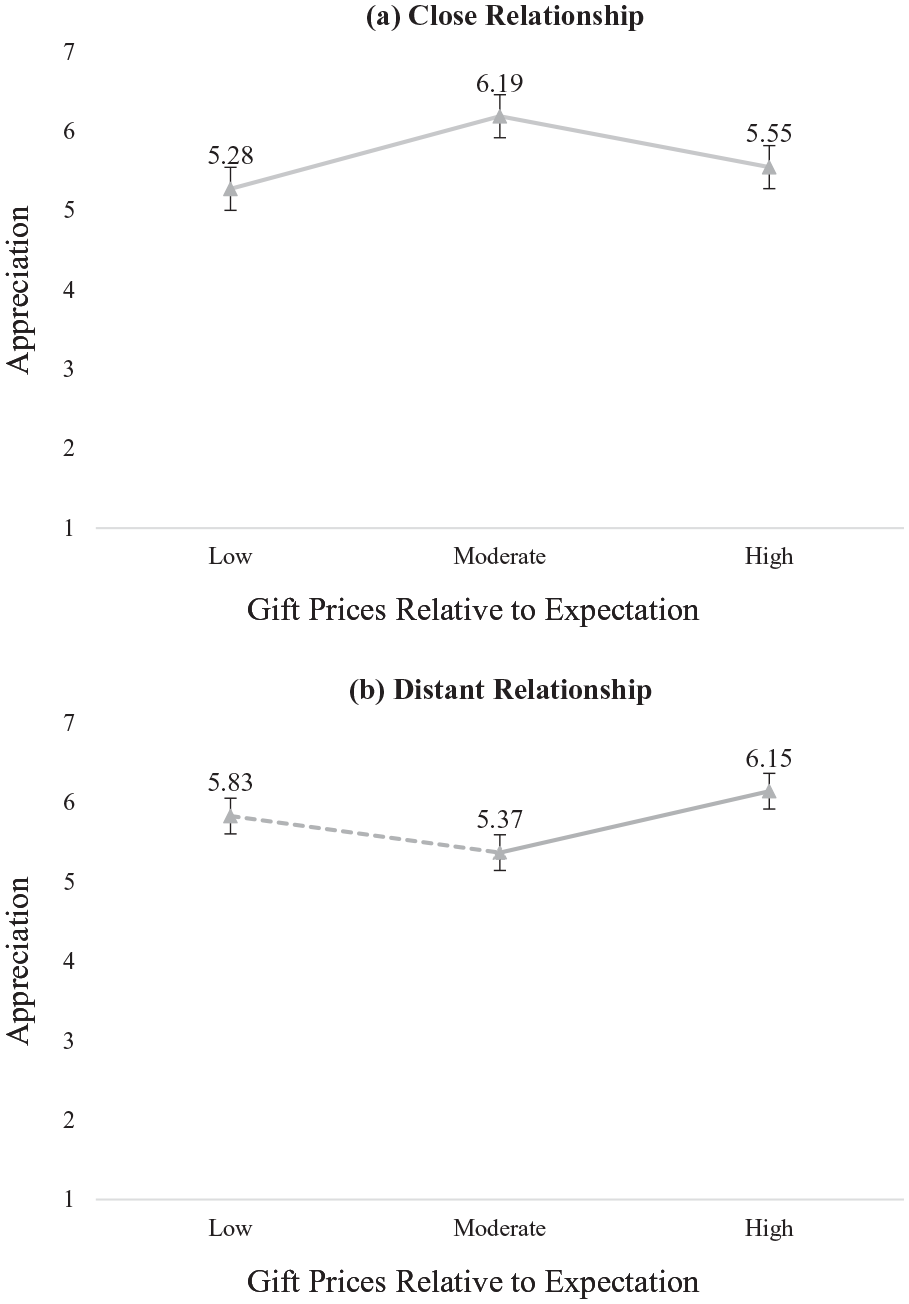
Feelings of appreciation across gift-price levels for close versus distant relationships (Study 4).
We confirmed our underlying mechanism using a moderated mediation test (Preacher et al., 2007, Model 7, Please see Table 2 for the detailed mediation results), with giver thoughtfulness and feelings of burden as mediators and relationship closeness as a moderator. Thoughtfulness showed a positive indirect effect in the close relationship condition (95% CI [.029, .466]) but a non-significant effect in the distant relationship condition (95% CI [−.063, .287]). Burdened feelings had a negative indirect effect, both in the close relationship condition (95% CI [−.124, −.002]) and in the distant relationship condition (95% CI [−.104, −.001]). The results indicate that gifts exchanged in closer relationships are more likely to exhibit an inverted U-shaped relationship between gift prices and appreciation. 8
General Discussion
Research has consistently shown that givers inaccurately predict recipients’ perceptions of and reactions to gifts (e.g., Flynn & Adams, 2009; Givi, 2020; Givi et al., 2021). For example, Givi et al. (2021) showed that givers tend to overestimate the importance of gift value because of a self-other discrepancy, wherein they incorrectly assume that recipients would focus more on relative gift value than they actually do. Givi (2020) revealed that givers are likely to underestimate how uncomfortable recipients would feel when they fail to reciprocate. We extend this line of research by focusing on recipients and their perceptions of gifts with varying monetary values. Social expectations regarding gift exchange often assume reciprocity and suggest that the value of a reciprocal gift should be appropriate. However, only a few studies have directly examined the influence of different gift price levels on gratitude responses. Moreover, overlooking whether gift values match recipients’ expectations, prior research concludes that price does not affect how recipients evaluate gifts or givers (Flynn & Adams, 2009).
This study fills a gap in the literature on how recipients react to different price levels of gifts. We draw on the recall of actual experiences or imagined scenarios to show that recipients are more likely to appreciate gifts that are priced close to their expectations, not too expensive, and not too cheap. In addition, we show that cheap gifts can cause recipients to consider the giver as thoughtless, whereas expensive gifts evoke burdensome obligations to reciprocate equally. Furthermore, we examined the important boundary conditions. We demonstrate that Asians, rather than North Americans, are more likely to show inverted U-shaped relationships with close rather than distant friendships. These findings deepen our understanding of how cultural and relationship characteristics affect recipients in forming gratitude and judging gift prices.
When selecting gifts, givers often experience anxiety in choosing the most appropriate gifts that would meet the recipients’ preferences (Baskin et al., 2014; Waldfogel, 1993; Wooten, 2000). We conducted several studies to identify the most appropriate gift price for maximizing recipients’ appreciation. Based on our findings, we recommend that gift givers meet expectations by choosing gifts of equal or similar monetary value to gifts previously exchanged with the recipient. To avoid evoking indebtedness, caregivers should consider cultural expectations and relationship intimacy. Our findings also offer important insights for practitioners, especially retailers. Consumers often ask retailers for gift recommendations, and retailers also recommend gifts for different relationships (e.g., “Perfect Gift for Best Friend” https://www.amazon.com/Friendship-Gifts/s?k=Friendship+Gifts), and we use our findings to recommend that retailers advise givers to choose gifts priced according to cultural norms and relationship intimacy. For instance, retailers often categorize gifts in terms of their relationships with gift recipients or gift prices. According to our findings, retailers should highlight gift prices, especially when consumers are looking to buy gifts for close persons. However, it is not necessary to suggest different price ranges for gifts for distant people. Retailers could also recommend gifts according to what they have received from the intended recipient, especially in Asian markets.
Our findings open new avenues for future research. It is known that gifts cultivate interpersonal relationships (Chan & Mogilner, 2017), but few researchers have examined modifications in gift-giving dynamics (Ruth et al., 1999). Experiential (vs. material) gifts are more likely to improve relationships (Chan & Mogilner, 2017). Gifts that reflect giver and receiver characteristics promote relationship closeness and satisfaction (Aknin & Human, 2015). In addition to this comprehensive understanding, future research could examine how gift prices cultivate interpersonal relationships over time and affect subsequent gift exchanges.
Our pretest shows that gift prices have different symbolic meanings in various interpersonal relationships. In romantic relationships, equity may not govern gift exchanges because a costly gift reflects the giver’s power and status (Belk & Coon, 1991, 1993) and signals a commitment to strengthening the relationship. Our pretest also shows that communal relationships (e.g., close family members) may diverge from reciprocal norms and dismiss concerns about gift prices. However, in exchange relationships, such as business associations, parties expect to exchange comparable benefits (Clark et al., 1986) and will have greater appreciation when reciprocal gifts meet their expectations. Given the inconsistent dynamics across relationships, future research should consider other types of interpersonal relationships, particularly business ones. Future research should further consider how power dynamics influence the evaluation of gift prices across various relationships.
In Study 1, we find that gift prices and materialistic inclinations have a marginally significant interaction effect on appreciation, suggesting that materialistic recipients prefer expensive gifts. However, other studies failed to support this contention. Furthermore, consistent with Eastman et al. (1997), Studies 2A and 2B showed that Asians (M = 4.75) had higher materialistic inclinations than North Americans (M = 3.99, t(682) = 8.00, p < .001). Nevertheless, Asians indicated less appreciation for expensive gifts, perhaps because cultural norms regarding reciprocity surpass materialistic inclination. Further research on the role of materialistic inclinations will deepen our understanding of gratitude in reactions to gifts.
We encourage future studies to test the moderating role of relationship closeness using a larger sample size. In Study 4, as we predicted, the inverted U-shaped relationship between gift prices and appreciation appeared in the close relationship condition but not in the distant relationship condition. However, the overall mediating moderation model was not significant. This may have occurred because of the relatively small sample size of this study. Future research could use a large sample size.
This study demonstrates that moderators influence the inverted U-shaped relationship between gift values and appreciation. We posit that an inverted U-shaped relationship is more likely when balanced reciprocity is expected. Building upon prior research, we predicted that close friends are more likely to exhibit an inverted U-shaped relationship than distant friends, as they would attach greater importance to the symbolic meanings of gifts and are more likely to reciprocate. However, communal relationships, such as family members or extremely intimate friends, may not exhibit price effects as they are motivated to give gifts in response to needs; thus, reciprocity is not expected (Clark & Mills, 1993). We encourage future research to clarify the boundaries of the proposed gift price effects by investigating various types of relationships. We encourage future research to test the moderating role of relationship closeness using a larger sample size. In Study 4, as we predicted, the inverted U-shaped relationship between gift prices and appreciation appeared in the close relationship condition but not in the distant relationship condition. However, the overall mediating moderation model was not significant. This may have occurred because of the relatively small sample size of this study. Thus, when testing the impacts of relationship types, future research should use larger samples.
Footnotes
Declaration of conflicting interests
The author(s) declared no potential conflicts of interest with respect to the research, authorship, and/or publication of this article.
Funding
The author(s) received no financial support for the research, authorship, and/or publication of this article.
