



Abstract
In analysing the working lives of independent filmmakers, a critical consideration is the aspect of where work takes place and the need for both appropriate space in which to shoot films and the mobility to make it happen. The concept of being ‘on location’ is a well-known aspect of film production as the traditional studio system was designed around economies of scale and the minimisation of costs for both environmental and human factors. For those outside of the commercial system who prioritise independence and the freedom to work on projects that enable creative control, the reality of location is a major financial and artistic consideration that affects several critical factors such as: the affordability of where to live; the expectation of mobility; opportunities for career development; and the viability of sustaining enough work in the domestic context. Based on 24 semi-structured interviews with independent filmmakers in the Australian screen industry, this research considers the precariousness of creative work in the cultural industries and how this intersects with both labour mobility and the desire to build a career and sustain meaningful work and employment.
Introduction
The Australian screen industry is reliant on a skilled and mobile labour market to generate feature length films, documentaries, and short films suitable for global distribution. There is a significant body of cultural research into the contribution of cinema as a part of our social history (Maddox, 1996; Moran & Vieth, 2006; Verevis & Williams, 2010) and the role it plays in contemporary society (Connolly, 2008; Cameron et al., 2010; Harley, 2017), making filmmakers and filmmaking an important consideration in debates on creative work and employment. However, the realities of creative labour markets are misunderstood in terms of structural factors, labour market conditions and the potential for exploitation and fragmentation (Banks & O’Connor, 2017; Moreton, 2018; O’Connor, 2009; Peck, 2005). Inherent assumptions that economic and social goals are naturally symbiotic hide a range of complexities in the ways communities finance and experience cultural life and how those who work in the creative industries are exploited for their talent and human capital (Banks & Hesmondhalgh, 2009; Moreton, 2018). These complexities include: the nature of urban evolution and accommodation for creative labour; the existence of social injustices and barriers to opportunity; and the capitalist imperative to prioritise profit over artistic merit (Banks, 2006, 2009, 2017, 2018; Banks & O’Connor, 2017). For research on creative labour, this means that economic indicators are inadequate for understanding the realities of those working in the creative industries. It is essential to consider the nature of opportunity and access to employment, labour mobility and where workers can afford to live, while using their talent to enable sustainable and meaningful careers.
Within the Australian screen industry, there is a paucity of research on the systems, structures and institutions that underpin the work of independent filmmakers and their capacity to sustain employment. Filmmaking by its very nature is project-based and production is complicated by the multitude of stakeholders and financial risk-taking associated with the investment required to complete a film viable for distribution (Blair et al., 2001; Ebbers & Wijnberg, 2017; Eikhof & Warhurst, 2013; Fitzgerald, 2012; Perretti & Negro, 2007). This creates a unique employment landscape that is highly precarious in terms of income and occupational security. Filmmakers ‘above the line’ in key creative roles (producers, directors, writers, cinematographers, and editors) are commonly independent of the traditional employment relationship via freelancing and operating small production companies. Those working in film ‘below the line’ in more technical and supporting roles may find employment in production firms but are still privy to the short-term nature of project work and the insecurity that matches this industrial landscape.
The influence of stakeholders, the system of production for independent filmmakers and an awareness of labour mobility and employment opportunity are under-explored in the Australian context. Evidence of the dual labour market, whereby ‘the social structure of the feature-film industry is dominated by a core-periphery split’ (Cattani et al., 2014 p.261) along with and the prevalence of unpaid work (Percival & Hesmondhalgh, 2014) are critical to understanding the realities of filmmaking. This paper will analyse the significance of precariousness broadly in work and employment and then specifically in creative work with the inclusion of filmmakers in the ‘artistic precariat’ (Bain & McLean, 2013, p. 94) being an indication of occupational struggle. It will then consider the importance of location and labour mobility in the working lives of filmmakers and the connection to opportunity and access for career sustainability. Following this brief literature review, the qualitative methods used in conducting the research will be outlined and the findings presented based on emergent themes from interviews with 24 independent filmmakers. Based on doctoral research into the broader sustainability of work and employment for independent filmmakers, this article will focus on the realities of precariousness and the significance of place and space as mechanisms for understanding the challenges facing creative labour in the Australian screen industry.
Precariousness and the ‘Artistic precariat’
Within sociology, the notion of precariousness is considered in many aspects of social life such as housing, education, health, and employment. Scholars have been tracking the change in how people are employed and the direct impact on key employment indicators such as wages, hours of work, collective representation, and regulatory protection. Kalleberg (2001) conducted a detailed analysis of the core−periphery model and the notion of the flexible firm from a broad range of international studies. He argued that our understanding of the flexible firm was centred on organisational management decision-making and lacked awareness of how insecure employment could be across firms and networks and become standard practice within an industry. This argument was further advanced by Rubery et al. (2002) who used the existence of project-sites, alliances, partnerships and agencies, to challenge the very existence of the ‘employment relationship’. They argued that multi-employer relationships fundamentally alter the way employment rights and laws are interpreted and applied which in turn, alters the way individuals are protected. This structural shift in the composition of employment is critical in understanding how conditions can deteriorate, leaving workers exposed to a vulnerable working environment even if they have standard legal rights. By 2009, Kalleberg argued that precarious work had become “the dominant feature of social relations between employers and workers in the contemporary world” (Kalleberg, 2009, p.17) and explained how a holistic and multi-disciplinary approach to analysing the structural and social dimensions of precariousness was essential for the well-being of individuals and the impact of work on society. For noting is the distinction between terms such as ‘precariousness’ and ‘precarity’ as established in the work of Butler (2009). Mills (2015) explains how Butler suggests that precariousness is linked to existentialism and the mortality of the human condition while precarity is constructed via social insecurity and the politics of vulnerability.
In the Australian context, precariousness in employment first emerged in scholarly research in the 1990s with the rapid growth in the casualisation of employment, the decline in trade union density, the shift in work from manufacturing to service, the decline in the public sector, and the feminisation of work (see Burgess, 1997; Probert, 1995). In 1998, Burgess and Campbell published their analysis on the nature and dimensions of precarious employment in Australia by highlighting the emphasis on job quality and the multiple ways in which work, and employment could be seen as insecure (Burgess & Campbell, 1998, p. 6). Significantly, they separated the increase in non-standard forms of employment that was generated through industrial transformation with the growth in precariousness as something that needed separate, even if related, scholarly attention. In their 2018 review, Campbell and Burgess reinforced their belief that precariousness as a concept is multi-dimensional, objective, and applicable to all forms of employment that may be affected by areas of insecurity (Campbell & Burgessl, 2018, pp. 49–50).
Perhaps one of the most important contributions to the precarious debate has been the work of Guy Standing via his text The Precariat: The New Dangerous Class (Standing, 2011). This offered a comprehensive analysis of the shift in how we classify workers, away from the traditional proletariat and ‘working class’ ideas of those at the lower end of the labour market to the emergence of a new class identified as the ‘precariat’ who experience much greater disadvantage and alienation than previously understood. To exist within the precariat, Standing argued that individuals ‘fare badly’ (Standing, 2011, p.10) across all seven forms of labour security explained as follows (see Table 1).
Forms of labour security under industrial citizenship.
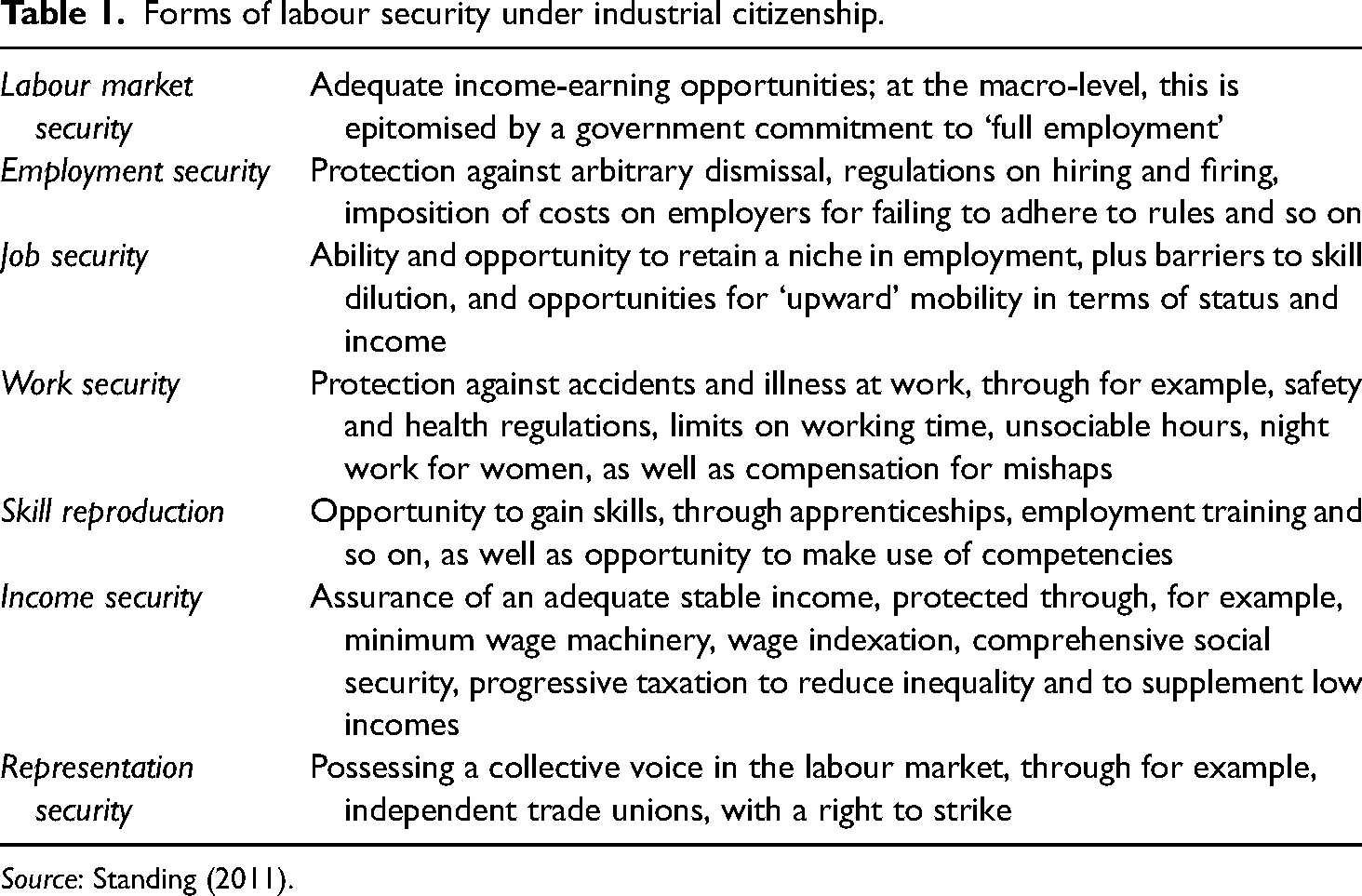
Source: Standing (2011).
In this approach it is not enough to experience one form of insecurity. Standing argues that there is a form of hopelessness, no ‘shadow of the future’ (Standing, 2011, p. 13) of where they may end up. However, this approach is problematic when individuals have a choice of work and careers and may not be suitable to creative workers in the screen industry who are able to move between secure and insecure employment. Controversially, the inclusion of filmmakers in the so-called ‘artistic precariat’ has been argued by multiple authors such as Bain and McLean (2013), Morgan and Nelligan (2018) and Samdanis and Lee (2019). Indeed, critics of Standing's approach to the precariat paradigm argue that evidence of this new class is contested (Arnold & Bongiovi, 2013) and lacks the complexity to understand work in systems where regulations exist for more than the permanently employed (Bessant, 2018; Mooi-Reci & Wooden, 2017; Markey & McIvor, 2018). Even so, insecure and short-term work is inherent in filmmaking and is well documented in a broad body of scholarly research (Cattani et al., 2014; Christopherson, 2008; Gill & Pratt, 2008; Morgan et al., 2013; Saundry, 2001). Therefore, how filmmakers adapt to a precarious work-life and survive over the longer-term while maintaining a sense of purpose and identity in the digital age is arguably a key factor in equity and opportunity for many who seek a creative career.
Filmmaking in Australia and the significance of location
From a work and employment perspective, filmmaking in the Australian context has been explored by a few key studies over the last two decades. Research by Jones (2005; 2007) was the first major qualitative study of film industry workers and provides an important record of the interplay between context and production crew and the issues affecting those wanting long-term employment. Nelligan (2015) explored the notion of precariousness within film industry employment and the idea that those in the industry simply accept the lack of job security, poor working conditions and absence of appropriate compensation. This supported the report by Throsby and Zednik (2010) titled ‘Do you really expect to get paid?’ for the Australia Council for the Arts (rebranded as Creative Australia in 2023) that provided the first major economic study of professional artists in Australia.
For independent filmmakers, a reality of working outside of the major studio system is the physical requirement of shooting ‘on location.’ The logic of having backlots and staged studios to manufacture multiple films has been the foundation of the traditional studio system to ensure economic practices and efficient production processes for both artistic benefits as well human capital (Swift, 2010; Nikolic, 2017). Choosing a suitable location to film is an important financial decision for both major studios and independents and creative hubs in geographical and industrial centres as a part of the global film industry. These production centres can have a precarious existence based on a range of factors such as government policy, accessibility and accommodation, natural and social structures, and financial imperatives such as ‘exchange rates, labour costs, foreign earnings and tax shelters’ (Coe, 2000, p. 80). However, it is important to recognise a few key aspects in filmmaking that cannot be separated from an analysis of production systems.
Shooting on location independent of a studio is challenging in terms of the practicalities of recording content – issues such as weather, landscape, permits, equipment, sets, noise, lighting, privacy and the local inhabitants are factors that may be prone to natural events or impacted by social situations that are difficult to manage (Frost, 2009). Additionally, hiring cast and crew has many challenges in terms of employing people to work on short-term projects in one-off locations. In their comparative case study analysis of films shot in both London and Los Angeles, Blair et al. (2003) found clear evidence of the influence of temporal, spatial and geographical factors in the employment processes and labour conditions for cast and crew. This variation in industrial experience was attributed to the complex interplay between social structures and social agency and the systems of regulation, networks, and practice. The concept of ‘cinematic geography’ examines the way that films are used to ‘focus on how social and cultural meanings are intertwined with space, place, scale and narrative’ (Lukinbeal, 2004, p. 248). This essentially means that location may be critical to the story being told and filmmakers should be aware of the significance of local landmarks and landscapes and how they relate to historical events, peoples, and traditions.
From a micro-perspective, the work that individuals undertake over time is analysed via the concept of a ‘career.’ This is particularly useful for creative labour when the viability of an industry is closely linked to the sustainable employment of highly skilled and/or unique workers. Notable work in this area of ‘creative careers’ highlights the complexities and challenges for specialists in creative industries (see Ashton, 2015; Matthieu, 2012; Menger, 1999; Taylor & Littleton, 2012; and Hennekam, 2017 for international debates; see Daniel (2016), Bennett & Hennekam (2018) and Morgan & Nelligan (2018) as significant Australian contributions to the body of knowledge). Creative workers require ongoing and meaningful employment to harness their talent and use their skills to ensure the viability of the industry. Given the competition for content by both distributors and audiences, the demand for both quantity and quality depends on workforce skill and flexibility. The connection between creative work and engaging in filmmaking over time proposes a conceptual shift in the relevance of careers for multiple actors, institutions, processes, and policies.
Methods
To allow for an examination of the realities of the working lives for Australian independent filmmakers, this project used an intensive, qualitative approach for primary research. Qualitative research relies predominantly on soft data that takes the form of impressions, perceptions and personal experiences from a range of reliable and valid sources (Creswell, 2013; Denzin & Lincoln, 2011; Porter, 2007; Rolfe, 2006), and given that the story-telling nature of career narratives was the most appropriate approach to investigating the working lives of filmmakers. Evidence was obtained through conducting in-depth, semi-structured interviews with 24 Australians who identify as ‘filmmakers’ and work independently of the major studio system. Participants were categorised according to their years of experience in terms of early career (1–5 years), mid-career (6–20 years) or late career (more than 20 years). Each participant was given a pseudonym as well as a code which relates to their length of work experience – therefore any quote with a C1 code represents an early-career filmmaker, C2 mid-career and C3 late-career. All participants identified as either female or male and the code includes either an F or an M to confirm gender. Participants were employed in a range of industrial arrangements that have been identified as either ‘employee’ if they have a full-time role with one employer and ‘contract’ or ‘permanent’ depending on the nature of their employment. In terms of occupational identity, some participants were only prepared to use the moniker ‘filmmaker’ as their dominant title even if they worked predominantly in other areas such as editing. If the participant agreed to an alternative occupational identity, such as ‘director’ then this is how they have been classified. The participants detailed are summarised in Table 2, including their pseudonym, their employment status, their occupational identity, and their code.
Research participants.
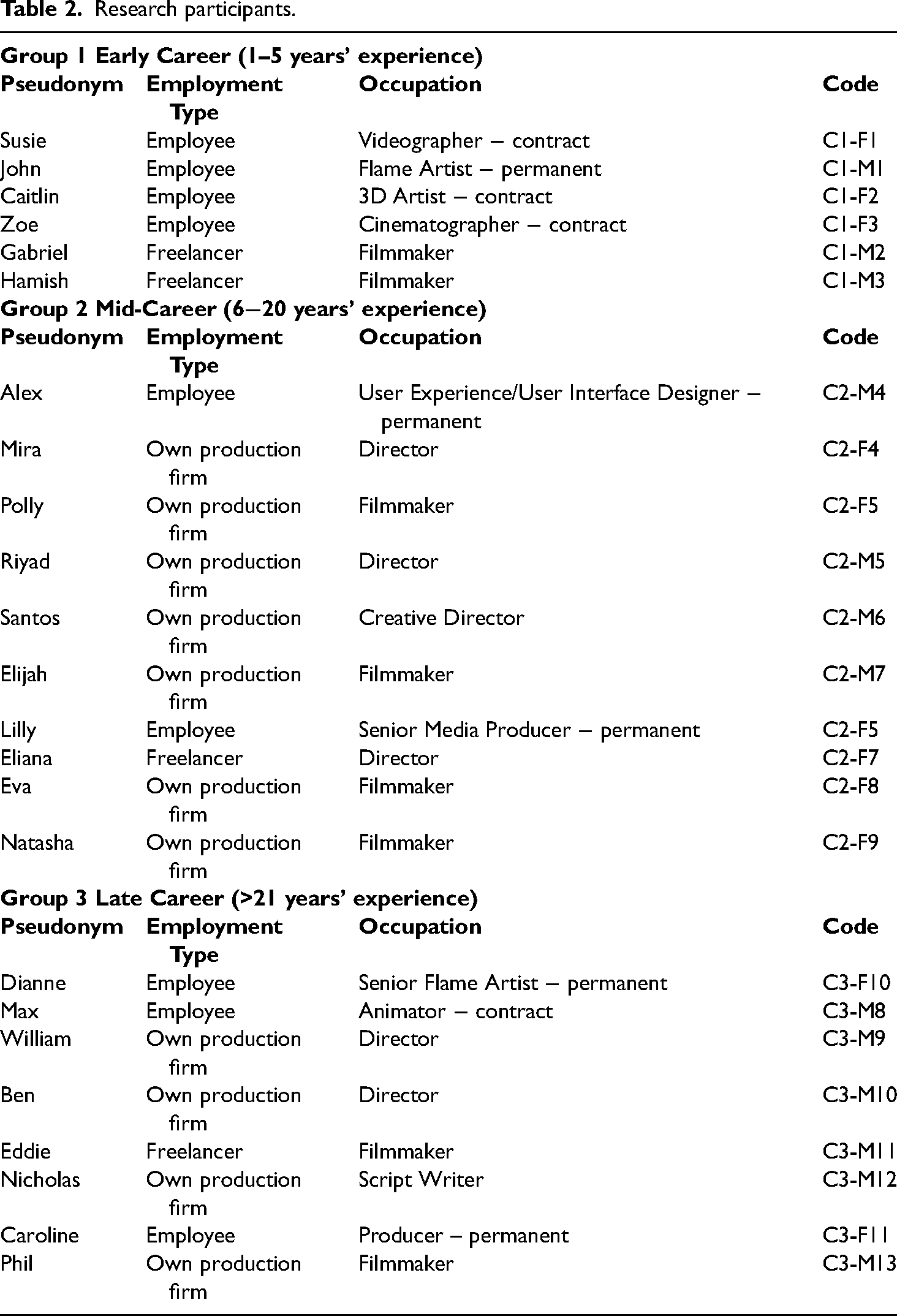
To make effective use of the data collected, the process of thematic analysis was undertaken as the principal method for exploring the meaning and contribution of the material generated. According to Braun and Clarke, thematic analysis describes the process of ‘identifying, analysing and reporting patterns (themes) within data’ (Braun & Clarke, p.79) that allows for a complex account of data that is both descriptive and interpretive. In support of this work, authors such as Guest et al. (2012) and Nowel et al. (2017) argue that the benefit of thematic analysis lies in its flexibility to be adapted to multiple epistemologies and theoretical standpoints while establishing trustworthiness in the presentation of the findings.
Findings
In this study, the impact of precariousness was paramount across all interviews, and it became an important part of the storytelling to confirm the extent and nature of this precariousness in exploring the work experiences of participants. For early-career filmmakers, there was an undeniable acceptance that starting out in the industry was dependent on finding short-term contract and freelancing jobs without an expectation for paid, secure work as established by earlier studies (Saundry (2001); Christopherson (2008); Gill & Pratt (2008); Morgan et al. (2013); Cattani et al. (2014)). For one participant on a short-term contract, there was a clear sense that working in the industry was about ‘luck’ and the nature of employment in terms of security and working conditions was not tied to a permanent role in either the short-term or longer term: I know how lucky I am to be working in the industry and to have a contract, but it's not permanent which is fine because no-one works permanently…at least I’ve never heard of anyone who has a job like that. I don’t think there is anything as ‘permanent, permanent’ work in this industry, like I don’t think it actually exists, so I don’t ever expect to have a permanent job and moving from contract to contract is normal. (Caitlin; C1-F2) I have been doing some freelance stuff, mostly freelance photography and videography work to earn some money because there is a lot of unpaid work when you are doing film work. I don’t mind because I know that you can’t expect to get paid in film work when you are starting out and the freelance photography is still creative. (Hamish; C1-M3) My first industry internship was for about 3−4 months. It was unpaid, and it was well…(sigh)… it ended up being a producer's assistant role where I did all sorts of things like cleaning the office and answering the door and picking up errands and a little bit of editing here and there. I worked 2–3 days a week unpaid. (Susie; C1-F1) I’ve had two internships, but neither were paid. They just wanted to know if I had the equipment to do the job - both were editing roles and I had to use my own software which is not cheap, but I only got the opportunities because I already invested in the technology. It was a good deal for them, I guess. (Gabriel; C1-M2) During my internship I had to go on two location shoots. I had to make my own way there and one was out of Sydney, and we had to be there from 6am to like midnight. I was a runner and so I had to work non-stop, and it was exhausting. I was a bit excited at first but then the reality of it all was difficult. (Susie; C1-F1) Being on a shoot can be really exciting as it's why we all want to be in filmmaking, and I always love every chance I get to make an actual film, but they are also really taxing and exhausting to do…I’m just a dog's body normally so I have to be there all day and night and just do as I’m told and not upset anyone! It's really hard work, particularly if you don’t get paid. (Hamish; C1-M3) I’m not sure if anyone has told you this, but working in the Australian film industry is a fairly tidal thing…if you are a freelancer, you are subject to feast or famine…the tide is out and it's low ebb and you are scrambling and that's when it becomes dangerous because you still have weekly bills to pay but nothing is coming in…yep, the industry can best be described as tidal and you need to know how to ride the waves to survive. (Nicholas; C3-M12)
This ‘tidal’ nature of filmmaking also extends to the need for movement and labour mobility to try and seek out the next project or opportunity. The desire for creative freedom creates a paradoxical context for an unregulated and unprotected employment system. Despite broader industrial protections via trade unions, industry guilds and basic labour laws, the cost of filming on location creates pressure for bending the rules and placing demands on independent producers to expect freelancers to operate outside of social working standards. Experiences of late-career participants in this research highlight the expectations for professional flexibility and labour mobility to eke out a living: The industry is all about your reputation and availability and sometimes the right place, though I’ve always been willing to travel. It is such a tough industry if you want stability. (Caroline; C3-F11) I have had to travel to follow the next job as it's a very niche market and it's not like other trades, I don’t get to choose where I live for work. (Max; C3-M8) I’ve been on and off projects for the last 30 years and really can’t recall any time at the one place in a permanent role but if I wanted that then I should have become an accountant or something boring like that…I guess we are all nomads going from job to job. (Phil; C3-M13) I’ve worked in Qld [Queensland], Victoria and NSW [New South Wales] on features while trying to get my own films into production, so I never think of myself as having one job as I’m always hustling for the next project. It does make living in one place tricky so I guess my whole life is in a state of flux…I don’t even own a car because that would require somewhere to park it. (Santos; C2-M6) I was hired to be a gun director in Sydney when I was living in Adelaide, and they flew me out and everything. But after the shoot it was so expensive to be in Sydney and I started owing people money…I needed to get back to Adelaide where I could afford to live but I just couldn’t get anything, like literally nothing was available and so I thought moving to Melbourne would be my best option. (Eddie; C3-M11) I’m in LA {Los Angeles} now working on some projects that I hope will land me something big in the future…I know a lot of people in Sydney will tell you that working in the US is not important, but I disagree completely. Going to LA and shooting with leading performers and creatives is a part of the dream, I don’t believe it if people say it's only about the work, ‘breaking America’ is the goal for everyone I know. (Elijah; C2-M7) I have access to the US so it's likely that I will film more there in the future than in Australia…I see myself as a global filmmaker. (Mira; C2-F4) At this point I only ever plan for film work to be done in Europe as it gets me out of the small scene here, so I’m not limited by the industry. (Ben; C3-M10) The real industry is in the US, I shoot local and low-budget to support the industry, but all my business connections are in the States. My business model is very successful as I get to make a feature every 5 years or so and I make money – my latest film had one screening at a cinema in L.A. {Los Angeles] to make it have an ‘official release’ and now it's streaming around the world. (William; C3-M9) My favourite shoot was in the small country town in outback Western Australia. Accommodation was very basic as we just stayed in a local motel and the shoot was hot, dirty and dusty. To be able to shoot there was a total privilege and quintessentially Australian. (Natasha; C2-F9) I really wanted to make a micro-budget film, and I had access to a friend's property in country NSW [New South Wales], and so this was a true independent film mindset where you have to be flexible. I had a small crew join me from Sydney and I put them up at the local caravan park which ended up being very affordable. (Mira; C2-F4) I shoot my films in Western Sydney – parking is free, the environment is very diverse in terms of background and location and the Councils are supportive for permits and the like. Also, if crews are local and can access the sets easily then they love working close to home. (Riyad; C2-M5)
Discussion
Other than animation, for most films a physical ‘shoot’ must take place for the story to come to life on the big screen. The importance of place, space and mobility are core elements of the role that location plays in the world of filmmaking due to the need to use the physical, cultural and spatial environment for the creation of visual artefacts (Blair et al., 2003; Frost, 2009; Lukinbeal, 2004). This research demonstrates the significance of location and the need for contextual understanding beyond the artistic to the economic and professional realms in analysing the sustainability of work and employment for independent filmmakers. In the Australian context, there are very real issues due to the size and scale of our geographical landscape and the opportunities within cityscapes that vary from state to state and beyond into the international arena. Most importantly, the issue of living affordability, access to work and a supporting industrial environment are critical to the lives of filmmakers and their ability to make a living.
Fundamentally, the experiences shared in this research demonstrate the complexity of location and the need for filmmakers to be flexible while seeking adequate living and working conditions. In a small market such as Australia, there is limited opportunity for movement in and out of the mainstream and across multiple formats unless someone is willing and able to move themselves. For others, the inability to balance living standards, personal needs and work opportunities is a major barrier for those who seek a sustainable career in independent filmmaking. The location requirements to produce films can be complex to navigate in terms of access, labour costs, geography and cinematic relevance that add another layer of reality to undertaking independent projects (Nikolic, 2017; Swift, 2010). Meanwhile, the major studios have the economic advantage of film sets and back lots and can access both human and physical resources much more effectively than those outside of the system.
The idea of being ‘on location’ was confirmed as a critical part of the working lives of filmmakers in terms of both shooting content and the access to industry work that supports them through the non-filming periods. The idea of a ‘nomadic’ or ‘gypsy-like’ existence was routinely commented on as a reality of the industry. When explored in detail, filmmakers were very aware of the limitations of the ‘tidal’ film industry and viability of settling in one location to have any chance of sustaining a decent standard of living while balancing family, housing affordability, networks and employment options for decent pay and conditions of work. International markets were seen as viable for those with deep networks and even deeper pockets as an alternative to the limitations of the Australian context, but this is counter-productive to the notion of local content and production systems. The capacity for early-career filmmakers to juggle both a domestic and international career is unrealistic resulting in an inequitable model of possibility for those who may not have the personal finances to navigate this duality.
Opportunity via place and space for creative labour is not equitable or assured and remains over time as an inhibitor of meaningful and sustainable work (Eikhof & Warhurst, 2013; Ebbers & Wijnberg, 2017). Sacrifices for family and personal relationships, building financial assets and occupational protection are often compromised by those making a living in the arts due to the need to find work and adapt to ever-changing social circumstances and understanding this is the first step in recognising the pressures placed on creative labour in the Australian screen industry. There is a clear debate in the literature regarding the extent to which a group of workers may experience precarity and whether this forms the basis for (in this case) an ‘artistic precariat’ as evolved from Standing (2011), Bain and McLean (2013), Morgan and Nelligan (2018) and Samdanis and Lee (2019). This study does not claim to paint independent filmmakers in this light. It is supporting the work of Kalleberg (2001, 2009) that identifies precarious work as the dominant paradigm in social systems. More specifically it demonstrates that the role of location and labour mobility is a critical element of precariousness in this context, and that the work of Standing (2011) could be expanded to incorporate this as a factor in analysing forms of labour security under industrial citizenship in future research projects.
Conclusion
On the 27 March 2018, 203 of Australia's leading filmmakers and performers along with the support of a range of key industrial organisations, released a signed open letter in support of a national campaign to encourage the continuation of screen content that is both locally produced and which comprises local stories. The letter was designed to bring publicity to the plight of the domestic screen production industry, to highlight the threat posed by cheaply produced overseas content, and to underscore the cultural importance of telling stories that resonate with local challenges. The letter represented the thousands of performers, producers, writers, and technicians who embody the Australian screen industry. As a political tool to generate support, the letter relied on the success and gravitas of the signatories to promote the merits of the local content and the importance for cultural identity.
This campaign, which was integrated with the broader ‘Make it Australian Campaign,’ followed three major reports into the challenges facing the local industry: the Report on the Enquiry into the Australian Film and Television Industry by the House of Representatives Standing Committee on Communication and the Arts (Commonwealth of Australia 2017); the Screen Production in Australia Study by the Screen Producers of Australia (Deloitte Access Economics 2018); and Skin in the Game: The Producer Offset 10 years On (Screen Australia 2017). Each report highlighted the precarious nature of work in the film sector. Each pointed to the inadequacies of existing government arrangements and provided estimates of the public funding support that would be required to maintain domestic feature film production capacity.
This article reinforces the claim of that campaign, that creative workers require ongoing and meaningful employment to harness their talent and use their skills to ensure the viability of the industry. Given the competition for content by both distributors and audiences, the demand for both quantity and quality rely on a workforce that can be both flexible and skilful whether the medium for viewing be in traditional theatres or via digital platforms. Significantly, the capacity for workers to access employment opportunities is an important consideration for equity within the arts and for sustainability of creative careers in areas such as independent filmmaking. The connection between creative work and engaging in filmmaking over time proposes a conceptual shift in the relevance of careers for multiple actors, institutions, processes, and policies.
Footnotes
Funding
The authors received no financial support for the research, authorship, and/or publication of this article.
