




Abstract
This article investigates former asylum seeker, Kurdish-Iranian Behrouz Boochani's efforts to decolonize truth-telling, especially in his prize-winning novel, No Friend but the Mountains: Writing from Manus Prison, in which he theorizes direct links between the colonization of Indigenous Australians and Australia's treatment of refugees. No Friend but the Mountains: Writing from Manus Prison both has borders as a theme and crosses borders by utilizing disparate literary forms to great effect. I explore truth-telling in Boochani's work through the lenses of border thinking, as theorized by Gloria Anzaldúa and Walter Mignolo, and heterotopia (other-place), as theorized by Michel Foucault. Boochani describes himself as ‘A shepherd who reads Foucault’, and states that it is possible to ‘examine Manus Prison using a Foucauldian framework and apply his philosophical critique of the prison, the mental asylum and psychology.’ Border and heterotopic thinking both provide powerful tools to critique institutionalized power structures and explore understandings and approaches towards decolonization.
At the 2019 Australian Academy of the Humanities Annual Lecture, Professor Joy Damousi made damning connections between ‘fortress Australia's … demonization and inhumane treatment of refugees and asylum seekers; and our inability to recognize the distinctive rights that Indigenous Australians hold as the original peoples of this land’ (Damousi, 2019). Acknowledging the role of her personal history as a child of Greek migrants to Australia in propelling her research, she told a story of learning of the plight of her mother's neighbours, the northern Greek Jews, under the Nazi invasion. And she affirmed the supreme importance of witnessing, ‘Before there can be justice, there must be truth’ (Damousi, 2019).
This article investigates an artwork of decolonial truth-telling: former asylum seeker, Kurdish-Iranian Behrouz Boochani's prize-winning novel, No Friend but the Mountains: Writing from Manus Prison (Boochani, 2018). Boochani, like Damousi (2019), theorizes direct links between the colonization of Indigenous Australians and Australia's treatment of refugees. My analysis uses the lenses of border and heterotopic thinking because, as I argue below, they are both important dynamics in the creation of an artwork, and they provide powerful tools to critique institutionalized power structures.
Border thinking was initially theorized by Gloria Anzaldúa and Walter Mignolo. Heterotopia (other-place), originally used as a medical term for displacement or misplacement of parts, was first used in cultural theory by Michel Foucault in his 1967 lecture, ‘Of Other Spaces’ (Foucault & Miskowiec, 1986). Rather than spaces that supposedly have clear boundaries – private/public, family/social and leisure/work – Foucault was interested in sites that have the ‘curious property of being in relation with all the other sites, but in such a way as to suspect, neutralize or invert the set of relations that they happen to designate, mirror, or reflect’ (Foucault & Miskowiec, 1986, p. 24). An example is a mirror – a ‘placeless place’, that none-the-less does exist in reality and which provides a reflection that can impact on real space (Foucault & Miskowiec, 1986, p. 24).
One example of Boochani's use of a heterotopic sensibility is his description of himself as ‘A shepherd who reads Foucault’. He states that it is possible to ‘examine Manus Prison using a Foucauldian framework and apply his philosophical critique of the prison, the mental asylum and psychology’ (Boochani, 2018, p. xv). No Friend but the Mountains: Writing from Manus Prison has borders as a theme and crosses borders by utilizing disparate literary forms to great effect.
Inspired by the border crossing inherent in Boochani's use of a multiplicity of writing styles, and the desire to create a heterotopic sense by juxtaposing many times and places, this paper includes interjections from my personal journal. I aim to move beyond an ‘institutionalized’ academic format, introducing ambiguity and subtly ‘unsettling’ the reader in a way that encourages personal empathy with the issues that Boochani raises. I am trying to open myself and my reader to ‘bear witness’ in multiple ways, offering an expansive way of writing and reading that allows reflection on the limits of academic knowledge production, and elevates other modes of truth-telling that are personal, situated and context-specific – attributes that can work towards a decolonial stance because they value a multiplicity of perspectives.
Like Damousi, I am aware of the impact of my own story on the way I value truth-telling. I can relate to another Australian historian, South African born Professor Colin Tatz, who left his homeland due to outrage at the extremes of racism against black South Africans (Tatz, 2003, pp. 7–8). Writing forthrightly about the genocide of Aboriginal Australians, he came under attack from conservatives as a scholar with a ‘Jewish background’. Tatz responded by asserting that he ‘would prefer to be regarded as one of Jewish foreground, as it is that foreground of my existence which compels me morally to investigate all manners and matters of genocide’ (Tatz, 2003, pp. 140–1). Sharing Jewishness, Australian citizenship and South African heritage with Tatz, I am conscious of the way my background influences the issues I’m drawn to explore in my work.
October 31st, 2018 (My Dad's birthday and Halloween!)
A few days ago I received an email from the University of Melbourne about a talk. It was booked out by the time I tried to register, but I went along anyway – free events often have no-show-ers. In this instance it was full, and I waited by the door to see if I would be allowed in. It was held at The Greek Centre on Lonsdale St and I enjoyed hearing Greek Australians move seamlessly from second generation Greek-accented English into (what I guess was) Australian-accented Greek. Eventually the woman at the door allowed me to enter if I was prepared to stand. The entrance was strange – a fire escape door seemed to lead nowhere but to a flight of concrete stairs. I exited again, confused, but the woman told me to continue through a door on the other side, which opened Narnia-like to a conference room where Pitjantjatjara drummer, Bart Willoughby was playing cajon with Kurdish Fadil Suna on oud.
In introducing Gumbainggir academic, Gary Foley, the Jewish author, Arnold Zable, emphasized the importance Boochani has given to dialogue with Indigenous peoples both in Australia and Manus Island. Foley spoke about how after WWII, German citizens proclaimed, ‘We didn’t know’ – Australians should not be given that opportunity. And he concluded by addressing Boochani: ‘To my brother. I understand your struggle. Your struggle is our struggle’. Zable congratulated Foley, ‘You really nailed it, Gary. As a nation we're good at imprisonment’.
I was wondering where this was all heading when suddenly the screen at the front of the stage was split in half by a Skype live feed – on the left was Behrouz Boochani on Manus Island, and on the right, the translator of his new book, No Friend but the Mountains: Writing from Manus Prison, Omid Tofighian. The audience spontaneously rose from their seats and burst into applause – I’m guessing I wasn’t the only person moved to tears. Suddenly the space of the meeting had been transformed into a heterotopia through the medium of Skype, especially in the definition of Kevin Hetherington: a sublime site of alternate ordering that unsettles us by fascinating, horrifying, ‘mak[ing] use of the limits of our imagination, our desires, our fears and our sense of power/powerlessness’ (Hetherington, 2002, p. 40).
In 1949 Theodor Adorno famously wrote, ‘To write poetry after Auschwitz is barbaric’ (Adorno, 1983, p. 34). In Of Border and Thresholds Michal Kobialka elucidates this statement, asking how suffering could ‘find its voice without being appropriated or assimilated by bourgeois subjectivity and its systems of power?’ (Kobialka, 1999, p. 9). Kobialka shows that later Adorno felt that art works did have a place after Auschwitz, so long as they were autonomous in being ‘governed by their own inherent structure rather than by social psychology’ (Kobialka, 1999, p. 10) and offered productive resistance instead of striving to be a form of representation that affirmed life (Kobialka, 1999, p. 10). Such conceptual works of truth-telling are ‘always changing and fluid, negating, decomposing, dissolving, deconstructing, or destroying any promise of representation’ (Kobialka, 1999, p. 10).
This boundary-crossing description evokes the concept of heterotopia – a counter-site that both contests and inverts (Foucault & Miskowiec, 1986, p. 24), juxtaposing several sites that are incompatible (Foucault & Miskowiec, 1986, p. 25). As defined by Michel Foucault, heterotopias ‘always presuppose a system of opening and closing that both isolates them and makes them penetrable’ (Foucault & Miskowiec, 1986, p. 26).
December 2003
I’ve come to Paris to do a theatre course and I hear about a ‘must see’ show, Théâtre du Soleil's Le Derniere Caravansérail. The performance starts and I’m dumbfounded to hear Australian accents. In a coup de théâtre, I see Australian border force guards being helicoptered over a small boat in a stormy sea – the guards ordering the boat to move out of Australian waters. Having been out of Australia for over two years, I feel a strange sense of embarrassed guilt about the scenario being enacted. I am in an unstable borderland of questioned responsibility.
April 2009
I’m in Wrocław, Poland to attend the ‘Giving Voice’ singing festival and I decide to visit Auschwitz. Places with such a clear purpose, preserved as historical timepieces do not seem to me to be inherently heterotopic. But I experienced heterotopia in the moments when I suddenly felt jolted out of ordinary reality: when I realized that practically all the photos of gypsy internees included their musical instruments; in the separate rooms full to the ceiling of hair, of spectacles, of shoes. In the room full of suitcases, I searched until I found one labelled with my name: ‘Berger’.
February 2024
I’m currently volunteering at Moresby Arts Theatre, Papua New Guinea. It's taken quite a while for me to get used to the idea that Manus Island is primarily a place where the local, Indigenous people live. In fact, having been here 6 months, discussion of the refugees has only ever happened a few times, when I’ve brought it up.
Goenpul woman, Distinguished Professor Aileen Moreton-Robinson uses the term ‘post-colonizing’ in a way that evokes the on-going heterotopic effects of colonization in Australia – the sense that relationships to land are viewed in several ways that are incompatible. She emphasizes that Indigenous people belong to a specific tract of country that is ‘constitutive of us, and therefore the inalienable nature of our relation to land marks a radical, indeed incommensurable, difference between us and the non-Indigenous’ (Moreton-Robinson, 2003, p. 31). She therefore argues against non-Indigenous people's sense of belonging in Australia as it is inextricably tied to the original theft of land made ‘legal’ through the ‘fiction of Terra Nullius’ (Moreton-Robinson, 2003, p. 25). The Mabo decision and 1993 Native Title Act have not resolved the problem for Indigenous people as they must now prove their native title in accordance with the White legal structure, in effect becoming ‘trespassers’ in their own land until they do so (Moreton-Robinson, 2003, p. 36).
Amangu Yamatji academic, Crystal McKinnon, convincingly shows how Australia's treatment of refugees is a contemporary ramification of the state violence central to colonization, that is ‘inextricably linked’ to the treatment of Indigenous people (McKinnon, 2020, pp. 691–2). In fact, ‘[c]arceral logic is at the core of the white supremacist nation state’ (McKinnon, 2020, p. 693) which directs its violence ‘inwards through the ongoing suppression of First Nations borders and sovereignty’ (Weber et al., 2023, p. 68) and ‘outwards as an expression of the prevailing neo-colonial world order’ (Weber et al., 2023, p. 68). McKinnon sees prisons on Rottnest and Palm Islands, which were designated for Indigenous people, as precedents for the way Manus is used for refugees (McKinnon, 2020, p. 694, 695), different versions of the ‘carceral archipelago’, despite the fact that Australia is a signatory to the United Nations Refugee Convention. Australia, initially used by Europeans as an island prison, continues to have a settler colonial relationship with Pacific nations such as Papua New Guinea (a former Australian colony), wielding extensive power through aid and defence partnerships (Australian Government, n.d.).
Australia paradoxically excised some of its offshore islands, and then its entire land mass, from its own migration zone to deny people asylum (McKinnon, 2020, p. 696). This Machiavellian use of border politics promotes heterotopic relationships to the post-colonizing land of Australia, in the sense that for refugees struggling off boats on to land, they both are and are not in Australia – they have arrived in a ‘placeless place’ (Foucault & Miskowiec, 1986, p. 24).
So, what is the place of art in this ‘placeless place’? In Theatre's Heterotopias: Performance and the Cultural Politics of Space, Joanne Tompkins admits that although theatre rarely has the capacity to directly create political change (Tompkins, 2014, p. 29), it can present on stage a paradoxical world where both actual and ‘conjured’ places exist, enabling both performers and audience to ‘rehearse’ potential alternatives to reality (Tompkins, 2014, p. 37). Australian visual artist and historian, Rachel Joy, argues that art that aims to address socio-political issues should slow the viewer down, enabling the border between themselves and the artwork to become permeable (Joy, 2017a, p. 52), so that they are active participants, allowing themselves to be moved (Joy, 2017b, p. 150). This art is a form of truth-telling that is inherently decolonizing in its insistence that there is no one ‘correct’ way of viewing the world.
Anthony Gardner evokes the concept of heterotopia in describing contemporary art's ‘absorption of postcolonial methods of reframing the ethnographic archive by reinhabiting its scenarios’ (Gardner, 2019, p. 24), making history itself in a way that is ‘shared, polyphonic, transcultural and multidirectional’ (Gardner, 2019, p. 28). A refusal of the split between art and politics (Mateer, 2019, p. 31) can help reveal the ambiguities inherent in both fields – a recognition that must ‘precede an ethical contemplation of historical circumstances’ (Mateer, 2019, p. 36).
Iranian/Australian artist, Hoda Afshar, collaborated with Boochani and other Manus refugees to create a video artwork, ‘Remain, 2018’, that juxtaposes images of their ‘island paradise’ with voice overs of refugees describing the horrors they have experienced there. Her explicit aim was to generate a feeling of incongruence ‘so the audience would have to pause to confront what they think they know’ (Afshar, n.d.). In discussion with Afshar, Boochani affirms the value of art that disrupts the border between reality and fiction, emphasizing the surreal phenomenon of exiling people who have not committed any crime to an island prison – a realist writing style would not have been appropriate to this situation. Rather, he aims to ‘create a new language with which to combat the language that upholds structure of power’ (Afshar, n.d.).
A pivotal text with similar aspirations is Gloria Anzaldúa's Borderlands (Anzaldúa, 1987). As declared in the introduction to the 2012 publication, ‘Borderlands is dangerous only because it has the power to change minds, to disturb complacencies’ (Anzaldúa, 2012, p. 3). Anzaldúa's book is astute in both its political analysis and poetic expression, for example her injunction to enter a new consciousness by being ‘on both shores at once, and, at once, see through serpent and eagle eyes’ (Anzaldúa, 2012, p. 100–1). She argues that a hybrid identity as ‘outsider within’ gives one ‘the ability to hold multiple social perspectives while simultaneously maintaining a centre that revolves around fighting against concrete material forms of oppression’ (Anzaldúa, 2012, p. 7). Borderlands are present wherever cultures ‘edge’ each other (Anzaldúa, 2012, p. 19) – places where distinctions between inside and outside blur, locations for thinking and releasing fears of what may come from outside (Mignolo, 2012, p. 260). According to Walter Mignolo, who was inspired by Anzaldúa's work, ‘border thinking’ emerged: from and as a response to the violence (frontiers) of imperial/territorial epistemology and the rhetoric of modernity (and globalization) of salvation that continues to be implemented on the assumption of the inferiority or devilish intentions of the Other and, therefore, continues to justify oppression and exploitation as well as eradication of the difference. Border thinking is the epistemology of the exteriority; that is, of the outside created from the inside; and as such, it is always a decolonial project (Mignolo & Tlostanova, 2006, p. 206).
July 1978
My Dad has a year-long sabbatical in San Diego and the whole family accompanies him. We particularly enjoy crossing the nearby border into Mexico for an exotic adventure. Previously border guards on both sides had waved us through without checking our papers. But today, as we attempt to return home, we’re stopped – Mum's convinced it's because Dad has his very dark summer tan, which, combined with his black hair, makes him look Mexican. They check our passports and discover that actually, our U.S. visas are not in order. A stressful few hours pass before Dad manages to contact U.S. colleagues who verify that he's working in San Diego.
June 1979
Having returned to Melbourne from San Diego, and finding that my local high school is overcrowded and poorly staffed, I’m starting at Mount Scopus Memorial College midway through Form 2. My first day is traumatic. Walking down the long corridors the morning Hebrew prayers emanating from each classroom are out of sync with each other and sound very ‘other’ to me. I’m constantly lost. My tunic becomes unbuckled and falls down. Sometime during this year there's an attack on a synagogue in Melbourne and barbed wire fences go up around the school.
September 2018
Having not returned to Scopus since I graduated in 1983, an actor friend asks if I’ll be an outside auditioner for the school musical. I accept the challenge. The fences have grown in height and seriousness. Listening to over 150 children sing songs and play short scenes from Wicked, is almost unbearable, but at one point a wave of emotion hits me as I think, ‘They didn’t kill us all off!’ During a break I visit the synagogue and enjoy revisiting the images of the animals on the wall that accompany the Biblical verse: ‘Be as strong as a leopard, And as swift as an eagle, Fleet as a gazelle, And brave as a lion’. The next line is harder for me to enjoy: ‘To do the will of thy Father, who is in heaven’ … But when the American rabbi appears, I’m friendly. He's moving the bima (platform used to read the Torah). It's cumbersome, so I offer to help. He's adamant he doesn’t want help and when I reminisce that I used to go to school here, he is deeply condescending, ‘Oh you remember wearing your pretty white dress and doing your batmitzvah?’ (The female version of the boys’ initiation into Jewish adulthood is a recent invention, and not accepted by all forms of Judaism.) I’m so thrown by his aggressive tone that I nod assent even though I never did a batmitzvah, and quickly leave the synagogue. As I pass his office to go back upstairs to the Wicked auditions, I note that he's a Trump supporter [see Figure 1].
January 2024
As, I was surprised to see, are the congregants of this remote Papua New Guinean church [see Figure 2].
Travelling in PNG [Papua New Guinea] during the 23/24 Israel/Hamas war, it's reassuring that everyone I meet is very pleased if I happen to mention that I’m Jewish. More problematic is some people's insistence that I’m a member of the ‘chosen people’, and their discomfort that I’m challenging their Bible faith if I question this idea. A brief discussion about the war left me with the uncomfortable impression that my acquaintance cared more about Israeli than Gazan civilian casualties – and a reluctance to initiate such discussions again.
In late 2023, Papua New Guinea was one of only 10 countries that voted against the U.N. General Assemblies resolution demanding a cease-fire in Gaza (Masih, 2023). Contributing (postcolonial) factors would include that PNG is a proudly Christian country (in February 2024 the constitution was amended to state this (EMTV Online, 2024)); and that it is one of only 5 countries with a full diplomatic mission in Jerusalem (currently funded by Israel (Al Jazeera, 2023)).
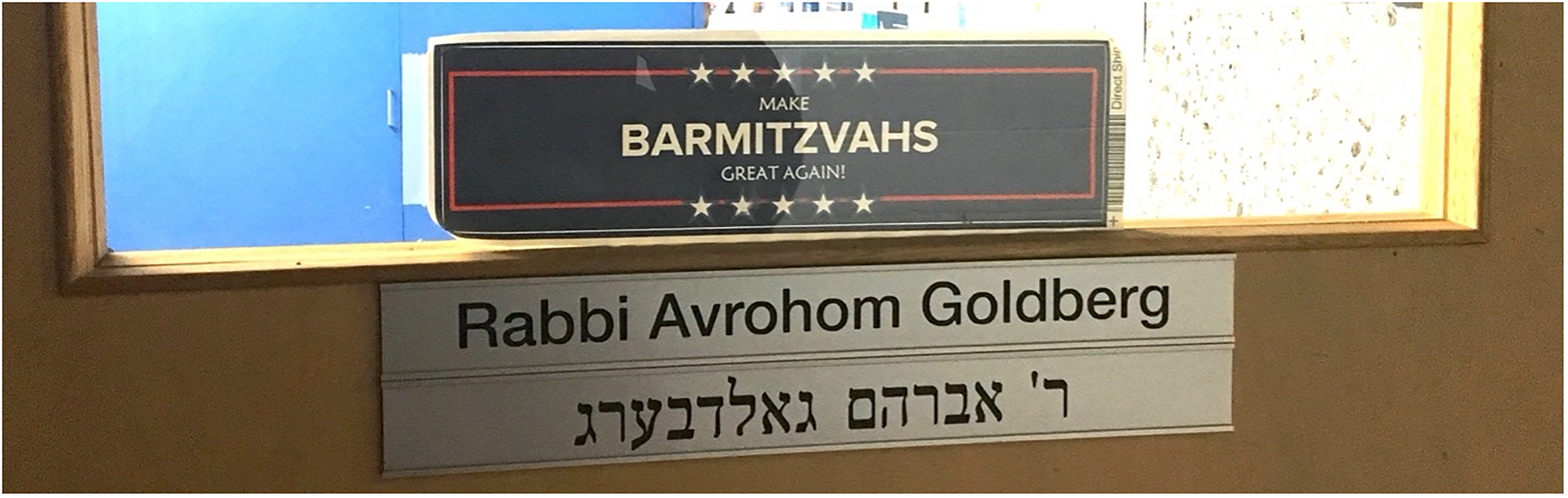
Signs on Mount Scopus Memorial College rabbi's door, 2018. Photograph: author.
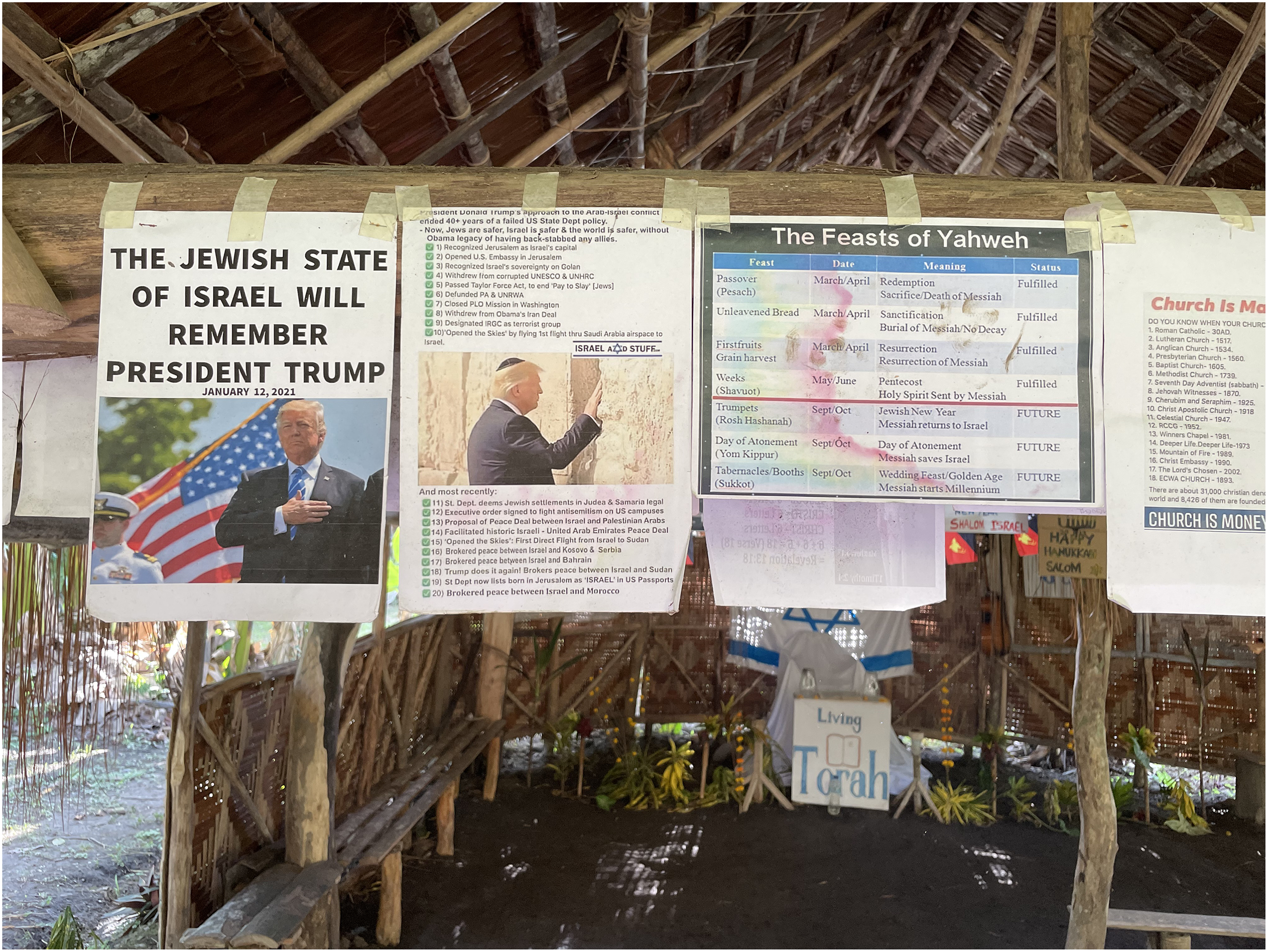
Living Torah Church, Kilimbit, Chambri Lake, East Sepik Province, 2024. Photograph: author.
Boochani has published many journalistic articles about his imprisonment on Manus Island but is critical of the fact that the language of political journalism simplifies and falsifies the truth. This echoes John Berger's assertion that the language used by the media, ‘is a voice at home with digits but not with living or suffering bodies’ (Berger, 2016, p. 139). The result is civic and historic amnesia to the extent that, ‘[t]he horizons of past and future are being blurred’ (Berger, 2016, p. 139). But Berger assures us that ‘we will have the courage to resist … in solidarity … [j]ust as we will continue indefinitely to praise, to swear and to curse in every language we know’ (Berger, 2016, p. 143). Or, in the words of Deakin University's Senior Lecturer in Indigenous Knowledges, Tyson Yunkaporta: If you want to take control of your life or work towards some kind of sustainable change in the world, you need to harness the power of story. Story-mind compares our stories with stories of other cultures to seek greater understanding of reality (Yunkaporta, 2019, p. 129).
I posit that it is Boochani as ‘othered’ artist, writing about the messiness of the daily life of an asylum seeker on Manus Island, that affords him the ability to write so powerfully, drawing us into his experience, and demanding that we take note.
In January 2019 No Friend but the Mountains: Writing from Manus Prison won Australia's most valuable literary award, the Victorian Prize for Literature. Boochani stated that it was ‘a paradoxical feeling’ to be so recognized by a government that has imprisoned him for six years (Wahlquist, 2019). In November the same year, he arrived in New Zealand to speak at a Christchurch literary festival. A statement to the press expressed an extraordinarily heterotopic vision of his relationship with Australia: Manus and Nauru are a part of Australia forever, and you cannot deny this. I don’t know that in the future I will have the opportunity or not to visit Australia. But I am Australian, as much as somebody like Peter Dutton. Because he played with the Australian international reputation, he damaged this country, he damaged this democracy. I, as a stateless person, will never go to Australia, but I spoke to Australians, I participated in events at universities, I wrote to the Australian people, to share the story of their Manus. I tried to make Australia a better place. That's why I am an Australian, as much as someone like Dutton (Doherty, 2019).
On arriving in Christchurch, Boochani vowed to continue to work for the freedom of those he left behind on Manus: It is like a duty, a responsibility, as a citizen in my future, to care about human rights. I will continue to work on this issue, because it is my life, I cannot walk away from my own life, my own experience. And Manus was my experience (Doherty, 2019).
December 1993
I’d been living in Edinburgh for a year and a half. I really liked it there – especially the sense of being part of traditional culture. I had a pair of Moroccan ceramic bongos that I’d play in a ceilihd band providing dance music for international students studying English.
But with the advent of my second winter came a sudden decision to leave. However, I wasn’t ready to return to Australia. Instead, I flew to Israel where I had ideas for settling and using art to contribute to the peace process. Within a week of arriving, I visited the aliyah office (aliyah – a Hebrew word meaning going up, used to designate Jews who move to Israel) to organize my papers to stay. I was told I should think about it and come back in a few months, which surprised me. I visited the Sinai and took the dog of the old school friend I was staying with for long walks in the orange groves. I was surprised at my friend's right-wing stance regarding relationships between Israel and Palestine. I remembered that when I’d previously been in Israel, the kibbutzniks I was staying with so hated a black dog that had strayed over from Syria, that they shot it, burnt it, and left its blackened carcass, legs pointing into the air, lying in the yard. I couldn’t speak Arabic or Hebrew; it wasn’t pleasant seeing so many young people carrying weapons. I left for ‘home’ after two weeks.
May 8th, 2017
I’m attending as much as I can of the inaugural Indigenous Yirramboi Festival. A cultural forum held at the State Library included an Indigenous-only session followed by one that was open to anyone. I arrived a bit late and rushed in, not wanting to miss out. A man at the door half went to stop me, asking if I was there for the cultural forum. I quickly said, ‘Yes,’ and went in. Once in, I realized that the Indigenous-only session was still running, and I left to wait outside for the open part of the program. Non-Indigenous people were then invited to enter but asked to sit at the back of the room. Once the session was over, I caught up with an old friend, Yorta Yorta/Gunaikurnai theatre maker, Andrea James. She was interested in how I felt about being excluded and then asked to sit at the back. I said it was fine, but actually it was more than fine. There's something in me that desires exclusion. Partly there's a sense that it's right that a people who have suffered and made to feel ‘less than’ should have a chance to assert themselves in whatever way they choose, including excluding others. Partly, I feel it as satisfying a deep-seated need in myself to not belong, to be excluded.
The front cover of No Friend but the Mountains: Writing from Manus Prison is ingenious (see Figure 3). It is about face size and is covered by a photograph of Boochani, his eyes staring out at the viewer's. The cover could be read as signalling that reading the book is entering into a dialogue with the author. Perhaps also that what is inside the book is really what is inside the author's mind.
Boochani celebrates the collaborative aspect of his book, especially valuing input from friends he communicates with in Iran (Boochani, 2018, p. xviii). He uses theatrical metaphors to describe a creative endeavour that both has borders as a theme and crosses borders by including disparate literary forms, writing that his book is: a playscript for a theatre performance that incorporates myth and folklore; religiosity and secularity; coloniality and militarism; torture and borders. … In Iran we would express our critical analyses in theatrical ways; for us, performance is a part of philosophy and advocacy. We act our ruminations, we embody our thinking … argument is narrative … theory is drama (Boochani, 2018, p. xxxii).
The translator of No Friend but the Mountains: Writing from Manus Prison, Omid Tofighian, reflects on the philosophical and political understanding of Australia's ‘border-industrial complex’ that developed between himself and Boochani and asserts that it is relevant to all nation-state border regimes (Boochani, 2018, pp. 361–2). Detained refugees can provide ‘crucial insight and critical tools for analysing the logic of border politics and its wider social and cultural impact’ (Boochani, 2018, pp. 363).
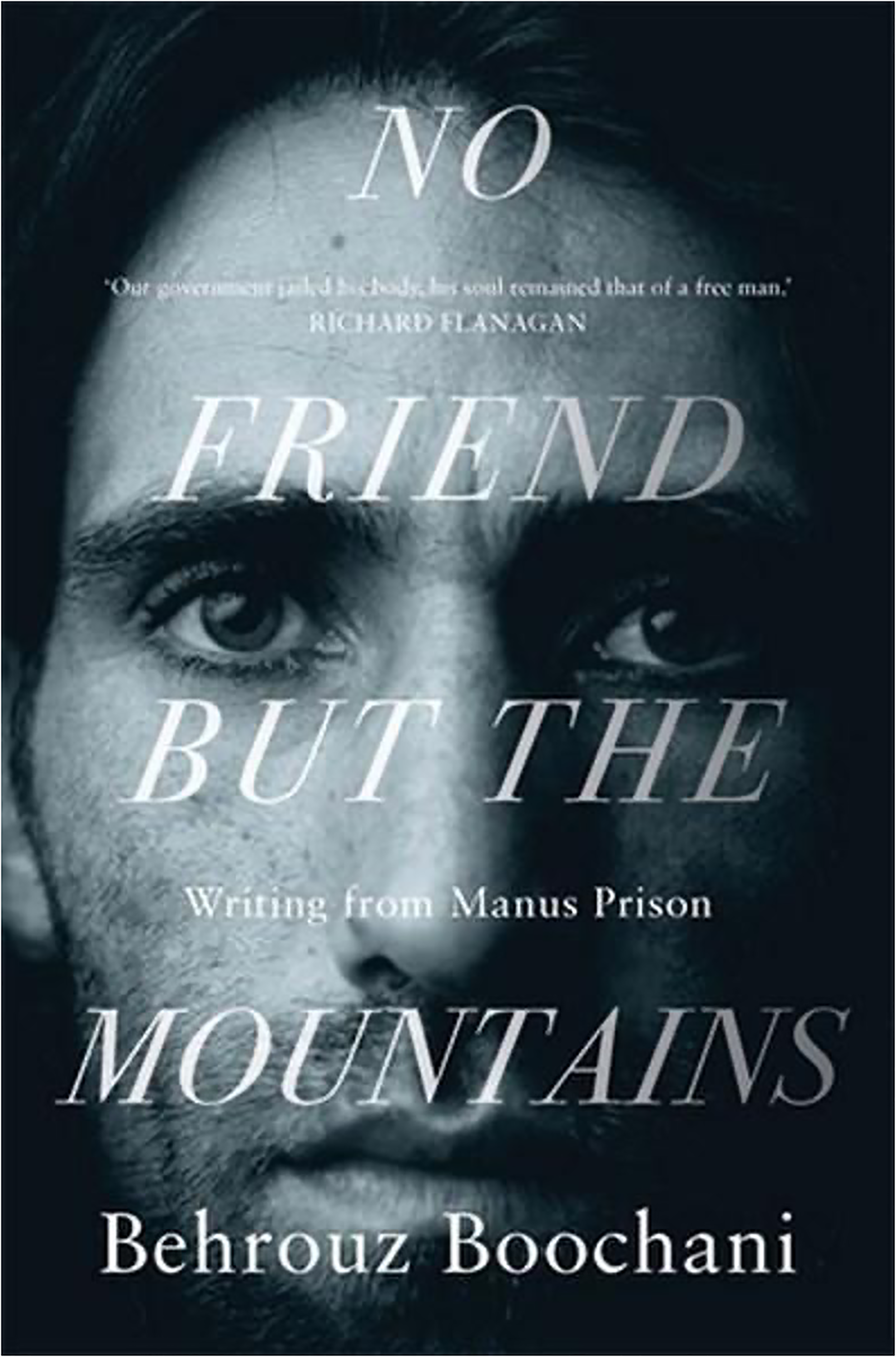
Front cover of No Friend but the Mountains: Writing from Manus Prison. Photograph: Jonas Gratzer.
In an interview, Australian author Richard Flanagan asked Boochani about the seemingly deliberate way he uses the tension between poetic and political writing to produce power and immediacy (Flanagan, 2022). Boochani responded by referring to the poetic traditions of both the Persian and Kurdish languages, and highlighted the fact that poetry has been an important factor in Kurdish resistance for a long period of time. The title of his book, No Friend but the Mountains, is a Kurdish motto, alluding to the way powerful nations have used Kurdish fighters, and then abandoned them. This has led to the development in Kurdistan of a sophisticated knowledge about resistance. Boochani stated, ‘I came to Australia, a liberal democracy, but they banished me. That culture of Kurdish resistance was borrowed and reproduced in Manus against another colonial system’ (Flanagan, 2022).
July 23rd, 2020
It's both Boochani's and my birthday, and the day he is granted refugee status in New Zealand. What a great birthday present!!!!!
In 2023 Freedom, Only Freedom: The Prison Writings of Behrouz Boochani was published, a compendium of Boochani's writing since 2013, interspersed with articles by others reflecting on his story and impact. In one of the last articles, originally published in 2020, Boochani reflects from his new home in Christchurch on his journey from Iran, where he ‘had little awareness of Australia’ (Boochani, 2023, p. 238) to his current understanding of how deeply his life has been affected by ‘Australia's history of White supremacy and settler colonialism’ (Boochani, 2023, p. 238), particularly the White Australia policy (1901–1973), instigated to bar non-White immigrants. He also highlights the story of the Stolen Generations, deploring the fact that although it was 2008 when the then Prime Minister Kevin Rudd apologized for the removal of Indigenous children from their parents, not only are Indigenous children currently disproportionally incarcerated, but Australian Governments have continued to separate refugee children from their families (Boochani, 2023, p. 240). He has said, ‘People in Australia think that they’re detaining refugees, but actually families suffer back home’ (Flanagan, 2022), and relates the cruelty of separating twins on Christmas Island, one of whom self-harmed (Flanagan, 2022). He writes: Australia is ‘a country where brutality and suffering are interwoven into the sociocultural fabric, ingrained in the soul of the nation’ (Boochani, 2023, p. 240).
Freedom, Only Freedom: The Prison Writings of Behrouz Boochani is introduced by prize-winning Wiradjuri author, Tara June Winch. She recognizes the importance of Boochani's writing as ‘anti-colonial truth-telling’ (Boochani, 2023, p. x), and a powerful response not only to ‘brutal border-control operations’ (Boochani, 2023, p. xi), but to the ‘structure of invasion’, ‘a mythology created during the frontier wars of Australia's colonial assimilation and annihilation of Indigenous peoples … which has perpetuated these events today’ (Boochani, 2023, p. xi). She asserts the connections between herself and Boochani as Indigenous writers, with oral traditions connected to the land and their ancestors (Boochani, 2023, p. x), and celebrates their affinity in ‘speak[ing] the language of testifying on our continent’ (Boochani, 2023, p. xi).
Having realized that ‘government propaganda’ was too strong for his journalism to effect change (Boochani, 2023, p. 69), and turning to creative expression, in 2017, Boochani felt the most important of his creative efforts was the film, Chauka, Please Tell Us the Time, co-created with Arash Sarvestani. The chauka is a local bird, ‘profoundly significant’ for the Manusians for the way it reliably tells time throughout the day. Chauka is also the name given by the prison authority to the solitary confinement cell. Boochani sees this profound disrespect as an example of how the Australian Government's colonial ideology ‘sacrifices’ both the refugees and the Manusian locals (Boochani, 2023, p. 70), a stance that is inherent in Australia's original decision to ‘desecrate’ the pristine ecology of the island by building the prison (Boochani, 2023, p. 97) without local consent (Boochani, 2023, p. 139).
In 2012, when the Manus Regional Processing Centre was founded, it was touted by the Australian and Papua New Guinean governments as part of an agreement that would bring development benefits to Manus and PNG. However, many researchers have shown that negative impacts have outweighed any benefits (Perera & Pugliese, 2021, p. 91; Rooney, 2021, p. 90).
Once the refugees were able to leave the confines of the prison, Boochani made friends with a local Manusian, Sam, who told him that Australia's lack of care for the locals extended to deciding not to invest in education and health as a way of keeping them under control (Boochani, 2023, p. 180). When Sam dies due to inadequate health care, Boochani writes, ‘No matter how many deaths have occurred on Manus, Sam's death feels the most tragic to me’ (Boochani, 2023, p. 180).
September 1997
It's the final year of my music degree. For my recital, I’ve decided to write songs to lyrics from an anthology of poetry published by Amnesty International, From the Republic of Conscience. The introduction commences:
During the Stalinist Terror, Anna Akhmatova queued for seventeen months outside the prisons of Leningrad. Together with thousands of others, she waited to hand in a parcel, or gain some news of a loved one. She wrote of the following exchange: ‘Beside me, in the queue, there was a woman with blue lips. She had, of course, never heard of me; but she suddenly came out of that trance so common to us all and whispered in my ear (everybody spoke in whispers there): “Can you describe this?” And I said: “Yes, I can.” And then something like the shadow of a smile crossed what had once been her face’ (Flattley & Wallace-Crabbe, 1992, p. 1).
February 2024
At Moresby Arts Theatre I’m honoured to be working with PNG playwright Nora Vagi Brash on her historical play, ‘Taurama’. I’m impressed when Nora tells me she used to be the country's Amnesty International representative, and tell her about the poetry book I love, now out of print. The following week I’m amazed when I discover a copy of From the Republic of Conscience in a tiny library in Taurama, an outer suburb of Port Moresby, and borrow it for Nora.
At the beginning of the No Friend but the Mountains: Writing from Manus Prison, Boochani boards a small boat in Indonesia with many refugees, bound for Australian waters. Soon they are surrounded by the boundlessness of the ocean (Boochani, 2018, p. 4). For Foucault the boat is the ‘heterotopia par excellence’, because it is ‘a floating piece of space, a place without a place, that exists by itself, that is closed in on itself and at the same time is given over to the infinity of the sea’ (Foucault & Miskowiec, 1986, p. 27). For voyaging refugees in this period, this displacement is extraordinarily heightened by the fact that while they are at sea the then Prime Minister Kevin Rudd introduced the policy that anyone seeking asylum in Australia by boat would be banned from entering Australia for life (Boochani, 2023, p. 9). To explain his understanding of this law, Boochani uses Giorgio Agamben's ‘state of exception’ theory (Agamben, 1999), whereby since WWI Western democracies faced with various crises use the language of war to justify an increase in government powers that can override constitutional, human or civil rights. For the refugees, ‘It's a blurry place … where we are both bound to, and at the same time abandoned by, Australian law’ (Boochani, 2023, p. 35).
In the here and now of living with desperate hope on an unseaworthy vessel, Boochani uses poetry to express a particular heterotopia:
When humans struggle over territory /
It always reeks of violence and bloodshed /
Even if the conflict is over a location the size of one body /
On a small boat /
And only for a period of two days (Boochani, 2018, p. 13).
March 2006
I’m doing the theatre-making course at the Victorian College of the Arts. Our teacher sets our first duet theme as the family. He speaks of siblings bickering in the back seat of the car as the origin of all territorial wars (especially before seatbelts became compulsory!).
However, in exhausted sleep, overcrowding forces the normal boundaries between families to break: ‘Men lie in the arms of another's wife, children lie on the chests and bellies of strangers. … The sovereignty of the waves has collapsed the moral framework’ (Boochani, 2023, p 16). The sinking boat is picked up by an Indonesian fishing vessel, and the refugees are ferried to a British cargo ship, then to an Australian Navy vessel for a transfer to Christmas Island, from where they are flown to Manus Island.
Boochani's description of the Manus Prison, ‘besieged by fences encircling its outer rim’ (Boochani, 2023, p 111), is highly evocative: ‘In addition to the torment produced by the oppressive enclosure of the prison fences, every prisoner creates a smaller emotional jail within themselves – something that occurs at the apex of hopelessness and disenfranchisement’ (Boochani, 2023, p 125). The need for actual solitude is intense. One place to be alone is the toilets: ‘With all the filth accumulated in these bathrooms, they are still probably the only place in the prison where the prisoners feel liberated, if only for a few minutes’ (Boochani, 2023, p 169).
May 1982
I’ve been having a spate of toilet dreams. They’re quite varied, but all variations on the theme of having to go to the toilet in a filthy public bathroom with no privacy. This morning I was woken up from such a dream by the sound of Dad's radio in the kitchen as he was having his morning muesli. My first reaction was extreme annoyance but then I started listening to the program – it was about the value of meditation. I immediately realized that meditation would be the antidote to these dreams. That the dreams were showing me that I needed more private space.
Even now, I still have disgusting public toilet dreams when I don’t get enough solitude.
However, the bathrooms are also crowded: There is no escape, not even one moment without sensing the presence of another person. But I learn over time how to stand alone, like the coconut trees inside the prison – how to exist in seclusion like them (Boochani, 2023, p 129).
The bathrooms are also the place where the men attempt suicide by cutting themselves with the standard issue razors: The place is a chamber that encapsulates history. The pain within the prison seems to pile up in these isolated spaces, here within the toilets … the location embodies an uncanny sense of awe, an eerie spirit (Boochani, 2023, pp. 170–1).
Though they will not admit it, the other prisoners are fascinated to witness the cathartic bloodletting. In a macabre version of Foucault's heterotopic mirror (a reflection is a ‘place-less place’ (Foucault & Miskowiec, 1986, p. 24) that none-the-less does impact on real space), Boochani describes ‘[t]he scene is a mirror that reflects the prisoners and they gaze into it’ (Boochani, 2018, p. 317). The word ‘scene’ is apt for this ritual boundary-breaching of the skin – ‘Self-harm has become established … as a kind of cultural practice’ (Boochani, 2018, p 317).
Being a writer, Boochani is fortunate to be able to both bear witness and protest by ‘cutting’ with words. He describes climbing onto the prison roof at night and reflecting on his life as if he were an observer from above, ‘cutting deep within oneself … like those moments after waking from a nightmare … depicting life itself’ (Boochani, 2018, pp. 263–4).
It is a period during which I am an emancipated being … I have made it up here, up into the ether, up on top of the prison, witnessing the spectacle … observing as I evaporate into the darkness (Boochani, 2018, p. 252).
Childhood constitutes our very first battle; childhood is a mythical tale, a complete epic. People are all born naked, … exposed; one is always on a journey. A childhood that replicates death, forever intertwined with death (Boochani, 2018, p. 263).
Life is full of islands; islands that all appear to be completely foreign lands in comparison to each other (Boochani, 2018, p. 265).
This writing is particularly evocative of Hetherington's interpretation of heterotopia in the way that it ‘unsettles the flow of meaning … like a collage, bring[ing] forward the out-of-place and offer[ing] it up as a basis for alternative perspectives and orderings, revealing what is hidden among the ruins … strange, unsettling, novel things that have a poetic wonder about them’ (Hetherington, 2002, p. 50).
Islands reappear at the end of No Friend but the Mountains: Writing from Manus Prison during the riot that leads to the killing of Boochani's friend, Reza Barati:
These men are reunited, but they are strangers /
They are remote and forlorn islands /
They are alone (Boochani, 2018, p. 354).
But blood crosses boundaries:
Alongside the walls of the tent enclosure /
Bodies on top of bodies /
A mixture of blood /
Different blood flowing into each other /
One blood / (Boochani, 2018, p. 353)
As does song:
The chant of a bird and the chant of a man /
Both chants blend into one / (Boochani, 2018, p. 356)
Writing is Boochani's primary artform, but he is also much connected to the performing arts (describing No Friend but the Mountains: Writing from Manus Prison as a playscript (Boochani, 2018, p. xxxii)). He writes about how he sings to keep himself sane, an escape from painful recollections of childhood (Boochani, 2018, p. 131). He is famous in the prison for looking through fences and singing (Boochani, 2018, p. 130).
Performance plays a boundary-breaking role within the Manus Prison. Boochani notes the excuses people normally use to celebrate: marriages; birthdays; and graduations (Boochani, 2018, p. 137) – all expressions of cultural border-crossings. The prisoners have no reason to celebrate, but do so as a kind of catharsis, yearning for ‘liberation through dance’ (Boochani, 2018, p. 133), undeterred by the guards, who watch with contempt (Boochani, 2018, p. 136). In the performance, ‘[e]verything is connected: joy, fear, hate, envy, revenge, spite, and even kindness’ (Boochani, 2018, p. 137).
The show starts with a group ‘like professional circus performers, or the sidekicks of a street theatre troupe’ singing and drumming on a white plastic table. Boochani comments that in normal life, this rowdiness would have been channelled into boundary-breaking ‘antisocial’ activities – smashing neighbours’ windows with rocks or ringing doorbells and running away (Boochani, 2018, pp. 34–5). But in prison the boisterousness is used to gather prisoners at the corridor of the star of the show, Maysam the Whore.
Maysam has such a special talent that Boochani wonders if his spirit could be inherited from the gypsy kowli peoples of Iran, ‘who conduct street performances and dance along the roadsides of strange cities’ (Boochani, 2018, p. 134). One night Maysam dresses as a religious cleric, his robes made from bedsheets. Whipping up the audience with dancing of ‘amazing speed’ (Boochani, 2018, p. 139), he jumps onto the table and demands silence from his ‘congregation’ to proclaim, ‘Because we are incarcerated men and there are no women in this prison, from this moment on I hereby ordain gay sex completely permissible’ (Boochani, 2018, p. 140). (Same-sex relations are criminalized in both PNG and Iran.) His proclamation ‘hits like a typhoon’ (Boochani, 2018, p. 140). Then he tosses off his costume and dances in red underpants, cut to look like women's underwear, which ‘raises the roof’ (Boochani, 2018, p. 140). Standing in direct opposition to the Manus system (Boochani, 2018, p. 141), Maysam gives the prisoners ‘a breath of fresh air’, by ‘tearing apart all the barriers that restrict and guide social engagement’ (Boochani, 2018, p. 185).
This is a classic depiction of a heterotopia. In The Badlands of Modernity: Heterotopia and Social Ordering, Hetherington analyses Paris’ Palais Royal, just before the French Revolution – a space of a marginal class of people about to lose their marginal status (Hetherington, 2002, p. 3). It was a place of performance, theatre and carnival where high and low were reversed, dirt was celebrated, the body lost its boundaries, and forms of authority and decorum were mocked (Hetherington, 2002, p 29). In this context, Hetherington discusses women's performance of themselves as Other as a way to empower themselves, constituting their identity on their own terms and consequently challenging ‘the spatiality of their location’ (Hetherington, 2002, p 27). In the Manus Prison, Boochani shows that Maysam the Whore was effective in doing just this.
Dec 12, 2022
Boochani is in Australia to launch Freedom, Only Freedom at the Wheeler Centre, defying Australian politicians’ avowal that he would never set foot in Australia – that's radical boundary-breaking right there! Unfortunately, I’m working out of town so it's me who joins via ZOOM, rather than being physically present with what I can none-the-less sense is an excitedly enthusiastic crowd.
Tofighian starts by emphasizing how the unreal, twisted and grotesque nature of border violence is explicitly expressed in Boochani's surreal writing as he searches for a new language of freedom through which we can not only better understand our personal relationships to the border industrial complex, but can also work towards systemic transformation.
Towards the end of the talk, I am moved that Boochani expresses his concern for Australian children of officers who worked in the prison camps: The warders ‘were traumatized as well … and that violence comes back to Australia’.
He ends by singing a beautiful song, introducing it with, ‘Music is a tool for preserving my personhood so I remain a human being’. Sung in Kurdish, most of us in the audience cannot understand the meaning of the song, but we feel the depth of feeling behind it. In the end, perhaps it is really through artistic expression that truth can exist beyond words…
Concluding remarks
As Peter Johnson has pointed out, overuse of the term heterotopia can lessen its usefulness (Johnson, 2013, pp. 796–7). It was partly for this reason I was reluctant to consider the Auschwitz Museum to be heterotopic (see above), even though it was a prison and is a museum, both of which spaces are included in Foucault's examples of heterotopia. However, both of these systems of ordering reality can be self-contained, and do not necessarily provoke a significant response in the person experiencing them. It is where my witnessing broke through into my experience of contemporary reality, challenging me phenomenologically, that I experienced Auschwitz as heterotopic.
It is for similar reasons that I think it is not particularly useful to consider the Manus Prison as heterotopic. But in Boochani's novel about the prison I believe he performs a creation of Manus Prison as heterotopia – although he was a prisoner for over six years, by his creative activity he takes control of ordering the space, creating it anew through his own eyes. I have shown that Boochani ingeniously satisfies Adorno's criteria for valid post-Auschwitz art, offering productive resistance through a unique artistic structure. Boochani, informed by his deeply personal experience, uses his work to offer a radical heterotopic vision that does not allow the reader's complacency, instead encouraging one to critically reflect on the entanglements and complicities of one's own subject position. His truth-telling challenges us to reach beyond our limits of empathy to build solidarity across borders and sites of struggle.
In this paper, reflections on Boochani's work are juxtaposed with my own experiences as a way of encouraging the reader to relate to the issues he raises through their personal stories. I have analysed Boochani's work using the concepts of heterotopic and border thinking; and attempted to create an article that embodies these concepts. My aim has been to show how these ways of truth-telling can empower a decolonial, contexualized and situated stance that truly values multiple perspectives.
Footnotes
Funding
The author disclosed receipt of the following financial support for the research, authorship, and/or publication of this article: This work was supported by the Federation University Post Graduate Award.

Author biography
Karen Berger is a researcher and theatre-maker, recently returned from volunteering at Moresby Arts Theatre, Papua New Guinea, with a focus on engaging young people. She has a particular interest in the potential of storytelling to empower community. Her MA and PhD investigated the use of performance to interrogate postcolonialism.