




Abstract
This article discusses the potential of Indigenous art as epistemic decolonial truth-telling regarding any future possibility of transitional justice. When practised in a manner that is attentive to Indigenous knowledges and methodologies, works of art can engage audience members with sensual and symbolic forms that elicit reflection, understanding, engagement and conversations complementing written and spoken communication. Through the painting Battle Mountain Memorial (2022) by Kalkatungu artist and co-author Ricky Emmerton, the authors explore how Indigenous art can subtly express profound truths regarding the misuse of colonial power. Through removing the shroud of silence in retelling the incident of the massacre of Kalkatungu people at Battle Mountain in 1884, this artwork is presented as a form of truth-telling, ensuring these events and truths are not overlooked or supplanted. Thus, this article contributes to discussions on interdisciplinary methodologies that incorporate Indigenous and non-Indigenous research methods, and on the interaction of visual, written and oral knowledges.
Introduction
Indigenous art can act as a powerful medium through which the acknowledgement and retelling of past injustices can be communicated; in short, as a vehicle for decolonial truth-telling in the service of justice. As Schmid (2008) suggests, transitional justice is a process of ‘acknowledging, prosecuting, compensating for and forgiving past crimes during a period of rebuilding after conflict’ (n.p.). Through the interweaving of personal narrative and academic research, Kalkatungu 1 artist and co-author Ricky Emmerton discusses his painting Battle Mountain Memorial (Figure 1), which acknowledges and depicts a massacre of Kalkatungu people in 1884. The painting is a truth-telling of the massacre from a Kalkatungu perspective, acting as a visual instantiation and affirmation of Indigenous knowledge. Indeed, historians have contrived the ‘truth’ of the colonial frontier, which became a place of frontiersmen conquering the land and its peoples with heroism – against an aggressive force of Indigenous warriors, who were erroneously viewed as defeated. The painting acts as a counterpoint to this colonial narrative, and therefore as part of decolonising truth-telling. It was included in Emmerton's masters research to provide some historical background of Kalkatungu resistance to the invasion and occupation by non-Indigenous people.
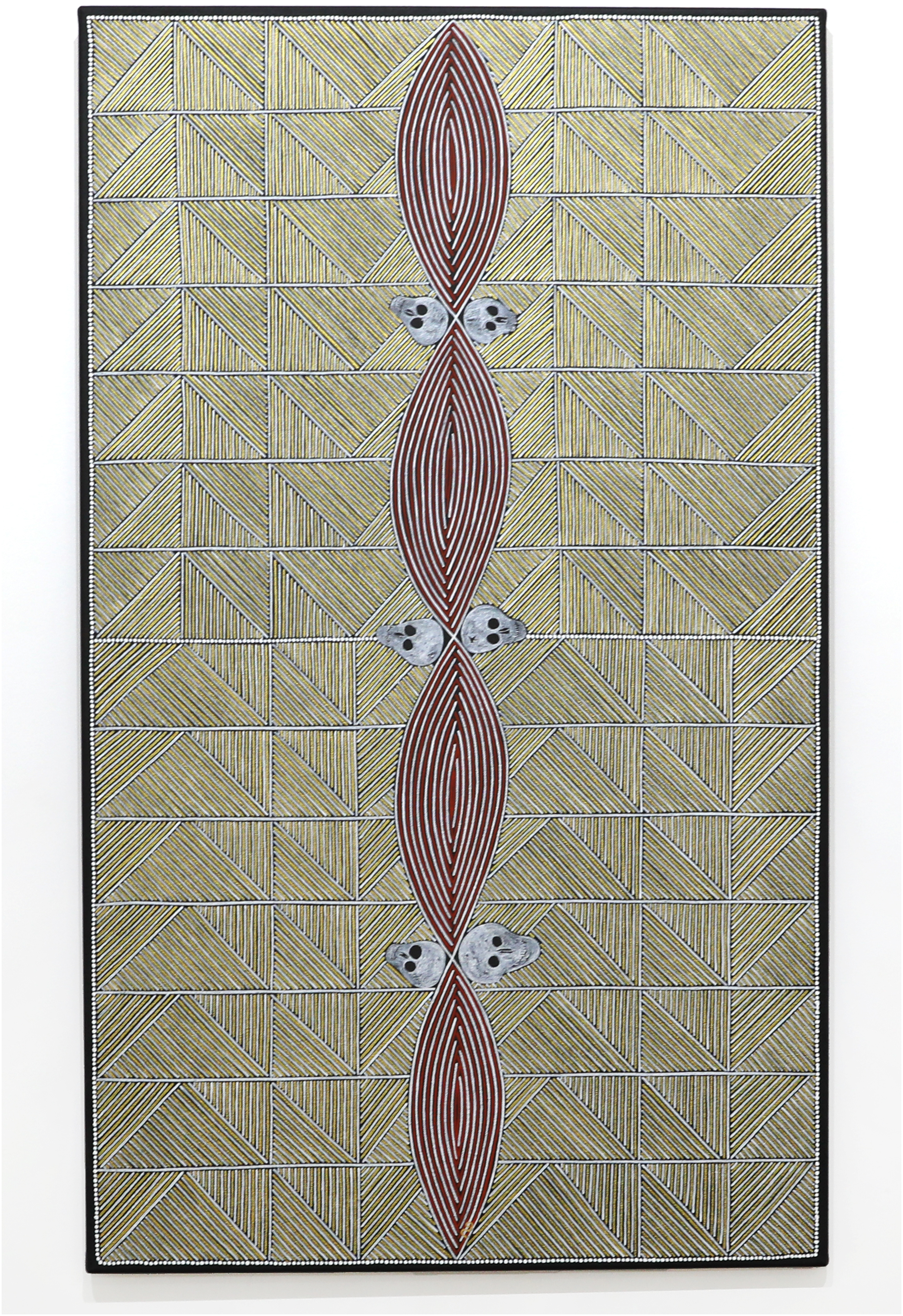
Battle Mountain Memorial, 2022, acrylic on canvas, 112 × 66 cm. Photo: Daniel Qualishefski.
I n the first part of the paper, Emmerton personally introduces his story and approach to his art practice, 2 which is traditional/contemporary or neo-traditional – a continuance of culture in the form of contemporary art. Then, we discuss the interdisciplinary methodology of ‘informed-practice-led research’ that influenced the creation of the artwork, and involved the incorporation of Indigenous and non-Indigenous research methods. Following the methodology, we introduce the historical context of the Battle Mountain massacre. To contextualise the artwork's significance, we then discuss the role of truth-telling in decolonial struggles, including the role of memorials in these processes. Battle Mountain Memorial is entitled ‘memorial’ to elevate it from a painting into an enduring object that functions as a memorial in the sense that it is a catalyst and a reminder of Kalkatungu resistance and survival. The final sections discuss how Indigenous art, including Battle Mountain Memorial (Figure 1), as a decolonising truth-telling practice, can underpin the ongoing resistance to colonisation and provide a foundation for the possibility of future social justice. Indigenous art, in its contemporary form, exists because Indigenous people see the value of a visual expression of culture as survival, revival and renewal: it is also a powerful statement of the need to decolonise and expose truths in the quest for justice.
My story and approach to art
My grandmother was a ‘bush-baby’, born in the bush on a remote cattle station in north-west Queensland. She was Injilinji by descent and became Kalkatungu through her marriage to my grandfather, who was a Kalkatungu man. She therefore insisted that we were Kalkatungu. My grandparents, along with other family, relocated to Townsville in the early 1950s. Here, a generous farmer allowed them to live on his property outside town. The family constructed a small corrugated-iron shack where they were happy to have accommodation, find work, fish and hunt for food wherever they could to support their growing family. My grandparents maintained their heritage, and along with other Townsville-based Kalkatungu families have passed on their pride of being Kalkatungu, albeit diasporic in nature.
Kalkatungu people are proud of our ancestors who are remembered as resilient, intelligent, creative and humorous people. It was this essence which enabled my grandparents to raise their children, and each subsequent generation, with the skills to negotiate the ‘white world’ by maintaining the pride, patience and strength received from our ‘black world’. The Battle Mountain massacre story is an important source of these virtues. The horrific events of colonisation and the continued suppression of Indigenous rights may seem remarkable; however, it confirms the legacy of our enduring principles and efforts to ‘un-silence’ our voices and undo the silencing.
Decolonising truth-telling is a recurring element in researching themes for my artworks. As is the case with Battle Mountain Memorial, uncomfortable truths are retold in some of my artworks because these events offer an opportunity for sharing knowledge, gaining knowledge and reiterating the position of Indigenous peoples in asserting our voice to complement understanding of past events in order to prevent future events of equivalent reckoning.
Art as decolonising truth-telling is a vehicle for our rights as Indigenous traditional custodians who have suffered, and continue to suffer, from the invasion of our lands, leading to loss of culture and the dehumanising of our people, subjugating us into western thinking and rendering us a voiceless, powerless minority in our own land. We, Indigenous Australians, need to develop our own ways of ensuring a strong future for the next generations.
Methodology: informed-practice-led research
Indigenous artists/academics can play an important role in developing methodologies related to their fields that question the relevance of established methods. As an artist who researches, I chose the methodological approach of practice-led research. This arts-based research method involves producing art, the underlying psychological and philosophical input of the artist, and taking into account how the research is influenced by the art's theme, meaning, interpretation.
My masters research developed a new research method that extended the paradigms of practice-led research. My project started with a practice-led research methodology; however, I was fortunate to reconnect with my Uncle Jimmy, a wise and respected Kalkatungu Elder. He gave me his blessing to take up the mantle of sustaining and promoting our culture through my art and academic research. I therefore found it necessary to employ a new integrated approach to my research that made me rethink the make-up and outcomes of my exegesis and artwork. I chose to keep the practice-led research methodology and alter it to my own method of informed-practice-led research. This article has further enabled an articulation of my Indigenous perspective on decolonising truth-telling where traditional knowledge ‘informed’ the theoretical content, aesthetic style and context of my paintings.
I started my research through a process of utilising the drawings and writings of amateur anthropologist Walter E. Roth (1897, 1904) as a valuable primary source of information on Kalkatungu artistic culture. Roth practised as a medical doctor in the north-west Queensland region from 1894 to 1897. His medical duties were not burdensome and so he began to conduct research on the local Indigenous people in his free time, including the Kalkatungu. Ethnographical Studies Among the North-West Queensland Aborigines was published in 1897. In the same year, the Protection Act was created (Aboriginals Protection and Restriction of the Sale of Opium Act 1897 [Qld]), and Roth's anthropology work qualified him subsequently to be appointed as the first Northern Protector of Aboriginals the following year in 1898 and Chief Protector in 1904 (B. Reynolds, 1988). Roth's Queensland Aborigines is among the earliest studies of its kind and a remarkable ethnographical study, considering he was an amateur. The late Professor Barrie Reynolds wrote in the foreword to the facsimile edition of Roth's ethnographic series that despite being ‘untrained in these fields … [t]heir importance is such that no anthropologist, archaeologist, historian or linguist concerned with Aboriginal north Queensland can afford to ignore them’ (MacIntyre, 1984). Roth was an accomplished illustrator and his drawings in Queensland Aborigines, along with knowledge from my Elders ‘informed’ the aesthetics of my ‘practice’ which then ‘led’ to further research.
While drawing on Indigenous methods of research, I also engaged in a reflexive process of practice-led research. Robyn Glade-Wright (2017, p. 94) explains that ‘in a reflexive process, literature about theories of art and the context of the art informs practice. In turn, the practice informs the establishment of a conceptual basis for the work, which informs theory.’ (Mackenzie & Knipe, 2006). Thus, the interpretivist/constructivist method involves personalised meaning. This might be a thought, a hunch or what Collingwood describes as a ‘psychic disturbance’ (Collongwood, as cited in Graham, 2005, p. 42). The creative process does not happen in a vacuum. This psychic disturbance motivates the artist to create artwork to address their concerns: ‘whilst the significance and context of the claims are described in words, a full understanding can only be obtained with reference to the creative outcomes’ (Candy, as cited in Glade-Wright, 2017, pp. 90). Art, and writing about art, is not static but a dynamic evolving classification. Through a process of imaginative construction or self-discovery an artist adds value through sharing and relating the personal to the public. As the artwork develops and is expanded, a ‘pattern of meanings’ (Creswell, as cited in Mackenzie & Knipe, 2006, p. 196) advances which can create new understandings of the topic.
My research for the artwork presented in this paper involved collecting and repatriating the decorative arts of the Kalkatungu from sources such as Roth (1897, 1904). This was in combination with talking to my family who assisted in relating documented information to traditional knowledge. This informative method expanded my knowledge of the Battle Mountain massacre .
I also draw from Indigenous Research Methodologies (IRM). Originally laid out by Linda Tuhiwai Smith in 1999, IRM have at their core an Indigenisation by ‘utilizing decolonizing methodologies’ (Drawson et al., 2017, p. 4) and incorporating Indigenous perspectives. Methods described by Indigenous Australian academics such as Karen Martin andBooran Mirraboopa recognise the value and importance of an Indigenous voice. Martin and Mirraboopa (2003, pp. 213–214) explain that it depends on the research being conducted; however, there must be protocols set in place, which ‘are part of the research findings and strongly reflect the relational ontology, epistemology and methodology employed through the Indigenist research framework’. That is because Indigenous culture is built on relationships to the natural environment: the land, the plants, the animals and ultimately to each other. Indigenous research paradigms and methods are formed by a reflexive process and relational ontology, epistemology and axiology. These philosophical systems have been identified as ‘Ways of Knowing, Ways of Being and Ways of Doing’ (Martin & Mirraboopa, 2003, p. 208).
By combining knowledge from my family with documented sources, I combined Indigenous and non-Indigenous methodologies. Although Shawn Wilson (2008) has argued that research could be purely Indigenous without any reference to western paradigms in their current position, and also (p. 12) suggests that even collaborative methodologies can be problematic because you ‘can never really remove the tools from their underlying beliefs’, some scholars have suggested that the ‘tools’ in themselves are not necessarily inherently bad (Nakata, 2007). Indeed, in some cases there is no other alternative but to combine methodological approaches. As Smith (1999, p. 39) states: Decolonization, however, does not mean and has not meant a total rejection of all theory or research or Western knowledge. Rather, it is about centring our concerns and world views and then coming to know and understand theory and research from our own perspectives and for our own purposes.
In my case, the combination of methods has proven both necessary and effective. It is necessary in that examples such as Roth are some of the only surviving sources of knowledge, and effective in that I have incorporated western and Indigenous research into a cohesive method.
Historical context behind Battle Mountain
The colony of Queensland separated from the colony of New South Wales in 1859, establishing its own policies for the treatment of the Indigenous population. One notable policy was the retention of the Native Mounted Police (NMP). The NMP consisted of non-Indigenous officers and Indigenous or ‘native’ troopers. The Indigenous troopers were recruited from distant lands where there were no ties to the lands they patrolled.
In the late 1800s the pastoral industry was the major economic activity worth 71.49% of the revenue of Queensland, and this gave pastoralists the political power to advocate for the NMP to protect them and their assets from Indigenous incursions (Armstrong, 1980, p. 80). What was not so clear was the unwritten policy of extermination of the Indigenous inhabitants under the guise of protecting the occupiers, along with the views of the Indigenous troopers themselves, which went unrecorded and so were effectively silenced (Richards, 2008). The NMP were viewed as an instrument of social order and ‘conformity through any means necessary’ (Bleakley, 2018, p. 44), creating fear amongst the Indigenous people by committing massacres (also termed in the following as reprisals, dispersals and/or punitive expeditions). The actions of the NMP have been understated for reasons such as failing to submit regular truthful reports, denial by government officials and historians, and pressure from the pastoralists’ political majority. As Armstrong (1980, p. 170) explains: ‘The Native Mounted Police, in its capacity to make dispersals and punitive expeditions, assumed the character of a para-military organization administering a crude form of justice and largely not responsible for its actions.’
Early explorers mapped the land, which enabled pastoralists to occupy the best positions. Kalkatungu Country was seen as ideal for grazing cattle and sheep despite the fact there are not many permanent water sources in the region, and those that exist are very sacred to our people. The invasive pastoralists’ livestock polluted the water and heavily grazed the grasslands, which reduced the capacity of the native plants and animals to occupy the same area, placing pastoralists and Kalkatungu at odds with each other. Therefore, cattle and sheep were speared for food and herds driven off by Kalkatungu, with reprisal attacks swiftly undertaken by the NMP and pastoralists (Armstrong, 1980, pp. 90, 126; Fysh, 1950). A reprisal or ‘dispersal’ consisted of the NMP, along with the pastoralists and prospectors, who would pursue Indigenous people, often killing great numbers of men, women and children (Armstrong, 1980, pp. 128, 170–172). Armstrong (1980, p. 111) insightfully noted that ‘[a] “dispersal” was, in fact, a camouflage for the indiscriminate killing, rape and child braining’. The Kalkatungu escalated the situation, not only due to sacred waterholes being polluted, but also in an attempt to wipe out the invaders who were committing atrocities that would now be labelled as war crimes (Fysh, 1950). The confrontations and massacres were becoming protracted, ultimately culminating with the battle at Battle Mountain.
The Battle Mountain massacre
The following account of Battle Mountain first appeared in Taming the North by Hudson Fysh, first published in 1933. Fysh chronicles the life of Alexander Kennedy who, in the 1870s, along with other pastoralists, took possession of land which belonged to the Kalkatungu people. Fysh relied on the eyewitness, but hardly impartial, testimony of Kennedy. Historians who followed have relied on Fysh's account of Battle Mountain, with some additional details, including Pearson (1949), Blainey (1970) and Armstrong (1980).
In 1884 some Kalkatungu challenged the NMP's Sub-Inspector FC Urquhart to ‘come out into the hills, and they would finish him off’ (Armstrong, 1980, p. 136). The invasion was led by Urquhart and his NMP troopers who joined forces with a civilian posse of pastoralists and prospectors including Kennedy in the pursuit. They finally tracked down the Kalkatungu, who had taken up a ‘defensive position on a boulder-studded hill, which is known to this day as Battle Mountain’ (Armstrong, 1980, p. 142). The invaders took up their position below and Urquhart proclaimed ‘Stand in the name of the Queen!’ (Fysh, 1950, p. 183), which was met with howling contempt and a hail of spears and rocks. Urquhart ordered his men to advance up a steep ridge; however, he was struck in the face with a lump of ant-bed and rendered unconscious. After Urquhart recovered, he devised a flanking movement that distracted the Kalkatungu from maintaining their position. Then, according to the reports, the Kalkatungu suddenly formed ranks and with large spears held horizontally out in front advanced in lines down the ridge only to be gunned down. It was also reported that ‘another “clearing up” operation’ went on for several days afterwards (Fysh, 1950, pp. 183–184; Armstrong, 1980, pp. 140–145). There are no reports of any fatalities amongst the invaders and the numbers of Kalkatungu killed is unclear: from as few as 30 (Lyndall et al., n.d.) to possibly hundreds (Blainey, 1970, p. 23; Armstrong, 1980, pp. 170–172). Fysh (1950, p. 184) describes ‘a number of natives falling’, and Armstrong concluded that ‘a slaughter of tremendous magnitude’ (1980, p. 144) took place. It is indisputable that with such an intense battle and ‘clearing up’ operations many Kalkatungu died.
Battle Mountain has been portrayed as an exemplary battle celebrating the bravery of the invaders and the Kalkatungu for bravely putting up a fight, only to concede defeat. Armstrong (1980, p. 140), for example, described Battle Mountain as ‘The Kalkadoons’ Last Stand – A Rendezvous With Destiny’. Elizabeth Furniss (as cited in Coombes, 2006, p. 173) identified why this label is not accurate when she stated that ‘critical frontier narratives, for example, typically romanticise [I]ndigenous peoples and lament their destruction by the forces of European expansion [through the] … heroic acts of the first pioneers and explorers in discovering and settling’ (original emphasis). The Kalkatungu resisted the invasion for decades (c. 1860–1890) in a protracted war, aided by the fact that they belonged to a large geographical area with parts that were inaccessible on horseback, providing a ready retreat.
There are many other stories of Indigenous people who resisted, and Furniss (2001) has identified that some historians have contrived the ‘truth’ of the colonial frontier, which becomes a place of frontiersmen conquering the land and its peoples with heroism – against an aggressive force of Indigenous warriors. This is a narrow view of history to justify the slaughter, casting Indigenous people such as the Kalkatungu as ‘the most savage of the Aboriginals under consideration’ (Roth, 1897, p. 135), or claiming ‘that the Kalkadoons were a tribe above the average in savagery and bravery’ (Fysh, 1950, p. 184). Battle Mountain in the frontier narrative context placed the Kalkatungu as a formidable enemy that was overcome by the invaders with ‘heroism, bravery and ultimate moral (and economic) triumph’ (Coombes, 2006, p. 177). The Kalkatungu, however, were only protecting their own lives, land and liberty from an unrelenting assault. Ironically, although there has been denial and silencing of atrocities, historians have helped ensure that stories such as Battle Mountain have remained in the collective memory and are now being revisited by Indigenous and non-Indigenous people as examples of the resistance by Indigenous people to the violence associated with colonisation: dispelling myths about the occupation of Australia as benign and peaceful with Indigenous people having ‘no influence on Australian history’ (Jenks, 1912, p. 16), or merely as ‘a codicil’ (Barnard,1962, p. 647).
While some historians have conducted extensive research into the atrocities of frontier colonial violence, the lack of official evidence has dissuaded others from accepting the evidence, particularly of the numbers killed. Bottoms (2013) states: ‘I have mapped only some of the massacres in colonial Queensland; it is my belief that it does not represent the true nature of violence on the frontier’ (p. 221). Evans & Ørsted–Jensen (2014) reveal that NMP records ‘have gone mysteriously missing’ (p. 2). Thus, we will never know the true extent of colonial massacres in Queensland. However, as Evans and Ørsted-Jensen (2014, pp. 6–7) conclude, for all participants, this was also, in immediate terms, ‘our’ Great War – a war for both the defence and conquest of Australia. Though the Australian War Memorial presently evades the issue with an ideological obduracy, it must eventually be faced. For only then, armed with an encompassing integrity, can we move forward to a process of nation-building that is ethically-based rather than being, as at present, merely ethnically constructed.
Thus, even though the violence did occur, it continues to exist in a covert political guise. Notwithstanding, accepting the violent invasion and slaughter of Indigenous people is inadvertent evidence of sovereignty because Indigenous people defended their land, meaning we were here first.
Battle Mountain is now sacred and revered by Kalkatungu people as a symbol of resistance. However, the invasion and war finally left the Kalkatungu unable to live a completely traditional life. As more land was taken, the survivors had little choice but to gather at pastoral stations and beg for insufficient rations in exchange for hard labour. For the Kalkatungu people to survive, our ancestors worked hard at maintaining cultural integrity as best they could. Today there are still efforts to revive the language and preserve knowledge of traditional material and spiritual culture. After Battle Mountain any further resistance by the Kalkatungu was unwinnable through violent means, the inevitable result being an attempted assimilation into a foreign culture, and for me to now take up the mantle and proudly showcase the continuation of Kalkatungu cultural heritage.
Our identity as Indigenous Australian peoples has moved quickly from a traditional mode to massacres and retaliation, motor cars and assimilation. However, there is incalculable value in Kalkatungu culture, and it is through art that I can best explore, express and share it. Foley (2023, p. 58) calculates the sacrifice to history her own Badtjala people made and the power of art as truth-telling when she states: ‘My life's mission has always been to write Badtjala people back into the narrative, back into the visual landscape, and back into the history of Australia, with dignity as a strong people.’ Art is a tangible form of individual expression and interaction with traditions that can help shape and guide our people into a strong future, secure in the knowledge of our long history of a spiritual connection to the land. It is hoped that recounting events such as Battle Mountain through art will aid the lack of official truth-telling and may help in dismantling the established views of the denial of atrocities and racism that formed colonial Australia and that underpins much of today's Australia.
Truth-telling and its role in decolonising
Decolonising truth-telling may be described as counteracting W. E. H. Stanner's (1969, p. 18) term the ‘great Australian silence’, whereby historians and educators have denied and silenced the extent of violence associated with colonisation. Wadawurrung artist Carol McGregor (2019, p. ii) exposes truths in her efforts to revive cultural practices in a process she classifies as ‘un-silencing … to describe the personal and political acts needed to undo colonial structures and thinking’. The great 'un-silencing’ of decolonisation and truth-telling have become broadened to include more than correcting the narrative that placed Indigenous peoples in what historian Henry Reynolds (1972, p. ix) described as ‘fringe-dwellers of Australian historiography’. Work is still being done in reinterpreting history and this is vital. Smith (1999, pp. 29–30) notes: Indigenous peoples have also mounted a critique of the way history is told from the perspective of the colonizers. At the same time, however, indigenous groups have argued that history is important for understanding the present and that reclaiming history is a critical and essential part of decolonization.
Through my research and art practice, which I narrate next, I engage with this vital work.
Compared to other countries’ efforts, there has been an unwillingness in Australia to admit to past nefarious actions. Internationally, truth-telling commissions have been established or proposed in Canada, Latin America, Africa, Asia, Europe and the Middle East, although unfortunately ‘the settler states of North America [or perhaps more accurately the USA] and Australasia are conspicuously absent’ (Slotta, 2015, p. 130). Truth-telling can lead to substantial achievements, as David Crocker (1999, pp. 21–25) states: [T]ruth may contribute to just punishment, fair compensation, and even reconciliation. This public dialogue may be one of the ingredients in or conditions for social reform that replaces a culture of impunity with a culture of human rights.
There are increasingly more efforts, such as the Bringing them Home report by the Aboriginal and Torres Strait Islander Social Justice Commission (1997), which heard evidence from the Stolen Generation of the lasting effects of historical child removal policies. This action led to an apology by the government in 2008 and reparations to victims. However, while the apology and social justice commissions enabled victims to voice their experiences, there was little in the way of structural change in policy and attitudes. The removal of children has largely continued without consultation between Indigenous families and government agencies.
The legacy of colonisation has influenced subsequent governments, institutions and individuals who may still assume that Indigenous people are inferior due to past ideas that inaccurately placed Indigenous people at the bottom of a hierarchical order. As Smith (1999, p. 19) argues: ‘Imperialism still hurts, still destroys, and is reforming itself constantly.’ This imperialistic conception of a hierarchical order was first based on the assumption that ‘Indigenous Australians were living in a “savage”, pre-civilised state where the construction of “savagery” was used to justify the concept of terra nullius and the imposition of “civilisation” on Indigenous Australians’ (Buchan & Heath, 2006, pp. 5–7). Imperialistic notions of superiority were bolstered by pseudo-scientific ideas of a ‘Great Chain of Being’, with Indigenous peoples delegated to the sub-human status of an inferior race or mere animals (R. McGregor, 1997), destined to ‘fade away’: an idea that was further reinforced by later Social Darwinist theories of a ‘doomed race’ (Rogers & Bain, 2016, p. 84). Although it has been disproved, the ideas of Social Darwinism instilled institutional racism in the form of a denial of frontier violence, excluding it from history by turning the attempted genocide of Indigenous Australians into ‘a supposedly natural process of extinction, rather than a settler-driven process of extermination’ (Rogers & Bain, 2016, p. 84). Similarly, images and tropes of ‘vanishing Indians’ in North America were used to promote the myth that Native Americans were also a ‘doomed race’, reinforcing the power of visual images, literature and art to create and perpetuate negative stereotypes and unjust world views (N. Brown, 2019; Hawley, 2016; Pappas, 2017; Romero, 2010; Sayre, 2015). Conversely, it also points to the power of art to create and promote positive images of Indigenous knowledges. The consequences of racist colonial notions and the current unwillingness of governments to address inequality and truth-telling is why artworks can act as ‘political documents’ (Chrysanthos, 2019, n.p.). in the form of resistance and education.
Indigenous research and art facilitate truth-telling when framed by decolonising methodologies, or as Larissa Behrendt (as cited in Archibald, 2019, p. 183) stated: ‘Indigenous storytelling is the counter-narrative to colonization.’ In recent decades, with continuing resistance to colonisation and its continuing reinvention of supressing Indigenous voices, Indigenous scholars are in a position of continuing to demand respect and equality through a re-evaluation of colonial policies and attitudes from an Indigenous perspective. Indigenous scholarship is reaffirming ‘Indigenous standpoint theory’ which is ‘challenging the assumptions around neutrality that are actually a way of reinforcing power structures of colonization and patriarchy’ (Behrendt, as cited in Archibald, 2019, p. 176). For instance, decolonising in academic settings has been equated with ‘strategies to combat assimilation’ (Archibald, 2019, p. 11). Overall, practising decolonisation in research can and should be a part of the ongoing resistance to colonisation, that can contribute to possible futures of social justice and truth-telling.
The prospect of social justice and truth-telling remains only a possibility, however, given the recent continued silencing of Indigenous voices through the ‘No’ vote to the Referendum in Australia. As non-Indigenous Australian artist and academic Rachel Joy (2019, pp. 235–238) who takes the position of ‘Occupier’ states: In Australia the ontological position of the Occupier has rendered the collective memory of invasion and occupation faulty or forgotten … What I’m trying to do is to find a way to express through my art what it is to be an Occupier Australian and how we might become something better.
Therefore, it is important that in research addressing decolonisation, truth-telling and social justice, people contextualise history and their place in it. This acknowledgement becomes effective when there is ‘growth of historical awareness and a far more realistic understanding of the whole process of colonisation’ (H. Reynolds, 2021, p. 8). Similarly, Brenda L. Croft (2015, p. 238) observes that within the art world there is also ‘an absent (silent, oppressed, dispossessed) history of adequate representation through critically assessing the distinct capacity of visual representation to address the chasm existing between Indigenous and non-Indigenous’.
Structural change in political arenas and attitudinal changes in social spheres can be achieved through education. Art can educate by reaching these multiple levels of society as an important method of truth-telling, enhancing understanding and empathy. Indigenous art has shown the value of Indigenous culture as an Australian form of ‘un-silencing’ the colonial narrative. Indigenous peoples along with Indigenous and non-Indigenous academics are at a stage where truths are becoming undeniable facts of history. The next stage is to account for and accept past wrongdoings and work towards an inclusive future.
Memorials as decolonial truth-telling
Battle Mountain Memorial is titled ‘Memorial’ to elevate it from a painting into an enduring object that functions as a memorial, which is as a catalyst and a reminder of Kalkatungu survival 140 years later as I have painted it in the present. The term ‘memorial’ describes a thing that commemorates a historical event for people to remember, and perhaps also describe the event. Memorials of uncomfortable histories enable people to contemplate difficult subjects, such as war. By helping people to understand an event, it will enter the collective memory where people, present and future, can process and evaluate the causes and consequences. Indigenous peoples have had little opportunity to memorialise colonial warfare by erecting monuments, memorials, statues or obelisks in public places. One of the few memorials to colonial frontier conflict is the Kalkatungu Memorial to Battle Mountain. Opened in 1984 (the centenary year), it still remains one of few memorials of its kind. Acknowledging the conflict and massacre at Battle Mountain in 1884, the plaque declares: ‘The spirit of the Kalkatungu tribe never died at battle, but remains intact and alive today’ (Gibson & Besley, 2004, pp. 52–53). The memorial itself stands near Kajabbi some 20 kilometres from Battle Mountain and consists of a simple stone cairn mounted with a plaque that ‘explicitly links events of the past with political issues of the present’ (Gibson & Besley, 2004, p. 52). The inspiration flowed from Elders such as my Uncle Jimmy and the newly formed Kalkatungu Tribal Council. The memorial is included in the Monument Australia website (Monument Australia, 2010–2024), and although there is currently no national scheme or place of remembrance of frontier conflicts in Australia, they remain outside the scope of the national memorial site in Canberra. There are efforts of regress including the touring art exhibition Art in Conflict, which is a step in the right direction. However, suggestions of a separate site for frontier conflicts could contribute to more segregation. Instead, the inclusion of Indigenous stories is beneficial to reconciliation, even though they are hard truths. Kalkatungu are fortunate we have a memorial and documented and oral evidence of past atrocities. By helping people to gain an understanding of violent and abhorrent acts of the past, Battle Mountain Memorial serves to prevent similar atrocities by contributing to a rewrite of Australian history.
The role of contemporary Indigenous art in decolonising truth-telling
Indigenous art should be seen as authentic, built on tradition, and as a continuance of culture. In their contemporary forms, Indigenous artworks exists because Indigenous people see the value of expressing cultural survival, revival and renewal. Art plays an important role in Indigenous culture and it is through this media that the beauty, depth and integrity of culture can be shared with a wide audience. Marcia Langton (as cited in Grossman, 2003, p. 110) made the distinction between Indigenous art as art and Indigenous art as ‘process’ of incorporation when she stated: My own observations of Aboriginal artistic production, and less so its marketing, are that it is a process of incorporating the non-Aboriginal world into the Aboriginal worldview or cosmology, to lessen the pressure for Aboriginal people to become incorporated or assimilated into the global worldview.
By incorporating historical events into art, they then enter the Dreaming and an ‘Aboriginal worldview’ so as to be remembered. As mentioned, Wadawurrung artist Carol McGregor exposes truths in her efforts to revive cultural practices. She combined working with her own and other Indigenous communities in researching methods of making possum-skin cloaks. C. McGregor (2019, pp. 37–43) expanded on the importance and relevance of art as truth-telling when she stated: ‘Telling our own stories in our own ways and forms is an important form of resistance …. [And h]ow our Indigenous past and memories are handled bears on how we move forward as a nation.’ Through this process, knowledge and skills were revived.
Indigenous art as truth-telling may be challenging and contentious. It is sometimes of a more heightened emotive nature, such as the video installation tall man (2010) produced by Indigenous artist Vernon Ah Kee in response to the Palm Island riot of 2004. However, rather than being described as a riot, it should be considered as a battle in the long war of resistance against oppressive police actions and abuse of powers of Australia's authoritative regime. As Ah Kee (2010, n.p.) stated: tall man … is about the lives of Aboriginal people and the way we see ourselves in times of this kind of trouble. As a people, the Aborigine in Australia exists in a world where our place is always prescribed for us and we are always in jeopardy. It is a context that we are continually having to survive. It is a context upon which we are continually having to build and re-build.
The images in Ah Kee's installation were sourced from mobile phones, hand-held cameras, television newsreels and video filmed by police officers to tell a powerful story of injustice for an Indigenous man who died in police custody after receiving several blows to the stomach. Senior Sergeant Chris Hurley was charged and found not guilty of manslaughter while local man Lex Wotton was tried and convicted for inciting the riots. Ah Kee, a member of the Kuku Yalandji, Waanyi, Yidinji and Gugu Yimithirr peoples, is known for his large-scale intimate portraits, whereas tall man is quite different in style and yet similar in representation as a video portrait. Ah Kee (2010, n.p.) examines ‘Wotton's role in bringing the crisis to a head, playing the role of the “tall man” – an Aboriginal term for a bogey man or spirit who elicits the truth from wrongdoers’. This artwork is a portrayal and a portrait of Palm Island: its residents, the police, and the boiling over of a desperate and disenfranchised community enraged by the grief of a death in police custody. The installation places four panoramic video screens side by side, displaying different times throughout the day on Palm. The heightened surreal images confront the viewer in a quasi-newsflash format. There is no narration, and with little editing or post production the footage is allowed to speak for itself. The content is almost unbelievable and an incredibly emotive, powerful statement of the need to decolonise and expose truths in the seeking of justice.
Gija lawman and traditional healer Paddy Bedford's Mt. King – Emu Dreaming (2004) is another form of evidencing through painting as truth-telling. This ochre-on-canvas painting references the Bedford Downs massacre, which took place at Mt King, an Emu Dreaming site, and was subsequently recorded in a new verse of Emu Dreaming. Bedford was born on Bedford Downs station in the Kimberly region of Western Australia and named after the station and its manager at the time, Paddy Quilty. When Bedford was still a baby, Quilty had ordered the massacre of Gija men at Mt King for spearing a bullock. Bedford maintained this theme in what became known as his Bedford Downs massacre paintings, one of which featured in the 2023 touring exhibition from the Australian War Memorial, Art in Conflict.
Indigenous art as decolonising truth-telling is not just about cultural revival, as illustrated by McGregor's approach, or confrontational truth-telling such as Bedford's massacre paintings or Ah Kee's tall man. Waanyi artist Gordon Hookey is one example of an artist who incorporates humorous and often misspelled text in his paintings to convey his thoughts and feelings. Within the two-part painting Reiteration in Perpetuity (2010) there is bold text stating: “ABORIGINELAND OK!” In McLean's (2016, p. 237) view, Hookey is ‘[a] master of agitprop, his punning humour ridicules the foolish antics of the Australian ruling class from the moral high ground of Indigenous vernacular’. Hookey's paintings are confrontational while using humour in a comic-book poster style to draw in and engage an audience to decipher the text and arrive at meaning.
Collaborative artworks are also methods of giving voice to Indigenous collective aspirations. The Uluru Statement from the Heart (2017) has been described as being simultaneously an ‘artwork as well as a political document' (Chrysanthos, 2019, n.p.). Its art is informed and inspired by precedents of Indigenous art as decolonising truth-telling through resistance or as evidence of Native Title claims. The Statement was signed by the 250 delegates who attended a conference at Uluru. Bordering the signatures and Statement is an artwork produced by Anangu artists who are the traditional owners of Uluru. Senior artist Rene Kulitja guided three other artists, Christine Brumby, Charmaine Kulitja and Happy Reid, in painting two creation stories which converge at Uluru, just as the Statement from the Heart and the signatures which, placed centrally, are convergences of Indigenous political good will.
Another collaborative artwork is the painting, Maparngujanka Ngurrara (Painting This Country) (1997), which was created by 59 senior male and female artists from the Great Sandy Desert in Western Australia. They were asked to paint their respective Country as ‘evidence in Native Title Claim hearings in their ongoing attempt to have their ancestral connections to the country recognised in Australian law’ (Caruana, 2012, p. 167). As these people had grown up in the remote desert there was very little western education. Therefore, without sufficient reading and writing skills, the painting acted as a voice or ‘document’ for their connection to Country during the claim hearings.
As illustrated by the examples narrated in this section, contemporary Indigenous art is multivocal and expresses political activism that resists colonising. Decolonising truth-telling through contemporary art represents the current struggle to de-mystify and reconcile the past in the pursuit of ending institutional racism and social exclusion.
My painting as decolonial truth-telling
My art practice is traditional/contemporary or neo-traditional in that it is a continuance of culture in the form of contemporary art. Having been formally trained by non-Indigenous people in Technical and Further Education (TAFE) and at university, I gained an affinity for the western concepts of composition and colour. I was initially taught to paint by my Elders by starting with a dark ground to represent the void of creation; then rendering and enhancing the story/painting with bright colours, lines, dots and patterns which make it mintja. Mintja is a Kalkatungu word meaning ‘shine’. It describes the use of contrasts of colours extending to lines, dots and patterns. Other terms such as ‘shimmer’, ‘brilliance’ and ‘flash’ have all been used to describe these aesthetic qualities in some Indigenous art which refers to spiritual energy.
Battle Mountain itself is a battlefield graveyard and holds the memory of a protracted war fought on Australian soil. Battle Mountain is widely recognised by Kalkatungu as a defining moment in the history of the invasion and is a source of pride. Our ancestors fought and died in defence of our people, culture and land because they felt they had no option but to attempt to remove the threat of their complete annihilation. In a wider context, Battle Mountain represents, for the Kalkatungu people and Australian history, a legacy of resistance against the invading forces of the NMP, pastoralists and prospectors through the agency of the newly established colony of Queensland.
The painting Battle Mountain Memorial seemed to me at the time as merely another retelling of a story well known among Kalkatungu. It was only once the painting was completed that I realised its importance as truth-telling: where art can be a vehicle for the dissemination process by including the counternarratives of an Indigenous perspective. I did not want a graphic depiction of the events, but rather I wanted a more conceptual painting relating to the gruesomeness of the event. The central ovoid patterns represent mountains or hills and are painted with red lines to represent the bloodshed, and white lines as a sign of mourning and fighting. The skulls relate to Blainey's (1970, p. 23) account that Kalkatungu were ‘slaughtered in such great numbers that, for decades, a hill [Battle Mountain] was littered with the bleached bones of warriors [men], gins [women] and piccaninnies [children]’. For Kalkatungu people today, we understand that when we visit Battle Mountain the spirits of the departed are happy because we have come to see them.
In the background line pattern or mintja thuuthuu (shiny line pattern) I have used white, which is a sign of both mourning and fighting. The gold in the mintja thuuthuu conceptualises the painting as a memorialisation of Battle Mountain, reinforcing justice as a process of – among other things – acknowledging past crimes after conflict (Schmid, 2008, n.p.), with the hope that such acknowledgement might lead to future justice, as noted earlier. Artworks just as memorials are forms of enduring acknowledgement. In my painting this is achieved by imparting the sacredness, pureness and incorruptibility that gold connotates. The Kalkatungu people valued gold similarly to other cultures as a rare, pure metal that remains, in its raw state, shiny: without tarnishing or oxidising. It is also conceptually indicative of decolonisation, as a relatively soft metal that can be worked, melted and reformed. Kalkatungu people, however, admired it in its natural state as nuggets or veins. In 1934 a prospector and stockman, F. G. Brown, was informed by an Indigenous stockman called ‘Kalkadoon’ Jack of a ‘giant gold nugget’ being placed in the centre of a corroboree ground (F. G. Brown, 1983, p. 51). Another Kalkatungu story refers to two yellow snakes, one large and the other small. The smaller snake is said to be a reef of gold that was mined out of Bower Bird mine in the late 1800s, while the location of the large yellow snake remains a secret (Brown, 1983, p. 45).
As explained earlier, Battle Mountain Memorial preserves the memory of the events of 1884 which resulted in the massacre of Kalkatungu people including men, women and children. Historians exemplify Battle Mountain as the moment that enacted the ‘detribalisation’ of Kalkatungu people, which is a fallacy. Kalkatungu people were not entirely removed from their culture and traditional social structure as implied by the term ‘detribalisation’. Battle Mountain is remembered as the time and place where our Kalkatungu ancestors stood and fought the colonial invaders head on. Although it remains outside the scope of the educational curriculum, it is hoped that through both the oral Indigenous history and the subsequent documentation, Battle Mountain can be seen as synonymous with resistance to the invasion of colonial forces in the 18th and 19th centuries. As there is no official voice for truth-telling, my artwork, academic methodology and the subsequent writing are an attempt to enter the Battle Mountain massacre into the wider Australian collective memory. While the Kalkatungu Memorial to Battle Mountain at Kajabbi is an important monument of localised acknowledgement, my painting can reach a wider audience, acting to reinforce the notion of art and memorials as devices or objects that serve a greater purpose.
Conclusion
Indigenous art can be a valuable method of decolonial epistemological truth-telling in relation to transitional justice, acting as a powerful counterpoint to the silencing of Indigenous voices and knowledge within colonial histories and narratives. This article has explored the context surrounding the Battle Mountain massacre as part of the brutal history of the invasion and assimilation of Indigenous people. Although some non-Indigenous historians have falsely characterised Battle Mountain as the moment that signified the victory over the Kalkatungu people, by contrast, Battle Mountain is remembered by Kalkatungu as a significant battle in an ongoing war representing a legacy of resistance that continues to this day. The painting Battle Mountain Memorial removes the shroud of silence by retelling the truth of the massacre and ensuring this truth is neither overlooked nor displaced.
Footnotes
Declaration of conflicting interests
The authors declared no potential conflicts of interest with respect to the research, authorship and/or publication of this article.
Funding
The authors received no financial support for the research, authorship and/or publication of this article.

Notes
Author biographies
Ricky Emmerton is an established Indigenous Kalkatungu artist and is currently enrolled in a doctorate of philosophy in creative arts at James Cook University. He completed his undergraduate studies at the University of NSW receiving an A&D Annual Award and he was highly commended in the Jenny Birt Award.
Kristi Giselsson is an adjunct senior research fellow at James Cook University. She was part of Ricky Emmerton's advisory team for his masters research project.