



Abstract
This paper analyses how regulations on hair are constructed and justified in the uniform policies of Queensland high schools. Covering Government, Catholic, and Protestant schools, this paper explores how uniform policy across these sectors deploys the rhetoric of community values and appropriate representation, promoting the idea that uniformity is unity. Drawing on an analysis of 50 uniform policies from Queensland schools, I explore how hair is regulated by such policies and what justifications are provided for this regulation. In doing so, I examine the idea of an imagined, idealised student body and how these regulations impact students’ ability to negotiate with gendered, classed, and racialised constructions of community.
Introduction
In 2020, a private Christian school just outside of Brisbane threatened to expel a five-year-old Cook Islands boy for breaching uniform policy. The subject of the breach was his long hair, worn in a bun, allegedly violating the requirement for male students’ hair to be ‘neat, tidy, and not hanging over their faces’ (SBS News, 2020). The family argued that the hair should be permitted to remain, as it was being grown for a cultural ceremony. The school, on the other hand, argued that allowing the child to keep his hair would result in ‘a loss of discipline’. Ultimately, the Queensland Civil and Administrative Tribunal ruled that the school had directly discriminated on the basis of race (SBS News, 2020).
This case is not unusual. In Australia, school uniform policy is not constrained to clothing. As a result, disputes over the legitimate reach of school control over student appearance are common – at their most expansive, uniform policy can control almost every aspect of student self-presentation, from the exact placement of school badges to the colour of hairbands. There is a rich body of literature surrounding the use of the uniform itself in Australian schools (e.g. Jones et al., 2016; Meadmore & Symes, 1996). Yet few scholars have examined the regulations that focus on those aspects of self-presentation beyond the ‘uniform’ as a set of assigned items of clothing. Hair, in particular, has received little attention.
In his call to consider ‘the borders of the body as more fluid, permeable, opaque – transcendable even’, Holton (2020, p. 556) highlights the transformative nature of hair. Holton’s analysis of hair is comprehensive, including discussion of hair as a ‘substance’ that can be used to shape adaptive identity, distinguish othered groups, inform in/correct performances of gender and race, or be severed as artefacts of love and loss. Hair may be considered distinct from the body, yet it enables one to ‘(re)shape and (re)frame’ borders by the will of the individual, society, or oppressor (2020, p. 559). Yet the tensions between students and schools over these borders have seen recurrent conflicts with little scholarly response.
Outside of the context of academic research, conflicts and controversies have been well documented in the news media over the past six years, with students ‘excluded’ from their school for not restraining protective braids (Kirkham, 2022), suspended for refusing to remove dreadlocks (Pearson, 2017), told that their protective hairstyles didn’t ‘represent the school’ (Wahlquist, 2017), refused the right to wear religious headgear (Press, 2022), required to pay for an on-campus haircut or be sent home (Harris, 2023), and been excluded from class photos for unnaturally coloured hair (Paul, 2022). Multiple schools have additionally made headlines for banning popular styles such as the mullet, with representatives of one school defending their ban by stating that ‘while personal expression, fun and creativity are important parts of who we all are, it needs to fit within the bounds of what is acceptable and required of us’ (Turner-Cohen & Daoud, 2021).
There is no objective or universally recognised definition of ‘acceptable and required’ hair styling. Each school’s idea of acceptable hair is influenced by specific social, cultural, religious, and economic contexts. Likewise, the manner in which student bodies are regulated varies, although the above examples indicate that ‘unacceptable’ styles are often associated with a non-dominant religious, cultural, racial, or gender group. This dynamic is the focus of the present study. Drawing on an analysis of 50 uniform policies from Queensland schools, I explore how hair is regulated by such policies, and what justifications are provided for this regulation. In doing so, I further examine the idea of an imagined, idealised student body and how these regulations impact students’ ability to negotiate with gendered, classed, and racialised constructions of community.
Australian schools and uniform policy
In Australia, the body of work on uniform policy is small, but valuable. Meadmore and Symes (1997) conducted an analysis of Government school policies, finding: uniforms are entwined with disciplinary tactics, schools’ uniform policies enable them to market to different types of clientele, and policies are formulated with legislative and community concerns in mind. More recently, Chen (2020) investigated the legal protections for hair in classrooms and workplaces across Queensland, Victoria, and the Australian Capital Territory. Chen argued that while schools assert that their ‘policies promote uniformity, unity, discipline and “equality”’, they often committed ‘indirect discrimination’ given the impossibility of a ‘one size fits all’ policy (2020, p. 368).
There has been greater interest in the uniform as a social phenomenon and its impact on students. Scholars have examined the origins and development of Australian uniforms (Weaver & Proctor, 2018), the use of uniforms in surveillance and discipline (Meadmore & Symes, 1996), the relationship between uniforms and gender (Jones et al., 2016), the effectiveness of uniforms in promoting sun-safe practices (Dono et al., 2014), and the role of uniforms in physical activity and sport participation (Alamri, 2015).
Discussions on Australian uniforms are complemented by global research on uniform policies and dress codes within schools and other institutions. This body of work includes Martin and Brooks’ investigation into dress codes in USA schools, which found that ‘students of colour are often criminalized before they make a mistake’ (2020, p. 4). In a similar study of Canadian school conduct codes, Raby (2005) argued that notions of ‘good taste’ effectively sideline students’ ability to demonstrate socially resistant identities. Speaking more broadly, Aghasaleh takes this idea further and suggests that dress codes are a vehicle for a moralising agenda that nurtures ‘patriarchal and White supremacist structures in which we pass judgements on people’s bodies to keep ourself safe, focused, and professional’ (2018: 106).
The ongoing media controversies surrounding the relationship between students’ hairstyles and school uniform policies resonate with the points raised by Aghasaleh (2018), Raby (2005), and Martin and Brooks (2020). The present study adds to this body of literature through an examination of uniform policies in Queensland, Australia. It does so, however, with an awareness that uniform policy is produced at the level of the individual school. As such, the purpose, scope, and effect of uniform policies is likely to differ dramatically even within the context of a single Australian state.
Methodology
This discussion draws from a reflexive thematic analysis of uniform policies across the state of Queensland, Australia. Due to the complexity of the Australian schooling system – considering schooling phases, affiliations, and gender divisions – this study focuses purely on Queensland. However, given the precedent set by the discussed media cases, the data emerging from this analysis is likely to be broadly applicable across state lines. Based on affiliation and socio-educational advantage, a representative sample of 50 policies was taken from the 553 schools in Queensland with a secondary component (as of January 2021).
Schools in Australia are generally divided into Government and non-Government, also known as the public and private sectors. The Queensland schooling system spans 13 years and is composed of four stages: prep (a preparatory year), primary (grades 1–6), secondary (grades 7–10), and senior secondary (grades 11–12). Other Australian states span the same time, with slight variations in naming conventions and age requirements (Queensland Government, 2016). According to the 2021 Australian Census, 57.32% of individuals enrolled in secondary school attended a Government school, 22.77% attended a Catholic school, 19.78% were in other private institutions (such as Protestant), and the remaining 0.13% were undefined (ABS, 2022). Typically, the uniform changes across each stage of schooling. For the purposes of this analysis, only senior secondary uniforms are analysed. These uniforms represent the final, formal stage of school control over student body, in an institution where they have been ‘simultaneously protected from, and prepared for, adult life’ (Collins & Coleman, 2008: 283). This focus thereby opens the possibility for further, interconnected analysis of the agency of post-schooling bodies.
Schools were initially divided according to their sector – public or private. Given the diversity of religious denominations within private schooling, school sectors were replaced with the school ‘affiliations’ of Government, Catholic, and Protestant. Certain schools are thus excluded, such as non-Christian religious schools and non-religious private schools, due to an insufficient number of schools with accessible policies.
Schools were further divided according to their socio-economic positioning, estimated by their index of community socio-educational advantage (ICSEA) value, obtained from the MySchool website. ICSEA scores are determined from select background and location data and are therefore a comment on the student body, rather than the school’s resources (ACARA, 2020). While socio-educational advantage does not strictly correlate with socio-economic advantage, it is the closest approximation available. Once the qualifying criteria were established, eligible schools were selected via a random number generator to ensure the schools included came from a diversity of contexts. Due to a lack of policies for private schools with low socio-educational advantage, this analysis looks at 20 Government schools, 15 Catholic schools, and 15 Protestant schools.
Examination of the data was undertaken via a reflexive thematic analysis, an approach to thematic analysis largely defined by Braun and Clarke’s (2006) six phases of: data familiarisation, generating initial codes, searching the themes, defining themes, naming themes, and producing the report. This is an approach that largely eschews codebooks and inter-coding in favour of an ‘unstructured and organic’ process that allows codes to ‘evolve’ alongside the researcher’s developing understanding (Braun & Clarke, 2021, p. 39). This approach was a deliberate rejection of positivist analysis, seeking to avoid the reduction of themes to quantifiable patterns – an approach more suited for related methodologies such as applied thematic analysis (see Guest et al., 2012). Instead, this analysis was motived by the notion that analysis should be underpinned by the question ‘what story do I want to tell based on my data?’ (Braun et al., 2022, p. 435). This is not to suggest that the analysis has been skewed in favour of a compelling narrative, but rather that qualitative analysis should ‘provide space’ for the ‘key moments or emotions of [participants’] storying’ (Jones, 2023, p. 558). Or, in this case, the possibilities for policy’s ‘storying’.
Schooling policies offer innumerable avenues for storytelling. This particular analysis has been shaped by Foucault’s work on power. As Friedrich and Shanks (2021) observe, studies of school uniforms and dress codes are often underpinned by Foucauldian theory. Most frequently, these studies draw on the theory of ‘docile bodies’. Using examples from prisons, schools, militaries, and hospitals, Foucault describes the power relations between institutions, groups, and individuals to analyse the tactics that institutions employ to train obedient ‘disciples’ by ‘[dissociating] power from the body … [reversing] the course of the energy, the power that might result from it, and [turning] it into a relation of strict subjection’. Or, as he summarises, ‘[a] body is docile that may be subjected, used, transformed and improved’ (2020 [1977], p. 136). Foucault’s exploration of how docility is achieved through everyday actions is extensive. His analysis includes strict rules for how individuals are distributed in space, how activity is controlled through timetables or disciplinary rhetoric, and how power dynamics and relationships are constructed between groups within the institutions.
Informed by Foucault’s concept of the docile body, the analysis thus did not simply look at what a code stated but investigated how regulations revealed dynamics of control. From this, the themes generated were broadly concerned with what exact elements of appearance a school controls and why this control was enacted and delivered. This article specifically draws upon the minutia of control in relation to hair, with an understanding that hair policy speaks to larger power dynamics.
The purpose of school uniform policies
Schools often offer justifications for both the use of uniforms overall and for specific elements of uniform policy. Although hair regulations are being examined independently, they were not constructed in isolation. Thus, it is necessary to examine the ideas underpinning these regulations.
Foucault (2020 [1977]) indicates that governance in institutions is not a matter of oppressive forces pushing down on unaware and non-agentic bodies. A key element of the relationship between individual and institution is the willingness to be governed – so long as the directives can be perceived as legitimate or beneficial. Roach Anleu and Sarantoulias argue ‘legitimacy cannot be assured only via the source of the directives; the way instructions and requirements are conveyed is important for acceptance and compliance’ (2023: 736). As such, uniform policies are typically foregrounded by multiple justifications that may cover both practical and ideological grounds.
As demonstrated by Table 1, uniform policy justifications fall into six key categories: occupational health and safety (OH&S), sun safety, school culture, school image, equality, and legislative compliance/community endorsement. 1
Frequency of policy justifications by school affiliation.
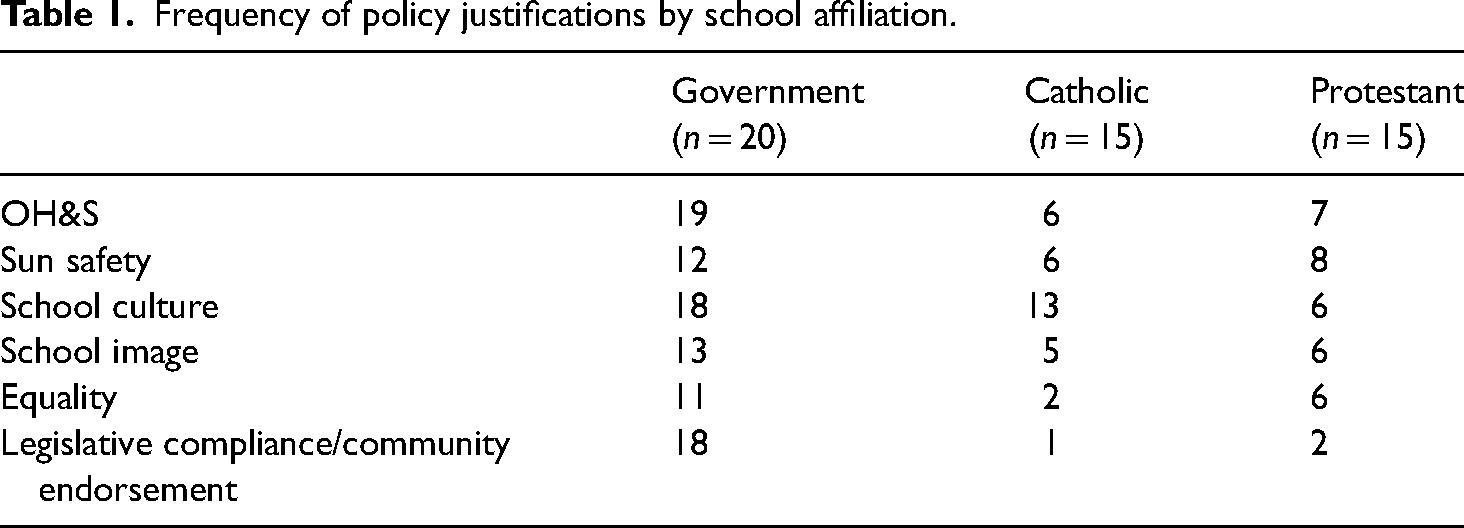
These categories are touched upon by all the school affiliations within this analysis, yet are not conceptualised and executed in the same manner by each school. Uniform policies are constructed from a multitude of influences – such as tradition, departmental obligations, feedback – and the motivations behind uniforms can be highly individualised. This section of the analysis aims to highlight predominant themes, rather than provide an intensive comparison between schools.
Government schools tend to provide more justifications for their policies than Catholic and Protestant schools, often citing four to five justifications in comparison to private schools’ one to three. In part, this is due to the fact that nearly half of Government schools appear to use a departmental template for their justifications, with minor rewording across different schools: Why do students wear a uniform?
Establishes a culture of school pride, a positive learning environment and high expectations. Promotes a positive image within the community with an identifiable uniform that is smart, tidy and worn appropriately. Addresses health and safety policies by ensuring students are wearing appropriate footwear and sun-safe clothing. School uniforms promote social equality among students because they diminish socioeconomic differences by reducing peer pressure associated with expensive ‘brand’ clothing. Improves student safety by enabling staff to identify people within the school grounds who are not associated with the school. (School #1, Government, annotations added)
Subsequently, Government schools were highly likely to cite any of the six justification themes. In contrast, Catholic and Protestant schools’ use of justifications tended to be more select and highly contextual. Regarding hair policy, the two most important categories to consider are school culture and school image – although they are rarely explicitly invoked.
‘School culture’ is a category that refers to the internal workings of the school. Predominant themes are: the uniform symbolising pride in the school, the uniform symbolising the student’s place in the school community, and the uniform facilitating an educational environment. These thematic categories often overlap and entwine, as demonstrated by the following statement: The purpose of the Student Dress Code is to: … promote student pride in the school community, comply with regulations concerning safety, hygiene and modesty; to uphold the traditions of the school colour and logo. (School #7, Government)
Within this statement, school culture is not explicitly referenced. Nonetheless, School #7 (Government) clearly indicates the type of values a student should hold. Notably, the individual student is never referenced. Rather, this statement indicates how the united student body should feel and behave, as embodied by the uniform.
Similarly, statements on school image reinforce the uniform as symbolic of institutional identity. In these cases, a clear distinction is drawn between the institution – as comprised of students – and those who witness and evaluate the school. We care about our students, their safety and their image in the community. We believe that students’ appearance is a very visible communicator about our school. (School #8, Government) [School #24] is an identifiable ‘community’. This community is judged, as a whole, by others who see it in many different situations and circumstances. Co-operation with the following minimum standards and expectations will assist in the prevention and enhancement of the [School #24] reputation, and the standing of all [School #24’s] members in the wider community. (School #24, Catholic) The [School #42] uniform is to be worn completely and correctly at all times on and off campus. [School #42] recognises that during teenage years individuality is often desired and expressed through clothing choice. However, the uniform is a vital representation of the school and its ethos, value base and placement as a private school. (School #42, Protestant)
The three quotes all reference notions of community, both that students belong to an internal school community and act as representatives to the wider ‘schooling’ community. The relation of image to this community takes on different types of emphasis, with School #8 (Government) simply labelling students’ appearance as ‘a very visible communicator’, while School #42 (Protestant) suggests that students’ desire for individuality should be secondary to their role as school representatives. These quotes are illustrative, rather than wholly representative, of the kinds of justifications schools deploy. There are no significant differences in how Government, Catholic, and Protestant schools utilise notions of image and community. All three reinforce that image is essential to community membership.
The uniform is integral to the correct performance of institutional identities, with Craik arguing that uniforms, across institutions, are a public symbol of ‘order, control, confidence, and conformity’ (2003, p. 128). For example, in Connor and McDermott’s discussion of military cadets, they observed that deliberate acts ‘such as saluting, marching and wearing the correct uniform, down to tying shoelaces correctly’ were vital demonstrations of the cadets’ commitment to military life (2013, p. 509), while Timmons and East found that the uniforms of medical staff were key in visualising professional boundaries, and unwanted changes to uniforms were ‘interpreted as an assault on professional boundaries, and on the status and jurisdiction of the professions themselves’ (2011, p. 1046). The school uniform, according to Meadmore and Symes, acts as a signifying practice that promotes a ‘distinctive school spirit and a sense of communitas’ (1996, p. 222) to distinguish individual schools and unite them against competitors. In part, it is this idea of unification that seeks to legitimate the uniforms’ use.
The school community and its institutional identity, as described in uniform policy, is ‘an idea and is also real; it is both an experience and an interpretation’ (Delanty, 2018, p. 5). Students operate within the school, a community with specific members and boundaries. Yet policy takes on an aspirational tone, interpreting the schooling body as a united force with a coherent collective identity. The messy reality of bodies and exploratory identities is not acknowledged, or rather circumscribed, by the policy. Uniforms and student bodies are idealised and regulatable; student appearances are shaped with a specific ideal in mind.
To achieve this idealised image, or in the very least strive for it, schools require student compliance. Adherence to policy, mandatory as it is, incorporates the student as part of the meaningful whole – unity in uniformity. Divergence, an individual blemish, can exclude the student or threaten institutional reputation. Thus, the students must set aside their own styling and behavioural preferences to uphold those of the institution – in other words, they must ‘dissociate’ power from their own bodies and ‘reverse’ it to the school (Foucault, 2020 [1977]). However, as will be discussed, these expectations are characterised by nuances around gender, class, and race.
Justifications for hair policies
Most schools, after establishing their overarching justifications for the uniform policy, did not seek to provide more specific justifications for policy surrounding hair. Several schools, however, did.
These justifications typically fell into two categories, either arguing that regulations benefit the schooling environment or prevent attention being directed at the students – that is, school culture and school image. These two types of justifications were used by Government, Catholic, and Protestant schools – although at a higher frequency in private schools than in public. Examples include: Undertaking a conservative hairstyle will ensure compliance with the high standards of dress and appearance in place at [School #17] and thereby help to maintain a positive tone in the school community and ensure that our primary focus will be centred on learning. (School #17, Government) [Hair] is to be of suitable length and style and should not bring undue negative attention to themselves or [School #26]. (School #26, Catholic) [School #47] recognises that choice of hairstyle can be a form of individual expression and seeks to balance this with the need to ensure students present themselves in a way that is consistent with [School #47] and wider community expectations. (School #47, Protestant)
With the above examples, several schools draw a link between their regulations and maintaining an effective educational environment – yet much is left to implication. In particular, School #47 (Protestant) requires students to balance ‘individual expression’ with ‘community expectations’, yet neither the community nor its expectations are ever established. Further interrogation of justifications alongside specific regulations can provide further clarity. For example, School #17 calls for ‘conservative’ hairstyles, while banning styles ‘awkwardly contrasting’ colours and lengths, rats’ tails, and top knots. Similarly, School #26 speaks to ‘negative attention’ while regulating hair length by gender. As will be discussed, such styles are imbued with socio-cultural connotations. In policy, justifications and regulations are presented together, yet never explicitly bridged.
In returning to Delanty’s (2018, p. 5) description of community as both ‘an experience and an interpretation’, it once again becomes necessary to question the implicit, yet unstated, ideal behind the shaping of the student body. As with broader policy justifications, the tension between the (abstracted) individual student and institution is not a matter of aesthetics. When they are described in policy, the student becomes an imagined and idealised body, one that represents the normative values of the school. The tensions between individual and institution, as implied by the aforementioned schools, is over the contested rights of the school to override the student’s own bodily history and values in pursuit of its own symbolism.
Regulating hair length
Regulations on hair length are an effective demonstration of expectations of gendered bodies and the different approaches public and private schools take towards the ideal student. Notably, whenever gender was mentioned across the sample, it was done in binary terms. That is, regulations were for female or male students, girls or boys. The transgender, questioning, non-binary, or otherwise gender non-conforming student was never accounted for within policy. Some schools did not directly distinguish students by gender. Rather, uniforms, sets, items, and miscellaneous regulations were directed to unspecified students. Their policies neither explicitly constrained, nor provided for, gender diversity in uniform policies. Thus, for the purposes of this article, the discussion can only cover binary constructions of gender in policy.
For Government schools, regulations surrounding hair length were largely rote. Fifteen schools required long hair to be restrained; one required hair to be no shorter than a No. 2 cut. Few sought to justify this regulation, with six schools referencing OH&S standards. None of the Government schools explicitly connected this regulation to gender. The strongest connection came from School #18’s implication that all female students would have long hair, while male students may have long or short hair. Girls’ hair must be tied up with blue or red Academy ribbon with logo for formal occasions … Hair must be tied back and neat at all times. Boys’ hair is to be kept short and neat, or if long, it is to be kept tied back off the face. (School #18, Government)
By contrast, private schools were heavily gendered. A total of 25 private schools, comprised of 13 Catholic schools and 12 Protestant schools, required long hair to be restrained. Fourteen of these schools only applied this regulation to female students. Maintenance of gender norms has been well documented in private schools, particularly ‘elite’ private institutions, encompassing gendered appearances, behaviours, and discourses (Gottschall et al., 2010; Wardman et al., 2010). As such, it is unsurprising that regulations on the length of female students’ hair is accompanied by limitations on male students. Thirteen schools, composed of five Catholic and eight Protestant, required male students’ hair to be cut short. Appropriate length was often defined in exacting detail, specifying where hair may reach in relation to the student’s earlobes and eyebrows, the shortest blade permitted to cut hair, and if tucking hair behind the ears was permissible. More lenient schools simply required hair to be clear of the collar.
Gendered assumptions often played a subtle role in uniform policy. For example, none of the four all-girls’ schools discussed a minimum permissible length. Furthermore, seven of the private schools provided different examples of unacceptable styling for male and female students. These examples often – but not always – included short hairstyles such as shaved patterns or undercuts as unacceptable for male students yet were never mentioned for female students.
If the requirement for female students to restrain long hair is cross-referenced with the requirement for male students to have short hair, there is a total of 17 private schools that explicitly link hair length with gender. Once again, few sought to justify their regulations on length. Only two private schools referenced OH&S standards, suggesting it plays a minimal role in hair policy, particularly when contrasted against Government schools. Rather, the expectations previously discussed surrounding normative appearances and community expectations are implicitly at play.
Thus, careful maintenance of gender norms is clearly documented in the policies of most Catholic and Protestant schools. Connell states that ‘masculinities do not first exist and then come into contact with femininities. Masculinities and femininities are produced together in the process that constitutes gender order’ (2004, p. 72). Most private schools, either by requiring short hair for male students or only discussing hair restraint in relation to female students, reinforced this gender order.
Foucault (2020 [1977], p. 187) argues that ‘In discipline, it is the subjects who have to be seen. Their visibility assures the hold of the power that is exercised over them’. In this context, he is speaking of the documentation of examinations; nonetheless, a literal interpretation of ‘visibility’ holds true. It is the uniformity of students that renders them visible, adherence to regulation – in both hair and uniform – that encompasses them under the authority of a particular institution. So too does deviation mark the student as a visible target for a disciplinary response.
In the context of private schools, schooling culture and image were not constructed in relation to the student body as a neutral undifferentiated body, but rather to a differentiated gendered body. Private schools clearly and deliberately inscribed normatively gendered bodies into policy. Noncompliance in this context highlights the student’s failure to adhere to policy and, depending on the infringement, a failure to correctly participate in the gender order.
Yet, it is not only in relation to appropriate length, hair restraint, and gendered performance that the visibility of the student reinforces institutional power.
Regulating hair colour and styling
Sixteen Government schools banned ‘unnatural’ hair colours, of which three additionally banned naturally coloured dye and two only permitted naturally coloured dye that ‘aligned’ with the student’s hair. Of the 29 private schools that regulated hair, all banned ‘unnatural’ hair colours, of which four additionally banned naturally coloured dye and four only permitted naturally coloured dye that ‘aligned’ with the student’s hair. Protestant schools were slightly more likely than Catholic schools to include these additional regulations, although not by a significant margin.
Across the public and private sectors, few schools elaborated on what constituted ‘natural’ or ‘unnatural’ hair colour. In this context, it is assumed ‘natural’ means naturally occurring hair colours (i.e., brunette, blond, black), yet there is potential for other naturally occurring colours to be restricted across institutions (i.e., red, white, grey). While these details are not necessarily recorded in published policy, they may still be regulated in the execution of policy. No schools explicitly justified their stance on hair colour, yet values surrounding school image were apparent across the three affiliations: The hair styles not permitted include, but not limited to … unnatural hair colours or awkwardly contrasting colours. (School #17, Government) Students should not use dye or blonding compounds in their hair, except for natural highlights that are natural to the individual student’s own hair colour. (School #28, Catholic) Students are not permitted to dye, bleach or colour their hair to create stark contrasts, a colour or multiple colours away from their natural hair colour. All treatments must be subtle, aligned with the student’s natural hair colour and have the effect of being barely noticeable. (School #41, Protestant)
The notions of awkwardness, naturalness, and subtlety across these quotes are not only highly subjective but also codify a mode of objective perception. They are likely intended as such, given the impossibility for schools to anticipate every possible colouring permutation. Yet the emphasis on these three categories indicates a concern for school image. For example, the quote from School #41 (Protestant) requires any colour modification to ‘have the effect of being barely noticeable’, a statement that both School #28 (Catholic) and School #17 (Government) only hint at. In ‘being barely noticeable’, a student can appear part of a cohesive whole, one with the united schooling community – a key value across the three school affiliations. A singular student – or a handful of students – who visibly deviate from their peers disrupts this visual.
Alongside this regulation was the common requirement for students to either wear a ‘conservative’ hairstyle or avoid an ‘extreme’ style. Ten Government schools used at least one of these keywords, all of which provided examples of unacceptable styling. Most Government schools that didn’t use a keyword likewise provided examples of unacceptable styling, with no significant difference in examples provided by schools with a keyword versus those without. A total of 24 unacceptable styles were listed across all Government schools.
A total of 18 private schools used the keywords ‘extreme’ and/or ‘conservative’, 10 of which were Catholic schools, the remaining eight Protestant schools. Just as with Government schools, all schools that used a keyword provided examples of banned styles, with no significant difference between their examples and the examples of schools without a keyword. Catholic schools provided 27 different unacceptable styles. Protestant schools provided a total of 30 banned styles. Table 2 details the most frequently banned styles, with regulations on length and colour for comparison.
Most frequently banned hair by school affiliation
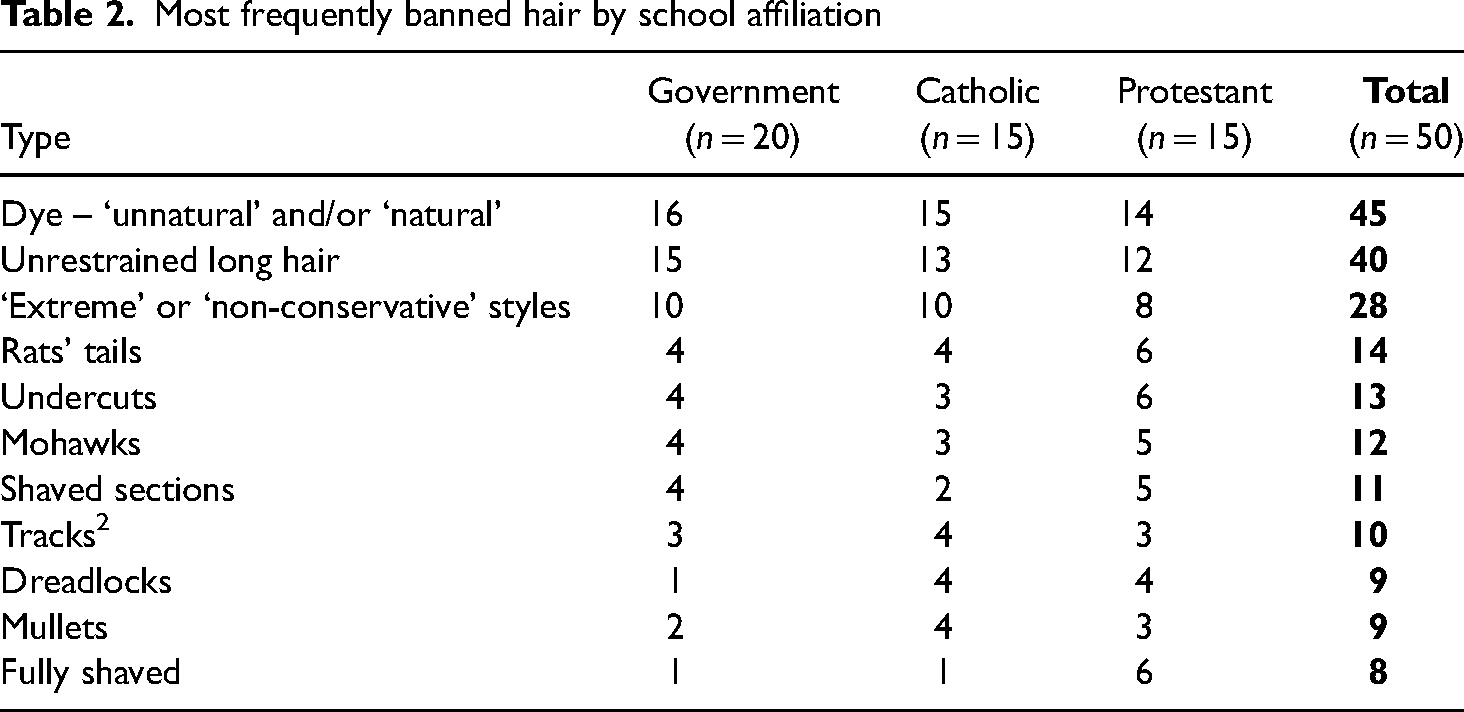
As demonstrated by Table 2, there is a stark difference between regulations on length and colour versus regulations on style. Across the three affiliations, 45 schools restrict hair colour, representing 90% of the sample. Similarly, 40 schools, or 80% of the sample, ban unrestrained long hair – as discussed previously.
Yet the most frequently banned style, a ‘rat’s tail’, was banned by 14 schools, only 28% of the sample. Hair colour, length, and style are overlapping yet distinct categories. A student’s hair may fulfil requirements on two counts – such as not being dyed and being restrained – yet fail on the final – such as being worn as dreadlocks. Thus, while there is a general consensus on inappropriate colour and length, there is only minimal consensus on what exact styles are impermissible.
Banned or impermissible hairstyles in schools are more commonly excluded on the criteria of being either ‘extreme’ or not ‘conservative’. These are not judgements derived purely from the aesthetics of the styles, but on their socio-cultural connotations. This is most evident in the more frequently banned styles – despite the minimal overall agreement. For example, both unnaturally coloured hair and long hair on males may imply participation in alternative or queer sub-cultures. Rats’ tails, shaved sections, and undercuts have all been framed as youth fad hairstyles at different points over the past decades. Mohawks have established roots in rock and punk scenes. Dreadlocks are rooted in black culture but have been repeatedly appropriated by hippie or ‘crunchy’ communities.
The mullet, as a characteristically Australian style, is a particularly noteworthy case study. Arguably, the mullet, so closely associated with the quintessentially Australian bogan, likewise represents a ‘contested, accumulated history of working-class identities’ (Paternoster et al., 2018, p. 442). Both celebrated in national competitions and mocked in national journalism, the mullet signifies a clientele that many schools may find undesirable. Elite private schools, in particular, have repeatedly made headlines for banning the style (Harris, 2023; Turner-Cohen & Daoud, 2021).
This is not an exhaustive list of associations, and it cannot account for how interpretations are influenced by who is wearing the hairstyle. Examining how particular bodies are regulated reveals the way intersections of class, culture, gender, and sexuality are deployed in the construction of normative appearances. For example, an undercut may be trendy on a male student, but a marker of queerness on a female student. A mullet may be a fad for elite private school students, yet indicate a public-school student’s supposed lack of cultural and economic capital. Divergence in schools that regulate by gender may risk the perceived binary. When a school bans a specific hairstyle, they are making a judgement on the socio-cultural associations and attempting to distance themselves from them.
Yet, in order to distance the school, the student must be distanced too. Should a student attempt to defy their school’s regulations, they risk losing their access to their institution. For example, in a recent case, students who attended an elite Catholic boys’ school in Sydney were informed that students arriving at school with a hairstyle not ‘appropriate’ according to uniform policy would be charged $20 for an on-site haircut or be sent home. Impermissible styles included dreadlocks, mullets, mohawks, buns, and braids (Harris, 2023). The criteria of ‘appropriate’ were not foregrounded, yet there is a clear valuing of norms around gender, class, and culture.
These regulations follow students outside of school hours and bounds. Aside from the fact that policy still applies so long as students are in uniform, thus regulating their bodies in public and digital spaces, hair alterations often take time, effort, and money. A student has leeway outside of the uniform to have unrestrained hair, use product, tie, and shape their hair into impermissible styles. But they cannot apply and remove dye or protective styles every day, and they cannot change length overnight. The greatest degree of bodily autonomy a student has is during their five weeks’ break each year, before they must return to school regulations. The school’s image, an image dependant on the student’s body being ‘used, transformed and improved’ (Foucault, 2020 [1977], p. 136), is prioritised both temporally and spatially.
In an analysis of textbooks used by students in a Delhi anathashram (orphanage) and village school, Bhattacharya found that depictions of school communities within textbooks were in stark contrast to the real communities of students. Despite using inclusive language, descriptions and depictions of schools drew upon ‘upper- and middle-class norms’ that did not ‘map onto the focal children’s actual lived experience’ (2019, p. 669). The gap between depicted and lived reality was, in part, due to differences in class, structures, and resources.
Bhattacharya argued that: [T]he issue is not merely a mismatch in representation: it is also about the powerful circulation of dominant literacy ideologies about what schools are like. In analysing the dissemination of ideologies, we must also consider which students get counted, why and, relatedly, whose experiences are included in the count. (2019, p. 675–676).
This argument is easily translated from school text to school policy.
School policy is not monolithic; the kinds of styles that schools ban vary across both individual institutions and sectors, often with minimal agreement. For example, one of the most frequently banned styles is dreadlocks, banned by nine of the 50 schools. It would thus, at a quick glance, be accurate to claim that around one in five Queensland schools ban the style. Yet with further examination, it would be more accurate to state that around one in twenty public schools (5%) ban the style, compared to eight in thirty private schools (26.67%). Thus, it is not only a question of who gets counted, but in what context.
Conclusion
This analysis sought to investigate how and why hair is regulated in Queensland high schools and investigate the meaning behind such regulations. The dominant ideology of uniform policy is that one may find unity through uniformity, that students should remain unobtrusive – ‘what is acceptable and required’ – to appear part of a coherent and cohesive community. In the context of schooling, the community’s values and membership is largely left to implication. The student is idealised, imagined, and projected via policy, to varying standards across institutions.
In his discussion of institutional power dynamics, Foucault argued that an institution’s power is derived from its subjects. Scholars such as Raby (2005), Robinson and Davies (2008), and Friedrich and Shanks (2021) have built on Foucault’s work to discuss the connection between educational institutions and cultural shaping of youth. They have discussed how educational institutions, from kindergartens to universities, introduce and enforce citizenship ideals on students. Children are perceived as ‘becoming’, or ‘everything that the adult is not – naïve, dependent, unsophisticated, immature, lacking critical thinking, inexperienced and unknowing’ (Robinson & Davies, 2008, p. 225). As compulsory attendees within a school, the appropriate norms of citizenship are repeatedly taught to students until they may be adequately transformed. Uniform policy can be used as a vehicle for these citizenship standards, to impart appropriate aesthetics and values for particular school communities. Subsequently, schools construct policy in consideration of cis-hetero gender norms, middle- and upper-class values of taste and conservatism, and ideals of whiteness to varying degrees.
Broadly speaking, these values are most apparent across Catholic and Protestant institutions. They are less visible, but certainly present, in Government schools. For most private schools, the ideal student was not gender neutral but already constructed as gendered within a binary order. Private institutions were also more likely to use the keywords of ‘extreme’ and/or ‘conservative’ and had a wider range of unacceptable styling than Government schools. While there was little consensus overall on what styles were inappropriate, all banned styles had connotations around class, queerness, alternative identities, or cultural identity. So, too, did constructions of policy seek to legitimate its deployment, with the ideal student as one who has complied and redirected their power towards the institution, non/adherence alternatively highlighting students as subjects of power or discipline.
In returning to the two foregrounding studies on Australian uniform policy, their conclusions remain sound. For example, Chen’s (2020) warning of indirect discrimination is evident in the enforcement of gendered styling or banning culturally connected styles. As discussed by Meadmore and Symes (1997), policy repeatedly referenced legislation and community, offered varying appeals, and opened the potential for disciplinary response – for all discipline was never explicitly referenced in relation to hair.
Looking at policy in isolation, it is tempting to argue they have largely failed to fulfil their own justifications. Broadly, policy justification spoke to OH&S, sun safety, school culture, school image, equality, and legislative compliance/community endorsement. Dependent on individual schools, stringent regulations cast doubt on the validity of these claims. Yet, written policy in isolation cannot provide a comprehensive account of lived experiences of hair – and broader uniform – regulations in action. This analysis has highlighted significant areas of concern, yet without first-hand accounts from current or former students, it cannot conclusively rule on which school failed or succeeded in their goals.
As Bhattacharya (2019), Delanty (2018), and Foucault (2020 [1977]) all indicate, constructions of community include a blend of the real and the idealised. This analysis has demonstrated the manner in which the student body is both imagined and projected. The media articles cited in the introduction are an effective demonstration of how students who don’t fit this ideal can be excluded from activities, campus culture, and their education. It is therefore essential that future scholarship examines the intersection of these two stages and examines how policy is practised, determining the extent to which uniform policy impacts the ability of marginalised students to access equitable education. Such research must acknowledge and explore the perspectives of students, as active and capable negotiators of policy.
Footnotes
Funding
The author(s) disclosed receipt of the following financial support for the research, authorship, and/or publication of this article: This research was funded through an Australian Government Research Training Program Scholarship.
Notes

Author biography
Kayla Mildren is a current PhD candidate at Griffith University. Her current research examines the body politics of uniform policy and practice in Australian schools.