



Abstract
International studies using the European Social Survey (ESS) reveal higher support for Universal Basic Income (UBI) in poorer countries with less generous welfare systems, and among individuals with lower income and education, and leftist political leanings. We present data from the 2019−20 Australian Survey of Social Attitudes mirroring the ESS question. Australia falls in the middle of European opinion, with 51% supporting a UBI, increasing slightly during the onset of Covid-19. We also find higher support among two different groups: (1) those facing greater ‘material’ precarity, including younger, low-income, unemployed, suburban renters, and (2) those who have more post-materialist concerns, including Green-left voters and those favouring redistributive values. Unlike in other countries, higher education predicts more support, while homeownership predicts less. The article concludes with challenges to introducing UBI to Australia, including potentially contradictory strategies for different support bases (material vs post-material), ongoing commitments to means-testing, and negative framing in the media.
Introduction
Advocates of Universal Basic Income (UBI) have seen hopeful signs emerge over recent years as countries increasingly experiment with forms of cash assistance to households. The income support delivered by most governments throughout the Covid years has given millions of people a sense of the kind of life that could be possible if governments regularly supplied an income sufficient to meet basic needs, with noted benefits for poverty reduction (Phillips et al., 2020). UBI might form one response to the precarity and inequality that characterises an integrated globalised world, even if it is introduced slowly, country by country.
However, the chances of introducing UBI within any country depend on how the political, economic, and welfare context of the country at a particular point in time impacts the level of public support that exists for UBI or related schemes. Basic Income has enjoyed several periods of heightened interest (Widerquist, 2019), with examples of Basic Income type proposals stretching back to at least the 18th century (Paine, 1974). Interest in UBI-style redistributive initiatives emerged during the early development of the welfare state, with serious discussion in the United Kingdom of a Basic Income model, which was eventually rejected in favour of social insurance in the 1940s (Torry, 2021). Unlike a Basic Income, where everyone receives the same payment, social insurance schemes require compulsory contributions while in work to fund payments in specific circumstances (such as unemployment or retirement), which vary in level according to previous earnings. UBI interest resumed in the 1960s and 1970s, with efforts focused on trials and social experimentation, especially in North America (Torry, 2021) and has grown substantially in recent years, with UBI entering policy debates (Widerquist, 2018), and culminating in a growing literature on econometric modelling of the costs and benefits of introducing schemes (Phillips, 2018; Spies-Butcher et al., 2020). As interest in the policy idea and potential impacts has grown, a complementary literature has emerged on public opinion towards UBI (Baute & Meuleman, 2020; Lee, 2018; Roosma & van Oorschot, 2020). Initially focused on identifying levels of support, analysis of opinion has increasingly converged with welfare state scholarship, exploring how differences within and across countries might be explained by socio-economic status, macro-economic outcomes, and political attitudes.
Our aim in this article is to explore Australian attitudes against this international, although primarily European, background. We review this extant international literature on support for UBI, and then present novel Australian data from the 2019−20 Australian Survey of Social Attitudes (AUSSA) designed to mirror the European Social Survey (ESS) UBI question. Our purpose is to examine significant differences in support for UBI based on key demographics indicative of socio-economic background, political affiliation, and opinion data about poverty and welfare. Specifically, we have two aims. First, we aim to see how support for UBI in Australia broadly compares internationally to support in other countries. Second, we aim to see if similar factors in Australia predict support for UBI, given Australia's different political landscape, liberal welfare system, and the relatively greater importance that Australian homeownership plays in poverty reduction.
Public support for UBI across countries and welfare states
Exploring public attitudes to UBI is complicated in two important ways. First, there are multiple potential Basic Income models within academic scholarship and policy advocacy (see Torry, 2021, pp. 12−19; van Parijs, 2004), combined with limited public understanding of the policy in general. It can therefore be difficult to frame questions and interpret responses.
Second, the academic scholarship on UBI suggests a variety of potential policy rationales. For some, UBI promises to move beyond the social relations of capitalism, by providing a form of basic economic freedom (van Parijs, 1995), reducing the gendered division of labour (Pateman, 2004) or reducing the systemic reliance on economic growth (Andersson, 2010). Following the global financial crisis, attention has focused more directly on the potential for UBI to address rising inequalities, and particularly rising economic insecurity. Most recently, the wide experience of receiving unconditional support payments during Covid-19 is likely to have radically changed citizens’ expectations of what governments are able to do (Tooze, 2021). UBI is now at the centre of several influential proposals for ‘practical’ forms of utopian politics (Bregman, 2018; Standing, 2014; Wright, 2006).
Alternatively, the policy also enjoys support from many pro-market libertarians because it requires relatively little administration and limits state discretion and perceived interference (Friedman, 1968). Several high-profile entrepreneurs have identified UBI as a solution to rising unemployment caused by automation (Sadowski, 2016), although analysis of earlier policy debates in Canada suggests that business interests tend to emphasise ‘basic’ entitlements, and are hostile to ‘universal’ and more adequate payments in practice (Calanitsky, 2018).
The complexities of the Basic Income debate have led to a variety of approaches to surveying public opinion. Many national (Bay & Pedersen, 2006; Jordan et al., 2021) or sub-national (e.g. Yang et al., 2020) surveys have sought to gauge aggregate levels of support for Basic Income, including within Australia (Azize, 2021; Hutchens, 2020). Often these surveys are directly linked to political and policy developments within a country, as with the Finnish Basic Income trial (Simanainen & Kangas, 2020) and growing support for the policy in Spain (Rincon, 2021). Many early surveys showed very high support when questions focused only on the provision of the new entitlement, and not on potential funding mechanisms (either spending cuts, tax increases or public debt).
More recently, survey questions have started to include preambles, with information about how the UBI policy works and how it will be funded. In this context, the Basic Income question introduced into the 2016 European Social Survey (ESS8) has become a widely analysed and influential model for exploring support and opposition to the policy (see Meuleman et al., 2018). The ESS8 question, which we reproduced for the AUSSA 2020 and analyse in this article, is lengthy. The full question is provided in the methods section below, and runs to about a page. While the question does not specify a particular UBI model, it does identify several key features: the scheme's purpose (to ensure everyone has a minimum standard of living); that the scheme is universal and unconditional; that the UBI will be provided in addition to other income; and that funding it would involve trade-offs (i.e. replacing other payments and requiring tax funding). Inclusion in ESS8 ensured the data could be correlated with a wide range of other demographic and attitudinal data, and could facilitate cross-national comparisons within Europe.
Results from the ESS8 data reflect themes common to the Basic Income and welfare state literatures. Cross-country comparisons found significant variation in support across countries, ranging from a third (33.9%) in Norway to over 80% in Lithuania (Meuleman et al., 2018 , p. 11). They reveal that support is higher in poorer, less equal countries with less developed welfare states (Kozak, 2021; Lee, 2018; Meuleman et al., 2018; Roosma & van Oorschoot, 2020 ). Alternatively, support is lowest in countries with existing universal welfare states, which makes sense when the question suggests that UBI will be funded at least in part by replacing (these generous) pre-existing support schemes.
At the national level, both low social security and economic insecurity increase support (Lee, 2018; Vlandas, 2020). While some studies identify low per capita incomes as a significant driver of higher support (Kozak, 2021), others suggest material deprivation, rather than low average incomes per se, are more important ( Roosma & van Oorschoot, 2020). Benefit adequacy also interacts with other attitudes. Living in a less developed welfare state led those fearful of automation to support Basic Income, while the reverse effect was visible in countries with more generous welfare states (Busemeyer & Sahm, 2021), and temporary employment per se was unrelated (Lee, 2018). This suggests that attitudes to Basic Income are shaped by the existing policy framework, with support stronger when existing social security is weaker.
At an individual level, support reflects similar demographic and attitudinal patterns to other welfare state initiatives, alongside much stronger support among the young (Vlandas, 2020). Both ESS8 and national survey evidence suggests that support declines with income (Baute & Meuleman, 2020; Bay & Pedersen, 2006; Vlandas, 2020).
The relationship between education and support for UBI is potentially more complicated. Most European surveys suggest support is higher among those with less formal education (Baranowski & Jabkowski, 2019; Baute & Meuleman, 2020; Bay & Pedersen, 2006), although Vlandas (2020) finds a weak positive correlation when controlling for other demographic variables.
The relationship to political attitudes is more consistent. Support is stronger among those on the political left, and those who favour lower income inequality and see lower inequality as the responsibility of government (Roosma & van Oorschoot, 2020). The association of Basic Income with progressive politics is reinforced by United States research, which shows that additional information about the scheme reinforces partisan divisions (Jordan et al., 2021), although knowing more about Basic Income in general is associated with higher levels of support (Baranowski & Jabkowski, 2019; Simanainen & Kangas, 2020).
The negative relationship to education complicates readings of Basic Income as a ‘post-materialist’ concern. ‘Post materialism’ (Inglehart & Abramson, 1999) refers to a set of values that arise among generations whose values have been shaped by (and thus reflect) secure, stable material upbringings, and who thus seek to focus on things ‘beyond’ material need; including the material needs of others. The theoretical links between UBI and post-materialism are interesting. UBI would potentially appeal to post-materialist desires for redistribution. However, UBI can also appeal to the materialist desires of the poor for better support, but be anathema to the materialist desires of middle and richer classes, through the threat of higher taxation.
Interestingly, the literature suggests support is higher among those on the left who hold traditionally ‘materialist’ labourist views, emphasising concerns over exploitation, rather than left-libertarians or other ‘post-materialist’ left positions (Schwander & Vlandas, 2020), a potentially surprising finding given the unease within many unions towards Basic Income (Vanderborght, 2006). Likewise, support is higher among those who support targeting welfare to those in need (Choi, 2021), a potentially paradoxical finding given the policy's explicit emphasis on ‘universalism’. Taken together, these findings suggest that Basic Income is seen by many as a more traditional welfare state response to economic inequality.
Support for UBI – the Australian context
The situation in Australia has important parallels with and differences from European countries. Australia is a high-income country, even by European standards, suggesting that support might be dampened by relative economic security. However, the Australian welfare state follows a liberal model. Social payments are modest and highly targeted. Australia's public aged pension is flat-rate and means-tested, creating a form of guaranteed minimum income, similar to a Basic Income. However, for working-age adults, flat-rate benefits are among the lowest in the Organisation for Economic Co-operation and Development (OECD) and strongly conditional (see Whiteford, 2020). While employment rates are relatively high, casual and contract work has expanded significantly, alongside underemployment, creating significant economic insecurity (Carney & Stanford, 2018). Similarly, while home ownership remains very high among retirees, rising house prices have eroded ownership rates for younger cohorts (Stebbing and Spies-Butcher, 2016), with a tiny social housing sector forcing many into a private rental market characterised by some of the weakest tenant protections in the OECD (Martin et al., 2018 , Table 5.1). For younger Australians, in particular, employment and housing insecurities, and a punitive and stingy benefits system are likely to produce stronger support for Basic Income.
In addition, the generally conservative orientation of much of Australia's media may work against wholesale adoption of support for UBI. Recent analysis of the way UBI discourse in framed in Australian debates shows that mainstream media outlets are generally hostile to the idea (Carroll & Engel, 2021). This may suit more conservative and centrist materialist agendas (including those of the traditional centre-left Labor Party) over those considered to be more strongly left wing and post-materialist (such as the Greens).
On the other hand, there is also the impact of Covid to consider. The Covid-19 pandemic hit Australia during the survey period. Alongside lockdowns and other public health measures, the Australian government introduced a sizeable economic assistance package. The package included doubling the main flat-rate working-age benefit, JobSeeker, significantly reducing means-testing and eliminating most forms of conditionality. While temporary, this measure approximated a version of a Basic Income. Recent research suggests Covid-19 did positively influence attitudes to Basic Income (Nettle et al., 2021), and it is possible the government response may have reinforced that effect in Australia.
Overall, these prior studies and considerations raise several questions particular for the Australian context. How does Australia compare to other countries? Are we generally for or against UBI? Do Australian attitudes align with those of other liberal low tax countries, those with generous social democratic welfare systems, or more unequal countries with lower per-capital income? What factors predict support for UBI in Australia? Are attitudes driven by materialist factors, as in Europe? Is support predicted by being poor or unemployed with lower education, or middle class or wealthy with higher education? How does economic insecurity impact attitudes, especially in a country where labour and housing markets are increasingly stratified by age and geography? And which attitudes predict support? Left/right identification? Perceptions about the responsibility and efficacy of government to alleviate inequality and poverty? Materialist or post-materilaist?
These issues lead us to set the following research questions for this study: RQ1: How does Australia compare to other countries in terms of support for a tax-funded UBI?
RQ2: To what extent is support for UBI based on more directly materialist experiences of poverty and precarity in Australia?
RQ3: To what extent is support for UBI based on more post-materialist progressive political values around general redistribution in Australia?
Data and methods
Data and sample
Our analysis draws on data from the 2019−20 AUSSA. The AUSSA is a mail-out survey to a randomised sample of 5000 Australian adults selected from the Australian Electoral Roll. It was run over a calendar year from 2019 to 2020 in four (seasonal) waves, with a cleaned final sample size of 1089 respondents, and a survey response rate of approximately 26%, which is typical for many contemporary social surveys. From this, we produced a working file of 1051 respondents who answered the question on support for UBI. Survey weights were included with the dataset, and applied to correct for imbalances in age, gender, and employment status.
Variables
The main question used to capture support for UBI was one replicated from the Wave 8 ESS (Lee, 2018), to enable direct comparison between Australia and these countries. This question provides respondents with the following initial information as a preamble: Some countries are currently talking about introducing a ‘Basic Income Scheme’. In a moment I will ask you to tell me whether you are against or in favour of this scheme. First, I will give you some more details. A
The government pays everyone a monthly income to cover essential living costs.
It replaces many other social benefits.
The purpose is to guarantee everyone a minimum standard of living.
Everyone receives the same amount regardless of whether or not they are working.
People also keep the money they earn from work or other sources.
This scheme is paid for by taxes.
After providing this information, the question then asks if the respondent is in favour or against introducing this scheme in Australia on a four-point scale with a ‘don’t know’ option provided at the end. In keeping with the coding and analysis of the ESS variable (Lee, 2018), we collapsed the 4-point scale into a binary yes/no variable here, with ‘strongly in favour’ and ‘in favour’ indicating support, and ‘strongly against’ and ‘against’ indicating opposition. We excluded ‘don’t know’ responses from the analysis. 1
Our analysis included an appropriate range of demographic covariates that accord with prior studies, and capture socio-economic status, and political orientations and values. All variables were collapsed into either yes/no dummies, or a few ordinal categories (i.e. low, medium, high) for ease of interpreting support across the categories (i.e. as proportions of each category who agree or disagree). Our demographic covariates and the categories into which they have been coded are as follows:
Our political orientations and values covariates and the categories into which they have been coded are as follows:
In addition to these, other variables beyond those in the descriptive analysis were derived for inclusion in the regression analyses. Dummies for occupation (manager, professional, technical or trades, other) were derived to stand as a more objective measure of social status to accompany the more subjective self-ascribed class. In addition, the variables on political party voting preferences were disaggregated into support for specific parties, in order to tease apart effects of voting for more centrist vs more radical parties on both left and right sides of politics.
Analysis
We first ran a series of descriptive analyses, comprised of proportions with error bars to demonstrate significance differences across the different categories of responses. Error bars are calculated by approximately doubling (×1.96) the standard error associated with each proportion to produce a 95% confidence interval. 3 Any observed differences with error bars overlapping by more than a quarter of a standard error are deemed to be non-significant at the 95% confidence level (i.e. there is more than a 1 in 20 chance that the observed difference is just due to random sampling error).
We then undertook a series of weighted binary logistic regressions. These were run predicting the dependent variable (support for UBI), to establish the presence of significant differences between predictors while controlling for other factors. Logistic regressions with odds ratios were calculated to predict support for a UBI based on demographic or attitudinal predictors. Binary dummies were calculated for each category of predictor variable noted above, and included in the model for ease of interpretation (i.e. a one unit change from ‘no’ to ‘yes’ for any of these dummies leads to an increase/decrease in the relative odds of supporting a UBI by the ORs 4 noted in Table 1). SEs are reported, and significant differences are indicated by the presence of asterisks beside the ORs.
Binary (reference) categories were omitted for: female; middle aged (36–64); being employed in paid work; having completed no more than high-school level education; being a non-managerial, professional or technical worker (i.e. service worker or working class); not experiencing financial hardship; having a mortgage; living in an inner-city area; perceiving oneself as upper class; voting for the Coalition (i.e. Liberal/National parties); believing level of inequality was appropriate (i.e. not too high); believing the government was good (i.e. not bad) at reducing inequality; believing the government was not responsible for the unemployed; and believing there was no need to reduce inequality or couldn’t choose whose responsibility it was.
Results
Support for UBI by country
We first look at support for UBI at the aggregated national level, comparing Austalia to data from the ESS about support in European countries (we note the European survey was conducted several years earlier, a point we return to below). This can be seen in Figure 1. We find Australian attitudes are broadly in the middle of European opinion, with 51% in support of introducing some form of UBI. Australian support is on par with its liberal Anglo counterpart in Europe, the UK, and is significantly higher than in countries with strong social democratic welfare systems, like Sweden and Norway. The lack of support in these countries has been attributed to the strong existing welfare state apparatuses, and the desire not to lose such support by introducing a UBI.
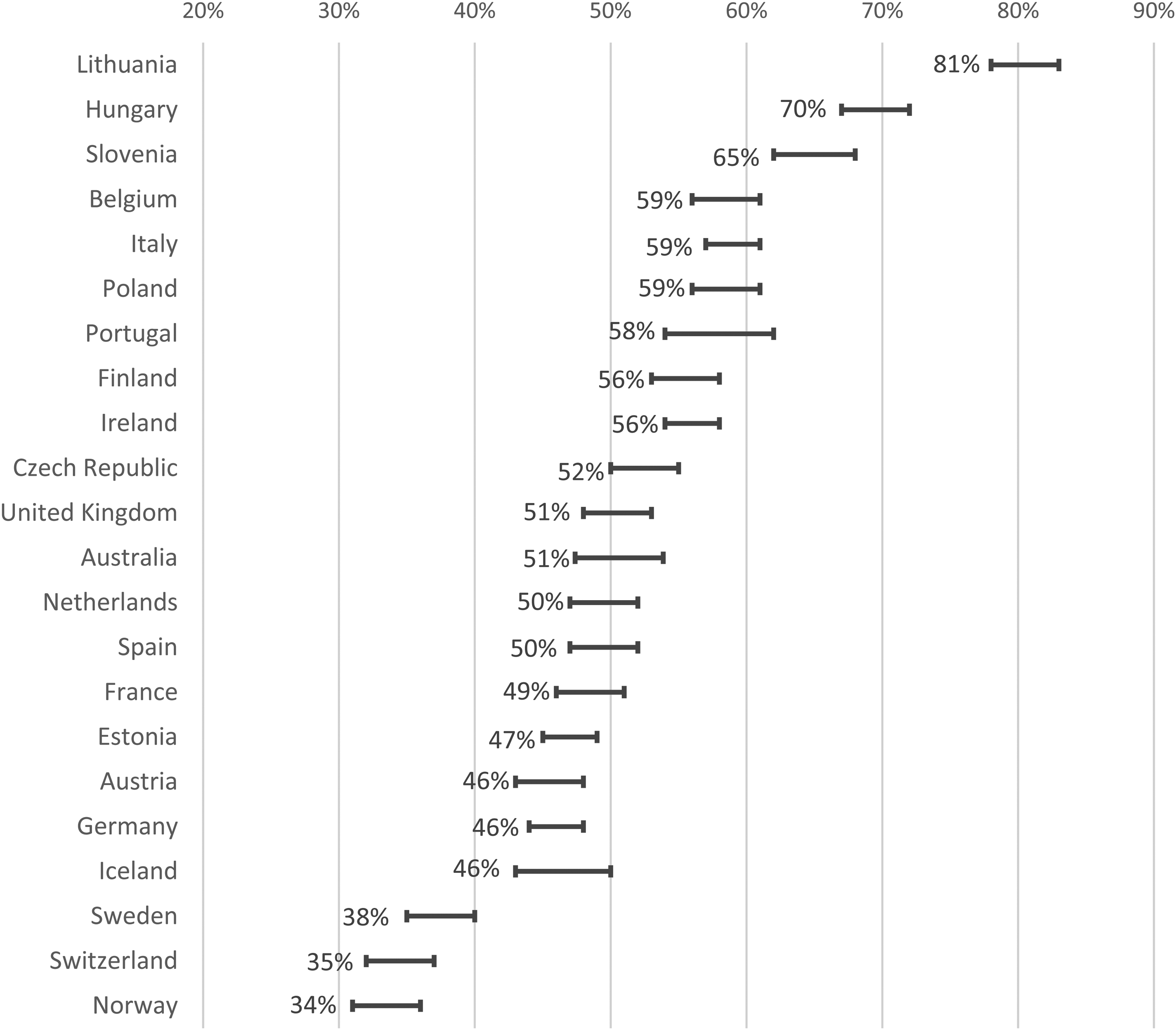
Support for Basic Income by country (%).
Support for a UBI in Australia is also significantly lower than that recorded in poorer countries (in terms of both GDP and GDP per capita) in terms of support. This suggests that aggregate levels of national poverty are not the primary driving force behind support for UBI in Australia, as much as they are in other countries at least. This raises questions about whether support for UBI at the individual level is based on financial position and hardship, or on ideological, political, and lifestyle factors and desires.
Individual demographic and socio-economic factors impacting support for UBI
We next turn to look at support for UBI at the individual level, to look at the impact of demographic and socio-economic factors. Results can be seen in Figure 2. In first looking at relevant demographic predictors of support, the data reveals patterns consistent with much of the existing literature, though with interesting exceptions around the relationships between education and UBI support. Support decreases substantially with age, with those aged under 35 significantly more likely to support a UBI than middle-aged people, who are in turn significantly more likely to support it than those aged over 65.
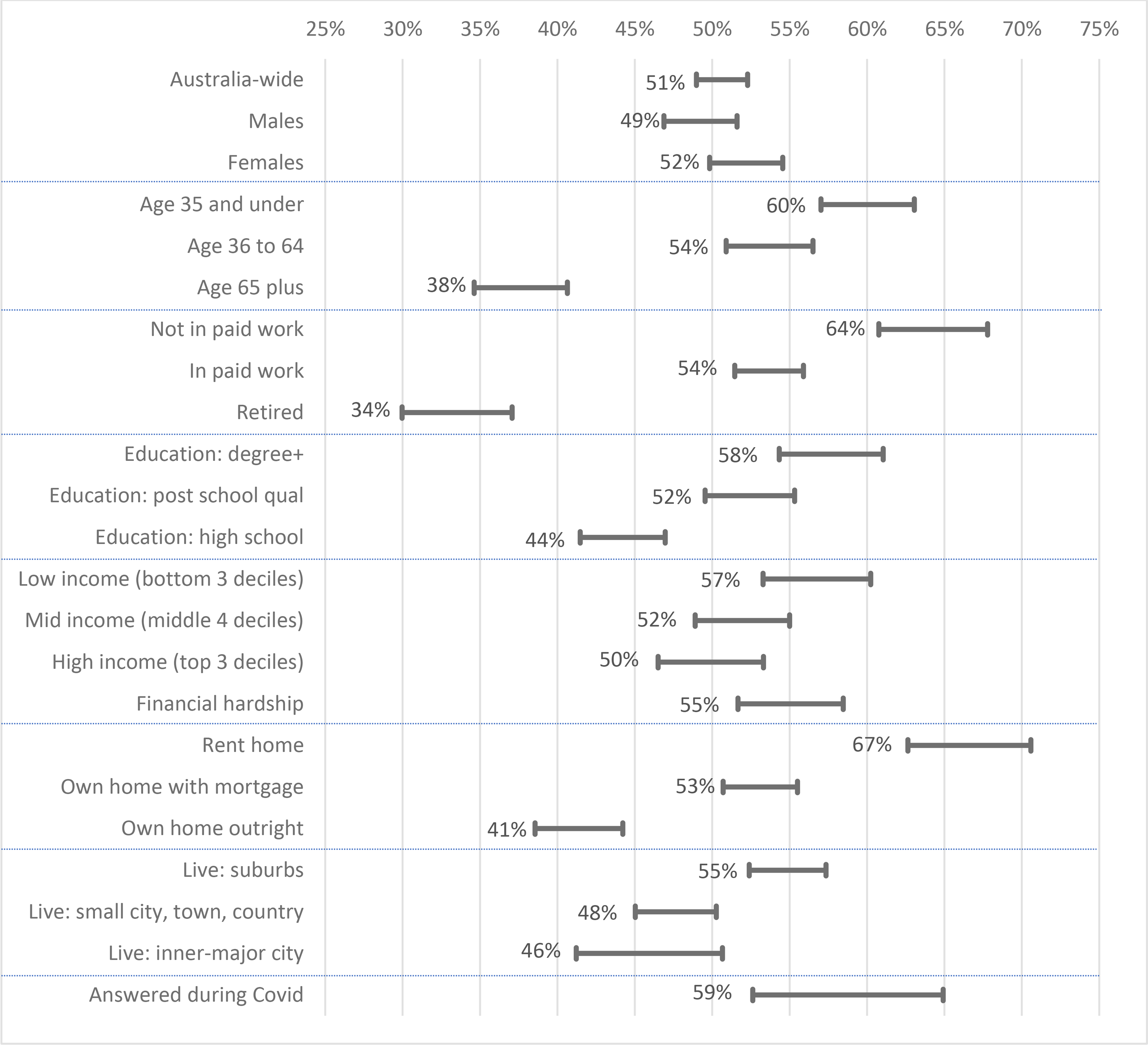
Support for Basic Income by key demographics (%), AUSSA 2019.
There appears to be some relation between personal economic circumstance and support for a UBI. Support is strongest among those who do not have work – those studying, unemployed, caring, or unable to work because of disability. It is lowest among those who have retired, who may well see themselves as having nothing to gain from a UBI (except a higher tax bill).
Similarly, there is stronger support for a UBI among those on lower income deciles, and those who report undergoing financial distress, and less support among those on higher income deciles. However, as can be seen from the overlapping error bars, the differences between middle and high income are small and non-significant. Income does not seem to be as strong a predictor of support as other factors.
In keeping with the unique economic importance of home ownership in Australia, we find that residence and geography matters. Being a home renter in a country like Australia, with poor rental market protections, is linked to significantly more support, while being an outright home owner is linked to less support. Living in outer suburbia, 5 rather than the inner city or smaller towns/country areas is also linked to more support.
One factor going against this link between poorer socio-economic circumstances and support for UBI is education. Degree holders are much more likely to support a UBI, while those who have not completed any qualifications beyond high school are much less likely to support it. This is in keeping with results by Baranowski and Jabkowski (2019) that teaching people about the benefits of UBI is linked to an increase in support for the concept, but goes against findings that generally link lower – not higher – levels of education to support for UBI (Baranowski & Jabkowski, 2019; Bay & Pedersen, 2006), or show little association with education (Vlandas, 2020).
Finally, we compare responses received before and after the implementation of the first lockdown by controlling for time in which people completed the survey. Our survey does reveal a modest increase in support for UBI during Covid, in keeping with similar findings (Nettle et al., 2021). However, the small sample size of respondents who answered during this period has resulted in a large standard error (and wide confidence intervals), rendering most observed differences non-significant. We note that any increase in support due to the Covid pandemic and the government response may slightly inflate Australian support compared to the European results obtained in more ‘normal’ times, however the difference is unlikely to be large.
Attitudinal and political affiliation factors impacting support for UBI
Next, we look at attidunal factors. These results can be seen below in Figure 3. Most of these are as expected, and accord with previous literature. Left-wing identification and perceived importance of the role of government is linked to strong support for UBI. Voting for a left party at the last election is linked to much stronger support for UBI than voting for a right-wing or an unspecified party – including voters supporting independents and minor parties, and likely dominated by right-wing supporters. 6
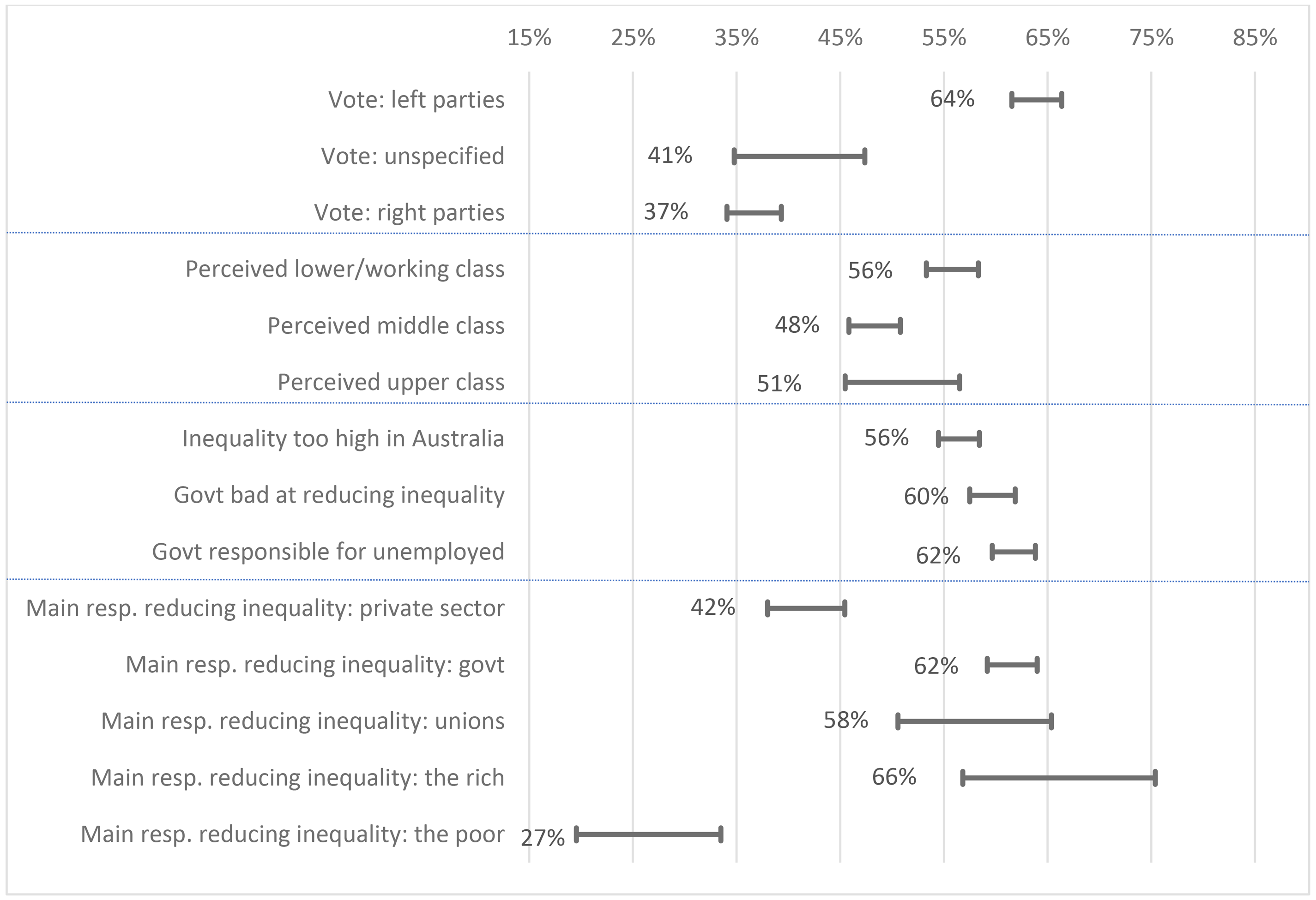
Support for Basic Income by political/redistributive attitudes (%) AUSSA 2019.
There was some support for the argument about materialism and personal socio-economic circumstances predicting UBI support. Identifying as lower class is linked to stronger support for UBI than identifying as middle class. The small number of persons who identified as upper class creates standard errors too big to identify significant difference between this class and others.
However, much of the attitudinal support was ideological, possibly beyond direct personal material concerns (we check this later in regression analyses). Perceptions that there was too much inequality in Australia, and that the government was responsible for reducing inequality and providing daily living support for the unemployed were also linked to stronger support for UBI. Of interest, those who thought that the government was not doing a good job in reducing inequality also supported UBI, perhaps seeing it as a mechanism to redress the problems governments had so far failed to deal with. In terms of specifying who was primarily responsible for reducing inequality, those who sided with government, the unions and blamed the rich favoured UBI, while those who sided with private business and blamed the poor were more against it.
There is of course a substantial overlap between many of these factors. Older people, for example, are far more likely to be retired, own a home, and have a lower level of education, each of which predicts lower levels of support. Many of these characteristics are likely to overlap with attitudinal perspectives as well. For this reason, we must turn to multivariate logistic regression in the next section, to attempt to tease apart some of these effects and see which remain when controls are introduced into the model.
We look next at the results of logistic regressions aimed at identifying demographic and attitudinal bases of support for UBI. These can be seen in Table 1. It is apparent from these findings that both personal economic circumstances and ideological position and knowledge impact support for UBI, and both come at the expense of other demographic factors. Age is not significant once these other variables are accounted for. This suggests that support for UBI is not directly associated with life-course factors, but with economic and (possibly generational) attitudinal factors that coincide with age. This conclusion is supported by recent analysis of electoral outcomes, which finds growing divergence in voting by age cohort is associated with changing patterns of asset ownership (Cameron & McAllister, 2019; Clark, 2022).
Binary logistic regression, demographic and attitudinal predictors of support for UBI, AUSSA, 2019.
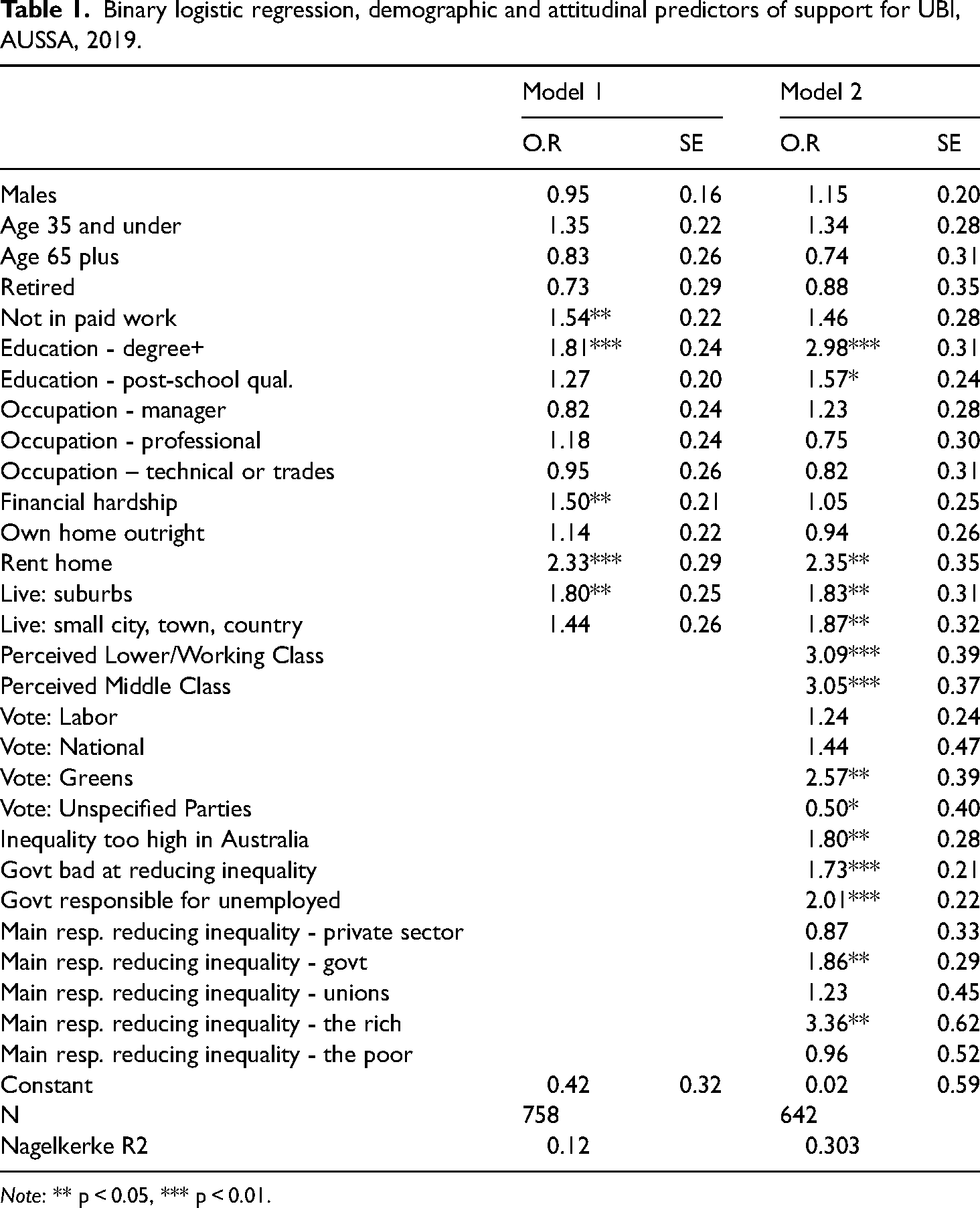
Note: ** p < 0.05, *** p < 0.01.
In both models in Table 1, materialist socio-economic factors such as not being in paid work, being a home renter (rather than owner), living in the suburbs, and not being part of the (perceived) upper class are significant predictors of higher levels of support for UBI. Living in a smaller city, town or country residence also becomes significant when controlling for attitudinal factors.
However, ideological post-material factors also play a key role, even when controlling for personal material circumstance. 7 Ideological positions such as believing inequality is too high, or that the government is responsible for reducing it and for looking after the unemployed, are positive predictors of support for a UBI. Further, beliefs that the government is doing a poor job at reducing inequity, or that the rich should be responsible for reducing inequality (presumably by giving up some of their income) also predict greater support for UBI.
In terms of political inclinations, voting for a centre-left leaning party such as Labor does not significantly predict greater support for UBI after other attitudinal variables are controlled for. However, support for UBI remains strongly correlated with support for the Greens, whose platform is both more economically left wing and whose issue set is more consistent with post-materialism. Voting for an unspecified party significantly predicts less support for a UBI. This might be surprising considering that the reference category is right-wing parties, such as the Liberal and National parties, until one considers that the unspecified parties are largely right-wing, nativist parties such as One Nation and the United Australia Party. This implies that support or opposition for a UBI is less likely to be shaped directly by partisanship, and is more likely to reflect values and ideology, a finding that is unsurprising given it has not been a focus of partisan contestation and consolidation in Australia so far.
Discussion
The findings support many aspects of the existing literature, though there are some notable exceptions. We find that Australian support for UBI is mid-range compared to attitudes in European countries, and on par with the liberal Anglo UK. This is in keeping with Australia's relatively high per capita income compared to many European countries (presumably lessening support; Kozak, 2021), but also its less generous welfare system when compared to Europe's social democratic countries (presumably raising support; Lee, 2018; Vlandas, 2020). We also found support for studies (Nettle et al., 2021) showing an increase in UBI support during the Covid period, when substantial welfare provisions (i.e. Covid-Supplement) gave many Australians access to a form of temporary cash assistance that resembles aspects of Basic Income.
Within Australia, attitudes to UBI follow patterns identified in the literature, but do so in ways that complicate attempts to read UBI as either conforming exclusively to conventional materialist welfare state politics on the one hand, or post-materialist concerns on the other. We confirmed that UBI support is higher among those who have lower income (Baute & Meuleman, 2020; Bay & Pedersen, 2006; Vlandas, 2020), and who are young, or of working age lacking paid work, while support is lower among those with high incomes and older retirees. And we confirmed findings that support is higher among the left, who typically support the redistributive nature of the welfare state and favour government intervention to reduce inequality (Roosma & van Oorschoot, 2020).
Even the materialist structure of social support for UBI reflects distinctive features of the Australian political economy. In keeping with the importance of home ownership and geography in Australia, we found that being a renter and living in suburbia was linked to more UBI support, while being a homeowner in an inner-city area or regional towns was linked to lower UBI support. The connection to housing tenure is particularly notable, both because it is not reflected in previous studies, and because it is consistent with the emerging structure of social risk within Australia. Taken alongside emerging evidence of the growing salience of asset ownership to voting patterns (McAllister & Makkai, 2019), our findings suggest that housing is moving to the centre of social stratification and politics in Australia.
Alternatively, our results also establish a clear and positive link between support for UBI and higher levels of education, consistent with the post-materialist thesis. While most prior studies found a positive association between lower education and more support (Baranowski & Jabkowski, 2019; Baute & Meuleman, 2020; Bay & Pedersen, 2006), we found that higher levels of education (in particular, university education) predicted higher levels of support for UBI. This is also consistent with the strong support for UBI among supporters of the Australian Greens, generally acknowledged to be the most post-materialist party in the Australian parliament, rather than supporters of the more materialist Labor Party. However, complicating any simple reading, support was also concentrated among those with a strong concern over inequality, a concern now also reflected in the Greens’ increasingly economically left-wing policy platform and rhetoric.
These findings suggest two things. First, attitudes to UBI partly reflect the politics of the welfare state, where low income and economic precarity predict support. However, precarity itself is contextual. Material conditions in Australia hold different risks from those in Europe, with regard to housing and geographic location. Australian housing has long been focused on facilitating owner-occupation over long-term renting (Martin et al., 2018). Consequently, there are fewer protections among renters than in many European countries, transforming renting into a form of precarity that predicts higher UBI support. Recent house price increases pushing more people into renting (Stebbing and Spies-Butcher, 2016) may therefore, inadvertently, increase support for UBI. Second, post-materialist concerns seem more relevant to support for UBI in Australia than within Europe. The support for UBI among more educated Greens voters is more pronounced here than in Europe. It also creates a more interesting set of challenges and opportunities.
We also note a few limitations to this article. The prior literature picked up on the importance of the issue of immigration, and how negative attitudes towards immigrants reduced support for UBI (presumably out of concern over new arrivals drawing too heavily on the taxpayer-funded welfare net). While we have not been able to replicate or test such findings here, as these variables were not available in the AUSSA dataset, we note the much lower support for UBI among voters of ‘other parties’, a category dominated by nativist, right-wing parties. As with its distinctive embrace of means-testing, Australia has also led the liberal world in imposing harsh border protection measures. Understanding how attitudes to means-testing and migration intersect with the universalist model of UBI remains an important step for Australian UBI research.
Conclusion
The results have several implications for the development of support for UBI. First, a UBI in Australia already enjoys reasonable levels of public support, but in a context of low salience, where attitudes are strongest at the edges of the political spectrum. Given the challenges of implementing UBI internationally, including in contexts with much stronger support and more active campaigns, and Australia's historic commitment to means-testing and fiscal constraint, it seems unlikely UBI will be implemented here in the short term.
Second, the contours of existing public support outlined here favour potentially contradictory strategies. Should UBI advocates emphasise UBI as a more traditional welfare state measure designed to address growing economic inequalities and insecurities? Or should advocates frame the reform in more utopian terms, as a stepping stone to a post-materialist, even post-capitalist future? Our analysis suggests there is existing support for each approach. Australian support will likely end up coming from forming a consensus between both materialist and post-materialist sources. These choices will also be shaped by demographic shifts, which have increased some forms of economic precarity among younger people, who are also at the core of the Greens constitutency and more likely to pursue higher education. However, the strength of support in the suburbs, an area where economic precarity is often strong but support for the Greens is weak, suggests this is not a simple story of emerging political convergence, but remains a challenge of building broader alliances across constituencies with different priorites.
Third, the results raise questions for applying UBI in an Australian welfare context. Prior research has noted that UBI support is higher among those who support targeting welfare to those in need (Choi, 2021), but Australia relies heavily upon means-testing of welfare (Whiteford, 2020). Australia's existing focus on flat-rate income payments, particularly when twinned with scandals over hostile government enforcement (e.g. the recent Robodebt scandal; see Whiteford, 2021), might create opportunities to relax aggressive forms of means-testing and move to more universal access (Spies-Butcher et al., 2020), or a focus on targeting might reduce support from a public conditioned to be hostile to universalism.
Finally, political and media representations will impact how these differing groups of potential supporters are brought on board, or alienated from the issues. We noted prior studies showing how mainstream Australian media has adopted a generally negative attitude towards UBI. Other studies from the US (Jordan et al., 2021) show that while support for UBI generally runs along partisan lines – with Liberals and Democrat more in favour and Conservatives and Republicans more against – negative media framing is more effective than positive framing, in terms of hardening conservative opposition to UBI. They note this could potentially drive a wedge between Liberal and Conservative Democracts. However, they also find that the relative simplicity of the UBI means that policy arguments are as effective as value arguments in shaping opinion (Jordan et al., 2021). This suggests that long-term information campaigns on policy benefits of UBI may be effective in countering short-term negative media framing. Attempts to bring together the two support bases for UBI must be cognisant of such framing issues. Building a clear majority support base for UBI will require the development of long-term arguments and policies with clear benefits that appeal both to materialist and post-materialist voters, and undermine the capacty for short-term negatively framed media campaigns to take root.
Footnotes
Funding
The author(s) received no financial support for the research, authorship, and/or publication of this article.
