




Abstract
Even though risk-taking is a common and widespread social experience sociological theorizing on the concept is scarce. This contribution aims to systematize and advance understanding of risk-taking and its different forms and how these connect to social inequalities and the social machinery. It considers risk-taking in the context of the debate about Bourdieu's theory of practice and Archer's theory of morphogenesis before suggesting a conceptual framework that outlines different rationales, dimensions, and the role of agency for understanding risk-taking as an individual and as a collective activity. The concept highlights the ambivalent character of risk-taking as an expression and mode of reproducing inequalities and a crucial resource to overcome disadvantage and foster social change.
Introduction
Risk-taking as a concept appears comparatively rarely in sociological theory (e.g. Goffman, 1967; Lyng, 1990; Tulloch & Lupton, 2003) and in socio-cultural approaches to risk such as risk society (Beck, 1992), cultural symbolic (Douglas, 1992) and governmentality perspectives. The latter tend to focus on macro-level, institutional, discursive and cultural aspects (Lupton, 2013) and struggle to connect risk-taking systematically with social inequalities and social change. For example, Ulrich Beck's risk society theory neither conceptually elaborates risk-taking as a concept nor engages systematically with cultural or milieu specific aspects of risk. With the risk society concept originally developed in contrast to class theory, for a long time continuities and new amalgamations of social inequality remained conceptually underdeveloped.
The low interest in risk-taking, however, is surprising for such a common and widespread social experience, which is in various ways connected to social inequalities (e.g. Cockerham, 2006). A large variety of phenomena – such as people not preparing for flooding, engaging in high-risk leisure sports or high-risk migration journeys, pregnant women smoking and drinking, workers ignoring safety procedures, and homosexuals revealing their sexual identity – are only a few of the issues a growing body of research is trying to make sense of.
Risk-taking contrasts with the broader concept of risk behaviour since it requires a minimum of awareness that a risk is taken (Zinn, 2015). It therefore sits uncomfortably within theorizing that puts the explanatory priority on ‘faceless’ social forces, which work beyond the conscious reflection and meaning that individuals generate about the social world and use as a compass to direct their everyday activities. 1 To prevent different forms of conceptual reductionism a convincing answer to the question of how individuals and society relate to the reproduction and transformation of social structures is necessary.
For this purpose, the article revisits the debate about Pierre Bourdieu's practice theory and Margaret Archer's theory of morphogenesis. Studies on risk utilizing Bourdieu's practice theory and the concept of the habitus tend to emphasize the reproduction of social inequalities and subordinate risk-taking (Crawshaw, 2004; Dixon & Banwell, 2009; Lindblath & Lyttkens, 2002; Williams, 1995). Channelling Archer's work, such a perspective can be criticized for neglecting the relative independence of the social and the individual spheres (Archer, 2000, 2012). Her critical realist perspective might be better suited to conceptualize individual responses to the erosion of social institutions in late modernity (Beck, 1992, 2009; Giddens, 1990), and to give more weight to the creative power of resistance and innovation (Joas, 1996) in contrast to pre- or unconscious routines and habits.
To clarify how sociology connects risk with inequality, and the role of risk-taking in its reproduction in the social sphere, this article systematizes the growing body of empirical research with the help of Archer's distinction between body/environment relations, subject/object relations and subject/subject relations. These connect to a body of scholarly work which provides additional support for the idea that there is a variety of motives for taking risks under different social conditions, such as basic needs (Maslow, 1970), protection of ontological security (Giddens, 1990), material desires, the quest for social recognition (Honneth, 1995) and feelings of self-worth (Mead, 1934), as well as the joy of exercising skills and courage (Lyng, 1990).
The article argues that these dimensions are involved to different degrees in risk-taking and might overlap in practice. They underpin three ideal-type forms of risk-taking: when risk-taking is an end in itself, when risk-taking is a means to an end and when risks are taken in response to vulnerability. These systematically relate to the different capacities people have for shaping their life in different social contexts. Risk-taking can also become a central resource people from different walks of life use to shape their future and can be seen as an expression of people's everyday struggles patterned by social inequality. But it also indicates attempts to change the future towards more desirable trajectories or to protect one's future against dangers or threats.
Consequently, the suggested framework emphasizes the desire, will, and capacity to take risks in everyday life, which is a resource not only for changing one's life or igniting broader social change but also an expression of fundamental social inequalities. It does not restrict the understanding of social reproduction and change to reflexivity but takes into account the capacity for, and consequentiality of, risks one takes in order to effect change. It might, therefore, be better suited to explain the contradictory social experience of both the need and desire to take risks in everyday life, which might be connected to the soaring social inequalities in present-day societies.
Social inequality and reflexivity: Bourdieu – Archer
For the understanding of the reproduction of social inequalities Pierre Bourdieu's practice theory has been pathbreaking. With the erosion of social institutions and detraditionalization of the social sphere (Beck, 1992; Giddens, 1990) there is a need to consider the growing discontinuities, which might require people to reflect upon their life and make risky decisions. Therefore, the article turns to the modes of reflexivity developed by Margaret Archer. Her focus on reflexivity, however, seems insufficient to understand the empirically observable multidimensionality of risk-taking, which arguably plays a crucial role in the reproduction and change of one's life as well as potentially broader social changes.
Social inequality
Pierre Bourdieu's authoritative theory of practice was a cornerstone for understanding the reproduction of social inequalities (Bourdieu, 1977, 1984, 1990) and an important contribution to overcoming the opposition of subjectivism and objectivism. Bourdieu conceptualizes actors as related to social fields, depending on their economic, symbolic, cultural, and social capital. Through participating in ongoing contestations and struggles in the social fields, actors develop shared knowledge of the ‘rules of the game’ (Bourdieu, 1990). Practices are supported and reproduced by one's habitus, a set of mainly preconscious dispositions and embodied knowledge, and the concrete social conditions of the fields one is engaged in. Thus, the habitus connects the subjective experience of individuals with the objective conditions of their existence.
Scholars who use Bourdieu's work to make sense of risk behaviour mainly emphasize the reproduction of social inequalities through a social field and the related habitus as a preconscious or unconscious force shaping people's activities. However, this does not necessarily mean that people decide about or engage with risk unconsciously. Instead, risk-takers are often well aware of when they are managing and taking risks, but the dispositions provided through the habitus influence whether they consider a risk worth taking or to be a normal part of their life (e.g. Crawshaw & Bunton, 2009).
Their reflections about risk might be part of ‘illusio’ – their hopes, wisdoms and strategies to manage their life. People usually do not realize to what extent their attitudes are part of the reproduction of social milieus they are part of. Their practical knowledge tends to obscure the reality of broader social patterns. Even though Bourdieu developed his theory at a time of relatively high stability and consistent reproduction of social structures, he was aware that social reality is too complex to permit a rigid application of standardized behaviour within a relatively stable institutional context. Instead, the habitus provides general dispositions to be applied and adapted to one's life. But these practical solutions mainly result in the reproduction of the social fields they originated from. Indeed, he also considers the possibility that the habitus does not fit well with social fields and could unfold an ‘explosive power’ (Bourdieu, 1993, p. 87f.). It might be here that risk-taking plays an important role, when the routines of practical knowledge must be modified to work under changing social conditions, and other sources of knowledge are required to inform new responses.
Bourdieu's theory of practice might be more difficult to apply at a time when social fields are more rapidly transforming but practice theory still allows the consideration that people respond to new social conditions on the basis of habitual practices and available social capital (Farrugia & Woodman, 2015). Nevertheless, since the habitus emphasizes the unconscious or preconscious sources of people's practices, there is little support for ideas of conscious and reflexive responses informing social change. People's actions, whether they just adapt or try to break out from normal modes of behaviour might be, either way, simply a manifestation of the habitus contributing to the struggles within a social field. However, risk-taking might not only be part of the habitual repertoire of a social group but a resource for changing one's life or even social reality more broadly as well (e.g. through consciously opposing normative expectations), therefore conceptual work must consider the possibility of conscious engagement or risk-taking not only reproducing but also (contributing to) transforming the social world. There the article turns to Margaret Archer who, in the past 20 years, has significantly contributed to the systematization of reflexivity as a central dimension for understanding social change.
Structure–agency
Margaret Archer's work (2003, 2007, 2012) is helpful in its critique of reductionism and the assumption of ontological independence of individual and structural dynamics. Archer highlights the limits of structural determinism of action when individual action is mainly the result of structural forces (downwards conflation), as she suggests would be the case in Bourdieu's practice theory. 2 This contrasts with individualist determinism of structure, such as in the case of rational choice theory, when structure results from the sum of individual activities (upwards conflation). She also argues that middle conflation, the mutual constitution of structure and agency as posited in Giddens’ (1984) structuration theory, fails to acknowledge that social structures as well as individuals follow their own rationales (analytical dualism). She therefore suggests an approach which takes both into account. Her theory of morphogenesis (processes which elaborate and change a system) in contrast to morphostasis (processes which preserve a system) emphasizes that there is a time difference between the dynamic of structures and people's relatively independent reflexivity informing their responses. People's internal conversations allow them to critically reflect on norms, roles, expectations, etc. and to follow, modify or reject them (Archer, 2007, p. 96). Thus, Archer's inner conversation is an expression of the struggle of the present with the past for a better future.
This can be illustrated by every generation of youth being born into a world which has been shaped by earlier generations. When growing up, youth has to interpret the world, which is notoriously contradictory and conflictual, containing all kinds of different and competing ideas as well as (unfulfilled) dreams. The result of the struggle of earlier generations is the starting point and the conditions for new generations to experience their life, including new technological developments, environmental degeneration, wars, global economic downturn or a large epidemic, which all contribute to shape a new generation.
However, as Archer argues, not all members of a generation respond in the same way to the (social) world they are part of. They differ in the form of reflexivity characterizing their inner conversation. It is this ‘continuous exercise of our reflexive powers, which is what makes us “active agents” – those who can exercise some governance in and over their own lives’ (Archer, 2007, p. 96). She developed a typology of four modes of reflexivity: communicative, autonomous, meta and fractured reflexivity (Archer, 2007, 2012, p. 13). In the mode of communicative reflexivity people require continuous external confirmation to transform their internal conversation into action. This form of reflexivity would support social immobility and would lead on the macroscopic level to social reproduction. The mode of autonomous reflexivity stands for internal reflection, which results in action without requiring external confirmation. This mode would support upwards mobility, which leads to social productivity. Meta-reflexivity includes a critique of one's own internal conversation, which is accompanied by uncertainty and self-doubt, but concentrates on normative projects beyond existing conditions. It therefore supports lateral mobility (volatility), which can lead to social reorientation on the macro level. Finally, fractured reflexivity is characterized by a lack of ability to have an internal conversation that could result in purposeful action. This tends to lead to a form of situational logic of following ‘gut feelings’. Archer suggests that in a globalizing world characterized by rapid change, volatile social conditions and eroding social institutions, a ‘reflexive imperative’ requires people's response (Archer, 2012). The experience of social discontinuity pushes people towards autonomous reflexivity while incongruity supports meta-reflexivity. In contrast, contextual continuity supports communicative reflexivity but is decreasingly observable. From this perspective, social change rewards autonomous reflexivity and meta-reflexivity, which in turn supports social transformation. 3
However, it is questionable to what extent the modes of reflexivity are sufficient to explain and better understand social continuities and change. The reason might be the ambivalent character of the socio-structural change underpinning the reflexive imperative. As Ulrich Beck suggests, even though individuals become ‘the reproduction unit of the social in the lifeworld’ (1992, p. 90), the normative expectation of reflexively shaping their life comes at a time when individuals are even more affected by forces such as ‘fashions, social policy, economic cycles and markets’ they can hardly control or predict (1992, p. 131). Under such conditions the degree of reflexivity might not matter as much or might already be an expression of privilege (Skeggs, 2004), while less privileged people might turn to faith and hope when managing highly consequential risks, they have little control over and when they have little back-up to respond to failure.
Nevertheless, even less privileged people might conduct elaborate reflexivity but cannot escape the structure of power and disadvantage they are exposed to. The risks which are open to them as the only option to protect their comparatively modest ‘wealth’ or to leave their position of disadvantage and vulnerability are, on average, more consequential than the risks better-off people take (Tulloch and Lupton, 2003; Zinn, 2020). It might better reflect the reality of decision-making to see reflexivity not only as being related to the patterns of their social contexts of continuity and discontinuity but also to take into account the consequentiality of the decision-making situations they face, the risks they respond to and take.
Archer's focus on the mode of reflexivity rather than the consequentiality of different risks can be interpreted as a normative bias towards individualized forms of an autonomous self against which other forms are positioned as inferior (Skeggs, 2004, p. 45ff.). Consequently, social change is attributed to individualized modes of reflection in contrast to collective modes (interactive and collective) of change when people respond to and take risks together in the face of contingent but dangerous futures, seeking support and encouragement from family and extended social networks.
The following outlines the theoretical basis of the empirically found key dimensions of risk-taking and forms of agency to characterize risk-taking as both an expression of social conditions as well as a valuable resource for change. Thereby, the framework acknowledges the resources (or social capital) people acquire through the course of their life as well as the habitus related to their position in a social space (Bourdieu, 1984), but also the creative forces the individual can mobilize to resist and modify dominant practices for changing their life or achieving broader social effects (Archer, 2012). Thus it provides a conceptual framework for analysis, which could be used to describe the mechanisms of risk-taking practices in their (changing) social contexts.
Risk-taking and inequality
For systematizing risk-taking, this article follows Parker and Stanworth's (2005, p. 328) suggestion to use Archer's distinction of three orders of the world—the natural, the practical and the discursive orders—as a starting point (2000, p. 199). Since the capacities to manage voluntary or involuntary challenges are unequally allocated within society, it is crucial to also integrate inequalities in any systematization of risk-taking. However, Parker and Stanworth's (2005, p. 328) suggestion of using risk-taking through the lens of personal commitments seems to be too narrow in a social world in which solidarity and commitment to a social group varies (Douglas, 1992) and risk-taking might even be driven by envy, competition, and conflict rather than solidarity. The extent to which risk-taking comes with a commitment to others, in contrast to being ‘a cloak for self-interest’ (Archer, 2000, p. 297), is therefore an open question. It seems more realistic to assume that ‘commitments’ vary from more self-centred to more altruistic. In the extremes, risk-taking might even be motivated by existential concerns about survival or the mere embodied sensation of feeling in control.
Natural orders and risk-taking in response to vulnerability
The natural order refers to the body–environment relation that is crucial for risk-taking in different ways. There is a body of research which shows that people sometimes take risks when their physical well-being is fundamentally threatened (e.g. Hayenhjelm, 2006; Nguyen-Trung, 2023). From the early poverty studies of the 19th century (Mayhew, 1861) to today's research on inequality there is little doubt that inequalities tend to widen (UNDESA, 2020). However, physical well-being can be threatened for a number of different reasons related to class affiliation or gender, from one's faith and ethnicity to one’s political persuasion. As the debates about intersecting inequalities have argued, there are different structural, cultural, and material conditions which overlap and might heighten vulnerability when coming together or allow for balancing resources against some risks (Olofsson et al., 2014). Vulnerability might vary but in the case of the ideal type of risk-taking in response to vulnerability it is the experience of one or more existential threats that motivates risk-taking rather than the desire to perform well or to find self-fulfilment and meaning in successful risk-taking. When very fundamental human needs are not met, or people are in jeopardy, they are sometimes prepared to take high risks. In terms of Maslow's (1970) theory of motivation this is about threats to physiological needs (air, water, food, shelter, sleep, etc.) and security needs (personal security, employment, property, health, etc.).
To give some examples, Hayenhjelm (2006, p. 190) argues that political persecution might push people to engage in high-risk migration with people smugglers. In countries where extramarital sex is prohibited for women, unwanted pregnancy might push women to seek high-risk backstreet abortion (Hayenhjelm, 2006, p. 190). During the Covid-19 crisis, some people ignored lockdown measures because they did not see any option to provide for their family other than getting out and seeking income and food (Santos, 2020). Or there were the Vietnamese farmers in the Mekong Delta who collectively saw no alternative to cultivating a high-risk crop even when disastrous drought was forecast (Nguyen-Trung, 2022). These examples already illustrate that such risk-taking is regularly the result of a balancing act between pressing threats to life and well-being, and attempts to escape them or just to prevent the worst for the time being.
Practical orders and risk-taking as an end in itself
The practical order stands for subject/object relations and the competence all risk-taking requires. It refers to performative achievements, which are necessary in all risk-taking but become a central motive when risk-taking is an end in itself. Risk-taking as in high-risk leisure sports or dangerous occupations requires excellent skills to be successful. Skills can be very technical but can also relate to social competence or courage (Goffman, 1967). This type of risk-taking has been described by research on edgework originally examining activities such as sky-diving, BASE-jumping, high altitude and free-climbing. It can also be found with less extreme risk-taking experience (but not necessarily less dangerous), where the major driver is the experience of one's ability to manage a challenge. While these activities are spectacular this is not necessarily the case. An example of an Australian theatre worker as provided by Tulloch and Lupton (2003, p. 36), illustrates that risk-taking just for the sake of taking a risk and enjoying the excitement of doing so can also be exercised through less spectacular activities in everyday life: Occasionally when I’m up on a ladder I get a bit reckless and I find myself balancing up in the ceilings of theatres on lighting bars, having stepped off the ladder onto the lighting bars. And I’m actually quite scared about what might happen…. Balancing on a bar 30 feet off the ground and continuing to work for a little while, and then escaping from that situation and making your way back down to some sort of solid floor, can give me a feeling that I’m very much in control of my body. And that is a very nice feeling really, I like that feeling. (emphasis added)
While all risk-taking requires skills, in these cases the skills are central for successfully managing the challenge. The desire to enjoy and experience one's own ability to have control seems to be a part of our nature as human beings (von Cube, 1990), but the experience clearly varies in terms of the opportunities, domains, and character of risk-taking as will be argued later.
Discursive orders and risk-taking as a means to an end
Finally, the discursive order refers to subject–subject relations with the major concern of self-worth (Archer, 2007). Empirical research as well as philosophical debates identify two central dimensions. The debate between Axel Honneth and Nancy Fraser (Fraser & Honneth, 2003; Honneth, 1995) about the moral patterns of societal conflict suggests the centrality of the social allocation of goods and the need for social recognition. Both are also central dimensions in the body of qualitative research on risk-taking (Zinn, 2020). Indeed, people accept or take risks to gain social recognition in a large variety of social spheres, from intimate relationships to occupational choice or political resistance. However, the growing importance of self-identity in history (Taylor, 1989) and specifically after the Second World War (Beck, 1992) draws attention to the importance of the integrity of one's self-identity for risk-taking, such as in the case of taking risks to stay true to one's beliefs and values. Thus, three aspects can be analytically distinguished even when they mix and combine: material gains (e.g. consumption, income), social recognition (cultural, political, legal) and a valued identity (e.g. staying true to oneself, protecting a valued self).
The classic study by Carson (1982) on workers on British oil rigs in the North Sea illustrates how the risk-taking of employees resulted from both their vulnerable position in an unequal power relationship and their readiness to take risks at work in order not to jeopardize their income. As one diver suggests: No one is going to make you do an extra dive when you’ve done your number of hours already; but you know you’ve got to go. (Carson, 1982, p. 76).
Other studies, such as Martin Kosla's (2015) work on electrical construction workers, have shown that competition with low qualified workers can encourage professionals to take higher risks for a competitive advantage in the labour market. Kosla showed safety regulations are often ignored when they interfere with professional core competencies while market pressure jeopardizes their jobs. We are professionals, we want to do a good job and get it done quickly and if the contractor isn’t making money, we aren’t making money. (Kosla, 2015, p. 396). I had a next-door neighbor … an old chap who had served in the Second World War … he was torpedoed twice and a real hero, and he was the littlest man on the estate and very kind and gentle but nobody ever messed with him.… Everybody respected him and I wanted that and that was part of why I joined the services. (Zinn, 2011, p. 260).
Often social recognition and feelings of self-worth go hand in hand but sometimes the justification for risk-taking is more self-focused. For example, Silke Roth (2015), in her study on aid work, argued that many aid workers accepted the growing risks of aid work since they felt that it provides their life with meaning and value. They wanted to do something that actually ‘makes a difference’ to people and feel that through their work they received much more than they gave. Roth showed that the participants were aware of the risks but were willing to tolerate or manage them because they wanted to make a contribution to improving human well-being and they valued the ways in which this contributed to their self- and social esteem.
Another example is the whistleblower, Snowden, who opposed his employer in order to stay true to his personal beliefs (Anderson, 2019). But there are also many cases which are less spectacular when people accept and take risks to gain or protect a valued identity; for example, when pregnant women who are smoking or drinking have to redefine their behaviour in the face of social stigmatization (Wigginton & Lafrance, 2014).
These different dimensions are not mutually exclusive but might overlap to different degrees, as the examples show. Material gains might be experienced as a form of social recognition and thereby can increase feelings of self-worth. Others might feel self-worth when performing well against their own (internalized) standards. In some cases, it might be the combination of different dimensions, rather than a single one, which together motivate people to take high risks.
However, the examples also illustrate the fact that risk-taking is mediated by deep social-structural inequalities when people take risks for financial gains or social recognition which seem otherwise not available to them. Whatever kind of risk-taking people engage in, the capacity to act, or their agency, is crucial for taking risks and risk-taking can even become an additional resource people use when lacking other means.
Agency
Agency or the capacity to act is an important element in understanding risk-taking and social inequality. The capacity to act is context-dependent, as Amartya Sen (2010) has outlined in his theory of justice and equality. In many democratic societies people might have legally granted human rights but such rights remain empty when they are not accompanied by so called functionings, which allow people to practise their rights in everyday life (Sen, 2010). However, these rights might be restricted to different degrees, mediated by one's social position. People take risks to overcome such restrictions in order to realize their desires and dreams.
People might most freely exercise their agency when risk-taking is an end in itself, and mainly depends on one's desires, skills and abilities in contrast to risk-taking in response to vulnerability when agency is highly restricted by a specific (social) situation and by one's capacities. In the case of risk-taking as a means to an end, people's activities are shaped by social forces but the degree varies between the other two extreme types.
As is argued below, people's risk-taking is part of a dynamic process during which people try to shape their life, for example, to protect themselves against an undesired loss or to reach a more desirable future. In such cases risk-taking can become an additional resource to (re)gain control over one's life or to attempt to avoid losing control (cf. Figure 1).
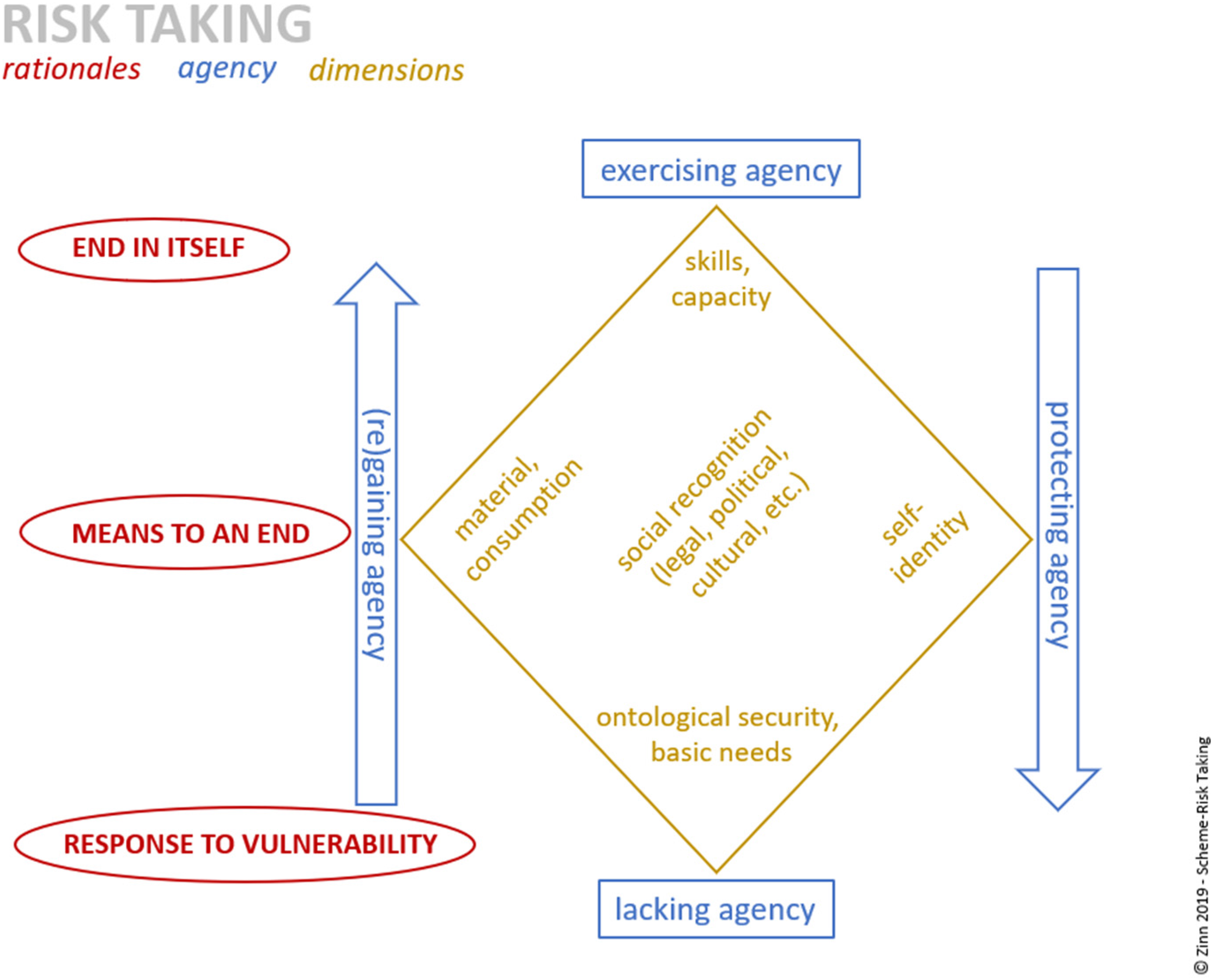
Rationales, agency and dimensions of risk-taking.
Regaining and protecting agency
As Bourdieu has argued, one's capacity to shape one's life depends on one's position in the social sphere, which is an expression of one's economic, social, cultural, and symbolic capital. It could be argued that if such capital is lacking and people’s rights are eroded, they have to take risks one way or another. For example, the oil-rig diver who has been asked to ignore safety procedures can decide to do so and thereby prove his value to the company. The diver could also reject the employer's demand and risk losing his job and income (Carson, 1982). Indeed, both responses are observable. Similar situations have been described in scholarship on health and safety in precarious work (Hall, 2016, pp. 428–30). For the workers it is less a problem of not knowing what the risks are (they often know all too well) but which choices they have the capacity to make when exercising agency and against which other risks they have to balance them. When providing for a family they might take more risks to secure a desired family lifestyle or simply for mere survival. 4
However, agency varies even when people have choices. When a young male in the UK decides to become a soldier after having been socialized with the Royal Airforce Cadets into the life of the armed forces this seems a continuation of a career and a natural ‘choice’ without any alternatives being considered (Zinn, 2011, p. 258). When living in a region with a high unemployment rate, the army might be a good choice with few alternatives available for working-class men. But, as some soldiers argue, engaging in a risky occupation might be an attractive option, promising some excitement compared with other occupations (Zinn, 2011, p. 245). Thus, it is not merely the structural but also the cultural limits, which prevent young men of a specific social milieu from considering alternatives. As an ex-soldier explained when looking back, becoming a soldier was the best and most normal option in his neighbourhood. He had never considered becoming a teacher, a doctor or anything like that even when having the necessary education, since these positions were for ‘the others’ who lived in the wealthy part of the city (Zinn, 2011, p. 253). Thus, structural and cultural options combine in one's agency by structuring both the objectively available options as well as the subjectively considered alternatives without determining the outcomes.
The examples about oil-rig divers and precarious work show that people take risks because they are worried about losing their status or income. Another example focuses on the protection of a valued identity. At a time when the harmful effects of smoking during pregnancy are well known, it is puzzling that some women still keep smoking. As Wigginton and Lafrance (2014) have argued in their study on Australian women smoking during pregnancy, these women might not be misinformed or ignorant about the risks, but they protect their smoking habit by redefining the risks. Sometimes, when smoking has become a learned strategy to manage stress, giving up smoking in a stressful situation such as pregnancy seems impossible. To deflect the stigma of being an irresponsible mother, they attempt to reinterpret the risks and seek approval through their GP that smoking less might be better than quitting altogether, since quitting smoking during pregnancy could unhealthily increase their stress (Wigginton & Lafrance, 2014).
These examples show that people exercise agency and take risks to protect something they value, such as their income, habits, or identity, or they take risks to (re)gain something they value, such as freedom and safety. While this might be so in most cases, there is also risk-taking which seems to a large degree unrestricted by social forces and therefore most freely exercised.
Exercising agency
Risk-taking as an end in itself seems least influenced by socio-cultural or individual restrictions, as Lyng (1990) once suggested. This is probably most often the case in leisure sport risk-taking, but even then economic resources, among other things, have an impact, such as in the case of BASE-jumping with the quality of gear and the events one can attend (Forsey, 2013).
The rhetoric of risk-taking is also used in situations where agency is exercised with little risk other than the danger of missing out on opportunities. There are far fewer examples of this in the literature. However, one is provided by John Tulloch and Deborah Lupton's (2003, pp. 72ff.) IT workers, who experienced flexibility and volatility of the labour market but, based on their skills, considered them as competing opportunities and chances rather than risks. They felt in control and often embraced the discourse of neoliberalism, defining risk-taking as a central part of ‘the human condition’. They confidently placed themselves among the winners while the others would be the ‘victim class’ (Tulloch & Lupton, 2003, p. 79). It is open to debate to what extent such examples should be discussed as chance-taking rather than risk-taking.
In contrast to chance-taking, in many cases people might lose the power to shape their life to a large degree. As a result of their lack of agency, they respond to external pressures by taking risks.
Lacking agency
As has been argued, when there are few alternatives available, people are prepared to take high risks to escape or to prevent an unbearable situation of acute suffering and likely disaster. But do these risk-takers have a choice? Can they actually exercise agency to any extent? In the large body of literature on employment dependency and workplace hazards, the common assumption is that people in precarious work often have hardly any choice. In contrast, Alan Hall (2016) suggests that these approaches fail to take into account that, in such cases, many workers still follow complex considerations of which hazards to accept.
As described earlier (Hayenhjelm, 2006), when paying people smugglers to escape political persecution or selling one's kidney to meet financial demands, risk-takers don’t have much of a choice. However, even in such extreme situations people try to exercise agency rather than giving in to their fate. Under these conditions, people can often not refer to or even actively ignore evidence about possible harm, but simply hope or rely on their faith to allow them to engage in high-risk/high-reward activities.
There are good examples which demonstrate the resourcefulness of coping strategies such as hope or faith to mobilize agency (Zinn, 2008, 2016). For example, the study of Bastide (2015) shows how illegal work migrants from Singapore, despite relying on faith to enable them to engage in high-risk work migration, did not act unreasonably or passively, but rather managed expected risks carefully and prepared for the possibility of bad experiences to the extent that was possible to them. However, when agency is restricted and the life situation remains unbearable, vulnerability can turn into ongoing suffering (Wilkinson, 2005) without any improvement in sight.
Agency and social change
It is reasonable to assume that people have different degrees of agency shaped by their upbringing, resources, and desires. But agency also varies in its consequences. It might result in routinized and institutionalized activities, such as normalized risk-taking, or it might be innovative, as in the case of transformative risk-taking. In this respect, risk-taking follows Archer's concept of morphostasis (social reproduction) and morphogenesis (social transformation). Indeed, all risk-taking is to a degree conscious and therefore reflexive, even though it is not clear to what extent risk-taking is part of a deliberative transformation of the world and to what extent a specific form of reflexivity is necessary to change one's life and the social world, as suggested by Archer. Instead, risk-taking might follow a habitus that provides skills and opportunities for social transformation relatively independent from the form of reflexivity and deliberation.
For example, many migrants currently trying to reach Europe, mainly from Syria and other countries such as Iraq and Afghanistan, are exposed to high risks and some die in the attempt to reach Europe. Are the rationales well captured with the modes of deliberation as suggested by Archer? A study on migrants from Senegal to the Canary Islands has revealed the difficult decisions that (mainly) young men had to make when entering a boat for a high-risk journey (Hernández-Carretero and Carling, 2012). One of the issues for these young men was the social dynamic they were exposed to. Migration attempts by boat became a ‘synonym for success’. Some informants reported that in this climate it was difficult for them to imagine that they would not take part in migration because they were too scared. They could not bear the thought that they might have stayed home while others changed their life. However, as we know, in many cases this might be illusory. Nonetheless, as we also know from the large migration streams to Europe, some are also successful and people are able to learn an occupation, or even study and integrate successfully into a new society and build a new life. The existential pressure at home and the collective sense-making of risk-taking might be a better explanation for their migration, motivated by the desire for material success and social recognition, than misinformation about the risks.
People seek for opportunities to exercise their agency. Therefore, risk-taking is not only what people do when they are resourceful, it is also a resource itself (or capital in Bourdieu's framework). People take risks to make up for their lack of ‘capacity’ or ‘capital’, and they do so not only individually but collectively (e.g. as part of their family) and are encouraged to do so by others.
By shifting the focus from reflexivity to risk-taking, the perspective can move away from a reflectionist notion of deliberation to give more weight to the resources and consequentiality of one's deliberations, which cannot be easily transcended by detached reasoning. In contrast to Archer's quote from Norbert Wiley – ‘we are little gods in the world of inner speech’ (Archer, 2007, p. 74) – the reality of deliberation is much more down to earth, where people take serious risks and have to suffer real consequences. Therefore, risk-taking combines reflexivity with the reality of the risks one is engaging with. The knowledge of these realities manifests in Bourdieu's illusio, or the ‘rules of the game’, and indeed people will reflect on this and take it into account when taking risks. But this reality is also changing, and people will sometimes make highly consequential decisions with little capacity to cope with the burden of the possibly negative outcomes.
Conclusions and perspectives
This article started with a discussion of the tension between the reproduction and transformation of social inequality, which builds on Archer's critique of Bourdieu's theory of practice. It suggested that, for the understanding of the reproduction and change of social patterns, risk-taking might play an important role. For advancing the understanding and systematization of the growing body of qualitative studies on risk-taking, the article utilized Archer's three domains of major concern that emerge from body–environment, subject–object and subject–subject relations. Empirical research provided the backdrop against which a number of theoretical frameworks were suggested to support observable forms of risk-taking related to these concerns about physical well-being, performative achievement and feelings of self-worth. These frameworks add to the dimensions of risk-taking the desire to test and prove one's abilities, as well as the trigger of physiological needs being threatened or unmet, and are complemented by risk-taking, which relates to material desires, social recognition, or subjective integrity. For a basic framework of risk-taking, the article suggested that such risk-taking dimensions are observable to different degrees, but each dimension might typically dominate in one of three rationales of risk-taking: when risk-taking is an end in itself, a response to vulnerability or a means to an end.
In contrast to Archer's suggestion of focusing on modes of reflexivity (Archer, 2012, p. 16), the article suggested that risk-taking might be a better way to understand the multidimensional connection between broader social change and human activities. Risk-taking may play a major role as a key feature in the reproduction of social inequality when acting as an expression of social positions. Risk-taking is also mobilized in order to make changes in personal life and, as a result, might also trigger broader social changes (e.g. when taken collectively). When risk-taking becomes a normal practice in late modern societies, and people are increasingly in the situation of having to manage the burden of unsuccessful risk-taking individually, soaring inequalities do not come as a surprise.
At the lower social strata, people are exposed more regularly to risks they have to take, and those risks are more consequential when there is little support for bearing the burden of possible undesired outcomes (e.g. Nguyen-Trung, 2022). At the same time, as Curran (2016) has argued, what might be a risk for some, provides huge opportunities for others. The recent Covid-19 crisis is only one among many examples. But the high cost for many contrasts with the small number of millionaires who have significantly increased their wealth from March to May 2020 (Neate, 2020), contributing to the widening of the gap between the poor and the (super-) rich.
Research provides evidence that people do not give in easily to a lack of prospects and a loss of agency. Even under extreme situations they try to mobilize agency by taking risks. As a result, strategies in between, such as trust, intuition, and gut feelings, as well as non-rational ways of managing the future such as hope, faith, and ideology, might be more important than ever to keep people going when knowledge and control are limited (Zinn, 2020).
Indeed, the proposed framework cannot replace available theories. It is rather a suggestion to complement broader theoretical frameworks by giving attention to a number of key dimensions which are central to people's risk-taking and the decisive role of risk-taking for people shaping their life and thereby contributing to the reproduction and change of the social sphere.
Footnotes
Acknowledgement
I am grateful for the lively discussions with my colleagues and their valuable comments to my work on risk-taking during my stay as a Fellow at the renowned Institute of Social Research in Frankfurt a. M. in Germany in 2022-23 (https://www.ifs.uni-frankfurt.de/home.html).
Funding
The author(s) received no financial support for the research, authorship, and/or publication of this article.
