




Abstract
Migrants rely on social capital when (re)settling in host communities. Connections with organisations are fundamental to developing local ties and accessing services. While scholarship is replete with studies on bonding and bridging ties, little is known about organisations’ ties with migrants. Less is known about how digital technologies facilitate these links. Our article draws on interviews conducted at the onset of the Covid-19 crisis with 23 organisations that support migrants. Our research involved: understanding how digital linking ties were developed; ways that organisations transitioned from in-person to digital engagements during the Covid-19 lockdowns; and how this transition facilitated engagement/reach across migrant communities. Our findings showed that organisations maintained ties with migrants when digital platforms enabled reciprocal engagement. We highlight challenges to creating linking ties largely due to resources constraints. This article contributes nuanced understandings of linking social capital and the impacts of a crisis on the development of social capital.
Social capital is critical for migrants as they navigate new tenures and develop local ties that support (re)settlement (George & Chaze, 2009; Ryan, 2011). The characteristics of social capital for migrants and their ability to create new ties in host countries are of long-standing interest to social scientists; these social ties are fundamental for the mutual development of obligations and expectations, shared norms, and a working trust of structures and people (Bourdieu, 1980; Coleman, 1988; Field, 2008; Keles, 2016). For migrants, these ties are often initiated by engaging with organisations that offer support related to acquiring employment, accessing services, and creating a new localised social network. Yet, within social capital scholarship, linking ties – ties between migrants and organisations – have received less attention (notable exceptions: Kianto & Waajakoski, 2010; Yli-Renko et al., 2002). Additionally, the increasing reliance on digital technologies has featured prominently in how social capital is formed, maintained, and enhanced. Indeed, migrants have embraced digital technologies to maintain and mediate connections with those in their home countries as they (re)settle in host communities (Baldassar et al., 2020; Cabalquinto, 2022; Felton, 2015). However, more localised ties in host communities, with established migrants and native-born residents, are often created in person and with little need for technology (Palmberger, 2017). Until the Covid-19 pandemic, linking social capital was developed and maintained almost entirely through in-person exchanges.
Covid-19 significantly influenced the way most people worked, studied, and socialised (Saladino et al., 2020). Restrictions on local, domestic, and international movements were implemented around the world, which made digital connections central to daily life. We situate this article in the context of the pandemic when localised ties became ‘digitally mediated’ (Parker & Song, 2006; Rafalow & Adams, 2017) and when organisations with the remit of caring for and supporting migrants moved to the digital realm.
During crisis events, the goal of government is to provide accurate information to the public. Throughout the pandemic, national, state, and local governments around the world sought to communicate efficiently and effectively with the public to slow the spread of the coronavirus. Key in this messaging, notably in Australia, was the need for behaviour change to physically distance from one another to maintain low community spread of the virus until the population was vaccinated. At the height of this crisis, governments struggled with tailoring, translating, and communicating Covid-19 information, particularly as it related to the lockdowns 1 enacted to slow virus transmission (Grey, 2020). In Australia, accurately broadcasting public health messages fell on non-government and community organisations with trusted relationships with migrants (Hyland-Wood et al., 2021). Organisations working with migrants had to rapidly transition to the digital realm and adopt new ways of communicating and engaging with clients.
Understanding how digital technologies can enhance or reduce social capital is not new (Calderon Gomez, 2021; Field, 2008; Julien, 2015; Neves et al., 2019; Williams, 2019). Existing scholarship demonstrates that digital technologies offer opportunities for synchronous and asynchronous engagements for people with different types of social ties (Wellman et al., 2001). Technologies provide connectedness that maintains bonding and bridging ties. In this article, we advance the social capital agenda by exploring connections, including digitally mediated ones, between organisations and migrants during Covid-19. Our intention herein is to bring organisations into direct focus and strengthen otherwise scant scholarship on linking ties. There is a sociologically valuable subsidiary of social capital theory in linking social capital and ties that requires scholarly attention, including impacts of these ties on migrants who are consistently at the periphery of support in host communities. The interplay of such sentiments (or not) with digital technologies is of import in this article.
We refer to many organisations as linkers – and digital linkers in some instances – due to their (digital) presence in the lives of migrants that served to share information and maintain local ties. The research integrated in-depth interviews with leading stakeholders, including local governments/councils, non-government organisations, grassroots organisations, and peak bodies in Australia. We illustrate connections that were enhanced, and instances where they were challenged, when organisations and migrants they service reverted to digital technologies during the pandemic, in a country that experienced multiple stringent lockdowns. The pandemic highlighted the vital role that organisations played to enhance engagement and provide conditions that connected migrants with each other and with other organisations in ways not seen before. We use the terms ‘migrants’ and ‘migrant communities’ 2 throughout this article, but acknowledge the heterogeneity of the terms related to debates on intersectionality (Brah & Phoenix, 2004; Webb & Lahiri-Roy, 2019) alongside those related to digital inclusion and exclusion (Borg et al., 2019). At this juncture, we flag that our research did not involve engaging directly with the migrant end users of programs/services rolled out by organisations. Their voices and perspectives are significant and future research in this space will capture and integrate end users’ experiences with organisations. In what follows, we bring together themes that frame this article: social capital, digital technology, and reciprocal engagement. We then outline context and methods, followed by a discussion of linkers’ strategies and challenges related to connecting with migrants during Australia's lockdown.
Literature review
Intersections between social capital and digital technologies
Social capital theory is principally applied in social sciences research as a lens to analyse social trust, norms, and networks (Bourdieu, 1980; Coleman, 1988; Field, 2008; Putnam, 1995a; Williams, 2019). Social capital, as a concept, has a long history and is heralded as essential for community life (Jacobs, 1961). Bourdieu (1980, p. 2) defined social capital as ‘the sum of actual or potential resources related to the possession of a durable network of more or less institutionalized relationships of acquaintance and recognition’. For scholars like Coleman (1988) and Putnam (1995b), social networks had two functions – to bond or to bridge. Bonding and bridging ties that overwhelm much of the social capital literature recognises that while it is a resource, social capital simultaneously offers access and opportunities to form a social network (Ryan, 2011). According to Putnam (1995b), bonding capital refers to dense social ties that are responsible for facilitating in-group loyalty, mobilising solidarity, and creating norms of specific reciprocity. This form of social capital is good for ‘getting by’ (Putnam, 1995b) while bridging capital is good for ‘getting ahead’. Bridging social capital does not require strong ties but, instead, is associated with the diffusion of information and opportunities as well as linkage to external assets. Bridging ties have access to different resources than bonding ties.
Social ties that have received limited attention in scholarship are linking ties. Unlike bonding and bridging ties, which are informal ties, linking ties are largely of a vertical nature involving relationships between organisations and individuals that either work within organisations or are connected to them (Kianto & Waajakoski, 2010). Kianto and Waajakoski (2010) discussed linking ties to better understand the social capital of organisations. They analysed intra-organisational and inter-organisational relationships related to organisational growth. Intra-organisational ties are social structures and relationships formed within organisations while inter-organisational ties address ‘relational qualities of collaborative arrangements among several organizations’ (Kianto & Waajakoski, 2010, p. 7). Our analysis demonstrates that inter-organisational ties exist between organisations and community members. Research reveals that organisations with strong client relationships can improve their organisational performance (Kianto & Waajakoski, 2010; Yli-Renko et al., 2002). There is scope then, to further examine the role of organisations as central to generating linking social capital with migrants. We seek to better understand how their linking ties with migrants can develop bridging ties down the track. We position this article within the remit of linking ties and the roles of organisations to service migrants’ needs. In particular, we are interested in how a crisis implicates the formation, maintenance, and enhancement of these ties when they become digitally mediated.
Our motivation for this article stems from intersections between social capital and the digital realm. Increasingly, scholars are paying attention to the role of digital technologies in daily life and these effects on social ties (Calderon Gomez, 2021; Wellman et al., 2003). There is now even a sub-category of research on ‘digital social capital’ that captures such interconnections. Existing research demonstrates that digital technologies can provide ‘social affordances’ and connectedness that mitigate loneliness and social isolation (Wellman et al., 2003). Social affordances, that are digitally mediated, provide both synchronous and asynchronous opportunities to create different ties between family members and close-knit friends to communities of practices, which allow interactions to be negotiated differently yet simultaneously.
There is a dearth of scholarship analysing how organisations transition to digital technologies, the challenges associated with this transition, and whether this transition during crises limits or encourages connections that benefit communities they service. While Putnam (2001) argued that social capital was decreasing, he called for further research to examine whether digital technologies played a critical part in this decline. Considerable scholarship now exists on the role of digital technologies in building social capital and enhancing ties (Keles, 2016; Parker & Song, 2006; Poortinga, 2012). However, this work is often directed at individual relationships (such as bonding or bridging ties) formed and/or maintained on the internet, with scholars arguing that ‘technologies remediate social practices [since] online and offline worlds [are now so] entangled’ (Calderon Gomez, 2021, p. 2536; see also Helsper, 2012; Ragnedda, 2017). Our article is uniquely positioned to contribute to debates on linking social capital and the digital field, particularly focusing on transitions of migrant-focused organisations from face-to-face exchanges to digital engagements during crisis.
Migrants using digital technologies
Digital technologies are valuable for enhancing engagement and maintaining contact (Cabalquinto, 2022). Strong ties online can enrich face-to-face, in-person communication (Habito et al., 2022; Wellman et al., 2001). In Australia, and elsewhere, maintaining social relationships during Covid-19 relied on access to technology and people's abilities to use a diverse repertoire of digital tools. According to the Australian Digital Inclusion Index, Australia's digital inclusion is improving; the Index simultaneously identifies that ‘Australians who speak a language other than English at home are in general more digitally included than others’ (i.e. the general population). While digital access and ability propel a growing desire to maintain connections through digital means, affordability is a key concern, as well as those in the population who remain excluded (Thomas et al., 2021).
Globally, increasing digital connectivity has revealed that some groups and organisations remain ‘digitally excluded’. Digital exclusion is the inability to use digital technologies due to limited access, affordability, and/or proficiency (Borg et al., 2019; Helsper, 2012). These components of digital exclusion exist across individual and organisational levels, and may cluster among certain groups (e.g. recently arrived migrants or organisations within a particular sector) (Holcombe-James, 2022). Ongoing research related to terminologies give preference to the term ‘digital inclusion/exclusion’ over ‘digital divide’ (Ragnedda & Muschert, 2018; van Dijk, 2006). ‘Digital inclusion’ acknowledges that ‘the simple binary description of a divide fails to do justice to the complex reality of various people's differing access and usage of digital technology’ (Warschauer, 2003, p. 44). Holcombe-James (2022) revealed that distinctions between digital inclusion and exclusion exemplified the unevenness of Covid-19's digital pivot across institutions in the cultural sector (Holcombe-James, 2022). Similarly, Kennedy et al. (2021) reflected on the digital pivot during Covid-19 in relation to participation, highlighting barriers low-income households faced when partaking in online activities. They argued that shifting to digital methods is not entirely inclusive and that face-to-face activities may still be essential to mitigate barriers to participation. Our analysis similarly demonstrates that some organisations and/or end users were digitally excluded and faced challenges in maintaining social ties during Covid-19.
Alongside the corpus of literature on digital inclusion and exclusion, scholars focus on the role of digital technologies in migrants’ lives (Felton, 2015). While some research points to barriers migrants face related to access, affordability, and ability (Alam & Imran, 2015), significant scholarship examines migrants’ digital practices, including ways that technologies shape personal, social, and family lives (Baldassar, 2007; Baldassar et al., 2020; Cabalquinto, 2022, 2018; Zhao, 2019). Migrants maintain social ties with friends and family in home countries by using messaging applications, especially with visual interaction, such as WhatsApp, Facebook Messenger, Viber, and WeChat.
While there is growing evidence of digital ability among migrants, the extent to which this ability exists within organisations that work closely with them is unclear. From Covid-19 we are yet to see the success or failure of linkers who transitioned to using technologies to connect with communities – there could be multiple limits regarding reach and technological capacities that resulted in digital exclusion amplified by Covid-19. Research reveals increased uptake of digital technologies among migrant groups, suggesting that during crises many migrants would be well-placed to maintain local and distant connections digitally (Cabalquinto, 2022). Yet, crises are challenging for individuals and organisations. There are migrants who face digital challenges; indeed, navigating the digital realm in Australia can be difficult due to variable English proficiency. Covid-19 amplified digital challenges that migrants and organisations faced in different respects; while there was a push to maintain social relationships during isolation, migrants felt pressure to access vital services offered by organisations due to such challenges.
Reciprocal engagement with end users
In the context of Covid-19, organisations can have a fundamental role as linkers to provide digitally mediated connections and/or reciprocal engagement to and with migrant communities (Gigliotti et al., 2019; Winschiers-Theophilus et al., 2019). Existing modes of engagement rely on top-down/one-way communication models. Thus, we contend that organisations would benefit by developing skills that encourage reciprocal engagement with end users. ‘Reciprocal engagement’ – like ‘participatory’ and ‘inclusive’ engagement – refers to two-way interactions between an organisation and end users. This type of engagement enables end users to communicate with organisations, and vice versa. For organisations to benefit from implementing digital technologies and reciprocal engagement, Winschiers-Theophilus et al. (2019) called for a collaborative process, working closely with community members when transferring services, programs, or knowledges to online platforms. However, organisations may still face difficulties, particularly as it pertains to their resources and abilities to reach individuals who are not already digitally connected (Anthias, 2021). As such, our research advocates for a more robust and community-focused approach that neatly weds needs of end users with those of organisations. Such collaborations guarantee that when digital technologies are implemented, they can be aligned with end users' technological ability, knowledge, and access.
During Covid-19, organisations swiftly transitioned their linking practices to the digital realm. Acting in haste, it was not necessarily viable to draw on an informed collaborative framework, but we believe this can be implemented readily post-crisis. Our research with organisations highlights that shifts to the digital realm can cultivate bridging and bonding relationships – among the migrants themselves and between the linkers and migrants – both in future crises and periods of dormancy. We draw on two research questions to guide our subsequent discussions. First, we ask whether organisations were able to create opportunities to connect with migrants during Covid-19 and what their experiences of doing so were. Second, we seek to understand whether digitally mediated connections maintained and/or enhanced the linking ties between organisations and migrants and whether these could lead to bridging ties.
The crisis and research context
In March 2020, the World Health Organization (WHO) declared Covid-19 a pandemic (WHO, 2020). Countries around the world responded with restrictions – some enforced strict stay-at-home orders while others were more lax. Despite the relatively low infection, community transmission, and death rates in 2020, Australian state and federal governments took a conservative approach, limiting local activities and implementing national and international travel bans. Significant in Australia's strategy for reducing the spread of the virus was the implementation of lockdowns. In June 2020, while many Australian states began to ease restrictions, a second wave unfolded in Victoria which led to a ‘stage four’ lockdown across Greater Melbourne. This lockdown was one of the most stringent in the world and was also implemented several times in other Australian states to curb the spread of the virus. All of the lockdowns essentially eliminated in-person and face-to-face contact, and led to dependence on online communication and digital engagement. As lockdowns were announced, there was consistent media commentary about the lack of appropriate communication with Victoria's migrant communities.
We commenced this research in March 2020 in Victoria, which is one of the most diverse states in Australia, and is increasingly becoming home to migrants from Asia, South America, and Europe. The 2016 Australian Census revealed that 49.1 per cent of Victorians were born overseas, or had at least one parent born overseas; 40.2 per cent of the Greater Melbourne population was born overseas (Australian Bureau of Statistics, 2017). At the outset of Covid-19, federal and state governments implemented a range of public health messaging and communication strategies that addressed community needs and support for adherence to preventative measures and essential advice. These strategies were critical, especially given Victoria's diverse community. During the second wave of the virus in Victoria, many questioned whether public health messages and information were effectively communicated by government and non-government agencies to migrants (Dalzell, 2020). These debates around whether migrants contributed significantly to rising case numbers continued as we developed this article, alongside discussions of an inquiry into Victoria's hotel quarantine program. Some debates that occurred in mainstream media and politics uncovered what scholars already knew: that migrants are over-represented as ‘essential’ workers, live in overcrowded dwellings, and are more susceptible to contracting the virus (Kluge et al., 2020; Nasreen & Ruming, 2019; Tietz, 2017). While these debates continued, we sought to better understand how organisations and migrants used digital technologies to engage with each other during Covid-19.
Methods and analysis
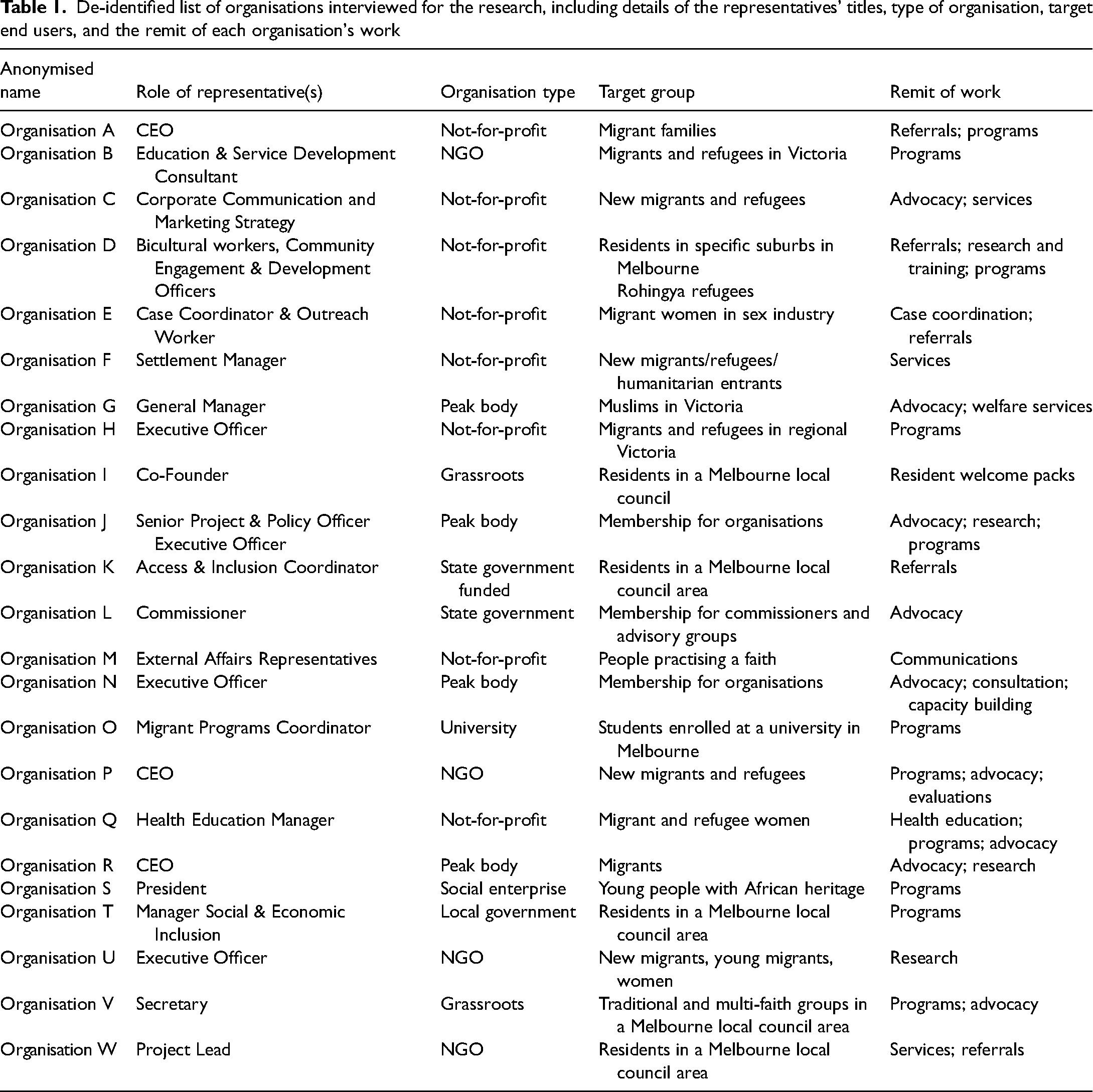
We remotely interviewed 23 key stakeholders, 3 including those who worked directly with migrants in Victoria and some across Australia (Table 1). These stakeholders provided a comprehensive capture of all the leading agencies and peak bodies in this space. We draw from an expert sample and have ensured representation across multiple sectors, and preferenced those who worked with migrants in areas of health, social support, religion, and education. 4 The interviews (45 to 60 minutes long) comprised questions on the adaptation of service/program delivery during Covid-19; how the organisations modified engagement with migrants; challenges; best practices; and sustaining digital engagement post-crisis.
De-identified list of organisations interviewed for the research, including details of the representatives’ titles, type of organisation, target end users, and the remit of each organisation's work
The authors separately undertook a hybrid approach of inductive and deductive coding of interview data, which was then comparatively discussed to ensure the reliability of themes (Xu & Zammit, 2020). We discussed the state of the literature, a potential framework, findings, and then established themes that formed the deductive analysis. The authors commenced analysis with strong understandings of the coding strategy that was to: (a) analyse data according to initial themes that were agreed upon together; and (b) integrate an inductive approach where codes were created directly from the data by the authors separately. Interview transcripts were analysed in NVivo. Examples of codes included: the role of organisations, technologies/platforms, approaches, and challenges. We then integrated a ‘bottom up’, inductive strategy (Xu & Zammit, 2020, p. 4) where we analysed data without knowledge of each other‘s codes. We met to discuss and compare codes as well as trends, meanings, and patterns across the data set (Braun & Clarke, 2019).
Results and discussion
Our research sought to better understand how organisations developed linking social capital for migrants through digital means during crisis. Two questions guided this research: first, we asked whether organisations created opportunities and/or experienced barriers connecting to migrants. Second, we wanted to better understand whether digitally mediated connections maintained and/or enhanced linking ties between organisations and migrants that could lead to bridging ties. Herein, we discuss the role of organisations to link and maintain connections with migrants using digital technologies. We refer to the organisations as linkers given their role of maintaining connections with migrants. As indicated in Table 1, the linkers in our sample provided essential services, opportunities, and/or programs to migrant communities prior to the pandemic. During Covid-19, these linkers were largely limited to digitally mediated connections due to several strict lockdowns. This article conceptualises digital linkers as organisations and/or representatives with a remit to support migrants through digitally mediated means. Digital linkers made the digital pivot; they also had the requisite ability and access to maintain linking ties with migrants. In this section, we contextualise organisations’ activities pre-crisis, then explain transitions to becoming digital linkers and examine their role during crisis; we also discuss challenges faced in transitioning to the digital realm, and explore ways that digitally mediated connections and engagements flourished (or not).
Pre-crisis activities
Prior to Covid-19, organisations relied mostly on in-person connections with migrants in Victoria. Many organisations delivered services that were ‘place-based‘ (Organisation A) – their local (i.e. suburb- or municipal-level) engagements included social gatherings, cooking classes, sewing programs, and mothers’ groups to promote diasporic or community connectedness. Organisations provided in-person services such as mental health care, case management support, and access to essential services. One health-focused not-for-profit organisation employed Rohingya bicultural workers
5
as part of a partnership project with the Rohingya community that relied on in-person activities. One bicultural worker discussed their role: I [was] helping the community and learning what services are available [in] different locations, finding suitable training [sessions], helping [as a] language interpreter where I filled out forms and helped write their resumes, [and] I engaged with the other communities. (Organisation D)
Here, linking ties between organisations and migrants involved the in-person nature of connecting, building trust, and sharing knowledges (Coleman, 1988; Putnam, 1995a). Significant to Covid-19, however, was the transition to the digital realm, which removed in-person, place-based means of connecting. Pre-crisis, some organisations already used digital media, but in limited ways; all of the organisations we interviewed maintained a website and some even went a little further, integrating Facebook groups and social media pages and digital newsletters into their end user communication strategies. Yet, the way the crisis unfolded meant that some organisations faced challenges as they attempted to create conditions for an effective uptake of digital technologies by migrants.
Becoming digital linkers? Approaches and challenges
As the crisis unfolded, organisations had two key roles: to deliver health messages and maintain connections. In return, migrants engaged with organisations, providing opportunities for migrants to connect with each other and build bridging and bonding ties beyond linking ties. This had the potential not only to strengthen social capital but also to expand their broader social networks during a period of isolation. We see the social network in this crisis as comprising digitally mediated connections between organisations and migrants. However, such digitally mediated connections and maintenance of linking and social ties came with struggles as both migrants and organisations adapted and attempted to transition to the digital realm.
Many organisations had to consider their reach and identify digitally included and excluded migrants they engaged with. Some organisations could not promptly shift to the digital realm due to their own digital barriers (Holcombe-James, 2022). Simultaneously, there were shifts in processes of linking to migrants too. A suite of challenges emerged, including access and ability to use technology. For the most part, organisations turned to existing digital infrastructures, such as websites, social media platforms, and digital databases. We observed how linkers attempted to create opportunities for synchronous and asynchronous connectivity that were tailored for migrants (Wellman et al., 2001). However, some organisations reverted to conventional modes of communication to share important health information with migrants who did not have access to technology: One of the reasons why you may be finding that people are resorting back to some of the more traditional, ethnic media or radio, is that not everyone has access to the internet and it's becoming more and more on our radar. (Organisation C)
Another organisation collaborated with other organisations and local schools to contact migrants and organise essential goods deliveries: Because schools were closed … their workers and teachers and welfare staff all switched to calling families about twice a week. Families they were really worried about, they [called] more regularly. They were connecting people to services for material aids and getting packages of groceries delivered. So making sure people eat … and then there was also getting people connected to the internet to things we were worried about [such as]: [people] not having enough credit on their phones to stay on the phone to Centrelink for many hours. (Organisation D)
6
Despite challenges, most organisations were aware of the importance of regular communication, either through local radio or phone calling. This conventional communication was prioritised to reach certain groups, particularly the digitally excluded, given Victoria's unique context where face-to-face engagement completely stopped. Few organisations opted for such communication as an interim measure as they developed or updated digital components of their engagements.
Diverse modes of digital technologies were important for the success of organisations in developing linking ties. Only a few organisations built resource and infrastructure bases when and as the pandemic unfolded: When Covid happened, we sort of dialled up the digital platform just because we had to get out there so quickly and we developed [a] website. We did it in English first and then it was getting some popularity, [so] we decided to assess our organisation [and] speak to our program managers on our top 10 languages. (Organisation C)
We note that sizes, ecological structures of organisations, and amounts of funding they receive were vital considerations as they transitioned services and activities online. This, in part, influenced support they could offer to migrants they had ties with, and ways in which they could develop new linking ties (or not). The success of digitally mediated connections required an active deployment of resources to connect with migrants depending on digital access, affordability, and ability. Some organisations reported that migrants they had ties with did not have smartphones or internet access. Organisation A demonstrated ways some organisations facilitated connection during crisis: We were really lucky that we had the resource[s] to buy all of [our clients] a tablet, because the schools aren‘t [providing them]. There is a real problem with community members not having access to technology … and access to internet as well. I think for women, being able to connect [is important]. Isolation is so deadly and it is really expensive to fix isolation. The cost of a tablet and a bit of internet is not expensive compared with the cost of isolation. (Organisation A)
Our findings show that maintaining linking ties with migrant communities was most successful when organisations were well-resourced. Once some migrants had resources, they faced challenges in maintaining linking and social ties.
Another challenge for migrants was related to building skills to use digital devices and technologies. One organisation we connected with indicated that bicultural workers were critical conduits and a trusted access point. They had mutual trust with their communities and fostered an environment for reciprocal engagement. Gigliotti et al. (2019) cautioned that organisations must ensure safety, mutual practices, and appropriate communication between end users to pursue successful reciprocal engagement. In the case of Organisation D, Rohingya bicultural workers supported their community to develop digital skills: Rohingya people, they don't know how to use computers and so we held one event through the internet. At that time, I talked with the community [about how] to join to this event. So we try to help people, send them messages, and [speak] on the phone, [guiding them to] download this app, and [telling them] the [Zoom] ID … [to] click this one, click that, click that. We [took] two weeks to grow to this session. So, we did work very hard. Now Rohingya people are learning. (Organisation D)
Bicultural workers in this example had significant reach into their communities. There was evidence that they were a type of linker embedded in organisations and had created conditions to form meaningful bonds (i.e. bonding/bridging ties) with communities, highlighting ways that these relationships can evolve. These strong bonds allowed the bicultural workers to enhance their relationships with migrants and develop digital skills that could be sustained even beyond the lockdowns. The role of bicultural workers reinforces Winschiers-Theophilus et al.'s (2019) argument that reciprocal engagement relies on close relationships with the community and feelings of trust and safety when it comes to connecting or transferring knowledges to the digital realm.
Creating digitally mediated connections
Throughout the pandemic, many organisations transformed services offered to migrants and actions they took to maintain linking and social ties. Despite their core business strategies/activities, organisations disseminated public health information in ways they may not have previously pursued. From our analysis, we identify three ways that organisations engaged with migrants: responding to crisis, maintaining links/ties, and creating new approaches for digital and reciprocal engagement.
Many organisations responded to Covid-19 by providing emergency food, communicating critical public health information to migrants, and ensuring migrants had access to digital technologies for engagement. Organisation C created a ‘hub’ on their website with Covid-19 information in multiple languages: We basically have a very small digital team and I tasked them with spending a couple of hours a day just doing as much research as they could and pulling all the information together. So, I guess that Covid site is more like a hub. We bring people [to the site] and then we link them to relevant information. (Organisation C)
While the digital hub collated and translated essential information, diverse digital engagements were required for rapid communication. For example, another organisation sent text messages to their end users: Most of the women, if English is not their first language … prefer to use SMS to communicate. I’ve been doing a lot of SMS messages to them … I input in the SMS so that they can have [it] as a reference, so they can use the Google translator to translate [the SMS] to their own language. (Organisation E).
These two responses kept migrants informed and connected, emphasising the critical role of organisations given their existing ties and trust built (D‘Angelo, 2015). The crisis relied on connections that organisations have to migrants, including those with lower English proficiency, to procure information and services. Tailored and translated messages – many community leaders translated, audio or video recorded, and broadcast messages via WhatsApp and YouTube (Organisations H and T) – held potential to strengthen trust and ties with migrants.
While transitions to the digital realm were made, in part, to continue offering services and programs to end users, they were also about maintaining links to the community and preventing isolation. One organisation based in regional Victoria held their playgroup online: Our playgroup is now being delivered into homes online by our playgroup coordinator [who] runs it from her lounge room, basically, and has all her props and her guitar and everything. She spent a good week or so teaching parents on how to get online using Zoom. (Organisation H)
Before Covid-19, local events and gatherings were regularly attended and had the potential to establish geographically proximate bridging and bonding connections. Organisation H's playgroup and Organisation I's online festival (described below), demonstrate possibilities for local ties to develop beyond the crisis. Organisation I discussed an online festival they organised for new migrants in a local suburb they serviced: we thought ‘Well, why don't we do an online festival that's live, full of live events, where people can actually interact?’ But we [would] still keep that place-based focus … we got 10 expressions of interest from people wanting to host something. So we … hosted a couple of dance classes. We got a yoga studio that wanted to host a yoga class, a girl who has worked in a Chinese holistic health clinic who wanted to run an acupressure workshop. We had a celloist as well. (Organisation I)
In these cases, digital technologies were a mediating tool that connected linkers with migrants in local areas. While community events were promising for developing future bridging and bonding ties with migrants, there was also discussion from organisations related to the extensive reach of their events to interstate and international audiences. Digitally connecting with these larger audiences meant that more migrants were engaged in activities during lockdowns. One participant discussed the intensity of their efforts to ensure digital connectedness: [We’ve had] double [the engagement], if not more, [compared to] what we were doing before and what we have planned…. Maybe it's because of [the] isolation situation and people wanting to connect in some way, but the levels of attendance – the conversations, the questions, and issues raised [on] the whole – [meant that] people are sharing how fantastic it has been to connect, how emotional they felt [connecting], and how great it was to be able to have that opportunity. (Organisation J).
Organisations played varying roles during Covid-19 based on the connections they sought to maintain with migrants and services they were able to offer. Rarely were organisations able to resource their target groups/clients. In other circumstances, organisations maintained links with migrants that were either geographically proximate or more universal. Many organisations transitioned their activities online and took on additional responsibilities to ensure the health, well-being, and safety of migrants.
Linkers were critical during Covid-19 despite challenges associated with transitions to the digital realm. Our findings demonstrated a strong uptake of social media and messaging platforms for communication. One participant said: ‘WhatsApp is where we find a lot of culturally and linguistically diverse communities are engaging’ (Organisation P) with family, friends, and community leaders. Several organisations used WhatsApp, Viber, and Facebook groups to maintain contact while others ran public events on Instagram: ‘We decided to do this [event] on Instagram Live because we identified that most of our members are interacting in lockdown on Instagram’ (Organisation S). A flurry of recent scholarship has uncovered the capacity of migrants to use social media and messaging platforms (for a comprehensive review, see Alencar, 2020); while organisations may not have moved that far into the digital realm without Covid-19, the emergence of digital linkers in our research meant that they engaged on social media and messaging platforms, suggesting potential for bridging ties to form if they continue digital and reciprocal engagements post-crisis.
Final remarks
This article offers a contribution to scholarship on linking social capital, digital technologies, and reciprocal engagement between migrants and organisations during Covid-19. Our case study is uniquely situated in Victoria – a state that is not only one of the most diverse in Australia, but one that endured some of the strictest lockdowns in the world when all in-person interactions ceased for a protracted period. As the crisis unfolded, and worsened, organisations were at the front line of connecting and sharing messages with migrants. This article pushes linking social capital scholarship further by focusing on organisations as linkers. Many digital linkers were born from crisis responses through the digital pivot. They swiftly transitioned to the digital realm, yet their struggles in doing so were evident as they used diverse means of maintaining contact with migrants especially due to barriers of connecting with some. Broadly, we found that when migrants were connected to organisations, they were able to ‘get by’ and access relevant and important information, connect to bicultural workers, and form ties to other migrants. These important components build and enhance social capital for migrants themselves and organisations. This finding is valuable beyond the immediate crisis. Building social capital is a process for migrants and organisations alike and our findings point to the central role that digital engagement can play.
Our participants’ accounts indicated that digitally mediated connections resulted in the maintenance of linking and social ties between organisations and migrants, yet it was clear that there were challenges associated with transitioning to the digital realm and using technologies for some organisations and migrants. Our research provides important insights into these challenges for the organisations who were essentially responsible for ensuring that migrants, including the hardly reached, were receiving information and not isolated. Some organisations implemented one-way models of engagement (such as the resource hub) where important information was accessible to wide audiences. In those instances, organisations were critical channels of information, conveyed in a culturally appropriate manner. Other organisations interacted more intimately through playgroups, text messaging, and online events. These digitally mediated connections had potential for bridging ties to flourish among migrants. By extending beyond linking ties, greater trust and reciprocity between migrants and organisations could develop. While this differs from conventional vertical ties associated with linking social capital and requires further analysis post-crisis, these are critical findings that sit at the intersection of and advance scholarship on digital and linking social capital.
Digitally mediated connections were crucial for many organisations to maintain ties with migrants. Bicultural workers encouraged digitally mediated connections as a model of reciprocal engagement. This example is one way that linking ties are not only vertical, but more horizontal or informal, and where linking ties can be enhanced as we move into hybrid styles of connection. Our findings tell us that, when required, organisations are adept at finding ways to connect with their end users, either through digital technologies, social media, or conventional means. These findings signal the potential of organisations to shift their practices and a willingness to learn new skills. As we finalise our article, semblances of ‘normality’ return around the world. We are seeing in-person activities resume. While we are confident that many organisations have adopted hybrid modes of operating and, as such, have maintained the digital components of their services/programs, we can now take pause and reflect on the lockdowns. From our musings, there are opportunities to embed formal digital engagement frameworks by creating templates and guides on digitally engaging with migrants. Organisations may reconsider resource allocations and digital infrastructures. These explorations, post-lockdown, require follow-up conversations with organisations. Other questions arise too, including how linking ties have strengthened, loosened, or been sustained and at what cost to other modes of organisations’ service/program delivery. Additionally, to truly understand ways that social capital was created, maintained, and enhanced during Covid-19 requires understandings of how migrants experienced lockdowns, including how they benefited (or not) from digitally mediated connections with linkers, and the implications of the crisis for their social and linking ties. Including these experiences would consolidate scholarship on linking social capital, digital social capital, and reciprocal engagement that will be significant for both future crises and everyday life.
Footnotes
Acknowledgements
We would like to extend our sincere thanks to the participants who contributed to this project. Their insights and contributions are deeply valued and we acknowledge that they gave up their time during a period of significant crisis to share their knowledge with us. We are also grateful to the two anonymous reviewers who offered generous feedback and encouragement that strengthened this article.
Funding
The author(s) received no financial support for the research, authorship, and/or publication of this article

Notes
Author biographies
Charishma Ratnam is a Human Geographer and Research Fellow at the Monash Migration and Inclusion Centre at Monash University, Australia. Her research spans a number of areas including experiences of migration, refugee resettlement, and (re)creating home. She is particularly interested in integrating novel methodologies with her participants, including digital, visual, and walking methods.
Chloe Keel is a post-doctoral researcher at the Monash Gender and Family Violence Prevention Centre at Monash University, Australia. Her work broadly focuses on perceptions of safety, gender, urban criminology and social processes in diverse contexts.
Rebecca Wickes (PhD Griffith) is a Professor at the School of Criminology and Criminal Justice, Griffith University. Her research focuses on urban and regional neighbourhood dynamics, social cohesion and social problems. She is the lead investigator on the Australian Community Capacity Study (ACCS) and was the Founding Director of the Monash Migration and Inclusion Centre (MMIC) at Monash University.