




Abstract
Commentators have predicted that Australian male primary school teachers will be extinct within 50 years. Drawing upon sociological ideas about the emergence of ‘caring masculinities’, this article qualitatively examines popular Australian understandings about male primary school teachers, their importance, why they are declining and whether, and how, this gender imbalance can be addressed. The study analyses data from 541 comments posted in response to nine online media pieces on male primary school teachers in Australia. The article shows that commenters believe men teaching young children experience stigmatised masculine identities but misplace the cause of this as the result of women and anti-feminist ‘anti-male bias’ rather than the constraining impact of hegemonic masculinity. The article suggests that until more caring and progressive forms of masculinity are culturally and economically valued in Australia we will see little change in the numbers of men entering primary school teaching.
Introduction
Contemporary social and cultural change has arguably created opportunities for new expressions of masculinity. Increasing individualisation, reflexivity and globalisation are theorised to create less fixed gender roles and more diverse and less traditional forms of masculinity (Christofidou, 2021). Critical men and masculinity studies theorise the development of more progressive masculinities that reject dominant or hegemonic models. Late modernity is argued to provide possibilities for new masculine identities based in emotion, reflexivity and care (Elliott, 2016; Holmes, 2015; Roberts et al., 2021). The rise of new caring, inclusive or emotional masculinities implies changing attitudes, particularly about men who work in traditionally feminine or caring professions. While new masculinities have been theorised in sociological research, there is little empirical research in sociology that examines attitudes about men in traditionally feminine occupations. This article addresses this gap using attitudes about male primary school teachers as a site to probe wider debates about changing contemporary masculinities. Guided by theoretical accounts about the emergence of caring masculinities (Elliott, 2016), this article analyses public attitudes towards men's involvement in primary or preschool education based on the online analysis of a series of media articles on this topic.
Caring masculinities? Theorising new masculinities in Australia
Masculinities are theorised to be changing in recent decades to be more inclusive, softer and caring (Christofidou, 2021; Elliott, 2019). A key model for theorising changes to men and masculinities is ‘caring masculinities’ (Elliott, 2016). This theory suggests the emergence of alternative models of masculinity based on men adopting caregiving roles (Scambor et al., 2014). Caring masculinity is characterised by men taking more responsibility for care in the private sphere but also in the public sphere by working in more ‘feminine’ professions of care (Elliott, 2016; Scambor et al., 2014). For Elliott, caring masculinities ‘reject domination’ (2016, p. 240) and embrace values and practices of care traditionally associated with women and femininity. A key component of this approach is that care extends beyond close and intimate bonds to wider political and social institutions, including domestic workers, teachers and the welfare state (Held, 2006). King and Elliott (2021, p. 874) suggest that ‘caring masculinities offers a transformative framework by which men can be engaged in gender equality and masculine norms can be reconfigured’.
International evidence, particularly from Europe, highlights the rise of egalitarian attitudes and the growing significance of caring masculinities (King & Elliott, 2021). What, though, is the nature and extent of change in Australian masculinities? Sociologists have pointed out that there is something distinctive about Australian masculinities. Hegemonic masculinity in Australia has been characterised by stoic self-reliance, lack of emotional openness and a focus on mateship that excludes women (Butera, 2008; Dempsey, 1992; Franklin et al., 2019). Following Elliott (2019, p. 109), we take hegemonic masculinity to be a description of ‘the elevated, valued, perhaps more traditional version of Australian masculinity’. Images of strong white men – convicts, lifeguards and explorers – and, more recently, male sportsmen and transnational businessmen, are celebrated Australian masculine figures (Connell & Wood, 2005; Philadelphoff-Puren, 2004).
There is evidence, however, that societal ideas of manhood are changing in Australia. Elliott (2019, p. 120), for example, highlights how young Australian men must balance progressive and traditional expressions of masculinity, facing competing requirements ‘to be both hard and soft’. The Unpacking the Man Box project, based on a survey of 1000 young Australian men (aged 18–30), draws attention to the significance of the ‘Man Box’ for understanding young Australian men's conformity to traditional masculinity norms and the largely negative impacts of this conformity. This research was carried out by the Men's Project – a Jesuit Social Services Initiative – and sociologist Michael Flood. The Men's Project and Flood (2020) found that most young men do not endorse Man Box rules. However, a significant minority of young men agree with traditional masculine norms while a larger proportion agree that Man Box rules are key societal messages they receive as men. Although theoretical models such as caring masculinity are sometimes positioned as overtaking older hegemonic forms, we follow Roberts et al.’s (2021, p. 3) suggestion that attention needs to remain on the ‘co-existence of multiple masculinities’. Beliefs and attitudes about how men ‘do gender’ (West & Zimmerman, 2009, p. 112) at work provides an empirical site to analyse theoretical arguments about how masculinity is changing, its institutional expression and the coexistence of traditional and new masculinities.
The gender (im)balance in primary school teaching
Work and employment is a central site to investigate changes in gender ‘orders’ and ‘regimes’ (Huppatz & Ross-Smith, 2017; Walby, 2020). The workforce composition of men and women in education provides a specific lens to investigate changes in masculinities. Social attitudes towards men who are involved in more care-oriented and traditionally ‘feminine’ professions, specifically those that involve caring relationships and close contact with children, provide a specific case study to examine changing masculinities. Despite claims about emerging ‘caring masculinities’, globally and in Australia, women are over-represented in education and training. In Australia, women make up 64% of the education workforce compared to 36% of men (WGEA, 2020).
Discussion about teacher gender balance in primary education has been a consistent focus of educational researchers in recent decades. This debate has been fuelled by reports from statutory authorities in Australia that recommend increased recruitment and retention of men into primary education (Weldon, 2015). Yet, the percentage of Australian primary teachers who are men has dropped from 30% in 1983 to 18% in 2020 (Australian Bureau of Statistics, 2021). This downward trend is evident in other developed nations such as England, New Zealand and the United States of America (Bureau of Labor Statistics, 2013; Cushman, 2008; De Salis et al., 2019).
The decline of male primary teachers is a concern for key stakeholders such as principals and parents (Cushman, 2008). These concerned stakeholders have cited a variety of reasons why more men are required in primary schools, including the perceived ability to act as positive male role models and father figures (e.g. Pollitt & Oldfield, 2017), make school classrooms more representative of their local communities (e.g. De Salis et al., 2019), and the perception that they are better suited to take on extracurricular roles such as school disciplinarian (e.g. Mills et al., 2008), manual labourer (Cruickshank, 2020) and sports coach (e.g. Burn & Pratt-Adams, 2015). Connell (2008) states that these perceptions are largely driven by a belief that men know men best: ‘only men can truly understand masculinity. Men have it, and women do not. Men appreciate the importance of sport, fighting, competition, emotional control, and so forth, in a way women cannot’ (2008, p. 132). The need for male role models to ‘rescue’ boys’ masculinity has been critiqued for its essentialising gender logic and for undermining the work of female teachers in the profession (e.g. Connell, 2002; Moosa & Bhana, 2020; Skelton, 2012).
Sociological research has highlighted how traditional notions of masculinity underpinning school systems lead to men fulfilling roles associated with discipline, physical activity and leadership (Connell, 2002; Palmer et al., 2020). This situation can actually advantage some men, with researchers such as Mills et al. (2008) and Williams (2013) using the term ‘glass escalator’ to describe the ‘invisible’ forces that can lead to men being promoted into management positions faster than women. This effect can be seen in schools within countries such as United Kingdom (Jones, 2008; Skelton, 2012) and Australia (Cruickshank, 2016; Mills et al., 2008). For example, in Australia men hold around half of the leadership positions in primary schools despite only 18% of Australian primary teachers being men (Palmer et al., 2020). Additionally, principals in Jones (2008, p. 695) study described men ‘being propelled into leadership positions by groups within society’.
‘Valuable and suspicious’: Dominant discourses about men and primary school teaching
One challenge that is consistently identified as contributing to the decreasing percentage of male teachers in primary schools is negative societal perceptions of male primary teachers (e.g. Mistry & Sood, 2015; Reid et al., 2019). A common theme is how male primary school teachers struggle with discourses that position them as both valuable and suspicious (Cruickshank, 2012). While men in primary school settings can be lauded and highly valued, they are also seen as suspicious, with men wanting to work with young children deemed to be ‘either homosexuals, paedophiles or principals in training’ (Mistry & Sood, 2015, p. 116).
Smith (2008), for example, based on interviews with male pre-service teachers and a discourse analysis of the Australian media, argues that male primary school teachers are positioned as dangerous or threats to children. There is also a damaging discourse of suspicion around gay men who teach or aspire to teach young children, with homosexuality often conflated with paedophilic threat (Moosa & Bhana, 2022). Researchers have also noted negative perceptions about male early-childhood teachers in teacher comments (e.g. Burn & Pratt-Adams, 2015; Mills et al., 2008) and media coverage (e.g. Cruickshank, 2019; Reid et al., 2019). These findings are supported by studies of female teachers in the United Kingdom (Jones, 2007), and of education stakeholders such as teachers, parents and administrators in Canada (Bernard et al., 2004), which found that all men in the primary teaching profession are perceived as high risk and likely have to deal with constant suspicion and surveillance. More recent research with male primary teachers and pre-service teachers (e.g. Cruickshank, 2019; Eldred et al., 2022) has indicated that these perceptions have not changed in the past decade and can make for difficult working conditions for male primary teachers, who believe these perceptions make them more vulnerable to accusations of inappropriate behaviour.
Research highlights how male primary school teachers believe the mass media negatively influences cultural perceptions. Male primary teachers have described media coverage of men in primary schools as a ‘shadow’ (Cruickshank, 2019, p. 7). There is a perception by male primary school teachers that the public image of male teachers has been tarnished by ‘moral panics’, which focus on a small number of cases where male teachers have been accused of acting inappropriately (Cushman, 2005; Mills et al., 2008). While the majority of allegations of child abuse against teachers are found to be false (Cushman, 2007), many male primary school teachers believe that high-profile media cases (e.g. Rolf Harris) negatively impact male teachers long after the actual stories have left the headlines (Burn & Pratt-Adams, 2015; Smith, 2008).
While researchers have examined male primary school teachers’ perceptions of media representations of male primary school teachers, there has been no research that addresses social and cultural attitudes about male primary school teachers. Studies highlight the media as influential in creating scepticism about men who aspire to teach young children, particularly through moral panics about paedophilia and child abuse, but less is known about everyday understandings of male primary school teachers. While there is substantial evidence of negative media coverage of male teachers affecting men in primary schools (e.g. Burn & Pratt-Adams, 2015; Cruickshank, 2019; Mills et al., 2008) there is less evidence that these mainstream media representations reflect beliefs and understandings about men in non-normative gender roles, such as primary school teachers. This article aims to help fill this gap by analysing how members of the public construct and position male primary school teachers based on an analysis of online comments responding to media stories about the second author's research on the topic. The article captures cultural attitudes and beliefs about male primary school teachers, which enables examination of wider sociological questions about gender, changing masculinities and normative shifts in attitudes towards men in more care-oriented and ‘feminine’ professions.
Methods
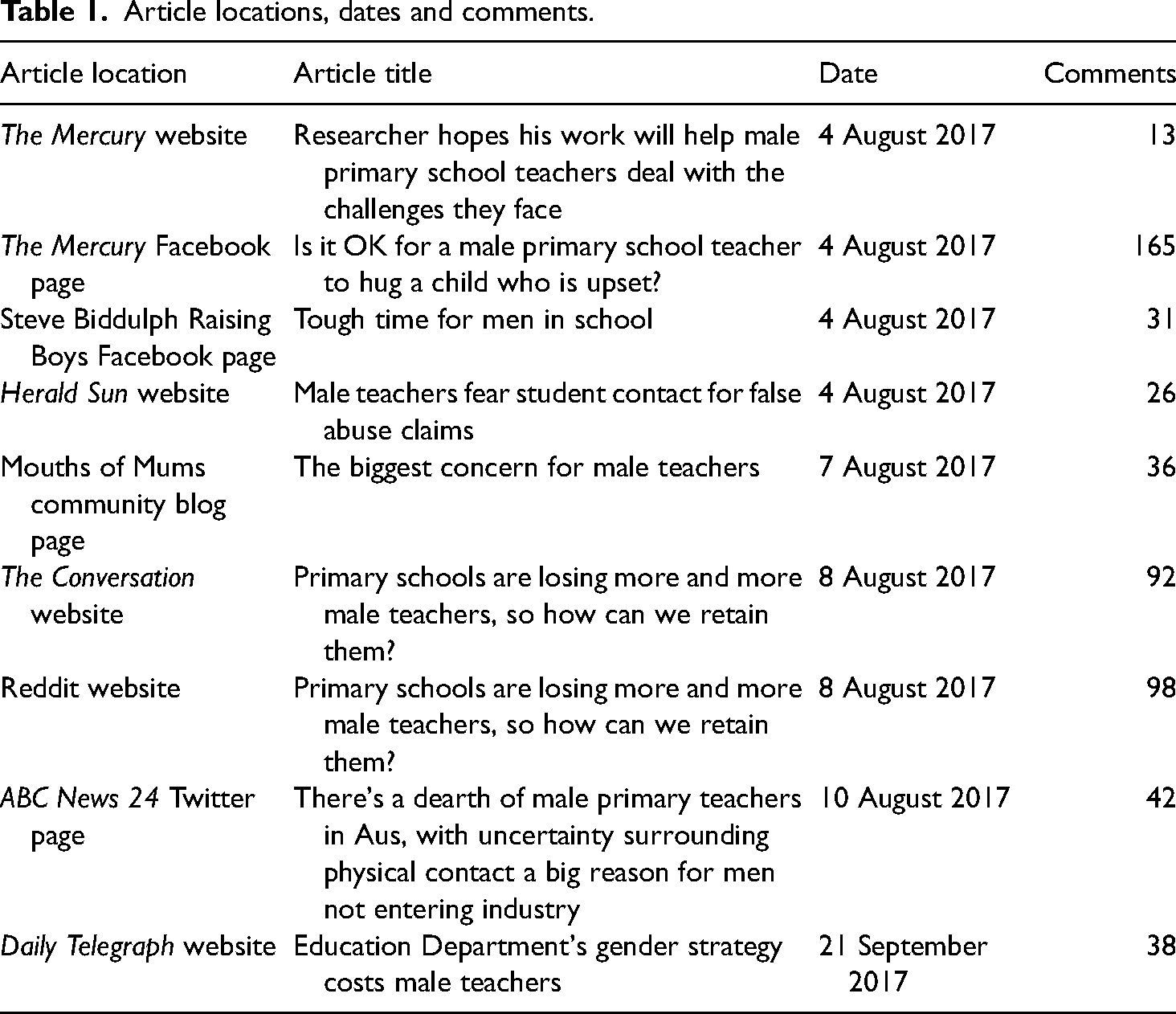
The study involved thematically analysing 541 online comments posted in response to nine online articles on male primary teachers, based on the second author's research, which captured local and national media attention. While some commenters identify as current or former male primary school teachers, most commenters present as either sharing stories about the experiences of male primary school teachers they know or were simply expressing their personal beliefs. Participants all posted using what appear to be anonymous pseudonyms. The posts analysed were published in The Mercury newspaper (and shared/reposted on The Mercury's Facebook page and Steve Biddulph's Raising Boys Facebook page), the Herald Sun newspaper (and shared/reposted on the Mouths of Mums community blog page), The Conversation website (and shared/reposted on Reddit), the ABC News 24 Twitter page, and the Daily Telegraph newspaper (see Table 1). This data provided a unique insight into social and cultural attitudes about male primary school teachers and the emergence of ‘caring masculinities’. User-generated communications offered sociological insight into everyday constructions of masculinity working in female-dominated primary schools without the solicitation of a researcher. These publicly available comments provided access to candid beliefs and attitudes about male primary teachers in a way that was meaningful to participants without the prompting of a researcher (Hookway, 2022). We approach the comments as personal but with little expectation of privacy. To mitigate any harms that could occur through comments remaining publicly available online and being reverse-searchable, we have followed the advice of Bruckman (2002) and Fiesler and Proferes (2018) to ‘disguise’ quotes through minor rewording rather than presenting them verbatim and have removed any identifying information.
Article locations, dates and comments.
We used an inductive approach to data analysis, which involved detailed reading and rereading of the raw data and developing categories to draw a picture of how male primary teachers were constructed and understood by members of the public (Thomas, 2006). This approach enabled us to develop an understanding by identifying patterns and themes within the data itself while paying attention to theoretical insights about changing masculinities (Liamputtong & Ezzy, 2005). Each author independently coded the comments and met regularly to discuss and develop the themes, utilising sociocultural approaches to teachers, gender and masculinity to interpret these findings.
While online communities and forums can be highly conflictual environments freed of the normative restraints of face-to-face interaction (Hookway & Snee, 2017), there was a high level of uniformity in the responses. Many comments referred to personal experiences with male teachers, predominantly as students or parents of students, whereas other commentors self-identified as teachers, former teachers and friends of teachers and/or former teachers. The thematic analysis developed four central themes: (1) stigmatised masculine identities; (2) men as victims of an anti-male agenda; (3) male primary teachers as needed positive masculine role models; and (4) idealised masculinity and beliefs that men make better teachers.
Results
Stigmatised masculine identities: Hegemonic masculinity and the culture of suspicion
Nearly all commenters agreed that men face stigmatised male identities as primary school teachers. The comments show high levels of sympathy for male primary teachers who they see as subject to powerful discourses of suspicion for working in a caring profession with young children. The following quotes provide a snapshot of this culture of suspicion men and the stigmatised identities men are believed to navigate in caring roles as teachers: Male friends of mine who were teachers gave up. Nearly all said it was just too dangerous and they could not deal with the continuous surveillance and suspicion. They said they were living on borrowed time. (The Conversation)
Totally agree with the suspicion of male teachers. I trained as a primary teacher but have gone back to engineering. There's still a stigma with male teachers. (ABC Twitter)
This is so sad. Being a male teacher these days means immediate suspicion and means they can be too scared to do their jobs. I would not be even slightly interested in being a teacher. (Herald Sun)
These comments are consistent with research from Australia (e.g. Cruickshank, 2019; Smith, 2008), the United Kingdom (e.g. Burn & Pratt-Adams, 2015; Jones, 2007) and Canada (e.g. Bernard et al., 2004; Gosse, 2011) that found men in the primary teaching profession are perceived as high risk, deal with constant suspicion and are subject to negative stereotypes. One of the most damaging of these stereotypes is male primary school teachers being labelled paedophiles. The theme that men are avoiding becoming primary school teachers or leaving the profession because of fears of being seen as a paedophile was striking across the online comments. As one Twitter user posted: ‘Male friend of mine really wanted to be primary teacher but he said you may as well write “paedophile” in big letters on his back.’
Similarly, a former kindergarten teacher relayed a story about being at a party where a woman established he was a primary teacher, which led her to ‘ask if I was a paedophile – just a joke she said’ (The Conversation). On Reddit, the highest voted post in response to sharing The Conversation piece titled ‘Primary schools are losing more and more male teachers, so how can we retain them?’ was ‘Stop treating men like paedophiles’. These descriptions align with research that shows male primary teachers endure constant suspicions about being sexual predators and child molesters, and that male primary teachers are acutely aware of these dominant cultural perceptions (e.g. Cruickshank et al., 2022; Mills et al., 2008; Moosa & Bhana, 2020). Wernersson (2016) has argued that images of the male primary teacher as a ‘paedophile threat’ is a dangerous symbol of masculinity, pushing men who support gender equality and progressive forms of masculinity away from teaching young children.
The culture of suspicion attributed to ‘caring masculinities’ (Elliott, 2016) was strongly linked in the online comments to beliefs that men were not entering teaching – or were leaving teaching – due to the internalisation of negative perceptions of male teachers as paedophiles and fears of being falsely accused of sexual abuse: Why the f**k would you be a male primary teacher these days? There are a lot of c**t parents out there and it only takes one unfounded accusation from one of them to ruin your career and possibly your life. (Reddit)
I wouldn’t be a male primary teacher for anything, it is FAR too easy to be falsely accused of something and then your career is over because mud sticks. (Herald Sun)
Many commenters focused on sharing stories of men's teaching careers being ruined by false accusations, including retelling news stories of male teachers who had committed suicide due to having their careers and reputations ruined by unproven accusations of sexual abuse. One commenter, a former kindergarten teacher, revealed that he was repeatedly told by colleagues that if children needed to go to the toilet and there was not a female colleague present ‘I was to let them piss/shit themselves rather than being even within eyeshot of the toilets by myself’. While this may be an extreme example, research shows that male primary teachers are extremely fearful of the possibility of having their career ended by accusations of sexual abuse and this impacts how male primary teachers interact with students (Burn & Pratt-Adams, 2015; Cushman, 2005). Such fears are also evident in pre-service male primary school teachers, who report avoiding all forms of physical contact, even when comforting a student, and report worries that one false report could ruin their career (Cruickshank et al., 2015; Lewis et al., 1999).
The commenters capture beliefs that men entering ‘caring’ professions such as teaching must navigate stigmatised masculine identities that reinforce ideas of men as ‘out-of-place’ in caring settings. While normative constructions of women as nurturing and caring allow female teachers to display caring behaviours as routine practices with children, these discursive positions are less available to men (Moosa & Bhana, 2020). The commenters suggest that cultural acceptance of ‘caring masculinities’ (King & Elliott, 2021) in institutional settings like schools are limited and there are harmful stereotypes attached to men who express caring masculinities. Although the commenters critique the culture of suspicion and stigma attached to male primary school teachers, and implicitly the discursive restrictions placed on men who take on caring roles, rather than locating this within dominant constructions of masculinity, their explanations fall back on conservative and misogynistic arguments which place men as victims.
Men as victims of an anti-male agenda: Mistaking the ‘Man Box’ for gender inequality
An overwhelming theme in the comments is that male primary teachers are ‘victims’ of wider feminist and gender equality discourses. Frequently commenters used words like ‘nowadays’, ‘these days’ and ‘today’ to capture the idea that recent cultural changes have created a world that is unfair to men. Men were frequently positioned as victims of a contemporary ‘anti-male agenda’ led by a mix of women, feminists, gender activists or ‘PC culture’. The following comments are indicative: Entire education system is developing an anti-male bias. (ABC)
Feminists have demonised men for so long that fathers can’t even safely take their children to the playground. (Herald Sun)
It is more than just political correctness gone wrong, it is an attack on the integrity of men. (Herald Sun)
Even if you could fix the problem of men working with young children being treated with suspicion, you’d still have to deal with the pervasive anti-male bias in schools. (Reddit)
The majority of commenters believed that women actively excluded men from teaching and caring roles with children. Comments relied on universalising and misogynist positions which blamed women for the suspicion men face as early-childhood teachers. For example, one commenter wrote ‘why would a man want to work in a school with a toxic culture of females and the threat of false accusations?’ (ABC) while another relayed a story about someone they believed would be ‘fantastic with children’ but when asked about teaching as a career choice ‘he said women don’t really want men in caring roles for children’ (The Mercury Facebook). Relatedly, feminists and ‘gender activists’ were vilified for constructing men as sexually dangerous. Further, commenters expressed concern about the absence of equity policies to rebalance the gender disparity in the profession of teaching, which they compared to industries such as military and IT: There are primary schools where the only male staff member is the gardener. So much for gender equity. No alarm bells from the feminazis. (ABC Twitter)
With the amount of gender activism in the education system I am surprised there are any men still there. (ABC Twitter)
Given the concern about gender segregation in other sectors like the tech sector, it's strange that the issue of a hostile working environment for male teachers is never even raised. (Reddit)
The armed forces are currently specifying the number/percentage of new recruits who are to be female. We probably need to start mandating a 50/50 split for staff in primary schools. What is good for the goose is good for the gander. (The Conversation)
These comments miss that, despite social reforms, the workplace continues to be an area of significant gender inequality for women. This is particularly so in Australia, where female participation is low in global terms, where the full-time gender pay gap is 20% and there are fewer women in leadership positions (Churchill & Craig, 2019; WGEA, 2020). While there are currently no workforce diversity policies focused on slowing the decline in male teachers, McGrath and Van Bergen (2017) suggest it may be problematic to advocate for more male teachers when women still face barriers in many other fields. We would add that, despite the over-representation of women in education, there are still enduring inequalities in education, with men over-represented in management and leadership positions and a continuing full-time gender pay gap (WGEA, 2020). There is also evidence that men reject feminised care jobs such as primary school teaching because it is seen as ‘women's work’, attracts lower levels of pay and status, and other careers are seen as more attractive (Drudy, 2008). As Drudy suggests, the best evidence suggests that policy-makers should focus more on the quality of entrants with the goal ‘to recruit effective, high calibre teachers whatever their gender’ (2008, p. 313).
While online commenters look to blame an ‘anti-male’ agenda for declining numbers of male primary school teachers, what these attributions miss is the ongoing power of dominant hegemonic constructions of masculinity (Connell, 2008). Rather than explaining lower levels of male participation in teaching as the outcome of prescriptive norms about masculinity or wider social and cultural factors such as low pay and low status, women, feminists and other ‘anti-male’ crusaders are blamed. Instead of supporting the need for non-hegemonic performances of men as carers of children, blame is attributed to groups such as feminists who support gender equity in work and advocate for changing norms of masculinity that make caring roles more acceptable for men. These changes are not only good for women, but also men (King & Elliott, 2021). While gender equality is often understood as an issue for women and girls – and it is women who remain most disadvantaged by gender inequality – there is increasing evidence that men also benefit from gender equality (King & Elliott, 2021; Scambor et al., 2014). As the Men's Project and Flood's (2020) research highlights, there is a need to challenge the ‘Man Box’ and change norms of masculinity in ways that promote healthy and ethical alternatives of masculinity based on gender-equitable roles and the promotion of caring relations between men, women and children.
Male primary teachers as needed positive masculine role models
Almost all commenters agreed there is a need to have more men in primary school teaching roles. A majority of comments within this theme focused on men's unique capacity to be positive male role models for children and fulfil hegemonic masculinity qualities: I hope that male primary school teachers will never be a thing of the past! They are important role models for kids. (Mouths of Mums blog)
Children need positive male role models in their lives and male teachers can be these great role models. There should be strict behaviour requirements for both teachers and students to avoid problems. (Mouths of Mums blog)
Male teachers are so important. They are amazing role models and I love that all 4 of my primary school aged children have a male teacher this year. (The Mercury)
I was delighted when my son had a male teacher in grade 5. I think it's really important that he has more male role models in his life (Steve Biddulph Facebook page).
A central feature of the ‘positive role model’ discourse is the assumption that young male children in primary school require male teachers as role models (Drudy, 2008; Skelton, 2012). This theme was evident across responses to most of the media articles. Commenters expressed beliefs that male primary teachers were needed to address the absence of men, or the absence of ‘good’ men, in children's lives, particularly with the rise of female-led single-parent families: Sadly my girls needed male role models in addition to their father. They’ve had 3 excellent male teachers, also really important on a personal level. (ABC Twitter)
Children need both male and female role models, especially those in single parent families with no fathers. (The Conversation)
My son prefers a male teacher and male teachers can be good for children, especially if they not get enough male role models at home. (The Mercury)
There are kids out there who have spent many years without a father figure … being able to get a hug from a male role model who actually gives a f**k could have helped some of them understand what it is to be a man who can show emotion and caring without aggression. (The Mercury)
These comments can be located within wider debates concerning the feminisation of teaching and concerns about a lack of positive male role models for young boys and academic underachievement for boys (Drudy, 2008; Moosa & Bhana, 2020). The perception that male teachers can be, and are often expected to be, positive role models has also been voiced by many practising male primary teachers (e.g. Cruickshank et al., 2020; Cushman, 2008). School is framed as a productive gender socialising institution which should supply young children with positive masculine role models. School is understood as offering the potential to socially rectify the wider absence of men in caring roles and close relationships with children in the private sphere.
There is a tension between commenters’ earlier positioning of men as victims of ‘anti-male’ culture and the suggestion that children and young people are lacking ‘good men’ in their lives. Reinforcing traditional ideas about masculinity, the commenters suggest it is only men who can best understand and respond to boys (Connell, 2008). Only men can know, teach and authentically connect with boys and ‘men-in-the-making’. While the last comment that men expressing emotion and care ‘without aggression’ has value in terms of promoting ‘caring masculinities’ (Elliott, 2016), the assumption that men are needed to provide positive masculine images for boys, and to a lesser extent girls, is problematic.
The notion that ‘only men can truly understand masculinity’ (Connell, 2008) is underpinned by a gender binary where masculinity and femininity is seen to be enshrined in male and female bodies (Connell, 2002; Skelton, 2012). This is a highly essentialised view of gender where females are permitted to only act in stereotypically feminine ways and males in stereotypically masculine ways. As Connell (2005: 230) has argued, women can be ‘bearers of masculinity as well as men’, and this is evident, for example, from how women use similar masculine modes of authority as men to how women adapt to models of male hierarchical management (Skelton, 2002). Likewise, men-teachers do not automatically perform masculinity (Skelton, 2012). Skelton (2002, p. 92) notes that ideas about the feminisation of teaching are also simplistic as they overlook how primary schooling is becoming more masculinised linked to ‘testing and assessment, performance indicators, league tables, stratified and hierarchical management and administration structures’. The benefits of men in school are understood not just in terms of their capacity to provide male role models but also their possession of essentialised masculine traits that make them unique and sometimes ‘better’ teachers.
Idealised masculinity and beliefs that men make better teachers
Discourses about men as positive role models dovetail with beliefs that men offer specific benefits within school environments that only men can provide. Perceptions of the unique advantages of men in school are linked to their capacity to express hegemonic masculine identities and behaviours, particularly their use of humour and interest in sport. Humour and sportiness are attributes seen as specific to men that are beneficial for young boys – and girls – and that only men can provide. Essentialised understandings of men that spotlight humour and sport as ‘distinctive’ attributes men bring to teaching were evident across articles but particularly in comments from The Conversation article: I think male teachers have a unique style of interaction with children, to which kids warm; jocular, ‘matey’ and often more sports oriented. (The Conversation)
With his sense of humour and calm manner he quickly ‘won over’ the parents and it became accepted that there would always be male teachers in the school. (The Conversation)
Male teachers use humour and playing sport at recess to build relationships with their students in ways that don’t involve the physical contact strategies their female colleagues use. (The Conversation)
Being ‘matey’, ‘jocular’, ‘humorous’ and ‘sporty’ were constructed as specific masculine traits that differentiate male primary teachers from female teachers. The essentialised logic reinforces narrow and rigid understandings of gender which assume that women cannot be sporty or humorous and similarly that all men are interested in sport and use humour to connect with students. The essentialised gender reasoning implies that for men to be valued and accepted as primary teachers they need to conform to a narrow set of hegemonic masculine behaviours and interests. For example, a commenter from The Conversation shared a story about how he decided not to go into teaching as he had ‘no interest in sport or other matey things’, and this would lead to him being ‘highly suspect’ and not trusted. These comments parallel research by Cushman (2008), who observed that to provide students, particularly boys, with positive male role models, school principals in New Zealand tended to favour men who demonstrated traditional forms of masculinity such as those performed within the national sport of rugby. These characteristics included being strong, reliable and good humoured, and give weight to Martino's (2008) view that sport is a masculine pursuit and an important part of being a ‘real’ (2008, p. 207) man. Smith (2008, p. 7) similarly found that expectations of male primary school teachers position them as ‘sporty, fun, manly, father substitutes’.
While most commenters shared positive experiences of male teachers as students and parents, some commenters suggested that men are superior teachers. This superiority was linked to essentialised ideas about hegemonic masculinity – strength, discipline, assertiveness – that men contribute and possess as men-teachers. For example, one participant wrote: ‘some of my best primary school teachers were men, they dealt with some difficult behaviour issues better than female teachers and also taught us well at the same time’ (Steve Biddulph Facebook page). Another said: ‘at my primary school the best teachers were all male. Not because of their masculinity but because they were really good at what they did (ABC Twitter). Others developed more explicitly sexist positions, calling female teachers ‘strident and nasty’, and blaming them for problems with male students in schools, based on their ‘lack of discipline and empathy’ (Herald Sun) with young men and boys in school environments. As Drudy (2008) notes, there is a popular ‘backlash’ discourse, particularly in Australia, which attempts to link boys’ underachievement in school with perceptions about the feminisation of teaching.
Such beliefs reproduce gender inequality where hegemonic masculine knowledge and practices are elevated over what are regarded as women's knowledges and practices. Traditional masculine qualities such as sportiness, mateship and humour, but also strength and assertiveness, are seen as superior to the so-called ‘natural’ qualities women bring to teaching. It is noteworthy that men's capacity for caring is rarely emphasised but rather possession of traditional masculine characteristics such as strength, sportiness, discipline and humour, which are construed as unavailable to women, and superior to what are regarded as female characteristics. In positioning men's ostensible distinctive and superior teaching characteristics, women's capacities and strengths are diminished and male power reasserted and reproduced.
Conclusion
This article has examined comments posted across nine online articles about a research project on male primary school teachers in Tasmania. The project gained significant local and national media attention, tapping into significant public debates about declining numbers of men in primary education in Australia. While existing research has analysed the social drivers of gender imbalance in primary education from the perspectives of multiple stakeholders, including principals, teachers, in-service teachers, there is no research that has investigated people's understandings and attitudes about male primary school teachers and declining numbers of men entering primary school teaching. Although the research findings have their limitations – framed often by a crisis narrative, small in number and difficult to determine who the commenters are and their motivations – this article helps make a modest contribution to the sociology of gender, masculinity and education by using cultural attitudes about male primary school teachers as an empirical site to explore key sociological debates about changing masculinities.
The empirical analysis of the online comments developed four key themes. First, there was a high level of agreement that male primary school teachers face stigmatised identities as men who work with young children. The comments highlight beliefs that men who are primary school teachers must negotiate a ‘culture of suspicion’, particularly the pernicious threat of being labelled a paedophile or being subject to false accusations of sexual abuse by students or parents. Second, the analysis showed that, rather than locating the culture of suspicion in relation to the power of dominant hegemonic understandings of masculinity, commenters drew upon sexist and misogynist explanations that blamed women, feminists and ‘PC culture’ for an anti-male bias. While commenters point to the lack of policy in Australia to address low numbers of male teachers – and blame feminists and gender equity policy-makers for ignoring men – what these assessments miss is that gender equality is about creating cultural spaces which value non-hegemonic and more caring-oriented expressions of masculinity. This kind of advocacy is important for championing ‘caring masculinity’ as a valued and legitimate form of masculinity for Australian men, with women as well as men benefiting from non-normative and non-dominant forms of masculinity (Men's Project and Flood, 2020). There are also problems with advocating for more men in primary teaching when women face significant structural barriers in multiple fields (Churchill & Craig, 2019), including education, where men benefit from a ‘glass escalator’ effect, being more likely to hold senior and leadership roles (Mills et al., 2008; Williams, 2013). While men are seen as suspicious, they are also constructed as highly valuable.
A third theme was that more men are needed in primary education to operate as positive role models for children, particularly young boys. Male primary teachers are positioned as needed role models, who can address the shortcomings of men's caring in the private sphere. Such comments are underpinned by problematic assumptions that only men can possess and truly understand masculinity (Connell, 2008), highlighting an essentialised and binary understanding of gender, which devalues women's capacity to contribute to the effective socialisation of young men. Women – as well as men – can be bearers of masculinity (Connell, 2005). The emphasis on the need for men as positive role models and the unique masculine characteristics they bring to teaching was linked to the fourth and last theme, which saw male teachers elevated as superior to female teachers. Central to this gendered elevation were beliefs that men possess specific virtues, skills and interests, such as humour and sportiness, but also strength, discipline and assertiveness, that make them superior teachers to women.
There is a paradox at work in this study that needs untangling and opens up opportunities for further research. While existing research strongly points to the barriers and stigma men face as early-childhood teachers, all the commenters in this study are encouraging of men as teachers. The commenters refer to the suspicion men face in primary teaching only in abstraction. The wider cultural discourse of suspicion they illuminate is something they reject. Research clearly shows the stigma and suspicion male teachers experience working in professional roles with young children, but it is also important to recognise the complexity of the source of this stigma. For example, it needs to be acknowledged how men reproduce gendered stereotypes and stigma, and how men are reluctant to enter caring professions due to issues about how it may trade off against their masculine capital. There is certainly evidence to suggest that male and female teachers play their role in reproducing rather than rejecting gendered assumptions and stereotypes (Eldred et al., 2022).
More broadly, the study illustrates how traditional hegemonic ideals of masculinity still profoundly shape attitudes towards men in caring professions such as primary school teaching. Men's value in primary school teaching appears to be reduced to older hegemonic models of masculinity rather than more progressive forms, which emphasise values and practices of care. Caring masculinity (Elliott, 2016), as a framework, appears to have limited analytical value in explaining why these commenters believe more men are needed in early-childhood teaching. It is not men's capacity to embrace care that appears to be revered in male primary school teachers but traditional tropes about men and masculinity. Men are understood, for example, as the ‘best teachers’ not due to their capacities for care, but for traditionally masculine values, such as humour, sportiness, discipline and strength. For more men to be involved in early-childhood teaching, caring masculinities will need to become a more valued and legitimate form of identity and expression for men. ‘Caring masculinity’ will need to become not only more culturally but also economically valued in Australian society and culture. The absence of men in early-childhood teaching is not simply about negative cultural attitudes but also its undervaluation as ‘women's work’ by men, work that offers low pay and status compared to other careers. While the commenters scapegoat various cultural sources for the lack of men teaching children – from feminism to PC culture – There is no need to look further than the twin forces of hegemonic masculinity and patriarchy for the reasons why there are declining numbers of men in primary school teaching.
Footnotes
Funding
The author(s) received no financial support for the research, authorship, and/or publication of this article.

Author biographies
Nicholas Samuel Hookway is Senior Lecturer in Sociology at the University of Tasmania. His research focuses on morality, identity and changing social bonds. Nick's book 'Everyday Moralities' (Routledge) was awarded The Australian Sociological Association (TASA) Stephen Crook Memorial Prize 2020 for best authored book within sociology.
Vaughan Cruickshank is a Senior Lecturer in Health and Physical Education at the University of Tasmania. His research focuses on male primary teachers, health and physical education, and health literacy.